




Abstract
Institutionalizing slum upgrading as part of government-led citywide or national programmes can overcome the limitations of piecemeal, “bottom-up”, ad-hoc upgrading projects. This article presents a case study of 15 years of practice to institutionalize participatory slum upgrading in Afghanistan. The article explains the main approach and tools used in Afghanistan to mobilize residents into Community Development Councils (CDCs), undertake neighbourhood action planning, and implement civil works projects in a co-production process to improve access to basic urban services and strengthen local governance. The findings provide original insights into key elements for institutionalization in fragile contexts: (i) building support of the international community, donors, and development banks for urban investment; (ii) the role of community contributions; (iii) the need to embed upgrading with improved tenure security and municipal revenue generation; and (iv) the importance of reliable and recent data to guide decision-making and build political support for in-situ settlement upgrading.
Keywords
I. Introduction
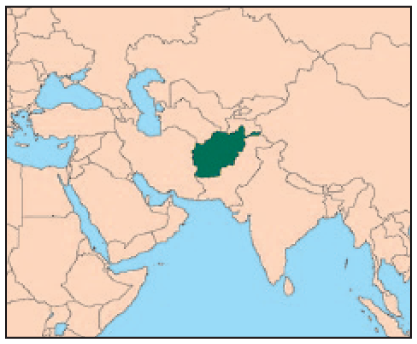
Rapid urbanization since the overthrow of the Taliban in 2001 has dramatically reshaped the spatial and demographic profile of Afghanistan. The urban population increased from an estimated 20 per cent of the total population in 2002 to 33 per cent in 2015.(1) In absolute numbers, this represents a significant increase from 4.6 million in 2002 to over 10 million people in 2016 living in cities. Projections indicate an average urbanization rate of 3.14 per cent over the coming two decades, with half of the Afghan population living in cities by 2060.(2)
Much of the urban population growth has been driven by refugee returnees, over 5.8 million of whom returned to Afghanistan between 2002 and 2015.(3) 2016 witnessed a surge in the return of both registered refugees and undocumented Afghans from Pakistan, with over 370,000 Afghans returning between January and November.(4) Returnees are drawn to the relative safety and economic opportunities of urban areas. Estimates indicate that between 49 per cent and 60 per cent of returnees to Afghanistan settle in towns and cities,(5) which, according to one report, “disproportionally absorb households that have a displacement history”.(6) This is especially true of Kabul.
Afghanistan’s cities concentrate many of its critical development challenges. Approximately one-third of the urban population lives under the poverty line.(7) One-third of urban households (34 per cent) experience food insecurity, a higher proportion than the 29 per cent of rural households that are food-insecure.(8) Weak local governance, corruption, gender inequality, land grabbing, and land and property tenure insecurity are common in cities.(9) The insurgency and conflict with non-state actors continue to inflict damage on urban infrastructure and result in significant civilian casualties.(10)
More than three-quarters (78 per cent) of the population in the 34 provincial capitals lives in slums.(11) This represents approximately 750,000 households: 5.5 million people. Access to improved sanitation is low (29 per cent) and no Afghan city has a comprehensive sewerage system. Only 14 per cent of urban dwellings are connected to the piped water network.(12) Land tenure insecurity is a significant issue, and the majority (61 per cent) of the housing stock consists of unplanned, informal housing.(13)
Set against this challenging backdrop is a strong culture of local kinship, resilience and mutual support in shaping social and cultural mores and access to services.(14) In both urban and rural areas, there is an established system of informal local governance, often centred around a mosque and respected village elders, which operates alongside – although often intertwined with – the official state system.
Despite the considerable funds and international assistance to Afghanistan over the past 15 years, there is surprisingly little critical scholarship and analysis on urban development and slum upgrading in Afghanistan. This article therefore aims to capture knowledge from experience to contribute to the literature on participatory slum upgrading and provide lessons learned for such programming in other fragile states with cities in crises. The article is based on the authors’ experience in Afghanistan with the United Nations, implementing both urban and rural programmes, between 2002 and 2016. Following the approach of Boonyabancha,(15) which documents the experience of “going to scale” with slum and squatter upgrading in Thailand, the article draws from project implementation records and reports, interviews with key stakeholders, and documents that reflect the institutional discourse during the period. The article is largely descriptive and, given the constraints mentioned above, it is not intended to be a critical review of development theory and practice in the context of Afghanistan.
II. Framing Participatory Slum Upgrading
a. The global challenge of slums
One out of every eight people in the world lives in a slum.(16) Although the percentage of the urban population in low- and middle-income countries (LMICs) living in slums has decreased since 2000, from 39 per cent to 30 per cent in 2014, in absolute terms the number of slum dwellers has increased by 28 per cent over this period.(17) While recognizing the limitations of the term,(18) the United Nations classifies a slum as a “settlement that lacks one or more of the following five conditions: access to clean water, access to improved sanitation, sufficient living area that is not overcrowded, durable housing and secure tenure”.(19)
Slums result from an interplay of forces. Formal housing supply is often insufficient to meet demand buoyed by rapid urbanization and natural population growth. Poverty, irregular incomes, unemployment, and a lack of viable housing finance mechanisms limit access to formal housing for the vast majority of urban dwellers in low- and middle-income countries. Slums typically lack legal land tenure and are not integrated with the “formal city”, which further exacerbates the precariousness of their living conditions.(20) As a result, households and communities take it upon themselves to address their housing needs.(21) Over many decades, initially precarious shelters are consolidated into durable, permanent houses.(22) Such consolidation is motivated by occupants’ needs and wants and facilitated by security of land tenure, political stability and the occupants’ economic capabilities.
While it may be easy to romanticize the self-built nature of slums and the resilience of their inhabitants,(23) the reality is that slums are a clear violation of the right to adequate housing.(24) Slum dwellers suffer disproportionately from inadequate sanitation, infrastructure and services, which impact their health and wellbeing and the wider environment.(25) Socio-economic issues are common, such as crime, violence, high levels of formal unemployment, and stigmatization of these areas and their residents.(26)
b. Addressing the challenge of slums
There have been a range of approaches to solving the slum challenge in LMICs over the past six decades. The rapid urbanization characterizing LMICs in the post-Second World War period brought about a proliferation of slums and increased the visibility of the housing problem.(27) During this period, self-built slums were viewed as social pathologies and a physical manifestation of the failure of governments to provide for their citizens.(28) To address the housing problem, many governments undertook large-scale housing projects to replace slums with “appropriate” housing, often after repressive evictions and slum demolition that disrupted the lives and livelihoods of the urban poor.(29) With the exceptions of Singapore and Hong Kong, government-led housing construction in LMICs was largely unsuccessful in addressing the challenge.(30)
A paradigm shift occurred in the late 1960s. Self-help housing began to be portrayed as the solution rather than the problem. Housing was to be viewed as a verb (what housing does) rather than a noun (the product).(31) Turner(32) argued that social organizations and self-builders produced better housing than heavy, bureaucratic governments did, because self-built housing matched occupants’ needs, capacities and priorities.
From the mid-1980s the focus shifted towards rehabilitating existing slums through in-situ upgrading.(33) Rather than focusing on housing itself, the public spaces of slums were upgraded through improvements to basic services and public infrastructure. Over the past two decades a shift has taken place towards “participatory” slum upgrading where residents are increasingly involved in the decision-making process of upgrading as partners.(34) According to a UN-Habitat report, “Community participation can at many stages both preserve residents’ sense of belonging and ensure that the services provided are what local people want, value and are ready to look after”.(35) In addition, it became increasingly clear that ad-hoc, project-based approaches to upgrading were insufficient to meet the scale of the urban challenge.(36) Thus “citywide slum upgrading” approaches have become the international policy norm.(37)
c. Slums as sites of urban fragility and humanitarian need
There is surprisingly little scholarship on urban slums in the context of fragility, the aftermath of conflict, and protracted crises, yet there is increasing recognition by practitioners that the “fragile city” is “the new normal” for many developing countries.(38) The “fragile city” has been described as the epicentre of urban poverty, urban disaster and urban violence.(39) Slums are the loci at which demographic pressures, unemployment, economic inequality, poverty and poor public services are most intensely felt.
Urban fragility is often approached through the lens of slums as sites of urban violence, insecurity and crime.(40) Muggah argues that “fragility is no longer confined exclusively to nation-state institutions but, rather, extends to their primate and intermediate cities and outlying metropolitan regions”.(41) Cities and their slums present unique challenges for conflict prevention and peace transitions, including “pressures linked to rising populations, migration, ethnic tensions, institutional deterioration and the weakening of urban services”.(42) Slums are often a tangible legacy of conflict in both their social and spatial characteristics, with stark segmentation of public and private space and eroded cohesion within neighbourhoods and among neighbours.(43)
Most scholarship on slum upgrading in areas characterized by violence and conflict focuses on Latin America. Slum upgrading efforts in this geographic area have been framed around extending the reach of the state, strengthening local governance and service delivery, and improving safety and security in urban informal settlements.(44) For example, “pacification” programmes in Rio de Janeiro favelas aim to improve security by strengthening state control, and by attempting to integrate favelas into “the formal city”.(45) Similarly, “social urbanism” approaches in Medellín have attempted to tackle inequality and exclusion by promoting improved services and mobility between formal and informal areas of the city.(46)
There is broad agreement among scholars and practitioners that reducing urban fragility and violence requires a participatory approach with communities to strengthen their resilience and capabilities,(47) and that this requires coordination across multiple levels of government.(48) Some scholars go further and suggest that conflict is intrinsic in urban development processes, and therefore interventions are needed to manage or contest the structural causes of conflict and violence.(49) Additionally, in fragile states and post-conflict situations, the line between humanitarian and development assistance is blurred.(50) Violence in cities is beginning to resemble classic armed conflict situations,(51) and, according to Moser and McIlwaine, “this has become the justification for humanitarian aid to now include urban violence within its remit”.(52)
Cities are often safe havens during conflict, and displaced people tend to gravitate towards urban slums. According to recent estimates, approximately 30 per cent of refugees and internally displaced people are housed by humanitarian agencies: the majority stay with family and friends or in makeshift accommodation.(53) As a result, tensions relating to land access and land rights are exacerbated during conflicts.(54) Urban housing, land and property (HLP) is a critical aspect of urban conflict and fragility. Land grabbing and informal, unplanned land subdivision cause specific planning and governance challenges for cities emerging from conflict.(55) The return of refugees and internally displaced persons (IDPs) presents a range of challenges, particularly if the land and housing they once occupied has changed ownership by being confiscated or sold.(56)
To address these challenges, Archer and Dodman advocate for a participatory approach whereby local populations are supported “to cope with and move on from crises…in ways that enable them to have full access to basic services and safe and secure shelter as they rebuild their homes or integrate their new communities”.(57) Additionally, area-based approaches to upgrading and rebuilding that allow for integrated, multi-sector planning and interventions are increasingly recommended for effective humanitarian response.(58) These issues and tensions are highly relevant for Afghanistan: a fragile state that is rapidly urbanizing, is experiencing protracted conflict, and has a considerable displacement history.
III. The Afghan Experience of Community-Led Urban Development and Slum Upgrading
a. The trajectory post-2002: from ignoring the slum challenge to in-situ upgrading
The Afghanistan Compact, agreed in 2006 between the government and the international community, included urban development as a sub-unit under the Economic and Social Development section of the Compact, with a focus on improving municipal capacity for service delivery. The Compact was followed by the Afghanistan National Development Strategy (ANDS) for 2008–2013, with the main urban programmes of: (i) Urban Governance, Finance and Management; (ii) Land Development & Housing; and (iii) Urban Infrastructure & Services.(59) While these foundational documents recognized the importance of urban development, there was no explicit focus on slum upgrading or addressing urban HLP rights issues, and no clear model for how to upgrade slums.(60)
The Afghan government focused on centrally planned housing delivery, through the Ministry of Urban Development and Housing (MUDH). During the decade after the Compact, ministers, mayors and elites spoke regularly about eradicating informal settlements (slums), especially those on hillsides and well-located land. The Urban National Priority Programme prioritized government-led housing supply over in-situ upgrading of informal settlements. Government-led housing supply, however, has proven insufficient, with an average of only 2,000 units built per annum between 2005 and 2015.(61) As a result, informal settlements expanded and people informally occupied and subdivided urban land for residential use on a significant scale.(62)
Only from the mid-2010s onwards did central and local authorities begin to accept the validity of in-situ upgrading as a viable model for addressing the challenge of slums and improving access to adequate housing. A Policy on Informal Settlement Upgrading was drafted between 2008 and 2013, under the leadership of the Ministry of Urban Development Affairs (MUDA) with technical support from various donor programmes. More recently, the Urban National Priority Programme (U-NPP) for the period 2016–2026 set a clear objective to upgrade informal settlements in the major cities using a citywide and multi-sectoral approach, which has been operationalized through a national programme: the Citizens Charter in Cities.(63)
The milestone shift in policy is in part due to consistent demonstration of how a participatory slum upgrading approach can be implemented in cities and can achieve results. Between 1995 and 2001, Community Forums for men and women were established in every urban district in the capital, Kabul, and in key secondary cities around the country. The aim was to strengthen urban communities’ resilience and capacities in the face of limited services, conflict and underdevelopment. In the absence of effective urban governance and management structures, communities came together to plan, address problems, identify solutions, and implement sub-projects on a range of issues including improving infrastructure and access to urban services, social welfare for vulnerable urban households, dispute resolution on land and water, and meeting humanitarian needs when faced with disasters.
The Community Forums during the Taliban regime (1995–2001) were the precursor to the now widely recognized Community Development Councils (CDCs): area-based networks of men and women who, with external support, lead the process of development planning and implementation at the local level.(64) CDCs are central to the National Solidarity Programme (NSP), a flagship initiative of the Government of Afghanistan, which UN-Habitat helped design in 2003.(65) NSP established 32,000 CDCs across 361 districts and financed nearly 65,000 development projects(66) valued at US$ 1.25 billion, including US$ 108 million of community contributions.(67) Although originally intended as a national programme, NSP targets rural districts and villages, not cities. Nevertheless, UN-Habitat applied the NSP model in cities using bilateral funding from donors and in cooperation with municipalities.
b. Urban community development councils (CDCs) as vehicles of co-production
UN-Habitat’s urban CDC approach is very similar to that of village CDCs under the National Solidarity Programme (NSP). An urban CDC includes on average 200–250 neighbouring households living within a defined area. The typical CDC project cycle involves five phases and 15 steps (Table 1).(68) The 15 steps are not always strictly implemented, although the five phases are commonly adhered to:
1) Raising of community awareness through a series of small and large gatherings;
2) Establishment of CDCs through open elections, with voting open to all residents of the neighbourhood (including voting for a chair, secretary and treasurer) and registration with the local municipality;
3) Preparation of a community action plan to identify local needs and priorities, as well as local resources;
4) Sub-project design, review and approval by the municipality; and
5) Project implementation and monitoring through community contracting, where the CDC receives and manages the sub-project funds.
The “people’s process” approach
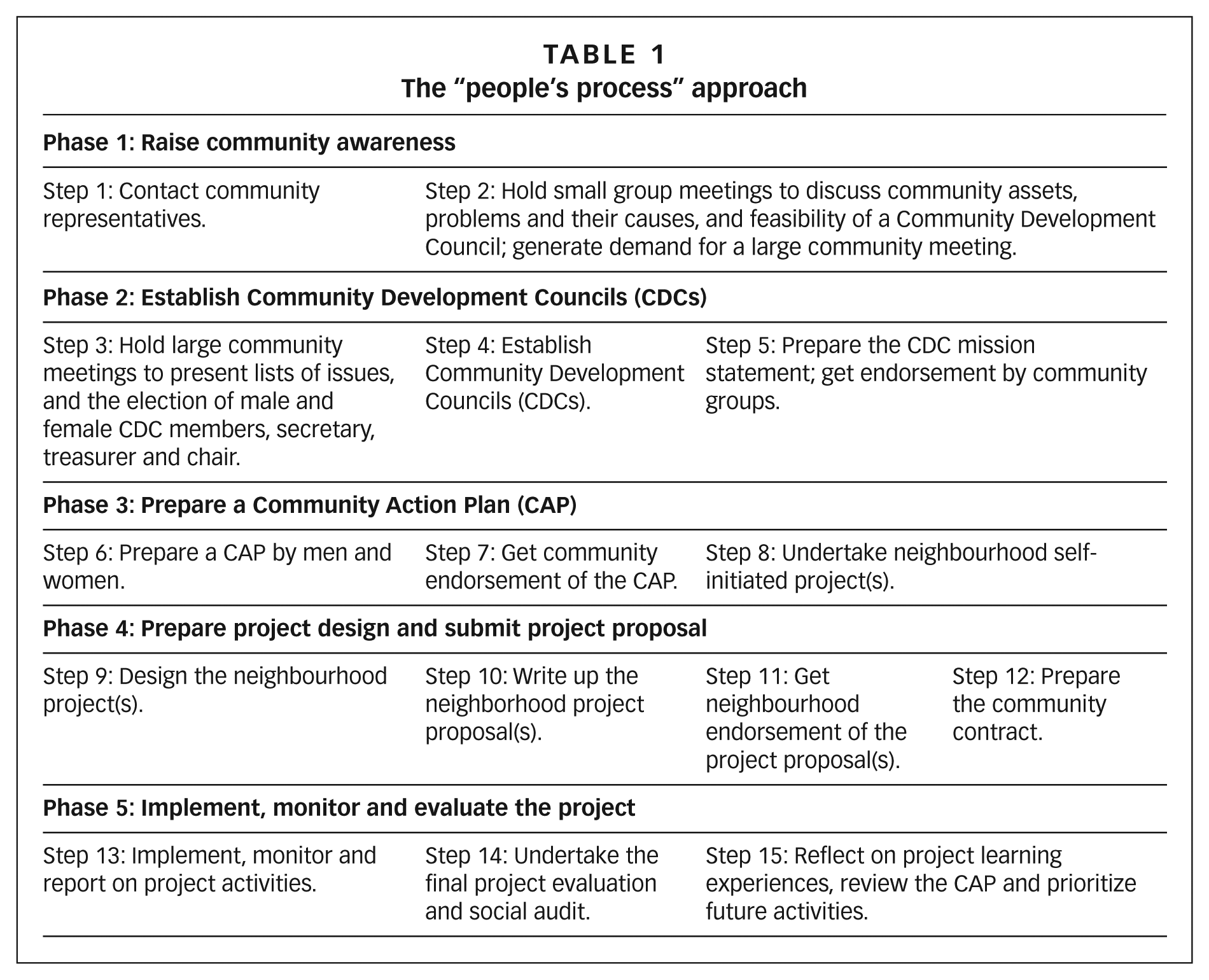
In most cases there are separate male and female CDCs, with the same geographic boundaries for each. They undertake the processes outlined in Figure 1 simultaneously, sharing their action plans and agreeing on sub-projects for the neighbourhood. If a community is willing, mixed-gender CDCs are established. Mixed-gender CDCs show promise for addressing gender inequalities and empowering women.(69) However, sensitivity is required because they can also do the opposite by reducing women’s opportunity to voice their concerns, needs and priorities in a safe space, which female-only CDCs can often better provide.
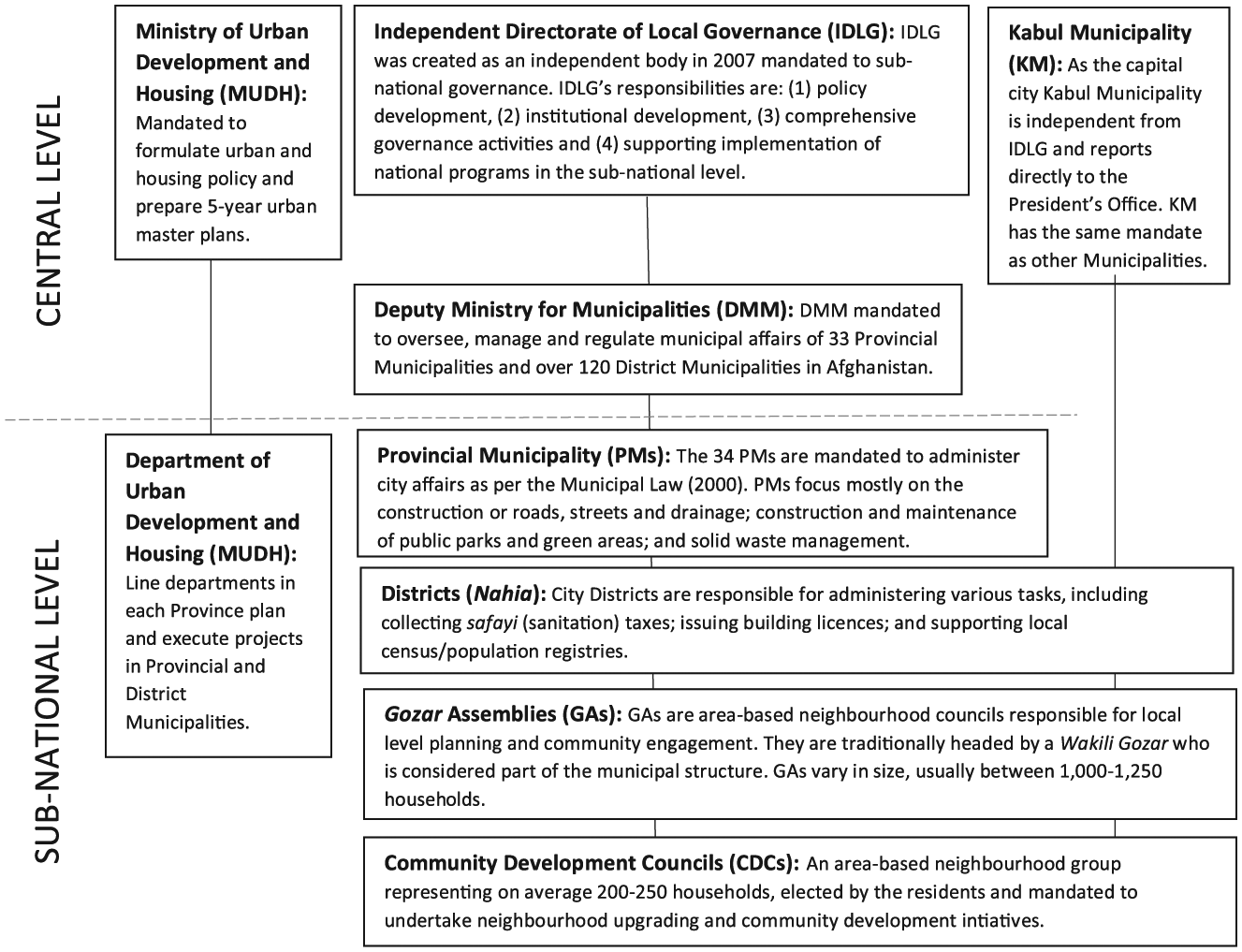
The governance structure of urban Afghanistan
A Gozar Assembly (GA), sometimes referred to as an Area Development Council (ADC) and comprised of a cluster of an average of five CDCs, is the next level in the local governance structure (Figure 1). GAs are mixed-gender, composed of representatives from the CDCs, and reflect the culturally rooted model of the wakili gozar in cities (translated as head of the neighbourhood). The GA mandate is to address larger-scale issues (beyond the scale of the CDC) and act as the institutional link between CDCs and the nahia (District).
CDCs and GAs regularly assume other functions beyond implementing infrastructure sub-projects. For example, some have taken the initiative to develop neighbourhood conflict resolution sub-committees, generate livelihoods support activities, support vulnerable households, and implement literacy skills development initiatives. Rather than being a parallel structure to formal local governance, CDCs and GAs are locally accepted entities for collective action at the local level that also foster a sense of civic responsibility.
Figure 1 shows the governance structure that links CDCs and gozars with city districts (nahias), municipalities and national urban institutions. Municipalities are regulated by the Municipal Law (2000), which provides only a limited mandate in service delivery.(70) In practice, municipalities primarily focus on development and maintenance of parks and green spaces, road construction, and solid waste collection. Other public services are the responsibility of line departments (Education, Health, etc.) or parastatal entities such as the Afghanistan Urban Water, Sewage and Sanitation Corporation (AUWSSC). CDCs and gozars are considered the lowest levels of urban governance in Afghanistan. Map 1 shows how the administrative governance framework is reflected territorially.
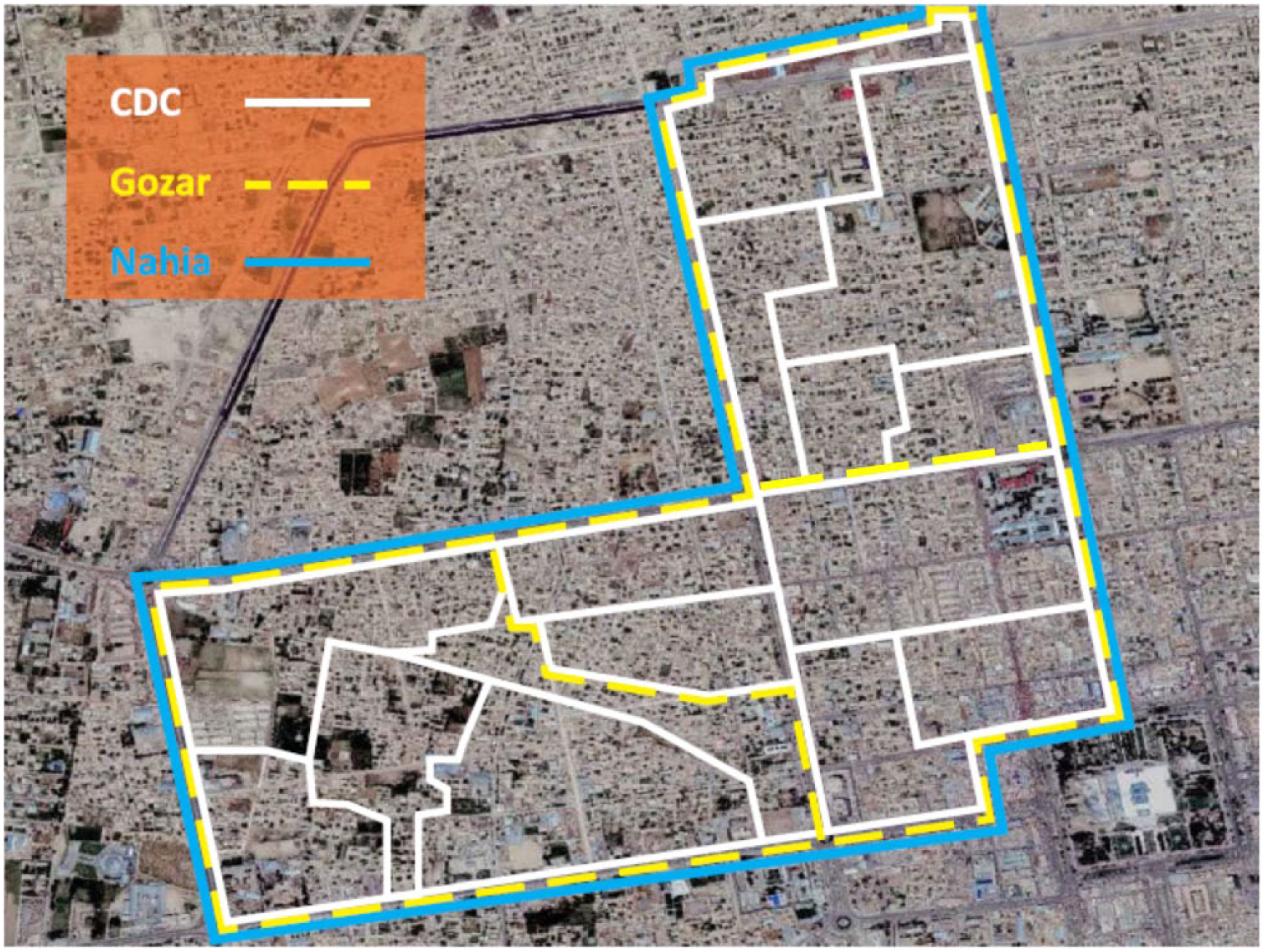
Example from Mazar-i-Sharif City of the territorial structure of a CDC, gozar and nahia
Community contribution to sub-project costs is an important component of urban upgrading and a demonstration of increased civic responsibility and community ownership over upgrading processes and outputs. Contributions can be cash or in-kind. Experience has shown that in low- and low-middle income neighbourhoods, contributions of between 25 and 35 per cent of total sub-project costs are possible if the residents lead the process, trust the facilitating partner, and see for themselves the direct results of their investment.
UN-Habitat’s urban CDC approach grew over the years and reached a large scale (Table 2). As of 2016, over 1.5 million Afghans in over 170,000 households (an estimated 19 per cent of the urban population) had been directly engaged through 645 CDCs. Over US$ 75 million has been invested through community block grants over the past 10 years. To put this into perspective, Kabul’s on-budget capital expenditure for the period 2011–2013 was US$ 11 million per annum.(71) In addition, an average of 23 per cent community contribution has been mobilized through UN-Habitat’s programmes, equalling over US$ 17 million.
c. Other slum upgrading efforts
Beyond UN-Habitat’s experience, other upgrading programmes have played a role in shifting thinking toward in-situ upgrading (Table 2). The World Bank-financed Kabul Urban Reconstruction Project (KURP) was approved in July 2004 by the Transitional Government of the Islamic Republic of Afghanistan and operated between 2006 and 2011. The US$ 25 million project was plagued by delays, with physical implementation only starting in 2008. Within the five-year period KURP upgraded slums within 19 gozars, reaching 142,215 people.(72)
While KURP had a degree of resident participation, “the project was not formally mandated to develop local-level, democratic and inclusive representative bodies, but it facilitated the establishment of elected community councils called Gozar Cooperating Shuras (GCSs)”.(73) One of the key lessons learned from KURP is that “community participation has proven crucial to make upgrading work”.(74)
Furthermore, the World Bank’s Final Report on KURP(75) noted: “the implementation of urban upgrading in Kabul positively impacted the opposition at the local and national level to service improvements in informal and unplanned areas. Visible results of service delivery improvements demonstrated the viability of urban upgrading as a relevant intervention in Afghanistan’s urban context for integration of under-served residential areas into the main fabric of the city.”
As a follow-up to KURP, the Kabul Municipal Development Programme (KMDP) commenced in August 2013 and targets over 1,773 hectares of informal settlements for upgrading, potentially reaching 775,000 people in Kabul City. A notable change in the design of KMDP is the integration of community contributions towards upgrading: “unlike in KURP, in the 19 settlements for which CUPs [Community Upgrading Plans] have been developed under KMDP, communities have opted to use their own funds for sanitation improvements, small culverts, and street lighting (light bulbs on boundary walls), in exchange for having the project provide public spaces and greenery”.(76)
IV. Institutionalizing Participatory Slum Upgrading in Afghanistan: The “Citizens Charter in Cities”
The cumulative result of the above-mentioned efforts was the demonstration of the validity of in-situ upgrading and citizen participation to address the major challenge of slums in Afghan cities. Beyond the physical outputs detailed in Table 2, donor and implementer reports on the efforts have also pointed to such valuable social impacts as (i) improved community cohesion and solidarity, with reduced ethnic tensions and a greater sense of local unity amongst diverse groups; (ii) the sustainable (re)integration of IDPs and returnees; (iii) an increased sense of belonging in cities and improved relations with municipality and service providers; and (iv) an improved engagement of citizens, including women and youth, in civic life, decision-making and conflict resolution.(77) Economically, the approach was reported to have demonstrated its impacts in creating livelihood opportunities, strengthening livelihood assets, stimulating the local economy through the direct investment in sub-projects at the local level, and harnessing significant community contributions to sub-project costs, which is essential in post-conflict countries where state and donor resources are constrained. As well, neighbourhood and housing regularization and formalization through incremental upgrading increased de-facto tenure security, which, according to a government report, proved a catalyst for private sector investment to make cities “drivers of development”.(78)
Based on these results, the approach was recently institutionalized into a national programme for participatory slum upgrading: Citizens Charter in Cities. Institutionalizing refers to a process leading to a situation where interventions are on budget, implemented largely under the responsibility of the government, and aiming to strengthen local governance and service delivery.(79) For example, the National Solidarity Programme (NSP) was institutionalized from its inception. It was managed under the overall responsibility of the Ministry of Rural Rehabilitation and Development (MRRD) and implemented through Departments for Rural Rehabilitation and Development (DRRD) in each province. “Institutionalized”, however, does not mean that a government necessarily implements all activities. NSP had considerable technical assistance from the World Bank, and over 30 “facilitating partners”, mostly NGOs, that delivered programme activities on the ground with communities.
In October 2016, the GoIRA launched a flagship national programme, the Citizens Charter (CC), as one of the National Priority Programmes of the National Unity Government. The CC replaces the NSP, building on its success while also moving away from the NSP model of small block grants and aiming for a “whole of government approach”. The objective, according to the World Bank, is “to improve the delivery of core infrastructure and social services to participating communities through strengthened Community Development Councils (CDCs)”.(80)
The urban component of CC Phase 1 (2016–2020) is intended to upgrade the neighbourhoods of 850 CDCs and 180 gozars across the four regional hub cities of Herat, Kandahar, Mazar and Jalalabad. Kabul was excluded on the basis that KMDP is operating in Kabul during this period. The value of Phase 1 is US$ 100 million, with approximately US$ 80 million invested in civil works. It will be implemented under the responsibility of the Deputy Ministry for Municipalities (DMM) of the Independent Directorate for Local Governance (IDLG) and the four target municipalities. It aims for an average 25 per cent community contribution to sub-project costs. Phase 2 (2020–2024) aims to target secondary cities such as Lashkar Gah and Taloqan.
The inclusion of urban slum upgrading in CC is a notable shift in national policy and resource allocation. Underpinning the shift was an increasing acceptance by government and donors of the value of both citizens’ participation and in-situ upgrading, and a broad consensus about how it can be done. This change in mindset was fostered by the proven successes of the approach over the past decade.
Another important factor was new urban data and an associated new urban narrative that provided a basis for policymakers and the international community to advocate for programmatic investment in urban areas under the Citizens Charter. From July 2014 to August 2015, the State of Afghan Cities 2015 programme (SoAC), funded by the Australian government and implemented by the Ministry of Urban Development with technical assistance from UN-Habitat, undertook the first baseline mapping of all 34 provincial capitals through interpretation of high-resolution satellite images to create a database of all urban housing units and land use.(81) A follow-on programme, Future of Afghan Cities (FoAC), expanded this dataset by using the same approach for the contiguous peri-urban built-up areas of the five major city regions and 28 strategic district municipalities.(82) Together these provided the first-ever reliable “urban” dataset for the country.
The SoAC and FoAC data demonstrated that the population in Afghan cities and city regions was close to 10 million, one-third of the total population, much larger than previously assumed.(83) Through the mapping process, the work profiled the urban realities, challenges and opportunities at international, national and local levels, and began to challenge the prevailing narrative of Afghanistan as a rural country. Other data collected showed the critical spatial, mobility(84) and territorial governance(85) interlinkages between urban and rural areas in metropolitan regions and advocated for a more balanced territorial response and strengthened rural–urban linkages.
Throughout the process, “urban champions” within the government and the donor community emerged and existing ones were strengthened. The process rallied urban actors within the government to work together, a significant feat after a decade of inter-ministerial conflict, mistrust and competition. The SoAC and FoAC programmes were the first joint initiatives of the leading urban institutions (MUDH, IDLG, KM and ARAZI)(86) and certainly the first joint output and common position advocating for greater support to urban development. Donors were sensitized to the urban agenda through discussion papers, meetings with ambassadors and heads of aid institutions, and bilateral meetings. A key champion was Afghan President Ghani himself, who understood the key urban issues, launched the SoAC 2015 Report, and believed in the participatory upgrading approach, having visited a CDC in District 11 in Kabul before coming to Presidential.
One needs to be careful about assigning simplistic “cause and effect” relationships. Yet it is hard to deny that without a decade of developing an approach to participatory slum upgrading and empirically showing the model works; elucidating and quantifying the serious urban housing and slum realities through SoAC and FoAC; and strengthening key government and donor champions, CC would not have included an urban component focusing on in-situ participatory upgrading. It would have been only for rural areas like its precursor, NSP. Only time will tell if it is successful; Afghanistan is a challenging context and there are legitimate concerns around the government’s capacity to implement such a programme. Nevertheless, it is a notable achievement for a country like Afghanistan to recognize the challenge of slums, and fund and implement a large urban programme across the four major cities with plans to expand to all major cities over the coming five years.
V. Reflections and Key Tensions
A recurring tension in the efforts described here has been the balance between, on the one hand, a community-led model to get things done, and, on the other hand, fostering meaningful citizen participation with lasting social impacts beyond the civil works projects. It is the case that community contracting through CDCs allows upgrading funds to bypass complex local government or donor procurement systems. Thus, CDCs can be a more expedient fiscal instrument for delivering upgrading programming, especially in the face of incapable, unwilling or corrupt local government authorities. Expedient action is particularly valued in post-conflict and protracted conflict situations. It has also been the case that in many programmes the upgrading process has been dictated by donors, most notably in terms of short timelines that match donor funding cycles, rather than the timeframes more appropriate to target communities that would allow more meaningful social impacts. This was particularly the case with the Community-Led Urban Infrastructure Programme (CLUIP) (Table 2), which had only a 12-month timeframe, just adequate for designing and building roads and drainage but arguably insufficient for any meaningful community action planning and endogenous social cohesion activities to develop in all of the 145 CDCs in which it operated.
Urban slum upgrading programmes in Afghanistan (2002–2016)
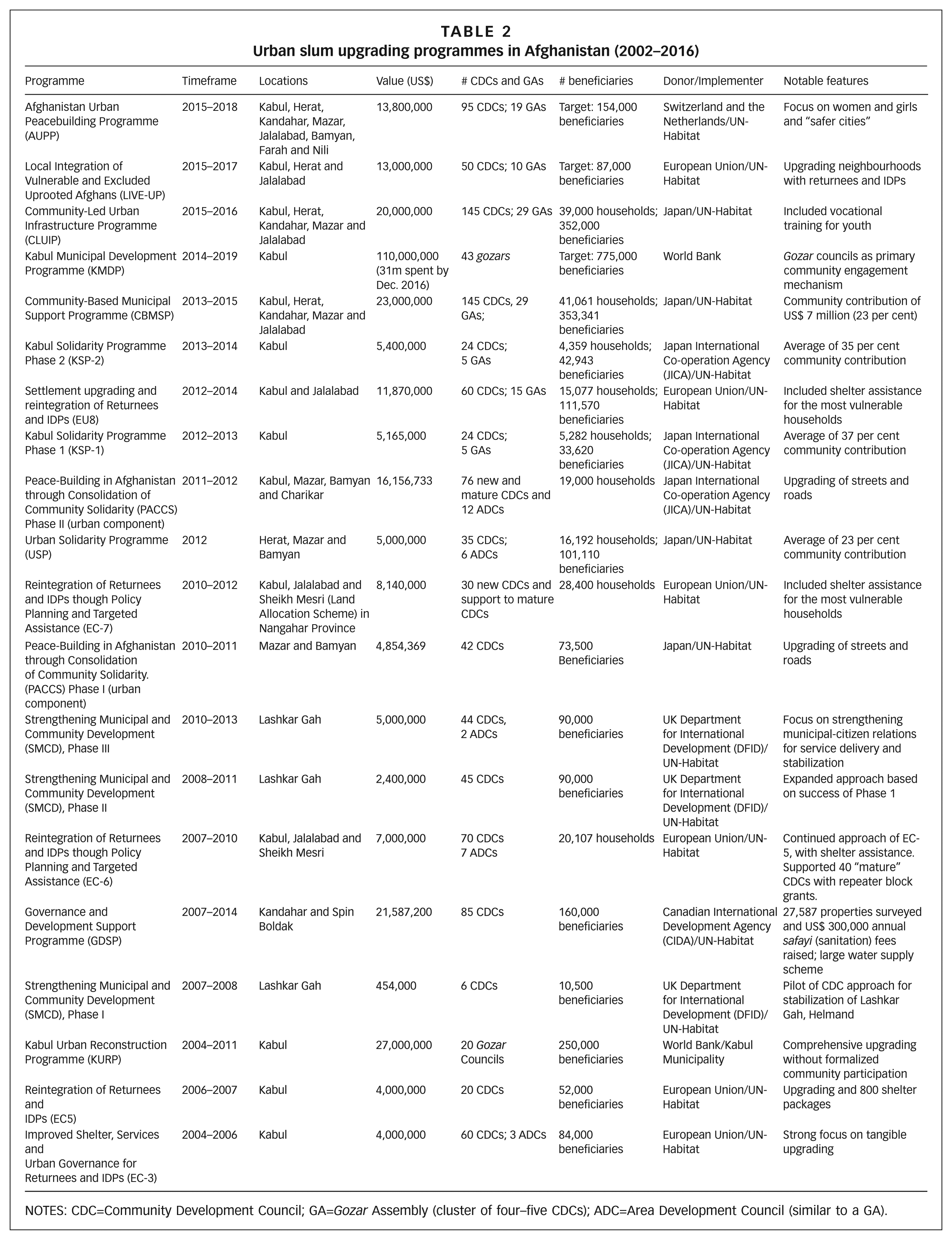
NOTES: CDC=Community Development Council; GA=Gozar Assembly (cluster of four–five CDCs); ADC=Area Development Council (similar to a GA).
As Section II explains, the global debate regarding meaningful modalities of citizen participation in slum upgrading and development is not new. As early as the 1960s, Arnstein(87) challenged ideas of “participation” with the Ladder of Citizen Participation, with eight rungs ranging from various degrees of nonparticipation, to degrees of tokenism, and ultimately citizen power. This has been further refined by Choguill.(88) Participation has been critiqued on a range of grounds over the past decades and often for good reason. Well-intentioned participatory efforts have been undermined by being ad-hoc, with a lack of follow-up, leading to the fatigue of those involved in what can seem like endless problem identification sessions. A lack of funds for implementation leads to frustration and can undermine the whole process of building stronger communities and local governance. As well, participation has been critiqued for reinforcing existing social dynamics and unequal power relations, including gender inequalities and elite capture of resources.(89)
Based on experience delivering these programmes, the authors argue that the experience in Afghanistan demonstrates that it is not a binary choice between “getting things done” and achieving broader goals of social change and improved local governance. Following Arnstein,(90) the criticisms of participation are not reasons for not employing a participatory approach.
Our experience shows that the impacts of participatory upgrading efforts vary. Some urban communities have achieved a lasting foundation for strong local governance, implementing projects beyond the donor-funded projects and maintaining the CDC after the donor-financed project was complete. Other CDCs, however, implemented the upgrading project and dissolved soon afterwards. Variation in development outcomes was also found in CDCs in rural areas in the NSP.(91) While space limitations here prohibit full analysis, we point to four key variables that have influenced the impacts of community-led urban upgrading in Afghanistan.
First, the degree of social cohesion prior to a donor intervention is critical in determining impact prospects. Social cohesion refers to the willingness of residents within the CDC boundary to put aside differences and come together to undertake the action planning and to manage upgrading implementation. Our experience has been that social cohesion is strongest when residents share the same religious sect (e.g. Shia, Sunni), ethnic group (e.g. Pashtoon, Hazara, Tajik), or province of family origin, which itself is often linked with political associations, and when they have a shared experience of the past (and/or present) conflict, such as a shared displacement history (often in Pakistan or Iran during the 1980s and 1990s).
Second, the length of time living in the settlement is also vital. We found that well-established neighbourhoods (e.g. District 1 in Kabul) have historical social ties and a sense of a shared local history that bond households and foster constructive community action. In contrast, the weaker social ties in neighbourhoods that have been recently settled with relatively recent returnees, high numbers of displaced persons, and/or recent rural–urban migrants, mean that community mobilization is more challenging.
Third, in our experience the economic level of the CDC makes a difference. Ironically, CDCs with a higher socioeconomic profile are more challenging to mobilize and to secure community contributions from. These CDCs are comprised of households that have a regular income, often through government employment (e.g. doctors, teachers, public servants). They have a relatively high degree of tenure security and higher expectations that the government should implement upgrading works without requiring community contributions. CDCs with lower socioeconomic levels, occupied by households relying on informal income – whether from casual day labour (e.g. construction labour), street vending or shopkeeping – have lower tenure security and less connection to, and trust in, government. Hence, they are more willing to invest personally in formalizing their neighbourhood and strengthening tenure security.
Fourth, how well the social work is implemented makes a difference. In UN-Habitat programmes, each CDC has an assigned programme team of two social organizers and one engineer. The skills, patience and experience of this team in mobilizing residents, forming CDCs, soliciting the CDC contribution to project costs, overseeing sub-project implementation, and resolving conflicts amongst CDC member households plays a key role in the performance of the CDC and its impact prospects.
Linked to critiques of grassroots participation is the tension around the suitability of the approach in addressing the complex challenges of fragile cities. Cities in LMICs have major issues that cannot be addressed only at the neighbourhood level, for example the delivery of basic urban services like water, electricity and sewage, public transportation and urban mobility, jobs and livelihoods, education and health services, and solid waste management. For example, in-situ upgrading of all informal settlements in Kabul, which house 70 per cent of the population, will not in itself result in a liveable city. Given the challenges of limited public space and traffic congestion, which require citywide planning and investment, in-situ upgrading may actually be counterproductive to sustainable urban development. When CDC-level infrastructure interventions are not connected to precinct- and city-level infrastructure, it can actually exacerbate urban problems.
In our experience, this has been the case with surface drainage, where CDC roadside drainage channels have not always been connected to larger municipal drains and have thus exacerbated flooding in downstream neighbourhoods. This reaffirms the concern that – although we have implemented projects of this nature – CDCs are not the best vehicle to implement municipal-level infrastructure projects such as large primary drains, public facilities, municipal offices and main roads. Urban development in fragile states requires action at municipal and national levels, such as effective spatial planning, strengthening of local taxation for service delivery, and improved land management and supply, which cannot be achieved only at the neighbourhood level.
The CDC approach is not a substitute for effective local urban governance but can lay the foundations for improvements in the face of complex and dysfunctional systems, especially in the aftermath of war or fragile, post-disaster situations. In Afghanistan, mayors and municipal authorities are not elected, and officials can use their power to satisfy their political ends. This was largely manifested in the context of this experience in the choice of where programmes operate, with mayors advocating for project CDC sites in areas where their supporters reside. As Figure 1 shows, the objective should be to integrate CDCs and Gozar Assemblies into the municipal governance structure. By linking citizens to municipalities through CDCs and gozars, this can begin a process of more inclusive and representative decision-making, increasing local taxation for service delivery, and improved accountability of municipal officials and systems. “Good governance”, therefore, begins to break down what Jackson describes as the “highly exclusionary and volatile networks of access” that govern access to resources and services.(92)
There is a tendency to romanticize community-led development, naively believing that “communities” are free of conflict, tensions and historical grievances, and to overlook the power dynamics, especially in terms of gender.(93) Conflict is messy and post-conflict reconstruction is far from straightforward. Urban neighbourhoods are often comprised of disparate individuals and families with different migration profiles, with underlying housing, land and property issues and violations, and inter-tribal/ethnic conflict. A UN-Habitat report notes, “Perhaps the most challenging issue is that of trust. Unlike a natural disaster, where the enemy of the people is nature, war pits neighbours against one another. This culture of mistrust is deep-rooted, and cannot be expected to fade away with the end of violence.”(94) Citizens particularly mistrust local authorities and often for good reasons, with abuse of power by state institutions and employees, nepotism, elite capture, and corruption endemic in fragile states.(95) Land is often at the core of the challenge.(96) However, the challenges around the “community” as a unit of intervention are not in themselves justifications for not using a participatory approach. They reinforce the importance of proper programme planning, monitoring and resources for more than just physical upgrading interventions, and of tailoring interventions to meet variations in the “maturity” and composition of urban neighbourhoods, as outlined above.
VI. Lessons Learned from 15 Years of Participatory Slum Upgrading in Afghanistan
The post-2001 “Afghanistan project” offers several important lessons for countries emerging from conflict or faced with protracted fragility and underdevelopment. A key lesson is to reaffirm the importance of citizen participation and co-production as a mechanism not only to upgrade the physical environment, but to facilitate a process of social healing and reconciliation after conflict. It is important to build on existing structures while recognizing the power imbalances and not exacerbate underlying conflicts. Purely grassroots approaches are problematic, and the real goal from the outset should be to link the top-down and bottom-up in a way that takes citizens needs into account and allows citizens to become actors in their city’s development.
In terms of “institutionalizing” participatory slum upgrading, the experience reaffirms the importance of political will and the need to change mindsets of policymakers, donors and government employees away from slum clearance and large-scale subsidized housing to in-situ upgrading.
The experiences also provide original insights into other key “ingredients” for institutionalizing slum upgrading. First, the importance of building the support of the international community, donors, and development banks for urban programming and investment should not be underestimated. The post-2001 Afghanistan reconstruction experiment was focused on building a strong central government for a rural population. Investment and programming for cities were neglected, the implications of which can be seen in Afghan cities today. International donors play a key role in reconstruction efforts, yet they arguably do not sufficiently understand urban development – retaining sectoral approaches to aid rather than area-based development – and therefore do not sufficiently finance urban programming that could mitigate the negative externalities of rapid urbanization during and after conflict.
Second, there is a need to balance “hard” civil works with the “soft” social facets of slum upgrading. Participatory upgrading needs to be about more than concrete roads and drains. It should also consider local economic development and productive infrastructure, as well as environmental, disaster risk reduction (DRR) and social safeguards. Furthermore, while some progress has been made, there remains insufficient meaningful engagement of women, youth, IDPs, and other vulnerable and marginalized groups that have not been systematically brought into the process to participate to their full potential.
Third, there is a clear need to better embed community-based slum upgrading into efforts to improve local and municipal governance. For example, greater attention in upgrading programmes needs to be given to improving tenure security and municipal revenue generation by addressing urban land management dimensions. Municipal capacity building for service delivery is also important to enable municipalities to have human and institutional capacity to reach and engage with citizens.
Linking all the above is a lesson learned on the importance of reliable and recent data to explicate the scale of urban informality, guide programme planning and decision-making, and build political support for in-situ upgrading. As discussed above, The State of Afghan Cities 2015(97) provided a firm foundation for decision-making and enabled a “call to action” to government and donors to address urban development challenges through national programming with associated resources.
VII. Conclusions
There has been no shortage of ad-hoc participatory upgrading projects in Afghanistan since 2002. Efforts have been largely implemented off-budget, by non-governmental actors, and have been driven by donor funding and timeframes. Nevertheless, the projects have demonstrated the validity of urban CDCs as a mechanism for citizen engagement in upgrading, achieving tangible improvements in the lives of millions of men and women, boys and girls, as well as fostering a sense of civic engagement and a strengthened social contract between citizens and the Afghan state.
The institutionalization of participatory informal settlement upgrading into a national programme is a remarkable policy shift. It represents a ground-breaking change toward recognizing the prevalence of urban slums and the potential of Afghanistan’s cities (rather than focusing on rural development), the validity of in-situ upgrading (rather than eradication), and the applicability of a participatory approach where citizens are empowered through local representative community structures (CDCs and Gozar Assemblies).
While this article strongly promotes a co-production approach to address the issues of slums, with broader implications for urban renewal, state–society relations, and local governance, it should not be read as the model to be strictly applied. The authors are well aware of the limitations of transformative, linear state-building models that, although common for Afghanistan, are rarely useful in charting a course of action that yields practical results on the ground. Instead, we advocate for engaging with the messy complexity of local conditions through involving citizens in the process (through local representative structures). Any such process should pay particular attention to those on the margins of society who seldom have a voice and can benefit most from being organized, networked, and recognized as partners in stabilization, reconstruction and development efforts.