




Abstract
This paper begins with the description of a theory that draws a parallel between slime mould behaviour and the functioning of informal settlements – part of a scholarly trend that recognizes and glorifies a kind of futuristic intelligence in these deprived zones. The paper goes on to demystify the slime mould theory using a case that, at first glance, seems to validate it. When faced with the threat of forced eviction due to a canal reclamation project, the informal residents living along the banks resort to a range of survival tactics that protect them from eviction, and, in an ironic twist, also make it impossible for the project to succeed. Seen in isolation, the informal residents seem to act as the theory predicted – without being guided by a “single brain” or a “power elite”. However, seen within the historical and political context, this moment of triumph is itself found to be bounded on all sides by defeat and deprivation.
Keywords
I. Demystifying the Slime Mould
In the first few pages of Nabeel Hamdi’s book Small Change: About the Art of Practice and the Limits of Planning in Cities, published in 2004, there is an intriguing account of research on slime mould behaviour and an application of the findings to elucidate collective behaviour in informal settlements. Slime moulds are organisms that exist as single cells but are capable of combining to form multi-cellular structures. Scientists put the slime mould inside a maze and placed some food at the exits. The mould found its way through the maze to find the food despite not possessing any brain or executive cell. Introducing this unique research, Hamdi writes that the “research was a part of the scientific search for an understanding of how simple and mostly independent cells, under the right conditions, come together and emerge as a larger more sophisticated organism, not led by a single brain and without the help of an executive branch, much in the way in which the highly sophisticated and informal sector works in cities”.(1)
Hamdi goes on to link the world of biology to that of sociology, referring to the sociologist Georg Simmel. “The point that the scientists and Simmel are making is that organic systems, in nature and in society, exhibit patterns – recognized in the informal cities of everywhere – where problems are solved by drawing on a variety of information from the multitude of small, relatively simple and local elements, rather than from some power elite or single brain.”(2)
As a scholar and practitioner, Hamdi has been a rare master when it comes to comprehending the realities of informal settlements at the local level. But that he still longs to find proper channels to transform “small change” into “big change”, or “emergence”, as he calls it, can be sensed from the title of his book published 10 years later – The Spacemaker’s Guide to Big Change.
It would appear that a comprehensive theory of “emergence” still eluded him, almost like the moment of satori, or enlightenment, eludes and frustrates a Zen monk.
The analogy is deliberate, for while Hamdi is brilliantly empirical when operating in the narrow lanes of slums(3) and informal settlements, he becomes increasingly mystical and vague when he begins his quest for scaling up and emergence.
In the second book he lists the actors who play a crucial role in scaling up local-level interventions and describes the approach one has to take with them to make scaling up a success.
“They [scaling-up strategies] are cultivated among high profile actors, often with the UN and other international development agencies, with captains of industry, bankers, housing managers, mayors, ministers and prime ministers. One avoids arguing that their methods and processes are wrong, nor that their procedures are inefficient or their ambitions misdirected or unjust. One avoids challenging their positions, but rather one works with their interests, which we respect and often share, whatever their motives.”(4)
These lines honestly describe the accepted wisdom in the world of international development – a desperate wish to bring about radical transformation while avoiding every attempt to alter the status quo. The historical and political context disappears from the scene as an enticing and misleading picture of informality is painted. The paradox may not be so difficult to explain. In the absence of context, an informal settlement appears to be exactly what he describes it to be – a slime mould finding its way without the help of a “power elite” or a “single brain”.
In their splendid critique of mainstream participatory development, Hickey and Mohan write that the inability to grapple successfully with power and politics turned participation into a purely technical approach and depoliticised what should have been an “explicitly political process”.(5) The authors emphasize the difference between “immanent development” and “imminent development”. While the former refers to development “as a historical process of social change”, the latter refers to development in the form of “specific interventions…as a means of managing those surplus populations that have either been excluded from or adversely incorporated into processes of immanent development”.(6)
From a historical perspective it is interesting that Hamdi’s earlier book was published in the same year as the collection edited by Hickey and Mohan. Based on Hickey and Mohan’s classification, it is not difficult to visualize Hamdi as a champion of imminent development, desperately seeking to make a leap to immanent development. However, a failure to “grapple successfully” with historical and political forces leaves Hamdi puzzled by questions that had already been adequately answered by Hickey and Mohan 10 years earlier. Instead of leaving the slime mould and maze aside, the answers are now sought by expanding the smaller maze to a bigger maze.
Indeed, the slime mould theory works fine from the point of view of imminent development, but it remains clouded by a kind of historical defeatism – that informal settlements with all their ghastly grandeur of deprivation are here to stay, that they are an entity unto themselves, that they possess a kind of futuristic internet-like intelligence that works without a “power elite”, and that they are not constantly created, crushed, shoved, controlled, studied and observed by elite power structures that always lie outside them, much like the scientists observing the slime mould inching through the maze.
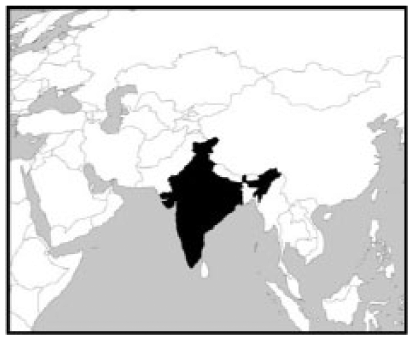
This paper aims to deconstruct and de-romanticize the image of the smart slime mould using a case that, at first glance, appears to confirm it. The case is that of a failed canal reclamation project undertaken in the city of Kolkata, the capital of the state of West Bengal in India, exactly at the time when Hamdi was writing about the slime mould experiment. Before getting into the case, however, it is vital to have some understanding of the political and economic context that prevailed in West Bengal when the canal reclamation was attempted. For if Hamdi wondered about the slime mould that lies within the maze, the present paper wonders about the context within which lies the maze.
II. The Context
Until very recently, West Bengal had the unique political identity of being the only state in India to be governed continuously by a coalition of leftist political parties, the Left Front, for over three decades. According to economist Jayati Ghosh, lead author of the West Bengal Human Development Report, this coalition was “motivated by a vision of political, economic and social change, which was different from that observed among most other state governments or the central government”.(7) And according to Atul Kohli, the coalition was attempting something that most other political parties in India had failed to achieve – to consolidate itself “by building its power base primarily on the lower and lower-middle classes.”(8)
This vision led to a focus on two interrelated strategies – reform of property relations and empowerment of the local government. From the start, it was the conviction of the Left Front that the reform of property relations was crucial to solving the problems of poverty and underdevelopment in the state. The twin strategies of land reform and democratic decentralization were never seen in isolation from each other. The devolution of power to the traditionally disempowered urban and rural local governments was seen as the best way to make land reforms more effective in terms of scope, fairness and sustainability. The land reforms, in turn, were seen as a way to strengthen the institutions of local democracy over time.
The land reform process took the form of registration of sharecroppers and redistribution of land to the same in rural areas, and registration of slums and increased tenure security of slum dwellers in urban areas. For historical reasons the emphasis on the land reform process, and its achievements, was much higher in villages than in cities. Apart from the material achievements of the land reform process, well documented by various scholars, an equally crucial achievement was the social-psychological one. Drawing on Biplab Dasgupta’s conclusions, Robert Thorlind wrote:
“The main achievement of these land reforms is more of a social-psychological nature – to curb the former monopoly of the rich and to make the poor peasant feel that the state is behind him and supports his rights. The land that he now holds, or more securely rents, provides the peasants with a certain amount of income and social status, and thus the ability to break through the mental barrier that makes him accept poverty and a low social ranking.”(9)
The achievements of the land reform process in the urban areas were more mixed. Here the process focussed on granting security of tenure to slum settlements and addressing the basic needs of the slum dwellers through upgrading projects. Legislation was passed by which most slum land was taken over by the government and rights of the tenant slum dwellers strengthened.(10) Although this was a positive step, over time, it created and widened the divide between formal slum settlements and informal squatter settlements in the city. In addition to the scores of slums that had existed in the city since the British times, the informal settlements had grown as a result of the massive inflow of refugees to the city.
During the Bangladesh war of liberation in 1971, the city of Kolkata came to “accommodate a refugee immigration of more than three times the original population of the city”.(11) These settlements almost always sprang up illegally, and the fact that they were located on extremely vulnerable and marginal land, such as along “the side of canals, large drains, garbage dumps, railway tracks and roads”, made granting of formal tenure more complicated.(12) Today, these settlements still lack all basic amenities. However, being old political allies of the leftist movement, these settlements of the refugees and the urban poorest always had the tacit protection of the government.
As legalized slums benefitted from multiple rounds of upgrading, the conditions in informal settlements remained the same. This created a curious situation, with two kinds of slums coexisting in the city, both depending on the policies of the Left Front for their sustenance, and yet possessing drastically different levels of vulnerability. While the legalized slums could increasingly rely on formal responses to fulfil their basic needs of water, sanitation, livelihoods, etc., the informal settlements had to become increasingly creative, diverse and innovative in their quest for survival. Thus, there came to be a situation where conditions existed, simultaneously, both for gradually discouraging slime mould behaviour and for vigorously encouraging it.
III. The Case – The North Canal Reclamation Project
In the late 18th century, British administrators and engineers started a unique process of linking naturally occurring creeks and channels with artificial canals to connect the rice-growing districts of eastern Bengal and the forests of the Sundarbans with the markets of Kolkata. In its fully functional stage, the network performed the twin functions of inland navigation and stormwater drainage.
From the middle of the 20th century onwards, the condition of these vibrant waterways became increasingly poor. After independence, East Bengal became part of Pakistan and West Bengal remained in India. This affected the economic interdependence between the east and the west, the main rationale behind the construction of the canal system.
Following the refugee crisis triggered by the Bangladesh war of liberation, the canals became practically unrecognizable as inland waterways. Crowded with informal housing on both sides, they resembled stagnant drains with nothing better to offer to the city than an increased number of malaria victims.
Although there were occasional demands for reviving this vital historical and ecological resource of the city from environmentalists and middle-class civil society organizations, any attempt to implement a project on those lines was bound to involve a confrontation with the informal settlements. Despite the political threat, the authorities started taking decisive steps to revive the canals of Kolkata from the late 1990s onwards. It was not just a concern for the environment that prompted this move. From the early 1990s the government of India had started liberalizing the national economy, and the cities and regions of India were feeling the shift. To the state of West Bengal and its capital Kolkata, the only region of India ruled continuously for decades by a coalition of leftist parties staunchly opposed to neoliberalism, this came as a serious challenge.
Despite their opposition to neoliberal economic policies at the national level, the leftist parties started succumbing to the demands for privatization and interregional economic competition in the state of West Bengal. Cleaning up the city of Kolkata, creating new infrastructure and attracting private investment started taking precedence over anti-liberal and pro-poor political ideology.
In the late 1990s the then chief minister of West Bengal, Budhhadeb Bhattacharya, announced the government’s intention to revive a prominent canal network in north-eastern Kolkata called the North Canal System, located adjacent to the township of Salt Lake, which was inhabited largely by middle- and upper-middle income households. The corporate media lauded the announcement and described it as the chief minister’s “Venetian Dream”.(13)
The strategy to revive the canal networks consisted of two main parts: (i) dredging the canals and (ii) initiating various services and development projects, such as operating a ferry service, widening canalside roads, and developing recreational and commercial uses along the banks and around proposed ferry terminals.
In 1998 the state transport department appointed ICICI Winfra (I-WIN), a joint venture company, to prepare a feasibility report for the canal reclamation project.(14) The report concluded that the project was technically and financially feasible, and would cost an estimated US$ 12 million. However, the study excluded the cost of evicting and resettling the informal residents from the canal banks.
The eviction of informal settlers and the dredging of the canals were to be undertaken by the Irrigation and Waterways Department of the government of West Bengal in cooperation with the local government. Following the eviction and the dredging, a private developer was to be appointed for implementing the second phase of the project on a 30-year build-operate-transfer basis.(15)
Despite the preparations, almost nothing was implemented on the ground for the next two years. The political and human costs of evicting the informal residents haunted the process. In 2002 and 2003 massive eviction drives were undertaken in various stretches of the canal network. Four contingents of the anti-riot Rapid Action Force and scores of police were present to keep the bulldozers from harm during the 2002 evictions.(16) Yet, when I visited the sites in 2004 and then again in 2005, a substantial number of hutments (hut encampments) were still standing.
The residents of the informal settlements outlasted these eviction drives by using a range of techniques that operated at such a local level that the project authorities could not spot them on their radar. Residents’ strategies depended on their ability to use the specific geographic features of the stretch they occupied, their paradoxical relationship with the middle-class residents of Salt Lake, and their ability to deal directly or indirectly with agents of the state (the local government and the police). These successful strategies were reconstructed through interviews and discussions with the informal residents living along the canal bank, the spokespersons of middle-class civil society in Salt Lake who attempted to pressure the government to revive the canal, managers of I-WIN and the representatives of the local government.
It was far easier to interview the informal residents than the authorities responsible for the project. Interviews were conducted in three informal settlement clusters, identified in Map 1 by the name of the lead key informant in each cluster. Ten respondents were interviewed in each cluster. However, the interviews always ended up as community discussions since curious neighbours and onlookers would join in and start participating.
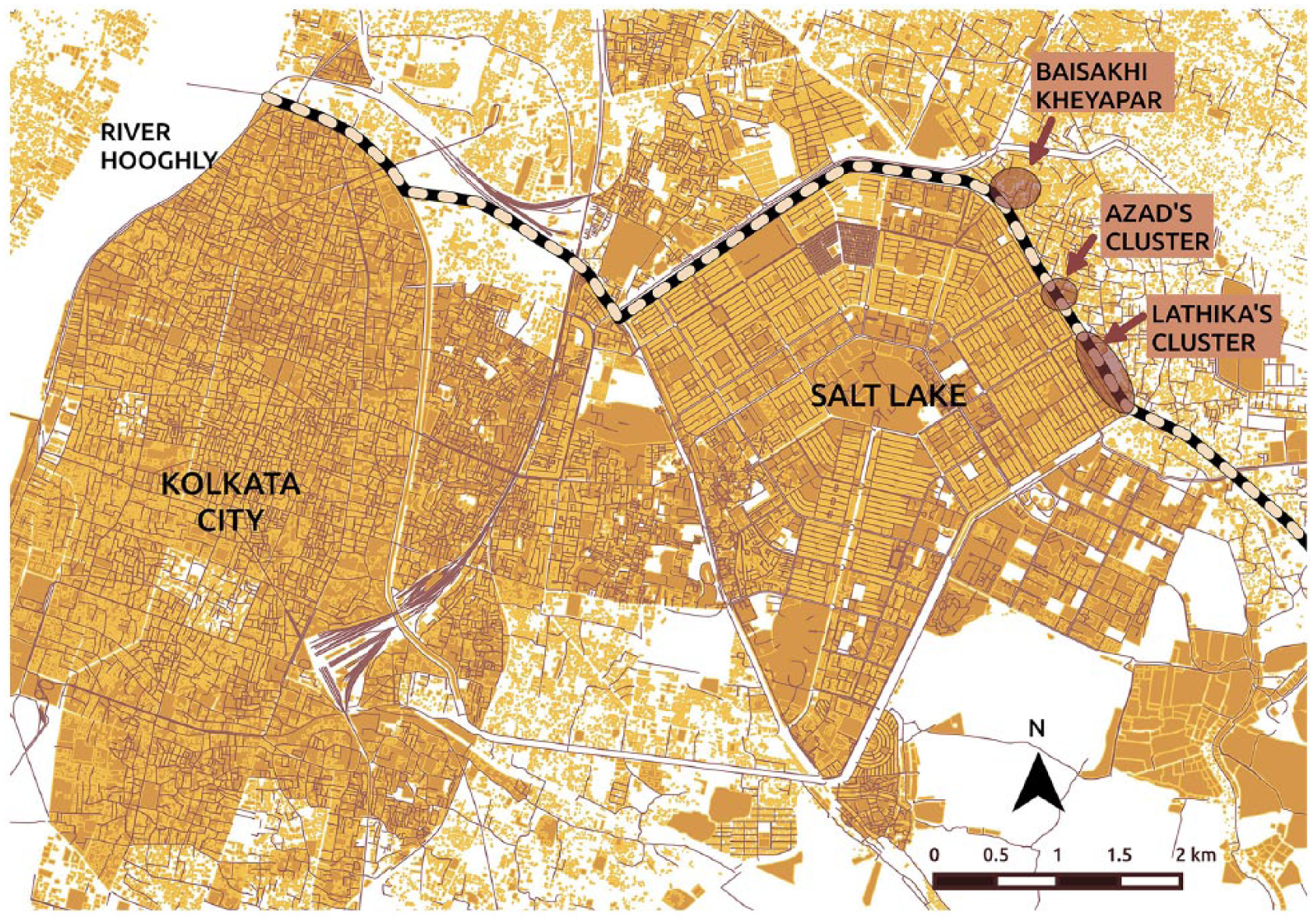
Locations of key informants
Three prominent respondents were interviewed for gauging the views of the Salt Lake civil society – the editor of the local newspaper; a retired judge of the Kolkata High Court who, in 2003, had assisted the residents’ associations of blocks adjacent to the canal to file a complaint to the West Bengal Pollution Control Board (WPCB) regarding the delay in the canal dredging; and a former additional director of the Central Bureau of Investigation, who was personally committed to seeing the canal restored as he hailed from a family of sailors. His responses, however, have not been included as his focus was on awareness regarding city canals and not the reclamation project directly. Members of 10 middle-class households living next to the three informal clusters were also interviewed, as well as elected councillors of the six Salt Lake wards adjacent to the canal.
Officials of I-WIN and the Irrigation and Waterways Department (IWD) proved difficult to access. After repeated requests a telephone interview was arranged with a chief manager of I-WIN. A senior IWD engineer agreed to an interview, but stated only that there were more important issues to which I should direct my attention. He refused to share the project reports and promised, but never delivered, a detailed map of the canal banks. This is not an unusual response by an Indian technocrat to a research endeavour that does not involve a prominent person. However, in such cases, more vital data come out of the respondents’ actions than their verbal responses. Fortunately, the case was closely monitored by the city’s leading daily newspapers, which provided the much-needed data to understand the actions and intentions of the project authorities.
If an independent middle-class researcher is shown the exit sign so casually, one can well imagine how alienated this official world of government servants must be from that of the abjectly poor informal settlers. Unofficially, of course, it was a totally different story, as the following sections will show.
IV. Counter-Eviction Strategies of the Informal Settlers
Along the North Canal, only one informal settlement of about 100 households, known as Baisakhi Kheyapar, was large enough to be perceived as a “settlement” by its own residents and by those of the middle-class neighbourhoods surrounding it. The rest of the informal settlers would locate along the canal wherever space permitted – sometimes in clusters of 5 to 20 hutments, sometimes as individual hutments, and sometimes adjoining the rear boundaries of middle-class plots of the Salt Lake township.
This is a kind of informal living situation where the extent of the settlements is better measured in terms of kilometres of possibility rather than the number of households. If one moves along the North Canal from east to west, the informal settlements first appear at the point where the canal starts to run along the northern border of the Salt Lake township (marked Ulta Danga Crossing in Map 2). After this nodal location, the hutments disappear altogether for a distance of about 3 kilometres. It is risky to construct any hutments in this stretch, as there is a high degree of visibility from a major arterial road that runs along the northern bank of the canal. After this distance the road veers away from the canal and the possibility of being detected by agents of the state or of being targeted as a conspicuous eyesore decreases considerably. This linear zone of safety and concealment stretches on for the remaining 2 kilometres of the northern border of Salt Lake.
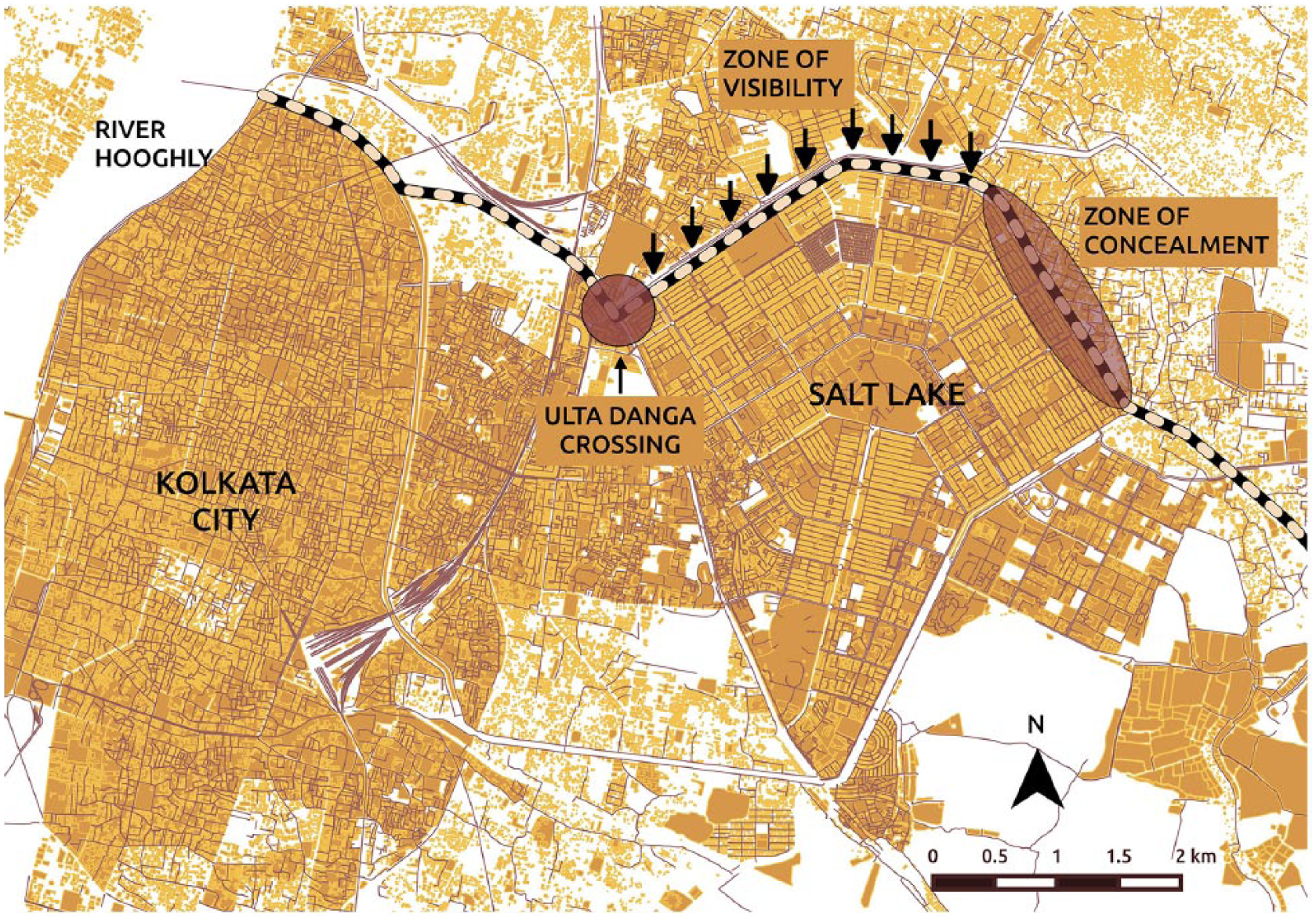
Zone of concealment
The main offices of many of the government departments, which were associated with the canal reclamation project, as well as the residences of their senior officials, are located in the Salt Lake township. To the informal settlers living along the North Canal, many of whom are employed as household helpers and cleaners, this situation created a unique opportunity to have direct access to the homes of those very officials who were drawing up the plans for evicting them. This opportunity was used by many informal settlers to gather prior information about planned eviction drives and also as a way of arranging a kind of informal security of tenure. Throughout the zone of concealment, many informal settlers constructed their shanties by attaching them to the rear walls of the houses of surveyors and engineers of the urban development department who were involved with the planning and construction of the township itself. The informal settlers work as household helpers for the families living in these houses, and the latter, in turn, use their official contacts to ensure that the former are not evicted from the canal bank.
This is how Lathika Sarkar, a middle-aged woman who works as a maid, described this situation:
“The gentleman who owns the house in front has arranged everything for me. He told the local police right on the first day not to threaten or bother me in any way.” (Interview with Lathika Sarkar, July 2005)
The other way of arranging such informal security of tenure is through negotiations with the ruling political party. The residents of Baisakhi Kheyapar use this strategy. This settlement has a mixed Hindu and Muslim population, the latter comprised of extremely poor seasonal migrants from Bangladesh who stay in the cluster a few months at a time and work in garbage collection and segregation. Another important occupation of the residents of the cluster is to set up mobile, roadside tea and snack stalls.
The residents got into an arrangement with a local youth club, which was affiliated to the ruling Left Front parties. The residents did not discuss this arrangement readily with outsiders. During a long interview session, one young woman finally agreed to talk about it.
“To tell you the truth, all the residents have to pay a one-time fee to the Shiv-Kali club, which is located in a neighbourhood to the north of the canal. When I settled here four years back, I had to pay Rs. 3,000 [approx. US$ 64 as of October 2001]. The fee must have increased to about Rs. 5,000 or 6,000 [approx. US$ 113–136 as of October 2005] now. The club works for the Left Front. We are all very active during the elections and vote for the party.” (Interview with Meena Ghosh, October 2005)
Initially, the residents had been given the hope that if they stayed politically active in favour of the Left Front, then their settlement would be granted formal recognition. Meena had herself been very active during the elections.
“I encouraged the residents to vote. In the last elections we cast as many votes as we could…sometimes 20 to 25 votes per person on a single day. But after the elections nothing really happened. Now my neighbours make fun of me. They laugh and say…’What happened Meena? You are not campaigning for the party anymore?’ “ (Interview with Meena Ghosh, October 2005)
The frankness with which Meena described the illegal process of proxy voting was almost amusing. Despite all the risks involved with such informal arrangements, Meena also mentioned the positive aspects.
“It is hard to live without any amenities. But we don’t have to pay any rent at all. Moreover, so many people in the settlement are involved with garbage collection and segregation. Do you think they would be allowed to do this kind of work, if they rented a room in a formal neighbourhood?” (Interview with Meena Ghosh, October 2005)
Most of the informal residents I interviewed still saw the Left Front as an ally, albeit an increasingly disappointing one. Lathika Sarkar told me,
“I used to be a strong supporter of the Left Front earlier. But now everyone has become just the same. They run to us before the elections shouting - My sister, my sister! Oh, you are living in such difficulty! We feel so sorry for you! - And the moment the elections are over, give dear sister a kick on the rear!” (Interview with Lathika Sarkar, July 2005).
Although the arrangement with the Shiv-Kali club protects the settlement from demolition, this security does not extend to the roadside stalls, which are an important source of livelihood for the residents. Seema, a neighbour of Meena Ghosh, runs a tea and snack stall of her own. In an interview she told me that her stall had been taken apart and confiscated by the demolition teams of the Salt Lake municipality many times.
“After such demolition drives, the stall owners have to start again from scratch…first by setting up the stall on the foot path, then to construct a fixed structure made of bamboo, and when enough money has been saved, to construct a mobile stall on a bicycle-van.” (Interview with Seema, October 2004)
However, the stall owners do have a mechanism for avoiding demolition. According to Seema, when a demolition drive takes place in Salt Lake it does not happen in all the residential blocks at the same time. When it begins in a certain block, a child from the informal settlements there runs to the other settlements and informs the residents about the drive. The stall owners then quickly move their stalls across the bamboo bridges into their respective settlements. If they receive the information well in advance and are able to respond quickly, then they are able to save their stalls.
Most of the informal settlers seemed quite confident about handling the various local actors. The policemen of the Salt Lake East police station, which is also located along the North Canal, have a monthly arrangement with most of the informal settlers. This is how Azad, an informal settler who lives on the canal bank with his wife and five small children, described the arrangement he has with the local police:
“The police never bother me! I have a monthly arrangement with them. I give them Rs. 50 or 60 [approx. US$ 1.13–1.36 as of July 2005] every month and that settles it.” (Interview with Azad, July 2005)
Azad is a Muslim mason from a village in Bihar but many of the other residents living near his hut are cycle rickshaw drivers. The cycle rickshaw drivers have unions of their own affiliated to different political parties. The rickshaw unions take fees just like the Shiv-Kali club and allot residential blocks and stretches of roads to the members to ply their rickshaws. The higher the fees, the more profitable the location allotted. The cycle rickshaw drivers are mainly Bengali Hindus but they have no objection to living next to Muslim families.
Some other residents like Lathika dealt with the police in more direct ways by appealing to the latter’s conscience. Despite being told not to by Lathika’s employer, the police did come to demolish her hut once. In the argument that ensued Lathika asked the policeman,
“Why would you demolish my home? What have I done to you that you wish to torment a poor and lonely woman like me? What kind of a human being are you?” (Interview with Lathika Sarkar, July 2005)
The policeman not only changed his mind, but also developed a deep respect for Lathika and started addressing her as mashi (the Bengali word for aunt). As she said with a laugh,
“Nowadays that policeman behaves very nicely with me. He visits me often to ask how I am. Sometimes I cook lunch for him. He eats and then takes a nice long nap in the very home he had come to demolish!” (Interview with Lathika Sarkar, July 2005)
The informal settlers, however, felt more insecure when dealing with non-local bureaucratic agencies, such as the Irrigation and Waterways Department. This is exactly what they had to encounter during the canal reclamation project. Azad said regarding the threat:
“We are not afraid of the police. But when people come from outside to demolish our shanties, then we have a problem. For example, when the canal dredging was going on some time back, we decided to vacate our home and shift to another spot on the canal bank. The workers came and told us that they are going to dredge the canal and we should move out. We dismantled our home and then set it up after the workers left.” (Interview with Azad, July 2005)
Most of the settlers construct their huts with temporary materials on top of a cement plinth. This makes it easier to dismantle and construct it again.
The first phase of the improvement project, which involved the dredging of the canal, could at worst lead to a temporary eviction. This second phase, which involved land use transformation, carried the threat of permanent eviction.
According to G P Bagree, chief manager of I-WIN:
“Some of the encroachers on the canal banks have deliberately not been removed because the moment the banks are vacated more people will move in to occupy the place. So we will clean the canal first and when the second phase of development starts, we will evict them.” (Interview with G P Bagree, July 2005)
The fact that local actors might not have any ability to resist the second phase created a threat to which the counter-eviction strategies of the informal residents had no clear answer.
V. Informal Settlers and the Middle Class – Bound in Eternal Love–Hate
The informal settlers were fully aware that no matter how vocal the middle-class residents of Salt Lake were regarding the menace of having dense informal settlements on the canal banks, they were far too dependent on them to get rid of them permanently.
Moreover, the middle-class residents were not able to organize themselves into effective pressure groups. One of the most influential voices was that of Bhagwati Prasad Banerjee, a retired judge of the Kolkata High Court. In 2003, he assisted the residents’ associations of neighbourhood blocks located adjacent to the canal to file a complaint to the West Bengal Pollution Control Board (WPCB) regarding the delay in the dredging of the canal. He expressed his opinion about the informal residents in no uncertain terms.
“The WPCB did nothing! The moment you try to evict the informal residents, it becomes a political issue. If you and I occupy an inch of land illegally in Salt Lake, we will be arrested, but nobody touches them just because they are poor! These encroachers should be thrown out!” (Interview with Bhagwati Prasad Banerjee, June 2005)
Whenever a “respectable” voice from within Salt Lake spoke, the tone remained the same. Moreover, there was a prevalent opinion that most of the informal residents were illegal immigrants from Bangladesh who were involved in all kinds of antisocial activities. The day-to-day interaction with the residents did not do much to change these opinions. The Left Front was generally seen as an ally of the informal residents that was putting up a charade of reclaiming the canal.
This is how Sudhir Dey, the editor of the township newspaper, described the situation.
“Ideally there should not be any informal settlements in a township like Salt Lake. But thanks to the Left Front, these people have been able to stay on. All these people have come illegally from Bangladesh and vote for the Left Front during elections.” (Interview with Sudhir Dey, July 2005)
When this comment was mentioned to Lathika Sarkar during a subsequent interview, she objected to it strongly.
“What a thing to say! Aren’t half the people in this city originally from Bangladesh! Why should we be singled out?” (Interview with Lathika Sarkar, July 2005)
Though far better off than the informal residents in terms of material resources, the middle-class residents of Salt Lake are poor in the sense of being alienated from and largely ignorant of both the details of an important development project being undertaken in their township and also the institutions of local government. In contrast, the very precarious and vulnerable position that the informal residents find themselves in forces them to closely follow the implementation of the project, and also to establish connections with various local actors.
VI. Informal Settlers and the Local Government
Given the new political–economic orientation of the Left Front government and the intricate relationship it had with informal residents at the ground level, the representatives of the local government resorted to a double game. None of the local ward councillors of Salt Lake Municipality ever officially said anything in favour of the informal residents. Yet they collaborated with the informal residents to delay evictions or even tacitly allowed them to stay.
The interview with Sudhanshu Shekhar Ganguli, a Left Front councillor, clearly showed the dilemma of the councillors. He expressed the official position at the start of the interview.
“The encroachers have to move out. Resettlement cannot be an option when it comes to illegal occupants. And even if it was an option, where could we find the land? We did not invite the encroachers to come and live here!” (Interview with Sudhanshu Shekhar Ganguli, November 2004)
However, unlike the middle-class voices of Salt Lake, his response did not end with this tone. He continued, as if obliged to find a more humane solution. The responses also revealed that the councillor was far more aware of the realities of the informal residents’ lives than the average middle-class resident.
“Eventually they would have to move out. Anyway, most of them have family and some land in the country-side too. In case of an emergency they do have some place to go back to. But you see…the trouble is that it is in our very homes that these settlers work. The residents of Salt Lake want both the improvement of the canal and also the inexpensive services of the informal settlers.”
Towards the end of the interview he said something that almost contradicted the position he took at the start.
“But we don’t wish to be too hard on them. We try our best not to evict them in a ruthless manner. Sometimes we undertake an eviction drive and ask them to move out…and after a while we let them come back again. Regarding those informal settlers who have some sort of an identification document such as a voter’s card, we don’t ask them to move out permanently. They can try to find some other area within the ward to re-build their home.” (Interview with Sudhanshu Shekhar Ganguli, November 2004)
Sukumar and Parboti, a couple living near Lathika Sarkar’s hutment, corroborated Sudhanshu Shekhar’s response in an interview.
“We would have to move out. We have lived here for many years, but now it seems that the canal banks are to be developed properly. If we really have to move out then we will go back to our village in the Sundarbans. Normally, when there is an eviction drive, then they give us a prior warning…sometimes one month in advance, sometimes just a week. But we still have some time for sure…we know that we will not be evicted before the autumn festival.” (Interview with Sukumar and Parboti, August 2005)
VII. Demise of the Venetian Dream
Sukumar and Parboti’s fears were unfounded, for the only thing to be permanently evicted in this whole affair was the reclamation project itself. Through their numerous and diverse counter-eviction strategies, the informal residents unconsciously sealed the fate of the project by affecting the dredging process itself. The top-down nature of the project and the absence of any formal participatory mechanisms meant that the authorities had no way of knowing what the informal settlers were doing in order to survive the eviction drives. The heavy-handed approach made them assume that once the drives had been completed the canal dredging would happen smoothly. It did happen smoothly, but in a very different sense.
There were many bamboo bridges constructed by the informal residents at different points on the canal so that people could cross over to the other side. It was assumed by the authorities that these bridges had been demolished before the dredging started. Only the local residents knew that many of the bridges in prominent locations were never demolished because the people put up a stiff resistance. Even the local municipal councillors of the Left Front supported the people against this project of their own government. The result was that the dredging was done only partially but this was never reported to the higher authorities.
A resident of a canal bank settlement, who refused to give his name, said,
“While dredging the canal the project authorities could not evict the informal settlers which were affiliated to the ruling party. They didn’t even dismantle the many bamboo bridges that are built across the canal. If you check the canal, you will see, that even after the dredging, some parts of it are still quite shallow!” (Interview, July 2005)
All this resulted in a rather embarrassing situation on the day of the inauguration of the ferry service on the canal. On 8 August 2006, two launches carrying important political leaders, government officials and other dignitaries set off from one end of the canal system but got stuck before reaching even half the length of the canal. One journalist described the debacle in the following words:
“The VIPs made quite a picture, clutching on to their clothes and hopping to the ground from the wooden plank with great relief. Hundreds of spectators from the shanties, including many children, cheered and clapped.”(17)
Finally, a project official confessed to the media that “the launches got stuck due to low depth. The excavation work was not carried out properly.”(18)
The plans to run a ferry service on the canal and undertake the beautification and commercialization of the banks were abandoned and remain so in the present day.
VIII. Slime Mould…or Not?
This tale of the defeat of the reclamation project at the hands of informal residents does indeed demonstrate all the symptoms of the slime mould theory. There was no “single brain” to guide the actions of the residents, nor was there any “power elite” to organize and lead them. Seen individually, without the historical and political context, the case offers a fascinating and unique account of underdog victory that begs to be replicated and scaled up. Yet, when seen within the broader historical context, this tale of victory is bounded on all sides by a reality of abject deprivation and defeat. The picture becomes complete when one compares the fate of the informal settlements, 10 years later, with that of the legalized slums. While the residents along the North Canal were waging their fascinating guerrilla struggle against eviction, as many as 140 legalized slums were receiving a second round of upgrading as part of a US$ 400-million Asia Development Bank (ADB)-funded project called the Kolkata Environment Improvement Project (KEIP). While the North Canal informal residents struggled to cling to their homes, devoid of any amenities, the beneficiaries of the KEIP in the legalized slums complained about the materials used for constructing the public toilets and the low water pressure in the community taps in consultation sessions carefully monitored by officials of ADB and non-governmental organizations.
Today, conditions along the canal bank remain much the same. There are more huts with brick walls and tin roofs now, but the overall pattern remains (Photos 1 and 2). The ferry stops that were constructed for the project were occupied by the informal settlers after they realized that the service had been discontinued. However, since then their shanties have been removed and the spaces are informally used by the traffic police as storage space.
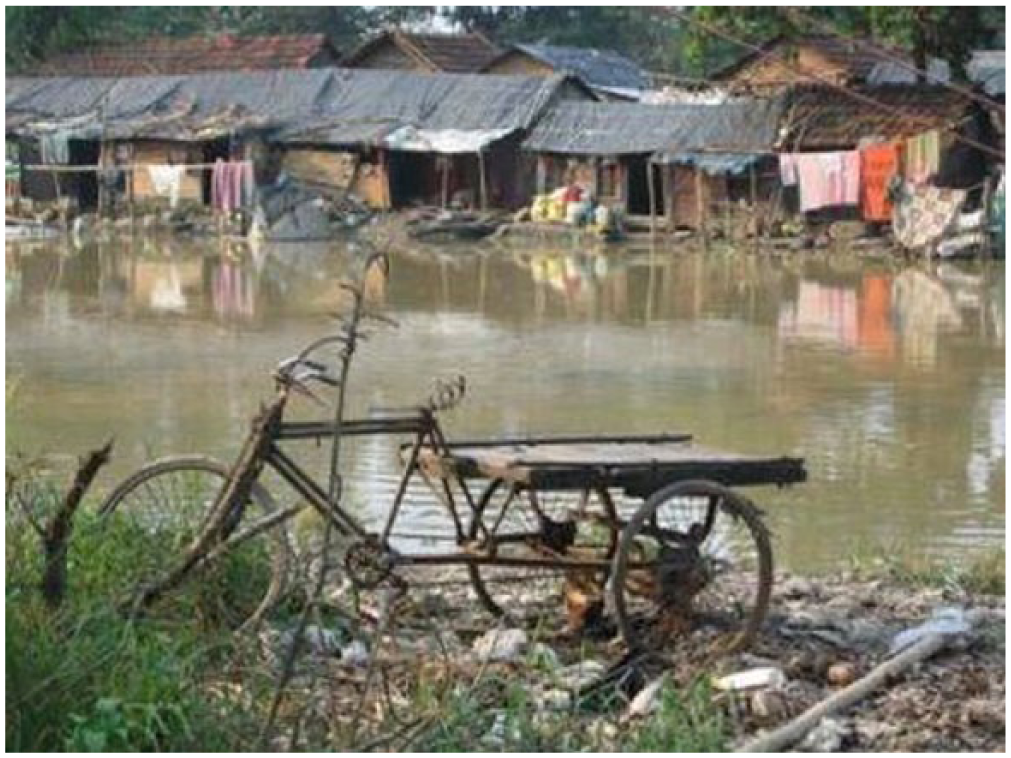
Baisakhi Kheyapar, 2005
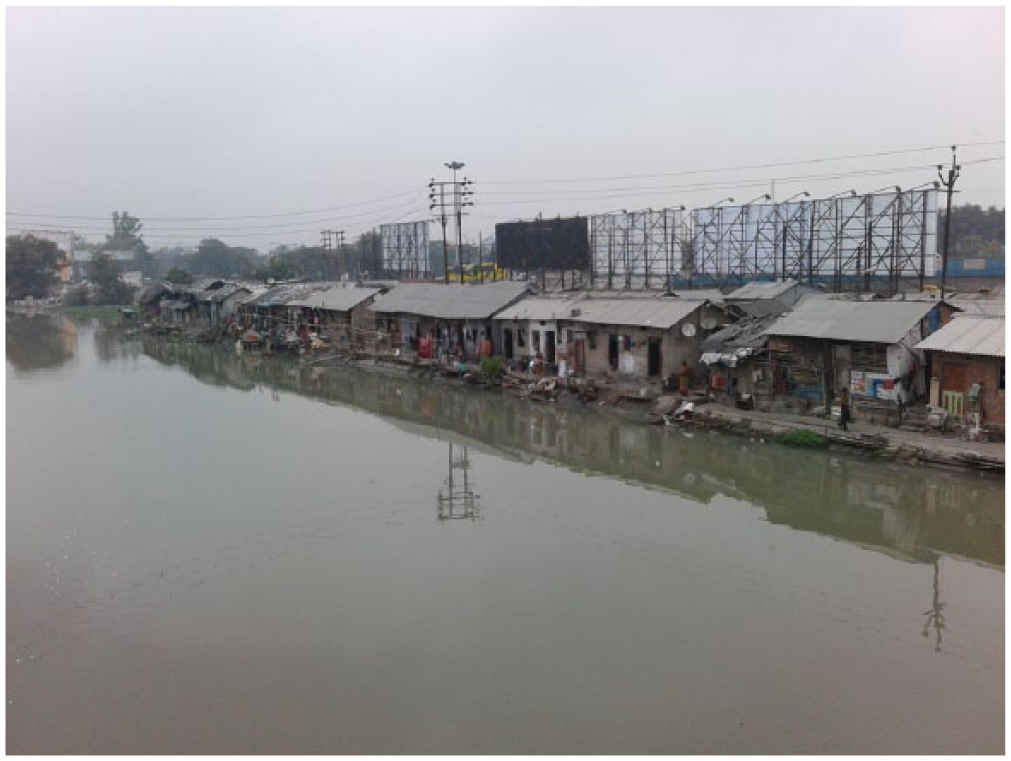
Baisakhi Kheyapar, 2016
Rather than a scaling up of the leftist approach of legalization and upgrading, the reverse has happened. The approach stagnated in the face of the sheer scale of informal settlements and then began to be scaled down when assaulted by neoliberal policies. The legalized settlements were able to retain their benefits, while the informal settlements faced the law of the jungle. One wonders which approach really begs to be scaled up if we are to witness the elusive “emergence”, or the transformative change theorized by Nabeel Hamdi.
Until then, it cannot be denied that in the gloomy days of general defeat and retreat, the triumphant emergence of the slime mould from the maze does indeed make an exciting story!