




Abstract
This paper describes the very large numbers of low-income households displaced by development or infrastructure projects in Ahmedabad and their relocation by city government to housing on resettlement sites. It discusses the involvement of the Mahila Housing SEWA Trust (MHT) in setting up the required resident welfare associations (RWAs) in eight of these resettlement sites and the difficulties MHT faced in getting residents to follow the many time-consuming procedures that were necessary. Constraints included distrust by residents of the government agencies and the lack of social networks or leadership structures in the resettlement sites resulting from the housing allocation process, which did not keep neighbours or communities together. The city government’s objective for the RWAs was not to support participatory governance or facilitate improvements in the lives of resettled dwellers but to pass on the costs, maintenance and management responsibilities of the resettlement sites to these associations.
Keywords
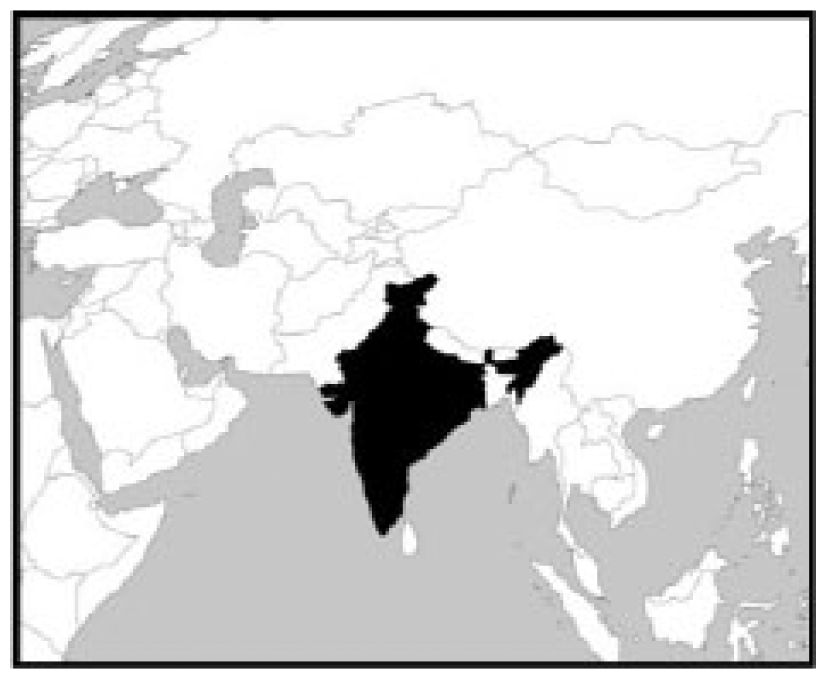
I. Introduction
The scope for, and responsibilities of, local-level governance in India have been expanded by a number of factors: economic liberalization, the increased role of the private sector in service provision, the adoption of decentralized measures of urban governance through promulgation and partial implementation of the 74th Constitutional Amendment Act, and the mandatory reforms of Jawaharlal Nehru National Urban Renewal Mission (JNNURM).(1) These responsibilities include the funding and maintenance of services by (any one or more than one of) the private, non-profit and people’s sectors in urban India. The private sector in this context is defined to include the informal as well as formal sectors, large firms and small local firms; the non-profit sector includes a variety of non-governmental organizations (NGOs); and the people’s sector includes both community-based organizations and individual actors.
The 74th Constitutional Amendment, backed up by the JNNURM reforms, mandated the formation of Ward Development Committees as local institutions of governance (which, however, have not been institutionalized in many states(2)), and this has given rise to a plethora of arrangements for local development and management. Largely, it has resulted in the growth of middle-class activism through resident welfare associations (RWAs)(3) as partners in the development process of cities(4) – and along with it, an elite capture of urban governance, as the local state comes under pressure to act in the favour of these organized citizens’ groups, often to the detriment of the urban poor.(5) This trend has been supported not only by local government-led progammes such as the Bhagidari(6) scheme in New Delhi and the Advanced Locality Management Programme(7) in Mumbai, but also by private agencies and other civil society organizations (CSOs) engaged in urban governance, such as the Bangalore Agenda Task Force.(8)
As mentioned above, the functioning of these RWAs is largely concentrated in the middle and upper classes of society and tends to exclude the urban poor from the development process of cities. This exclusion leads to inequalities in the development process, which reinforce segmentation within cities. While some kind of semi-formal or formal association may exist within some urban poor housing settlements, these groups tend to be dysfunctional at present for multiple reasons. These include the low organizing capacity of the poor; their inability to devote time to local governance issues in the daily struggle to earn a living; their lack of legal ownership of land, affecting their sense of belonging; their illiteracy and lack of financial capacity to engage in managing local affairs; the social fragmentation in informal settlements; and above all residents’ fear of local strongmen who exert total control over local functioning. In addition, local governments are unable to accept the RWAs, if any, of urban poor settlements that they consider illegal, an important reason for their lackadaisical support to them. In contrast, local governments tend to lend enthusiastic support to upper- and middle-class RWAs. Although RWAs are sometimes formed within urban poor settlements with the help of intervention from NGOs or CSOs, organizing and mobilizing the urban poor into this collective form of participation involves considerable time and effort.
In the context of this dismal scenario in slums(9) across India’s cities, this paper discusses one of the cases of the formation of RWAs at relocation or resettlement sites in the city of Ahmedabad, where housing has been constructed under the Basic Services to the Urban Poor (BSUP) component of the JNNURM. Impractical as it may seem, the BSUP guidelines have mandated the setting up of RWAs to support the participation of programme beneficiaries.(10) This is the first time that the need for RWAs in a resettlement programme has been recognized and included in policy by the national government. The RWA’s role in the programme is envisaged by the government at every stage of implementation – pre-construction, construction and post-construction – for full recovery of operating and maintenance costs of existing infrastructure services in order to ensure their longevity.(11)
This paper describes the complexity in the formation of RWAs in relocation sites in Ahmedabad, despite the involvement of a local NGO, the Mahila Housing SEWA Trust (MHT). The local government, namely the Ahmedabad Municipal Corporation (AMC), despite the BSUP mandate for establishing RWAs from the beginning of the process, only thought to set them up after construction of housing on the relocated sites was completed and the dwelling units had been allotted to those displaced. Realizing its own incapacity to take this on, and in the absence of any relevant local governance structure such as a Ward Development Committee, the local government decided to involve the two NGOs working on urban housing issues in the city, MHT and Saath. MHT and the resettled sites it managed were selected for the study described here because of the former’s presence in more than one of these sites (Figure 1), and because the organization was keen to share its experience with a larger audience.
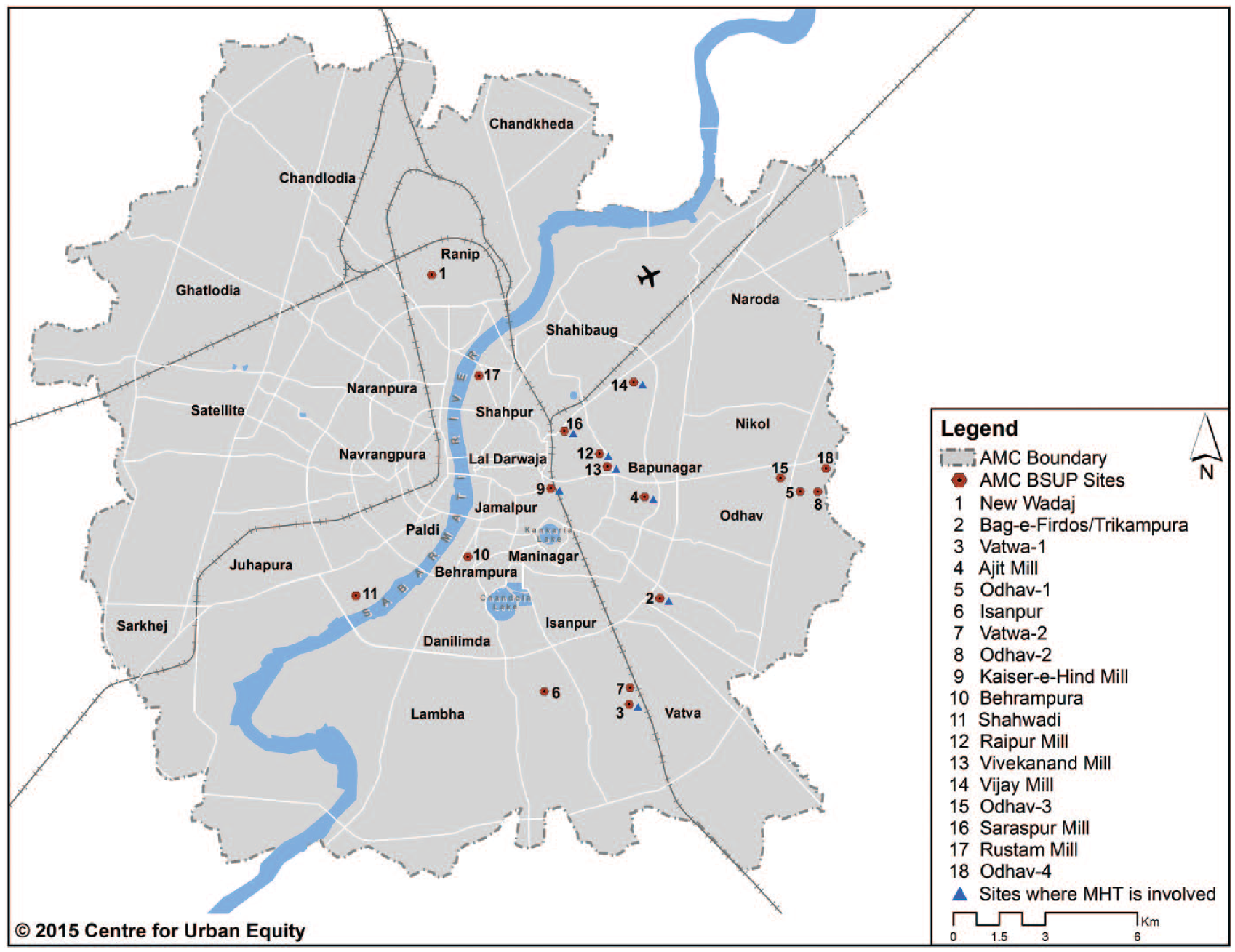
Location of BSUP sites in Ahmedabad
MHT was given the task of community mobilization by AMC at two BSUP housing sites – Ajit Mill and Bag-e-firdos in September 2009, followed by six other sites in May 2012. The scope of its work included forming and registering RWAs, educating the beneficiaries on the necessary operation and maintenance of basic services, informing beneficiaries of the cost of services and then collecting the payments, and providing general support for social and community development activities at these sites over a period of two years. The NGO also had to ensure that the relocated dwellers continued to live in these sites and did not sell or rent their allotted dwelling units. This last task was important given that many beneficiaries were moved to the resettlement sites under duress, as these sites were distant from their former settlements.(12) Until the RWAs were formed, AMC bore the operation and maintenance expenses, the electricity charges for pumping and distributing water from the bore-wells, and the costs for the lighting of common spaces and all necessary repairs. The plan was to pass on all these functions and their costs to the RWAs once they were formed. MHT was paid a fixed consulting fee for its work, based on the expectation that the work would take two years to complete.
The study on which this paper is based covered all eight sitesallotted to MHT. Qualitative methods were used to understand the formation of the RWAs and bottlenecks in the process. Besides interviews with the four involved MHT staff, focus group discussions were conducted separately with the leading members of the RWAs in each resettled site and with other occupants of these sites. The mobilization meetings organized by MHT for the occupants of these sites were also attended. The paper aims to describe the entire process of formation of RWAs, taking account of challenges in the process of resettlement and difficulties faced by MHT in fulfilling the task of community mobilization for long-term maintenance of the site. Since MHT had no formal standing or real relationship with the resettled families, the goals of community participation, whether in form or spirit, were not realized. This remained a technocratic exercise. These RWAs were not indigenously formed, as in case of the middle-class localities. Although it used the rhetoric of community participation in the formation of the RWAs, the NGO could only simply pass on the responsibilities of post-project management to the disparate displaced groups without adequate mobilization or support.
The second section of this paper provides some background on Ahmedabad and the relocation process under study. The third section describes the process laid out for the formation of RWAs on the resettlement sites and the fourth section presents the actual process followed in practice, describing the bottlenecks along the way. The final section presents the lessons from this process in Ahmedabad City, questioning the intention of the local government to genuinely facilitate improvement in the lives of the resettled slum dwellers.
II. Background of the Relocation Process
Ahmedabad, the largest city of Gujarat State, had a population of 6.3 million in the urban agglomeration area in 2011. It has undertaken many large infrastructure projects since 2006, including the Sabarmati Riverfront Development (SRFD), the Bus Rapid Transit System, Kankaria Lakefront Development and general road widening. These projects have resulted in the displacement and resettlement in more than 18 BSUP sites of close to 20,000 households, of which 11,000 had lived on the riverfront.(13) While the estimated number of allotted dwelling units is known, the number of those who were not included in the resettlement process is unknown(14) for many reasons, including the lack of an initial survey of households living on the original sites, confusion around the definition of a household(15) and a rehabilitation policy stating that one house per household was to be allotted. BSUP housing typically consists of four- or five-storey buildings (Photo 1), with 32 dwelling units(16) in each block. The resettlement process was started in 2009 by AMC.(17) Resettlement sites are predominantly in the eastern part of Ahmedabad, with a handful in the western part (Figure 1).
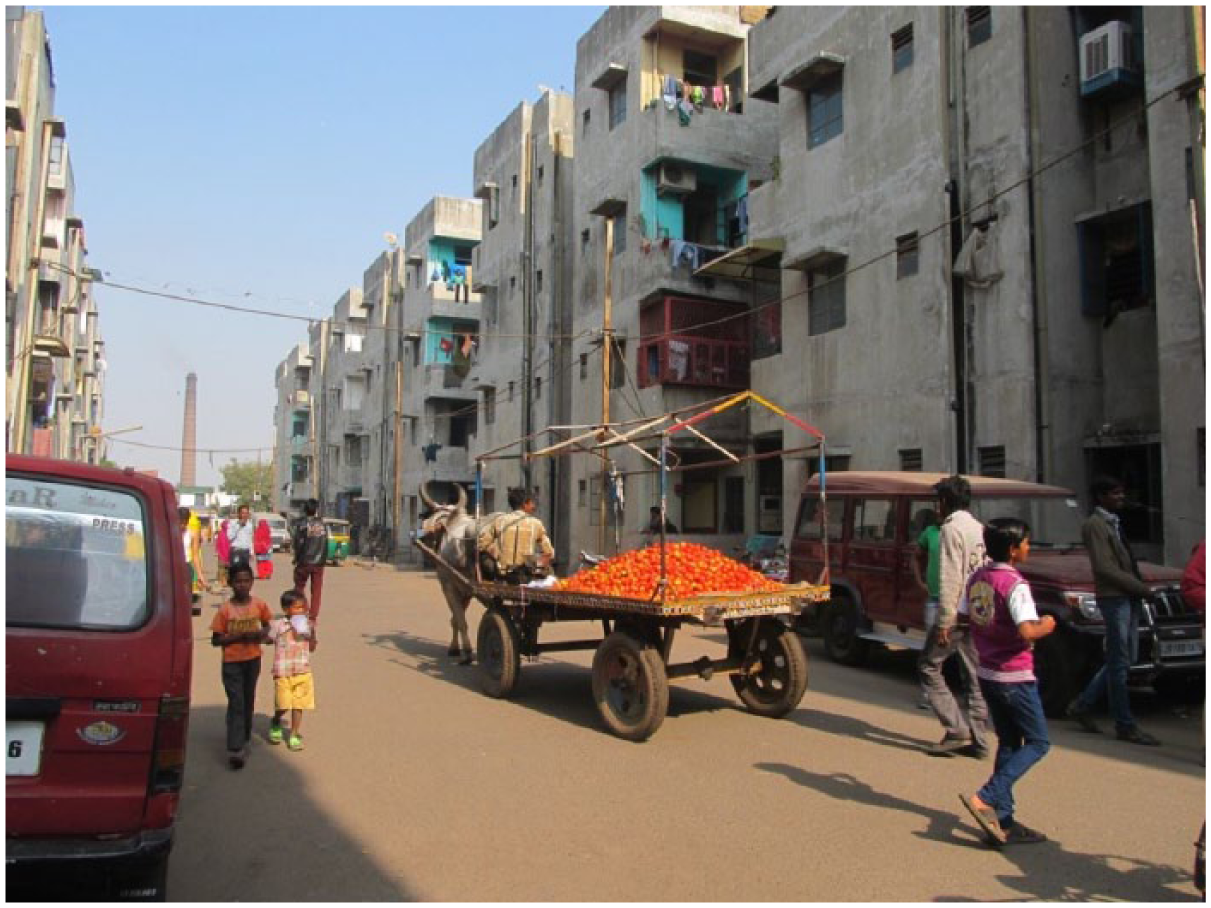
BSUP housing – Ajit Mill
Surveys by the Sabarmati Riverfront Development Corporation Limited (SRFDCL), a special purpose vehicle established for the SRFD project, identified 11,000 slum households to be resettled.(18) Identification of beneficiaries, along with collection and verification of their documents, was done by AMC, with the locally formed Sabarmati Nagrik Adhikar Manch (SNAM – consisting of local leaders from many different riverfront settlements) playing a greater or lesser role at different times. AMC provided resettlement to the evictees from the riverfront in response to public interest litigation filed in the Gujarat High Court,(19) which ordered a stay on evictions without alternative housing.
Various AMC departments and agencies were involved at various stages in the resettlement process. AMC’s Housing Department tendered out housing construction to private contractors, and the allotment of dwelling units to the approved beneficiaries was managed by SRFDCL. Those displaced by other infrastructure projects in the city were allotted units by the Estate Department of AMC through a computerized draw system devised by AMC, after which documents related to the allottees’ eligibility were collected and verified. Acceptable documents to prove eligibility for resettlement were ration cards, voter identity cards, driving licences, bank passbooks, passports or any other form of identification with the claimant’s address and photo. Ration cards do not have a photo but could be supported by another document with a photo of the household head. These documents carry a date, which would prove that the claimant was resident at the demolished site. A cut-off date for the inclusion of the household in the list of applicants was set out by the agency/authority responsible for resettlement.
The resettlement process in Ahmedabad entailed first the allocation of the dwelling unit and then the verification of the eligibility of the household. If a household allotted a dwelling unit was unable to produce evidence of eligibility, that unit would fall vacant and come up again in the next draw. The computerized draw of allotments mixed households from all the sites, and hence residents from one evicted site could end up in a number of different resettlement sites, and one resettlement site could have evictees from multiple eviction sites. This was a sure source of disharmony, which made formation of an RWA extremely difficult. A better approach would have been allotment of dwelling units after the verification of documents of the affected households’ residency at the evicted sites, with evictees of one site moving to one resettlement site.
After the allotment, beneficiaries had to make an initial payment, consisting of the beneficiary contribution and NGO fees.(20) AMC had arranged to link the households with a bank to obtain a loan for the amount required as the beneficiary contribution. At no point during the planning or construction stage was community participation involved, in spite of the BSUP guidelines. The resettlement process described above would have made such participation difficult. Thereafter, allotment letters were given to the beneficiaries by AMC’s Estate Department and the SRFDCL. Changing floors was possible and granted upon submission of an application by the beneficiary. The computerized draw system led to a large number of vacant units in each block, when people were found to be ineligible due to a lack of acceptable documents. Further, the allotment process took two or three years after construction was complete. Security lapses and the Estate Department’s failure to keep track of non-allotted units contributed to vandalism and encroachment, and metal frames of doors and windows were stolen from blocks with vacant units. By the time all allotted units were occupied, the site infrastructure such as water pipelines had also begun to deteriorate, calling for reinvestment from AMC. The residents had begun to lodge complaints with AMC around repair and maintenance issues, which were most often not heeded. There was an atmosphere of mistrust and anger, especially on the sites at a distance from residents’ former settlements. It was in the context of this social complexity and these difficult conditions that MHT was invited to form RWAs.
III. Formation of Rwas: The Process
The process of community mobilization commenced sometime after the relocation was completed. In legal terms, the RWA is a cooperative housing society, a form popular in Ahmedabad, comprising all the allottees at each BSUP site. This society is registered by the Ahmedabad District Co-operative (ADC) Union, as prescribed in the by-laws of the Gujarat Co-operative Societies Act, 1962.
This cooperative housing society or RWA has a core committee of 11 members,(21) who handle the day-to-day affairs of the site and deal with government organizations and NGOs as and when required. The RWA is required to have a registered address; maintain the accounts of its members’ maintenance contribution to the cooperative; record proceedings of its internal meetings; have these records duly certified by the ADC Union from time to time; conduct annual audits; convene monthly meetings with residents regarding upkeep; and hold an annual general meeting with the ADC Union officials. The society’s account has to be held in ADC Bank, which provides an annual income and expenditure statement to the RWA. An AMC official would be nominated to work with each RWA to monitor and ensure its smooth operations. Among the core committee members, only the president, secretary and treasurer are vested with the power to make decisions pertaining to the RWA’s finances. Other dwelling unit owners, not part of the core committee, are nominal members of the RWA.
The number of RWAs in a settlement varied by its size – for instance, the smallest of these eight sites was Kesar-e-Hind Mill, consisting of six blocks with 192 dwelling units; the largest was Sadbhavna Nagar, Vatwa, consisting of 77 blocks and 2,464 units. The jurisdiction of each RWA was decided based on the dwelling units served by one bore-well/underground water storage tank (UGWT). This was because the RWA’s duties included managing water distribution and minimizing conflicts arising around this, as well as problems arising during fund collection for any repair work. Sadbhavna Nagar, for instance, had six UGWTs, which led to formation of six RWAs, with the units served by each UGWT becoming members of that particular RWA.
There were several steps in the formation of the RWA for any BSUP site:
Identifying 11 members of the core committee. Members were selected to ensure equal representation from all blocks under an RWA.
Submitting application forms for formation of the RWA along with requisite documents to the ADC Union.
Collecting shareholder fees(22) (around INR 255 [US$ 4]) from all core committee members.
Opening a bank account (a non-interest paying current account) in the name of the RWA in the main branch of ADC Bank.
Collecting shareholder fees from remaining dwelling unit owners while awaiting the RWA’s registration number. These funds would be deposited in the RWA’s bank account to meet its financial needs in future.
Making seals for the top three designations (the president, secretary and treasurer) and a letterhead for the RWA with their names, after getting the registration number of the RWA.
Transferring the RWA’s current account from ADC Bank’s main branch to any other branch of the same bank located closer to the site and converting it to a regular savings account to enable the RWA to earn interest on the funds.
AMC and MHT handing over the RWA to the residents of the particular site, after which the RWA would be responsible for the upkeep of the site.(23)
IV. The Process in Practice
After moving to the BSUP sites, people were troubled by the unavailability of basic facilities. The lack of involvement of community residents during planning stages also meant that certain modifications or additions were needed within the sites. The livelihoods of many were affected, as limited alternative job opportunities were available around most of these sites. Many people had to travel long distances back to their original workplaces, located near the riverfront. Vulnerable groups and women in particular faced problems in these sites due to a lack of security and safety. Relocated residents continued to identify themselves with their original localities on the riverfront. It took a long time for people to accept the new reality. The de facto formation of new heterogeneous communities, as explained before, led to alienation, a lack of communication and interaction, and a vacuum in leadership. The leaders from the original localities were most often not available now to assist the people at these sites. Many disputes arose because of community differences, personal problems and frustrations, stemming from the feeling of being uprooted from the place where they had lived for generations.
Given these challenges, an immediate task for MHT, after receiving the work order from the local government, was motivating people to adapt to their new locations. On the original sites, the people had lived at ground level. This transition to four-storeyed buildings was difficult. Common sights at the new buildings were residents throwing waste directly from upper floors or into common corridors or common plots, water taps being left open, and fights breaking out because of low water pressure. Initially, most efforts of MHT were focused on behavioural change and took the form of training programmes, rallies, health camps and immediate conflict resolution. This was challenging for MHT, whose focus until then had been limited to facilitating access to basic services in slums lacking such services. This was the first time that MHT had worked with households that already had access to basic services and on community development issues for post-project operations and maintenance.
After procuring the official beneficiary lists for these sites from AMC, MHT started a door-to-door verification check, recording details of rented, vacant and closed units, and found many vacant units to be vandalized, illegally usurped and then self-occupied or rented by some locally powerful individuals (called strongmen earlier) without the knowledge of AMC or SRFDCL. Many residents complained of illicit activities (such as the sale of drugs or alcohol(24)) being carried out in these vacant units, especially in the larger BSUP sites. In June 2013, the local government started a special drive to oust these illegal occupants and seal off the vacant units.(25)
General meetings were held at the sites to create awareness among residents about the process of RWA formation. The idea was to bring people to one platform and facilitate interaction among them. In most of the sites, people who came from the same former community or who had known each other before interacted with each other but were unwilling to join with others to form RWA groups. Many did not come to the meetings. Each meeting was attended by different people, which meant that discussions had to be repeated and the process of RWA formation was stalled. It proved to be a time-consuming process for MHT to expedite the RWA registration process, ensuring fair representation of residents who were well-informed about its objectives.
To form a representative core committee, members from each block on the site were selected in a consensual way. There was a limited pool of residents, given the number of vacancies in each block, but even these residents were often unwilling to become committee members. There was also the threat of local touts – self-appointed “leaders” (called strongmen earlier) – stepping up to resolve residents’ issues and finding their way into the RWAs, at least in larger sites. There were also cases where selected members withdrew from the core committee on the grounds of caste differences and refused to coordinate with other residents. Hence, significant time on the part of MHT was consumed in cajoling and convincing residents to become, and remain, committee members.
After the 11 core committee members were identified, the RWA was registered with the ADC Union. The core committee members’ shareholder fees were deposited in a bank account in the main branch of ADC Bank, opened in the name of the respective RWA. RWAs in Ajit Mill and Bag-e-firdos were named by their residents after their local leaders or saints, but the other BSUP sites were named by the local government, which wanted to avoid saints’ names since most sites had mixed religious communities. People by and large accepted the names selected by the government since any subsequent modifications would have led to the forfeiture of their deposited shareholder fees.
It took considerable time to register the RWAs, given the low literacy rates and financial insecurity of residents, as well as their uncooperative behaviour. The ADC Union was apprehensive about the very idea of forming RWAs in these sites. They adhered stringently to the established requirements in terms of details, necessary documents and member strength for forming an RWA, and MHT had to constantly ask committee members for valid documentation, as well as furnishing necessary documents for these sites from the local government. At many sites, selected members refused to participate and sometimes threatened to withdraw from the committee when they were pressed.
While they awaited the registration number of the RWA from the ADC Union, MHT conducted door-to-door drives to collect shareholder fees from the remaining unit owners. This process was also difficult. Many owners were not at home when MHT members came by; when the absent owner was a man, his wife was often reluctant to pay. Sometimes the unit had been rented out, and tenants were asked to inform the owner about the need to pay the fee; sometimes the unit had even been sold to a new owner.(26) Illiteracy also deterred people from paying the shareholder fees. Miscommunications and misunderstandings about the RWA’s regulations and functions also delayed the process. Residents who had amicable relations with MHT or the RWA president might be conversant with the regulations and cooperative about the process. Others, having strained relations, might fear that they were being duped, or that their money would be misused. Overall, the collection of shareholder fees proved to be a herculean and tedious task for MHT. To allay the fears of the residents, they decided to provide a receipt, signed by the respective RWA president, upon shareholder fee payment. The residents were advised to retain this receipt, which would have to be presented to AMC in the future after repayment of their bank loan. (As discussed above, AMC arranged with the bank for loans to households for their beneficiary contributions.)
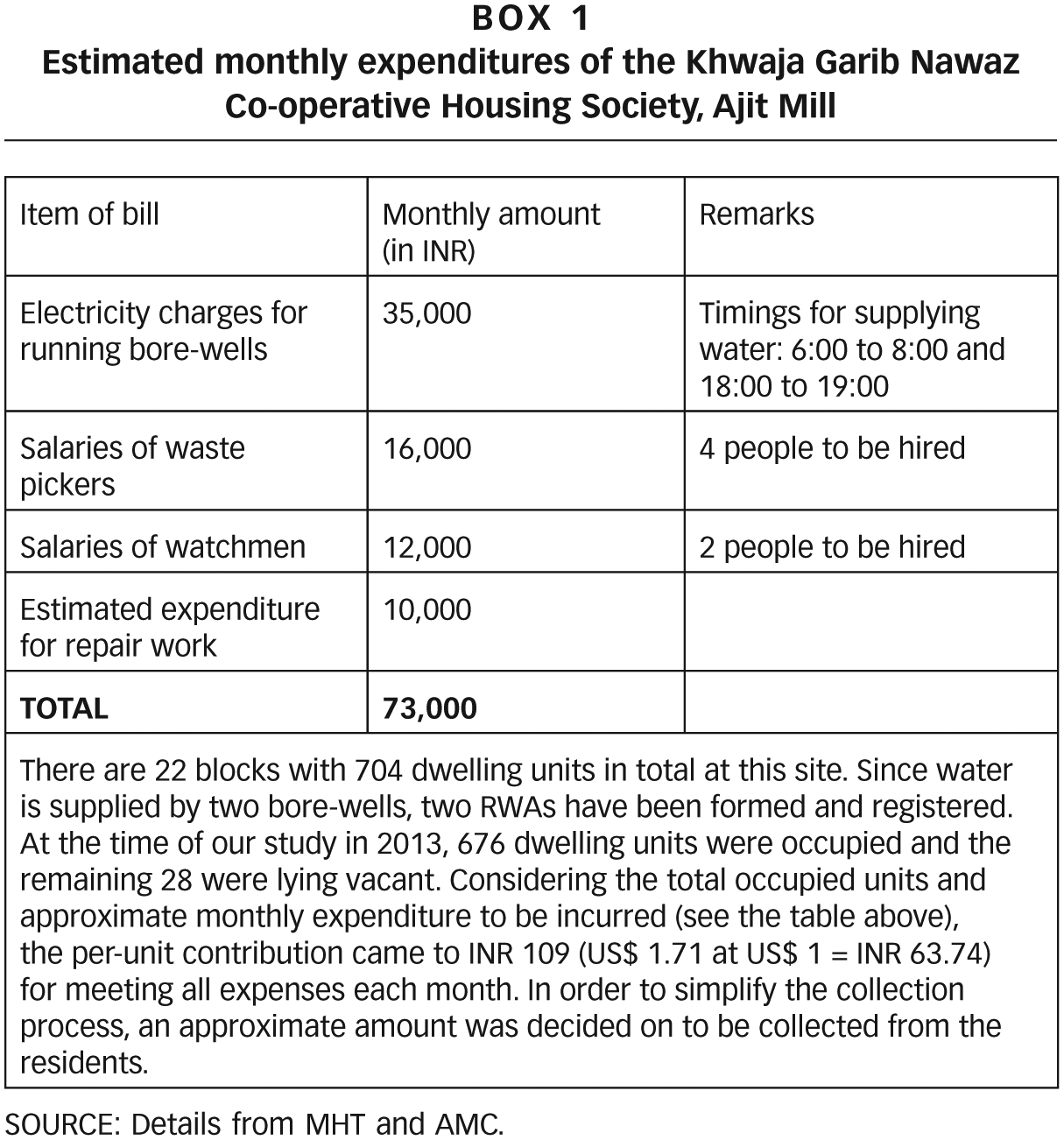
Residents’ contributions towards operating and maintenance expenses were calculated for each BSUP site, based on the expenditure of AMC on the infrastructure at that site. (See Box 1 for a description of one RWA.) These contributions covered the salary of a person hired to turn on water each morning or evening to fill the overhead or underground water tank, cost of the electricity for the pump, common lighting, garbage collection, sweeping of common areas, replacement of any faulty fixtures and so on. The operational time of the bore-well was to be decided by the residents, depending upon their usage. The RWA members and residents were repeatedly informed by MHT about these costs, and in the event of default on these fronts, the residents would eventually have to face the consequences.
While the schedule for completing the scope of work in the first two allotted sites was two years, it was only after three years that Ajit Mill’s RWAs received their registration numbers from the ADC Union, and the responsibilities of the RWAs were hastily handed over to their members without complete collection of shareholder fees from all unit owners. The uneven coverage of MHT’s awareness programmes, the size of the BSUP sites, the fears and illiteracy of residents, the limited leadership skills of the selected committee members, the withdrawal of some committee members, the mistrust between residents and committee members, the lack of community harmony, the financial insecurity of residents and their lack of cooperation in the process have all contributed to extending the whole process well beyond the stipulated timeframe of two years.
At the time of this study, the local government, which had been paying the operating and maintenance charges for all sites since the relocation began, was in the process of withdrawing from this responsibility and shifting these costs onto the residents to reduce its own financial burden. This led to additional pressure on MHT to expedite formation of RWAs at these sites. Vandalism on many sites had resulted in the need for immediate repairs of infrastructure, which the local government had not responded to despite receiving repeated complaints. Residents felt that, despite having paid their shareholder fees to the RWA, and their individual electricity bills and house taxes, they did not own their unit legally (since they only had their allotment letter as proof); nor were their grievances around infrastructure services being addressed. They were apprehensive about their capacity to pay high amounts for the various charges and feared that once the day-to-day responsibility of running the site fell to them, the authorities would simply shrug off their remaining responsibilities. At many sites, the residents were expressing their grievances through massive protests or hunger strikes. This conflict-ridden situation could have been avoided if the resettlement had been well planned, if MHT (or another NGO) had been involved from the beginning, and if the whole process had actually followed the BSUP guidelines and shifted the operating and maintenance charges more gradually onto the residents.
V. Reflections
The main problems faced at different levels in the BSUP sites were:
A lack of clarity within local government with regard to their strategy and the mechanisms of the resettlement process and RWA formation. The hindrances experienced along the way were not expected and MHT had to find its way as it went along. The local government had started the whole RWA process without building a basis for trust, as the resettlement process itself had not been well managed.(27) If the on-site physical infrastructure at the new sites had been trouble free, this would also have built trust among the resettled households, making the task of forming and then operationalizing the RWAs easier.
An absence of interest in the registering authority. Registration of RWAs for resettled people has not been an area of interest to the ADC Union owing to the poor financial, educational and participation levels of this sector of the population.
To set up RWAs in the settlements occupied by low-income households or in slums and later pass on the entire responsibility for governance on to them is an onerous and tedious task, even with the intervention of an external agency. While on one hand the involvement of an external agency can indeed help in the mobilization and motivation of residents, if that external agency has no roots within the community, it leads to more mistrust and conflict than help in promoting local governance. It was a good policy decision by the local government to bring in MHT, which had longstanding experience of working with slum dwellers, to set up RWAs on the resettlement sites. But local government appears to have done this more with the idea of passing the buck and extricating itself from the responsibilities of managing the rehabilitation sites, than with a genuine desire to equip residents to take on these responsibilities. The process of RWA formation was envisaged by AMC to take two years and the funds given to MHT reflected this duration. But the task took longer than expected and no additional payment was made to MHT. This strengthens the argument that AMC was instrumental in setting up the RWAs not because it wanted a representative group at community level to assist in local governance but only to pass down its responsibilities. RWAs formed in this way do not become a local tier of urban governance.
For the NGO engaged, it is essential to be transparent in the processes undertaken and adopt a strategy to build strong, trustworthy relations and a widespread interactive network with the residents. Fair and transparent methods for selecting core committee members, such as elections in the presence of the NGO, local authority or ADC Union representatives (as monitoring arbitrators in case of any disputes or discrepancies) is essential. Proceedings of the selection process should be transparent to all residents living in the site. Given the vulnerability of residents, the presence of leaders with vested interests in the core committee of the RWA (if any) could mean that money might be extorted from residents without justification. Hence, the utmost care should be taken in selection of the committee members.
From a larger perspective, the scenario could have been very different had community participation been involved in the initial stages – listing households for resettlement, planning the BSUP sites, setting up a process of transfer to resettlement sites and, above all, in the process of allotment. All these would have infused a sense of ownership of the process as well as of the new site. The task is onerous and time-consuming, and an adequate time period for this has to be set. All these steps would have aided in the formation of RWAs post-settlement as well as minimizing conflicts within the sites and strengthening community ties. Arguably, AMC could then more easily have shifted the resettlement site maintenance to the new residents.
Though the idea of forming RWAs within urban poor settlements has not yet worked successfully, the attempt to organize relocated people at these BSUP sites through this structure is a commendable one. How effectively these RWAs might be able to address their primary objective (i.e. the upkeep of their sites) without any backing from the local government will become clear with time. Given the fact of their daily struggle for existence, it would be unrealistic to expect the RWAs of the urban poor to be able to participate in discussions on larger development processes the same way that middle-/upper-class RWAs do. Also, the very idea that the local authority can disengage completely in terms of any support/intervention in the RWA’s functioning at these sites may not be practical or lead to the envisaged results. Finally, the top-down establishment of a participatory process, at the behest of the local government and through an external agency such as a NGO, is challenging at best, and should respect the community as well as the NGO in the process. The goal should be genuine decentralized governance and not passing the buck to the most marginal of urban populations.
Footnotes
1.
This includes mandatory adoption of the Community Participation Law (CPL), through which the Community Participation Fund (CPF) designed to encourage community-based participation in urban governance can be accessed.
2.
Mahadevia, D (2010), “Urban Reforms in Three Cities: Bangalore, Ahmedabad, and Patna”, in V Chand (editor), Public Service Delivery In India: Understanding The Reform Process, Oxford University Press, New Delhi, pages 226–295.
3.
Also referred as “neighbourhood associations”. See Smitha, K C (2010), “New Forms of Urban Localism: Service Delivery in Bangalore,” Economic & Political Weekly Vol XLV, No 8, 20 February, page 73.
4.
Kundu, D (2009),”Elite Capture and Marginalization of the Poor in Participatory Urban Governance: A Case of Resident Welfare Associations in Metro Cities”, in India Urban Poverty Report 2009, Ministry of Housing and Urban Poverty Alleviation, Government of India, pages 271–284.
5.
Kundu, D (2011), “Elite Capture in Participatory Urban Governance”, Economic & Political Weekly Vol XLVI, No 10, 5 March, pages 23–25; also Kamath, L and M Vijayabaskar (2009), “Limits and Possibilities of Middle Class Associations as Urban Collective Actors”, Economic & Political Weekly Vol XLIV, Nos 26 and 27, 27 June, pages 368–376.
6.
The word bhagidar means partner. Launched in 2000, the majority of RWAs and market traders associations were registered with the Delhi government as partners under this scheme.
7.
An initiative by citizens of Mumbai and Municipal Corporation of Greater Mumbai (MCGM) officials to address the issue of waste management in the city.
8.
Ghosh, A (2005), “Public–Private or a Private Public? Promised Partnership of the Bangalore Agenda Task Force”, Economic and Political Weekly Vol XL, No 47, 19 November, pages 4914–4922.
9.
The term “slum” usually has derogatory connotations and can suggest that a settlement needs replacement or can legitimate the eviction of its residents. However, it is a difficult term to avoid for at least three reasons. First, some networks of neighbourhood organizations choose to identify themselves with a positive use of the term, partly to neutralize these negative connotations; one of the most successful is the National Slum Dwellers Federation in India. Second, the only global estimates for housing deficiencies, collected by the United Nations, are for what they term “slums”. And third, in some nations, there are advantages for residents of informal settlements if their settlement is recognized officially as a “slum”; indeed, the residents may lobby to get their settlement classified as a “notified slum”. Where the term is used in this journal, it refers to settlements characterized by at least some of the following features: a lack of formal recognition on the part of local government of the settlement and its residents; the absence of secure tenure for residents; inadequacies in provision for infrastructure and services; overcrowded and sub-standard dwellings; and location on land less than suitable for occupation. For a discussion of more precise ways to classify the range of housing sub-markets through which those with limited incomes buy, rent or build accommodation, see Environment and Urbanization Vol 1, No 2 (1989), available at  .
.
10.
We use the term “beneficiaries” as the BSUP housing is subsidized and when used for resettlement of the project-affected population, the allottees have to pay only 12 per cent of the total cost.
11.
MHUPA (2010), Guidelines for funding various activities related to ‘Project Implementation and Quality Assurance’ and ‘Community Mobilisation’ in respect of BSUP/IHSDP Projects under JNNURM, Ministry of Housing and Urban Poverty Alleviation, Government of India, accessed 5 August 2015 at .
12.
For details of the impacts of such a rehabilitation process, see Patel, S, R Sliuzas and N Mathur (2015), “The risk of impoverishment in urban development-induced displacement and resettlement in Ahmedabad”, Environment and Urbanization Vol 27, No 1, pages 231–256.
13.
Mahadevia, D, R Desai and S Vyas (2014), “City Profile: Ahmedabad”, Centre for Urban Equity Working Paper 26, CEPT University, Ahmedabad, available at .
14.
In the case of resettlement of those evicted from the Sabarmati Riverfront, the leaders of the organization that steered the resettlement process provide a rough estimate of 1,700 evicted households that were not resettled. For the details of this resettlement process, see Mahadevia, D (2014), “Institutionalizing Spaces for Negotiations for the Urban Poor: New Vocabulary for Urban Planning”, in Inclusive Urban Planning, State of the Urban Poor Report 2013, Ministry of Housing and Urban Poverty Alleviation, Government of India, New Delhi, pages 148–166.
15.
A household is defined as sharing a common kitchen. The problem comes when a joint family is to be resettled. The slum dwelling unit is typically an incremental house to which a room gets added when a new married couple is added to the household. The resettlement units are either one- or two-room units, which are a challenge for joint families, which hence tend to claim to be more than one household in the survey. Thus, the exact number of households to be resettled is nearly impossible to estimate. See reference 14, .
16.
Each dwelling unit of 28 square metres consists of two rooms, kitchen, bath and toilet facilities.
17.
No NGO/external agency was involved in the entire process of rehabilitation.
20.
According to BSUP guidelines, 12 per cent of the total project cost was to be beneficiary contributions (approximately Indian rupees [INR] 67,860 in this case [US$ 1,065 as of August 2015]). After paying their initial contribution (which varied from INR 3,260 to INR 7,860 [US$ 51 to 123] for different sites), loans for the remaining portion of the beneficiary contribution were to be provided from banks that were to be identified by AMC in due course.
21.
Selected amongst dwelling unit owners of a particular BSUP site. Tenants are ineligible to be a part of this core committee.
22.
Members of a cooperative society are shareholders in the society. Shareholder fees from the core committee members are used as the initial contribution to set up and register the society.
23.
For upkeep of a site, each dwelling unit within the site would have to contribute a monthly amount to the RWA. See Box 1 for a description of one RWA.
24.
Alcohol is prohibited in Gujarat State – Ahmedabad is in Gujarat State – and hence its sale and consumption without a permit is illegal.
25.
DNA (2013), “AMC ousts 46 of 1K illegal occupants in EWS homes”, 26 June, available at .
26.
As per the guidelines, only after full payment of the beneficiary contribution was sale of the dwelling unit permitted.
27.
See reference 13; also Desai, R (2014), “Municipal Politics, Court Sympathy and Housing Rights: A Post-Mortem of Displacement and Resettlement under the Sabarmati Riverfront Project, Ahmedabad”, Centre for Urban Equity Working Paper 23, CEPT University, Ahmedabad, available at .