




Abstract
Many theoretical urban sanitation planning approaches exist, but there is limited evidence of the successful implementation of these approaches, prompting questions about their suitability, especially in complex urban environments in low-income countries. Using primary and secondary data from Lusaka, Zambia, we explore possible limitations of these theoretical planning approaches in informal peri-urban areas. The findings show that while the “enabling environment” aspects stressed by the literature are weak here, these limiting factors are significantly affected by a poor planning culture and inherent dynamics of power, politics and history. A fuller understanding of the local situation is needed to support the transition of planning approaches from theory to reality, so that real progress in sanitation service delivery can be achieved in complex urban environments.
Keywords
I. Introduction
Although progress has been made globally to improve the sanitation situation for the world’s poorest, there are still an estimated 2.5 billion people who lack access to improved sanitation.(1) In urban environments, the progress made has been outpaced by population growth so that in 2012, 756 million people lacked access to improved sanitation, up from 215 million in 1990.(2) A major challenge in urban areas is for city planners to extend drinking water and sanitation services to reach the cities’ poorest, who are often located in informal settlements characterized by poor site conditions, low income, high population density, lack of legal land tenure, lack of planning, poor infrastructure, and poor access to formal water, sanitation and waste management services.(3) Beyond technical constraints, these areas have tremendous inherent social, political and institutional complexities that can be barriers to the provision of basic services and require specific approaches for planning.(4) Due to the lack of basic service provision in such environments, households are commonly responsible for building and managing their own sanitation needs, which often results in the use of low-quality un-standardized facilities.(5) In sub-Saharan Africa, on-site technologies are used by 65–100 per cent of the urban population.(6) Faecal sludge is often poorly managed, which can create environmental and public health risks; these are intensified in settlements that are unplanned and informal in nature.(7)
Within the literature, a wide range of planning approaches is available to support the implementation of improved sanitation services, specifically targeted for use in urban areas.(8) However, a limited number of case studies are available providing evidence of their successful implementation. This calls into question the adequacy of the existing sanitation planning approaches, especially in complex informal settlements.(9) This paper explores their possible limitations by comparing existing theoretical approaches to the field realities observed during the collection of primary research in Lusaka, Zambia.
II. Existing Planning Approaches for Urban Sanitation Service Provision
The requirement of an “enabling environment” is central to most of the urban sanitation planning approaches that have been developed over the last decade (e.g. Sanitation 21, Community-Led Urban Environmental Sanitation, Household-Centred Environmental Sanitation).(10) An enabling environment is defined by the political, economic, educational, socio-cultural, organizational, technical and legal conditions required for implementation success.(11) The Community-Led Urban Environmental Sanitation (CLUES) planning process, for example, focuses on the following conditions:
The level of government support, in terms of political support and favourable national policies and strategies;
The legal and regulatory framework, with appropriate standards and codes at national and municipal levels;
Institutional arrangements that accept and support the community-centred approach used;
Effective skills and capacity ensuring that all participants understand and accept the concepts and planning tools;
Financial arrangements that facilitate the mobilization of funds for implementation; and,
Socio-cultural acceptance, i.e. matching service provision to the users’ perceptions, preferences, and commitments to both short-term and long-term participation.”(12)
Within the planning approaches that have been developed, the need for situational analyses to clarify the status of the enabling environment and to identify the required improvements is key and makes up part of the planning process.(13) While different approaches focus on supporting the planning process within different decision-making domains (for example, CLUES focuses on the community level and Sanitation 21 on the city level), the need to identify key stakeholders and their roles in sanitation service provision is explicit in all cases, in order to understand upfront the specific interests, priorities and incentives of individuals or collectives. The Sanitation 21 approach further highlights the significant impact that institutional relationships and political economy can have on the planning process. And it points to a need to gain an understanding of previous investments in service provision and constraints to their success.(14)
Despite the ubiquity of the “enabling environment” framework and planning approaches aimed at achieving success, the almost universal failure to achieve the required “enabling environment” is a common theme throughout urban sanitation literature and within the limited number of case studies and evaluations available.(15)
Beyond these urban sanitation planning approaches and frameworks, there are also discussions of the need both in the sanitation sector and beyond for a clearer understanding of the role of power and politics. Abrams(16) and the Institute of Development Studies(17) indicate that water and sanitation-related activities are undertaken within complex political contexts, that a greater understanding of the political nature of these activities is required and that political expertise should be included as part of the capacity of the planning team. Clement(18) proposes the need for better consideration of the historic, social and political context in which communities, institutions and individuals operate and of the role that power and vested interests take in the development of institutions and rules implemented. Similarly, in their analysis of the evolution of the political economy sector, Hudson and Leftwich(19) argue that to achieve sustainable outcomes in development, the structures and institutions of power and the agents (individual or collective) who control them or who are controlled by them must be understood. Previous studies in Zambia highlight the effect that politics can have on sanitation interventions; however, its dominance (along with power) as an inhibiting factor to success in informal settlements has previously not been discussed in much detail.(20)
The research reported on in this paper, drawing upon primary data, questions the adequacy of current urban sanitation planning approaches in Lusaka, Zambia, in terms of their ability to assess situations and identify bottlenecks that need to be overcome so that an “enabling environment” can be created.
III. Context
Lusaka is the capital city of the Republic of Zambia. The population of Lusaka Province was recorded in the 2010 census at approx. 2.2 million with an annual growth rate of 4.7 per cent.(21) Most population growth has occurred in informal settlements (defined in Lusaka as peri-urban areas – PUAs), where over 60 per cent of the city’s population is said to reside.(22) The current sanitation situation within the city varies between formal and informal settlements. In formal planned areas, predominantly occupied by middle- to high-income residents, sanitation provision consists of the use of the existing conventional sewerage system and on-site septic tanks. Only 10 to 20 per cent of the overall population is served by the sewerage system, however, and the majority relies on on-site systems.(23) Figure 1, depicting the centralized sewerage network, highlights how little of the city it actually reaches. In planned areas, formalized private emptying services operate and provide sludge collection, transportation and disposal services for those with on-site systems.(24)
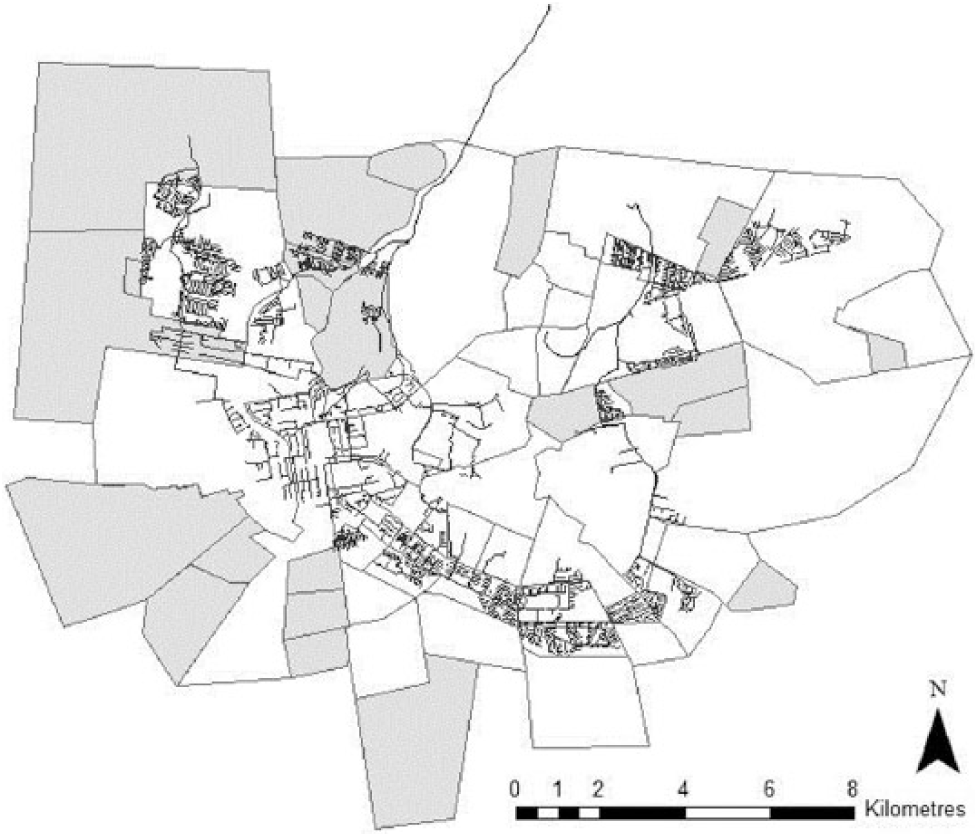
GIS map depicting the location of formal and peri-urban areas and the centralized network in Lusaka
In PUAs, only on-site systems are used and it is estimated that approximately 90 per cent of households use privately owned pit latrines, commonly shared among several households.(25) These facilities, often poorly designed and constructed without reference to formalized design standards, are shown to pose a high risk to the surrounding environment and public health through the contamination of groundwater resources.(26) Waterborne diseases such as cholera occur commonly in PUAs in Lusaka and may be attributed to the poor sanitation situation.(27) Cost and physical access constraints mean the city’s formalized private emptying services are not used in such areas. Instead it is common practice for informal pit emptiers or the households themselves to manually empty the facilities once full and dump the faecal waste indiscriminately, causing further risk to the environment and to public health.(28)
Historically in Zambia, a one-party political system based on socialism was in place. Constitutional change occurred after 1991 (caused by pressure from the population) and a multi-party government was implemented.(29) Policies introduced by this government included the liberalization of the economy and reforms to the entire public service management system.(30) As a result of these reforms the Ministry of Local Government and Housing (MOLGH) became the organization with the overall mandate to coordinate urban sanitation for the whole population through local authorities. In the case of Lusaka, the local authority created the commercial utility, Lusaka Water and Sewerage Company (LWSC), to manage both urban water supply and sanitation service provision on its behalf.(31) Within LWSC there is a specific Peri-Urban Department that deals with the management of water supply and sanitation in PUAs. This department has predominantly focused on the provision of water supply in PUAs (either through LWSC directly or through community-based organizations) and limited sanitation service provision has been implemented. In cases where sanitation provision and pilot projects have been implemented in PUAs, these have been led by non-governmental organizations. However, in recent years LWSC has expressed its commitment to sanitation access in these settlements, as demonstrated by the recent introduction of a sanitation levy and the implementation of two pilot projects, one focusing on providing sanitation services through faecal sludge management(32) and the other through a condominial sewer system.(33) While there is limited evidence with which to evaluate the success of these pilots to date, their implementation demonstrates that LWSC is becoming more seriously involved in sanitation service provision in PUAs.
The current absence of sanitation service provision and the high rate of population growth in these PUAs mean that they provide an ideal opportunity to explore the possible causes of inaction or the failure of sanitation service delivery where it exists. Lusaka is also an interesting case, as it has recently become the focus of possible donor investments, specifically related to sanitation improvements.(34) The focus on Zambia may be due to its continuous economic growth, ongoing political stability and recent movement into the category of lower-middle income country.(35)
IV. Methodology
This research forms part of a wider collaborative research project funded by the UK Engineering and Physical Science Research Council, aimed at the development of a locally appropriate and decentralized solution for the treatment of faecal sludge in PUAs of low-income countries. This paper is an output of the collaboration and focuses on providing an insight into how inherently complex dynamics at the city, community and household levels affect the development and implementation of such a technology and, more generally, successful sanitation service delivery to PUAs.
During field visits to the city of Lusaka in February–May and December 2013, primary data collection was completed within three distinct decision-making domains within the city: household, community and city. A total of 169 household-level questionnaires and 16 semi-structured interviews with key informants from relevant community organizations were conducted in three PUAs of Lusaka (namely, Chazanga, Kanyama and George). While the data collected are not discussed in detail in this paper, we do triangulate the findings from the household/community level with those at the city level to support the findings of this paper.
Semi-structured interviews were conducted with 36 stakeholders involved in city-level decision making related to sanitation, including individuals from the regulator, commercial utility, city council, university, ministries and various non-governmental organizations. The interviewees were selected using snowball sampling methodology.(36) The interviews were analysed using the thematic coding method outlined by Braun and Clarke(37) and Boeije(38). Secondary data (related to sanitation programming and planning) were also collected and reviewed, and contributed to the triangulation of findings from the primary interviews. The data collected and methods used aimed to provide a qualitative account of the situation to help identify reasons for the existing situation and the lack of progress related to the provision of sanitation service delivery in PUAs.
V. Situational Analysis of Sanitation Service Provision in PUAs of Lusaka
The analysis of secondary data and interviews with key stakeholders from the city-level domain provided novel insights into the current sanitation situation in PUAs of Lusaka, and the dynamics that may be directly related to the current lack of sanitation service provision. These findings will be discussed in relation to the enabling environment criteria outlined above.
a. Government support
The National Urban Water Supply and Sanitation Programme (NUWSSP 2011-2030) in Zambia was developed as the long-term national programme targeted at achieving Zambia’s vision that “every household have access to adequate, clean and safe drinking water and sanitation services by 2030”.(39) While this document outlines a development framework, upon review it is shown to lack clarity and to provide a weak analysis of the existing “enabling environment” and the role of key stakeholders in achieving improved sanitation service provision, especially in complex PUAs.
Another important document is the Sanitation Master Plan for Lusaka, produced in 2011 by external development agencies, the United States Army Corps of Engineers and the Millennium Challenge Account.(40) The aim of this plan was to establish the investment needs of LWSC over a 25-year period and to provide a principal framework for planning investment in the sanitation sector. This document provides a detailed situational analysis of the existing conventional sewerage system and outlines required improvements. However, it contains a much lower level of detail for solutions for PUAs. This Sanitation Master Plan is now being used as the strategic plan for LWSC.
Although national strategies, plans and policies related to urban sanitation do exist in Lusaka, a review of the associated documentation shows they are weak at supporting successful sanitation interventions in PUAs, which is reflected by the limited number of successful projects to date. An LWSC employee remarked: “For planning, each area has investment proposals drawn up for them which highlights where investment is required. They then look at these proposals and highlight the most affected areas e.g. areas with no capacity, cholera outbreak, political influences/pressure.”
This statement indicates that proposals for investment in each area are drawn up internally within LWSC. However, little evidence of such internally developed plans was seen during data collection. Instead, LWSC appeared to rely on the Sanitation Master Plan completed by external agencies. The statement indicates that the way interventions are actually executed may be influenced less by the requirements outlined in plans or in the course of a detailed situational analysis and more by external political activity and pressures. It is clear from the review of available data, including the interviews, that planning of the kind prescribed in the various planning approaches is not actually conducted in Lusaka, which in itself may be a reason for poor service provision to date.
During the interviews, the impact of the lack of political will and high-level support for sanitation in PUAs was also discussed. Interviewees indicated that the current absence of a department at the ministry level devoted to sanitation prompted questions to be raised about who is “driving” these issues from above. Interviewees from Lusaka City Council (LCC) indicated that, overall, there is a lack of will within government to support improvements in service delivery; once individuals are employed in positions of authority they have limited motivation to create change. Another issue highlighted was the difficulty people face in doing their jobs correctly or creating change, as this can get them fired if it is seen to go against the agenda of political leaders. A lack of staff to implement strategies was also highlighted as a limitation.
The impact of power and politics on the success of service delivery and related interventions was a clear theme throughout the interviews. Interviewees indicated that PUAs are “political playgrounds” that are rife with political tension and power struggles. The main reason given was that over 60 per cent of the population live in these areas, causing them to be seen by politicians as highly competitive areas for gaining electoral votes. This is also said to create an environment in these PUAs where precedence is given to any activity (whether legal or illegal) that will improve individuals’ and parties’ political advantage. The all-important decisions regarding land allocation and encroachment in PUAs in Lusaka are controlled predominantly by community-level politicians and political cadres, with limited city-level authority control or support. One political science student from Lusaka indicated: “With the current government this cadre scene is much stronger as their strategy was based on mobilising the unemployed youth…They are struggling with this issue as it is difficult to establish control. The high level politician will state that they want money for the cadres and the cadres then rule the streets.”
Power struggles within political parties were shown to cause internal fractures that can complicate and prevent the implementation of strategies, as stakeholders act within their individual interests rather than with the government, city and community as a whole.
Overall, the findings lead to the conclusion that issues related to weak government plans and strategies, political will and high-level government support may be a major cause of inaction related to sanitation. Interviews indicated that the role and impact of politicians and political activities are significant at all levels of service delivery, that precedence is given to individuals/organizations/interventions that align with political interests, and that there may be negative consequences for those that do not.
b. Legal and regulatory framework
The PUAs in Lusaka have developed in the absence of planning regulations. There are laws that govern how settlements should be developed,(41) outline the obligation of local authorities “to provide water supply and sanitation service to areas falling under its jurisdiction”(42) and define what is required to prevent public health impacts.(43) However, these laws provide inadequate clarity and conflicting legal guidelines for the development and delivery of services in PUAs. There are, for instance, no regulations stipulating how faecal sludge (from on-site systems) is managed, treated and disposed of or how biosolids (treated sewage sludge) should be safely reused or disposed of (after conventional treatment). Interviewees from donor agencies, the University of Zambia and LCC indicated that the recovery of potential resources from faecal sludge/biosolids is unsupported in Zambia, meaning that the collection, transportation, treatment and reuse of faecal waste is not prioritized or enforced by anyone.
The lack of a clearly defined legal and regulatory framework specific to addressing the existing public health and sanitation service delivery issues in PUAs has created a “grey area” for intervention within the city whereby few laws have actually been enforced. This has led to a situation whereby households themselves have developed dwelling and on-site sanitation provisions devoid of planning support, technical standards or construction supervision.
To summarize, the findings indicate that while a legal and regulatory framework exists for sanitation service delivery in Lusaka, the unclear or non-existent regulations relating specifically to planning in the complex environment of PUAs, along with the lack of legislation related to the safe management of faecal sludge and resource recovery, have contributed to the poor level of sanitation access in PUAs. As described in the next section, this problem is compounded by an inability of existing institutions, as a result of their unclear responsibilities and legal status, to create regulations where they are needed or to enforce existing regulations.
c. Institutional arrangements
Currently, few institutions, service providers and regulatory bodies from the city level have a direct presence or continuous involvement at the community/household level in PUAs. The exceptions are the local Ministry of Health (MOH) clinic, Ward Development Committees and Water Trusts – all entities linked (loosely) to intervention and service provision that have a direct link to the community level in PUAs. Without the presence and involvement of structures specifically focusing on sanitation service delivery for these areas, there is limited capacity, weak enforcement, and a lack of resources directed at the grassroots level (household and community level). The functionality, priorities and sustainability of existing community-level institutions and their ability to support sanitation interventions were raised as an issue of concern by a number of interviewees, especially when politicians and political agendas infiltrate and influence such organizations.
The relationship observed between the mandated utility (LWSC) and the community-based organizations supplying water in PUAs (Water Trusts) complicates the situation. Currently, in terms of regulation, the Water Trusts are not recognized legally by the regulator, the National Water Supply and Sanitation Council (NWASCO), and so LWSC is held accountable for water supply service provision in the PUAs. A number of respondents indicated concerns with this arrangement and the effect it has on service provision, enforcement of standards and control within PUAs. An LWSC employee noted: “The setup of Water Trusts had implications on LWSC as they were very much their own entity that LWSC had little control over. The Water Trusts see LWSC as an outsider and although this relationship has improved it has been a challenge.”
Although this arrangement does not currently have direct implications for sanitation provision, LWSC employees indicated that in the future the Water Trusts may be the main institutional bodies they collaborate with at the community level to implement sanitation service delivery.
The performance and enforcement capabilities of institutions were shown to be further affected by people’s political connections (e.g. “who people know”). One representative from the local council said: “This is a problem as when there is a problem there [in PUAs] politicians create restrictions on how you can perform. You can be fired if you speak up about issues.”
Another key factor discussed was the unclear roles and responsibilities of key institutions (LWSC, LCC and MOH) and the way this affects the management of public health, the regulation/standardization of on-site facilities and the overall provision of sanitation services in PUAs. Respondents from the University of Zambia, LWSC and LCC specified that even the name of the commercial utility, Lusaka Water and Sewerage Company, created uncertainty as to its role in providing services to PUAs. This name appeared to indicate that the company’s role was related only to provision and maintenance of sewerage systems and not to on-site sanitation provision such as pit latrines and septic tanks.
The result is a situation whereby nobody is driving change to address the inadequate sanitation service provision in PUAs, creating regulations where needed or enforcing regulation where it currently exists.
The priorities of various organizations and individual employees were also shown to affect how they function. A number of clear examples of this were highlighted during the interviews. The priority given by LWSC to commercial activities and the perceived lack of return on investment from the Peri-Urban Department were shown to diminish recognition for that department and to affect the financial resources it receives, the job security of its employees and its involvement with the central business activities of the company. Another issue, related to implementation of the Public Health Act, was described by an MOH employee: “Many of the people who run and organise things [in relation to the Public Health Act] are doctors who are focused on curative measures rather than preventative ones which are usually an afterthought.”
The findings indicated that the absence (at all levels) of institutions focused specifically on sanitation with the required capacity, legal support and resources was having an impact on sanitation provision in PUAs. The unclear roles and responsibilities of institutions and the varying priorities of organizations and individuals working within them were also shown to be a dominant theme affecting how institutions perform. The priorities of dominant institutions within the sector were also shown to influence the type of interventions instigated.
d. Effective skills and capacity
Many respondents felt that the lack of higher-level institutional presence and support at the community level left communities and households to deal with sanitation issues on their own without proper guidance and without the appropriate skills and knowledge. Their lack of knowledge about regulations, rights and political avenues for making demands for services creates an imbalance in power.
Respondents also claimed that perceptions about the capacity of institutions to deliver has detrimentally affected how institutions work together, or with communities, to improve service delivery. For instance, LCC’s failure to provide solid waste services to PUAs through community-based enterprises left respondents in some cases perceiving LCC as having low capacity to deal with municipal solid waste. This perceived incapacity of LCC (seen as lack of technical ability, financial ability, reliability and staffing) was shown to prevent collaboration. A similar situation was recorded between LCC and the MOH in relation to management of public health in PUAs. Here the capacity of LCC, as perceived by the MOH, left the MOH only willing to collaborate with LCC in times of public health outbreaks (e.g. cholera).
e. Financial arrangements
Many informants assumed that service provision was considered by the providers not to be commercially viable because of the low-income status of households and the potentially poor return on investment. Respondents from the LWSC (along with interviewees from the University of Zambia) assumed that PUA households were unwilling to pay because they could not afford the services. A MOLGH representative disagreed with this perception, stating: “I don’t agree with this excuse. Mainly because 70% of Lusaka’s population live in such environment so with usage of water and services there must be money to be captured from the areas. Problem is ensuring systems are in place to capture that money.”
Other interviewees noted that people’s experience with service delivery in the past, along with its current transparency and quality, affected households’ willingness to pay, findings that are consistent with results at the household and community level. A key informant from a donor funding institution stated: “There is a trend in willingness to pay/operate and maintain well, with regard to age. People who are aged 60 or over, pay their bills and operate their systems well, as they are used to a clean environment which was enjoyed historically in socialist times. Younger people don’t pay bills or maintain toilet well as to them this situation is normal [lack of clean environment].”
The need for transparency, so that consumers can trust that revenue collected is going towards service provision, was indicated as a critical factor in increasing the willingness to pay for services. The provision of appropriate, reliable and accessible services was also emphasized as important by a number of respondents and resonates with household findings. According to a representative from LWSC: “People within these communities have an income and are looking for a good service within their means.”
This point links directly with the need for institutional bodies to have a presence at the community level and to provide services that meet communities’ perceptions of their own needs.
Another important dynamic discussed was the impact of donor funding on the sustainability, suitability and scale-up of programme interventions. There was the sense that donor funding results in short-lived programmes rather than sustainable long-term outcomes at the scale required or in keeping with city-level planning programmes. A political science student from Lusaka stated: “They [donors] give them [government] no choice whereas they should allow them to do it themselves and make their own agenda, not have them over a barrel in terms of giving funding for certain output and not letting them do what is right for them/ the country.”
The results indicated, then, that while the perceived ability of households to pay affected the service provider’s willingness to provide services in PUAs, customers’ willingness to pay was more related to the perceived quality of the service provided, the transparency of transactions, the history of service provision that they had experienced and the physical presence of service providers within the community. The current dominance and reliance on donor funding was also seen as an impediment in the capacity for programmes to be sustained and scaled up.
f. Socio-cultural acceptance
As highlighted above, the perceived quality of a service is key to whether a community will accept it and will be willing to pay for it. Reliable, accessible services, responsive to the priorities of users, were indicated to be of high importance to customers. Some respondents indicated also that sanitation is a key priority for households, and that the failure to achieve it results from the lack of support and an inability to improve their facilities on their own. Other respondents, however, indicated that households do not prioritize sanitation for cultural reasons and because of longstanding habits. Some respondents noted that in rural areas, people are used to open defecation and when they migrate to cities they are happy to continue the practice. Others indicated that low priority is given to sanitation as it is a culturally sensitive topic that people prefer not to deal with, or even to think or speak about. Examples were given of cases where ecological sanitation (ecosan) toilets provided to PUA communities were not accepted as it is not culturally acceptable for people to handle faecal sludge.
Interviewees indicated that the level of success of previous interventions (for example ecosan, which was shown to be culturally unacceptable) could affect the acceptance of future interventions. In particular, they indicated that communities may eventually become intolerant of pilots if they perceive there to be no tangible outcomes from their participation. They also mentioned that the failure to implement successful pilots and scale them up to appropriate service delivery levels may cause the community to perceive the government/LWSC as incompetent and unprofessional.
Perceptions of the communities were also shown to be affected by politicians who often use water supply and sanitation for political gain. This was said to cause mixed messages for the community about the role of the government/politicians and often cause tension within the community when services that have been promised do not materialize. A key informant from an international NGO stated: “[You] have situations where a politician sends messages into the community that contradict [the] national programme. In that case as an implementer you face challenges in trying to help the communities move up the sanitation ladder. [You] can’t underestimate the power of politicians- what they say is the good news so people believe in politicians.”
A number of respondents indicated that for intervention success, politicians should be involved within all intervention stages and convinced to move away from their individual interests to consider the wider needs of the communities within PUAs. Another important aspect that was discussed to address this problem was increasing households’ knowledge and political awareness so that they are clear about the roles and responsibilities of institutions/politicians and understand what their vote means.
The priorities of users, their habits, cultural preferences, perceptions, awareness and experiences were thus all shown to affect the acceptance of sanitation interventions.
VI. Conclusions
Results presented from the city-level interviews show that factors contributing to the failure of sanitation service provision and development in Lusaka align with the enabling environment criteria but also go beyond them.
Overall, the enabling environment for supporting the delivery of sanitation service provision in PUAs in Lusaka was shown to be weak and requiring immediate attention. First, the analysis highlighted the need for clear, detailed and targeted plans and strategies to be developed for the delivery of improved sanitation service delivery in PUAs. These strategies and plans must be based on a detailed analysis of the existing situation and should be developed internally with strong government and political support. There is a need to convince stakeholders in key institutional roles of the potential return on investment in providing sanitation services in PUAs so that internal funds are allocated to it, moving away from the current dominance and reliance on donor funding. While the analysis identified that a legal and regulatory framework currently exists in Zambia, governing planning, service delivery and public health, these laws need adapting and updating in order to clearly and specifically target the issues present in PUAs. In particular, the need for laws that identify and support the safe management and reuse of faecal sludge was identified. Also highlighted as a key requirement to ensure progress is the need for strong and continual enforcement of any laws created.
Along with a strong, well-targeted legal and regulatory framework, there is the need for well-defined institutional roles and responsibilities and the creation of capable driving institutions whose priority is sanitation service delivery. This need for defined institutional roles and responsibilities goes beyond the sanitation sector to wider basic service delivery. The presence of such institutions at the grassroots level (community and household) was also shown to be key to ensure that adequate support and capacity building are provided. The analysis also highlighted the need to better analyse and understand individual and organizational interests, priorities and incentives and the existence and influence of dominant players who may impact sanitation service delivery. Finally, it is important to analyse and understand the effect of customers’ and institutional perceptions and expectations, cultural preferences and the historical context of service provision on current and future sanitation service provision.
While a weak enabling environment was shown to be the key reason for poor sanitation service provision in PUAs, the analysis identified the degree to which this weakness was related to aspects of politics and power. There are multiple examples of the ways that the power exerted by politicians and the domination of the sanitation agenda by powerful institutions influence the organization and development of PUAs in Lusaka. The analysis highlighted the need to more formally recognize the influence of power and politics on development in Lusaka. This recognition is a requisite for operating in poor “enabling environments” and a sine qua non for their improvement. The paper supports the idea that politically driven stakeholders within all domains should be directly encouraged to engage fully in all planning and implementation processes conducted so that they can be convinced of the benefits of supporting the development and implementation of improved service provision in informal settlements. The analysis shows that even in a politically stable and low-middle income country such as Zambia, these complex dynamics are at play, affecting how institutions and communities function and the way development occurs in areas where the majority of the capital’s population resides. Although these factors are alluded to in urban planning literature – in particular within the Sanitation 21 and CLUES approaches,(44) which recognize the need to understand and manage the political economy related to sanitation – this analysis illustrates that more needs to be done, in particular in the situational analysis part of the planning process. Here the current focus of the process, to identify stakeholders and their roles, interests, priorities and incentives, should be modified to give more attention to understanding the impacts of power and politics. An appreciation and understanding of the historical context was also shown to be of key importance. These findings coincide with literature that highlights the need for a better understanding within the sanitation sector of the influence that politics, power and history can have on the evolution and functioning of complex systems, such as PUAs.
The paper further highlights the need for the sector to do more to ensure that theoretical planning approaches are relevant and useful to planners in the field. While existing urban sanitation planning approaches can provide guiding principles for city-level planners, the analysis shows that the complexities inherent in individual cities and areas within them may create barriers to their successful use in reality. In the specific case of Lusaka, there is an immediate need to develop properly formulated strategic city-wide plans that are inclusive of both formal and informal areas and are based on an in-depth formalized understanding of the existing sanitation situation and exploration of causes for service provision failure. To overcome this issue, this paper concludes that more time needs to be spent on the situational analysis process and in particular on a better understanding of the impact of power, politics and historical events on individual behaviour and on how institutions are created, mobilized, utilized and organized to bring about development and achieve service delivery within complex PUAs.
Footnotes
Acknowledgements
Funding:
The authors would like to acknowledge the funding received by the UK Engineering and Physical Science Research Council through the project A Global Solution to Protect Water by Transforming Waste (EP/J00538X/1).
1.
2.
See reference 1.
3.
STEPS Centre and Sarai (2011), Contesting sustainability in the peri-urban interface, STEPS Research Report, Social, Technological and Environmental Pathways to Sustainability Centre, Brighton, 14 pages; also Hogrewe, W, S D Joyce and E Perez (1993), The unique challenges of improving peri-urban sanitation, WASH Technical Report No. 86, U.S. Agency for International Development, Washington, DC, 71 pages.
4.
Norström, A (2007), Planning for Drinking Water and Sanitationin Peri-Urban Areas: A proposed framework for strategic choices for sustainable living, Swedish Water House Report, No. 21, Stockholm International Water Institute, Sweden, 16 pages; also Lüthi, C, J McConville and E Kvarnström (2010), “Community-based approaches for addressing the urban sanitation challenges”, International Journal of Urban Sustainable Development Vol 1, No 1–2, pages 49–63.
5.
Scott, P, A Cotton and M Sohail Khan (2013), “Tenure security and household investment decisions for urban sanitation: The case of Dakar, Senegal”, Habitat International Vol 40, pages 58–64.
6.
Strauss, M, A S Larmie, U Heinss and A Montanegero (2000), “Treating faecal sludges in ponds”, Water Science and Technology Vol 42, No 10, pages 283–290.
7.
Ferguson, B (1996), “The environmental impacts and public costs of unguided informal settlement; the case of Montego Bay”, Environment and Urbanization Vol 8, No 2, pages 171–193.
8.
Kennedy-Walker, R, B E Evans, J M Amezaga and C A Paterson (2014), “Challenges for the future of urban sanitation planning: critical analysis of John Kalbermatten’s influence”, Journal of Water, Sanitation and Hygiene for Development Vol 4, No 1, pages 1–14.
9.
See reference 8.
10.
Parkinson, J and C Lüthi (2013), Sanitation 21- A planning framework for improving city-wide sanitation services, International Water Association, GIZ and Eawag, London, 32 pages; also Lüthi, C, A Morel, E Tilley and L Ulrich (2011), Community-Led Urban Environmental Sanitation Planning: CLUES. Complete guidelines for decision-makers with 30 tools, Swiss Federal Institute of Acquatic Science and Technology/Department of Water and Sanitation in Developing Countries,Water Supply & Sanitation Collaborative Council and UN-Habitat, Duebendorf, 102 pages; and  , Household Centred Environmental Sanitation: Implementing the Bellagio Principles in Urban Environmental Sanitation, Swiss Federal Institute of Aquatic Science and Technology, Duebendorf, 48 pages.
11.
Peal, A, B Evans and C van der Voorden (2010), Hygiene and Sanitation Software. An Overview of Approaches, Water Supply & Sanitation Collaborative Council, Geneva, 156 pages.
12.
See reference 11.
13.
See reference 10, Parkinson and Lüthi (2013); Lüthi et al. (2011); and .
15.
See reference 8.
16.
Abrams, L (2003), “Politics and governance at the interface between water and development”, Water Science and Technology Vol 47, No 6, pages 109–114.
17.
Nicol, A, L Mehta and J Allouche (2012), “Some for All? Politics and Pathways in Water and Sanitation”, IDS Bulletin Vol 43, Blackwell Publishing Ltd, Oxford.
18.
Clement, F (2010), “Analysing decentralised natural resource governance: Proposition for a “politicised” institutional analysis and development framework”, Policy Sciences Vol 43, No 2, pages 129–156.
19.
Hudson, D and A Leftwich (2014), From Political Economy to Political Analysis, Developmental Leadership Program, University of Birmingham, Birmingham, 122 pages.
20.
Manase, G, M Mulenga and B Fawcett (2001), “Linking urban sanitation agencies with poor community needs”, Paper presented at the 27th WEDC Conference, Water, Engineering and Development Centre, Lusaka, 4 pages; also Lunga, C and P Harvey (2009), “Multi-sectoral decentralized water and sanitation provision in Zambia: Rhetoric and reality”, Paper presented at the 34th WEDC International Conference, Water, Engineering and Development Centre, Addis Ababa, 2 pages; and Gutierrez, E (2007), “Delivering pro-poor water and sanitation services: The technical and political challenges in Malawi and Zambia,” Geoforum Vol 38, No 5, pages 886–900.
22.
23.
24.
Mikhael, G and B Clouet (2012), Planning Faecal Sludge Management Services in Lusaka’s Peri-Urban Areas, in Volume I: Market Assessment, Water & Sanitation for the Urban Poor, London, 94 pages.
25.
26.
Von Münch, E and K M K Mayumbelo (2007), “Methodology to compare costs of sanitation options for low-income peri-urban areas in Lusaka, Zambia”, Water SA Vol 33, No 5, pages 593–602.
27.
28.
Peal, A (2012), A rapid evaluation of the outcomes of WSUP’s capacity development interventions under the AusAID-funded programmes in Nairobi, Lusaka and Dhaka, Water and Sanitation for Urban Poor, 71 pages.
29.
Burnell, P (2001), “The Party System and Party Politics in Zambia: Continuities Past, Present and Future”, African Affairs Vol 100, No 399, pages 239–263.
31.
See reference 22.
32.
33.
World Bank (2013), “South‑South Technology Transfer Offers Low-Cost Sanitation Solution for Africa’s Urban Poor”, 12 September, accessed 16 January 2014 at .
35.
World Bank (2014), “Zambia Overview”, accessed 15 August 2014 at .
36.
Bryman, A (2008), Social Research Methods, 3rd edition, Oxford University Press, New York.
37.
Braun, V and V Clarke (2006), “Using thematic analysis in psychology”, Qualitative Research in Psychology Vol 3, No 2, pages 77–101.
38.
Boeije, H (2010), Analysis in Qualitative Research, SAGE Publications Ltd, London, 748 pages.
39.
See reference 21, page 1.
40.
See reference 22.
44.
See reference 10, Parkinson and Lüthi (2013); and .