




Abstract
The improvement of sanitation conditions in slums(1) is difficult in part because of economic and institutional environments that often prevent private or public investment in infrastructure. This analysis of sanitation conditions in informal settlements in Nairobi and Kampala compares user practices. It also identifies the main actors involved in the provision of overlapping sanitation systems, involving a multitude of small-scale providers, along with the challenges these present. The paper goes on to describe a new market-based approach in Nairobi, developed by a social enterprise, Sanergy, which is responsible for the construction of facilities and the collection and treatment of wastes. The system improves user satisfaction, community wellbeing and environmental quality, pointing to a clear opportunity for such market-based interventions where a customer base already pays for sub-standard services. There remain challenges, however, around the ability to scale up and finance these providers, especially in complex operating environments that increase transactional costs for companies.
I. Introduction
Diarrhoea kills more children per year than the combination of other communicable diseases including HIV/AIDS, malaria and measles. Nearly 9 out of 10 diarrhoea cases are linked to inadequate water, sanitation and hygiene, which contribute to more than two million deaths annually.(2) This is a particularly serious problem in urban informal settlements, where high population density can lead to the build-up of large volumes of waste and the quick transmission of communicable diseases such as diarrhoea and cholera.(3) This same high density makes the provision of adequate water and sanitation particularly problematic in these settlements.
High density is not the only problem, however. It is difficult to provide improved sanitation, defined as a facility that “hygienically separates human excreta from human contact”,(4) in informal settlements for a number of interconnected reasons.(5) These include the lack of high-level political leadership aimed at improving living standards and access to basic services;(6) weak or conflicting governance arrangements that create inertia within the provision structure;(7) and a lack of formal tenure arrangements and a transient population, which dampen the demand for private investment in sanitation facilities.(8) The absence of government provision has created the opportunity for profitable but largely unregulated businesses to develop.(9) Residents in informal settlements have to pay, relative to their income, higher costs for basic services than households in richer areas because they lack the political and economic power to obtain better and cheaper services.(10) Finally, logistical issues, such as narrow streets and muddy paths, prevent easy collection of wastes.(11) These difficulties have resulted in, at best, piecemeal improvements in sanitation conditions. More than 180 million people living in urban areas in sub-Saharan Africa still lack access to improved sanitation.(12)
Within urban areas, a multitude of actors, operating at different scales and with different institutional arrangements, can lead to a complex patchwork of provision systems,(13) which do not align to form a coherent and sustainable sanitation system. The patchwork reflects the place-specific history of service provision and the current ability and willingness to pay for services. Often, multiple systems operate in a single geographic area.(14) Recently, there has been a push towards promoting a “market-based” approach to improving sanitation conditions through the collection of user fees and the sale of end products made from wastes, for example organic fertilizer.
The current impasse in provision of improved sanitation for millions of people living in informal settlements in East Africa is taken as a starting point in this paper to investigate how sanitation systems in these settlements function and what has to be considered when developing improved options. We briefly trace the historical development of the current systems, and then explore the complexity of sanitation markets through analysis of the situation in two capital cities in East Africa: Nairobi and Kampala. These cities are chosen for comparison as they represent the difficulties faced by governments, utilities, NGOs or private sector organizations aiming to develop sanitation services within urban informal settlements. The analyses are structured around four research questions:
What are the current access arrangements?
What are the current waste management systems?
Who are the key actors involved in sanitation provision?
What is the impact of a new hybrid sanitation system introduced in Nairobi on the overall levels of provision and user experience?
We go on to consider a hybrid model of sanitation provision introduced in one informal settlement in Nairobi by a social enterprise, Sanergy. The company develops dense clusters of public toilets that are owned by local entrepreneurs. The local entrepreneur purchases a toilet from Sanergy and is then responsible for cleaning the toilet and building a customer base of users. The price of the toilet includes the connection to the waste collection service that removes faeces and urine from the toilets on a daily basis. It is a hybrid system in that the company falls between a large-scale centralized sewerage system and a small-scale, decentralized network of sanitation providers.(15) Sanergy is responsible for all parts of the sanitation system, including sales and marketing of facilities, provision of loans for customers, collection of user fees, manufacturing of the toilets, construction of facilities, collection and transport of wastes, treatment of wastes, sale of organic fertilizer made from waste, linking with external regulatory requirements and establishment of procedures for internal regulation of quality control standards. This hybrid approach results in a systematic logic of provision, but it requires intensive investment in all areas of the sanitation system in order to increase the possibility for a user to access an improved facility.
II. Evolution of sanitation systems in East Africa
a. Colonial provision through to structural adjustment
During colonial times, cities developed sewerage systems to service colonial elites. This led to the development of a “sanitary buffer” separating these serviced elites from native populations in urban and peri-urban areas, who were forced to develop on-site sanitation systems.(16) Decolonization did not lead to the improvement of the sanitation situation. Modern infrastructure plans were developed based on a centralized planning model that did not link up with institutional arrangements or market demand.(17)
In post-colonial development states, systematic failures have been observed across all key services including health, education, water supply and waste collection.(18) The failure to improve service delivery led to a re-examination of the problem and proposal of new solutions. A major reform effort was the reduction of government involvement in areas of service provision where it is presumed that the market is more productive, effective and efficient. Private sector participation was vigorously promoted as a panacea for achieving greater efficiency and investment in the urban water and sanitation sector in Africa, Asia and Latin America.(19) But this did not lead to the development of efficient delivery models that serve the whole population.
Increased private sector involvement aimed to address a lack of capacity and financial resources. But this was not successful for a number of reasons, including conflicts between investors and civil society or the former state provider (e.g. Bolivia, Argentina) or loss of interest by foreign investors in frontier markets. A comparison of service provision contracts revealed that only 5 per cent of the world’s population is served by a formal private sector arrangement.(20) The level of foreign private finance and investment has been particularly low in the sanitation sector, which has received a minute portion of overall water sector investment. The reduction of government provision during the period of structural adjustment did not produce improved sector-wide performance; rather, it led to an evolution of delivery approaches involving different institutional contexts, service arrangements and actors (e.g. private company, utilities, NGOs).(21)
b. Self-help sanitation and the push towards market-based solutions
Sanitation services entail the payment of money for the provision of a technology or waste-related service. These services exist throughout the sanitation system, from the household (e.g construction of a toilet) through the collection and transport of wastes (e.g. the removal of wastes from a pit latrine) to the treatment centre (e.g the conversion of wastes into useful end products such as fertilizer). During the development of most sanitation systems, user preferences and consumer demands are often overlooked, which can lead to the development of inappropriate technologies and services. Therefore, it is important to understand the user perspective when developing sanitation facilities.
Most African residents in informal settlements have adapted to the near complete lack of publicly funded sanitation options and provide for themselves, or employ informal or small-scale service providers to build and empty on-site sanitation facilities. These facilities vary in cost and technology, depending on the urban context and socioeconomic factors. The plurality of providers, operating at multiple scales across formal and informal markets and institutions, has led to a provision patchwork with no overall logic or regulatory standards.(22) The patchwork can include government providers, private operators, NGOs or collective, community-driven approaches. Community-driven approaches have some notable successes.(23) But there are significant challenges to address, including the engagement of communities in the development and management of sanitation systems, the often tense relations between community groups and the government, and the need to develop affordable technologies and payment structures that can cover operation and maintenance costs.(24)
The development of affordable sanitation technologies through the creation of a sustainable business model is the new dominant paradigm in service provision for the urban poor.(25) This trend has been pushed by agenda-setting sector agencies such as the World Bank’s Water and Sanitation Program (WSP) and several bilateral agencies with sizeable sanitation portfolios such as the UK Department for International Development (DFID) and United States Agency for International Development (USAID). The Bill & Melinda Gates Foundation’s entry into the sanitation sector in the recent past has also meant a massive investment in “sanitation value chain” initiatives for “base of the pyramid” (BoP) urban markets.(26)
The current debate around the development of innovative BoP technologies and services frames the government as the central node within a network of service providers, each with its own task. In this model, the state is responsible for “network governance”, rather than being the driving force behind economic development or the delivery of urban environmental services. The state regulates and facilitates urban development rather than driving it. It is argued that this approach can incorporate more stakeholders, including users, civil society groups and NGOs, and the formal and informal private sector. Within this model, the informal sector is a key link in the collection and emptying of wastes in on-site sanitation systems, especially for the very poor in informal settlements.(27)
The underlying philosophy behind the market-based approach is that economic incentives can result in more efficient and productive services, compared to services delivered though government agencies. In addition, supporting productive end use or reuse of human waste can stimulate new integrated solutions that can generate a profit, or at least recover operation costs. A number of social enterprises, such as Sanergy (Nairobi, Kenya), SOIL (Port-au-Prince, Haiti) and X-runner (Lima, Peru), are piloting projects that try to make hygienic sanitation affordable and accessible for the urban poor, using market-based approaches.(28) The successful development of these new initiatives depends heavily on the context in which they are located. A lack of understanding of this context will most likely lead to a failure to adopt a new product or service.(29)
III. Case Study Context – Nairobi and Kampala
Two case studies were chosen for comparison because they are representative of the evolution of sanitation provision and the related problems in urban informal settlements in East Africa. Both cities contend with a legacy of colonial infrastructure and institutions, reflected in both their sewerage networks and their government structure.(30) The lack of government provision of urban environmental services in informal settlements in both cases(31) has led to the construction of on-site toilet facilities that need to be emptied frequently.(32) There is limited space for construction of new facilities and some latrines are inaccessible at night due to insecurity.(33) Although the two cities have had similar historical developments, the current structures of provision reflect place-specific circumstances. In Nairobi, the Nairobi Water and Sewerage Company, responsible for the construction, operation and maintenance of the sewerage system, has developed an Informal Services Department and its sewerage systems serve some informal settlements. In Kampala, by contrast, the National Water and Sewerage Corporation serves a much smaller percentage of its informal settlements.
We conducted representative household surveys in informal settlements in the two cities. In Kampala, 1,500 households, sampled from 50 informal settlements, were interviewed as part of a baseline survey that assessed socioeconomic status and the sanitation conditions. In Nairobi, we conducted the survey in two informal settlements, Mukuru and Kibera, in order to compare areas where the Sanergy system is in operation against conventional systems. In total, 1,427 household surveys were conducted, but the sample was weighted towards Mukuru, where Sanergy operates. In both surveys a random sampling approach was taken, whereby every third household was asked to participate in the study. The questionnaires were developed in collaboration with implementation partners and translated by a team of researchers.
Household characteristics within the two cities are fairly similar and reflect issues common to people who live in informal settlements (Table 1). Household heads were on average 34 years of age in Nairobi and 38 in Kampala, and most had limited formal education. The major difference between the two populations is in the structure of the tenure arrangements. In Kampala, 40 per cent of households owned their house. In Nairobi, 85 per cent of sampled households were tenants and only 3 per cent of their landlords lived within the areas surveyed. Other Nairobi research confirms that most tenants rent accommodation from absentee landlords,(34) generally well-connected local government officials, politicians or other local leaders with strong political connections.(35) In some informal settlements the land is owned by the government; in others it is privately owned. The land owner may be entirely different from the person who owns the housing structure.(36)
Comparison of sample characteristics in Nairobi and Kampala
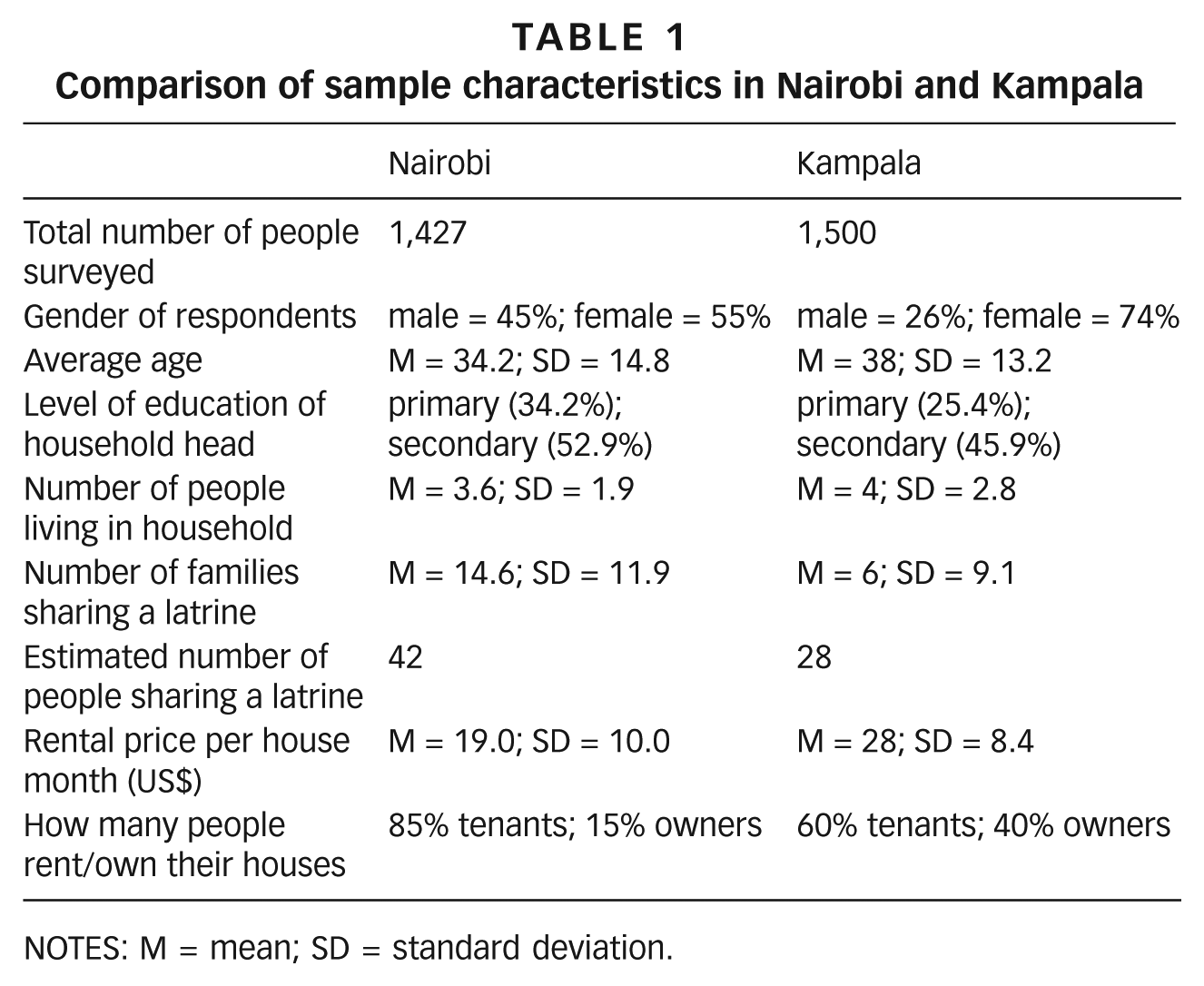
NOTES: M = mean; SD = standard deviation.
De facto tenure – tenure arrangements that are not ordained by law – is the reality for many residents in these informal settlements.(37) The process of obtaining de jure tenure – a legal representation of tenure enshrined in a formal document such as a title or rental contract – is difficult. But people living with de facto tenure still invest in sanitation infrastructure, while many households pay for sanitation services such as emptying of latrines. This illustrates that people make piecemeal improvements to sanitation facilities without legal tenure. Any company, however, that attempts to build sanitation facilities in line with policies and regulations must contend with the difficult issues of tenure and land ownership.(38)
This landscape is difficult to work within because it requires time to understand it and to create positive relationships with the important local actors.(39) In addition, the lack of ownership and fear of eviction decrease residents’ willingness to pay for improvements in household infrastructure.(40)
IV. Who are the Consumers and Producers of Sanitation Facilities in Urban Informal Settlements?
In describing the workings of the sanitation systems in Nairobi and Kampala, we split the systems into smaller components: access arrangements and user practices, the construction of sanitation facilities and infrastructure, the collection and transport of wastes, and the proper treatment or disposal of wastes.(41) This arrangement allows us to discuss in parallel the consumers and producers of the sanitation systems.
a. User practices and access arrangements
Availability, access and cleanliness of the facility are all important factors to consider from the user’s perspective. This highlights the need to split the user of the facility (the tenant or paying customer) from the producer (usually the landlord or the public toilet operator). While tenants can organize communal cleaning activities and sometimes pay for the emptying of the latrine, they are unlikely to demand improvement in sanitation conditions due to prevailing structural issues, such as insecure tenure rights and lack of access to capital.(46)
b. The construction of sanitation facilities and infrastructure
In the study areas, the facilities are connected to three general systems of waste management: a centralized sewerage network, with the utility company responsible for the functioning of the system and disposal of wastes; decentralized networks that that give specific individuals responsibility for the maintenance of certain latrines; and the hybrid model pioneered by the sanitation social enterprise Sanergy.
Each system requires a different constellation of access arrangements and technology and has separate issues related to proper operation and maintenance. In the surveyed informal settlements in Nairobi, three quarters of the households use on-site facilities, and a quarter are connected to sewer lines. In Kampala, only 1 per cent were connected to a sewer line. The decentralized system relies on a myriad of small-scale operators that are paid to build, repair and empty latrines. Local fundis (handymen) are contracted to build facilities while groups of young men usually empty the pits.(47) In the Mathare slum in Nairobi, the Mungiki gang controls some of the public toilet facilities. It also provides services such as waste collection.(48)
Within the surveyed informal settlements in Nairobi, very few users (7 per cent) had ever built a toilet, and those were all landlords or people with secure tenure arrangements. In Kampala, 97 per cent of the private or shared toilets were paid for by household owners or landlords (the remainder were paid for by tenants or NGOs) and 55 per cent of the public facilities were paid for by the local government (Kampala Capital City Authority) or area politicians. The remainder of the facilities were owned by NGOs or community-based organizations (CBOs) (31 per cent) or landlords (14 per cent).
The reasons respondents gave for constructing a new latrine varied, but all focused on the desire to improve sanitation conditions for themselves, their families or their tenants. The cost of constructing and operating a latrine is largely dependent on the type of technology. There is an already existing market for the construction of sanitation facilities. Introducing a new product or sanitation service into the marketplace requires a competitive pricing structure, for not only the installation but also the ongoing operation and maintenance costs. But any construction of a new facility in an informal settlement requires the navigation of complex land tenure arrangements and vested interests that benefit from the status quo.(49)
The sustainability of the system depends on the ability to find a sustainable source of finance. Part of the reason for pushing the market-driven approach is the recognition that people already pay for sanitation services and that this “market” could be entered with improved products and services in order to generate mutual benefit for users and providers of the system.(50) The decision to construct a latrine is based on many factors and the many technologies and emptying options reflect a fragmented “market” without a coherent logic. Table 2 compares construction costs for different sanitation facilities found in East African cities.
Comparison of construction and maintenance costs of different facilities in East African cities
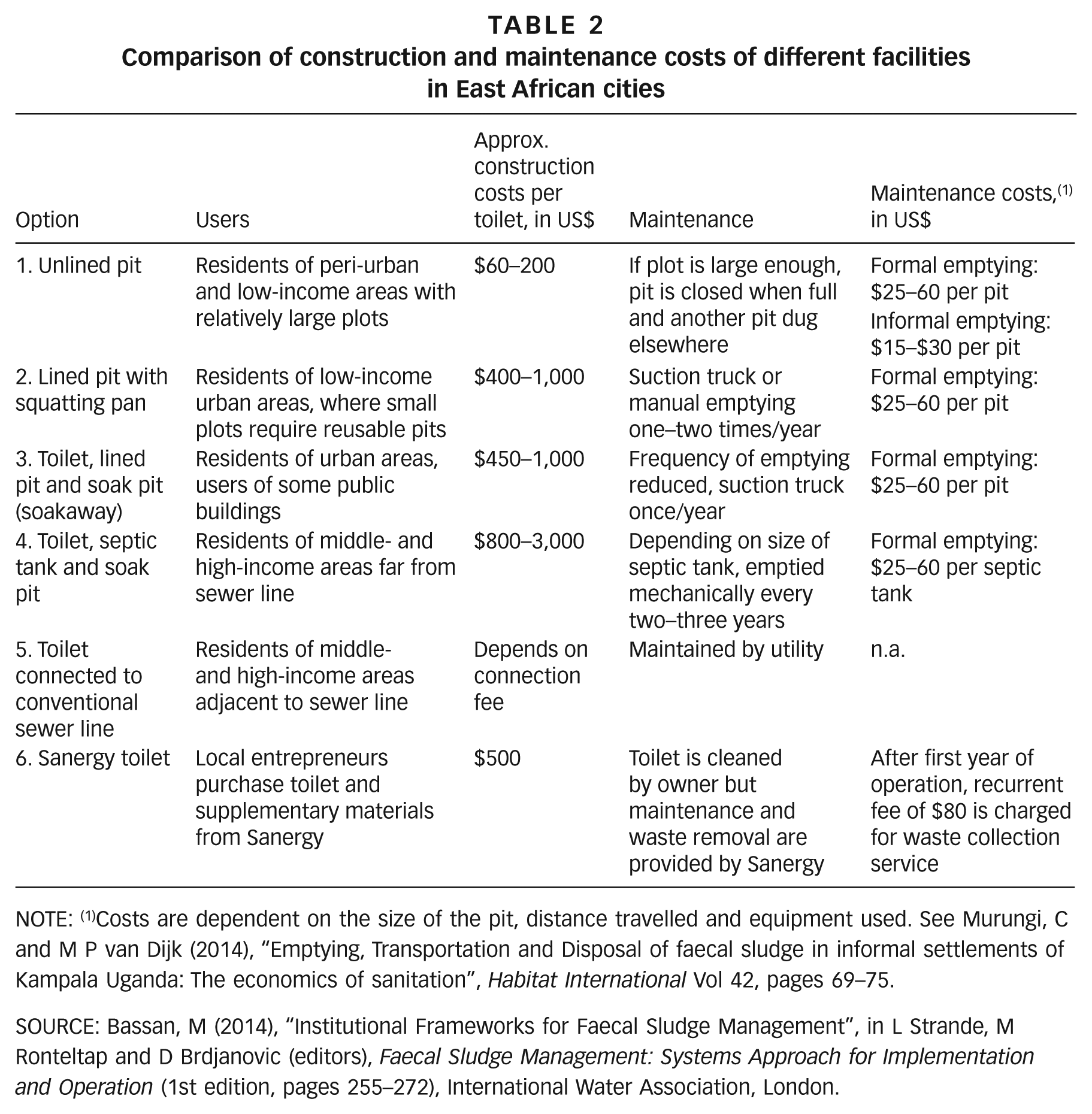
NOTE: (1)Costs are dependent on the size of the pit, distance travelled and equipment used. See Murungi, C and M P van Dijk (2014), “Emptying, Transportation and Disposal of faecal sludge in informal settlements of Kampala Uganda: The economics of sanitation”, Habitat International Vol 42, pages 69–75.
SOURCE: Bassan, M (2014), “Institutional Frameworks for Faecal Sludge Management”, in L Strande, M Ronteltap and D Brdjanovic (editors), Faecal Sludge Management: Systems Approach for Implementation and Operation (1st edition, pages 255–272), International Water Association, London.
A variety of actors are involved in the construction of sanitation facilities and infrastructure. Most owners of public facilities in Mukuru are private owners (74 per cent), reflecting the impact of the Sanergy system. In Kibera, most public providers are NGOs/CBOs, which especially target the most vulnerable. However, NGO/CBO initiatives tend to focus on site-specific projects (i.e. latrine construction) and do not take into account the entire sanitation value chain from the user interface to safe disposal of human waste. These interventions, thus, tend to have a limited impact on urban sanitation solutions due to the lack of a sustainable revenue source and their major focus on construction of toilet facilities, rather than the development of a sustainable system.
In the case of public toilets, whether the owners are private entrepreneurs, NGOs, community groups or government, they are responsible for the construction of the facility, as well as for organizing the cleaning, maintenance and regular emptying of the latrines. It is in their interest to have a functioning toilet that does not discourage customers from using the facility. The situation for households sharing a toilet is rather different. The landlord or owner is responsible for the construction of the latrine whereas the tenants, usually a group of households, take turns cleaning the facilities. Landlords are mainly responsible for the maintenance and emptying of the latrine, but sometimes tenants also pay these costs. There is little NGO/CBO presence at the household level and no government actors involved in the provision of these facilities. These patterns hold for informal settlements in both cities (Figure 1).
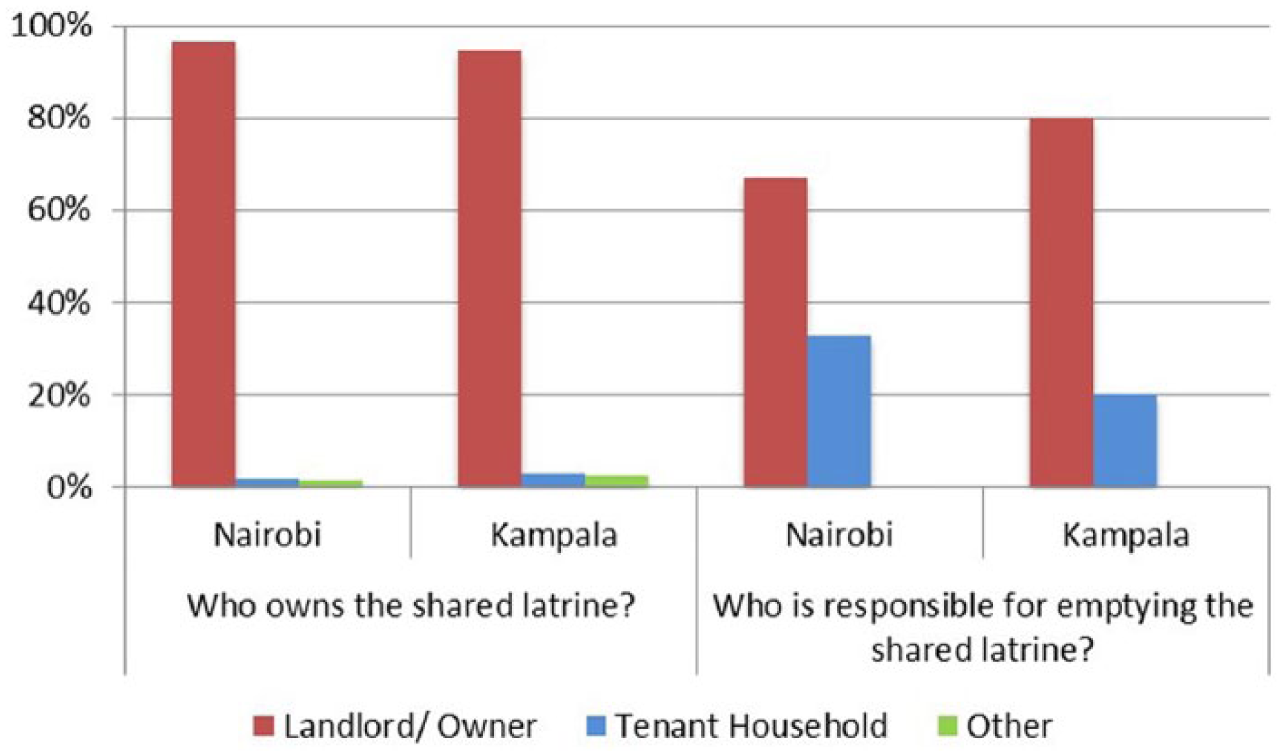
The main actors who own a shared latrine and bear responsibility for emptying the latrine within informal settlements in Nairobi and Kampala
c. The collection, transport and treatment of wastes
The safe collection, transport and disposal of waste is one of the most important but underappreciated links in the sanitation system. Private operators with mechanized trucks or groups of manual emptiers who use buckets, spades or even bare hands to empty the pits are hired to conduct pit emptying. It is largely the responsibility of landlords to organize the emptying, although some households also organize and pay for this. It is interesting to contrast the waste management systems of the informal settlements in the two cities. In Nairobi, the majority (86 per cent) of facilities connected to pits were emptied by hand. In Kampala, the majority (90 per cent) of those reporting paying for an emptying service hired a removal truck. The difference is striking and could be explained by the lower population density of Kampala, leading to easier access for trucks.
In Kampala, the price for emptying a pit is determined by the owners of the removal trucks. These owners are involved in a Pit Emptiers Association Union (PEAU), which could regulate quality of service and prices, but owners are unlikely to advocate for regulation that would cut into their profits. The absence of competing government provision and regulatory arrangements has led to the creation of a monopoly. Truck owners receive no subsidies and set prices based on the ability to recover costs and make a profit.(51)
Many wastewater treatment plants in East Africa are not operational or else lack the capacity to correctly treat the amount of faecal sludge produced in urban areas.(52) The failure to operate and maintain these plants, a major problem, requires serious investigation. The majority of people in East African cities live in informal settlements and use facilities serviced by providers that collect waste but do not treat or dispose of it in a process that complies with international guidelines on the safe disposal of human wastes, meaning that much of it is dumped back into drainage systems or open water bodies.
d. Conclusions on the consumers and producers of sanitation systems
In this section we have highlighted current user practices and access arrangements in parallel to the practices of different producers of the system. This gives us a unique perspective because most studies focus on either the user or producer. In Kampala, where most people use shared facilities (Figure 2), the lack of social cohesion around cleaning could lead to facilities becoming dirty and unusable. However, nearly every toilet is linked to the decentralized and fragmented pit-emptying services. These are controlled by the owners of the removal trucks, who effectively have a monopoly and can set prices in an environment with no regulation.
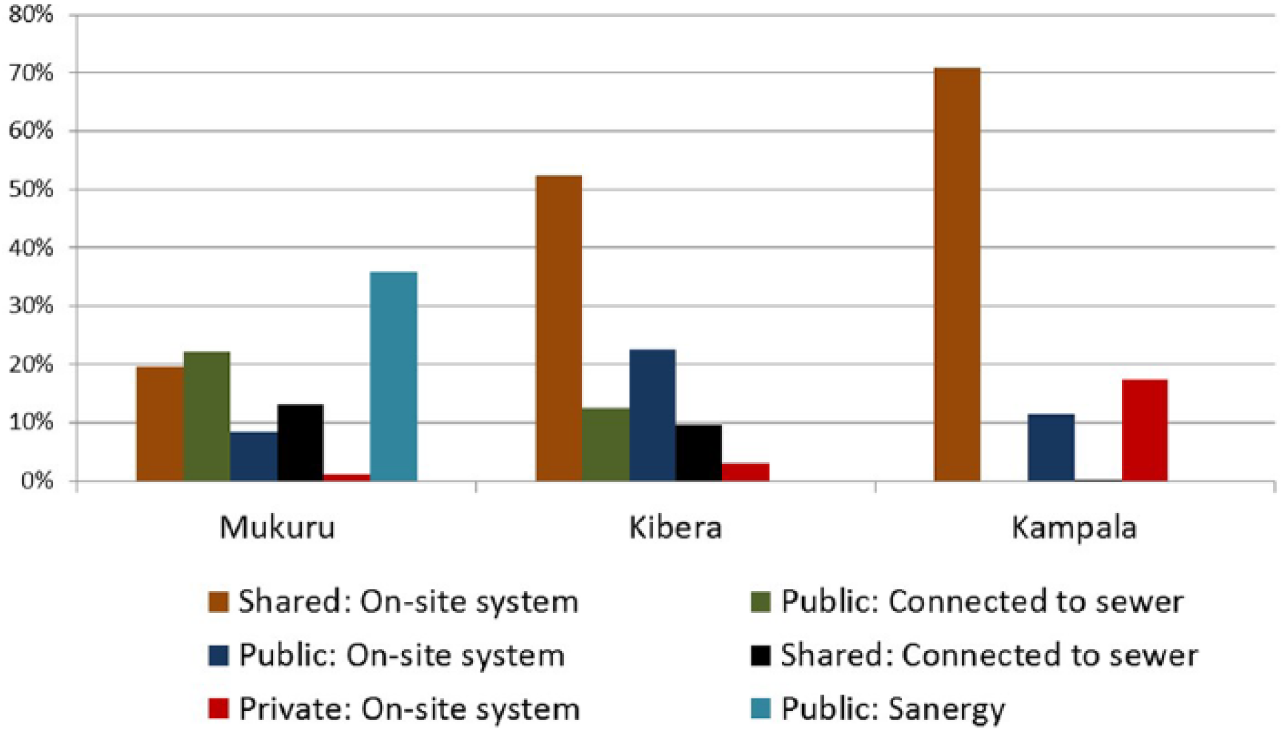
Comparison of the different combinations of access arrangements and types of waste management systems in informal settlements in Kampala and Nairobi
In Kibera and Mukuru, there is a fairly even split between people who access shared facilities and those who use public facilities, and many facilities are connected to the sewerage system, relative to Kampala (Figure 2). The major problem with the public system is access to the facilities at night. The informal settlements in Nairobi are notorious for high levels of crime and insecurity, and many people do not like to venture out at night. These figures illustrate that a decentralized network of providers serves the majority of latrines in urban informal settlements. Although some facilities are served some of the time, this does not mean that all facilities are served all the time. There is little to no regulation of quality standards, which leads to fragmented and conflicting actor arrangements. This leads in turn to the development of unsafe, unclean and unhygienic facilities. Therefore, the potential for a complete sanitation system that serves a large number of people within an urban area while collecting the wastes and turning them into a product that could be sold to generate a revenue stream is very appealing.
V. A Case Study of Sanergy: A Sanitation Social Enterprise
Sanergy was founded by a group of graduate students from the Massachusetts Institute of Technology, Sloan School of Management.(53) The company is registered both as an NGO and as a company that can make profit. This structure makes it possible to leverage financial capital through investor funding and grant funding from donors. The company currently employs 212 people. Of these 90 per cent are Kenyan employees, many of whom live within the areas of operation.
Sanergy aims to create a sustainable sanitation system through the development of dense clusters of toilets. Over 600 Sanergy toilets have been installed in six informal settlements in Nairobi. The high density of toilets allows for lower costs of waste transportation. The company is responsible for the sale of toilets to local entrepreneurs, marketing of toilets within communities, construction of toilets, daily collection of wastes, treatment of wastes and the sale of organic fertilizer made from wastes. The Sanergy toilet contains a source-separating toilet pan and is housed within a brightly coloured and distinctly branded superstructure. The toilet has been designed by Sanergy’s product development team, which uses a human-centred design approach to design new products and improve the quality of existing products and manufacturing processes.
The Sanergy system improves environmental quality through the daily collection of 4.5 metric tonnes of faeces and 2.5 tonnes of urine. The urine is safely disposed into soak pits while faeces are converted into organic fertilizer. The fertilizer is made through the co-digestion of faeces with other sources of organic waste. The process occurs within a Biomax(54) reactor whereby enzymes are added to a heated digester to speed up the process of fertilizer production. The certification for the sale of organic fertilizer was granted in 2015 by the Kenya Bureau of Standards. Sales have started to generate an income stream for the company, which is looking to increase sales at markets around the periphery of Nairobi. It is envisioned that the revenue from the fertilizer sales can cover the physical infrastructure and management of waste collection.
Sanergy is responsible for the sale of a toilet to a local entrepreneur. The entrepreneur pays for the toilet through a cash payment or a micro-finance loan. The entrepreneur is then linked to the Sanergy waste collection and operational support teams. This leads to the waste being collected by safe waste collection methods; the toilets are marketed within the local communities and the quality of the toilets is monitorred by a field support officer. Through the sale and marketing of toilets, Sanergy has been able to attract a significant proportion of households to pay to use its facilities on a regular basis. In the areas where it operates, the on-site system is less prevalent and more facilities are connected to sewerage lines (Figure 2). Despite the competition with other systems of provision and consumption, it has been able to capture most users of public facilities and a third of all users in its areas of operation, in part because its facilities are considerably cleaner and nicer to use than other toilets in the area. All participants in the Nairobi sample were asked to rate their satisfaction with current facilities in regard to cleanliness, smell, functionality of the latrine and the possibility to wash hands. Regular users of the Sanergy facilities were more content on all these fronts. The most striking difference was around handwashing (Figure 3). At every Sanergy facility there is a handwashing station, whereas this is not guaranteed at regular facilities.
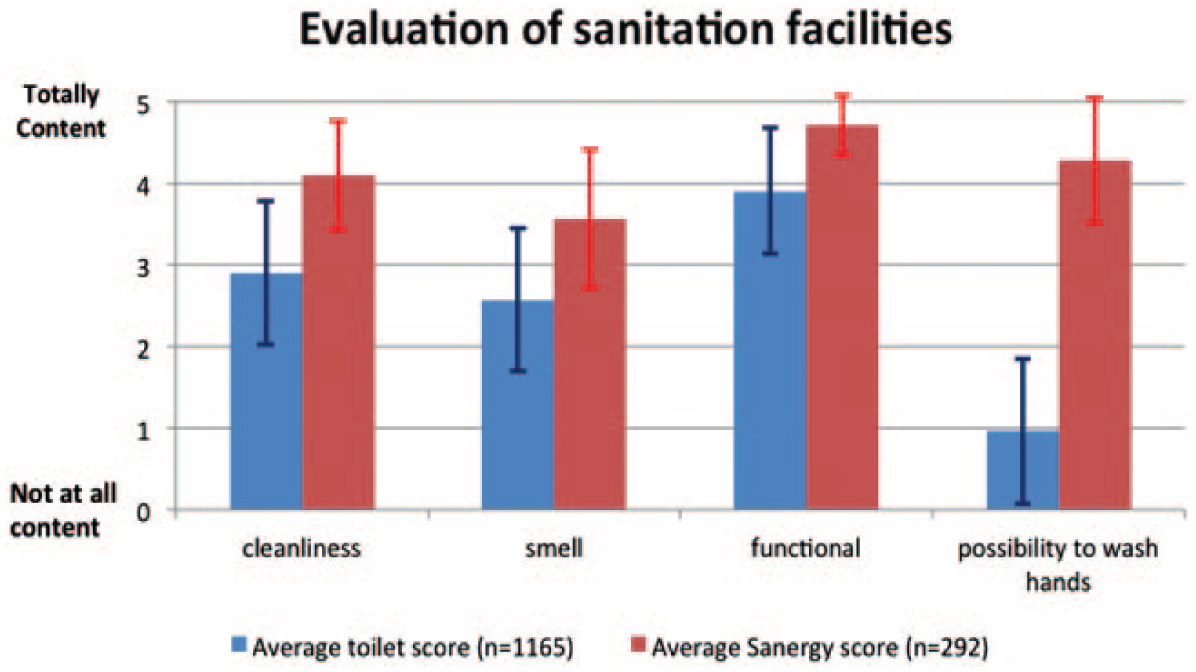
Means and standard deviations of four dimensions of user satisfaction for users of Sanergy and regular toilets
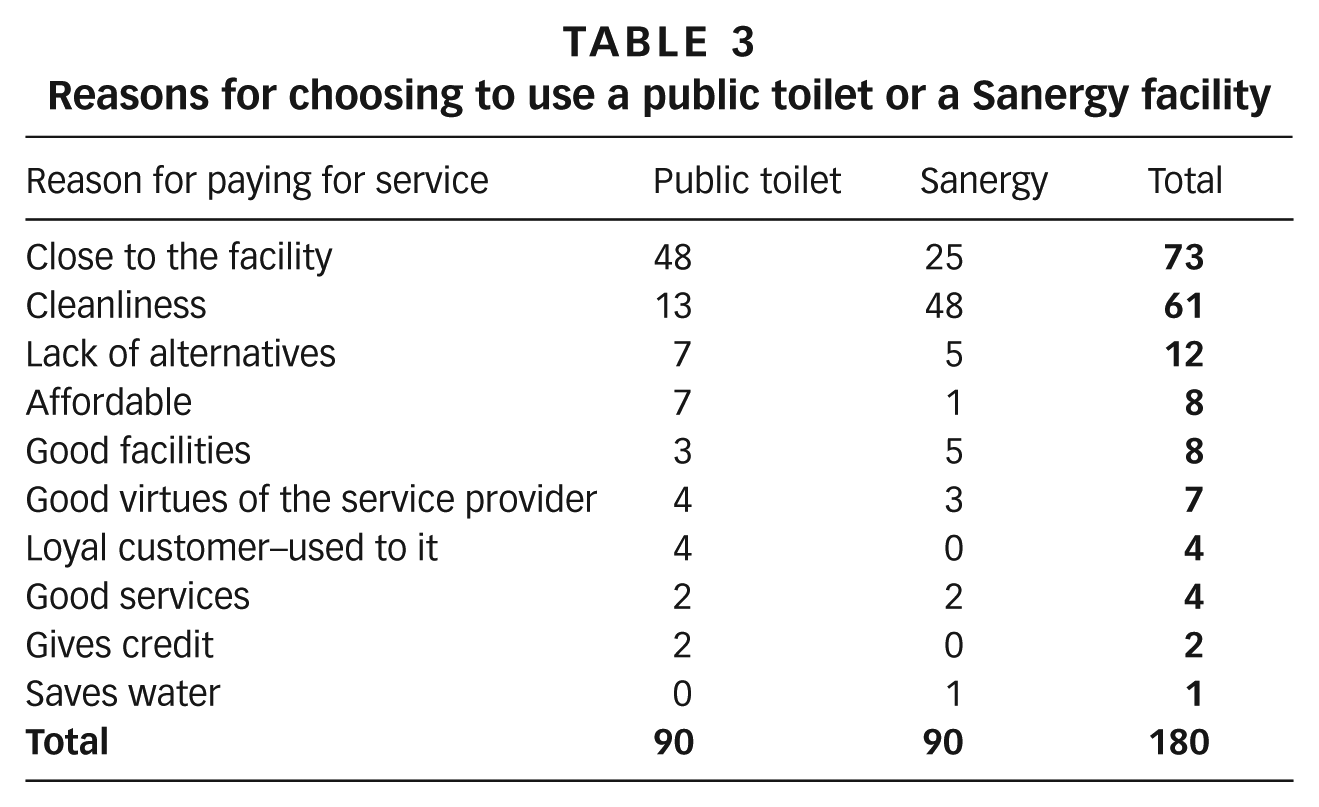
The major reason users gave for using a Sanergy facility was the cleanliness of the facility and the location. In contrast, the reason given by those using another public facility was the convenient location, followed by the cleanliness of the latrine, lower cost, and the lack of alternative facilities or information about alternatives. These reasons for using different facilities underscore the importance of understanding consumer demand within the marketplace. Cleanliness is a major factor. But many users both of Sanergy and, especially, of other facilities make their choice primarily on the basis of proximity, thus highlighting the importance of this non-service related aspect (Table 3).
Reasons for choosing to use a public toilet or a Sanergy facility
The majority of Sanergy toilets are public pay-per-use facilities owned by a local entrepreneur who either pays directly for the facility or takes out a loan to finance the payment. Although the aim is to sell toilets to home owners, the value proposition for a landlord is different than for an entrepreneur. The landlord receives no direct return on investment, unless greater rent is requested from tenants. The marketing of the facility to a landlord is made even more difficult because many live elsewhere and many rental agreements are managed by property agents who have no (economic) incentive for improving sanitation facilities.(55) Expanding into different markets will require further development of sales and marketing techniques and navigating through the difficult real estate market in urban informal settlements.
The issue of land ownership in informal settlements is a significant obstacle to the development of sustainable infrastructure. Sanergy requires a certificate of land registration before the construction of a toilet can begin. Construction of any toilet must be sanctioned by overlapping layers of formal and informal authority. First, an entrepreneur must identify land on which a 3-foot by 5-foot structure can be built. Once the land owner has been identified, a lease arrangement between the entrepreneur and owner must be made, or the title of the land sold, before a toilet can be constructed. This is not an easy process to initiate or complete, given the number of absentee owners. After securing a piece of land the entrepreneur must navigate through the local political structures to secure permission for construction. For most cases this requires the entrepreneur to request permission from the assistant chief, the chief, the chairman, the ward manager and the county representative. To add to the difficulty, Kenya is going through the process of devolution, which means a blurring of local roles and responsibilities and difficulty in identifying the person responsible for granting permission, without which a structure cannot be built. In addition to the formal political structures, local entrepreneurs note that many “youth groups” (usually affiliated with local gangs) offer them “protection”, requiring them to give up some income for their business to operate within an area of control. Failing to respond suitably to any of these challenges can lead to demolition of infrastructure by the local authority or “youth groups”. Sanergy does not become involved in land negotiations but helps to facilitate interactions between the local entrepreneurs who purchase a toilet and the relevant local authorities through the employment of a government relations officer. This precarious situation is also somewhat diffused by Sanergy offering customers “demolition insurance”.
Sanergy can operate because the policy environment allows the provision of waste collection and treatment by private companies. The company is not contracted by the government or fully reliant on international aid donors to finance the system. This affords it freedom to develop internal standards of accountability that interact with standards and regulations set by municipal political authorities and national regulatory bodies. Therefore, it can provide sanitation services within a constrained politcal space and an imperfect market, but it is not directly developing the overall strategy for city-wide sanitation provision or the regulatory environment that develops quality standards.
VI. Discussion
a. Explaining the consumption and production of sanitation systems
The aim of the research was to understand who is involved in the consumption and production of sanitation systems in informal settlements in Nairobi and Kampala. The research investigated current user practices and access arrangements, identified the key actors involved in the provision of sanitation systems, and highlighted the impact of a new sanitation system on user practices and satisfaction. In the investigated areas, the majority of households rely on on-site sanitation systems serviced by a network of formal and informal operators. These systems are characterized by poor coordination, unsafe practices and a lack of sector regulation. In the past few years, these deficiencies have led to the emergence of market-based approaches currently being tested in a number of locations such as Mukuru, Nairobi. These service providers tap into existing urban sanitation markets where private providers pay for the construction and emptying of toilets and disposal of wastes.
The analysis illustrates that in these settlements, sanitation provision is complex and does not form a coherent system. Rather, it is a collection of overlapping systems of consumption and provision that are heavily structured around daily living conditions. Understanding this complexity and the type of service being provided throughout the sanitation system allows us to identify points for interaction. For example, the main challenge for users is accessing a clean and hygienic facility nearby, when they need to go. The issues of cleanliness and access are significantly different from the producers’ issues in planning and constructing sanitation facilities. Here, the main concern is securing land and working through the often complex tenure arrangements and overlapping layers of political authority. The implication for market-based providers is that the difficult operating environment can hinder the diffusion of the new system. Identifying and negotiating with key stakeholders within local political structures is vital for successful adoption of new infrastructure.
The planning and construction of the facilities does not have to directly include end users, although facilities should not be planned that are in direct contention with prevailing socio-cultural norms.(56) For example, people who wash themselves after defecating cannot use urine-diverting dry toilets (UDDTs) because they need water for ablution, but the aim of dry toilets is to have as little water as possible in the faeces to ensure the safe destruction of pathogens.
The main challenge for the collection and transport of waste is logistical and relates to the type of system in place and the location of the facility. Sewerage systems require different operation and maintenance procedures than an on-site system. Proper treatment or disposal of wastes requires significant local discretion as the prevailing climatic and socioeconomic conditions will determine the most appropriate treatment process and potential markets for the sale of end products. The treatment of wastes requires a regulatory environment developed by the government.
A new hybrid system is being pioneered by Sanergy, which is developing dense clusters of (public) toilets in certain informal settlements in Nairobi. The company is responsible for every link in the sanitation value chain. This overview ensures a high degree of quality assurance as Sanergy knows how clean its toilets are, how much waste is collected and how its waste is treated. Users of the Sanergy latrines are more content than users of other facilities, especially with the greater possibility of handwashing. The users value the clean and hygienic environment provided by the facilities. In the areas of operation, a significant proportion of households are choosing to pay to use the facilities. It is too early to say whether this new approach will succeed or fail. The challenge for the company, and for similar companies operating in the sector, is to scale up the system to different areas and sell more toilets to different market segments. A report has highlighted the fact that none of these new initiatives is yet operating profitably.(57)
b. Policy implications
Large-scale service providers and utilities in cities of East Africa must change their way of doing business if they want to reach the millions of low-income users (largely located within informal settlements) currently without access to good-quality sanitation services. This will require the creation of dedicated pro-poor providers that have a clear institutional mandate and the staffing and resources to increase access for low-income residents. In Nairobi, the creation of the Informal Settlements Department as a dedicated unit within the Nairobi Water and Sewerage Company in 2007 has brought about a change in approach towards informal settlement service provision. The current strategy aims to ensure that a fixed percentage of the total revenue collected by the utility should come from low-income communities, in order to extend and sustain services to these settlements. A crucial element of pro-poor services is the signing of letting contracts or delegated management arrangements with NGOs, social enterprises or private sector service providers that are closer to the realities of the end users.(58) The development of pro-poor units that serve people in informal settlements requires significant political will as these are not the most profitable markets to enter. Often, strong political will focused on improvement of basic services is lacking from areas with weak governance institutions; or the people in power prefer the status quo as it leads to the betterment of their individual economic situation.(59)
Urban sanitation services deliver at least some coverage to millions living within informal settlements. But the services operate within a complex environment, are often fragmented, and do not align to form a cohesive and sustainable system. This context is important when considering the development of sanitation markets because markets do not function perfectly or outside of existing institutional arrangements. Rather, markets should be viewed as an interaction between different actors including consumers, suppliers, organizations, labourers and governments.(60) These actors and the market should be seen to be in constant co-evolution within different institutional settings.(61) The neglect of a wider understanding of how markets are structured, operate and perform leads to an underestimation of the complexity of the sanitation system and the related transactional costs when working in these areas.
Table 4 illustrates the stakeholders and the major activities required to develop a sustainable sanitation system.(62) The major stakeholders involved are the national ministries, utility companies, local governments, private companies and CBOs/NGOs. For each of these stakeholders the most suitable role or responsibility is indicated with a green tick. Only the national ministries can set up a legal framework in which waste management companies (public, private, utility or hybrid) can operate. They can also provide other functions such as coordination between stakeholders and the synthesis of best practices in monitoring and evaluation into key learnings. National and municipal utilities could fulfil most roles and responsibilities apart from the development of the legal framework. However, these utilities have inherited unsustainable sanitation infrastructures that have failed, for a number of different reasons, to provide safe sanitation for the large and growing number of people living in towns and cities in East Africa. Hence the rise of the fragmented provision that exists today. The local government, through police officers, public health officials or community-based organizations, could enforce the legal framework. It is possible that CBOs/NGOs could fill many of the roles and responsibilities, but the lack of sustainable and long-term funding will ultimately undermine their operations. Private companies (shaded in Table 4) are most adept at focusing on the collection, transport and treatment of wastes and the reuse of waste into different products.
Roles and responsibilities of different stakeholders involved in the provision of sanitation services
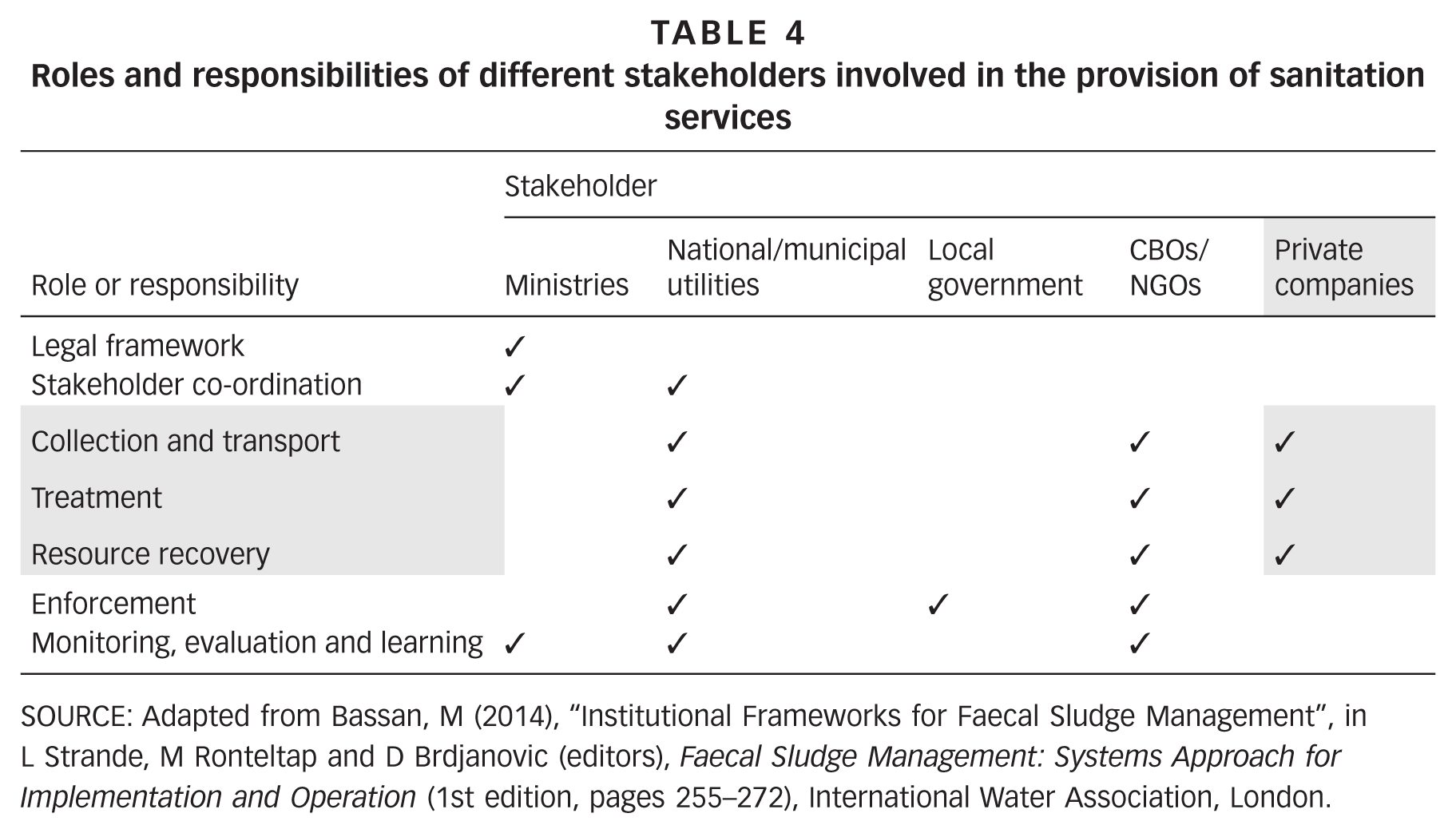
SOURCE: Adapted from Bassan, M (2014), “Institutional Frameworks for Faecal Sludge Management”, in L Strande, M Ronteltap and D Brdjanovic (editors), Faecal Sludge Management: Systems Approach for Implementation and Operation (1st edition, pages 255–272), International Water Association, London.
The opportunities for private companies to develop a market-based approach are clear, if often overstated. There is an already existing sanitation market where people pay private providers for the construction of latrines and the collection, transport and disposal of wastes. However, many of the providers do not have to factor in externalities such as the environmental effect of dumping wastes into the environment. Generating value from the reuse or sale of end products could subsidize at least part of the sanitation chain. Utilizing the concepts and best management practices from business can certainly reduce the operating costs of a service but it is difficult to envision a completely private, profitable company providing safe sanitation for all. Recognizing the limits of a singular focus on market-based approaches is not admitting defeat but highlighting areas that require different types of intervention.
Private providers can help to deliver sanitation services but they cannot develop the overall strategy of provision, which needs government direction, regulation and financial support. Historically, the development of sanitation systems has involved large public subsidies because the market will only service those who can afford to pay for sanitation services.(63) In countries that achieved total sanitation coverage within the last decades there has been high-level political will to improve material living conditions.(64) In many African cities weak governance institutions undermine the delivery of key services. Without serious consideration of the institutional setting, the new wave of projects aimed to develop products and services around the sanitation value chain will underestimate the transactional costs of working in informal settlements and overestimate the profit to be made at the bottom of the pyramid.
Footnotes
1.
The term “slum” usually has derogatory connotations and can suggest that a settlement needs replacement or can legitimate the eviction of its residents. However, it is a difficult term to avoid for at least three reasons. First, some networks of neighbourhood organizations choose to identify themselves with a positive use of the term, partly to neutralize these negative connotations; one of the most successful is the National Slum Dwellers Federation in India. Second, the only global estimates for housing deficiencies, collected by the United Nations, are for what they term “slums”. And third, in some nations, there are advantages for residents of informal settlements if their settlement is recognized officially as a “slum”; indeed, the residents may lobby to get their settlement classified as a “notified slum”. Where the term is used in this journal, it refers to settlements characterized by at least some of the following features: a lack of formal recognition on the part of local government of the settlement and its residents; the absence of secure tenure for residents; inadequacies in provision for infrastructure and services; overcrowded and sub-standard dwellings; and location on land less than suitable for occupation. For a discussion of more precise ways to classify the range of housing sub-markets through which those with limited incomes buy, rent or build accommodation, see Environment and Urbanization Vol 1, No 2 (1989), available at  .
.
2.
Bartram, J and S Cairncross (2010), “Hygiene, sanitation, and water: forgotten foundations of health”, PLoS Medicine Vol 7, No 11.
3.
4.
See reference 3.
5.
van Dijk, M P (2012), “Sanitation in Developing Countries: Innovative Solutions in a Value Chain Framework”, in H Sun (editor), Management of Technical Innovation in Developing and Developed Countries (1st edition, pages 65–83), Intech, Rijkeka.
6.
Northover, H, S K Ryu and T Brewer (2014), Achieving total sanitation and hygiene coverage within a generation – lessons from East Asia, WaterAid, London.
7.
O’Reilly, K and E Louis (2014), “The toilet tripod: Understanding successful sanitation in rural India”, Health & Place Vol 29, pages 43–51.
8.
Scott, P, A Cotton and M Sohail Khan (2013), “Tenure security and household investment decisions for urban sanitation: The case of Dakar, Senegal”, Habitat International Vol 40, pages 58–64.
9.
Gulyani, S, D Talukdar and R Kariuki (2005), “Universal (non)service? water markets, household demand and the poor in urban Kenya”, Urban Studies Vol 42, No 8, pages 1247–1274.
10.
See reference 9; also Nilsson, D (2006), “A heritage of unsustainability? Reviewing the origin of the large-scale water and sanitation system in Kampala, Uganda”, Environment and Urbanization Vol 18, No 2, pages 369–385.
11.
Mikhael, G, D M Robbins, J E Ramsay and M Mbeguere (2014), “Methods and means for collecting and transport of faecal sludge”, in Linda Strande, Mariska Ronteltap and Damir Brdjanovic (editors), Faecal Sludge Management (1st edition, pages 67–97), International Water Association, London.
12.
See reference 3.
13.
van Vliet, B, J van Buuren, P Oosterveer and G Spaargaren (2014), “Network governance and waste and sanitation service provision”, in B van Vliet, J van Buuren and S Mgana (editors), Urban Waste and Sanitation Services for Sustainable Development (1st edition, pages 9–26), Routledge, London.
14.
Letema, S, B van Vliet and J B van Lier (2014), “Sanitation policy and spatial planning in urban East Africa: Diverging sanitation spaces and actor arrangements in Kampala and Kisumu”, Cities Vol 36, pages 1–9.
15.
See reference 13.
16.
See reference 14.
18.
Pritchett, L and M Woolcock (2004), “Solutions When the Solution is the Problem: Arraying the Disarray in Development”, World Development Vol 32, No 2, pages 191–212.
19.
Budds, J and G McGranahan (2003), “Are the debates on water privatization missing the point? Experiences from Africa, Asia and Latin America”, Environment and Urbanization Vol 15, No 2, pages 87–114; also Kirkpatrick, C, D Parker and Y Zhang (2006), “An empirical analysis of state and private-sector provision of water services in Africa”, The World Bank Economic Review Vol 20, No 1, pages 143–163; and Prasad, N (2006), “Privatisation Results: Private Sector Participation in Water Services After 15 Years”, Development Policy Review Vol 24, No 6, pages 669–692.
20.
Hall, D and E Lobina (2006), Pipe dreams – The failure of the private sector to invest in water services in developing countries, Public Services International, Ferny-Voltaire.
21.
See reference 18.
22.
See reference 13.
23.
Ostrom, E (1996), “Crossing the great divide: coproduction, synergy, and development”, World Development Vol 24, No 6, pages 1073–1087; also Lüthi, C and S Kraemer (2012), “User perceptions of participatory planning in urban environmental sanitation”, Journal of Water, Sanitation and Hygiene for Development Vol 2, No 3, pages 157–167; and Lüthi, C, J McConville and E Kvarnström (2009), “Community-based approaches for addressing the urban sanitation challenges”, International Journal of Urban Sustainable Development Vol 1, No 2, pages 49–63.
24.
McGranahan, G (2013), Community-driven sanitation improvement in deprived urban neighbourhoods, SHARE research report, London School of Hygiene and Tropical Medicine.
25.
Mulumba, J N, C Nothomb, A Potter and M Snel (2014), “Striking the balance: what is the role of the public sector in sanitation as a service and as a business?”, Waterlines Vol 33, No 3, pages 195–210; also Kennedy-Walker, R, B Evans, J Amezaga and C Paterson (2014), “Challenges for the future of urban sanitation planning: critical analysis of John Kalbermatten’s influence”, Journal of Water, Sanitation and Hygiene for Development Vol 4, No 1, pages 1–14.
26.
Graf, J, O Kayser and S Brossard (2014), Designing the next generation of sanitation businesses, Hystra, London.
27.
See reference 11.
28.
See reference 26.
29.
Jones, S, N Greene, A Hueso, H Sharp, and R Kennedy-Walker (2013), Learning from failure: lessons for the sanitation sector, UK Sanitation Community of Practice, London; also Peal, A and S Drabble (2014), The Urban Programming Guide: How to design and implement an effective urban WASH programme, Water & Sanitation for the Urban Poor, London.
31.
See reference 13.
32.
See reference 14.
33.
Murungi, C and M P van Dijk (2014), “Emptying, Transportation and Disposal of faecal sludge in informal settlements of Kampala Uganda: The economics of sanitation”, Habitat International Vol 42, 69–75.
34.
Gulyani, S and D Talukdar (2008), “Slum Real Estate: The Low-Quality High-Price Puzzle in Nairobi’s Slum Rental Market and its Implications for Theory and Practice”, World Development Vol 36, No 10, pages 1916–1937.
35.
Syagga, P, W Mitullah and S Karirah-Gitau (2002), Nairobi Situation Analysis Supplementary Study: A Rapid Economic Appraisal of Rents in Slums and Informal Settlements, Paper prepared for the Government of Kenya and UN-Habitat under the Collaborative Nairobi Slum Upgrading Initiative, Nairobi.
36.
See reference 34.
37.
Gulyani, S, E M Bassett and D Talukdar (2012), “Living Conditions, Rents, and Their Determinants in the Slums of Nairobi and Dakar”, Land Economics Vol 88, No 2, pages 251–274.
38.
See reference 8.
40.
See reference 8.
41.
Tilley, E, L Ulrich, C Lüthi, P Reymond and C Zurbrügg (2014), Compendium of Sanitation Systems and Technologies, Swiss Federal Institute of Aquatic Science and Technology (Eawag), Dubendorf.
42.
Katukiza, A Y, M Ronteltap, C B Niwagaba, J W A Foppen, F Kansiime and P N L Lens (2012), “Sustainable sanitation technology options for urban slums”, Biotechnology Advances Vol 30, No 5, pages 964–978.
43.
Tumwebaze, I K, C G Orach, C Niwagaba, C Luthi and H-J Mosler (2013), “Sanitation facilities in Kampala slums, Uganda: users’ satisfaction and determinant factors”, International Journal of Environmental Health Research Vol 23, No 3, pages 191–204; also Tumwebaze, I K, C B Niwagaba and I Günther (2014), “Determinants of households’ cleaning intention for shared toilets: Case of 50 slums in Kampala, Uganda”, Habitat International Vol 41, pages 108–113.
44.
Heijnen, M, O Cumming, R Peletz, G K-S Chan, J Brown, K Baker and T Clasen (2014), “Shared sanitation versus individual household latrines: a systematic review of health outcomes”, PloS One Vol 9, No 4.
45.
Günther, I, A Horst, C Lüthi, H J Mosler, B C Niwagaba and K I Tumwebaze (2011), Where do Kampala’s Poor “Go”? - An overview of urban sanitation conditions in Kampala’s informal settlement areas, ETH, Zurich.
46.
See reference 8.
47.
See reference 13.
48.
Bartolucci, V and A B Kanneworf (2012), “Armed Violence Taking Place Within Societies: SALW and armed violence in urban areas”, in O Greene and N Marsh (editors), Small Arms, Crime and Conflice: Global Governance and the Threat of Armed Conflict (1st edition, pages 122–137), Routledge, Milton Park.
49.
See reference 37.
50.
Prahalad, C and A Hammond (2002), “Serving the world’s poor, profitably”, Harvard Business Review Vol 80, No 9, pages 48–57.
51.
For further information on the actors and costs of emptying services in Kampala see reference 33.
53.
Zimmerman, E (2014), “Sanergy turns poop into profit in Kenya’s slums”, CNN Money, accessed 11 November 2014 at ; also Sanergy, accessed 11 November 2014 at saner.gy.
54.
Biomax
, accessed 11 November 2014 at .
55.
See reference 34.
56.
Mara, D (2013), “Pits, pipes, ponds–and me”, Water Research Vol 47, No 7, pages 2105–2117.
57.
See reference 26.
59.
See references 9, 34 and 53.
60.
Fligstein, N and L Dauter (2007), “The Sociology of Markets”, Annual Review of Sociology Vol 33, No 1, pages 105–128.
61.
Beckert, J (2009), “The social order of markets”, Theory and Society Vol 38, No 3, pages 245–269.
62.
Bassan, M (2014), “Institutional Frameworks for Faecal Sludge Management”, in L Strande, M Ronteltap and D Brdjanovic (editors), Faecal Sludge Management: Systems Approach for Implementation and Operation (1st edition, pages 255–272), International Water Association, London.
63.
Black, M and B Fawcett (2008), The Last Taboo, Earthscan, London.
64.
See reference 6.