




Abstract
This paper describes how the inhabitants of Llico, a small fishing town in Chile, organized to move from the coastline to avoid a tsunami that devastated their homes and livelihoods and then to manage immediate responses. It then describes how long it took for state support to arrive and how the inhabitants were marginalized from planning and implementing the reconstruction processes. As a result, this poorly served their needs and priorities and failed to utilize their knowledge and organizational capacities. Here and elsewhere in Chile, post-catastrophe reconstruction processes miss the opportunity to improve living conditions for the affected communities and to develop policies for disaster management that incorporate and use their social capital.
I. Introduction
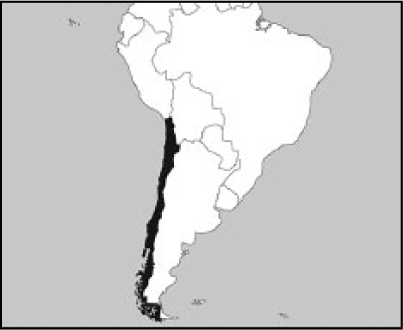
In Chile the earthquake–tsunami of 27 February 2010 affected over 500 kilometres of coastline and damaged more than 220 thousand homes. There were 525 deaths, an estimated one million inhabitants who were affected to different degrees, and an estimated cost of approximately 15 per cent of the national GDP. Although Chile is regularly visited by strong earthquakes, never before had the country faced a catastrophe of such magnitude in strong economic, political and social conditions of stability and development.(1)
Within the field of public policy, socio-natural disasters allow us to reflect upon the methods in which necessity-solving actions are devised and implemented in contexts of urgency and vulnerability. The Chilean reconstruction process, after the earthquake and tsunami of 2010,(2) the so-called 27F, made it evident that solutions centred on the recovery of infrastructure and without considering social factors are deficient: they place the affected communities on a secondary plane instead of at the centre of the process, diminish the potential of the catastrophe as an opportunity to improve quality of life and, furthermore, create new problems and vulnerabilities.(3)
Two weeks after the earthquake a new administration took over the national government. The new authorities decided to implement a reconstruction process based on the regular instruments for urban housing policies. These decisions were based on the fact that the country, despite its continuous exposure to tectonic movements, had not developed a specific institutionality to face disaster. Indeed, reconstruction post-27F shed light on the limits of the housing and territorial policies that had been at work during the past 30 years in Chile and that were applied to manage the process. These strategies were efficient in the past at reducing the country’s housing deficit and, in the post-catastrophe context, at reconstructing infrastructure and housing in a relatively short amount of time, but were inappropriate for improving the quality of life and expressing respect for the ways of life of local inhabitants.
Llico is a small fishing and rural coastal town in Chile’s Bío-Bío Region. Its case demonstrates that the communities are, thanks to their own social capital, quite resilient in the face of disaster. Nevertheless, during the state-led reconstruction phase, these qualities were rendered invisible through governmental action that privileged a model based on subsidies and alliances of the public–private sector. This article is based on empirical evidence produced by the Observatorio de la Reconstrucción.(4) It demonstrates how the members of the community were able to become protagonists of their own emergency management and capable of facing adversity together, and how once the reconstruction model was put into action, the community became a passive recipient of a process that was inappropriate in local terms, thus creating new social issues.
Between 2011 and 2013 the Observatorio de la Reconstrucción of the Universidad de Chile collected and systematized information about the experience of Llico’s inhabitants, produced through post-disaster support workshops (2012) and more than a dozen in-depth interviews and focus groups (2013) carried out with state employees, local leaders and the town’s inhabitants. The professional and academic team of the Observatorio has been able to develop a perspective “from below” of public policies, from the point of view of the experiences of inhabitants themselves, through research and counselling of the communities during their reconstruction process.
II. Llico zero hour
Llico is a small coastal locality with a population of 600 inhabitants, in the Arauco Province in Southern Chile. Before the catastrophe of 2010 it was a peaceful place, which survived mainly on agriculture and small-scale fishery. Its people lived in self-built homes on spacious land plots, most of which had been inherited from one generation to the next. Their lives were structured by work and family. The main collective events were centred around the neighbourhood council, which represented all of the locality’s population, the fisherman’s syndicate (an all-male collective) and the association of kelp harvesters (an all-female collective). In contrast to most other localities of the Arauco Gulf, Llico has geographical characteristics that led to the town’s full flooding due to the tsunami that followed the earthquake on 27 February 2010.
The tectonic movement began around 3:34 am on that day, registering 8.8° on the moment magnitude scale with its epicentre 190 kilometres north of Llico. Some minutes thereafter, official radio broadcasts stated that “there is no tsunami danger, there is no tsunami alert”(5) – as explained by government authorities. Nevertheless the Llico community disregarded this message immediately; the inhabitants reacted according to their own knowledge of sea behaviour, which they had inherited throughout many generations, especially the knowledge gained during the earthquake and tsunami of 1960 (the strongest earth movement ever recorded in world history, with a magnitude of 9.5°). Thus, all of Llico’s population met on the main street and marched toward nearby high ground in search of protection, and the town was completely evacuated.
Julián, a fisherman and syndicate leader, transported the elderly in his pickup truck. They made it to a small unfurnished cabin with broken windows, which acts as an occasional shelter for forest rangers. It was the only place where they could be safe. Julián took the decision of leaving children and the elderly there to safely spend the night.
At around 7:30 am the ocean’s waves flooded the beach, reached the main road and the small harbour infrastructure and destroyed all of the homes and businesses standing on the coastline. From the high ground the community members could see, stunned, the whole town being engulfed by water. Around noon, after the water had receded, they could see people scavenging among the debris, collecting materials. The people of Llico interpreted this as looting attempts. Plus, the only radio station still broadcasting informed listeners that over 100 escaped inmates of the Arauco prison, some 30 kilometres away from Llico, roamed free in the region’s forests.(6) Thus the Llicans immediately organized a night patrol of 40 guards to protect the families, and whatever remained of the town after the tsunami, from looters and inmates wandering around. They also organized groups of men to cut down trees and thus make it more difficult to access the town’s roads. The community attempted to turn Llico into a fortress, protected from looters and criminals.
The people organized in groups by families. They were roughly divided into three territories containing small camping units, 17 in total, of about two to ten tents each (Photo 1). The camps were named according to the families’ surnames: Martínez, Rojas and Sáez, among others. Each of the territories numbered over 100 persons and a total of 20 to 50 families, represented by 34 delegates and five spokespersons in charge of coordination with external assistance. Women’s groups registered the number of affected families, taking special note of the children and those with special needs (the elderly and people suffering from chronic illness), with the aim of rationalizing and prioritizing the help they expected to be coming in within the next days.
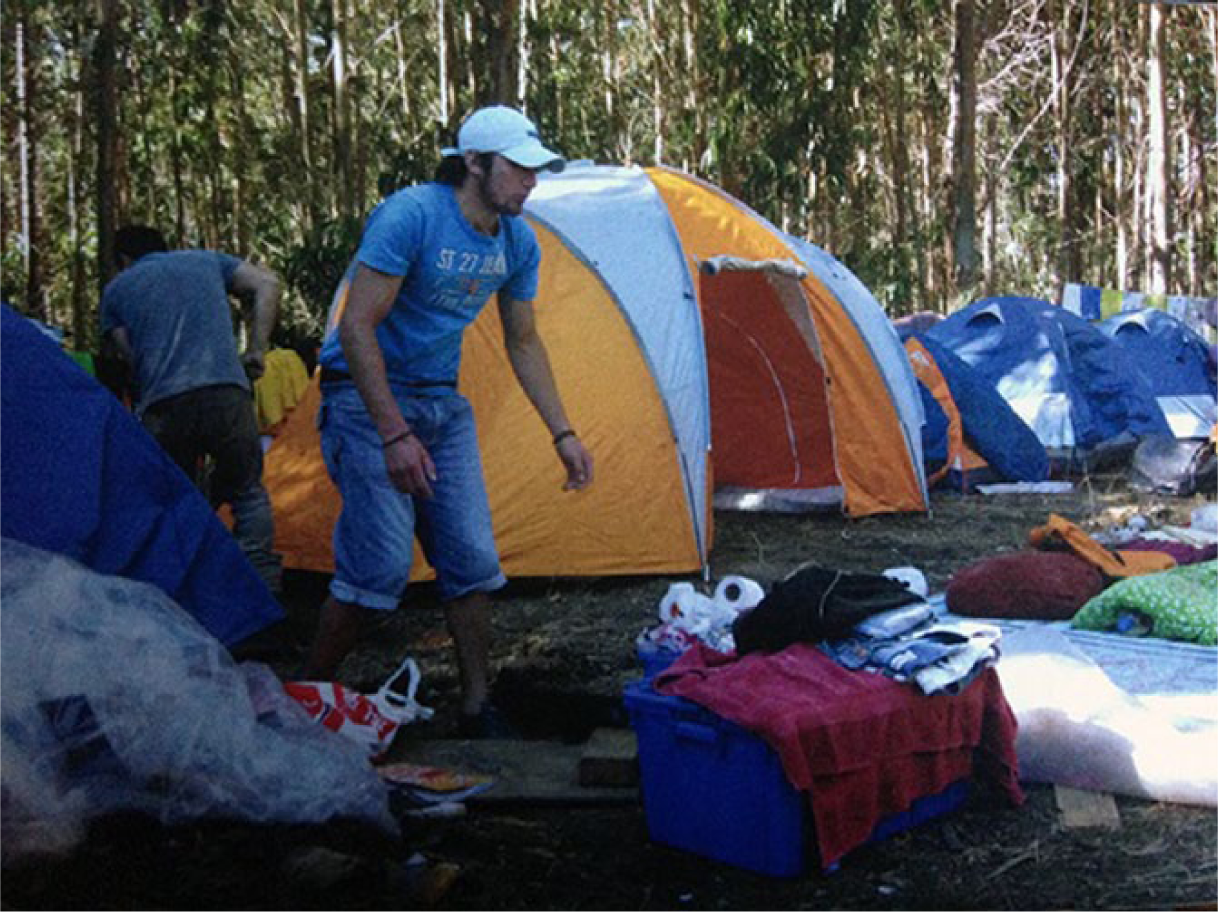
Emergency camp in the hills of Llico
In Llico the shops were empty, radio broadcasts reported on major looting in nearby cities, and the people of Llico were worried about the seemingly rampant shortage of products. They attempted to accumulate basic goods, such as water, suddenly a precious substance that was collected in jugs by the men. Meanwhile women-led commissions got organized to cook collectively with the available ingredients.
After a few days they had their first encounter with authority: the mayor of Arauco (the administration to which Llico belongs). His mission was limited to meeting with and providing emotional support to the population, more than distributing nourishment or urgently needed help, which was almost nonexistent at that moment. The mayor spoke with the people and even authorized the women to enter the school and the dispensary so they could retrieve their food stores.
A week later the military arrived in combat suits. After becoming aware of the high degree of organization achieved by the neighbours, it decided to withdraw, leaving behind only a one-man post. The night patrol operated further. The military was followed by people bringing donations that were stored in the town’s gym, requiring each camp to name two delegates to organize and distribute goods according to people’s needs.
III. The state arrives in llico
Some weeks after the tsunami, the state finally made a visible appearance in Llico. State reaction was so slow that the civil leaders and citizens were left with the impression that their own state had barely participated in the emergency process. Actually, during the first few weeks the role and contribution of the governments of Japan and Brazil were far more noticeable, as well as assistance coming from the private sector, foundations, NGOs and churches.
According to the gathered interviews, one of the first visible government actions was the arrival of the Un Techo para Chile (A Roof for Chile) Foundation(7) to distribute emergency shelters, one of the first clues that the reconstruction would become a process led by public–private partnerships. The mayor requested specifically that emergency shelter be designed appropriately for the regional climate, and was backed up by the community leaders on this point. The emergency shelters would temporarily satisfy the need for roofs; nevertheless, when the rainy season started in April, the structures had to be covered with plastic tarps, and their inhabitants had to build channels around them along with access paths, because the original ones had turned into mud pits. At that moment it became evident that the emergency housing was not appropriate for Llico’s climate. Four years later the homes are still there and their state now makes it evident that they were not designed to withstand four years as they have had to.
Tensions arose as soon as the shelters were installed, not because of the shelters themselves, but because of their location proposed by government officials. The municipality decided to seize four hectares, two of which became occupied by 58 victims. Land owners were requested to accommodate other family members with no assigned land, emergency shelters were built in their backyards, and thus 115 other victims were relocated. Those in the first group were denominated the aldea (emergency village) inhabitants.(8) Thus two categories arose: those who settled on land designated for emergency shelter (aldea – Photo 2); and those who settled on the land plots of their relatives. This differentiation marked the future of the reconstruction process. The government focused on assistance to the aldeas, which in Llico’s case originated as the result of a rashly carried out administrative decision, without much thought at that moment. There were no relevant differences between the inhabitants of aldeas and those who were placed in their relatives’ backyards. Nevertheless this situation created a rupture within the community that still exists; the villagers had better access to more state help and benefits while those who settled next to their families felt neglected and suffered under a heightened sense of vulnerability.
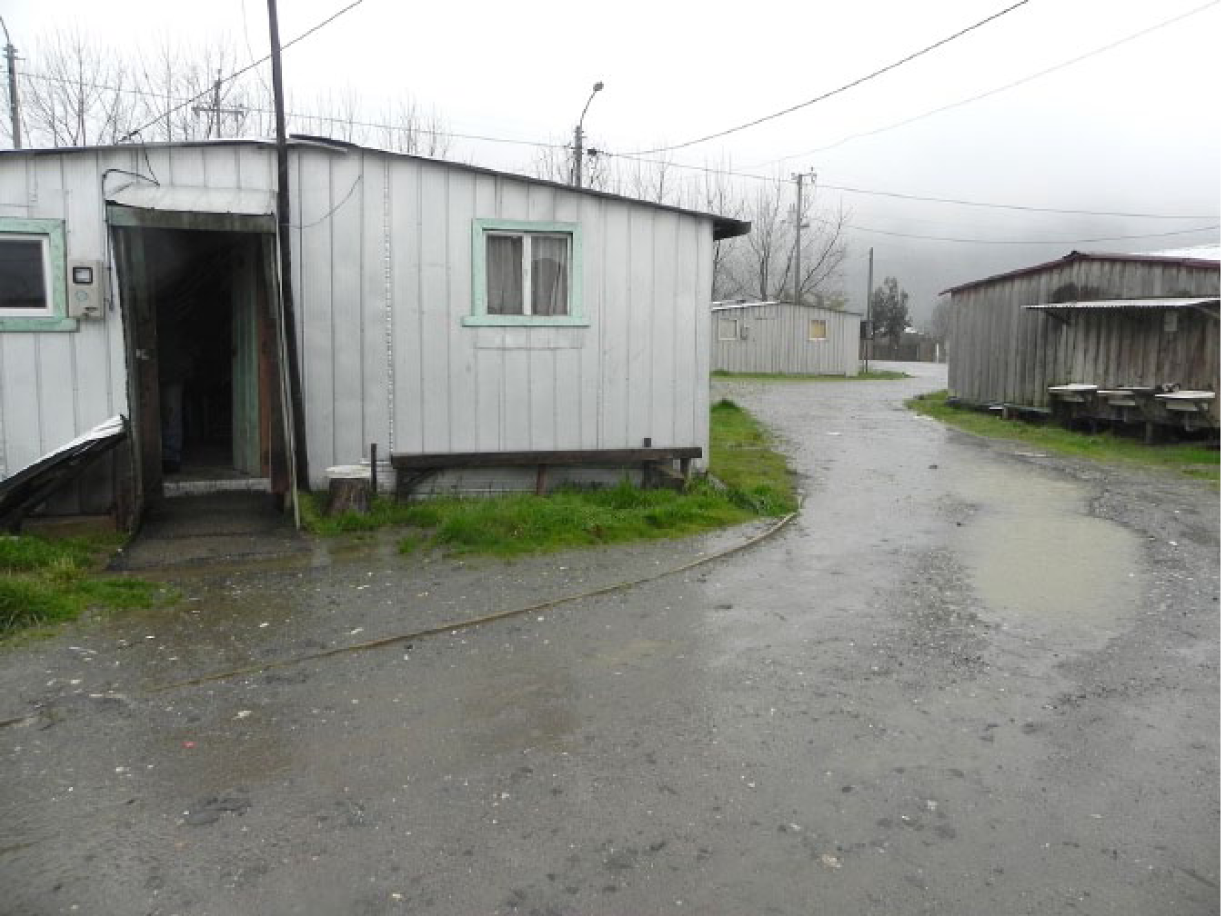
Emergency Village “Hope” (Aldea “La Esperanza”)
One of the last actions carried out during the emergency process was the creation of a cooperative, with the support of the fishermen and city hall, to organize the benefits donated by the IncaJapón fishery.(9) This cooperative later became an association that included all of the syndicates and associations of the Arauco Gulf. The earthquake and tsunami destroyed more than just the infrastructure and facilities of the local fisheries (loss of ships, fishing material, destruction of piers and machinery, etc.); it also caused a radical change in marine flora and fauna. In the months following the tsunami the Arauco Gulf lost the wealth of marine life on which it depended, a direct and tough impact on local economies. Syndicates and other groups of the Gulf got organized to recover economic activity by themselves, as a strategy in the face of the state’s inactivity. Although this initiative lost shape in the following months, in Llico it operated for over a year, giving way to new proposals and applications for resources from private institutions.
During the second half of 2010, the government carried out actions that intervened in Llico’s landscape. First of all, the construction of structures on the coastline was prohibited, in order to eradicate housing in risk zones. The construction of permanent housing was planned on the town’s periphery, sidewalks were improved, and the main road and services were put back in operation. The Ministry of Housing and Urbanism (MINVU) ordered the formulation of a Master Plan for the Reconstruction of the Coastline (PRBC18) with the intention of proposing a new urban design as well as a solution for the coastline, which had been declared inhabitable. The proposal was made by a team of consulting firms and coincided with a previous 27F proposal to reconstruct the harbour and build a seafront. The proposals were modified many times, and the people of Llico have not received a clear explanation as to why. In the end the government approved the construction of a “mitigation forest”, which meant that trees would be planted along the coastline and should act as a barrier against future tsunamis. The people of Llico witnessed this in disbelief. The tsunami waves were higher than any trees; plus, the planned trees are not native to the region, threatening the local landscape.
IV. Llico’s housing
The home is recognized by all of Llico’s people as a vital necessity and a problem for all the families who lost theirs. This has been precisely the main concern of the community organization during the past four years. This is why Julio, a former syndicate leader, was democratically elected by the community to represent it in the negotiation for housing.
The promise was to begin the reconstruction in 2010 with new housing construction beginning right in the first year. This was not the case, leading to an increase in the people’s distrust of authorities. As a means to exert pressure the Llicans decided to take over the town’s main access road. The national delegate for the reconstruction at that moment got in contact with Llico’s inhabitants to explain the delays. Still, first steps were barely visible by February 2012. Priorities were decided by the inhabitants, while at the same time five construction companies presented their housing proposals. The neighbours chose their preferred proposal by voting in an assembly. The construction of new housing began late in 2013, although by the end of the year municipal authorities halted the work, due to disregarded construction codes that affected the quality of the houses. Over a year of protests, meetings with authorities followed; the community’s demands were broadcast through diverse media such as the written press and the internet. In July 2014 an agreement enabled the victims to move into the new homes, while the authorities made a commitment to solve the quality issues. To date (early 2015), the quality deficiencies of the houses have not been corrected.
The community has become increasingly impatient and critical of the process. Houses had to be relocated far away from the coastline, hindering the daily life practices that were related to fishery and kelp gathering; the new land plots are narrow and the housing complex looks like a big city slum to the Llicans. Their homes were previously built on ample lots, with enough space for the house, a tool shed, some animals (mainly horses and chickens) and a vegetable garden. Llico is a rural settlement. The new houses are like población houses (poblaciones are the precarious social housing complexes of the big cities) and the Llicans express their fear towards this change imposed on their way of life: they do not know how to live in a población; they do not know how to live in small buildings that provide no privacy and where they cannot maintain their customs linked to fishing and small-scale agriculture.
At the same time the new town design is precarious and so are its services, such as lighting and sewer systems and school and health services; they are all not what they used to be. Over the course of time, the Llicans have become more critical, and you can sense their unease; they suspect that the reconstruction process has been a sum of actions that were not aimed towards an improvement of their conditions prior to the catastrophe (Photo 3).
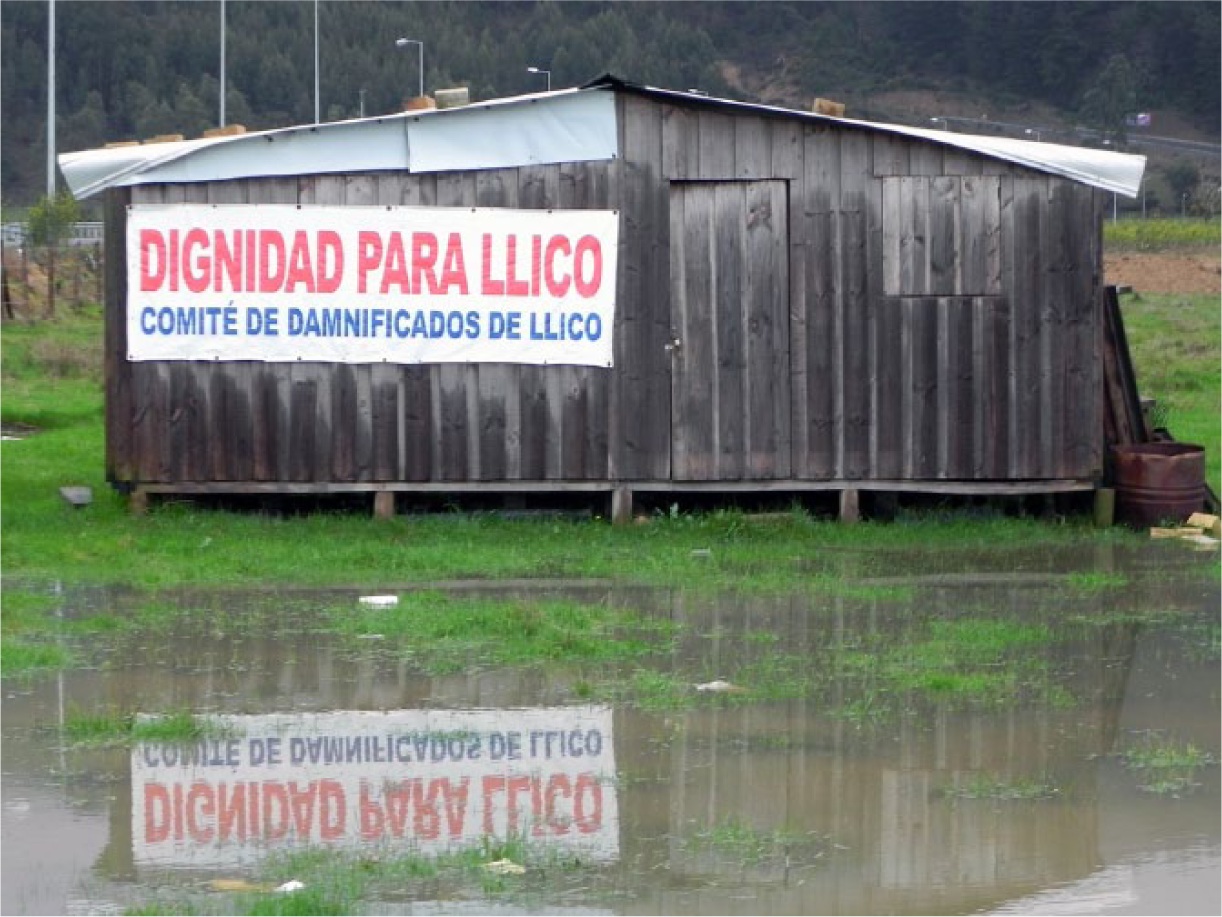
Emergency house with banner: “Dignity for Llico: Association of affected people of Llico”
V. Governmental Reconstruction Programme: Actions Devoid of Citizens
To better understand the experience of the Llico community, it is necessary to put the management process of the catastrophe into perspective. The governmental agency that assumed the lead of this process within the state was the Ministry of Housing and Urbanism.(10)
The reconstruction programme advanced by the government took as its course of action the use of preexisting institutions and public policies. The tension provoked by the action of regular institutions in exceptional times has been intensely debated,(11) thus constituting one of the most sensitive dimensions in the evaluation of the post-27F process.
In the past 30 years the Chilean state has diminished its role in territorial planning, handing it over to private initiative, especially to real estate interests.(12) The state’s role has been reduced to supporting vulnerable groups in obtaining housing through a subsidy system. It acts as a distributor of these subsidies to individuals and their families, who must go out and search within the real estate market for a housing offer that they can acquire. In fact, all of the phases of the process of housing development, more specifically organization of demand, design and construction, have been taken over by private companies (the so-called EGIS(13)) that are there to make a profit.
In this context, post-27F politics adopted the established model as the main strategy for the reconstruction of over 220 thousand damaged houses along the 500 kilometres of affected coastline. International organizations identify three stages of disaster management: happening, emergency and reconstruction. In Chile there are no institutions responsible for the first stage, the happening of the disaster itself. A debate to establish a Civil Protection Law started in 2010. This law should be oriented towards creating protocols and establishing responsibilities to prepare institutional and civilian reaction in the face of natural disaster. The management of an emergency is focused on the restoration of basic services to the affected population, for which each of the sectorial ministries is responsible, and providing shelter for the more vulnerable families through emergency settlements. In 2010 the construction of emergency housing was given over to a private foundation: the Un Techo para Chile Foundation, which is promoted by the Society of Jesus. Dozens of teams of young voluntary workers, without any support from professional and experienced construction personnel, were responsible for building thousands of emergency homes provided by the foundation in a context of low coordination with the main and local governments, as well as close to no communication with the affected communities. As was observed in Llico, the emergency shelters are of a standard design; there are no variations to adapt them to climate conditions or special needs of their occupants.
The management of emergency settlements is one of the three pillars of the Reconstruction Plan devised by the government and directed by the Ministry of Housing and Urbanism. The second pillar consists of the recovery of 220 thousand homes. The ministry is in charge of assigning subsidies, both for the repair of homes (approximately 110 thousand) and for the construction or purchase of new houses (approximately 110 thousand). This is the part of the Reconstruction Plan that has been given more visibility in public opinion, and the aspect that the government has chosen to present as an indicator of the progress of the complete process. The third pillar of work consists of making Master Plans for more than 100 localities. These plans should become an orientation guide for public investment in the short run. We will not delve into whether the plans are or are not working, but just want to note that in many cases these plans have been devised by universities, consulting firms and private foundations that have barely any connection to the affected territories. Today they seem more like archive documents than work guidelines.
In the last three years of fieldwork as a team, the Observatorio de la Reconstrucción, we have identified a high degree of specificity and variability of the processes of reconstruction in more than 15 localities. In our empirical observations it becomes evident that a reconstruction policy with clear procedures, deadlines and resources is nonexistent. What we have here is a cluster of actions developed under management models with dissimilar results and impacts. The process of reflecting and learning in the Chilean case should have been devised from the diversity of local experiences.
Nevertheless, despite this level of disarray, it is possible to identify some common elements. First, the relationship between the state and affected population has almost exclusively been mediated by the assignment of subsidies for the recovery of destroyed homes. The state assigns, and private companies build. Second, in the field of territorial planning, the so-called Master Plans have been commissioned from private companies and universities that have no links whatsoever to the affected territories. This results in the low relevance of some of the proposals and the lack of acceptability of the plans by the communities.
The citizens have been absent in these reconstruction policies; they have been formulated as recipients of state subsidies, forgetting and foregoing the social capital possessed by the communities as a vital resource for the reconstruction of their life projects. The story of the first days post-disaster in the locality of Llico makes it evident that two fundamental aspects of the process of reconstruction should be included: the concepts of social capital and resilience. Bourdieu formulated the concept of social capital in a clear and direct way, stating that this type of capital is the “sum of real or potential resources linked to the possession of a durable network of more or less institutionalized relationships of knowledge or mutual recognition”.(14) In this network, the relationships are based on trust, reciprocity and cooperation; on some occasions these qualities are observed as aspects of social organizations that encourage mutual benefit.(15) On its own, resilience is a concept that possesses a variety of meanings, but its use in the context of socio-natural disasters is linked to the condition and ability of people and collectives to recover and rebuild life situations that are an improvement over their previous conditions.(16) We could say that resilience requires social capital, and in the context of reconstruction, resilience develops as a consequence of a series of “institutional arrangements” that sustain it. In other words, resilient reconstruction from the perspective of the state should contain at least three stages:
first: thinking of reconstruction mainly as the reconstruction of life projects, not just infrastructure and facilities: people at the centre of the process;
second: recognizing the existence of resilient conditions in communities; and
third: encouraging the development of resilient qualities through actions devised in conjunction with the affected communities.
VI. Conclusions
The Llico community demonstrates a history that might seem extraordinary but is not unique. According to the monitoring of the communities done by the Observatorio de la Reconstrucción, a great number of them had the capacity to organize themselves in order to face the event and the emergency of the catastrophe of 27F. Most times, the communities organized on their own in the face of the abandonment, silence or delay in taking action of the states or private enterprises. That same force and quality, seen as social capital and resilience potential, was disregarded by the state at the moment of pushing forward the reconstruction process. The Llicans, who were protagonists self-managing their emergency, have been reduced to recipients of a subsidy, the beneficiaries of a service. Planners and builders arrive to construct the new Llico; its inhabitants observe from a distance but must suffer the impacts “brought to them” by the reconstruction.
In Chile, it is possible to rethink the limits of the housing and territorial policies through an empirical analysis of what has happened on different scales throughout hundreds of different localities after the earthquake and tsunami of 27 February 2010. A successful policy in the South American context, which has diminished the housing deficit, has shown its limits in the construction of a habitat in which the communities can develop their life projects and feel that they are part of the solution to their problems.
Footnotes
1.
Rasse, Alejandra and Francisco Letelier (2013), “El proceso de reconstrucción de viviendas en el centro de Talca: fotografía a dos años de la catástrofe”, Revista INVI Vol 28, No 77, pages 139–164.
2.
An earthquake that measured 8.8° on the Richter scale and took place in Central Southern Chile on 27 February 2010.
3.
Archer, Diane and Somsook Boonyabancha (2011), “Seeing a disaster as an opportunity – harnessing the energy of disaster survivors for change”, Environment and Urbanization Vol 23, No 2, pages 351–364.
4.
The Observatorio de la Reconstrucción is a project that links the academic community with the local communities that were affected by the 27F earthquake, composed of professors, civil servants and students of the Instituto de la Vivienda de la Facultad de Arquitectura (INVI), the Instituto de Asuntos Públicos and the School of Economics and Business of the Universidad de Chile.
5.
On the night of the earthquake, the tsunami alert system of the National Emergency Office (ONEMI, by its initials in Spanish) failed completely. Since 2010 there has been an ongoing legal process against those in charge. On March 2014, the courts sentenced the former shift manager of the ONEMI to 541 days in jail. The process continues against other public officers, who have been accused of being responsible for a number deaths caused by the tsunami.
6.
A total of 446 inmates escaped from four prisons in different cities that lost control due to the earthquake. In Arauco’s case, 105 prisoners escaped, most of whom were recaptured in the following weeks. Sánchez, Natalia (2013), 27F: Los otros damnificados, Ceibo, Santiago, 210 pages.
7.
A private foundation linked to the Catholic Church that made an agreement with national authorities for the construction of emergency housing, in the form of wooden structures of 11–15 m².
8.
Settlements of emergency houses that received vast amounts of emergency funds were named aldeas to distinguish them from the campamentos, vulnerable settlements that had existed prior to the disaster. The aldeas were not initially provided with basic services to avoid their becoming permanent, but this later changed due to the urgent needs of southern localities where the climate tends to be cold and rainy.
9.
Many companies and private entities distributed different types of help in the affected zones to satisfy basic needs (food, cover, etc.), but also to reactivate local economies (small-scale fishery, small business, agriculture, etc.). There was no centralization or coordination of these according to the observations of Chamorro, Sergio, Henry Herrera, Charlotte Mathivet, Claudio Pulgar, Elvira Valdivieso and Paulina Vergara (2011), Informe para la Relatora Especial de Naciones Unidas

11.
Instituto de la Vivienda (2010), (Plan de) Reconstrucción: Opinión del Instituto de la Vivienda, INVI – Universidad de Chile, Santiago, page 10, accessed 10 February 2014 at http://goo.gl/a55mQa; also Rasse, Alejandra and Francisco Letelier (2013), “El proceso de reconstrucción de viviendas en el centro de Talca: fotografía a dos años de la catástrofe”, Revista INVI Vol 28, No 77, pages 139–164; and
Gonzáles, Luis Eduardo (2012), Plan de reconstrucción estratégico sustentable de Duao, Iloca y La Pesca: deconstrucción de una iniciativa de gestión territorial post 27-F: implicancias sobre el hábitat residencial, Thesis for the Master’s in Residential Habitat Degree, INVI, Santiago, 120 pages.
12.
Sepúlveda Ocampo, Rubén, Jorge Larenas Salas, Vanessa Prado Barroso, Bárbara Prat Waldron and Jun Álvarez González (2010), “Bicentenario: Oportunidad de repensar las políticas urbano - habitacionales en Chile”, Revista INVI Vol 24, No 67, pages 21–67.
13.
Empresas de Gestión Inmobiliaria Social (Social Real Estate Management Companies). There are three types of these organizations: public companies, companies formed by the municipal administration, and private nonprofit (usually foundations and NGOs) or for-profit organizations.
14.
Bourdieu, Pierre (1985), “The Forms of Social Capital”, in John G Richardson (editor), Handbook of Theory and Research for the Sociology of Education, Greenwood, New York, 248 pages.
15.
Putnam, Robert D, Robert Leonardi and Raffaella Y Nanetti (1994), Making Democracy Work: Civic Traditions in Modern Italy, Princeton University Press, Princeton, 258 pages.
16.
Foster, Kathryn A (2011), “Professing Regional Resilience”, in Amy Liu, Ronald V Anglin, Richard M Mizelle Jr and Allison Plyer (editors), Resilience and opportunity: lessons from the U.S. Gulf Coast after Katrina and Rita, Brookings Institution, Washington, DC, pages 17–30.