



Abstract
This article argues that existing inequalities of all kinds in the city of Santiago de Chile are symptoms of the gap between those who are favoured by the distribution of benefits and those who are at the margins of this process. We propose that these groups are differentiated not only by the socioeconomic sector to which they belong but also by the part of the city in which they live. People’s exclusion is also affected by gender. The point of view taken is that although these inequalities have a systemic and structural nature, they are not abstract elements in people’s lives. We claim that, in fact, they are social, economic, political and institutional types of violence, which affect individuals and groups.(1) These types of violence, which in turn have visible manifestations (such as direct violence) and invisible manifestations (such as structural and cultural violence),(2) are examined in the case of Santiago de Chile in the context of three different socioeconomic districts (low, medium and high).
I. Introduction
Santiago is the most visible face of the extreme changes that have taken place in Chile over the course of the last 40 years. These are changes that have affected the country in the social, economic, political-institutional and cultural spheres and continue to do so today, with territorial manifestations. Taken overall, many of these changes are positive, especially in terms of the macroeconomic figures (which are “excellent” and “enviable” according to some commentators). However, if we go down to street level – where students, workers and public employees are holding protest marches, or where people in marginal urban neighbourhoods live their lives – it is clear that progress has not been the same for everyone. And for some, the changes have not even been positive. The most evident expression of this imbalance is the worsening and hardening of inequalities in the country.
In this article we maintain that the inequalities so evident in Santiago today are symptoms of an underlying conflict that is structural in nature, which the reigning neoliberal model(3) may not have initiated but has certainly aggravated. We refer to the gap that has opened up between those who have benefited from the distribution of the gains and those who remain excluded from them. These groups are differentiated not only by the socioeconomic sector they belong to but also by the city territory they live in. Gender also plays a role.
Although our starting point is that these inequalities are systemic and structural in nature, they are not abstract elements in people’s lives. In fact, they are forms of violence, social and economic, political and institutional. These forms of violence can affect both individuals and groups, and where inequalities are also present they do not affect everyone in the same way. Their manifestations, effects and scope, their perpetrators and their victims, differ depending on the neighbourhood where people live, their level of income, their age, whether they are women or men, and also according to the territories they move through or are excluded from in their daily and working lives.
II. Visible and Invisible Forms of Violence
Not all forms of violence in the city manifest themselves in the same way. With regard to this, Galtung(4) speaks of visible and invisible forms of violence. According to Moser, most definitions of violence refer to it as the use of physical force that causes damage to others in order to impose the will of the person inflicting it. However, she indicates that there are “… more extensive definitions that go beyond physical violence and consider actions that cause psychological damage, material deprivation and symbolic disadvantages to be violence.”(5) This takes us back to Galtung, who indicates that the phenomenon of violence can be compared to an iceberg, in that the visible part is much smaller than the unseen portion. He proposes the existence of three forms of violence – direct, structural and cultural – and suggests the concept of a “triangle of violence” to represent the relations existing between them.
Direct violence, which is visible, is embodied in behaviour and occurs when one or more persons inflict physical, verbal and/or psychological acts of violence on other people. It refers to an abuse of power or authority, an action that generally takes place in asymmetrical relationships. According to Galtung, this is the manifestation of something, not the origin.
Structural violence, which is invisible, is not enacted by individuals but is hidden to a greater or lesser extent in structures that either hamper or do not facilitate the satisfaction of needs, and specifically becomes manifest in the negation of these needs. This violence refers to an existing distinction or conflict between social groups (normally described in terms of gender, ethnicity, class, nationality, age or other), in which the sharing of or access to resources is systematically settled in favour of some parties and at the expense of others.
Cultural violence, which creates a legitimizing framework for structural and direct violence, shows itself in attitudes. According to Galtung, cultural violence is expressed through countless means (symbolism, religion, ideology, language, art, science, laws, the media, education, etc.), and serves to legitimate direct and structural violence and also to inhibit or repress any response by victims of this violence. Similarly, for Bourdieu,(6) symbolic violence conceals relationships based on force, which is to say domination by those who force their discourse on others. Cultural or symbolic violence, therefore, exists as a web of values that are reinforced by society’s legal standards, relations with nature, gender relations and labour relations.
After accepting the types of violence described by Galtung, we return to the proposal by Moser,(7) who indicates that different types of violence often intertwine and become superimposed and that a set of categories to cover different types of violence is needed. We believe incorporating the four categories of violence (political, institutional, economic and social) is appropriate according to the motives of those inflicting them:
political violence refers to violence inflicted in order to gain or hold onto political power;
institutional violence is inflicted by state institutions, not just by police forces. Some of this violence is inflicted by public officials in the application of public policies that affect citizen or civil rights;
economic violence is inflicted in order to secure economic gain and/or material goods. This covers a wide spectrum ranging from direct violence, such as theft, to structural violence, such as the regressive distribution of income; and
social violence takes place on a daily basis in cities, in barrios, in families and in homes.
The manifestations of violence and insecurity in Santiago have a special status: most of them are not crime-related nor linked to internecine war situations as in other Latin American cities. Instead, they are the visible expression of a structural violence associated with the effects of economic or social policies that have constrained the ability to respond to the population’s basic demands. In this sense, they are linked to the widespread and growing economic and social inequality in a society whose guiding light is profit. And they are based on a form of cultural violence: neoliberal ideology, “the rule of markets”,(8) which has legitimated the processes of wealth concentration, segregation and discrimination.
From the analytical standpoint we adopt here, these forms of violence are interconnected. This approach seems particularly interesting to us because, in the case of Santiago, as in many cities, structural violence has a territorial referent, revealed in the processes that have transformed the city, exacerbating differences and inequalities.(9)
III. The Territory
The tipping point in Chile was the military coup in 1973,(10) whose crimes against humanity and human rights violations took place on a scale unprecedented in the country’s history, and are now widely known. In time, the political violence of the military regime’s early years was replaced by social violence.(11)
The foundations for the new urban order were laid between 1973 and 1985, a period in which citizens’ organizations were repressed and dismantled, municipal territories were sub-divided, ownership of urban land was organized as the basis for the land market, and the enterprises in charge of urban infrastructure began to be privatized.(12) These were the measures used to bring about a city with clearly demarcated territories, where different sectors of society would not mix; a city whose infrastructure and services were turned into a business opportunity and a new source of funds for investment in real estate businesses.(13)
During this same period, the social, economic and political organizations in the city were broken up, repressed or taken over. For instance, the trade unions were initially banned and then constrained both by restrictive laws and by a de-industrialization model that reduced the political clout of the working class. Town halls and neighbourhood associations were controlled and local authorities were appointed by the military government. This was the method used to control any possible reaction or opposition to the new regime. The brutality of the initial repression created a sense of fear among people living in low-income neighbourhoods, which inhibited any reaction against the military regime for a very long time.
Finally, this territorial reorganization and ordering of the city laid the foundations for the future operation of the property market in the city: the areas with the most valuable land were cleaned up – freed of the unstable settlements of the poor – and people with low incomes were concentrated in the south and west of the city.
The privatizing tendencies visible in the spatial and administrative reorganization of Santiago also guided the privatization of public services such as education and health, of urban equipment and, in particular, of the administration of the workers’ pension funds. The return to democratic government in 1990 did not reverse the trends established by these arrangements. Instead, in many ways, it reinforced them.
In short, the city’s urban structure changed radically between 1973 and the present day. Whereas Santiago was a concentrated city in the early 1970s, in the 2010s it is a spread-out city criss-crossed by a network of motorways managed under concession.(14) The city centre has lost its importance and many of the commercial activities and key services have moved to new suburbs and shopping centres, first targeting the high-income areas and later spreading to the rest of the city, following the new road and underground networks.
Two aspects stand out in this process of change in the city’s structure: one concerns its territorial organization and the other the regulations that govern that organization. First, in the 1980s, the territory of the city’s municipalities was reorganized to establish socially and economically homogeneous territorial units. From the 1990s onwards, and more forcefully in the early 2000s, city laws were deregulated and urban planning was reduced to a minimum.(15)
Together with these changes in the urban structure came modifications in the city’s productive structure. At the end of the 1960s, Santiago was a city with an industrial base, where unionized workers and their political parties were important players in public life. This is no longer the case, and now Santiago is a service-based city.(16)
One of the flipsides of having diminished the social and economic clout of the workforce is an increasing concentration of income. Whereas the 1960s and the early 1970s were a time not only of democratization but also of greater social and economic equality, the military coup brought that trend to an abrupt halt. The changes in the Gini coefficient for income distribution in Santiago between 1960 and 2010 summarize the city’s political and social history (Figure 1): in the 1960s, income distribution was becoming increasingly more equitable but, as the graph shows, the coup d’état and the start of the military regime was a tipping point, and the trend towards equity was reversed. From then on, although with some ups and downs, a major concentration of income became the norm.
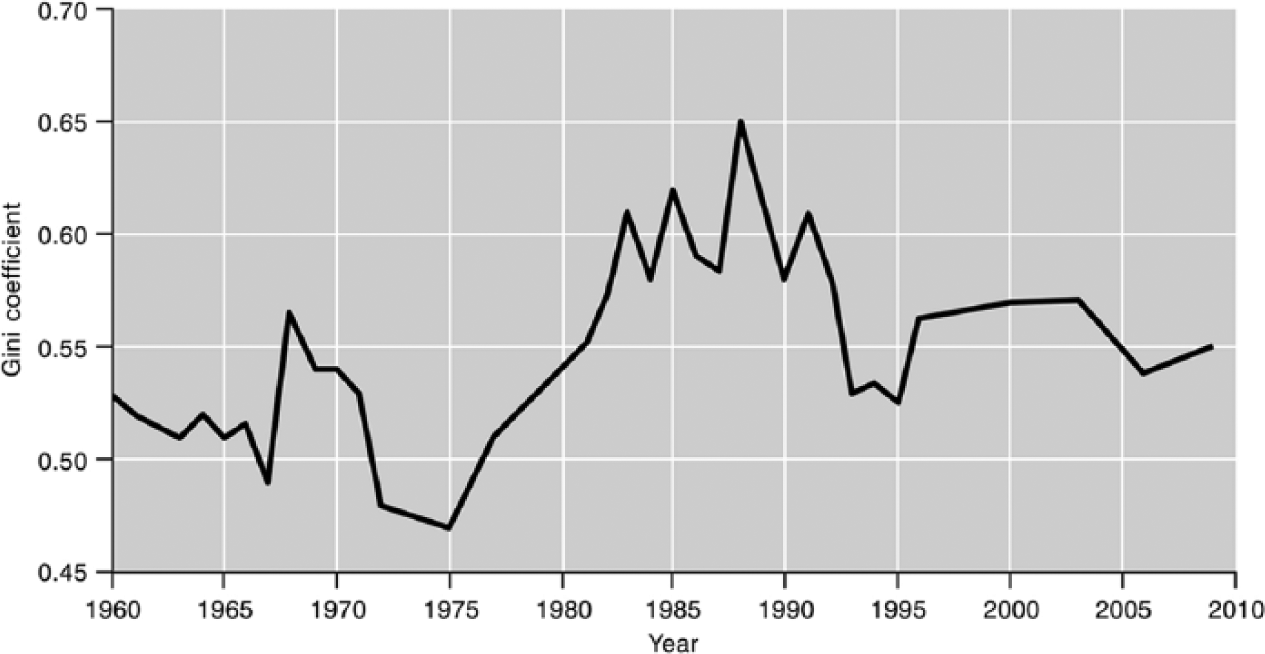
Santiago: changes in the Gini coefficient, 1960–2010
Today, 40 years after the military coup, life is good in Santiago for some people – but not for others (Table 1).
Qualitative indicators of gains and losses in Santiago
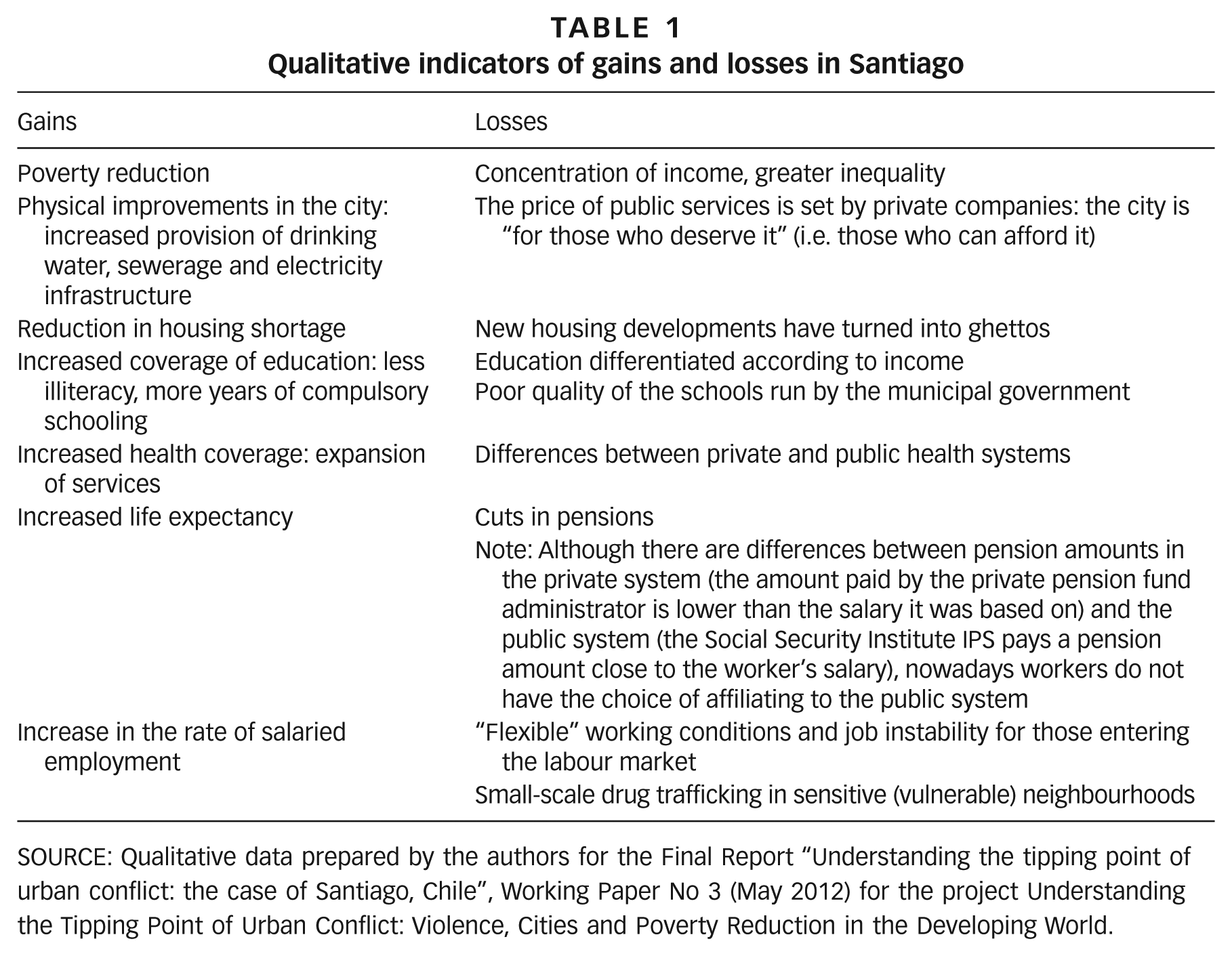
SOURCE: Qualitative data prepared by the authors for the Final Report “Understanding the tipping point of urban conflict: the case of Santiago, Chile”, Working Paper No 3 (May 2012) for the project Understanding the Tipping Point of Urban Conflict: Violence, Cities and Poverty Reduction in the Developing World.
IV. Santiago: Its Forms of Violence and Insecurity
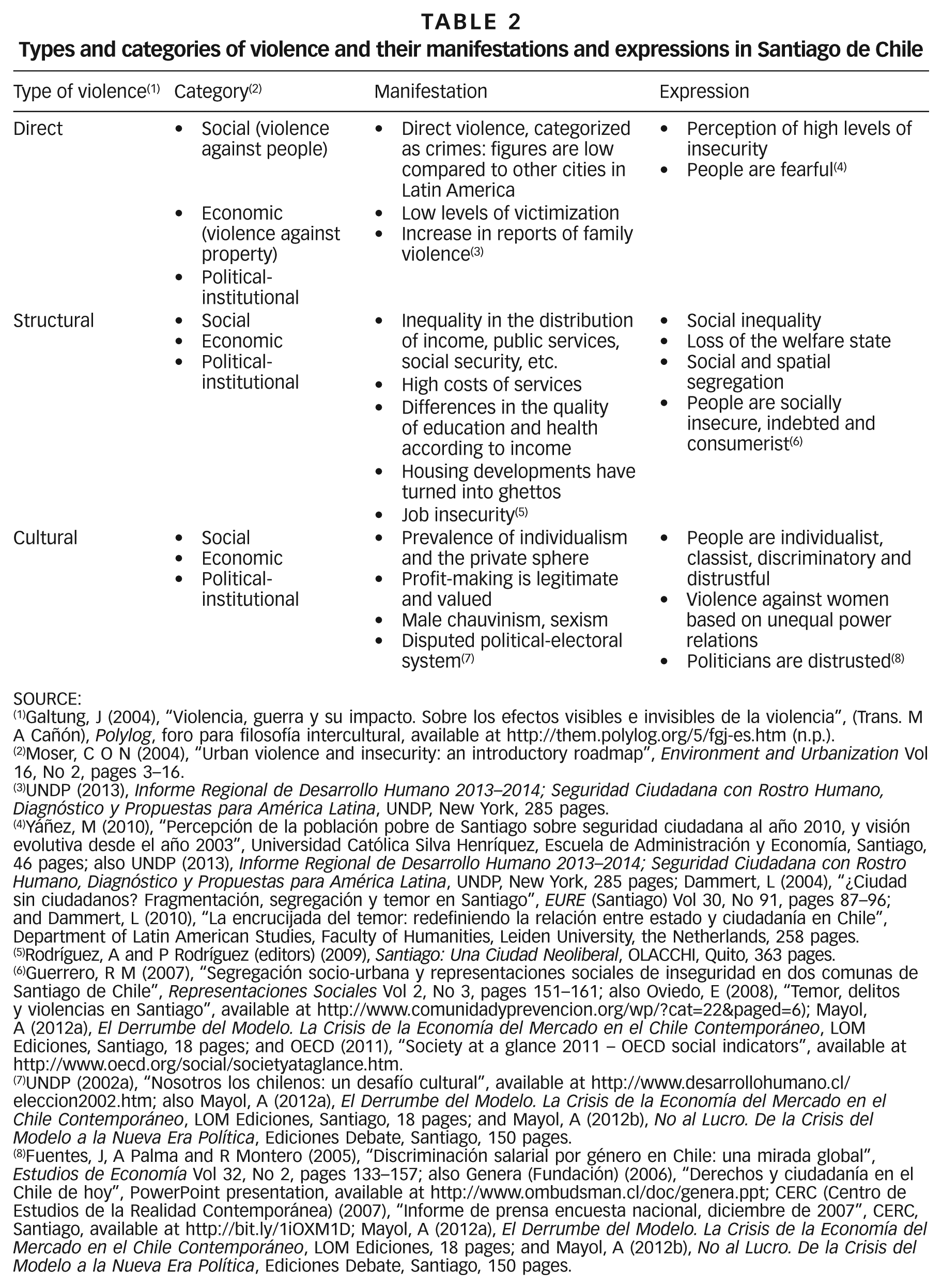
Galtung’s typology of violence – direct, structural and cultural – can be combined with the categories proposed by Moser – social, economic and political-institutional – to provide an organizing framework for identifying the main types and categories of violence according to their manifestations and expressions (Table 2).
Types and categories of violence and their manifestations and expressions in Santiago de Chile
SOURCE:
Galtung, J (2004), “Violencia, guerra y su impacto. Sobre los efectos visibles e invisibles de la violencia”, (Trans. M A Cañón), Polylog, foro para filosofía intercultural, available at http://them.polylog.org/5/fgj-es.htm (n.p.).
Moser, C O N (2004), “Urban violence and insecurity: an introductory roadmap”, Environment and Urbanization Vol 16, No 2, pages 3–16.
UNDP (2013), Informe Regional de Desarrollo Humano 2013–2014; Seguridad Ciudadana con Rostro Humano, Diagnóstico y Propuestas para América Latina, UNDP, New York, 285 pages.
Yáñez, M (2010), “Percepción de la población pobre de Santiago sobre seguridad ciudadana al año 2010, y visión evolutiva desde el año 2003”, Universidad Católica Silva Henríquez, Escuela de Administración y Economía, Santiago, 46 pages; also UNDP (2013), Informe Regional de Desarrollo Humano 2013–2014; Seguridad Ciudadana con Rostro Humano, Diagnóstico y Propuestas para América Latina, UNDP, New York, 285 pages; Dammert, L (2004), “¿Ciudad sin ciudadanos? Fragmentación, segregación y temor en Santiago”, EURE (Santiago) Vol 30, No 91, pages 87–96; and Dammert, L (2010), “La encrucijada del temor: redefiniendo la relación entre estado y ciudadanía en Chile”, Department of Latin American Studies, Faculty of Humanities, Leiden University, the Netherlands, 258 pages.
Rodríguez, A and P Rodríguez (editors) (2009), Santiago: Una Ciudad Neoliberal, OLACCHI, Quito, 363 pages.
Guerrero, R M (2007), “Segregación socio-urbana y representaciones sociales de inseguridad en dos comunas de Santiago de Chile”, Representaciones Sociales Vol 2, No 3, pages 151–161; also Oviedo, E (2008), “Temor, delitos y violencias en Santiago”, available at http://www.comunidadyprevencion.org/wp/?cat=22&paged=6); Mayol, A (2012a), El Derrumbe del Modelo. La Crisis de la Economía del Mercado en el Chile Contemporáneo, LOM Ediciones, Santiago, 18 pages; and OECD (2011), “Society at a glance 2011 – OECD social indicators”, available at http://www.oecd.org/social/societyataglance.htm.
UNDP (2002a), “Nosotros los chilenos: un desafío cultural”, available at http://www.desarrollohumano.cl/eleccion2002.htm; also Mayol, A (2012a), El Derrumbe del Modelo. La Crisis de la Economía del Mercado en el Chile Contemporáneo, LOM Ediciones, Santiago, 18 pages; and Mayol, A (2012b), No al Lucro. De la Crisis del Modelo a la Nueva Era Política, Ediciones Debate, Santiago, 150 pages.
Fuentes, J, A Palma and R Montero (2005), “Discriminación salarial por género en Chile: una mirada global”, Estudios de Economía Vol 32, No 2, pages 133–157; also Genera (Fundación) (2006), “Derechos y ciudadanía en el Chile de hoy”, PowerPoint presentation, available at http://www.ombudsman.cl/doc/genera.ppt; CERC (Centro de Estudios de la Realidad Contemporánea) (2007), “Informe de prensa encuesta nacional, diciembre de 2007”, CERC, Santiago, available at http://bit.ly/1iOXM1D; Mayol, A (2012a), El Derrumbe del Modelo. La Crisis de la Economía del Mercado en el Chile Contemporáneo, LOM Ediciones, 18 pages; and Mayol, A (2012b), No al Lucro. De la Crisis del Modelo a la Nueva Era Política, Ediciones Debate, Santiago, 150 pages.
As well as identifying the different forms of violence and their manifestations, it is also interesting to highlight the point – although it may seem obvious – that its manifestations occur in a specific space. This leads us to consider the multiple uses and meanings of public space and private space. In Chile, the concept of urban violence, and in recent decades the concept of citizen safety, have usually been associated mainly with the public space. This tends to reaffirm the idea that public space is the site of violence and insecurity, while the home is the welcoming space, the place of refuge and protection. In such circumstances, the corollary of fear is that people shut themselves away; there is a loss of freedom and restricted possibilities for going out and about. This situation affects men and women differently: women’s use and enjoyment of the city is more restricted.(17) At the same time, the home is where women are particularly at risk of gender-based violence.
Applying the categories described so far, the question is: which forms of violence – direct, structural, cultural; social, economic, political-institutional – occur in Santiago, by location, class and gender? To answer this question, we reviewed the secondary information available for three districts of Greater Santiago: Lo Barnechea on the northeastern periphery, whose residents belong to the high socioeconomic stratum although it also has a clearly demarcated low-income enclave; La Florida in the southwest of the city, a middle-income, middle-class district; and La Pintana on the southern periphery, the district with the highest rates of poverty in Greater Santiago.
a. Direct violence
According to the secondary information available, the manifestations of direct social violence and direct economic violence vary, and whether one or another predominates depends on the socioeconomic stratum.
Furthermore, many of the crimes perpetrated against the residents of a high-income area like Lo Barnechea occurred outside their district, not in it. The situation is different in La Florida and La Pintana, where most of these crimes take place in the victims’ own neighbourhoods or another part of the same district. From this point of view, although the residents of the high- and middle-income districts are victims of violent crime to a similar degree, the level of violence in the neighbourhood or district varies greatly according to whether the crimes perpetrated against its residents are committed outside or within the area. The situation is different in La Pintana, the lowest-income district studied, where most of the crimes that affect its residents take place in the district itself.
A special case is that of crimes identified as gender violence. These are forms of violence that affect women because they are women, and until very recently were grouped in the category of “family violence”.(19) According to the National Survey of Victims of Family Violence and Sex Crimes 2008,(20) produced by the Home Affairs Ministry, 35.7 per cent of women in Chile between the ages of 15 and 59 have been victims of violence perpetrated by their partners at least once in their lives. Added to the insecurity experienced by women inside their homes is their fear of being victims of sexual violence in their neighbourhood. In the low socioeconomic sector, this fear is justified by reality: the number of reported rapes in this group is 19.3 per 100,000 women, while in the highest stratum it is 5.5.
One particular type of direct economic violence that has become increasingly relevant to the public in Santiago is the violence related to the small-scale drugs trade, involving low-income individuals or families who make up the bottom rung of the drug-trafficking networks. An increasing number of women are involved in the trade, a trend that seems to go hand-in-hand with the increase in the number of female-headed poor households. In these households, since the welfare state in Chile was replaced by a subsidiary state, the burden of responsibility for solving their social needs increasingly falls almost solely to the family. In addition, the group most vulnerable to drug use and at the greatest risk of addiction are poor and unemployed young people who have dropped out of education (structural social violence). This leads them to form or join the gangs that are increasingly active in certain neighbourhoods.
By contrast, in the case of men, larger numbers of whom are part of the workforce, the neighbourhood is the place where they come back to for sleep and rest. For most men, their use of the space is less varied than for women, being limited to the journey to and from work as well as leisure activities in the evenings and at weekends. Older men – many of whom are now retired – make more use of public space. Their perceptions of insecurity are significantly different to those of other men and more like those of women.
b. Structural violence
With regard to structural forms of violence, we can distinguish between those that are social, economic and political-institutional in nature.
With regard to quality of life, the Human Development Index (HDI) has changed in the following ways in the three districts studied: in the low-income district it increased slightly, but the area’s ranking among all districts in the country fell significantly, reflecting the worsening inequality in the city; in the middle-income district it fell slightly and its place in the overall ranking fell; the HDI in the higher-income district increased in the period studied and rose in the overall ranking of districts nationwide (Table 3).
Human Development Index (HDI) in three selected districts of Santiago
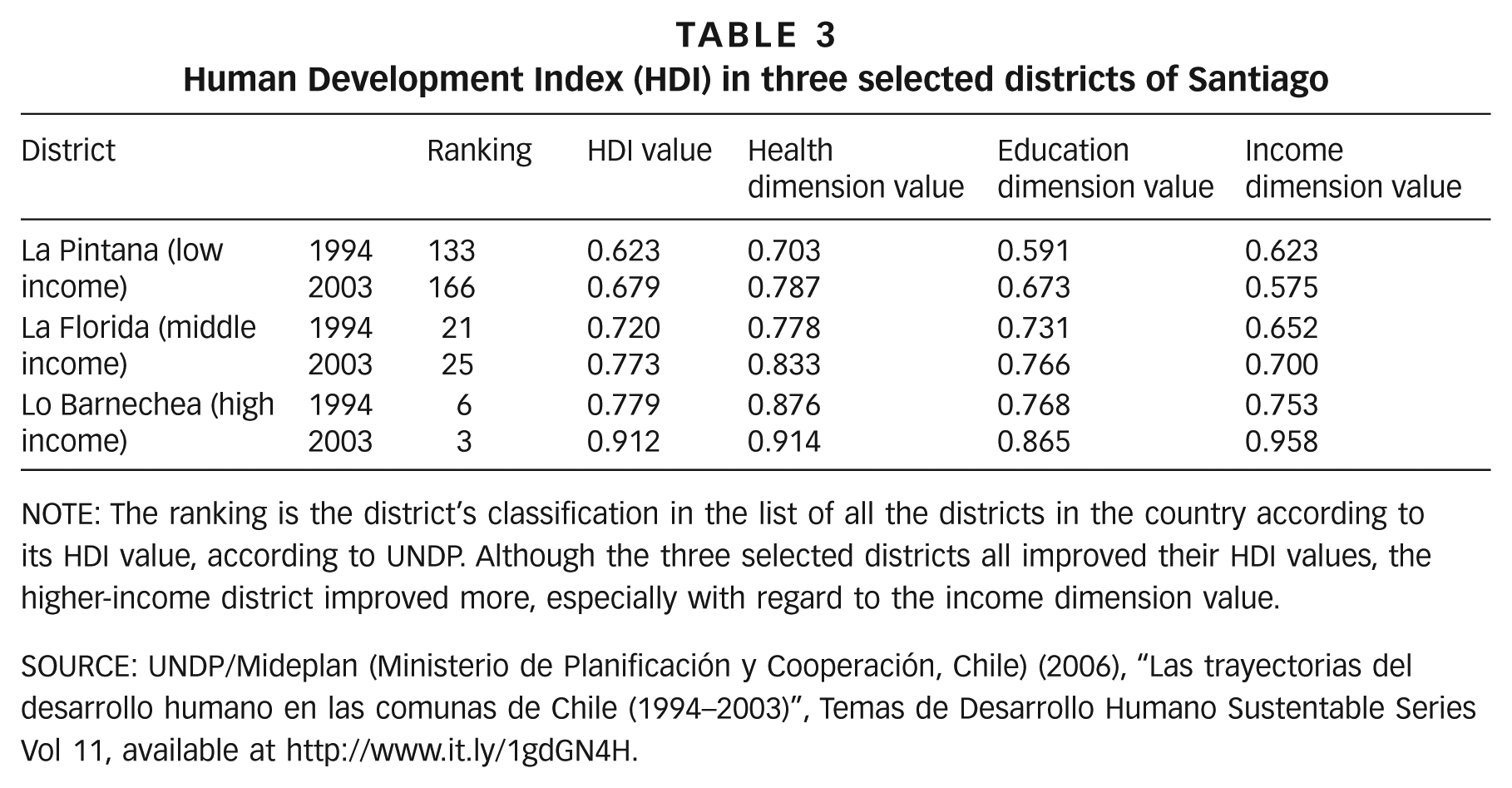
NOTE: The ranking is the district’s classification in the list of all the districts in the country according to its HDI value, according to UNDP. Although the three selected districts all improved their HDI values, the higher-income district improved more, especially with regard to the income dimension value.
SOURCE: UNDP/Mideplan (Ministerio de Planificación y Cooperación, Chile) (2006), “Las trayectorias del desarrollo humano en las comunas de Chile (1994–2003)”, Temas de Desarrollo Humano Sustentable Series Vol 11, available at http://www.it.ly/1gdGN4H.
As far as inequality in access to education and health is concerned, although enrolment in schooling is high in Chile, there is a huge disparity between public or state-subsidized education and private, fee-charging education. The residents of the poorest districts are not only educationally segregated in terms of the number of years of schooling they complete but also with regard to the quality of the education they receive. Education results at the district level strongly suggest that the quality of education is unequally distributed at the socioeconomic and territorial level as well, and that the inequalities worsen with each successive level of education.(21)
With regard to health, the privatization of the health system has meant the coexistence of a private, better-quality system and a public system that, in most cases, is unable to provide an adequate response to the urgent needs of the people it serves. Access to a deficient system that discriminates on socioeconomic grounds is a form of violence faced daily by those with low incomes.
Other spheres of life affected by structural economic violence are consumption and indebtedness.(25) Levels of family savings are low in Chile and there are strong cultural pressures linked to consumption, pushing people towards credit as a strategy for obtaining consumer goods. As a result, households now have more goods and better housing infrastructure, but their indebtedness causes high levels of worry and anxiety in families, aggravated in many cases by people’s job insecurity.
With regard to the use of time, the figures of a survey on that subject(26) reflect how women in the second to fourth quintiles devote half a working day to unpaid domestic labour, and this rises to nearly three-quarters of a working day (5.7 hours) in the first quintile. The impossibility of hiring domestic help affects the poorest women by keeping them from getting a job. In other words, the material poverty of women in the lowest-income stratum is compounded by a new form of scarcity – time poverty.
c. Cultural violence
Measurements made in the last 10 years show that citizens in Chile have extremely low levels of interpersonal trust.(28) According to figures from the study “Derechos y ciudadanía en el Chile de hoy” (Rights and citizenship in Chile today) published by the Genera organization in December 2006,(29) when asked the question “Do we in Chile discriminate?”, 92 per cent of interviewees in the country answered in the affirmative. Also, 37 per cent stated that the main form of discrimination against people is for “being poor”. Physical appearance, skin colour and the lack of education were considered, to some extent, reasons why people suffered from attacks. The perception of being discriminated against because of the condition of poverty was clearly stated in a study by Yáñez,(30) where 62.3 per cent of the poor people surveyed said they felt “unsafe” or “very unsafe” when they walked around Santiago today. Only 15.3 per cent felt “very safe” or “safe”.
Added to this is a noticeable tendency to encounter wage discrimination by race(31) and by gender,(32) as well as social discrimination against immigrants.(33) In a context of insecurity and distrust such as we find in Santiago, the cultural violence of discrimination aggravates the “… damage to the recognition, enjoyment or exercise, in equal conditions, of the human rights and fundamental freedoms of all individuals”, as Law No 20.609 against discrimination in Chile defines it.
In the opinion of some analysts, Chile has become “… the leading neoliberal society in the Latin American region.”(34) The country is starting to identify with an advanced modernity of the type found in the United States, with an order focused on protecting property that exalts individual rights – though not obligations to the community – and where personal achievements are expressed in the form of material goods. In their pursuit of the mantra “success equals money”,(35) Chileans seem to be seeking security for themselves by disconnecting from others. In this context, social co-existence is becoming increasingly selfish, individualist and aggressive – in short, asocial, in the sense of being merely utilitarian.(36)
Arnold-Cathalifaud, Thumala Dockendorff and Urquiza Gómez(37) argue that, in parallel with this process of increasing individualism, the key issue on the public agenda is no longer violence, in its multiple forms and manifestations, but insecurity, symbolized by crime and the absence of social ties and moral standards. From this perspective, they argue that crime constitutes a reality whose presentation in the media reinforces the image of “other people” as likely aggressors. This, in turn, underpins the withdrawal from social life and into the private space. In response to these insecurities, what is taking hold is a market imaginary that is indifferent to collective motivations,(38) weak in social ties such as fellow-feeling and friendship, but full of “… salaried workers and disciplined consumers”.(39)
V. Postscript
When this profile of Santiago was drawn up as part of the Urban Tipping Point project (2011–2012), invisible forms of violence were the subject of academic, institutional and political discourses, but they did not form part of the “common sense” of those whom Moulian calls “… salaried workers and disciplined consumers.”(40) Now, two years later, this is no longer the case.
If the 1973 coup was a decisive tipping point in the history of the country and of Santiago, the citizen protests of 2011 were a new decisive tipping point. The year 2011 was marked by people taking to the streets to hold marches, demonstrations and protests, as well as strikes, shutdowns and the occupation of institutional buildings. They included secondary school and university students protesting against profit-making in public education;(41) environmental organizations protesting against environmentally destructive electricity generation projects (“Patagonia without dams”); GLBT movements; victims of the February 2010 earthquake who were still homeless; indebted homeowners; indigenous peoples; health workers; public transport users; fisherfolk; miners; public employees. Between 26 February and 4 November 2011, a total of 77 huge public demonstrations took place in Santiago, some of them mobilizing more than 200,000 people. These eight months of mass protests made visible the structural and cultural violence that underpins a very unequal society.
Did the protests manage to change the country’s inequality? No. But they did change the “common sense” about it. This means that the role of the state in the provision of education and health, social security and housing has started to become part of the public conversation and political agenda. Moreover, the issue of inequality in such matters formed the core of the speeches during the last presidential campaign and constitutes the main topic in the agenda of the current government.
The invisible has started to become visible in the city.
Footnotes
1.
Moser, C O N (2004), “Urban violence and insecurity: an introductory roadmap”, Environment and Urbanization Vol 16, No 2, pages 3–16.
2.
Galtung, J (2004), “Violencia, guerra y su impacto. Sobre los efectos visibles e invisibles de la violencia”, (Trans. M A Cañón), Polylog, foro para filosofía intercultural, available at  .
.
3.
Harvey, D (2007), Breve Historia del Neoliberalismo, (Trans. A Varela Mateos), Akal, Madrid, 256 pages.
4.
See reference 2.
5.
See reference 1, page 4.
6.
Bourdieu, P (1999), Intelectuales, Política y Poder, Eudeba, Buenos Aires, Argentina, 272 pages.
7.
See reference 1, page 5.
8.
Theodore, N, J Peck and N Brenner (2009), “Urbanismo neoliberal: la ciudad y el imperio de los mercados”, Temas Sociales Vol 66, SUR, Santiago, Chile, 12 pages.
9.
These processes include the eradication of shanty towns and the removal of their inhabitants (approximately 170,000 people), which was one of the key policies of the military dictatorship between 1978 and 1985. Connected to this are the social housing projects for low-income groups, both past and present (1990–2004), which have displaced about one million people to the outskirts of the city.
10.
11.
Castel, R (2004), La Inseguridad Social. ¿Qué es Estar Protegido?, Manantial, Buenos Aires, Argentina, 120 pages.
12.
Harberger, A (1978), Director of the School of Economics at the University of Chicago, laid down the basic principles of what would become the country’s urban policies when he said that “… cities grow in a
13.
As Harvey rightly notes, Chile was the first country to implement a neoliberal platform. It was implemented by force, during a military dictatorship, long before the Washington consensus; see reference 3, pages 14–15.
14.
See Poduje, I and G Yáñez (2009), “Planificando la ciudad virtual: megaproyectos urbanos estatales y privados”, in A Rodríguez and P Rodríguez (editors), Santiago, una Ciudad Neoliberal, OLACCHI, Quito, Ecuador, pages 277–299.
15.
Trivelli, P (2009), “Sobre la evolución de la política urbana y la política de suelo en el Gran Santiago en el periodo 1979–2008”, in A Rodríguez and P Rodríguez (editors), Santiago, una Ciudad Neoliberal, OLACCHI, Quito, Ecuador, pages 207–227.
16.
In 1967, 36.9 per cent of Santiago’s GDP came from productive activities; in 2005, the figure was 27 per cent. In 1967, services accounted for 56.2 per cent of the city’s GDP, rising to 70.8 per cent in 2005.
17.
Falú, A and O Segovia (2007), “Presentación”, in A Falú and O Segovia (editors), Ciudades para Convivir: Sin Violencias Hacia las Mujeres, UNIFEM/Ediciones SUR, Santiago, Chile, pages 13–21.
18.
See Subsecretaría de Prevención del Delito, Ministerio del Interior y Seguridad Pública, Chile (2010), “Encuesta nacional urbana de seguridad ciudadana (ENUSC), 2010”, available at .
19.
Although in Chile there have been advances in relation to the institutional approach to violence against women, the law still refers to “intra-family violence” and “sex crimes”. According to a study by the Economic Commission for Latin America and the Caribbean (ECLAC), “… the new Law No 20.066 on IFV [Intra-Family Violence] constitutes a substantial advance in the response to VAW [Violence Against Women], yet it still continues to be known as the ‘Law on Inter-Family Violence’, meaning that the gender perspective is not seen as a relevant factor in the existing VAW.” See ECLAC (2009), “Country assessment on VAW – Chile”, Santiago, Chile, page 68, available at .
20.
Ministerio del Interior y Seguridad Pública, Chile (2008), “Encuesta nacional de victimización por violencia intrafamiliar y crímenes sexuales, 2008”, available at .
21.
22.
OECD (2011), “Society at a glance 2011 – OECD social indicators”, available at .
23.
According to the UNDP’s Human Development Index (updated figure for 2007), the income of the richest 10 per cent in Chile is 26 times higher than the income of the poorest 10 per cent.
24.
There are no figures for Lo Barnechea for 1990 because it was only designated as a district in 1996.
25.
Hidalgo, M (2011), “Las cadenas del endeudamiento”, Le Monde Diplomatique (Chilean edition), available at .
26.
Instituto Nacional de Estadísticas (INE) (2008), “Encuesta experimental sobre uso del tiempo en el Gran Santiago”, INE, Santiago, Chile, available at .
27.
Morales, E and S Rojas (2009), “Relocalización socioespacial de la pobreza: política estatal y presión popular”, in A Rodríguez and P Rodríguez (editors), Santiago, una Ciudad Neoliberal, OLACCHI, Quito, Ecuador, page 137.
28.
CERC (Centro de Estudios de la Realidad Contemporánea) (2007), “Informe de prensa encuesta nacional, diciembre de 2007”, CERC, Santiago, available at .
29.
Genera (Fundación) (2006), “Derechos y ciudadanía en el Chile de hoy”, PowerPoint presentation, available at .
30.
Yáñez, M (2010), “Percepción de la población pobre de Santiago sobre seguridad ciudadana al año 2010, y visión evolutiva desde el año 2003”, Universidad Católica Silva Henríquez, Escuela de Administración y Economía, Santiago, Chile (n.p.).
31.
Zúñiga, A and H Santos (2008), “Segregación ocupacional y discriminación salarial en Chile: el caso de los pueblos indígenas”, Documento No 6, Ministerio de Planificación, Departamento de Estudios, División Social, Santiago, Chile, 155 pages.
32.
Fuentes, J, A Palma and R Montero (2005), “Discriminación salarial por género en Chile: una mirada global”, Estudios de Economía Vol 32, No 2, pages 133–157.
33.
34.
Gómez, J C (2007), “Chile 1990–2007: una sociedad neoliberal avanzada”, Revista de Sociología Vol 21, page 54.
35.
Moulian, T (1997), Chile Actual. Anatomía de un Mito, LOM Ediciones, Santiago, Chile, 355 pages.
36.
37.
Arnold-Cathalifaud, M, D Thumala Dockendorff and A Urquiza Gómez (2008), “Algunos efectos de procesos acelerados de modernización: solidaridad, individualismo y colaboración social”, Papeles del CEIC Vol 1, No 37, Universidad del País Vasco, Spain, 28 pages, available at .
38.
See reference 36, page 24.
39.
See reference 35, page 7.
40.
See reference 35, page 7.
41.
Chile has a strong social and economic institutional segregation in its educational system. In other words, education is not only classist but also a means by which inequalities are reproduced and magnified. In parallel, because neighbourhoods and districts are configured according to social strata, the better educational facilities are located where higher-income people live.