




Abstract
This paper examines the nature and paradoxes of the relationship between urbanization and gender-based violence, especially violence against women. It highlights how such violence varies according to geographic scale as well as a range of other causal and contextual processes in cities of the global South. The discussion highlights that while the underlying causes of gender-based violence rooted in patriarchal relations are ubiquitous across place, certain “triggers” or “risks” can lead to variations between urban and rural areas. However, it also argues that the existing data on gender-based violence makes it extremely difficult to make any accurate comparison between cities and the countryside and therefore it is more helpful to focus on the relationships between urbanization and gender-based violence. On the one hand, cities provide women with greater opportunities to cope with violence more effectively in relation to tolerance, access to economic resources and institutional support. Yet on the other hand, social relations can be more fragmented, which can lead to greater incidence of violence as can the pressures of urban living, such as poverty, engagement in certain types of occupation, poor quality living conditions and the physical configuration of urban areas. Ultimately, cities themselves do not generate gender-based violence, and opportunities for reducing it can be enhanced in urban areas.
I. Introduction
Gender-based violence is now recognized as a crucially important dimension of wider gender inequalities and gendered power relations in all societies of the world. However, gender-based violence varies according to geographic scale as well as a range of other causal and contextual processes. This paper explores the nature of the relationships between urbanization and gender-based violence in cities of the global South, highlighting that while the underlying causes of gender-based violence rooted in patriarchal relations are ubiquitous across place, certain “triggers” or “risks” can lead to variations. In arguing that the existing data on gender-based violence makes it extremely difficult to make any accurate comparison between urban and rural areas, the paper focuses on cities in the global South and the processes of urbanization. The paper suggests that cities themselves do not generate gender-based violence. However, processes of urbanization can create heightened risk factors for women, making them more vulnerable to violence at the same time as they may create opportunities for them to deal more effectively with it, whether through informal or formal means. In illustrating the paradoxical processes at play, the paper calls for much more robust research on variations in gender-based violence between rural and urban areas.
II. Defining And Categorizing Gender-Based Violence
While violence refers strictly to “…the use of physical force which both causes hurt to other(s) in order to impose one’s wishes”,(1) crime can be violent (physically or psychologically) or non-violent (such as crimes against property, drug-related offences or vandalism). However, the definitions are often used interchangeably because so much contemporary crime is violent. On the other hand, violence should be, but is not always, considered to be a crime, especially in the case of institutional, intra-family and honour-based violence. It is therefore important to identify a range of categorizations of violence. Among the most commonly used, and the one adopted in the current paper, is that distinguishing between social, political, economic and institutional violence. While these types overlap, they are identified in terms of the “…physical act that consciously or unconsciously is used to gain or maintain power, and is based on the primary motivation behind the violence”.(2)
In turn, all violence is inherently gendered, although gender-based violence is distinguished where the gender of the victim of violence is directly related to the motive for the violence. More specifically, most research and policy on gender-based violence focuses on women and uses the 1993 United Nations Declaration of the Elimination of Violence against Women in Article 1 as the benchmark. This notes: “The term ‘violence against women’ means any act of gender-based violence that results in, or is likely to result in, physical, sexual or psychological harm or suffering to women, including threats of such acts, coercion or arbitrary deprivations of liberty, whether occurring in public or in private life”.(3)
Although it is acknowledged here that all violence is inherently gendered,(4) and that men can be victims as well as perpetrators of violence,(5) it is essential to recognize that women and men experience violence and conflict in different ways, as victims and as perpetrators, and for different reasons.(6) Gender-based violence is not only “social” in nature, as is usually assumed, but it can be a form of political, institutional and economic violence. In turn, it is difficult to separate out what we can call “everyday violence”, linked to delinquency, robbery, drug-related violence and intra-family violence, and that are heavily concentrated in cities of the global South, from the political violence of armed conflict.(7) The manifestations of all these types of violence are underpinned by prevailing gender ideologies and identities that have long been known to vary across place and space.(8)
III. Urbanization And The Incidence Of Violence Against Women
Although men are often more likely to experience urban violence and to die from it, especially if involved in gangs,(9) this is not usually as a result of gender-based violence. Instead, women are most likely to be vulnerable to such violence, especially in urban slums.(10) More specifically, and with the focus squarely on physical and sexual violence reflecting the availability of data (which is invariably of poor quality),(11) some suggest that violence against women by male partners is less prevalent in cities than in rural areas, while gender-based violence by a non-partner is higher in urban areas. For example, it has been noted that in Tanzania, violence at the hands of an intimate partner is experienced by 56 per cent of women in rural areas compared to 41 per cent in cities; in turn, 19 per cent of women in rural areas experienced violence at the hands of a non-partner compared to 34 per cent of women in urban areas (Table 1). However, this is not always the case, as noted by Kishor and Johnson, who stated that women living in rural areas were less likely to suffer violence at the hands of a non-partner in only four out of seven countries.(12) This contradictory pattern has also been noted in Bolivia, Haiti and Zambia, where women living in urban areas were more likely to report partner violence than women living in rural areas, while in Kenya, Moldova and Zimbabwe, the opposite was true.(13)
Proportion of adult women experiencing physical and/or sexual violence by intimate partner or non-partner by rural/urban residence
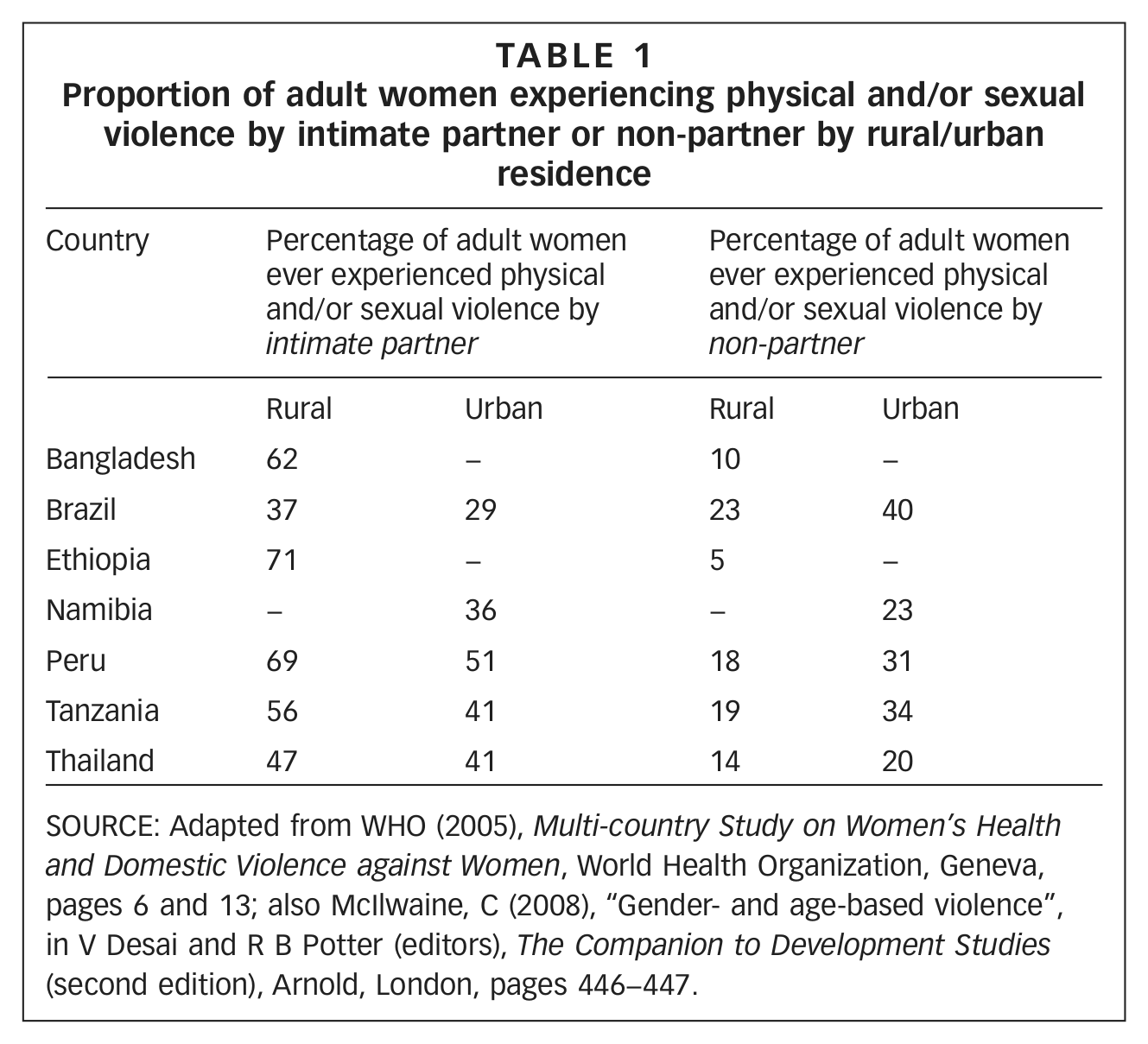
SOURCE: Adapted from WHO (2005), Multi-country Study on Women’s Health and Domestic Violence against Women, World Health Organization, Geneva, pages 6 and 13; also McIlwaine, C (2008), “Gender- and age-based violence”, in V Desai and R B Potter (editors), The Companion to Development Studies (second edition), Arnold, London, pages 446–447.
These ambiguities also emerge in relation to beliefs surrounding violence against women by intimate partners (Table 2). It has been reported that women are more likely to report that husbands are justified in beating or hitting their wives in rural areas compared to urban areas in a wide range of countries. In general, women felt that men were justified in beating or hitting their wives when they went out without telling him or when they neglected their children, especially in African countries. For example, in Ethiopia where very large proportions of women agreed that beating and hitting were justified, the rates were especially high in the countryside: 69.1 per cent of women agreed that violence was justified whenever a woman went out without telling her husband, compared to 41.5 per cent in urban areas (Table 2). However, much more sustained and rigorous research is required in order to make any such claims with any accuracy. Yet, it is possible to examine how urban living can contribute to variations in gender-based violence in cities.
Women’s attitudes towards wife beating in relation to whether husband is justified in hitting or beating his wife
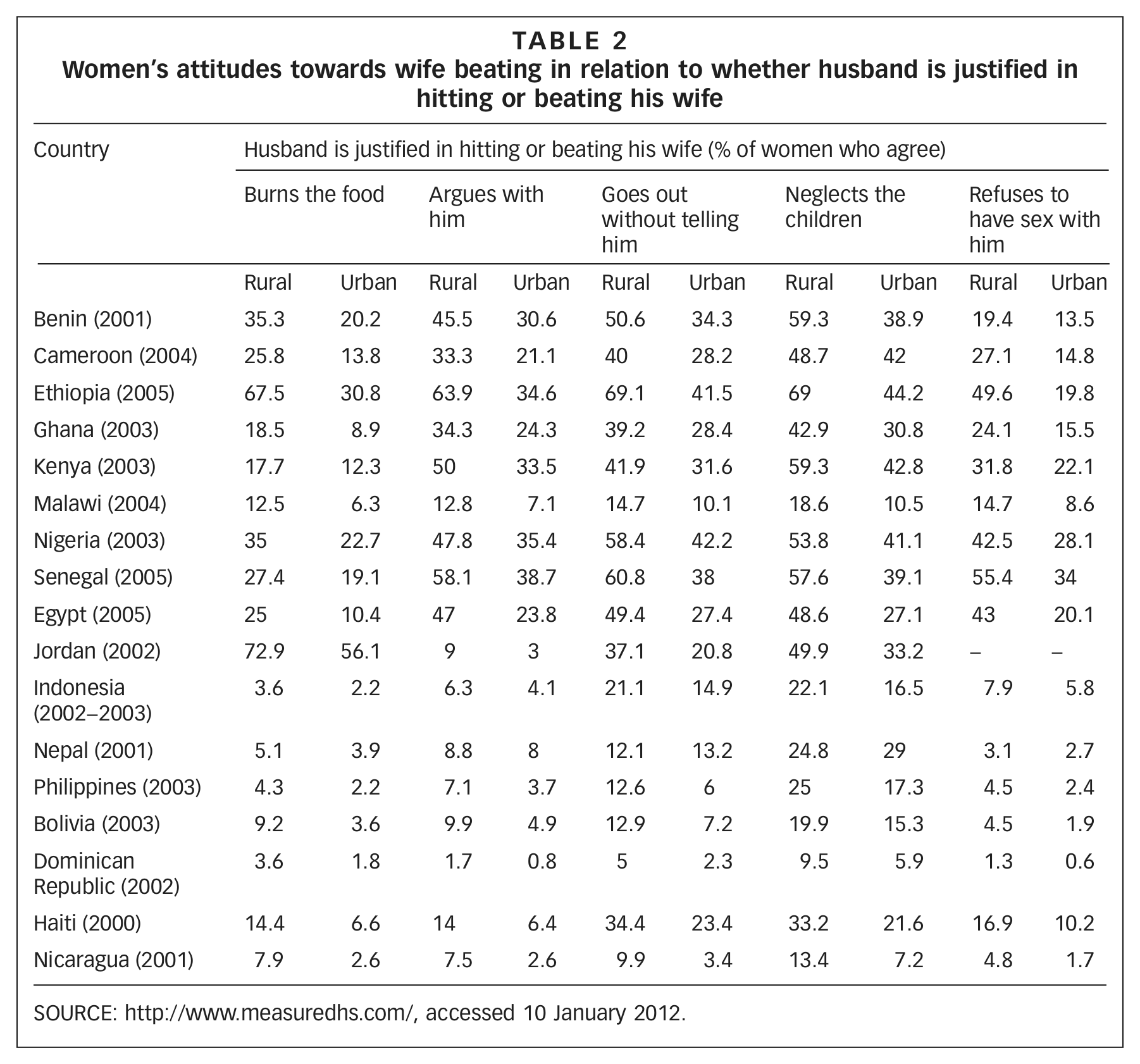
SOURCE: http://www.measuredhs.com/, accessed 10 January 2012.
IV. Causes Of Gender-Based Violence In Cities And Associated Risk Factors
It is also important to examine the underlying causes and the risk factors associated with gender-based violence in cities that do not necessarily create conflict in the first place but can make its perpetration more likely. At a general level, gender-based violence differs across and within different societies according to circumstances and scales relating to the individual, the family, the community, as well as the broader national context. However, existing conceptual explanations highlight how no single cause at any level or any place determines violence, but various combinations of factors may create a situation where political, economic and social violence is more likely to occur. Gender identities underpin all levels of causality and shape both women and men’s involvement in, and experiences of violence. However, O’Toole and Schiffman(14) identify two main ways of explaining violence against women. The first interprets male violence as “natural” and rooted in biological differences, which effectively means that changing male behaviour is extremely difficult. The second, favoured by feminists, relates male violence to the social constructions of patriarchal forces, which makes it preventable.(15) Therefore, gender-based violence is not just a feature of micro level interactions among intimates but it is also deeply embedded within processes occurring within communities and wider society.
Drawing on this core distinction, Pickup et al.(16) outline three related sets of factors that account for violence against women. The first relates to psychological factors, where men who abuse women have “impaired masculinity”, which they are often thought to have learnt through witnessing violence as the norm as they grew up. The second relates to external factors, which usually include poverty, which may aggravate or increase violence, even though gender-based violence occurs regardless of socioeconomic position.(17) In addition, social instability linked to male unemployment and women’s increased labour force participation, as well as armed conflict, can contribute to gender-based violence.(18) The third set of factors is referred to as the gender and development approach, which emphasizes patriarchy and inequalities between women and men. Here, violence against women is the ultimate weapon for men wishing to assert power and control.
Some of these factors are structural causes underlying the perpetration of gender-based violence, while others constitute risk factors.(19) These act as a set of “triggers” that can precipitate violence against women and that are rooted in challenges to hegemonic gender norms of given societies.(20) As well as many of the factors outlined above, others are more specific. These include the life course, in that younger women are more likely to experience violence than older ones, also the HIV status of men or women, as well as male alcohol and substance abuse.(21)
In relation to alcohol, women whose partners get drunk regularly are 4–7 times more likely to suffer violence across the seven nations included in Kishor and Johnson’s study.(22) In another study of Peru, Colombia, Haiti, the Dominican Republic and Nicaragua, partner alcohol abuse had the strongest and most consistent effect among all family factors on the likelihood of experiencing domestic violence.(23) In Kerala, South India, alcohol was widely blamed for male partner violence against women, although women viewed alcohol as the root cause rather than gendered power imbalances.(24) Although much rarer, it has been noted that alcohol use among wives can also lead to domestic violence on the part of women, as shown in a study in the Philippines.(25)
V. How Does Urban Living Affect Gender-Based Violence?
While many of the causes and risks outlined above occur in both rural and urban areas, some of these manifest in particular ways in cities. One set of triggers relates to the configuration of urban spaces and the nature of the activities that occur there, which can increase the likelihood of women experiencing gender-based violence. A study from the Philippines shows that living in urban slums can lead to a greater incidence of violence against women, especially that perpetrated by someone who is not a partner.(26) In a study of married women in Lima, Peru, it was found that the proportion of poor women who had experienced domestic violence was higher than for women from middle-class backgrounds.(27) Among the poor women, 85 per cent had experienced psychological violence in the previous year, 34 per cent had experienced physical violence and 53 per cent reported sexual coercion. Among the middle-class women, 81 per cent had experienced psychological violence, 21 per cent physical violence and 38 per cent sexual coercion. Therefore, while rates were still high among the middle classes, poverty emerged as an “aggravating factor” in relation to physical and sexual abuse.(28) Therefore, poor women are often the most vulnerable to violence because, as Kabeer suggests: “…they are most exposed to the risk of violence and least able to remove themselves from violent situations.”(29)
Such “stress-induced violence” is exacerbated by living in makeshift dwellings in insecure settlements. This makes women vulnerable to burglary, theft and rape, with little recourse to protection, either formally or informally.(30) Indeed, within low-income urban areas themselves, there are particular localities where gender-based violence occurs more frequently. For example, where sanitation facilities are located far from people’s homes there is evidence that women and girls face risks of violence and attacks if they walk alone to use them, especially at night. This has been found in studies in urban India and South Africa.(31) Another important location for the perpetration of gender-based violence in cities is schools. In some cases, school violence is linked with people, and especially gangs, coming from outside the school grounds and targeting girls arriving and leaving, as found in the case of Colombia.(32) Gender-based violence also occurs within the school grounds and has been shown to be perpetrated by male students in mixed-sex schools as well as by teachers, especially in the South African context. Gender-based violence within schools is usually sexual in nature, and in the case of teachers represents a major abuse of power and trust often maintained through a conspiracy among other male teachers.(33) While there may be more sanitation facilities and schools located in urban areas, it is important to emphasize that gender-based violence associated with these is just as likely to occur in the countryside.
Places where alcohol is bought and consumed are also associated with the high incidence of gender-based violence. With alcohol acknowledged as being a major risk factor in the perpetration of gender-based violence, it is not surprising that bars, cantinas, taverns and shebeens (which tend to be concentrated in cities, although obviously they are also located in rural areas) have been identified as especially dangerous for women to frequent or even to pass by. In many countries, drinking establishments are used primarily by men, with women often avoiding them because of fear of attack by men under the influence.(34) In other contexts, women who do frequent bars often face the risk of experiencing gender-based and especially sexual violence. While this may apply in general, it also relates specifically to those who engage in informal and commercial sex for money. It has been found that risks of experiencing violence are higher among all women who utilise bars regardless of whether they are engaging in recreational, survival or commercial sex. For example, in Soweto and Hammanskraal in South Africa, among women who engaged in “survival sex” (informal), rape was found to be widespread in the shebeens or stokvels (gathering place for drinking and socializing).(35)
Certain open public spaces in cities, and especially in slums, are also identified with the perpetration of, or fear of, violence against women in particular. In participatory mapping in Colombia and Guatemala, the main areas identified as dangerous were isolated parks, secluded river banks, basketball courts and areas where gangs congregated and where drugs were sold.(36) In Johannesburg, South Africa, one study noted that 31 per cent of rapes were perpetrated in open spaces such as rough ground.(37) Gangs in particular were often identified as perpetrators of rape. Indeed, there is a long history of gang violence against women characterized in the phenomenon of “jackrolling”. This refers to rape in front of others and is linked with the widespread acceptance of violence against women, the violence of the apartheid state and deep-seated patriarchal ideologies. In the 1980s and 1990s, “jackrolling” was commonplace in the poor townships and often involved gangs of young men in cars cruising streets and raping women.(38)
The other set of issues that affects women’s experiences of violence in cities relates to the intersections between social, economic and institutional changes, the ways that gender identities transform and the incidence of gender-based violence in urban areas. It has been argued that gender inequalities lessen in cities, as gender ideologies become more flexible. It has also been acknowledged that where patriarchal strictures loosen or are challenged, then violence against women can both increase and decrease.(39) For example, studies of the relationships between “male patriarchal control” and women’s experience of intimate partner violence in Colombia have shown that where control levels are high, then violence is also high.(40) Similarly in the Philippines, the greater number of areas of decision-making that men dominate, the more likely they are to use violence against their partner.(41) However, the same study from the Philippines also found that when women dominated decision-making they were also more likely to experience violence. This is because men feel threatened by changes in gender ideologies and react against such threats by using violence against women. This point is made by Pallitto and O’Campo, who found that “women’s autonomy” did not necessarily lead to a reduction in abuse, because in societies where “women’s status” is improving as in Colombia, higher rates of abuse are exhibited as men assert themselves violently.(42) By the same token, when women are more able to operate independently economically and socially, as is more likely in cities than in rural areas, they will be more able to challenge violence perpetrated against them.(43)
This leads directly on to the relationships between urban economic change, gender norms and violence against women. Urbanization tends to be associated with high levels of women’s labour force participation rates, especially in services and export-manufacturing.(44) While the debates about the empowering effects of paid employment continue to rage, the specific links between women’s labour force participation and violence against women remain unclear.(45) Reflecting the gendered processes taking place at the household level, when women take on paid employment they are able to access the economic resources that can potentially free them from violent households. However, such access can also lead to a “backlash” entailing violence against women.(46) For instance, in the case of the Philippines, it was found that when women earned more than 50 per cent of the household income they reported more domestic violence than those who earned less.(47) The relationship between women’s paid employment and experiences of domestic abuse also depends on the type of work that women are engaged in. Women working in irregular, low-paid and casual jobs of low quality are more likely to experience domestic violence, while those working in better-paid, higher quality jobs tend to experience less as they have more resources and choices to resist it. In turn, violence against women is further exacerbated when male partners are unemployed or have irregular work.(48)
Some types of occupation also put women more at risk of gender-based violence. As noted above, sex workers in particular are especially vulnerable to violence. For example, in a survey of 540 female sex workers in Bangladesh, 49 per cent had been raped and 59 per cent had been beaten by police in the previous year.(49) Sex workers have also been the victims of trafficking. In a study of 580 sex workers in East Bengal, India, 24 per cent had been trafficked into the sector. In addition, violence was more commonly experienced among those who had been trafficked, especially among those sold by their family members (57 per cent) compared to those who became sex workers voluntarily (15 per cent).(50) Again, it is important to remember that sex work and the trafficking of women occurs in both urban and rural areas, although there are concentrations in cities.
Another important case of urban-based employment among women linked with widespread gender-based violence relates to the femicides in Mexico and Central America. Although these brutal killings are experienced by many poor women in cities, they are especially concentrated among maquila workers who are employed in export-manufacturing factories owned by transnational corporations involved in the assembly, mainly of garments and electronics. The reasons for these femicides are complex and are perpetrated by partners and non-partners; it is generally agreed that they are an expression of extreme gender discrimination. Some have suggested that maquila workers in particular are targeted because they are the preferred workers in the factories, which can leave men unemployed. Others indicate that male resentment has built up against women’s economic and social independence, which often contrasts with the social norms they are accustomed to in their conservative home villages from where many have migrated. Maquila workers can also be vulnerable to violent assault because of their migrant status, which means that they have fewer friends or family to act as protectors. In addition, they invariably live in urban slum areas far from factories and end up having to walk long distances at night to and from work, leaving them more open to attack.(51)
The social and institutional fabric of cities is also important in making women more or less vulnerable to gender-based violence, although again the situation is not clear-cut and is somewhat paradoxical. As noted above, it has been argued that social relations in cities are particularly fragmented. This can lead to higher risks for women in that it has also been widely reported that when women have “someone to talk to”, their experience of domestic violence tends to be less.(52) In cities where friendship groups may be smaller, women can be more isolated and therefore less likely to respond to or exit from situations of gender-based violence.(53) On the other hand, tolerance of violence against women can be lower in cities, linked to more flexible gender ideologies.(54) This situation has been referred to as the “sanctions and sanctuary framework”,(55) where levels of partner violence are found to be lowest where there are community sanctions against it and where women have access to shelter or family support. Sanctions can be formal legal provisions or moral pressure from neighbours. In Bangladesh, for example, 66 per cent of women in rural and urban areas remained silent about their abuse due to acceptance of violence, stigma and fear, although women in cities were more likely to seek and receive help (60 per cent) compared to those in the countryside (51 per cent), even if only 2 per cent of this was institutional.(56)
Partly related to the social and institutional characteristics of the city are the ways in which gender-based violence correlates with constructions of fear and mobility, which, in turn, affects women’s well-being. The extent of fear experienced by urban dwellers is not necessarily directly linked to actual victimization rates among a given population, but often rooted in media sensationalizing and demonizing of certain parts of cities.(57) However, it has also long been acknowledged that women experience greater fear of violence, and that this is linked to wider patriarchal inequalities that influence women’s confidence to negotiate the city in terms of using public transport and operating freely in open public spaces.(58)
Although much work on the gendered nature of fear has focused on the countries of the global North, increasingly these issues are identified as especially significant in cities of the global South such as in Argentina, Brazil and Chile.(59) The spatial restrictions that violence and fear impose on urban dwellers, and especially on women, have been a key issue. In Guatemala, spatial freedom among women was severely undermined by fear of sexual violence, fuelled by gossip about gang rapes.(60) This affected young women’s ability to attend night school as well as general social interaction.(61) Participation in community affairs is also affected, as most meetings take place in the evenings and any spontaneous involvement with others will be marred by suspicion, as noted in the case of Brazil.(62)
a. The costs and consequences of gender-based violence in cities
As well as issues relating to women’s mobility and participation, there are also direct costs of gender-based violence in cities, and indeed elsewhere. As survivors of violence, women experience physical and psychological health problems and in some cases, death. Health outcomes can include injuries and disabilities caused by violence, as well as sexually transmitted infections, unwanted pregnancies, abortions, AIDS-related deaths and illnesses, and chronic pain syndrome. However, the psychological trauma caused by victimization or by witnessing violence is just as severe, and can include post-traumatic stress disorder, rape trauma syndrome, depression, anxiety, and alcohol and drug abuse.(63)
These adverse health outcomes of gender-based violence put pressure on health facilities and are a socioeconomic cost at the national level in relation to lowering productivity and affecting the creation of human and social capital. The costs can be direct in relation to expenditures related to gender-based violence, such as health care and judicial and social services, as well as indirect, linked to undermining productivity in the workplace and loss of earnings to an economy when someone dies. For example, in Colombia it has been estimated that the national government spent US$ 73.7 million in 2003 to prevent, detect and offer services to survivors of family violence. This was equivalent to around 0.6 per cent of the national budget.(64)
At the level of the city, gender-based violence undermines the economic productivity of the urban labour force. When women experience widespread and repeated violence, they are unable to work or function effectively. In a study of Nagpur, India, 13 per cent of women had experienced incidents as a result of which they could not undertake paid work because of the health effects of abuse by a partner; they had to miss an average of seven work days per incidence of abuse.(65) Not only does violence undermine productivity, but wider labour demand can be affected with women having to take on the informal, poorly remunerated jobs in order to ensure households get by economically.(66)
Related to this is the social stigma and rejection experienced by women who are often blamed for bringing violence upon themselves. It is not uncommon for women who have been raped to be stigmatized despite being victims. In severe cases, gender-based violence can result in death. In a study in Pune, India, it was reported that 16 per cent of all deaths during pregnancy were the result of partner violence.(67)
VI. Interventions For Reducing Gender-Based Violence In Cities
Addressing gender-based violence, and especially violence against women, entails a multi-dimensional and holistic approach. UN−Habitat usefully outlines a range of policy approaches at the local level in cities, which address urban crime and violence and all of which are gendered in some way, albeit not explicitly.(68) These approaches are not mutually exclusive and they address both the causes and effects of urban violence.
The first approach addresses “enhancing urban safety and security through effective urban planning, design and governance from a gender perspective in cities”, which has also been referred to as Crime Prevention Through Environmental Design (CPTED). This involves using a spatial and design perspective and includes upgrading or changing the urban infrastructure and physical fabric of the city. For example, if outside toilets are phased out, then women are much less likely to put themselves in situations of risk.(69) Although many of these initiatives only address the risk factors and aim to make the city a safer place for women to live and travel, many of these types of initiatives have proved to be successful in reducing the incidence of gender-based violence.
The second deals with “strengthening formal criminal justice systems and policing from a gender perspective in cities”. This focuses on legal reform and legislation, often prompted by the campaigning of women’s movements. In the 1980s and 1990s, legal reforms were instituted in many countries, focusing on physical and sexual abuse by an intimate partner and usually involving the criminalization of perpetrators. While these have become more widespread in the developing world in recent times, there remain serious problems in terms of implementation on the ground. For example, in India there have been three decades of lobbying by the women’s movement to address domestic violence, with many legislative changes linked primarily to Section 498A of the Indian Penal Code (Anti-Cruelty Act) and Section 304B (Dowry Death Act). However, despite legislation, the women’s movement states that the number of dowry crimes and the incidence of domestic violence have increased. While the new law created in 2005, called The Protection of Women from Domestic Violence Act (PWDVA), which aimed to try and address these increases has had some positive outcomes in terms of providing greater ease in filing and winning cases, it remains limited.(70)
Another well-known judicial intervention has been women’s police stations, the majority of which have been located in cities. The first women’s police station (DDM – Delegacia da Mulher) was created in São Paulo, Brazil in 1985 mainly in response to mass demonstrations demanding women’s rights. Everyone working there had to be female, with the aim of reducing violence against women. By the mid-2000s, there were 125 women’s police stations in the state of São Paulo and 339 throughout Brazil,(71) and 475 units nationwide by 2010.(72) In addition, in many countries where women’s police stations have been established, legislation that addresses domestic violence has also been instituted. In Brazil, the Maria da Penha Law, or Law of Domestic and Family Violence, (named after a notable feminist who was left paraplegic by her abusive husband) was signed in 2006. This explicitly criminalized domestic violence and introduced a detention penalty of between six months and a year for committing this offence. However, women from poor, working-class areas are often not interested in pressing charges against perpetrators, but are using police stations and police officers for conflict resolution. In addition, women police officers and the police stations themselves are often not taken seriously within the Brazilian judicial system as a whole, and domestic violence can be treated less seriously than other crimes. Overall, few cases ever make it through the judicial process to sentencing, although they have contributed to raising the visibility of violence against women as a violation of women’s rights that is not a private matter. Similar issues have been raised in India in relation to the slum police panchayats or police stations.(73) However, judicial reform backed up with training has been shown to be effective. As part of the UN Women’s Global Programme on Safe Cities Free of Violence against Women, judicial staff at the Thonburi criminal court in Thailand made an increased commitment to enforce the Domestic Violence Act. In addition, courtrooms have been re-designed to use partitions and cameras to protect survivors from coming into direct contact with perpetrators.(74)
A third set of interventions relates to “community-based approaches to enhancing urban safety and security and reducing risk factors from a gender perspective”. This involves a community assessment to gather information on the nature of gender-based violence, raising awareness in communities, and building networks to encourage community members to work together to address gender-based violence, often through the work of NGOs. One way of documenting and raising awareness of gender-based violence is through women’s safety audits in cities. These involve conducting a needs assessment in communities to identify the main types of violence experienced, and an inventory of environmental factors such as lighting, signage, areas of danger and so on.(75) This can be achieved through participatory crime mapping, where “hotspots” of violence for women (and men) can be pinpointed.(76) These can help to reduce the risk of experiencing gender-based violence, if not the causes.
The final type of intervention is “non-violent resolution of conflicts from a gender perspective”. This has been included in the women’s police stations, where it has been noted that women are often more concerned with mediating with their abusers than with initiating a judicial process, as noted above. Also part of this is social capital building, where both informal and formal social support mechanisms can help to reduce gender-based violence. For example, in Colombia and Guatemala, it has been found that people recognized the importance of rebuilding social relations as a way of preventing everyday violence, and that social organizations run by or associated with women were the most likely to be trusted. Of particular importance in Colombia were the state-supported “community homes” (hogares comunitarios), which are managed and run by local women who, as “community mothers” (madres comuntarias), provide child care from their homes with a small subsidy from the government. Several community members suggested that community violence reduction projects should be run through community homes.(77)
More recently, many innovative projects have been developed. For example, under the auspices of the UN’s multi-stakeholder campaign, UNiTE to End Violence against Women, to prevent and eliminate violence against women and girls globally, there have been projects such as those giving scholarships to girls in Arusha, Tanzania who would otherwise have had to undergo female genital mutilation and/or get married. The scholarships are worth more than a dowry to families and can thus prevent such violence against women in the first place.(78) Another interesting example from Papua New Guinea is the UN Women’s Safe City Port Moresby programme, in partnership with the National Committee for the District Capital (NCDC), which has worked with informal street vendors to revise the market by-laws to ensure they are gender sensitive in terms of upgrading the infrastructure to provide safe spaces for women to sell from and store their goods.(79)
As noted above, the inclusion of men in gender-based violence programmes has been very important, especially young men. Also as part of the UNiTE to End Violence against Women, UN Women and a number of other UN agencies in Colombia organized a competition for young men aged between 18 and 25, who were asked to design a T-shirt that would contribute to the debate on gender-based violence. The winning entry was a heart made of band-aids with the caption beneath reading “Violence against women is not in my vocabulary”. The winning T-shirt was worn in all cities in Colombia on 25 November 2012 – the International day to Eliminate Violence against Women – when local and regional leaders and women’s organizations took to the streets in a purple bike lane to state “No more violence against women”.(80)
VII. Conclusions
This paper has shown that gender-based violence is not only hugely diverse in nature but that it also has a very high incidence throughout the global South. While there are variations between urban and rural areas, the discussion suggests that gender-based violence tends to differ in nature rather than incidence. While the underlying causes are rooted in unequal power relations between women and men, the paper has outlined a range of risk factors that accompany urbanization processes. These can exacerbate gender-based violence in many circumstances, especially in relation to urban poverty, slum dwelling, the prevalence of gang violence, low-quality sanitary facilities, widespread sale of alcohol, and an urban environment that lacks street lighting and has secluded, un-policed spaces. Other triggers that predominate in cities include fragmented social support networks and the concentration of various jobs associated with gender-based violence such as factory and sex work. However, urban living can also lead to wider improvements in women’s lives, with knock-on effects for their experiences of gender-based violence, most of which are positive. Urbanization is generally associated with the loosening of patriarchal restrictions, which can mean that women as individuals and as urban dwellers are less likely to tolerate gender-based violence. Cities also provide more employment opportunities for women to become economically independent, thereby widening their choices for dealing with violence. In turn, formal institutional support is more widespread in cities, where women can more easily seek help to address gender-based violence. Overall, these patterns are not static and change according to context and circumstance. Indeed, although there are some broad characteristics of urban gender-based violence, much more accurate data on urban−rural variations is needed in order to make anything other than some tentative conclusions. Even if this were available, the relationships between urbanization and gender-based violence would most likely remain paradoxical.
Footnotes
Acknowledgements
An earlier version of this paper was prepared as background for a report published by  for the UNFPA Urbanization, gender and urban poverty: paid work and unpaid care work in the city, IIED, London. I would like to thank Cecilia Tacoli and Gordon McGranahan for their earlier comments on the paper, as well as Sylvia Chant and an anonymous reviewer for their helpful suggestions on it in its current guise.