




Abstract
This paper attempts to demystify and deconstruct the current Smart Cities craze in India. It does so by refusing to be distracted by the discourses of the Smart Cities idea in general and of the Smart Cities Mission of the Government of India in particular. It focuses instead on the privatized physical spaces of urban inequality in India, specifically gated neighbourhoods and integrated townships. It argues that just as these privatized spaces have increased in size and complexity over time, their corresponding legitimizing ideologies have also evolved and become more sophisticated, to finally give birth to their newest avatar – Smart Cities. Seen in this light, Smart Cities appear less as a novel idea floated to guide the sustainable development of our future cities, and more as an ideological cover for the ongoing processes of neoliberal urbanization. The paper buttresses these arguments with an analysis of the design process of integrated township projects that I have been involved in, comparing the essential characteristics of these projects with the operational aspects and components of the Smart Cities Mission.
Keywords
I. Deconstructing a Conceptual Apparatus
In his insightful analysis of neoliberalism, David Harvey wrote that “for any way of thought to become dominant, a conceptual apparatus has to be advanced that appeals to our intuitions and instincts, to our values and our desires, as well as the possibilities inherent in the social world we inhabit”.(1)
Perhaps, apart from appealing to our “intuitions and instincts”, a “conceptual apparatus” should also strive to reach a level where it can simultaneously shape, obfuscate and take over an entire way of thought, and channel it towards particular socioeconomic and class interests.
Incidentally, Harvey has discussed this aspect too, not while discussing the “conceptual apparatus” but while elaborating the characteristics of counter-revolutionary theory, which he described as follows: “A theory which may or may not appear grounded in the reality it seeks to portray, but which obscures, be-clouds and generally obfuscates (either by design or accident) our ability to comprehend that reality. Such a theory is usually attractive and hence gains currency because it is logically coherent, easily manipulable, aesthetically appealing, or just new and fashionable…A counter-revolutionary theory automatically frustrates either the creation or the implementation of viable policies. It is therefore a perfect device for non-decision making, for it diverts attention from fundamental issues to superficial or non-existent issues.”(2)
It could be argued that the Smart Cities Mission of the Government of India, a programme that was launched in 2015 and has more or less taken over the discourse on contemporary urbanization in India, is exactly such a creature. Harvey’s description gives us a powerful theoretical tool to deconstruct and peer into the material base of the idea of Smart Cities, but with one modification. Rather than being a “device for non-decision making”, it is actually a device for a kind of aggressive decision making, which simultaneously keeps any action regarding alternatives or critiques confused and stalled.
The various definitions, descriptions, guidelines and critiques of Smart Cities head in so many different directions that at first glance the concept does indeed seem to be exactly what Harvey writes – “easily manipulable, aesthetically appealing…fashionable…a perfect device for non-decision making”.
On its website,(3) the Ministry of Housing and Urban Affairs of the Government of India gives a very general description of a Smart City, which contains everything from adequate infrastructure, efficient mobility and affordable housing to good governance. In short, it provides nothing to distinguish the Smart City from any earlier model of a desired city, apart from adding the prefix “smart-” to most of the listed characteristics.
However, on the same website, there seems to be far more specificity regarding the selection criteria, coverage, components, operational strategies and financing mechanisms of the Mission. A total of 100 cities shall be covered over a period of five years. The selected cities are to be ranked based on a set of criteria. In the first round of selections, the city of Bhubaneswar came first in this ranking, followed by Pune and Jaipur. The proposals for selection are almost always prepared by private consulting firms, which are closely associated with various stages of the Mission, including proposal preparation, the designing of community consultation strategies, monitoring and implementation.
This contrast between the clarity regarding the goals of the Mission and its operational aspects is so extreme that it might almost be by design.
Most accounts of the origins of the Smart Cities concept agree that it did not originate in the field of urban design and planning, but rather from the initiatives of certain technology firms.(4) Smart Cities are described as cities “where information technology is the principal infrastructure and the basis for providing essential services to residents”.(5) Ayona Dutta describes them as “part of the dreams and aspirations of ‘success’ of a young urban population”, which, in India, consists of “software engineers, middling entrepreneurs, management professionals, PR consultants, advertising professionals and so on”.(6) David Harvey strongly objected to the Smart Cities attempt to provide a “technological fix to social problems, which don’t have technological fixes”, thereby fetishizing the technological fix. Yet that is precisely the aspect of Smart Cities that fascinates and fuels the aspirations of the young “technocratic nationalists” of India described by Dutta.(7)
G Sampath describes Smart Cities as “the same old cities but with a ‘smart solution’ tacked on”, which could be “the layering of data capture devices such as CCTV cameras over existing infrastructure to create a ‘smart’ grid”. He adds that, while the “debates about the smart city in the West tend to focus more on the dangers posed by digital colonisation of the analog cityscape” (concerns raised by scholars like Evgeny Morozov and Adam Greenfield), these concerns “do not fully capture the political dynamic of the smart city agenda in the Indian context”.(8)
What then captures and explains what Smart Cities really are in an Indian context?
This paper approaches the topic from a slightly different angle than those put forward by the authors discussed above. If we are indeed trying to deconstruct and understand a “conceptual apparatus”, then what exactly is this an apparatus for? Using classic Marxist terms, this paper asks: If the Smart Cities idea is the super-structure, then what is the material base that gives rise to it and then enters into a dynamic and dialectical relationship with it?
II. The two Talks
A few years ago, while working for a prominent real estate development company in Kolkata, I was given the task of organizing a talk by one of India’s most respected and accomplished architects, B V Doshi. The occasion was the inauguration of a large mixed-use residential complex, Upohar, developed and constructed by our company in the southern part of the city and designed by the architect himself. The seven-hectare site had a rather irregular shape. But Doshi, living up to his reputation, had created a unique layout that minimized the disadvantages of the site. This placed the multi-storeyed blocks at different angles along the periphery, while opening up the central spaces for recreational activities and pedestrian circulation (Figure 1).
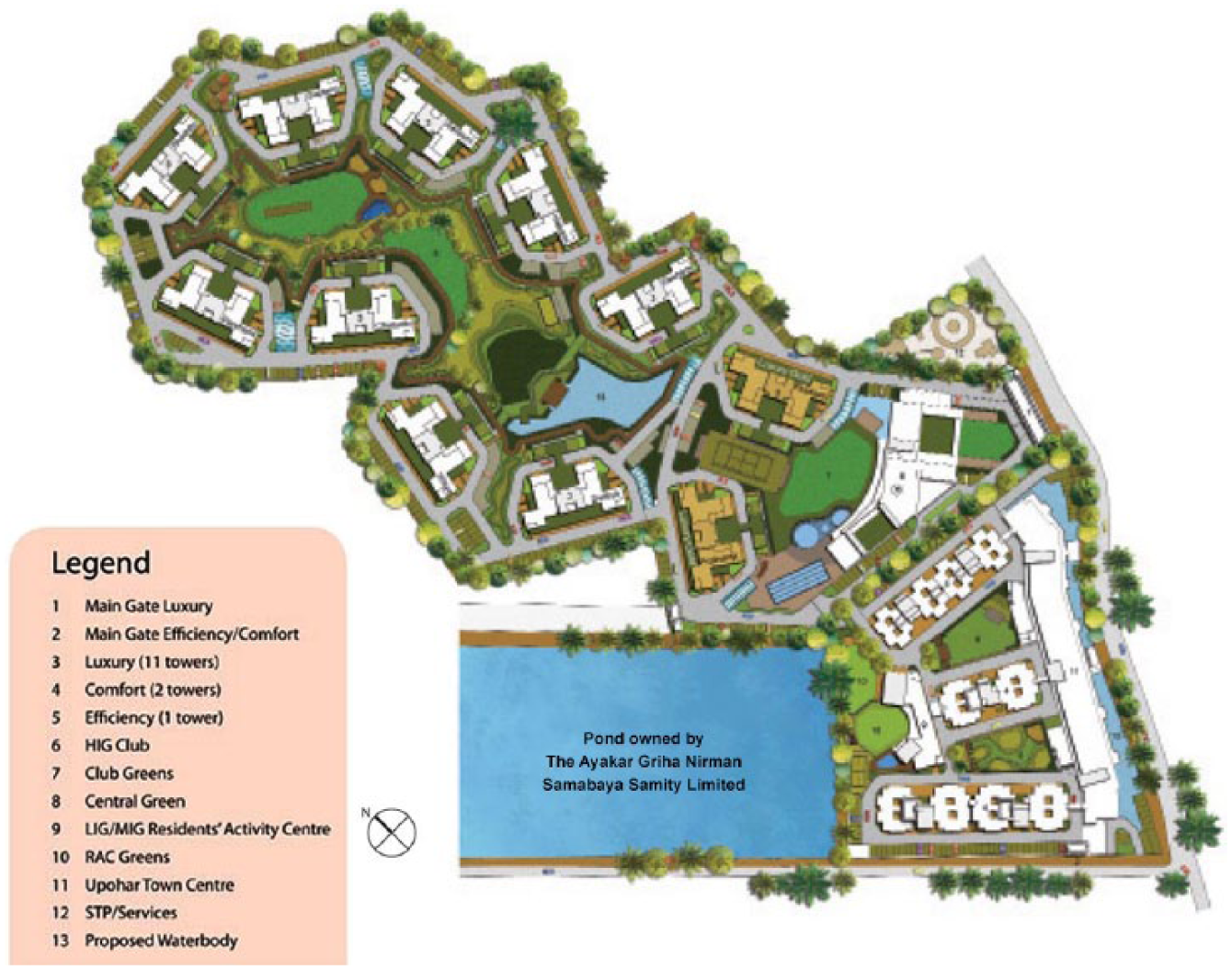
Site plan of Project Upohar
The project had all the characteristics that would satisfy an ardent supporter of the New Urbanism movement – unrestricted pedestrian movement, ample green space, mixed-use development and the provision of affordable housing. There was a range of recreational facilities including a swimming pool, badminton and tennis courts, and a social club, which was also the venue of the talk.
However, none of the creative achievements of the project could distract even the most casual observer from the most unambiguous identity of the project – it was a gated community.
Curiously, on that day, Doshi made not one but two presentations with distinctly different themes. The first presentation, which he made himself, celebrated the energy, vibrancy and informality of Indian inner cities. His talk was as lively as its theme, filled with images of life and livelihoods in these dense urban quarters. It had nothing to do with the project that was being inaugurated and that he had designed. In the second presentation, his young assistants gave a detailed account of the design process and details of Upohar (the word means “gift” in the Bengali language). Gone were the hand-drawn sketches of the vibrant chaos of inner-city spaces, the narrow alleys and the throngs of shops, mosques rubbing shoulders with temples, people and auto rickshaws jostling for space. In place of all that came the typical, polished presentation of an architectural firm determined to turn the heads of the most sceptical clients with its 3-D renderings, visualizations and animations, sans a single human being remotely resembling the average Kolkatan. It was a crisp and quintessentially “smart” presentation.
Quite puzzlingly, Doshi chose to celebrate the theme of the second presentation as much as the first. At the end of this second presentation he said, “The solution to the urban problems of the city of Kolkata lies in filling it up with as many Upohars as possible!”
It was quite unnerving to hear this statement from a man who is universally known as an architect–visionary, and who, as an educator, has been a tireless champion of the interaction between people and places and the vernacular. As a manager in a large development firm, it was not uncommon for me to hear architects and designers give subtle hints of their desire to be hired for forthcoming projects. But that an architect of Doshi’s stature would make a public appeal for a wholesale restructuring and reimagining of Kolkata as a city of gated communities, providing an unending stream of design consultancy contracts for his profession, was rather startling.
As no question came from the assembly of architects and students who formed the audience, I asked Doshi how the urban problems of any large city in India could be solved by scaling up a measure that seemed to compound and aggravate urban challenges wherever it was implemented. The great architect reflected for a moment and then replied that such a question would require a bigger discussion, which would not be possible in the course of the presentation.
Shortly after that, in private, he confessed that the very same question troubled him immensely but he had no clear answers. That answer given in private had the tone of a reluctant and fatigued honesty. It summarized the frustration and helplessness that conscientious architects feel in the face of a steady and resolute growth in the power of private real estate development companies in India. Given my position in the company, I should not have been too eager to seek out such answers anyway. After having spent years working for activist NGOs and completing a PhD critiquing neoliberal urbanization, it was a challenge to find myself working for a private developer out of sheer livelihood concerns. While trying to understand Doshi’s ambivalence I had to nurture my own.
III. Switching Shoes
I did that by trying to imagine myself as a diehard ideologue and policymaker on behalf of the private real estate sector in India. What exactly would I do? And quite like the protagonist of Costa-Gavras’ classic film “Le Capital”, I decided to dig into my own academic critique of neoliberalism and turn ideological enemies into allies. What if I could take the essential characteristics of special economic zones (SEZs), and make them the basis for the idea of a special urban zone (SUZ)? Basically, it would just provide policy guidance, structure and greater legal acceptability for trends that were already gaining ground and were spontaneously expressed in Doshi’s public appeal. The SUZs could be developed by a single private developer, or a consortium, as progressively larger gated, mixed-use neighbourhoods. The role of the state would be to provide a range of incentives to private developers, especially in the form of availability of land, relaxation of environmental laws and exemption from taxation.
What began as a simple roleplaying exercise to spend an idle day at work soon took a different turn when I decided to Google around to fill in some details of my SUZ idea. I found out that two years earlier, in 2008, the Confederation of Real Estate Developers’ Associations of India (CREDAI)(9) had already drafted a proposal for what it called special residential zones (SRZs). Despite the slight difference in the name, the general thrust of our ideas was exactly the same. The concept note by CREDAI clearly stated that “SRZs are primarily SEZs applied to a different sector”.(10) While introducing the concept, the author of the note wrote, “Fortunately, India has a workable model in place in the form of SEZs, albeit not in the housing space, which I believe can be effectively applied with some modifications”. The note defined the SRZ as follows: “A Special Residential Zone (SRZ) is a notified geographical region that is free of domestic taxes, levies and duties (both for the creation of, operation and maintenance of the SRZ) with special development rules to promote large scale, greenfield, affordable housing projects for the country’s masses.”
I must confess that the CREDAI idea surpassed mine in also heeding, though quite unconsciously, David Harvey’s words on the need for a conceptual apparatus quoted at the start of this paper. The apparatus wisely conceived by CREDAI was none other than affordable housing. In fact, the concept note on SRZ itself was titled “Special residential zones: a viable and compelling solution to India’s affordable housing crisis”.
For someone who has witnessed the desperate daily struggle of real estate professionals to squeeze out every possible square inch of saleable area in a project, often at the expense of parks, schools and playgrounds, it is hard not to be sceptical about the sudden concern for affordable housing on the part of these FAR (floor area ratio) maximizers. Even in our company, along with the recognition of the importance of affordable housing, there was a steady, albeit cautious, move towards what were conveniently described in the CREDAI note as “integrated townships”.
In reality, these were scaled-up versions of the earlier generation of smaller gated villas and residential complexes. The typical product mix of these projects included plotted housing units or villas together with high-rise apartments, private clubs, recreational areas, employments zones, malls and sometimes private hospitals. Famous and highly reputed architectural firms were hired for the design of these townships, as much to ensure architectural merit as for marketing purposes. Serious studies of social and cultural issues, post-occupancy realities and relationships with the surrounding environment were conspicuous by their absence. The architectural firms, often from other cities and sometimes from other countries, had neither the opportunity nor any apparent inclination to harmonize the projects with the urban context in which they were situated. While observing the design process of these projects, I could not help describing them as projects of Gated New Urbanism. Within their privately guarded boundary walls, these projects contained all the elements of the New Urbanism movement, albeit of a rather alien and ridiculous type. There was clear emphasis on pedestrian movement and they had none of the chaos, mess, noise, crime and pollution of the typical Indian city. Apparently ample (but in reality carefully constrained and often cosmetic) green spaces lined the pedestrian walkways and bicycle lanes. However, the townships, with their own private security, were totally isolated from the surrounding urban environment and drew on architectural styles that bore no resemblance to the buildings outside.
IV. Building Integrated Townships
While the Upohar project was being inaugurated, the company was already involved in the planning and construction of three integrated township projects of varying sizes at different locations. The smallest of them, with an area of 8.5 hectares, was located in Raipur, the capital of the state of Chattisgarh in central India, and was designed by a prominent architectural firm based in Delhi. The second, located near the village of Dhulagarh on the outskirts of Kolkata’s twin city Howrah, had an area of approximately 20 hectares, and was designed by a Kolkata-based firm. The third covered about 30 hectares and was located in Kalikapur, on the rural frontier of New Town, the large suburban extension of Kolkata. The Kalikapur project, designed by a prominent urban planning firm based in Singapore, was the largest integrated township project the company had embarked upon up to that point, and it contained villas, apartments, malls, clubs and a specialty hospital.
Although the main target of the projects was inevitably the high-income groups (HIGs), each of them had to negotiate with the issue of affordable housing. In the Indian context, this is categorized as housing for the middle-income groups (MIGs), low-income groups (LIGs) and economically weaker sections (EWS). According to the Ministry of Housing and Urban Poverty Alleviation, in 2010 (the start of the design process of the three townships) the maximum monthly household income to allow eligibility for EWS status was INR 5000/- (US$ 110.3 as of 15 December 2010), and for LIG status it was INR 5001/- to 10000/- (US$ 110.3 to US$ 220.6).
According to the housing policies of most state governments, any private development must include construction of a substantial share of affordable units and also commit a certain percentage of the total floor area constructed to these units. The latter condition is added to ensure that developers do not reduce the floor area of affordable units excessively. Upohar, for example, had 248 units in the LIG category (single bedroom), 360 units in the MIG category (two bedrooms), and 664 units in the HIG category (two- to five-bedroom luxury apartments). With a total of 605 units in the MIG and LIG categories, the project had almost as many affordable units as it had HIG units.(11) Apart from being equitable, this method of cross-subsidizing lower-value units/plots with higher-value units/plots is generally considered a more intelligent and effective model for increasing the supply of affordable housing than earlier models such as direct state provision.(12) However, what authors often fail to describe are the very creative methods that developers use in order to squeeze out extra value for their luxury units.
As the number and floor area of units, as well as the percentage of the floor area ratio (FAR) to be allotted to affordable housing, are fixed by government policies, the developers minimize the land area on the project site on which the affordable units are constructed. In the case of the Raipur township, less than 6 per cent of the total land area was allotted to the EWS units (shown in dark brown in Figure 2), whereas 50 per cent of the area was allotted to high-income units and almost 3 per cent to the club alone. The ratio of affordable to luxury units remains the same in terms of absolute numbers, but with the extra land the developers can add value to the luxury zones through the provision of exotic landscaping, recreational amenities, pathways, sports facilities and so on, all of which contribute to raising the price of the luxury units.
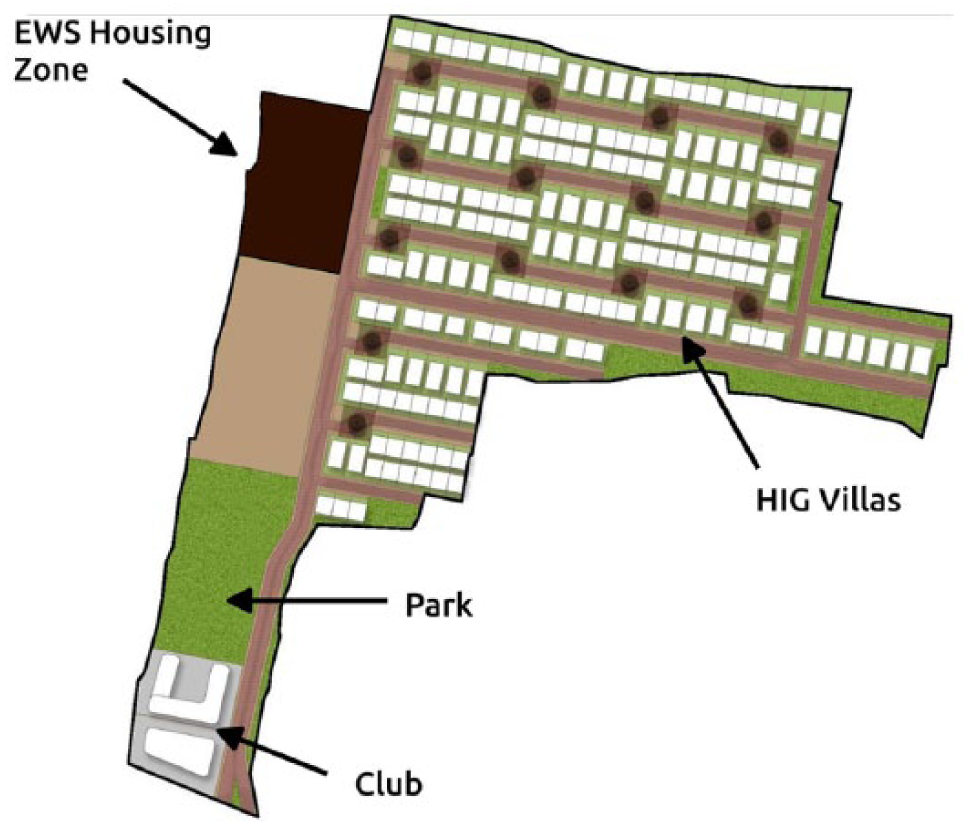
Land area under EWS housing in the Raipur township
The other method is to locate the projects outside the city municipal limits, where the laws regarding mandatory provision of affordable housing would not apply. The first design options for the Dhulagarh site, submitted by the architectural consultant in December 2010, for example, had approximately 7 per cent of the site area earmarked for affordable housing. However, when it was confirmed that provision for affordable housing would not be mandatory at that location, the apartments were removed and the area was rezoned to contain plots for high-income groups in the updated design submitted in December 2011.
In the case of the Kalikapur project, the initial understanding was that the location did not call for the construction of affordable units, as the site lay just outside the geographical limits and jurisdiction of New Town Kolkata Development Authority (NKDA), which is responsible for urban development on the eastern fringes of the city. However, in 2012, due to the expansion of the area under NKDA’s control, the Kalikapur site came within the jurisdiction of the planning authority. As a result it became mandatory for the developer to construct affordable housing units.
In one of the design meetings to discuss the issue, a senior advisor of the company pointed to the bright side of things: as the project site was located in the fringe areas, the provision of affordable units within the site would solve the problem of a steady supply of servants for the high-income units. In an earlier meeting before the provision of affordable housing was declared mandatory, the same advisor had said half-jokingly that this integrated township was only for households that could spend at least 10 million Indian rupees (US$ 224,215 as of 31 March 2011) for a single unit. The affordable housing zone in Kalikapur was never designed as the project was finally abandoned. The original design of the project, which was unencumbered by any need to provide affordable housing units, is shown in Figure 3.
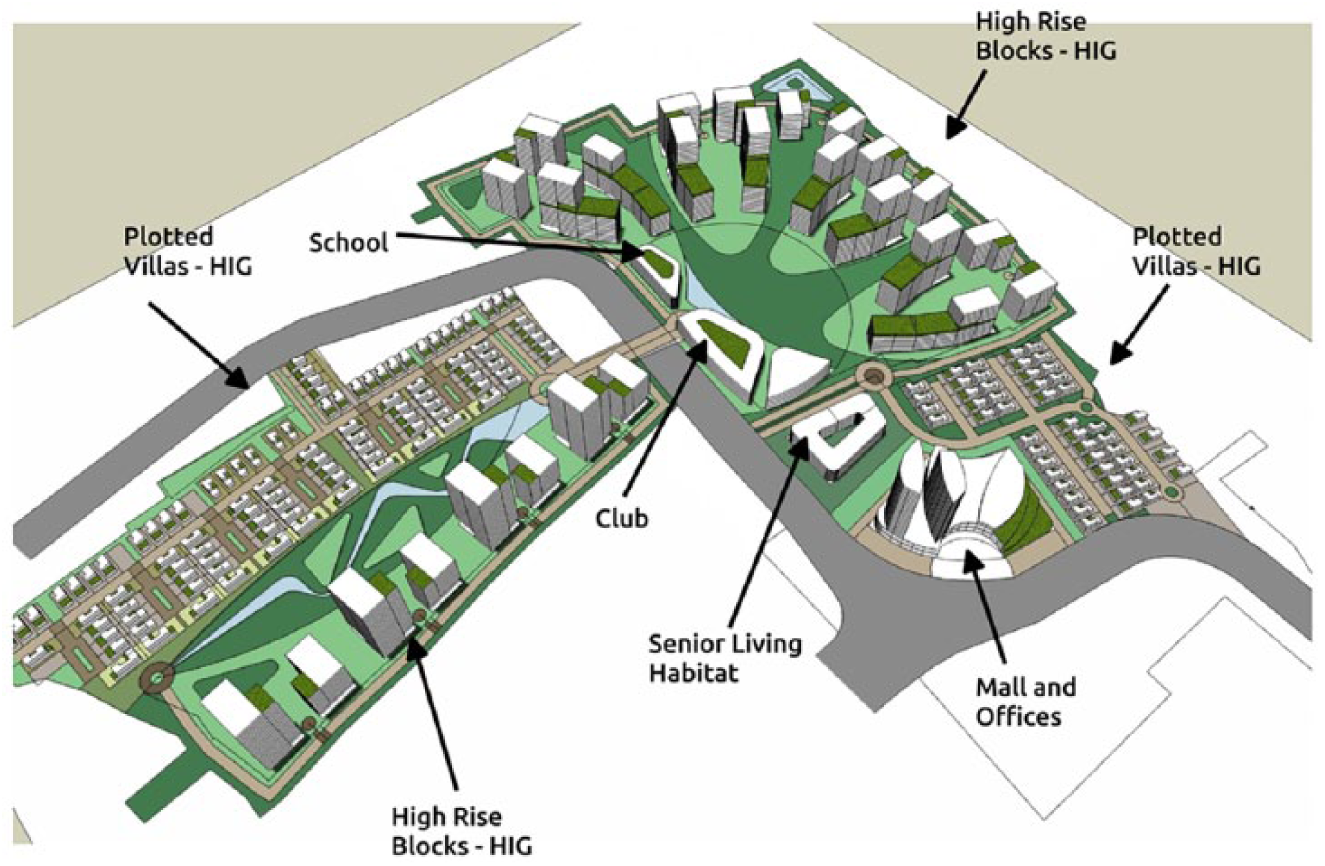
Site layout of the project at Kalikapur
The meetings to discuss the design and location of affordable units within the project sites were often interesting and revealing. In one of the meetings to discuss the location of EWS units in the Raipur township, a senior executive of the company remarked that it might be risky from a business point of view to let bhangis (Hindi term for the sweeper caste, one of the lowest in the caste hierarchy) live next to upper-middle class residents in such a posh township. His remark was met with protests from other senior executives and managers. He quickly retracted his statement, saying that he himself was all for social mixing in the sites, but the upper-income buyers might feel otherwise.
The need to please the market led easily to regressive and even feudalistic perceptions informing the design process. For example, despite hiring highly accomplished architectural and engineering consultants, the design of many of the projects had to be vetted by a consultant in Vastu Shastra, the traditional Hindu system of architectural design considered a pseudo-science by many rational sceptics. If the consultant found the design did not conform to the requirements of Vastu Shastra, archaic rituals would be performed on the project site to mitigate the effect of the discrepancies, and attempts would be made to modify the designs to incorporate the suggestions of the consultant.
The exact location of the affordable units within the site was no less complex an affair. In the case of the Raipur project, in one of the earlier versions of the layout design, the site for EWS housing was located to the north of the club, with a green area separating the two. When the architect presented the design to the company executives, he was asked whether the park was intended as a sort of inclusive buffer which could be used equally by the residents of the EWS housing and the high-income residents, who would definitely also be the main users of the club. It soon became clear that in his eagerness to squeeze the EWS housing onto the site, the architect had not given due consideration to the “riskiness” of common green space that could lead to encounters between high- and low-income residents. In the revised version of the layout, the EWS zone was pushed to the northwestern corner of the site and a zone of high-income units was inserted in between the EWS zone and the club greens.
It is not difficult to characterize these privatized spaces of inequality as the engines of neoliberal urbanization in Indian cities. Similarly, the first CREDAI note could be seen as an attempt to create a conducive policy and legal environment for the implementation of such projects.
What was really interesting was to witness this process from within a world that had no knowledge of the academic critique of neoliberal urbanization, nor any interest in it. Once, when I mentioned the term to a senior advisor of our company, who was in charge of the process of land acquisition for the company’s projects, I was benevolently asked to focus on the realities of urbanization and not be confused by meaningless academic terms. Like the banks in Costa-Gavras’ film, the real estate companies were creating gated townships by confining themselves to a gated reality that had ever less need to look at the larger social context.
V. From Integrated Townships to Area-Based Smart City Development
At first glance, this discussion of integrated townships may appear to have little relation to the Smart Cities concept. However, if we shift our attention from the “idea” of Smart Cities to the actual material processes and spaces being put in place in the name of Smart Cities, then the links are more apparent.
The Indian Smart Cities Mission specifies two operational strategies for turning the shortlisted cities into Smart Cities – area-based development (ABD) and pan-city solutions. According to the Ministry of Urban Development, ABD focuses on undertaking “city improvement (retrofitting), city renewal (redevelopment) and city extension (greenfield development)” in certain limited pockets of the selected cities. Pan-city solutions focus on applying “smart” (read: information technology) solutions to infrastructure facilities at the city level.(13) However, the Mission would channel 80 per cent of the total funds to the ABD component – which, on average, covers just about 2.7 per cent of the total area in the selected cities.(14) According to Rajiv Gauba, former Secretary of the Union Urban Development Ministry, the ABD plans would involve infrastructure creation. As infrastructure is capital intensive, it has been promoted only in small pockets of the city. Once developed, these pockets would presumably act as catalysts for change for the rest of the city and as models to be replicated by other cities. The pan-city solutions, which are based on information technology, can be applied to the whole city as they need less funding.(15) However, this strategic orientation of the Mission, together with the budgetary allocations, has ensured that the selected cities chose already well-developed and high-value locations as the sites of ABD. In Bhubaneswar, 90 per cent of the INR 4537 crore (US$ 672.5 million) Smart City funds are proposed to be spent in the existing central business district, under the Bhubaneswar Smart District (BSD) plan, covering less than 3 per cent of the city area (Figure 4).
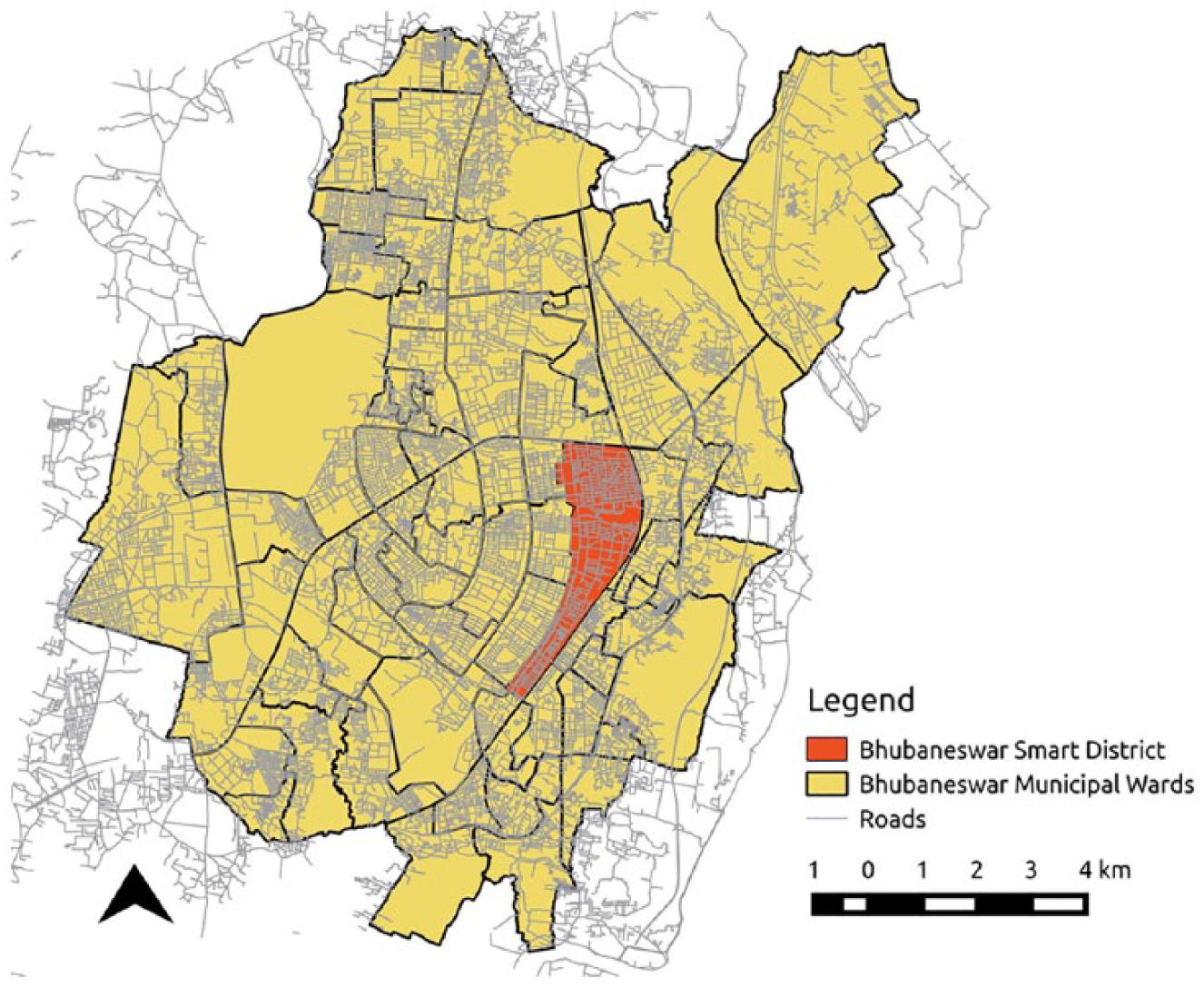
Location of the Smart District in Bhubaneswar City
In Pune, 76 per cent of the proposed INR 2870 crore (US$ 442.3 million) budget will be spent in the Aundh-Baner-Balewadi area, which covers approximately 1 per cent of the total city area. A major daily newspaper reports that the situation is similar in the other selected cities.(16) Of the total funds intended for the Smart Cities Mission, only INR 1000 crore in each city would be covered by funds from central government, state government and local bodies. The remaining funds would be raised from private sources and the “returns would be recovered through revenue sharing models which would also involve higher user charges or monetisation of public land”.(17)
According to Anupam Saraph, a visiting professor of systems science at Pune University and an Aundh resident, “The Smart City mission is not meant for city improvement but caters to the interests of real estate and technology players. A majority of Smart City projects are targeted at people who can pay additional revenue to private players and the local government. This is one of the reasons for choosing the Aundh-Baner-Balewadi belt, which has residential complexes for those with a higher disposable income.”(18)
The plan of the Bhubaneswar Smart District, prepared by Toronto-based IBI Group’s India operations in collaboration with Jones Long LaSalle (JLL India), and implemented by a special purpose vehicle called Bhubaneswar Smart City Limited (BSCL), may cover a much larger area than any of the integrated townships discussed earlier, but qualitatively it is not so different in its plan to create a high-value, mixed-use zone in a prime location of the city to the exclusion of other areas.(19) Like the layouts of the integrated townships, the layout of the Bhubaneswar Smart District seems to bear no direct relation to its surrounding urban landscape. And just like the visualizations of the integrated township projects, the website of the BSCL shows the layout plan of the Smart District not as an integral part of the city, but as a distinct parcel of land surrounded by blank white space (Figure 5). The website lists the six major redevelopment projects that would be part of the Bhubaneswar Smart District:(20)
Railway Station Multi-Modal Hub: A 4.8-hectare mixed-use, redevelopment project containing the city railway station and “Bhubaneswar’s first smart building”, the details of which have not been provided on the website.
Satyanagar Institutional Core: 16 hectares of underutilized public land to be developed as an institutional, business and education hub with a central plaza. The website clearly mentions that “private investments shall be pro-actively promoted”.
Lake Neutral: A 12-hectare rainwater harvesting, landscaping and green infrastructure zone to be developed as an ecotourism project.
Janpath People’s Smart Path: The main 5-kilometre long transit corridor passing through the District, which would be developed as a pedestrian-friendly corridor.
Janpath Housing Redevelopment Project: 12 hectares of government land to be used for housing construction.
Mission Awaas: Redevelopment of four informal settlements in the area through construction of EWS units using a cross-subsidization model.
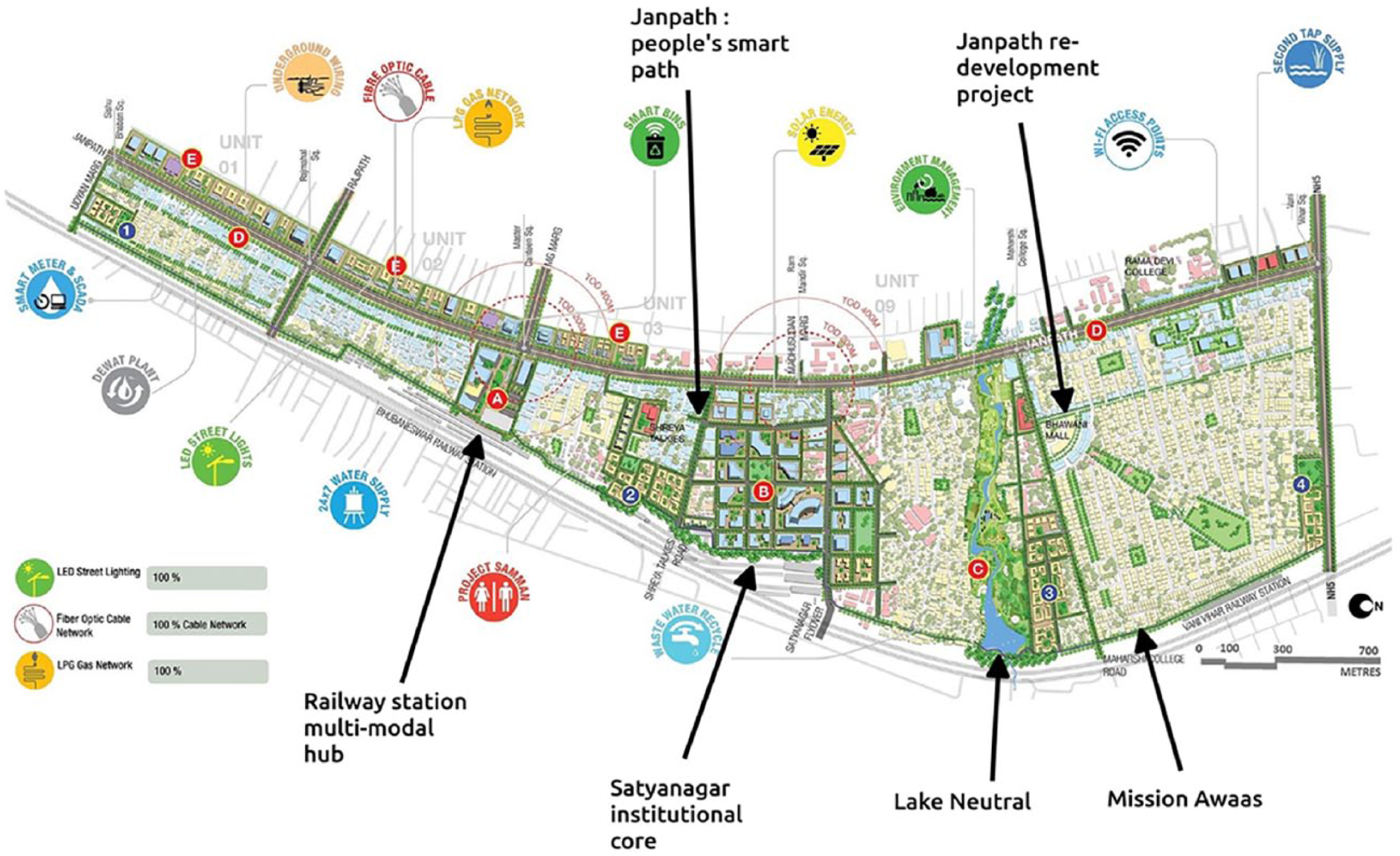
Layout plan of the Bhubaneswar Smart District
Apart from the last component, all involve substantial privatization of public land in the prime, central area of the city, largely for commercial and high-income residential and recreational purposes.
Seen in this way, the ABDs of the Smart City Mission can be described as a far more advanced and scaled-up version of integrated townships. They encompass a far larger area of the city and are supported by the powerful ideology and propaganda of Smart Cities. Just as the ABDs cover a far larger area than the average integrated township, the idea of Smart Cities too is a massive leap from the older idea of SRZs.
G Sampath provides a valuable insight into Smart Cities in his article “Fooled by smartness”: “Without adequate infrastructure, foreign capital, which the Indian state desperately seeks, will not come to India, or at least not in the volumes sought. But India needs foreign capital to upgrade its infrastructure. The smart city is the way out of this impasse. Not the whole country, not the entire city, just one small area in select cities will get the infrastructure developed to first world specifications — and this is where the bulk of the smart city funds will go. The document which encapsulates government policy on smart cities, the Smart City Guidelines (SCG), yields three obvious conclusions. One, there will be no big public investment in expanding urban infrastructure. Two, the state will support the construction of smart city enclaves where businesses and smart (read: prosperous) citizens are welcome to create the kind of urban infrastructure they want, and for which they will pay from their own pocket. And three, the only kind of city-wide public investments would be those that…help create a market for ICT (Information and Communications Technology) service providers.”(21)
This clear, delimited and realistic description of Smart Cities seems a far cry from the information technology-fuelled utopia dreamed of by India’s “technocratic nationalists”, but comfortably similar to the integrated townships that private real estate developers are building all the time. Approached like this, the grand idea of Smart Cities does seem rather inseparable from the material realities of these spaces of urban inequality. And if the Smart Cities idea is indeed becoming a cover for the processes of neoliberal urbanization in Indian cities, then the existing theories used by scholars to understand and deconstruct neoliberal urbanization could also be used to understand and deconstruct the Smart Cities idea.
VI. Revealing the Smart Neoliberal City
A few years ago, while giving a talk on neoliberalism, Nik Theodore said that “in the aftermath of the 2008 financial crisis, commentators from across the political spectrum rushed forward to proclaim the death of neoliberalism”.(22) He referred to author–activist Naomi Klein and Alfred Gusenbauer, former Chancellor of Austria, who had both likened the financial crisis, as an indictment of neoliberalism, to the Berlin Wall, as an indictment of authoritarian communism.(23) This Berlin Wall metaphor, which became particularly popular among members of the Left, claimed that following the crisis, neoliberalism had collapsed under the weight of its own contradictions.
Theodore argued against these claims, saying that as “neoliberalism does not exist as a unified and static structure or as an end state condition, it is less likely to fail in a totalizing moment of collapse”.(24) Moreover, “because neoliberalization projects collide in place with inherited political–institutional arrangements, neoliberalization is associated with polymorphic forms and outcomes”.(25) The Berlin Wall metaphor also failed to fully capture the conditions in emerging economies like India – where, ironically, the Left has indeed suffered a near collapse in the recent years while the trends of neoliberalism have evolved and are poised to move forward aggressively and creatively.
In the same talk, Theodore also added to Harvey’s description of a conceptual apparatus by saying, “for an ideology to be hegemonic it is not necessary that it be loved. It is only necessary that it have no serious rival.”(26) In India, the Smart Cities Mission not only has no serious rival, but also happens to be much loved. The idea of SRZs, despite its novelty, did not circulate much outside the community of real estate companies and their ideologues in CREDAI. The appeal of Smart Cities, on the other hand, is pan-Indian. With its focus on technological fixes for urban problems, it successfully disentangles itself both from the need to justify itself using any noble notion such as affordable housing and from the uneasy association with integrated townships.
Integrated townships and the upcoming ABD plans, which could be considered the material spaces of neoliberal urbanization in India, along with their legitimizing ideologies of SRZs and Smart Cities, have evolved historically by colliding in place with inherited political–institutional arrangements. They are not merely novel ideas that have been floated to guide a sustainable urbanization process for the future.
In their study of large urban development and renewal projects across Europe,(27) Swyngedouw et al. showed how these projects were a prime engine of neoliberal urbanization in European cities in the last decades. India’s integrated townships, for example, share many of the characteristics of the large urban development projects studied and described by Swyngedouw et al.
First, “their sheer dimensions elevate them to central icons in the scripting of the image of the future of the cities in which they are located”.(28) More than any of the vague and general verbal descriptions of Smart Cities, it is the visual impact of these large gated integrated townships (especially from the outside in the case of the excluded) and the actual experience of living in them (in the case of the included), that assist in “scripting” the image of the future Smart City.
Second, just as in the case of the European urban development projects, the Indian integrated townships both symbolize and further assist in the shift from a “social to a spatial definition of development” and “targeting places rather than people”.(29) Such a shift becomes all the more powerful in a situation where the economic advisors of the central government do not even wish to acknowledge crucial social problems such as inequality. It could also be said that government bureaucrats are merely reflecting the aspirations and priorities of the increasingly prosperous “technocratic nationalists”, who are seduced by an image of Smart Cities that eschews the social in favour of the technological. In the case of our own company, there were multiple instances in which the state transport authorities were willing to orient the routes of public transport facilities based on the locations of malls and integrated townships (either constructed or conceived).
Third, these projects undermine democratic, participatory and empowering engagements in the process of urbanization, in favour of a “highly formalised form of public participation that maintains key power in the hands of the existing elite structure”.(30) The integrated townships create isolated islands of the rich where everything functions in otherwise chaotic cities. Smart Cities with all their technology also create the impression that things can be fixed at the city level without having to waste time over urban social movements or participatory processes.
It could be argued that the proposed ABDs would further strengthen these characteristics and make them a more systemic feature of urbanization processes in India. Most importantly, the Smart Cities Mission, in general, and the ABDs, in particular, have emerged at a time when, according to the eminent journalist P Sainath, there has been a massive shift in the “moral universe” of Indian society.(31) He cited the example of a debate on television between the economist Thomas Piketty and Arvind Subramanian, the chief economic advisor of India, together with Professor Bibek Debroy, then chief advisor to the state government of Rajasthan, on the issue of economic inequality in India. While Piketty stressed that inequality was one of the most serious issues facing India, both Subramanian and Debroy brushed the issue aside and went as far as to say that if some people made pots of money and flaunted it, then it really was no business of the government. Sainath summed up the significance of this debate in the following lines.
“Even in the early years of the reforms, in the early nineties, had the chief economic advisor to the Government of India said that flaunting of wealth was not an issue at all, and that Piketty was making too big an issue of inequality, I promise you, that person would have been looking for a job the next morning. It’s how much your universe has shifted. There is no way that a chief economic advisor in the ‘80s or the ‘90s would have justified flaunting of wealth and inequality. And here is another thing – most of us from the middle classes accepted it. It did not raise a big furor at all. Nobody wrote a single editorial.”(32)
In the context of such a shift, it is hardly necessary for the Smart Cities idea to pay homage to social agendas such as affordable housing or to feel any trace of guilt for being associated with spaces of urban inequality such as integrated townships. In a context where the vulgar display of wealth is considered not only acceptable but also “smart”, proponents of the Smart Cities idea could truly hope to scale up the image of the gated township to that of a gated city.
Meanwhile, it is turning out to be big business for private developers, national and global consultancy firms, and IT companies. As no serious challenge to the Smart Cities Mission has come from either activist or academic circles, in conclusion, it is perhaps best to quote the final words spoken by the protagonist in Costa-Gavras’ film “Le Capital”: “They are children…the big children. They are having fun. They will continue to have fun, until it all blows up.”
Footnotes
1.
Harvey, D (2007), A Brief History of Neoliberalism, Oxford University Press, page 5.
2.
Harvey, D (1988), Social Justice and the City, Basil Blackwell, pages 150–151.
3.
Ministry of Housing and Urban Affairs (2017), Smart Cities Mission, accessed 30 October 2017 at  .
.
4.
Sampath, G (2016), “Fooled by smartness”, The Hindu, 28 July.
6.
Dutta, A (2015), “A 100 smart cities, a 100 utopias”, Dialogues in Human Geography Vol 5, No 1, pages 49–53, page 50, accessed 14 March 2017 at .
7.
See reference 6, page 50; also Harvey, D (2016), David Harvey on Post-neoliberalism, Trump, Infrastructure, Sharing Economy, Smart City, Interview by Evgeny Morozov, YouTube, 15 November, accessed 5 March 2018 at .
8.
See reference 4.
9.
10.
Gera, K (2008), “Special residential zones: a viable and compelling solution to India’s affordable housing crisis”, accessed 14 March 2017 at .
12.
Patel, S B (2011), “Inclusionary housing”, Economic and Political Weekly Vol XLVI, No 43, pages 13–14, page 14.
13.
See reference 3.
16.
See reference 14.
17.
See reference 14.
18.
See reference 14.
19.
American Planning Association (2017), Bhubaneswar Smart City Plan, accessed 30 October 2017 at .
20.
Bhubaneswar Smart City Limited (n.d.), Area Based Development, accessed 19 February 2018 at .
21.
See reference 4.
22.
Theodore, Nik (2014), Neoliberal Urbanism, YouTube, 31 January, accessed 5 March 2018 at .
27.
Swyngedouw, E, F Moulaert and A Rodriguez (2002), “Neoliberal urbanization in Europe: large-scale urban development projects and the new urban policy”, Antipode Vol 34, No 3, pages 542–577, page 567, accessed 14 March 2017 at .
28.
See reference 27, page 567.
29.
See reference 27, page 568.
30.
See reference 27, page 571.
31.
Sainath, P (2016), Politically Free, Imprisoned by Profit, 22nd Safdar Hashmi Memorial Lecture, YouTube, 27 October, accessed 7 March 2018 at .
32.
See reference 31.