




Abstract
This paper discusses the state and development of three community-based settlement upgrading projects in Metro Manila that have taken place since 2009. These projects are all part of the ACCA (Asian Coalition for Community Action) programme, which is designed to support community-based settlement upgrading initiatives in 15 Asian countries, and was launched by the Asian Coalition for Housing Rights in 2009. The main aim of this article is to highlight the common features of a community-based approach, as integrated by the ACCA programme, within the context of the Philippines and to review its potential and challenges.
Keywords
I. Introduction
This paper discusses community-based settlement upgrading approaches in three areas of Metro Manila, undertaken as part of the Asian Coalition for Community Action’s three-year programme with the Asian Coalition for Housing Rights.(1) The aim of this programme is to stimulate a shift from government or donor-led development to people-centred solutions through a scaling up of the community-led upgrading processes in Asian cities. The main tools used to achieve this goal are networking activities and financial support, delivered to the communities through ACCA loans (ranging from US$ 3,000 loans for small projects up to US$ 40,000−60,000 for big ones).(2)
The design of the ACCA programme minimizes the external pressure on communities in terms of the project concept and how the money is used. Communities have to meet some minimum requirements but the upgrading process is planned, facilitated and executed by the people themselves, who take over the upgrading process from external actors.
The way these programmes have been approached in Metro Manila is especially interesting for two reasons. First, in the context of Southeast Asia, the Philippines has the greatest problem with homelessness and the spread of informal settlements.(3) Of Metro Manila’s 11,566,325 inhabitants,(4) around 37 per cent, or four million, live in informal settlements(5) and their numbers are growing faster relative to the overall population.(6) The number of slum dwellers in Metro Manila may reach as many as nine million by the year 2050.(7)
Second, the Philippines is one of the most progressive countries in Southeast Asia in terms of decentralization of urban governance and planning processes, and civil society engagement is higher than in countries such as Burma, Vietnam, Cambodia and Laos. But compared to Thailand, another progressive country, minimal financial resources are devoted to slum upgrading in the Philippines.
This paper describes how, under these circumstances, communities managed to develop settlement upgrading solutions with the potential to affect urban development, reshape urban policies and allow people to extend their role in urban governance.
II. Shift Towards Decentralized Development in the Philippines: The Local Government Code and the Urban Development and Housing Act
The 1987 Constitution formulated after the People’s Power Revolution and the collapse of the Marcos regime was a milestone in the Philippines. Its main principles were the autonomy of local governments and the participation of community-based and people’s organizations in decision-making at all levels of social, political and economic life.(8) This philosophy was reflected in formal documents dealing with governance and urban development, and primary among them was the Local Government Code (LGC), which was formulated in 1991 and focused on the accountability of local officials and bureaucrats, the collection of local taxes and the improvement of public services and general welfare.(9) The LGC boosted decentralization, increased the autonomy of local government units (LGUs) and reinforced the power of communities/people’s organizations and NGOs. National agencies and offices were obliged to conduct periodic consultations with appropriate LGUs, NGOs and people’s organizations, and other concerned sectors of the community before any project or programme could be implemented.(10) In addition, the capabilities of LGUs or barangays(11) to participate and implement national programmes were enhanced.
Another crucial document within the context of settlement upgrading and community participation was the Urban Development and Housing Act of 1992 (UDHA), which provides the mechanism for implementing a comprehensive housing and urban development programme. It manifests the government commitment to be more the enabler than the provider of housing for the poor.(12) The shift was from a highly subsidized, centralized policy towards a participative and market-oriented housing approach. Paradoxically, this approach was reflected both by the annual financial input into housing provision, one of the lowest in Asia (less than 0.1 per cent of the GDP on average(13)), as well as the relatively high competence and responsibility of community and civil society representatives involved in upgrading.
Like the LGC, the UDHA enhances bottom-up processes and acts in favour of the poorer members of the population. It provides legal protection against forced evictions and supports social housing programmes for informal settlers,(14) setting the basis for slum communities to work for secure tenure on a citywide scale, as well as for the private sector and NGOs to become partners with the city for social housing.(15)
The UDHA provided the framework for implementing the National Shelter Programme, which, under the guidance of several shelter agencies, was designed to provide social housing units at a cost of less than US$ 6,000, targeted at low-income households under the thirtieth percentile for income.(16)
As a consequence of these laws, several programmes provided social housing and secure tenure, the most significant in terms of the number of beneficiaries being the Community Mortgage Programme (CMP), the presidential land proclamations and the Resettlement Programme (Table 1).
Community Mortgage Programme (CMP), presidential land proclamations and resettlement programme in Metro Manila
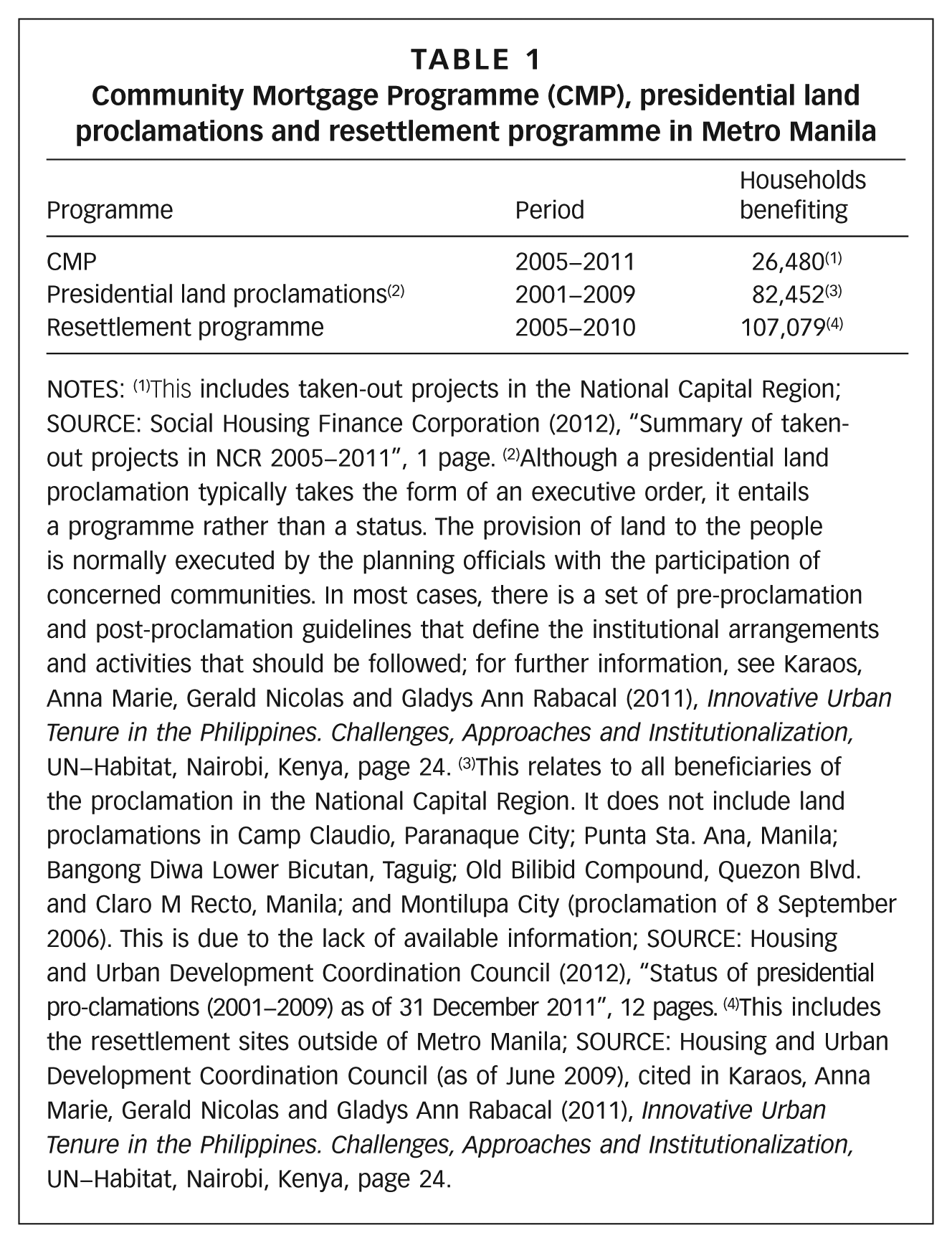
NOTES: (1)This includes taken-out projects in the National Capital Region; SOURCE: Social Housing Finance Corporation (2012), “Summary of taken-out projects in NCR 2005−2011”, 1 page. (2)Although a presidential land proclamation typically takes the form of an executive order, it entails a programme rather than a status. The provision of land to the people is normally executed by the planning officials with the participation of concerned communities. In most cases, there is a set of pre-proclamation and post-proclamation guidelines that define the institutional arrangements and activities that should be followed; for further information, see Karaos, Anna Marie, Gerald Nicolas and Gladys Ann Rabacal (2011), Innovative Urban Tenure in the Philippines. Challenges, Approaches and Institutionalization, UN−Habitat, Nairobi, Kenya, page 24. (3)This relates to all beneficiaries of the proclamation in the National Capital Region. It does not include land proclamations in Camp Claudio, Paranaque City; Punta Sta. Ana, Manila; Bangong Diwa Lower Bicutan, Taguig; Old Bilibid Compound, Quezon Blvd. and Claro M Recto, Manila; and Montilupa City (proclamation of 8 September 2006). This is due to the lack of available information; SOURCE: Housing and Urban Development Coordination Council (2012), “Status of presidential pro-clamations (2001−2009) as of 31 December 2011”, 12 pages. (4)This includes the resettlement sites outside of Metro Manila; SOURCE: Housing and Urban Development Coordination Council (as of June 2009), cited in Karaos, Anna Marie, Gerald Nicolas and Gladys Ann Rabacal (2011), Innovative Urban Tenure in the Philippines. Challenges, Approaches and Institutionalization, UN−Habitat, Nairobi, Kenya, page 24.
In spite of these programmes and the relatively large role of communities in the upgrading process (especially in CMPs), the housing backlog in Metro Manila has not been resolved. The programmes failed to provide the expected results in terms of financial sustainability,(17) organizational transparency(18) and effectiveness.(19) For this reason, some may also assume the focus on decentralization in Philippine legislation to have failed, since the community-based development did not visibly increase the sustainability of the projects undertaken or gradually lead to the enhancement of the official programmes. The more important question for this paper is whether the focus on people’s empowerment and community-led upgrading underscored in the LGC and UDHA also failed to provide the expected results.
I argue here that, although the problem of homelessness has not been resolved, decentralization reforms and people’s activism have left a mark. Community empowerment has had results in the context of various dimensions of the settlement upgrading process. Communities have managed to extend the meaning of a community-based upgrading process, as defined in government programmes, through the development of their own solutions, which have emerged on the border between formality and informality.
III. The ACCA Programme
The three community-based upgrading projects reviewed in this paper are all linked to the Asian Coalition for Community Action (ACCA) programme. ACCA was initiated in 2009 by the Asian Coalition for Housing Rights with finance from the International Institute for Environment and Development (IIED), which received a grant from the Bill and Melinda Gates Foundation to facilitate community-based initiatives in Asian countries. The programme’s financial support is delivered in various ways:
Big ACCA projects are funded by loans (sometimes grants) of US$ 40,000−60,000 for housing projects. Communities have to formulate proposals in order to access these funds, defining the reasons for the project, how they will manage the project financially and what its impact might be in terms of community and government relations.
Small ACCA projects receive loans of US$ 15,000 per city, an amount shared across at least five communities to enhance infrastructure, gain access to water, pave roads etc., according to their needs.
Small amounts of financial support are also devoted to network-building, joint activities, meetings, workshops or support for research, the mapping of informal settlements and the creation of city and community profiles.(20)
The organizational structure for administering this financial support is essential to the programme, since it functions as a platform linking local urban poor communities to the international movement.
In the Philippines, there is a requirement that borrowed funds are repaid and injected into a revolving fund, so that other communities can benefit from the money. Each community that benefits from the money becomes part of the ACCA network and is expected to participate in the future in disseminating and unifying the upgrading approach around their cities and countries.(21) Communities that first benefit from the loan are responsible for reviewing the applications of candidate communities that would like to join the network.
The community-based initiatives described here are big ACCA projects in Metro Manila, which took place in the first round of the programme (2009−2011). The communities involved are:
members of the Urban Poor Alliance (UP−ALL) federation of communities in Quezon City (Commonwealth/Batasan), assisted by the Foundation for the Development of the Urban Poor (FDUP);
the Masagana organization in Tanza, Navotas City, assisted by the Technical Assistance Organization Pilipinas (TAO); and
the Kabalikat community organization, assisted by the Urban Poor Associates (UPA) in Baseco, Manila.(22)
This particular sample was selected for several reasons. First, the money was used directly for housing projects, which automatically implies that participants had to deal with various critical and ubiquitous urban issues such as security of land tenure, scarcity of space and official development policies.
Second, each community, although unified by the ACCA programme, faced different realities and had different objectives, allowing us to see the broader picture behind the community-based approaches.
Third, the ACCA programme is the largest and strongest initiative in Asia that supports community-based solutions to the upgrading of settlements. Communities that join the programme agree on the philosophy that they are “prime movers and solution makers”.(23)
Finally, participants in the ACCA programme already had some organizational structure in place, which made it easier to prepare the proposals and access the loan, and also some experience of settlement upgrading and relations with local government.
The study, then, did not look in a broad way at how ACCA worked in Metro Manila. Rather, it considered how specific communities, with their own rich experiences and ambitions, used modest financial support, managed to set up networks and enriched the ACCA with their own experiences, contributing to the development of a unified community-based approach to settlement upgrading.
IV. Quezon City (Commonwealth, Batasan): Urban Poor Alliance
a. Project context: struggles over land property rightsin Quezon City
The context of the upgrading in Commonwealth and Batasan in Quezon City (Figure 1) resembles that of many communities in Metro Manila. Most of the communities taking part in the ACCA programme in Quezon City are settled in an area that was originally planned for government buildings as part of the National Government Centre.(24) However, only some government buildings were constructed and people occupied the rest of the vacant land from 1970 onwards.
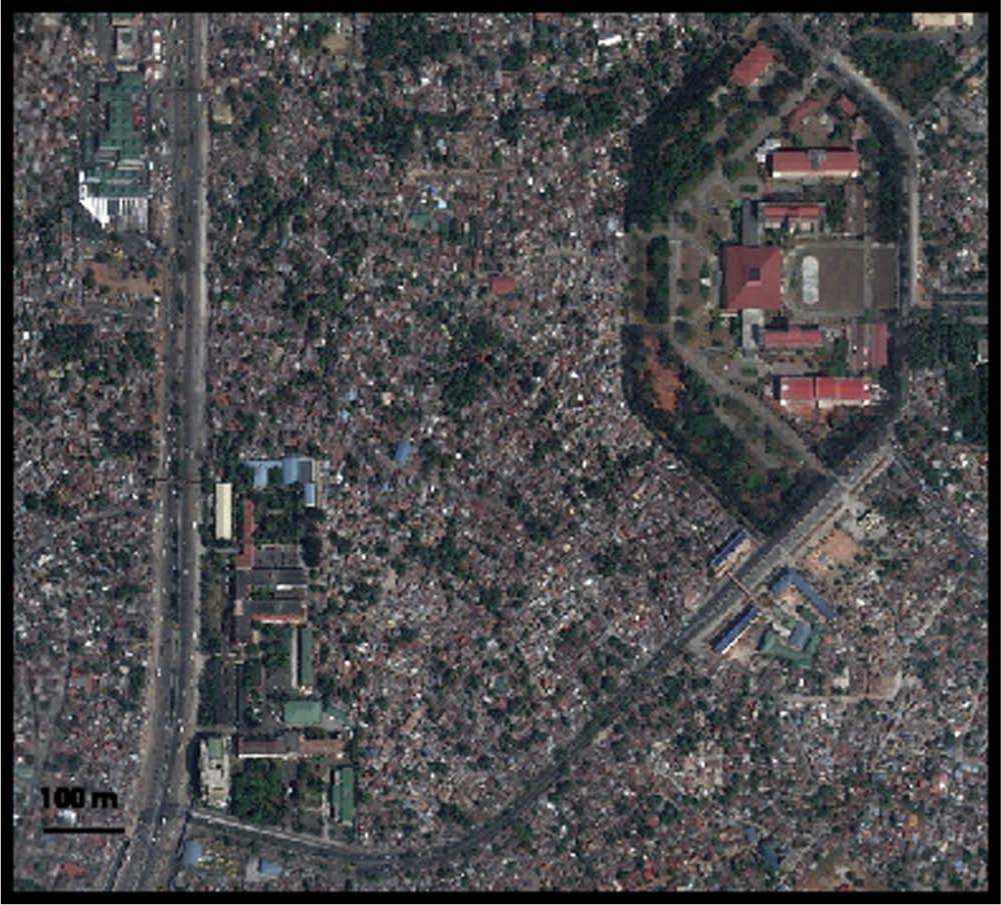
Commonwealth and Batasan in Quezon City
Since then, there has been a dispute over the land property rights. The government threatened eviction, while residents engaged in political rallies for secure tenure and development of the site as a housing area. In 1987, the conflict resulted in Proclamation No 137, issued by President Corazon C Aquino, devoting part of the land to the urban poor. In 2003, the National Government Centre Housing and Land Utilization Act,(25) signed into law by President Gloria Macapagal-Arroyo, placed the area formally into the people’s hands.
These proclamations provided the legal basis for the communities concerned to work on sub-division plans. Generally speaking, such plans are prepared by a contracted surveyor and then formulated into a Community Development Plan (CDP). In many communities in the area, this is still an ongoing process. Finalization depends on the financial capacities of the concerned communities, as each household has to pay for their lot to be surveyed, and the time taken for completion varies from case to case. Plans are then delivered to the Project Management Office of the National Housing Authority, which approves or rejects them. Communities with approved CDPs can move ahead with monumenting and reblocking according to the regulations(26) and also with the preparation of technical descriptions and sub-division plans. Simultaneously, the local government creates a list of qualified beneficiaries who are supposed to receive “contracts to sell” and, eventually, buy the land.
This whole lengthy process was accelerated when the families from different homeowners associations accessed the ACCA loans. The money was used to purchase the materials and finalize the reblocking process, which had begun in an incremental manner years before (Photos 1A and 1B).
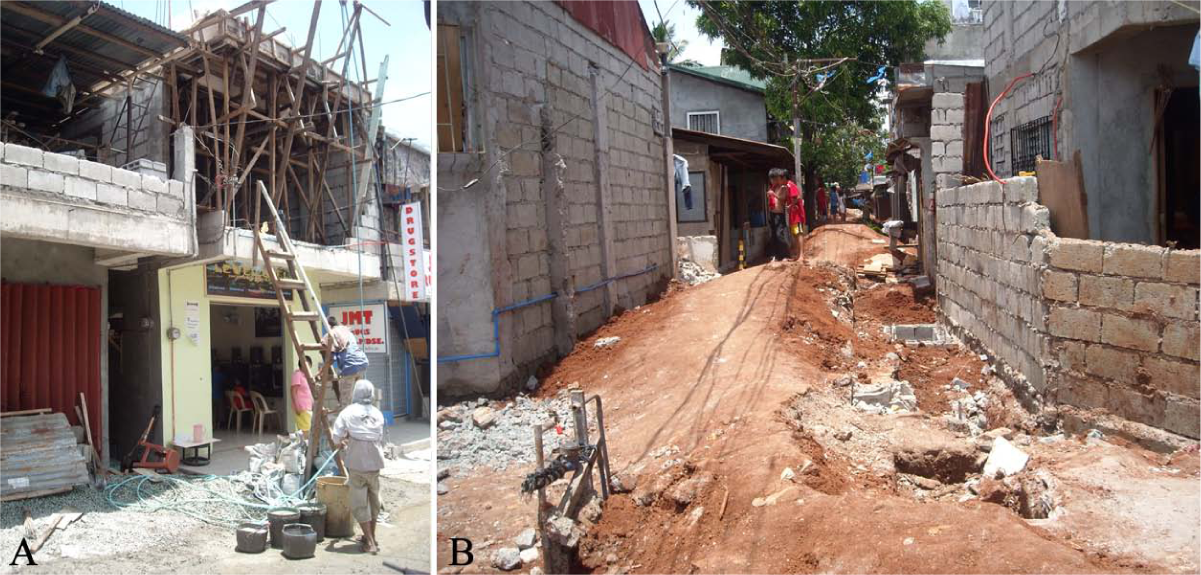
Reblocking with ACCA support in Commonwealth, Quezon City
As well as speeding up the process, the loan also allowed communities to gain additional support from the LGUs. As noted by community representatives, there was a direct link between the finalization of the reblocking activities and the government’s engagement with the provision of services (roads, infrastructure etc). The reason for this is that prior to the reblocking activities, which have to be financed by the community members, the LGU is not eligible to provide services, since the settlement design may not comply with the sub-division plans and BP220 regulations(27). But once the community has provided approved plans from the National Housing Authority to the LGU, the latter can start to fulfil its mandate and deliver services to the settlements. In other words, if LGUs were providing services in an unregulated settlement they would, in a way, legitimize structures that were constructed “illegally”. After communities have submitted plans approved by the National Housing Authority, LGUs are obliged to provide services. However, many of the community leaders interviewed also ironically connected the increased provision of services with the arrival of elections.
A number of obstacles, beyond formal approval, had to be overcome in areas benefiting from ACCA support. Often, and surprisingly, these were linked to internal problems within the communities. For example, there were people who did not want to scale down their lots according to proclamation guidelines. Those with bigger lots preferred to keep them without a title rather than settle for smaller lots and secure tenure. Community leaders together with local government, through their joint Reblocking Task Force, had to put pressure on these rebellious participants in order to enforce changes to the lot sizes. There were also claims of land ownership by land mafias,(28) who demanded payment from the concerned families. Last but not least, many renters, who would not be eligible to access the land, accepted the changes only when the LGU promised to provide a medium-rise building in the vicinity.
b. Quezon City network: the political power of the urban poor
The direct holder of the ACCA funds in Quezon City was an NGO, the Foundation for the Development of the Urban Poor (FDUP), which was obliged to deliver the money to communities interested in a loan. FDUP disseminated news about the money and supported the creation of a structure responsible for distributing funds and selecting projects.
This was achieved easily, since a network of communities had been formalized in Quezon City before the inception of the ACCA programme. The Urban Poor Alliance (UP−ALL) coalition of community federations and allied NGOs (UPAK, ULAP, HPFPI, ULRM, LCMP−PO, FEDHOPE, ALMANOVA and, temporarily, DAMPA) was formulated in Quezon City in 2007 to advocate for political reform and land rights for the urban poor.(29) The coalition had considerable achievements, including the mobilization of the Local Housing Board in 2009(30) to start real work in the field, years after it was set up in 1996.(31)
Thanks to the existence of the UP−ALL coalition, the ACCA programme could reach a large number of communities immediately and involve them in the new network. Building on that, UP−ALL members in Quezon City decided to create a new organizational structure that would continue previous activities and manage the ACCA programme. It was composed of three committees:
Housing and Urban Liveability Committee (CRECOM/Credit Committee);
Organizational Development and Advocacy Committee; and
Education and Research Committee.
The first committee – CRECOM – consisted of eight representatives from community federations and three members from assisting NGOs. This committee, which represented the majority of Quezon City community associations, was responsible for the creation of savings policies, guidelines for lenders and the selection of the ACCA big and small projects. The involved leaders, after being trained in ACCA processes, decided to create a Social Housing Fund composed of the ACCA and UK Aid funds allocated to housing development (Table 2). The joining of the funds was designed to leverage more funds from Quezon City Council, something that had not yet been achieved.
Social Housing Fund in Quezon City
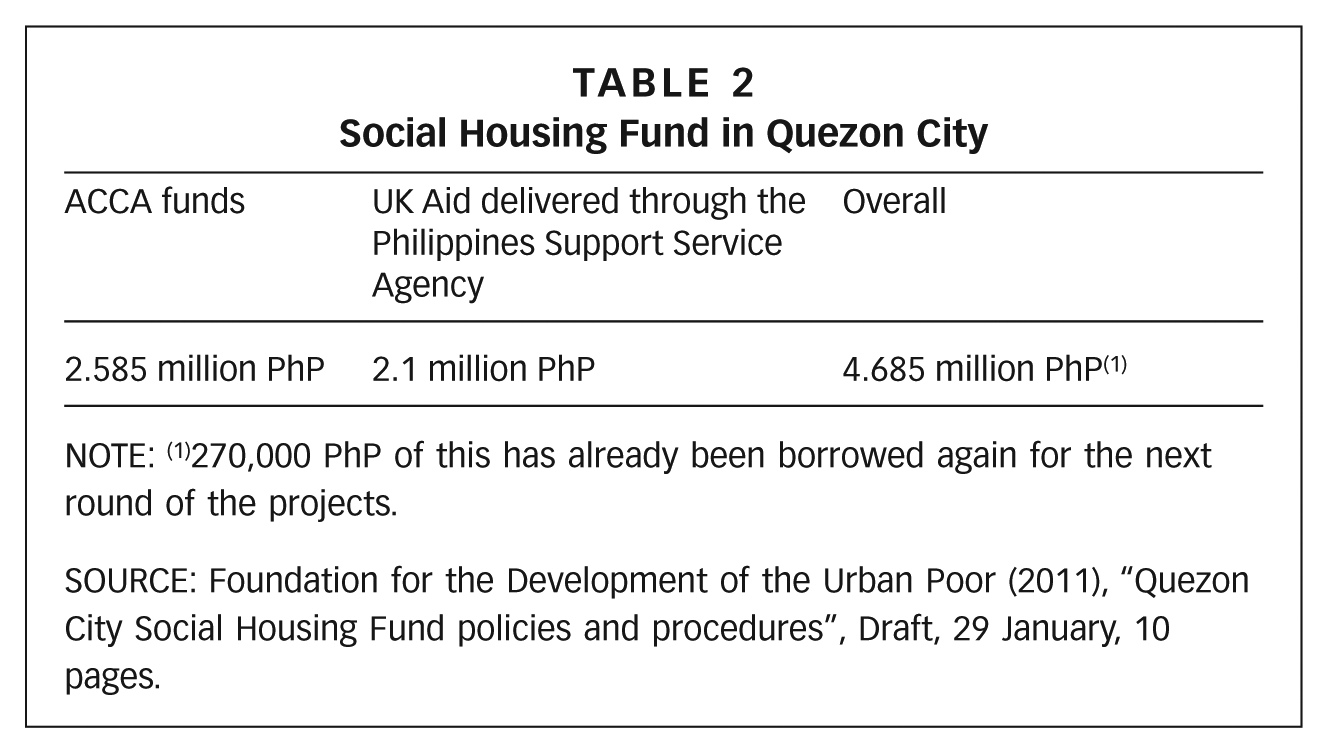
NOTE: (1)270,000 PhP of this has already been borrowed again for the next round of the projects.
SOURCE: Foundation for the Development of the Urban Poor (2011), “Quezon City Social Housing Fund policies and procedures”, Draft, 29 January, 10 pages.
CRECOM decided to allocate the ACCA fund reserved for big projects (US$ 40,000) not to one community but to families from different communities in Commonwealth and Batasan (Esbacona Blk 2, East Unt. Kaakibat, Namappa, Faithville, Sitid Tala Nay homeowners associations) and the funds were used for the required reblocking.(32) Another part of the available funds, devoted to small ACCA projects, was assigned by CRECOM to the development of livelihood projects. CRECOM made decisions about interest rates on the loans (six per cent for one-year projects, nine per cent for two-year projects) and there was an option that 50 per cent of the interest could go back to the concerned communities if they repaid the loan in full and on time (Table 3).
Distribution of interest repayments in the Quezon City revolving fund (6−9% interest rate)
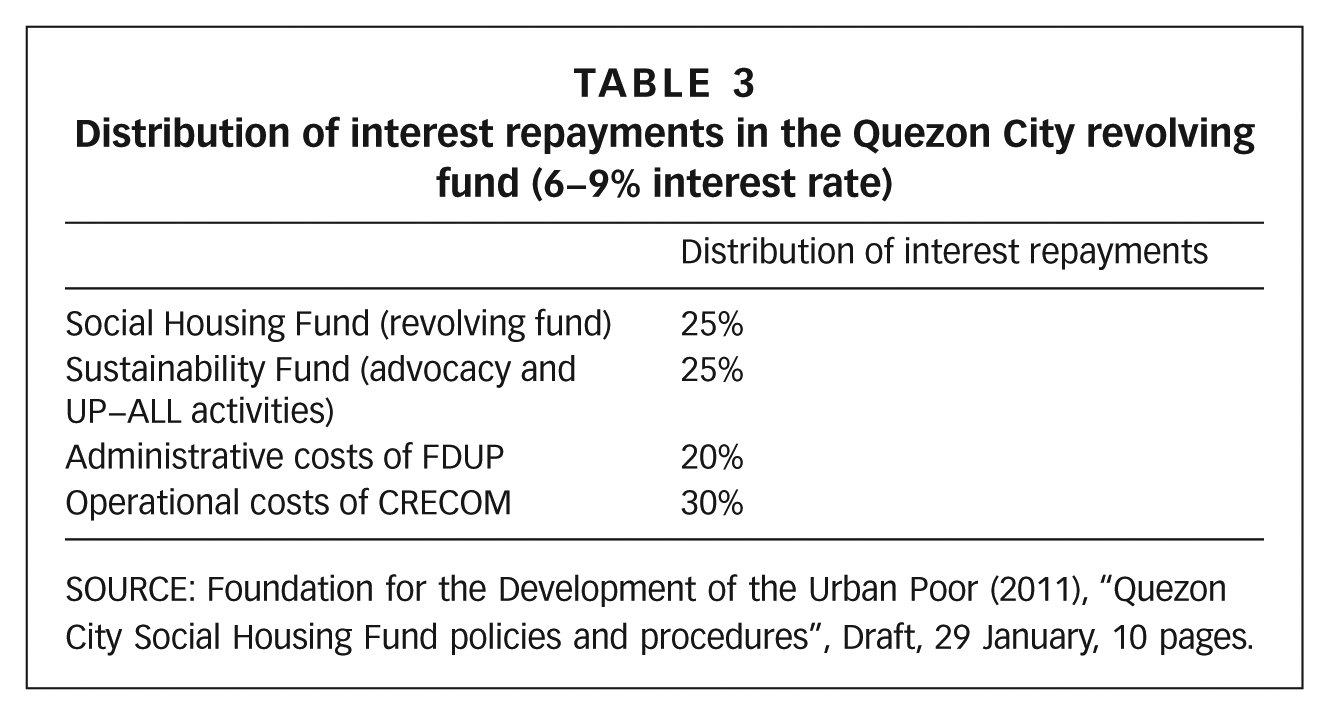
SOURCE: Foundation for the Development of the Urban Poor (2011), “Quezon City Social Housing Fund policies and procedures”, Draft, 29 January, 10 pages.
The two remaining committees (Organizational Development and Advocacy, and Education and Research) spent supplementary funds on compiling city and community profiles. These detailed reports, facilitated directly by the communities, were one of the first efforts to determine who exactly lived in Quezon City’s low-income settlement areas.
Nonetheless, however successful the network was in setting up an organizational structure, the functioning of the revolving fund was more problematic. By 2012, network members who had received the big ACCA project loans had repaid only 38 per cent of the amount due. Regarding the small project loans, one of two recipient groups had repaid the whole amount. This low repayment rate may be related to the fact that the communities had little experience of savings schemes. The very detailed screening mechanism did not require the communities to have established savings groups prior to availing themselves of loans; they required only 20 per cent of the loan amount in money or sweat equity.
V. Navotas City (Tanza): Masagana
a. Project context: fish pond community in Navotas
The Masagana of Navotas Neighbourhood Association (Masagana), quite different from the Quezon City examples, represents a fish pond community located in Tanza, Navotas City (Figure 2 and Photo 2). The funds accessed by the organization were designed not for upgrading but for relocation to a new neighbourhood outside Metro Manila. The community was not engaged in any government programme but purchased the land directly from the owner.
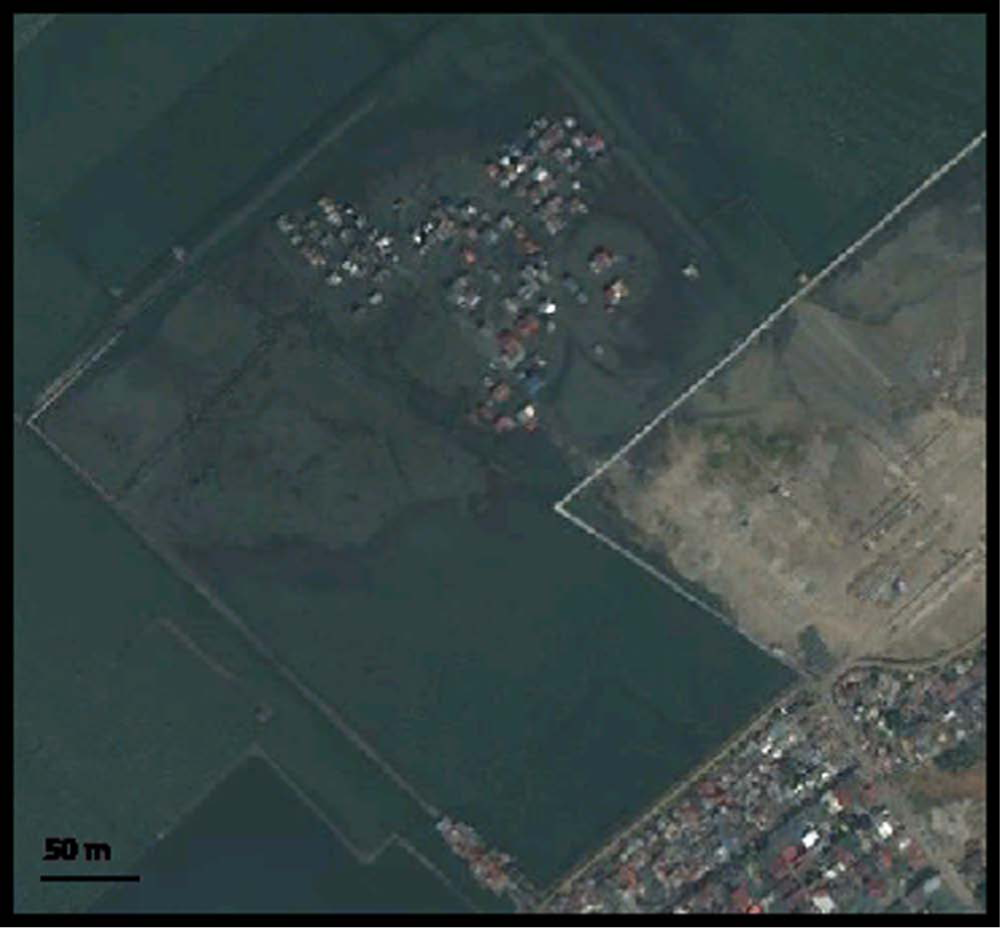
Fish pond community, Tanza, Navotas
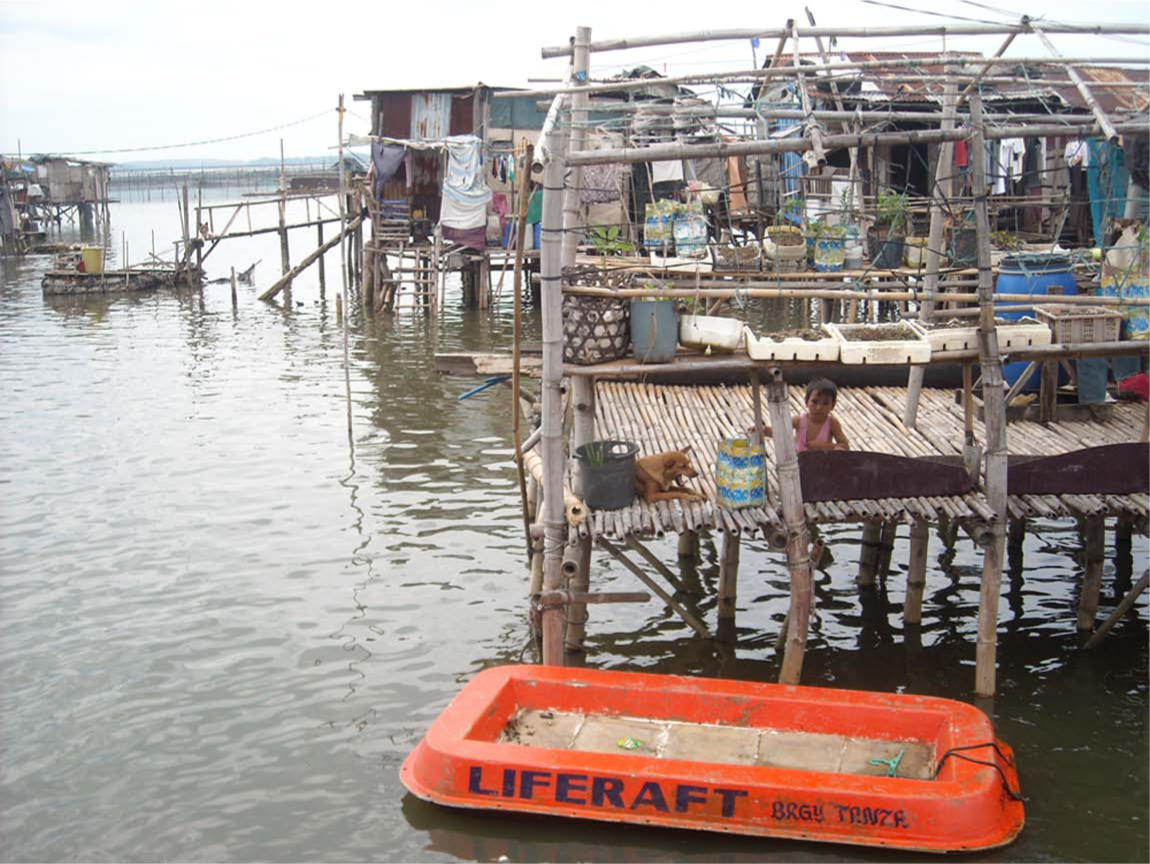
Fish pond community, Tanza, Navotas
The community organization includes 89 families (73 in savings schemes) living in a fish pond in houses built on stilts. People arrived there after being evicted from different parts of Navotas and Malabon, hoping to purchase the land from a private owner. At the time, the area was not permanently under water and only flooded following seasonal typhoons.
Originally, the community was represented by a group called Sanagmana, which was involved in collecting money to buy the fish pond land. As in many other instances, part of the collected money disappeared in unclear circumstances. This led to a split among Sanagmana members and to the creation of the new Masagana organization in June 2009. At this point, the opportunity to purchase the land no longer existed and, facing repeated typhoons, the community decided to move away from the area. With the support of the NGO TAO Pilipinas, the group decided to buy land in Bulacan (24 kilometres from Navotas) with the help of an ACCA loan. As of March 2012, they had already saved PhP 318,090, which was added to the loaned funds.
Selecting the land was left entirely up to the community, and the settlement plan was created with help from TAO during participatory planning sessions. The community also took advantage of a loan from SELAVIP and a donation from Japan for post-typhoon recovery, and the LGU in Navotas will give them some help in moving as well. By May 2012, part of the community had moved to the resettlement area and had started to prepare the land for site development and the construction of houses.(33)
b. Navotas network: facing the challenge
The NGO TAO, which started to support the ACCA process in 2009, had previously worked in the Navotas area and had established contacts with several communities. The activities undertaken by Masagana and TAO reflect ACCA’s basic approach, including community networking and promoting savings.
Forming networks in Navotas proved to be far more difficult than in Quezon City. The communities initially involved had either previously worked with TAO or had been approached by TAO through another NGO (COPE) and the federation of people’s organizations, DAMPA. At the initial meeting in May 2009, people were informed about the scope of the programme and taught about savings schemes and experiences from the Homeless People’s Federation Philippines. Afterwards, each community organization had to prepare ACCA-compatible policies to be applied in Navotas. These were presented and coordinated at the next meeting, and communities arrived at a consensus on the savings policies to be used in Navotas – these were ready by August 2009. The communities decided that the interest rate for the loans would be three per cent, distributed as presented in Table 4.
Distribution of interest repayments in the Navotas revolving fund (3% interest rate)
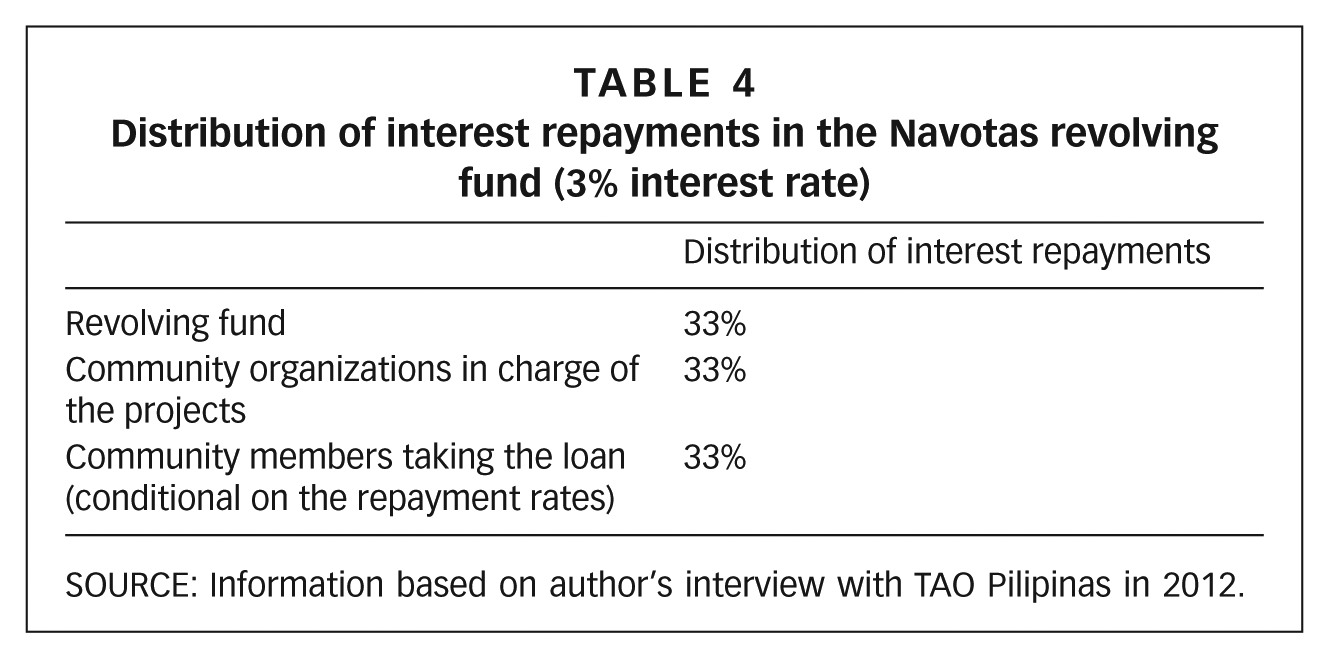
SOURCE: Information based on author’s interview with TAO Pilipinas in 2012.
The communities also established a Project Management Committee (PCM), which decided upon the type of projects and distribution of the ACCA funds according to the needs of the community organizations involved. Each community was supposed to have a delegate on the PMC.
Initially, the network was composed of:
two representatives from Masagana in Tanza (which later received a US$ 40,000 loan for a big housing project) and a community organization called the “Bicol” group;
representatives from communities mobilized by COPE, namely the North Bay Boulevard North barangay (NBBN) and North Bay Boulevard South barangay (NBBS); and
representatives from the 16 communities belonging to a federation from Tangos, Navotas.
In order for all the communities to benefit from the loan, they had to create savings groups (six months prior to the loan delivery) and be officially registered as a community organization/homeowners association according to government rules. The groups that joined the network were supposed to be evaluated by members of the PMC. In order to remain objective, those evaluating candidates who wanted to join the network had to be from a different barangay.
Over time, the network became smaller. The first to leave were communities from NBBN and NBBS, whose participation ended because they did not attend meetings or engage sufficiently in the development of the network.
Another problem emerged regarding the “Bicol” group from Tangos. Although they benefited from a loan for a small project, and were able to pay it back, part of the money collected within the community disappeared and the people repaying the loan felt cheated and refused to pay more. This eventually led to the resignation of the community’s leader. Almost half of the borrowed amount plus interest was paid back, but in the end, the community left the network. The problem here lay in how to collect the money, which can be effected in various ways.(34)
Last, but not least, the federation from Tangos did not fulfil the formal requirements. It emerged that participating organizations were not formally registered, or they lacked the organizational structure required by local law (including registration with the Securities and Exchange Commission as a community organization) and thus were not able to take the ACCA loan. It appeared that the community monitoring undertaken by the community organization from another barangay had not been so detailed after all.
Considering that Navotas is one of the oldest centres of the people’s movement, the failures around these fundamental concerns were surprising. Nevertheless, Navotas lacked the one strong network that existed in the Quezon City case, where it was easier to create an ACCA network using a unified and politically recognized structure.
As of May 2012, of the five members of the Project Management Committee representing more than 20 communities, only three were left. They represented Masagana, Pantalan UNO and Ar Domingo. In March 2012, communities in Ar Domingo started to repay their loans for water connections; Pantalan Uno has not yet benefited from the loans. Despite these initial issues, Masagana continues its efforts to enlarge the network and increase participation in the revolving fund. New members are expected to join the network soon.
VI. Manila (Baseco): Kabalikat
a. Project context: shanty town of Baseco
The last community that took part in the big ACCA project in Metro Manila was linked to the Kabalikat community organization, assisted by the NGO Urban Poor Associates. Both organizations had already worked in barangay 649, commonly known as Baseco (Photo 3), at the beginning of the twenty-first century and since then have achieved considerable success in settlement upgrading.
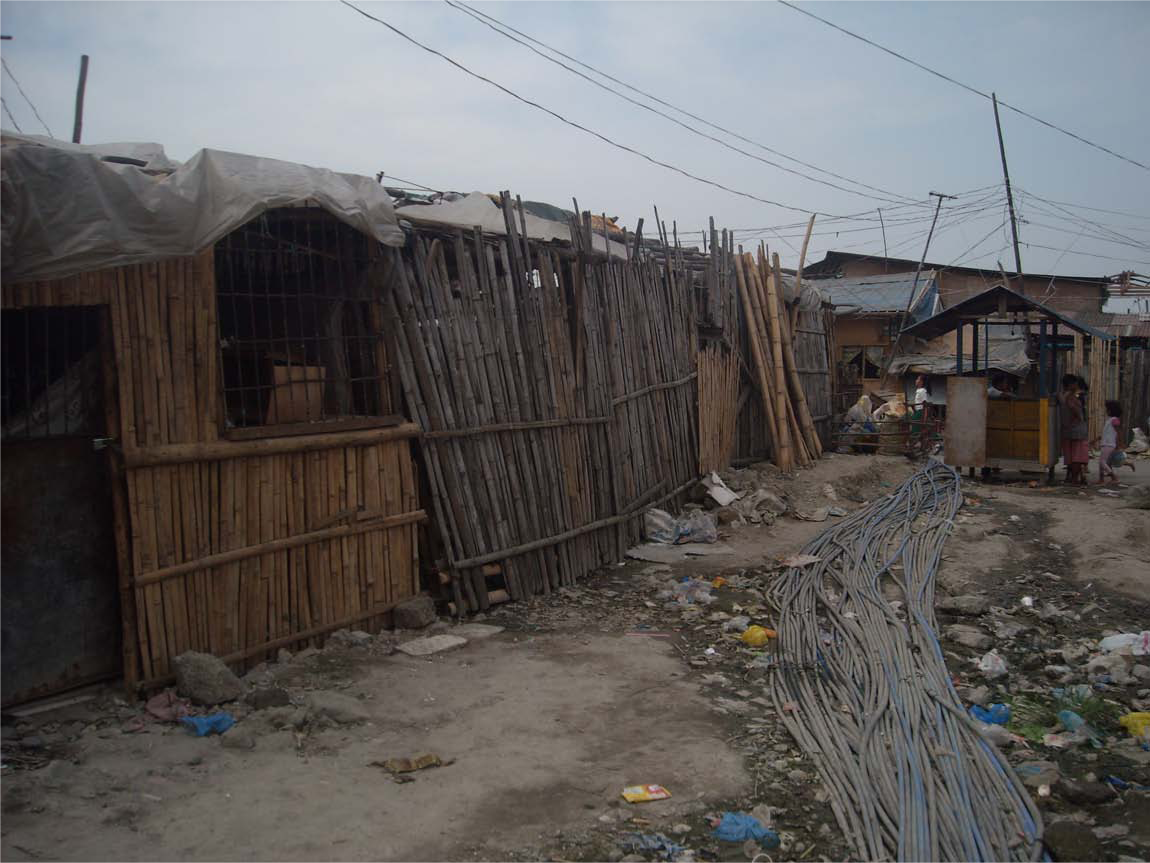
Baseco shanty town
Baseco is located in the harbour area of Manila (Figure 3). Originally, it was just a landfill area stretching into the sea. People settled there because of access to many employment opportunities in the shipping industry.(35) Between 2002 and 2005, the area was enlarged by the government to form a triangle of land of approximately 56 hectares, connected to the mainland by a narrow piece of land. Nowadays, about 10,000 families live in Baseco, most of them without sanitation and with limited access to electricity and social amenities.(36)
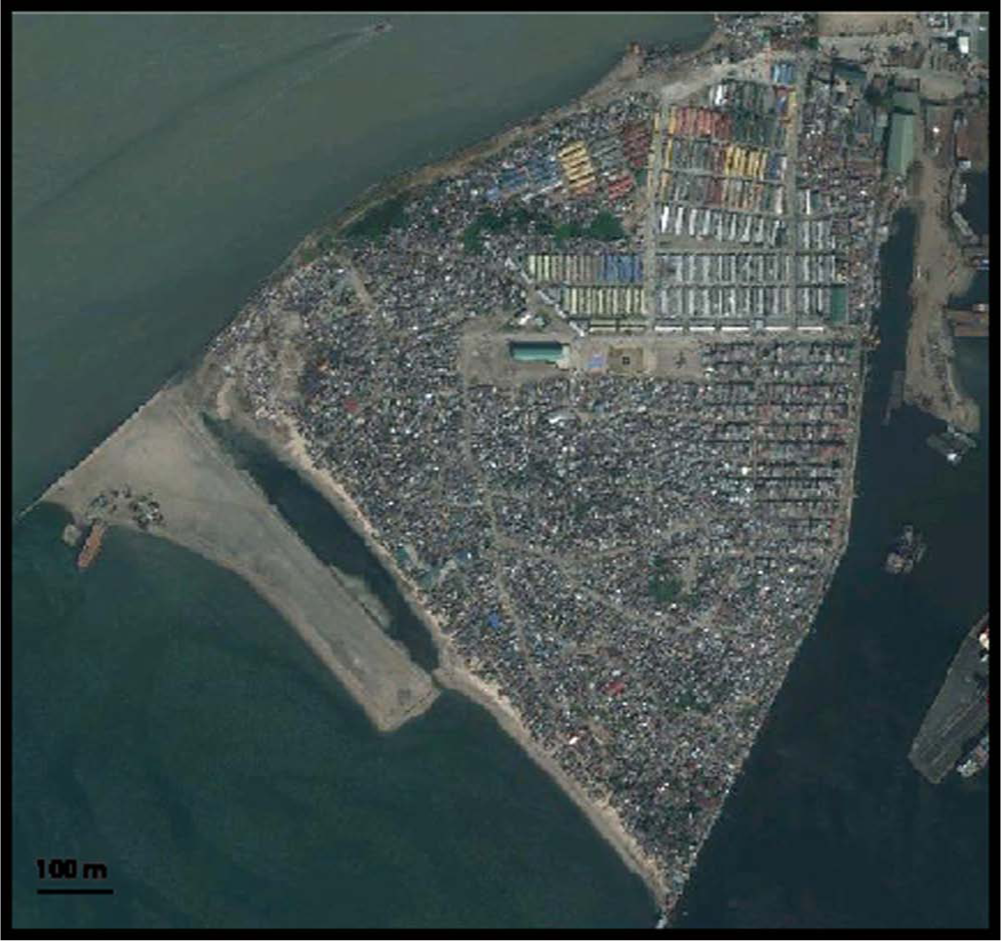
Baseco
In spite of its legitimization in a 2002 proclamation,(37) there have been many attempts to resettle the area’s people. In 2007, the government proposed to stabilize the ground on the condition that everyone temporarily moved away from Baseco. The proposal was refused.
Since the proclamation, there have been many external and community-led housing initiatives in the area, mainly because of yearly fires that gradually destroyed what people had built. Initiatives include housing in the burned northern part of Baseco, with the guidance of Habitat for Humanity and Gawad Kalinga.
More interesting, in terms of this paper, were the initiatives undertaken by Kabalikat with the guidance of the NGO Urban Poor Associates (UPA). In 2002, with technical help from TAO, people took part in participatory planning sessions to produce frameworks for further development of the area (with row houses preferred to single houses or duplexes). The plan was accepted by the LGU and partially used in the so-called “new site” area in the east of Baseco. The site was developed under the supervision of the local government, which donated materials worth up to PhP 15,000 per family. As a result, people built some of the best housing in Baseco, some units being three storeys high and equipped with toilets (Photo 4).
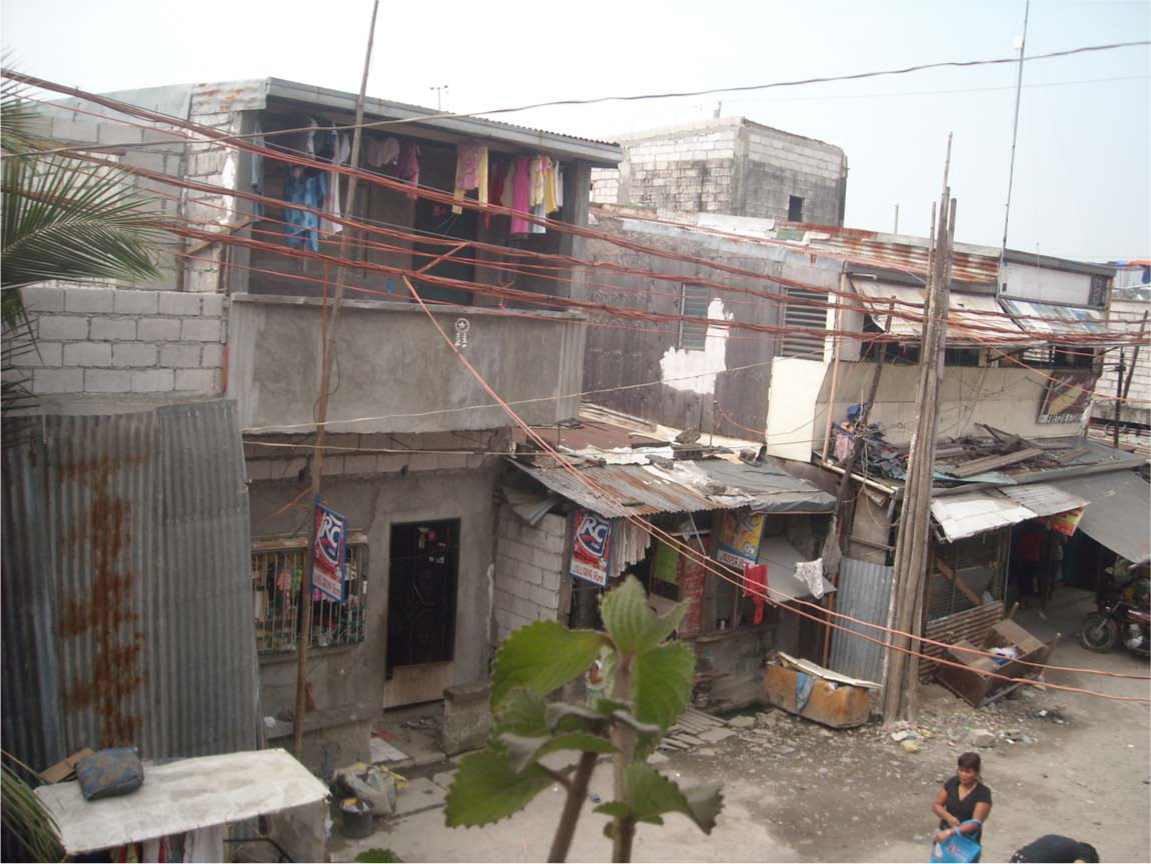
The New Site area in Baseco
Kabalikat became part of the ACCA programme when small projects for drainage systems in blocks 6−8 and 8−10 of the new site were initiated. Money for the big ACCA project followed but, unlike other projects in Metro Manila, it was delivered in the form of a donation for the construction of houses in an area that had suffered fire damage in 2010. In this case, the emergency situation justified this type of financial support as, otherwise, ACCA prefers to give loans for their capacity to increase community ownership and enhance the capacity for savings. In the Kabalikat case, 218 families benefited from the support, each receiving PhP 12,000 worth of materials, which eventually resulted in the construction of 205 consolidated houses (Photo 5). The design was selected in consultation with invited architects (Kabalikat and UPA cooperate with the MAPUA School of Engineering)(38) and houses were allocated in a lottery after the area had been divided into equal plots.
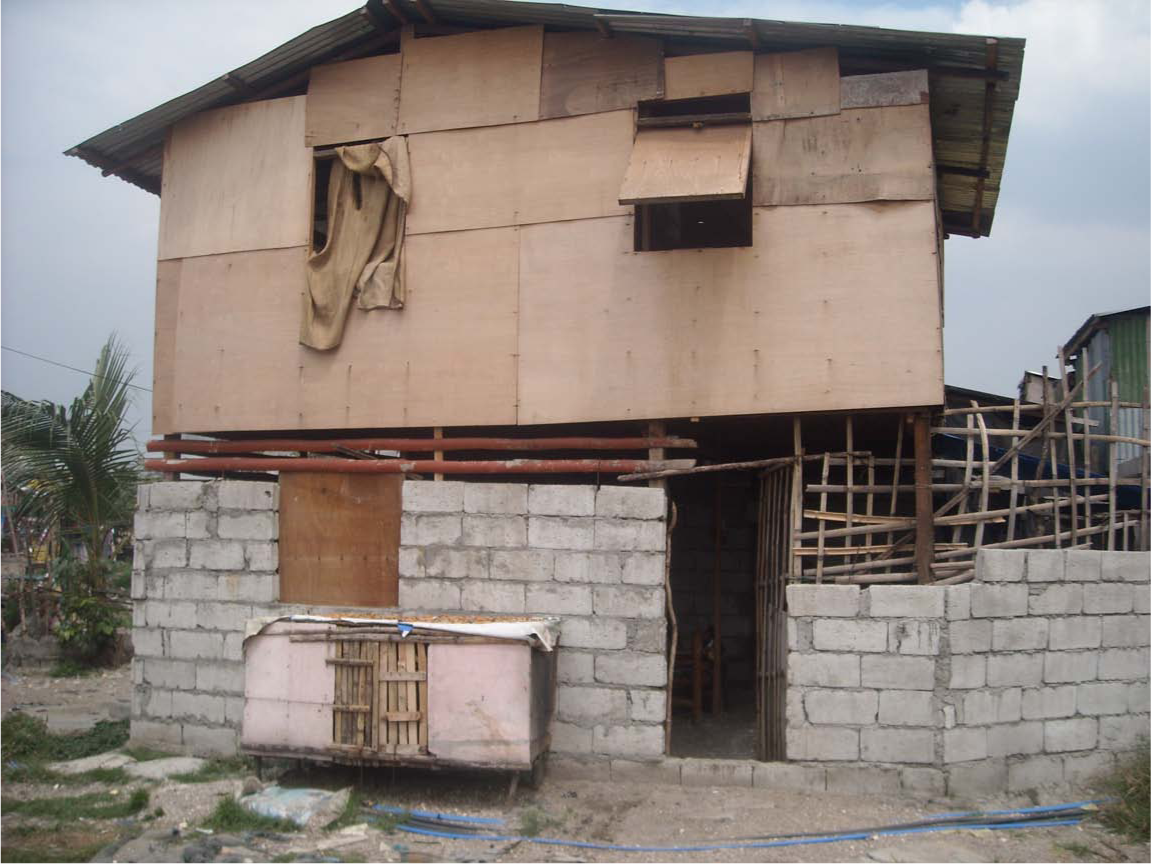
House constructed with ACCA support
The foundations were built by families or with the help of contracted specialists; the rest of the house build was left up to the families and their financial capacity. Nowadays, the area is consolidated and most of the houses are two storeys high.(39) A modest donation of materials came from Habitat for Humanity, but most of the work was undertaken by the people themselves.
b. Manila network: the anti-eviction platform
Because the money delivered to Kabalikat was a donation, not a loan, there was no fund to be administered and no need to select new projects. This meant that an important element of ACCA – the setting up of self-managed networks − was not carried out in the area.(40) Nonetheless, Kabalikat was involved in the anti-eviction networks that existed before the ACCA programme. Participation in these kinds of platforms may be linked to two elements. First, to the community’s situation whereby it had lived under the threat of eviction for many years; and second, to the fact that the community is assisted by UPA, which is very active in the field of anti-eviction campaigning.
Kabalikat is active in negotiating with the local government − facilitating the projects in a bayanihan (collective) manner − and proposed the Baseco development plan to the LGU (Figure 4). This was supported by UPA, which is strongly involved in negotiations with various government actors. Despite the fact that Kabalikat had not set up a network, it has visible achievements in empowering local communities and negotiating with the barangay administration. There is a savings scheme in the area that began before the community’s participation in the ACCA programme, and expenditure of these funds is prioritized by the people (for instance, for water connections or the installation of the meters). The remaining savings will be used to purchase the land when the “contract to sell” is finally delivered to the families concerned. This can happen only after all of the spatial and infrastructure requirements have been fulfilled. At present, this seems a long way off, as more than half of the settlement area still resembles a classic shanty town. Moreover, there are still people in power who would like to rescind the proclamation that legitimizes Baseco.
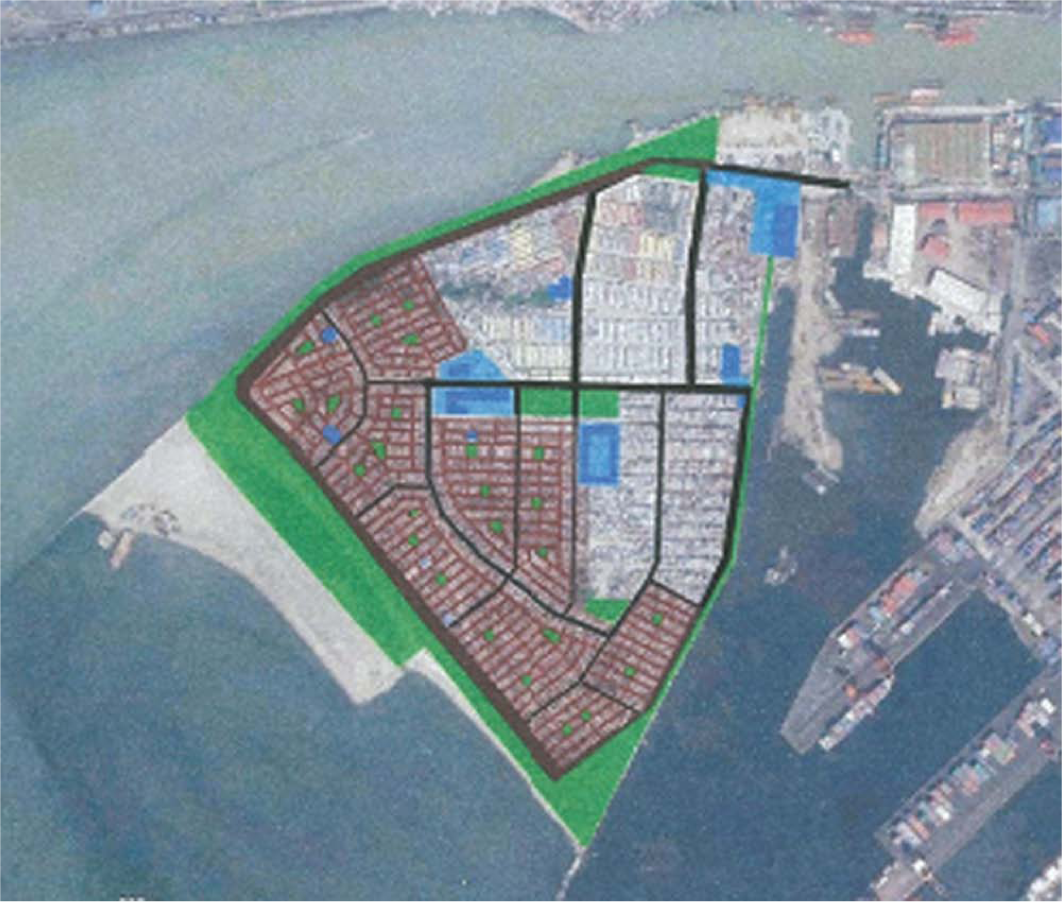
Baseco development plan
VII. Conclusions
The community organizations described in this paper share several elements in common (Table 5). Most importantly, many of their organizational features were in place before the commencement of the ACCA projects. ACCA was able to build on existing experiences to try to link them through a wider network.
Features of community-based approaches in the analyzed community organizations
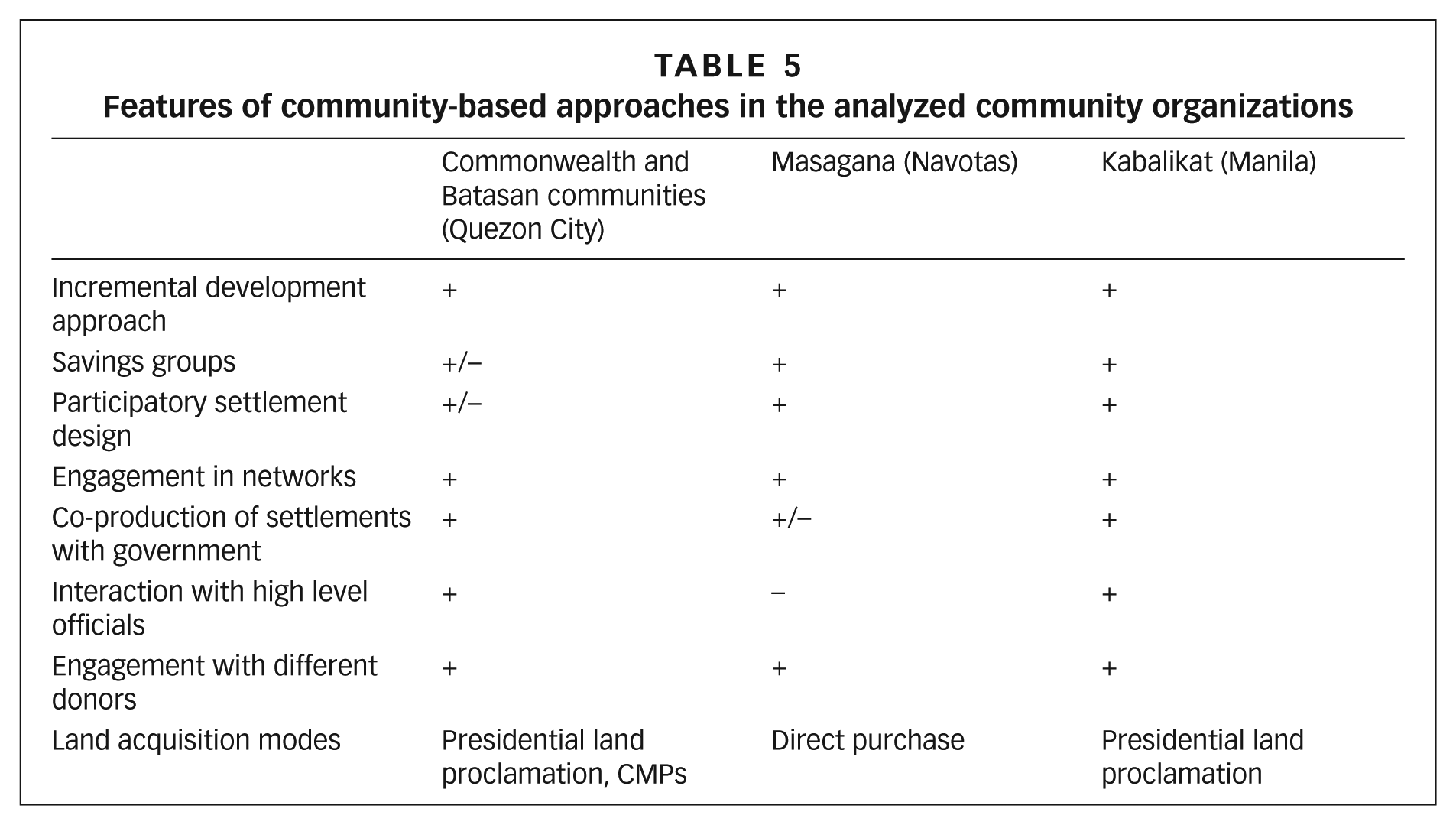
Community-based approaches, as characterized by the efforts described here, share the following features:
incremental development;
community savings groups;
participatory settlement design;
engagement in different networks of community organizations;
engagement with different donors; and
co-production of the settlement with the government.
The following elements were present in two of the three communities:
participation in government programmes: in Quezon City presidential proclamations and CMP; in Baseco, Manila, a presidential proclamation; and
high levels of interaction between networks and high level government officials (except with the Navotas network).
a. Lessons learnt
Based on these three cases, several practical lessons can be learnt about the community-based approaches in Metro Manila:
An incremental model of development is favoured by the communities. With modest financial support, communities have the financial and technical capacity to finalize the works incrementally(41) (for instance in the Baseco new site or the ACCA area cases). Incremental construction also responds best to the specifics of government programmes (CMP, land proclamations), which require the transformation of settlements according to building law standards and involves lengthy negotiations between involved stakeholders.
A full participatory planning process for the settlement helps with conflicts and with securing free spaces (for instance in the ACCA-funded project in Baseco). The framework for government programmes allows freedom in the design as long as it complies with official regulations such as BP220, but does not necessarily facilitate discussion and collective decision-making, which can be important in resolving resistance to change from some people, as was encountered in the Quezon City case.
Work undertaken by the community in the bayanihan (collective) manner, and the results this provided, mobilized LGUs and barangays to participate in the development of settlements, the provision of services, roads etc. There is potential for a co-production model of development, identified as a joint production of services between citizen groups and the state.(42) It helps the government to save money, accelerates upgrading and calls into question the stereotype of the passive poor. Currently, however, co-production is most often an informal arrangement and it is not considered a legitimate mode of development in Metro Manila.
Without the strong advocacy of networks, the institutions designed as platforms of cooperation between government and communities (Local Housing Boards or specific Local Inter-Agency Committees − LIAC’s) fail to work properly and fulfil their mandate.
The previous existence of community-based saving schemes, as in the Navotas case where communities were obliged to save money for at least six months prior to accessing the loan, seems to provide a better guarantee of high repayment rates compared to a very strong filtering mechanism for accessing the loans (credibility of loan takers, counterpart of 20 per cent of loan amount in money or sweat equity etc.), as in the Quezon City case. However, we should take into consideration that the networks in Navotas are small and might not be fully representative. Nonetheless, the NGO FDUP, which is involved in helping the Quezon City networks, is already advocating the inclusion of obligatory community savings for the communities interested in accessing the loans (according to initial ideas, the communities should have at least six months experience of running saving schemes before they can access a loan).
b. Challenges of the community-based approach
Based on these three cases, community-based settlement upgrading can be considered successful in Metro Manila. Nevertheless, there are definitely challenges:
Based on repayment figures, the revolving fund might not be sustainable in financial terms in spite of the fact that its rules and regulations are planned by the communities participating in the ACCA network. Although community-based loans (similarly to CMP) might be more successful in terms of repayment rates than other programmes,(43) the assumption of full repayment, based on experience, might not be reasonable in the cultural and political context of the Philippines. However, a revolving fund can help communities to set up their own savings instruments and has the potential to leverage money from the government. Revolving funds may be fully operational in future but need more time to be internalized within participating communities.
New mechanisms to increase repayment rates and to strengthen the culture of community savings have to be explored.
Strong community networks are successful in negotiations with high level politicians and have stronger positions than individuals for negotiating their rights at the city(44) or national level.(45) The problem highlighted by community leaders is cooperation from the bureaucratic machine, which is not externally monitored and may prefer to maintain the status quo. Hence, there is potential for the creation of a community monitoring system, not only for finished projects but also for evaluating cooperation with representatives of bureaucracy.
Network-building works when there is one political agenda behind the scheme, as in Quezon City.
Savings groups must have mechanisms that prevent easy access to the money by only one person (for instance, the one used by the Kabalikat organization). There have been several examples where this human factor has failed and part of the savings has disappeared.
Attention should be given to micro (everyday) aspects of planning. Seemingly banal elements such as accessibility of the meeting space, the timing of meetings, or personal relations can influence heavily the planning process.
The settlement upgrading process may be blocked not only by the external actors (developers, unsupportive government etc.) but also by internal community tensions. While increasing social cohesion within the group, the community upgrading process may also be linked to conflict. The introduction of participatory methodologies for settlement design, or wise government engagement will facilitate solutions to conflicts.
Overall, these examples of big ACCA projects confirm that there is a relatively unified community-based approach to settlement upgrading in Metro Manila that expands on the government’s strategies for upgrading. The common features of the community organizations’ work can serve as indicators of the approach or direction that unified communities will develop since, in the cases described, concerned communities got closer to their objectives of secure tenure and developed settlements. In the case of the Philippines, the approach has the potential to be incorporated into government policies, especially in terms of co-production and incremental development (which were previously tried by government and worked well, but which for some reason have since been neglected by the authorities). All of these factors illustrate that communities in the Philippines have managed to develop their own solutions within a very complex legal framework and with limited financial support from the government. They have also succeeded in working collectively, even though the number of stakeholders and their complex relations do not always provide the easiest environment for cooperation and unity.
Although most of the strategies chosen by the communities are based on their previous experiences, ACCA is a model programme that allows communities to take the lead in upgrading actions and to leverage their solutions through the creation of a wide network of communities both within the country and on an international scale. The solutions developed in the Philippines may differ from other ACCA experiences but this can be considered a particular strength of the programme, since concerned groups can use the programme’s flexible arrangements and fit them into their own requirements, expectations, rich experiences and existing programmes. Overall, the programme enables an expansion of the effects of community-based approaches on settlement upgrading, and serves as a tool that can strengthen the position of communities in negotiations with authorities, and can affect the modes of governance in Asia.
Footnotes
Acknowledgements
The author is grateful to all of the community and NGO leaders and community members who contributed to the research. These include representatives of Masagana, Kabalikat, UP−ALL Coalition in Quezon City, HPFPH, TAO Pilipinas, FDUP and UPA.
2.
Asian Coalition for Housing Rights (2010), 107 Cities in Asia: Second Yearly Report of the Asian Coalition for Community Action, published by ACHR in both printed and electronic forms, available at  , 48 pages.
3.
Yu, Sandra and Anna Marie Karaos (2004), “Establishing the role of communities in governance: the experience of the Homeless People’s Federation Philippines”, Environment and Urbanization Vol 16, No 1, pages 107−120.
4.
Figure from the 2007 population census.
5.
Ballesteros, Marife Magno (2011), “Why slum poverty matters”, Policy Note No 2011−02, Philippine Institute for Development Studies, 6 pages.
6.
Which, for the period 2007–2011, was estimated to reach 1.7 per cent annually in the Philippines; see World Bank (2012), “Population growth (annual percentage)”, available at .
7.
Ballesteros, Marife Magno (2010), “Linking poverty and environment”, PIDS Discussion Paper No 2010−33, 31 pages.
8.
Etemadi, Felisa (2004), “The politics of engagement: gains and challenges of the NGO coalition in Cebu City”, Environment and Urbanization Vol 16, No 1, pages 79−94.
9.
Spahn, Paul Bernd (2006), “Annex D: Decentralization in the Philippines in the light of international experience”, in International Conferences: Revisiting Decentralization in the Philippines, German Agency for Technical Cooperation (GTZ), Decentralization Programme/Konrad Adenauer Foundation (KAS), Makati City, Philippines.
10.
The Local Government Code of the Philippines, Republic Act 7160 (1991).
11.
The barangay is the smallest administrative unit in the Philippines.
12.
See reference 3.
13.
Ballesteros, Marife Magno (2009), “Housing policy for the poor: revisiting UDHA and CISFA”, Policy Note No 2009−04, Philippine Institute for Development Studies, 6 pages.
14.
Karaos, Anna Marie, Gerald Nicolas and Gladys Ann Rabacal (2011), “Innovative urban tenure in the Philippines. Challenges, approaches and institutionalization”, UN−Habitat, Nairobi, Kenya, 137 pages.
15.
Teodoro, John Iremeil E and Jason Christopher Rayos Co (2009), “Community-driven land tenure strategies: the experiences of the Homeless People’s Federation of the Philippines”, Environment and Urbanization Vol 21, No 2, pages 415–441.
16.
See reference 13; also Ramos, Grace C (2000), “The Urban Development and Housing Act (UDHA) of 1992. A Philippine housing framework”, available at .
17.
Sufficiently described in Ballesteros, Marife Magno (2002), “Rethinking institutional reforms in the Philippine housing sector”, Discussion Paper No 2002–16, Philippine Institute for Development Studies, 40 pages and in , see reference 13; also Llanto, Gilberto M (2007), “Shelter finance strategies for the poor: Philippines”, Environment and Urbanization Vol 19, No 2, pages 409−423.
18.
See reference 15.
19.
Cacnio, Faith (principal author) (2009), “Community-based housing finance initiatives. The case of Community Mortgage Programme in the Philippines”, UN−Habitat, Nairobi, Kenya, 55 pages.
20.
More information on the ACCA programme and the ACHR coalition is available at: http://www.achr.net/; also see Environment and Urbanization Vol 24, No 2 (), “Addressing poverty and inequality – new forms of urban governance in Asia”.
21.
In this way, ACCA forms regional, national and city development committees, which decide on any prolongation of the programme, unification of the approach and selection of new participants.
22.
Interviews and focus group discussions with community/NGO leaders, as well as site visits were conducted for all the analyzed projects. This was supplemented with participation in some community level activities and additional interviews with representatives of HUDCC, NHA, SHFC, charitable organizations and communities outside the ACCA network.
23.
See reference 2.
24.
In 1979, President Ferdinand E Marcos issued Proclamation No 1826, reserving 444 hectares of land for the purpose.
25.
Republic Act No 9207.
26.
27.
See reference 26.
28.
Illegal groups or individuals who claimed to have a right to the land occupied by the settlers.
29.
In 2010, the coalition was powerful enough to influence government policies. It decided to support Noynoy Aquino in the presidential election campaign in return for his declaration to create a 10-point Covenant with the Urban Poor; see Nicolas, Gerald (2011), “The price of informed advocacy: UP−ALL’s experience in negotiating housing solutions”, available at .
30.
Local Housing Boards deal with land and housing issues, and in 2008 President Arroyo required that they should be included within LGUs.
31.
This took place on 25 January 2009 when Mayor Belmonte signed the Implementing Rules and Regulations for Local Housing Boards; see Miranda, Jesus Jason (2010), “Local Housing Board?”, Kyusi UP−ALL Bulletin No 3, November 2009/January 2010, 8 pages.
32.
Most of the communities who were loaned money were in the situation described in preceding pages; only two communities from Batasan were involved in the CMP project.
33.
The community moved away from the fish pond after June 2012. The land selected for the resettlement has been officially reclassified from agro-industrial to residential; however, the process is not entirely finalized. The conversion still needs to be approved by the Provincial Board. Community members who had a job in Metro Manila have not yet relocated to the resettlement site. Furthermore, recent elections (May 2013) resulted in a change in the local administration, so the community will once again need to build up a rapport with new officials.
34.
For instance, Homeless People’s Federation members collect small sums of money on a weekly basis. Money collected by the Kabalikat organization can be accessed from the bank with only the signatures of three responsible people.
35.
Racelis, Mary and Angela Desiree M Aguirre (2002), “Child rights for urban poor children in child friendly Philippine cities: views from the community”, Environment and Urbanization Vol 14, No 2, pages 97−113.
36.
Urban Poor Associates (2010), “Urban Poor Associates, SELAVIP, yearly report”, accessed 20 August 2012 at .
37.
Presidential Order No 145, 18 January 2002 (President Arroyo).
39.
The second floor is made of wood, following a memorandum agreement that forbids the beneficiaries to infringe various technical norms.
40.
Although UPA and, occasionally, Kabalikat take part in ACCA country meetings.
41.
Greene, Margarita and Eduardo Rojas (2008), “Incremental construction: a strategy to facilitate access to housing”, Environment and Urbanization Vol 20, No 1, pages 89−108.
42.
Mitlin, Diana (2008), “With and beyond the state − co-production as a route to political influence, power and transformation for grassroots organizations”, Environment and Urbanization Vol 20, No 2, pages 339−360.
43.
See reference 13.
44.
Papeleras, Ruby, Ofelia Bagotlo and Somsook Boonyabancha (2012), “A conversation about change-making by communities: some experiences from ACCA”, Environment and Urbanization Vol 24, No 2, pages 463−480.
45.
See reference 29, Nicolas (2011); also see reference 31, .