




Abstract
Answering the call in this special issue to spatialise degrowth studies beyond the Global North, this paper examines practices of ‘park-making’ in Chennai and Metro Manila as a potential degrowth pathway. Parks in the coastal mega cities of Metro Manila and Chennai can be seen as relics of a colonial era, and spaces coherent with capitalist, growth-oriented and consumerist logics. At the same time, however, they become spaces that prefigure alternative ways of organising social life in the city based upon values of conviviality, care and sharing. Using qualitative methods of analysis, this paper examines what practices people engage with to satisfy their everyday needs in parks, but also the dynamics of exclusion and contestation that play out in these spaces. In doing so, we evaluate when and under what conditions park-making supports practices of de-growth and commoning beyond consumerist culture. Both commoning and uncommoning practices are detailed, revealing the role of provisioning systems that lead to the satisfaction of needs for some at the expense of others. Further, writing from cities that are highly unequal, and where the basic needs of many are yet to be met, we assert that understanding how degrowth manifests in these contexts can only be revealed through a situated urban political ecology approach. Spatialising degrowth in cities of the Global South should start with a focus on everyday practices, study power relationally and explore the scope for a radical incrementalism.
Introduction
It is 3.30 pm on a November Friday afternoon in Nageshwara Rao in 2019, a park in the busy commercial and residential neighbourhood of Mylapore in Chennai created in the 1950s by filling an old pond that had then become a garbage dump. The park has just reopened after the ‘lunch break’. I observe a group of girls entering the park in school uniforms. They sit down by a tree and proceed to converse and laugh, sharing mango slices bought from the street vendor at the park entrance. A few feet away, but hidden by the dense foliage, is a very thin man wearing a dhoti and sleeping on a bench. I suspect he has been here a while. Perhaps he came in before the gates were shut for the ‘lunch closure’, and the guard let him stay and have his rest. I hear some hip-hop music and walk about 100 meters towards a small stage. I stumble upon a dance class. A middle-aged man is directing his young pupils through gyrating moves. From where I am standing, I can also see two older men playing a game of badminton, and several children fighting over swings and a slide, as their mothers watch. Amidst these activities, a steady flow of walkers circulates along the paved tracks that cut through the park’s greenery. As the afternoon goes on, the flow thickens and intensifies. The younger children leave, to be replaced by college students and couples, some of whom are canoodling in the dark, secluded corners of the park.
Nageshwara Rao Park is one of Chennai’s 528 public parks. In a petit four acres, it packs together a great number of people and activities. Similar scenes also play out in Rizal Park, a larger 143-acre park in Metro Manila. While parks like these are well-used and heavily trafficked, in coastal land-constrained Asian cities like Chennai and Metro Manila, public spaces are under constant threat of enclosure and privatisation (Gidwani and Baviskar, 2011), as cities become central sites for capital accumulation and speculative investment (Goldman, 2011). Park space has also been claimed by the state in recent years for road-widening, the construction of metro-systems, public buildings or to increase car parking facilities in busy commercial areas. While specific rationales for privatising these public spaces may vary, a common growth-oriented planning and spatial development logic dominates all these practices (Xue, 2022).
Urban development in Asian cities is highly inequitable and exacerbates prior exclusions along caste, class and gender lines. The state, in alignment with market interests, privatises infrastructures and reshapes existing spaces to accommodate resource-intensive lifestyles (Gopakumar, 2020; Parikh, 2021) and facilitate the mobility of capital (Goldman, 2011). Asian cities are characterised by an ‘eviscerating urbanism’, which combines a parasitic urbanisation that colonises peri-urban hinterlands with a speculative urbanisation that continuously converts into commercial retail and residential space those ‘commercially underutilized spaces which frequently serve as commons for poor residents’ (Gidwani and Reddy, 2011: 1640). The product is a bifurcated city, with an urban bourgeoisie tied into global circuits of capital, and an urban underclass lacking access to basic material necessities for a decent life. A city where the consumer is the ideal urban subject and where consuming is the everyday legitimating structure for urban development that benefits the few at the expense of the many, what Brand and Wissen (2021) call the ‘imperial mode of living’. It is in everyday practices and routines, linked to specific infrastructures and social orientations, that the hegemony of consumerism as ‘a comprehensive material and symbolic practice’ (Brand and Wissen, 2021: 56) is maintained.
These everyday dynamics of an ‘imperial mode of living’ are in direct contrast with a degrowth society principle, which entails ‘an equitable downscaling of production and consumption that increases human well-being and enhances ecological conditions at the local and global level’ (Schneider et al., 2010: 512). Indeed, degrowth offers an alternative logic to organise urban life and societies (Xue, 2022) by promoting ways of meeting needs and achieving well-being beyond capitalist values through sharing, simplicity, conviviality, care and commoning. Central to a degrowth agenda is a fairer distribution of existing resources and the expansion of public and shared modes of provisioning (Hickel, 2019), alongside the curtailment of private property and corporate profit accumulation (Jarvis, 2019). But, as the Editorial to this special issue argues, degrowth scholarship is yet to fully grapple with the realities of eviscerating urbanisation in Asian cities, just as critical urban scholarship from the South has not substantially engaged the degrowth intellectual tradition in its search for radical alternatives. What might proposals and pathways to degrowth look like if we considered the actually-existing conditions of Global South cities in theorising its alternatives? Such a situated approach, as practiced by urban political ecologists, would entail starting with everyday practices and examining diffuse forms of power relationally (Lawhon et al., 2014). It would work from the premise that both the politics of and pathways to degrowth would manifest differently in different contexts, and that history, culture and context matter. It is with attention to specificity and seeking situated understandings of degrowth that we proceed here.
Answering the call in this special issue to spatialise degrowth studies beyond the Global North through a situated approach, this paper examines practices of ‘park-making’ in Chennai and Metro Manila as a potential degrowth pathway. Following Lefebvre (1974), our concept of park-making sees parks as socially-produced spaces (re)shaped by everyday socio-environmental dynamics and by meaning-making practices, which are mediated by technocratic planning and management, urban design and environmental rhythms. On the one hand, parks in Asian cities are manifestations of colonialist and modernist planning efforts at making orderly and liveable spaces for elites through beautification projects (Arabindoo, 2011). The putative public character of parks has always been maintained by prohibiting activities deemed to be civic nuisances (Baviskar, 2018). Today, the development of parks is also part of a broader ‘green growth’ strategy (Anguelovski et al., 2018), sometimes resulting in displacement of informal settlements (Coelho, 2020) or ‘green gentrification’ (Gould and Lewis, 2012; Wolch et al., 2014). On the other hand, these public spaces are often reclaimed as ‘commons’ by citizen protests, but also through everyday practices that change their commercial meaning and character to something more akin to ‘the commons’ (Harvey, 2012). This type of quotidian, vernacular commoning takes place when people meet and mingle (Sheller, 2021), loiter, play, sleep or do nothing at all (Phadke et al., 2011) in public spaces. In those moments and through those practices, parks can go from spaces that are coherent with capitalist, consumerist and growth-oriented logics to pre-figuring alternative ways of organising social life and space in the city.
Holding these multiple possibilities in mind, in this paper we examine how people in two Asian mega cities practice parks to fulfil their everyday needs, involving shared stewardship of space and mutual accommodation, but also the dynamics of exclusion and contestation that play out in park-making. Through a qualitative study that combines semi-structured interviews (n = 69) with diverse park users, participant observation at five parks and stakeholder workshops with planners, activists and researchers in Metro Manila and Chennai, we evaluate when and under what conditions park-making supports degrowth through ‘commoning beyond consumerist culture’ (cf. Helfrich and Bollier, 2015), and when it instead reinscribes the ‘imperial mode of living’ (Brand and Wissen, 2021) characteristic of neoliberal cities.
Conceptual framework: Spatialising degrowth through park-making
Following Xue (2022) and a sociomaterial approach that recognises that the social affects the material and vice versa (Leonardi, 2012), our attempts at spatialising degrowth are based on an ontology that sees the social and spatial in a dialectical relationship with each other, where space is socially produced, and in turn socio-spatial patterns enable or constrain certain activities. We define park-making as a spatial practice conducted not only by planners and urban designers, but also by ordinary people in their daily use of parks. Park planning and maintenance practices inscribe specific political, social and economic relationships into space through design, that is, the mobilisation of resources to achieve a particular goal (Gross, 2010). Planning and design produce the material arrangements that in turn determine the exercise of human agency and provide frames for social activity. For example, defensive or hostile architecture reinforces boundaries by preventing homeless people from sleeping on park benches, and certain forms of landscape architecture in parks prevent groups from gathering in protest (Smith and Walters, 2018).
In studying everyday use of parks, we engage with a social practice theoretical framework which considers the doings and sayings of everyday life as the focus of empirical investigation (Schatzki, 2002). Going to the park as a practice involves different ‘elements’, such as material arrangements, but also codes and rules on how to behave, which allow for the satisfaction of human needs (Sahakian and Anantharaman, 2020). Whether explicit or implicit, such governing codes imply shared understandings of what to say and do in park spaces, which reveal normativity in practices (Sahakian, 2022; Sahakian and Wilhite, 2014). This focus on everyday practices enables us to see parks not as static, sedentary spaces but rather as spaces produced, negotiated and transformed by people, institutions and their practices, as part of a park-making activity.
To explore how park-making supports degrowth practices through commoning beyond consumerist culture (Helfrich and Bollier, 2015) we analysed going to the park in Chennai and Metro Manila in relation to the concept of ‘commoning’ (Zimmer et al., 2020) and documented how diverse people used parks to satisfy their needs. While parks are often studied as ‘public goods’, we contend they can also function as a ‘new’ socio-ecological urban commons (Hess, 2009): their material arrangements and governing codes are produced and maintained by state practices, by enclosing land as park space, planting and maintaining trees, creating and enforcing rules, etc. Importantly, these arrangements are simultaneously (un)made by people through everyday practices of use and habitation – and in ways that both dove-tail with and challenge the governmentalising function of park-spaces (Blomley, 2008; Gidwani and Baviskar, 2011; Huron, 2015; Zimmer et al., 2020). Acknowledging the liminal and dynamic nature of parks (as public spaces, as de-commercialised zones, as commons, as enclosed, as open, etc.), we study urban commons not as a static or sedentary object, but rather as a ‘mobile’ practice resulting in ‘socially-produced shared spaces’ (Sheller, 2021). Following Zimmer et al. (2020) we use the concepts of ‘commoning’ (creating commons) and ‘uncommoning’ (dismantling commons) to characterise the multidirectional processes and multiple actors through which park-making could (not) result in commons-based provisioning of peoples’ well-being, whereby people’s needs are met by producing and using things and services together, entailing social practices, acts of provisioning and forms of peer governance (Bollier and Helfrich, 2019).
To move beyond growth-led imperatives in determining the value of space in planning, we focused on studying how park practices satisfy limited, satiable and un-substitutable human needs (Cardoso et al., 2022; Sahakian and Anantharaman, 2020). As Gorz (1989: 111) puts it, ‘[t]he limited nature of needs constitutes an obstacle to economic rationality’ meaning there is no point in working more than necessary to satisfy one’s needs. This makes need satisfaction a compelling degrowth argument, as it instils a sense of ‘enoughness’. Theories of human needs are manifold. For Doyal and Gough (1991), participation, health and autonomy are basic needs, while Max-Neef (1991) proposes a horizontal taxonomy of nine fundamental needs. We engaged with an approach to ‘Protected Needs’ developed by Di Giulio and Defila (2020), such as being protected by society, having contact with nature and having the material necessities for life (for a complete list, see Figure 1).
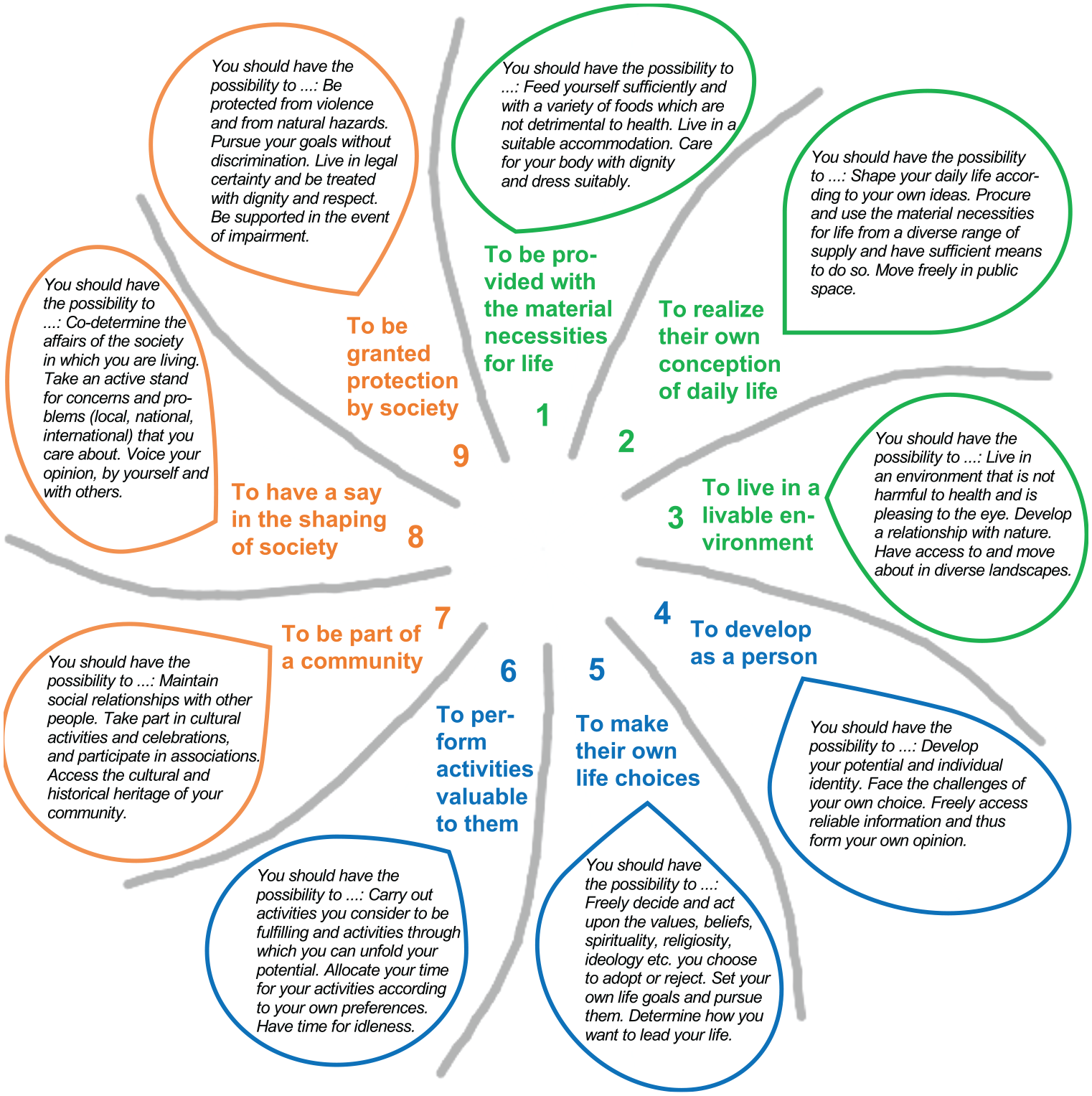
The list of Protected Needs.
In this paper, we uncover in what ways park-making provides some of the essentials for a good life for all through commons-based provisioning. But equally important, in what ways is the commoning of parks interrupted or undermined by coercive control, exclusionary property or private ownership (Sheller, 2021), that is, through uncommoning practices? If the social life of commoning is about specific patterns of de-commercialising, cooperation, sharing and relating to each other, then in highly unequal cities differentiated by the intersection of class, caste, age and gender, cooperation, care and conviviality can be undermined by individualism, social prejudice and elite capture. Thus, we adopted a critical lens to understand how social identities, power relations and economic processes mediate social practices and need satisfaction. Here we draw on post-colonial and social-constructionist critiques of park development that identify parks as spaces of social and political contestation (Arabindoo, 2011; Zimmer et al., 2017), as well as a broader critical urban orientation that recognises the prior exclusions of caste, class and gender that structure urban space and experience.
Research methods
Our qualitative data analysis draws from observations at five public parks (three in Chennai, India; two in Metro Manila, Philippines), interviews with a total of 69 park users, and two workshops (one in each city) with actors representing the public sector, non-governmental organisations, academe as well as urban planners, environmental advocates and park managers – all conducted in 2019. The parks were selected for their accessibility to a diverse mix of users with the aim of capturing the inclusion/exclusion dynamics that undergird park-making in everyday life. Accordingly, we engaged in purposeful sampling in each park to reach a diverse mix of participants in relation to age, gender and socio-economic class. In India, we did not sample by caste, though in some cases the information was volunteered. We captured diversity by visiting the parks at different times of the day and week, and by exploring different spaces in the parks – from the more visible play areas for children, to the more hidden and remote spots.
Chennai and Metro Manila have similar tropical climates, are coastal cities facing constraints in their expansion, and both have a legacy of park-making as a colonial project. In Chennai, the study was conducted in Nageshwara Rao park, a mid-size older park in the city centre, Anna Nagar Park, one of the city’s largest and most well-maintained green spaces and Perambur Park, a heavily trafficked, new park in the city’s northern suburbs. The three parks are in very different parts of the city, with distinct class and caste cultures. In Metro Manila, the study was conducted in Rizal Park, a national park in Manila, the country’s capital, and the University of the Philippines (UP) Academic Oval in Quezon City, a 2.2-km tree-lined stretch of asphalt road inside the campus of a state university. The five parks are all equipped with benches, jogging paths, picnic areas, play structures and water features.
Interviews with park users were conducted in Tamil, Tagalog and English, using a common interview guide; interviews were transcribed and translated, when necessary, into English. All qualitative data was anonymised and de-identified. The interviews were designed in three phases: first, research participants were invited to describe their activities in the park. They were then asked to read and react to a list of needs. This list was discussed and agreed to among all team members in Manila, Chennai and Switzerland; how terms were described was adapted into language that was suitable for the two research sites. The lists were also translated into Tamil and Tagalog and were printed in a visually-appealing ‘mandala’ format. We recognise that working with a list is normative, yet we needed a yardstick for assessing ‘the good life’ beyond consumerism across two different research sites. A more detailed analysis of need satisfaction in parks is provided in Sahakian and Anantharaman (2020).
In a third phase, participants were asked to share their most and least favoured aspects of the park, often through taking photos or participatory photography (see Allen, 2012). The research team coded the material based on ‘elements of practices’ and ‘human need satisfaction’, deductively and based on our conceptual framework. We then shared transcripts between research sites and engaged in ‘insider outsider’ analysis, which led to new themes emerging inductively. In late 2019, stakeholder interviews and workshops also took place in both Metro Manila and Chennai, with environmental organisations, governmental officials, academic researchers and urban planners involved in park planning and maintenance. The goal was to share findings on how parks satisfy human needs and uncover tensions and opportunities for park planning in Chennai and Metro Manila.
We now turn to the types of practices that people perform in parks in relation to need satisfaction. We identify loitering and non-commercialised pleasure and informal work and subsistence economies as instances of commoning, and anti-poor park-making, and elite capture as instances of uncommoning.
Commoning in parks: Socially-shared spaces meeting needs
Loitering and non-commercialised pleasure
Anna Nagar Park in Chennai is buzzing with people at almost all times of the day in the cooler winter months. In the evening, the atmosphere is electric and jubilant, with groups of children learning how to roller skate, exercise walkers determinedly making laps through the park, and every bench occupied by small groups of men and women of diverse ages and classes. For two young men, coming to the park every evening was a way of gaining some relief from life’s pressures:
we sit at the playground watching kids play and learn skating. Watching them relieves me of my own worries. When I am in the room (boarding house for students), I am worried about not being able to find a job or pass the exam. Here, all that goes away watching the kids fall down and get up.
They hail from small towns and are from non-dominant caste backgrounds. Three young women, sitting in a lawn area, have just finished bachelor degrees from a government college and are now earning lower-middle-class income as administrative workers in a local company. ‘Here, we can be happy and pass the time. If ten of us sat and talked at home, the parents would kick us out. Here we can talk freely’. The trees and shade make the park more comfortable, but they are also a place for young people to hide away: ‘We come to see the lovers’, one of them says, giggling. As we chat, they share more about what this space means to them and what needs it satisfies. ‘Coming here with friends, celebrating birthdays, cake cutting. Good memories’, one says nostalgically.
For most of our young interviewees, in both Chennai and Metro Manila, especially those from lower-middle class or rural backgrounds, the most valuable part of coming to the park was the opportunity to take a pause, and to think and behave in ways less encumbered by social expectation, such as proper gendered behaviour. Going to the park allows women and young people to develop their potential as individuals and to voice their opinion on the society in which they live, to talk openly and freely with friends and certain family members, carrying out discussions on intimate or controversial matters: in Chennai, ‘Nobody judges about what we talk here’, ‘We can talk about things here we cannot talk about at home’. Certain activities taking place in parks give people the sense of being part of a community, as a human need. As a young male biker in Metro Manila put it:
It’s nice to meet up with other bikers in the park. Even if we don’t know each other, we acknowledge each other with a nod or a wave. Bikers are also ready to help other bikers, for example, with a flat tire.
Another young man in Metro Manila summed up the benefits of parks: ‘to watch people, interact with them allows you to be part of a group even if you don’t know them. There are sudden interactions with people, you start playing with them’. A 25-year-old man in Rizal Park explained that ‘even if I go here alone, I feel like I’m still part of a community. I don’t feel alone ‘cause there are lots of people, even if they come from different backgrounds’. This sense of freedom from scrutiny or judgement was particularly acute for women respondents, for whom home was a space of patriarchal control over thoughts and ideas, and parks were spaces where they were relatively free of surveillance.
For middle-aged women, the park also offered a break from household chores. As one 55-year-old middle-class woman in Chennai, who met her five friends and her 80-year-old mother in the park every week put it, ‘Women are always at home, with kids, doing housework, cooking, cleaning, and all that. So, coming to the park is an outlet. An opportunity to be free. It helps me sleep well at night’. Whether for social gatherings, being alone, for recreational activities or for doing nothing at all, the park allows people to experience a sense of freedom and peace that they do not achieve elsewhere. In these congested cities, the park is a space in stark contrast to busy, noisy, hot and polluted streets, which lack natural shading, and is more accessible to more people than ‘green’ private spaces, such as the leafy gated communities of the elites. Importantly, the sense of peace and freedom was something experienced by women across class and age differences, and who came to the park for different reasons. A 33-year-old wife of an auto-rickshaw driver in Chennai spent every Saturday at Anna Nagar Park with her seven-year-old child. Contrary to their tenement in the outskirts of the city, her child could play freely in the park, and they could take advantage of the toilets and water fountains, and benches for rest. Similarly, coming to the park for a young woman in Metro Manila was a way of giving her child freedom to play without judgement, something that enabled her to relax as well.
As Phadke et al. (2011) assert in their treatise ‘Why loiter’, pleasure seeking in public holds the possibility of not just expanding women’s access to public space but also of transforming women’s relationship with the city and re-envisioning citizenship in more inclusive terms by undoing public space hierarchies. Furthermore, ‘the possibility of a pleasure that does not cost anything and at the same time brings the “undesirables” out into the streets making them visible threatens to undermine established notions of urban social order’ (Phadke et al., 2011: 186). Loitering, in this sense, is an exercise of freedom and of mutuality, both key aspects of commoning (Helfrich and Bollier, 2015). Parks offer the possibility of pleasure, irrespective of ability to pay, and when women in particular, claim public space as a space to just be, they challenge gender norms and necessitate spaces that are well-equipped to meet their needs. Loitering is thus facilitated by acts of provisioning (c.f. Helfrich and Bollier, 2015) some of which are accomplished by park-planning and design practices that provide access to lighting, toilets, benches and lawn areas.
The empirical material presented above highlights how the park as a space of pleasure-seeking is in stark contrast with the many commercial centres that have emerged in both contexts – since the 1930s in Metro Manila, and since 1990s in Chennai. These commercial centres masquerade as public spaces while only being accessible to some social groups and while the range of activities available do not serve a wide range of social needs, but only those which are directly related to economic growth and a consumerist logic. In both sites, park users invoked going to the park not only as less cost-prohibitive than going to the shopping mall, but also as less restrictive. People claim to feel less controlled in their bodily movements and voice. In Rizal Park, a grandmother, who had brought her grandchild to the park, explained: ‘There are no prohibitions here. Unlike in the mall’. She goes on to say, ‘All the games and toys in the mall require fees so the mother and daughter rarely go’. Precariously employed and college-going youth came to celebrate birthdays or other life events. One 26-year-old man commented ‘here we do not have to pay money to sit’. Trees offered shade and benches provided a place for them to meet and talk to friends or pass the time, free of cost. Older men and women had regular groups that they met with in the park on a daily or weekly basis. A young mother in Metro Manila likewise observed: ‘[I]n places like the Mall of Asia … although there are other forms of entertainment, you are still limited. In malls, they seem to be watching you; that’s why they prevent you from doing stuff’. A young Filipino remarked:
In malls, if you don’t carry something with you when you leave, you feel like something is lacking. I feel like you’re there to purchase. Compared to the feeling after I come from the park, I feel more fulfilled and there is no pressure to buy.
For another young man, ‘malls are stressful, noisy, and crowded; people don’t feel pressured to spend money while in the park, the amenities are for free’.
Informal work and subsistence economies
The unequal access of different social groups to public spaces and spaces of leisure and socialisation is well documented (Baviskar, 2018; Parikh, 2021). But one social group that is systematically excluded and marginalised in urban planning are informal workers. Dominant planning and development logics view informal work as inefficient and as a nuisance for public spaces, while at the same time increased unemployment rates, jobless growth, enduring poverty and the rise of the ‘gig economy’ force more people to make a living through informal work (Tucker and Anantharaman, 2020). Park planning practices have historically and contemporarily not contended with this reality, instead criminalising street vending and other forms of informal work on sidewalks and in parks. For instance, in Metro Manila, Rizal Park and the UP Academic Oval are part of the 1905 Burnham Plan for Manila City (following the concepts of the then popular City Beautiful Movement) and the 1949 Frost-Arellano Plan for Quezon City (with the Garden City Movement in mind), respectively. In both urban plans, public green spaces were seen as tools for the socialisation of the poor as they mingle with the elite in these spaces (in the case of the Burnham Plan) and for the leisure of the working class (in the case of Frost-Arellano Plan). However, the ‘poor’ in the Burnham Plan and Frost-Arellano Plan referred to waged workers and not informal settlers (Saloma and Akpedonu, 2022), many of whom now use the park to earn a living or have a safe space to stay. With intermittent ‘sidewalk clearing’ campaigns in the city evicting vendors and the homeless, these groups are even more reliant on parks, just as park administrators control their entry into parks that are putatively supposed to be for everyone.
However, we observed several examples of informal work being accommodated in park spaces through tacit approval from both officials and other park users, which we interpret here as instances of commoning because they challenge the officially-sanctioned uses of public space. Instead they reflect instances of commons-based provisioning of livelihoods criminalised by spatial ordering schemes emerging from neoliberal urban agendas. Parks provide physical spaces for vendors to earn a living and keep them relatively safe from practices of sidewalk clearance. Vendors are occasionally recognised for their ability to add to the park-using experience, by offering access to the consumption of food, drink and souvenirs, as discussed in our workshops. An urban planner in Metro Manila explained the symbiotic relationship between park users and vendors in these words:
It’s just really good if at the beginning of a park-development project, we already fixed how to integrate vendors … We would not be attracting as many people or have people stay for as long if we didn’t have street vendors.
An implementer of a government programme that develops public open spaces in the Philippines’ 145 cities likewise pointed this out about street vending: ‘One of the discussion points with local government units is how to manage the street vendors because they are part of the city as well. They give vibrancy and fulfil the basic human needs’.
Unfortunately, government programmes and park administration do not systematically include vendors as part of the park-making process. And in practice, what and where vendors are allowed to sell in parks is also contested. As a 36-year-old female vendor in Rizal Park admitted: ‘it is not allowed to sell in the park, but it is not clear if there is a permit required’. She revealed that because of tensions between vendors and the park management, vendors avoid specific areas where the park director passes. An elderly female vendor explained: ‘guards run after the children (who are) selling items. If they are caught, the goods are confiscated’. Yet, over time, she and fellow vendors made friends with some of the guards who stopped apprehending them, even though as one vendor explained: ‘They (security guards) pass by sometimes and ask for money to buy energy drinks, or to get a pack of fish crackers’. During Christmas time in Metro Manila, each vendor gave gifts to these guards. In Chennai, vendors are stationed at the entrance to the parks, selling food, drinks and balloons for children. While park rules explicitly prohibit vending within the park, ambulatory vendors can be spotted within. While by and large vendors reported that they were informally allowed to operate, sometimes guards kicked them out based on complaints from some park users. Vendors are, thus, constantly negotiating state administration and control, in an attempt to assert their legitimacy – often through small bribes towards those who represent the park-making administration. This dynamic reveals the broader patterns of precarity and negotiability that vendors are subjected to in cities (Tucker and Anantharaman, 2020).
Other types of informal work were observed in our sites. In Nageshwara Rao Park, the amphitheatre and badminton court served as a space for dance classes taught by artists who could not afford a studio space for rent. In Anna Nagar Park, a young woman was recruiting survey respondents for a job where she gets paid if she meets her quota of survey-takers for the day. The park was a well-trafficked, safe place for her to solicit respondents alone, she said. While these ways of making use of the park by precariously-employed youth and informal workers might reveal dimensions of commoning, 1 in that these ways of using park spaces challenge existing, growth-oriented notions of what public space is meant for and for whom, they are certainly an inadequate response to the failure of the state to provide stable and meaningful employment for many.
Uncommoning in parks: Anti-poor park-making and elite control
Anti-poor park-making
To present parks as modern, world-class and suitable for elite consumption, park managers control the activities of informal vendors and the unhoused, and restrict their presence, as we will now discuss. Homeless people in Rizal Park in Metro Manila must abide by regulations that include no lying down, whether on benches or on the ground, and leaving when the park closes at the end of day. They are also allowed to stay only in particular areas of the park, where they are least visible from the middle-class activity areas – such as the Rizal Monument, the park’s main attraction. Thus, while the homeless are oftentimes invisible to park users, park administrators, well-aware of the locations they are in, will exert some form of discipline on their behaviour. In Chennai, parks are locked up at night and in the middle of the day, to prevent people from staying in them overnight or for prolonged periods.
The argument for controlling the presence and practices of the poor, especially poor men, was legitimised as an issue of public safety, and particularly safety of women. Indeed, making public spaces accessible and used by women is another way in which cities try to signal their status as modern (Phadke et al., 2011). Consequently, poor men are coded as undesirable, something we witnessed both in our interview responses and in park management practices. Middle class and elite users noticed and remarked negatively upon working class men sleeping on benches. As two men, upper middle class in their twenties told us in Nageshwara Rao Park ‘look there, see, there is a drunk lying on the bench. And his beer bottles are there behind the tree. You always see this here, people drinking and sleeping. But I guess they are mostly harmless?’ In interviews in Perambur park, one man and two women (middle class, in their 50s) complained about ‘slum boys’ coming into the park through a side-gate. Our interviewees connected their presence in the park to second- or third-hand reports of theft and harassment and suggested that teenagers and young men from the slum should not be allowed to come into the park. In Anna Nagar Park, we witnessed an egregious attempt at excluding poor men from the park. An upper middle-class man in his 40s who was active in the park users’ association called security guards and physically removed a dishevelled man who approached us asking for some money. This was purportedly for our safety. While the assumed illegalities of the poor in the park were forcefully condemned or sanctioned, elite illegalities were ignored. For instance, several respondents mentioned to us that a section of Anna Nagar Park had been encroached upon by a private club, but speculated that because the club was patronised by elites, no one had dared to issue a complaint.
Classist/casteist fear of informal settlers and poor men pushed for more securitisation of park spaces through security guards, locked gates and entry/exit times, denuding the function of the park as a socially-shared and peer-governed commons. Fear and distaste for informal workers and youth had been internalised by many middle-class park users. A young man in Metro Manila, explaining the need for security guards in parks, hinted at the dangers of the ‘freely accessible’ park: ‘The campus is open to the public and there are residents who are informal settlers around the area’. Ironically, the same presence is the source of unease and insecurity for vendors in Rizal Park who, at times, see the security guards challenge their means of livelihood, as we described above.
In contrast, young women primarily identified infrastructural deficits such as insufficient lighting as contributing to lack of safety, and the presence of others as the source of safety. ‘At night, there are areas in the park that are very dark, so just be careful’, a 22-year-old woman in Metro Manila cautioned. A female graduate student said that although she feels safe in the park, she only goes there at specific times deemed to be safer. Similarly, a 21-year-old woman who comes to Rizal Park in the early evenings to exercise alone explained how she stayed in the same place that is well-frequented and well-lit. A well-trafficked, well-used and well-provisioned space provided safety amongst strangers. A 35-year-old woman visiting Anna Nagar Park by herself echoed these sentiments saying ‘I feel safe here. No one bothers me. I can spend the whole day in the fresh air and be free’.
Elderly or older respondents in both Chennai and Metro Manila also identified young people from lower economic groups as undesirable, claiming that their presence inhibited their use or enjoyment of the park. A UP professor in Metro Manila recalled: When I was still doing tai chi, there was a group of young people playing volleyball and were very noisy. We told them to move a bit and their response was: ‘Why? Does UP (University of the Philippines) belong to you?’ … Here, there are people who are not what are considered to be ‘UP-type’ people. The jumping jologs (a term used to describe a tawdry person who belongs to the lower class). They will steal something from you.
A law enacted in 1992 in the Philippines granted benefits to individuals aged 60 and above, including especially marked spaces for ‘senior citizens’ in parks. The elderly across classes enjoy public parks as a common resource for rest and recreation because of this regulatory environment, in contrast to younger people, especially from low-income groups, who are seen as engaging in activities deemed as unacceptable to the older generation such as creating noise and engaging in public displays of affection. A 36-year-old runner described the ‘un-desirable’ in the UP Academic Oval as ‘people who hang out to drink alcohol, from the informal communities. There are young boys, like a group with BMX bikes. They appear early in the evening and do dangerous manoeuvres’.
These comments reflect key ‘social dilemmas’ (cf. Hess, 2009) in the use and governance of commons, pitting elderly users against youth, or women against poor men. However, as we will discuss below, the overall under-investment in the development of public goods and the ways in which parks are taken over by elites are other underlying reasons for these tensions, beyond class/caste prejudice. When parks are (seen as) scarce and are inadequately provisioned with basic infrastructure, they become more of a contested resource as opposed to a socially-shared space.
Elite capture and status consumption
Idealised commons are about shared stewardship and not ownership, where access and use by some should not denude for others. However, in both Metro Manila and Chennai, commoning practices challenging growth and private ownership are undermined by the overall underinvestment in public goods that makes parks more susceptible to elite capture. As Harvey (2012) points out, the steady provision of public goods is a necessary precondition for these publics being appropriated as commons by people through their actions. When the public sphere shrinks, there are fewer possibilities to realise commons. Moreover, contemporary codes of making and managing ‘nature’ in cities disadvantage working-class and other marginalised groups (Baviskar, 2018). Codes of aesthetic governmentality secure the few remaining public spaces for an elite few (Ghertner, 2015). As 21st-century cities increasingly embrace an urban sustainability and green growth agenda, parks are often developed to attract investment and propertied consumers (Anguelovski et al., 2018), and in turn are reserved for these elite groups. Park development is coherent with an agenda to render cities ‘world-class’. This is visible in how park designers prioritise aesthetics over functionality, invest in the development of ‘show-piece’ parks and prohibit certain people and activities from parks to project parks as friendly-spaces for bourgeois consumption. When the image of parks is maintained by prohibiting certain activities and people, their function as socially-shared commons is undermined. These park-making functions dismantle the parks as commons, that is, are uncommoning practices.
In both Metro Manila and Chennai, enhancing park quantity and quality is a low priority for the municipality. Instead, parks have been commandeered for other purposes, such as for the metro or to provide parking facilities, as was the case in the Shenoy Nagar neighbourhood (Chennai) in 2019. As both cities expand, the state has ceased developing and maintaining public parks. Our interview with the Parks Superintendent in Chennai indicated that the cash-strapped municipal government has few internal resources devoted to park planning, design and maintenance, outsourcing these tasks to private contractors. A planner in Chennai remarked that the city tends to invest in developing spectacular, ‘show-piece parks that look like a painting’, using ‘world-class’ materials like polished concrete (which become treacherously slippery in the monsoon season!). These parks were often developed in upper-caste, wealthy neighbourhoods or neighbourhoods frequented by foreigners and expatriates. Yet, many public park users in Metro Manila comment that ‘no rich people come here. They don’t like public places’, despite being privileged in the planning of parks. Meanwhile, the municipality allows smaller green spaces in working class neighbourhoods (which are used by less mobile populations such as the poor, children and women) to languish from neglect. Our visual observations confirmed that several parks in the northern, industrial parts of Chennai were in disrepair, while parks in the wealthier, upper-caste dominated Southern parts of the city appeared better maintained. Wealthier neighbourhoods have powerful and well-organised Resident’s Welfare Associations (RWAs) that lobby their local representatives and municipal functionaries to upkeep their facilities.
Sometimes parks are public only in name. During our stakeholder workshops, civil society actors cautioned that new parks designated in the periphery of Chennai are sometimes handed over to Resident Welfare Associations or private companies for maintenance due to budget shortages. The state asks private developers to allocate some green space within gated communities to comply with master planning rules. Private developers and elite RWAs render parks as securitised spaces with opening and closing times and a guard posted at the entrance. Such securitisation dissuades full participation from non-elites in the use of parks, not to mention more active involvement in planning and design. When private actors take over governing public space, they can impose their class/caste-based preferences on the park and exclude other groups. Our interviews with key activists in the city revealed that some RWAs have tried to bar Dalit, non-Brahmin and working-class communities, including domestic helpers who work in middle class homes, from using parks. These blatant expressions of casteism and classism are antithetical to the commoning of parks (Gidwani and Baviskar, 2011). Importantly, it is the absence of state investment in development of green public spaces that makes them more susceptible to elite capture and to a ‘quasi-privatisation’, reducing access for the very groups who benefit from parks the most, while also reproducing caste and class-based oppression in the city. In summary, our findings seem to suggest that the least privileged groups who seem to need the park the most are also those who have the least control over park-planning, design and governance.
The everyday imperial mode of living (which emphasises growth, private property and status consumption) is also noticeable in how upper middle class and well-to-do people use parks. These groups engage in leisure activities with consumer goods, which are a form of social distinction through self-care. Well-to-do families in Chennai will drive to the best-maintained parks in private automobiles for daily exercise. Branded running shoes and workout gear, mountain bikes and helmets, roller blades and knee pads, are just some of the consumer goods that serve as class markers in parks. In Metro Manila, a middle-class activity includes birdwatching, oftentimes with expensive equipment for viewing and photographing at a distance. Pets are also a form of class distinction, depending on their pedigree and grooming. A mother in her 40s who was visiting Rizal Park with her children said: ‘We like it that we can bring the dog. The dog is always inside the house. Here, the dog can relax’. In Metro Manila, there is also tension between the UP Academic Oval Park functioning as a passageway for a form of public transport called the jeepney (a privately-operated mass transit running on second-hand diesel engines from Japan and which is used by a huge part of the population who cannot afford to buy their own cars or ride taxis) and the wellbeing of park users and the park itself. As a male jogger observes: ‘(The jeepneys) are smoke belching. There is a short portion where runners, joggers run side by side with jeepneys …. I do not like that smell when I run’. The manager of the UP Academic Oval explained: A park demands to be taken care of. Looking after the UP Academic Oval is an effort to maintain access without sacrificing environmental quality. This would involve prioritising infrastructure such as walkways, bike trails, rather than parking lots and roads.
Often, upkeeping the quality of the park sometimes means limiting practices associated with low-income groups such as taking a jeepney to get from one place to another while supporting middle-class leisurely pursuits such as bike trails. Yet limiting automobile access is also important to maintain the ecological integrity of green spaces. These tensions between ecological and social goals and the needs of diverse social goals are exacerbated by a consistent underinvestment in public provisioning of wellbeing.
Conclusion
Park-making as a social and spatial practice in the cities of Chennai and Metro Manila reveals the different ways in which park practices challenge dominant growth logics. These practices involve forms of ‘commoning’ towards enhancing prefigurative ways of organising social life in the city based upon values of conviviality, care and sharing, as opposed to consumerism. The many ways in which green public spaces satisfy human needs in cities is one way of valuing them as commons, including a sense of feeling part of a community, or having contact with nature. Loitering was valued by most women in our study, with the park a unique space for engaging in a non-productive activity. Yet not all people can satisfy their needs in all ways: young men from poorer backgrounds were seen as engaging in the least desirable activities in the parks, even when doing nothing at all. This relates to the ‘uncommoning’ of parks: anti-poor ideologies are salient in both Chennai and Metro Manila, targeting both informal workers and lower-class young men, and the intersections between these groups. Park-making also coincides with growth prerogatives in different ways: for example, in how elite interests dictate what activities are desirable or not. More visible on a quotidian basis are the many ways in which status consumption permeates into park spaces, through markers of the middle and upper classes, such as expensive sports gear for running and biking.
Our study contributes to work on spatialising degrowth in cities in three ways. First, it brings forward the relevance of ‘need satisfaction’ as one way of evaluating urban development beyond growth logics. In such an evaluation, a consideration of social location and positionality is essential – gender, age and class shape how people practice parks. Second, we reveal the significance of systems of provision (how parks are planned for and maintained) that facilitate some forms of ‘park-making’ over others, in turn resulting in commoning or uncommoning. In many instances, the provisioning of parks is under the tutelage of elite interests. Finally, our study reiterates the importance of studying everyday life dynamics in spatialising degrowth. While degrowth scholarship has charted transformative visions for future change and evaluated intentional and small-scale community initiatives such as co-housing or urban gardening as potential degrowth pathways, less attention has been paid to everyday dynamics of inclusion and exclusion in the Global South’s cities. Our search for the quotidian and vernacular instances of commoning in such cities is an attempt to advance this conversation.
In addition, our study shows that while parks satisfy needs for a diverse range of people, the ways parks are practiced are fundamentally influenced by the prior exclusions of the city, in terms of access to work, shelter and mobility. Can park-making as commoning address these broader exclusions? Our study shows that certain human needs which are considered important by park users across classes and social groups are not satisfactorily met. Thus, we conclude our paper with some policy recommendations which, if enacted, can begin to recoup the role of experts and professionals such as park designers and planners in supporting commons-based provisioning.
The first recommendation is for park planners to design parks with diverse uses and users in mind, and prioritise functionality over aesthetics. Meeting the basic need for sustenance, for example, demands operational water fountains and clean toilets. Planners could also consider ways to support livelihood and food provisioning practices in parks, through the development of urban vegetable gardens for example. While such gardens are not devoid of middle-class vested interests, they provide opportunities for people to plant and grow their own food – particularly in cities such as Metro Manila and Chennai, where working-class labourers hail from the more rural provinces. Parks could also become spaces where diverse people might access nutritional programmes, language skills, professional training, second-hand clothing swaps or showers and bathing opportunities, among the many ways that the human needs for being part of a community, developing as a person or accessing material necessities might be satisfied. Offering such services without vexing middle-class sensitivities around park making as essentially associated with leisure and aesthetics would require both challenging these hegemonic interests, as well as setting aside more urban space for public and commons purposes, and thus limiting the privatisation of urban space. While these recommendations might sound trivial and marginal compared to the scale of the challenge, we speculate that they open scope for radical incrementalism (Lawhon et al., 2014) – the more ways in which park-making supports parks functioning as socially-shared spaces that meet people’s needs, the less people depend on privatised consumerism. It also expands the spheres and strengthens the practices of care, conviviality and sharing in the city, prefiguring alternatives to the ‘imperial mode of living’.
This study also indicates the need for further research, for example, in uncovering the many planning practices that can promote degrowth upstream from park activities, including urban development, budget allocations or tourism. Our study took park activities as a starting point: more meta or macro analysis would have yielded a different understanding of power, and how it is diffused at different scales. In cities such as Metro Manila and Chennai, how can people who are most often excluded from park-making have a voice in how parks are planned, maintained and governed, to meet their needs? And can the scaling-up of such practices have a significant effect in prompting degrowth? Critical participatory action research could be useful, towards engaging diverse groups of people in park-making, rather than the current configuration favouring middle-class and elite interest groups. Further research might also seek out those who do not frequent public parks, to further understand dynamics of exclusion.
Protecting the ability for diverse groups of people to satisfy their needs through going to the park, as a practice, is essential in the cities of South and Southeast Asia. Such an effort would require explicit institutional arrangements that consider the diverse needs of park users and that protect against elite capture. And yet parks cannot be a panacea to all the ailments in Asian cities: they remain islands for commoning in a vast sea of growth logics.
Footnotes
Acknowledgements
We would like to thank the research team in Chennai, including Sumana Narayanan and Poornima Chandran, and in Metro Manila, including Cherie Audrey Alfiler and Abigail Marie Favis. We also thank the special issue editors and reviewers, and all of the participants who agreed to be interviewed for our study. We are grateful to the Institute of Sociological Research for supporting Manisha Anantharaman’s stay at the University of Geneva as part of the Alba Viotto Visiting Professorship.
Funding
The author(s) disclosed receipt of the following financial support for the research, authorship, and/or publication of this article: This article draws from a research project funded by the Swiss Network for International Studies, co-coordinated by Marlyne Sahakian and Antonietta Di Giulio. The authors disclosed receipt of financial support from the SNIS for the research on which this paper is based.
