




Abstract
This paper reflects on the progress made in climate change adaptation in the city of Durban since the launch of the Municipal Climate Protection Programme in 2004. This includes the initial difficulties in getting the attention of key sectors within municipal government, and how this was addressed and also served by the more detailed understanding of the range of adaptation options and their cost-benefits. There is also a better understanding of the potentials and constraints on community-based adaptation and the opposition from some landowners to measures to protect and enhance ecosystem services. The paper ends with lessons learnt that contradict some common assumptions – for instance, what approaches best build support for climate change adaptation within local governments, what measures work and from where lessons can be drawn. It also describes the perhaps unexpected linkages between local action and international influence and highlights the need for international climate change negotiations to recognize the key roles of urban governments in developing locally rooted adaptation and resilience.
Keywords
I. Introduction
In many ways, the city of Durban in South Africa typifies the many small- to medium-sized cities around the world that are likely to be significantly impacted by climate change. These cities are caught in a “perfect storm” of population growth,(1) escalating adaptation needs and substantial development deficits created by a shortage of human and financial resources, increasing levels of informality, poor governance, environmental degradation, biodiversity loss, poverty and growing inequality. In South Africa, these challenges have been further exacerbated by a legacy of formalized racial division that has created widespread environmental injustice, inequity and exclusion. In the case of Durban, this has manifested itself in an urban spatial form that matches “… ideal apartheid planning nearly perfectly”(2) and perpetuates a system where the poorest and most vulnerable live far from jobs and services, often in compromised environmental conditions. This nexus of human need and environmental risk continues to pose a significant challenge to post-apartheid city planners charged with achieving equity and sustainability for all. Recognizing this systemic vulnerability, Durban’s Municipal Climate Protection Programme has prioritized the need to tackle the challenge of climate risk within the context of poverty, escalating urbanization and deteriorating environmental conditions, and has become a national and international leader in the field of climate change adaptation planning and implementation.
II. Location and key Characteristics
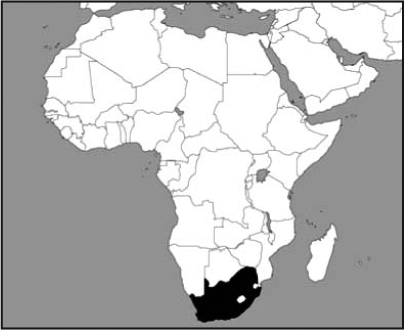
The city of Durban is situated in the province of KwaZulu–Natal in South Africa (Figure 1) and is the location of the largest port on the east coast of Africa. The city limits are synonymous with the boundaries of the eThekwini municipal area and eThekwini Municipality is the local government responsible for planning and managing the city. The municipal area covers 2,297 square kilometres, of which approximately two-thirds is rural or semi-rural in nature.(3) Significantly, the city is also located in the middle of the Maputo-Pondoland-Albany global biodiversity hotspot – one of 34 hotspots worldwide. These internationally significant areas are characterized by high levels of species endemism and habitat loss.
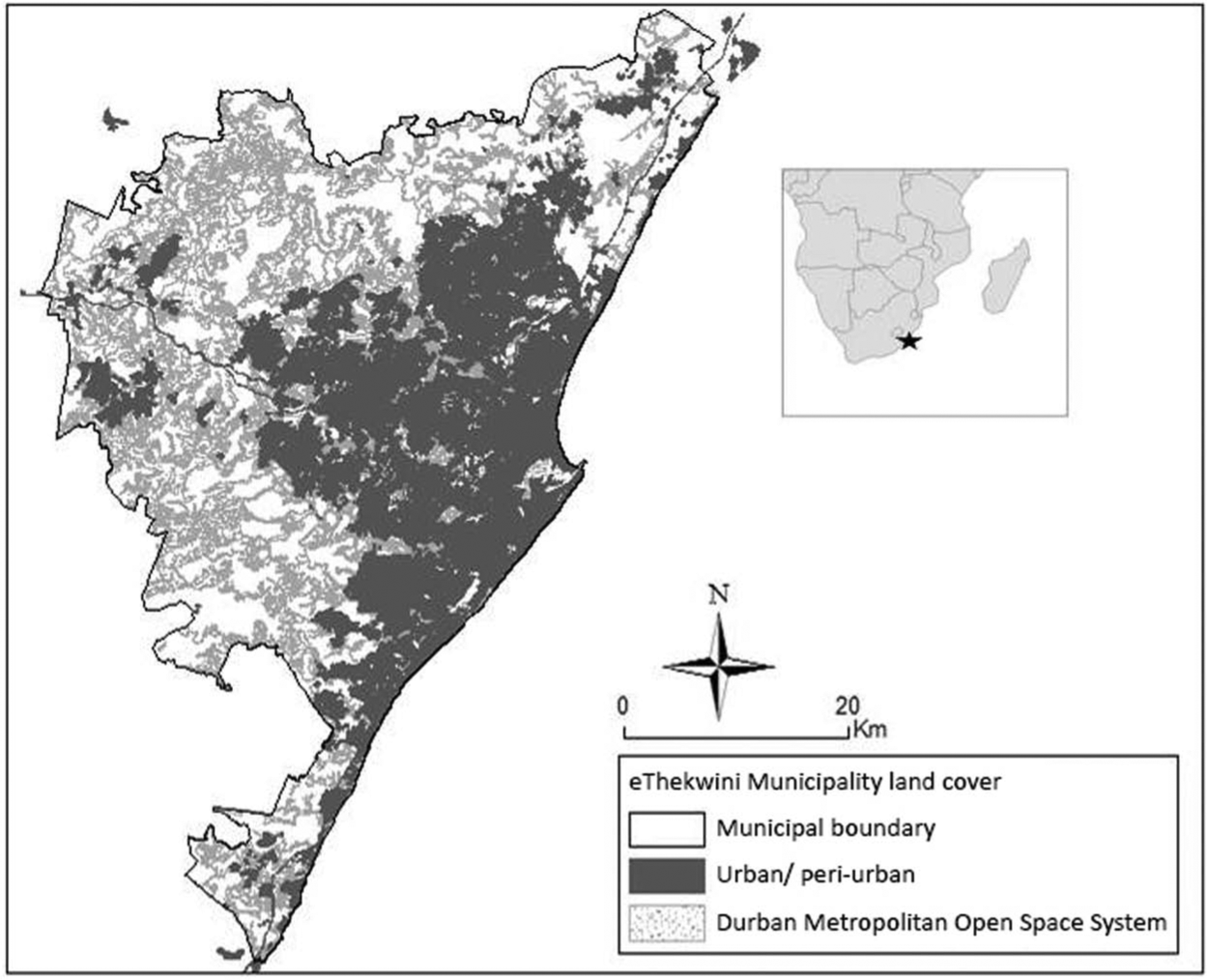
Southern Africa (inset) indicating the location of ethekwini Municipality (main) with urban/peri-urban areas and the Durban Metropolitan open Space System (D’moss)
Although situated south of the tropic of Capricorn, Durban has a sub-tropical climate with hot, wet summers and mild, dry winters. This is due to the moderating influence of the Agulhas Current that flows pole-wards along the edge of the narrow continental shelf adjacent to the municipal coastline, which is approximately 100 kilometres long. The warm current keeps winter temperatures very mild, with daytime average temperatures a minimum of 11°C, and summers warm and very humid, with a maximum average of 28°C (South African Weather Service). The rainy season usually extends from September to March, with a mean annual precipitation in excess of 1,000 millimetres.(4) Durban and its suburbs are hilly, with very few flat areas, except for locations in and around the central business district and the harbour. The western suburbs reach an altitude of up to 850 metres.
III. Development Profile and Deficits
a. Population
Durban has a population of approximately 3.5 million, which represents an increase of 660,000 since the 2001 census.(5) The majority of the city’s residents are African (71 per cent) followed by Indian (19 per cent), White (eight per cent) and Coloured (two per cent) communities. These percentages are important, as challenges such as poverty and unemployment are associated predominantly with the African group and this has implications for the adaptive capacity of the city as a whole. Currently, Durban is South Africa’s poorest metropolitan area,(6) a fact reflected in figures for 2009, which showed that 41.8 per cent of Durban’s residents experienced conditions associated with poverty. This translated into a Gini Coefficient of income inequality of 0.62 in 2010.(7) Durban is also a city plagued by stubbornly high levels of unemployment. In 2009, the employment rate was approximately 74 per cent, but this included both the formal and informal sectors.(8) In 2010–2011, the municipal Quality of Life Survey(9) indicated that 64 per cent of households surveyed earned less than US$ 440(10) per month. The future prognosis is also bleak given that only 25 per cent of respondents had completed secondary school and 11 per cent had tertiary education, while 10 per cent had no education at all.(11)
The 2010–2011 Quality of Life Survey further indicated that Durban, like much of southern Africa, has a high HIV infection rate with a prevalence of 40.3 per cent among pregnant women,(12) while less than 20 per cent of Durban’s population has medical aid.(13) In summary, the most serious day-to-day problems reported by residents of Durban in the 2010–2011 Quality of Life Survey included poverty (21 per cent), unemployment (17 per cent), crime (eight per cent), transport (six per cent) and health (six per cent).(14)
b. Extent of infrastructure, service provision and housing quality
Durban’s residents live in both formal and informal settlement types, with varying levels of service provision, infrastructure and housing. The 2010–2011 Quality of Life Survey indicated an average household size of 3.7 people,(15) with 40 per cent of respondents expressing some level of dissatisfaction with their housing. Although eThekwini Municipality has delivered 90,000 houses over the past decade, there is still a backlog of approximately 406,611 units.(16) This could take up to 28 years to address based on current funding/service delivery levels.
In South Africa, delivery of household utilities such as water, refuse removal and electricity is the responsibility of local government. Over the past five years, the municipality has made substantial progress in this regard, but a great deal more still needs to be done to eradicate the backlogs (Table 1). Electricity is available to 75 per cent of the city’s residents, potable water (within 200 metres of dwellings) to 91 per cent, sanitation (at least ventilated improved pit latrine service) to 75 per cent and waste collection (once a week) has increased to 100 per cent.(17) The municipality has pioneered the provision of free basic services to the most needy by providing nine kilolitres of water to more than 300,000 households, 65 Kilowatt hours to 70,000 households, property rates exemptions to more than 200,000 households and more than 6,000 community gardens.(18)
Summary of current service delivery backlogs in ethekwini Municipality (2011–2012)
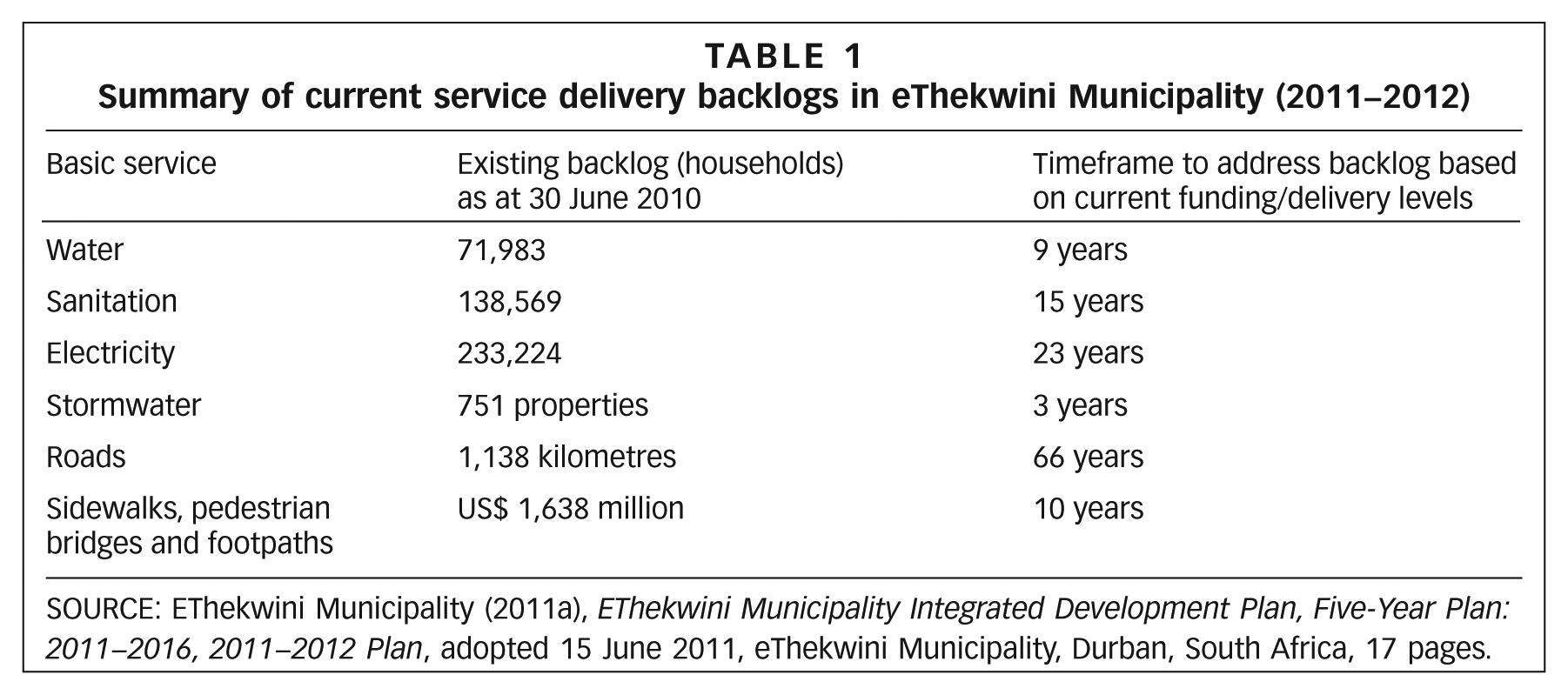
Source: EThekwini Municipality (2011a), EThekwini Municipality Integrated Development Plan, Five-Year Plan: 2011–2016, 2011–2012 Plan, adopted 15 June 2011, eThekwini Municipality, Durban, South Africa, 17 pages.
c. Loss of ecosystems
It is acknowledged by eThekwini Municipality that the city’s natural ecosystems provide a critical supply of free ecosystem services that are essential to ensuring Durban’s long-term sustainability and meeting the basic needs of the poor and vulnerable. The free ecosystem services provided by the city’s open space system were valued at US$ 387.5 million per annum in 2003, when the system was substantially smaller than it is today.(19) This “bio-infrastructure”(20) is also seen as a critical climate change adaptation tool. An important consideration in this regard is the future of the city’s large rural areas, where poor, traditional communities are directly dependent upon ecosystem services and are consequently most at risk from the impacts of climate change.
Recent work on the development of a systematic conservation plan has, however, revealed that the city’s ecosystems are under serious threat. Every terrestrial habitat has undergone significant levels of transformation and requires some level of protection if a representative and persistent example of the city’s biodiversity is to survive. Quantitative targets set for the protection of different vegetation types have already been exceeded for four of these. This level of transformation will greatly hinder any attempt to utilize ecosystem-based adaptation as a key climate change response tool and is particularly problematic in the African context where ecosystem-based adaptation is likely to offer one of the most flexible, cost-effective and sustainable approaches to climate change adaptation.
IV. Existing and Future Climate Challenges
Current projections suggest that under climate change conditions, temperatures in Durban are likely to increase by 1.5°C–2.5°C by 2065 and by 3°C–5°C by 2100.(21) Projected annual rainfall changes are likely to include an increase in aggregated rainfall by 2065, with an increase of up to 500 millimetres by 2100. This is likely to manifest itself as an increase in extreme rainfall events and stream flow intensity across the municipal area, with prolonged dry spells between rainfall events. There is likely to be an increase (from 30 per cent to a potential doubling) of rainfall variability between the middle and the end of the century. Sea level rise along the municipality’s coastline is already 2.7 centimetres per decade and may accelerate in the future.(22) The likely impacts of these changes include an increase in both rapid and slow onset disasters due to:(23)
an increase in frequency and intensity of extreme weather events (floods, storms etc.), causing increased infrastructural damage and affecting human well-being and safety as well as insurance costs;
a decrease in water availability due to changed rainfall patterns and increased evaporation, which will affect subsistence dryland farmers the most;
an increase in the erosive capacity of river courses, resulting in the loss of more top soil, a decrease in the agricultural value of land and an increase in dam siltation;
an increase in erosion of coastal areas due to sea level rise;
higher energy consumption due to increased residential cooling needs;
an increase in economic losses due to property damage and decreased tourism revenue;
an increase in heat-related vector-borne (e.g. malaria) and water-borne (e.g. cholera) illnesses;
an increase in heat stress, leading to dehydration, particularly for children and the elderly;
changes in the geographical distribution of plants and animals, resulting in the extinction of species that are unable to move and an increase in the prevalence of invasive alien species. This will negatively affect biodiversity and the associated ecosystem services;
a potential reduction in yield of staple food crops such as maize and changes in optimal planting and harvesting dates, as well as the need to increase the use of irrigation;
an increase in respiratory problems due to a decrease in air quality (e.g. changes in the concentration and distribution of near-surface ozone) and increased dampness; and
a deterioration of foods, leading to increased incidents of food-borne diseases.
Past extreme climatic events, although not directly attributable to climate change, give an indication of the level of future risk faced by the city given that the frequency of these events is likely to increase under a changed climate. During 2007, the east coast of South Africa experienced a severe storm that was the result of a combination of a cut-off low pressure system preceded by a series of tropical storms. The onshore-directed winds created swells of up to 10 metres that coincided with the Equinox period in March, also coincident with the year’s highest tides and an 18-year maximum in the sun’s gravitational pull on the earth (highest astronomical tide). The resulting damage was extensive along the east coast of South Africa, and in eThekwini Municipality amounted to almost US$ 12.5 million.(24)
Although large-scale disasters are a critical consideration, a look at smaller incidents that affected at least 100 people, recorded between 2009 and 2012 by the municipal Disaster Management Unit, shows how frequently “small-scale disasters” occur within the municipality.(25) The two most commonly occurring incident types are storm damage (due to frequent and intense storm events) and fire (due to the need to keep homes warm), and these broadly coincide with the summer and winter seasons, respectively. It is apparent that the overwhelming majority of these incidents occur within informal or low-income and vulnerable communities.
In summary, although Durban has achieved a great deal from a development point of view since the advent of democracy in 1994, substantial human need and poverty still exist, and environmental transformation and change continue to escalate. As a result, the existing adaptive capacity of the city is low and will need to be substantially enhanced. Key challenges in this regard include the following:
short-term political and development needs overriding long-term concerns such as sustainability and adaptability;
the lack of finances and suitably skilled human resources to undertake adaptation planning and implementation;
ineffective links between government and community structures that prevent an adequate assessment and response to community level risk;
an economic development model that is locked into a standard manufacturing paradigm rather than transitioning to a more adaptable green economy;
lack of political will and understanding of the critical relationship between climate change and biodiversity issues;
the impact of the global recession embedding the business-as-usual model of urban planning and management rather than favouring flexibility and innovation;
decreasing opportunities for ecosystem-based adaptation due to extensive transformation of natural habitat; and
lack of a legal mandate for climate protection planning and action at the local level.
All of these challenges will need to be addressed if Durban is to forge a new, sustainable, Africa-appropriate development path.
V. Development of Climate Change Adaptation Initiatives
Ethekwini Municipality responded to the complex climate challenges highlighted above through the initiation and development of a citywide Municipal Climate Protection Programme in 2004.(26) This programme is characterized by a strong and early focus on adaptation (see Phase 2 in Figure 2) that sets it apart from the mitigation focus of many other cities.(27) Although the climate protection work of the municipality has focused predominantly on adaptation, the establishment of the Energy Office in 2008 provided the opportunity to initiate a supporting mitigation work stream in 2011 (Figure 2).
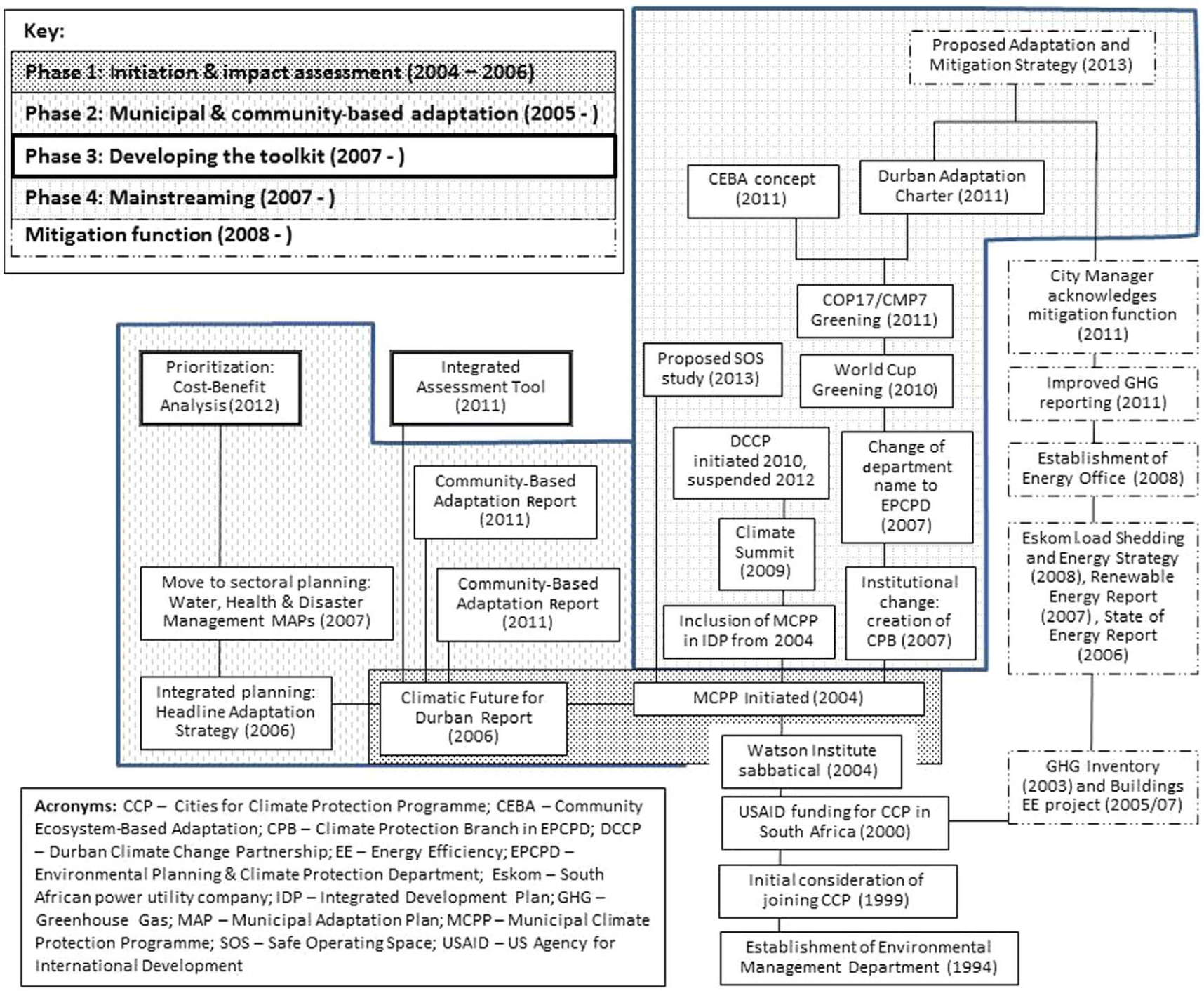
Development of the Municipal Climate Protection Programme (the key indicates the phasing of the work and related timelines)
Despite early contact with ICLEI–Local Government for Sustainability’s(28) Cities for Climate Protection Programme, the key catalyst for the mainstreaming of climate change concerns in Durban was the participation of the Head of the (then) Environmental Management Department (later renamed the Environmental Planning and Climate Protection Department) in an advanced international environmental management programme in 2004. This provided an opportunity for an in-depth engagement with the science of climate change, and was a critical factor in the subsequent initiation of the Municipal Climate Protection Programme by creating a local level activist for change. This underscores the importance of capacity-building in institutionalizing complex environmental issues such as climate change at the local government level.(29)
The development of the programme since 2004 has been phased and opportunistic in nature both in response to the newness of the field and to the lack of suitable precedents to guide action. A phased approach has ensured that the experience and knowledge gained through early intervention can be used to shape and refine subsequent actions and thinking; while the opportunism has been a by-product of the limited interest, leadership, institutional support and resources available for climate protection planning in the city.
Following the initial climate change impact analysis undertaken at the start of the Municipal Climate Protection Programme, the work plan was extended through the development of an adaptation work stream in 2006. This is made up of several separate components:
municipal adaptation (i.e. adaptation activities linked to the key line functions of local government);
community-based adaptation (i.e. adaptation activities focused on improving the adaptive capacity of local communities);
a strong ecosystem-based component present in both the municipal and community interventions;
a series of urban management interventions that address specific climate change challenges (e.g. the urban heat island, increased stormwater runoff, water conservation and sea level rise); and
several actions taken to mainstream climate protection action and develop locally appropriate tools to facilitate uptake.(30)
The focus has been on the initiation of projects that represent a “no-regrets” approach and are beneficial under a range of climate change scenarios, and the majority of this work was initially funded using the municipal biodiversity budget. The first dedicated climate change funding for the Municipal Climate Protection Programme was received in the 2010–2011 financial year, and various sources of international funding have also been used to supplement municipal resources as and when they have become available.
a. Municipal adaptation planning
i. Headline climate change adaptation strategy
Following the completion of the initial climate change impact analysis, the development of a headline climate change adaptation strategy was undertaken. The objective of this strategy was to identify the key municipal sectors that would be affected by climate change and to highlight appropriate and practicable adaptation options.(31) While the strategy process was useful in engaging municipal sectors in a discussion around climate change impacts and possible responses, it ultimately stimulated no new adaptation actions except in the biodiversity sector. Although no formal analysis of the failure of the process was undertaken, past experience suggested that a number of factors were probably critical:
the high level and generic nature of the strategy;
excessive existing workloads;
urgent development challenges/pressures that result in issues that are perceived as less urgent being ignored;
the perception of climate change as a distant and unlikely threat; and
a shortage of skills and funds.
ii. Sectoral municipal adaptation plans
To address these shortfalls, the adaptation planning process was refined through the development of sector-specific adaptation plans that were aligned with existing business plans, development objectives and available funding and skills. Two pilot sectors (i.e. health and water) were initially selected to test this approach.(32) Their selection was based on: vulnerability to existing climate variability and projected climate change risk; their importance to the city’s development agenda; the fact that the Environmental Planning and Climate Protection Department(33) had a good working relationship with key individuals within these sectors; and that these two sectors would be affected by similar climatic factors. During the process of developing the health and water municipal adaptation plans, however, it became clear that regardless of the level of adaptation achieved, the need to respond to emergency situations that exceeded sectoral capacity would continue to exist. As a result, the disaster management sector was also drawn into the pilot programme.
This sectoral approach to adaptation planning has been substantially more successful than the earlier integrated approach, as it facilitated the development of focused climate change adaptation champions who could carry the adaptation message back to colleagues within their sector.(34) These champions have built on the early activism of the Environmental Planning and Climate Protection Department by becoming catalysts for change in their own departments. Some of these champions have now reconvened in a network of officials working on a cross-sectoral project at the river catchment level, which aims to explore the fine-scale planning and technical and governance requirements of local level adaptation, thereby demonstrating the transferability of the approach between projects. In this way, integration between line functions emerges as a by-product or outcome of the sectoral approach, rather than being a deliberate process to be followed as is usually advocated in the literature.(35)
iii. Municipal adaptation plans cost-benefit analysis
The municipal adaptation planning process identified 47 possible adaptation interventions within the three sectors. Given the human and financial resource constraints within the municipality, it was necessary to prioritize these interventions for action, and as a result a cost-benefit study was initiated in 2011. The approach used in this study differed from standard methodologies in that the benefit metric was not derived from the economic value of the adaptation initiative but was, rather, a quantification of the number of people each adaptation initiative was likely to reach and the extent of the potential resulting benefit.(36) This included consideration of whether the initiative had a life-saving effect, a significant improvement or only a slight improvement on lifestyle, and the numbers of people affected. Initial findings suggested that socio-institutional measures such as capacity-building and improved planning provide the most cost-effective approaches. For example, the establishment of a disaster management forum and climate change awareness initiatives are likely to benefit the most residents for the least cost, while high-cost hard infrastructure projects scored very low in the analysis. An interesting finding was that the short-term benefit to cost ratio of ecosystem-based adaptation interventions did not score as well as may be expected when compared with other adaptation interventions. It has been suggested that this outcome is likely due to the high initial cost of rehabilitating degraded ecosystems and purchasing land in urban areas. The benefit to cost ratio did, however, improve over the long term, indicating the long-term value of investing in ecosystem protection and management. The project also used a participatory approach to ensure that leaders of the three sectors take ownership of the resulting prioritization.
b. Community-based adaptation
i. Community level risk assessment
Regardless of how effective local government adaption might be, the adaptive capacity of the local communities and individuals is also central in dealing with the challenges of an uncertain and risky future. As a result, a research project was initiated to develop a better understanding of the potential for community-based adaptation in two poor, high-risk low-income communities. One community was selected to represent the urban and peri-urban areas of the city, while the other represented the more rural areas. Detailed vulnerability and risk evaluations were conducted in order to inform the development of sustainable cross-cutting adaptation measures.(37) A survey and livelihoods analysis was conducted in both communities, with a focus on five main components: livelihoods and demographics; food security; infrastructure and services; water and sanitation; and social networks. The key conclusion of the study was that the lack of social cohesion (manifesting in things such as apathy, crime, a weak sense of community, distrust of leadership, clashes between political and traditional leaders, etc.) was a key limiting factor in achieving any meaningful community-based adaptation. This meant that while some generic suggestions could be made regarding the possible structure and process of developing adaptation plans for the two communities, it was not possible to prepare such plans in the absence of a programme to address the need for social cohesion. This need, however, falls well outside of the remit and capability of a local government department focused on biodiversity and climate protection planning, and has been identified as an urgent national level priority in the National Development Plan 2030: Our Future – Make it Work report launched on 15 August 2012.(38)
ii. Food security
As part of the ongoing climate change impact assessment work undertaken within the Municipal Climate Protection Programme, research was undertaken into food security in low-income rural communities.(39) This revealed that these communities grow approximately 50 per cent of their food, with maize being the predominant crop, while the remainder (also predominantly maize) is purchased and costs low-income families in excess of 50 per cent of their monthly income.(40) Field trials of alternative staple crops and further climate modelling that incorporated projected rainfall changes demonstrated that although increased temperature is an important consideration, precipitation or available plant moisture is a more critical limiting factor in crop production. Thus, if precipitation increased and/or irrigation were possible, greater food production and security would likely result from the projected temperature increases in Durban. This, however, would require planting times to be shifted towards winter and the provision of irrigation.
iii. Water-harvesting
This project involved an assessment of the water-harvesting technologies currently available in South Africa. Following the completion of the assessment (and based on the findings of the food security research), the decision was made to invest in a pilot micro-agriculture water management system at a school in a peri-urban community. The system harvests water from the school roof in a series of tanks and this reduces flooding of the school grounds. The water is used for drinking and to irrigate food gardens on the school premises. Stormwater runoff has also been managed through the installation of a system of tyre berms with vetiver grass plantings and the use of indigenous plants. While there was strong support for the project from the school principal, no support has been received from the provincial education authority who owns the site. It has also been discovered that financial regulations do not allow the municipality to invest in infrastructure on land it does not own, which has put a stop to any further interventions by the Environmental Planning and Climate Protection Department.
In summary, the community-based adaptation component of the Municipal Climate Protection Programme, while highlighting some important research issues, has resulted in little actual community transformation and remains an area requiring more work. The potential for this is, however, limited by the lack of appropriate human and financial resources currently available to the Environmental Planning and Climate Protection Department.
c. Ecosystem-based adaptation
Both the municipal and community-based adaptation work streams have a strong focus on ecosystem-based adaptation. At the municipal level, the ecosystem-based work is focused primarily on the need to understand and respond to the implications of climate change for the design and management of the Durban Metropolitan Open Space System (D’MOSS).(41) D’MOSS is the 95,000-hectare system designed to protect the city’s globally significant biodiversity and ensure a sustainable supply of the related ecosystem services.
Because the output of long-term research such as bioclimatic modelling will not be immediately available to inform biodiversity planning and management, work has been undertaken to reduce the vulnerability of indigenous ecosystems to non-climate threats and to increase the overall adaptive capacity of these systems. Key to this approach has been the development of an open space plan that will ensure representation and persistence of the city’s biodiversity resources. To this end, systematic conservation planning has been used to identify priority biodiversity areas that must be protected and managed.(42) Land acquisition and a variety of town planning tools are then used to protect the areas identified. These tools include the use of “special rating areas”, which use an additional levy on property taxes agreed to by the affected owners to improve management in an area. Attempts have also been made to incorporate formally the open space system into the municipal planning scheme, firstly, through the introduction of a controlled development layer, and secondly, and at a smaller scale, through the split-zoning of private properties affected by D’MOSS into residential and conservation portions to protect endangered ecosystems. Both the controlled development layer and split zoning were legally appealed and contested in the High Court on the basis that there is no legal mandate for local government to protect local level biodiversity. The resultant judgement has, however, confirmed the authority of local governments to legislate in respect of environmental matters and is regarded as a significant victory for eThekwini Municipality (and hence other local governments in South Africa). A conservation zone for privately owned land and an environmental conservation reserve for state-owned land has also been created to ensure the protection of biodiversity and ecosystem services and to replace the use of the generic public open space reservation on conservation-worthy land.
In parts of the city where biodiversity and ecosystem assets have already been lost, it is necessary to expand and enhance the conservation estate. For example, to protect the beachfront from storm surges the municipality is rehabilitating natural dunes as a no-regrets and cost-effective measure. The first opportunity for large-scale ecosystem restoration, however, emerged during the “greening” of the FIFA Football World CupTM in 2010 and led to an expansion of the community-based adaptation work stream through the establishment of a number of large-scale community reforestation initiatives, the first of which is located in the buffer zone around a regional landfill site.(43) This project created jobs for local community members in managing the nursery and planting the trees on site, and provided others with the opportunity to become “treepreneurs” by growing locally sourced indigenous seedlings for the project; these are then exchanged for credit notes that can be used at quarterly “tree stores” to “buy” food, building materials and other pre-ordered goods, or for school fees. Early indications are that the direct socioeconomic impact on the communities is significant, with increased and improved educational opportunities and food security reported as the most important benefits.(44) Both this project and a second one, smaller in scale, were initiated using international funding, but both are now fully funded by eThekwini Municipality.
This model has also been rolled out to a third site in the city and has prompted the development of the Community Ecosystem-Based Adaptation (CEBA) concept,(45) which highlights the mutually beneficial and positively reinforcing relationship that exists between ecosystems and human communities. The CEBA concept extends the “treepreneur” model into a catchment-wide process, whereby ecosystem restoration and maintenance provide a range of “ecopreneur” opportunities for resident, indigent community members to generate an income. These opportunities include tree propagation, alien plant removal, riparian bank restoration and recyclable materials collection, with embedded training opportunities. The attraction of the CEBA model is that it is acceptable to both private sponsors and political leadership, and that it combines both mitigation and adaptation in a no-regrets approach that can be easily replicated. The concept has also been exported to the neighbouring municipalities through the city’s NGO partner, highlighting the importance of partnerships in enhancing adaptive capacity.
The eradication and management of invasive alien species is a key part of the city’s ecosystem-based adaptation strategy at both the municipal and community levels. Dealing successfully with the invasive alien species threat at the local level is both complex and challenging, and requires a strategic approach, training, coordination and prioritization.(46) The benefits that accrue, such as employment and skills development for previously unemployed members of local communities and the improvement in ecosystem services following the rehabilitation of ecosystems, however, provide useful building blocks in the move to a greener economy.
d. Adaptation through urban management and the development of locally appropriate tools
A range of urban management interventions has also been used to explore various adaptation opportunities. A Green Roof pilot project, for example, has highlighted the value of green roofs in encouraging inner-city biodiversity, also as a potential source of inner-city food security and a tool to reduce the impacts of the urban heat island and increased stormwater runoff.(47) The success of this project has encouraged the municipality’s Architecture Department to become more involved in championing the concept of green roofs on municipal-owned buildings.
In an effort to further raise public awareness of environmental and climate change issues as part of the city’s greening of recently hosted mega-events, a series of Green Guidelines have been published. These provide practical tools to assist individuals, businesses and institutions to live and work more sustainably in Durban. The series addresses energy efficiency, water conservation, sustainable waste management, green landscaping, green roofs and green eventing. The high demand for the series confirms the need for concise, simple, relevant and useful information.
Given the difficulties of assessing local level implications of climate change, the development of an integrated assessment tool was commissioned in order to provide a means for local level decision makers to evaluate and compare strategic development plans and policies within the context of climate change. It was also intended to facilitate an interrogation of issues such as land use conflicts (e.g. agricultural needs overlapping with important biodiversity areas), the identification of priority areas for action (particularly with regard to vulnerable communities and protection of infrastructure) and the identification of the potential opportunities for economic growth presented by climate change effects.(48) The goal was for the tool to be utilized by individuals not familiar with the basics of climate change science and who were likely to be challenged by the analysis of complex data sets. The need to include a range of sectoral and climate datasets has, however, made the tool too difficult for most decision makers to use, and at the same time the tool is not sufficiently sophisticated to allow detailed technical analysis. The analysis was further limited by the varying scale and quality of available data and the fact that much of the data could only be modelled at a macro scale. Of greater use was an independently developed sea level rise tool, developed by a coastal engineer within the municipality, which was included in the integrated assessment tool and that uses three scenarios to highlight the potential threats to the city’s coastline.(49) This tool is being used to inform future development and planning along the coast, including the need for retreat where necessary.
e. Mainstreaming
A multi-pronged approach has been used to mainstream the need for climate protection within municipal operations (Phase 4 in Figure 2). This has included: institutional restructuring (i.e. the creation of the Climate Protection Branch in the Environmental Planning and Climate Protection Department, and the assigning of the mitigation function to the Energy Office); re-naming the then Environmental Management Department to acknowledge the new climate function within the municipality; the inclusion of the Municipal Climate Protection Programme as a deliverable in the city’s key strategic planning document (i.e. the Integrated Development Plan); aligning Municipal Adaptation Plan development with existing work streams; the development of large-scale reforestation initiatives as part of the FIFATM World Cup greening programme; and starting the development of a combined adaptation and climate change mitigation strategy. In these ways, the early activism and catalytic interventions of the “founding” champions are being translated into new policies and on-the-ground implementation.
It was recognized early on in the development of the Municipal Climate Protection Programme that the low priority accorded to adaptation within the broader climate change debate was a significant limiting factor in advancing the programme. A unique opportunity to address this emerged with South Africa’s hosting of the United Nation’s Framework Convention on Climate Change COP17–CMP7(50) in 2011. Realizing the strategic opportunities it afforded to advance the adaptation agenda as an urgent priority for African cities and profile Durban’s adaptation work at the local and international level, the Environmental Planning and Climate Protection Department initiated Durban’s host city bid for COP17–CMP7 in 2010. Following the city’s selection, the department worked with other members of a local government partnership (constituted of representatives from the Environmental Planning and Climate Protection Department, the South African Local Government Association, the South African Cities Network, the National Department of Environmental Affairs and ICLEI) to organize and host an adaptation-focused international local government convention at COP17–CMP7. The key outcome of this convention was the Durban Adaptation Charter, signed by 107 mayors representing more than 950 local governments worldwide, with the majority of signatories being from the global South. Post-COP17–CMP7, the Environmental Planning and Climate Protection Department has continued to work with members of the original local government partnership as well as a group of new international partners, with the aim of ensuring the effective implementation of the Durban Adaptation Charter. By thinking locally, the Environmental Planning and Climate Protection Department has been able to act globally in helping to influence the priority assigned to the importance of urban adaptation.
As a result of his role as host of the local government convention at COP17–CMP7, the mayor of Durban, Councillor James Nxumalo, has emerged as a global champion for climate change adaptation. He has been elected as a member of ICLEI’s Regional Executive Committee for Africa, where he is responsible for the Adaptation and Disaster Risk Reduction Portfolio. He is also the African representative on ICLEI’s Global Executive Committee and was recently elected as one of three vice-presidents, holding the Resilience, Climate Adaptation and Durban Adaptation Charter portfolio. Councillor Nxumalo is also Chair of the South African Local Government Association Climate Change Champions Committee, which aims to build capacity and champions within local governments within South Africa. In addition, eThekwini Municipality appointed a new municipal manager in 2012, who has expressed a desire to pursue a clear and centralized environmental and climate change agenda that builds on the legacy of COP17–CMP7. The emergence of these champions in executive positions in Durban highlights the value of hosting high profile, public awareness-raising events like COP17–CMP7.
Not all mainstreaming has, however, been so successful. At the city’s first Climate Summit convened in 2009 to profile the climate protection work being undertaken by the municipality, participants agreed on the establishment of a broadly representative partnership to address climate change issues in Durban. Whereas similar partnerships, for example in London, New York, Chicago and Los Angeles,(51) were created through the convening powers of strong leadership figures such as the mayor, the Durban Climate Change Partnership was established using a democratic process that included advertisements in the local press, public consultation and the establishment of an advisory forum to elect a steering committee. This resulted in a partnership with an equitable balance between public, private and civil society, and included representation from the youth, disabled persons and faith communities. The resulting steering committee was, however, largely ineffectual due to a combination of factors: early distrust among the groups; a lack of influential and uniting leadership; insufficient long-term commitment from participants; and the inability to secure funding. The municipality’s involvement in the steering committee was also restricted by financial regulations that limited its capacity to assist in funding the partnership and reduced its participation to observer status.
VI. Outcomes and Important Lessons
It has become clear from the experience in Durban that concepts such as resilience, which infer (either implicitly or explicitly) a “bouncing back” to some previous state or the maintenance of the same structure and function during and after disturbance, are not useful. The current form and function of a city such as Durban are the key drivers of unsustainability and these must be changed rather than preserved if adaptive capacity is to be increased. More useful and practical in the long run is the idea of “bouncing forward” or “transformation”,(52) which implies a more radical shift to a new mode of urban planning, management and governance. Such an approach is radical in the sense that it needs to be flexible in the face of uncertainty and evolve on a learning-by-doing basis, while prioritizing systemic interventions that strengthen ecosystems and communities in order to maximize sustainability and well-being. Using this understanding, it is possible to analyze the Municipal Climate Protection Programme in a manner that challenges some commonly held assumptions and offers alternative insights into the outcomes of local level experiences.
Hosting once-off mega events such as the FIFA Football World CupTM and COP17–CMP17 has also allowed the initiation of greening initiatives with a strong adaptation focus (e.g. the development of a Green Guideline series and large-scale reforestation programmes), and provided a unique opportunity to profile the need for local level adaptation through the development of the Durban Adaptation Charter. These experiences reinforce the idea that there is no silver bullet solution for local level adaptation, and that progress and transformation will in all likelihood be achieved through the implementation of a set of smaller, more incremental or “10 per cent solutions”.(57)
All of the adaptation projects described above were initiated and driven by the Environmental Planning and Climate Protection Department of eThekwini Municipality. This case study has been limited to the work of this department, but further details of climate change adaptation initiatives can be obtained from the booklet “Durban: A Climate For Change”, which can be downloaded from the Environmental Planning and Climate Protection Department website,(62) and further information can be obtained from the authors.(63)
Footnotes
Editors’ note: This is the fifth paper in Environment and Urbanization by Debra Roberts and her colleagues on climate change and Durban (see Cartwright et al. (2013), Vol 25, No 1; Roberts et al. (2012), Vol 24, No 1; Roberts (2010),Vol 22, No 2; and  , Vol 20, No 2. We have encouraged these submissions for three reasons. First, because it is very unusual for local government staff to write about climate change adaptation from their perspective of having to design and implement it (and negotiate support for it from their own city government); second, because of the many innovations that Durban has developed and tried; and third, because of the quality of the papers, which also include the authors’ discussions of constraints and difficulties. So these five papers, published since 2008, provide what is perhaps an unprecedented account of the processes by which climate change policies are being developed in a city, including the methodologies and the constraints faced.
1.
2.
Schensul, D (2009), “Remaking an apartheid city: state-led spatial transformation in post-apartheid Durban, South Africa”, PhD thesis, Department of Sociology, Brown University, USA, page 3.
3.
4.
Diab, R D, R A Preston-Whyte and R Washington (1991), “Distribution of rainfall by synoptic type over Natal, South Africa”, International Journal of Climatology Vol 11, pages 877–888.
5.
6.
7.
8.
See reference 6.
9.
See reference 3.
10.
US$ 1 = approximately R8.
11.
See reference 3.
12.
See reference 3.
13.
See reference 3.
14.
See reference 3.
15.
See reference 3.
16.
Personal communication with Mark Byerley, 2013.
17.
See reference 5.
18.
See reference 5.
19.
20.
Roberts, D, R Boon, N Diederichs, E Douwes, N Govender, A Mcinnes, C Mclean, S O’Donoghue and M Spires (2012), “Exploring ecosystem-based adaptation in Durban, South Africa: ‘learning-by-doing’ at the local government coal face”, Environment and Urbanization Vol 24, No 1, April, pages 1–29.
21.
22.
See reference 7.
23.
24.
Mather, A A and G F Vella (2007), “Report on the March 2007 coastal erosion event for the KwaZulu-Natal Minister of Agricultural and Environmental Affairs”, Durban, South Africa, 9 pages.
25.
Personal communication with Malcolm Canham, 2012.
26.
Roberts, D (2008), “Thinking globally, acting locally: institutionalizing climate change at the local government level in Durban, South Africa”, Environment and Urbanization Vol 20, No 2, October, pages 521–537.
27.
Carmin, J, I Anguelovski and D Roberts (2012), “Urban climate adaptation in the global South: planning in an emergency policy domain”, Journal of Planning Education Research Vol 32, No 1, pages 18–32.
28.
Hereafter referred to as ICLEI.
29.
See reference 26.
30.
See reference 20.
31.
Roberts, D (2010), “Prioritizing climate change adaptation and local level resilience in Durban, South Africa”, Environment and Urbanization Vol 22, No 2, October, pages 397–413.
32.
Constable, L and A Cartwright (2009), “EThekwini Municipality climate change municipal adaptation plans: health and water”, Report by Environmental Resources Management prepared for eThekwini Municipality, Durban, South Africa, 48 pages.
33.
This is the department responsible for initiating the Municipal Climate Protection Programme.
34.
Mather, A A, D Roberts and G Tooley (2011), “Adaptation in practice: Durban, South Africa”, in K Otto-Zimmermann (editor), Resilient Cities: Cities and Adaptation to Climate Change. Proceedings of the Global Forum 2010, Local Sustainability Series Vol 1, pages 543–563.
35.
36.
Cartwright, A, D Roberts, J Blignaut, M de Wit, K Goldberg, M Mander and S O’Donoghue (2013), “Economics of climate change adaptation at the local scale under conditions of uncertainty and resource constraints: the case of Durban”, Environment and Urbanization Vol 25, No 1, April, pages 1–18.
37.
See reference 21.
39.
See reference 31.
40.
See reference 21.
41.
See reference 20.
42.
See reference 20.
43.
See reference 20.
44.
Mancebo, E (2011), “Final report to Wildlands Conservation Trust: social assessment of the Buffelsdraai landfill site community reforestation project”, Greater Capital Report prepared for eThekwini Municipality, Durban, South Africa, 48 pages.
46.
See reference 20.
47.
van Niekerk, M, C Greenstone and M Hickman (2011), “Creating space for biodiversity in Durban: guidelines for designing green roof habitats”, reviewed by D Roberts, M Spires and N Diederichs Mander, Report prepared for eThekwini Municipality, Durban, South Africa, 48 pages.
48.
See reference 23.
49.
Mather, A A (2007), “Linear and non-linear sea level changes in Durban, South Africa”, South African Journal of Science Vol 103, No 11–12, pages 509–512.
50.
Conference of the Parties serving as a Meeting of the Parties.
51.
Finn, D and L McCormick (2011), “Urban climate change plans: how holistic?”, Local Environment Vol 16, No 4, pages 397–416; also , “Adapting to climate change: business as usual?”, Greater London Authority, London, 24 pages.
52.
Shaw, K and K Theobald (2011), “Resilient local government and climate change interventions in the UK”, Local Environment Vol 16, No 1, pages 1–15; also Pelling, M (2011), Adaptation to Climate Change: From Resilience to Transformation”, Routledge, Oxon, 224 pages; and Manyena, S B, G O’Brien, P O’Keefe and J Rose (2011), “Disaster resilience: a bounce back or bounce forward ability?”, Local Environment Vol 16, No 5, pages 417–424.
53.
See reference 34.
54.
C40 Cities Climate Leadership Group is a network of the world’s megacities taking action to reduce greenhouse gas emissions and address climate risks and impacts locally and globally.
55.
See reference 20.
56.
See reference 20.
57.
See reference 35.
59.
The climate protection mandate of local government in South Africa is not yet clearly defined or regulated by national law or policy – the National Climate Change Response White Paper approved by Cabinet in October 2011 observes that: “Local government plays a crucial role in building climate resilience through planning human settlements and urban development; the provision of municipal infrastructure and services; water and energy demand management; and local disaster response, among others…” (page 38) but gives no clear direction on how this can be achieved.
60.
See reference 26.
63.
The biographical details at the beginning of the paper include the authors’ e-mail addresses.