




Abstract
As climate change impacts are felt within growing numbers of cities in low- and middle-income countries, there is growing interest in the adaptation plans and programmes put forward by city authorities. Yet cities face considerable constraints on this front. This paper aims to provide a better understanding of these constraints by analyzing the case of Rosario, in Argentina. The city has a strong coherent governance system, with a commitment to decentralization, transparency, accountability and participation. Its long tradition of urban planning has evolved to include a broad vision of urban challenges and responses, a commitment to environmental sustainability and a strategic plan that has involved multiple stakeholders. This paper describes the many measures implemented in Rosario over the last 18 years, which provide a solid foundation for more systematically addressing adaptation. It also describes the significant challenges faced by the city’s administration, especially around funding, data and the challenge of responding to pressing and competing interests.
I. Introduction
Tens of millions of urban dwellers in low- and middle-income nations are at risk from the direct and indirect impacts of climate change, most of whom have consumption patterns and lifestyles that have contributed very little to global warming and climate change.(1) The distribution of the impacts is uneven between and within countries, regions and urban centres, but there is little doubt that many of those at highest risk are low-income groups, and that climate change will probably exacerbate the constraints and deprivations they already face in their daily lives.
Some urban locations are more at risk than others to such hazards as floods or landslides, or are more vulnerable to high temperatures, water stress, sea level rise and changing patterns of precipitation.(2) But critical city infrastructure and services – flood defences, water networks, sewerage, drainage systems, solid waste collection, transportation, health centres, schools, emergency services, etc. – are also unevenly provided across urban areas. Even when they are in place, they are often poorly maintained. Storm and surface drains, for instance, which are key to limiting disaster, are often clogged with solid waste. Practice has shown that installing infrastructure is often not enough; for one thing, this can transmit a false sense of security. Furthermore, complex urban environmental problems need sound social and institutional systems to support structural and non-structural interventions.
Mitigation to reduce greenhouse gas emissions is, of course, an essential response to climate change. But in urban areas in low-income and many middle-income nations, adaptation to cope with the effects of climate change is and will continue to be of particular importance.(3) This makes urban planning and local development more challenging, as city operations have to adapt both to current climate variability and to future climate change.(4)
The quality and capacity of city and municipal governments have considerable influence over the distribution and level of risk within a city. Much has to do with government’s capacity to understand risks and plan accordingly and its ability to work together with different stakeholders, including those most at risk.(5) Growing numbers of cities and municipal governments around the globe are putting forward plans and programmes on climate change adaptation, but in most of these only very preliminary steps have been taken.(6) There are several reasons for this:
Climate change issues are often perceived as global and in the distant future.(7) There is little certainty around the potential impact in specific cities. There has been no translation of global risks to the local level, and practical, accessible information to guide local action is scarce.(8)
No city government is recognized for the disasters it has prevented, and risk reduction investments have to compete for scarce resources with what are judged to be more pressing needs – such as backlogs in infrastructure and service provision, poor quality housing and social emergencies (including high levels of unemployment).(9)
Solutions to these immediate, pressing issues are usually narrowly focused, managed by a single government sector, and seldom envisioned as responding to broader local development issues.(10) Usually, there is a lack of understanding of the co-benefits of adaptation planning, urban planning and environmental sustainability.(11) In many cities where there is some action on climate change, it focuses on mitigation.
There is a shortage of skills and financial resources. Often, municipal and city governments are understaffed, with little access to external sources of financing.(12)
Departments in charge of managing risk and adaptation to climate change often have limited budgets and lack political influence within the government structure,(13) depending on more powerful departments for action. The cross-cutting, cross-departmental, cross-sector nature of climate change adaptation also makes it difficult to address issues that fall within different departments. Climate change adaptation requires coordination between departments with different powers, resource availabilities and priorities.(14)
Horizontal relationships are important, but so also is the vertical autonomy of municipal and city governments. Relations between local, regional and national levels are critical, as are those between sectors and between private and public spheres. Local governments often lack the autonomy and decision-making powers over key policy issues such as transportation, land use planning, energy and infrastructure provision. There is often a “problem of fit” between the problem to be addressed and local possibilities.(15)
This paper aims to provide a better understanding of these constraints faced by city and municipal governments in Latin America in developing adaptation plans, by analyzing the case of the city of Rosario, in Argentina.
II. Research Background
This is the first of three city case studies to emerge from dialogue and discussions with government officials and other local stakeholders around what has been achieved and what needs to be done to become effective climate change adapters.(16)
As climate change impacts are felt locally, there is increasing, and often urgent, interest in the adaptation plans and programmes being put forward by city authorities. There is some understanding of what such plans should include, but much less on how they should be implemented and what the implications might be.(17) It is important to assess the extent to which an adaptation strategy is actually guiding and influencing the largest and most powerful departments within city and municipal governments, and whether these departments are putting in place the needed regulatory frameworks to guide urban expansion and infrastructure development.
An effective city climate change adaptation strategy needs support from most if not all departments and sectors. It needs specialist staff to organize it and high level support to encourage the engagement of all relevant departments. It needs the knowledge and capacity to build resilience and set in motion the procedures to reduce risks – including disaster preparedness for extreme weather events.(18) For any large city with different local governments, it also depends on the coherence in adaptation across different jurisdictions.
It is a challenging task to identify cities that are actually implementing climate change adaptation plans and programmes with more than nice-looking statements of intent. Several cities have plans and programmes, but not many can show them in advanced stages of implementation. In selecting case studies, we looked for cities that met certain conditions: effective governance; institutional capacity; innovative planning and legal frameworks; holistic approaches to urban environmental problems and local development issues; a capacity to work with the urban poor; and an engaged civil society. These conditions create a basis for including adaptation measures in local environmental and development agendas, whether or not this has been made explicit.
Rosario in Argentina was chosen for various reasons. The first is the quality and coherence of its governance system. Since 1989, Rosario’s mayors have come from the same political party, and successive mayors have maintained policy coherence and all made transparency, accountability and participation core features of their administrations. The second reason is a decentralization process that is more than merely administrative and that encourages greater participation. Third, there is a long tradition of urban planning that has evolved over time from mere physical planning, to include a broader vision of the urban challenges and responses. Finally, there is a strategic plan for the city and its metropolitan area, a tool that has involved multiple stakeholders and that acts as an umbrella for the different city plans and stitches them together within a shared vision of the city.
Between February and April of 2011, background material on Rosario was assessed and analyzed to prepare for interviews, which took place in May, on the opportunities, challenges and strategies used to improve urban environmental governance in general and more specifically climate change adaptation. Researchers had general guidelines on the issues to be covered in the interviews, but open dialogue was encouraged, allowing interviewees time to develop their thoughts. Each interview, in most cases with one individual, took approximately two hours. In general, the response was very good and interviewees shared their insights willingly.
III. Characteristics of Rosario
a. Socioeconomic context
Located 300 kilometres northwest of Buenos Aires on the Paraná River, Rosario is the third largest city in Argentina and the largest in the province of Santa Fe, with a population of just over one million.(19) It forms the core of Greater Rosario, extending over neighbouring departments (Figure 1).
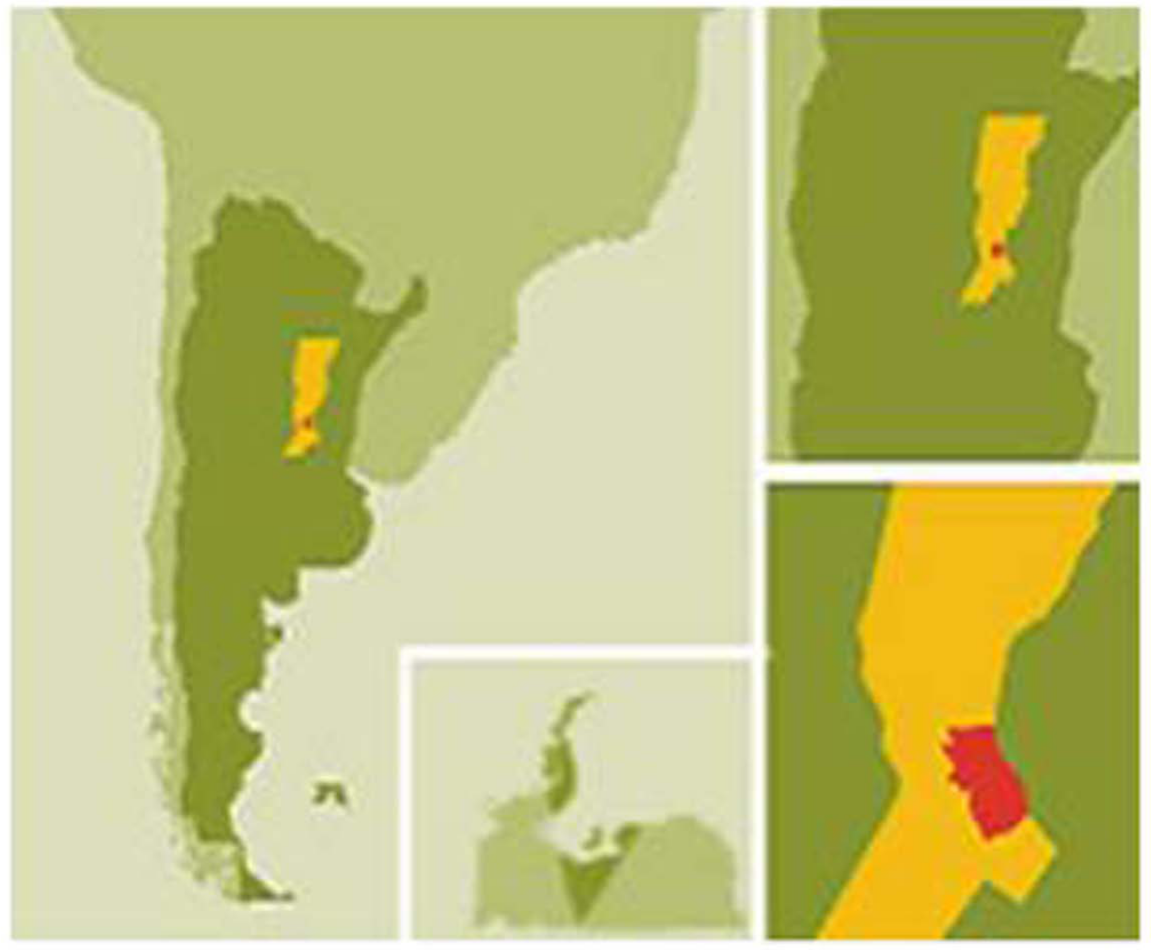
Location of Santa Fe and Rosario
Historically, Rosario has been a regional centre for the fertile pampa húmeda,(20) and one of Argentina’s principal ports for agricultural products. Both its port and railway system, and later the road system, were planned for exporting the region’s agricultural products. The result was highly concentrated spatial development – everything led to the port and most activity was concentrated there. Until recently, most of the riverbank was occupied by the port and railway infrastructure. The 1967 urban plan included a plan for renovating the area, and while some initiatives were undertaken earlier, the most notable interventions were implemented during the first administration of Mayor Binner. Today, the process continues.
Industrial development started slowly in the 1930s, mostly with the farming industry, and consolidated in the 1960s when a mix of metal, mechanical, chemical, petrochemical and other industries settled in the area, taking advantage of the port and railway and highway systems. In the mid-1970s, the city’s economy went into steep decline. Increasing national external debt, weakened regional economies, low commodity prices, economic deregulation and barriers to international competition all took a heavy toll. Many medium- and small-scale enterprises collapsed.
The return to democracy in 1983, after the military dictatorship, brought relief, but the national government could not manage inflation, the fiscal deficit, economic stagnation and increasing foreign debt. When the Argentine peso was pegged to the US dollar in the 1990s, this made it almost impossible to compete internationally and pushed the agricultural sector into a deep crisis. The economic and social crisis, characterized by high unemployment, was aggravated by the arrival of impoverished migrants from the northwestern and northeastern provinces. During the 2001–2002 socioeconomic crisis, poverty levels reached more than 40 per cent(21) and unemployment in Greater Rosario more than 30 per cent in May 2002, the highest in the country.(22) In the department of Rosario as a whole, however, 85 per cent of the population was above the national average in terms of unmet basic needs because health, education, housing quality and access to water and sanitation were relatively good.(23)
In the years after the crisis, national economic stability and international conditions favoured the agricultural sector and Rosario benefited from this. Increased public funds and a boost in business activity and construction brought economic mobility; unemployment in Greater Rosario went down to 11.2 per cent in 2006(24) and poverty levels to 22.9 per cent,(25) below the national average.
b. Political and administrative context
Rosario is the capital of the department of Rosario, and although the municipal government has a high degree of autonomy over its own functions, most financial resources come from the federal government and are allocated at the provincial level.(26)
Rosario’s government consists of an executive branch (the mayor and the municipal secretariats) and a legislative branch (the city council). Both the mayor and the 22 city councillors are directly elected by popular vote.
Despite economic ups and downs, there has been political and institutional stability in Rosario. In 1983, with the return to democracy, Horacio Usandizaga of the Unión Civica Radical (UCR) was the first democratically elected mayor of Rosario. Re-elected after his first term (four years), he resigned in 1989 when President Raúl Alfonsin was forced to leave office due to the economic crisis. Héctor Cavallero of the Socialist Party, an outstanding city councillor, was elected to complete the term and then re-elected in 1991. During Usandizaga’s term, the city initiated an urban planning transformation process, upon which the socialists later built, strengthening its social dimension.(27) The Socialist Party has continued to control the city government, and after Cavallero, Hermes Binner and Miguel Lifschitz were elected, each for two terms.
c. Relations between municipal government and national and provincial governments
The socialist governments in Rosario have never received much support from either national or provincial governments.(28) Until 2007, when Hermes Binner, former Rosario mayor, was elected governor of the province, the provincial government had been Justicialista(29) for 25 years, meaning almost constant confrontation between Rosario and the provincial government. Relations with the national government, led by the re-elected Cristina Fernández de Kirchner, have also been problematic, and since 2007, the province itself has also had complicated relations with the Kirchner administration.
But despite the adverse provincial and national socio-political context, the city’s approach to urban management, based on efficient organization and accountability and placing great emphasis on social policies and urban planning reform, has consolidated and strengthened the party’s position as a viable choice,(30) providing the opportunity for the city to manage itself independently from higher government levels.(31)
IV. Integrating Social Dimensions into Urban Planning and Development
The commitment of the city’s socialist administration to integrating social dimensions into urban planning and development(32) can be seen in the restoration of riverbanks and public spaces, in the infrastructure and service provision in peri-urban areas, in the health service and in the decentralization and participation process. The administration considers health to be a fundamental right of all citizens, for example, and has been working to improve the service for the last 15 years, moving from a traditional model based on treating sickness to one based on health prevention and promotion, with a network of community health centres, hospitals and emergency services. More than 25 per cent of the municipal budget is used for health, and the health service is provided not only to rosarinos but also to residents from other provinces and foreigners.
Successive socialist administrations have also been working towards restructuring urban governance through decentralization and participation. At the end of 1995, an assessment showed the city’s profound spatial inequalities. Most commercial, business, administrative, cultural and social activity developed historically within the central district. But as a regional centre that attracts migration (both from rural areas and neighbouring countries such as Paraguay), Rosario also had informal settlements that grew rapidly towards the west (blocked in other directions by the river and neighbouring cities) and authorities had difficulty in reaching these marginalized areas. Decentralization began in 1996, aiming to make government more effective, more efficient and to bring it closer to all its citizens. The city was divided into six districts – centre, south, southwest, west, northwest and north – taking into account size, area, population and urban imbalances (Figure 2).
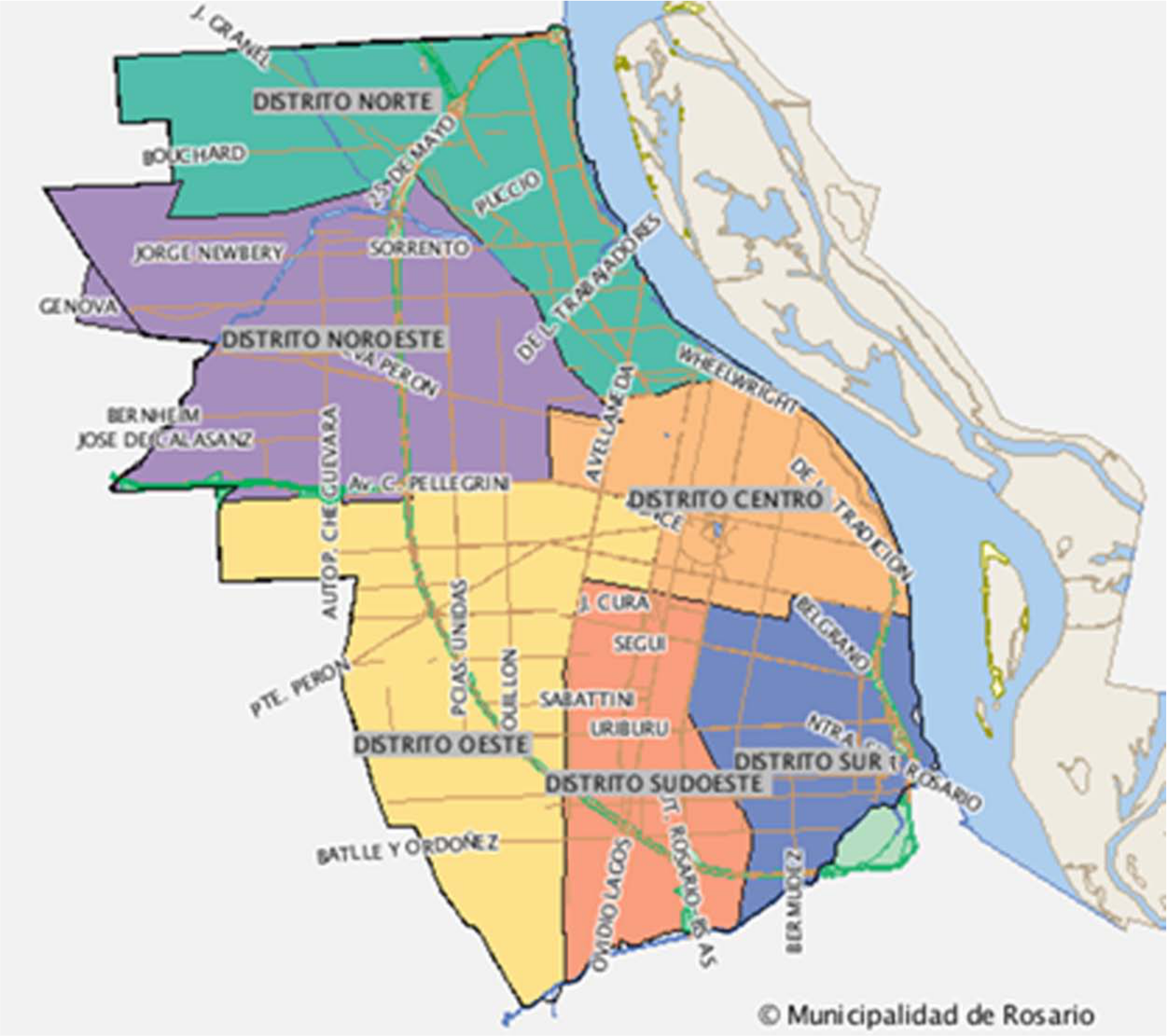
Decentralized districts within Rosario
The process took time, but now all six municipal districts have functioning district centres with administrative services, urban development and socio-cultural and health services; they have registry offices, bank branches, provincial tax offices and customer service outlets for the different service utilities.(33) Local policies now respond to the actual needs of each district and its inhabitants. The city government has had to invest not only in building new centres or recovering old buildings for the purpose, but also invest in running them. Besides staff to carry out the different administrative services provided from the district centres, a large proportion of the regular urban maintenance work is also undertaken directly from there.
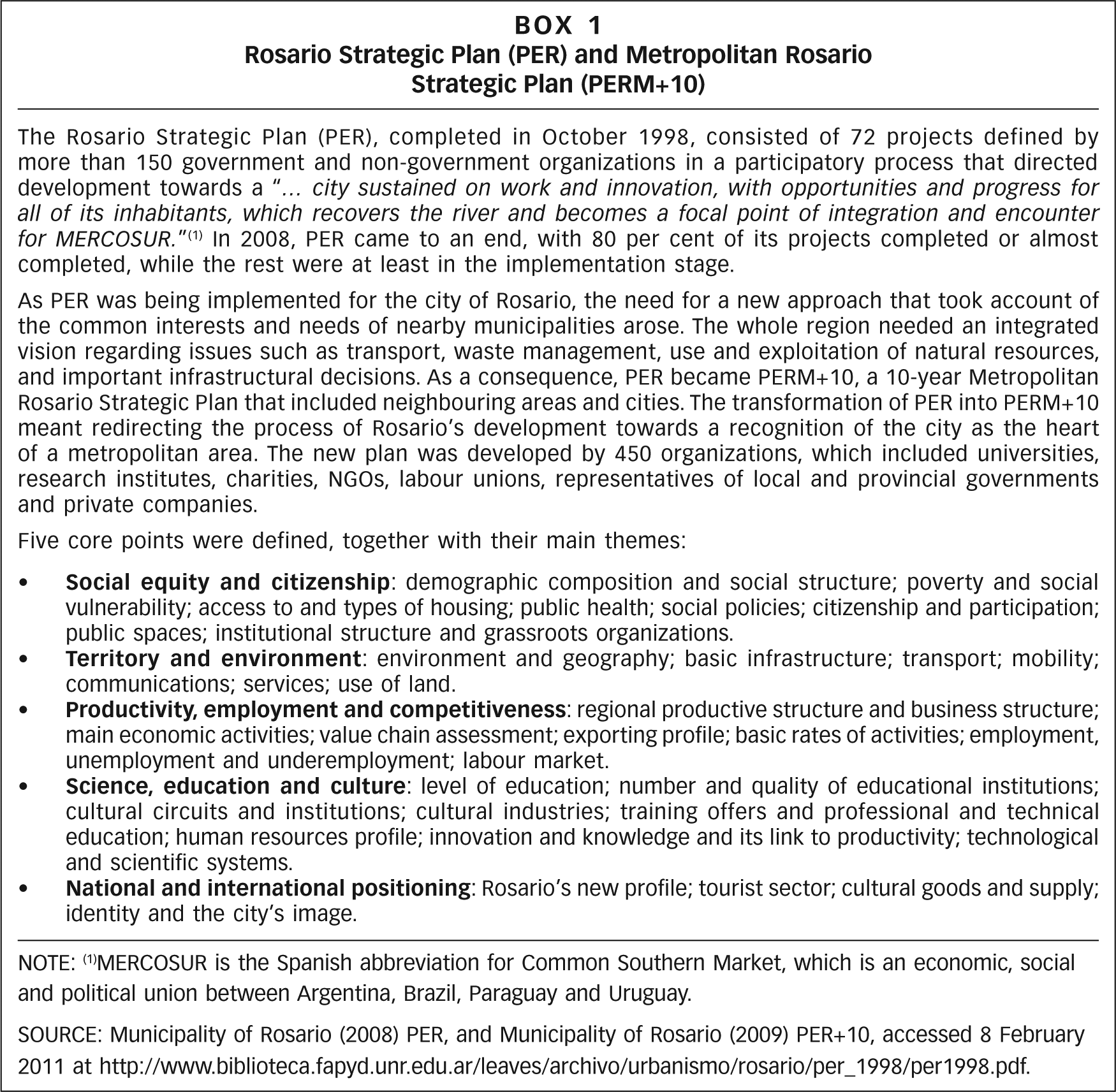
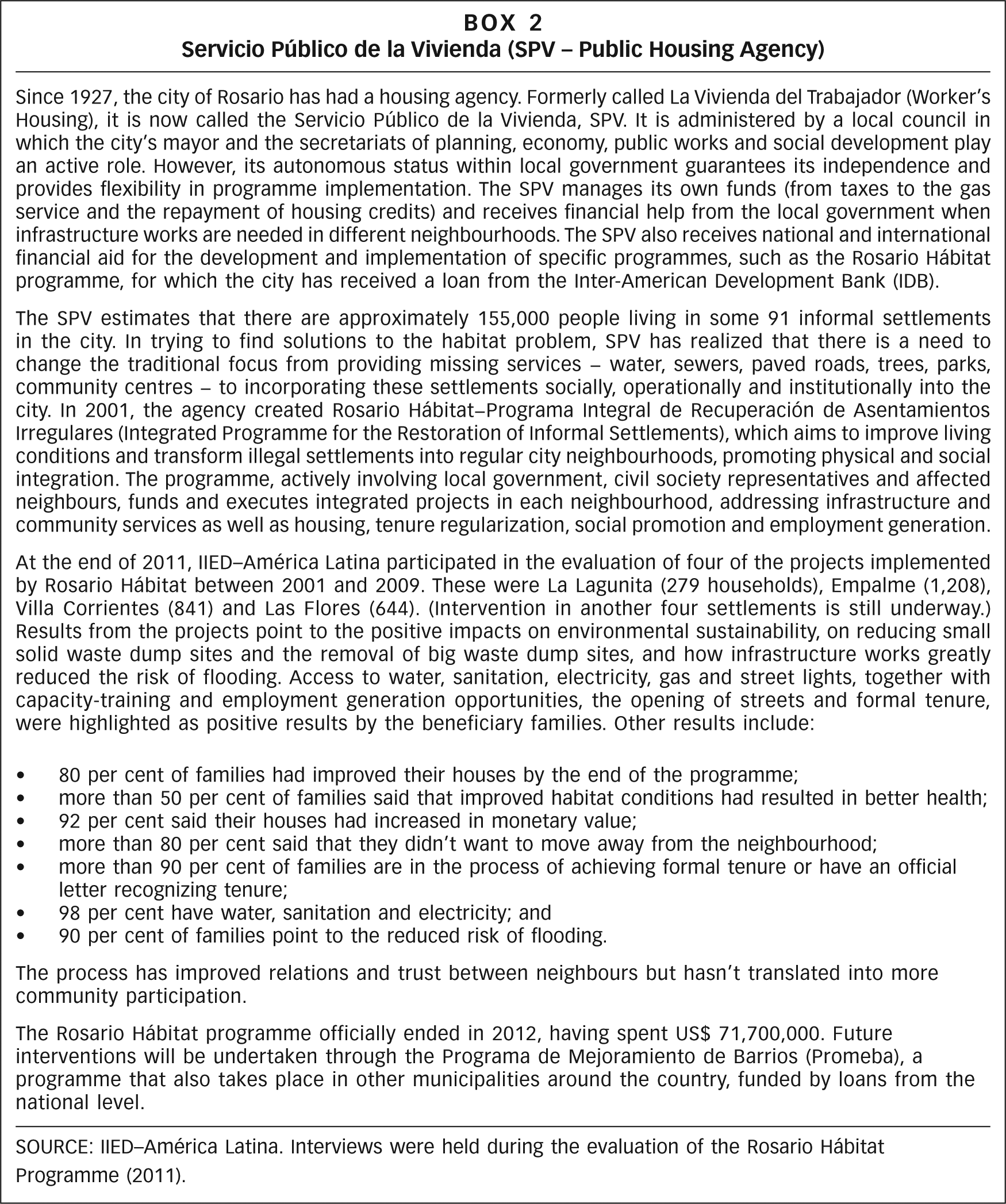
This has been more than merely an administrative decentralization process. The idea was also to create easy access for neighbours to meet and organize activities at the district level and participate in local planning and decision-making. Rosario has been actively implementing different participatory experiences since the 1980s, a commitment on which the comprehensive city development plan is based. In each district, urban development planning workshops allowed local institutions and representatives of different sectors to discuss urban projects and participate in the development of the strategic plan for Rosario (PER) and its update after 10 years (PERM+10) (Box 1) – tools that guide the long-term and coherent development of the city.
With regard to informal settlements and integrating these within the city layout, the city has a Servicio Público de la Vivienda (SPV), an autonomous agency that seeks to solve the housing problems of low-income families (Box 2).
V. Urban Planning Tradition
The city of Rosario has a long urban planning tradition. At first, this was geared towards controlling urban sprawl and it produced various plans that ultimately led to the two main planning tools used today, namely the Urban Plan of Rosario 2007–2017 (PUR, Plan Urbano de Rosario – Box 3) and the Metropolitan Strategic Plan (PERM+10). The socialist administration has emphasized reforming urban planning and, as mentioned earlier, formulating social policies that include decentralization, an improved health service, redistribution of urban benefits, and participation. Both PER (and later PERM+10) (Box 1) and PUR anticipate challenges, and guide decision-making and programme implementation around city development. These tools were developed in an integrated way – one is the practical expression of the other: PER needs PUR for its implementation. Together, they integrate social, environmental and territorial planning within an integrated vision of the city.(34)
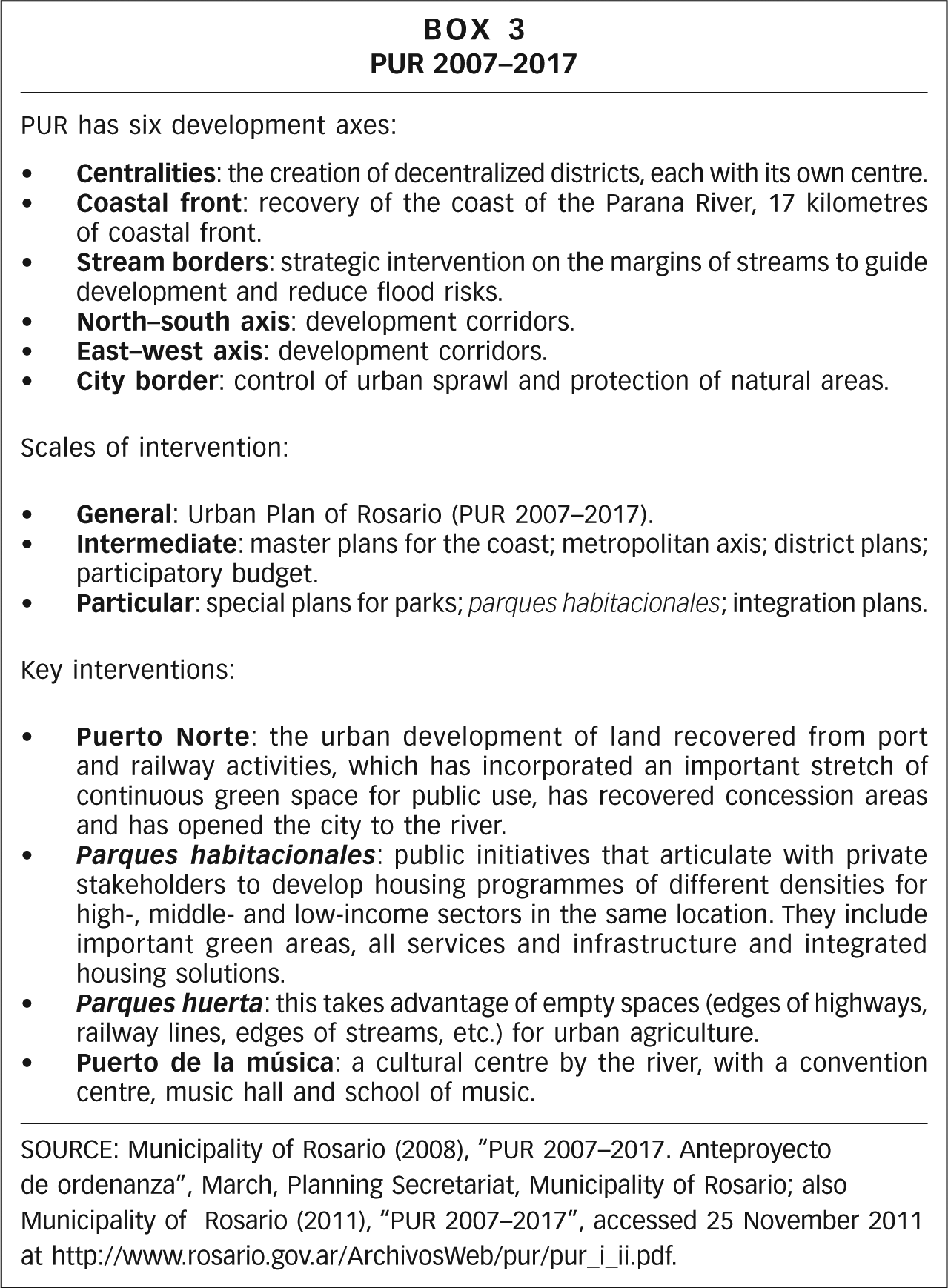
The urban plan establishes guidelines for land use, the transport system and mobility, public spaces, historical, natural and built heritage, housing, infrastructure and services. In addition, the city administration developed plans at different scales, namely master plans and special plans associated with PUR to guide interventions in specific areas. Partitioning the plan has been a strategy not only to adapt to specific local needs but also to guarantee the progressive continuity of PUR’s implementation. Discussing and reaching consensus over a general plan for the city is different from the same process applied to plans at a smaller scale. As specific plans progress, former obstacles and conflicts are solved, developers and landowners, as well as the general public, see the positive results of the interventions and start to support the process.
a. Innovations in urban planning implementation
PUR is innovative in the region for several reasons. It has been developed in participatory ways. It establishes clear rules, but goes beyond these to create innovative mechanisms for accessing financial resources, establishing partnerships etc. that make the plan possible. Because the city has a small budget (one-fifteenth of the budget of the autonomous city of Buenos Aires(35) for one-third of its population) and important restrictions in terms of passing norms and regulations (it is not an autonomous city), from the outset the administration saw the need and potential to work through concertación and generated enough interest in the private sector for them to invest following the development of the urban plan . One of the main challenges for PUR has been access to financial resources. The possibility of working in association with different stakeholders, establishing public and public–private partnerships, has been key to success. The aim is to capture investments that have a strong return in terms of public benefits. The city is clear that for every development, the private developer has to provide some compensation to the city, which will be used to buy land, construct trunk services, public housing or public spaces.
The city signed “agreements” and concession contracts with various stakeholders (landowners, developers, etc.). A key to the successful implementation of so many of the plan’s projects has been the strong political support.(36) Given that previous urban plans had taken so long to be approved by the local council because of their complexity that they came too late to guide development, the plan was divided into areas of intervention so that parts of the plan could go ahead even when the global plan had not yet been approved. This incremental strategy worked much better, with projects having been implemented that have the whole urban plan as a reference.(37) However, the total plan has still not been approved by the city council, with those who are against it in its current guise arguing for the need for further debate.
A similar strategy was used to intervene in the area known as Puerto Norte. This area, formerly used for port and railway activities,(38) had seven different private and public owners. The city administration had for many years lobbied to move port activities to the south and make room for public spaces, urban developments, cultural centres, etc. The municipality had to negotiate with each landowner, in a process that was taking years to resolve. To overcome this, the administration divided the project into seven units, allowing it to be planned in stages that could be initiated separately. In contrast to urban developments in other cities such as Buenos Aires (the case of Puerto Madero(39)), the restoration of riverbanks in Rosario took place on private land where building and development restrictions were imposed in line with PUR, and much of the area was recovered for public use.
In the case of parques habitacionales (Box 3), each has been tailor-made based on ownership, the existence of informal settlements, infrastructure access, proximity to riverbanks, etc. In the case of parque habitacional Ludueña, for instance, with 15 different landowners, the city presented an overall proposal. Instead of each individual owner having to give up 15 per cent of their land to the city for public and community spaces, the administration developed a plan for the whole area that benefited all parties. The end result was a large park area instead of many individual plazas, along with community centres and service areas. The owners benefited from being able to develop the area and also benefited from trunk infrastructure provided by the city government.
b. Keeping pace with urban development challenges
Every intervention is characterized by clear rules and obligations for all parties involved. Land is left for public and community spaces; buildings with historical value are preserved; densities and heights are controlled; and construction permits are modified according to the urban plan for each area. The city government developed several tools in order to achieve this. For example, every agreement that is signed with a big private landowner or real estate developer includes an amount of land for the development of public space and land that the city government can use to develop social housing. In other cases, when a private landowner benefits from changes in the building code, they compensate the city by paying into a city fund; those who are adversely affected by new restrictions receive instead a subsidy to preserve local historical and natural heritage. In this way, the government guarantees the development of the city according to the overall urban development plan; in order to control this, the city urban code had to be updated.
All these changes came with risks, as there are many vested interests in land and property development. There were many critics during the initial years of the plan, and conflicts with private parties such as the real estate sector, the School of Architects and the Construction Chamber. One can still discuss whether the compensation mechanisms are adequate. Local experts argue that the money recovered since these mechanisms were implemented is not significant and the benefits have not been redistributed. Some claim that the infrastructure works have primarily benefited just a few residents. There certainly needs to be more thinking and improvement around these interventions and redistribution mechanisms in Rosario. However, it is fair to say that the city administration has come further than most in the region and has the capacity to reflect and improve these processes.
In many cases, application of the new code and protection of landmarks was too late. Pressure from the private sector to develop certain city areas has increased, especially since the 2004 construction boom, and the city administration has not always been capable of keeping up with the necessary controls and setting of norms.
The creation and/or recovery of public spaces has significantly increased the green area per inhabitant (10.4 square metres per inhabitant at present, with the aim to surpass the 12 square metres recommended by WHO). Pedestrian zones, parks, beaches on riverbanks and islands, and educational and children’s parks have been created or restored, and there is an 11 kilometre-long park along the water’s edge. Park and public space deficits within the city are progressively being addressed through the implementation of the master or special urban plans.(40)
The city has also recently finished an Integral Mobility Plan (PIM – Plan Integral de Movilidad Rosario), which aims to promote the use of clean and renewable energy, discourage the use of private cars and encourage public transportation, reduce GHG emissions, control pollution and improve institutional governance arrangements.(41)
VI. The Cross-Cutting Environmental Approach
There is a strong environmental component to the planning reforms. Some of the main goals of the urban plan are to reduce density in the central area and redistribute population to other areas of the city; also control the heights of the buildings and establish some distance between them. Issues such as mobility, transportation and access to services and infrastructure (such as water, sanitation and drainage networks, public spaces, health centres and community centres) are taken into account, but also wind patterns and flood risks. New urban norms incorporate energy efficiency criteria and safety measures in the use of certain construction materials, such as glass in high-rise buildings. Environmental measures undertaken with different sectors include the delimitation of flood risk areas that guide land use; the development of parks in flood risk zones; early warning and emergency systems and educational campaigns for risk prevention; dengue campaigns, including control of mosquito breeding grounds and strong community awareness campaigns; and the creation of a green belt around the city, used for urban agriculture.(42) One issue that still needs regulation is the use of tin roofs, which is common but these are easily damaged during hailstorms. Funds should be allocated to research and development into materials that are more resistant.(43)
Representatives of civil society believed that the local administration could have done more. During public discussions around modifications to the urban code, experts and local NGOs argued that insufficient attention was being given to such environmental issues as the impacts of population densities, heat island effect, air circulation, air quality etc., and that the influence of construction companies, professional schools and the Construction Chamber was too strong.(44) Aside from this, as in any city, the application of new norms is slow and the controls needed to cover all new construction take time and resources. There are always ways around the regulations so these need to be constantly revised.
During Mayor Lifschitz’s first term, the Environment Department was changed to a sub-secretariat, reflecting the need for the environment to be a cross-cutting issue that is addressed in coordination with all the different government areas and sectors.(45) In practice, this has proved to be much harder than initially expected. The environment has not necessarily been a cross-cutting issue in different public policies, and the sub-secretariat is always underfunded and depends on other areas to implement actions.(46)
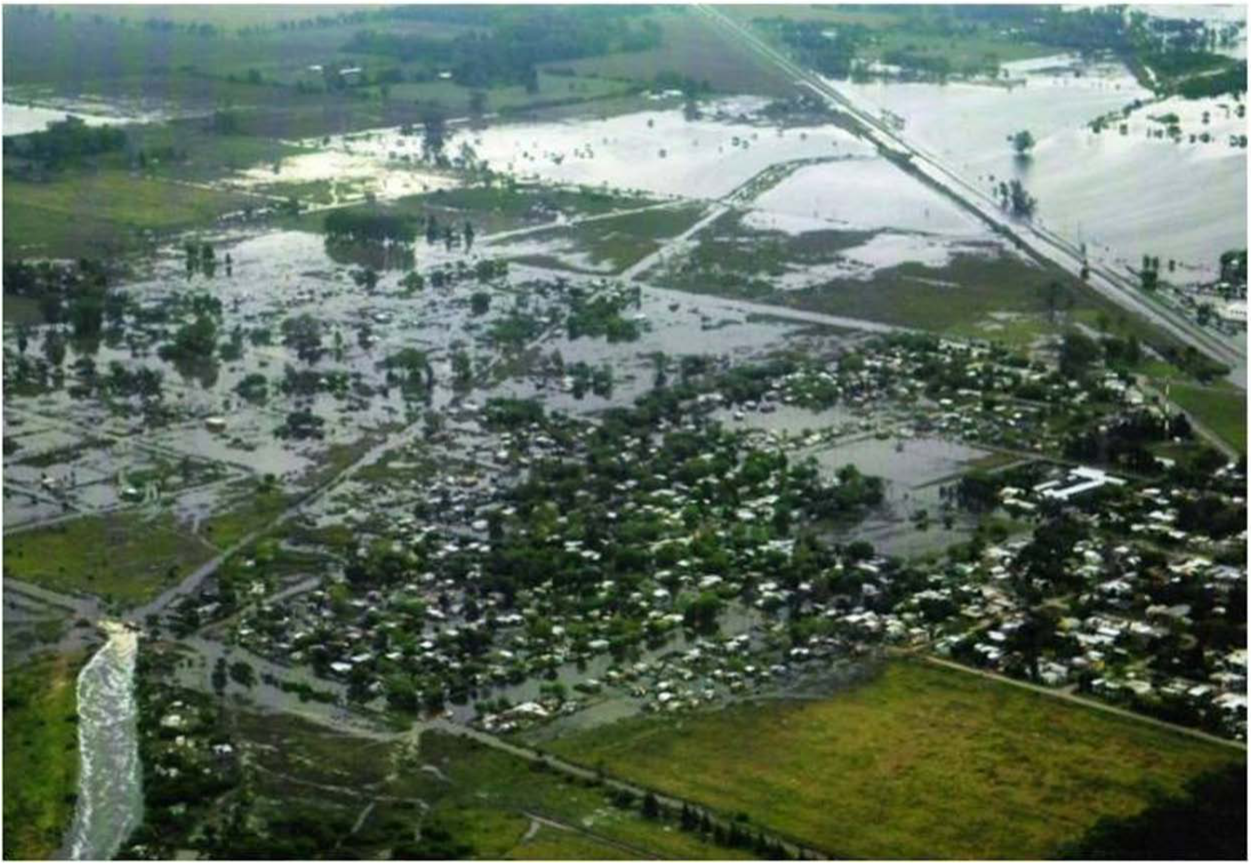
Floods in Nuevo Alberdi, Rosario (2007)
a. Integrating flood risk management
One of the main risks in Rosario is flooding associated with intense rainfall and overflow from local streams. In 2007, 180 millimetres of rain fell in 30 hours and 300–400 millimetres in five days.(47) More than 3,000 people were evacuated and an area measuring more than five square kilometres was flooded.
The city’s Department of Water Management (Dirección General de Hidráulica), supported by a research group from the University of Rosario, has established new risk thresholds based on the analysis of historical and recent precipitation records. This information is used to redefine flood areas and allow for better urban planning, and the data are mapped to establish limitations and restrictions on construction. Using all this information, specific regulations regarding the areas around the Saladillo and Ludueña streams were modified and approved in December 2011. Over the years, Rosario has taken flood risk seriously, as is evident in the more than 50 people working on the issue within the Secretariat of Public Works,(48) and the city, or the province of Santa Fe, has implemented structural measures to reduce the risk of floods. Many of the actions relate to measures such as the construction of the dam over the Ludueña stream to control peak flows(49) and the channelling of the lower section of the Ludueña where it flows into the Paraná River.
Different city departments and secretariats work in an integrated way to control sprawl and redirect urban growth away from flood risk areas. Areas on the margins of rivers and streams are being gradually converted into green spaces with the dual purpose of preservation and protection. All new housing developments (private and public) and informal settlement upgrading programmes are analyzed by the Department of Water Management (Dirección General de Hidráulica) to establish the viability of the intervention or programme.
Some people occupying low-lying land have already been affected by redevelopment processes. When floods occur, the local government offers assistance for evacuation but does not intervene to protect houses and assets built on land already cleared by the city.(50) This is a clear example of the government’s policies irrespective of the political costs – it takes strong political will to support this. There are many interests at play, however. For instance, in December 2011, the local council, after a heated debate, approved an urbanization plan in Nuevo Alberdi, in an area at risk of flooding and with no services. Informal settlers have lived there for more than 40 years but recently, the land was bought by private developers. Apparently, infrastructure work undertaken by the province means that the area will not flood in the future. The new private owners want to displace old settlers and local NGOs are disputing government actions. The debate is ongoing.
Since floods cannot be totally prevented, the city has an emergency system that is expected to improve substantially in the near future as the province restores non-functioning monitoring stations. Civil protection response mechanisms are also being improved. The Municipal Civil Defence answers to the mayor and has a staff of more than 100, as well as machinery, trucks, portable power plants, etc., which shows its increasing importance within the municipal system. But as always, resources (human and physical) for emergency response depend heavily on other areas and sectors, and much of the effort is spent on coordinating the work of different municipal and provincial offices and civil society organizations. Recently, the Municipal Civil Defence established a training centre that is expected to train 30 per cent of all service staff, 40 per cent of municipal staff, and all teachers, policemen and those working in areas that deal with large numbers of people (such as night clubs).(51)
There is also the need for physical prevention work, such as the continuous maintenance of drainage channels along the streets, as well as structural measures such as channelling, dams and alleviator channels. For instance, an alleviation channel is being built on the Ibarlucea channel, taking into account potential future levels of the Paraná River. All interventions are coordinated between different municipal areas and, over the last few years, with the province. Usually, the main problem is a lack of funds. There was no discussion during interviews of the viability of non-structural measures associated with bio-engineering and “soft” technologies.
b. Climate strategy
Despite the actions mentioned above, which are directly associated with reducing vulnerability and enhancing resilience and adaptation, the feeling within the local administration is that they haven’t progressed much with their adaptation agenda;(52) the focus tends to be more explicitly on mitigation.
One of the main challenges in the view of the former Sub-secretary for the Environment is that the city still lacks an inventory of greenhouse gases, which constrains the development of mitigation strategies. Such an inventory was underway in 2011, but neither the city nor the country has obligations regarding emissions. Over the last years, they have been working on converting public lighting (street lights, public buildings, etc.) and traffic lights to use more efficient technologies such as LEDs.(53) Other Municipal Civil Defence projects, for example gas capture through bio-digesters, have been too costly to pursue.(54)
In 2009, the Sub-secretariat for the Environment, Taller Ecologista (a local NGO) and the Technological University (UTN Universidad Tecnológica Nacional) signed an agreement to develop a climate strategy for the city. The initial step was to set in motion discussion workshops and awareness-raising campaigns. A meeting was convened with advanced graduate and post-graduate students to present projects related to climate change, with the aim of generating relevant knowledge and professional interest, and 10 projects were selected for further development. The advisory board, with members from the local administration and academia, will concentrate for now on knowledge production. The capacity to maintain this discussion space will depend on the ability of the local government to motivate the group and generate funds for project implementation.
The local council also drafted a norm with the support of Taller Ecologista to implement the use of solar water heaters. This was approved in December 2011 but with modifications, making mandatory the use of solar water heaters only in new public buildings.(55) Furthermore, the city recently passed a norm regarding urban green terraces, which adds green surface and may contribute to slowing down water flow and reducing peaks during intensive rains thanks to the drainage system that green terraces require.(56)
Although these initiatives have not shown any substantial results to date, the articulation that exists between different departments and secretariats makes it possible and realistic to address complex issues such as those related to climate change. The Sub-secretariat for the Environment continuously coordinates with the different secretariats and departments on issues related to heat stress (and strokes), tropical diseases, flood prevention and emergencies, public spaces and urban forestation.
More recently, the municipality embarked on a programme of sustainable construction and energy efficiency. An advisory board was set up in April 2011 with the participation of universities, service providers, professional schools, the Construction Chamber, etc. The aim was to promote good practice and awareness and eventually pass a norm with the consensus of many different stakeholders.(57) Strategically, the authorities decided to work slowly, to allow time to incorporate the proposed measures and see the advantages in a context where energy subsidies are disappearing.(58) The importance of the programme is that for the first time, sustainable construction and energy efficiency is being incorporated as a public policy, and not just the result of isolated actions such as green terraces or solar water heaters. It is not only about a commitment to the environment or an awareness of the impacts of climate change; it also has to do with the sustainability of cities. If energy costs continue to rise, one will see empty houses and buildings, impossible to maintain.(59)
The programme is not geared directly to social housing programmes. There are limitations in this regard. Most social housing programmes are funded with extra-municipal resources and the prototypes are already defined. The introduction of modifications to make housing prototypes more sustainable and energy efficient could reap important benefits for the most vulnerable or those with lower incomes, but this has to be incorporated into national housing policies, with the consensus of different sectors and stakeholders who need to think beyond building the largest number of houses at the lowest cost.(60)
The sustainable construction and energy efficiency programme is still running, but has not received enough funds and staff to make a difference. After several meetings and with no chance of actually implementing actions, the advisory board lost momentum and stopped meeting.(61)
The city’s long-established programme on solid waste management and reduction is also environmentally important. The SEPARE (Separate) programme has been running, with modifications, for the last 10 years, and all recycled materials are recovered by co-ops. They have been working by trial and error to make waste-recycling projects more socially and economically sustainable.(62) The programme is receiving funds to create a new sanitary fill that could receive non-recyclables and organics for composting.
In Rosario, many actions not directly geared to mitigation or adaptation are indirectly effective because they try to be environmentally sound. The measures to reduce flood risks, for instance, include measures to cope with more extreme rainfall. The city’s solid waste management policy, intended to be environmentally sustainable, is coherent with greenhouse gas mitigation. The same is true regarding the creation and maintenance of public spaces, parks and trees/forestry and with the city’s transportation efforts. Over the last years, the city has been testing and improving traffic circulation and discouraging the use of private vehicles. The main purpose is to improve traffic control, but with the side-effect of reducing emissions.(63)
Over the years, the city has developed, as part of PER, a Local Agenda 21 based on the inputs of different stakeholders who participated in workshops, surveys, participatory diagnosis, etc. Working commissions were formed and although the plan has had its ups and downs, it has always remained within the city’s environmental strategy, and the stakeholders who are involved remain active. In April 2012, the city held a series of workshops, seminars and different activities to prepare for Rio+20. One of the themes prioritized was the climate change strategy.
The city has a good working relationship with the province. Most of the work done at provincial level has more to do with mitigation, stopping deforestation and land use changes, and the efficient use of energy. In 2011, the province created the Secretariat of Energy to promote the development of alternative energy sources, providing support to municipalities with less-developed capacities (not the case with Rosario). The province is participating in the development of a sanitary landfill for metropolitan Rosario and the creation of regional consortiums for waste management. Adaptation actions are linked more to flood-related work, and over recent years the province has invested in defences, early warning and monitoring systems, and water management and land use planning, with the idea of keeping water where it is. This has generated many conflicts with powerful groups and landowners. The province is working on improving synergies with the national government and participates actively in the Federal Environmental Council (Consejo Federal de Medio Ambiente – COFEMA).(64) The city, however, has no (formal) relations with the national government in terms of climate change, and there has been little success in engaging with the national level.(65)
VII. Participation
A key feature of the Rosario administration that ties everything together is participation. Since the Socialist Party came to office, all the different plans (PER, PER+10, PUR, PIM, Local Agenda 21, etc.) have been developed in consultation with relevant stakeholders from the private and public sectors, making use of different participation channels. The decentralization process also leads to improved participation mechanisms.
The city has been implementing participatory budgeting since 2002, following the model of Porto Alegre in Brazil but adapting it to the local context. It aims to promote public participation in the use of public resources, strengthen state–civil society links, increase transparency, and give citizens a voice in diagnosing problems in their districts and proposing solutions. Involvement has grown continuously. Regarding the projects to be implemented during 2012, 52,694 rosarinos participated and US$ 42 million was allocated, US$ five million more than the previous year.(66) The budget allocation represents only five per cent of the total city budget (most of which goes to fixed costs) but it is important in terms of the discretionary funds available for projects.(67)
Recently, the urban code was replaced by a new, integrated set of norms compiled under the name Las Normas Urbanísticas de la Ciudad de Rosario (Decree No 3497/05), and municipal technicians from different government areas, universities and service providers participated in the debate.
Although participation permeates decision-making in Rosario, there is always concern around what form it takes. In some cases, participation has not really involved citizens and has only reached institutions or formal groups such as universities, private companies, NGOs and formal citizen organizations.(68) In other cases, the participation spaces were there but the local administration was not capable of conducting the process. There was no connection with what was discussed and the actual possibility of implementing or transforming local policies.(69)
VIII. Conclusions
Rosario is not a recognized international leader in addressing climate change. It has not prepared an official mitigation plan, much less an adaptation plan, nor presented its climate change action plan at international forums. The city is still struggling to complete greenhouse gas inventories. It has, however, implemented several specific mitigation measures and tries continuously to place this issue on the government’s agenda. For local authorities, adaptation to climate change has been a much more diffuse issue than mitigation, and their initial response is to think that they aren’t doing much and that mitigation is the first serious step in a climate change agenda. The connection between climate change adaptation and good urban planning, risk reduction and management, good governance mechanisms and environmental concerns is not established quickly.
However, Rosario’s particular way of responding to current development challenges has put in place the flexibility, creativity and commitment needed for adaptation, regardless of whether this is made explicit or not. Rosario’s policies have had continuity and consistency, despite being frequently revised over 18 years of socialist administration, because each administration has built upon the progress of its predecessor. This is quite unusual; it is more common for there to be a revision of all that has been accomplished and for the need to point out the negative aspects of the previous administration and to differentiate from it.
Policies are strongly underpinned by urban planning reforms and a commitment to social equity. These, together with environmental sustainability as a key component of habitat improvement, cross all policies and actions. Urban planning is the physical support of social transformations, and environmental sustainability is a measure of the city’s future viability.
Efforts are being made to find new ways of working across different secretariats. The city’s GIS, for instance, is produced and shared between administrative areas. Public administration leans naturally towards sectoral division, and cross-cutting policies take great effort to produce. Clearly, the preparation of PER, PER+10, PUR 2007–2017 and PIM all involved integrating different sectors and government areas, but this needs to be the working strategy for most, if not all, government plans and actions.
There is a strong political will to support the process developed in Rosario. Career employees, technical staff, members of the executive and the legislative all tend to share a common vision of the city and its people. Over the years, the city administration has maintained its course, and fundamental to the process has been political support to the secretaries and no vested interests in the private sector.(70)
The local administration is clear about its constraints, and creative in searching for ways around these to achieve its objectives. Examples are the strategy used to get parts of the city plan approved, or the mechanisms used to engage public–private sectors in different urban interventions. Representatives of the construction sector mentioned the city’s flexibility in conveying competing interests, creatively searching for solutions and integrating social housing within the land market to get financial resources and land to start solving housing needs.(71) A concern of the local administration is that they have still not obtained sufficient land for much-needed social housing programmes.
The decision to discontinue Rosario Hábitat is in some ways a setback. The programme allowed for the improvement of housing and services in informal settlements, relocation from flood areas and legal tenure for many families. The focus on employment and social cohesion also improved community resilience. The city barely keeps up with the growth of informal settlements, which results from both natural growth and the continuous inflow of immigrants.
Improved contact with residents through decentralization and participatory budgeting has cost money but is in line with the political commitment to democratic inclusion. An important percentage of the city budget goes to health – also a political decision, especially given this is a provincial responsibility.(72) Active citizen participation also provides continuity and can act as a safeguard for the processes implemented. Citizen participation, however, is not an easy process for any city, and perhaps one of the faults of PERM+10 and PUR has been that the intended participation has not been fully achieved. The typical citizen probably lacked the information for knowledgeable, confident involvement. Participation also carries risks – not everything proposed by stakeholders is necessarily in line with what government expects or needs, and local governments should be prepared for this. There have to be instances where stakeholders can influence local policies. There has to be a clear commitment to the process and continued support. In a city like Rosario, there are probably more participation opportunities than can possibly be sustained. This can cause frustration, especially when many actions are tied to the availability of financial resources that are simply not there.
Compared to other cities, Rosario has certainly made interesting advances in terms of urban planning, decentralization, participation and flood risk prevention. It struggles constantly to include environmental issues in planning and to keep up with pressures from competing interests. It demonstrates the continuity and transparency necessary to develop long-term processes. Many interviews captured critical perspectives – as in any administration, things could be done better, but the bar is set high and critics also recognize how well Rosario is doing compared to other cities. Criticism is also good, as it constantly places demands on the local administration to work on alternative solutions. The will to cooperate, engage and propose actions was clear – most critics are associated with what the city is doing, not with what it doesn’t do.
IX. Present and Future Challenges
One of the main challenges for the city is access to funds. There have been creative efforts, but every action needs financial resources, whether it be running the decentralized districts, managing the health service or maintaining green areas and the solid waste collection. The former Sub-secretary for the Environment recognized that funds were needed to develop a greenhouse gas inventory, but more pressing was the need for mosquito control, urban forestry, solid waste management, etc. Most of the environmental budget goes to finance these routine activities.
Local governments are allocated increased responsibilities but not the increased budgets to help address them. Increased citizen awareness also comes with increased demands. For example, the city has 20,000 street trees and 10,000 more in parks, an asset for all. However, the cost of maintaining them is so high that it has been suggested they be removed. Good city management costs money.(73) On leaving office, Mayor Lifschitz recognized that despite all the good work that had been done and the growth in the economy and employment opportunities, his administration had still not been able to significantly transform the living conditions of poor urban dwellers.(74)
Often, once specific programme budgets have been spent, programmes run the risk of losing momentum and coming to an end, often to the detriment of positive results that need time to mature. There has to be a strong political will and adequate institutional arrangements to enable long-term development processes. Collaboration is essential, but it also takes consensus-building, time and energy, and this can hinder the city’s flexibility and capacity for quick reaction.
Key to many of the programmes and actions encouraged by the city is support from higher levels of government. Conflict on this front, especially at the national level, has hindered the city’s capacity to embark on projects, although it has also made the administration more resourceful and independent. International funds usually go to national governments and are centrally managed, but city level adaptation projects are not a priority for the national climate change agenda. The mechanisms for local governments to access international funding are complex, and usually they have to adapt to the priorities of funding agencies, not necessarily what they most need.(75) An attempt is underway to achieve formal recognition by the province of the metropolitan area. Mayors have signed an agreement to constitute the region and believe that this will allow the area as a whole to access funding mechanisms.(76)
Data is also a challenge. Climate change adaptation actions require specific local knowledge about vulnerability and impacts, and call for an updated, comprehensive database.(77) But there is a lack of sound data and modelling frameworks at the city level. Rosario is producing good information on flood risks but much is beyond the city’s capacity. Flood-monitoring stations, for instance, are not a city responsibility nor do they have good historical records. Where the city has relevant information, it is complicated to share it between city offices. Without this type of information, it is difficult for city administrations to buy into climate change adaptation or to demonstrate clearly the relationship between climate change and other local planning processes.(78) A related challenge is the documentation and evaluation of current efforts, which can in theory provide good learning opportunities.(79) But external consultants often undertake evaluations of programmes with little participation of local government staff and this results in long reports of little practical use.
Footnotes
Acknowledgements
This work was supported by the Rockefeller Foundation within a programme on “Advancing knowledge and understanding of action on urban adaptation to climate change in support of the IPCC’s Fifth Assessment”, implemented by IIED. We are grateful to all those interviewed who openly shared their knowledge and perceptions. Special thanks to Arq. Marcela Nicastro, who reviewed the paper, collaborated with local contacts and provided background information.
1.
Bartlett, S, D Dodman, J Hardoy, D Satterthwaite and C Tacoli (2009), “Social aspects of climate change in urban areas in low- and middle-income nations”, Contribution to the World Bank Fifth Urban Research Symposium on Cities and Climate Change: Responding to an Urgent Agenda, Research Cluster 5, Marseille, France, 28–30 June, 44 pages.
2.
3.
Sharma, D and S Tomar (2010), “Mainstreaming climate change adaptation in Indian cities”, Environment and Urbanization Vol 22, No 2, October, pages 452–465.
4.
See reference 3.
5.
6.
Hardoy, J and P Romero Lankao (2011), “Latin American cities and climate change: challenges and options to mitigation and adaptation responses”, Current Opinion in Environmental Sustainability Vol 3, pages 158–163; also Bulkeley, Harriet (2010), “Cities and the governing of climate change”, Annual Review of Environment and Resources Vol 35, pages 229–253.
7.
See reference 6, Hardoy and Romero Lankao (2011); also Roberts, D (2010), “Prioritizing climate change adaptation and local level resilience in Durban, South Africa”, Environment and Urbanization Vol 22, No 2, October, pages 397–413.
9.
Hardoy, J, G Pandiella and L S Velásquez Barreto (2011), “Local disaster risk reduction in Latin American urban areas”, Environment and Urbanization Vol 23, No 2, October, pages 401–413.
10.
See reference 9.
11.
See reference 3.
13.
Dodman, D and D Satterthwaite (2009), “The costs of adapting infrastructure to climate change”, in M Parry, N Arnell, P Berry, D Dodman, S Fankhauser, C Hope, S Kovats, R Nicholls, D Satterthwaite, R Tiffin and T Wheeler (editors), Assessing the Costs of Adaptation to Climate Change; A Review of the UNFCCC and Other Recent Estimates, IIED and Grantham Institute for Climate Change, pages 73–89; also Carmin, J, D Roberts and I Anguelovski (2009), “Planning climate resilient cities: early lessons from early adapters”, Contribution to the World Bank Fifth Urban Research Symposium on Cities and Climate Change: Responding to an Urgent Agenda, Marseille, France, 28–30 June, cited in  , see reference 6.
16.
The other two case studies are Chetumal, in the state of Quintana Roo, México and Manizales, in Colombia.
18.
See, for instance, Bernard, Susan M and Michael A McGeehin (2004), “Municipal heat wave response plans”, American Journal of Public Health Vol 94, No 9, pages 1520–1522.
19.
20.
Pampa húmeda is the ecological region known as the granero del mundo (“world barn”) because of its excellent conditions for agricultural production.
21.
Diario El Ciudadano (2002), “Casi la mitad de los rosarinos están por debajo de la línea de pobreza”, accessed 10 April 2002 at .
22.
INDEC (2002), “Comparación tasas de empleo y desocupación”, accessed 25 July 2002 at .
23.
The national index of unmet basic needs was 17.7 per cent in 2001; see Instituto Nacional de Estadísticas y Censos (2001), Buenos Aires, cited in Almansi, F (2009), “Rosario’s development; interview with Miguel Lifschitz, mayor of Rosario, Argentina”, Environment and Urbanization Vol 21, No 1, April, pages 19–35.
24.
Data from the household survey; see Instituto Nacional de Estadísticas y Censos (2001), Buenos Aires, cited in , see reference 23.
29.
The Justicialista Party is the largest component within the Peronist movement.
30.
See reference 28.
31.
See reference 28.
32.
See reference 28.
35.
36.
See reference 35.
37.
See reference 35; Arq. Mirta Levin explains that since 1967, five plans have been sent to the local council for approval, without success.
38.
Since 1960, the city has been involved in conflictual negotiations to move the port to the south of the city. The process is still underway and further negotiations and the incorporation of valuable pieces of land for public use are still pending; the outcome will depend on the persistence of the city’s administration to continue negotiating.
40.
Levin, M and M F Sbarra (2008), “La ciudad de Rosario: política referida a los espacios públicos”, in J Llop Torné (editor), Programa URB–AL: Proyecto Rosario SUMA, Una Solución Urbana Desde una Mirada Alternativa, Fundació UPC (Universitat Politécnica de Catalunya) pages 53–57.
42.
Interview with Daniela Mastrangelo, former Sub-secretary for the Environment, Municipality of Rosario, April 2011.
44.
Interview with Pablo Bertinat, Taller Ecologista, March 2012.
45.
See reference 42.
46.
See reference 44.
49.
Interviews suggest that it needs improved maintenance; this will depend on the province of Santa Fe.
50.
Interview with Graciela Dacunto, environmental consultant to the Rosario Hábitat programme, April 2011.
51.
Interview with Raul Rainone, General Coordinator of Civil Defence, Municipality of Rosario, May 2012.
52.
See reference 42.
53.
See reference 42; also see reference 44.
54.
See reference 44.
55.
See reference 44.
56.
Interview with Stella Andretich, Professor at the Catholic University (UCA), Rosario and IRAM regional delegate, May 2012.
57.
Interview with Eduardo Gonzales, Director of the Energy Efficiency and Sustainable Constructions Programme of the Secretariat of Public Services and Environment, April 2011.
58.
Since 2004, service tariffs, including those for gas, electricity and fuel, have been subsidized by government as a way of keeping down the cost of living.
59.
See reference 42.
60.
See reference 42; also interview with Arq. Resse, former Deputy of the Public Housing Service of the province of Buenos Aires, October 2010.
61.
See reference 44.
62.
See reference 42.
63.
See reference 56.
64.
Interview with Cesar Mackler, Secretary of Environment, Province of Santa Fe, May 2012.
65.
See reference 42.
67.
68.
Interview with Arq. Marcela Nicastro, February 2012.
69.
See reference 44.
71.
Representative of an architects’ studio involved in the design and building of some of the interventions, at presentation of PERM+10, 26 April 2011.
72.
Interview with Arq. Marcela Nicastro, April 2011.
73.
See reference 42.
74.
Mayor Lifschitz, at presentation of PERM+10, 26 April 2011.
75.
Discussion group at workshop ADAPTE: Vulnerabilidad y Adaptación al Cambio Climático de las Ciudades Latinoamericanas, 8–9 February 2012.
76.
Leonardo Raymund, mayor of San Lorenzo, at presentation of PERM+10, 26 April 2011.
77.
See reference 3.
78.
See reference 3.
79.
See reference 3.