




Abstract
Although urban women generally enjoy some advantages over their rural counterparts, a range of gender inequalities and injustices persist in urban areas that constrain their engagement in the labour market and in informal enterprises and inhibit the development of capabilities among younger women. These include unequal access to decent work, human capital acquisition, financial and physical assets, intra-urban mobility, personal safety and security, and representation in formal structures of urban governance. But the nature of these varies for different groups of women, not only on account of poverty status and where they live in the city, but also according to age, household characteristics, degree of engagement in income-generating activities and so on. This paper reviews what we have learnt from the literature on gender and urban development. It discusses disparities in access to education and vocational training and to land and housing ownership through a “gender lens”. It considers service deficiencies and associated time burdens, which limit income generation among women. Violence and gender, and gender divisions in access to different spaces within the city and in engagement in urban politics, are also covered. These factors cast doubt on whether women’s contributions to the prosperity often associated with urbanization are matched by commensurate returns and benefits.
I. Introduction: Urban Prosperity and Gender
That urbanization has been associated historically with an expansion in economic, social and political opportunities for women is one plausible reason why, in the context of increased celebration of the city as a generator of wealth and well-being, the issue of gender and urban prosperity has come to the fore, being the theme of UN–Habitat’s State of Women in Cities 2012/13. Yet notwithstanding that urban women enjoy some advantages over their rural counterparts, barriers to female “empowerment” remain widespread in the global South, especially among the urban poor. Indeed, that several gender inequalities and injustices persist in urban environments is highlighted all the more when considering prosperity in conjunction with poverty. An analysis embracing both phenomena reveals the frequently stark contrasts between women’s inputs to and benefits from the accumulation of wealth in cities. On the one hand, women make significant contributions to urban prosperity through a wide range of paid and unpaid labour, including building and consolidating shelter and strategizing around shortfalls in essential services and infrastructure. On the other hand, women often reap limited rewards in terms of equitable access to “decent” work, human capital acquisition, physical and financial assets, intra-urban mobility, personal safety and security, and representation in formal structures of urban governance.
While it is arguably useful to deflect preoccupation with urban poverty and to think about the wealth-generating capacity of cities, especially given that macro level statistical data reveal a broadly positive correlation between urbanization and per capita GDP,(1) there is rather less evidence of this in developing regions, especially in Africa.(2)
Prosperity is not an inevitable outcome of urbanization, with poor living standards coupled with socioeconomic disparities and lack of decent work opportunities often associated with violence, crime, insecurity, and mental and physical ill-health.(3) Although the United Nations Fund for Population Activities notes that “…no country in the industrial age has ever achieved significant economic growth without urbanization”, it also concedes that “…the current concentration of poverty, slum growth and social disruption in cities does paint a threatening picture.”(4)
Such portents are particularly applicable when viewed through a “gender lens”, which calls for analysis that not only takes into account socially constructed differences among women and men but also recognizes that gender is a multi-dimensional and intersectional concept.(5) Thus, despite the “win–win” view associated with “smart economics”(6) that “…economic development and growth are good for gender equality, and that greater gender equality is good for development”,(7) the fact that quantitative indicators of gender equality bear little statistical correlation with urbanization and per capita GNI(8) is perhaps no surprise. As Khosla reminds us, women form a highly heterogeneous urban group: “Urban women, while generally sharing specific gender interests arising from a common set of responsibilities and roles, constitute a fairly diverse group. There are elderly women, working women and women whose major responsibility is in the domestic sphere. There are also women who balance multiple roles at the same time. Poor women living in slums and low-resource areas face disadvantages which are very different from those faced by women from middle-class families. Slum dwellers also experience an unequal level of service, women are doubly disadvantaged from poor access [sic]. Cities, especially large urban areas, also have more numbers of women-headed households, single women living by themselves, professional women who need to travel…”(9)
Aside from intersectionality with other criteria of social difference, the multi-dimensionality alluded to in “gender lens” discussions is also critical in helping to explain why women do not necessarily benefit from urban prosperity. In line with Bradshaw’s contention that women’s poverty is “…not only multi-dimensional but is also multi-sectoral…[and]…is experienced in different ways, at different times and in different ‘spaces’”,(10) it is necessary to recognize different dimensions of poverty such as income, assets, time and power, as well as to consider how different, albeit porous and interconnected, urban spaces – at domestic, community, citywide and national levels – combine to disadvantage particular constituencies of women.(11)
Understanding how gender inequalities in prosperity and poverty emerge, play out and persist in urban areas is thus perhaps best approached by taking a multi-dimensional, multi-sectoral and multi-spatial approach.(12) At a minimum, this involves taking into account gender in relation to urban demographics, divisions of labour, human capital, space, mobility and connectivity, and power and rights.
II. Gender and Urban Demographics
a. The feminization of urban populations
Among a range of demographic processes pertinent to gender in cities is that women are increasingly forming the majority urban population across the global South. Although Latin America and the Caribbean stands out as the main region where urban sex ratios have historically been feminized, the majority of countries in Africa are now showing similar tendencies.(13) Only in Asia, particularly South Asia, do men outnumber women in cities. In India, for example, the urban sex ratio of 90 women per 100 men is lower than the all-India figure of 93.3, and in large – “million plus” – cities, which contain one-quarter of India’s urban population, there are only 86.1 women per 100 men.(14)
This partly reflects the legacy of male-selective urban migration, which in South Asia and sub-Saharan Africa has been attributed traditionally to moral and physical restrictions on independent female movement, virilocal marriage, the encouragement of young men to gain experience in the city as a form of masculine “rite of passage” and the comparative lack of employment opportunities for women.(15) Even if there is some evidence that women are now gaining ground in urban labour markets, upward trends in female migration also owe to rural women’s cumulative disadvantage in land acquisition and inheritance coupled with economic deterioration in the countryside and pressure on households to spread risk.(16) Additional factors, noted by Hughes and Wickeri for Tanzania, are that HIV-positive women are motivated to move to urban areas to gain better access to medical treatment as well as to reduce stigmatization.(17)
Generally speaking, feminized urban sex ratios are at their most pronounced in “older” cohorts (>60 years) and dramatically so among the “older old” (>80 years). In Argentina, Chile, Botswana and South Africa, for example, “older old” women outnumber their male counterparts by nearly two to one, while in Malaysia and China the ratio is nearly 150 to 100.(18) What this means for gendered shares of urban prosperity is not yet established, but given a common association between advanced age and poverty, especially among women, this is a challenge to be faced in light of ongoing trends, particularly as younger female cohorts will undoubtedly be implicated in unpaid care provision for elderly people as well as for the infirm.
b. Cities of female-headed households?
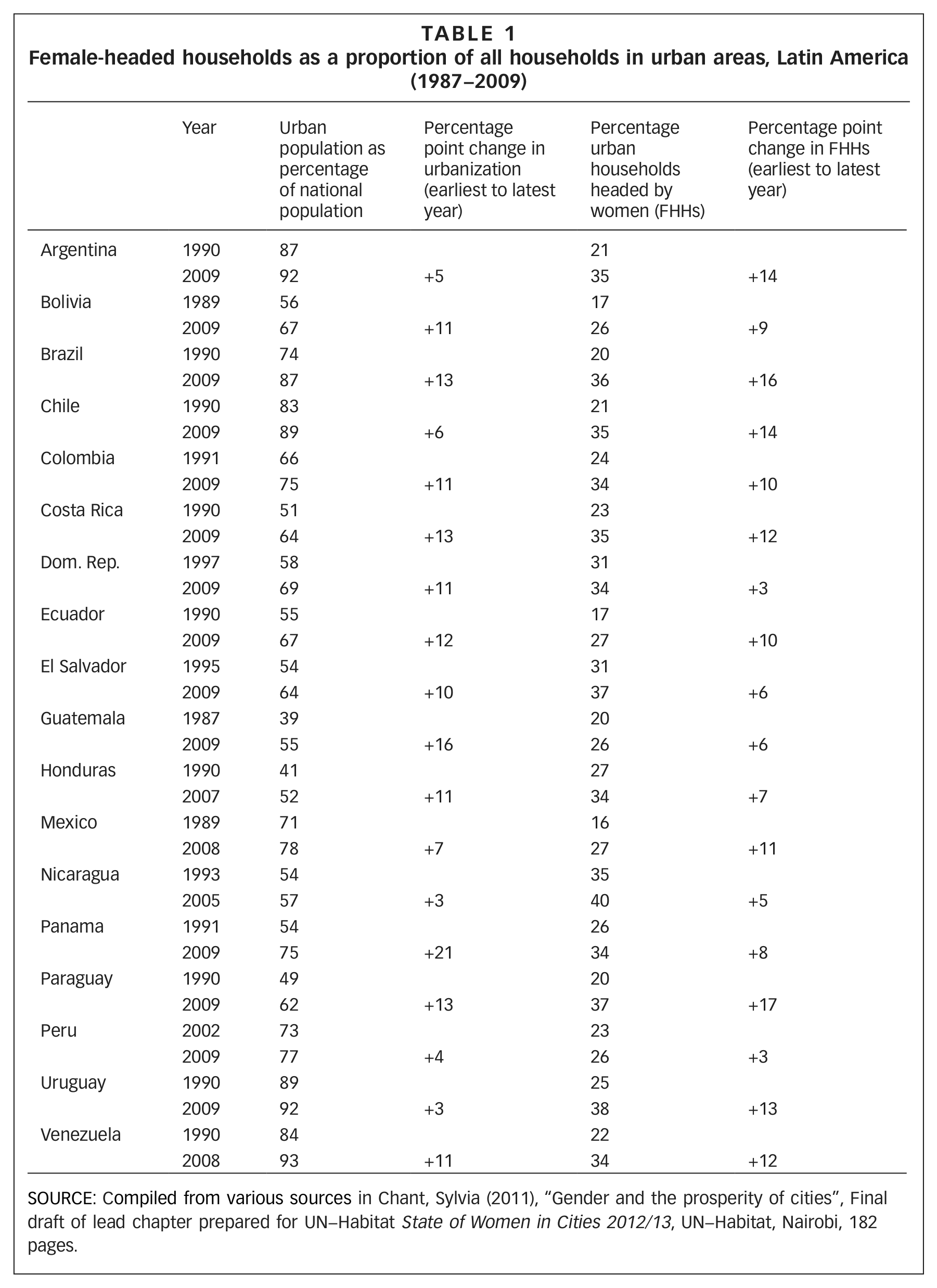
Sex-selective demographic ageing, on account of its association with widowhood, is likely to play a part in the fact that female-headed households (FHHs) are on the rise, especially in urban areas, a phenomenon which hitherto has been particularly marked in Latin America (Table 1).
Female-headed households as a proportion of all households in urban areas, Latin America (1987–2009)
SOURCE: Compiled from various sources in Chant, Sylvia (2011), “Gender and the prosperity of cities”, Final draft of lead chapter prepared for UN–Habitat State of Women in Cities 2012/13, UN–Habitat, Nairobi, 182 pages.
Over and above urban demographics such as the cumulative legacy of female-selective urbanward migration in Latin America, driving factors in the formation of FHHs here and elsewhere include greater access to employment and independent earnings, reduced entanglement in and control by patriarchal kinship systems,(19) and higher levels of urban female land and property ownership.(20)
The greater autonomy and agency experienced by urban women is likely to be pertinent not only to the formation of FHHs, but also in helping to account for the fact that, despite conventional wisdom, there is no clear or systematic relationship between FHHs and poverty in urban areas.(21)
c. Cities, gender and fertility
Declining fertility is an integral aspect of the demographic transition and has been regarded as central both to urbanization and to women’s progressive “emancipation”.(22) Yet total fertility rates (TFRs) are commonly higher among poorer groups of the population and in slums(23) than in the wealthier urban neighbourhoods.(24) In urban Bangladesh, for example, the TFR in slums is 2.5 compared to 1.9 for non-slum settlements.(25) Such disparities owe to uneven information on reproductive health, unmet needs for family planning, and slum/non-slum variations in the incidence of early pregnancy and marriage.(26) In a range of countries this is often associated with early school drop-out among girls (Figure 1), condemning many to lower level jobs and remuneration throughout their lifetimes, which underlines the fact that cities are not necessarily associated with prosperity for all.
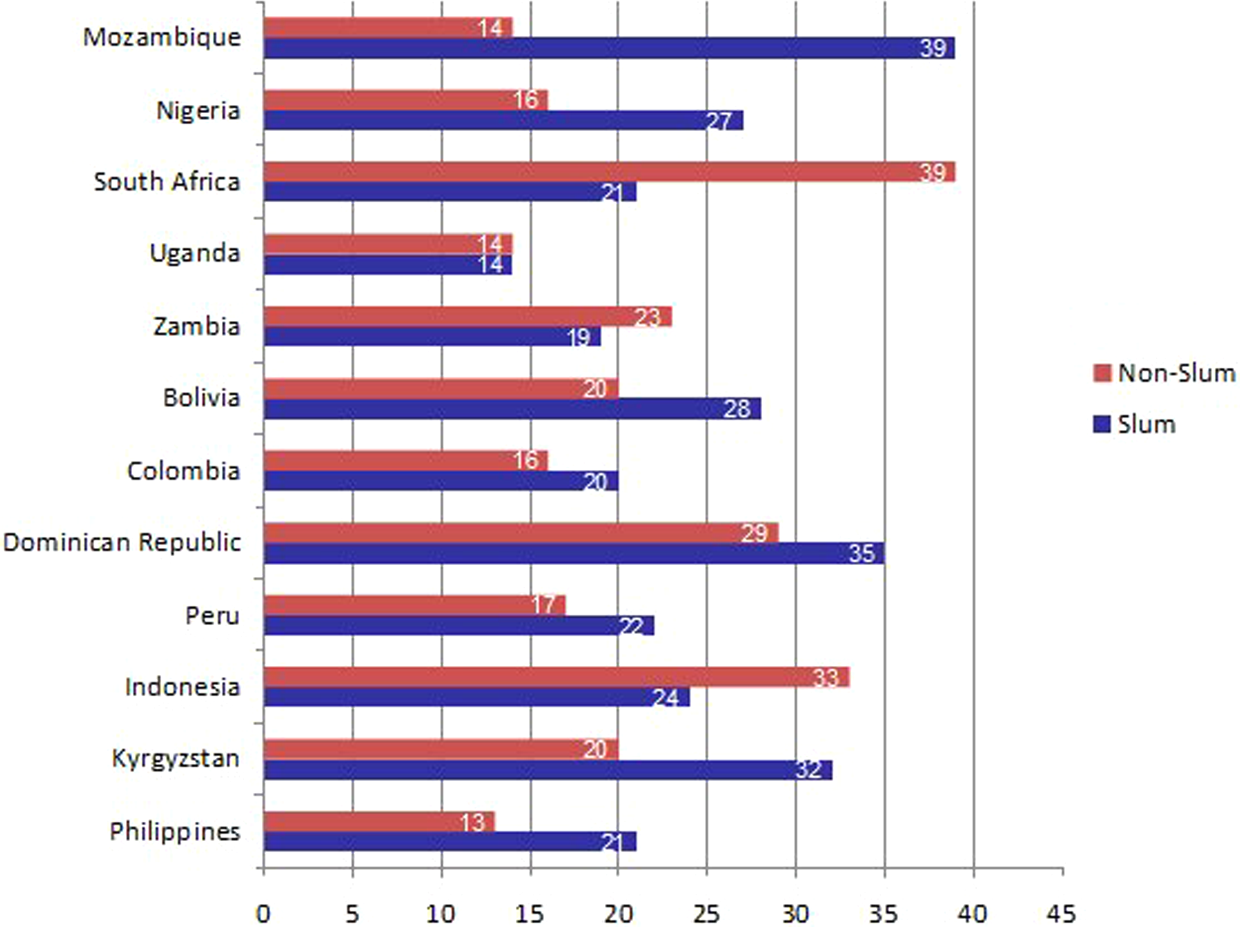
Female school drop-out rates due to pregnancy and early marriage for slum and non-slum residents in selected countries (percentage)
III. Gendered Divisions of Labour in the Urban Economy
Gender differences in prosperity also owe to divisions of labour in the paid labour force as well as in the unpaid “care economy”.(27) While men’s labour is largely concentrated in “productive”/income-generating work, women undertake the major role in “reproductive”, unpaid labour, which includes routine domestic chores as well as more specialized care work.(28) Although women across the global South are engaged increasingly in paid as well as unpaid work, this does not seem to have been accompanied by a commensurate upturn in male participation in the latter.(29) Such inequities reinforce, if not exacerbate, a female-biased “reproduction tax”,(30) which, despite the stretching of women’s overall working hours, combines with other discriminatory processes within the home and in the labour market to impinge upon the type of income-generating activities available to women, as well as leading to a lower value being placed on women’s work in the market.(31)
a. Gender divisions in remunerated work
In respect of gender divisions in remunerated work, it is well documented that in the so-called “formal economy”, women tend only to feature prominently in industry where multinational companies have opened export-processing branch plants and favour female labour because they represent a docile, but reliable, workforce that can be paid lower wages than men but at higher rates of efficiency.(32)
Although the development of information and communications technology has the potential, as a new economic sector, to provide a “gender-neutral”, or at least more level, playing field, there is little evidence to date that women are making as much headway as men, being generally confined to low level routine tasks such as data entry.(33) While not denying that some women have been able to secure niches in comparatively well-remunerated sub-sectors, such as call centre work,(34) as cautioned by UNRISD: “The boom of information technology services and of the off-shoring of office work by multinational companies [have] opened up career opportunities in formal skill-intensive employment for educated, English-speaking women from the urban middle classes. While women make up a large share of the workforce in this emerging sector, segmentation and discrimination along the lines of gender, caste and class are widespread, and women tend to be concentrated in low-end occupations.”(35)
It is also important to countenance that the urban-related “feminization of labour” (in respect of the rising engagement of women in remunerated work) has been accompanied by an “informalization of labour” across the global South, particularly since the debt crisis of the 1980s and the neoliberal economic reforms that have followed in its wake. Moreover, analysis of the recent global financial crisis suggests that this is impacting heavily on the poorest workers in the informal economy, who in the majority are female.(36)
Gaps between women and men in the informal economy owe to several factors including women’s restricted use of space, their lower levels of skills and work experience, limited access to start-up capital and their often secondary (and under- and/or unpaid) roles in “family businesses”.(37) As a result of constraints on women’s spatial mobility arising from moral and social norms, and due to the demands placed on women by reproductive ties, women’s informal economic activities are commonly based at home (Figure 2).
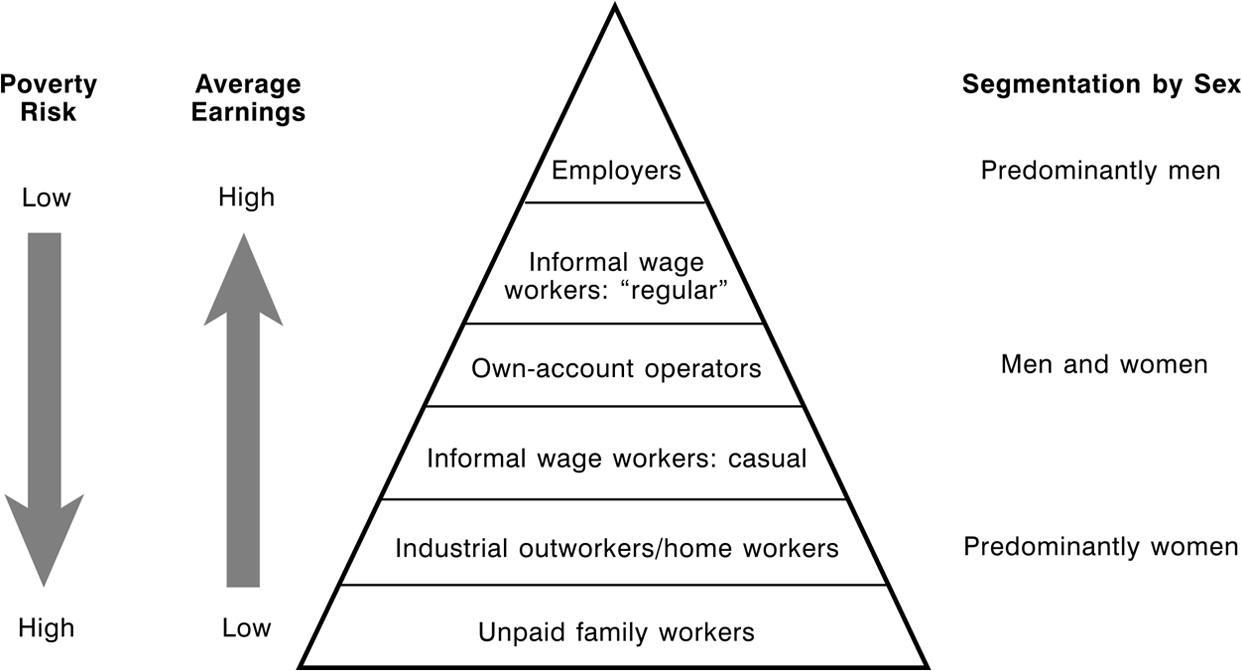
Segmentation by sex within the informal economy
Domestic-based income-generating options are especially limited in nature and earning potential for female slum dwellers, whose frequently peripheral locations, compounded by inaccessible or unaffordable transport, hamper access to wider and more remunerative markets and whose reproductive time burdens, exacerbated by inadequate services and infrastructure, afford them little flexibility.(38) A further consideration is that competition among women in similar situations, who may only have scope to engage in a narrow range of under-capitalized activities, can lead to a “discouraged labour effect” and workforce drop-out.(39)
Yet discouraged or not, the pressures on poor households to generate income means that women increasingly spend more time in remunerated endeavours, while also continuing to undertake the bulk of unpaid domestic labour and care work. These multiple activities exert additional demands in terms of “patching together” activities that are often separated in urban space, such as shopping, child care and employment.(40)
Another factor with inter-generational implications is that daughters often have to assume a greater share of reproductive labour, which may cause absenteeism from school or early drop-out, thereby inhibiting their own accumulation of human capital.(41)
IV. Gender Disparities in Human Capital
Gender disparities in human capital pertain to education, vocational training and skills, and are not only critical in terms of women’s participation in labour markets and economic growth overall(42) but are also an integral aspect of “personhood”, affecting women’s general capacities, their self-esteem and their ability to exert agency.(43) Educated women, on average, delay marriage and childbirth, are less vulnerable to HIV/AIDS, enjoy more power in their homes and in public arenas and have fewer children, who also tend to be healthier and better educated.(44) Despite closing gender gaps in education, women still constitute approximately two-thirds of 774 million adult illiterates worldwide.(45) Among contemporary generations of girls, completion of education (especially at secondary and tertiary levels) is often disproportionately low.(46)
Young women may be withdrawn from school (if they are actually enrolled in the first place) because their parents or guardians may not perceive girls’ education to be important or because their labour is needed from an early age to help out with unpaid chores or household finances, even if there is considerable evidence that young people can and do combine work and schooling.(47) For girls who reside in slums, pressures may be exacerbated by lack of space, light, peace or basic infrastructure to undertake essential private study.
V. Gender Gaps in Physical Capital/Assets
Gender differences in access to housing (a “private” asset), along with gender-differentiated impacts of deficient services and infrastructure (public assets), also pose major barriers to women’s access to urban prosperity.
a. Land and housing
Housing is critical to women in numerous ways, as summarized by Miraftab: “Housing is a key resource for women; it is an asset important to their economic condition and central to their physical and social well-being. It is the site of child rearing and income generation and a nexus for social networks of support and community-based reliance… Housing is a significant economic asset to women that contributes to their independence, economic security and bargaining power with men in their households and in society at large. Most importantly, it helps women determine their own futures and make the decisions that affect their lives.”(48)
Moreover, housing is critical to people’s identity, dignity and sense of belonging, especially if their rights are upheld by law,(49) and in constituting a pathway out of poverty(50) can also be a route to prosperity.
Despite the fact that gender equality in rights to land and housing has been established in numerous international treaties and conventions,(51) gender continues to be a major axis of shelter discrimination, with COHRE asserting that: “When addressing housing as a human right, it is impossible to adopt a gender neutral approach. Women, either by law or by action, are excluded from or discriminated against in virtually every aspect of housing.”(52)
Although there is rather limited sex-disaggregated statistical information on land and property ownership,(53) estimates show that women represent less than 15 per cent of land and property owners worldwide. Despite the assertion that women’s long-run prospects of securing property are better in towns and cities than in the countryside – partly because of greater social and economic opportunities(54) and partly because more land and property is acquired through the market rather than inheritance – it is important to recognize that women’s general disenfranchisement in rural contexts “…reaches deep into urban areas.”(55) Indeed, data gathered from 16 low-income urban communities in developing nations showed that only one-third of owner-occupiers were female.(56) Although some housing programmes prioritize female heads, as in South Africa,(57) in male-headed households title almost invariably goes to men.(58) Bearing in mind caveats in data, it is also important to underline that in sub-Saharan Africa and the Middle East and North Africa, inheritance rights remain so glaringly unequal that even where there is total equality in property rights in principle, this is rarely the case in practice (Figure 3).
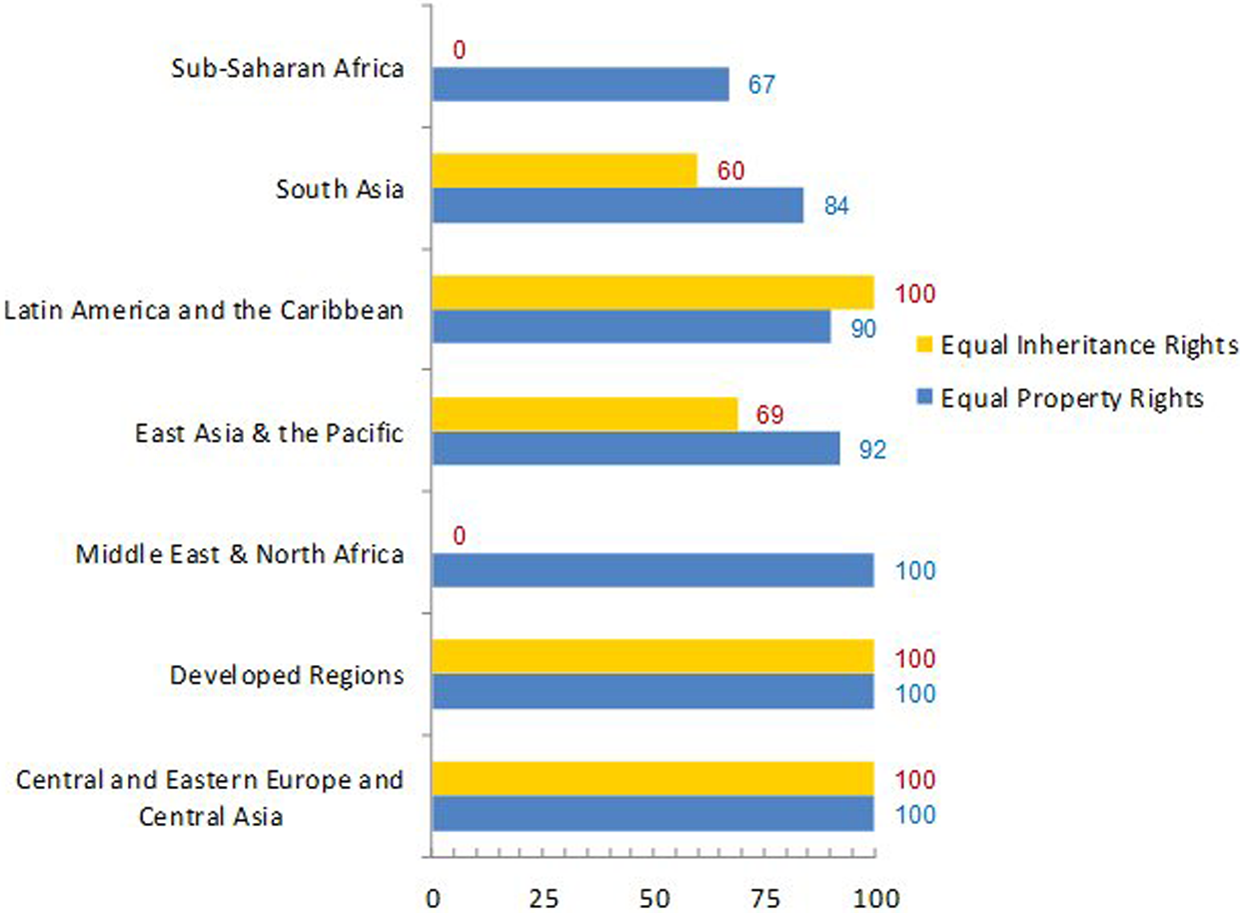
Gender equality in property and inheritance rights by region (percentage)
Women’s access to land in most parts of the world is usually through husbands or fathers, and their rights over it so tenuous that divorced or deserted women commonly face eviction and/or homelessness in the event of conjugal dissolution. The same applies to widows who may be subject to “property grabbing” by their husband’s kin, as noted in India by Nakray in the context of women whose spouses die of HIV/AIDS,(59) as well as in many parts of sub-Saharan Africa.(60) Indeed, the only alternatives for widows facing destitution through dispossession may be to subject themselves to various demeaning and/or self-sacrificial strategies to retain rights to property, such as committing to post-conjugal celibacy or entering into forced unions with their spouses’ brothers (Levirate marriage).(61) Moreover, women may be disenfranchised as daughters, regardless of the efforts they have made to support parents and/or brothers economically.(62) In some cases, as noted in India by Jackson,(63) mothers may favour the inheritance of sons over daughters given the expectation that the former will provide for them in their old age. And even where both spouses are alive, and women may be de jure owners of land or property, this may mean little in respect of their de facto rights over sale, transfer or even utilization.(64)
Over and above deeply entrenched patterns of patriarchy, which require women to defer to men’s prerogatives in respect of ownership and management of key household assets,(65) common explanations for gender disparities in shelter and the tendency for land and housing to be registered in the name of (male) “household heads” include women’s limited access to stable employment and earnings, finance and credit.(66)
In respect of unpartnered women, qualms about safety and security may prompt them to opt for dwellings annexed to landlord-occupied rental housing rather than venturing into the owner-occupancy market, as noted for slums in Luanda, Angola.(67) Yet rental shelter may be just as problematic for women as owner-occupancy. For women on their own, lack of regular employment and earnings can act as an obstacle to securing a rental contract or one that does not require a substantial downpayment. An additional factor, noted by Vera-Sanso(68) in southern Indian cities, is that rental accommodation may be hard to obtain or hold onto in the face of aspersions about the sexual propriety of women without male “guardians”. Discrimination against single women, especially young women, on these grounds is also noted in Tanzania, where it can be compounded by stigma against HIV/AIDS-affected individuals.(69) In Quito, Ecuador, where the majority of lesbian women rent single-occupancy accommodation, discrimination on the basis of sexuality is a further issue.(70)
Poor women’s limited access to land and property in cities, whether owned, leased or rented, places a major brake on their prospects of prosperity insofar as this restricts the establishment of microenterprises. Lack of ownership or control of dwellings means that scope for entrepreneurial activities is limited by landlords, or by fellow family members or residents in cramped overcrowded dwellings or multi-occupancy compounds. Moreover, women may not only lack a physical base or space appropriate for storing and/or protecting their produce or machinery but may also suffer from a poor location and inadequate services and infrastructure, which exacerbate the obstacles to exiting poverty.
Whether driven by economic constraints, legislative barriers or sociocultural norms, a picture obtains in many cities where those who are the main occupiers of housing are often those with the fewest rights. The injustice of this situation is further underscored by the fact that women frequently make substantial contributions of time, money and labour to the housing stock in urban areas of the South.(71)
b. Urban services
The more “public assets” of safe drinking water and sanitation were collectively established as a human right by the UN Human Rights Council in 2010. Yet although access to water is progressing in line with Millennium Development Goal targets,(72) it is important to bear in mind that this does not cover water for bathing, washing and cleaning.(73) Improvements in sanitation are even less encouraging. In urban Tanzania, for example, the outstripping of investments by demographic growth means that in informal settlements several households are forced to share a single pit latrine, which not only causes discomfort and risks to health but also poses questions regarding responsibility for cleaning.(74) In India, less than one-quarter of slum households in Chennai, Delhi, Mumbai and Kolkata have access to improved toilet facilities.(75)
Evidence suggests that gender-inequitable time burdens resulting from service deficits greatly constrain women’s ability to benefit from urban prosperity.(76) Where decent services do not exist, or are compromised by lack of affordability where privatization has taken place, women have to engage in several forms of compensating labour. Where dwellings lack domestic mains-supplied water, for instance, women have to collect it from public standpipes, wells, boreholes, rivers or storage drums served by private tankers. At communal sources, women may also have to compete with one another, compounding the stress and conflict associated with routine chores.(77) Furthermore, the costs of water may be prohibitive, up to 8–10 times more from private than public suppliers.(78)
Where electricity is not available, time has to be spent collecting or buying fuel, making fires to cook and heat water, and shopping on a daily basis due to the lack of refrigeration. Where there is no rubbish collection, or people cannot afford to pay for private waste contractors, women have to dispose of solid waste, and in cases where there is no domestic sanitation, faecal matter and waste water too.(79) Needless to say that having to care for children in such contexts adds massively to women’s “time poverty”.(80) The heavy “reproduction tax” exacted by these burdens reduces women’s potential for rest and recreation, not to mention well-remunerated “decent work”, as well as compromising human capital formation among younger generations of women. Another critical consideration is that lack of services thwarts women’s ability to engage in the kinds of small-scale, basic income-generating activities such as food preparation and laundry work, which might be their only option in a situation of limited skills and training and exiguous start-up capital.
A lack of services impacts not only on women’s and girls’ workloads but also on their dignity and self-respect. Although sanitation shortfalls affect everyone, there is little doubt that women suffer most, for example on account of having to use shared facilities when experiencing menstruation or when pregnant, or, for reasons of propriety, to restrict the times they use or accompany their children to communal toilets.(81) It is also important to remember that concerns in this area relate not only to sanitation per se but also to lack of water and/or private spaces for bathing and cleaning. As stressed by Joshi, Fawcett and Mannan, being unable to fulfil norms of personal hygiene (not least to be able to present for employment) or failing to maintain clean dwellings (in accordance with norms of “good housewifery”) is just as stressful to slum-dwelling women as is a lack of sanitary facilities for themselves or visitors.(82)
Further difficulties arise because women may also be limited in their use of shared toilets and wash blocks because of fear of violence en route or at destination, as described for Nairobi’s largest slum, Kibera, by Amnesty International.(83)
c. Violence and gender in urban areas
The importance of addressing violence against women in urban contexts is widely recognized at citywide, national and international levels.(84) While men are more likely to become fatalities of urban violence, especially in the context of young male members of slum/gang-based groups,(85) women are as frequently, if not more, at risk of violence in their own neighbourhoods as well as in cities at large, especially where they have to venture out of their homes to collect water or to use communal sanitation facilities.(86) While young women might be especially prone to sexual abuse, including gang rape, elderly women may also be vulnerable along with women who “transgress” heteronormative boundaries, such as those who, in one form or another, live “independently”. This includes lone women and lone mothers who, as revealed by evidence from slums in Bangladesh, India and Kenya, are often so insecure about living without men that they opt to stay in abusive relationships with “real” or “make-do” husbands.(87) Sexuality is another issue, with a reported 90 per cent of lesbian women in Quito, Ecuador, having suffered abuse in their neighbourhoods on account of “lesbophobia”.(88)
Where dwellings are flimsy and there are no security patrols, women may be vulnerable to break-ins, theft and rape in their own homes.(89) Another crucial issue is that women’s lack of ownership or entitlement is widely regarded as weakening their defence against domestic violence.(90) The relative anonymity of some female urban dwellers, especially recent migrants, may make them more vulnerable to attack from strangers, or in cases of intimate partner abuse, less able to seek protection from kin or neighbours.(91)
Domestic violence affects an estimated one in three women across the world,(92) which taken into consideration with other forms of violence in urban areas, especially slums, makes women twice as likely as men to suffer acts of violent aggression.(93) Indeed, a global study conducted by the Centre on Housing Rights and Evictions led to the conclusion that: “Violence against women in…slums is rampant…and emerges as perhaps the strongest cross-cutting theme.”(94)
d. Urban health and gender
Gender-based violence is now recognized as a major health issue affecting women,(95) and compounds a host of other problems pertinent to physical and mental well-being that disproportionately affect female residents of cities and slums and that pose major barriers to women’s prosperity.
For slum-dwelling women, risks to physical and mental well-being are aggravated by a range of “stressors” attached to their inputs to household reproduction.(96) For example, the use of solid fuels such as biomass (wood and crop residues), coal and charcoal for cooking is far more harmful to the environment (through deforestation) and to individuals (through lung and atmosphere-polluting hydrocarbons and carcinogens) than “cleaner” more expensive options such as kerosene, liquid petroleum, gas and electricity. This is especially the case in cramped, poorly ventilated spaces, such that “indoor air pollution” has been termed a “quiet and neglected killer” of poor women and children.(97) And where water is not available domestically, severe fatigue, strain on joints and other ailments can arise from having to carry vessels over long distances, often up or downhill on rough footpaths, or over ditches and open sewers.
In spite of patchy data on mental health, poverty and gender in the global South, evidence from São Paulo, Brazil, reveals that common mental diseases (CMDs) are highest (at 21 per cent) in the poorest socioeconomic district of the city and lowest (12 per cent) in the wealthiest.(98) This resonates with recent evidence from South Africa that shows a higher prevalence of CMDs in Cape Town’s peri-urban slums (35 per cent) than in rural areas (27 per cent), and that gender (being female), unemployment and substance abuse are the most common correlates.(99) Indeed, coping with the loss of household earners, caring for the sick and dealing with death means that female-headed households may be at an above-average risk of an “urban penalty” in health.(100)
VI. Gender Divisions in Space, Mobility and Connectivity
Women’s access to different spaces in the city – especially public space – is generally more limited than for men, not only on account of the association of reproductive labour with the home, which impinges on the time and ability to engage in extra-domestic activity, but also because of strong symbolic dimensions surrounding the “forbidden” and “permitted” use of spaces governed by patriarchal power relations and norms of female propriety, which may require certain modes of dress, behaviour and limitations on social interaction to render women “invisible” or unapproachable.(101) Limited female mobility can seriously jeopardize women’s prospects of benefiting from “urban prosperity”, through lower literacy rates resulting from non-attendance at school, limited ability for social mixing and restricted labour force participation.(102) Use of, and access to, space among women is also frequently cross-cut by time, such that without private or company-provided transport facilities, women’s mobility in the “urban nightscape” is parlous.(103)
Gender-blind transport planning often assumes male labour patterns, prioritizing travel from peri-urban areas to city centres during “peak hours”. This ignores women’s dominance in domestic, informal, part-time work in non-centralized zones, non-peak journeys and disproportionate household and care burdens – reflected in “trip chaining”, which refers to multi-purpose, multi-stop excursions.(104) Low-income women also face particular challenges regarding transportation costs and time burdens,(105) with obstacles compounded for elderly and disabled women and women in sex-segregated societies.(106) Another crucial gender issue in public transport is personal safety and security. Where transport connections are situated in isolated or poorly lit areas, or bus and train carriages are heavily overcrowded and/or inadequately or ineffectively staffed, women and girls face verbal, sexual and physical harassment and even assault, resulting in physical harm, psychological anxiety and fear of moving around the city.(107)
It is also critical to note that even in the new “digital age”, where technology has the potential to diminish the constraints posed by physical limitations, women’s connectivity with others is commonly hampered by a gendered “digital divide”, as discussed previously.
VII. Gender Disparities in Power and Rights
The final critical component of conceptualizing the interrelationships between gender and urban poverty and prosperity relates to gender differences in power and rights.
Engagement in urban politics and governance is not just a fundamental right but also an integral and potentially major route to gender equality in urban prosperity. Accordingly, the importance of active involvement by women in civic participation has been stressed by UN–Habitat in its Gender Equality Action Plan.(108) Given that the hub of national politics and protest is usually urban based,(109) the fact that women’s parliamentary representation is one of the three main indicators in MDG 3 (to “promote gender equality and empower women”) is also a step in the right direction.
In the past decade, some advances have been made regarding women holding seats in national parliaments,(110) although in only 23 countries of the world do women comprise more than 30 per cent of the lower or single house of the national parliament.(111) And at ministerial level, the gender gap increases dramatically.(112) Taking into account local councillors as well as parliamentarians, only one in five is female in a diverse range of contexts.(113) Moreover, recent research shows that female politicians often only last a single term for a variety of gender discriminatory reasons.(114)
Yet, building on a long legacy of women engaging in collective struggle in towns and cities around the world for basic services and infrastructure, housing, health care and rights to use public urban space for informal economic activity,(115) one can observe a mounting female presence and visibility in recognized structures of urban governance. For example, in Brazil, women have been the majority of participants in budgetary assemblies in Porto Alegre, which has been a pioneer in inclusive urban governance.(116) And in India, the 74th Constitutional Amendment Act introduced in 1992 required 30 per cent of seats on local councils, panchayati raj, to be occupied by women.(117)
Despite the common claim that Indian women’s recruitment into the panchayati raj has led to their being proxies for male household members (parshad patis),(118) Beall argues that the presence of women in decision-making bodies has played a critical role in helping to prioritize matters of fundamental importance in women’s daily lives.(119) By the same token, optimism about this trend is not unqualified, partly because local government bodies are usually resource constrained and, as such, arguably offer rather limited bases for power, influence and transformation.(120) Moreover, in Ecuador and Venezuela, what Lind refers to as the “institutionalization of women’s struggles” has served to compensate for weak welfare states, while simultaneously framing women as “maternalist problem solvers”. (121) A related problem is that women’s engagement in movements and programmes around basic services and poverty reduction tends to feminize responsibility in ways that burden women even more, sideline men further and neglect “strategic gender interests” in favour of “practical gender needs”.(122)
Therefore, despite some undoubted spin-offs for women from formal and informal modes of civic participation, one major concern is how the general instrumentalism of state (and NGO) initiatives that court their engagement plays out in terms of their share of urban prosperity. Although women’s efforts in urban political and policy domains can undoubtedly help reduce income poverty and other types of hardship that are associated with the multiple gendered deprivations common to towns and cities of the global South, one also has to ask about the cost at which this comes.
While Khosla argues that without women’s engagement – especially in decision-making positions – there is little likelihood that gender issues will be granted a seat at the political and policy table,(123) to enlist poor women in the largely unpaid and fundamentally altruistic work of building better cities arguably entraps them in roles that go against the grain of transforming gender or creating a more equal share of urban prosperity.
VIII. Concluding Comments and Reflections
In this paper I have tried to show how a “gender lens”, which comprises a range of multi-dimensional and multi-spatial perspectives on urbanization, hinders women’s immediate prospects of benefiting from “urban prosperity”. Accordingly, diverse interventions are required on a number of fronts and levels.
A major issue is unpaid reproductive work, which persists in being undervalued and under-supported despite its critical role in ensuring the daily regeneration of the labour force and the very functioning of urban life. The importance of this labour needs to be recognized not only in itself but also on the grounds that it constrains women’s engagement in the labour market and most other urban “opportunities”, inhibits the development of capabilities among younger generations of women who may have to “carry the can” for the expanded burdens of mothers and other female kin, and can also seriously disadvantage children of both sexes, especially in light of the recent global financial crisis.(124)
Greater public sector investment in services such as water and sanitation would undoubtedly reduce women’s reproductive labour burdens, with the same applying to physical infrastructure such as gender-sensitive, safe, affordable and accessible public transport, and gender friendly public spaces, as advocated, inter alia, by the Global Programme on Safe Cities Free from Violence Against Women.(125) The more “private” space of housing is an indispensable part of this picture, not just in terms of quality but also in respect of ownership and tenure security, which can play a major role in strengthening women’s social, psychological, economic and political positions.
Closer compliance with gender equality in shelter, as exhorted by CEDAW and other international human rights instruments, can be approached in a plethora of ways including through state, NGO and private sector support of the numerous initiatives generated by women themselves in the form of group savings and collective land acquisition and building schemes.(126) Partnerships can take the form of facilitating gender-responsive housing finance, assistance in obtaining tenure security, subsidized materials and training in construction techniques.(127) There should also be concerted efforts to increase pro-female housing rights initiatives, such as statutory joint or individual titling, or mechanisms to ensure that they are fully represented on committees that decide on land rights in communities that observe customary law.(128) Support for paralegal services that help women realize their land and shelter entitlements is also crucial.(129) Also, recalling the importance of rental accommodation for urban women, interventions to promote their security of tenure in this sector should not be neglected.(130) And last, but not least, for women in rental and owner- or quasi-owner-occupied housing alike, greater media exposure of abuses regarding tenure security, shelter adequacy and personal safety could also be pertinent.
While various MDG targets have been important in enhancing women’s access to education and work, much more needs to be done to cater to the needs of women workers whose future will remain disproportionately wedded to the informal urban economy. Urban policies concerning land and land use are vital here, with slum clearance, the gating of middle-income and elite residential neighbourhoods, and restricted access by informal entrepreneurs to public spaces often exacting huge tolls on people’s ability to avoid poverty, let alone achieve any form of “prosperity”.
Last but not least, gender-equitable prosperous cities need to promote women’s and men’s participation in civic engagement and urban governance and politics, while avoiding the all too frequent situation whereby high levels of women’s activism at the grassroots level do not translate into high profile representation in formal municipal or political arenas.
While “smart economics” thinking seems to have permeated the urban development agenda through concepts of “smarter cities”, it is important to bear in mind that although mobilizing investments in women can have huge impacts on the generation of wealth, there is also a serious danger of instrumentalizing gender to meet these ends.(131) As such, if women are to enjoy a “golden urban age”, then gender rights and justice should remain uppermost in urban prosperity discourse and planning.
Footnotes
1.
See, for example, Dobbs, Smit, Remes, Manyika, Roxburgh and Restrepo (2011); also  .
.
3.
Krujit and Koonings (2009); also Rakodi (2008); Rodgers, Beall and Kanbur (2011); and , page 3.
5.
See Davids and van Driel (editors) (2005); also .
7.
Morrison, Raju and Singa (2010), page 103.
8.
See Chant (2011), Table 1.5, pages 39–41; also .
11.
See, for example, Massey (1994); also Jarvis, Cloke and Kantor (2009); and .
12.
As outlined in Chant (2011); also Chant and Datu (2011a); and .
13.
See Chant and Datu (2011b), , page 3.
15.
Chant and McIlwaine (2009), Chapter 3; also .
16.
Tacoli (editor) (2006); also .
19.
For example, Bradshaw (1995); also .
21.
See Chant (1997); also Chant (2007a); and .
22.
See Dyson (2010); also .
23.
The term “slum” usually has derogatory connotations and can suggest that a settlement needs replacement or can legitimate the eviction of its residents. However, it is a difficult term to avoid for at least three reasons. First, some networks of neighbourhood organizations choose to identify themselves with a positive use of the term, partly to neutralize these negative connotations; one of the most successful is the National Slum Dwellers Federation in India. Second, the only global estimates for housing deficiencies, collected by the United Nations, are for what they term “slums”. And third, in some nations, there are advantages for residents of informal settlements if their settlement is recognized officially as a “slum”; indeed, the residents may lobby to get their settlement classified as a “notified slum”. Where the term is used in this journal, it refers to settlements characterized by at least some of the following features: a lack of formal recognition on the part of local government of the settlement and its residents; the absence of secure tenure for residents; inadequacies in provision for infrastructure and services; overcrowded and sub-standard dwellings; and location on land less than suitable for occupation. For a discussion of more precise ways to classify the range of housing sub-markets through which those with limited incomes buy, rent or build accommodation, see Environment and Urbanization Vol 1, No 2, October (1989), available at http://eau.sagepub.com/content/1/2.toc and .
24.
For example, Chant and McIlwaine (2009), Chapter 3; also Montgomery, Stren, Cohen and Reed (2004).
26.
Gupta, Arnold and Lhungdim (2009), page 43.
27.
Elson (1999); also Folbre (1994); Perrons (2010); and , pages 4–5.
28.
See Budlender (2008); also Budlender (editor) (2010); Chant (1996); UN–DESA/UNDAW (2009); UNRISD (2010); and .
31.
Perrons (2010); also .
32.
Elson and Pearson (1981); also , page 35.
33.
See Lugo and Sampson (2008); also .
37.
Chant and McIlwaine (2009); also Chant and Pedwell (2008); Chen (2010); Chen, Carr and Vanek (2004); Lessinger (1990); Meagher (2010); and see also in this paper.
40.
McDowell, War, Fagan, Perrons and Ray (2006); also , page 1.
41.
See CPRC (2010); also González de la Rocha (1994); and .
42.
Klasen (2002); also .
44.
Grown (2005); also Tembon and Fort (editors) (2008); and .
46.
Lloyd (2009); also Morrison, Raju and Singa (2010); and .
50.
Moser (2006); also .
57.
Goebel, Dodson and Hill (2010), page 578.
60.
See Rakodi (2010); also Sweetman (2008); and , page 109.
61.
See COHRE (2004); also ; and Kothari (2005).
62.
See Chant (2007a), Box 4.9 on The Gambia, pages 181–183; also .
64.
Chant (2007b); also .
66.
Benschop (2004); also COHRE (2004); and , page 75.
70.
Benavides Llerena, Sánchez Pinto, Chávez Nuñez, Solesdipa Toro and Paredes (2007), sub-section 1.6.12.
71.
See Chant (1996); also Chant (2011); and .
73.
Joshi, Fawcett and Mannan (2011), page 102.
75.
Gupta, Arnold and Lhungdim (2009), page 20.
77.
78.
Chant (2007b), page 62; also , pages 897–898.
80.
Chant (2007b); also Gammage (2010); Morrison, Raju and Singa (2010); and .
81.
See, for example, Amnesty International (2010); also Chant (2011); and .
82.
Joshi, Fawcett and Mannan (2011), pages 103–105.
85.
86.
See ActionAid (2011); also Hughes and Wickeri (2011) on Tanzania, page 884; and on India.
87.
Joshi, Fawcett and Mannan (2011), page 100.
88.
Benavides Llerena, Sánchez Pinto, Chávez Nuñez, Solesdipa Toro and Paredes (2007), sub-section 1.6.12.
90.
Hughes and Wickeri (2011), page 853; also COHRE (2008), pages 14–15; and , page 16.
91.
See COHRE (2008), page 24; also , page 23.
96.
See Chant (2007b); also Ekblad (1993); and .
100. Goebel, Dodson and Hill (2010), page 579; also Montgomery, Stren, Cohen and Reed (2004).
101.
See Fenster (1999); also Fenster (2005); Jarvis, Cloke and Kantor (2009); Lessinger (1990); Vera-Sanso (1995); and .
102.
Kantor (2002); also Lessinger (1990); and .
104.
Kunieda and Gauthier (2007); also ; and UN–Habitat (2009), page 126.
106.
Jarvis, Cloke and Kantor (2009); also .
107.
Fernando and Porter (2002); also .
108.
UN–Habitat (2008b); also .
113.
UN–Habitat (2008b), page 3; also .
115.
See Benjamin (2007); also .
116.
See Jarvis, Cloke and Kantor (2009), pages 240–241.
119.
Beall (2010); see also , page 23.
122.
Molyneux (1984); also .
124.
See Esplen, Harper and Jones (2010); also , page 422.
125.
UN–Habitat (2010b), page 13; also .
127.
See, for example, Chant (1996); also Moser and Peake (editors) (1987); and .
129.
COHRE (2004), pages 77–78; also , page 84.