




Abstract
This paper explores the organizing of household solid waste management collection and disposal practices in informal settlements. It is based on a case study of an NGO project that supports Manos Unidas (Joined Hands), an informal waste picker cooperative in Managua, Nicaragua. Using horse carts, these waste pickers collect household solid waste from informal settlements where there was no previous regular, official waste collection. Unlike many development projects, which try to control people’s agency, the support examined here focused on the residents of illegal neighbourhoods and the waste pickers, who themselves became city constructors and co-producers of basic services such as household waste collection rather than service recipients of aid programmes or municipal governments. By slightly changing the actions of the actors already involved in informal waste handling in the informal settlements, the project succeeded in transforming an agent of pollution into the solution to several interconnected problems, namely illegal dumping by the cart-men and residents, the cart-men’s low and irregular incomes and the lack of household waste collection services.
I. Introduction
In many Southern cities it is common for 30–60 per cent of the urban population to live in informal settlements.(1) While informal settlements are anything but homogeneous,(2) they do share some features: they are often overcrowded, with high levels of insecurity for residents and with poor or informal housing, and they are often forgotten or abandoned by formal city management and are unconnected to most public services such as roads, pavements, water, sewage, standard housing, street cleaning and municipal waste collection. In Graham’s(3) terms, these informal settlements are not “switched on” − to use the metaphor of an electricity system.(4)
Household solid waste management collection and disposal practices in informal settlements of Southern cities, more often than not, are ignored by city management authorities and public waste collection services. Instead, the informal sector frequently provides waste collection services in these areas.(5) This paper is based on a case study of an NGO project supporting Manos Unidas (Joined Hands), an informal waste picker cooperative in Managua, Nicaragua. Using horse carts, these waste pickers collect household solid waste in informal settlements where there was no previous regular and official waste collection system.
The paper describes how the project succeeded in establishing and stabilizing a number of connections between the collective actions of those involved in the formal and informal waste collection systems (i.e. the local community, waste pickers and the municipality), thus bridging the gap between the informal settlements and the formal city through the co-production(6) of household solid waste collection in the informal settlements in connection with the formal municipal waste collection system.
II. City Management, Action Nets and Translations
As a theoretical framework for this case study, we apply Czarniawska’s conceptualization of city management as a complex “action net”, comprising collective actions interconnected according to a specific institutionalized pattern at a given time and place.(7) “The concept of action nets…”, according to Czarniawska, “…is founded on the idea that in each time and place it is possible to speak of an ‘institutional order,’ a set (not a system) of institutions (not necessarily coherent) prevalent right then and there. Such institutions shape organizing inasmuch as they dictate which actions, conventionally, should be tied together.”(8) From this perspective, city management can be understood as “…a set of actions accomplished within a seamless web of inter-organizational networks, wherein city authorities constitute just one point of entry.”(9) As we will see, numerous actors and their collective actions are interconnected in Managua in organizing the city, for example planners, politicians, development aid workers, squatters, waste pickers, community leaders, engineers, volunteers and labouring children.
Analytically, using the action net concept helps us understand how connections between actions, often loosely coupled, eventually create actors at a given time and place; for example, it is the action of occupying land illegally that makes the actor a squatter. “Translation” is “…the mechanism whereby connecting is achieved…”(10) or, put differently, the process whereby collective actions (e.g. the informal waste practices in the informal neighbourhoods and the formal municipal waste collection system) are interconnected.
III. Methodology
The data analyzed here were gathered during three field visits to Managua, in December 2009–February 2010, January–February 2011 and June–August 2012. The research was qualitative,(11) based on semi-structured interviews, observation at meetings, workshop participation and photographs.
During the course of our fieldwork, we conducted personal interviews with 60 people, including community leaders, residents, waste pickers, NGO workers, development aid organization officers, city managers, public officers, politicians, ambassadors, development aid organization managers and directors, municipal waste operators, waste collection cooperative members, waste handling and recycling corporations, NGO volunteers, engineers and architects. We also took part in non-participant observation at meetings and events during project implementation. These included meetings of development aid organizations, environmental campaigns involving cleaning brigades, social events in the studied barrios (neighbourhoods) organized by the municipality to promote the project, waste picker cooperative meetings, and a workshop to evaluate the development project with residents and community leaders. We documented these events by taking photographs and keeping a field diary of our observations.
As Lindberg and Walter have stated: “The concept of the action net is a way of studying processes rather than an analytical tool. Therefore, recognition of the existence of an action net is not a desired result of a study of organizing; it is the point of departure.”(12) Accordingly, when coding and categorizing our data,(13) we treated the new household solid waste collection service provided by the Manos Unidas cooperative as our point of departure, together with the connections with (or “translations” to) the collective actions taken by the city management and local community during project implementation.
IV. Household Solid Waste Management in Managua and its Informal Settlements
a. The official municipal waste management service
Managua’s waste management department functions directly under the central city management, which provides funding to run the operations. Every day, the department collects 1,200 metric tonnes of waste along 132 routes using a fleet of more than 80 vehicles. Approximately 40 of these are modern compaction trucks donated by Italy in 2008,(14) while the rest of the fleet comprises a mixture of vehicles – a “salad”, as one officer put it.(15) Household waste collection services are provided three times a week and households must bring their waste out to the compaction truck at the precise moment it passes by.
Only approximately 30 per cent of the waste collection costs are covered by the waste collection fee.(16) This means the service depends on funding from the municipal budget, allocated every year during the annual strategic planning. A recent report compiled by UN−Habitat in Managua calculated that a decentralized model of household solid waste collection could save up to 50 per cent of the current annual costs.(17) The report recommended constructing waste transfer stations in each of Managua’s seven districts and also replacing compaction trucks with dump trucks for primary household waste collection. According to the recommendations, waste would be disposed of at waste transfer stations in the city districts and then transported by container trucks for final handling at the municipal landfill. The new decentralized waste management system would reduce the number of transportation routes for the primary collection vehicles as they would not need to go to the municipal landfill to dispose of the collected waste. Similarly, the use of dump trucks instead of compaction trucks would reduce costs since they are cheaper to run and maintain, especially on bad roads. Despite the huge savings that would be realized by a more decentralized waste management system, city management is still reluctant to replace modern waste compaction trucks with a “less modern” technology.(18) At the time of writing this paper, the waste management model comprising waste transfer stations supported by a fleet of more appropriate vehicles for household waste collection was being tested in pilot projects in city Districts 5, 6 and 7.
b. Household solid waste management in informal settlements in Managua
The Managua local government city map shown here (Figure 1) indicates the city waste collection routes and shows a number of blank white spaces unserved by these routes. These blank spaces represent the spontaneous settlements created after illegal land invasions by squatter communities, mostly in the 1980s and 1990s.
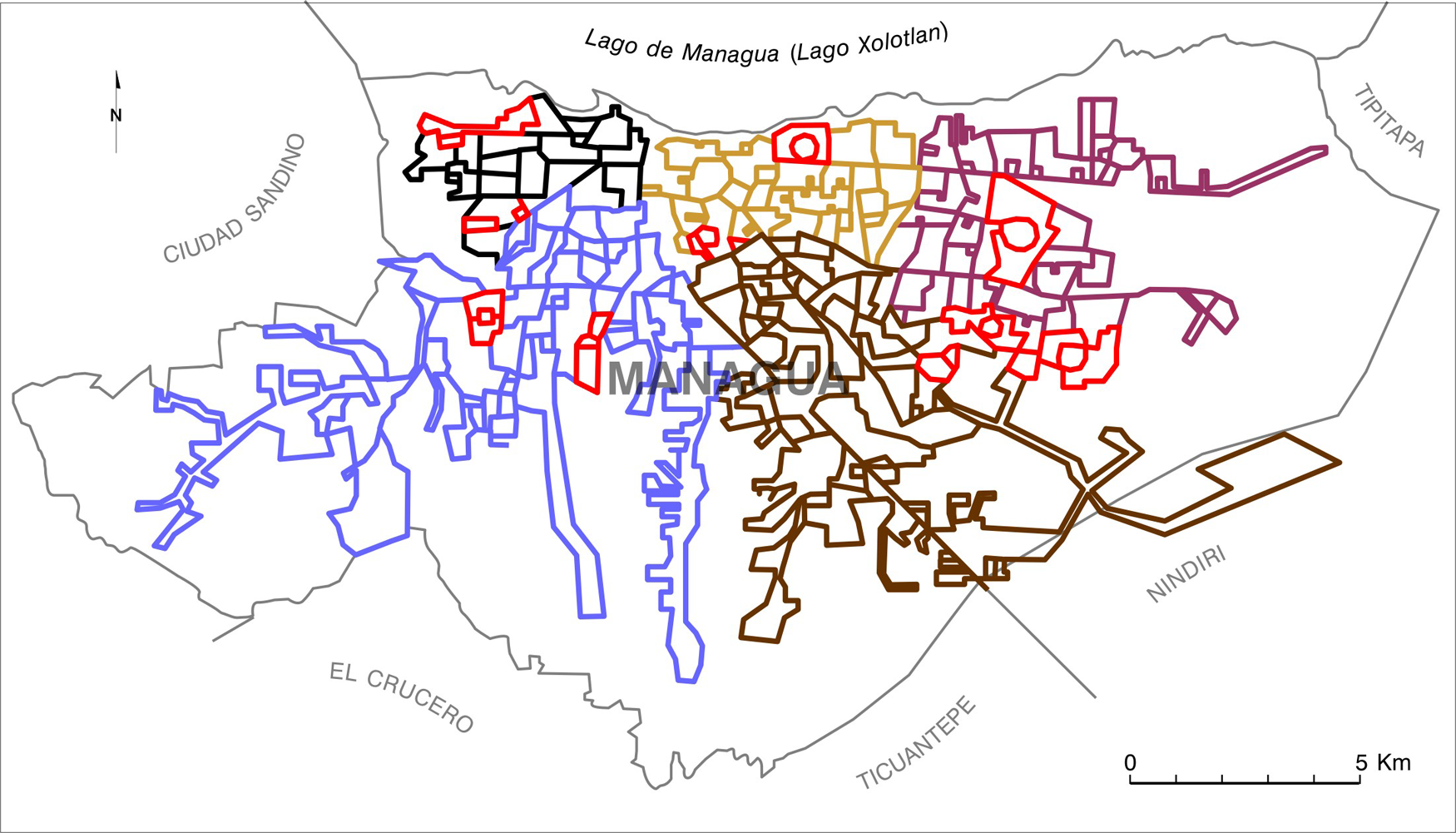
Map of Managua showing the city waste truck routes. Note the un-routed areas
Up to 40 per cent of the city of Managua consists of these informal settlements,(19) which are represented on city planning maps as undeveloped areas or open space, as if (in the words of Hardoy and Satterthwaite) “…the illegally developed sites occupied by thousands of households somehow did not exist.”(20) Maps like this clearly “…illustrate official attitudes to these settlements.”(21) Many of Managua’s informal settlements, which appear as blank spaces on city management maps, are ignored by official city plans, documents, city management and municipal services.
Official waste collection services are no exception. Even where city government chooses to provide service to these settlements, it is impractical given the current situation. Narrow alleys full of potholes and a multitude of hanging cables and other hindrances that are typical of the informal settlements of Managua mean that new and technologically advanced, but delicate, waste compaction trucks cannot enter or, if they do, they soon break down (Photo 1).
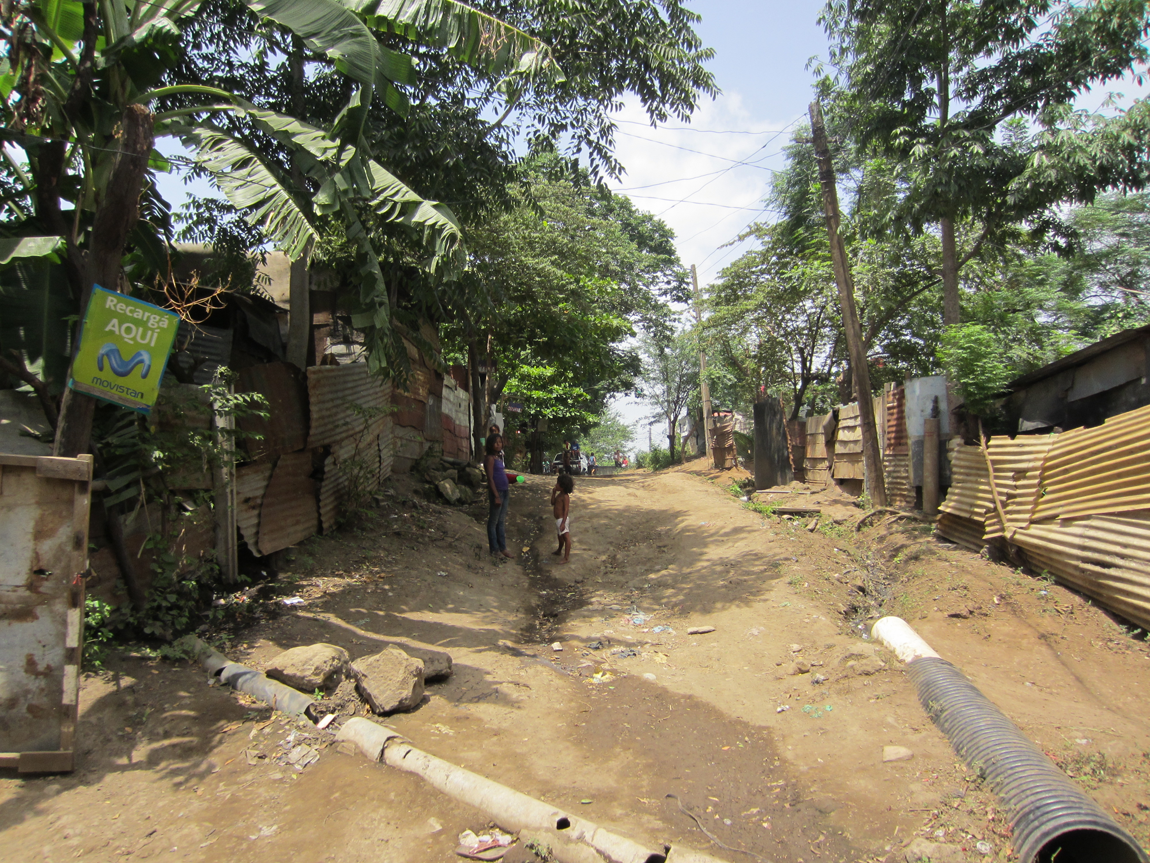
Narrow street that waste compaction trucks cannot enter because of low hanging cables, trees and the condition of the road
Although municipal statistics ignore the fact, the residents we interviewed in some of these informal settlements confirm that municipal waste trucks collect waste occasionally, at best, and only in the main streets. Since residents have to take out their waste bags at the exact moment when the truck passes, it is impossible for many residents of inner streets to make use of the service (Photo 2).
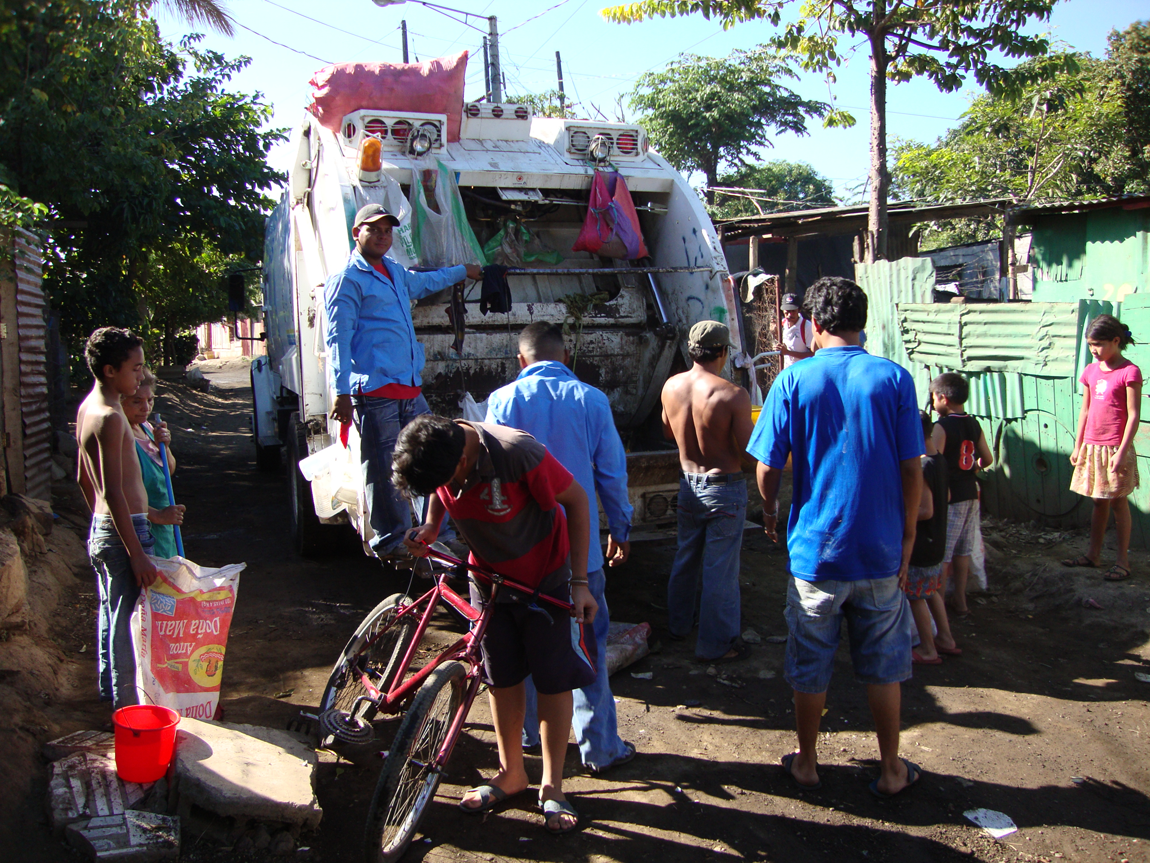
Waste compaction truck on a dirt street in an informal settlement where it is possible for it to enter. Note the low cables and the hanging sacks on the back of the truck that contain sellable recyclables that the workers sorted while collecting
Even in informal settlements that are accessible to modern compaction trucks, waste collection services are reportedly very irregular and unreliable.(22) In 2009 in Managua District 5, it was estimated that 33 per cent of households were not served at all by official municipal waste collection, while the service provided to other households was inadequate.(23)
In these circumstances, residents of unserved barrios often dump their waste in the closest storm canal or even pay barrio children to collect the waste and dump it somewhere else, resulting in the formation of illegal dumps (Photo 3). These illegal practices have many implications for local residents, the waste recycling economy and the city district, including higher municipal costs to clean and collect waste from the storm canals and roadsides (Photo 4); damage caused by frequent flooding because storm canals and drains are blocked by waste; lost opportunities to recover recyclables due to ineffective waste handling; unhealthy working conditions, stigma and very low and irregular incomes for those handling waste; the connection to child labour and other forms of labour exploitation; pollution of air, water and soil; the proliferation of vermin; and the spread of vector-borne and respiratory diseases, with the concomitant increase in medical expenses and work and school absenteeism.(24)
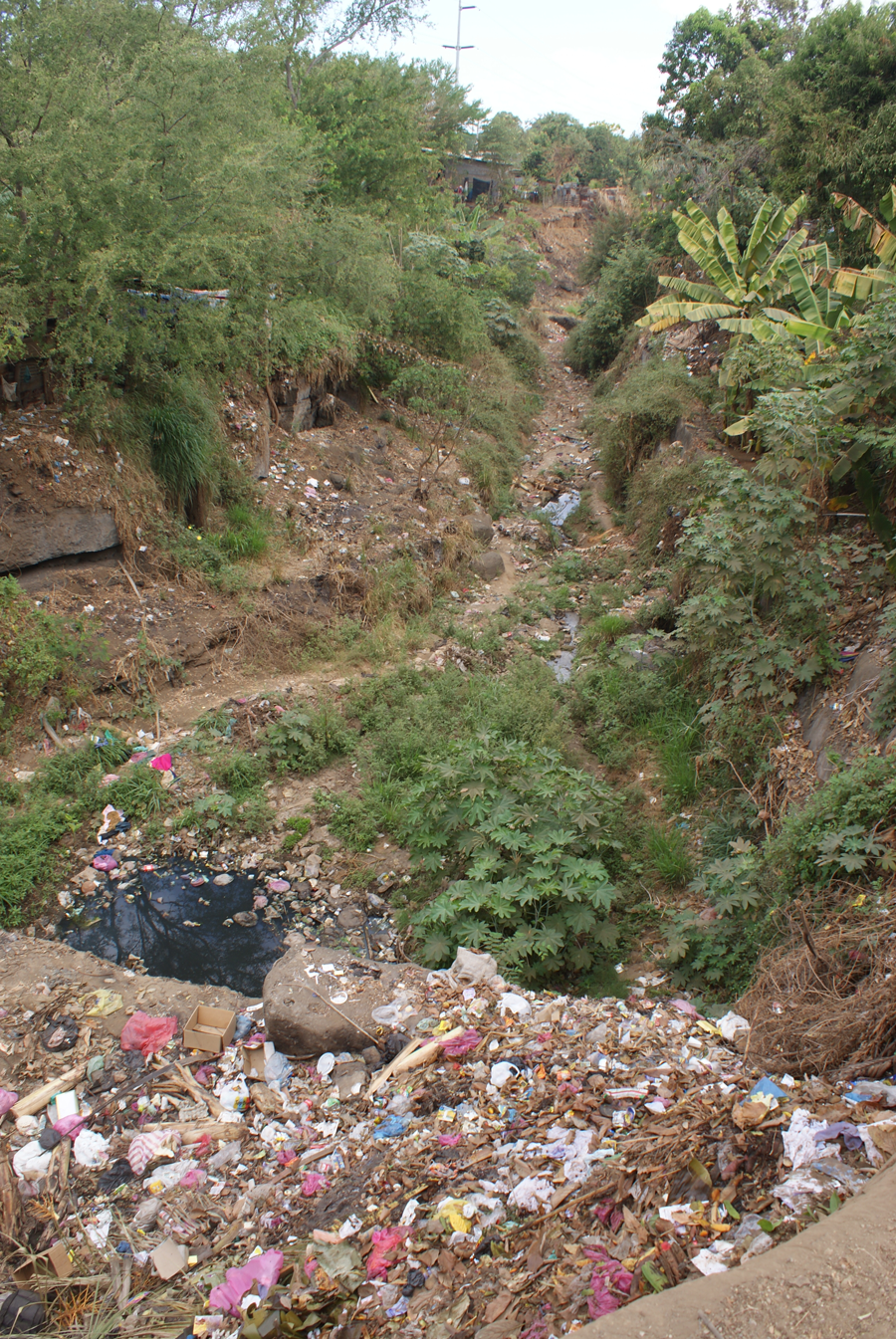
River bank with illegally dumped waste
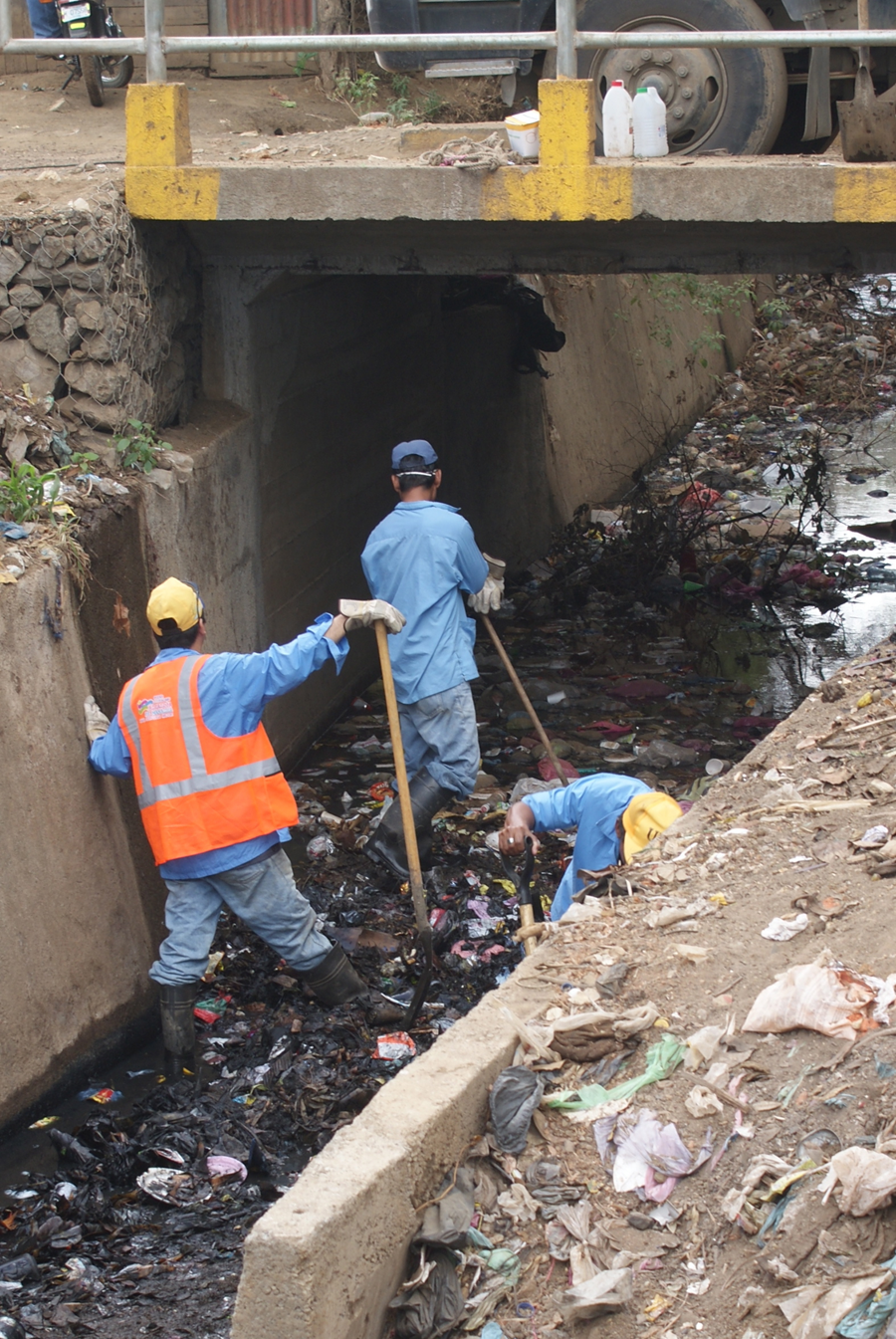
Waste dumped into a storm canal is being cleared away in preparation for the rainy season
V. The Manos Unidas Waste Management Project
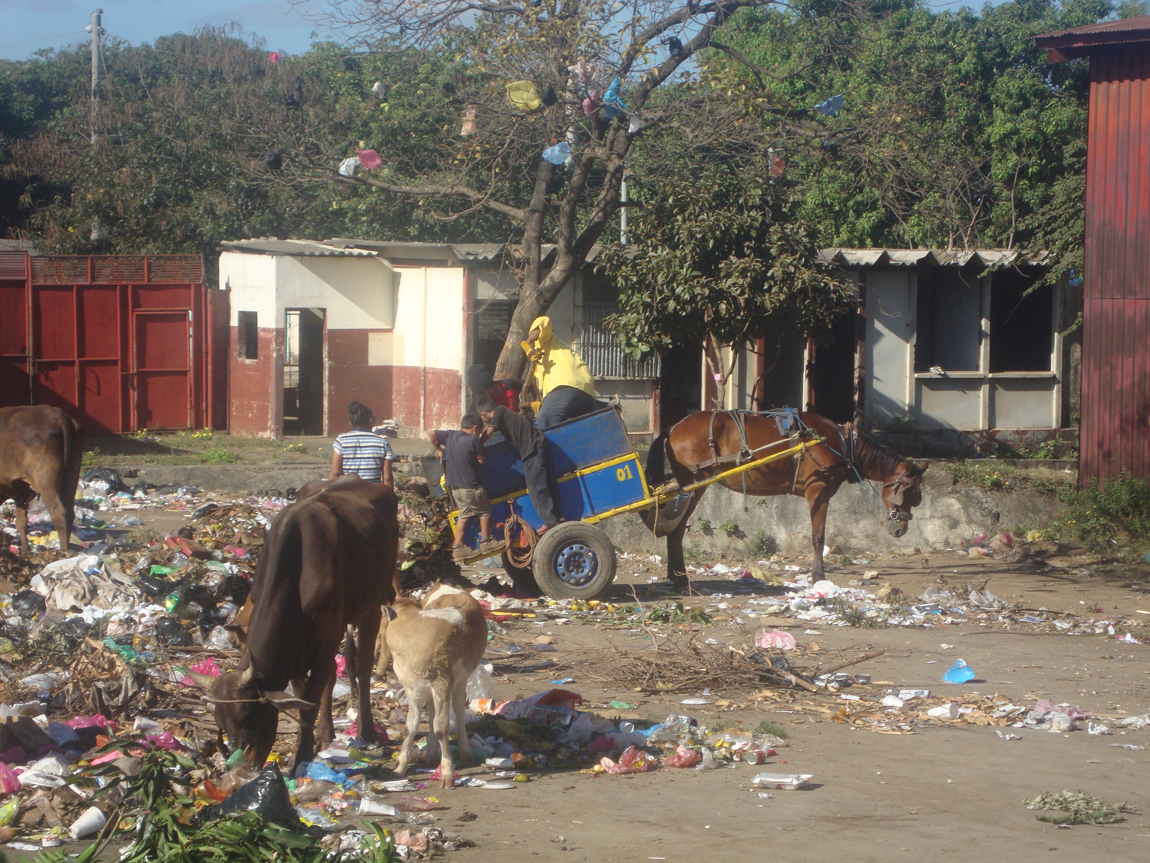
Manos Unidas is a cooperative of 18 cart-men who collect household solid waste from several barrios in District 5 as a result of a waste management project supported by Habitar, a local NGO, and the United Nations Development Programme (UNDP) in Nicaragua. Prior to the project, the cart-men collected debris and garden waste from wealthy barrios, disposing of it in nearby clandestine dumps (Photo 5). They had low and irregular incomes, were persecuted by the police and were stigmatized by local communities as sources of contamination.
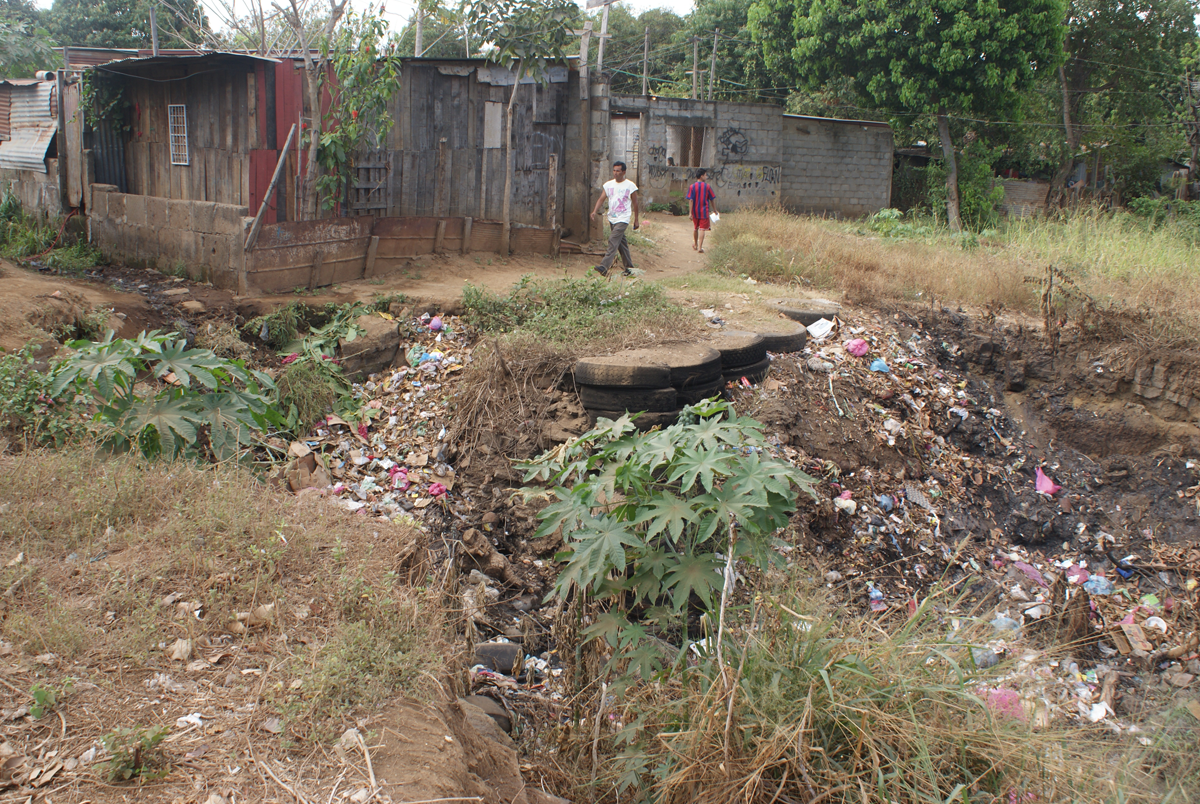
Informal settlement with a clandestine dump − District 5, central Managua
According to the Habitar representative: “For the city officers and their experts, the cart-men were nothing but a problem.” In the opinion of the Habitar representative, this preconception simply implied that these officials were “…unaware of what the real city of Managua is. They just do not know the reality in the informal settlements. For example, in many pulperías [local stores] horse shoes and horse food are sold…”, making it obvious to those who choose to look that horses, and therefore cart-men, are operating in the city. The institutionalized dimension of the informal waste practices in the spontaneous settlements was largely unseen by city authorities but familiar to local NGOs such as Habitar, which had been implementing other waste infrastructure projects in the barrio for several years.
The familiarity with informal waste collection practices that Habitar had gained was crucial to identifying the Manos Unidas cart-men as a potential agent to provide household waste collection services in District 5. As a result, in 2009 the necessary funds were approved for the project, which was named Proyecto Alianza para el Manejo de los Desechos Sólidos en el Municipio de Managua (Public−private partnership for household solid waste management in the city of Managua). The project, which had a total budget of US$ 214,930, was to be implemented from 2009 until 2012. It was funded through the UNDP Public−Private Partnerships for Service Delivery (PPPSD) in partnership with WASTE, Advisors on Urban Environment and Development of Gouda, the Netherlands. The executing entities were the local NGO Habitar and the municipality of Managua.
During 2009, the cart-men were trained in the necessary competencies (i.e. accounting, management, law, waste management, labour risks, care of animals) to perform this new service. The project also supported Manos Unidas in the design of the service (e.g. frequency, pricing) and the collection routes. Simultaneously, during the first year of the project, Habitar started campaigns with the support of community leaders and other grassroots organizations in the barrios, both to increase the awareness of more appropriate waste handling practices and to introduce the household waste collection service by Manos Unidas.
In 2010, the cart-men were temporarily licensed by the city authority to collect household solid waste in District 5. After a first pilot year, in 2011 a formal agreement was signed between the Managua city management and Manos Unidas to collect household solid waste on agreed routes in District 5.
The collected waste was disposed of at a waste transfer station in District 5, where the municipal waste trucks could collect and transport it to the municipal landfill. The project initially planned to use the waste transfer station as a model for more sustainable waste handling practices, such as recycling, composting and re-using. However, legal issues regarding the tenancy of the land and difficulties engaging with the municipality hindered the renovation of the place and the construction of new infrastructure. Instead, the waste transfer station remained simply a place to dispose of the household waste collected in the barrios, from where it would be removed by municipal trucks.
The project officially ended in 2012, although at the time of writing this paper Habitar and UNDP continued to support Manos Unidas and the barrios in District 5 through other programmes. Since then, the municipality has irregularly fulfilled the signed agreement. In the first months of 2012, the waste transfer station was not cleared regularly, causing considerable pollution in the surrounding area and complaints from neighbours. Order was restored at the waste transfer station a few months later when municipal waste trucks once again started removing waste regularly. The municipality had formulated a project to get the necessary resources to equip the waste transfer station with more appropriate physical facilities, and during our last field visit in July 2012 we witnessed ongoing construction.
Further complicating the situation, during 2012, a year of municipal elections, the city began collecting household solid waste from some of the main streets in the informal settlements where Manos Unidas operates, an infringement of the signed contract. As a result, Manos Unidas continues to struggle to provide a stable and regular service along the agreed routes.
The Manos Unidas project was one of six Managua development projects in the area of urban waste governance funded by various international aid organizations, namely the European Union URBAL Programme, the Italian Agency for International Development Cooperation, the Spanish Agency for International Development Cooperation, UN–Habitat and the Norwegian Agency for International Development Cooperation. The projects dealt with the formulation of a waste municipal plan; also the upgrading of La Chureca, the municipal dumpsite; siting, designing and developing a new sanitary landfill, waste recycling station and composting infrastructure; the creation of a number of waste transfer stations in city Districts 6 and 7; the eradication of child labour related to waste collection; the elimination of illegal dumping and the improvement of public health; and the establishment of microenterprises and cooperatives, such as Manos Unidas, for collecting, recycling and transforming household solid waste in neighbourhoods out of the reach of the formal municipal service. Encountering different projects within the Managua city management resulted in a diffusion of ideas, strategies and even infrastructural solutions within the projects. This explains, for example, how the construction of waste transfer stations, or supporting informal waste collectors, were similar solutions to the lack of household waste collection but with somewhat different forms in Managua Districts 5, 6 and 7.(25)
In the following we analyze how the Manos Unidas project succeeded in establishing and stabilizing a number of connections between the collective actions of Manos Unidas, the local community and the city authority.
a. Manos Unidas and the community
During the first phases of the project, the introduction of this new service − provided by a much stigmatized social group − was not easy. It was crucial to anchor this new idea among barrio residents through the work of community leaders: “The first week that Manos Unidas collected the household waste, almost no residents used their services. The carts were empty. ‘For three córdobas [ca. Euro 0.10] I would rather dump the waste in the river!’ said many. But there was an awakening after community leaders started visiting the barrio, household by household, and this is how awareness was raised. Every project, if it has good community leaders, will work.”(26)
Once the new service, or new collective action, became better established, trust in critical urban services such as waste collection was restored: “Local residents now have the certainty that they will have this service, regularly.”(27) This growth of trust “…in an impoverished community that does not believe in what the authorities say…”(28) is significant. The establishment of this service also had consequences for the waste accumulated in spontaneous dumps. Local residents mobilized themselves in environmental brigades to clean up the barrios and storm canals and to raise awareness among residents.
As a result, only a few months after Manos Unidas started collecting household waste in 2010, the barrios were cleaner (Photo 6). As one local resident told us during our second field trip to Managua in January 2011: “My barrio is cleaner now because my community is supporting the Manos Unidas waste collection service.” Compared to the municipal trucks, the cart-men provide a more personal, efficient and precise service. Since they always take the same routes and receive the fees directly when they collect the waste, they have established more personal relationships with residents.(29) A more personal, market-driven relationship means that both the cart-men and their customers are concerned with service quality. A symbiotic relationship has thus been established between the population and the cooperative: “I am concerned about the health of the cart-men and their risks of getting sick if they do not wear gloves. If he gets sick, I will not get the service!”(30)
“If I had to choose between the modern municipal waste truck and the cart-men, I’d choose Manos Unidas. The service is more personal, they wait for you if necessary, it is more environmentally friendly and it does not break down the way the municipal trucks do.”(31)
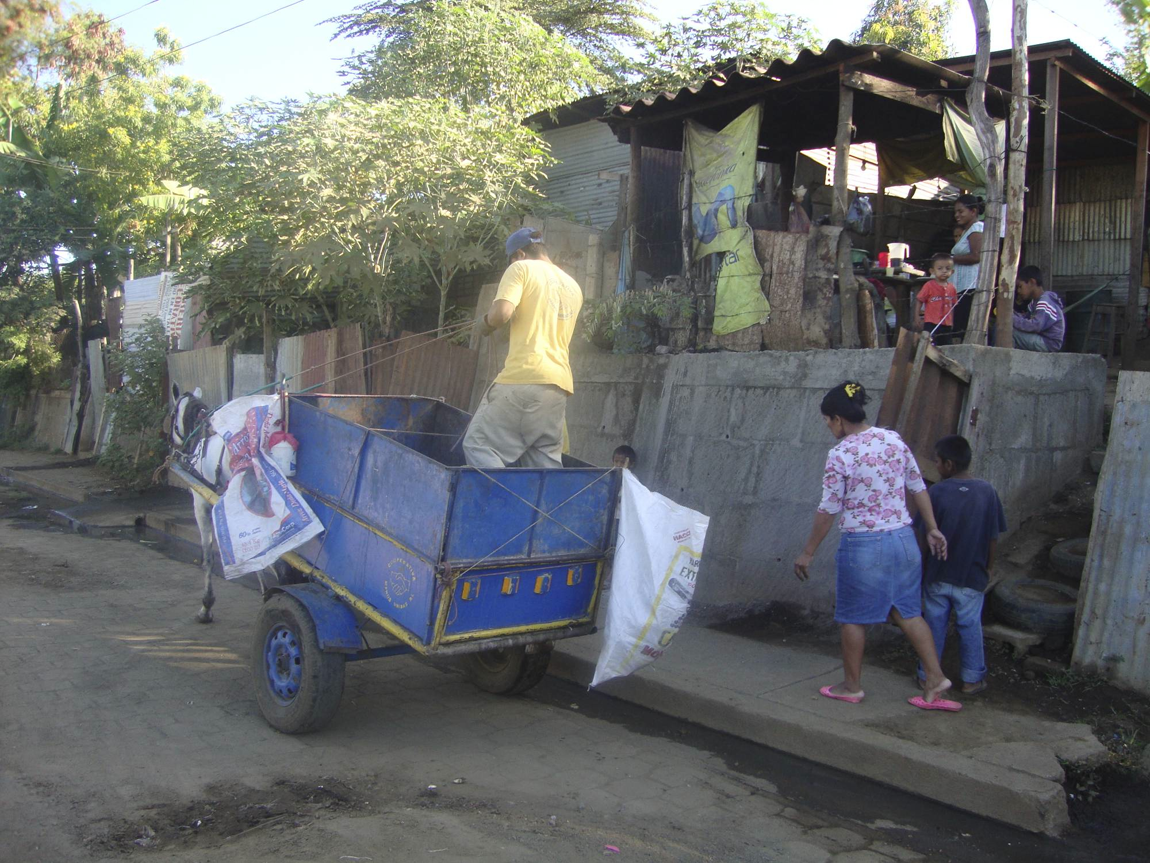
Horse cart-man from Manos Unidas collecting waste
The stabilization of a symbiotic relationship with the community is, in the words of one Habitar officer, “…what protects Manos Unidas from the municipality”, which licenses operators in the barrio: “The local residents are aware of the importance of this service and will support its continuance. They will promote it to the municipality.”
b. Manos Unidas and the city authorities
The relationship between municipality and cooperative was to have been consolidated through the creation of both a public–private partnership and a district waste transfer station, from which the waste collected by the cart-men would be transported for disposal at the municipal landfill by the municipal waste management department (Photo 7). In 2011, the official agreement between Manos Unidas and the city of Managua was signed by the mayor in a ceremony that received considerable media attention. It was a two-year licence to collect household solid waste along a limited route in District 5. In July 2012, Manos Unidas was still struggling to exercise their right to the route, as the District 5 administration (which is not the formal waste collecting body) also collects there at times, confusing the inhabitants as to who actually should collect the waste and who should be paid to do so: “Look, I pass here on Tuesdays, Thursdays and Saturdays. But the district’s truck now passes on Wednesdays and Sundays. So, when I come, there is nothing to collect and I don’t get paid. Or sometimes, people save their waste for the truck and then it does not come, so when I come they give me six sacks but they pay only the same three córdobas. … It shouldn’t be like this.”(32)
Horse cart-man from Manos Unidas at the temporary waste transfer station
Despite the difficulties, Manos Unidas continues to provide the service, hoping that the relationship with the municipality will be clarified in the future.
Although the existing infrastructure at the waste transfer station was temporary and the plan to use it as a model for the city’s other districts did not succeed, the establishment of a formal physical place for waste transfer in the district facilitated the institutionalization of the service provided by Manos Unidas and the shift from illegal dumps to a controlled waste transfer point. Anchoring this change in the community once again supported the stability of this new arrangement. While another development project funded by UN−Habitat had initially failed to build more sophisticated waste transfer stations in city District 7 due to “not-in-my-backyard” (NIMBY) mobilization, the District 5 transfer station was supported from the beginning by the local residents, who understood its importance.(33)
In District 6, another waste transfer station was constructed and started operating at the end of 2011, supported by the Italian development aid project BasManagua. Its construction went ahead despite NIMBY mobilization: “At the beginning, the population voiced their disagreement with the waste transfer station. Now they all know about it. We have explained that the station will not become a second Chureca.”(34) The efforts by community leaders and environmental brigades to raise awareness within the community in Districts 5 and 6, together with the opportunity to create new jobs associated with waste collection in the barrio through the creation of additional cooperatives, contributed to the acceptance and embeddedness of the project.
Despite that, later in 2011, the District 5 transfer station suffered a crisis when waste overflowed because the central waste management department did not collect the waste as planned due to a lack of vehicles and resources. We conclude that waste transfer stations are very vulnerable arrangements that require well-established connections and coordination, since they depend completely on municipal services for regular waste removal.
VI. Discussion
a. Connecting actions for more sustainable waste collection services in informal settlements
By slightly changing the actions of the actors already involved in informal waste handling in the informal settlements, the Manos Unidas project succeeded in turning the cart-men from agent of pollution into the solution to several interconnected problems, namely illegal dumping by the cart-men and residents, the cart-men’s low and irregular incomes and the lack of household solid waste collection services. In essence, the cart-men in Manos Unidas still do what they did before: they collect waste and dispose of it. However, now they collect household solid waste regularly, earn regular salaries from the fees households pay, dispose of waste at a legal waste transfer station in the city district, and are respected and valued by the local community because of the social and environmental services they provide. Furthermore, the informal settlements that once were unserved by a waste collection service today enjoy a regular, economical and efficient service, and illegal dumping has been eradicated in the barrios. Trust in this regular basic service was established, as illegal dumps were transformed into legal transfer points, illegal squatters into responsible citizens and cart-men into environmental heroes. Furthermore, the new waste transfer station, situated at the nexus between the formal and informal city, physically “switched on” the informal settlement, connecting it to the formal city.
These transformations – “translations” or “connections” in action net theory terms – were possible thanks to the enduring connections established between Manos Unidas, the local residents and the city government. Anchoring ideas, new services, actors, practices and even infrastructure was crucial to the success of the project. Institutionalizing the co-production of waste collection services calls for regular, long-term relationships and arrangements.(35) Far from being formal, these arrangements, such as the agreement signed between Manos Unidas and the municipality, could remain flexible or, as Joshi and Moore put it in their work on co-production, “…undefined, informal and renegotiated almost continuously.”(36)
As in other waste collection projects elsewhere, such as a community-based waste management project in Madras,(37) policy arrangements can break down and local residents and waste pickers need to ask for help. Here in Managua, for example, that was necessary when the District 5 administration started to collect waste in streets near Manos Unidas’ routes, or when municipal waste management staff stopped collecting waste regularly from the transfer station.(38) Once the programme ended, the role of the local NGO Habitar and of UNDP, which were behind the programme, was to help stabilize these undefined and vulnerable connections − which they still do, either by supporting Manos Unidas in its ongoing negotiations with the municipality or by funding a small project for the cooperative through the UNDP’s small donations programme.
b. Connecting the informal settlements to the formal waste city management
As a result of the Manos Unidas project, and others promoting waste picker cooperatives and microenterprises for household waste collection services in Districts 6 and 7, Managua’s waste management system is becoming a hybrid of formal and informal services, public and private suppliers, legal and illegal practices, and modern and traditional technologies, all in the setting of the formal and informal city.
As Gerry and Bromley state in relation to formal and informal work in cities: “Dualism has never been able to satisfactorily handle the complexities of urban life in Third World situations.”(39) In our study, the informal and the formal become embedded categories in the urban setting, “…not only inseparable and interdependent but also indefinable.”(40) This hybrid quality has been described as urban informality, meaning “…the manifestation of informal processes in the urban environment.”(41) Urban informality hence becomes constitutive of the urban condition itself,(42) as the boundaries between the informal and formal spaces in the city become more permeable.
The hybridization of waste management in Managua and the co-production of waste collection services in some neighbourhoods are understood as temporary by some city officers whom we interviewed, who feel it will last only until the streets are paved and the cables lifted. However, other interviewees, also from within city management, believe that a hybrid system, in which an increasing number of waste picker cooperatives collect household solid waste from informal settlements in collaboration with the formal waste collection system, represents a more efficient and lower-cost management model.
This hybrid waste management model, created through the co-production of basic services, needs social capital (stemming from the participation of the community and its leaders) as much as it needs technical know-how, financial capital and local government political support. As Anand has noted regarding waste collection in Madras, projects such as the one supporting Manos Unidas would be impossible without the regular removal of waste from the transfer station by the municipal waste trucks.(43)
In this project, as in many others elsewhere related to waste management collection in informal settlements, we observed government resistance to relinquishing control over a critical and popular service that is a core municipal function around the world, especially when political elections are approaching.(44) Occasionally, public officers or politicians might ban waste-picking activities simply to prevent health hazards related to their irregular practice.(45) A common government response is to consider these organized communities more as threats than opportunities.(46) One challenge to the stabilization of these arrangements between informal collectors and authorities is the fragmentation of city management interests in which politicians, city officers and districts each have different agendas and interests, as illustrated above.
In Nicaragua, the idea of a hybrid model of waste collection, or the co-production of waste collection in informal settlements between informal waste pickers and the formal waste management system, is very recent. The model of waste picker cooperatives associated with waste transfer stations has spread and, at the time of writing this article, was being expanded into Districts 6 and 7. However, it is still too early to conclude that this idea for the governance of waste in informal settlements will take root in the Managua city management. As other case studies have found, it can take decades for an innovative and alternative solution to be scaled up, as in the case of Karachi’s wastewater project.(47) One of the challenges lies in the continuation of these projects: the stabilization and institutionalization of ideas within city management that, when translated into practice on a larger scale, can contribute to the improvement of household solid waste management(48) in informal settlements around the world.
c. Co-production of household waste collection services in informal settlements
In a context of weak municipalities unable to provide basic services, such as in Managua, low-income citizens do not just remain passive. Occasionally, co-production processes emerge, such as the public–private partnership supported by the local NGO, the community leaders and other grassroots organizations in District 5 for the collection of household waste.
We have also demonstrated that the informal city is not only about low-income residents being supplied with illegal and non-official services. The residents of informal settlements also carry out entrepreneurial and innovative strategies, based on available local resources, to cope with their situation of scarcity; strategies that, as with the service provided by Manos Unidas, can often be sustainable.(49) In this urban informality, the forgotten residents of the informal settlements and the waste pickers become city constructors. They do this in two ways, first, by illegally invading land to gain their right to the city and, second, by self-organizing their settlements. Residents struggle to gain legal title to their houses and to be “switched on” as part of the city through the provision of basic urban services such as water and electricity. They may achieve this by providing themselves with services either through spontaneous and illegal practices or through the self-organization of their communities.
Informal settlements are gradually consolidated through the efforts of their owner–residents who collectively organize themselves to construct basic infrastructure.(50) In our story, as in those of other Latin American cities, favelados, squatters and ordinary citizens become the real city builders.(51) These processes of co-production constitute an urban social movement that unintentionally challenges the nature of the state and civil society.(52) While in cities in wealthy societies, participatory democracy and citizenship are undergoing a crisis whereby citizens are being reduced to mere recipients of services, in cities of the Global South such as Managua, residents literally construct the city, brick by brick. Citizenship here is something one must fight for and win, and not take for granted.
Examples of democracy and community participation constitute valuable material to enrich the urban and organization studies literature and to inform city management praxis elsewhere in the world. The co-production of basic services has been understood as an urban social movement(53) in which the collective activities of residents of informal settlements may not involve direct political claims but, rather, involve engagement with the state and with city management.
VII. Conclusions
In this paper, we have examined how the development project supporting the Manos Unidas cooperative succeeded through an understanding of existing local waste management practices in the barrio and by trying to establish and stabilize new connections through processes of co-production. In the case of Manos Unidas and the support it received from the Nicaraguan NGO Habitar, funded by the UNDP and other international aid organizations, the project supported both the local residents and the cart-men by enabling informal sector activities to flourish and by providing low-income households with adequate basic services. Unlike projects that bulldoze informal settlements or simply provide services and goods to local residents, the support here focused on the informal settlement residents and the waste pickers who, acting for themselves, were able to construct their homes and develop their waste collection system in the informal city.(54) The acknowledgement of and connection to existing initiatives underlie the success of many innovative development projects.(55) In other words, cities need waste management policies that incorporate existing informal waste practices(56) and that recognize the need to develop innovative, unconventional and sustainable solutions that match local resources and needs.(57)
Footnotes
1.
Hardoy, Jorge E, Diana Mitlin and David Satterthwaite (2001), Environmental Problems in an Urbanizing World: Finding Solutions for Cities in Africa, Asia and Latin America, Earthscan Publications, London, page 12; also UN−Habitat (2003), The Challenge of Slums, UN−Habitat, London, 310 pages; and United Nations Population Fund (2007), State of World Population 2007, Unleashing the Potential of Urban Growth, available at  .
.
2.
Gilbert, Alan (2007), “The return of the slum: does language matter?”, International Journal of Urban and Regional Research Vol 31, No 4, page 704.
3.
Graham, Stephen (2005), “Switching cities off”, City Vol 9, No 2, pages 169–194; also Graham, Stephen and Nigel Thrift (2007), ”Out of order: understanding repair and maintenance”, Theory, Culture & Society Vol 24, No 1, pages 1−23.
4.
As with electricity systems, waste management is part of the multiple, networked infrastructures that together allow cities to function; and as with electricity, if a part of the city is not connected to the system, it does not function in the same way as the rest of the city − it is not “switched on”.
5.
Arroyo, Jorge, Francisco Rivas and Inge Lardinois (editors) (1999), Solid Waste Management in Latin America: The Case of Small and Microenterprises and Cooperatives, WASTE, Gouda, The Netherlands, 214 pages; also Coad, Adrian (2000), “Planning for sustainable and integrated solid waste management”, Report of CWG International Workshop, Manila, the Philippines, September 2000, available at www.skat.ch; and Scheinberg, Anne, Justine Anschütz and Arnold van de Klundert (2006), ”Waste pickers: poor victims or waste management professionals?”, Paper presented at the Solid Waste, Health and the Millennium Development Goals CWG−WASH Workshop, Kolkata, 1−5 February.
6.
Co-production refers to the joint production of public services between citizen and state. See, for example, Bovaird, T (2007), “Beyond engagement and participation: user and community co-production of public services”, Public Administration Review Vol 67, No 5, pages 846–860; also Ostrom, Elinor (1996), ”Crossing the great divide: co-production, synergy and development”, World Development Vol 24, No 6, pages 1073–1087; Mitlin, Diana (2008), “With and beyond the state; co-production as a route to political influence, power and transformation for grassroots organizations”, Environment and Urbanization Vol 20, No 2, October, pages 339−360; and Whitaker, G P (1980), “Co-production: citizen participation in service delivery”, Public Administration Review Vol 40, No 3, pages 240–246.
7.
Czarniawska, Barbara (2004), “On time, space and action nets”, Organization Vol 11, No 6, pages 773−791.
8.
See reference 7, page 780.
9.
Czarniawska, Barbara (2010), “Translation impossible? Accounting for a city project”, Accounting, Auditing and Accountability Journal Vol 23, No 3, page 420.
10.
Lindberg, Kajsa and Barbara Czarniawska (2006), “Knotting the action net or organizing between organizations”, Scandinavian Journal of Management Vol 22, No 4, page 295.
11.
Silverman, David (2006), Interpreting Qualitative Data: Methods for Analyzing Talk, Text and Interaction, 3rd edition, Sage, London, 428 pages.
12.
Lindberg, Kajsa and Lars Walter (2012), “Objects-in-use and organizing in action nets: a case of an infusion pump”, Journal of Management Inquiry, published online before print, 16 August 2012, doi: 10.1177/1056492612455242, page 5.
13.
Strauss, Anselm and Juliet Corbin (1990), Basics of Qualitative Research: Grounded Theory Procedures and Techniques, Sage, London, 312 pages.
14.
Interview with the Director of Managua Waste Management Department.
15.
Interview with Managua Waste Management Department officer.
16.
See reference 14.
17.
18.
See reference 14.
19.
Parés Barberena, María Isabel (2006), “Estrategia municipal para la intervención integral de asentamientos humanos espontáneos de Managua, Nicaragua”, United Nations: The Economic Commission for Latin America (ECLA), 118 pages.
20.
Hardoy, Jorge E and David Satterthwaite (1989), Squatter Citizen: Life in the Urban Third World, Earthscan Publications, London, page 39.
21.
See reference 20.
22.
Interviews with residents in informal settlements in Districts 5, 6 and 7 in Managua.
23.
UNDP, Habitar and Managua Local Government (2009), “Alianzas para el manejo de desechos sólidos en el municipio de Managua”, Managua, 31 pages.
24.
Interviews with representatives from Habitar and UNDP.
25.
Zapata Campos, María José and Patrik Zapata (2011), “Civil society organizations as development translators”, Paper presented to the EGOS Conference, Gothenburg, July 2011.
26.
Interview with a resident of District 5.
27.
Interview with Habitar officer.
28.
Interview with BasManagua officer.
29.
By contrast, in the formal city waste management system, payment is handled by a tax collector who visits households to collect the fees.
30.
Interview with a resident who uses the Manos Unidas service.
31.
Interview with a community leader.
32.
Interview with Manos Unidas member.
33.
Interview with Habitar officer.
34.
La Chureca is the Managua city dump; see Zapata Campos, María José and Patrik Zapata (2012), “Changing La Chureca: organizing city resilience through action nets”, Journal of Change Management Vol 12, No 3, pages 323−337.
36.
Joshi, Anuradha and Mick Moore (2004), “Institutionalized co-production: unorthodox public service delivery in challenging environments”, The Journal of Development Studies Vol 40, No 4, page 40.
37.
Furedy, Christine (1992), “Garbage: exploring non-conventional options in Asian cities”, Environment and Urbanization Vol 4, No 2, October, pages 42–61; also Anand, P B (1999), “Waste management in Madras revisited”, Environment and Urbanization Vol 11, No 2, October, pages 161−176.
39.
Bromley, Ray and Chris Gerry (1979), Casual Work and Poverty in Third World Cities, David Fulton Publishers, page 306.
40.
Hernández, Felipe and Peter Kellett (2010), “Re-imagining the informal in Latin America”, in Felipe Hernández, Peter Kellet and Lea K Allen (editors), Rethinking the Informal City. Critical Perspectives from Latin America, Berghahn, New York, page 6.
41.
Al Sayyad, Nezar and Ananya Roy (2004), “Prologue/dialogue: urban informality: crossing borders”, in Ananya Roy and Nezar Al Sayyad (editors), Urban Informality. Transnational Perspectives from the Middle East, Latin America and South Asia, Lexington, Oxford, page 1.
42.
Fiori, Jorge and Zeca Brandâo (2010), “Spatial strategies and urban social policy: urbanism and poverty reduction in the favelas of Rio de Janeiro”, in Felipe Hernández, Peter Kellet and Lea K Allen (editors), Rethinking the Informal City. Critical Perspectives from Latin America, Berghahn, New York, page 184.
44.
See reference 37, Furedy (1992); also Wilson, David C, Adebisi Araba, Kaine Chinwah and Christopher Cheeseman (2008), “Building recycling rates through the informal sector”, Waste Management Vol 29, pages 629–635; also, local elections were held in Managua in 2012.
45.
See reference 1, Hardoy, Mitlin and Satterthwaite (2001), page 233.
47.
See reference 1, Hardoy, Mitlin and Satterthwaite, page 233.
49.
Mehrotra, Rahul (2010), “Foreword”, in Felipe Hernández, Peter Kellet and Lea K Allen (editors), Rethinking the Informal City. Critical Perspectives from Latin America, Berghahn, New York, page xiii.
50.
See reference 40, page 11.
51.
See reference 40, page 12.
54.
See reference 6, Mitlin (2008); also Kellett, Peter (2005), “The construction of home in the informal city”, in Felipe Hernández, Mark Millington and Lain Borden (editors), Transculturation: Cities, Space and Architecture in Latin America, Rodopi, New York, pages 22−42.
55.
Hasan, Arif (2006), “Orangi Pilot Project; the expansion of work beyond Orangi and the mapping of informal settlements and infrastructure”, Environment and Urbanization Vol 18, No 2, October, pages 451–480; also see reference 6, Mitlin (2008); and see reference 37, .
57.
See reference 1, Hardoy, Mitlin and Satterthwaite (2001), page 227.