




Abstract
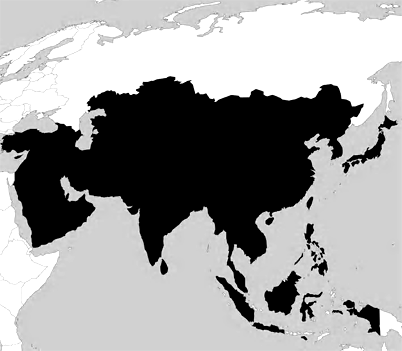
This paper describes people’s process, community networks and platforms of work between communities and professionals in Asia; also how these networks, which have reduced the isolation of low-income and disadvantaged communities, have built their confidence, produced finance to support their priorities, legitimized and capacitated their organizations and catalyzed effective action. Networked and informed community groups are increasingly able to lead development processes and work together with government agencies, politicians and other stakeholders, from academics to NGOs. By being unified through a common group or association, community members gain strength in numbers and shared financial capital, opening up many more opportunities than if they worked individually. By giving examples of national networks of the urban poor in Sri Lanka, the Philippines, Mongolia and elsewhere, this paper seeks to demonstrate the value of networks in supporting a people’s process of development.
I. Introduction
A few days after the Asian tsunami struck Thailand, the Thai national people’s savings network was in southern Thailand preparing communities for a people-centred relief, recovery and rehabilitation process. From within the various tsunami-affected communities and villages, they established networks of people, including youth, fisher-folk, boat builders, renters, people with land problems, the elderly, savings groups and carpenters. These networks sought to break the isolation of individuals, families and communities and enabled them to face their common problems with a strengthened and solid unity. It enabled a stronger negotiating position for communities and groups dealing with government, NGOs and other “external” actors, and offered them greater control over their choices for reconstruction and rehabilitation rather than having these imposed. Endesha Juakali, disaster survivor of Hurricane Katrina in New Orleans, visited southern Thailand and Banda Aceh in September 2006 as a guest of the Asian Coalition for Housing Rights (ACHR). At the time, he was leader of the “Survivors’ Village” movement in New Orleans, which was fighting against the planned demolition of public rental housing in the city and the loss of affordable housing in general. At the end of his visit, Endesha declared:
(In New Orleans) “….everybody is waiting on the government to do something. Y’ know, the government is going to give me US$ 150,000; the government’s got to make the levee strong; the government has to clear the debris. Now, what I’ve seen in Asia, which is very good, is that everywhere I go, I see where the people just decided: we’re gonna go do this. And that’s the kind of thing I’m gonna bring back to New Orleans. I’m gonna say hey, forget about the government, we’re gonna do this. And I think that that’s gonna spill over, as other people see us say we not waiting … I’m bringin’ that back … That’s Asia’s gift to me. That’s what I’ve learned.”(1)
Endesha’s emphasis is on the way people do it themselves: the people’s process. This could not have been accomplished in southern Thailand without an established grassroots process to transfer the confidence and practical knowledge to the surviving communities. This grassroots process needs to be nurtured, and in ACHR’s experience this is done most effectively through a multitude of complementary networks that establish stronger relationships among the urban poor and then work with other groups across public platforms. This paper elaborates on these networks, their work and their contribution to the Asian Coalition for Community Action (ACCA). It describes the way in which the ACCA process builds on ACHR’s earlier work in network building to further a people-led process of development. The investment in networks reflects a belief that low-income groups need to act collectively to challenge processes of exploitation, dispossession, discrimination and disadvantage. ACCA seeks to strengthen community networks between local groups within settlements or practising the same trade, and those between communities at the city, national and regional scale. These networks enable the formation of joint working groups or platforms between organized communities and professional agencies, including NGOs, and between organized communities and government at various levels, including (potentially) both officials and politicians. Once the urban poor are organized and gain the strength of a collective voice, they can more effectively interact with other urban development agencies. Organization and networking enables people to compensate for their lack of economic power and social status. As Ofelia Bogotlo elaborates: “…we are weak, but socially we are strong and by getting together as a group means we can challenge, ask for more.”(2) The paper begins by describing the importance of the people’s process and then moves on to examine the contribution of networks and platforms in supporting this process.
II. The People’s Process
Since the start of its activities in the late 1980s, ACHR members have recognized that the strategies followed by governments in Asia are drawn mainly from Western models of urban development, with primarily top-down plans that are imposed on citizens. This approach to development is embedded within the development curricula of most of Asia’s educational institutions, ensuring that it continues to be used by the next generation of professionals. As a consequence, in most cities ordinary citizens are isolated from the decision-making process of city planning and development. ACHR has sought to challenge this, recognizing the significance to inclusive urban development of strategies that centre on what people are doing for themselves and that support and enhance this. Through an experiential process of learning by doing, a people’s process model has been evolving throughout Asia. One part of this challenge, as illustrated in Figures 1A and 1B, is to shift away from the politicians and planners aligning to develop the city far away from the realities of the people, towards a more collaborative model in which there is a joint process for urban planning.
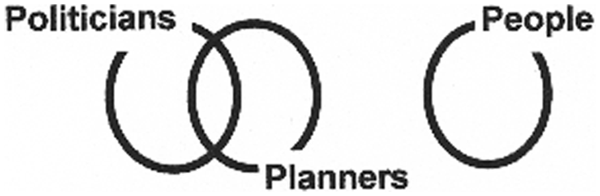
The present city planning process (where people are excluded) from the planning process between politicians and planners
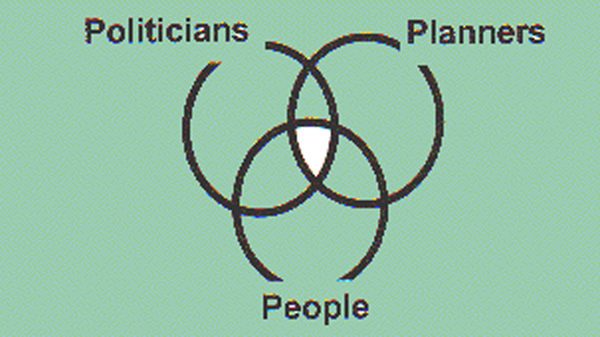
The need is to create, nurture and then institutionalize the common space. So people are involved in the city planning process
There is a consensus among ACHR members that a major problem facing Asia is the centralization of power, with relatively few opportunities for most citizens to be involved in determining their own development options. There are concerns that decisions related to development are made increasingly by the political elite and reflect their interests. The urban poor are free to make decisions about their own day-to-day survival but they are constrained in their options in other significant aspects of their lives and well-being. To secure a more open development process means that there is a need to challenge inequalities and “re-balance” power relations. How can the urban poor find and/or create more control over their lives? How can they achieve greater visibility, recognition and acceptance? How can they begin to believe in their entitlement to greater participation in decision-making and be part of political processes that are now dominated by the elite? These are all central questions for ACHR members who have been seeking to support a more pro-poor and inclusive city.
When asked about strategies to nurture this people’s process, community leaders and their NGO supporters highlight the importance of addressing the adverse power relationships experienced by the urban poor. Grassroots community leaders emphasize the psychological and social consequences of these adverse power relations, and the need to nurture positive cultural representations that challenge the way in which these top-down approaches encourage passivity and dependence. When articulating solutions, many community leaders believe in the need to create and nurture a collective belief and solidarity. When recognizing the commonality of disadvantage and injustice, people have the potential to challenge outcomes. Ofelia Bogotlo, a community leader from the Philippines, elaborates its significance thus:
“I think the community or people’s process is a collection of ideas. Putting them together [in a network] gives us a chance to prove that we can do such things that the rich or government people think that we cannot do. They seldom listen to us, but we know and live the issues, and therefore we believe we are so much closer to the solutions to those issues. We have found that if people in communities come together and discuss, give their opinions, then slowly, slowly, they will find a solution, ways to do things better… things that they never believed that they could do. So it’s very much a matter of gaining confidence in yourself, in the community, and gaining the confidence of other actors such as government. And the people’s process, for me, is letting us show the skills that we have, show these skills to those in government and in society who think we don’t have skills, we don’t have enough knowledge. If only they would give us trust and let us do [it] the way that we think we can do it, and prove it to them, that in this part let the people do, let them find their own way to do it, and let them solve their problems.”(3)
A strong community network avoids the weakness of past strategies and promotes a people’s process approach to development. Sometimes, the urban poor have used a common feeling of injustice to adopt an alternative ideology and “confront” the elite, demanding reform or revolution. But a confrontationist approach rarely has mass appeal – it is neither fully understood nor accepted by the majority of urban poor engaged in a daily struggle for survival. While some success has been achieved and social progress secured, considerable injustice remains. This situation suggests that an alternative approach is needed that is more effective in building a mass movement.
As elaborated in more detail in the paper in this issue of the Journal on “How poor communities are paving their own pathways to freedom“,(4) ACCA’s approach is to support grounded practical interventions that improve people’s lives and to consolidate changed social relations. The paper by Diane Archer in this issue of the Journal describes the significance of financial accumulation and strategizing to support community processes of development. ACCA’s processes seek to use finance as a mechanism to reinforce the relational changes needed to promote a people’s process. While finance is a significant trigger and an important factor in supporting new initiatives, much more than finance is required to drive the process forward. Box 1 describes how the small projects in Mongolia have helped to tackle the isolation of households that proves such a handicap to effective action.
Networks in Mongolia
Nandasiri Gamage, an advisor to the Sri Lankan Women’s Co-op (previously the Women’s Bank), argues that such networks are needed to take the people’s process forward as a political concept. His argument is that: “…the government always takes chances with the people’s votes, and then makes their own plans for the people (the poor).”(5) In a context in which government is more concerned with their own agenda than with the difficulties faced by those with low incomes and/or who are disadvantaged, there is a need for strong representative organizations of the urban poor. Box 2 elaborates the strategy in Sri Lanka and the importance of savings-based organizing. It shows how strong local organizations can build into a collective force.
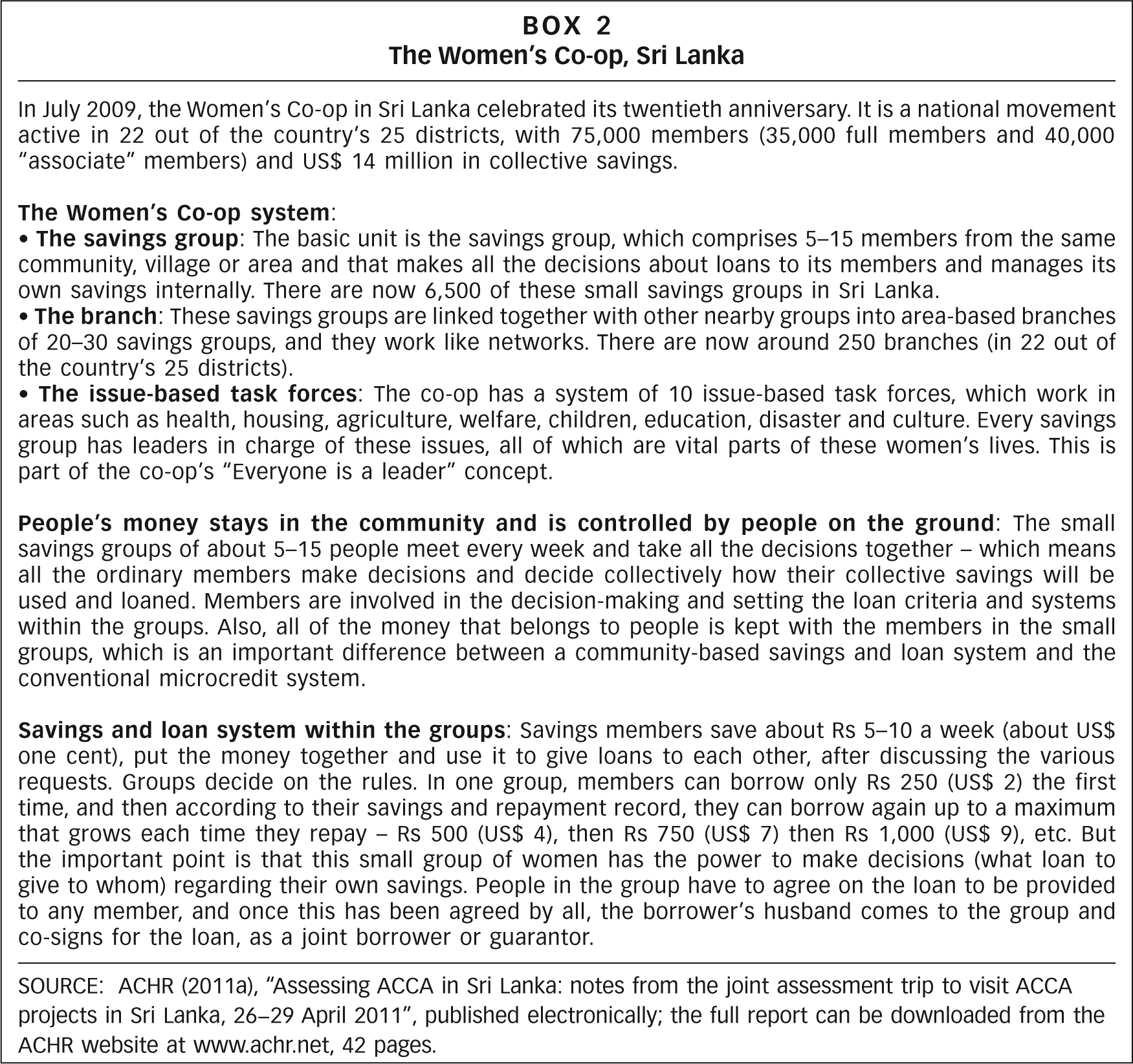
The Women’s Co-op, Sri Lanka
As a local network, the savings process breaks the isolation of low-income families and draws people together into a collective financial system. As community leaders collect money, they are also collecting people, visiting families every day to pick up the daily savings and speaking about issues that concern the families. The savings process develops the strength of collective decision-making, as groups allocate loans and decide on lending terms and conditions. It provides low-income households and communities with their own resource base to answer their basic needs. As problems will almost inevitably emerge, communities can learn to solve uncomfortable issues and realize that many of the solutions to their problems have to come from within the community, not from the outside. One of the most important effects of the savings and credit programmes is that it brings women into the community organizing process and re-adjusts the status of women within the community.
As already suggested by Nandasiri Gamage, advancing the people’s process requires an engagement with the state. Scale is important, as the larger the group the less likely it is that it will be ignored and, in general, the greater the recognition it will receive. Networks at the community and city levels nurture a people’s process. Groups also promote horizontal learning and a necessary social cohesion. But linking community groups with professionals and formal agencies can be difficult. If there is leadership by an NGO or other authority, then the group may recreate “vertical” social relations. To link successfully at the city level, i.e. to create city platforms that link different social groups, requires a strong foundational base of community networks. A community network leads to informal groups and friends, and a horizontal structure of learning, sharing and helping each other and negotiating, because they are people in the same structural position in society. In this way, networking has an important function in creating alternative political relationships. At the same time, the community networks are involved in helping local groups assess needs, develop their own priorities and realize goals such as upgrading, walkways and housing.
Box 3 summarizes an experience in the Philippines in which communities learned from each other to challenge the financial constraints on land purchase and financial loans. It demonstrates the importance of community networks in supporting community development approaches, and such experiences lie behind the development of ACCA’s strategies. Community-to-community support adds to finances and skills and helps to negotiate political relationships.
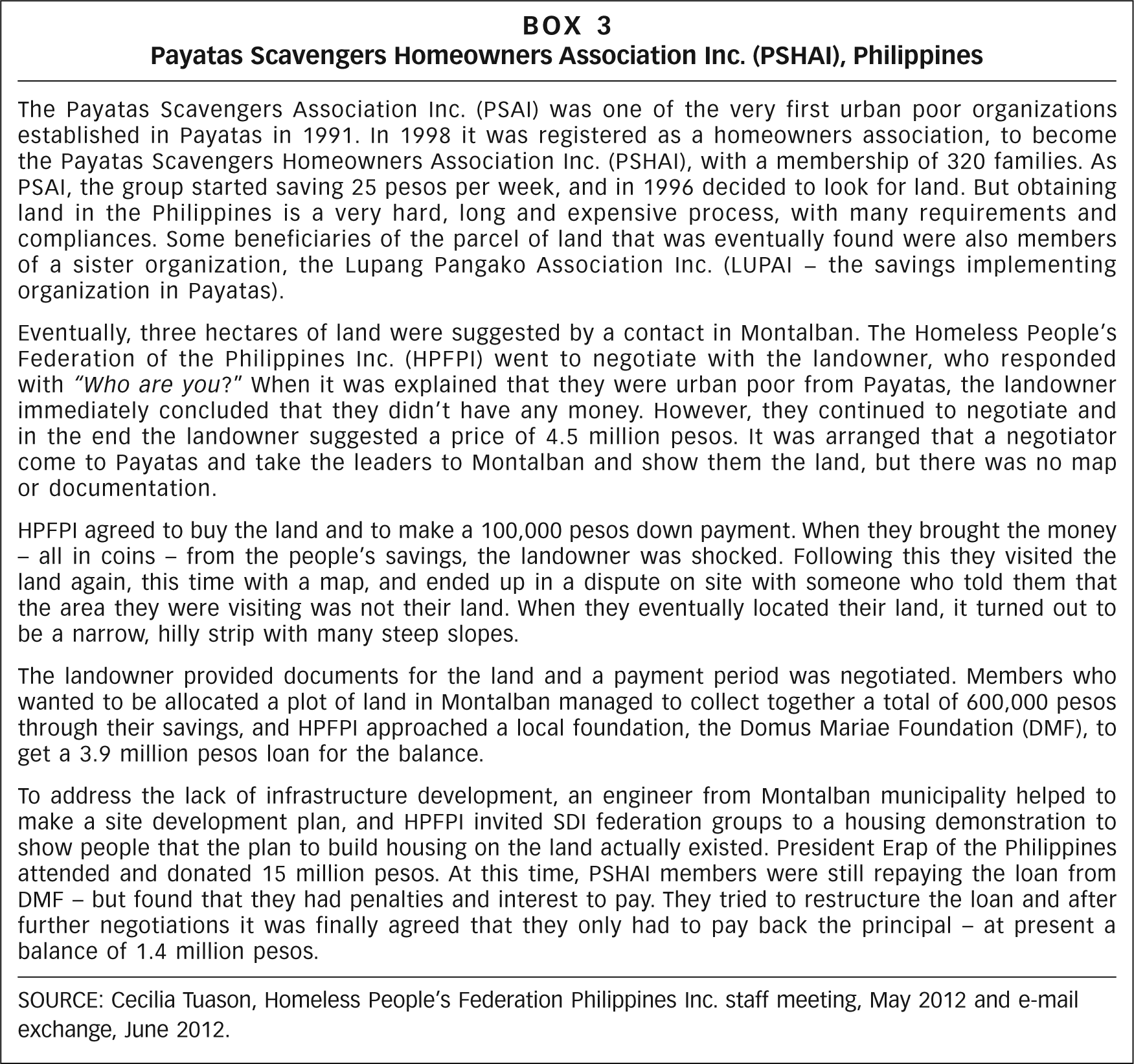
Payatas Scavengers Homeowners Association Inc. (PSHAI), Philippines
As the savings schemes that make up the Homeless People’s Federation Philippines Inc. (HPFPI) came together, the federation members realized that they could change the perceptions of outsiders, who believed that the urban poor are unable to provide any solutions of their own to their problems. They realized that although no one had guided them or taught them what to do, that from saving funds together, to searching for land to purchase (such as cheap land that had been foreclosed by banks), to building their own low-cost houses, they had been able to find the solutions themselves. The federation concluded that this was the real power of the community: when people come together, with some money, and face communal pressures from various outside forces, then they have to rely on their strength and creativity to develop their own ideas and solutions.
Key elements of the experience in the Philippines described in Box 3 are also evident in Sri Lanka. Nandasiri Gamage argues that organizations such as the Women’s Co-op can represent the poor and challenge the dominance of the private sector and the government. As people define their own solutions to poverty, and work out how to realize these strategies within their networks, they are able to negotiate their way into the present division of power between the private sector and the government and open up the formal decision-making process.
ACCA puts many elements together to enhance the people’s process and produce changes in attitude, scale, finance, actions, delivery and collaboration between the poor and the city. The processes facilitated by ACCA are described in more detail elsewhere in this issue of the Journal.(6) Small and big projects, community development funds, participatory planning and city and national processes all combine to support public examples of the people’s process in urban development. The following sections elaborate on the networking dimensions of ACCA, as it seeks to consolidate community power to advance their own processes.
Iii. The People’s Process and Networking
Other articles in this issue of the Journal have articulated the outcomes of ACCA strategies. The significance of social relations in negotiating for pro-poor social and economic change should not be underestimated. Networks are alliances between peer grassroots organizations, and ACCA supports these in multiple forms. The design of ACCA has sought to enhance individual networks that existed prior to the beginning of the programme and to build new networks where they can support ACCA’s objectives. In the 1990s in Thailand, for example, there were more than 100 people’s networks formed on the basis of common features related to housing, such as the Apartment Community Network, formed of households living in apartments; also the Relocation Settlements Network, the Canal Settlements Network, the network of those living on railway land and the Four Regions Slum Network, among others. Similarly, the Baan Mankong informal settlement upgrading programme,(7) supported by the government, has led to the emergence of the National Union of Low-Income Community Organizations (NULICO), a national network of low-income communities actively involved in savings groups and settlement upgrading. It is networks such as these that can provide immediate support to communities affected by disasters, for example after the tsunami in Thailand, while also offering longer-term support with regard to securing tenure and pushing for policy change.
The understanding behind all these networks is that they strengthen the process through five key contributions:
networks
networks
networks
networks
networks
ACCA processes to build local networks and support an urban development process from the “demand side” centre on a citywide survey of all slums in the city. This may be done by communities themselves or, in some cases, in collaboration with a city process such as the CDF mechanism.(8) Once networks are established at the settlement level, ACCA encourages their consolidation into community networks at the city level. The city network is essential to changing political processes, as many decisions that affect the urban poor are made at the city level, for example zoning, land layout approvals and building regulations. These decisions affect the numbers that can get access to land, the costs of such access and the costs of construction.
Although at first sight it may appear that the ACCA small projects for infrastructure upgrading risk being exclusionary, in practice that is not the case. While projects are on-going, other communities can start, perhaps with savings and then progressing onto lending and small income generation activities. The value in the size of the small projects also comes through. The maximum support for small projects is US$ 3,000, and once communities see what a difference this amount can make to their quality of life they are motivated to begin processes to enable this, even if they have not been selected for a grant.
Thirty-six of the small projects supported by ACCA are taking place in seven Sri Lankan cities. These seven cities were selected strategically, in order to build on current strong local processes and respond to acute need in a post-war period, and to engage the interest of other local authorities. Box 4 sets out some of the activities that have taken place using the small grants in Sri Lanka, with a focus on the city of Nuwara Eliya.
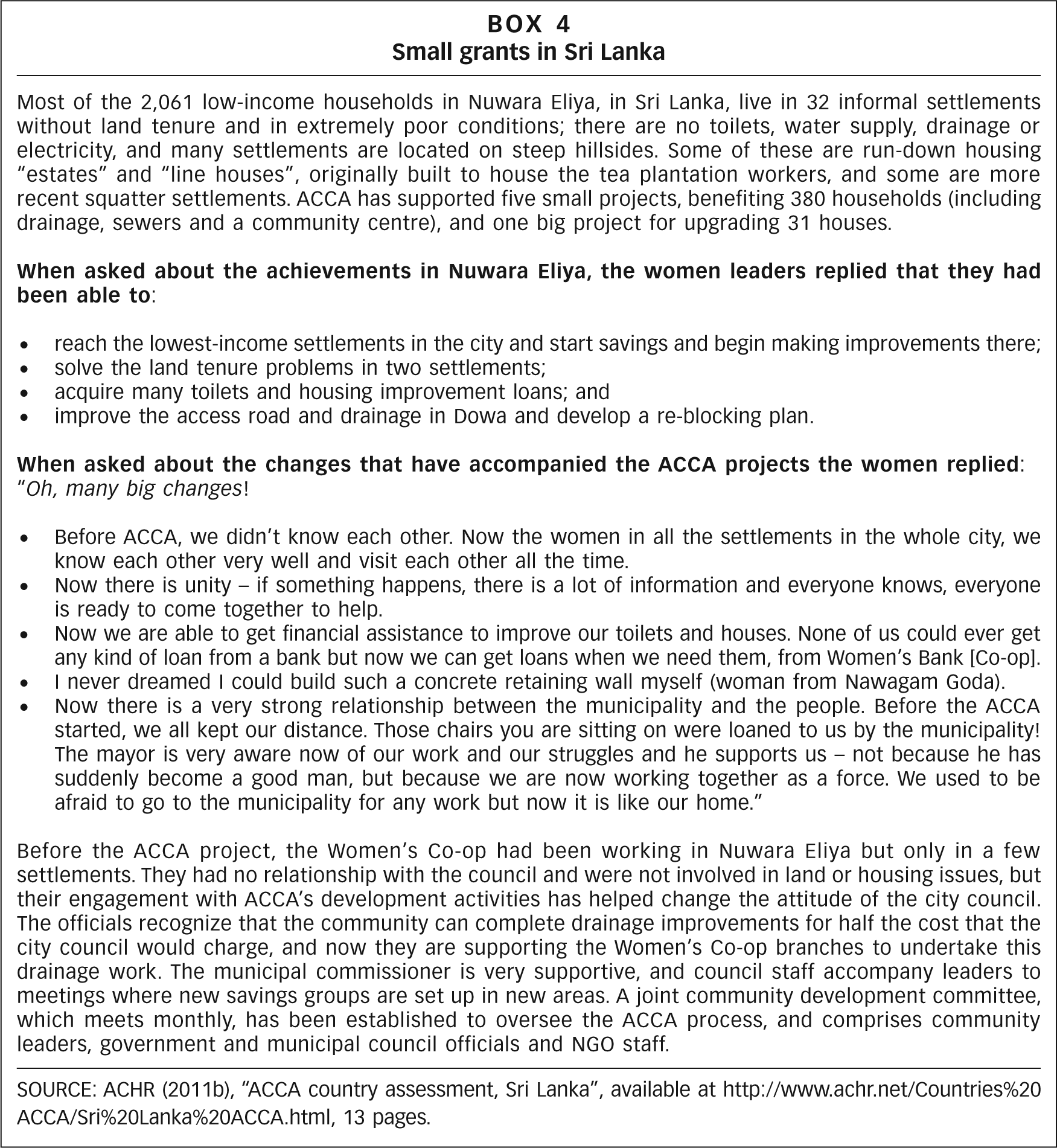
Small grants in Sri Lanka
At the national level, city networks come together to support the development of other urban centres in the country. In Sri Lanka, this has enabled the Women’s Co-op to support the development of activities in Batticaloa, and Box 5 describes how the national community networking process functions in a new city. ACCA builds these local processes through community exchanges, with support from professionals and with local government participation. For example, in January 2012, ACHR and community architect groups in Indonesia hosted a workshop on Community-driven Disaster Resilience. Participants included Mr K Sivanathan (municipal commissioner of Batticaloa), Fenoz Fazzmil (community mobilizer, Sevanatha) and a Women’s Co-op representative (Ms K Kalawathi – Women’s Co-op treasurer, Batticaloa). The municipal commissioner returned feeling confident and keen to strengthen the community development fund and community-led activities.
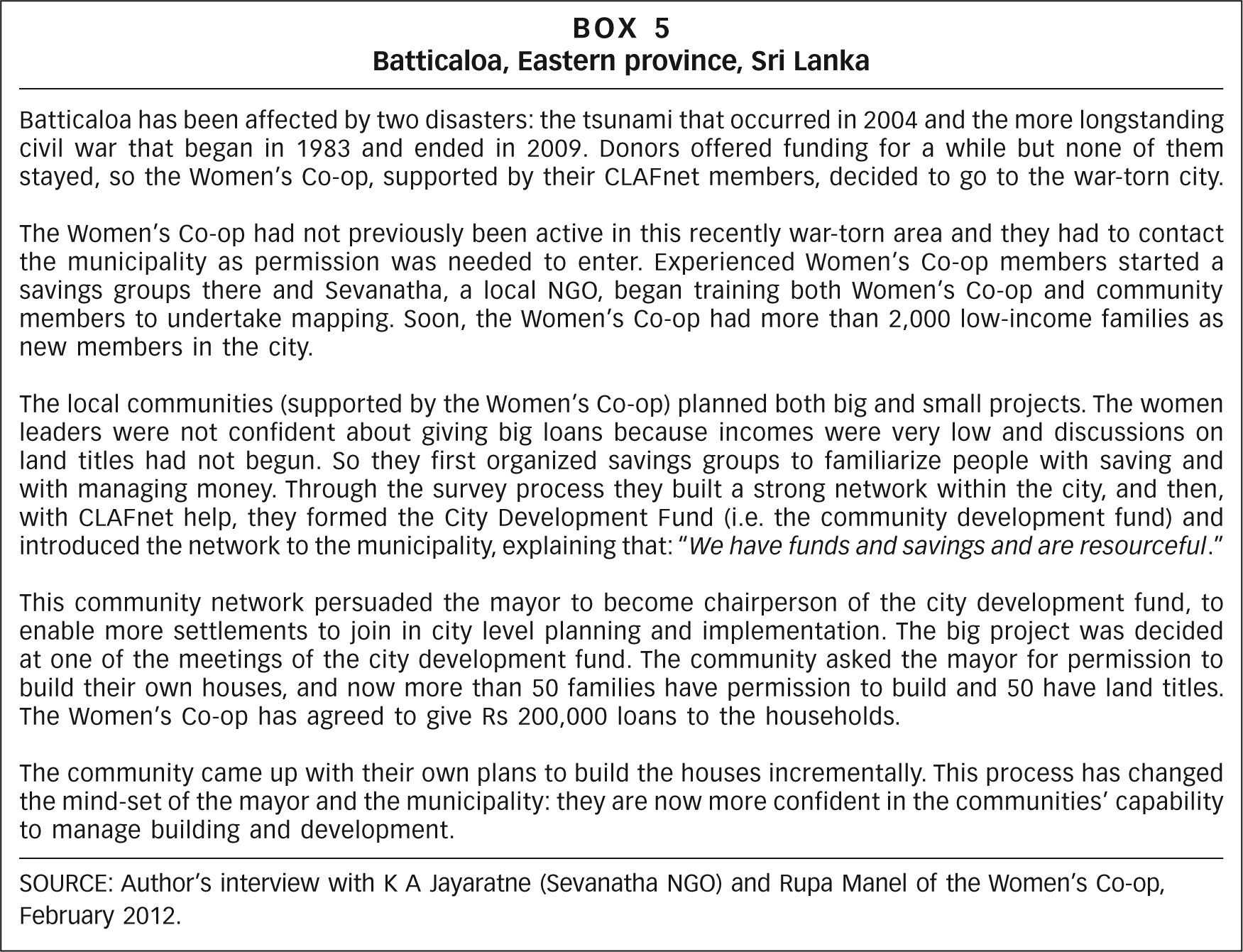
Batticaloa, Eastern province, Sri Lanka
IV. City and National Platforms
Stronger community networks enable city and national platforms to emerge. These platforms bring together the community networks and professionals, both from NGOzs and, in some cases, the state. Within ACCA, joint platforms with the government centre on the community development funds described in Archer,(9) which manage revolving loan funds on a citywide scale and provide a meeting place for community networks, interested professionals and local government. However, community development funds are not the only platforms supported by ACCA.
Community leaders at the Women’s Co-op, Rupa Manel and Anoma Jayasinghe,(10) believe that the formalization of relations with Sevanatha through the CLAFnet platform at the national level has been helpful to their work. CLAFnet is the Community Livelihoods Action Facility Network, a national loan fund described in Box 6. NGO staff complement the Women’s Co-op activities and improve their members’ skills base in surveying and housing construction and upgrading. At the same time, Sevanatha use the particular special skills of the Women’s Co-op members, asking their leaders to initiate savings groups and catalyze community organizing. This builds their movement and leads to greater experience, greater trust in their decision-making and hence confidence among the leaders.
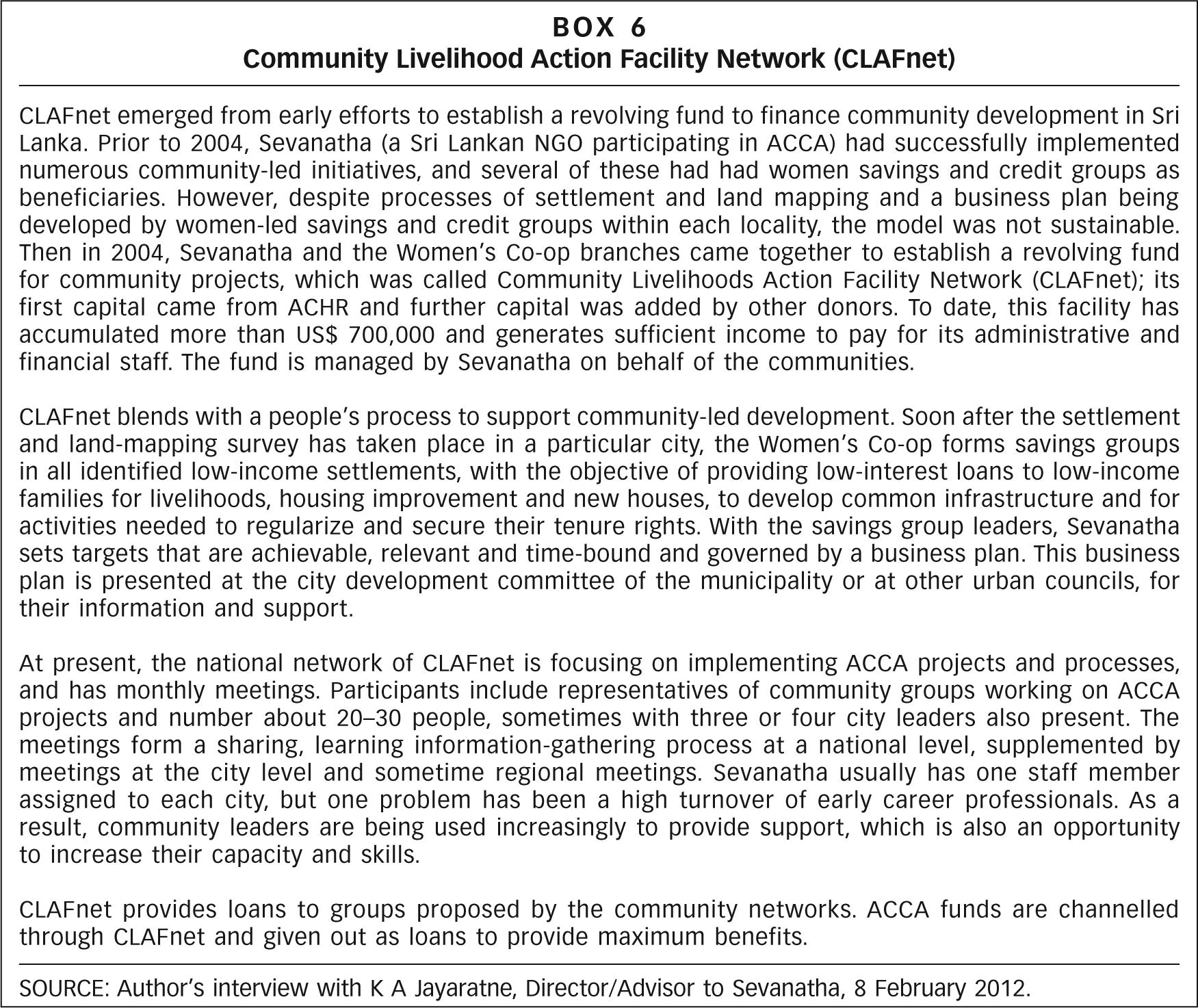
Community Livelihood Action Facility Network (CLAFnet)
Together with NGOs working in the urban sector in Sri Lanka, the Women’s Co-op established CLAFnet following the tsunami in order to maximize the benefits of external finance. Working within ACCA has encouraged CLAFnet to institute a simple, systematic process to expand to new areas and plan accordingly. Flexibility of funding conditions is critical. In the war-torn area of Batticaloa, for example, CLAFnet has decided to give the housing loans interest free, and also to offer a three-month grace period for repayments. The ACCA programme encourages the community networks to develop revolving funds so that projects can continue after the ACCA programme. The flexibility in the use of monies means that activities can be adjusted as required in the local context. Some other donor finance is received by Sevanatha, but there is not as much flexibility or local decision-making, and the monies are less effective in supporting local development because the same rules have to be imposed everywhere.
Sri Lankan community leaders believe that strengthening the CLAFnet national platform has helped address competition between urban poor organizations in Sri Lanka. Experiences of national platforms in the Philippines repeat the experiences from Sri Lanka and also illustrate the potential of the networks to bring together alternative traditions of community organization. As groups have engaged with national level activities, they have gained a new perspective and are better able to face issues together. In the Philippines, the ACCA groups include some organizations that have a different approach to that of the Homeless People’s Federation Philippines Inc. (HPFPI). Such groups may work with the Community Mortgage Programme, which offers low-interest loans to secure land for communities facing eviction, or may focus on government lobbying and advocacy work, using the community organizing methodology. In the past, relationships between different community federations have been strained and there has been disagreement about the best solutions to use. After sharing experiences within ACCA, these different organizations, including the various community groups, now work together, maintaining their own identity and combining forces when needed. As Nonoy Chavez of HPFPI Central Visayas said: “We link with others so the agenda of the urban poor will be strong and we can all go in a more or less common direction.”(11) The ACCA monies are managed through a national fund that is open to everyone in this broader coalition. At the same time, individual groups keep their own separate funds, such as the HPFPI’s Urban Poor Development Fund, which has been capitalized by its members and other grants. The ACCA fund has opened up new possibilities and allows larger strategic interventions, something that could not have happened before, with smaller disparate groups.
The community groups in the Philippines decided to build on the past experiences of the Urban Poor Alliance (UP ALL), a grouping of people’s organizations and NGOs formed in 2005. The original UP ALL lacked strength because the members only gathered when there was a common pressing issue to address; however, the new UP ALL shared the experiences of ACCA-funded projects. The new UP ALL was created in August 2011 and the community leaders in the network formulated the criteria for those applying for ACCA funds. A committee was tasked to review all ACCA applications from the different networks and communities; they meet every quarter but also communicate through e-mail when there are proposals being made. Representatives of UP ALL now speak with one voice for up to 500 community associations (in Quezon City for example) at barangay and city level. As Jayson Miranda of FDUP said: “They have increased their negotiating power and the local government cannot now disregard them because of the larger scale.”(12)
V. Acca as A Platform Supporting a Regional Network
ACCA (and ACHR in general) is a regional platform that opens up learning of good practices from across the region, with people-to-people horizontal learning while also instilling confidence and impetus to the integrated teams that take part. Box 7 provides summary information on the key organizations involved with ACHR. When the ACCA programme began, ACHR realized that it could go to scale quickly because it had been developing the organizational foundations and social approaches for more than 20 years.
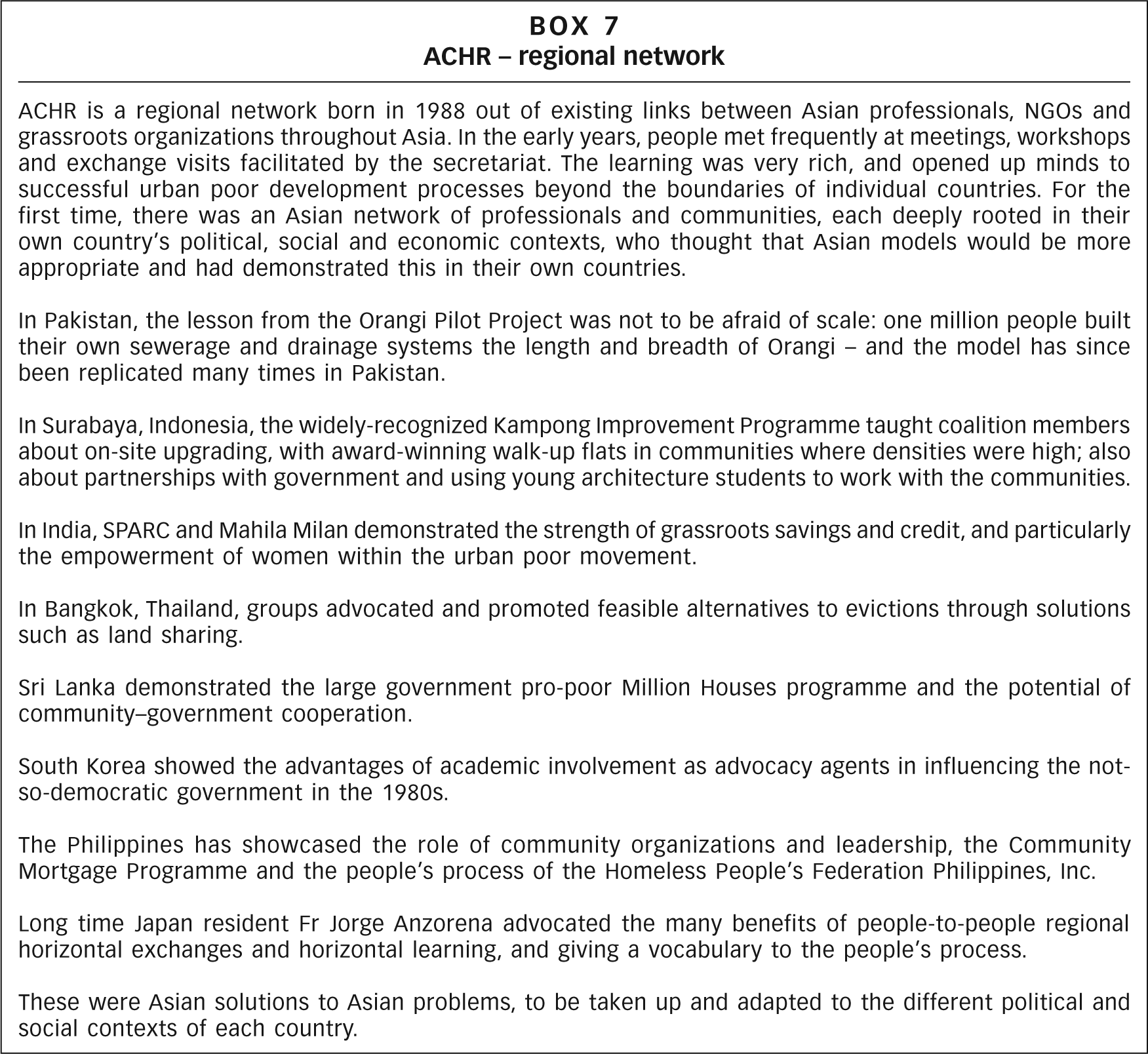
ACHR – regional network
Today, the world offers and allows many more possibilities, and ACHR has learnt much from experimenting with new methodology. From the community exchange programmes of the 1990s there emerged integrated teams of communities, NGOs and government to visit and learn from good practices around the region. In the process, practices in different countries became agents for change for others. ACHR continues to open up to new kinds of inter-country cooperation.
Beyond the citywide and national networks that have grown from the people’s movement in Asian countries, the ACCA programme has supported community-to-community learning across borders through a system of assessment trips as well as regular workshops, meetings and exchanges. These mechanisms of peer-to-peer support have now evolved into a self-contained network, the Urban Poor Coalition Asia (UPCA), which provides a common voice and home for active urban poor community groups in the region. The culmination of a year-long process of meetings and discussions to build the base on which UPCA stands, it was launched formally in April 2012 in the Philippines. UPCA serves to demonstrate the strengths and capacities of urban poor groups across Asia to stand up for themselves on a uniform basis and play a key role in ensuring that the interests of the urban poor are not neglected by governments and international agencies. UPCA will inform and negotiate with multiple stakeholders, and has already met with representatives from three international development agencies. At the launch, an UPCA committee comprising representatives from Thailand, Sri Lanka, the Philippines, Vietnam and Cambodia was elected by the hundreds of community representatives present at the launch event.
One key role to be played by UPCA will be as a source of finance for the needs of urban poor communities, through a regional revolving fund capitalized by ACCA and to which national community groups also contributed, of which around 70 per cent will be reserved for housing-related loans. This fund will be managed by the UPCA committee and will serve to complement and further the activities and processes that were ignited through the ACCA programme. Ultimately, it is hoped that the UPCA regional revolving fund will be able to leverage funds from other stakeholders, from international development agencies to national governments, in order to further boost and sustain the activities of community groups around the region. To this end, UPCA is actively supporting knowledge awareness regarding alternative financial mechanisms, by liaising with international institutions such as the World Bank and the Asian Development Bank, with the support of ACHR.
UPCA is the culmination of many years of strengthening of the people’s process on the ground in Asia, as well as the empowerment of urban poor groups in bringing about change in their lives, to the point where they have the confidence to represent their interests internationally through this regional network. UPCA will help to ensure the sustainability of a people-driven process in urban development in the region, as well as giving the urban poor a common voice through which they can negotiate and work with other stakeholders. While the ACCA programme has done much to build up the confidence of community groups and has supported them through flexible finance mechanisms, UPCA represents the maturing of these groups into a unified network for the urban poor.
VI. Conclusions
The power of people and their mass organization continues to be demonstrated, most recently in the Arab Spring and the Occupy movement. ACCA participants believe centrally in the need to support a people’s process of urban development. At a meeting in January 2011, ACCA’s slogan was: “The world is changing: let people be the solution”. The changes in the world represent old challenges and new contexts. New technologies, such as mobile phones, have combined with new organizations, such as satellite TV channels, and present alternative viewpoints and multiple perspectives. As people engage with the possibilities, they continue to face social inequalities and manifest disadvantage. Established elites and financial crises prevent development aspirations from being realized and constrain opportunities for low-income and disadvantaged groups.
Nevertheless, the experience of ACHR members is that people are continuing to search for development opportunities and the strategies they follow have an obvious potential to make a substantive contribution to challenges that are widely recognized. Faced with more powerful political, social and economic groups, the urban poor have to work together in networks that enable them to consolidate their own political power. As shown above, such networks help to ensure that the urban poor gain the skills, capabilities and confidence to negotiate for access to state resources. Such networks nurture the people’s process, refining and developing practice and adjusting to the new realities.
At the same time, platforms between urban poor groups, supportive professionals and state officials and politicians also have a significant contribution to make. Across Asia, there are examples of participatory governance that show how the joint involvement of different groups in practical urban development experiences introduces new approaches that can help to address longstanding problems of insecure land tenure, inadequate access to basic services and poor quality housing. Such platforms help to build an understanding between different groups and enable them to learn together about the potential offered by new strategies. As learning takes places, the experiences are transformed into new institutional practices.
The emergent UPCA network reflects the reality on the ground – networked and informed community groups are increasingly able and wanting to lead development processes and represent their interests on different platforms: locally, nationally and regionally. Increasingly, people are the change they want to see in their world, and community networks are an essential vehicle to manifest their power for change. While the ACCA programme helped support communities and networks, they have now matured and gained the necessary momentum to act independently, building up their own financial mechanisms and functioning as independent entities with which other stakeholders can interact.
Footnotes
Acknowledgements
This text was compiled from interviews with “experts” on the subject matter from across ACHR. Each person involved in putting this paper together has either spent a lifetime supporting people’s process or living as a member of a low-income community in Asia. Particularly insightful contributions were received from Somsook Boonyabancha, Nadasiri Gamage, K A Jayaratne, Ruby Haddad, Ofelia Bogotlo and Anoma Jayasinghe. For most interviewees, English is at best a second language; I thank them for their time and knowledge.
1.
This quote is drawn from Learning from the South, a film directed by Peter Swan and produced by ACHR in September 2006. The quote comes from a discussion on disaster rehabilitation between Wardah Hafidz (Urban Poor Consortium, Indonesia) and Endesha Juakali (a Hurricane Katrina survivor from New Orleans). The discussion took place in Ache, Indonesia. The film is available from ACHR,  .
.
2.
Drawn from the author’s interview with Ofelia Bogotlo, President of the Homeless People’s Federation Philippines Inc. in ACHR’s office in Bangkok, 14 February 2012.
3.
See reference 2.
4.
See the paper by Boonyabancha, Carcellar and Kerr in this issue of the Journal.
5.
Drawn from the author’s interview with Nandasiri Gamage in Sri Lanka, February 2012.
6.
See reference 4.
7.
See Boonyabancha, Somsook (2005), “Baan Mankong; going to scale with ‘slum’ and squatter upgrading in Thailand”, Environment and Urbanization Vol 17, No 1, April, pages 21–46; also Boonyabancha, Somsook (2009), “Land for housing the poor by the poor: experiences from the Baan Mankong nationwide slum upgrading programme in Thailand”, Environment and Urbanization Vol 21, No 2, October, pages 309–330.
8.
See the paper by Diane Archer in this issue of the Journal.
9.
See the paper by Diane Archer in this issue of the Journal.
10.
Interview with Rupa Manel and Anoma Jayasinghe, 9 February 2012.
11.
Interview with Nonoy Chavez by Jonathan Price, 23 February 2012.
12.
Interview with Jesus Jayson Miranda, the Deputy Executive Director of Foundation for the Development of the Urban Poor (FDUP) by Jonathan Price, 23 February 2012.