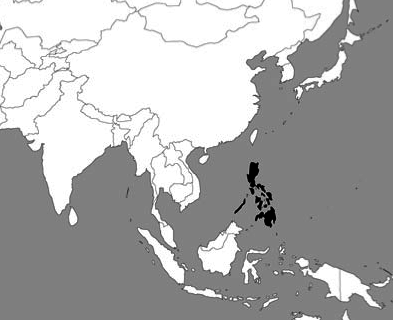
This paper is from a transcript of a conversation between Ruby Papeleras and Ofelia Bagotlo, two community leaders in the Homeless People’s Federation Philippines Inc. and Somsook Boonyabancha from the Asian Coalition for Housing Rights. The community leaders reflect on the difficulties that community organizations face in finding solutions – for instance, getting land and getting local governments, donors and activists to respect their priorities. They describe the steps towards building an urban poor movement – learning to trust ourselves, building this trust by establishing community savings groups and instigating initiatives (which show other groups their capabilities and other urban poor groups what is possible), drawing everyone in and using their different skills in surveying and undertaking community initiatives. They also discuss how the flexible funding for small projects available through the ACCA programme helps catalyze local activities while they wait for government. Small grants or revolving fund loans can be managed by communities, so the financial management makes people more powerful in terms of planning, prioritizing, decision-making and implementing projects. Small projects also help prepare communities for larger, more difficult housing projects and bolster their negotiations for land (showing their capacity to pay and invest). With no solutions on offer from government or the private sector, community people begin to take over, creating a movement in which people are finding alternative solutions that are cheap, efficient, easy, quick, equitable and full of the social elements that are missing from government-provided housing. From this they show local governments what they can do. Small projects are a bridge to link different individuals and agencies, and provide a language for dialogue between them.
Somsook: In every country, urban poor communities are trying to find their way in a very complex and difficult situation. Besides eviction, bad housing, lack of services and all the problems of poverty, they face all kinds of pressures from the formal system.
Ruby: In the Philippines, the government won’t recognize you if you are not registered. When we negotiate with the government, the first question is always: “Is your organization legally registered?” First, you have to form a community association and register with the Securities and Exchange Commission in order to have a legal personality. Then you can’t buy land as a group – or even negotiate to buy land – without registering yourselves as a homeowners association with the Housing and Land Use Regulatory Board. And you can’t form a homeowners association without first being a registered community association. It’s not easy to get that registration: the people have to elect a set of officers and have a set of objectives, and then there are yearly fees, taxes and reporting requirements. If communities aren’t ready for all this, they end up losing all their savings in penalties because they can’t comply with the yearly obligations for registered organizations.
Ofelia: And anybody who wants to set up an organization can register themselves, so you end up having many community organizations in the same area. In one barangay (urban district), there will be at least 100 registered community organizations. Many of them clash with each other and many overlap. Some have political connections, some are close to the government, some are set up by communities themselves and some belong to NGOs or development organizations.
Ruby: And it’s not only the communities clashing. The NGOs also have differences and compete with each other for control of this or that area, and that leads to more fragmentation. If some communities want to join the Homeless People’s Federation, for example, their supporters may not be happy with the possibility of “losing their baby”.
Somsook: One example of this is Barangay Gulod, in Quezon City, where one of the communities is undertaking a re-blocking project with support from the FDUP’s ACCA project. That area is one giant informal settlement but it’s broken up into lots and lots of separate organizations. Some link into the FDUP process, some don’t. So the development is fragmented and complicated. It’s very difficult to make any change in this thick soup of rules and regulations, with so many overlapping organizations and agencies.
Ruby: Poor people are also pulled by activists into their campaigns, but it’s almost never the communities who dictate that kind of process. These activists are always people from outside the community: they aren’t affected by those problems themselves and they don’t really feel what the people feel, as insiders. They come in and try to nurture anger against injustice in the community people, stir them up and get them to fight. But after the protests and the barricades, those outsiders go back to their homes, while we are still here, still living with these problems, without any solutions. Political factions also use poor people in this way, as cannon fodder when the opposition wants to bash the current administration. We have to negotiate with these groups all the time, but they cannot see any possibility, any opening with the government. If we show them some progress or some good thing in the government, they are not comfortable with that.
Ofelia: A lot more community people are realizing now that after decades of shouting and protesting, their lives haven’t gotten any better. They don’t want a long battle with the government, they want peaceful and secure lives, they want improvements, they want solutions. That’s why more and more are open when we bring them to visit our projects and show them that if they aren’t so busy fighting and barricading, they can get this kind of land, build this kind of house, pave this kind of street. To get all these things, we have to negotiate in a different way with the government.
Somsook: So the government and the other development actors can’t give you any real solutions. The solution is something people have to find themselves.
Ruby: But to develop our own solutions, we need resources. And when we do get some resources for communities, many of those donors and development agencies feel threatened by this new possibility where people control things. They don’t want to lose their power. They don’t want to be in the equality stage with us. They want to stay at the stage where they are high up there and we are very low down here.
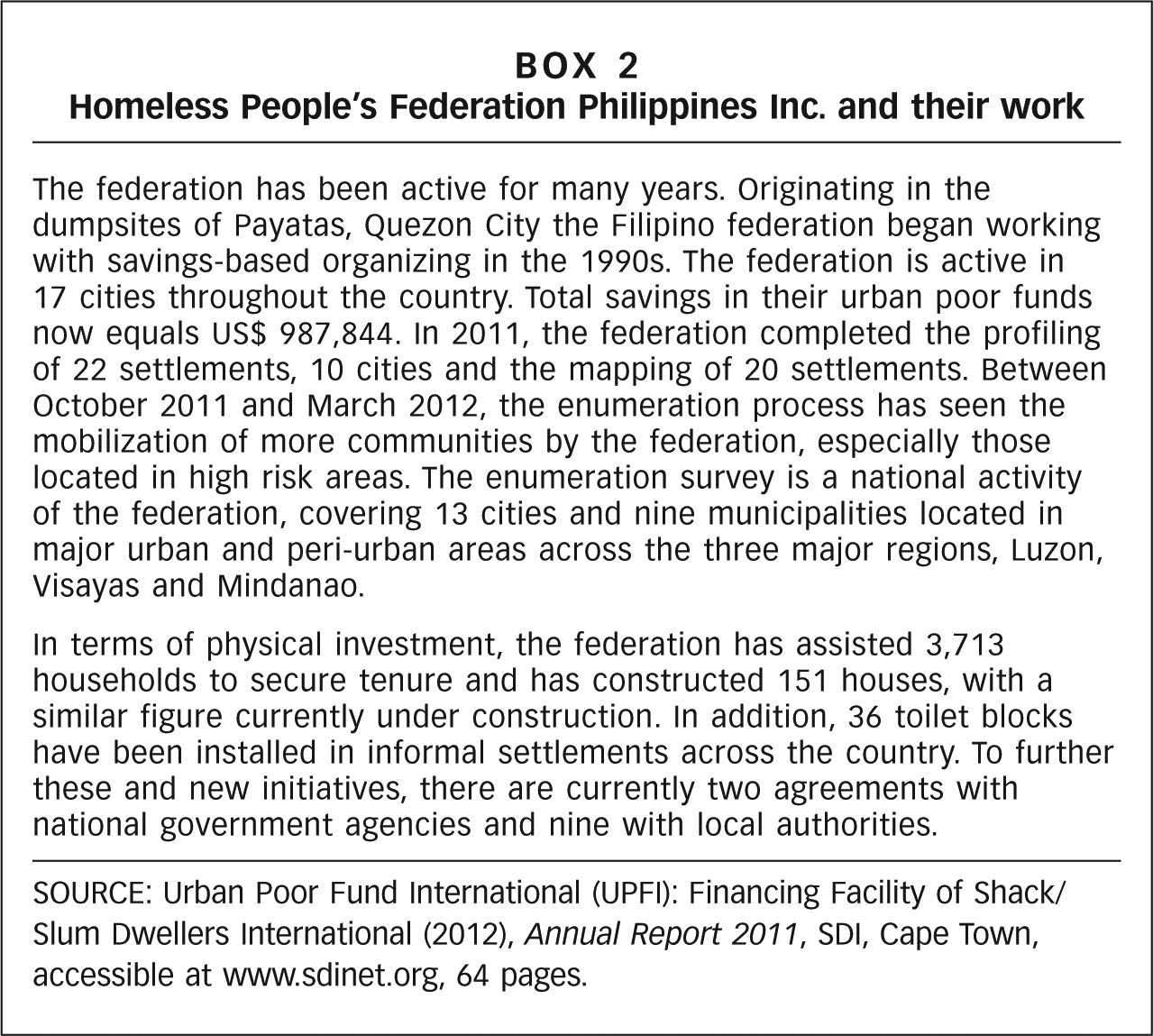
Homeless People’s Federation Philippines Inc. and their work
Question: How can people begin to break through these obstacles?
Ruby: The first step is for poor people to learn to trust themselves. Because we’re poor and because we live in slums,(2) nobody trusts us, nobody believes in us. We don’t have money, our jobs are illegal, our communities are illegal, our connections to electricity and water are illegal. We are the city’s big headache. This is the entire perception of people outside the communities. But we are human beings too and we have lives in this city. If we are given space to be part of the decisions and plans, we also can be part of the solution.
Ofelia: Before, I never wanted to talk because I was afraid that if I spoke, I’d make some mistake. But when I started to work in the federation, slowly, slowly I began to think that if others can speak out, why can’t I? And when I began to believe that I could do it, I could do it. For me, that confidence in ourselves is the most important thing of all. A people’s process builds that confidence and trust in a great big number of people, and turns it into a great big force, so all of us can find a better way, can improve our lives, our communities and ourselves.
Ruby: We build this trust in ourselves by preparing ourselves, by doing our own initiatives, by bringing in our own financial contributions and by doing things that others think are impossible for us to do. In our federation, we see the people’s process as a big space for people to do things in their communities, to identify needs, start solving problems, make mistakes and learn from those mistakes. This doing of things actually strengthens us and builds our capacities to continue finding solutions to bigger and more complex problems. But this process has political dimensions also, because it allows people in a community to begin working together, to strengthen relationships, to make communal decisions and to find solutions that come out of a collective process that is bigger and more powerful than only one person or one community or even one city.
Ofelia: Savings is an important part of building this trust in ourselves. In the federation, we always start with savings.(3) Being poor is not a hindrance to putting pesos into a savings group. If you have a problem, and set a target to address that problem, you can save, you can put aside that peso. And when you cannot solve a problem alone, you put your pesos together, and that larger collection of pesos can solve the problem.
Ruby: When we heard outsiders say: “They are scavengers, they don’t have money!”, we really felt the challenge to save, to put our money together. And that saving is not only putting pesos together, it is putting a system into the community and using that savings system to address our larger issues and to change the perspective of those outsiders who think no solution could ever come from those illegal people. “We are scavengers, but we have money. And when we put our money together, we can even buy land.” This is the real change, when these things we thought were impossible come from our savings. Nobody told us to save our money together. Nobody said search for possible land for our housing. Nobody said look for cheap land that has been foreclosed by the bank. Nobody said build very simple houses that you can construct yourselves and expand later. Nobody told us any of these things. There wasn’t any book with all these steps in it. This is the real power of the community process: if we are together, if we have money and if we have pressure from different kinds of problems, we become very strong and creative and we come up with a lot of ideas.
Question: How can you kick-start this process of people-led change in communities?
Ruby: One of the reasons poor people come together is because they have serious problems in common, which they struggle with together – problems such as eviction or water supply or toilets. In our experience, the more problems people have, the more they can unite.
Somsook: But there are so many poor people facing all those problems who don’t unite. How do you get them to come together into a force that can move in the same direction?
Ruby: Sometimes that coming together starts when people have a problem in common, and sometimes it starts when people see a concrete project that shows a solution that is the outcome of being together. So both the chicken and the egg can work as the motivation! But either way, our experience is that you can’t push projects if communities are not ready. To us, being ready means surveying the community,(4) discussing, starting savings, negotiating for land – all those activities that bring people together, get them to look at their community, understand the issues and start exploring their own solutions, as a community. The federation is now expanding into areas where people are really poor and facing all kinds of problems.(5) Because we have tested our own community-led process, we can share it with these new communities and show them that it works. But sometimes, this concept is new to communities, and it’s a long process to make them understand why they have to lead the game, not let others do things for them. Our role as a federation is to be a support system for them as they find their own way to this understanding. Instead of telling them how to do things, we tell about what we do, bring them on exchanges, show them possibilities and help them reflect on what they see.
Question: How do you get everyone in the community involved in this change process?
Somsook: The problem is that even in poor communities, there are haves and have-nots, members and non-members, and all these inequalities mean that there are always some who participate and many who don’t. How can we find ways so that everyone in the community can get in the boat and be part of finding the solution?
Ruby: This is also a challenge for our federation leaders, who fall into the same trap of feeling like they aren’t equal with the people in their communities. Again and again, we hear leaders complain: “There aren’t enough people willing to work in the community and it’s so hard to get anybody to participate! It’s always the same faces doing everything.” They’re just like politicians: once they get elected to the task of coordinating some task, they go right up into the air, become little dictators and forget about their neighbours. But communities have lots of people in them and everyone has capacity. Some may be very good cooks, some very good carpenters. Some may be good at keeping accounts and others at speaking English. You can’t accomplish anything meaningful without a huge variety of skills or without team work. Equality doesn’t mean everyone is the same! If you believe in equality, you don’t take over for everyone but you open up space and see how different people in the community can find a place in the process. That is how new leaders emerge.
Somsook: In a community process, there is a need for different people to answer different kinds of needs and gaps. Those different needs can be made into a more horizontal system, a task force of people who respect each other and whose skills complement each other’s. In that kind of system, each member has a clear role and each task has its own dignity, but everyone works together and they move forward together. It’s not just leaders and followers. But it is so hard to find that kind of system. Somehow, most of the systems by which people organize themselves are still vertical. When poor people make a community organization, they also recreate that vertical system, one way or another – because in our societies, that system is our only teacher, unfortunately.
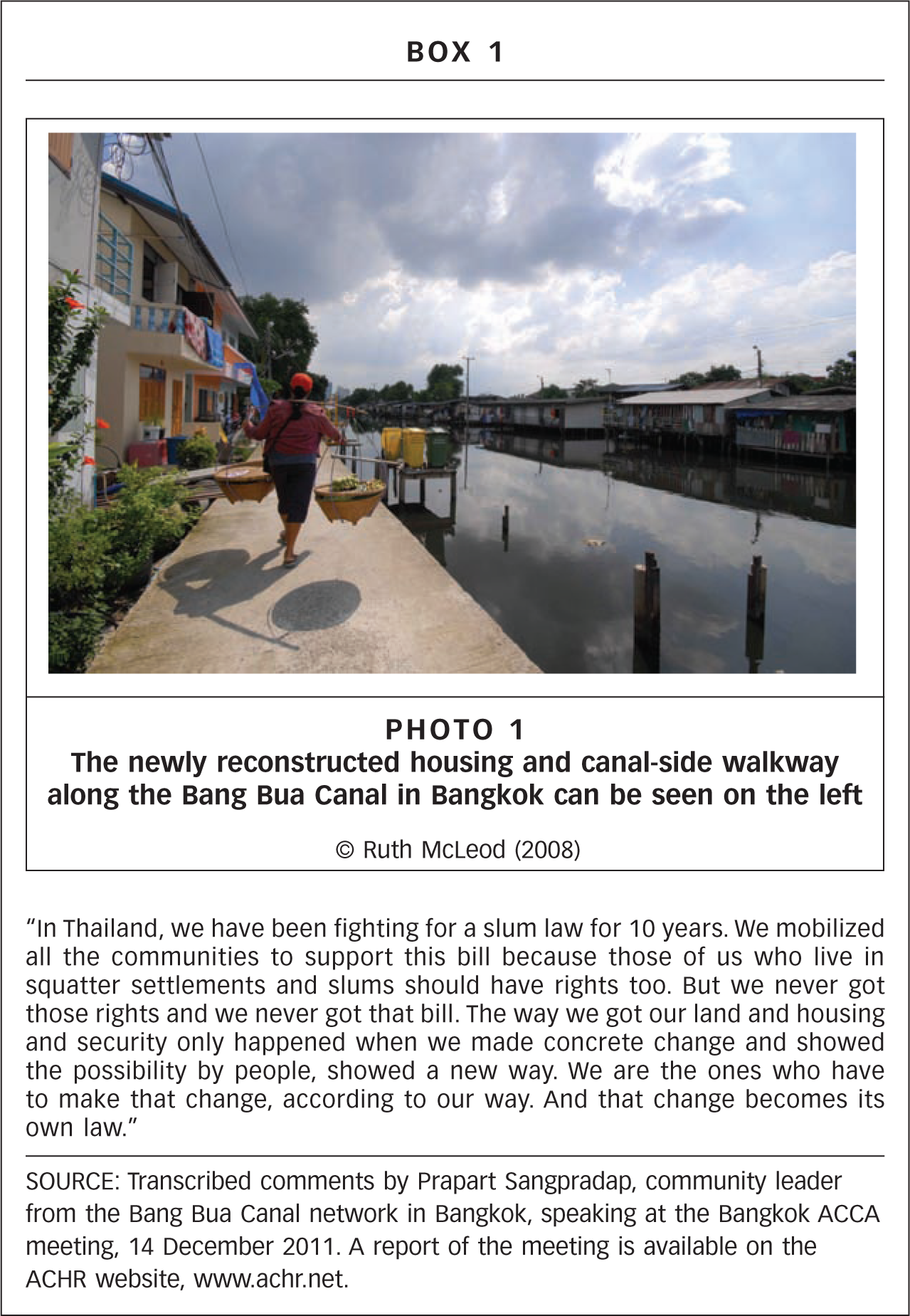
Ruby: In all the ACCA projects, we manage the budgets as loans – not grants – to members of the federation savings groups. But since the projects those loans finance bring benefits to the whole community, it may happen that 200 families will enjoy a new paved walkway that only 20 families are actually paying for. Most of the savings group members are proud that they are doing something for their community, but some naturally feel a little resentful that they have to work so hard to repay while others enjoy the walkway without paying a peso. But that is changing, as we do more projects. The ACCA projects have led to a big growth in savings groups in almost all the communities once the projects have been completed, and most of the projects have involved good participation from the whole community – not just the savings members. We have realized that it shouldn’t be only the federation savings members who pay for the improvements, but all the community members who benefit from the project can be involved. Even if they’re not helping repay the loans, they can support the projects in other ways, helping with the construction, providing materials or cooking a meal for the workers.
Question: When so many communities are waiting for the government to deliver, how can you get people to believe that they can do it themselves?
Ruby: For us, demanding a solution from the state is like giving away the power to solve our own problems to the government – the same government that has not been able to make any change for so many years. There is another way! In the federation, we start with ourselves, start by doing things that address the problems we face, in real ways, right away. So we start with savings and surveys and meetings – all those things that make us active and set us on that solution-finding path. By starting with action, people are little by little finding solutions that fit our systems, fit our lives.
Somsook: This is a new system, and what we are trying to do with the ACCA programme is to give people this space to get started and to take concrete action, with small and big projects and with the various tools the programme offers, so they can start finding their way towards concrete solutions that lead to structural change.
Ofelia: Before ACCA came, all we did was savings, savings, savings. When we went into the communities, all we heard was: “We’re tired of only savings, but nothing happens!” But when Typhoon Ketsana hit Luzon, and a lot of houses were broken by the flash floods, we used money from ACCA to make a special loan fund for house repairs in the affected communities. The communities managed the process collectively, deciding on the loan ceilings and repayment terms, figuring out who needed the loans most urgently and then buying all the materials collectively, in bulk. Before, they only saved, but now, with the disaster fund, they were making real changes in their lives. The small ACCA projects also brought about a big change: their minds were set that with savings, you just put the money there and it made no difference in anybody’s lives. But with path walks, they saw a lot of change. The children in those communities now had a place to play safely and drunken people could stagger home without falling down into the creek! After that, we didn’t need to go into the community and orient again about savings – they came to join by themselves!
Question: What is the role of the small ACCA projects in this?
Ruby: This was the first time the federation had funding to actually do these kinds of small projects in communities, to address very serious needs for drains, path walks, community centres, bridges and toilets. The small projects are simple and quick and they bring immediate benefits to many people, so they motivate people to save and join in the community process, because they see real concrete developments coming from their savings. In all the ACCA communities, the projects have given a big boost to the savings process. Also, these projects are really need based. In our system in the federation, communities borrow the money, it’s not a grant. So they only undertake projects they really need, because they have to pay for them fully. But the small projects help in so many other ways:
They turn waiters into doers: The small projects bring about a big change in people’s belief in their own power. In many communities, people wait around, year after year, thinking that someday the government will come and give them something. The small projects turn people who wait into people who do things. The projects build up the community organization by showing concrete results of working collectively. Sometimes, we encounter leaders who are very powerful and say: “I am the one!” But with these small projects, it’s not only one person, it’s the whole community: everybody plans them, everybody helps build them and the loan is for everybody.
They build a community’s maturity: The implementation of these small projects – which is never easy! – is both a test of a community’s maturity and a means to build that maturity. In the process of planning and undertaking these projects, communities have to deal with all the infighting, the conflicts, the factions, the ups and downs, the gossips who say: “They can’t do it! They’re just talking!” And in the process, their community organization matures. People can’t learn to deal with all those things without having actual projects to work on. This is not classroom learning, it’s hands-on learning you get only by going through all that stuff and still finishing the project.
They strengthen a community’s ability to manage funds: All of the federation’s ACCA projects are loans to communities, through the revolving fund. By giving people in the community and in the city the responsibility of managing the funds, the small projects help them grow stronger. That trust helps people develop their accountability and their capacity to procure materials and undertake other developments in the community when the loans revolve.
They help prepare communities for housing: The small projects are learning laboratories and they warm up communities for the housing projects they will undertake later. To do a housing project, we have to work out the land and basic services, develop the plans, design the houses, find the finance – it’s a long, complicated process. But the small ACCA projects to make roads, drains and path walks can be implemented easily and quickly, and they strengthen and prepare us for those larger and more difficult housing projects.
They bolster a community’s negotiations for land: Most of the communities that implement small projects in the Philippines are on insecure land, and these projects are their bargaining “capital” when they move to the next step, which is negotiating for land. When they go to the landowner, they can say: “We already paved the road and developed the drainage”, and that demonstrates that they can pay and that they have invested in developing the land that he owns.
They help motivate people from other communities to start: When we work with new communities, we can introduce our organization, explain about savings and enumeration and tell them about our experiences. But the most powerful way of convincing them about people-led change is to bring them to see the ACCA roads and path walks and the housing projects, and let them talk to the people who went through so many struggles to finish them. Usually, they ask us for orientation to help start the savings right after that!
Question: How do you bring all these scattered organizations and scattered projects into a citywide force, to make a citywide change?
Ruby: One of the real breakthroughs of the ACCA process is that urban poor alliances are becoming strong in several cities now, which link our federation with other federations and urban poor organizations in the city. We are all realizing that when we do things in a scattered way, as separate organizations, we have no strength and we cannot accomplish anything. In most cities, the only time all the urban poor unite is when some politician comes along and says: “We’ll give you rice if you go to my rally!” They only unite because of the rice! Here, we are trying to unite around common issues and to appreciate each other’s strengths: the federation is good with savings and we do housing and upgrading, while the others may be good at advocacy and policy reform. We are going to make this strategy of uniting all these scattered and sometimes competing community organizations in each city one of the goals of our new Urban Poor Coalition Asia.
Somsook: This is the stretch that brings about change, and that really changes perceptions of both the poor communities and of the city. Once the different federations are able to talk together, this makes them a big vote bank that represents all the community people in the city. They can negotiate with the city from a much stronger position because they represent the city’s whole urban poor population. What city could ignore that kind of force? And when the upper layer leaders in these big federations sit together in a friendly way, then the people in the communities and in the various factions will take on the same mood. This is important because it starts dissolving the many differences and factions that fragment communities.
Ruby: Iloilo was our first experiment in truly citywide thinking and citywide upgrading.(6) This was where we tested the small upgrading projects before ACCA started, with some funding support from ACHR. But we used the funds not just to make a few small infrastructure improvements here and there but also to link the different federations in the city to get together, to set their own criteria and decide on what projects to do in which communities. We used that process to build a communal platform. It took a long time to get started because all these federations and factions, who didn’t care much for each other, had to sit together, discuss and start dancing together. Many found it a big headache, but finally, the urban poor alliance in Iloilo clicked – they got it. And the small upgrading projects were the key to pulling all those different organizations – who represent most of the communities in the city – to come together and begin going in the same direction.
Somsook: Normally, people fight for their rights, for space, for status or for recognition – they fight over abstract things. But with the ACCA programme, they can talk about concrete needs and look at the whole city in very concrete ways: what are the problems and which ones need fixing first? And then start fixing all of them, right away.
Ofelia: Another citywide alliance of urban poor community organizations is UP–ALL in Quezon City, which the NGO FDUP helped set up as part of their ACCA project. There are about 400 community organizations in Quezon City, some started by activists, some by NGOs and some by hard core activists who do barricades. When our federation joined this new UP–ALL, we had our doubts that all these groups could really be united! At first, there were lots of quarrels between the leaders from these organizations, but now the alliance is starting to work, like the ones in Iloilo and other cities. We used to have such a heavy burden, always fighting among ourselves and with NGOs in different cities, but we have to free ourselves of that burden, stop the fight and go to the real work. They will begin to see how much more is possible when the urban poor can talk together and work together. If we managed to do it in Iloilo, Quezon City and Mandaue, we can build these citywide alliances in other cities.
Question: Why haven’t governments been able to address all these problems in any significant way?
Ruby: We have been lobbying the government for so many years for basic services, health programmes and other things, but still we have nothing. But land is still the most difficult issue. Without land, we cannot think of housing for the poor, whoever builds it! Most government agencies still think of housing for the poor as something the National Housing Authority (NHA) manages, private contractors build, local governments support and poor communities pay for. “Participation” in government solutions begins and ends with people paying for everything. We want to show another way, because most government agencies really don’t have any other idea how to do it.
Somsook: The reality today is that the government cannot give you the solution. It’s useless to go on expecting they can. They don’t have the intention or the policies, for the most part. They don’t know how to work with poor people and their knowledge is not keeping up with the changing world. If they do find some resources for housing the poor, they use contractors and those solutions cannot reach the real poor.
Ruby: In the city of Rodriguez, north of Metro Manila, a big World Bank-financed tourism project is being planned, for which hundreds of poor families will have to be relocated. But the project can’t get going because the relocation isn’t happening. The World Bank can only release the loan once the site has been cleared of all those families. Agencies inside the municipality are blaming the city’s housing department, and the housing department is blaming the people, who are reluctant to be chased out of the houses they’ve invested so much in and from the communities where they all have jobs, for a project they know almost nothing about and that might never actually happen, like so many other eviction-causing government schemes. There is a new government in Rodriguez and a new, pro-poor mayor who is a good man. But his administration is still very new and needs time to put in place the structures to manage a big city, and they have fallen back to asking the NHA to do it. Which means the people will get little boxes on tiny resettlement plots in a vast grid development designed by NHA engineers and built expensively by contractors. And the people will have to pay for everything – land, houses, site development and infrastructure. If this is the only solution, it will not be easy to evict all those people. So the government is in a difficult position – they will lose their political legitimacy and their votes.
The local government has a lot of challenges and limited resources, and for that reason, they are open. The mayor is starting to learn from the federation. We are like the devil whispering in his ear: “Don’t get these professional agencies. Let the people do it themselves.” Because of the implementation of ACCA and our savings, which has been active in Rodriguez, they have invited the federation to sit on the local housing board. We’re there to help the government build strong relations with the people and we’re there to represent the needs and the realities of the people. We are now trying to ensure that the affected communities will be part of the technical working group that will plan and facilitate the relocation process, and in these ways we are trying to show a new way, in which people know, people plan and people do.
Somsook: In the early stages, the NHAs in many Asian countries had some capacity and idealism, and they developed some good solutions such as in situ slum upgrading and slum redevelopment. But at some point these institutions stopped growing, and many of them became more like real estate developers of contractor-built housing that had nothing to do with low-income communities. Suddenly, there was a big gap in many Asian countries, and that’s why community people began taking over, to fill that gap. Otherwise, they faced eviction all the time, with no solution from the government and no solution from the private sector. That process of community people taking over is now becoming a big movement. It’s not just a few projects here and there or a few solved problems – it is now a system, in which people are finding alternative solutions that are cheap, efficient, easy, quick, equitable and full of all the social elements that are missing from all that supply-driven housing.
Question: How can you get governments to get on this train with people, collaborate with them?
Somsook: Many city governments are now seeing this new process of people developing their own solutions and saying they want to support it and be part of it. But there are other cities where the government is still reluctant. So it’s important to keep trying to find ways of getting the local government to accept this new thing and to work with communities as a team. When a community builds a 200-metre concrete road or puts up street lights, the local authority will know about it and will pay serious attention. Infrastructure upgrading is something the local government really does care about.
Ruby: They feel bad when we start constructing something public without them, without asking for permission, without getting them to collaborate. They are used to being the ones who dominate public construction, but here, people are doing it themselves. These ACCA small projects are a tactful way of dealing with the local authority. People have serious problems for a long time, and no matter how much they scream and cry, the local authority never does anything. So now the poor are doing it themselves. When the local authority sees these projects that the poorest people in the city have done, they feel ashamed: they feel they’ve lost control, lost their image, lost the respect. The projects are a challenge to them but we do it in a diplomatic way, always inviting them to the inauguration, to cut the ribbon. And they always come!
Ofelia: Because they show concrete solutions, these projects have given a new image of what poor community people are able to do and deliver. They have given those communities a new respect from the system, because they show the local governments how the people can do their own upgrading. And in the process, they keep going to the government to ask to borrow construction equipment, to ask for this and that.
Ruby: Because of the ACCA projects, we have begun to negotiate with the local governments, even in cities where the communities only had quarrels with them and never discussed anything! But with ACCA, the direction for communities is very clear: to implement ACCA is to link and negotiate with the government, because the government has a lot of resources to support our communities and we can’t access those resources without dialogue, without making friends. The communities may not get that support right away, but the important thing is that they move forward on that front, the discussion opens and they begin to explain to their local authorities about the ACCA programme, about their projects and about what they are doing. This connecting with the government – and with other local institutions – is not only during the project implementation, it is a long-term vision.
Somsook: After three years, we can now see how the ACCA programme is helping to build that kind of partnership between the people and the city. The tools the programme offers – like the small projects – work like a bridge to link those different actors and provide a language for dialogue between them. Otherwise, we can talk forever about abstract things such as rights and partnership. The programme’s tools allow them to really start doing something together, and through action to bring about actual physical improvements, with dialogue, collaboration and partnership.(7)
Ofelia: When we plan and carry out these solutions ourselves, we are showing the government that we are not a burden, we are not a headache for the city, we are not waiting for any hand-outs. We are showing them that we can do our own development and that we can contribute to the city also.
Question: How can you challenge and change the planning rules and building standards that make housing for low-income households inaccessible?
Somsook: All poor people’s housing projects are below standard, one way or another, because poor people can’t afford big plots of land or big rooms or setbacks or wide roads or low density – you name it. They can’t follow those formal standards because they were designed for people with much higher incomes. That’s why they can’t afford any kind of private sector housing that does follow those standards. And that’s why they have to grab whatever land they can and develop whatever kind of housing they can afford – which is always below standard. That’s the reality. So the art of doing poor people’s housing is the art of getting governments to agree with your plans, which are always below standard. How do you do that?
Ruby: Sometimes, to get the approval, we say that we are following the rules, but in reality we don’t follow them. In Payatas, for example, the scavengers’ savings group bought the land and made a nice official layout plan with the engineer that met all the planning standards and building by-laws, to get the permits, but the reality of what they actually built was not standard. But most of our housing projects are joint projects with the local authority, and this is always an advantage because they can sign the approval and then pretend not to see when we have to build according to the reality, in ways that don’t follow the rules.
Somsook: That’s what the Thai communities do also. The draft plan they submit for approval has to follow all the minimum two-metre and four-metre road widths and all the rules so they can get the approval and get their house registration numbers. But then they construct a little differently. But this negotiation strategy doesn’t always work. In some of the Baan Mankong projects, the leaders have been put in jail for not complying with building by-laws.
Ruby: Our plot sizes may be smaller than allowed, but the quality of the house construction is not sub-standard at all – nobody wants to lower that standard! In the sub-division plan for our housing project in the Lower Tipolo Homeowners Association Inc. (LTHAI) community in Mandaue, we reduced the plot size so we could fit in everybody who was a victim of the fire and to make the houses affordable to everyone. The issue was not whether or not to follow the standards but to make the housing affordable. The plots are 32 square metres (compared to the NHA minimum of 40 square metres) but the two-storey row houses have 48 square metres of space, with 24 square metres on each floor. And inside, they’re very nice, with two bedrooms upstairs. That’s how we maximize the living space on the small plot.
Somsook: Sometimes, those formal standards are worth questioning. In Bangkok, one of the big condo developers is now selling studio apartments of only 22 square metres for 800,000 Baht (US$ 27,000). That’s the most minimum unit the formal housing market has to offer but who would ever call that decent housing? And that’s three times the cost of the 40 or 50 square-metre houses people build themselves in Baan Mankong. In the community housing projects being implemented in so many countries, no matter how small the plots or houses are, the floor area is always bigger than that!
Ruby: As we plan and develop more and more actual housing projects, we are learning a lot about how to do it better, more cheaply and more efficiently. By demonstrating that this lower standard can still be nice, we are trying to change the policy in the longer term and starting to lobby to amend those inappropriate building codes.(8)
Somsook: The Thai communities have also helped change the standards. In many cases, we have invited ministers and high level officials to Baan Mankong housing projects that people designed and built themselves, where everything is too small and sub-standard in many ways. But actually they are beautiful communities, and they make a powerful argument to those officials for lowering standards. Sometimes, the communities also send letters to the ministry and organize demonstrations. Finally, they have agreed to change the setback requirements and lower the minimum road widths and minimum plot sizes.
The interesting thing about people’s housing projects is that they almost always start with their real affordability, so they can’t do anything too wild or too high standard. Affordability is the reality check. And actually, most communities can make houses with more floor area than people had in the old slum, if they plan it carefully. In Thailand, most of the Baan Mankong houses – even those on very small plots – have more living space than people had in the old slum, but with a much better environment and infrastructure. And the monthly loan repayments for those houses are less than what people were paying before to rent a miserable little room! The key is that these designs come from the realities of people’s lives: how much they can afford to borrow and to repay every month.
Ruby: We have also learned that if you start small, even if the loan is not enough to completely finish the house, people will be inspired to scrimp and save every extra peso to continue that house. The important thing is to start, because once they’ve started, people already have the target to finish the house. Then, instead of frittering away their money on unnecessary expenses, they are focused on finishing their house. That small loan is a big motivation.
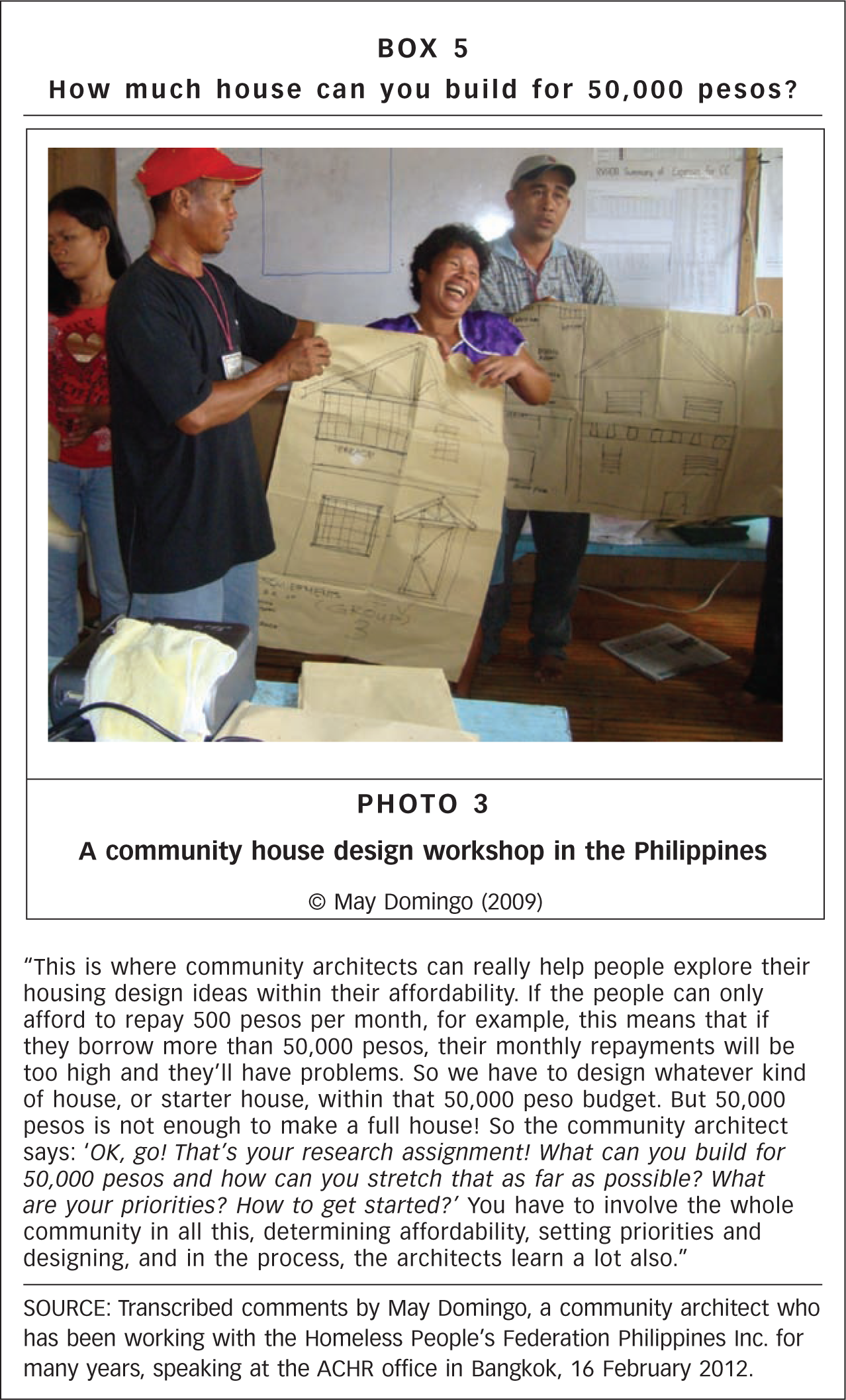
Somsook: The community architects have opened up a whole new world of community planning, which is right in the middle of this big change by people we’re talking about. Before, the only picture people had in their minds when you said “housing for the poor” was the standard government box, with minimal everything, shoddy construction, grim little boxes strung out in long rows on a grid. But when the community architects come and help people translate what they want and what they can afford into creative new forms, that process is so important in expanding people’s ideas of what is possible with housing – even very low-cost housing.
How much house can you build for 50,000 pesos?
Ruby: The ACCA projects have also changed the way our community architects deal with communities. At first, many of them came into communities with the idea that: “We are from the university and we know something!” But because the communities also have skilled construction workers and artisans who contribute all kinds of ideas to the projects, the architects also learn from the community people. These young professionals do have some experience from the university, but they don’t have experience in how to make these kinds of projects within a poor community. It changes their perspective a lot. And many of them enjoy the experience and the relationships so much that they have turned down good jobs outside – with good pay! – to keep working with us.
Question: What is the role of finance in bringing about these changes?
Ruby: The ACCA money is flexible money that allows us to manage our own development.(9) It opens up space for us to experiment, to develop our skills and to make mistakes, while we try to create some good solutions. Other donors are much stricter, looking into the repayments and all the financial aspects. They’re more worried about how the money will be repaid than what kind of changes the money will bring about. They don’t see the bigger aspect of how people change and how people become the solutions in their societies through this kind of process. But with ACCA, the focus is on how small financial grants or revolving fund loans can be managed by communities themselves, so the financial management makes people more powerful in terms of planning, prioritizing, decision-making and implementing actual projects. We also have donors who make us categorize people in the communities according to who can and who can’t afford the housing loans. The focus is all on capacity to repay. But with ACCA, we can give space for everyone in the community to be part of the change process, even very poor people who may not have the capacity to repay loans. They also have a dream to get a house, they are also part of the community and they should be part of the projects too.
Somsook: In most development processes around the world, almost all of the resources that finance that development are being controlled by people who are not themselves in need. They are not slum dwellers, they are not poor, they have never experienced deprivation of any sort. Yet they set the systems, make the rules and design the structures – and then expect all those poor souls on the ground to follow what they say. And it never works. That finance never reaches those people on the ground in any significant way, to help them make any significant change. We know that and they know that. But in this experiment with ACCA, we are seeing how even a very small amount of money can allow people on the ground to make a lot of breakthroughs, a lot of change. But those finance controllers are not “crossing the river”, from their old, conventional, top-down side, to this new side, to see how finance can actually give people the freedom to do so many things.
Footnotes
1.
The work of the Homeless People’s Federation Philippines Inc. (HPFPI) has been discussed in earlier issues of Environment and Urbanization, particularly in the context of their work on disaster responses. See, for example, Yu, Sandra and Anna Marie Karaos (2004), “Establishing the role of communities in governance: the experience of the Homeless People’s Federation Philippines Inc.”, Environment and Urbanization Vol 16, No 1, April, pages 107–120; also Teodoro, John Iremil E and Jason Christopher Rayos Co (2009), “Community-driven land tenure strategies: the experiences of the Homeless People’s Federation Philippines Inc.”, Environment and Urbanization Vol 21, No 2, October, pages 415–442; and Carcellar, Norberto, Jason Christopher Rayos Co and Zarina O Hipolito (2011), “Addressing vulnerabilities through support mechanisms: HPFPI’s ground experience in enabling the poor to implement community-rooted interventions on disaster response and risk”, Environment and Urbanization Vol 23, No 2, October, pages 365–381.
2.
The term “slum” usually has derogatory connotations and can suggest that a settlement needs replacement or can legitimate the eviction of its residents. However, it is a difficult term to avoid for at least three reasons. First, some networks of neighbourhood organizations choose to identify themselves with a positive use of the term, partly to neutralize these negative connotations; one of the most successful is the National Slum Dwellers Federation in India. Second, the only global estimates for housing deficiencies, collected by the United Nations, are for what they term “slums”. And third, in some nations, there are advantages for residents of informal settlements if their settlement is recognized officially as a “slum”; indeed, the residents may lobby to get their settlement classified as a “notified slum”. Where the term is used in this journal, it refers to settlements characterized by at least some of the following features: a lack of formal recognition on the part of local government of the settlement and its residents; the absence of secure tenure for residents; inadequacies in provision for infrastructure and services; overcrowded and sub-standard dwellings; and location on land less than suitable for occupation. For a discussion of more precise ways to classify the range of housing sub-markets through which those with limited incomes buy, rent or build accommodation, see Environment and Urbanization Vol 1, No 2, October, available at .
3.
, “Meet the Philippines Homeless People’s Federation”, Environment and Urbanization Vol 13, No 2, October, pages 73–84.
4.
The April 2012 issue of Environment and Urbanization discusses processes of community surveying and enumeration.
5.
To learn more about HPFPI’s work on disaster responses, see Rayos Co, Jason Christopher (2010), Community-driven Disaster Intervention: Experiences of the Homeless People’s Federation Philippines Inc., IIED/ACHR/SDI Working Paper 25, IIED, London, 69 pages. This working paper describes the ways in which the federation has organized communities following a disaster, helping them to secure land and construct housing.
6.
See reference 5 (case study 5).
7.
See other papers in this issue of the Journal for many examples of this.
8.
See in the paper by Boonyabancha and Mitlin in this issue of the Journal.
9.
The experiences of the federation in the Philippines have shown the importance of such monies. ACCA funds have added to money that the federation has secured from both its members and donors willing to support the flexible use of monies. To date, local savings schemes have borrowed US$ 630,571 from the federation and these funds have been capitalized by savings. The strategic use of these monies for shelter development has leveraged about US$ 23 million.
References
1.
ACCA (2010), “Report on the Nepal assessment trip, 22–25 November 2010”, available at www.achr.net, 18 pages.
2.
CarcellarNorbertoRayos CoJason ChristopherHipolitoZarina O (2011), “Addressing vulnerabilities through support mechanisms: HPFPI’s ground experience in enabling the poor to implement community-rooted interventions on disaster response and risk”, Environment and UrbanizationVol 23, No 2, October, pages 365–381.
Rayos CoJason Christopher (2010), Community-driven Disaster Intervention: Experiences of the Homeless People’s Federation Philippines Inc., IIED/ACHR/SDI Working Paper 25, IIED, London, 69 pages.
6.
TeodoroJohn Iremil ERayos CoJason Christopher (2009), “Community-driven land tenure strategies: the experiences of the Homeless People’s Federation Philippines Inc.”, Environment and UrbanizationVol 21, No 2, October, pages 415–442.
7.
Vincentian Missionaries Social Development Foundation Inc. (VMSDFI) (2001), “Meet the Philippines Homeless People’s Federation”, Environment and UrbanizationVol 13, No 2, October, pages 73–84.
8.
YuSandraKaraosAnna Marie (2004), “Establishing the role of communities in governance: the experience of the Homeless People’s Federation Philippines Inc.”, Environment and UrbanizationVol 16, No 1, April, pages 107–120.





 .
.