




Abstract
This paper describes the enumerations of informal settlements undertaken in 2010 by the National Slum Dwellers Federation of Uganda in the cities of Arua, Jinja, Kabale, Mbale and Mbarara, covering about 200,000 people. It describes how this federation was founded and subsequently developed through an earlier enumeration and initial work in informal settlements in Kampala. It also discusses the relationship between the federation and other actors, including the national government and Cities Alliance, and their role in supporting the formation of the federation. It explains how federation members developed the capacity to undertake the enumerations and later improved upon those skills, for example developing a GIS, to support the planning and implementation of upgrading by federation, local and national government agencies. The paper ends with a discussion of the way enumerations can encourage the rapid maturation of urban poor groups and their relationship with their cities and other development actors and the larger political context.
I. Introduction
This paper traces the long, slow process through which a slum dwellers federation(1) in Uganda built its capacity to undertake large-scale enumerations and mapping in informal settlements. It highlights the importance of community-driven processes and the ways in which ownership over these processes can profoundly transform both the mentality and the capacity of a community. It also highlights the complex relationships between federations, NGOs, local government, national government and other external organizations, illustrating the wide range of actors that have a role in large-scale enumerations such as the five-city enumeration in Uganda, which will be discussed here.
In a number of countries, citywide slum enumerations have been undertaken by residents’ local federations. Uganda will be one of the first where this becomes part of a large-scale international development project. Here, the National Slum Dwellers Federation of Uganda (NSDF–Uganda) will partner with Cities Alliance as part of the Transforming the Settlements of the Urban Poor in Uganda (TSUPU) project, funded by the Bill and Melinda Gates Foundation. Through this project, they will explore a strategy developed by Shack/Slum Dwellers International (SDI),(2) whereby slum federations that have emerged as a result of the process of enumeration will work closely with their city and national governments to address present challenges of informality and to plan for expanding cities of the future.
II. The Formation of the Ugandan Slum Dwellers Federation
The National Slum Dwellers Federation of Uganda (NSDF–Uganda) was founded in 2002. Its formation was unlike that of other federations in that it emerged from a request by the government of Uganda that SDI provide assistance in dealing with slums.(3) SDI’s work had already been introduced to some Ugandan officials by Homeless International; however, the first direct contact was made at the first UN–Habitat World Urban Forum held in Nairobi in June 2002.
At the Forum, the 70-strong SDI delegation set out to demonstrate that organized urban poor communities had developed highly effective responses to urban poverty. Indeed, they contended that the participation of organized slum dwellers was central to the capacity of cities to manage rapid urbanization. To demonstrate the kinds of projects they were capable of, federations of the SDI network erected life-size cloth models of houses and community toilet facilities. Led by its president, Jockin Arputham, the SDI delegation also pushed to have the voices of slum dwellers heard in networking events, seminars and plenary discussions. By the end of the Forum, a visit to Uganda by an SDI delegation had been organized, which would be hosted by the Ugandan Ministry of Lands, Housing and Urban Development.
In September 2002, a team of federation leaders and support NGO staff from India, South Africa and Kenya and from Homeless International visited Kampala. This visit spurred two parallel processes, namely the development of a Memorandum of Understanding and a mobilization of slum dwellers in Uganda’s primary cities of Kampala and Jinja. The Memorandum of Understanding between the National Ministry of Housing and Public Works (as the housing ministry was then known), SDI and Homeless International was signed early in 2003. It stipulated that the ministry would directly support SDI in its mobilization of slum dwellers in Uganda’s primary cities of Kampala and Jinja. The ministry identified Kisenyi, located next to the wholesale markets and one of the largest and oldest settlements in the centre of Kampala, as the most pressing target for the first slum enumeration. Kisenyi’s central location and high land value increased the potential interest for development there.
Throughout 2003 and 2004, SDI organized frequent learning exchange visits to Kampala by federation members from countries around Africa and support staff from SDI, to develop the institutional arrangement between the national government and SDI. The visits also sought to continue mobilizing daily savings groups and to support the foundation of the National Slum Dwellers Federation of Uganda (NSDF–Uganda). SDI also supported exchange visits for high ranking government officers from Uganda, including the Minister of Housing, and also for slum dwellers from Kisenyi to SDI project sites in Kenya, South Africa and India.
III. Don’t Map the Fences: The First Enumeration
By the end of 2003, NSDF–Uganda, with support from SDI, had conducted its own enumeration and mapping(4) of Kisenyi in partnership with the national housing department. Kisenyi is part of Kampala Central Division – one of the city’s five divisions, each of which is made up of administrative units called parishes. Kisenyi occupies three of its division’s seven parishes, with Kampala’s central business district occupying the remaining four. Up to 85 per cent of Kampala’s land is covered by shack-dominated sprawl similar to that in Kisenyi. In many cities, slums are physically segregated pockets of shack housing; in Kampala the reverse is true – the city has pockets of formally planned areas within the larger unplanned and poorly served areas. For this reason, Kampala’s slums are identified by the name of the administrative location they occupy rather than having the more colourful names that informal settlements are often given, such as Joe Slovo and Barcelona in Cape Town, or Kosovo in Soweto or Kambi Moto (meaning “camp of fire”) in Nairobi.
The 2003 enumeration in Kisenyi was supported by a team of federation members from Kenya, South Africa and India, who transferred some of the knowledge they had gained through their years of work. During the preparations, some team members were surprised by the mixed land use within Kampala’s informal settlements, which can include formal structures such as schools or banks. Peter Chege, a federation member from Kambi Moto, Nairobi said: “I was very surprised when the group [of enumerators from Kisenyi] I was assigned to work with brought in filled-out forms from the city’s fire station, a public school and a Stanbic Bank branch.” This mix of formal and informal, although not unique to Uganda, was unfamiliar especially to the visiting Kenyans, and challenged the direct transfer of their enumeration skills.
Kisenyi’s three parishes, Kisenyi I, Kisenyi II and Kisenyi III, are each further broken down into administrative zones. Kisenyi III, for instance, consists of seven zones. Each zone is represented in Kampala’s city council by a local councillor grade 4 (LC4). These councillors are for the most part also popularly accepted slum leaders. When SDI started to mobilize the residents of Kisenyi, they had no choice but to work within this community administrative structure because of the nature of SDI’s entry into Uganda, which was through the government. There were no other developed social organizations governing the areas occupied by the urban poor communities, and the few male leaders that SDI encountered had close affiliations to local politicians.
The initial assumption of NSDF–Uganda’s community contact persons in Kisenyi was that the government was undertaking a housing project and SDI was a supporting donor. The local councillors reassured SDI, however, that they would mobilize the community for the project and support it. While the National Ministry of Housing and Public Works assigned the task of doing the enumeration to SDI, the local community leaders had trouble explaining to the local government why an enumeration was necessary, as they maintained lists of all the residents in their areas. The figures the local leaders provided, however, did not appear to tally with the visual assessment made by Shekar and Jockin from the Indian federation. A “hut count”(5) of Kisenyi III was agreed upon, and it showed a far larger population than the councillors’ list did. Realizing that they had under-represented themselves politically, the local councillors were persuaded that an enumeration was important.
During the 2003 enumeration process, the first teams from SDI, with the support of the local councillors, mobilized women into collective daily saving groups,(6) each group representing the community within a certain zone. One benefit of organizing this way, i.e. through women, was that the groups were not seen as a threat to the current political order or as an alternative community governance structure and were accepted by the local councillors. Peter Chege noted:
“We kept telling the community to keep the [government] administration out of the savings groups and they kept bringing them in. We thought the administration was similar to Kenya, where they want to be the controllers of the land in the slums, but here [in Uganda] it’s different, you cannot speak to the community without them.”
The practice of savings took off in zones with more shacks and fewer permanent buildings. The more residential of the Kisenyi parishes, Kisenyi III, became the core of the federation and the focus of SDI’s work for the next years. Within the more commercial Kisenyi I and II, the practice of daily savings collections was made more difficult by the physical distance between shacks. Despite this, however, and despite high-income groups coming into the area, the savings schemes have been sustained.
a. Results from the Kisenyi enumeration
The 2003 enumeration counted 27,000 households in Kisenyi, around four-fifths of which had moved to Kampala between 1985 and 1995. It also showed that tenure arrangements in Kisenyi are extremely complex and are representative of the challenge faced by urban residents throughout Uganda. Here, cities have a complex, layered land tenure system with customary ownership rights and informal structure owners and tenants. Resolving these complex tenure arrangements forms the basis of NSDF–Uganda’s work today.
While planning and undertaking an enumeration, it is common for some change in thinking about upgrading solutions to take place within a community. Often, when the data analysis is finished and presented to the community, in some sense it affirms what the community has learnt about itself more informally throughout the process. This was the case in Kisenyi. For the community, in addition to getting an accurate population count of the settlement, the 2003 enumeration contributed to a greater level of awareness about the infrastructure and services present in their settlement, and the possible paths towards upgrading. When the enumeration was first introduced, the community assumed that it would “bring a housing project”. As the process got underway, they began to understand more clearly that their participation and direction was necessary to achieve anything long lasting; the community would first have to determine its priorities and then strategize about how best to achieve them. Through the enumeration, the range of interests in the settlements became apparent and the leaders started to ask questions such as: “How do we do this? Is our situation unique?” What first seemed to be an issue of insufficient financial resources to build houses became a question of how to reconcile the various interests in the community so that housing upgrading could take place.
The enumeration also introduced other changes to Kisenyi, including increasing the stature of the savings collectives with a strong women’s membership. Without upending the local leadership, the savings groups had become legitimate community voices through their contributions to the enumeration − now recognized by local government officials and landowners − and had the confidence to discuss settlement upgrading solutions.
2003 enumeration findings
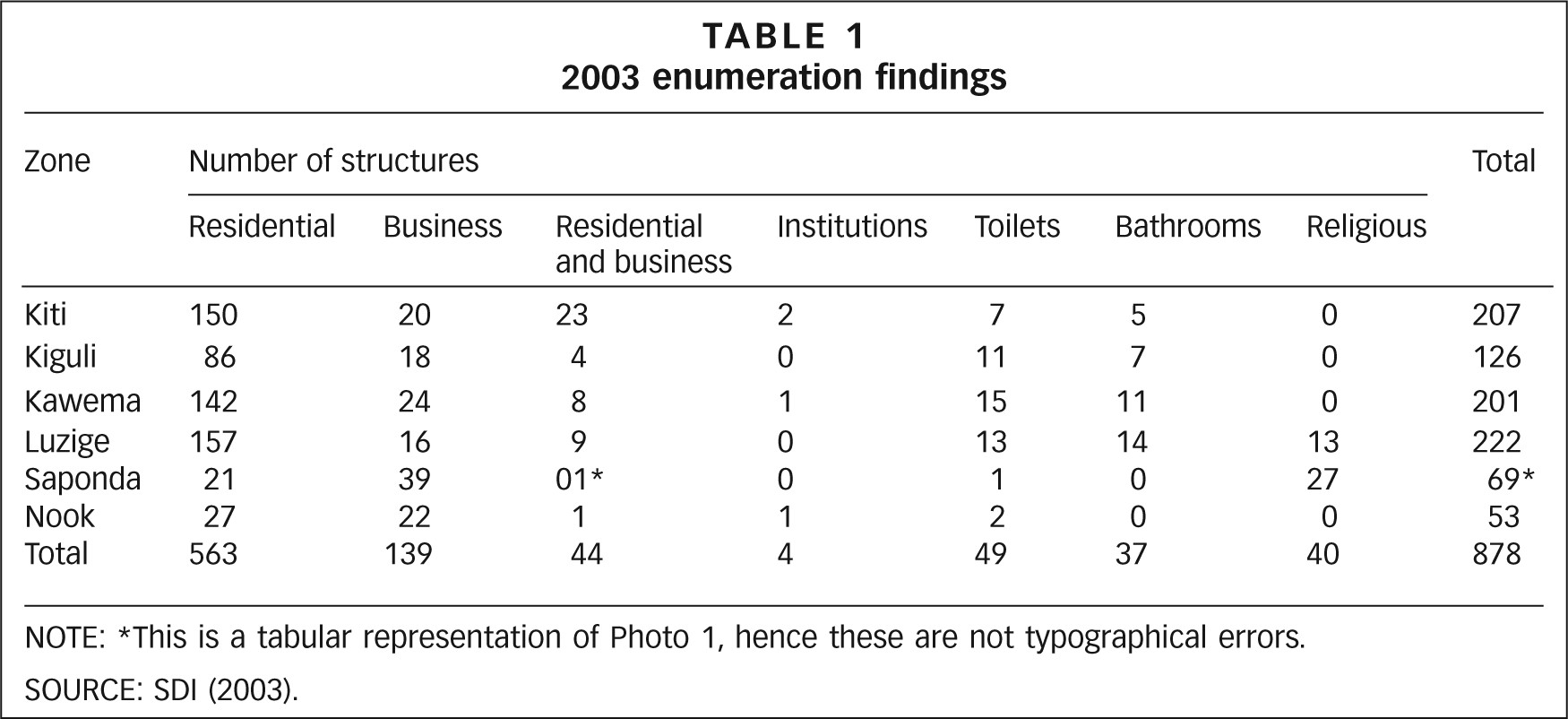
NOTE: *This is a tabular representation of Photo 1, hence these are not typographical errors.
SOURCE: SDI (2003).
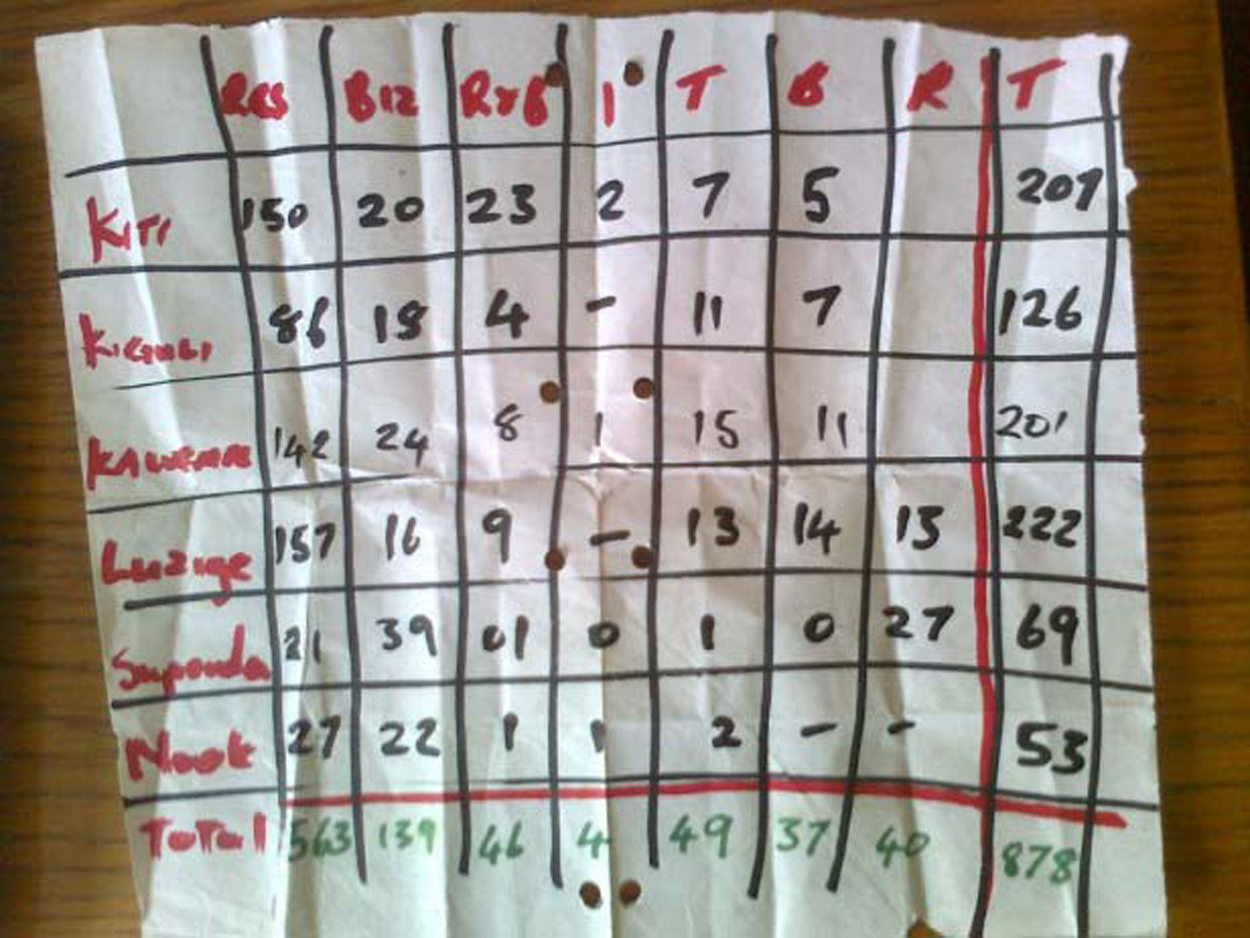
Shack numbering chart used by the Kisenyi community
The experience of this enumeration was also important in other ways. It supported the further growth of NSDF–Uganda and the fine tuning of its organizational structure. This included negotiations over matters such as whether an activity was voluntary or not, when an allowance would be given, who gave it and how it was accounted for. It also introduced not so simple principles, for instance that the post-enumeration mapping exercise should not capture the wire and shrub fences built around many shacks. NSDF–Uganda had learnt from other affiliates that when you map plots with fences, it gives the impression of a totally occupied settlement. When you leave out the fences, the community can see the spaces between the shacks and can more easily visualize a settlement upgrade. Working out these strategies helped NSDF–Uganda to mature and build up internal resources of experience and knowledge, as well as a strong structure able to manage an enumeration and to successfully address problems as and when they arose.
This enumeration culminated in a house model exhibition inaugurated by the Minister of Housing in the centre of Kampala, which was visited by large numbers of people. This festive occasion helped break the ice between the communities and the national and local government officials present. It also marked the inception of the slum dwellers federation in Uganda.
Building on this, SDI along with NSDF–Uganda later negotiated with the local municipality for land on which to construct the first community toilet in Kisenyi, which included a meeting facility; this was followed by three demonstration houses. The process was not easy and took place against the backdrop of a significant governance crisis in 2006 surrounding the presidential elections. The community groups struggled to achieve an organizational structure that could deliver on the proposed demonstration project. Although they were ultimately successful in constructing the houses, the existing leadership was challenged and the logic of a more proactive federation process took root as a viable alternative. While this process was fraught with challenges and wastage, it set a precedent that showed government and communities that it was possible to turn their aspirations into concrete reality. However, despite these gains the struggle in Kisenyi continues. With land values going up in the city centre, Kisenyi is now being eyed by developers and government who would like to replace it with an attractive centre with high rise buildings. Evictions continue, but slowly and casually, a few at a time so as not to be so noticeable.
IV. Lead-Up to the Five-City Enumeration
In the years between the first Kisenyi enumeration and the five-city enumeration in 2010, NSDF–Uganda continued to grow both in terms of its own capacity and internal processes and in consolidating government support.
With the process around building the toilet block and the three demonstration houses in Kisenyi, the capacity of savings schemes to go beyond simply savings and to become a community platform for action became apparent. It also became clear that this community process could not be adequately supported and sustained by the ministry’s technical approach to development; the internal community negotiations that are so necessary to building capacity for collective action often appeared to ministry officers as a waste of time. Another source of support was required. The South African and Kenyan federations understood the need for a realignment of community interests – something that they themselves had gone through. To address this need, in 2005 SDI explored avenues for establishing a local support agency for NSDF–Uganda, similar to the support NGOs for other SDI federations. In 2006, the SDI secretariat seconded one of its staff to establish a local organization, recruit staff and support the building of a support NGO. This marked the beginning of ACTogether, a registered NGO that was set up to provide technical support to NSDF–Uganda in terms of drawing up and facilitating the federation to carry out a programme of activities.
With this alliance established, NSDF–Uganda was able to focus more on building its grassroots strength and organizational capacity. Mobilization of new savings groups, sensitization to the tools and methods used by SDI members and exchanges with other federations helped the movement to mature.
At the same time, there was a focus on generating and strengthening government support for slum upgrading more broadly in Uganda. The land for the community demonstration project of three incrementally built houses and the community toilet and meeting facility mentioned earlier had been procured by the city council of Kampala – in principle strengthening the government/SDI relationship. The larger focus of this process, however, was the continuous interaction between the Ugandan government and the global urban development sector, largely facilitated by SDI. The confidence and the network that grew from this sustained interaction contributed to the policy position that the Ugandan government would later adopt, which created the enabling environment for citywide community-led enumerations.
Unlike many African governments that focus on rural development in spite of rapid urbanization and the growing importance of urban economies, by 2009 the government of Uganda had recognized the need to capture the positive impacts of urbanization as the driver of its economy.(7) Another significant indicator of the government’s commitment to urban development came during the Fifth World Urban Forum in Rio de Janeiro in 2010. Apart from the host country’s president, Luiz Lula da Silva, the only head of state to attend was Uganda’s Yoweri Museveni. His presence underlined the intention of his government, as did his commitment “… to enhance competitiveness of the urban sector in order to harness its potential as a driver of economic growth.”(8)
The most significant milestone in 2010 was the Ugandan government’s inauguration of the Transforming the Settlements of the Urban Poor in Uganda (TSUPU) project, in partnership with Cities Alliance, the World Bank and SDI, with funding from the Gates Foundation. The US$ 4.1 million initiative is currently operating in five secondary cities, namely Arua, Jinja, Kabale, Mbale and Mbarara. It focuses on secondary cities because, while Uganda’s current level of urbanization is fairly low, the urban population growth rate is very high. It is hoped that this initiative will help prepare these cities to proactively manage their future growth. The government was clear that it did not want to include Kampala in the programme as they had their own designs for Kisenyi and Kampala’s development.
Under TSUPU, a National Urban Policy and Strategic Urban Development Plan would be developed, the Uganda National Urban Forum would be launched and efforts would be made to build institutional change through the universities, bringing more academic and student input into the planning and policy formation processes. It was intended that most of the work would take place at the city and community levels, where there is direct engagement with the urban poor. For each of the five cities, city development and slum upgrading strategies would be drawn up, municipal development forums would be established and the capacity of government officials to plan development would be increased. NSDF–Uganda decided to use this new programme to its advantage and to continue its work supporting urban poor communities in these new cities. It helped create the momentum needed to build their capacity and scale up in a short time. During the development of the initiative, SDI and members of the Ugandan alliance of NSDF−Uganda and ACTogether negotiated with Cities Alliance to align their priorities. This commitment was underlined by the funding allocation, whereby half of the initiative’s funding was intended for small-scale community upgrading projects.
Drawing on the experience of the first enumeration in Kampala and those of other SDI affiliates, NSDF–Uganda argued that a five-city enumeration in Arua, Jinja, Kabale, Mbale and Mbarara, conducted and led by the residents of these settlements, was needed for several reasons:
to enable the slum dwellers and each municipality to gather baseline information on housing, population, infrastructure, basic service provision, livelihoods and governance and to use this information to create a slum upgrading plan and to guide the delivery of social services in all the informal settlements within each municipality;
to engage the local municipalities in these processes with the idea of strengthening their working relationship with the urban poor communities; and
to enhance the capacities of the slum dwellers involved in the research to collect and appreciate the use of self-generated information in planning their future slum upgrading and in addressing other development needs of their settlements.(9)
V. Going to Scale: The Five-City Enumeration
For NSDF–Uganda, preparations for the five-city enumeration were part of its own maturing process, building its strength and confidence as an organization and developing its ability to engage with policy makers and local officials. It had also conducted some initial settlement profiles(10) – collecting basic information through discussions with residents – to build awareness and mobilize these communities for a full enumeration:
“First of all, you do the profile; we went along and did the profiling in those areas and those mayors have to sign [endorse the profile]…. We attracted [the attention of] the municipal council that there are some people that are doing work on the ground, so we told them that the bigger process is going to come, that the enumeration is going to come.” (Edith Samia, NSDF−Uganda)
After the initial settlement profiling, NSDF–Uganda wanted to undertake enumerations in each of the five cities. The first step was to strengthen its relationship with local government and ease any local fears about the proposed enumeration:
“First of all, [the government officials] thought they are going to lose their jobs. Because they said: ‘How can the poor people spearhead such programmes?’ [B]ecause of the corruption they knew, they thought there was a lot of money there, so why do we as poor people spearhead such programmes?” (Edith Samia, NSDF–Uganda)
It was at this point that TSUPU began to have a major impact. Municipalities were feeling pressure from above and below to work with NSDF–Uganda and support these enumerations. As the agenda had been set at the national level there was a good chance that the local politicians would not necessarily buy into it. But with NSDF–Uganda’s ability to develop strong relationships with municipalities at the local level, this was possible. In the past there had been issues with land grabbing by private businesses, government officials and other powerful groups, so if a programme was started without the consent of local community leaders, there could be strong community resistance. Furthermore, it adds legitimacy in the eyes of the community if local leaders endorse such projects, because that ensures in some small way against the project turning into a land grab later on. It was also a sub-goal of the TSUPU programme that these relationships between community groups and municipalities be strengthened into working partnerships.
The initial settlement profiles involved the active participation of community leaders, the municipality and the residents. A series of meetings were held with municipal officials and division leaders to gather general data about the informal settlements and the larger city. The settlement profile team then met with the local councillors to identify local teams to work with NSDF–Uganda on the enumeration. Each local enumeration team was trained to ensure that the information gathered during the profiling exercise was accurate and could be used in future as a basis for planning. The slum profiles, endorsed by both the community and the municipality, were regarded as a basis for collaboration in development between organized slum dweller communities and the municipality.(11)
Once the framework for the enumeration and the cities had been agreed, NSDF–Uganda began entering the local communities in the five cities, raising awareness about the enumeration and discussing with local leaders how best to involve the wider community:
“So the community was also informed, the community was there when we were drawing the maps [preparing for the settlement profile]. And we informed the local leaders to call their councils, the village councils, and inform them that there is a very big programme which is coming in this area. And we had this, what is it called, whereby we advertise to all the media, we advertise in the movie, to get everybody to talk about [the upcoming enumeration]… The public started to raise [awareness], talking about that there is a programme which is going on.” (Edith Samia, NSDF–Uganda)
In each of the cities, “opinion leaders” from each informal settlement were brought together and the enumeration discussed so that there would be no misunderstandings about the purpose of the exercise. Mass community meetings were held to answer questions and recruit enumeration teams from the local savings schemes. Then the enumeration was organized and training began. In each settlement, more people were trained than was strictly necessary, as training was a way of spreading understanding and ownership of the enumeration throughout the community. Several waves of residents were trained. Even this early on in the process, the community had an appetite for action and clearly saw possible outcomes of the enumeration:
“After training them, we told them to go pick other people to come also and then we would train them, so that the exercise spread through the community. So in that training we answered all their questions, like: ‘Are you going to grab our land?’ But as we convinced the opinion leaders, they got the leaders to come and then everyone to come… And the enumerators and the community had to know what was happening. So they were saying: ‘Wait you had told us a long time ago that the enumerations were taking place’… ‘We have been requesting the municipal councils to give us land tenure and they have been refusing’… ‘I know this is the time we are going to ask for our land tenure’.” (Edith Samia, NSDF–Uganda)
Each enumerator was also trained in community mapping using walking papers, a manual mapping technique whereby community members walk around the settlement and draw a map of what they see:
“So as we got this together, as I told you we had to outline in their training, to teach them how to make their own maps, maps of the area… Yes [walking papers]. First, we gave them charts and let them show us exactly how the settlement is for each of the different settlements. They would draw a picture of the area, tell us where the road is, the school is, where the roads go, so that you have the whole picture.” (Edith Samia, NSDF–Uganda)
After the initial settlement mapping, the enumeration began with a mobilization team, followed by a shack-numbering team. After each shack had been counted, NSDF–Uganda knew how many survey forms were needed and each enumeration team was assigned a specific section of the community to enumerate. Dividing up the houses was an important step because this was the basis on which each enumeration team would be monitored, to make sure that they were surveying the houses they claimed they were and were covering enough houses per day:
“So this area where I worked, there were about 700 households. So I had to get 700 questionnaires, and then with those 700 questionnaires I had to select the team, because the team is 20 people and I had to say, you and you and you, go to this cluster. You and you and you, go work here. You and you and you, go there. After that, in the evening they would bring back the filled-out forms. But among those teams where we selected people, we had one treasurer. We had the original treasurer, who had been given money to give to these sub-treasurers, to give out [to cover travelling costs] because of the distance… Now what we do, is in each settlement they elect one treasurer who’ll know how many people have worked today, how many questionnaires they have brought today, what have they done today. So with me, my role was to see, to supervise exactly what was happening, to keep everything moving, to see what the community does, if they are filling in the right thing, have all of them brought back the questionnaires. Now, what I had to do was, after compiling whatever they have done, I took it to the NGO, because in each region there was one NGO coordinator and then also a national one coordinating the whole process.” (Edith Samia, NSDF–Uganda)
While most of the fears of community members were answered in the initial discussion and awareness phase, for others, the way the enumeration was carried out eased any lasting concerns. As the surveying went on it became easier for residents to see the purpose, and also how NSDF–Uganda managed things. Occasionally, there were a few remaining sceptics and people who wanted to use the enumeration for personal benefit:
“So, as the community saw that this one is community driven… They were not scared, they started moving forward. Except, there were some places where people have been hit so much by land grabbing, so they are resistant. So we had to go and speak with them, sit down and show them, say this is a very good exercise. Sometimes they say: ‘First you give us money, give us money and then we’ll give you information. If you don’t give us money, we are not going to give you any information.’ And what we advise them, we say if I go to someone else’s house too, maybe I can get the information from them, and if that one also resists, we go to the local leader. And the local leader we ask kindly, give us the information. There was this one, we were going to begin the exercise and we told them, set your own rules, which are going to govern everyone in the community. And the first thing was abuses. But we have to stay quiet and polite, because we want information in order to change this area’s way of life.” (Edith Samia, NSDF–Uganda)
The enumerations in each city were conducted concurrently, and so the whole five-city enumeration took less than a month to complete. The process was supported by teams from SDI affiliates in Kenya, Tanzania, South Africa and Zimbabwe. The data entry was completed in each region by computer-literate members of NSDF–Uganda rather than staff from the support NGO. For NSDF–Uganda, ownership of all aspects of enumeration, including data entry, has been a major milestone.
“We never knew that we [the federation and the community] have to drive our own processes. But now we have to drive our own processes… So now we are doing data entry and after the data entry we are going on a big test of the [GIS] mapping.” (Edith Samia, NSDF–Uganda)
NSDF–Uganda felt that the five-city enumeration was a major success:
“This exercise took us some time and we have [gathered] a lot of information from the people, we have identified so many problems in the communities there, whereby even the government, the municipal councils never knew what was happening, is now put down in this questionnaire.” (Edith Samia, NSDF–Uganda).
The information gathered from this enumeration will be the basis upon which NSDF–Uganda engages with government and presses municipalities for secure tenure and the ability to upgrade housing in these settlements. The TSUPU programme has supported these goals through the establishment of municipal and national urban forums, which institutionalize the participation of the community in developing urban policies and projects, as well as through the direct monetary support of community initiatives.
“Because we have already got that information, we know what problems [there are], we know what the areas are now that don’t have facilities, that don’t have this… So now we know and can identify projects which are suitable… We have the power now at least to negotiate the services we need for our people. We are going to have that power… So at least this enumeration we have done, it is going to address a lot of things which are going to benefit our communities.” (Edith Samia, NSDF–Uganda)
VI. Using Enumeration Data for Slum Upgrading
After the five-city enumeration(12) had been completed and the results shared, community members began discussing their priorities and desires in terms of development projects. They had become part of the process and wanted to continue playing a role. At present, for instance, NSDF–Uganda is pursuing water and sanitation projects in four cities, based upon needs identified during the enumeration.
The enumeration in Jinja counted about 20,000 residents living in informal settlements; 83 per cent had no access to a toilet and 95 per cent no access to water on their compounds. The vast majority of residents purchase water from privately owned water points at an average cost of 100 shillings per jerrican. Many of the sanitation systems had failed a long time ago, leaving residents no option but to relieve themselves in the bush or in the lake. NSDF–Uganda presented these findings to the local council and secured land for a sanitation unit in one of the city’s worse-served neighbourhoods. NSDF–Uganda has already begun construction of this sanitation unit, which has toilet and bathing facilities for men, women and the disabled.
The enumeration in Mbarara counted about 80,000 individuals living in informal settlements; 42 per cent had no access to a toilet and 67 per cent no access to water on their compounds. Most water points are privately owned and water sells for about the same as in Jinja – 100 shillings per jerrican. Some residents collect water from the Rwizi River, exposing themselves to the threat of contamination. Pit latrines are in poor shape, with many not functioning because of blocked drains. NSDF–Uganda presented their findings to the municipal council and secured land for the construction of a sanitation unit. Plans are with the council and are awaiting approval.
The enumeration in Arua counted about 55,000 people living in informal settlements; 79 per cent had no access to water and 58 per cent no access to a toilet on their compounds. Here too, most people obtain water from privately owned standpipes, at around 100 shillings per jerrican, and from government-run boreholes. On average, there was one standpipe per 200 residents in Obolokofuco cell (neighbourhood) and one standpipe per 307 residents in Azia cell. NSDF–Uganda is working with the municipal council to install water points in the worst-served areas, two standpipes for each main network.
These are but a few examples of how enumeration data are being used by NSDF–Uganda. Verified enumeration data have been published in the form of city profiles and given to the municipal councils in each of the five cities, and will continue to inform and target development interventions.
VII. Developing Geographic Information Systems
The successful enumeration process inspired NSDF–Uganda to pursue new challenges. This includes creating detailed maps of the areas, which can be combined with enumeration data using GIS. Each settlement in the five cities had already been mapped using walking papers, but now NSDF–Uganda is creating a set of geo-referenced maps of those same settlements. The mapping and the integration of the spatial data with the enumeration data using GIS is currently underway. NSDF–Uganda decided on a process that uses satellite imagery, which is then verified and expanded upon at the ground level by community teams.
This spatial data will be combined with the enumeration data to create a GIS database for use in urban and development planning. NSDF–Uganda will also be testing a new GIS platform known as the Social Tenure Domain Model, which was developed by the Global Land Tools Network (part of UN–Habitat). This testing is significant for the development of the software as it tests the capacity of the software and GIS to accommodate complicated and informal forms of land tenure. As noted above, Uganda has one of the most complex, irresolvable urban land tenure systems in the world. In certain places, such as Kisenyi slum, the Kabaka (constitutional king of the Buganda kingdom) owns the land. Over time, landowners have received land grants, held at the king’s pleasure. In turn, they have parcelled out the land and granted leases to structure owners, who have built a sprawl of 35,000 shacks that they rent out on a monthly basis to the city’s poor. Any attempt at slum upgrading comes up against the question: “Who among these layered interests is the beneficiary?”(13)
NSDF–Uganda members who have mastered the technical skills needed to undertake this process are already training teams in each of the five cities. The ability to undertake technical tasks such as these has been a significant challenge for NSDF–Uganda as an organization, but also for members individually. As skills have developed and maps have been produced, it has become a source of pride and accomplishment as well as a milestone in the use of satellite mapping and GIS by the urban poor. This is illustrated through the stories of NSDF–Uganda members such as Robert Kakinda from Kampala, who became a trainer in GIS. Robert first learned to map on an exchange to Jinja, and has since, through practice, proven to be a strong mapper. He has led mapping teams across Uganda and has become an adept teacher and committed and organized mapping leader. In Photo 2, taken in the yard in front of the Kabale federation’s regional office, Robert shows the local team the symbols used by NSDF–Uganda to represent features such as electricity poles, water points and garbage skips.
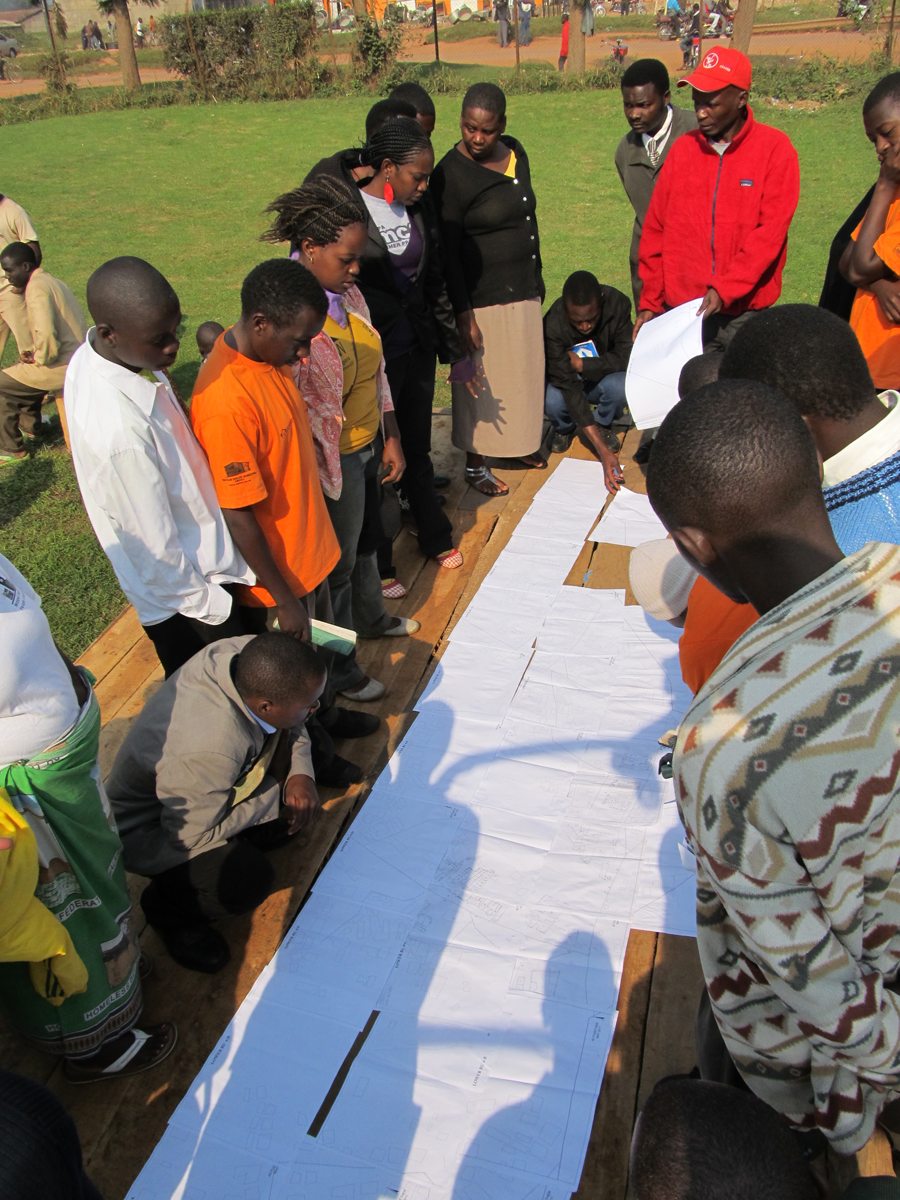
Robert Kakinda explains the mapping process
Once Robert was convinced that the group had assimilated the symbols, he proceeded to show them the satellite maps of Kabale’s cells (neighbourhoods). The group was asked to identify certain features on the maps in order to show that they understood how to read them. Because each and every structure needed to be identified, interns from local universities digitized the satellite maps to show only the structures. In order for the new maps to be big enough for the community to record structure level features, the satellite maps were broken down into a series of “zoomed-in” maps. The community was then able to record on these maps the numbers allocated to each structure during enumeration. In so-doing, the rich household data collected during the recent enumeration (community-run censuses) could be linked to spatial maps using GIS technology. The smaller maps are segments of the entire cell. To ensure that the community understood this, they assembled the smaller “zoomed-in” maps like a jigsaw in strips. On each day of the mapping process, the teams, which were allocated their own “strips”, traversed the settlement to ensure every square foot was mapped. Each team, led by one experienced mapper, consisted of local NSDF–Uganda members who will become the leaders once the visitors have departed.(14)
The mapping process enriches the information gathered during enumeration and assists NSDF–Uganda and its local government partners to take a bird’s eye view of the challenges in informal settlements, and move from isolated projects to a more systematic approach to slum upgrading.
VIII. Conclusions
The rapid maturing of the Ugandan alliance (NSDF−Uganda and ACTogether) in undertaking the five-city enumeration and developing proposals to (for instance) improve provision for water and sanitation illustrates some of the most important nuances of the federating process. These include the relationship between community processes and the local municipalities and the larger political sphere, as well as the prime importance of having development processes in informal settlements driven by the community. The successful execution of the five-city enumeration depended both on the organizational maturity of NSDF–Uganda and external political support. If either of these had not been present, the enumeration wouldn’t have been a success. When it comes to working at scale, NSDF–Uganda’s processes are necessarily enmeshed within a larger political context and, in some cases, within the context of international actors. While federation processes start at the community level, with daily savings, enumerations and exchanges as the foundation for any later projects, without a supportive larger context these projects are much more difficult to undertake successfully. Helping to facilitate this supportive political context is part of SDI’s work as a whole and forms the basis for its wider advocacy and engagement with national governments and various non-state actors such as the Cities Alliance and UN–Habitat.
Yet, however supportive the national political context is for community-led development, if the community capacity and initiative isn’t there, very little will happen. This capacity and initiative takes time to develop; it needs to be patiently nurtured and supported through groups such as federations, which are themselves composed of and led by the urban poor. Support NGOs are important, but it is only through coping with the challenges of leadership and agenda setting that communities of the urban poor can critically engage with the issues that they face and can grapple with the best ways to prioritize their needs and find solutions. If they are to sit at the negotiation table with policy makers and government officials as partners, they must be actively driving the process, not just following agendas set by others. When the community drives the process, the transformation in attitudes and commitment can be astounding. The move towards GIS in Uganda serves as a good example of how quickly federations can mature and evolve, taking on new tasks that outsiders or even “professionals” might feel unable to undertake. Without ownership of the process, the hard-won understanding of the issues facing their settlement, and the confidence and capacity that has been built over time within the members of NSDF–Uganda, it would have been impossible to begin GIS mapping, particularly at scale. This is the transformation of attitudes and understanding that daily savings, enumerations and exchanges seek to foster, giving voice to communities and helping to make their priorities actionable. The Ugandan federation has faced and will continue to face challenges, but their rooting in the community, their patience in supporting community processes, and the commitment of the community members themselves all keep their processes going and create conditions favourable to success.
Footnotes
This paper was written by Jack Makau and Skye Dobson and draws heavily on interviews with Edith Samia from the National Slum Dwellers Federation of Uganda.
1.
A slum dwellers federation is a membership-based organization of the poor organized around the basic processes of daily savings, participatory enumerations and peer learning exchanges. On the foundations created by these basic processes, the federations undertake housing and infrastructure development projects.
2.
3.
The term “slum” usually has derogatory connotations and can suggest that a settlement needs replacement or can legitimate the eviction of its residents. However, it is a difficult term to avoid for at least three reasons. First, some networks of neighbourhood organizations choose to identify themselves with a positive use of the term, partly to neutralize these negative connotations; one of the most successful is the National Slum Dwellers Federation in India. Second, the only global estimates for housing deficiencies, collected by the United Nations, are for what they term “slums”. And third, in some nations, there are advantages for residents of informal settlements if their settlement is recognized officially as a “slum”; indeed, the residents may lobby to get their settlement classified as a “notified slum”. Where the term is used in this journal, it refers to settlements characterized by at least some of the following features: a lack of formal recognition on the part of local government of the settlement and its residents; the absence of secure tenure for residents; inadequacies in provision for infrastructure and services; overcrowded and sub-standard dwellings; and location on land less than suitable for occupation. For a discussion of more precise ways to classify the range of housing sub-markets through which those with limited incomes buy, rent or build accommodation, see Environment and Urbanization Vol 1, No 2 available at  .
.
4.
In Uganda, enumerations begin with the training of a survey team made up of residents of the settlement that is to be enumerated. This team then counts each of the shacks and systematically counts each household to estimate the population of the settlement. The infrastructure and services within the settlement are also counted. The enumeration questionnaire can be more or less detailed depending on the needs of the specific federation. Manual mapping of the settlement, using methods such as making “walking papers” (a manual mapping technique where community members walk around the settlement and draw a map of what they see) or plane-table maps, quickly follows.
5.
A “hut count” is where a community counts the number of structures in its settlement. This is one of the first data collection processes by federations and becomes part of a settlement profile or subsequent enumeration.
6.
Daily savings groups are voluntary community associations formed in informal settlements around mutual daily savings and loans; they function in a similar way to informal credit unions.
7.
8.
Ministry of Land, Housing and Urban Development (2010), “A strategy for transforming settlement of the urban poor in Uganda − a secondary cities support programme”, Project Document, page 5.
10.
A settlement profile is a small-scale, more generalized enumeration that is carried out through talking to groups of residents, with the goal of obtaining an estimate of the size and level of infrastructure in a settlement.
12.
The five-city enumeration counted a total of about 200,000 residents in informal settlements.
13.
Makau, Jack (2011), “Solving the land information gap through GIS”, ACTogether blog, 21 February, accessed 20 October 2011 at .
14.
Dobson, Skye (2011), “Putting slums in Kabale on the map”, ACTogether blog, 14 July, accessed 20 October 2011 at