




Abstract
Constructed wetlands (cws) for wastewater treatment may be part of the answer to the urgent need for a change in the approach to wastewater treatment in developing countries. Although thailand has several cws, there have been no studies of their sustainability. To remedy this, the sustainability of three promising cws in very different settings was assessed. These were located at koh phi phi, a world-renowned international tourist and holiday resort; sakon nakhon, a northeastern provincial capital; and ban pru teaw, a small post-tsunami village on the andaman coast. Key stakeholder interviews, questionnaires and household interview surveys, together with existing data and on-site measurements of the key pollutant content of wastewater were used to evaluate the systems. Results show that major management and treatment problems have emerged in the projects at koh phi phi and ban pru teaw due to the lack of post-construction personnel development and maintenance; but on the other hand, sakon nakhon is the first cw in thailand to obtain iso 9001 certification. The results reveal the importance of the socio-cultural dimension of sustainability; public perception, awareness and knowledge, local expertise and clear roles for institutions could explain the differences in sustainability of the cws. The environmental benefits and the low operation and maintenance costs are also important for sustainability, by justifying the system and avoiding user payments.
Keywords
I. Introduction
Inadequately managed wastewater can be a hazard to both the environment and the health of humans. It may undermine biodiversity, natural resilience and the capacity of nature to provide the fundamental services on which human well-being depends.(1) About 90 per cent of all sewage in developing countries is discharged into natural water bodies without any treatment,(2) and eutrophication caused by wastewater is one of the most prevailing global environmental problems of our time.(3) Water pollution by wastewater is also among the most serious environmental problems in Thailand.(4)
Improvements in wastewater management in developing countries requires investment, but it is not only a question of the amount of investment, the quality is equally important. The transfer of environmental technologies from industrialized to developing countries is often unsuccessful, and existing conventional wastewater treatment plants are largely failing, as they are in Thailand.(5) There is therefore a need for a paradigm shift in wastewater management.(6) New approaches need to include sensible investment and technological innovation, and these need to be locally based and appropriate to the communities that they are built to serve.(7) Such systems are beginning to emerge and are implemented in environments and contexts where conventional systems have or will fail. Constructed wetlands (CWs) for wastewater treatment may fulfil these requirements, and they have many advantages that make them highly promising in most developing countries.(8) CWs are treatment technologies that apply natural, chemical, biological and physical processes. They can be adapted to the local climatic and environmental conditions and they require low capital investment, low operation and maintenance (O&M) costs and less skilled operator knowledge compared to most conventional technologies.(9) CWs can be constructed to serve both large and small communities, although focus has been on small-scale systems, probably because it is still an emerging technology. CWs are criticized for requiring more land than conventional wastewater treatment systems such as activated sludge systems; however, taking into account the land salvage value, CWs seem to be a feasible option even in medium dense urban contexts.(10) Although CWs are often used in combination with household level septic tanks for primary treatment, these are not essential for the CW to function properly if other measures are installed to remove grit, heavy solids and floatable materials prior to treatment in the CW. (11)
Several CWs and the underlying technologies and processes are well described in the literature,(12) and several case studies from Thailand have also been published.(13) Many of these Thai CWs were built for technical research purposes,(14) but several systems were built to serve the public in a city or village context.(15) Follow-up studies of these systems are, however, largely lacking. Without knowledge of the longer-term sustainability, the challenges, failures and successes, it is not possible to assess when such CWs can play an active role in wastewater management.
Three previously studied CWs in Thailand were revisited to assess their sustainability using the three dimensions of sustainability defined by Balkema et al.(16) The economic, environmental and socio-cultural dimensions together determine the overall sustainability of wastewater treatment systems. The analysis of the economic dimension includes O&M costs and willingness to pay (WTP); the analysis of the socio-cultural dimension includes available expertise, institutional requirements and public perception, awareness and knowledge; and the environmental dimension is an analysis of the CWs’ impact on the surrounding environment.
II. Methodology
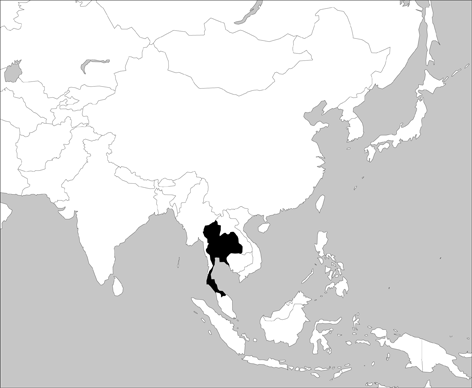
Data collection was conducted during fieldwork in three study sites in Thailand that have recently been showcased as examples of sustainable wastewater treatment. Sakon Nakhon,(17) Koh Phi Phi(18) and Ban Pru Teaw(19) were visited between March and May 2010. They were selected because they all included CWs as a treatment method and represented different system sizes and contexts typical for Thailand.
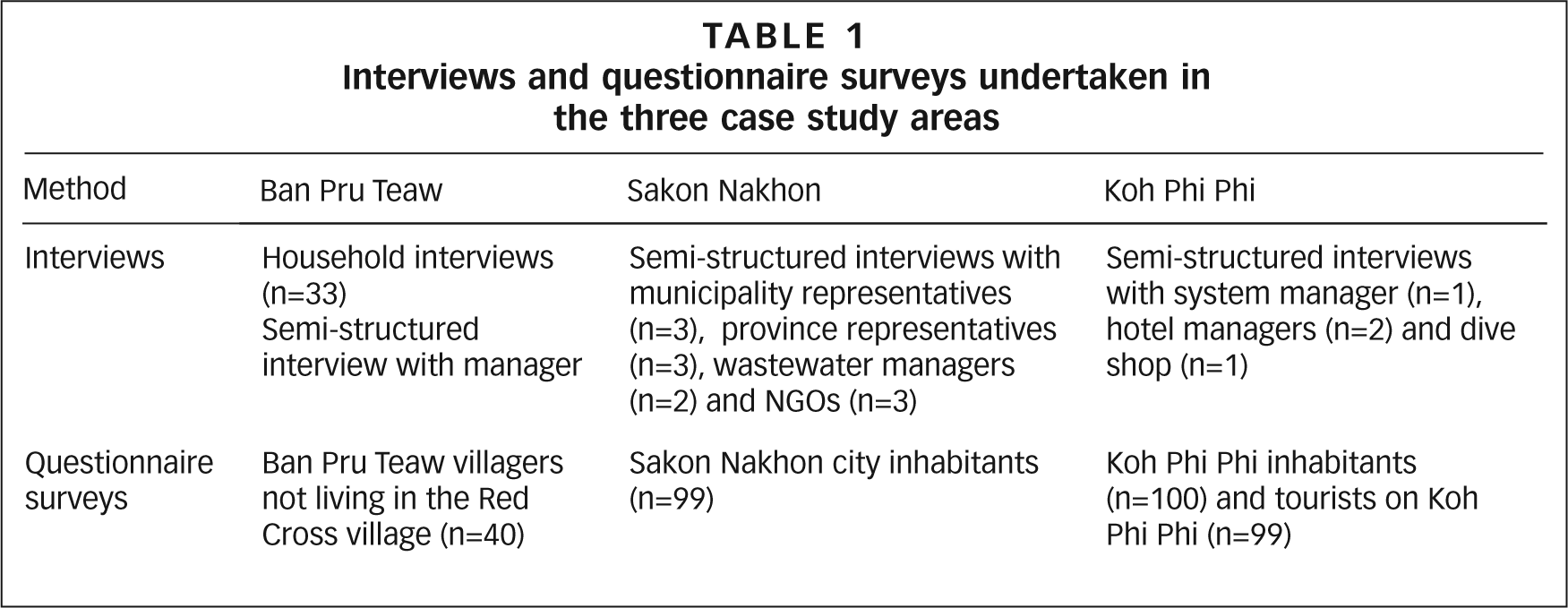
The study adopted a range of different methods. The interviews and questionnaire surveys, presented in Table 1, investigated the knowledge and perception of the locals and the system users and how this influenced the sustainability of the studied systems.
Interviews and questionnaire surveys undertaken in the three case study areas
All fieldwork in Sakon Nakhon and Ban Pru Teaw was conducted with Thai and English-speaking assistants, providing translation and help with practical issues.
The questionnaire surveys contained both closed and open-ended questions and took 10–20 minutes for respondents to complete. Help was available if questions needed clarifying or if respondents needed assistance. The questionnaires in Sakon Nakhon were distributed in a public park, at a hairdressing salon and to employees and students at a local university campus. The questionnaires in Koh Phi Phi were distributed in the streets and shops of Ton Sai village and on Loh Dalum beach. Household interviews lasted typically 15–30 minutes and other interviews lasted from 45 minutes to several hours.
Data on system performance for Sakon Nakhon and Koh Phi Phi came from the Sakon Nakhon municipality and the Pollution Control Department of the Ministry of Natural Resources and Environment. System performance data for Ban Pru Teaw were derived from sample analysis in March 2010. Samples were collected and brought, on ice, to the laboratory within 24 hours. They were analyzed for COD, TSS, TKN, TP, nitrate-N and nitrite-N in accordance with standard methods (Box 1).(20)
III. Study Areas
Ban Pru Teaw township is located in Phang Nga province in southern Thailand and was established after the tsunami disaster that hit the region in 2004. It comprises five villages funded by five different charities with a total of 418 houses. Eighty of these are located in the Thai Red Cross village and a complete wastewater management system was built together with the village. The system consists of a septic tank for each household, a combined sewer system and a CW for the treatment of wastewater effluent; construction of the CW finished in January 2006. Most of the Red Cross village residents originate from the destroyed village of Ban Nam Kem, and are generally poor and unemployed, day labourers or have their own small businesses (Table 2).
General characteristics of the three case study areas
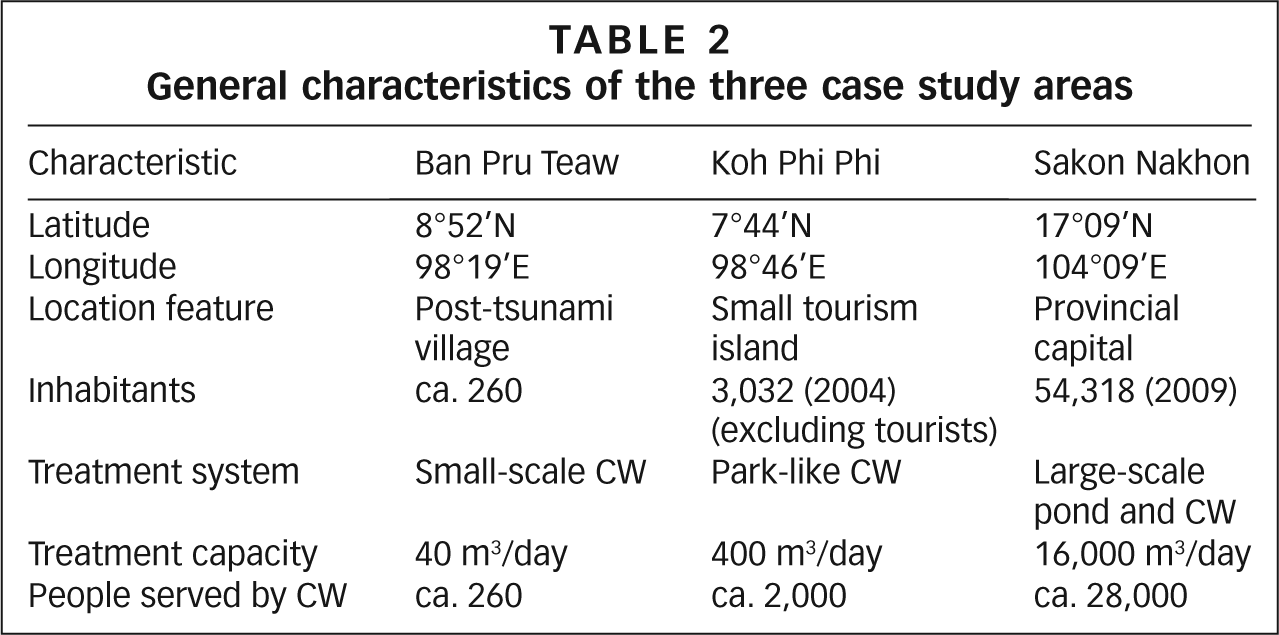
Koh Phi Phi is a small island off the coast of Krabi province. It is a major tourist destination and about 90 per cent of the adult population of 3,032 are employed in the tourism sector, generating approximately 4,417.97 million Baht (€108.24 million) in 2004.(21) The attitudes and opinions of the more than one million annual visiting tourists therefore have a major indirect impact on the decisions made on the island.
The main village (Ton Sai) and the existing wastewater management systems were almost completely destroyed by the tsunami in 2004. A new system was therefore built alongside the reconstruction of the island. This consists of a sewage system covering the central area of the village, a pumping station and a combined pond and CW system for wastewater treatment and re-use. The system began operating in October 2007 but problems with the treatment performance, caused by construction flaws, were apparent from the start; these problems are well described by other authors.(22)
Sakon Nakhon city and municipality is the provincial capital of Sakon Nakhon province in northeastern Thailand, and is situated next to the large Nong Han Lake. A sewage system, covering roughly 70 per cent of all households in the municipality, and a series of ponds for wastewater treatment were constructed in 1992, followed by the construction of a combined pond and CW system in 1997. Almost all buildings connected to the sewage system have septic tanks for primary treatment of black water. The wastewater treatment system covers a massive area (70 hectares) next to the town and in 2005 it obtained the ISO (International Organization for Standardization) 9001 certification as the first and only wastewater treatment facility in Thailand.
IV. Results
a. Operation and maintenance (O&M) costs
The Thai government funded the construction of both parts of the wastewater treatment plant in Sakon Nakhon. This is the norm when establishing wastewater management systems in Thailand, and the local government, in this case the municipality, is then charged with the responsibility for covering O&M costs.(23) The municipality decided on the wetland and pond system partly because of the low investment and equipment costs but mainly because of the low O&M costs. These are covered within the ordinary budget and therefore the municipality avoided being dependent on user payments to sustain the system. The mayor, Mr Komut, was very aware of how important this was, and the success of the treatment plant without user payments is a major issue in his election campaigns.(24) It is also a subject that positively influences voters: 61 per cent of the questionnaire respondents in Sakon Nakhon said that the treatment plant influenced their view of the mayor and the municipality (n= 87). Only nine per cent of the 61 per cent disliked the treatment plant.
Regarding Ban Pru Teaw and Koh Phi Phi, the Danish development agency, DANIDA, funded the construction of their wastewater management systems after the tsunami disaster. DANIDA installed a series of safeguards, including:
a performance bond of 10 per cent of the construction costs for the contractor to rectify possible mistakes discovered within the first year after completion;
grants to cover O&M costs for three years in Ban Pru Teaw at 100,000 Baht/year (€2,380) and for five years on Koh Phi Phi at 500,000 Baht/year (€11,900); and
the option for the donor to withhold O&M budgets if necessary.
In addition, DANIDA provided O&M manuals, on-site training of local staff, community level public relations activities and a three-year technical supervision and monitoring scheme.(25) A community-based committee was set up on Koh Phi Phi with responsibility for the operational and financial aspects of the wastewater management system. A third-party assessment body was included in the post-construction phase. Because, according to the manager, funding stopped after only two years, the treatment plant in Ban Pru Teaw has been running without funds for a year and a half. Funding to Koh Phi Phi also stopped before the initially agreed time because of a malfunction of the CW as a result of a mistake made during construction (the contractor had mixed soil into the gravel filter medium) and the lack of a key authority taking responsibility for the management and rectification of the system.(26) Regarding the CW on Koh Phi Phi, negotiations between DANIDA and the local government in Krabi are now in progress.(27)
At the time of the visit (March 2010), the CW in Ban Pru Teaw was in much need of maintenance. The gravel bed had become clogged and needed to be cleaned or replaced. Lush green weeds in the first cell and withering weeds in the two following cells had replaced the original Cannae lilies, and the area around it had been transformed from park-like scenery to a bushy and untidy area. The village headman, who is also the system manager, was considering charging each household about 20 Baht/month to cover O&M costs and to correct these problems.(28)
The system manager on Koh Phi Phi is also considering charging users to correct the major flaws in the plant. However, this is impossible at the moment because he is under suspicion of corruption by fellow island inhabitants, as no one is convinced that the embassy has stopped giving him the funding.(29)
b. Willingness to pay (WTP)
In order to examine the viability of user payments, the WTP for wastewater treatment was part of the interviews and questionnaires. The results for Sakon Nakhon and Ban Pru Teaw are presented in Figure 1. Despite different settings and contexts, with and without wastewater treatment systems, the majority of citizens would pay up to 20 Baht/month (€0.50). This may be explained by a quote from one of the respondents: “It wouldn’t affect our budget to pay only 20 Baht per month.”(30) Many others made similar statements in all locations.
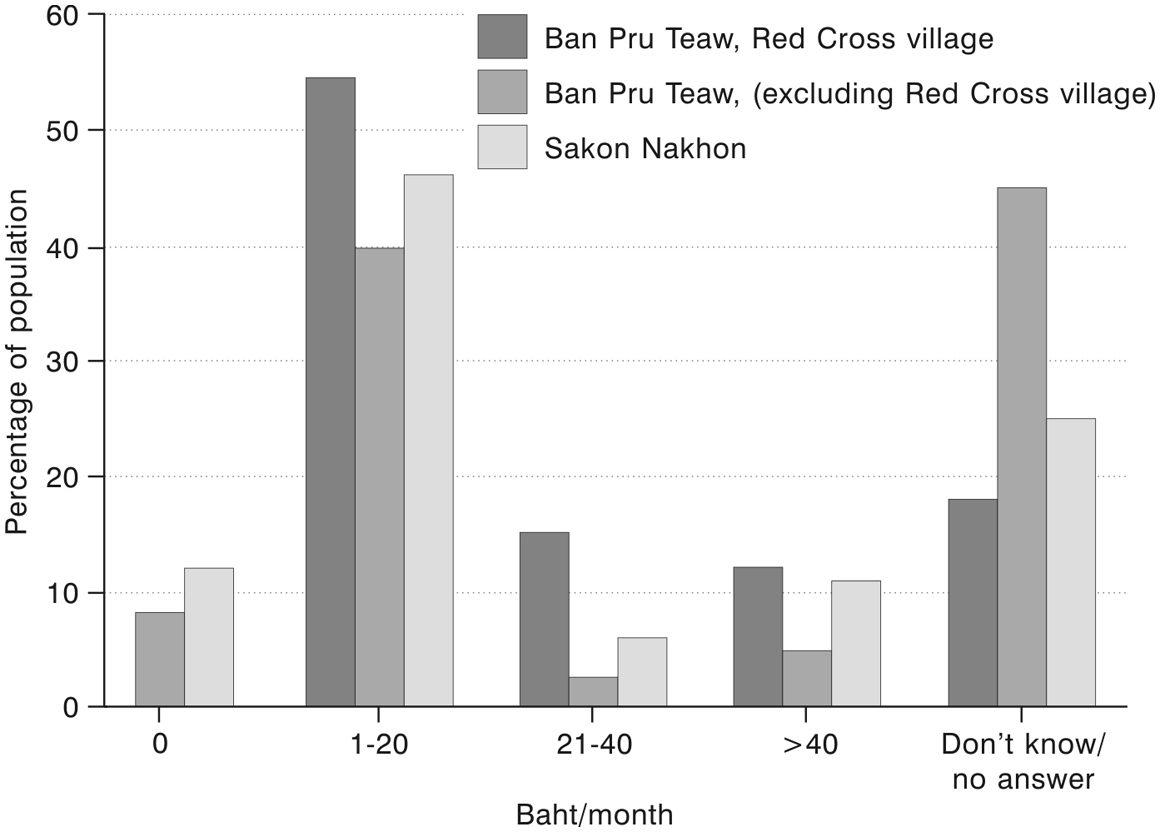
The willingness to pay (WTP) for wastewater treatment by citizens in the Red Cross village in Ban Pru Teaw, in all other villages in Ban Pru Teaw (excluding the Red Cross village) and in Sakon Nakhon
The manager on Koh Phi Phi was convinced that the inhabitants would be willing to pay for the treatment of wastewater once the issues relating to corruption and responsibility for the faulty construction had been solved. Although 100 of the island inhabitants were asked how much they would be willing to pay, only a minority would answer the question (16 per cent), probably due to the sensitivities concerning alleged fraud or corruption.
Payment by tourists may be another viable way to finance O&M of the plant. Eighty-seven per cent of tourist questionnaire respondents were willing to pay extra for their accommodation on Koh Phi Phi in order to achieve better wastewater management on the island. The median WTP was 100 Baht (€2.40) per night.
c. Environmental impact in Ban Pru Teaw
No environmental benefits from the CW were evident to the inhabitants of Ban Pru Teaw. During three visits and over 11 days in Ban Pru Teaw in March 2010, the pumps for feeding the CW with wastewater were only noticed running once; for the rest of the time, wastewater was by-passing the CW. The automatic pumps didn’t switch on very often, not even after heavy rainfalls at the end of the dry season. The system manager estimated that about 70 per cent of all wastewater and run-off water by-passed the system. Since the effluent is ultimately released at a distance from the village, any direct impact from the wastewater on the inhabitants’ environment is very limited.
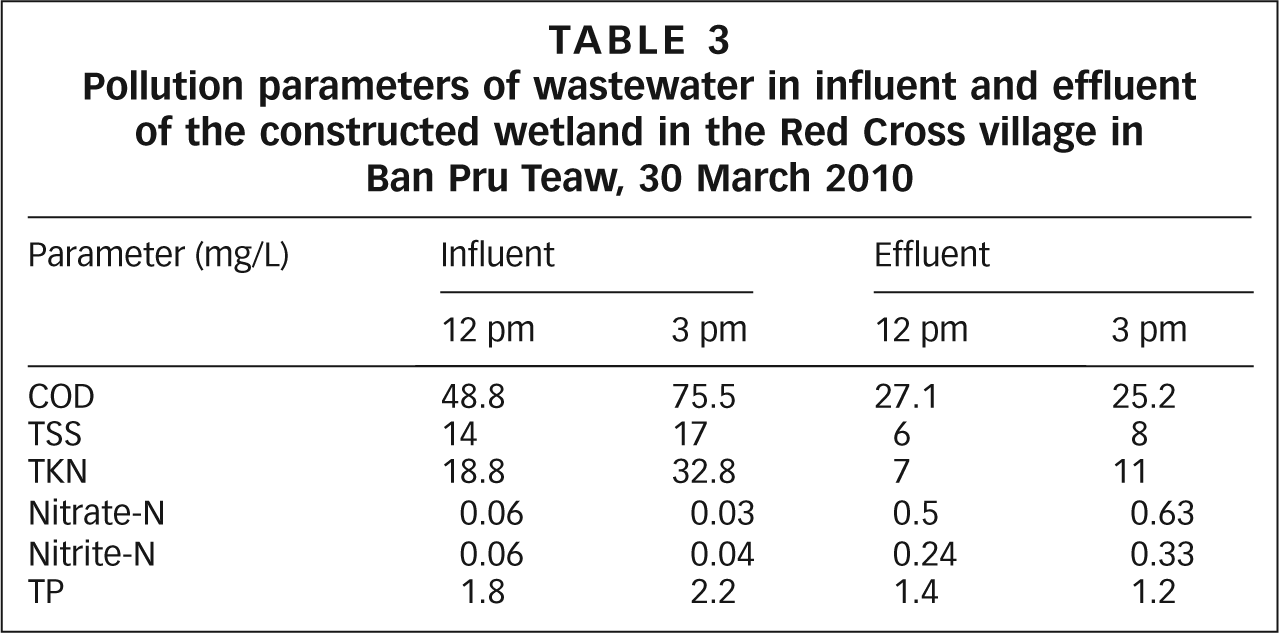
To get an indication of the system’s performance, water samples from both the inflow and the outflow were taken at noon and three hours later (Table 3). The system is reducing the nutrient and pollutant load of the wastewater, but the inflowing wastewater is remarkably clean. This is most likely a result of household level septic tanks for black wastewater and dilution by stormwater run-off in the collection system.(31)
Pollution parameters of wastewater in influent and effluent of the constructed wetland in the Red Cross village in Ban Pru Teaw, 30 March 2010
d. Environmental impact in Sakon Nakhon
In contrast to Ban Pru Teaw, Sakon Nakhon is much more dependent on the adjacent water body for fishing and water supply, and it is obvious to most people where the wastewater flows. Nong Han Lake is a shallow lake with very little outflow and is prone to eutrophication.(32)
The pollutant indicator parameters in both the influent and effluent of the treatment plant in Sakon Nakhon vary a lot during the year (Table 4). However, the treatment system in Sakon Nakhon mainly reduces organic matter and nitrogen, while phosphorous is let into the lake where it may potentially promote the risk of eutrophication and hypoxia. The large treatment and storage capacity ensures that the system is never by-passed, even during the rainy season.
Pollution indicator parameters for the influent and effluent wastewater to the Sakon Nakhon wastewater treatment plant for four quarters of 2009 and the treatment efficiency of the parameters
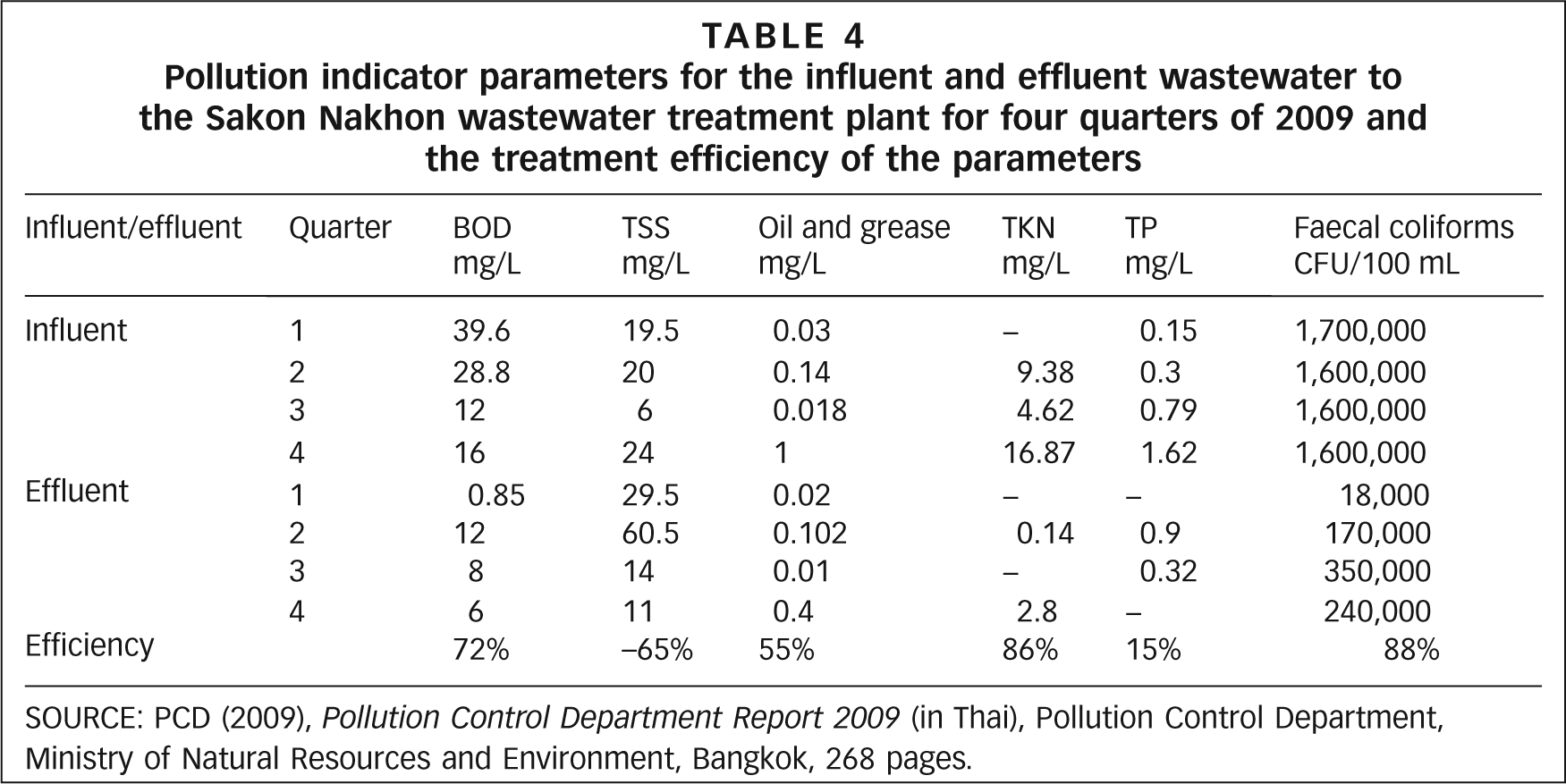
SOURCE: PCD (2009), Pollution Control Department Report 2009 (in Thai), Pollution Control Department, Ministry of Natural Resources and Environment, Bangkok, 268 pages.
The benefits of the treatment plant on the health of Nong Han Lake were described by two environmentally engaged NGOs in the lake area as being substantial and positive. Also, the majority of the citizens of Sakon Nakhon said that they had experienced an improvement or a great improvement in the environments of Nong Han Lake (74 per cent) and the city (78 per cent) and in the quality of the water supply to the city (77 per cent), from before to after the treatment plant was constructed (n=87).
e. Environmental impact on Koh Phi Phi
No data are available on the total wastewater volumes on Koh Phi Phi, the volume handled by the wastewater treatment plant or the number of households that are actually connected to the sewage system. The environmental impact of the plant is therefore difficult to quantify. Although only a minor part of the total amount of wastewater actually enters the plant, the treatment efficiency is quite good on all measured pollution indicators (Table 5), but the nutrient and pollutant content of the inflowing water is much higher than in Sakon Nakhon and Ban Pru Teaw. The plant, however, is also affecting the surrounding environment by being smelly and taking up a lot of space in the cramped and crowded village; it is certainly not used as a park despite the presence of benches and flowers.
Pollution indicator parameters for the wastewater treatment plant on Koh Phi Phi
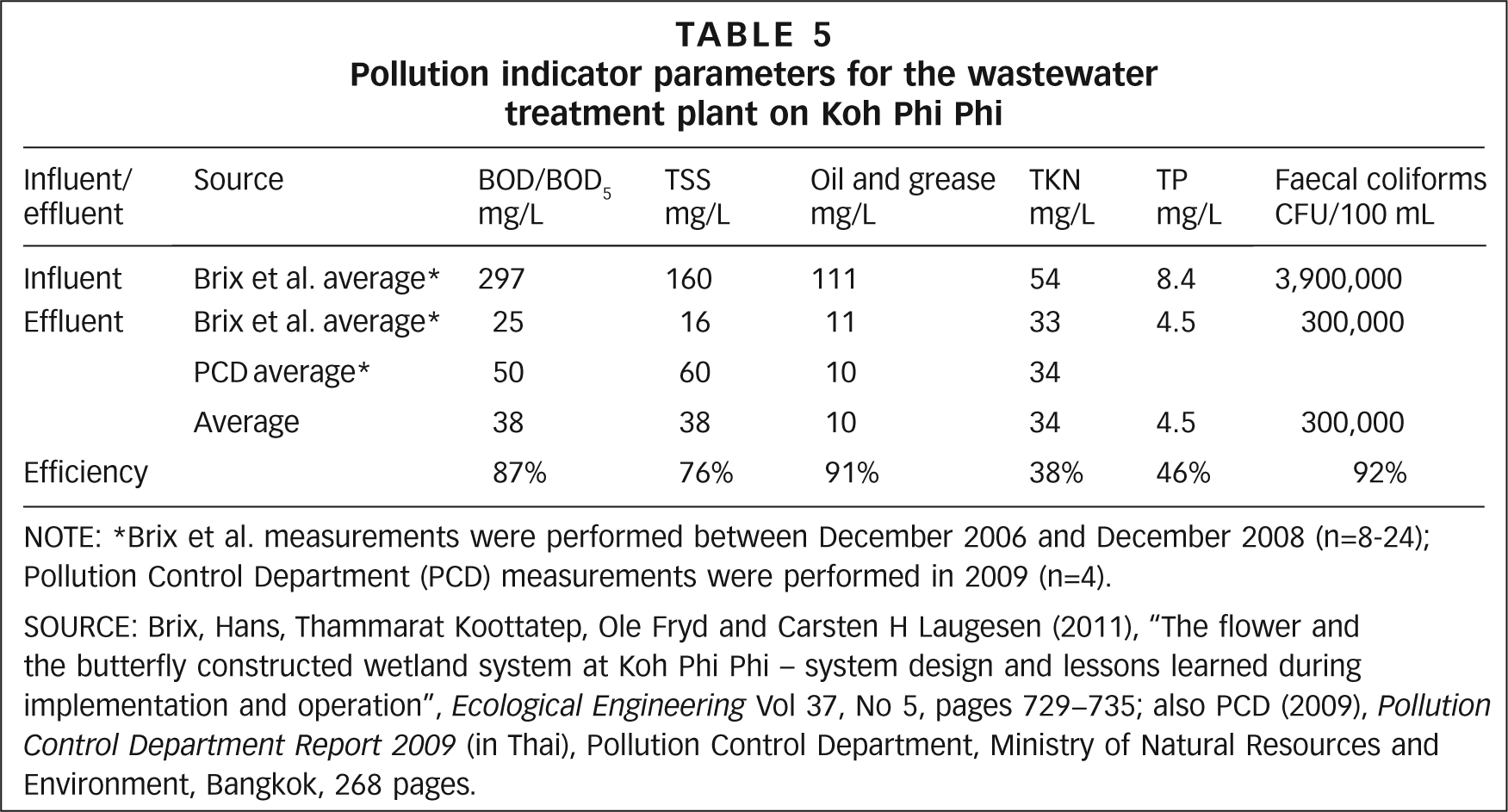
Note: *Brix et al. measurements were performed between December 2006 and December 2008 (n=8-24); Pollution Control Department (PCD) measurements were performed in 2009 (n=4).
Source: Brix, Hans, Thammarat Koottatep, Ole Fryd and Carsten H Laugesen (2011), “The flower and the butterfly constructed wetland system at Koh Phi Phi – system design and lessons learned during implementation and operation”, Ecological Engineering Vol 37, No 5, pages 729–735; also PCD (2009), Pollution Control Department Report 2009 (in Thai), Pollution Control Department, Ministry of Natural Resources and Environment, Bangkok, 268 pages.
Not many of the island inhabitants were happy with the treatment plant even though the questionnaire survey revealed that the majority of them thought the impact of wastewater caused a deterioration in the environment. More than half the respondents rated the impact of wastewater on the town environment and on the water quality at the Ton Sai and Loh Dalum beaches to be one, two or three on a scale of one (very important) to 10 (very unimportant). The mean was 4.6 for the town (n=99), 4.1 for Loh Dalum (n=99) and 4.2 for Ton Sai (n=96).
f. Available expertise
Although there was available expertise during the construction of all three systems, Sakon Nakhon differs from the other two in that it retained this expertise regarding O&M. This is because the system in Sakon Nakhon was locally planned, designed and constructed, and is now locally operated. Two local construction and consultancy companies built the wastewater management system together with the municipality and employees of the Wastewater Management Authority of Thailand. Some of the same people now operate the system.
The systems in Ban Pru Teaw and on Koh Phi Phi were planned and designed by people from outside the communities.(33) Now, there is no opportunity for the basically trained manager in Ban Pru Teaw to get the necessary support to correct the flaws. He is therefore trying to transfer responsibility for the CW to other authorities nearby. The situation is almost identical on Koh Phi Phi, where the local manager has been left more or less alone with a malfunctioning treatment plant for more than four years.
g. Institutional aspects
In Sakon Nakhon, responsibility for the system lies with the municipality, but good cooperation with, and clear roles for, the province and the national Wastewater Management Authority ensure that the treatment plant is sustainable. Cooperation with other municipalities is also good, and similar wastewater treatment plants have either been constructed or are being planned in other towns around Nong Han Lake. The treatment plant in Sakon Nakhon also differs from the other two cases in that it was initiated by HRH the King of Thailand. Royal projects in Thailand are extremely prestigious and highly exposed in the media.(34)
No regulations or control mechanisms exist in Ban Pru Teaw and the system is left to itself in the setting of a small village. DANIDA has completely withdrawn from the project.(35)
The roles of the institutions are poorly defined on Koh Phi Phi, and it is partly why the local manager was left unaided when the system proved to be faulty. The unclear roles and responsibilities of DANIDA and government bodies, together with a lack of cooperation between the local government and provincial government sectors, were identified as reasons for the failure.(36) The absence of any authorities (provincial, municipal or at the village level) on the island may be a substantial part of the problem.(37)
h. Public perception, awareness and knowledge in Sakon Nakhon
From the questionnaire survey in Sakon Nakhon and interviews with officials and NGOs, it is apparent that the public and the municipality perceive that there is a need for the wastewater treatment plant and that they support it. Eighty-seven per cent of questionnaire respondents knew about the treatment plant and it was evident that wastewater management is a subject of interest to the public: 65 per cent said that they had a great interest; 26 per cent had little interest and only three per cent said that they had no interest at all; six per cent didn’t know (n=99). Eighty-one per cent of the respondents had experienced problems with the management of their wastewater (n=99), but there was no significant relationship between the problems experienced and interest. When asked their opinion of the treatment plant in the municipality, almost two-thirds said that they liked it (53 per cent) or liked it very much (13 per cent); 20 per cent had no opinion, but only a few disliked it (14 per cent) or disliked it very much (one per cent) (n=87). It is therefore in the interests of the municipality and the mayor to inform people about the wastewater management system. For this reason, they are distributing leaflets and providing information via the Internet; radio stations in Sakon Nakhon also promote the treatment plant; it often features on local television and it was once on national television. Respondents said that newspapers or other publications, friends or family and the radio were their major sources of information (ca. 19 per cent each). TV, the Internet and schools were other high scorers (ca. 10 per cent each), and 43 per cent received information from multiple sources (n=82). The main means of public information and education supported by the municipality is the information centre neighbouring the treatment plant. Here, citizens can book a visit over the phone or via the Internet and can learn about wastewater treatment and environmental protection. However, only two per cent of respondents had received their information from this centre, yet 34 per cent of respondents had visited the treatment plant on their own initiative (n=87).
i. Public perception, awareness and knowledge in Ban Pru Teaw
Although the Red Cross village in Ban Pru Teaw is a much smaller community than Sakon Nakhon, and everyone had seen the CW, 30 per cent of the interviewed households didn’t know what it was for and only 36 per cent knew where the effluent from the CW went. During the household interviews, only a handful of people were enthusiastic about the CW; the majority were more or less apathetic. However, 30 per cent said that they thought that the wetland had improved the environment to some extent; 48 per cent said that it had benefited the community by providing a park-like area or by improving the drainage or water re-use potential; and 18 per cent said that they could think of no positive influences. Four of the respondents had at some time participated in either the construction or O&M of the CW, and they had more knowledge about it and supported it more than most other interviewees. The village headman was the only one still active in O&M and he appeared to be eager to make it work and to keep it running.
No one in the Red Cross village said that wastewater management was a major problem. But to test whether the CW had any influence on this, the same question was asked of households in the other four villages of Ban Pru Teaw. All villages had a similar sewage and septic tank system and no significant differences emerged. Solid waste management was the worst problem for residents in all five villages, and there was no difference between villages with regard to complaints about the local water supply, possibly receiving effluent from the treatment plant, and the communal water supply (detailed data not shown).
j. Public perception, awareness and knowledge on Koh Phi Phi
The problems experienced by residents on Koh Phi Phi are numerous, and more than 20 different categories of problem were identified. Half the respondents mentioned problems relating to solid waste management and 40 per cent mentioned problems relating to wastewater management (n=100). When the island inhabitants were asked about the environmentally related problems that they were experiencing, 22 different categories of problem were mentioned. Again, problems of solid waste management scored highest and were mentioned by more than 60 per cent of respondents, compared to about 40 per cent who mentioned wastewater-related problems.
Because of the massive impact of tourism on the economy of the island, the opinions and perceptions of the tourists may therefore be just as, or more, important when establishing the need for the wastewater treatment plant on Koh Phi Phi.
The tourist respondents, generally characterized as being in their early to mid-twenties, were asked to give three reasons why they chose to travel to Koh Phi Phi. The top six answers are shown in Figure 2. They were also asked to name up to three problems that they thought were apparent on Koh Phi Phi, and only seven per cent mentioned wastewater management as being a direct problem. In comparison, 30 per cent said that the high prices were a problem, 25 per cent said that solid waste management was a problem, 21 per cent said that the island was overcrowded and 19 per cent said that the general smell on the island or that of wastewater and/or solid wastes was a problem (n=94). When asked to name the top three environment-related problems, more than half the respondents named issues relating to solid waste management and 28 per cent said pollution of seawater by things other than wastewater. Eighteen per cent named issues relating to wastewater management, 16 per cent issues regarding poor quality of the water supply and 16 per cent mentioned smell (n=91). Tourists were also asked to rate individually the water quality at Loh Dalum and Ton Sai beaches, because most of the wastewater from the main town as well as from the treatment plant effluent is released into the water at these beaches. The mean for Ton Sai beach (n=43) was slightly higher, at 5.8, than for Loh Dalum, at 5.3 (n=75), on a scale of one (very good) to 10 (very poor). Also, interpretation of the town’s environment was rated with a mean of 4.9. From the problem identification results, the low ratings for the beach water and the town environment may be attributed to problems of solid waste management rather than problems of wastewater. The questionnaire respondents were further asked to rate their intention to re-visit Koh Phi Phi if they were to travel to Thailand again on a scale of one (definitely not) to 10 (definitely). The tourists also rated their intention to re-visit the island if they found the island equipped with only very basic or ideal wastewater management, and if they found the quality of the water at the beaches to be 20 per cent worse or 20 per cent better. The results are presented in Figure 3.
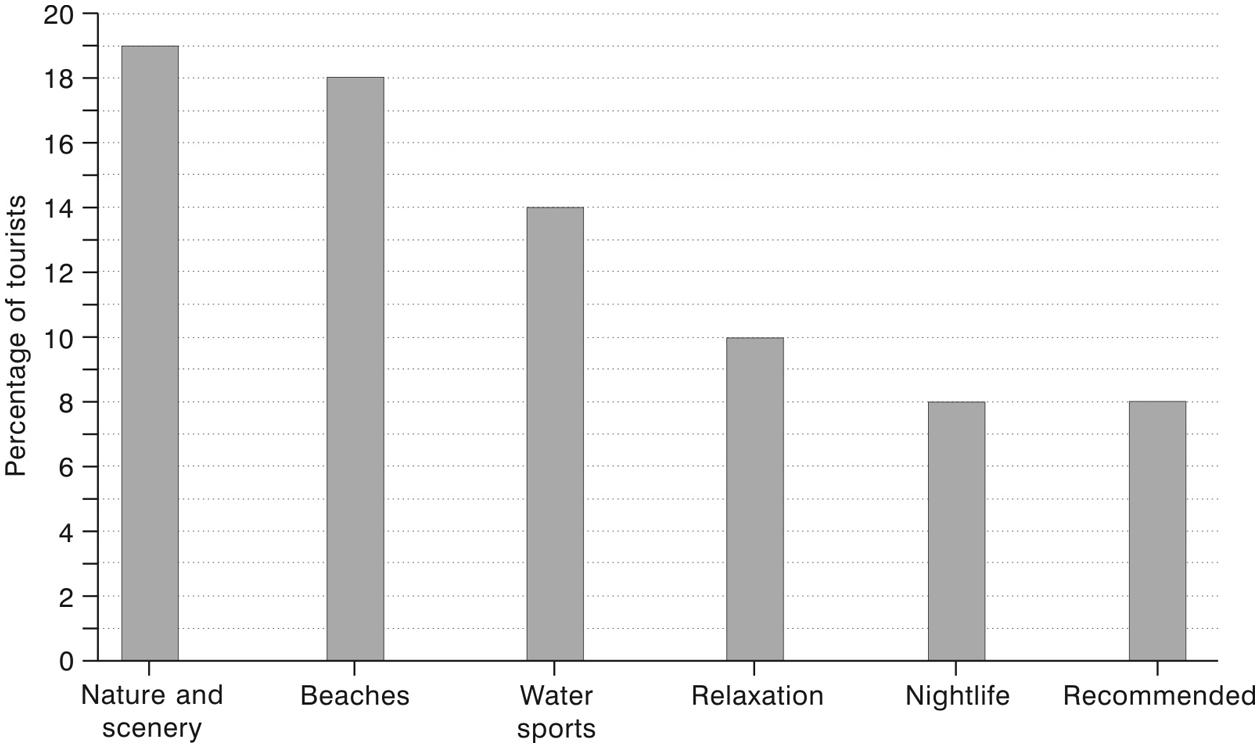
The top six reasons for tourists to travel to Koh Phi Phi
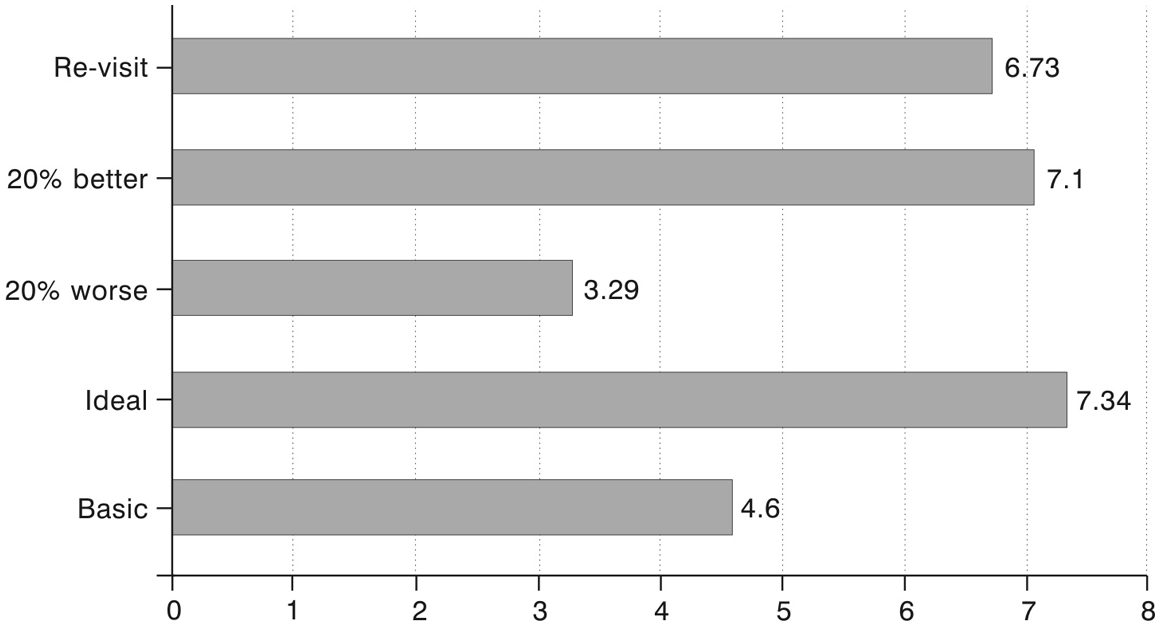
Tourists’ intention to re-visit Koh Phi Phi if in Thailand again*
A paired-samples t-test and eta-squared statistics revealed that if the beach water quality was poorer or if wastewater management was only basic, the negative effect on the intention of the tourists to re-visit the island would be significant and large. There would also be a significant improvement in the intention to re-visit if the sea water quality was better or the wastewater management was ideal, but the effect would only be small and moderate, respectively.
V. Discussion
The results indicate strongly that the socio-cultural dimension, including the attitudes, awareness, knowledge and support of the local public, is crucial to the sustainability of CWs in Thai communities. Local expertise has to be available, institutional conditions need to be clear and the public has to be knowledgeable and supportive. Without public support, the attention and funds will go to other issues. The environmental dimension also affects sustainability, but the effect is indirect. To the decision makers and the public, the existence of the treatment plant is justified by the positive impact on the environment. Since the Thai public are only willing to pay very small fees for wastewater treatment, the low cost of CWs also affects sustainability through the economic dimension. This is in line with Brix et al.,(38) who identify the social and institutional dimension as the next important step in developing sustainable wastewater management systems in developing countries.
a. The environment justifies the wastewater treatment
All three wastewater treatment plants showed similar treatment effects as other CWs from around the world, with some exceptions (Figure 4). A study of a solid waste management project in Yala, Thailand revealed that the positive impact on the environment sparked public support. It also strengthened the capacity and confidence of the municipality and led to a closer relationship between the public and the municipality.(39) The same thing was observed in Sakon Nakhon, whereas the opposite was true in the case of the faulty plant on Koh Phi Phi. The benefits to the environment were small in Ban Pru Teaw and no significant support and enthusiasm was observed from the public.
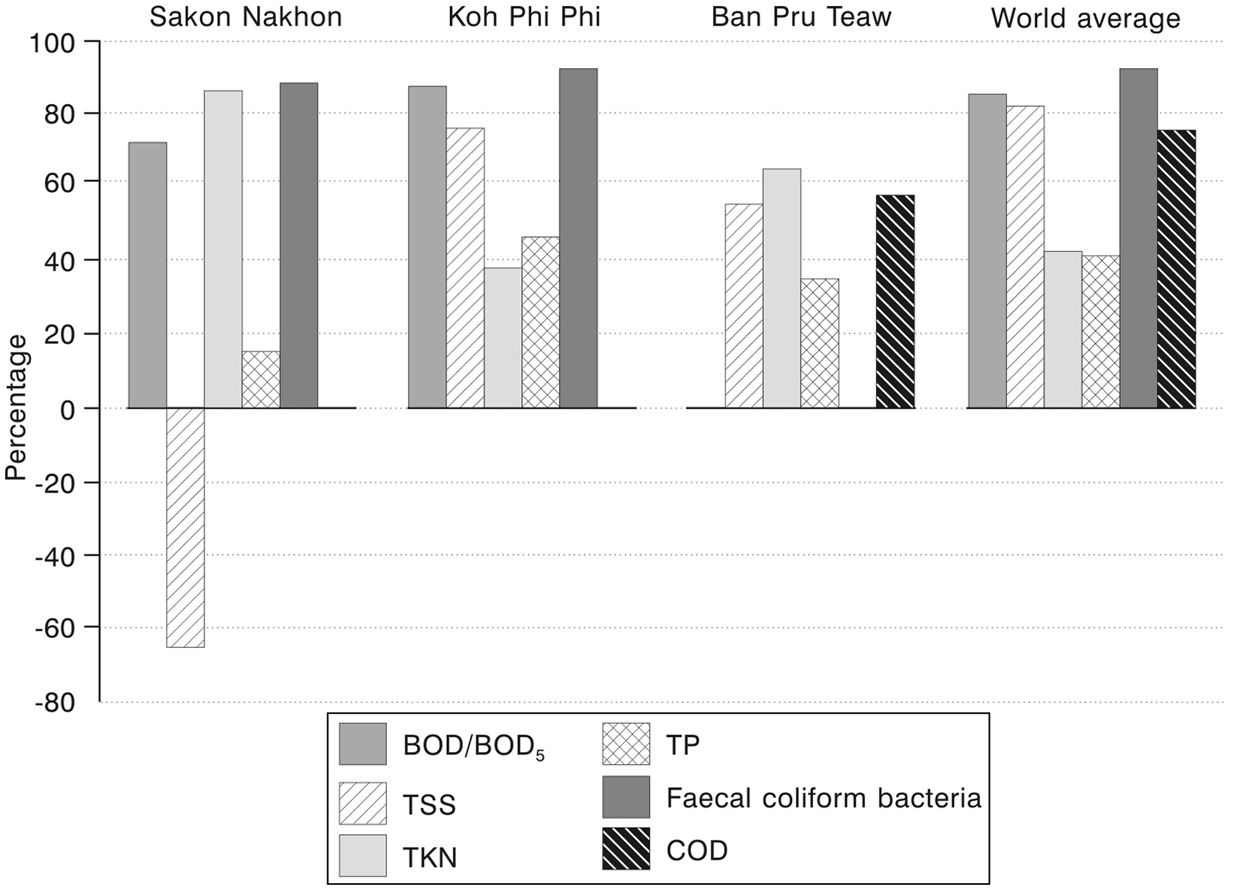
Treatment performances for the three studied wastewater treatment plants for different pollution indicator parameters compared to the average treatment performances for constructed wetlands across the world
The COD/BOD, TKN and TSS levels in the wastewater inflow in Ban Pru Teaw and Sakon Nakhon were remarkably low. All pollution indication parameters were considerably lower than those typically found in dilute domestic wastewater.(40) In terms of TKN, they compare more to grey water.(41) The TP values were also similar to values for grey water in some studies,(42) but were well under others.(43) COD/BOD and TSS were both well below values found in grey water in other studies.(44) Although the TSS value increased between the influent and the effluent in Sakon Nakhon, it is still very low. The collective results correlate with low values found in other wastewaters in Thailand, which can probably also be attributed to the use of septic tanks and the tradition of using water instead of toilet paper.(45) With these low values for pollutants in the wastewater, and the natural high organic degradation potential in the tropical conditions of Thailand,(46) the impact of wastewater on the environment near Ban Pru Teaw is limited. Also, with so much wastewater by-passing the CW, there are no positive impacts for the community that justify the treatment plant.
Because of the size of the city of Sakon Nakhon, the derived large volume of wastewater and the eutrophic lake, the treatment plant is more justified here. Settacharnwit et al.(47) studied the nutrient status of Nong Han Lake during 2001. They found a considerable difference in phosphate and Ammonia-N concentrations during the year, with values peaking in the early wet season. They indicated that nutrients were imported from sewage and run-off during first rainfall events via streams flowing into Nong Han Lake. Furthermore, according to Settacharnwit et al.,(48) a high phosphate concentration near Sakon Nakhon in the early wet season indicated a by-pass of the treatment system with the first heavy rainfalls. The managers of the treatment system rejected this.(49) It might instead be attributed to the fact that the “first flush” of the sewage system in Sakon Nakhon brings high levels of phosphorous to the treatment plant; and with a phosphorous removal rate of only 15 per cent, much of it will still flow into the lake. The retention time might simultaneously be shortened due to higher flow rates, further lowering the efficiency of phosphorous removal. The limiting nutrient in Nong Han Lake, however, is likely to be nitrogen and not phosphorous, similar to most tropical lakes.(50) With a high TKN removal rate, the treatment system is better in limiting nitrogen released into Nong Han Lake, and the benefit of the treatment plant is notable to the public and politicians. However, based on results from Færge et al.(51) and Magid et al.(52) on nutrient loading per capita, it is evident that the wastewater treatment plant only collects a small proportion of the nutrients in the wastewater that the 38,023 people in the Sakon Nakhon city centre can be expected to deliver. This indicates problems with connecting houses to the sewage system (it is generally a problem to get individual households to connect to a sewage system in Thailand(53)), and wastewater may be released into the environment. The most important element for sustainability, however, is recognition by the public that the treatment plant is effectively limiting environmental degradation, although the potential may be much bigger. Also, agriculture, which covers 45 per cent of the catchment area, is still expected to be the main contributor of phosphorous and nitrogen to Nong Han Lake.(54)
b. The role of tourists regarding sustainability
Similar to the results from Koh Phi Phi, Dodds et al.(55) found the beauty of the destination, the cleanliness of the beaches and the protection of the marine environment to be the top three most important factors for a tourist’s holiday experience on Koh Phi Phi. However, the natural assets, which clearly attract most of the tourists, are also very sensitive to the wastewater management on the island.
Although performance is poor, the collection and treatment system is, to some degree, handling some of the generated wastewater, and the environmental problems would probably be even worse without it. Generally, tourists do not perceive wastewater management to be a problem, and any improvement would not lead to many more re-visits. On the other hand, any deterioration would have a profound negative effect on the number of tourists re-visiting.
Tourists perceived the water quality at the two main beaches, Loh Dalum and Ton Sai, to be average. Reopanichkul et al.(56) found that the same bays were polluted and all the water quality parameters were sub-standard. The beaches were, however, rated as excellent in a national survey and received 4.5 stars out of a possible five. They were both rated to be among the 16 per cent best beaches in Thailand.(57)
Reopanichkul et al.(58) also found the water quality in the bays to be considerably poorer in the wet season than in the dry season. This might explain the less than excellent ratings by the tourists, since the questionnaire survey was performed just after the first rainfalls of the wet season had occurred. Algae bloom in the water was observed on the days of the survey.
The poor water quality (due to wastewater) near the coral reefs of Koh Phi Phi may negatively affect the corals(59), although it was found not to be an issue that would immediately impact on diving tourism on the island.
Contrary to the tourists’ perception, wastewater management is perceived as a major problem by the inhabitants, although it is not the biggest problem. The main environmentally related problem for both groups was the poor management of solid wastes, perhaps because this is visually more apparent. In the period between the first visit at the beginning of March and the second visit at the beginning of May, a 20 Baht (€0.50) entrance fee for every tourist visiting the island had been introduced to cover improvements in solid waste management. Although both tourists and residents still thought that this issue was the worst problem, it nevertheless points to the fact that the community is capable of acting on the needs of the tourists, thereby stressing the importance of tourist perception on island initiatives.
The fast and often unplanned development of tourist areas such as Koh Phi Phi has had a significant impact on the coastal and sea environment in Thailand.(60) Tourist payments are therefore justified and may help finance the O&M of treatment plants in such areas. Most tourists on Koh Phi Phi would pay extra, but high prices is already ranked as the number one problem among tourists, and expenditure by tourists visiting Koh Phi Phi is low compared to many other destinations; this is because most visitors to Koh Phi Phi are young backpackers.(61) So the tourists may not be willing or able to spend much more than they already do, despite their answers in the questionnaire. The situation would probably be different in other tourist areas in Thailand with an older clientele.
c. No further fees or taxes
It is very important for the sustainability of a wastewater treatment system to keep O&M costs low and to avoid user payments. Even the more knowledgeable public was mostly unwilling to pay more than 20 Baht/month, equal to one dish at a roadside restaurant. Instead of weighing up the pros and cons, respondents quoted what they thought they could spare without limiting their budgets. This may be because they expect to get these services without having to pay extra or because they don’t see or experience the benefits of the treatment plant. Other studies have shown similar results and confirm that low WTP is a particularity of Thailand.(62) The public generally expects the basic environmental services to be provided by local government, with no further fees beyond taxes and water payments.(63) In Thai municipalities, the mayor and the municipal council are elected by the citizens, and the chances of election or re-election are slim if tariffs are part of the election campaign or have been implemented during the period of power.(64) Wastewater charges have been an election issue in many municipalities in Thailand, and the provision of basic infrastructure and services is usually a major theme in election campaigns.(65)
Large local governments, such as those in Sakon Nakhon and Krabi (Koh Phi Phi), may be able to cover the low O&M costs of CWs, but small-scale decentralized systems, although thought to be very promising,(66) may face problems of economic sustainability, as illustrated by the Red Cross village in Ban Pru Teaw, where the WTP may just be enough to cover the 400 Baht/month electricity bill for the pumps and other small maintenance jobs. There is still a long way to go between the approximately 15,000 Baht/year that user payments would generate and the 100,000 Baht/year that Ban Pru Teaw was receiving before funding stopped and which was perceived by DANIDA as necessary for sustainability.(67) Consequently, forms of finance other than direct user payment need to be in place for an economically sustainable CW.
VI. Conclusions
When designing and planning for new wastewater treatment plants in Thailand and other developing countries, the socio-cultural dimension needs to be included in the sustainability assessment. Public perception, awareness and knowledge, local expertise and the clear role of institutions are crucial. CWs have an advantage because of low O&M costs, but without visible benefits to the environment, support from the public and the local governments will disappear and the plants will prove to be a poor investment.
Footnotes
Acknowledgements
Appreciation goes to Dr Samonporn Suttibak, Dr Napaporn Phuangpornpitak and Sumon Sangkaew for translation and invaluable help in the field. Also thanks to Dr Thammarat Koottatep and students and staff at the Asian Institute of Technology, SERD for being helpful and welcoming. Finally, thanks to all the people in Thailand who participated in the study and to the staff and children at the orphanage in Ban Pru Teaw.
1.
Corcoran, E, C Nellemann, E Baker, R Bos, D Osborn and H Savelli (editors) (2010), “Sick Water? The Central Role of Wastewater Management in Sustainable Development. A Rapid Response Assessment”, UNEP, UN–Habitat, GRID–Arendal, Arendal, 88 pages.
2.
UNDPI (2002), “Fact sheet on the United Nations International Year of Water 2003”, DPI/2293B, Milano, available at http://www.un.org/events/water/factsheet.pdf; also UN–WATER (2008), “Tackling a global crisis: International Year of Water 2003”, available at  .
.
3.
See reference 1.
4.
Kruawal, Kornprabha, Frank Sacher, Andreas Werner, Jutta Müller and Thomas P Knepper (2005), “Chemical water quality in Thailand and its impacts on the drinking water production in Thailand”, Science of the Total Environment Vol 340, pages 57–70.
5.
Brix, Hans, Thammarat Koottatep and Carsten H Laugesen (2007), “Wastewater treatment in tsunami-affected areas of Thailand by constructed wetlands”, Water Science and Technology Vol 56, No 3, pages 69–74; also Evans, Peter C (1999), “Japan’s Green Aid Plan: the limits of state-led technology transfer”, Asian Survey Vol 39, No 6, November, pages 825–844.
6.
Laugesen, Carsten H, Ole Fryd, Thammarat Koottatep and Hans Brix (2010), Sustainable Wastewater Management in Developing Countries. New Paradigms and Case Studies from the Field, ASCE Press, Reston, 260 pages.
7.
See reference 1.
8.
Kivaisi, Amelia K (2001), “The potential for constructed wetlands for wastewater treatment and re-use in developing countries: a review”, Ecological Engineering Vol 16, pages 545–560; also Zhang, Dongqing, Richard M Gersberg and Tan Soon Keat (2009), “Constructed wetlands in China”, Ecological Engineering Vol 35, pages 1367–1378.
9.
See reference 6; also see reference 8; and Vymazal, Jan, Margaret Greenway, Karin Tonderski, Hans Brix and Ülo Mander (2006), “Constructed wetlands for wastewater treatment”, Ecological Studies Vol 190, pages 69–96.
10.
See reference 6.
11.
Solano, M L, P Soriano and M P Ciria (2004), “Constructed wetlands as a sustainable solution for wastewater treatment in small villages”, Biosystems Engineering Vol 87, No 1, pages 109–118.
12.
See, for example, Vymazal, Jan (2005), “Horizontal sub-surface flow and hybrid constructed wetlands systems for wastewater treatment”, Ecological Engineering Vol 25, pages 478–490; also Vymazal, Jan (2007), “Removal of nutrients in various types of constructed wetlands”, Science of the Total Environment Vol 380, pages 48–65; and Stottmeister, U, A Wiebner, P Kuschk, U Kappelmeyer, M Kästner, O Bederski, R A Müller and H Moormann (2003), “Effects of plants and micro-organisms in constructed wetlands for wastewater treatment”, Biotechnology Advances Vol 22, pages 93–117.
13.
See reference 5, Brix et al. (2007); also Koottatep, Thammarat, N Surinkul, C Polprasert, A S M Kamal, D Koné, A Montangero, U Heinns and M Strauss (2004), “Treatment of septage in constructed wetlands in tropical climate – Lessons learnt after seven years of operation”, Water Science and Technology Vol 51, No 9, pages 119–126; Koottatep, Thammarat, C Polprasert, N T K Oanh, U Heinss, A Montangero and M Strauss (2001), “Septage de-watering in vertical flow constructed wetlands located in the tropics”, Water Science and Technology Vol 44, No 2–3, pages 181–188; Kantawanichikul, S, S Pilaila, W Tanapiyawanich, W Tikampornpittaya and S Kamkrua (1999), “Wastewater treatment by tropical plants in vertical flow constructed wetlands”, Water Science and Technology Vol 40, pages 173–178; and Yirong, C and C Puetpaiboon (2004) “Performance of constructed wetland treating wastewater from seafood industry”, Water Science and Technology Vol 49, No 5–6, pages 289–294.
14.
See, for example, reference 13, Koottatep, et al. (2001); also see reference 13, Kantawanichikul et al. (1999); and Sirianuntapiboon, Suntud, Manich Kongchum and Worawut Jitmaikasem (2006), “Effects of hydraulic retention time and media of constructed wetland for treatment of domestic wastewater”, African Journal of Agricultural Research Vol 1, No 2, pages 27–37.
15.
See reference 5; also see reference 6.
16.
Balkema, Annelies J, Heinz A Preisig, Ralf Otterpohl and Fred J D Lambert (2002), “Indicators for the sustainability assessment of wastewater treatment systems”, Urban Water Vol 4, pages 153–161.
17.
See reference 6.
18.
See reference 5; also see reference 6; Koottatep, Thammarat, K Pongponrat and A Taweesan (2009), Peoples Participation in Wastewater Management in Tsunami-hit Area: A Case Study of Phi Phi Islands, CIDA–AIT, Klong Luang, 86 pages; and Brix, Hans, Thammarat Koottatep, Ole Fryd and Carsten H Laugesen (2011), “The flower and the butterfly constructed wetland system at Koh Phi Phi – system design and lessons learned during implementation and operation”, Ecological Engineering Vol 37, No 5, pages 729–735.
19.
See reference 5; also see reference 6.
20.
22.
See reference 18, Koottatep et al. (2009); also see reference 18, .
23.
Rammont, Lalita and A T M Nurul Amin (2010), “Constraints of using economic instruments in developing countries: some evidence from Thailand’s experience in wastewater management”, Habitat International Vol 34, pages 28–37.
24.
Mr Komut, mayor of Sakon Nakhon, personal communication, April 2010.
27.
Mads Beyer, Development Counsellor, Danish Embassy, Bangkok, personal communication, May 2010.
28.
Bornsong Chaysawaay, village headman, personal communication, March 2010.
29.
Sommai, Koh Phi Phi wastewater system manager, personal communication, May 2010.
30.
Woman, household interview, Ban Pru Teaw, March 2010.
31.
See reference 6.
32.
Settacharnwit, Surattana, Rodney T Buckney and Richard P Lim (2003), “The nutrient status of Nong Han, a shallow tropical lake in northeastern Thailand: spatial and temporal variations”, Lake and Reservoirs: Research and Management Vol 8, pages 189–200.
34.
Jory, P (2001), “The king and us: representations of monarchy in Thailand and the case of Anna and the King”, International Journal of Cultural Studies Vol 4, No 2, pages 201–218.
35.
See reference 27.
36.
See reference 22.
37.
See reference 29.
39.
Mongkolnchaiarunya, Jitti (2005), “Promoting a community-based solid waste management initiative in local government: Yala municipality, Thailand”, Habitat International Vol 29, pages 27–40.
40.
FAO (1992), “Wastewater treatment and use in agriculture”, Natural Resources Management and Environment Department, Rome, available at .
41.
Sulakazana, L, S Jackson, N Rodda, M Smith, T Mcgounden, N McLeod and C Buckley (2005), “Re-use of grey water for agricultural irrigation”, Howard College, Durban, 9 pages; also Christova-Boal, D, R E Eden and S McFarlane (1996), “An investigation into grey water re-use for urban residential properties”, Desalination Vol 104, pages 391–397; Veneman, Peter L M and Bonnie Stewart (2002), “Grey water characterization and treatment efficiency”, The Massachusetts Department of Environmental Protection, Massachusetts, 40 pages; and Carden, Kirsty, Neil Armitage, Kevin Winter, Owen Sichone, Ulrike Rivett and Justine Kahonde (2007), “The use and disposal of grey water in the non-sewered areas of South Africa: Part 1 – Quantifying the grey water generated and assessing its quality”, Water South Africa Vol 33, No 4, July, pages 425–432.
42.
See reference 41, Christova-Boal et al. (1996); also Travis, Micheal J, Noam Weisbrod and Amit Gross (2008), “Accumulation of oil and grease in soils irrigated with grey water and their potential role in soil water repellency”, Science of the Total Environment Vol 394, pages 68–74; and Jefferson, B, A Palmer, P Jeffrey, R Stuetz and S Judd (2004), “Grey water characterization and its impact on the selection and operation of technologies for urban re-use”, Water Science and Technology Vol 50, No 2, pages 157–164.
43.
See reference 41, Sulakazana et al. (2005); also Wiel-Shafran, A, Z Ronen, N Weisbrod, E Adar and A Gross (2006), “Potential changes in soil properties following irrigation with surfactant-rich grey water”, Ecological Engineering Vol 26, No 4, July, pages 348–354.
44.
See reference 42, Jefferson et al. (2004); also reference 43, Wiel-Shafran et al. (2006); Al-Jayyousi, Odeh R (2003), “Grey water re-use: towards sustainable water management”, Desalination Vol 156, pages 181–192; and Wiel-Shafran, A, A Gross, Z Ronen, N Weisbrod and E Adar (2005), “Effects of surfactants originating from re-use of grey water on capillary rise in the soil”, Water Science and Technology Vol 52, pages 157–166.
45.
Giri, Rabindra R, Hiroaki Ozaki and Junici Takeuchi (2005), “An alternative for sustainable domestic wastewater treatment in Bangkok”, Asian Journal of Water, Environment and Pollution Vol 3, No 1, pages 77–82; also Giri, Rabindra R, Hiroaki Ozaki and Junici Takeuchi (2006), “Biodegradation of domestic wastewater under the simulated conditions of Thailand”, Water and Environment Journal Vol 20, pages 169–176.
47.
See reference 32.
48.
See reference 32.
49.
Channachai and Ruangrot, wastewater system managers, Sakon Nakhon municipality, personal communication, April 2010.
50.
See reference 32.
51.
Færge, Jens, Jakob Magid and Frits W T Penning de Vries (2001), “Urban nutrient balance for Bangkok”, Ecological Modelling Vol 139, No 1, March, pages 63–74.
52.
Magid, J, A M Eilersen, S Wrisberg and M Henze (2006), “Possibilities and barriers for re-circulation of nutrients and organic matter from urban to rural areas: a technical theoretical framework applied to the medium-sized town of Hillerød, Denmark”, Ecological Engineering Vol 28, No 1, November, pages 44–54.
54.
See reference 32.
55.
Dodds, Rachel, Sonya R Graci and Mark Holmes (2009), “Does the tourist care? A comparison of tourists in Koh Phi Phi, Thailand and Gili Trawangan, Indonesia”, Journal of Sustainable Tourism Vol 18, No 2, March, pages 207–222.
56.
Reopanichkul, Pasinee, R W Carter, Suchai Woranchananant and C J Crossland (2010), “Wastewater discharge degrades coastal waters and reef communities in southern Thailand”, Marine Environment Research Vol 69, No 5, June, pages 287–296.
57.
58.
See reference 56.
59.
See reference 56.
60.
See reference 56; also ONEP (2009), Thailand National Report on the Implementation of the Convention on Biological Diversity, Office of National Resources and Environment Policy and Planning, Ministry of Natural Resources and Environment, Bangkok, 76 pages, available at http://www.aseanbiodiversity.org/index.php?option=com_docman&task=doc_download&gid=91&Itemid=202.
61.
See reference 55.
62.
See reference 23; also see reference 39.
63.
See reference 23; also see reference 39.
64.
See reference 23.
65.
See reference 23.
66.
See reference 6; also Lens, P, G Zeeman and G Lettinga (editors) (2001), Decentralized Sanitation and Re-use, IAW Publishing, London, 650 pages.
67.
See reference 28.