




Abstract
Low-income households in South Africa’s rapidly urbanising cities often face significant challenges in accessing grid electricity. These challenges are illustrative of the limitations of conventional municipality-led grid expansion, and necessitate the exploration of alternative energy solutions that could reshape energy provision in these contexts. To better understand how such alternative solutions are envisioned and realised, this paper examines an imaginary-in-the-making around off-grid electrification in informal settlements through decentralised renewable energy infrastructures. Drawing on three case studies in the City of Cape Town (CCT), it explores the social and political dynamics of this emerging off-grid electricity imaginary, and explores technical solutions for solar home systems, mini-grids, and solar-powered public lighting. At the heart of these dynamics lies the transformative shift towards the formal recognition of this imaginary in the CCT’s 2050 Energy Strategy, published in 2023. Employing dramaturgical analysis, with the Triple-Re Framework (TRF), this paper aims to understand how alternative energy imaginaries can gain traction in African cities. We argue that the dynamics around the off-grid electricity imaginary can be understood as a ‘dramaturgy of incrementalism’ a dramaturgy that creates a new political reality for informal settlements and opens up new forms of urban citizenship. The case studies demonstrate how (i) off-grid electricity imaginaries help re-imagine how renewable energy can improve electricity access in African cities while promoting equity and inclusivity, and (ii) how the dynamics around the imaginary open up new opportunities for political participation, contestation, and urban citizenship.
Introduction
South Africa’s post-COVID-19 economic slowdown and rapid urban migration (Resilient Cities Network, 2023) have intensified challenges in cities like Cape Town, particularly in extending infrastructure and services to growing informal settlements (City of Cape Town [CCT], 2021). Cape Town’s urban landscape remains shaped by spatial apartheid-era segregation, which displaced marginalised black and coloured communities to under-resourced townships (Resilient Cities Network, 2023). Today, these inequalities persist, with over 270,000 households (19%) living in informal dwellings, many lacking essential services like water, sanitation, electricity, and infrastructure (CCT, 2021; Ngxiza, 2012).
Informal settlements in Cape Town have deep historical roots, with many dating back to apartheid-era housing shortages and state neglect (Knox et al., 2018). In recent years, new settlements have emerged through land occupations, with residents protected by laws such as the Prevention of Illegal Eviction Act (1998) and constitutional rights to housing (Barry et al., 2007). Yet, service delivery remains uneven, frequently stalled by power struggles among stakeholders, fuelling community protests (Nleya, 2011).
Despite an overall electricity access rate of above 90%, some informal settlement residents remain disproportionately excluded from clean, affordable, and reliable energy (City of Cape Town, 2023a). This stems from urbanisation outpacing grid expansion, combined with restrictive reticulation policies and technical constraints in areas like wetlands and power line servitudes (Cantoni et al., 2022; CCT, 2024b; Conway et al., 2019).
This paper examines the social and political dynamics evolving in the context of a new imaginary centring on off-grid electricity solutions, through three case studies in Cape Town’s informal settlements. These off-grid electricity solutions, developed collaboratively by academia, communities and private utilities, leverage solar-powered systems to meet critical energy needs.
The first case study examines a mini-grids project in Qandu Qandu, Khayelitsha, providing lighting, phone charging, TV/radio and refrigeration (Bobbins et al., 2024; Caprotti et al., 2022). The second focuses on a solar home systems project in Siqalo, Philippi, providing lighting, phone charging, and TV/radio access. The third looks at solar powered project public lighting in PJS, Khayelitsha (Borofsky, 2022; Briers, 2023; Briers and Borofsky, 2020). Together, these initiatives illustrate an emerging off-grid electricity imaginary taking shape in informal settlements.
At the centre of this inquiry is the question of how seemingly neutral technologies like renewable energy systems become deeply intertwined with socio-political debates about urban citizenship and energy governance in Cape Town. By analysing the social and political dynamics of this imaginary, we trace how off-grid electricity configurations gain meaning, legitimacy, and influence.
Socio-technical imaginaries are ‘collectively held, institutionally stabilised, and publicly performed visions of desirable futures … through, and supportive of, advances in science and technology’ (Jasanoff, 2015: 4–5). Hendriks et al. (2025: 2) emphasise that imagination, understood as a collective process, plays a central role in shaping social and political life. This paper examines how the off-grid Electricity imaginary influences the adoption of off-grid electricity solutions in informal settlements. It highlights the imaginary’s transformative potential to reshape relationships between technology, society, and policy, opening pathways toward more inclusive energy systems and sustainable urban futures.
Futures thinking is central to urban sustainability and planning (Beck and Mau, 2003; Appadurai, 2013). However, the challenge is not only about identifying imaginaries, but explaining how and why certain imaginaries emerge, gain traction, and shape policy and social practices. As Jasanoff and Kim (2009), Marcus (1995) and Hendriks et al. (2025) have shown, explaining imaginary uptake is as crucial as identifying it. Jasanoff and Kim (2021) further illustrate how dominant energy futures are shaped by competing imaginaries that include some visions while excluding others, reflecting deeper political and social dynamics (Oomen et al., 2021).
To analyse this process, we draw on the Triple-Re Framework (TRF) (Hoffman et al., 2021), which conceptualises how infrastructural imaginaries gain traction in real-world settings. The TRF–re-imagination, re-coding, and re-configuration offers a nuanced lens for understanding the social justice potential and outcomes of energy transition processes (Hoffman et al., 2021). Central to the TRF is an analysis of how the visions of energy futures relate to changing (policy) codes and thus allow for the emergence of new technical configurations (here: off-grid electricity provision).
We also apply dramaturgical analysis to examine how these imaginaries are performed, staged, and legitimised in everyday practices. We explore how small, visible actions by communities acquire meaning and influence, contributing to system change (Oomen et al., 2021; Yuana et al., 2020). These locally driven practices embed imaginaries in daily life, helping to materialise alternative energy futures.
The research question guiding this paper is: Can we discern an emerging alternative socio-technical imaginary driving energy provisioning in urban informal settlements in Cape Town, and how do we explain its dynamics? By combining the TRF with a dramaturgical analysis, we examine the interaction between technology, society, and imaginaries. The case studies reveal how community-led responses to state inaction are reshaping Cape Town’s energy landscape–shifting discourse and governance from large-scale, state-led models to decentralised, collaborative systems.
We suggest that the state’s failure to integrate informal settlements into the formal energy system has opened a space for the identification and circulation of alternative imaginaries, and a different way of ‘doing politics’, based on a dramaturgy of incrementalism that is rewriting the relations between local government, citizens, and private utilities. This interplay of grassroots initiatives, imaginaries, and policy reveals how local, incremental manifestations of urban citizenship can drive systemic change, advancing energy transitions that are not only technically feasible but also socially just.
The paper is structured as follows: The next section outlines the case studies followed by the theoretical framework and methodology. The subsequent section presents the empirical findings which are then examined in the discussion in relation to the social and political dilemmas. The paper concludes with a summary of key insights and implications.
Experimenting with off-grid energy systems in three informal settlements in Cape Town
We analysed three experiments with off-grid electricity systems in Philippi and Khayelitsha townships, both approximately 20–35 km from Cape Town’s city centre. Established during apartheid, these areas still face challenges including limited infrastructure, and high crime, poverty, and unemployment rates (Ngxiza, 2012).
Case study 1: Solar-powered mini grids in Qandu Qandu informal settlement, Khayelitsha
Established in 2022, Qandu Qandu houses around 3000 households. Due to its location beneath a high-voltage line and near a wetland, it is excluded from grid access under the CCT’s Residential Electricity Reticulation Policy (Cantoni et al., 2022; CCT, 2024b).
The site became a pilot for off-grid electricty solutions through a partnership with Zonke Energy, the University of Exeter, the University of Cape Town and others (Caprotti and Bobbins, 2022). Eleven solar mini-grid towers (1.2 kWp panels with 5 kWh batteries) each supply 16 households with pay-as-you-go electricity for lighting, charging, and small appliances. The project also offers community wi-fi, solar lighting, and a local office that supports technical faults and engagement (Caprotti and Bobbins, 2022).
Case study 2: Solar home systems in Siqalo informal settlement, Philippi
Siqalo, established in 2005 and home to around 2000 households, is located on privately owned land, where the owner has refused grid access (Damons, 2021; Fisher and Singh, 2023). In response, iShack installed solar home systems for 205 households, providing power for TVs, phone charging, and lighting (Phaliso, 2024).
The systems operate under a rent-to-own, pay-as-you-go model, with a portion of the subscription contributing to the eventual ownership of the infrastructure. Local technicians were trained to support ongoing maintenance.
Case study 3: Solar powered public lighting in PJS informal settlement, Khayelitsha
PJS, a 30-year-old informal settlement in Site B, Khayelitsha, is home to around 2300 residents (Borofsky, 2022; Briers, 2023). In 2020, a solar-powered public lighting project was implemented by two PhD students from ETH Zurich, in collaboration with two local NGOs and a Cape Town-based lighting engineer (Borofsky, 2022; Briers, 2021, 2023).
While PJS is connected to grid electricity, the two high-mast lights installed by the CCT do not adequately light the settlement’s narrow pathways, leaving residents, especially women vulnerable when accessing toilets and water points at night (Borofsky, 2022; Briers, 2023).
To address this, 281 shack-mounted solar lights were installed outside homes, lighting up paths and shared spaces (Borofsky, 2022; Briers, 2023).
Theoretical framing
Tracing the agency behind articulating and enacting off-grid electricity imaginaries in Cape Town’s informal settlements reveals urban citizenship not as a fixed institution or legal status, but as a relational field of activity (Hoffman, 2013). In this space, community leaders, residents, intermediaries, and officials engage in dynamic, co-productive processes that challenge and reshape dominant urban governance.
This view aligns with Isin and Nielsen’s (2008) concept of acts of citizenship, where citizenship is enacted through practice rather than granted by the state. Urban citizenship emerges through everyday negotiations, claims, and collaborations shaped by how people inhabit and transform the city. It is constituted through situated practices of governance, service delivery, and spatial change, where actors like residents, intermediaries, and researchers actively shape socio-technical systems and urban futures.
As Chilvers and Longhurst (2016) note, participation in energy transitions is co-produced through the entanglement of people, technologies, and institutions. Similarly, Rovisco and Lunt (2019) argue that citizenship is performed through political and cultural acts, as individuals assert and contest their belonging in the public sphere. These perspectives underscore urban citizenship as participatory and dynamic, embodied through the material and symbolic practices of everyday life in informal settlements.
Recent scholarship supports this view. Resnick (2025) and Pieterse et al. (2024) highlight how urban citizenship in African cities is enacted through claim-making, informal politics, and collective engagement with infrastructure and planning processes. This reflects a citizen-centred approach to city-making, where residents mobilise local knowledge and networks to navigate and reshape urban governance from below (Mbaye, 2025).
Complementing this, the concept of energy citizenship extends participation into the energy domain, emphasising how individuals and communities move beyond passive consumption toward active engagement in energy transitions (Hargreaves et al., 2019; Silvast and Valkenburg, 2023). Burke and Stephens (2017) emphasise the importance of energy democracy in building inclusive transitions, while Alevizou et al. (2018) highlight how material participation embeds citizenship in everyday energy practices.
Together, these perspectives highlight that urban citizenship is not a fixed identity but a continuous process, made and remade through everyday interactions, contestation, and shared problem-solving. It is through these situated and negotiated practices that the right to the city (Lefebvre, 1996) is claimed and materially expressed, shaping both urban and energy imaginaries. In this paper, we examine how imaginaries create political spaces where policymakers, residents, scholars, activists, and intermediaries interact, contest ideas, and co-produce new futures. Urban citizenship, then, becomes a product of the broader imaginary-in-the-making.
The Triple-Re Framework (TRF)
The TRF approaches energy transitions not as a simple shift from fossil fuels to renewables, but as a process shaped by complex interactions of actors across three domains: ideas, codes, and actual configurations. Hoffman et al. (2021) present the TRF–re-imagining, re-coding, and re-configuring, a framework for understanding how different actors influence energy transitions across various levels and over time.
The TRF highlights that institutional efforts can either support or hinder transition outcomes, depending on the agency involved. Re-imagining refers to the collective adoption of shared future visions that shape actions in the present. In the case studies, off-grid providers and communities envision a decentralised, locally co-produced model of energy access, a ‘world that could be’. These visions foster urban energy citizenship, where residents claim agency in shaping energy futures through material participation (Alevizou et al., 2018).
Re-coding refers to changes in the formal rules, policies, and institutional procedures that govern energy systems, what is permitted, prioritised, and resourced. Shifts in codes affect decisions on infrastructure planning, funding, and justice outcomes. Re-configuring refers to the work involved in installing new infrastructural reconfigurations, including technical and financial know-how, capacity building, and the active repair and maintenance of infrastructure (Hoffman et al., 2021). Across the case studies, solar mini-grids, solar home systems, and solar-powered public lights are developed through collaboration with academia, technical experts, and communities. The case studies also illustrate the employment of local agents for maintenance and the use of donor funding to deploy the infrastructure.
The TRF deepens the understanding of socio-technical imaginaries by offering a structured lens to analyse how they move from ideas to institutions to material systems. While the imaginaries concept (Jasanoff and Kim, 2009) connects technology and societal visions, it often overlooks the specific political and infrastructural constraints of contexts like South Africa (Swilling, 2019). The TRF helps clarify how and when imaginaries translate into systemic change and how they enable new forms of urban citizenship.
A dramaturgical analysis of energy transitions
The case studies reflect how small, community-led actions can cumulatively drive systemic socio-technical change. Each success, while seemingly minor, contributes to broader policy and practice shifts, highlighting the transformative potential of grassroots initiatives (Halpern and Mason, 2015). The TRF helps explain how imaginaries, visions of desirable futures move from local experimentation into broader institutional settings. It shows how re-imagining at the grassroots level can, over time, lead to re-coding in policy and ultimately contribute to re-configuring energy systems.
To explore how this shift unfolds, we use dramaturgical analysis as a methodological lens. Brissett (2005: 3) defines dramaturgy as ‘the study of how human beings accomplish meaning in their lives’, with a focus on critical moments or situations that shape understanding. Dramaturgical analysis examines the roles, settings, and scripts that structure interactions, helping us understand how meaning, legitimacy, and authority are performed and negotiated in complex, multi-actor environments (Stacey et al., 2025).
This approach is particularly useful in the context of energy transitions, where actors–including community members, policymakers, NGOs, and private sector players–engage across a range of physical and social settings, from informal settlements to council chambers. Dramaturgical analysis highlights who speaks, to whom, where, and how, revealing how different forms of expertise and power intersect (Brissett, 2005; Brissett and Edgley, 2017; Stacey et al., 2025; Yuana et al., 2020).
It also illuminates citizenship as claim-making (Holston, 2008; Isin, 2008). When residents experience off-grid alternatives, they begin to articulate demands for inclusion in new energy futures. The imaginary fuels this process: we have seen this better future and we want it.
Grassroots actors use narrative strategies and symbolic acts–such as protests, public demonstrations, and visible infrastructure–to legitimise their claims, challenge dominant governance models, and gain public and institutional support. These actions often centre around key moments framed as turning points. Dramaturgical analysis helps reveal how these moments operate, showing how imaginaries are performed, contested, and translated into policy language and institutional agendas.
By combining TRF and dramaturgical analysis, we gain a deeper understanding of how local innovations in energy access do not simply remain isolated but can influence broader systemic change through the interplay of imagination, performance, and institutional uptake.
Methodology
This paper employs an ethnographic, qualitative case study methodology (Sena, 2024), drawing on the first author’s long-term engagement in the case studies and working as a policymaker at the CCT. This insider position enabled sustained interaction with the three case study sites and participation within broader networks of stakeholders across the city. Acting as a ‘reflective practitioner’ (Schön, 1983) through direct observation, site visits, and engagement notes fostered a deeper understanding of the dynamics at these sites. This situated knowledge reflects Pieterse’s (2015) call on epistemological practices of Southern urbanism, which embrace contextual, practice-based knowledge produced through close, embedded engagement with urban realities in the Global South.
This grounded understanding was complemented by semi-structured interviews and participation in formal meetings (Gobo and Molle, 2024; Lahlou et al., 2015). In collaboration with a Cape Town-based intermediary, we mapped energy access and poverty alleviation interventions using secondary data from policies, reports, and social media. Interviews with community leaders, technical experts, and officials provided insights into off-grid electricity projects and the roles of various actors, including NGOs, off-grid energy service providers, and government departments.
Mapping and selected cases
The three case studies were selected through a two-step process. First, energy access and poverty alleviation initiatives in Cape Town were mapped in partnership with the Economic Development Partnership (EDP), a local intermediary organisation. EDP’s involvement was critical in minimising potential bias, given the lead author’s position within CCT. The mapping process was informed by interviews and deliberations with a strategic reference group, which included municipal officials, civil society representatives, and technical experts. As part of this process, three online meetings were held between August 2023 and September 2024 with the Cape Town Energy Poverty Reference Group, convened by EDP. The group included 10 representatives from local NGOs and CCT officials. A stakeholder and initiatives matrix was developed to identify key actors, interventions, and institutional linkages.
From the mapped initiatives, three were chosen for their focus on off-grid electricity infrastructure, offering alternatives to conventional government-led grid access efforts. This distinction was significant given Cape Town’s high grid electricity coverage of over 90% (CCT, 2022). These cases revealed how stakeholders address gaps–where grid electricity access is deprioritised, shaping the socio-technical imaginary of off-grid electricity in informal settlements and challenging traditional grid-based approaches. Additionally, a review of Cape Town’s 2050 Energy Strategy identified these initiatives as part of future energy provisioning for informal settlement residents (CCT, 2023b).
Data collection and sampling
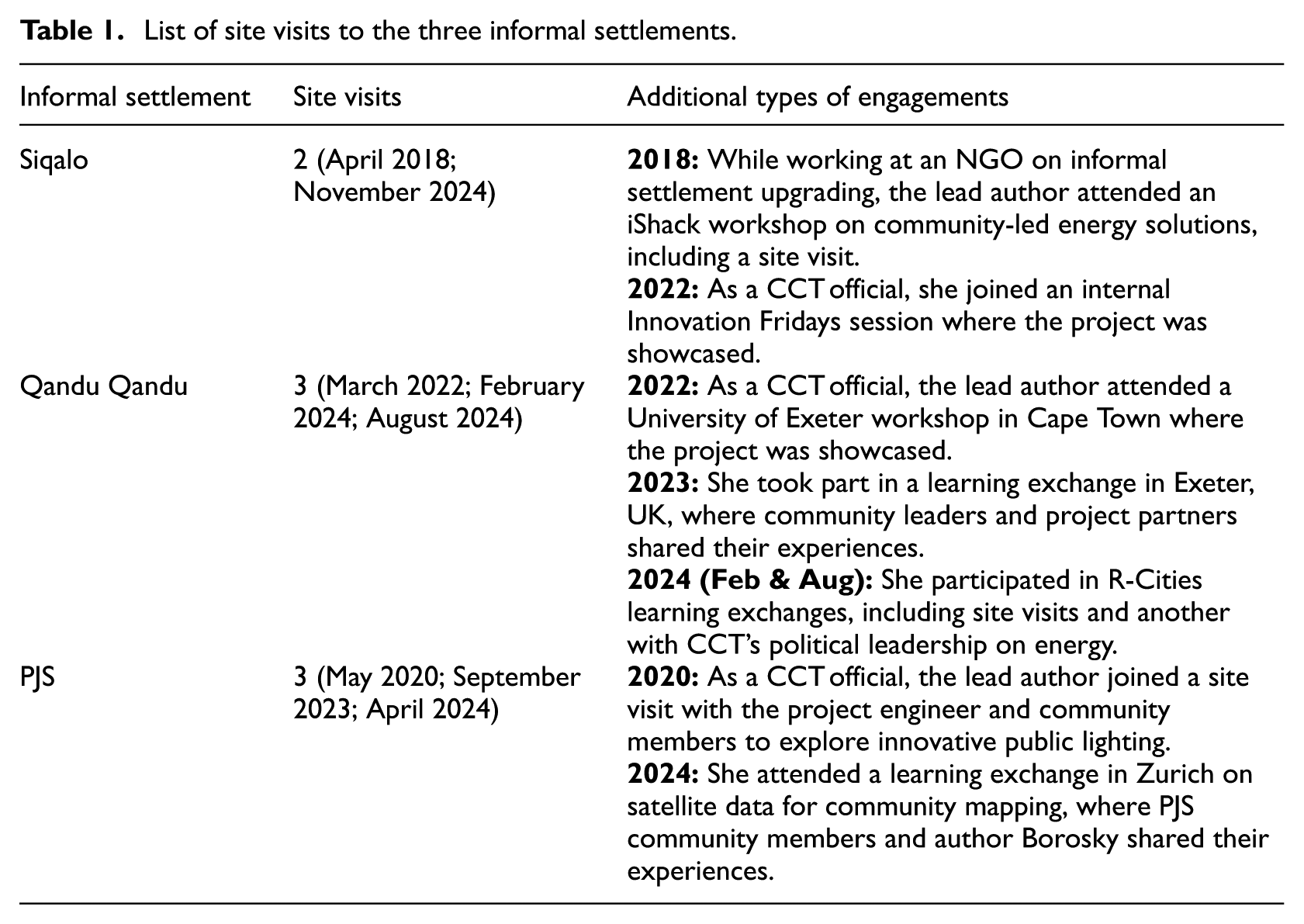
Twenty-four semi-structured interviews were conducted with community leaders, CCT officials, NGOs, and project implementers. Site visits to Siqalo, Qandu Qandu, and PJS took place between 2018 and 2024, complementing the lead author’s ongoing engagements as a CCT official and participation in energy access workshops organised by implementing partners (Table 1).
List of site visits to the three informal settlements.
Interviews and actor groups per case study.
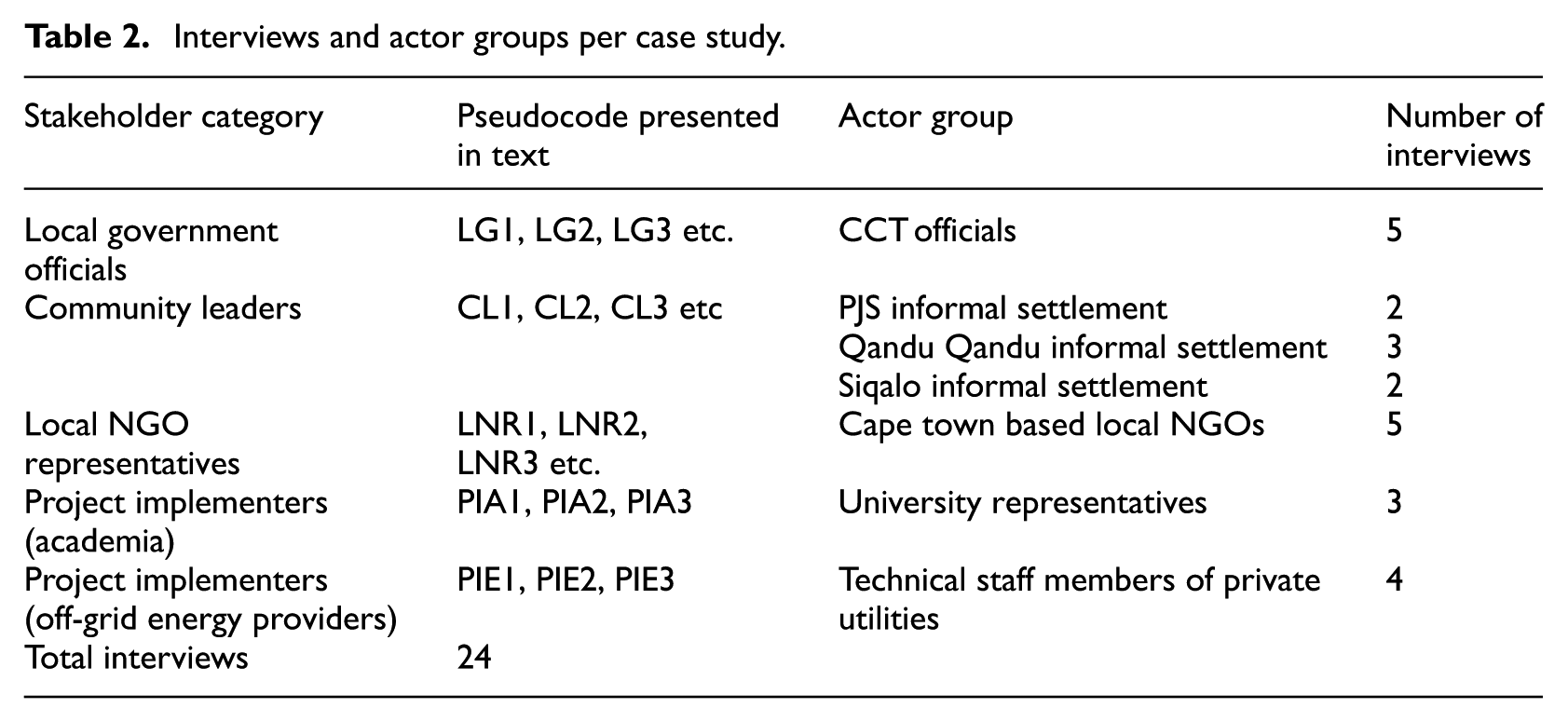
Interview participants were selected for their involvement in the initiatives. Interviews allowed respondents to discuss their roles openly and reflectively. Community leaders and NGOs reflected on their role in organising communities, the challenges faced, and how the initiative was seen to be a solution to the challenges faced by the community in relation to energy access. Project implementers and academic partners focused on the detailed processes undertaken for implementing the project, and collaboration with the community. Local government officials discussed the CCT’s approach to energy poverty, institutional constraints, and policy integration. All interviews were one hour long, with the community leaders interviews taking place in person in their communities with one government official at the EDP offices, and the rest of the interviews taking place via Microsoft Teams. Interviews were transcribed, and data was pseudonymised, coded, and categorised to represent primary stakeholder responses.
Findings and analysis
The construction of the off-grid electricity imaginary
Informal settlements in South Africa are shaped by deep inequality and the absence of basic services, often occupying what Yiftachel (2009) terms ‘gray spaces’ zones of partial legality and exclusion that limit residents’ capacity to claim full urban citizenship (Benjamin, 2008; Holston, 2008; Roy, 2009). In this context, access to electricity represents more than energy, it signals visibility, inclusion, and recognition as equal citizens (Lemanski, 2020). Grid connection becomes a marker of integration into formal infrastructure, reinforcing urban legitimacy (Cantoni et al., 2022). Yet post-apartheid frameworks often equate citizenship with the passive receipt of state services (Miraftab, 2003), overlooking the everyday actions through which residents assert their rights (Holston and Appadurai, 1996). The case studies challenge this model. Rather than waiting for formal provision, communities perform what Isin and Nielsen (2008) call ‘acts of citizenship’–assertions of agency through self-organised off-grid initiatives. Rooted in collective mobilisation, these actions reframe urban belonging and contribute to the construction of more inclusive urban futures (Fainstein, 2014; Heller, 2009).
The TRF highlights how shared visions of possible futures, what we call socio-technical imaginaries can influence how people think about and practise citizenship in new ways, especially in urban settings. A vision of a possible world, in the cases studied, emerges because of the installation of a new, off-grid electricity, configuration. The citizenship manifests itself as a claim to electricity, without using the coded configuration provided by the local authority. In this emerging off-grid electricity imaginary, citizenship is redefined as an active, participatory practice that empowers residents to claim their right to the city (Fainstein, 2014; Lefebvre 1966). This re-imagining transcends legal status, fostering agency through initiatives that shape policy, strengthens community solidarity, and creates new avenues for participation. Framed as acts of dramaturgy, these methods amplify residents’ voices, redefine energy access as a shared responsibility, and support co-creation of more inclusive urban futures.
In all three cases, surveys served as scenes in the social performance of claim-making. In PJS, a community-led survey helped shape project goals based on lived experience (LNR1). In Qandu Qandu, a mobile app tracked household energy use, while in Siqalo, iShack, and NGO partners identified barriers to access.
The public lighting campaign emerged from safety discussions that included water and sanitation. Community testimonies revealed fears of using toilets at night due to poor lighting. Police also reported patrol challenges in unlit areas, including attacks and stolen firearms. (Participant LNR1, 2023, interview, edited)
These scenes highlight how symbolic acts–like data collection and testimony reveal infrastructural inequality and reinforce claims to essential services. In PJS, this performance aligned with the Social Justice Coalition’s 2016 protest in well-lit suburbs to expose inequalities in lighting (Karim, 2019).
Similar protests took place in Siqalo and Qandu Qandu. In 2021, Siqalo residents told the media: ‘We are not asking for much … just basic services … We will pay like everyone else’ (Tshuma, 2021: 7), rejecting informal norms like illegal connections. In 2019, Qandu Qandu residents marched to the Civic Centre, citing reliance on izinyoka and danger boxes 1 (Gontsana, 2019: 8). ‘Siqalo Shack Dwellers Want Solar Power’ read a 2021 headline (Phaliso, 2024).
These performances, protests, data, collection and media, assert agency from the city’s margins, reframing energy as a collective right. They embody a dramaturgy of incrementalism, where public acts slowly reshape the discourse of urban citizenship from passive receipt to active co-production of infrastructure.
Another example of dramaturgy is the strategic use of GIS tools. In PJS, mapping informal footpaths helped determine where to install solar lights; in Siqalo, GIS is used to monitor solar home system uptake.
We used GIS to show stark lighting disparities. Khayelitsha’s darkness contrasted with well-lit suburbs. This challenged the City’s density argument and linked poor lighting to crime, policing, and ambulance access. (Participant LNR1, 2023, interview, edited)
Here, GIS visuals become powerful props, exposing infrastructure inequality and reinforcing demands for equitable service delivery. These visuals, framed through staged actions, challenge official narratives and strengthen claims to visibility and safety.
At the same time, the CCT’s responses, through newsletters such as ‘City Rolls Out High-Mast Lights in Informal Settlements’ and ‘The Facts About Public Lighting in Khayelitsha’, attempt to address these critiques, but also expose the limitations of current municipal responses (CCT, 2013). The CCT’s acknowledgement of challenges like theft and vandalism attributes service limitations to external factors, rather than structural inequalities. This narrative allows the CCT to defend its position while subtly shifting responsibility onto the communities themselves for issues relating to public infrastructure.
In all three case studies, uniforms and a local office (as in Qandu Qandu) help legitimise off-grid electricty projects, embodying a dramaturgy of incrementalism. Branded technicians mirror formal providers, building trust and signalling a reliable alternative system. In PJS, lights marked ‘Property of PJS’ mimic municipal infrastructure, while consistent technician involvement in Qandu Qandu and Siqalo normalises off-grid electricty. By adopting state-like symbols, these initiatives blur formal/informal boundaries and position off-grid electricty providers as credible actors in the urban energy landscape.
These visual and performative strategies complement broader acts of citizenship, through which residents claim the urban stage and assert their rights. Framed by deliberate dramaturgy, this shift from passive entitlement to active participation redefines how citizenship is enacted. Together, these efforts amplify community voice and agency, presenting off-grid electricity provisioning as a step toward more inclusive and equitable urban futures.
Governing the newly emerging off-grid electricty imaginary
The three case studies illustrate how off-grid electricity infrustructure in informal settlements not only address gaps in service delivery but also redefine local agency within urban development. These initiatives reflect a governance model grounded in participation, accountability, and co-production. By collaborating with technical experts, communities gain the tools to engage with government using technical evidence shifting from recipients of state services to active problem-solvers. As Rauschmayer et al. (2018) argue, meaningful governance requires voice, representation, and agency.
Informal settlements are often structured around internal governance systems, such as amakomiti or people’s committees that mediate with the state, coordinate infrastructure, and resolve disputes (Haque et al., 2021; Ngwane, 2021). These community electricty structures played a critical role in the off-grid projects, facilitating alignment between project goals and community needs. They helped implement tasks ranging from household surveys to installation and maintenance, often mobilising unemployed youth (PIE1–3).
This model contrasts sharply with dominant municipal approaches, where participation is mandated by law (Local Government: Municipal Systems Act, 2000) but often remains tokenistic. As a result, community frustrations are frequently expressed through protests.
When the CCT implements projects, they never consult us as community leaders … we just see contractors working in our community. At that point, there’s nothing we can do. (Participant CL1, interview, 2023)
Off-grid electricty initiatives instead foster more reciprocal, trust-based forms of governance. In PJS, after thefts during phase one, a community meeting helped redefine the solar lights as shared property, instilling a sense of collective responsibility (CL2, interview, 2023). In Qandu Qandu, households hosting mini-grid towers receive free energy in return for protecting the infrastructure. In Siqalo, residents take ownership of solar home systems after 24 monthly payments–strengthening long-term buy-in.
Transparency was central to building accountability. In one case, protests over youth employment led to reforms in recruitment processes (CL3, interview, 2023). In Siqalo and Qandu Qandu, transparent billing systems helped residents understand cost structures fostering trust and informed participation.
These practices shift the performance of service delivery itself, recasting residents not as passive recipients but as co-creators of infrastructure. In doing so, the projects contribute to a broader reimagining of citizenship–centred on agency, belonging, and a collective claim to urban futures. This reflects a growing off-grid electricty imaginary that challenges existing governance norms.
Social entrepreneurs play a key role in mediating between grassroots implementation and institutional advocacy. They manage on-the-ground logistics while also engaging municipalities to secure subsidies and policy support.
The first grant enabled us to engage the municipality to recognise off-grid electricty systems under the subsidy framework, allowing households using our systems to access the indigent energy benefit. We also engage in advocacy with local governments and handle legal matters when disputes arise. (Participant PIE2, interview, 2023, edited)
Despite the success of these pilots, many government officials remain hesitant to view off-grid electricity infrustructure as legitimate long-term solutions to addressing energy accessing in a highly urbanising environment. This resistance reflects a deeper discomfort with decentralised, adaptive models of service delivery.
The Electricity Department insists on full electrification, which would be ideal but it is not feasible. We need a gradual path. In Stellenbosch, it took nine years, but they got electricity it shows incremental energy services can lead to grid access. (Participant PIE3, interview, 2023, edited)
Despite the promise of off-grid systems, government departments remain reluctant to see them as legitimate solutions. However, recent shifts in South Africa’s Just Energy Transition (JET) dialogues show increasing support for decentralised models. The Presidential Climate Commission’s 2024 report highlights the potential of community-owned mini-grids and solar home systems, citing Zonke Energy’s Qandu Qandu pilot and iShack’s rollout to over 2000 households (Cherry et al., 2023).
Yet, scaling these solutions especially in urban informal settlements like Cape Town remains difficult due to gaps in regulation, subsidies, and municipal integration. The PCC recommends including off-grid electricty systems in the Non-Grid Electrification Programme and revising the Free Basic Electricity subsidy to support non-grid electricty users.
At the local level, the CCT’s 2050 Energy Strategy aligns with these goals. Programme 2.1 commits to subsidising non-grid electricty sources in unelectrified settlements, and Programme 2.3 promotes off-grid public lighting (CCT, 2023b). The City’s 2022–2027 Integrated Development Plan (IDP) and recent newsletters also reflect this growing institutional acceptance (CCT, 2022, 2024a, 2024b).
Together, these developments reflect an emerging policy space where the once peripheral off-grid electricty imaginary is beginning to influence national and municipal energy planning. Realising its full potential, however, requires greater institutional flexibility, regulatory reform, and sustained investment in community capacity.
Discussion
Our analysis reveals the dynamics of off-grid electricity experiments in informal settlements, showing how the off-grid electricity imaginary captures the imagination of residents, policy makers, technical experts, and community leaders, and how it spreads. We also demonstrate the spread of the imaginary in two CCT policy frameworks, the IDP and the 2050 Energy Strategy. The case studies thus reveal how experiments evolved from grassroots, community-based initiatives into institutionalised policy. We traced the dramaturgy of bottom-up incrementalism that helps explain these dynamics. From an energy transitions perspective, the cases reflect features of the TRF. They demonstrate how re-imagining (the spread of a new socio-technical imaginary, rooted in local needs), leads to re-coding (the protocols and examples being embedded into policy frameworks) over time leading to a broader re-configuration of the electricity provision system.
A key question is the significance of these findings. They highlight the importance of the interrelation of imagination, futures and citizenship in African urban contexts. For disadvantaged residents in informal settlements the ability to see and experience a possible better future is vital. Each of the three cases demonstrate this. The dramaturgical analysis also revealed the need for a broader view of citizenship–one that creates and rehearses acts of collective ownership and purpose.
Another issue is the relevance of these case studies for the energy transition. We suggest positioning our understanding of the cases within the concept of a ‘radical incrementalism’ (Hajer and Oomen 2025), a notion developed in the context of rethinking urban futures in the Global South (Pieterse, 2015). The core idea is that, in this context, successful bottom-up experimentation may be more effective than pursuing large-scale plans through formal decision-making processes, which are often constrained by political capture (Swilling and Annecke, 2012). Radical incrementalism holds that small interventions can, under the right conditions, scale up and produce significant change.
Unlike Lindblom’s (1979) original concept of incrementalism ‘muddling through’ with modest outcomes–radical incrementalism suggests that transformational change is possible when experiments align with a responsive policy environment. Using the TRF framework, incrementalism becomes powerful when the imaginary spreads (re-imagining), policy adapts (re-coding), and the system evolves (re-configuration). TRF-based analyses elsewhere (Haldar et al., 2024) show that transformation is never linear; feedback loops are common. New hardware installations (re-configuration) may inspire new visions (re-imagining) or reveal new opportunities or challenges (re-coding).
In summary, this dynamic between re-imagining, re-coding, and re-configuration is evident across the case studies.
Drawing on the case studies, we identify a distinct pattern of action, a ‘dramaturgy of radical incrementalism’ emerging in response to state failure. Rooted in community-led development, it involves grassroots mobilisation, protest, media influence, and local innovation gradually reshaping energy access policy and practice.
We highlight four patterns that define this dramaturgy of radical incrementalism:
I. Local actors–residents, NGOs, academia, and innovators establish the legitimacy of off-grid electricity. Community involvement in installation and maintenance embeds these solutions in daily life. Tools like GIS and budget analysis empower communities to challenge state policies, while uniforms worn by technicians symbolise professionalism and institutional legitimacy.
II. Communities use protest not just to express grievances, but as strategic performances to challenge poor access to energy such as illegal connections and inadequate public lighting. These actions mobilise public opinion and pressure the state for systemic change.
III. Media, such as newspapers, newsletters, and platforms like X (formerly Twitter), amplify community voices on energy access. This shifts public discourse and strengthens calls for off-grid electricity subsidies. The City of Cape Town (CCT) also uses media to explain its challenges and later promote off-grid electricity solutions.
IV. As these community-driven initiatives gain visibility, they influence formal policy. CCT’s 2050 Energy Strategy and IDP now include off-grid electricity solutions as part of long-term, inclusive energy access planning, signalling a shift from local innovation to formal policy solutions.
On the one hand, this process not only advances but re-imagines an off-grid electrification by demonstrating how small-scale, community-driven solutions can contribute to broader just energy transitions. It highlights how societal actors can drive change that aligns with broader policy goals. Importantly, it shows that change does not have to be immediate or disruptive; instead, small innovations, supported by community involvement and policy integration, can challenge entrenched systems and open new pathways for just energy transitions.
At the same time, it raises new dilemmas and tensions around the role of the state. In marginalised informal settlements, the state’s involvement is often limited. As seen in the case studies, off-grid electricity projects increase the significance of resident participation, disrupting the conventional state-led electricity model and blurring traditional lines of authority and legitimacy.
Off-grid electricity infrastructure offers a decentralised alternative that redefines urban inclusion by empowering residents with energy access outside formal grids. It broadens the meaning of citizenship, showing that recognition can go beyond legal status and enable fuller participation in urban life.
Political and governance legitimacy in energy provision remains contested, as municipalities grapple with conflicting responsibilities and structural limitations in extending electricity to informal settlements. Addressing this challenge requires navigating and transforming complex policy frameworks. Legal and regulatory constraints such as zoning restrictions, environmental protections, and power line servitudes often prevent the delivery of formal services, reinforcing exclusion, and limiting state intervention.
Off-grid electricity provisioning challenges the state’s monopoly, introducing decentralised, community-driven models supported by local knowledge and donor funding. This repositions the state as a facilitator alongside non-state actors. However, limited state involvement risks creating a parallel governance structure, reflecting broader tensions around authority and responsibility.
The rise of off-grid electricity provisioning models signals a shift toward shared responsibility, urging the state to adopt a mixed governance approach that balances community agency, external partnerships, and its responsibility for citizens’ rights to ensure access to basic services.
Conclusion
This paper employed a dramaturgical lens, complemented by the TRF, to critically examine how an off-grid electricity imaginary gained traction and legitimacy across three informal settlements in Cape Town. Through solar mini-grids, home systems, and solar-powered public lighting, residents, academia, community leaders, and private utilities collectively enacted new socio-technical configurations that speak to a broader imaginary of inclusion and energy justice. These technologies not only address service delivery gaps but also catalyse new claims to urban belonging–co-producing a vision of African urban futures shaped by agency, and everyday experimentation.
The dramaturgical analysis of radical incrementalism reveals how acts of citizenship–protests, participatory surveys, branded technicians, and GIS mapping become tools to challenge infrastructural exclusion and establish legitimacy from the margins. These performances signal a shift away from passive models of service delivery, toward a participatory politics where urban citizenship is reimagined as active, negotiated, and co-produced. In this emerging off-grid imaginary, access to electricity becomes a claim to the city itself–symbolising recognition, visibility, and shared responsibility.
These activities not only foster socio-technical imaginaries of an inclusive urban energy future but also emphasise the importance of co-creation, where residents trust that they can actively shape local energy solutions. Further research that pays closer attention to the manifestation of how such imaginaries emerge, evolve and translate into policy and practice in other urban contexts is thus vital.
Our findings contribute to urban theory by foregrounding how imaginaries, shaped in informal settlements, can lead to new ways of building citizenship and delivering services. These imaginaries are manifested not only through technology, but also through discourse, performance, and new forms of governance. They show that informal settlements are not simply sites of exclusion, but also of innovation–spaces where alternative forms of belonging and urban governance are imagined and enacted.
Finally, the cases underscore the potential of academic collaboration and co-production. In two of the three case studies, universities were involved–well-intentioned, yet marked by steep learning curves. Providing alternative technological configuration is never sufficient by itself. It calls for an understanding of the subtle ways in which imaginaries spread, a capacity to listen to citizens’ needs, and to appreciate the often-complex position of policy makers. Co-producing knowledge in these contexts means engaging not just with technology, but with contested imaginaries and the making of urban futures. Our research strategy–rooted in embedded researchers and long-term engagement–was essential for grasping the complex urban dynamics at play.
While these case studies reflect progress toward social justice and inclusivity in energy transitions, they also highlight governance dilemmas and questions of state legitimacy. Off-grid electricity initiatives often operate outside traditional state frameworks, implicitly challenging the authority and role of local and national government in energy provision. As South Africa advances its just energy transition, finding ways to balance decentralised, community-led innovation with state-led governance will remain a critical task.
Footnotes

Funding
The authors disclosed receipt of the following financial support for the research, authorship, and/or publication of this article: This research is part of the Reconfiguring Energy for Social Equity (ReSET) project and was supported by the Volkswagen Foundation (grant number 96958).
Declaration of conflicting interests
The authors declared no potential conflicts of interest with respect to the research, authorship, and/or publication of this article.