




Abstract
In the UK Network Rail Environmental Sustainability Strategy 2020–2050, minimal waste and the sustainable use of materials are highlighted as core priorities. The ambition is to reuse, repurpose or redeploy all resources. In low adhesion conditions, sand particles are used to enhance traction throughout the network. However, sand is in danger of becoming scarce as many applications demand it. In this study, an alternative adhesion enhancing particle system made of recycled crushed glass is examined in terms of density, size, shape distribution, mineralogy, mechanical properties, and bulk behaviour to better understand their characteristics in comparison with the typical Great British rail sand currently in use and reported in the literature. Their effects on tribological behaviour and surface damage are also investigated using the High-Pressure Torsion test in dry, wet, and leaf-contaminated conditions. Both particle characterisation and tribological testing show promising results. Recycled glass particles provide an acceptable level of traction with a similar level of rail damage as typical rail sand. It is suggested to perform full-scale laboratory and field tests to further confirm the suitability of this material.
Introduction
The adhesion 1 or traction at the wheel-rail contact during train operation is of great importance. Loss of traction can lead to train delays, safety risks, and at worst accidents, resulting in a £345 m cost to the British railway industry annually [1]. Undesirably low traction can be encountered when there are contamination layers on the top of the rail such as water or leaves. As one solution to increase traction to sufficient levels, rail sanding has been employed since the early years of the railway industry.
During the rail sanding process, sand particles are applied to the wheel-rail interface in a stream of compressed air targeted at the rail slightly ahead of the wheel. As the train moves, the wheel passes over the sand particles resulting in their breakage and an increase in the wheel-rail traction. The efficiency of getting sand particles in right place is very low, resulting in around 80% sand wastage [2]. Sand resources are limited as this natural material is commonly used in many applications, such as computer microchips, construction, and cosmetics, just to name a few. Therefore, sand may not be a practical option for rail sanding in the near future.
The properties of different sand options used in rail sanding applications has been studied in recent years. Arias-Cuevas et al. [3,4] studied the effects of sand size on wheel/rail adhesion and wear; this work also studied the effects of sand quantity, as did Omasta et al. [5] in a separate piece of work. Skipper et al. [1] proposed a framework for particle characterisation and utilised it to characterise three sand options used in the rail industry. They investigated the impact of each of the three sands on wheel/rail adhesion enhancement in wet, dry and leaf contaminated conditions. Elsewhere, Wang et al. [6] studied four different mineral types to assess possible links between a particulate material’s crushing strength and its effect on traction. In other research, Skipper et al. [7] characterised four particle options supplied by various industrial suppliers and compared the properties to the standard Great British (GB) rail sand. They studied the effects of each of the four options on adhesion and electrical conductivity and compared the results to the performance of GB rail sand. Most recently, work has been undertaken to quantitatively assess the effects of particle size, shape, and hardness on adhesion mitigation using a wide range of particle types [8].
Building on the Network Rail 30-years strategy for: delivering a sustainable railway, minimising the waste, and increasing the sustainable use of material [9], in this study, recycled crushed glass is proposed as an alternative to the standard sand used for rail sanding. The particles’ density, shape and size, bulk behaviour, mechanical and mineralogical properties are characterised and compared to typical rail sand. The characterisation data can help verify that this recycled crushed glass material is a practical alternative to typical rail sand in terms of both performance and compatibility with sanding systems. High Pressure Torsion (HPT) tests are executed to investigate the tribological performance of the crushed recycled crushed glass particles in dry, wet and leaf contaminated conditions. HPT results are compared to the data for the standard rail sand to present whether the crushed recycled crushed glass is a suitable substitute.
Particle Characterisation
Preparation of recycled crushed glass particles
Various types of glass bottles are used to produce the recycled crushed glass particles. The glass bottles are emptied and washed to remove the residual liquid and the labels and then crushed under compression. To produce the particles with desired sizes, ∼100 g of the crushed glass pieces are placed inside a laboratory disc mill (SIEBTECHNIK TEMA Machinery Scheibenschwingmühle TS 750) for 7 s. The resulting glass particles are sieved using four different mesh sizes to categorize them into three sieve cuts as follows: category one retained on a 2 mm mesh sieve while passing a 3.35 mm mesh sieve (named Recycled Glass Large-RGL), category two retained in a 1.18 mm mesh sieve (named Recycled Glass Medium-RGM), and category three retained in a 600 μm mesh sieve (named Recycled Glass Small-RGS). Figure 1(a) shows the size distribution of the particles from the three size categories compared to the GB rail sand. It can be seen that the particle sizes are mostly inside the range currently proposed in GMRT 2461 which is from 0.71 mm to 2.8 mm [10]. The process is repeated until 2 kg of each sample is prepared. (a) Particle size distribution of the three samples based on sieving. The red area shows the size range currently accepted by GMRT 2461[10]. Particle shape distributions of (b) GB rail sand, and (c) recycled crushed glass, (1) sample one retained on 2 mm mesh sieve, (2) sample two retained on 1.18 mm mesh sieve, and (3) sample three retained on 600 μm mesh sieve based on flatness and elongation plotted on Zingg charts obtained from X-ray Computed Tomography. (colour figures are available in digital version of this paper).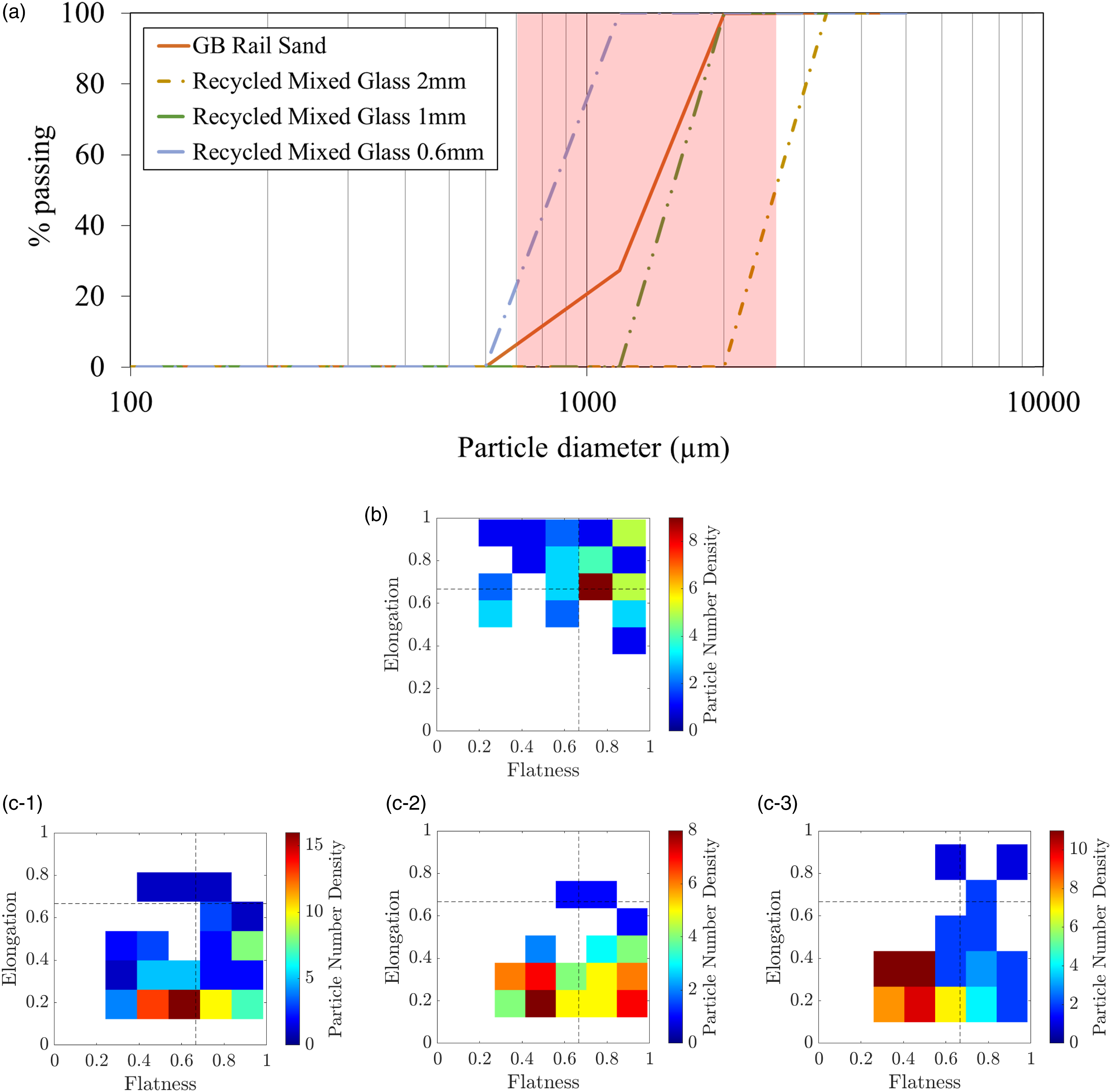
Density
The density of particles is evaluated using the gas jar method following BS1377-2:1990 [11] using two samples of the recycled crushed glass particles each weighing ∼400 g. The average of the values of the density of the recycled crushed glass particles is 2512.18 kg/m3 with a standard deviation of ±4.25 kg/m3.
Shape Characterisation
Particle shape characterisation is conducted by performing X-ray micro-Computed Tomography (μCT) scans. One sample from each particle size category comprising of ∼70 particles, representative of the whole size distribution, is chosen and scanned utilising the μCT system (SkyScan 1176) located in the Preclinical in-Vivo Imaging Facility at Newcastle University Medical School, UK. The μCT system is operated with a source current of 357 μA and a voltage of 70 kV. The resulting μCT images are reconstructed to produce greyscale cross-sectional slices with a voxel side length/image resolution of 8.81 μm which resulted in a 3D image with 7444 × 7444 × 7117 voxels.
To make image analysis feasible, μCT images of each sample are resized with a factor of 0.25 resulting in a decrease in the size of the 3D matrix to 1861 × 1861 × 7117 voxels. This increases the computational efficiency, while making sure that the particles size and shape are conserved [12].
The images are analysed, and the particle shape descriptors are calculated from the 3D particle geometries using the SHAPE code by Angelidakis et al. [13], readers are referred to Angelidakis et al. [14] for more information on particle shape descriptors. Particle shape distributions are plotted on Zingg charts in terms of flatness and elongation and presented in Figure 1(b) for GB rail sand, and in Figures 1(c-1), (c-2), and (c-3) for recycled crushed glass from category 1, 2, and 3, respectively.
Bulk Characteristics
The Angle of Repose (AoR), the angle a pile of granular material produces relative to the horizontal plane which is a measure for the flowability of granular materials, is quantified to characterise the particles’ bulk behaviour. Among the various methods of measuring AoR, none is defined as the standard. Here, the procedure proposed by the technical committee of the International Society for Soil Mechanics and Geotechnical Engineering (ISSMGE TC105) as a part of a round robin testing programme [15] is used to evaluate the AoR of the particles in categories 1, 2, and 3. A digital camera (SLR camera Canon (Tokyo, Japan) EOS 60D 18 MP CMOS) with EF-S 18–200-mm lens is utilised to capture the photos and the open-source software Fiji-ImageJ is used to measure the angles.
For each category, the tests are performed three times and the average value, and the standard deviation of the data are reported as follows: 37.38° ± 1° for category 1, 36.47° ± 1° for category 2, and 38.00° ± 1° for category 3. These values can be compared to the value of the AoR for GB rail sand 28.60° ± 0.5° [7] as the benchmark.
Mechanical Properties
Nano-indentation tests are performed on the particles to measure their hardness and reduced modulus. Samples of the particles are mounted on a steel stub and tested utilising a nano-indentation instrument (NanoTest Vantage) and a diamond Berkovich indenter. The tip shape of the indenter is calibrated using a fused silica reference sample prior to testing. The experiments are carried out with a maximum load of 80 mN, loading time of 8 s, unloading time of 4 s, and maximum load hold of 10 s. The tests are repeated to obtain at least 10 reasonable indentations that are not adversely affected by the surface roughness. Figure 2 presents the loading and unloading graphs for all the experiment instances. The particles’ hardness (the ratio of maximum load to indentation area) and reduced modulus (the slope of unloading) are measured to be 7.28 ± 0.12 and 83.60 ± 0.55, respectively. These values can be compared to the values of the hardness and the reduced modulus for GB rail sand 12.50 ± 0.9 and 85.84 ± 8.76 [7], respectively, as the benchmarks. Loading and unloading graphs during the nano-indentation tests for recycled crushed glass particles.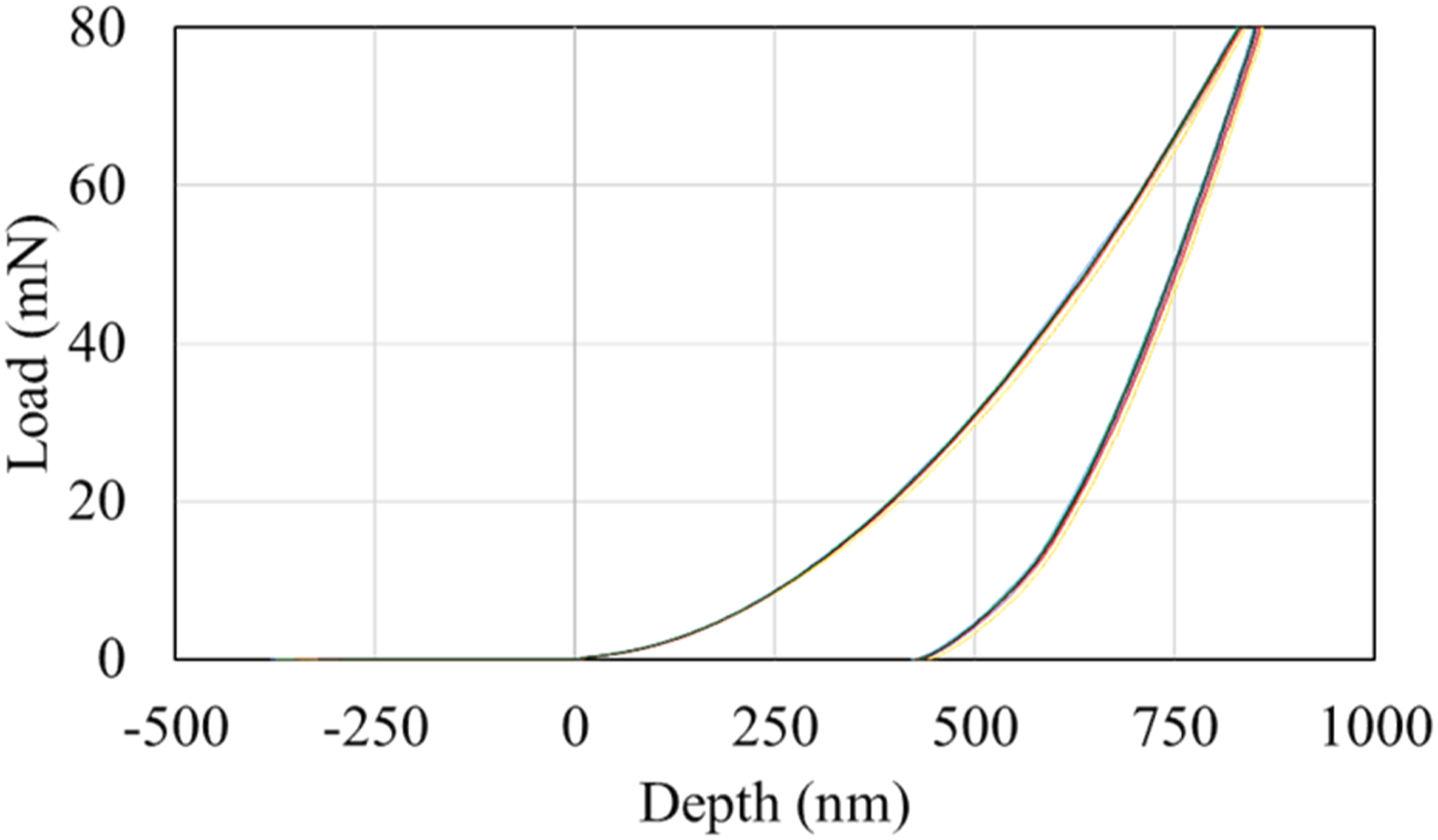
Mineralogical Properties
For mineralogical characterisation and phase identification of the particles, powder X-ray diffraction (XRD) experiments are performed. For this purpose, a small sample of the particles is ground to a fine powder and transferred to the sample holder of the diffractometer (Bruker D2 Phaser with LynxEye detector using Cu Kα radiation). A preliminary scan (with 2theta between 5–100°) is run to check for low angle peaks prior to the main measurement scan. The diffractometer parameters are set to a divergence slit of 1.0 mm, with a 2theta range of 10–100°, step size of 0.033°, and 0.5 s step-1 and a Ni filter is used to reduce Kβ radiation. The detected peaks are compared to reference patterns for compounds/materials containing Si and O within the Crystallography Open Database. For the recycled crushed glass, although there is only one peak present within the pattern, it does match silicon oxide (SiO2), (reference 96–900–5022). XRD tests on the GB rail sand showed similar results as the sample appears to be silicon oxide (SiO2), (reference 96–153–2513). The X-ray diffraction pattern of the sample is presented in Figure 3. Powder X-ray diffraction pattern for recycled crushed glass (blue) and GB rail sand (black).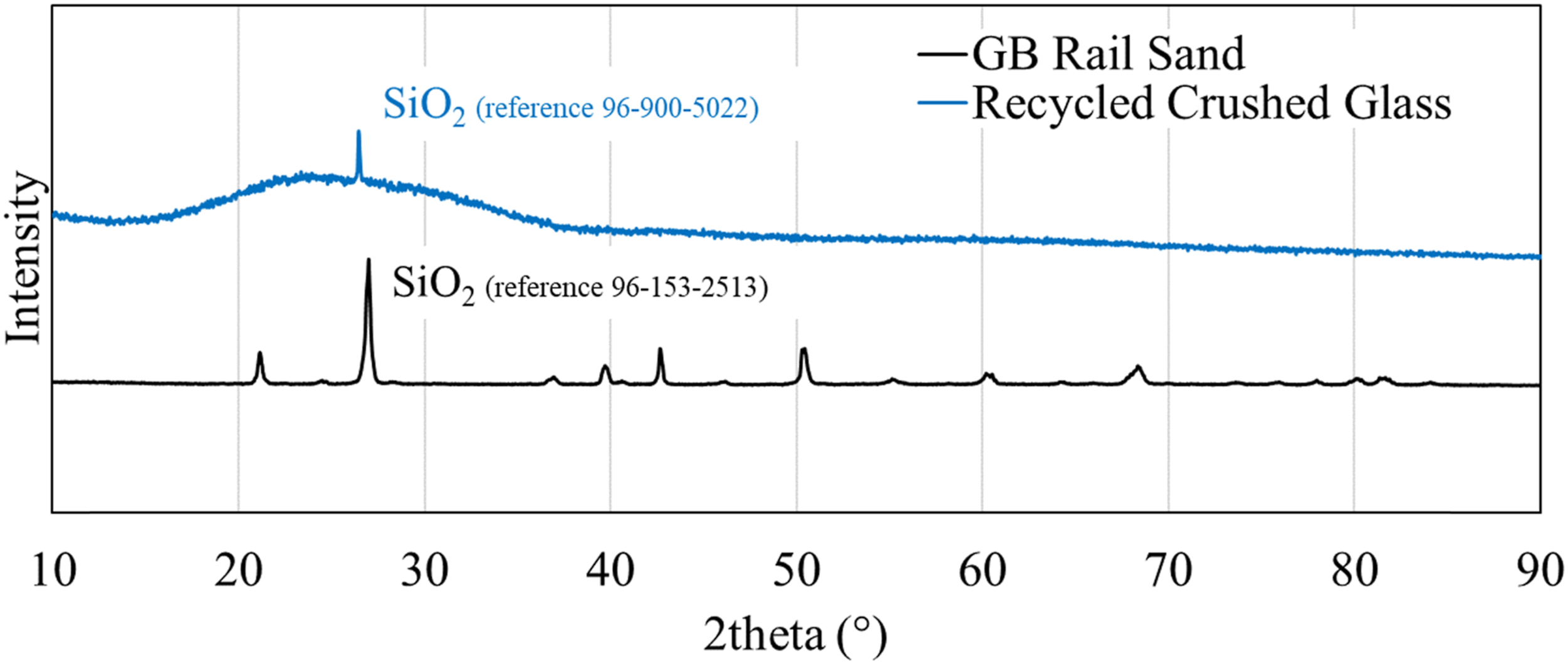
Tribological Laboratory Testing
The set-up for the high-pressure torsion (HPT) experiments comprises of two flat specimens compressed together. Then, the contact is turned through a designated sweep angle by exerting a torque which varies for different contact conditions [16]. The HPT set-up located at the University of Sheffield is able to provide 400 kN and 1000 Nm of normal load and torque, replicating contact stresses with a maximum of 900 MPa, corresponding to a 60 kN load on one wheel [17].
One application of HPT tests is the investigation of the effects of sand on adhesion, as demonstrated by [1]. Figure 4 presents a schematic of the HPT rig. The specimens made of wheel (1) and rail (2) steel are secured to their corresponding holders (3). First, there is no contact between the specimens, then, the two specimens are brought into contact and utilising the axial hydraulic actuator (5), a normal load is applied. A rotational hydraulic actuator (4) is employed to rotate the specimen faces against each other. The torque and axial load are measured by load cells (6 and 7) and recorded by the controller (8). The crosshead (9) can be raised as needed and hydraulic pressure is supplied to the rig by a ring main (10). Depending on the third body layer placed on the contact area of the specimens, the required amount of torque for turning the contact through the desired sweep angle is defined. Full schematic of the high pressure torsion rig (after [16]).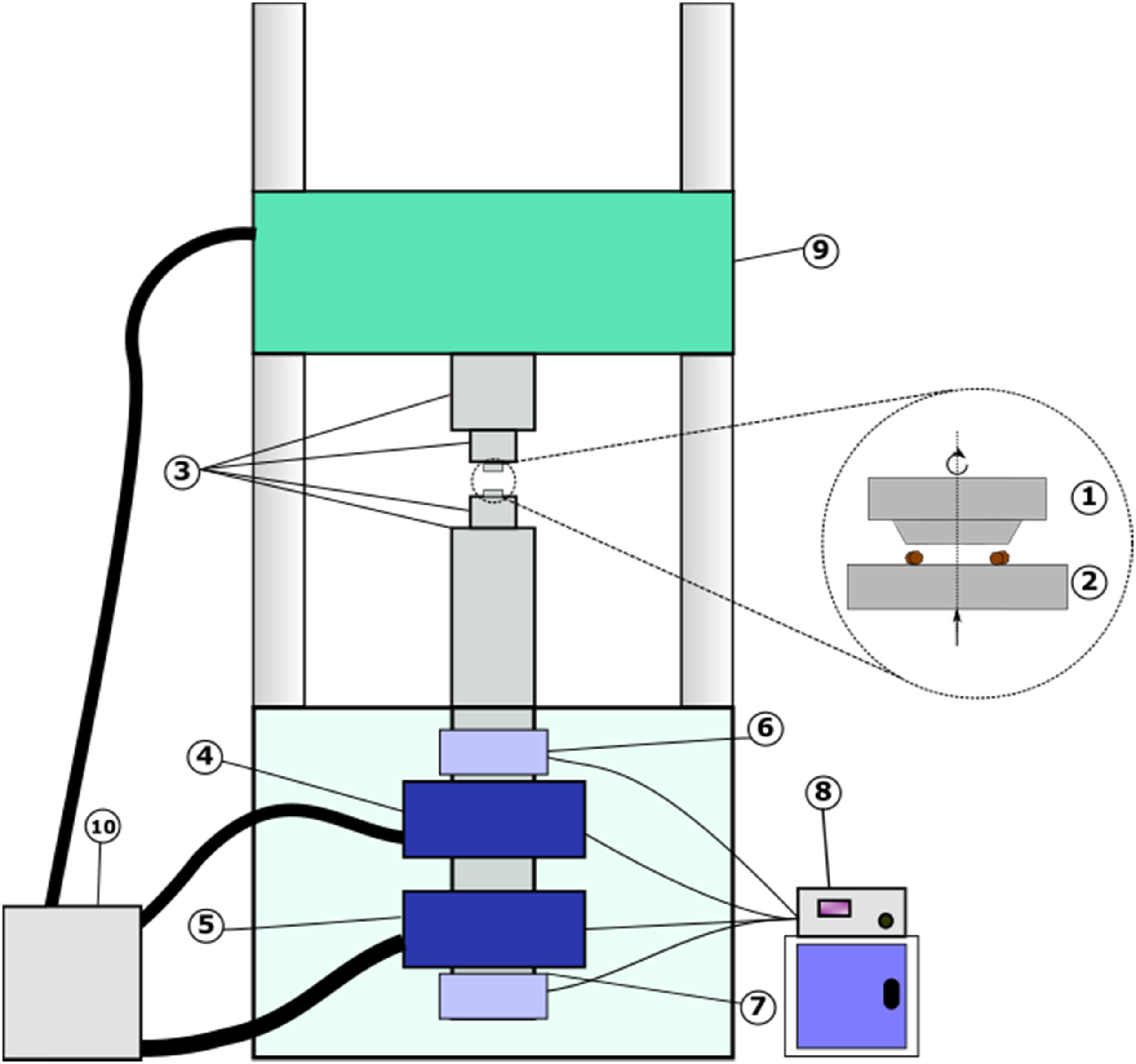
Wet conditions were created by applying 20 μl of distilled water evenly into the contact, and leaf contaminated conditions were created by applying 25 mg of leaf powder and 20 μl of distilled water, which was then conditioned with one sweep before a further 20 μl of distilled water was applied. Particles were applied to the contact by hand, whilst ensuring an even spread around the contact (see [1,8] for an example of the spread pre and post-test), 25 mg of material were applied per test to match the 7.5 g/m limit imposed by GMRT2461 [10].
Concluding Remarks
Figures 5(a), (b), and (c) show the HPT results in terms of coefficient of traction versus displacement for recycled glass (RG) in comparison with GB rail sand for three conditions of dry, wet and leaf contaminated contact. The surface roughness after the test was quantified and presented in Figures 5(d), (e), and (f). It can be seen that the level of traction and surface roughness by RG are comparable with GB for all conditions, with some variation in leaf contaminated conditions. Nearly all materials produced traction above the minimum braking level of 0.09 [18] (with the exception of RGL in leaf contaminated conditions), which suggests they can act as a viable alternative to rail sand. The differences (or lack thereof) between GB rail sand and the recycled crushed glass are probably due to the dominant factor governing traction in dry and wet conditions being particle hardness (see Skipper et al. [8]), which is relatively similar between the particle types used here. However, in leaf contaminated conditions, the dominant factor is particle size, hence why you see a difference in traction in Figure 5(c) where different sizes of recycled crushed glass were used. These relationships also largely apply to the surface roughness results. High pressure torsion results for (a) dry interface, (b) wet, and (c) leaf contaminated conditions; Surface roughness quantified using the alicona infiniteFocusSL 3D optical profilometer and reported in terms of root means square height of the surface roughness, (d) Recycled glass small (RGS), (e) Recycled glass medium (RGM), and (f) Recycled glass large (RGL). (colour figures are available in digital version of this paper).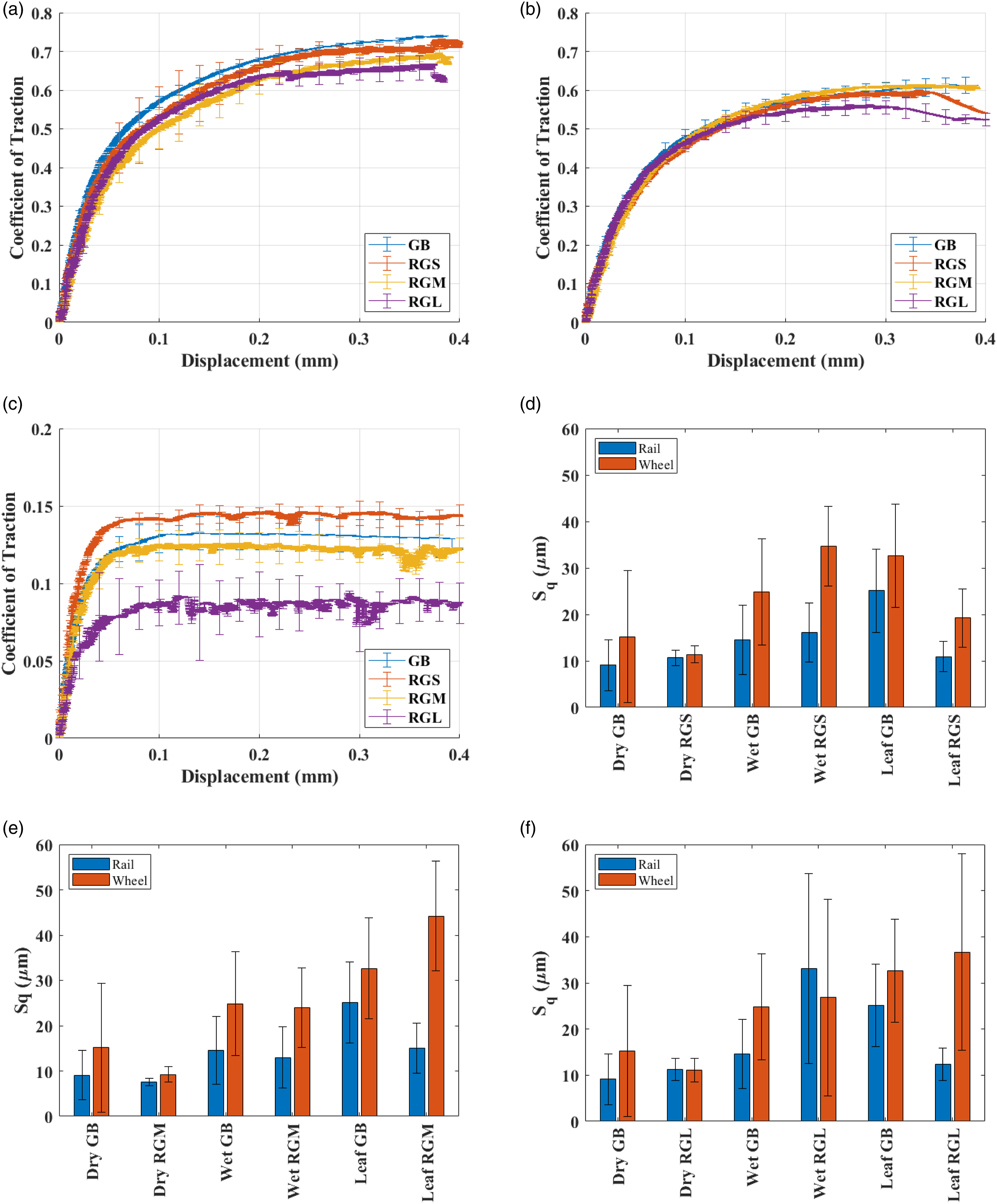
Both materials have similar density, size, mechanical properties, and mineralogy (GB sand characteristics are reported in [1]). With regards to shape, GB particles are more compact, while RG is more elongated or bladed (see reference [14] for more information on particle shape classification). It is important to note that the AoR of RG is around 10° higher than GB sands. This means that the flowability of RG is less than typical rail sand and may jam in the current sanding systems. Overall, it is suggested to perform full-scale laboratory and field tests to confirm the suitability of this material.
Footnotes
Acknowledgements
For the purpose of open access, the author has applied a Creative Commons Attribution (CC BY) license to any Author Accepted Manuscript version arising.
Declaration of conflicting interests
The author(s) declared no potential conflicts of interest with respect to the research, authorship, and/or publication of this article.
Funding
The author(s) disclosed receipt of the following financial support for the research, authorship, and/or publication of this article: This work is funded by the UK Engineering and Physical Sciences Research Council (EPSRC) grant No. EP/V053655/1 RAILSANDING - Modelling Particle Behaviour in the Wheel-Rail Interface.
