




Abstract
Today, sustainability and its economic, social, and environmental pillars are the main elements of new product market development. Therefore, manufacturers, considering all stages of a product life-cycle, consider it necessary to have a framework for producing sustainable products. Moreover, new product design and development processes especially sub-process of product definition and detailed design processes can play a very critical role in developing product sustainability. This paper considers the role that the car platform can play in creating a family of products and with regard to various data related to the environmental, economic, and social pillars of each of the 15 modules of a car platform and also, using the best–worst method technique and multi-objective mathematical programming with the augmented epsilon constraint method, we were able to achieve a set of platforms with maximum sustainability. The present study explores the possibility of determining the most efficient combinations of modules for every one of the 23 cars’ platforms to produce a collection of products. Through these methods, the 54 efficient solutions in the Pareto front were achieved, and out of this number, after considering all the factors and weights of the objective functions, solution no. 51 was selected as the most efficient. Subsequently, all the 15 module variants of the 23 platforms were determined for solution no. 51. Finally, these variants were ranked on the basis of the SAW technique, and finally, sensitivity analysis is done.
Keywords
Introduction and literature review
Designing a product is a creative process during which customer needs, strategic requirements of companies, and the limitations of regulatory agencies are conjoined. Based on the findings of Appelqvist et al., 1 approximately 70% of product cost and 80% of product quality are determined during the stage of design and programming, which is one of the major stages in the process of developing new products.
Today, modularity is a key concept in the new production processes, making products agile, reactive, and reliable and it enables the companies to respond promptly to the changes in the market and its requirements.
Ulrich and Epinger 2 presented the Product Clustering technique to separate the products from more complex systems and then combined them to produce a perfect product in the form of modular product architecture and new product development.
Pakkanen et al. 3 describe a method for modular product family development aiming for product configuration and On the other hand, Schöggl et al. 4 describe improving method for sustainability performance in early phases of product design and Zhang et al. 5 present a new functional model; approach to support identification of both shared and individual behavioral modules across a family of products for module-based product family design, in the automotive industry, the concept of modularity has received more attention and in the development of different models of cars, improving the sustainability of each module or selecting more sustainable modules from existing modules, can lead to the development of more sustainable platforms and a family of automotive products with more sustainability. Schiavone et al. 6 describe how Rieter Automotive is approaching the challenge the systematic integration of environmental consideration in product development. So, herein, we try to achieve the selection and combination of modules and the development of a set of the most sustainable platforms and a family of automotive products.
Kammerl et al. 7 provided a conceptual framework for designing sustainable products. Their proposed approach emphasized that automaker companies should apply the principles of sustainability in the early stages of design and development.
In another study, Lan 8 used a “relatively appropriate” method by considering the components of sustainability in the design and development of a bicycle platform and utilized a mathematical model to select platform modules with maximum stability.
Ma and Kermer, 8 in their case study, designed and developed a coffee machine based on sustainability components.
In another study, Lumsakul et al. 10 addressed the challenges and problems in designing products and production systems due to the ever-changing customer needs and the issue of increasingly frequent changes and the complexities of the product and the resources required.
Watz and Hallstedt 11 proposed a group model for visualizing the complexity and dependence in sustainable design, improving sustainable product development capabilities, and identifying the relationships between sustainability criteria and product development requirements.
Hartmann Christoph et al 12 their found that the sustainability of its constituent modules and the development of ranking models and mathematical programming have not been previously discussed. Held 13 gave an overview of how German car companies are currently dealing with the challenges and opportunities for sustainable product development. Therefore, the issue of developing a family of automotive products with the help of identifying and selecting a set of the most stable automotive platform modules can be introduced as a research gap.
Also, based on previous research, similar studies have been conducted on the design and development of sustainable products for bicycles, coffee-makers, and refrigerators, whereas no studies have been conducted on the design and development of a sustainable vehicle platform so far. This research gap is the objective of this study. In addition, in this research, efforts have been made to provide a method for evaluating and selecting a set of platforms based on 15 modules of a vehicle platform with different economic, environmental, and social pillars in mind.
Ahmad et al. 14 review and analyse recent and emerging product design tools (published from 2007 to 2017) and consider other aspects of sustainability along with environmental factors and also, Hallstedt and Isaksson 15 address the question of what material to use in the early stages of product development and what decisive effect this choice has on the end of a product’s life, therefore, in this study, after determining different parameters, data related to every module and variant are analysed, including every variant of each module data including ability to assemble, fixed price, weights and revenue of the recyclable materials, the energy consumption of producing each variant in the recycling, the amount of CO2 emission of each variant in the production, the importance of module's quality based on customer opinion and satisfaction with the quality and repairs of every variant of each module, the amount of purchase demand for every variant of each module, each platform's assembly capacity and six types of production lines, assembly capacity of variants based on the assembly of each platform, and finally, customer satisfaction with on-time delivery of the vehicle.
Rösch et al. 16 and Hallstedt 17 proposed an indicator system and sustainability criteria and also it was addressed earlier, sustainability calls for simultaneous consideration of economic, environmental, and social pillars. Thus, by adopting a multi-purpose optimization algorithm and introducing tools, such as a mathematical and a quantitative model in order to detect a set of efficient solutions, this study explores the possibility of determining the most efficient combinations of modules for each of the 23 platforms. Computations of deciding the effective weights of every sub-pillar of objective functions are done on the basis of the best-worst method (BWM) and the modelling is done in accordance with a multi-purpose evolutionary algorithm with the help of an augmented epsilon constraint method.
Since the research method here is a case study, it is organized in this order: firstly, the subject is addressed and the literature review is discussed followed by the problem statement. After that, the method of the problem-solving process and the recommended mathematical model are explained. Finally, parameters, the problem-solving process, data analysis, conclusion, and references are presented. A summary of the review of the literature is provided in Supplemental Appendix Table 1. This article first presents the included method. In the following, we will express the mathematical model, which includes problem statement and mathematical modelling, steps of the problem-solving process, objective function, index, parameters, decision variables, constraints, problem-solving approaches including multipurpose function optimization algorithm, epsilon constraint method, augmented epsilon constraint method and BWM.
Consistency index of the best–worst method (BWM).

Ameli et al. 18 proposed a multi-objective model for selecting design alternatives and end-of-life options under uncertainty and in the next section, we will describe a case study. This section includes the expression of an issue in the automotive industry, which is based on real and industrial data. This includes the a problem-solving process, determining the weight factors of objective functions based on the best–worst method BWM, determining a set of efficient solutions by applying the augmented epsilon constraint method, identifying the Pareto solutions for objective functions and ranking of platforms (Pareto front) based on the importance weights of sustainability pillars, determining efficient (sustainable) variants of each module in the production of 23 platforms, sensitivity analysis and ranking of the Pareto solutions.
In the continuation of the article, we will deal with Results and Discussion, Conclusion and Future research directions, Appendix, and References.
Method
Statement of the problem and mathematical modelling
Based on what was mentioned in the introduction and review of the literature and the gap of the research, the purpose of this research is to develop a mathematical tool that can help the designer in selecting the best possible combination of modules and their related variants in order to design and develop a set of the most efficient and sustainable vehicle platforms.
Steps of the problem-solving process
The modelling steps include the following: first, by reviewing the literature and consulting with experts, the sub-pillars of sustainability in the target industry (automotive industry) and the required criteria of measuring the impacts of product sustainability during all stages of the lifecycle for evaluating the entire lifecycle are discussed. Then, the main platform modules of a vehicle are assessed. The problem-solving steps are shown in Figure 1.
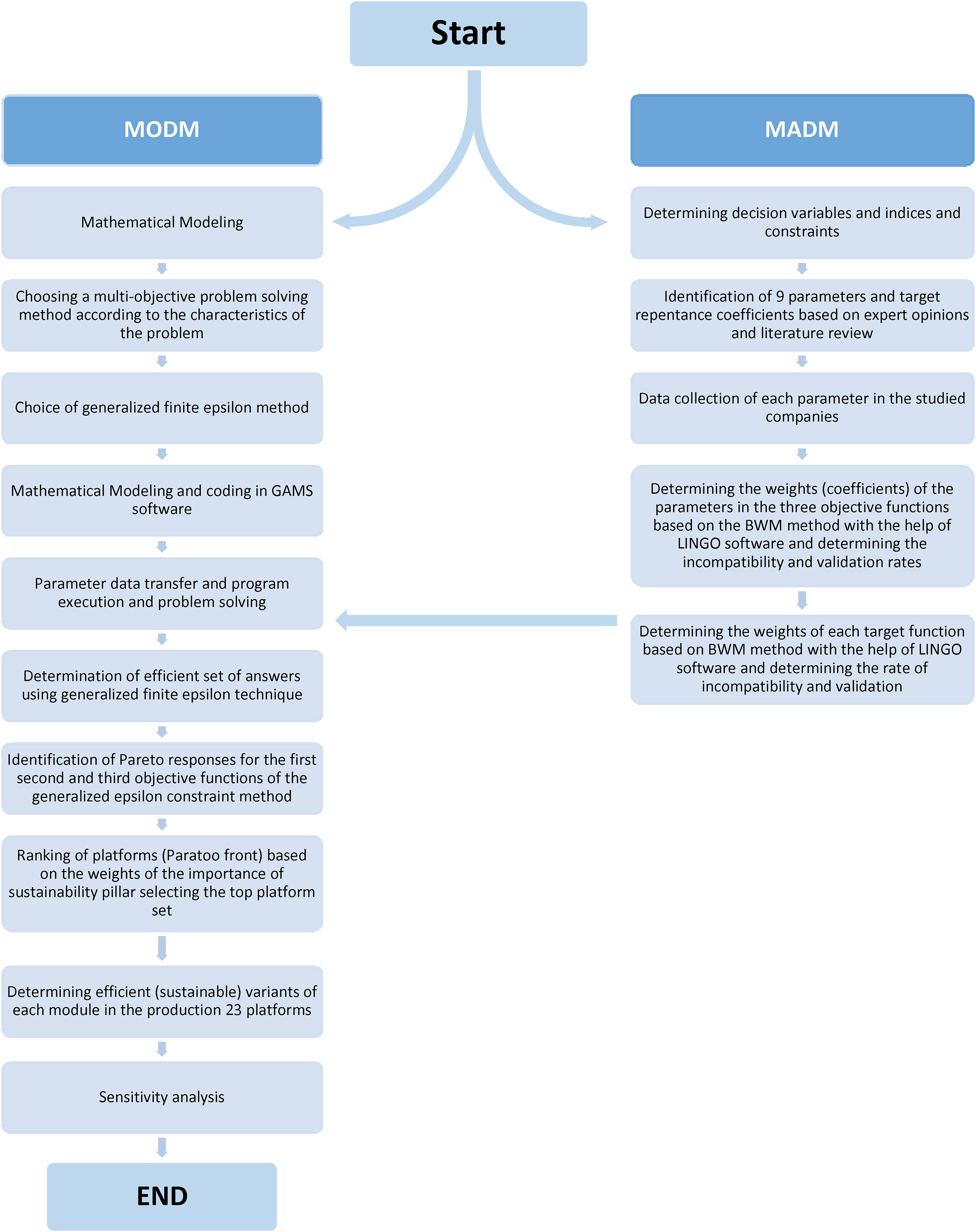
Problem-solving steps.
Herein, to address the objective of the research and also to reduce complexities in the subject of research, it is assumed that the objective functions, variables and various parameters are independent of each other.
Objective function
Objective functions include maximization of the production vehicle family's sustainability in the lifecycle of products by selecting the best platform modules with the highest level of durability (minimizing the fixed-price of products, minimizing their environmental effects, and maximizing the social benefits). The purpose of this model essentially is to determine which variant (K) of each module (J) in the vehicle platform (I) must be integrated to elicit the most efficient 23 platforms regarding economic, environmental and social aspects.
The first objective function is to minimize product development costs. In this objective function, the total cost of combining the modules of a platform is deducted from the revenue generated from the recycling of platform modules after the end of the product life (its current value) and the actual cost of developing a platform is obtained.
In this equation, the assembly costs of modules on different platforms are considered equal and are not considered in the objective function:
The second objective function is related to minimizing the environmental challenges of the generated platform. In this function, the goal is to minimize energy consumption, pollution produced, separation time for recycling, and minimization of residual waste after the separation stage:
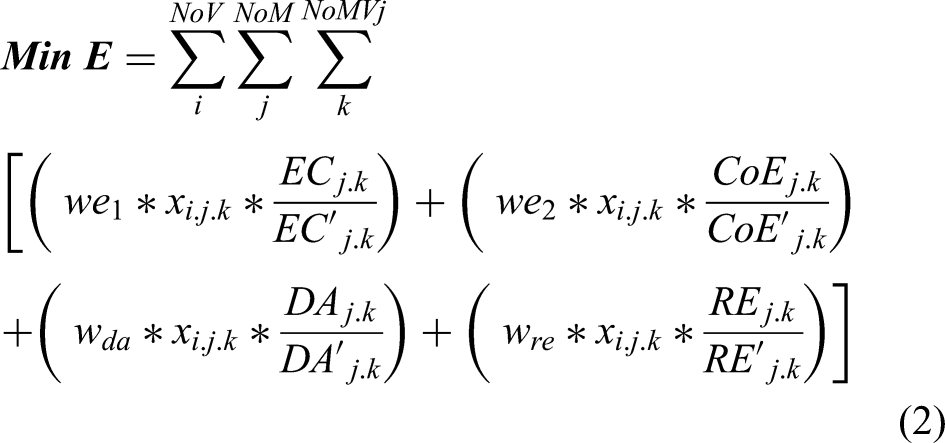
The third objective function is related to maximizing social components such as customer satisfaction with product quality, customer satisfaction with after-sales service, and customer satisfaction with timely delivery of the pre-purchased vehicle: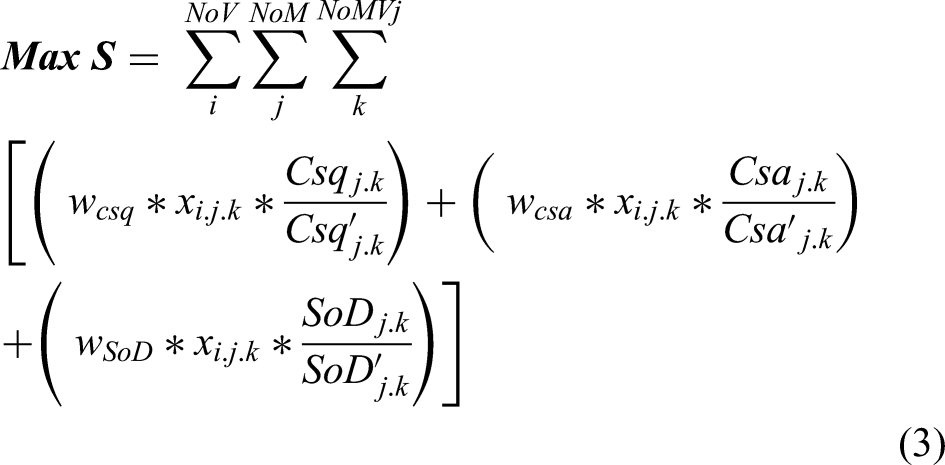
Index
Two indices are defined according to the aspects and objectives of the study in identifying and selecting efficient modules in the field of developing sustainable platform(s): j for the modules and k for the variants of each module. Further indices include:
Parameters
Based on the review of the literature and experts’ consult, the combination of parameters used in each of the objective functions is described as follows:
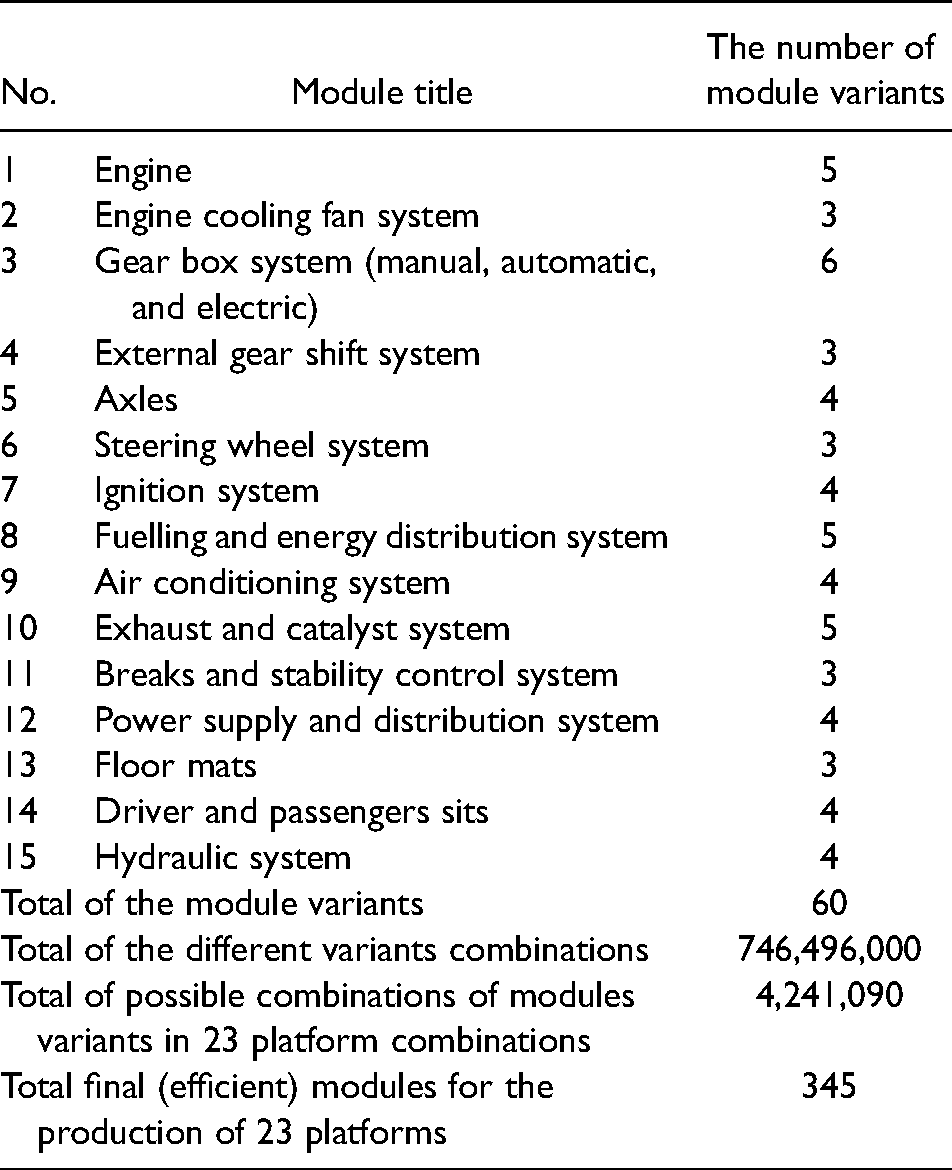
In Table 5, different sorts of assembled variants of 15 modules are introduced after analysing the platforms that automakers use in a product family of vehicles, as well as acknowledging the fact that each platform could be made of various modules.
Based on the exposition above, this study mainly aims at providing an approach to selecting the best and the most sustainable combination of various platforms in automaker companies.
The number and types of module variants.
The total fixed price of every one of the 56 types of modules is explained extensively in Supplemental Appendix Table 3 by analysing the collected data and the observations obtained from itemized price index and the structure of a product's fixed price.
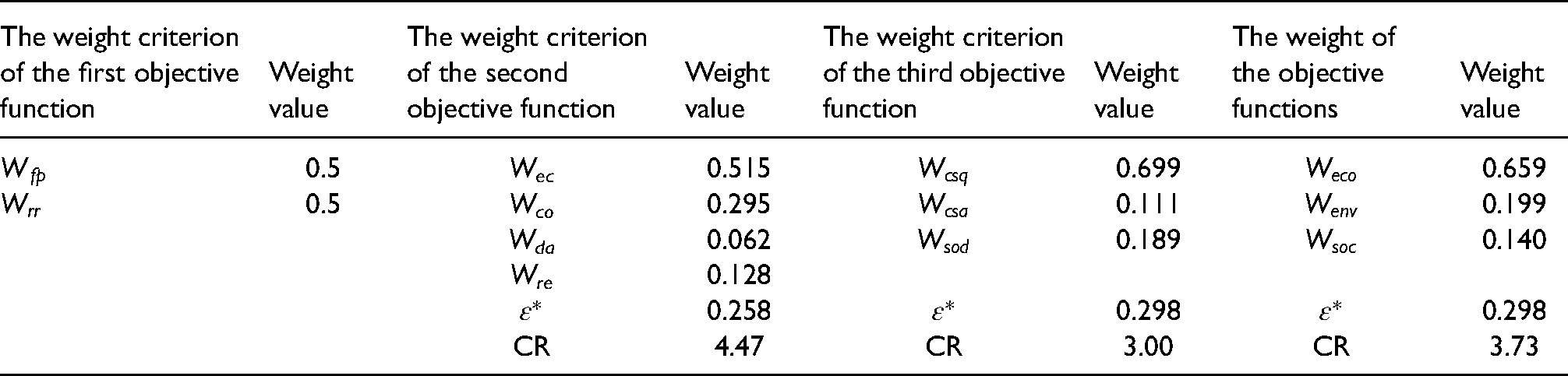
Computational results of weights of objective functions and consistency ratios.
The parameter of the fixed price of each variant includes the sum of the utilized materials and parts costs, production and assembly costs, manufacturing overhead costs, transportation costs, insurance costs, sales and after-sales services, performance taxes, as well as value-added taxes.
One of the influential bases in a product's sustainability pillars, especially in the case of environmental pillars, is the possibility of recycling materials at the end of their lifecycle and bringing in profits from recycling those materials.
The elements and components of a vehicle are categorized into four groups: (a) ferrous metals and non-ferrous metals, (b) plastics, (c) rubber, and (d) glass.
Furthermore, in calculating the fixed price of the recyclable module materials on the basis of their weight, the price increase rate of ferrous metals, non-ferrous metals, plastics, and other materials have been considered 5%, 8%, and 7%, respectively, above the inflation rate of rubber equal to the inflation rate.
In order to estimate it, the recyclable materials’ value after the end of the vehicle's lifecycle was calculated based on a yearly 35% price increase and then was adapted to the present value based on a 30% inflation rate, which is attached to Supplemental Appendix Table 4. The parameter of recycling revenue is finalized by determining the weight of the four categories of materials (ferrous and non-ferrous metals, plastics, and rubber) used in a variant of each product, the life expectancy of each module, the present value of the materials, and the price difference between the price increase rate and the annual inflation rate of recyclable materials.
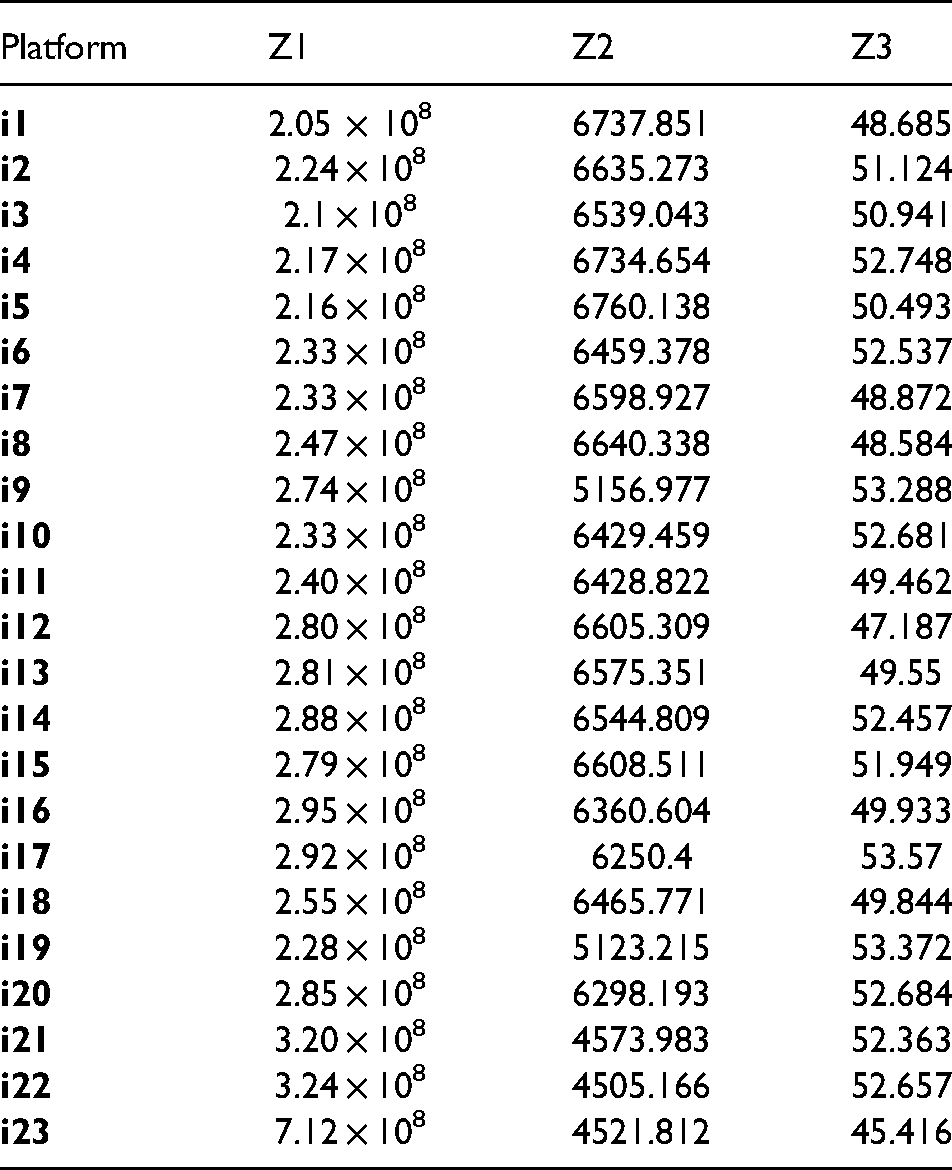
Table of 23 platforms and the effect of each of them on the amount of target functions of Pareto point no. 51.
Wrr: Weight impact factor of recycling revenue.
Exploitation and production of raw materials Turning mineral materials into raw materials Products and modules from raw materials Assembling modules on vehicles Each product's module in usage step Disassembling and recycling the product, that is, the vehicle
One of the influential sub-pillars in improving a product's sustainability is to reduce the energy consumption of its module. Therefore, to estimate the energy that is consumed during a product's lifecycle, the following points are taken into following energy consumptions including:
The said data are listed in Supplemental Appendix Table 5. In the remainder of this study, the energy consumption of producing and utilizing each module can be calculated for the other stages to increase the computational accuracy of this method.
Wec: Weight impact factor of energy consumption.
Producing mineral materials Turning mineral materials to raw materials The production process of products and modules from raw materials Assembling modules on the vehicles Utilizing each product's module Recycling modules and vehicles
Another important matter in the environmental aspect of a product's sustainability is to reduce the various emissions that are the outcome of module production. On this account, to estimate the amount of produced emissions during the lifecycle of a product, the following emission of six stages of production have been factored in:
The emission of one of the environmental contaminants, CO2 in this case, during the process of production and utilization of each module's variant has been calculated for stages 1 and 2 and has been explained in detail and attached to Supplemental Appendix Table 6.
Wco: Weight impact factor of CO2.
Using the data collected from the related website and the data provided by the auto-making companies, the number of parts and the amount of time needed for disassembling each of these parts are stated in the following table. In addition, on that basis, the disability to assemble the kth variant of the jth module is calculated and stated in Supplemental Appendix Table 7. The number of parts proportioned to the time is divided by the maximum of the number of parts proportioned to the time.
Wda: Weight impact factor of ability to disassemble.
Another key element in the environmental sustainability of a product is the issue of recyclability and non-recyclable waste from each module at the end of the product life. Therefore, with the help of weight data of the four elements of each module, including the weight of ferrous metals, weight of non-ferrous metals, the weight of plastics and weights of various types of rubber, and also an estimate of the recyclability of each of the four materials used, and by multiplying the recyclability coefficient in the amount of materials used in each variant of each module, the amount of recyclable materials is obtained and then by dividing the recycled materials by the materials used, the ratio (percentage) of recyclability of each variant of each module is obtained l us bring. Finally, by subtracting this percentage from the number 1, we obtain the percentage of non-recyclable materials of each variant of each module as presented in Supplemental Appendix Table 8.
Wre
In the company that provided data on this part of the case study, customer satisfaction was evaluated in two periods: once three months after delivery and once 15 months after delivery. In this evaluation, the body of the vehicle, powertrain and fuelling system, suspension and transmission system, safety, heating ventilation, air conditioning, and electrical equipment were evaluated. Given that this case study's subject matter is platform modules of the vehicle, the results of the evaluations are based on the 15 modules. The findings are stated in Supplemental Appendix Table 9.
According to the findings, five modules affected customer satisfaction the most; namely, engine system, brake system, steering wheel system, air conditioning system, and gearbox system. Other modules are placed in the lower ranks. All 15 modules are compared based on six standards, reliability, durability, efficiency, price, brand, and convenience.
First, the measures of the mentioned six standards and the average obtained score were determined by consulting eight experts in the field. Then, having employed the linear normalization method, the measures were calculated. Ultimately, the final score of customer satisfaction of each module was calculated using the formula below and attached to Supplemental Appendix Table 10:
Mor: Module ratio (ranking) of customer satisfaction index (Supplemental Appendix Table 10).
Wom: Weight of module importance (ratio) (Supplemental Appendix Table 10).
NoCI: Number of customer satisfaction indicators (Supplemental Appendix Table 10).
Customer satisfaction index with quality is determined based upon six standards, reliability, durability, efficiency, price, brand, and variant utilization convenience, and it is estimated as the following stage (Figure 2).
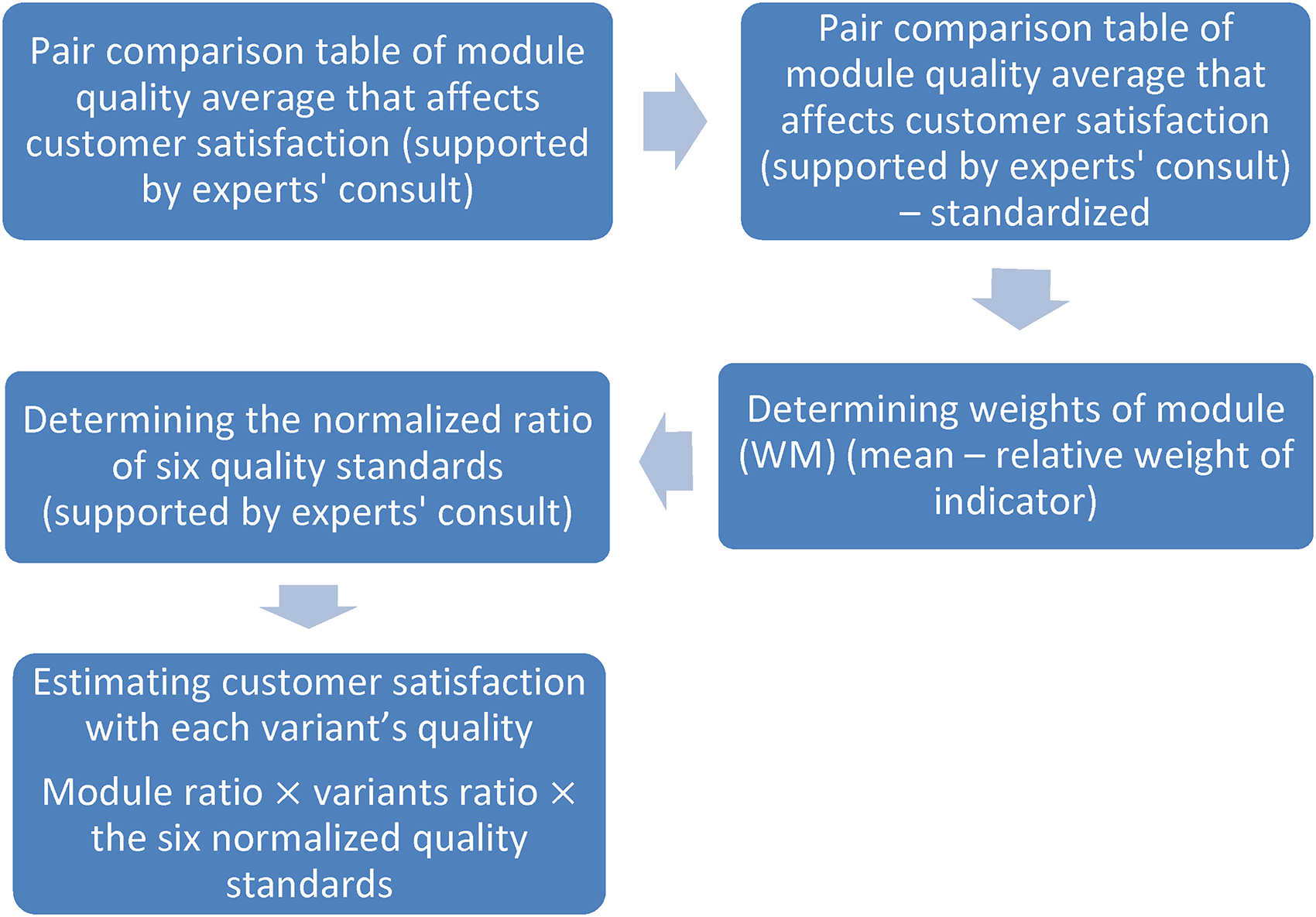
Stages of determining customer satisfaction with variant quality.
Another indicator of customer satisfaction is their satisfaction with after-sales services. Through meetings and reviews conducted from after-sales service centres and inspection companies supervising them, the information below was obtained and customer satisfaction with each of the modules was estimated. What is more, having considered the diversity of the variants of each module in terms of technology and manufacturing conditions of different automakers, manufacturers were divided into three groups: standard, good, and excellent with coefficients of 0.8, 1, and 1.2, respectively.
The final weight of each module in creating customer satisfaction with repairs and after-sales services is estimated by multiplying the quality ranking of each module by the quality ranking of the supplier as shown in Supplemental Appendix Table 11. The customer satisfaction indicator of repairs and after-sales service is calculated based on the following steps (Figure 3).
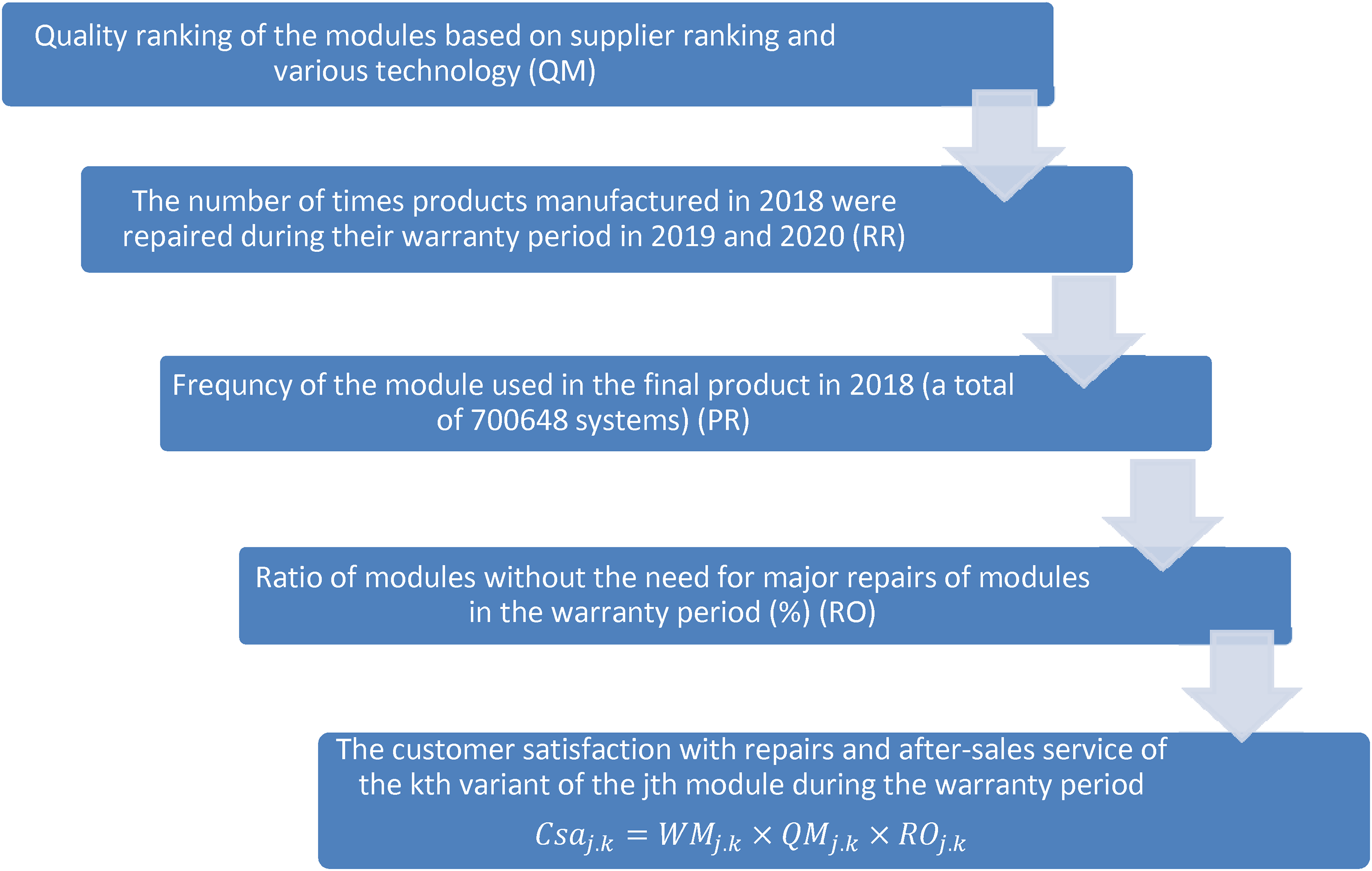
Determining customer satisfaction with repairs and after-sales services.
One of the social sub-pillars of sustainability is to have the customer's demands met on-time. This is under the influence of the quantity of demands, the production capacity of major suppliers, and the ability to assemble production halls. To calculate it, the following mathematical model is utilized.
Based on what has been mentioned so far, the company, which is being studied here, is currently manufacturing up to 39 product variants, and six other product variants are in the production planning stage. All these various products are produced on 23 different platforms. Therefore, the product demand for 39 product variants determines the demand for the 23 platforms described below. The data are presented in Supplemental Table 19. The quantity of demand for every variant of each module depends on the demand for the respective platforms.
Through examining the production capacity of different suppliers of components and platform items, along with collecting data from the supply chain of internal automakers, the data are presented in Supplemental Appendix Table 14.
One of the limitations of finding a proper solution for the problem here is the limitation of the ability to assemble different types of platforms in production lines, in addition to the limitation of production capacity in manufacturing sites. The capacity of module assembly in the manufacturing sites depends on the capacity of platform production lines. Data collected on this matter are explained in Supplemental online Appendix Tables 14 and 15.
Min (supply capacity of manufacturers, capacity of module assembly) = satisfaction with on-time delivery (production percentage) demand of modules.
These tables provide data on the following: demand of platforms and related modules, supply of variants of every module by suppliers, the capacity of platform assembly, the capacity of variant assembly, and finally, customer satisfaction with on-time delivery.
The capacity of platform assembly depends on the capacity of assembly on production lines. The capacity of the module's variants assembly depends on the supply capacity of each module and the capability table of different variants of modules on different platforms.
Validation method
Since this research has been done in an industrial environment and the purpose of this research is to provide a practical model to create sustainability in the design of the vehicle platform, in order to validate the data collected, Delphi method has been used to gather, summaries and converge the opinions of experts.
As Gluszek 19 pointed out in her article, the Delphi method, by applying the opinions of experts and repeating it, converges the data and gives acceptable validity to the results. In this research, in order to validate the data and comments, the informed and expert participants were divided into three groups and answered the questions separately and the results were sent to the central coordinator and the coordinator processed the contributions of the contributors, and central and logical tendencies were identified. The results were then given feedback to the experts and they were asked to submit their comments again with the help of the results provided by the coordinator. This process continued until the coordinator ensured the validity of the data. The purpose of this technique was to eliminate the bias that is possible when gathering different groups of experts. In the Delphi technique, the specialists do not know who the other specialists are during the process, and based on this, good confidence was created in the validity of the opinions and data collected.
Decision variables
In this article, we seek the question that, which variant of each module should be combined for the final product to have the highest sustainability ranking. Accordingly, the decision variable is a binary variable
Constraints
In this paper, due to the volume and variety of collected data as well as the objective functions set in the economic, environmental, and social fields, many constraints can be set for the problem. However, to simplify and stick to the main concept of the article, only five constraints are defined.
In assembling different platforms, according to the design and development of platforms, different variants of modules are used (as demonstrated in Supplemental Appendix Table 2). In equation (6), the constraint is that only one variant of each module is used in the assembly of each platform. In equation (7), this constraint is expressed in the fact that in the assembly of each platform, only 15 modules are built. In equation (8), the constraint indicates that the In equation (9), the constraint states that the total assembly capacity of production lines exceeds the demand for final products:




Problem-solving approaches
In the proposed problem-solving space, in some cases, the discussion of weighting the indicators is done, which uses BWM weighting approaches, and in the proposed mathematical model, due to the presence of multiple objectives, the augmented epsilon constraint method is used. Each of the methods will be explained below.
Multipurpose function optimization algorithm
The multi-objective optimization problem is a sub-branch of a set of multi-criteria decision-making methods that takes place among an unlimited set of possible solutions. Pareto solutions of a multi-objective problem are a set of non-dominant points that dominate all other solutions. It is worth mentioning that the solutions obtained would dominate each other provided they include the following conditions.
Epsilon constraint method
One of the well-known approaches to dealing with multi-objective problems is the epsilon-constraint method. This method has many applications for optimizing multi-objective problems. Using this method, the Pareto front can be created for multi-objective issues.
The produced Pareto solutions are presented in a table and the decision-maker selects one of the produced solutions based on the preferences and priorities.
Augmented epsilon constraint method
Mavrotas and Floris 20 introduced an improved version of the epsilon constraint method called the augmented epsilon constraint method (AUGMECON2). This method generates practical and efficient Pareto optimal solutions in comparison with the epsilon constraint method using the lexicographic optimization method in preparing the balance chart. This research employs the AUGMECON2 method in order to find efficient optimal solutions for small-size problems.
The AUGMECON2 method has an iterative method that solves a mathematical model in the following manner in each iteration.
The GAMS code of augmented epsilon constraint methods is available in the library of GAMS software and can be employed to solve various models. It is proved that the solutions obtained by the augmented epsilon constraint method are all within the boundaries of Pareto optimality. The whole area of efficient solutions can be examined by this method.
The BWM
In this method, the decision-maker determines the best and worst indicators and pair comparison is made between each of these two attributes, the best and the worst, and other attributes. Then a maximum–minimum problem is formulated and solved to determine the weight of different attributes. Also in this method, a formula for calculating the inconsistency ratio is considered in order to check the validity of the comparisons.
The steps of the BWM are as follows:
Determining the research sttributes Comparing the best attribute with alternative attribute (BO) and then comparing the alternative attribute with the worst (WO) Establishing a nonlinear programming model (by solving this model in lingo optimization software, the attribute weights are calculated) Determining the consistency ratio in the BWM
The consistency index of this method is presented in Table 1.
Case study
Here, an actual case study is presented accompanied with its particular characteristics regarding a vehicle manufacturing company. This study tries to investigate the sustainability pillars in economic, environmental, and social fields throughout the process of produced vehicle’s design and development.
The platform is a major and vital part of the vehicle and is a frequent piece in various vehicles. Consequently, the subject matter of this case study is the platform parts of a vehicle. That is, here the study proceeds by determining the sub-pillars of sustainability and collecting data related to each of these sub-pillars for different variants of every module. Ultimately, the most efficient platforms from the perspective of sustainability will be identified and selected by adopting a mathematical programming model.
Experts claim that some key components included in sub-pillars of sustainability in economic aspect are fixed price and recycling revenue of the platform pieces, in environmental aspect are energy consumption and CO2 emission during different stages of module's lifecycle, and finally, in social aspect are customer satisfaction with quality and after-sales services, and disassembly and recyclability of modules.
The number of each module's variants in this study is specified in Table 2.
The platform modules are categorized based on the type of the vehicle, target market, level of technology, and the capabilities of manufacturing companies and hence have different variants.
If the goal is to achieve a combination of these platform items with the highest level of sustainability, considering the different variants ahead and the limitations of their combination and production, an appropriate mathematical model is required to select the best set of solutions out of the many combinations of the variants. In this case study, considering the diversity of the variants of 15 modules, regarding materials, technology, the manufacturing company, etc., a combination of choices for constructing 23 platforms in every module is achieved. In total, these platforms lead to the production of 39 variants of the product.
In order to identify and choose the most sustainable combination for the production of platforms with the highest level of sustainability, it is necessary to gather information on the economic, environmental, and social pillars of these modules. Hence, the data are provided in Supplemental Appendix Tables 3 to 16.
This study aimed for coming up with a suitable solution for identifying and selecting a set of the best combinations possible to maximize the platform sustainability. Therefore, firstly, modelling and definition of the main variables, objective functions, and the restrictions are discussed.
Problem-solving process
In this section, we discuss the following steps:
Calculate the weights of the objective functions using the BWM technique. Determine a set of efficient solutions by applying the augmented epsilon constraint method. Identifying the Pareto solutions for the first, second, and third objective functions of the augmented epsilon constraint method. Ranking of platforms (Pareto front) based on the importance weights of sustainability pillars (selecting variants of platform no. 51 as the superior platform system). Determining efficient (sustainable) variants of each module in the production of 23 platforms (no. 51) (identification of top platforms). Pareto response sensitivity analysis and ranking.
Determining the weight factors of objective functions based on BWM
In the first objective function, both parameters are of economic nature, and in the parameter of recycling revenue, the time value of future revenue is calculated. As a result,
In the second objective function, in order to determine the weights of each attribute, the best and the worst attributes are selected out of a total of 4. Experts have stated that out of four attributes of the second objective function, that is,
In the third objective function, in order to determine the weights of each attribute based on BWM, the best and the worst attributes are selected out of a total of 3. According to the experts, out of three attributes meaning
Weight factors of the three economic, environmental, and social objective functions (Weco, Wenv, and Wsoc) were studied in the same manner, and based on what experts have stated, out of these three criteria, the best is the economic weight factor and the worst is the social weight factor.
In order to calculate the weight of each criterion, the items above were coded in the Lingo software by comparing the best attributes with the others and the rest of them with the worst and prioritizing them from 1 to 9. The results obtained are presented in Table 3.
Additionally, to determine the consistency ratio according to the weights and values of the objective function, the value of the consistency index is specified based on the paired comparison between the best and the worst attributes, as shown in Table 4. The paired comparison between the best and the worst attributes results in 6, and based on Table 1, the consistency index is 3. The consistency ratio is calculated by dividing 
Determining a set of efficient solutions by applying the augmented epsilon constraint method
As mentioned, the augmented epsilon constraint method was used to solve the three-objective mathematical model and was coded in GAMS mathematical programming software.
To solve the model, coding was done in GAMS software, based on the data presented of each parameter in 15 data tables (Supplemental Appendix Tables 2–16), and after performing the computations, an efficient set of solutions for the three-objective functions was determined that includes 54 of the best Pareto solutions for the triple values of the objective functions.
In the next step, the three-objective functions were achieved according to the weights, and by normalizing the data of the objective functions and applying the weights of each, the resulting 54 Pareto solutions were ranked. Following that, after selecting the most efficient Pareto solution,
Identifying the Pareto solutions for objective functions and ranking of platforms (Pareto front) based on the important weights of sustainability pillars
According to the computations performed in GAMS with the augmented epsilon constraint method, 54 values were achieved in the Pareto front (Supplemental Appendix Table 17). These 54 values for the three, economic, environmental, and social, objective functions could be indicators of the sustainable combination of platform modules. In addition, in order to rank the 54 Pareto responses and determine the superior response from the set of efficient responses (Pareto front), first, the values of each of the three objective functions for each of the Pareto front responses are determined and then this ratio is normalized. Then, based on the coefficients (functions) of the triple economic goal (Weco) and environmental (Wenv) and social (Wsoc) mentioned in Supplemental Appendix Table 17, the amount of the cumulative objective function is determined for that point. On this ground, Pareto point no. 51 is the superior solution of the Pareto front.
The graph of the efficient solutions points and the position of rank 51 are shown in Figures 4 to 6.
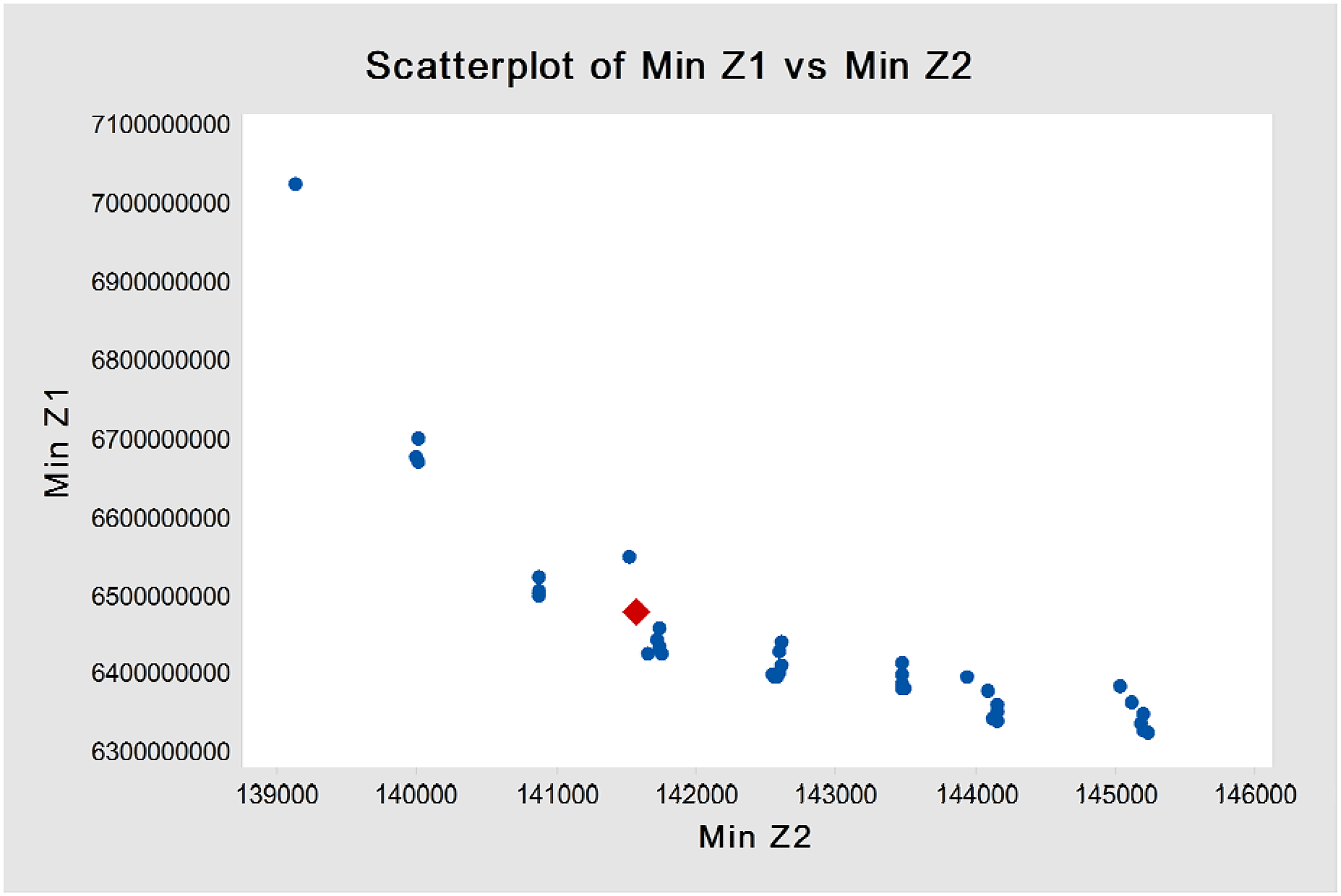
Pareto front the first and second target functions.
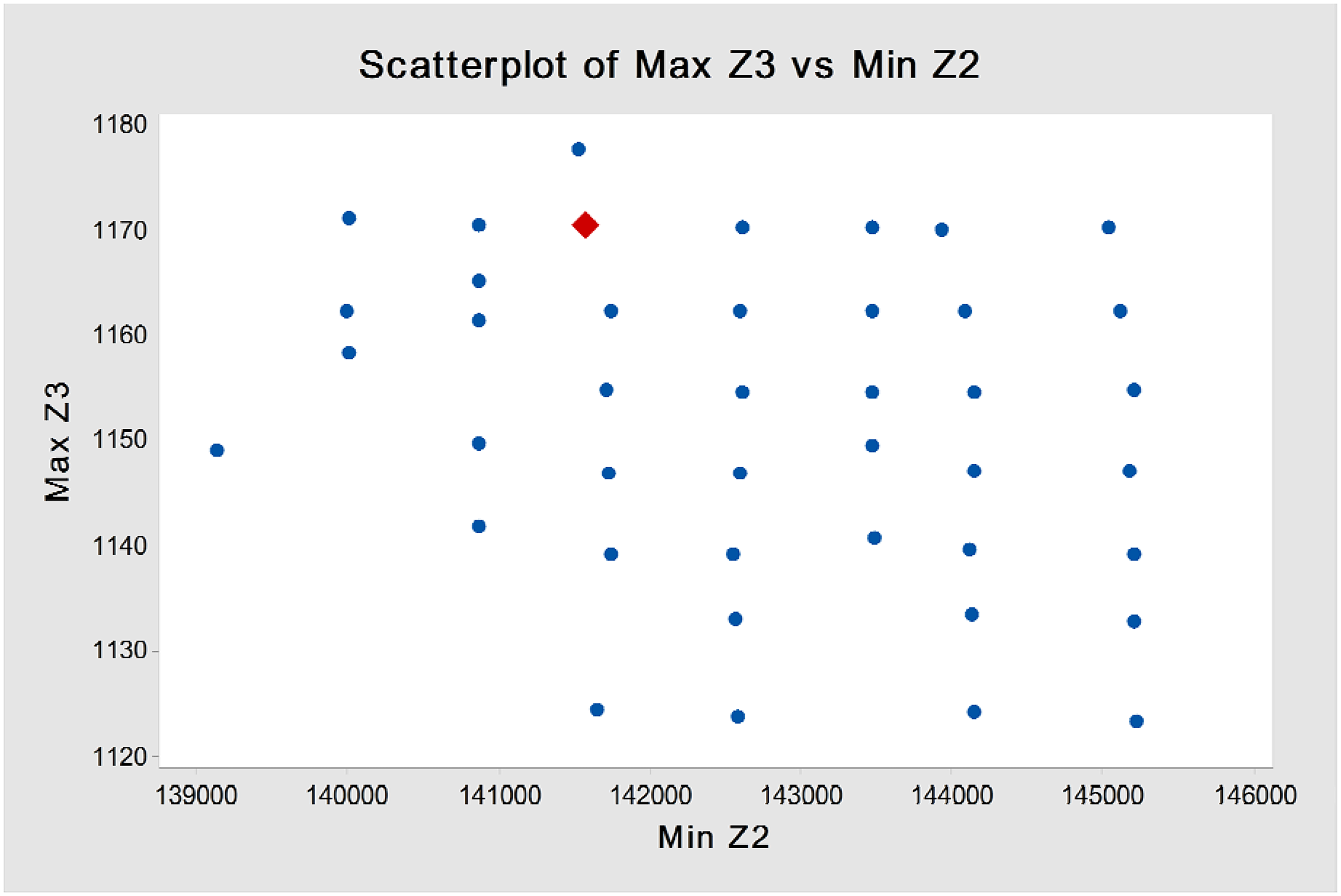
Pareto front second and third target functions.
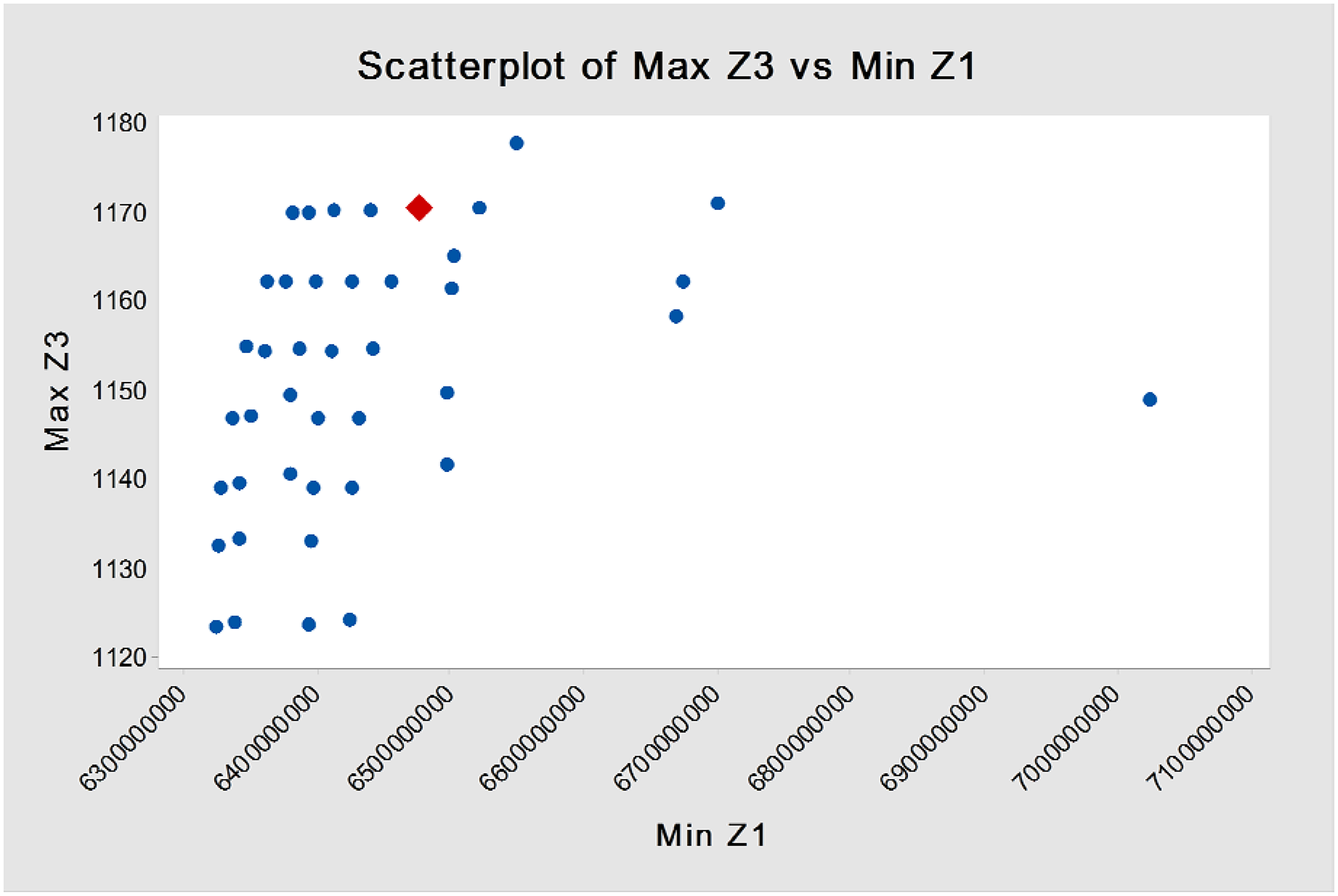
Pareto front first and third target functions.
Determining efficient (sustainable) variants of each module in the production of 23 platforms (no. 51)
With selecting solution no. 51 as the superior Pareto solution, weights of the objective functions in each of the 23 platforms are presented in Table 4.
With the final computations of the mathematical model, one combination, the most sustainable and efficient one, was selected for each of the 23 platforms. These chosen combinations were selected out of 4,241,090 possible combinations. Additionally, in order to determine the variants of the selected sustainable modules of the platforms, the values of
Sensitivity analysis and ranking of the Pareto solutions
In this research, sensitivity analysis is done on the basis of changes in three parameters of each objective function, including parameters of fixed price, 1 CO2 emission, 2 and customer satisfaction with quality. 3 Later on, the values of each of these parameters in five levels were evaluated. These levels include level one: 40% parameter reduction, level two: 20% parameter reduction, level three (previously obtained solutions): no parameter change, level four: 20% parameter increase, and level five: 40% parameter increase. The problems were analysed once again over all of these levels using the augmented epsilon constraint method and the values of the better solutions on every level were determined in 54 Pareto fronts. Subsequently, values of Xi, j, and k for the better solution were calculated and the 23 platforms constructing this solution were determined accordingly. Eventually, the said variants were compared and ranked with the help of the SAW technique (Supplemental Appendix Tables 19–21).
Results and discussion
This research was presented so as to provide a practical model for operation in car design and development centres. Since the platform of a car has an important role in the production of a family of products and the joint platform is an important concept in car companies, in order to promote sustainability principles in a series of products, in this research, an attempt was made to provide a practical model for selecting the main modules of a car platform with maximum sustainability.
Given that the development of sustainability of a product is a multi-criteria concept with multiple and different components, accordingly in this study, the problem of mathematical planning in the form of a multi-objective model to identify and achieve a set of superior choices of the module car platforms was presented with a sustainability approach.
As a result, with the help of mathematical modelling and its solution, the best (most sustainable) combination of modules was selected to produce each of the 23 platforms that are being produced by the automotive company.
With the final computations of the mathematical model, one combination, the most sustainable and efficient one, was selected for each of the 23 platforms. These chosen combinations were selected out of 4,241,090 possible combinations.
To identify and select the most sustainable combination to produce platforms with the highest level of sustainability, it is necessary to collect information about the economic, environmental, and social pillars of these modules. Therefore, various data were collected from one of the reputable car manufacturing companies and are presented in Supplemental Appendix Tables 3 to 16. Also, based on the information collected from the design and engineering department of the factory, different variants of modules that can be assembled on any platform were collected and presented in Supplemental Appendix Table 2. Based on the collected data and considering that three different objective functions (minimizing economic indicators, minimizing the effects of environmental indicators, and maximizing social indicators) were considered, this study aims to provide a suitable solution to identify and select one of the best possible combinations to maximize platform stability. Therefore, first modelling and defining the main variables, objective functions, and constraints are discussed.
In fact, by having the pillars of sustainability of this modelling in mind, it can be claimed that by selecting different platform combinations in each of these 23 platforms, a product family of automotive products can be achieved. In the present study, the augmented e-constraint method is implemented in order to carry out the multi-objective optimization and three goals, including minimizing the economic and environmental impacts and maximizing the social impacts of a platform were discussed and analysed based on the collected data (9 parameters) using the precise method of augmented epsilon constraint. A set of possible solutions were provided and out of these efficient solutions, the most sustainable ones were selected for 23 platforms. The analysis and the process of selection were realized through scientific and mathematical modelling and procedures which were mentioned before. Some of them include BWM ranking, utilizing Lingo and GAMS software, and so on. Through these methods and procedures, the 54 efficient solutions in the Pareto front were achieved and out of this number, after considering all the factors and weighting the objective functions, solution (Pareto optimal points) no. 51 was selected as the most efficient solution. Subsequently, all the 15 module variants of the 23 platforms were determined for solution no. 51. Finally, these variants were compared and ranked on the basis of the SAW technique.
Conclusion and future research directions
This research has been done according to the needs assessment and development of sustainability approach in an automotive company and with the aim of developing this approach in all design and development projects of new products. Obviously, the concept of sustainability in manufacturing companies is expanding, and undoubtedly similar research will be pursued and evolved in the future. This approach can also be implemented in other manufacturing companies that produce a particular product.
As for future research, it is recommended that more parameters in the economic, environmental, and social fields would be examined and addressed. Additionally, problem-solving methods can be developed, and other techniques, such as meta-heuristic and innovative algorithms can be employed.
This paper does not limit the components of sustainability (economic, environmental, and social) and these components are considered only through objective functions. In future research, the current model can be developed based on new constraints.
Supplemental Material
sj-xlsx-1-pie-10.1177_09544089221092514 - Supplemental material for A sustainability approach to vehicle modular platform design: A mathematical model
Supplemental material, sj-xlsx-1-pie-10.1177_09544089221092514 for A sustainability approach to vehicle modular platform design: A mathematical model by Davood Omidzadeh, Seyed Mojtaba Sajadi, Ali Bozorgi-Amiri and Farzad Movahedi Sobhani in Proceedings of the Institution of Mechanical Engineers, Part E: Journal of Process Mechanical Engineering
Footnotes
Declaration of conflicting interests
The authors declared no potential conflicts of interest with respect to the research, authorship, and/or publication of this article.
Funding
The authors received no financial support for the research, authorship, and/or publication of this article.

Supplemental material
Supplemental material for this article is available online.
Notes
Nomenclature
References
Supplementary Material
Please find the following supplemental material available below.
For Open Access articles published under a Creative Commons License, all supplemental material carries the same license as the article it is associated with.
For non-Open Access articles published, all supplemental material carries a non-exclusive license, and permission requests for re-use of supplemental material or any part of supplemental material shall be sent directly to the copyright owner as specified in the copyright notice associated with the article.
