




Abstract
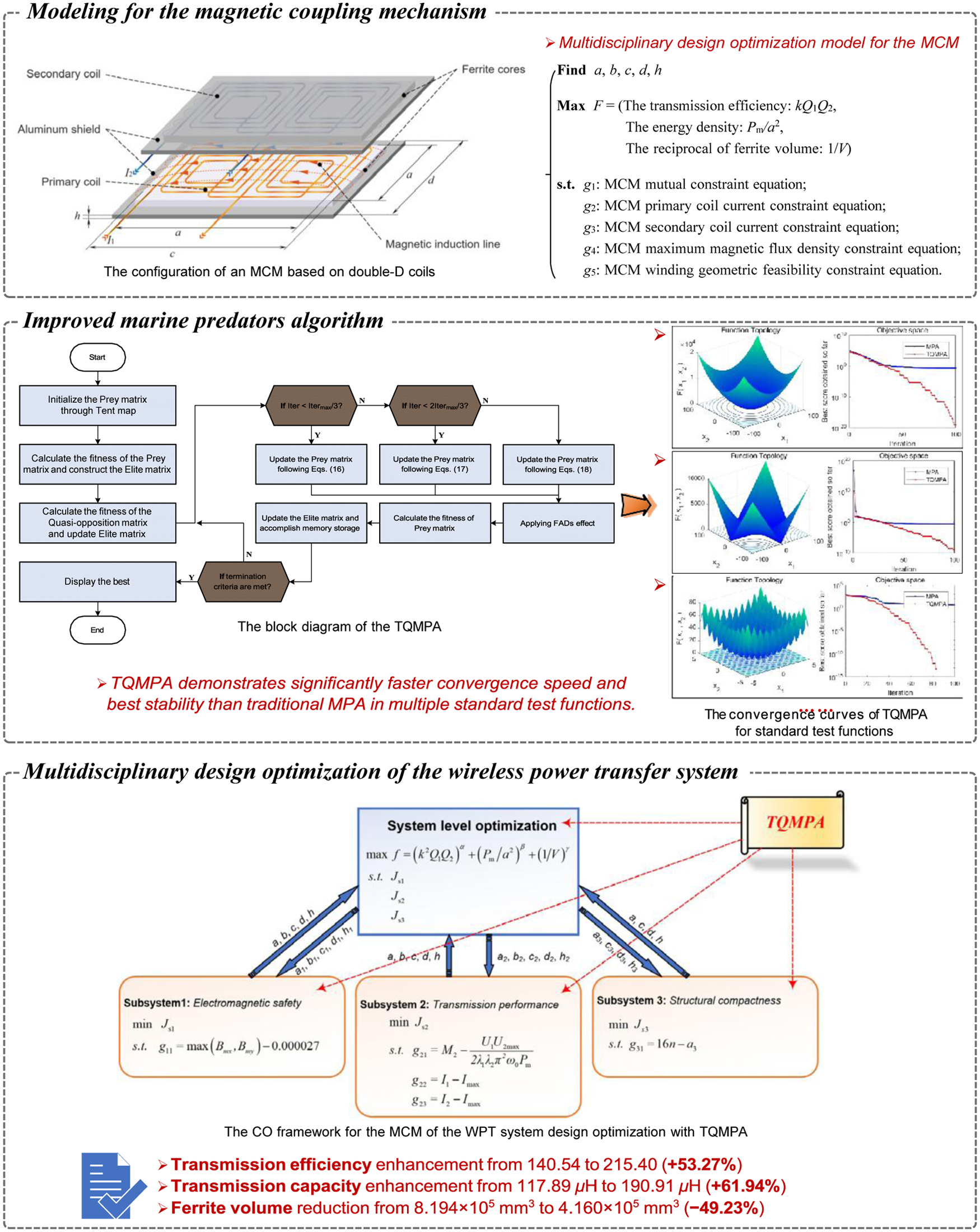
Wireless Power Transfer (WPT) systems have garnered increasing attention with the rapid advancement of Electric Vehicles (EVs). However, the design optimization of the WPT system remains a significant challenge due to the inherent multidisciplinary complexity. The core of the WPT system is the Magnetic Coupling Mechanism (MCM), which plays a critical role in energy transmission. To enhance the overall WPT system performance, this paper proposes an improved Marine Predators Algorithm (MPA), integrated with the Tent map and Quasi-oppositional learning strategy (TQMPA), to achieve the efficient optimization of the MCM. A comprehensive analytical model of the MCM using double-D coils is developed, and relevant performance evaluation metrics for the WPT system are systematically derived. Benchmark testing on 20 standard functions indicates that TQMPA converges faster and escapes local optima more effectively. These improvements are especially prominent in low-dimensional unimodal optimization problems. On this basis, a multidisciplinary design optimization framework is formulated based on the collaborative optimization strategy, incorporating key subsystems including transmission performance, electromagnetic safety, and structural compactness. Simulation results confirm the superior optimization performance of TQMPA over the original MPA. While maintaining electromagnetic safety and offset tolerance, the proposed method achieves a notable 53.27% improvement in the transmission efficiency and a significant 49.23% reduction in the ferrite volume, which can offer valuable insights for future intelligent optimization in complex WPT system design.
Keywords
Get full access to this article
View all access options for this article.