




Abstract
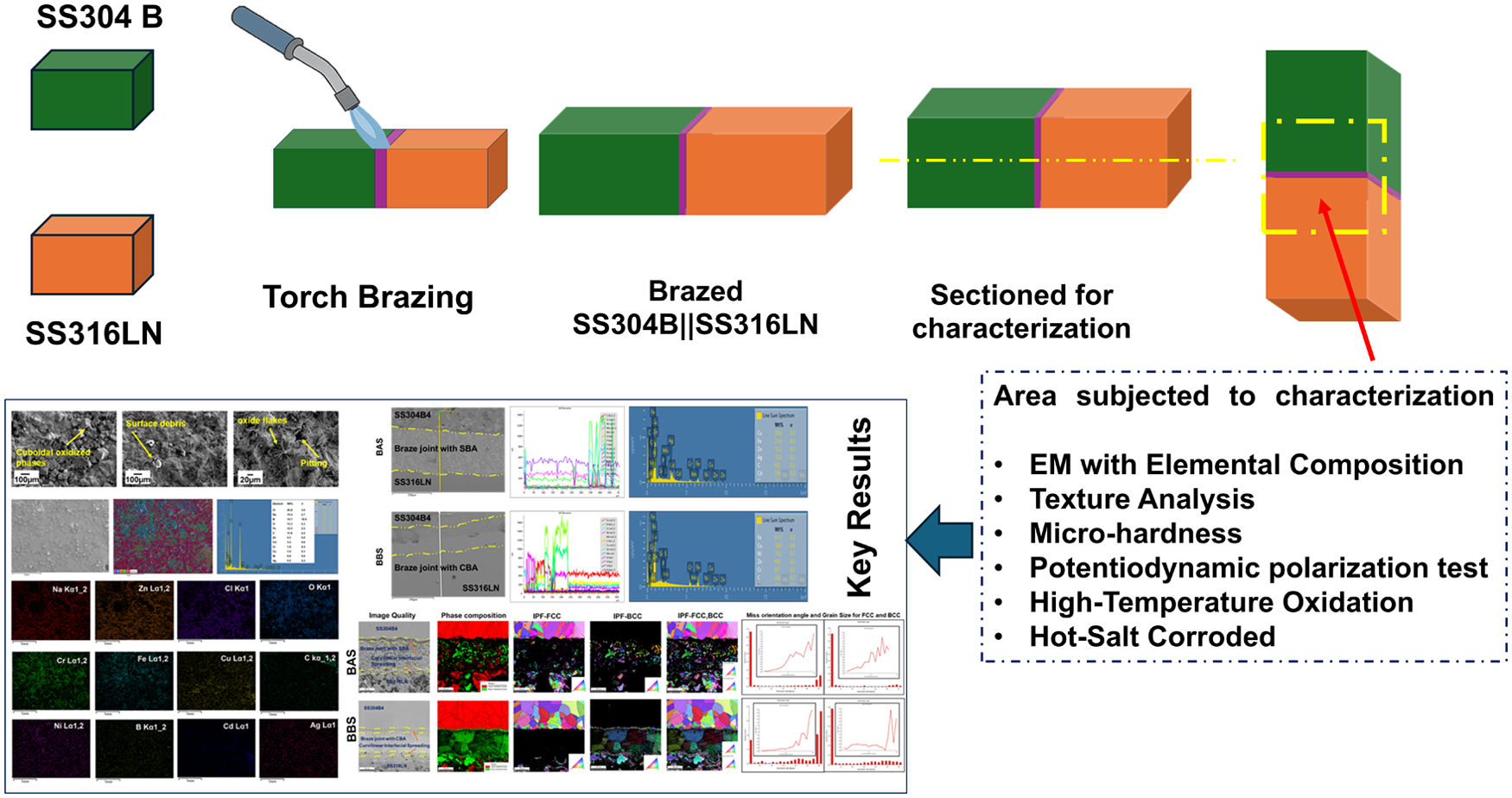
This study investigates the joining of SS304B4 and SS316LN stainless steels for automotive exhaust applications using torch brazing and diffusion bonding with interlayers (Cu, Ni, Ni–Cu–Ni, TiCuSil). Torch brazed joints were fabricated using Ag-based (SBA) and brass-based (CBA) fillers, designated as BAB, BAS, BBB, and BBS. Among these, the BAS joint (SS304B4-SBA-SS316LN) exhibited superior microstructural integrity with a refined interface and defect-free bonding. Texture analysis revealed dual-phase stability and uniform texture distribution in BAS, while BBS showed micro-voids and grain coarsening. Potentiodynamic polarization tests demonstrated a lower corrosion rate (8.68 mm/year) and higher breakdown potential (0.311 V) for BAS compared to BBS (16.01 mm/year, 0.221 V). BAS also showed lower mass loss (0.012 g) in hot salt corrosion over eight thermal cycles, and retained a smooth surface with fewer pits. Microhardness dropped at the interface (BAS: ∼145 HV), confirming filler softening. These findings establish BAS as a structurally and environmentally robust joint for high-temperature automotive service.
Get full access to this article
View all access options for this article.
References
Supplementary Material
Please find the following supplemental material available below.
For Open Access articles published under a Creative Commons License, all supplemental material carries the same license as the article it is associated with.
For non-Open Access articles published, all supplemental material carries a non-exclusive license, and permission requests for re-use of supplemental material or any part of supplemental material shall be sent directly to the copyright owner as specified in the copyright notice associated with the article.
