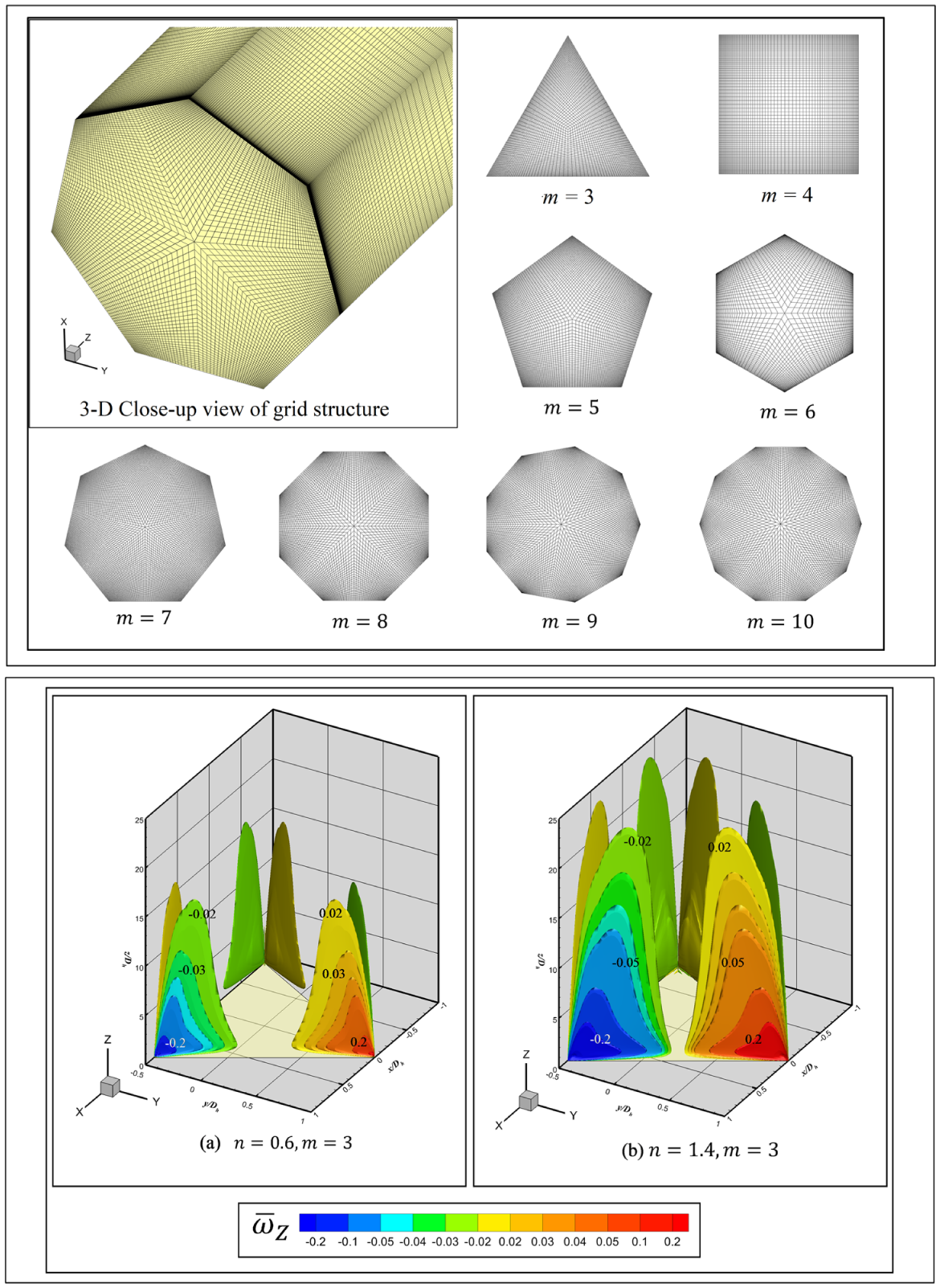
The study of turbulent flow in polygonal ducts holds significant relevance across industries, drawing the attention of fluid dynamicists over many decades. Despite substantial research on square and triangular ducts, the fluid dynamic correspondence with total sides () and flow behaviour indices () across the larger rheological spectrum of pseudoplastic, Newtonian, and dilatant fluids remains underexplored. To address the literature gap, we numerically model the rheological turbulent flow in straight ducts with regular polygonal cross-sections, offering unified insights and advancing understanding of geometric and rheological influences in internal flows. We analyse the nature of secondary flow originating inside the polygonal ducts, characterised by oppositely directed vorticity zones and curvature in in-plane streamlines. Results show that the secondary velocity magnitudes peak at approximately 1% of the bulk velocity near corners and decay downstream, influenced by both and . Dilatant fluids exhibit higher secondary velocities near the inlet but faster spatial decay. The near-wall strain rate distributions indicate higher strain rates in dilatant fluids and thickened viscous sublayers in pseudoplastic fluids. However, the net boundary-layer-thickness at the fully-developed state is predominantly influenced by the flow behaviour index rather than duct geometry, with shear-thickening fluids exhibiting nearly 10% thicker layers than shear-thinning fluids under identical Reynolds numbers. The three-dimensional illustrations bring out the influences of and on quasi-streamwise vortices, with increased three-dimensionality sustained in shear-thickening flows. Notably, vortex persistence drops by nearly 88% when increases from 3 to 10, highlighting the reduced role of corner-induced secondary flows as the cross-section approaches circularity. We propose new correlations to predict the entry length, centreline-to-bulk velocity ratios, and friction factors of the fluid flow with reasonable accuracy (10%–16%). The findings and proposed correlations contribute to efficient duct design, paving the way for future studies in complex geometries and advanced fluid systems.
McEligotDMJacksonJD.“Deterioration” criteria for convective heat transfer in gas flow through non-circular ducts. Nucl Eng Des2004; 232: 327–333.
2.
PetkovVMZimparovVDBerglesAE.Performance evaluation of ducts with non-circular shapes: laminar fully developed flow and constant wall temperature. Int J Therm Sci2014; 79: 220–228.
3.
Shabeeb MuhammadTVyasGDondapatiRS. Computational investigations on non-circular ducts used for large scale cooling applications. In: 2021 International Conference on Simulation, Automation & Smart Manufacturing (SASM). Mathura, India: IEEE, 2021, pp. 1–6.
4.
HaqueMEHossainMSAliHM.Laminar forced convection heat transfer of nanofluids inside non-circular ducts: a review. Powder Technol2021; 378: 808–830.
5.
Zeinali HerisSNassanTHNNoieSH. CuO/water nanofluid convective heat transfer through square duct under uniform heat flux. Int J Nanosci Nanotechnol2011; 7: 111–120.
6.
MuzychkaYSYovanovichMM.Pressure drop in laminar developing flow in noncircular ducts: A scaling and modeling approach. J Fluid Eng2009; 131: 111105.
7.
HameedMHMohammedHHAbbasMA.Optimization of laminar flow in non-circular ducts: A comprehensive CFD analysis. Journal of Sustainability for Energy2023; 2: 175–196.
8.
TeleszewskiTJ.Numerical laminar forced convection modelling in a ceramic and concrete solar collector with non-circular duct. E3S Web Conf2019; 116: 00091.
9.
SpalartPRGarbarukAStabnikovA.On the skin friction due to turbulence in ducts of various shapes. J Fluid Mech2018; 838: 369–378.
10.
De AmicisJCammiAColomboLPM, et al. Experimental and numerical study of the laminar flow in helically coiled pipes. Prog Nucl Energy2014; 76: 206–215.
11.
MohamedHAAlhazmyMMansourF, et al. Heat transfer enhancement using CuO nanofluid in a double pipe U-bend heat exchanger. J Nanofluids2023; 12: 1260–1274.
12.
NowruziHGhassemiHNourazarSS.Hydrodynamic stability study in a curved square duct by using the energy gradient method. J Braz Soc Mech Sci Eng2019; 41: 288.
13.
SaffarianMMohammadiMMohammadiM.Non-Newtonian shear-thinning fluid passing through a duct with an obstacle, using a power law model. Strojniški vestnik J Mech Eng2015; 61: 594–600.
14.
HauswirthSCBowersCAFowlerCP, et al. Modeling cross model non-Newtonian fluid flow in porous media. J Contam Hydrol2020; 235: 103708.
15.
ChhabraRP. Non-Newtonian fluids: an Introduction. In: KrishnanJMDeshpandeAPKumarPBS (eds) Rheology of complex fluids. Springer New York, 2010, pp.3–34.
16.
NsengiyumvaEMAlexandridisP.Xanthan gum in aqueous solutions: Fundamentals and applications. Int J Biol Macromol2022; 216: 583–604.
17.
BushMB. Applications in non-newtonian fluid mechanics. In: BrebbiaCA (ed.) Viscous Flow Applications. Springer Berlin Heidelberg, 1989, pp.134–160.
18.
SantoshiPNReddyGVRPadmaP.Flow features of non-Newtonian fluid through a paraboloid of revolution. Int J Appl Comput Math2020; 6: 75.
19.
NaccacheMFSouza MendesPR.Heat transfer to non-Newtonian fluids in laminar flow through rectangular ducts. Int J Heat Fluid Flow1996; 17: 613–620.
20.
GroismanASteinbergV.Elastic turbulence in a polymer solution flow. Nature2000; 405: 53–55.
AbdelgawadMSCannonIRostiME.Scaling and intermittency in turbulent flows of elastoviscoplastic fluids. Nat Phys2023; 19: 1059–1063.
23.
YasirMQiHElseesyIE, et al. Insight into heat transport exploration of rotating Darcy Forchheimer flow of hybrid nanofluid. Case Stud Therm Eng2025; 69: 105980.
24.
BilalSYasirM.Mass transpiration impact on effectiveness of heat transport of ternary hybrid nanofluid with velocity slip. Case Stud Therm Eng2025; 73: 106530.
25.
PrandtlL.Essentials of fluid dynamics with applications to hydraulics, aeronautics, meteorology and other subjects. Hafner Pub; 1952.
26.
NikuradseJ.Untersuchungen über die Geschuindigkictsuerteilung in Turhulenten Strömungen. J R Aeronaut Soc1927; 31: 1170.
27.
HoaglandLC.Fully developed turbulent flow in straight rectangular ducts: secondary flow, its cause and effect on the primary flow. Doctoral dissertation, Massachusetts Institute of Technology, 1962.
28.
BradshawP.Turbulent secondary flows. Annu Rev Fluid Mech1987; 19: 53–74.
29.
GuhaABosuK.The fluid dynamics of bend. Phys Fluids2025; 37: 063120.
30.
DudaDBémJYanovychV, et al. Secondary flow of second kind in a short channel observed by PIV. Eur J Mech B Fluids2020; 79: 444–453.
31.
MadabhushiRKVankaSP.Large eddy simulation of turbulence-driven secondary flow in a square duct. Phys Fluids A Fluid Dyn1991; 3: 2734–2745.
32.
NikitinNVPopelenskayaNVStrohA.Prandtl’s secondary flows of the second kind. Problems of description, prediction, and simulation. Fluid Dyn2021; 56: 513–538.
33.
LeutheusserHJ.Turbulent flow in rectangular ducts. J Hydr Div1963; 89: 1–19.
34.
EinsteinHALiH.Secondary currents in straight channels. Eos Trans AGU1958; 39: 1085–1088.
35.
GuhaAPradhanK.Secondary motion in three-dimensional branching networks. Phys Fluids2017; 29: 063602.
36.
LinJLavalJPFoucautJM, et al. Quantitative characterization of coherent structures in the buffer layer of near-wall turbulence. Part 1: streaks. Exp Fluids2008; 45: 999–1013.
37.
ShengJMalkielEKatzJ.Buffer layer structures associated with extreme wall stress events in a smooth wall turbulent boundary layer. J Fluid Mech2009; 633: 17–60.
38.
PinelliAUhlmannMSekimotoA, et al. Reynolds number dependence of mean flow structure in square duct turbulence. J Fluid Mech2010; 644: 107–122.
39.
ZhangHTriasFXGorobetsA, et al. Direct numerical simulation of a fully developed turbulent square duct flow up to Reτ=1200. Int J Heat Fluid Flow2015; 54: 258–267.
40.
UhlmannMPinelliAKawaharaG, et al. Marginally turbulent flow in a square duct. J Fluid Mech2007; 588: 153–162.
41.
PirozzoliSModestiDOrlandiP, et al. Turbulence and secondary motions in square duct flow. J Fluid Mech2018; 840: 631–655.
42.
YaoJZhaoYFairweatherM.Numerical simulation of turbulent flow through a straight square duct. Appl Therm Eng2015; 91: 800–811.
43.
AlyAMMTruppACGerrardAD. Measurements and prediction of fully developed turbulent flow in an equilateral triangular duct. J Fluid Mech1978; 85: 57–83.
44.
HurstKSRapleyCW.Turbulent flow measurements in a 30/60 degree right triangular duct. Int J Heat Mass Transf1991; 34: 739–748.
45.
TurgutOSarıM.Experimental and numerical study of turbulent flow and heat transfer inside hexagonal duct. Heat Mass Transf2013; 49: 543–554.
46.
MarinOVinuesaRObabkoAV, et al. Characterization of the secondary flow in hexagonal ducts. Phys Fluids2016; 28: 125101.
FluentAN.ANSYS fluent theory guide R17. ANSYS, Inc, 2016.
49.
RoachePJ.Perspective: A Method for uniform reporting of Grid Refinement Studies. J Fluid Eng1994; 116: 405–413.
50.
BirdRBArmstrongRCHassagerO.Dynamics of polymeric liquids. 1: Fluid mechanics. Wiley, 1987.
51.
ChhabraRPRichardsonJF. Non-Newtonian flow in the process industries. Elsevier. Epub ahead of print 1999. DOI: 10.1016/B978-0-7506-3770-1.X5000-3.
52.
CollinsMSchowalterWR.Behavior of non-Newtonian fluids in the entry region of a pipe. AIChE J1963; 9: 804–809.
53.
MarnJTernikP.Use of quadratic model for modelling of fly Ash-Water mixture. Appl Rheol2003; 13: 286–296.
54.
RudmanMBlackburnHMGrahamLJW, et al. Turbulent pipe flow of shear-thinning fluids. J Non-Newton Fluid Mech2004; 118: 33–48.
55.
MetznerABReedJC.Flow of non-newtonian fluids—correlation of the laminar, transition, and turbulent-flow regions. AIChE J1955; 1: 434–440.
56.
KozickiWChouCHTiuC.Non-Newtonian flow in ducts of arbitrary cross-sectional shape. Chem Eng Sci1966; 21: 665–679.
57.
RuschakKJWeinsteinSJ.Accurate approximate methods for the fully developed flow of shear-thinning fluids in ducts of noncircular cross section. J Fluid Eng2019; 141: 111202.
58.
YigitSGrahamTPooleRJ, et al. Numerical investigation of steady-state laminar natural convection of power-law fluids in square cross-sectioned cylindrical annular cavity with differentially-heated vertical walls. Int J Numer Methods Heat Fluid Flow2016; 26: 85–107.
59.
ColebrookCF.Turbulent Flow in pipes, with particular reference to the transition region between the smooth and rough pipe laws. J Inst Civ Eng1939; 11: 133–156.
GovierGWWinningMD. The flow of non-Newtonian fluids. In: Meeting of the Amer. Inst. of Chemical Engineers, Montreal (Quebec), Canada, 1948.
62.
Syed Abid HussainSIAHickeyJPGodboltB, et al. Error quantification among CFD solvers for high-speed, non-adiabatic, wall-bounded turbulent flows. In: AIAA Scitech 2021 Forum. VIRTUAL EVENT: American Institute of Aeronautics and Astronautics. Epub ahead of print January2021. DOI: 10.2514/6.2021-1842.
63.
NikuradseJ.Untersuchungen über turbulente Strömungen in nicht kreisförmigen Rohren. Ing Arch1930; 1: 306–332.
64.
HinzeJO.Secondary currents in wall turbulence. Phys Fluids1967; 10: S122–S125.
65.
HinzeJO.Experimental investigation on secondary currents in the turbulent flow through a straight conduit. Appl Sci Res1973; 28: 453–465.
66.
LorenziniM.The influence of viscous dissipation on thermal performance of microchannels with rounded corners. Houille Blanche2013; 99: 64–71.
67.
HuserABiringenS.Simulation of turbulent square-duct flow - dissipation and small-scale motion. AIAA J1996; 34: 2509–2513.
68.
StankovicBBelosevicSCrnomarkovicN, et al. Specific aspects of turbulent flow in rectangular ducts. Therm Sci2017; 21: 663–678.
69.
SchlichtingHGerstenK.Boundary-layer theory. Springer Berlin Heidelberg. Epub ahead of print 2017. DOI: 10.1007/978-3-662-52919-5.
70.
ThomasADWilsonKC.New analysis of non-newtonian turbulent flow–yield-power-law fluids. Can J Chem Eng1987; 65: 335–338.
71.
WilsonKCThomasAD.Analytic model of Laminar-turbulent transition for bingham plastics. Can J Chem Eng2008; 84: 520–526.
72.
BougouinAMetzgerBForterreY, et al. A frictional soliton controls the resistance law of shear-thickening suspensions in pipes. Proc Natl Acad Sci USA2024; 121: e2321581121.
73.
SenguptaSBanerjeeAPramanikS.Morphology of laminar rheological flow in polygonal ducts. Phys Fluids2024; 36: 083627.
74.
ShahRKLondonAL.Laminar flow forced convection in ducts. Elsevier; 1978.
75.
KozickiWTiuC.Improved parametric characterization of flow geometries. Can J Chem Eng1971; 49: 562–569.
76.
DodgeDWMetznerAB.Turbulent flow of non-newtonian systems. AIChE J1959; 5: 189–204.
77.
HartnettJPRaoBK.Heat transfer and pressure drop for purely viscous non-Newtonian fluids in turbulent flow through rectangular passages. Wärme- und Stoffübertragung1987; 21: 261–267.
78.
YooSS. Heat transfer and friction factors for non-Newtonian fluids in circular tube. Ph.D. Thesis, University of Illinois at Chicago, 1974.
79.
ShaverRGMerrillEW.Turbulent flow of pseudoplastic polymer solutions in straight cylindrical tubes. AIChE J1959; 5: 181–188.
80.
ThomasDG.Heat and momentum transport characteristics of non-Newtonian aqueous thorium oxide suspensions. AIChE J1960; 6: 631–639.
81.
HanksRWRicksBL.Transitional and turbulent pipeflow of pseudoplastic fluids. J Hydronautics1975; 9: 39–44.
82.
IrvineTF.A generalized blasius equation for power law fluids. Chem Eng Commun1988; 65: 39–47.
83.
KawaseYShenoyAVWakabayashiK.Friction and heat and mass transfer for turbulent pseudoplastic non-Newtonian fluid flows in rough pipes. Can J Chem Eng1994; 72: 798–804.
84.
El-EmamNKamelAHEl-ShafeiM, et al. New equation calculates friction factor for turbulent flow on non-Newtonian fluids. Oil GasJ2003;101(36):74.
85.
TrinhKT.A general correlation for turbulent friction factors in non-Newtonian fluids. Epub ahead of print 6 September 2010. DOI: 10.48550/ARXIV.1009.0968.