



Abstract
Problems with the current methods for reliability improvement are discussed as well as two generic methods for reliability improvement. The paper argues that reliability improvement is underpinned by common principles that provide key input to the design process. The domain-independent methods change the way engineers and scientists approach reliability improvement. The presented generic methods encourage simple low-cost solutions as opposed to some traditional high-cost solutions based on introducing redundancy, condition monitoring, reinforcement and use of expensive materials. The domain-independent methods allow engineers and scientists in a particular domain to access excellent solutions and practices for eliminating failure modes in other domains. In this way, the constant ‘reinventing of the wheel’ is avoided. As part of the presented approach, a generic method for increasing reliability by increasing the level of balancing and by substitution have been presented. In addition, a new classification of techniques related to increasing the level of balancing has been introduced and discussed for the first time. The paper also proves rigorously that if two components must be selected from n batches containing reliable and faulty components with unknown proportions, the likelihood that both components will be reliable is maximised by selecting the components from a randomly selected batch.
Keywords
Introduction
The problems with current reliability-improvement methods
For a long time, the reliability and risk literature1–9 failed to acknowledge that reliability improvement is underpinned by generic principles and methods. As a result, practically no relevant discussion about generic methods for reliability improvement in design exists in standard textbooks on mechanical engineering.10–21 Many industries have almost identical risk-reduction solutions but prefer to look for risk-reduction solutions only within their own specific domain. This approach raises unnecessary barriers between industries and prevents sharing effective, universally applicable generic solutions.
As a consequence, much time is wasted as engineers and scientists often re-invent the wheel in a particular domain instead of accessing proven generic solutions from other domains. In addition, the lack of education in generic methods for reliability improvement led to numerous missed opportunities for improving reliability by using cheap and effective methods.
Domain-independent methods for improving reliability22,23 take engineers and scientists along highly profitable exploration paths – along paths they would not otherwise have travelled. Generic risk-reduction methods provide a constant reminder about the existing highly-effective generic concepts for improving reliability, boosting creativity and help translate the generic concepts into useful reliability-improvement ideas and solutions.
The widely popular among many reliability practitioners physics-of-failure approach created the incorrect perception that reliability improvement can only be achieved by developing physics-of-failure models. According to this approach, deterioration and failures are the result of underlying failure mechanisms. Despite that in a number of cases, the physics-of-failure approach does lead to effective reliability improvement, often, the physics-of-failure approach is not feasible and cannot bring satisfactory solutions.
Indeed, in many cases, the complex mechanisms causing failure remain unknown or are highly uncertain. Often, failure is the result of many contributing factors. Identifying the causes of failure usually requires extensive research which is costly and time consuming.
The root-cause-analysis approach has a substantial appetite for data. Thus, obtaining the values of the constants entering the physics-of-failure models requires numerous lengthy and expensive experiments and often remain unknown or highly uncertain. Gathering data for months and years to be used as a basis for a realistic reliability model is a time-consuming and painful approach to improving reliability.
Finally, physics-of-failure models serve only a narrow domain and cannot normally be used to improve reliability in other domains. For example, a physics-of-failure model for reducing the consequences from hydrogen embrittlement in welds cannot be applied in other unrelated areas.
A distinction must be made between the discussed generic methods for improving reliability and TRIZ.24–27 TRIZ is a general methodology for inventive problem solving which is not necessarily oriented towards reducing risk, despite that TRIZ includes 40 general inventive principles that, in a number of cases, can be used to reduce risk. The TRIZ methodology and its popularity in industry is a strong evidence of the power of generic thinking in problem solving. TRIZ however, cannot be used as a substitute for the generic methods for reliability improvement for the following reasons:
- TRIZ does not employ any mathematical models and algorithms. In many cases, developing a correct risk-reduction strategy does require such models. Reliability improvement in these cases, is done by building reliability models of the competing systems and determining which system is more reliable.
- The TRIZ system of 40 inventive principles does not cover key reliability improvement techniques. For example, TRIZ does not include the method based on improving the level of balancing, the principle requiring a decrease of the rate with which damage accumulates and the method based on using deliberate weaknesses to reduce risk.
- Reliability improvement methods which follow from the reliability theory such as removing/blocking a common cause, k-ot-of-n redundancy and standby redundancy, are beyond the reach of the TRIZ methodology.
- TRIZ does not normally cover mechanisms through that harm develops and techniques that help to delay or block these mechanisms. In contrast, an important part of the proposed generic methods is the classification of failure mechanisms and the techniques through which failure modes resulting from these mechanisms are eliminated.
Domain-independent methods provide a basis for disciplined thinking towards identifying effective reliability improving solutions
Improving the reliability of an engineering product or process effectively consists of eliminating failure modes. The reliability improvement solution must preserve the functions of the original product/process and eliminate critical failure modes.
In addition, the reliability improvement solution must not introduce new critical failure modes or make the product/process more complex and expensive.
One of the pillars of the domain-independent approach to reliability improvement is the similarity of the reliability improvement problems and their solutions across various domains of human activity.
Thus, a common cause (e.g. incorrect maintenance procedure) and techniques for removing common causes are frequently encountered problems in mechanical engineering, electrical engineering, manufacturing, construction, aerospace engineering, automotive industry, medicine, environmental sciences, etc.
Another pillar of the domain-independent approach to reliability improvement is the observation that while there is practically an infinite number of reliability improvement problems, the general principles on which the reliability improvement is based are relatively few.
Indeed, a reliability improvement problem in a particular domain has often been solved in another domain by using a similar method. Thus, eliminating failure modes of a mechanical system by substituting it with electrical, magnetic or optical system has been applied in the control of automotive engines, in measuring temperature, in measuring loading stresses, in controlling manufacturing processes, etc. At the heart of the reliability improvement in all these domains is the method of substitution, whose underlying idea is eliminating failure modes by substituting assemblies working on a particular physical principle with assemblies/systems working on a different physical principle. This is a common generic method that can be used for eliminating critical failure modes in various industries.
Domain-independent methods discipline the thinking about reliability improvement and help avoid the constant ‘reinventing of the wheel’.
It must be stressed that the generic methods for reliability improvement do not replace the professional knowledge in the specific domain where they are employed. Instead, these methods help structure the problem and suggest likely avenues where efficient solutions can be deployed.
In what follows, two powerful generic methods for improving reliability are discussed in detail: the method based on increasing the level of balancing and the method of substitution. These methods must be part of the design tools of every design-engineer.
The presented domain-independent methods:
- do not rely on reliability data.
- are appropriate for new designs, with no failure history and with insufficiently researched failure mechanisms.
- are not associated with extra cost.
The presented methods also encourage simple, low-cost solutions as opposed to some traditional high-cost solutions based on introducing redundancy, condition monitoring, reinforcement and use of expensive materials.
Improving reliability by increasingthe level of balancing. Classificationof techniques for increasing the levelof balancing
Despite that in a number of practical solutions, reliability has been effectively improved by increasing the level of balancing, improving reliability by increasing the level of balancing has not yet been distilled as a generic reliability improvement method in engineering design. No analysis of mechanisms and techniques through which increasing the level of balancing improves reliability has ever been presented. The known applications have not been used to formulate the method and build appropriate classification of different techniques related to this method.
Consequently, the outlined gap in the relevant published literature determined one of the goals of this paper: introducing a new generic method for improving reliability by increasing the level of balancing, classifying key techniques relevant to this method and introducing new techniques for improving reliability by increasing the level of balancing.
The underlying idea of this method is improving reliability by ensuring increased balance of loads, properties and reliability-critical parameters over the different parts of a system.
In well-balanced systems, load is distributed more uniformly across components and as a result, the loading stresses are smaller. Distilling numerous examples of improving reliability by increasing the level of balancing and organising the knowledge yielded the following major techniques (Figure 1):
- Ensuring a more uniform distribution of loads
- Altering the transmission paths of forces
- Ensuring a more uniform distribution of internal stresses
- Ensuring a more uniform distribution of material properties
- Improving the systems’ stability
- Reducing the magnitudes of inertia forces
- Capturing a compensating factor
- Reducing variability of reliability-critical parameters
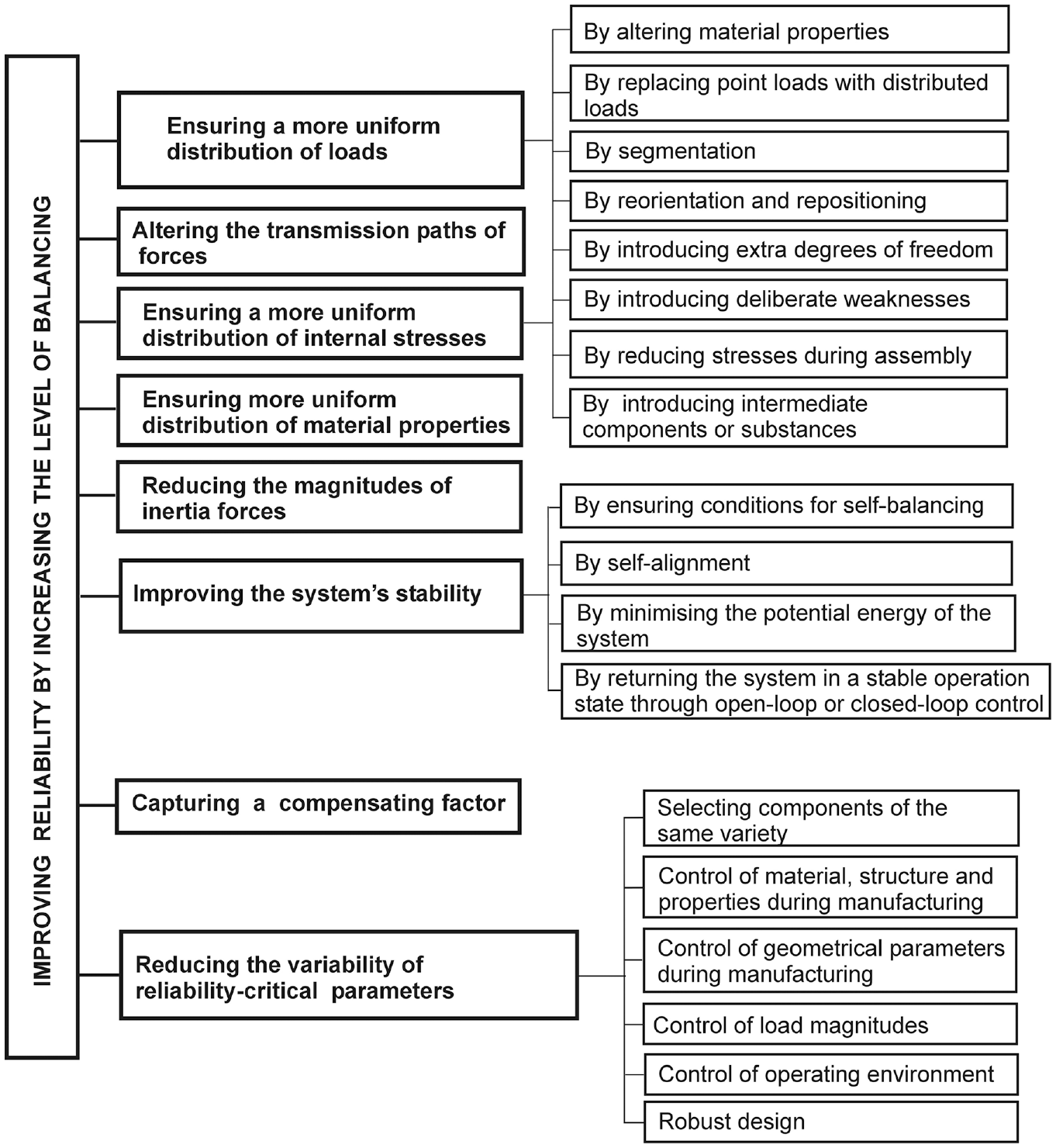
Classification of techniques related to improving reliability by increasing the level of balancing.
Examples of efficient application of the different techniques for increasing the level of balancing
Ensuring a more uniform load distribution leads to significantly reduced contact stresses and wear.
Imbalanced electrical loads, for example, frequently cause excessive heat generation and reduced reliability of electrical devices. An adequate prescription of the parameters of the components in electrical circuits improves the level of balancing of electrical loads and reliability. Imbalanced input voltage, for example, could lead to imbalanced input power of the modules in electronic circuits which creates a possibility of exceeding voltage rating of capacitors and system failure. This can be prevented by increasing the level of balancing through a voltage sharing balance circuit. 28
Imbalanced flow of data in computer networks frequently results in delays and lost packets of information. Proper management of the data flow by employing prioritisation algorithms improves the level of balancing of the data flows and improves the quality of service of the network.
Self-balancing of transportation networks involving autonomous vehicles could make a full use of the intelligent characteristics of the self-driving vehicles and improve the utilisation rate of the vehicles in the system. This improves the distribution of transportation resources in the road network and the efficiency of vehicle service. 29
Point loading often causes excessive deflection of the load-carrying surfaces, excessive stresses and failure. Unless the load-carrying surface has been specifically designed to accommodate point loads, the point load often causes excessive deformation and failure. Increasing the level of balancing of external loads by distributing them uniformly over the load-carrying surface decreases deflections and stresses and reduces the likelihood of failure. Including deliberate weaknesses or extra degrees of freedom, for example, does not permit the formation of peak stresses and contributes to a more uniform distribution of the internal stresses. Such is, for example, the case where extra degrees of freedom are introduced in statically indeterminate trusses to turn them into statically determined structures. The result is a more uniform distribution of the internal stresses and reduced peak stress magnitudes.
Altering the transmission paths of forces
Altering the transmission paths of forces contributes significantly to increasing the level of balancing and improving the reliability of assemblies and structures. As a rule, short and direct transmission paths are associated with minimum amount of deformation and increased level of balancing. Avoiding eccentric axial loading of columns by applying the force through the centroid of the column cross section avoids bending associated with eccentric loading and leads to a better stability of the column. 30
External forces, applied through the centres of symmetry of sections and through axes of rotation, are associated with an increased level of balancing due to absence of moments. An increased level of balancing is also present if the transmission path of the external force is within the cone of friction.
Reducing the magnitudes of inertia forces also increases the level of balancing and is commonly performed on rotating components.
Ensuring a more uniform distribution of the internal stresses
In designing components, a more uniform distribution of the internal stresses can be achieved by avoiding stress concentrators. These lead to elevated local levels of the stresses that can easily exceed the strength of materials even at relatively low nominal internal stresses away from the stress concentrators.
Imbalanced internal stresses in loaded components however, can be present even in the absence of stress concentrators. In the design of composite rods, composite beams and composite torsion bars, the limit state corresponding to the onset of failure (e.g. yielding) in the different materials can occur at significantly different levels of the loading force. This leads to an unbalanced design where components made of a particular material are overdesigned while components made of another material are designed with insufficient strength. Commonly, unbalanced designs of composite components are characterised by significantly different factors of safety related to the constituent parts. In many cases, such designs can be balanced to some extent by altering the geometry of the constituent parts made of different materials in such a way that the limit state associated with the different constituent parts occurs at close magnitudes of the loading force.
Using segmentation and intermediate components to improve the level of balancing
As a rule, increased segmentation of external loads increases the level of balancing and improves the load-carrying capacity of the assembly.
Thus, for high-torque applications, planetary type of gearbox is often preferred for transmitting torque because of the increased number of contact points (three instead of one). 31 This reduces the contact stresses on the gear teeth and enhances durability.
Similarly, transitioning from a key connection in shaft/hub assembly to a spline connection is beneficial because torque is transmitted through multiple elements (instead of a single element) and, as a result, the contact stresses are reduced.
Often, the contact of two components with high hardness does not permit a uniform distribution of the contact stresses. As a result, some zones from the contacting surfaces are characterised by high contact stress intensity while for others, the stress intensity is low. Using elastic components as mediators (e.g. rubber or other appropriate material) improves the distribution of contact stresses and reduces their magnitude. Increasing the level of balancing through intermediate components provides protection against elevated stresses from shock loading.
In what follows, an example will be given related to improving reliability by increasing the level of balancing through an intermediate component. The example is related to concrete piles driven into the ground 27 (Figure 2(a)).
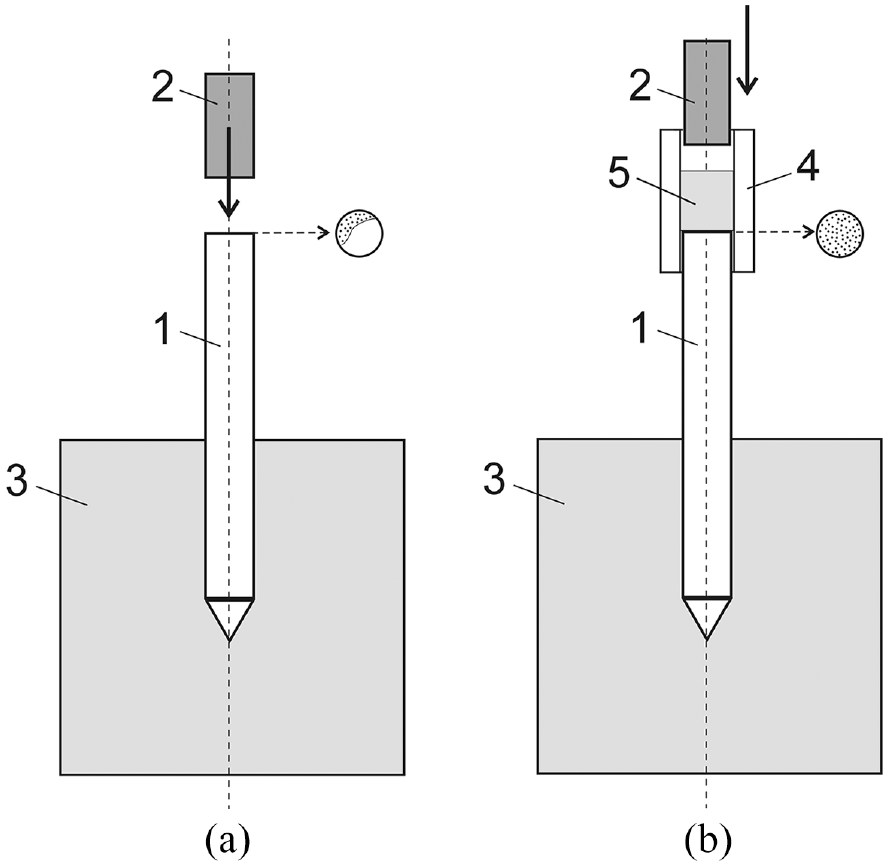
Eliminating the failure mode ‘damaging the top of a pile driven into the ground’ (a), by increasing the level of balancing through an intermediate component (b). 27
In Figure 2(a), driving the pile 1 into the ground (3) causes damage to the top end of the pile because of uneven distribution of the contact pressure from the hammer 2. Part of the top end of the concrete pile is overstressed which promotes cracks and damage of the concrete pile.
Introducing a cheap intermediate component 5 between the hammer 2 and the pile 1 by using the sleeve 4 (Figure 2(b)) improves the uniformity of the load distribution over the top end of the pile. This results in reduced contact stresses and reduced likelihood of damaging the top end of the pile. The intermediate component can simply be sand or other cheap material.
Increasing the level of balancing by correcting negative distribution of loads resulting from segmentation
As noted, although segmentation is beneficial in reducing the stresses in loaded assemblies, it is associated with a downside. Often, the loads are not distributed uniformly across the separate segments. This is a technical contradiction associated with segmentation and, to the best of our knowledge, no discussion has been presented in the literature so far about the negative effects from segmentation.
Possible ways of resolving this technical contradiction and improving the load distribution over the separate segments is the alteration of material properties, geometry or structure.
Here is an example of resolving this contradiction by an alteration of the material properties. Consider a load P acting at the centre of a square platform supported by four symmetrically arranged load-carrying elements (legs) made of the same material and with equal cross-sectional area. Because of the segmentation into four load-carrying elements (legs), in the ideal scenario, the load P will be supported by legs each carrying a load with magnitude P/4.
Suppose that, because of geometrical imperfections, one of the elements has a height which is by
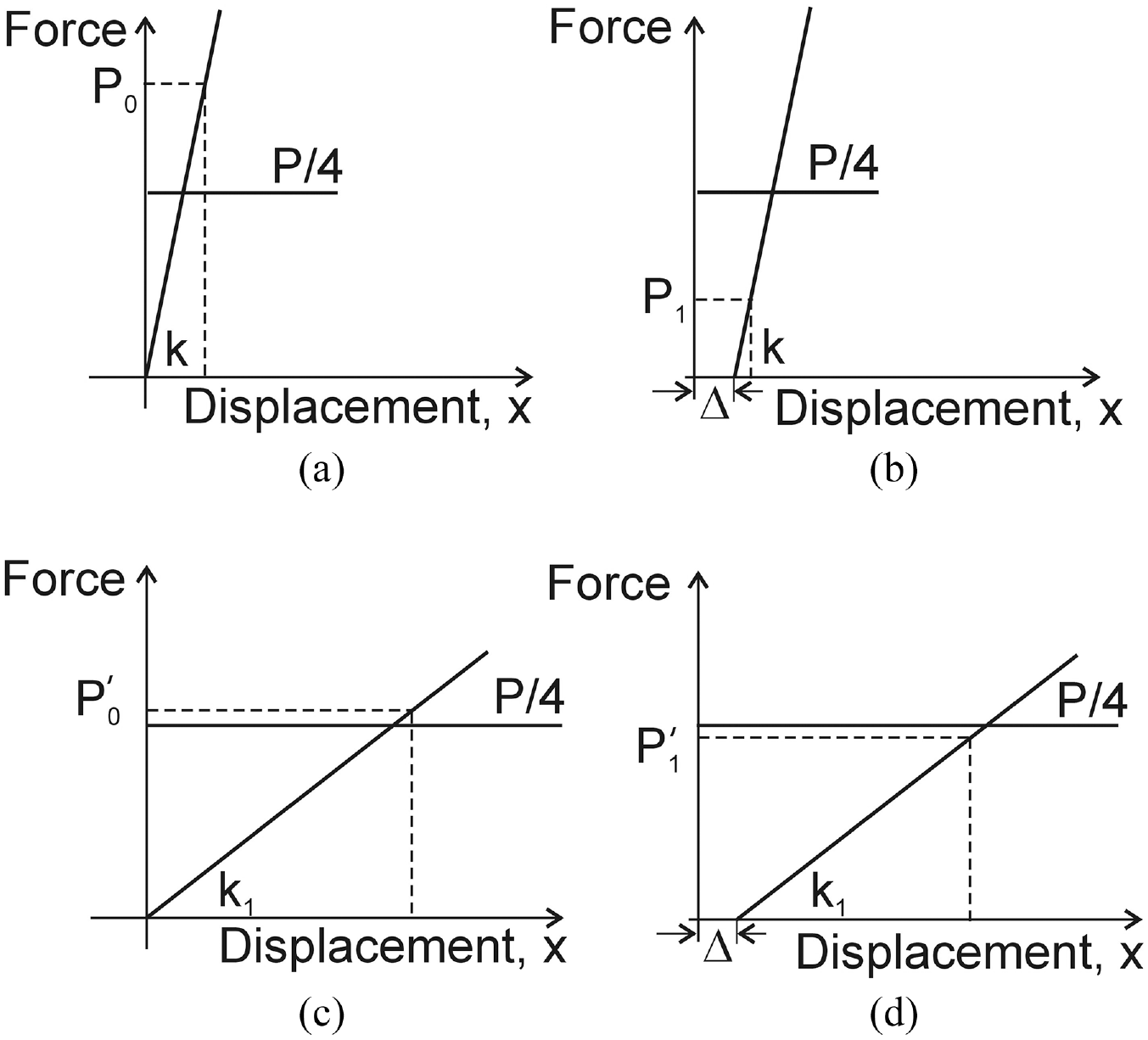
The differences in the load magnitudes P1 and P0 in (a) and (b) can be reduced as shown in (c) and (d), by reducing the stiffness of the load-carrying elements.
The magnitudes
This alteration of the material properties results in reduced loading forces
An example of alteration of geometry to improve the level of balancing can be given with the use of different pitch values to ensure uniform thread load distribution in bolted joints. 32 More uniform distribution of the stresses along the thread of a bolt connection is also ensured by selecting the material of the nut to be of smaller stiffness than the material of the bolt. 32
Increasing the level of balancing through continuity and homogeneity
It is a well-documented fact that fatigue life depends strongly on the amplitude of the loading stress. According to the Paris-Erdogan law (Paris and Erdogan
33
), the rate of fatigue crack propagation

where
Avoiding discontinuous operation (start-stop regimes) of pressure vessels and pipelines reduces the range of the internal thermal and loading stresses and greatly enhances fatigue life.
Ensuring continuity in welding and hot rolling avoids defects associated with the interruption of the operation and improves the quality of the final product. Eliminating transitional regimes in electrical circuits with large inductors, caused by unnecessary start-stop regimes eliminates excessive voltages and the risk of damaging components in the circuit. Shifting from a linear reversed motion to a rotation eliminates large inertia forces associated with reversing the motion.
Homogeneity in material properties is an important factor in increasing reliability by increasing the level of balancing. A uniform heating and cooling of a steel component with non-uniform thermal properties in the core and at the surface layers causes the appearance of a significant thermal gradient and thermal stresses. The thermal stresses can be so large that they often lead to the fracture of components with large sections. In contrast, uniform properties of heat-treated component guarantee uniform thermal properties and a significant reduction of the internal thermal stresses upon heating and cooling.
Furthermore, eliminating the anisotropy of the microstructure in loaded components eliminates the anisotropy of strength and creates better conditions for resisting forces acting in different directions. Guaranteeing a structure with uniform grain size in an alloy eliminates excessive variation of the fracture toughness and creates better resistance to crack propagation. Uniform stiffness of supporting columns guarantees uniform elastic deformations and enhanced reliability.
Increasing the level of balancing by improving system’s stability
Stability is a property of vital importance to engineering systems. For a stable system, a bounded input produces a bounded output and the system returns in equilibrium state once the external disturbances have been removed. The system’s stability can be improved significantly by ensuring conditions for self-balancing.
Improving system’s stability by self-balancing
Unwanted forces create excessive internal stresses in components and assemblies and require extra material or reinforced material with increased stiffness to resist them. As a result, the weight and cost of assemblies are increased. The extra loads also create extra friction forces, premature wear, fatigue degradation and failure.
The need for extra material, reinforced material and heavier construction can be avoided if conditions for self-balancing are created. As a rule, ensuring conditions for self-balancing in a system improves the system reliability.34,35
Self-balancing can be achieved by (i) full or partial compensation of forces or negative factors or by (ii) stabilising the system through open-loop or closed-loop control.
Self-balancing through symmetrical design can be used to eliminate undesirable forces. An example of such symmetrical design 36 can be given with two turbines mounted on a common shaft in such a way that the axial force on one of the turbines is compensated by an equal and opposite axial force from the second turbine. As a result, a trust bearing is no longer needed; degradation caused by wear of the trust bearing is avoided and the reliability of the assembly is improved.
Increasing the level of balancing can be done by counter-balancing mechanisms designed to take the effort out of moving and supporting heavy loads, and positioning manipulator arms. The result is reduced magnitudes of the required forces for maintaining equilibrium states, improved positioning precision and reduced stresses. Thus, using counter-weights in robots avoids the need for powerful actuators to overcome static loads. For such counter-weight systems, the required motion can be attained by a low-power actuator whose energy consumption is necessary only for overcoming the friction forces. 37
Counterweights in lift carriages increase the ascending acceleration and decrease the descending deceleration. As a result, the amount of power required from the motor is much smaller than the power needed to lift the weight of the carriage in the absence of counterweights which extends the reliability of the motor and its life.
Improving the system’s stability by active balancing
Multiple components of the same type, working simultaneously, often rely on devices/circuits whose sole purpose is to actively balance the load on the separate components. In these applications, passive balancing is not sufficient to guarantee the required flexibility and resilience and there is a need for active balancing.
An example of a transition from passive to active balancing can be found in crane systems where the counterweight from fixed becomes dynamic, with possibility to be shifted, depending on the operating load. 38
Super-capacitors in particular, because of manufacturing variations, are not identical. During charging super-capacitors in series, at a constant current, the capacitor that reaches first the rated voltage could be damaged if charging continues after the capacitor has reached its rated voltage. Supplemental active circuits can then be used for monitoring and balancing the charging process. 39
Active balancing is also very important for battery cells. The variation in the capacity of battery cells connected in series, causes the voltage of some cells to rise into dangerous levels, which results in a faster degradation of the cells. Active balancing of battery cells 40 is not only important for improving the performance of the battery; it also extends battery life and enhances safety.
Active balancing can also be done by open-loop or closed-loop controllers which monitor the controlled process variables and compare their values with specified reference levels. A control action is generated that brings the process variables to match their specified reference values.
Increasing the level of balancing by a compensating factor
In this type of balancing, a third factor is used to provide the balancing response. Capturing a compensating factor is present in cases where disturbances initiate changes which correct the disturbances. Thus, seals should be designed in such way that frictional heat does not cause an increase of the frictional forces but their reduction. Pahl et al. 15 consider a layout of taper roller bearings where the thermal expansion of the shaft creates a compensating effect which does not allow the load on the bearings to increase. Often, disturbances initiate two factors acting in opposite direction that compensate each other and return the system into a stable state.
Increasing the level of balancing by selecting components from the same variety
Increasing the level of balancing can also be achieved if the variability of critical parameters is reduced. The variability reduction prevents a non-uniform distribution of loading stresses.
For an assembly built on components logically arranged in series, the life of the assembly is limited to the shortest life of a component in the assembly. A significant variation in the lives of the components arranged in series shortens the life of the assembly.
Thus, variation in the fatigue resistance of components with identical functions, sharing a common load and logically arranged in series, means that due to variation in fatigue resistance, the assembly will fail significantly before the expected life span in the absence of such variation. Similarly, the variation in the properties of seals could cause a seal assembly to leak long before such leakage appears in an assembly with small variation of properties.
Reliability-critical parameters vary and this variability should be controlled to increase the level of balancing. Broadly, the following techniques for controlling variability can be distinguished: (i) selecting components of the same variety; (ii) control of material, structure and properties during manufacturing; (iii) control of geometrical parameters during manufacturing; (iv) control of load magnitudes; (v) control of operating environment and (vi) robust design.
Selecting components from the same variety is an important technique for reducing the negative impact of the variability of properties. Often, deep uncertainty is present about the fractions of components from different varieties. Consequently, an important question is how to maximise the probability of selecting components from the same variety.
Most commonly, the available components are of two varieties: reliable components and faulty components. Commonly, the percentage of reliable components in n separate batches (or suppliers) is unknown. In this case, it can be shown that the probability of purchasing all components from the variety ‘reliable components’ is maximised if all components are sourced from the same, randomly selected batch(supplier).
This can be demonstrated with an example featuring selecting two reliable components from n batches (e.g. containing the same type of bearings, seals, electronic components, etc.) which are subsequently built into a system. For the system to work, both components selected must be from the variety ‘reliable components’.
Suppose that the percentage of reliable components characterising the n batches are
If the two components are purchased from a randomly selected batch with probability (1/n), the probability that both components will be of the variety ‘reliable components’ is given by
If the two components are purchased from two different, randomly selected batches, the probability that both components will be reliable is given by

It can be shown that

Inequality (1) can be obtained from the classical Muirhead’s inequality. 41
Let
According to the classical Muirhead’s inequality, if a sequence

where the symmetric sum
Consider the sequence

holds. Next, dividing both sides of inequality (3) by n! gives inequality (1).
For three batches (
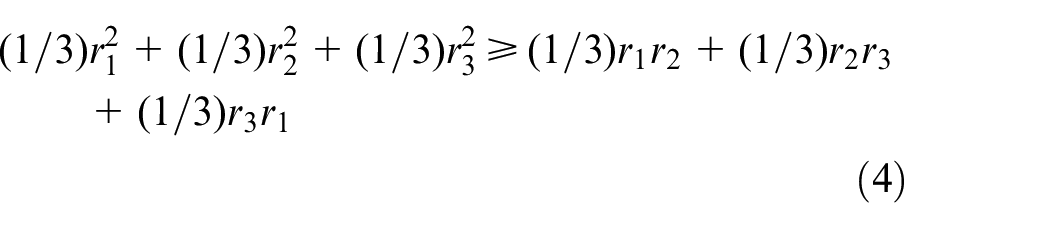
The difference between the left- and right part of inequality (4) can be significant. Thus, for

while the probability of selecting two reliable components from two randomly selected batches is
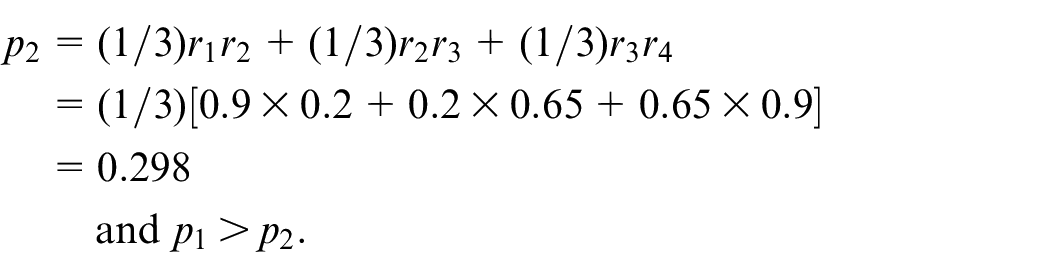
It must be pointed out that choosing two products from the same batch will also maximise the probability that both selected products will be faulty. It must be pointed out that selecting two components from a single, randomly selected batch will also maximise the probability that both components will be faulty. This, however, does not mean that it is more beneficial to select the components from two different batches. Despite that selecting from two different batches decreases the probability that both selected components will be faulty, for a faulty system to be present it is not necessary both selected components to be faulty. Selecting a single faulty component is sufficient. Selecting components from two different batches decreases the probability of having a reliable system (two reliable components). This conclusion remains unchanged if the fractions of reliable components are considered to be fractions of faulty components.
Indeed, if we consider

while the probability of selecting two reliable components from two randomly selected batches is
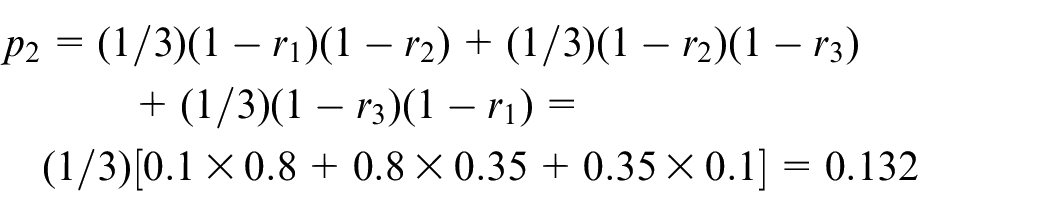
Again,
No matter what
By using the Muirhead’s inequality (2), the result related to selecting two components from n batches can be generalised to selecting
Improving reliability by substitution. Classification of techniques for the method of substitution
Underlying idea
The underlying idea of the method of substitution is to remove failure modes of an assembly working on a particular physical principle by substituting it with an assembly working on a different physical principle.
The classification of techniques (Figure 4) includes:
- substitution with mechanical assemblies
- substitution with electrical assemblies
- substitution with magnetic assemblies
- substitution with optical assemblies
- substitution with acoustic assemblies
- substitution with software-based systems
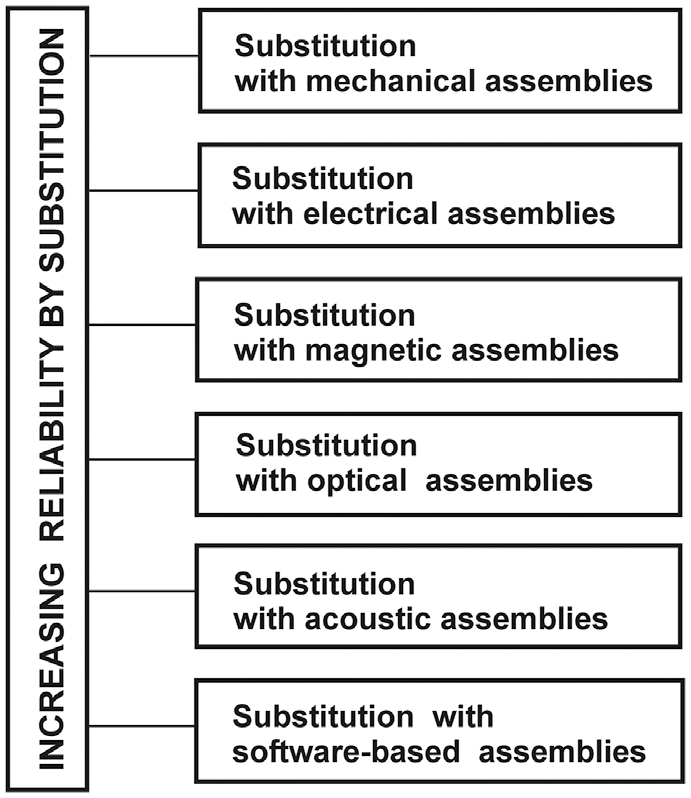
Techniques for improving reliability by substitution.
Substitution can also be made by using a combination of the listed basic techniques. Substitution is justified only if it removes failure modes and does not introduce more dangerous new failure modes. Eliminating particular critical failure modes by substitution may cause other critical failure modes. The design obtained by substitution with electrical or magnetic assemblies for example, should be checked carefully for new critical failure modes.
Examples of efficient application of the method of substitution in various domains
The substitution with mechanical assemblies is sometimes considered for electrical and electronic devices. Many electronic assemblies depend on the availability of batteries, on reliable operation of the power source and are also associated with risk of overheating and fire. Electronic assemblies also exhibit increased tendency to failure in environments with increased temperature, with strong electromagnetic interference, with increased vibrations and humidity.
If any of these conditions are present and the risk of failure is not acceptable, a substitution with mechanical assembly could be considered. Mechanical assemblies are less sensitive to strong electromagnetic radiation, temperature, humidity and vibrations.
A typical example of this type of substitution is the replacement of a battery-powered radio with mechanical, spring-powered radio in remote places where batteries are not readily available.
Efficient applications of the substitution with electrical/electronic assemblies are: the control of ignition timing for engines with electronic control module; the substitution of mechanical relays with electronic relays; the substitution of mechanical pushbutton switches with pushbutton switches whose operation is based on the Hall-effect, etc.
This type of substitution can also be applied with success for eliminating failure modes associated with various testing or measurements.
Consider an experimental test for cracks in the coatings of steel pipe sections working in corrosive environment. The plastic coating prevents corrosion of the pipe and it is therefore critical that no through cracks exist in the coating. Using mechanical test based on covering the pipe section with fluorescent paint reveals all the cracks but this mechanical method is associated with a failure mode. Together with all through cracks, the fluorescent paint method also reveals all blind cracks in the coating which do not provide paths through which the pipe could corrode.
The false indication from the mechanical, fluorescent paint method can be avoided by substituting the mechanical testing assembly with an electrical assembly. The pipe section is submerged in electrolyte. One electrode is attached to the inside surface of the pipe and the other electrode is placed in the electrolyte which makes a contact with the outer surface of the pipe section.
If voltage is applied to the electrodes, the presence of weak current indicates through cracks penetrating the plastic coating. In the substituting electrical assembly, blind cracks can no longer distort the results of the test and cause a false alarm.
The central idea of the substitution with magnetic assemblies is eliminating failure modes by substitution with assemblies/systems working on a magnetic principle.
A typical example is the magnetic stirrer which eliminates the need for a seal and with this it also eliminates failure modes related to leakage from seals and failure modes related to corrosion.
The magnetic worm gear eliminates a number of failure modes associated with conventional gears:
- No wear is present because the transfer of torque is frictionless;
- There are no failure modes associated with lubrication because there is no need for lubrication;
- The maintenance is simplified which eliminates failure modes associated with incorrect maintenance;
- There are no failure modes associated with misalignment;
- The spread of vibrations is eliminated.
Consider a safety valve on a pipeline carrying flammable toxic fluid. The valve is maintained in open position by hydraulic pressure. In case of a loss of pressure in the hydraulic line, the valve must be returned in closed position by a mechanical compression spring. Due to failure caused by fatigue, corrosion, or sagging of the spring (caused by stress relaxation), the spring may fail to return the valve in closed position and stop the toxic fluid in the pipeline. This poses significant safety risk which could be eliminated if the mechanical spring is replaced by a magnetic spring. The substitution of the mechanical spring with a magnetic spring eliminates all of the major failure modes of the mechanical spring: fatigue failure, sagging and corrosion failure without introducing new failure modes.
Another use of this type of substitution is the substitution of a mechanical attachment with magnetic attachment, if a quick release must be made in case of emergency.
An interesting application of substitution with magnetic assemblies is the substitution with assemblies acting as deliberate weaknesses which disconnect/decouple two components when the load exceeds a certain value. The failure of the deliberate weakness decouples the components, releases the load and prevents failure. In this case, the advantage of the magnetic assembly acting as deliberate weakness compared to a mechanical type of deliberate weakness (such as a shear pin, rupture disk, etc.) is that it can be restored quickly, at no cost.
The substitution with optical or acoustic systems/assemblies simplifies design, eliminates moving parts, accumulates less damage, reduces wear and fatigue, increases precision and improves maintainability.
A good example of substitution with optical assemblies is the substitution of the electro-mechanical mouse (with a rolling ball) with an optical mouse. Compared to the electro-mechanical mouse, the optical mouse is characterised by:
- Significantly improved durability;
- No dirt collection;
- Easy maintenance, no need for cleaning;
- Capability to work on any surface;
- Better motion tracking;
- Better precision.
Substitution of electrical wire lines with fibre optic lines results in:
- Improved performance in harsh environments (with high humidity, high pressure, high voltage or high temperature);
- Insensitivity to electromagnetic interference;
- Less amount of accumulated damage.
Substitution with optical assemblies can be applied with success for eliminating failure modes associated with various tests or measurements. A typical application example is the infrared optical thermometer substituting the thermocouple. This substitution eliminates the following failure modes:
- measurement variability caused by the variability in attaching the thermocouple to the surface whose temperature is measured;
- disrupted temperature field and errors in the measured values due to the thermocouple attachment/insertion;
- high rate of deterioration of the mechanical contact and low durability;
- relatively low measurement speed;
- low reliability in measuring temperatures higher than 1300°C;
- low reliability of the measured values for high-voltage surfaces.
Another example of removing failure modes by substitution with optical assemblies is the substitution of bonded-type strain gauges with optical strain gauges. The reading from bonded strain gauges is very sensitive to the quality of preparation of the surface and the quality of the glue. Therefore, a significant measurement variability is present due to the variability in the quality of strain gauges attachment. Poor attachment of the strain gauges leads to a distorted measurement. In addition, the measurement speed is low because the measurement requires careful preparation of the surface and secure attachment of the strain gauges.
The optical strain gauges do not require any physical contact hence avoid failure modes associated with poor contact. Optical strain gauges also eliminate errors associated with the preparation of the surface which causes measurement variability. Finally, optical strain gauges increase significantly the speed of measurement.
Reliability can also be improved by a substitution with software-based systems.
Thus, the complexity needed to guarantee a required kinematics, for example, can be transferred from very complex mechanisms to software coupled with simple servomotors. Software components guarantee flexibility and do not exhibit deterioration which is a major contributing factor to unreliability. Furthermore, replicating software does not result in manufacturing variability of the software component.
Software components can serve as a basis of intelligent equipment that provides guidance and warnings for the user about its correct operation. This helps to avoid dangerous actions and prevent injuries and other failure modes. Software components can also deliver effective troubleshooting which reduces risk by reducing the consequences in the case of failure.
The substitution of mechanical assemblies with electrical and software systems also permits the introduction of sensing capabilities. These make the systems capable to reset their goals autonomously and to adapt under changing external environment which significantly enhances the resilience of the systems. This also enhances the functionality of mechanical systems and enables them to meet a broad spectrum of user requirements. For example, some modern air conditioning units are capable of sensing both temperature and humidity and adapt their function to the environment through fuzzy logic reasoning. Another example is the programmable electronic control units (ECU) in modern cars. The ECU controls the valve timing, ignition timing, transient fuelling, air/fuel ratio, the optimal amount of fuel injected in the engine at different combinations of engine speed and throttle position, water temperature correction when the engine is cold, etc. The programable control increases reliability, reduces fuel consumption and air pollution and enhances the life of the engine.
The software components are also major components of modern systems with artificial intelligence. The autonomous car is capable of interpreting the information coming from sensors, identifying obstacles, lanes, vehicles, pedestrians, taking appropriate navigation routes and executing necessary actions. These capabilities help avoid collisions and other accidents associated with lack of sleep, lack of concentration, information overload, insufficient reaction speed, etc., which are typical for human drivers.
Machine vision, artificial neural networks (ANNs) and deep neural networks (DNNs) are some of the software components for visual object recognition.
Conclusions
Despite that a number of solutions for increasing reliability of components and systems by increasing the level of balancing already exist in engineering, these solutions have not been recognised as instances of the same domain-independent method. For this reason, a number of opportunities for increasing reliability by increasing the level of balancing can be easily missed in the design of systems and processes.
A domain-independent method and a number of new techniques have been proposed for increasing reliability by increasing the level of balancing. In addition, a classification of techniques for improving reliability by increasing the level of balancing has been introduced and discussed for the first time.
Central to the proposed classification are the following techniques:
- ensuring a more uniform distribution of loads;
- altering the transmission paths of forces;
- reducing the magnitudes of inertia forces;
- ensuring a more uniform distribution of the internal stresses;
- improving the distribution of material properties;
- improving system’s stability;
- capturing a compensating factor and
- reducing the variability of reliability-critical parameters.
If components must be selected from n batches containing reliable and faulty components with unknown proportions, the probability that all components will be reliable is maximised by selecting the components from the same randomly selected batch.
Segmentation reduces loads but is also associated with uneven distribution of the stresses over the separate segments. A method for re-balancing the loading stresses in elements supporting a load has been proposed. The method is based on reducing the stiffness of the material.
Central to the proposed classification of the method of substitution are the following major categories: (i) substitution with mechanical assemblies; (ii) substitution with magnetic assemblies; (iii) substitution with electrical assemblies, (iv) substitution with optical assemblies; (v) substitution with acoustic assemblies and (vi) substitution with software-based systems.
Design for reliability is underlined by common domain-independent principles that are vital for the reliability improvement of products and processes and provide key input to the design process.
The generic principles for reliability improvement allow engineers and scientists in a particular domain to access excellent solutions and practices for eliminating failure modes in other domains. In this way, the constant reinventing of the wheel in reliability improvement and risk reduction is avoided.
Generic methods change the way engineers and scientists approach reliability improvement and risk reduction. The presented generic methods encourage simple, low-cost solutions as opposed to some traditional high-cost solutions based on introducing redundancy, condition monitoring, reinforcement and use of expensive materials.
Footnotes
Declaration of conflicting interests
The author declared no potential conflicts of interest with respect to the research, authorship, and/or publication of this article.
Funding
The author received no financial support for the research, authorship, and/or publication of this article.
