




Abstract
The paper introduces a new, powerful, domain-independent method for improving reliability and reducing risk by exploiting asymmetry, along with a classification of corresponding techniques. A system reliability improvement technique has been proposed based on asymmetric arrangement of redundancies which is not associated with any implementation costs and can be used for improving reliability and reducing the risk of failure in various unrelated domains. Despite the extensive research on redundancy optimisation, no existing technique has yet addressed the problem without requiring knowledge of component reliabilities. This paper demonstrates that system reliability can be improved without any knowledge of components’ reliability values. Specifically, it establishes that for series-parallel systems, an asymmetric arrangement of interchangeable redundancies consistently results in higher system reliability compared to a symmetric arrangement, regardless of the individual reliability values of the components. This result has been obtained through reverse engineering of a rigorously proved algebraic inequality. Finally, the paper proposes a new technique for reducing risk by exploiting an asymmetric non-linear output from a process. This technique has also been obtained through a reverse engineering of a rigorously proved algebraic inequality. The technique is also applicable to improving the performance of systems and processes with nonlinear concave output in various unrelated domains.
Keywords
Introduction
In standard design literature,1–10 there is a notable absence of domain-independent methods for improving the reliability of designed components by exploiting asymmetry. Although asymmetry has already been utilised to enhance the functionality of designs and processes,11–15 all existing approaches exploiting asymmetry are domain-specific. Domain-specific methods, however, even when successful, cannot transcend the narrow domain they serve and cannot normally be used to improve reliability in other, unrelated domains.
A strong reason for the slow adoption of domain-independent methods for reliability improvement is the belief held by many specialists that the specialised knowledge and expertise in their field are sufficient to solve all reliability issues associated with their designs. These specialists often view domain-independent methods as less tailored to addressing the specific reliability issues within their narrow domain, and for that reason, they consider these methods less effective.
However, the TRIZ problem-solving framework,16–18 widely adopted by companies and researchers around the world, clearly demonstrated the advantages of using generic principles in resolving technical contradictions and driving innovation. Similarly, domain-independent methods for improving reliability promote rapid mental mapping, bolster intuition and often lead to surprising breakthroughs and swift solutions for challenging problems.
Improving the reliability of designs through exploiting asymmetry involves leveraging the asymmetric response from altering the arrangement of features, position, location, orientation, output characteristics, geometry and properties to achieve better reliability. This often leads to simple, low-cost solutions. For instance, using the asymmetric response from the inversion of features, position, location and orientation can eliminate failure modes or minimise their impact. However, the discussion of inversion as a domain-independent method for inducing asymmetric responses to improve reliability is missing in the reliability literature. Similarly, there is a lack of discussion and classification of other generic, domain-independent techniques for improving reliability by exploiting asymmetry in both popular and recent reliability engineering texts.19–28 Such a classification could promote disciplined thinking and prevent the oversight of effective reliability enhancing solutions.
The absence of a classification of techniques related to improving reliability through exploiting asymmetry is rather surprising, given that design engineers have already used domain-specific techniques based on asymmetry to enhance the functionality of their designs.
As demonstrated in this paper, the domain-independent asymmetric arrangement of redundancies in series-parallel systems can significantly enhance their reliability even in the complete absence of information about the reliability of individual components or their ranking. Despite the extensive research on redundancy optimisation in the reliability literature, no existing technique has yet addressed redundancy optimisation without requiring specific knowledge of component reliabilities. Traditionally, optimal redundancy allocation methods begin with known reliability values for all components and redundancies. For example, a multi-performance redundancy optimisation technique for multi-state systems using a genetic algorithm has been introduced in Ding et al., 29 relying on known component reliabilities. Similarly, Aqel and Mohamed Mellal 30 addressed the redundancy allocation problem with nature-inspired AI algorithms, such as adaptive particle swarm optimisation, which also depend on known component reliabilities.
To address redundancy allocation in large systems, several approaches have been presented in Florin et al., 31 including the Lagrange multipliers technique, a pairwise hill-climbing algorithm and an evolutionary algorithm. Additionally, Si et al. 32 reviewed system reliability optimisation techniques driven by importance measures, which also depend on known component reliabilities.
The key insight of this paper is in understanding that by leveraging asymmetry, system reliability can be improved without any knowledge of component reliability values. Specifically, the paper establishes that for series-parallel systems, an asymmetric arrangement of interchangeable redundancies, consistently results in higher system reliability compared to a symmetric arrangement, regardless of the individual reliability values of the components or their ranking. This result has been achieved through reverse engineering of complex algebraic inequalities.
Reverse engineering of algebraic inequalities 33 is a powerful method for optimising systems and processes under deep uncertainty regarding the values and distributions associated with controlling variables. This method has also been used in this paper to leverage asymmetry in the output characteristics of a filter to reduce the risk of pollution.
A number of powerful domain-independent methods for improving reliability and reducing risks have already been developed and are effective across various unrelated domains. 34 In the present paper, this body of work is extended by introducing another powerful domain-independent method for improving reliability and reducing risk based on exploiting asymmetry. In this connection, a basic classification of domain-independent techniques based on exploiting asymmetry has also been developed.
Additionally, two novel domain-independent techniques for improving reliability and reducing risk by exploiting asymmetry are introduced for the first time:
(i) Improving system reliability by using an asymmetric arrangement of interchangeable redundancies, in the absence of knowledge about the reliabilities of the system’s components and their ranking; (ii) Improving process/system performance by leveraging its asymmetric non-linear output.
Domain-independent techniques for improving reliability and reducing risk by exploiting asymmetry
Reducing the losses from failures by asymmetric strengthening proportional to the cost of failure
Cost of failure of components is often highly asymmetric. Understanding and strengthening according to the asymmetric cost of failure can significantly reduce the losses from failures of the entire system. The technique of asymmetric strengthening according to the cost of failure of the components ensures more resources towards strengthening allocated to components with higher cost of failure.
An example of reducing the losses from failures by asymmetrical strengthening proportional to the cost of failure can be given with two very simple systems consisting of only two components, logically arranged in series (Figure 1).
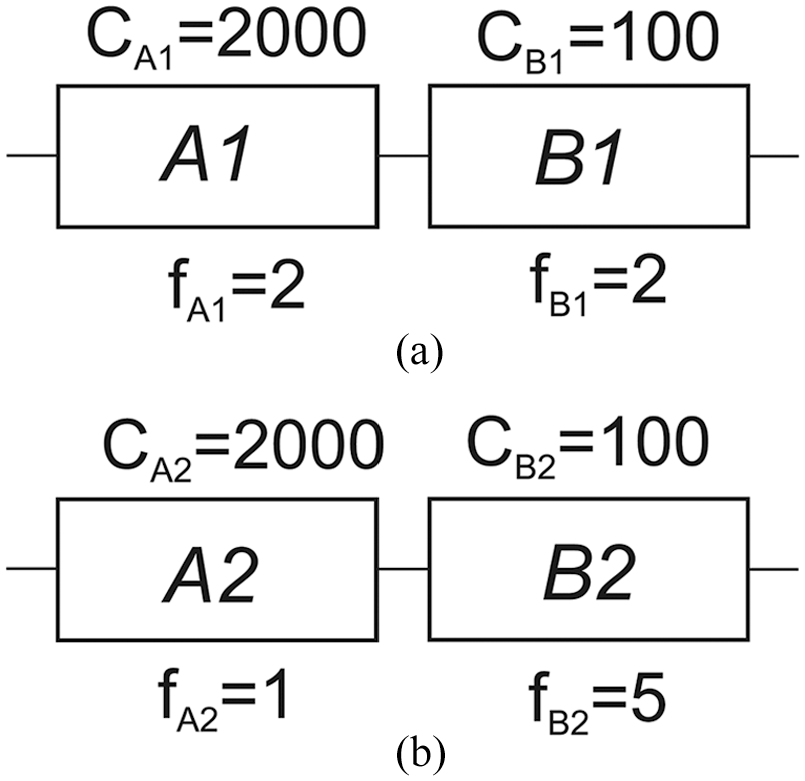
(a) A systems composed of two components only each characterised by the same reliability and (b) a system demonstrating that asymmetric strengthening of the components reduces the losses from failures.
For the first system (Figure 1(a)), suppose that component A1 fails on average twice a year (

while for the system in Figure 1(b), the expected losses from failures

As can be verified, the asymmetrically strengthened system in Figure 1(b) is associated with smaller losses from failures!
This simple example demonstrates that uniformly strengthening components against failure can lead to significant losses. However, in the common case where system failures have varying associated costs, asymmetrically strengthening components – proportional to their failure costs – can significantly reduce the overall losses from system failures.
Improving reliability by asymmetric strengthening according to the anticipated loads
Loading is often asymmetric and reinforcing for asymmetric loading can significantly improve the reliability of various systems. By anticipating and accommodating uneven forces, engineers can ensure that mechanical components and structures perform reliably under real-world conditions.
The technique of asymmetric strengthening according to the anticipated loads also ensures that the structure can handle the highest expected loads without over-engineering other parts, thereby improving reliability while optimising material use.
An example of improving reliability by asymmetric strengthening according to the anticipated loads is the asymmetric joint design tailored to specific loading conditions or operational demands. In many joint configurations, stresses are not uniformly distributed; certain areas experience higher stresses than others. An asymmetric design strengthens the joint precisely where high stresses occur, reducing stress concentrations. 15 This approach is particularly critical under cyclic load conditions, where fatigue failures commonly initiate in high-stress regions. When a joint primarily experiences loading in a specific direction, asymmetric reinforcement can improve its load-bearing capability in that direction. This enhances the joint’s safety factor against failures like shearing or bending in the primary loading direction. By reinforcing material only where it is critically needed and reducing it where it is less essential, asymmetric strengthening in joint designs can save material and reduce weight. This results in cost savings, reduced inertia in dynamic systems and improved fuel efficiency in vehicles.
Roads are designed with varying pavement thickness, typically thicker in areas expected to bear higher loads, such as near intersections or curves. This asymmetric strengthening extends the pavement’s lifespan and enhances its reliability.
Another example of improving reliability by asymmetric strengthening according to the anticipated loads is using stiffer springs or stronger materials on the side of the vehicle that typically bears more load which reduces wear and improve vehicle handling.
Offshore wind turbines subject to uneven forces from wind, waves and currents is yet another example. The foundations of these turbines are often designed asymmetrically, with additional reinforcement on the windward side to handle the higher loads thereby enhancing the reliability and stability of the entire structure.
Improving reliability and reducing risk by exploiting an asymmetric response from inversion
Exploiting asymmetric response from inversion is an effective domain-independent reliability improvement technique that leads to simple, low-cost solutions. Following this technique, particular features of the system or process are inverted so that the same set of required functions is delivered by the system but failure modes do not appear or, if they do appear, their impact is minimised. The inversion technique relies on exploiting the inherent asymmetry found in engineering systems and processes. A failure mode that appears in a specific position, orientation, motion or state often vanishes when the system is shifted to the opposite state, all the while maintaining the system’s essential functions.
The asymmetric and dual nature of many characteristics and properties often permits reducing vulnerability and eliminating failure modes by shifting towards the other extreme of the characteristic/property while preserving the required function. Thus, shifting from forward to backward motion, motion to rest and rest to motion, often creates a response that eliminates critical failure modes.
Inversion can be done by inverting relative position, orientation, motion, functions, features, properties, thinking and introducing inverse states.
An example of an asymmetric response achieved by inverting position, that causes a specific failure mode to disappear, can be given with a cover of a container under pressure. By inverting the position of the cover from outside to inside, the failure mode ‘leakage from the cover seals’ is eliminated because the internal pressure helps to strengthen the cover seal.
In certain cases, inverting the relative position might not eliminate a failure mode, but it can substantially delay its occurrence. This concept can be illustrated by an example where the inversion of the electromotor’s position relative to its support introduces an asymmetry in the loading stress. When the position of the electromotor with respect to its supports is inverted, most of the loading stress becomes compressive, which enhances fatigue life.
Another example of eliminating a failure mode by inversion causing asymmetric response can be seen in the enhancement of the reliability of a normally open switch soldered onto a printed circuit board (PCB).
When excessive force, is applied during the operation of the normally open switch, the soldered connection on the printed circuit board experiences increased stress amplitude. Over multiple operations of the push-button, this elevated stress amplitude leads to premature fatigue cracking. By harnessing asymmetry through inversion, the normally open switch can be transformed into a normally closed one. This alters the activation process; instead of closing the normally open contacts, the activation now requires opening normally closed contacts. As a result, an excessive force applied to the push-button does not translate into an increased stress amplitude associated with the soldered points on the circuit board. Due to this inversion, the detrimental fatigue loading on the soldered points is diminished significantly thereby eliminating premature fatigue failure. This use of the asymmetric response from inversion effectively removes a crucial failure mode.
Going through the different ways of inversion (inverting relative position, orientation, motion, functions, features, properties or states), disciplines thinking and avoids overlooking effective solutions for reliability improvement and risk reduction.
Exploiting components and systems with asymmetric response
This technique leverages asymmetric response to favourably bias the system’s response in a way that enhances reliability, ensuring that under specific conditions, the system behaves in a manner that prevents damage or maintains functionality
Diodes are typical components with passive asymmetric response. They allow current to flow in only one direction, preventing reverse currents that could damage circuits.
Check valves is another example of a component with passive asymmetric response. They allow fluid to flow in one direction only, preventing backflow that could lead to system failure or contamination.
Torsion bars in vehicle suspensions that allow controlled twisting to absorb shocks in one direction while resisting excessive twisting in the opposite is yet another example of a component with passive asymmetric response.
Systems with active asymmetric response dynamically adjust the system’s behaviour based on its operating conditions, ensuring that the system remains reliable under a wide range of scenarios. As rule, such systems utilise sensors and control algorithms. The active asymmetric response allows a system to adapt its behaviour in real-time to counteract potential sources of unreliability. By making real-time adjustments, the system can remain reliable under a wide range of operating conditions.
Active asymmetric response is based on sensors and feedback, for example, by using sensors to monitor the system’s operating conditions and performance. If a potential source of unreliability is detected, the system adapts its behaviour to counteract it. Depending on the detected threat to reliability, the system makes adjustments that are inherently asymmetric. For example, if one part of a system is overloaded, asymmetric movement of a counterweight is activated so that the stresses appearing at a particular critical region are counterbalanced.35,36
Exploiting asymmetric geometry
Asymmetric geometry often translates in asymmetry in stiffness. The asymmetry in stiffness ensures that when external forces are applied, the component or system naturally flexes or deforms in a manner that optimises load distribution and minimises stress intensification. When a force is applied, the component or system will naturally bend or shift in a manner that channels the load through the stiffer regions while allowing more flexible areas to deform without breaking.
Beams with an asymmetric profile can offer tailored deflection properties, ensuring they flex or bear load more effectively in specific directions or under unique loading conditions. Thus, a tapered (asymmetric) cantilevered beam, despite using the same volume of material, possesses a superior load-bearing capacity compared to its straight-beam counterpart.
Aircraft wings are designed with varying thickness in critical areas to handle asymmetric loads thereby improving the wing’s fatigue life and overall structural integrity.
Asymmetric geometry can also be employed in fluid systems. Asymmetrically curved channels can help in reducing cavitation, turbulence or promoting laminar flow thereby extending the life of the system.
Asymmetric geometry is used in the design of impeller blades: For pumps or fans, blades with an asymmetric profile can optimise fluid or air movement, thereby improving efficiency and reducing wear.
In load-supporting beams, having asymmetric geometry for the web and flange (e.g. the T-beams), can tailor the strength along anticipated load directions.
Exploiting asymmetric material properties
Exploiting asymmetry in properties can provide improved mechanical reliability in many engineering applications.
Using hybrid materials is a typical example of combining materials with different properties in an asymmetric manner, where the high-performance material is placed in regions of high stress or wear, and the low-performance material is used in less critical areas. In components such as turbine blades, the heat-resistant ceramic is used in high-temperature zones, while the alloy part is used in low-temperature zones.
Next, using different materials in asymmetric configurations at joints or bonds often enhances reliability in specific directions. This is achieved by bonding materials with complementary properties, like combining a tough material with a hard, wear-resistant one at critical connection points. In the aerospace and automotive industries, a high-strength alloy is often used for the structural part of a frame while bonding it with a less stiff material at the interface to absorb vibrations.
Asymmetric properties created by heat treatments are often used to modify a material’s properties, such as hardness, toughness or ductility. Commonly, the tooth flanks of gears, which experience a high rate of wear, undergo such heat treatment to increase hardness, while the microstructure in the central zones of the gears is left unchanged to preserve toughness. Asymmetric material properties that strengthen the surface and increase fatigue resistance in components can also be achieved through localised laser treatment or electron beam processing.
Another well-known technique that leverages this concept is the use of functionally graded materials. These are composite materials where the composition or the microstructure is intentionally varied in space to create a gradient in specific properties, producing a material with varying mechanical or thermal characteristics. By creating a material with varying hardness, incompatible combination of properties can be achieved that provide enhanced reliability: for example, a hard exterior for wear resistance and a ductile interior for impact resistance.
Functionally graded materials can be designed to reduce the thermal stresses that develop at the interface of two different materials. By grading the material, thermal expansion mismatch is reduced, and the thermal stress is distributed over a larger volume.
In jet engine applications, functionally graded materials can serve as effective thermal barriers between the hot gases and the underlying metal components. The gradient in thermal conductivity prevents the metal components from overheating.
Exploiting asymmetric positioning
Asymmetrically positioned elements building a system can prevent the entire system from reaching a resonance frequency, which can be destructive. Resonance points in a system are identified and elements are positioned asymmetrically to avoid these resonances, thus preventing potential fatigue failure due to fluctuating stresses.
Asymmetric positioning of heavier components in a system can be done for attaining optimal centre of gravity, thereby improving the stability and performance, especially in mobile systems.
In mechanical assemblies, fasteners (like bolts or rivets) may be placed asymmetrically to account for uneven loading. For instance, in a structure where one side is expected to bear more load, additional or stronger fasteners might be used on that side. This approach enhances the reliability of the joint by preventing failure under asymmetric loading conditions.
Exploiting asymmetric loading
Loading can be designed so that wear is deliberately uneven across components. This decreases the risk of failure by ensuring that wear is deflected from components with large consequences of failure towards easily replaceable components associated with small consequences of failure.
Loads can also be applied asymmetrically across different components or systems based on real-time performance metrics. For example, high-performance vehicles experience dynamic loads, especially during cornering. Asymmetric suspension setups deliberately distribute loads unevenly to improve traction and handling in specific conditions, which enhances the vehicle’s reliability by preventing overloading and failure of suspension components.
Exploiting asymmetry in ageing
Components are made to match their expected lifespan. For example, components that are more wear-resistant or fatigue-resistant are used in areas subject to high stress. Thus, in automotive and aerospace engineering, different components have different expected lifespans – tougher components are used in high-wear areas and cheaper while less durable components are used in low-stress areas.
Often, it is beneficial to use components with varying lifespans consisting of replacing shorter-lived parts more frequently to protect longer-lasting and more expensive parts. As a result, components with shorter lifespans can be swapped out with minimal downtime and cost, while longer-lasting components remain operational. Regular replacement of components with short lifespans that experience wear or degradation over time can extend the lifespan of more expensive critical parts and ensure that the system continues to meet performance standards without requiring a full replacement.
This technique is widely used in industries like consumer electronics, automotive and heavy machinery, where parts like filters, gaskets or seals are designed for easy replacement without significant system disruption.
Exploiting asymmetric payoffs
This technique is about designing strategies where the potential downside is limited while the upside remains significant. Asymmetry is exploited by ensuring that while the exposure to negative outcomes is limited, the potential for positive outcomes remains unchanged or is amplified.
An example can be given with portfolio diversification with asymmetric payoffs. Such portfolios include assets with asymmetric payoffs, such as options, where the potential upside is large while the downside is limited to the initial investment.
Another relevant example can be given with setting a stop-loss in trading. It ensures that a stock is automatically sold before losses become too large thereby preserving potential gains and limiting potential losses.
Paying for insurance is yet another example: it has a small, predictable cost, but it protects against catastrophic financial losses. A similar example can be given with investing in monitoring equipment. It is associated with a modest initial investment but can prevent catastrophic system failures, associated with huge finances losses.
Figure 2, summarises this section by introducing a classification of domain-independent techniques for improving reliability by exploiting asymmetry.
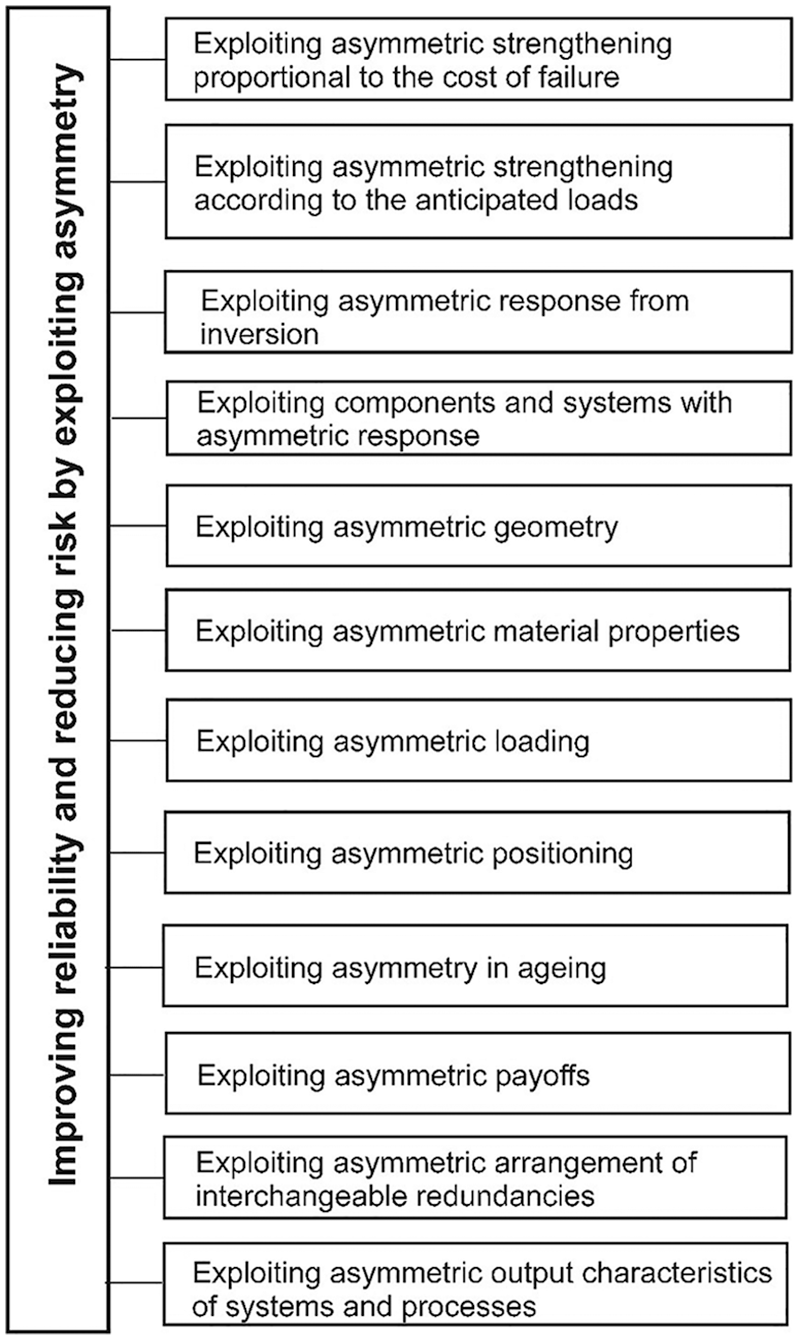
Classification of domain-independent techniques for improving reliability and reducing risk by exploiting asymmetry.
The next two sections focus on two new powerful low-cost techniques for enhancing reliability and reducing risk by exploiting asymmetry: ‘asymmetric arrangement of interchangeable redundancies’ and ‘exploiting asymmetric output characteristics’.
Improving system reliability by asymmetric arrangement of redundancies
In what follows, applications related to improving the reliability of common systems with redundancies at a component level will be proposed, by asymmetric arrangement of interchangeable redundancies.
The reliability improvement method is a low-cost, domain-independent and can be used for improving reliability and reducing the risk of failure in various unrelated domains.
This method is derived from reverse engineering of the algebraic inequality:
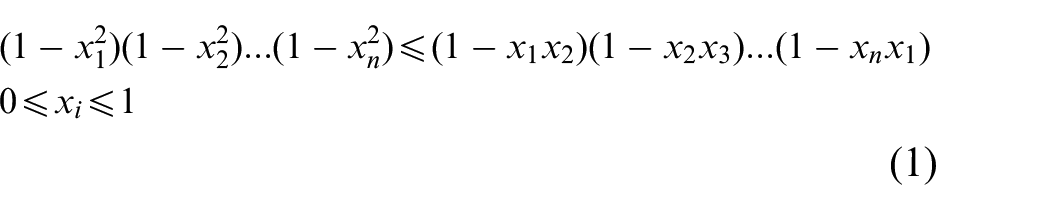
where
The proof of inequality (1) has been presented in the Appendix.
Now let
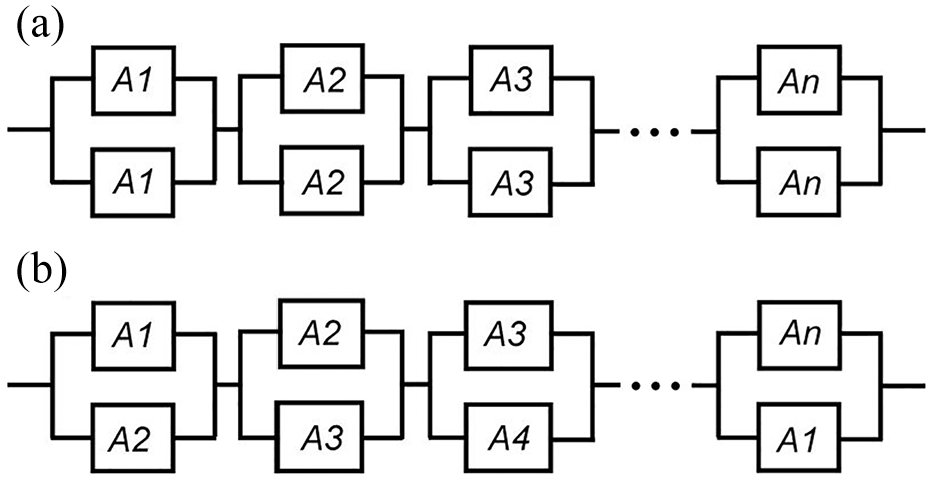
(a) Reliability network with interchangeable redundancies with: (a) symmetric and (b) asymmetric arrangement of the interchangeable redundancies.
Inequality (1) effectively establishes that the asymmetric arrangement of the interchangeable redundancies is always characterised by a larger reliability, compared to their symmetric arrangement, irrespective of the probabilities of failure
Note that even though the probabilities of failure
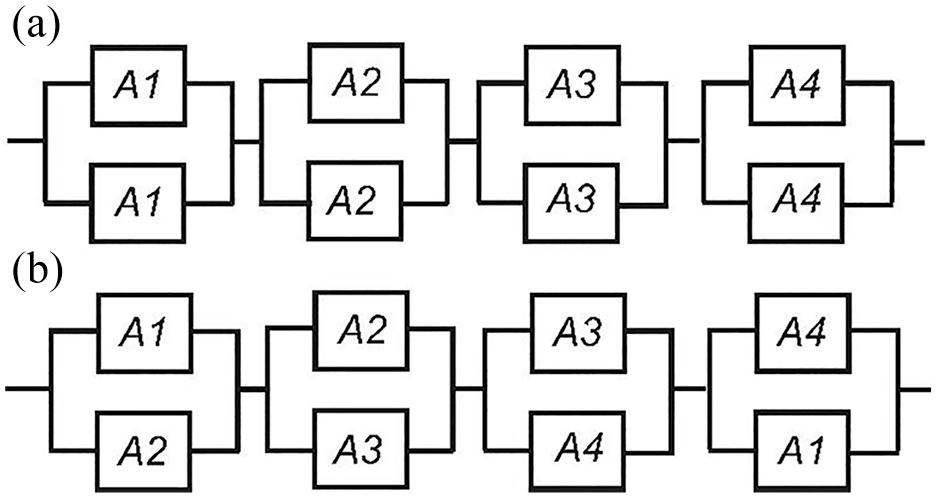
Reliability network demonstrating that no ranking of the reliabilities of the components is necessary in order to apply the method: (a) system with symmetric redundancies and (b) system with asymmetric redundancies.
We must point out that no particular ranking of the components by their reliability is necessary for the method to be applied. To demonstrate this, we select the series-parallel system in Figure 4 consisting of 4 sections connected in series.
The probabilities of failure of the components and the reliabilities of systems (a) and (b) are given in Table 1. The values
Reliabilities of the systems in Figure 4 for different values of the probabilities of failure of the components building the systems.
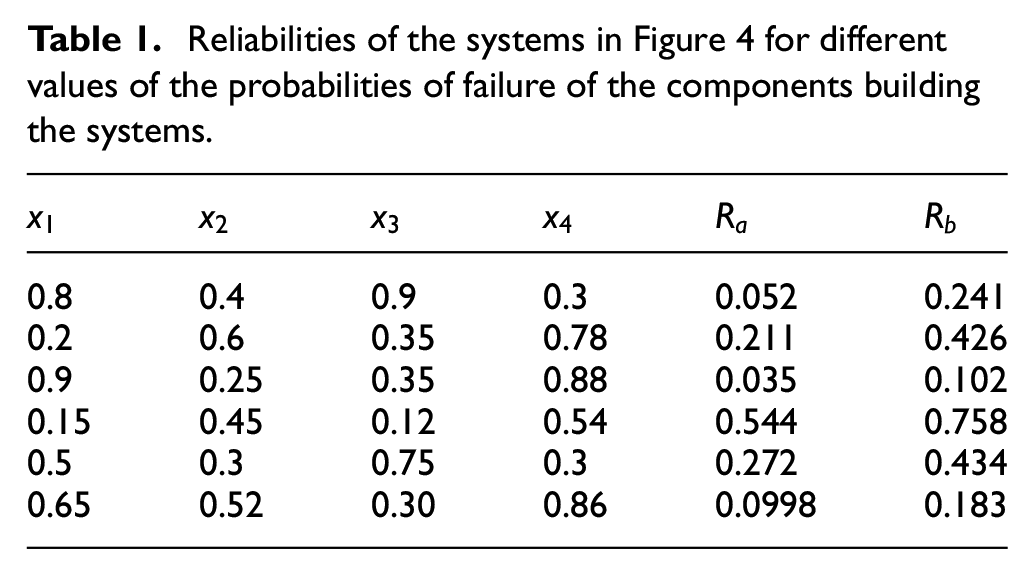
As can be verified from Table 1, in all instances of ordering the component probabilities of failure, the asymmetric arrangement of redundancies always lead to a system with superior reliability (
To maximise the reliability of the original system, in the presence of a total uncertainty about the probabilities of failure of the individual components, the arrangement of redundancies must be such that the original symmetric arrangement is completely destroyed in all parts of the system. Consider the system in Figure 5(a). The reliability of this system can be increased by swapping the redundancies in the first and second sections. This results in the system shown in Figure 5(b). However, the reliability of the system in Figure 5(b) can be further improved by destroying the existing symmetry in the third and fourth sections connected in series. This leads to the system shown in Figure 5(c).
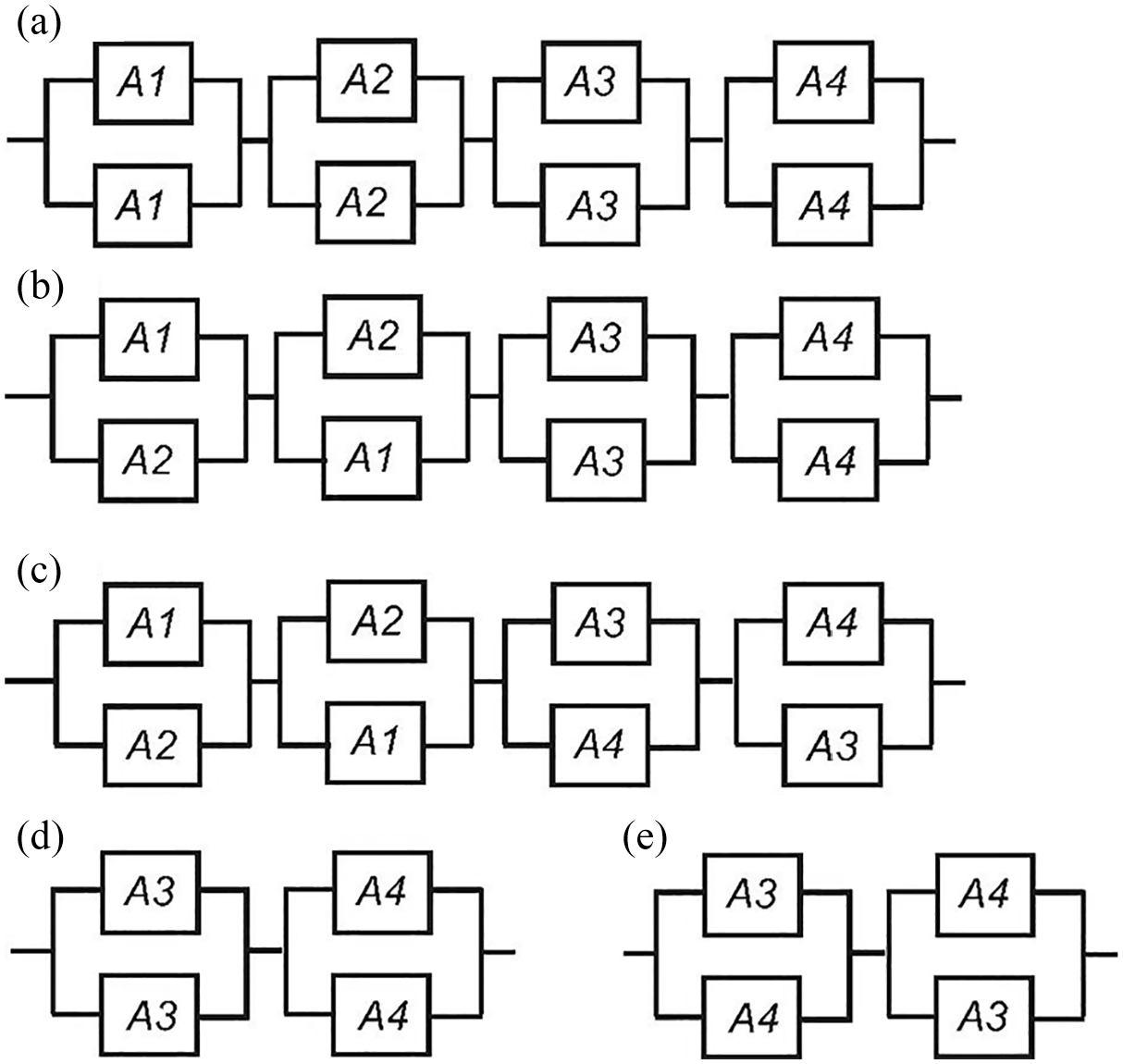
(a) Initial system, (b) system with improved reliability, (c) system with maximised reliability obtained by destroying the symmetry in all parts of the system (a); (d) a subsystem, connected in series within system (b); (e) a subsystem, connected in series within system (b).
Indeed, the system in Figure 5(c) has a greater reliability than the system in Figure 5(b) because:
(i) The section in Figure 5(d) is connected in series in the system from Figure 5(b), and the section in Figure 5(e) is connected in series in the system from Figure 5(c).
(ii) The section in Figure 5(d) has a smaller reliability than the section in Figure 5(e).
Interchangeable redundancies can involve different types of components, which correspond to real-world applications. For example, interchangeable redundancies of different types might include interchangeable seals of various kinds, such as O-ring seals, cartridge seals, pressurised and unpressurised seals, etc. Interchangeable sensors could measure the same quantity but operate on different physical principles. For instance, the temperature in two zones could be measured with thermocouples of different types, thermal resistors or bi-metal thermometers. Similarly, the pressure in two zones could be measured by bellows-type pressure gauges, manometer pressure gauges, piezometer pressure gauges, Bourdon tube pressure gauges and capsule pressure gauges.
Interchangeable redundancies can also involve components of the same type but of different varieties. Examples of components of the same type but different varieties include components of a particular type but of different ages. Additionally, components of a particular type can vary if they are produced by different manufacturers. Components of the same type but different varieties also differ in their reliability values. Typically, new components of a particular type have greater reliability than older components of the same type. Similarly, components of the same type produced by different manufacturers also differ in their reliability.
An example of a mechanical system that can benefit from asymmetric arrangement of the redundancies is given in Figure 6. The system consists of n pipelines transporting toxic fluid with two valves on each pipeline. All valves are initially open and a signal to close is sent to all of them in order to stop the fluid in each pipeline.
The system is deemed operational when, upon receiving a command for closure, the flow is halted in all n pipelines. To enhance system reliability, each pipeline features a redundant valve. This redundancy implies that at least one valve on each pipeline must respond to the closure command to ensure that the flow in the pipeline is halted.
The valves are of types A1,A2,…,An, characterised by probabilities of failure to close on demand
The reliability network of the system in Figure 6(a) is given in Figure 3(a). It is a series-parallel system which is quite common in numerous engineering applications.
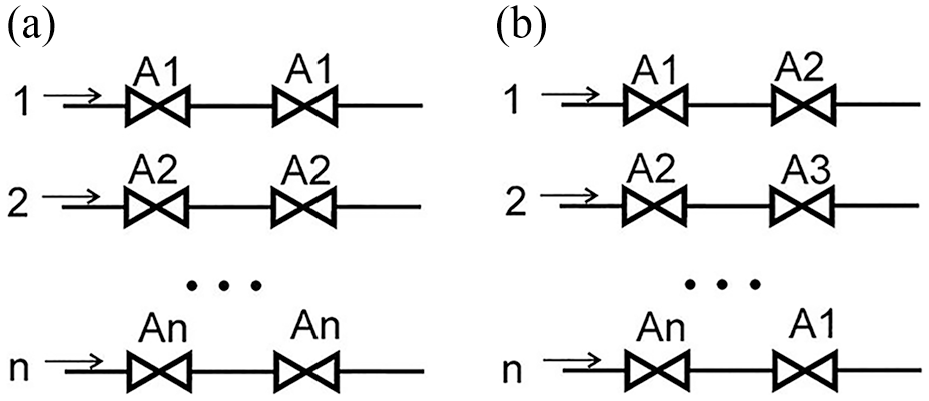
A system of n pipelines transporting toxic fluid with two valves of types A1,A2,…,An, on each pipeline: (a) symmetric arrangement of the redundant valves and (b) asymmetric arrangement of the redundant valves
The proposed reliability improving technique exploiting asymmetry is domain-independent. It can be used for any system with interchangeable redundant components: valves, sensors, seals, etc. In another example, Figure 7 presents a mechanical system that can also benefit from asymmetric arrangement of redundancies.
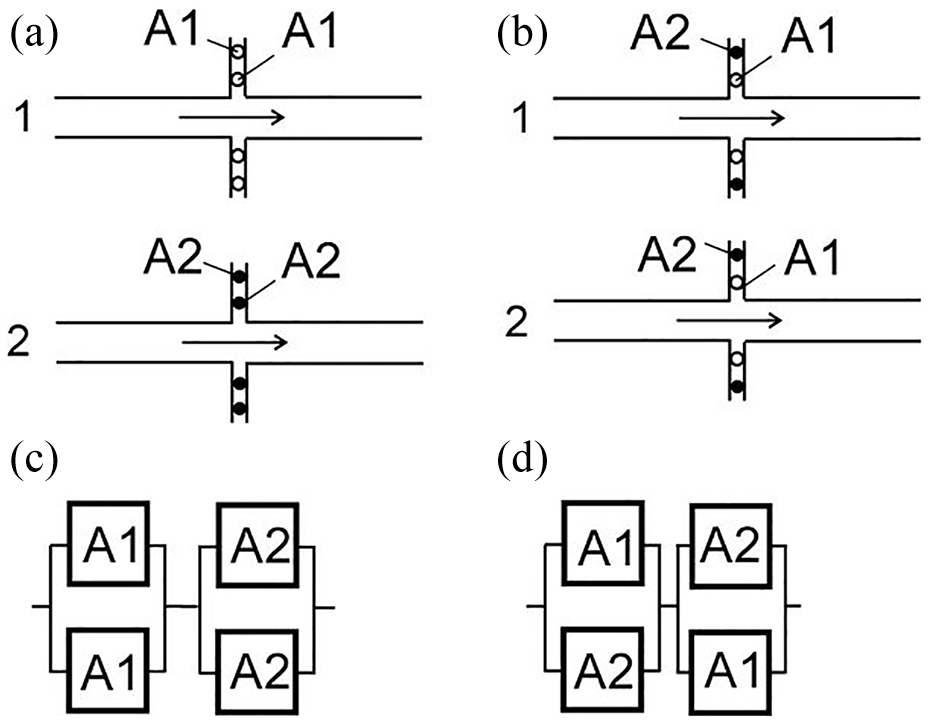
A system of two pipelines with flanges sealed with seals of types A1 and A2: (a) Symmetric arrangement of the redundant seals, (b) Asymmetric arrangement of the redundant seals, (c) Reliability network of system (a), and (d) Reliability network of system (b).
This system comprises two pipelines that transport toxic fluid. Each pipeline is equipped with a flange and each flange has two seals. For the system to be operational, at least one seal on each flange must prevent the toxic fluid from leaking out. To enhance the system’s reliability, one of the seals on each flange is redundant. This redundancy ensures that the flow within the pipeline remains isolated, provided at least one seal on each flange is functional.
The seals in the flanges are of types A1 and A2, characterised by probabilities of failure on demand

The left-hand side
According to inequality (2), the reliability of the system with mixed types of seals in Figure 7(b) is superior to the reliability of the system with the same type of seals in Figure 7(a) (
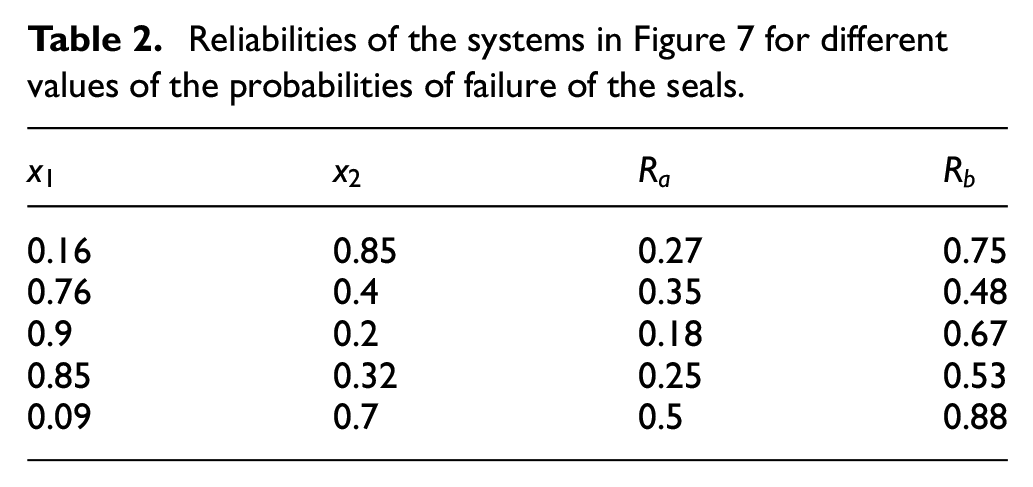
The difference in the reliability of the systems in Figure 7(a) and (b) can be significant as the next numerical example shows.
Suppose that, for a period of operation of 5 years, the probabilities of failure charactering the seals are


The reliability of the seals arrangement in Figure 7(b) is 2.78 times greater than the reliability of the seals arrangement in Figure 7(a)! The asymmetric configuration of seals in Figure 7(b) leads to a dramatic improvement in the system’s reliability.
Similar results are obtained for different combinations of values for
Reliabilities of the systems in Figure 7 for different values of the probabilities of failure of the seals.
Improving the reliability of series-parallel systems with multiple redundancies, in case of unknown reliabilities of components
Reverse engineering of algebraic inequalities can also be used to improve the reliability of series-parallel systems with multiple redundancies in case of unknown reliabilities of the components. It is assumed that each component in the systems has the same number of interchangeable redundancies. Consider the correct abstract algebraic inequality:

which has been rigorously proved in the Appendix. In inequality (3):
Let the variables, x, y and z in inequality (3) be physically interpreted as ‘probabilities of failure’ of components of type X, Y and Z. It can be shown that, in this case, the left- and the right-hand side of inequality (3) can be physically interpreted as the reliabilities of two alternative series-parallel systems.
Indeed, consider the physical system in Figure 8. It features three pipelines with three valves of types X, Y and Z, physically arranged in series. All valves are initially open. With respect to stopping the fluid in all three pipelines, the reliability networks corresponding to the physical arrangements in Figure 8(a) and (b) are given by Figure 9(a) and (b), correspondingly. These reliability networks represent the logical arrangement of the valves (which is different from their physical arrangement). Each section of three valves in parallel in Figure 9 corresponds to the three valves in series on each of the pipelines in Figure 8.
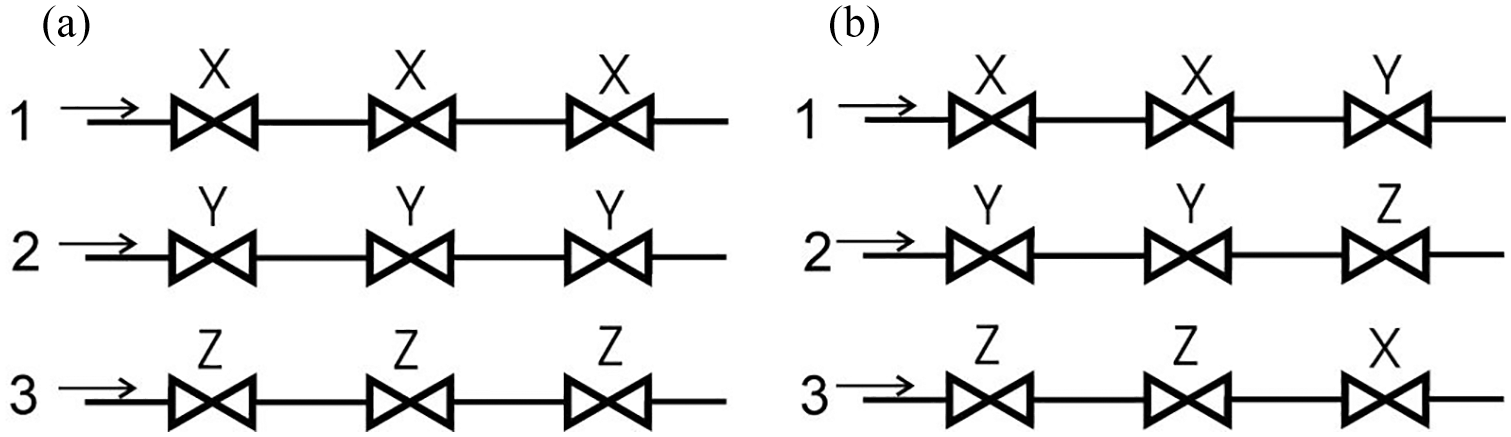
Functional diagrams of two different arrangements of valves on three pipelines. (a) Symmetric arrangement of the redundant valves; (b) Asymmetric arrangement of the redundant valves.
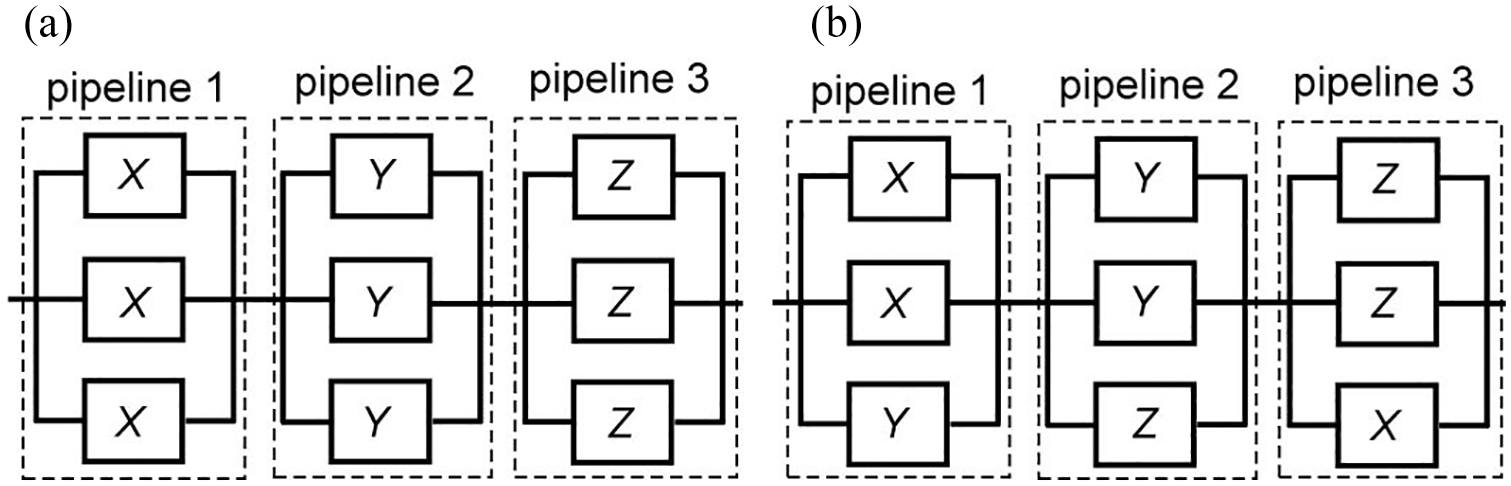
If the probabilities of failures of the valves of types X, Y and Z are denoted by x, y and z, respectively (
The reverse engineering of inequality (3) yields that the left-hand side of inequality (3) represents the reliability of the system in Figure 8(a) while the right-hand side of the inequality represents the reliability of the system in Figure 8(b).
According to inequality (3), the reliability of the system in Figure 8(b) is superior to the reliability of the system in Figure 8(a) and this conclusion has been made in total absence of knowledge regarding the probabilities of failure x, y and z of the three different types of valves or their ranking.
Inequalities similar to inequality (3) can be reverse engineered relatively easily because products of the type
In this connection, the inequalities (4)-(6), where



If x, y and z are interpreted as probabilities of failure of components from types X, Y and Z, the reverse engineering of inequalities (4)-(6) yields that their left- and right-hand sides correspond to the reliabilities of the series-parallel systems in Figures 10 to 12, correspondingly. The left-hand sides of the inequalities correspond to the reliability of systems ‘a’ while the right-hand sides correspond to the reliability of systems ‘b’.
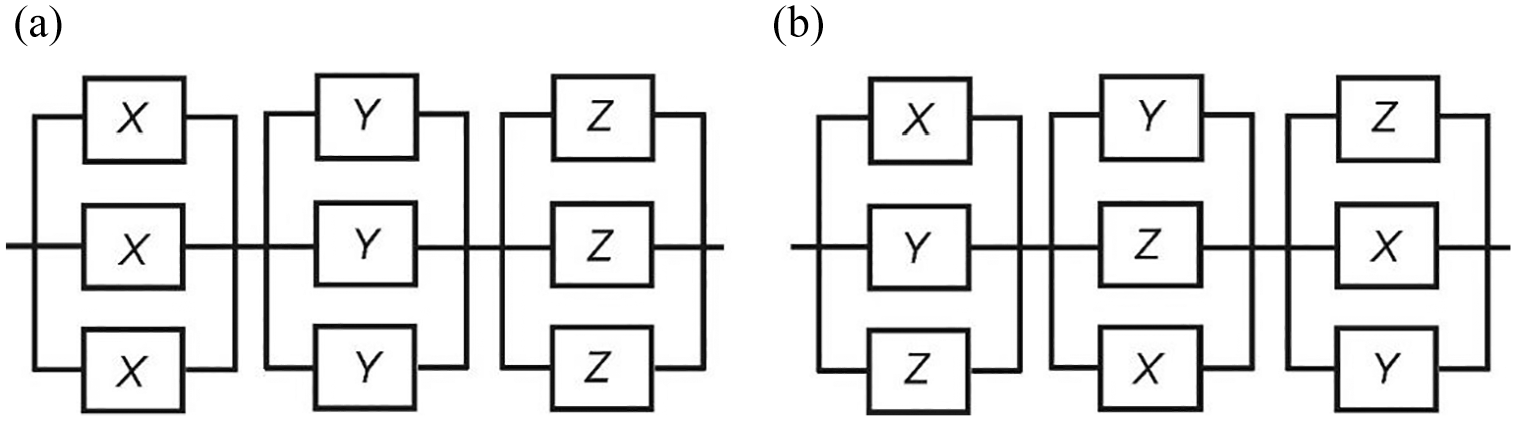
(a) A system obtained from the physical interpretation of the left-hand side of inequality (4) and (b) a system obtained from the physical interpretation of the right-hand side of inequality (4).
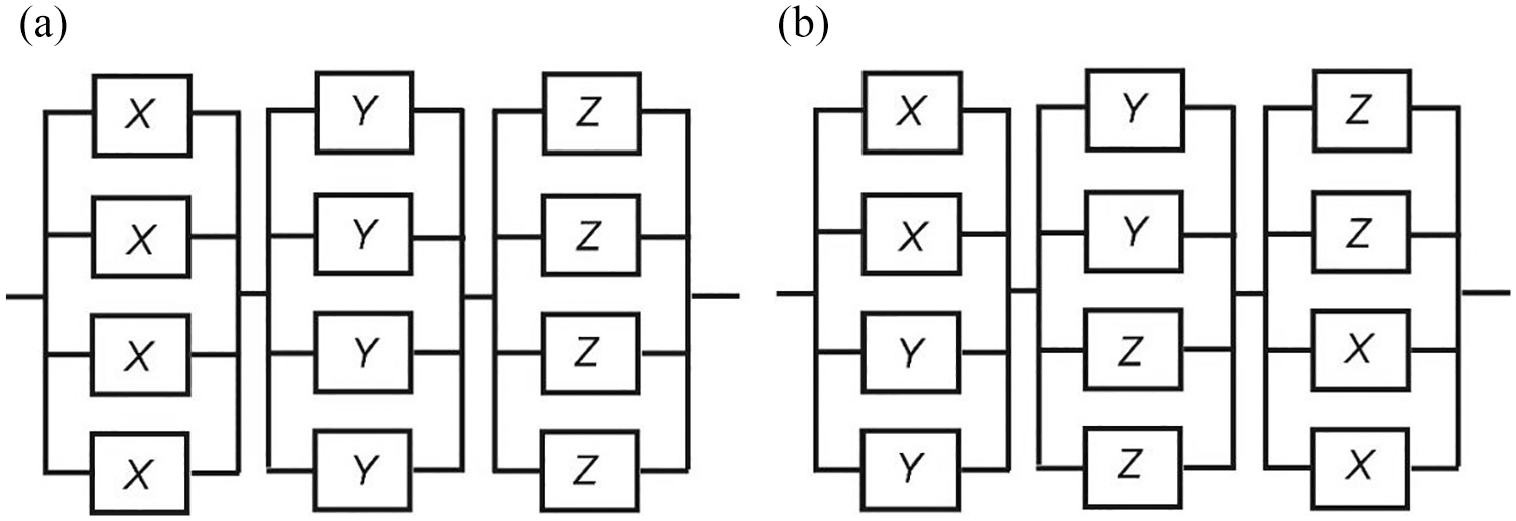
(a) A system obtained from the physical interpretation of the left-hand side of inequality (5) and (b) a system obtained from the physical interpretation of the right-hand side of inequality (5).
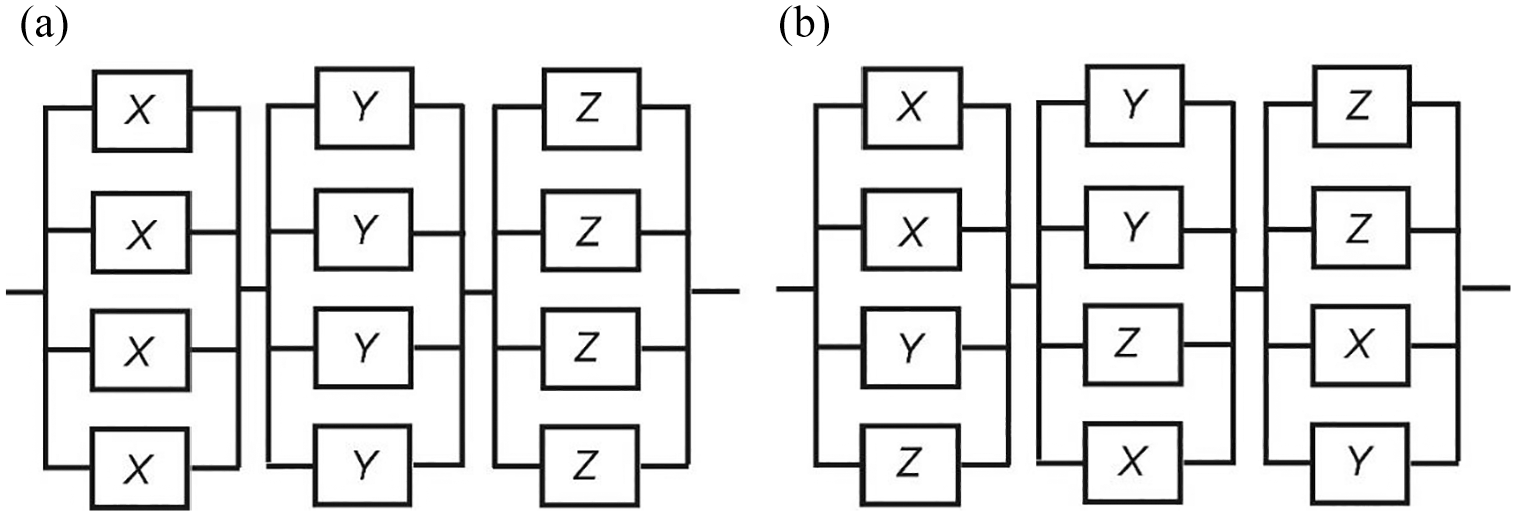
(a) A system obtained from the physical interpretation of inequality (6) and (b) a system obtained from the physical interpretation of the right-hand side of inequality (6).
The results obtained for systems with an equal number of redundancies cannot automatically be extrapolated to systems with a different number of redundancies in each section in series because systems with a different number of redundancies in each section are no longer symmetrical. If, for systems with unequal number of redundancies in each section, inequalities similar to inequalities (3)-(6) can be proved to be correct, then interchanging redundancies will result in system reliability improvement.
Exploiting asymmetric output characteristics to reduce the risk of pollution through reverse engineering of an algebraic inequality
If
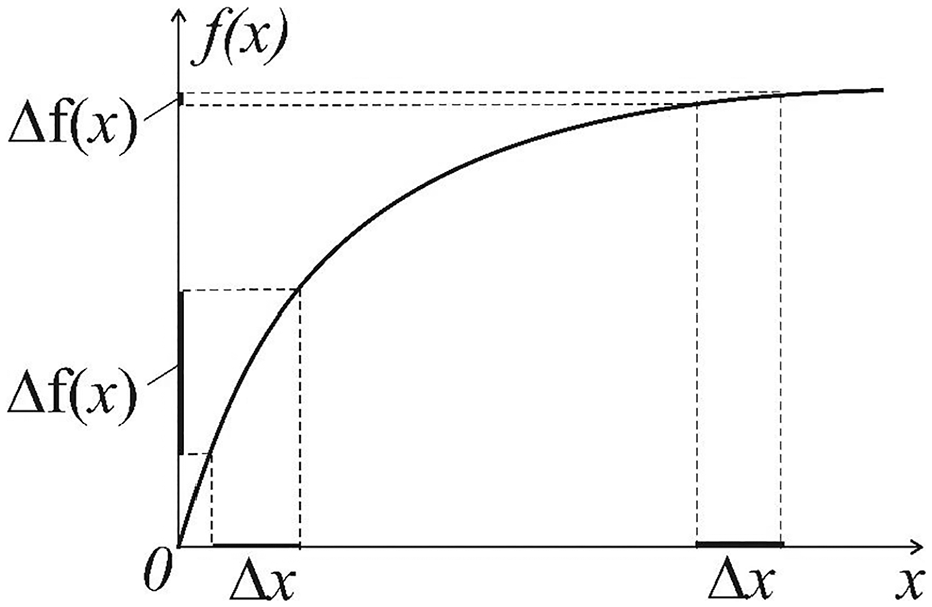
An asymmetric concave output characteristic used to develop robust designs.
Indeed, variations
There is however another, powerful use of the asymmetry associated with the output characteristic
Let the quantity

where
- The growth of a material’s strength or other properties as a function of the amount of reinforcing substance added can often be described well by a concave power law.
- Due to limited solubility, the growth of gas solubility in a liquid as a function of the partial pressure of the gas, can be approximated well by a concave power law.
- The rate of natural resource extraction, such as oil or minerals, often follows a concave power law, as the remaining reserves become increasingly difficult and expensive to access.
- Economic growth in mature economies often exhibits concave power law, as diminishing returns on investment and resource constraints limit the rate of expansion.
- The growth of skill or knowledge acquisition as a function of time or practice, often exhibits concave power law as individuals approach the limits of their potential.
Even concave functions that are not necessarily concave power laws can often be approximated very well by concave power law functions.
According to Fu et al.,
38
the dependence of the collection efficiency and thickness of the fibrous media in the filter, for a specified duration, is described by a nonlinear, concave curve reaching a region of saturation with increasing the thickness of the filter. A plot collection efficiency [%] versus log-thickness based on experimental results published in Fu et al.
38
can be fitted very well with a straight line (Figure 14) which shows that in the range 8–300 µm, the trend ‘Collection efficiency [%] – Thickness of filter in µm’ can be approximated very well by the concave power law (7) with power approximately equal to
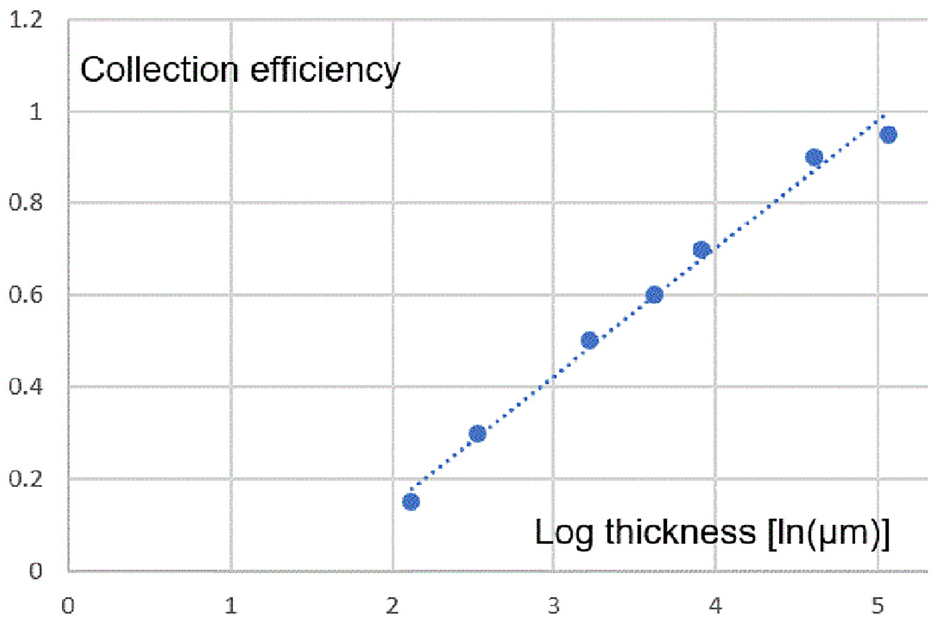
Collection efficiency versus log-thickness of the filter according to experimental measurements from Fu et al. 38
The quantity of the absorbed substance versus thickness of filter therefore is given by a concave power law (Figure 15). The asymmetry of the characteristics in Figure 15 can be exploited to increase the performance of such filters through reverse engineering of an algebraic inequality.
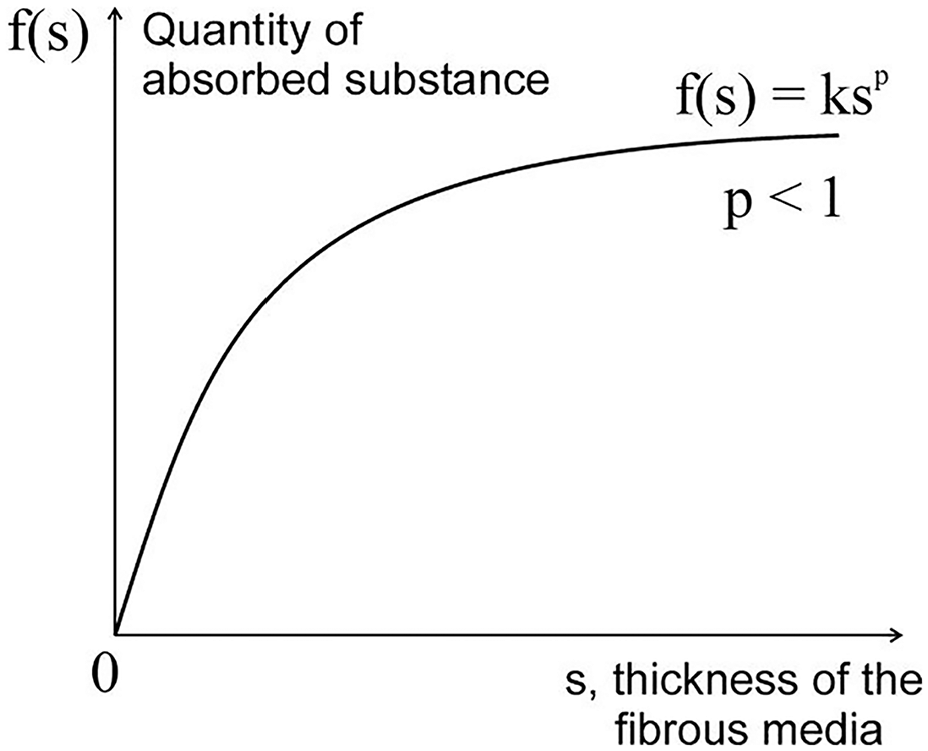
Quantity of absorbed substance (collection efficiency) versus thickness of the fibrous media in the filter, approximated by a concave power law.
Let the quantity

where
Consider the algebraic inequality

which always holds if
According to inequality (9), the quantity of absorbed harmful substance can be increased by segmenting the filter. This is because of the asymmetric, strictly concave dependence (8).
Segmenting the filter with thickness s of the fibrous absorbing media into smaller sections with thicknesses

and their sum results in a larger total quantity of absorbed substance because of the algebraic inequality (9):

Note that if the collection efficiency of the filter were symmetric (linear), there would not be any benefits for the collection efficiency. Indeed for

Note also that if the collection efficiency of the filter were non-linear and strictly convex (bending upwards), there would also be no benefits for the collection efficiency. In fact, there would be a reduction in the collection efficiency due to the segmentation. Indeed, in this case,

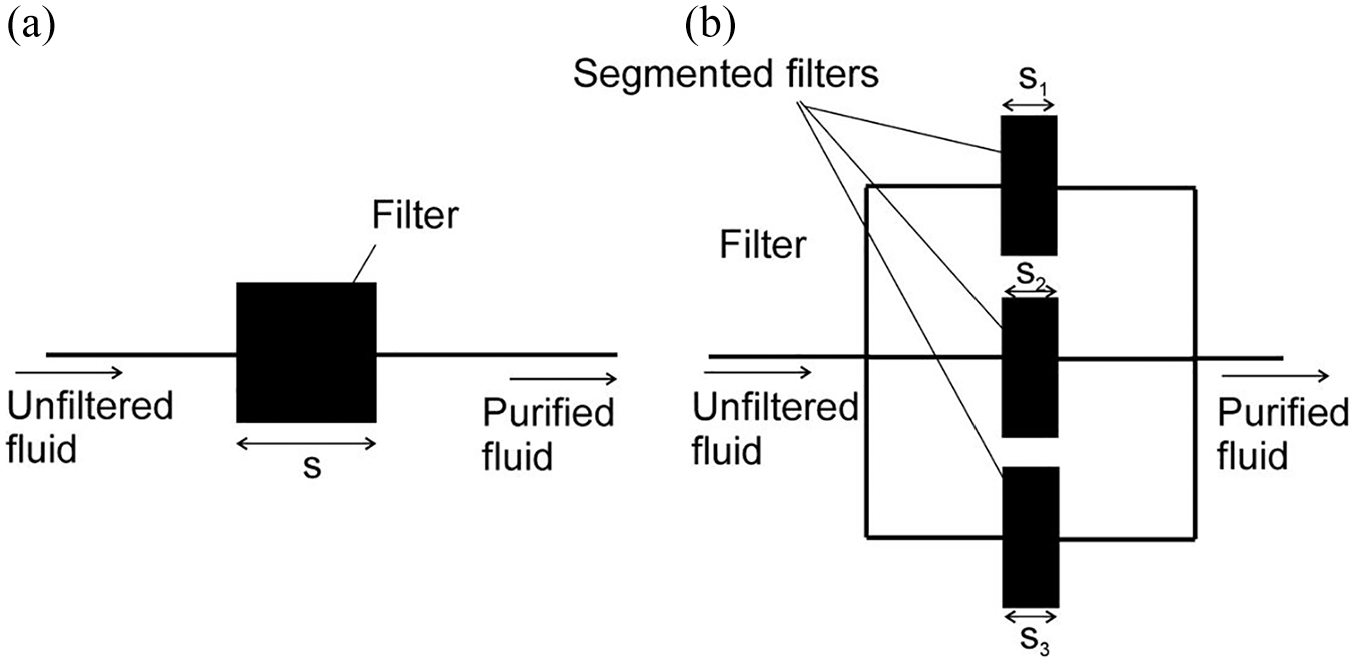
(a) Original and (b) segmented filter with greater collection efficiency.
Conclusions
A new, powerful, domain-independent method for improving reliability by exploiting asymmetry has been introduced, along with a basic classification of corresponding techniques. The classification of these techniques establishes a foundation for disciplined thinking and prevents the oversight of effective reliability-improving solutions exploiting asymmetry.
Despite the extensive research on redundancy optimisation, no existing technique has yet addressed the problem without requiring knowledge of component reliabilities. This paper demonstrated that system reliability can often be improved without any knowledge of component reliability values.
It has been established that for series-parallel systems, an asymmetric arrangement of interchangeable redundancies consistently results in higher system reliability compared to a symmetric arrangement, regardless of the individual reliability values (or probabilities of failure) of the components.
The proposed technique based on asymmetric arrangement of interchangeable redundancies is not associated with any implementation costs and can be used for improving reliability and reducing the risk of failure in various unrelated domains.
Through reverse engineering of a rigorously proved non-trivial algebraic inequality, an effective technique has been proposed for reducing pollution by exploiting an asymmetric non-linear output of a filter. This technique is applicable to improving the performance of systems and processes with nonlinear concave output.
Scope for future work
The future development of the ideas in this paper involves developing new low-cost techniques for improving reliability and reducing risk by exploiting asymmetry. New applications of the developed techniques will also be sought.
Footnotes
Appendix
Declaration of conflicting interests
The author(s) declared no potential conflicts of interest with respect to the research, authorship, and/or publication of this article.
Funding
The author(s) received no financial support for the research, authorship, and/or publication of this article.
