




Abstract
By enabling consumer products to be produced on demand and eliminating waste caused by excessive production and transportation, 3D Printing Cloud Services (3DPCSs) are increasingly welcomed by non-professional customers. With more and more 3D printers becoming available on various 3DPCS platforms, the evaluation and selection problem of 3DPCS has attracted much attention for both novices and experienced users. In this paper, we propose a probabilistic-based extendable quantitative evaluation method for 3DPCS evaluation. This method combines the advantages of the information transformation technique, the multinomial distribution probabilistic model, and the uncertainty based weighting method. Evaluation factors, the major attributes that significantly affect the performance of a 3DPCS, are modeled using probabilistic models. At the same time, historical service data is introduced to dynamically identify and update the evaluation factors. Based on these parameters, the proposed quantitative evaluation method can support the evaluation and comparison of 3DPCSs. Numerical simulation experiments are designed and implemented. The corresponding results verify the effectiveness of the proposed evaluation model. The presented evaluation method can serve as the basis of service evaluation and selection on a 3DPCS platform. Although the focus of this work is on 3DPCS, the idea can apply to other types of cloud manufacturing services.
Keywords
Introduction
3D printing, also known as additive manufacturing, is a layer-by-layer deposition manufacturing process, which is used to make scaled three-dimensional objects directly from computer-aided design data, and the manufacturing process is automatically controlled. 1 Compared with traditional subtractive manufacturing, 3D printing has decisive advantages in saving energy cost and reducing material waste. 3D printing also has advantages in the fabrication capability of the complex geometric components, especially in the context of individualization manufacturing. According to a report 2 released by the McKinsey Global Institute, by 2025, the economic impact of the 3D printing industry probably could achieve $500 billion per year. The value of customization will play a significant role in this amazing change.
The prospect of the 3D printing industry is promising and the 3D printing service market is growing fast. 3 In the meantime, with the rapid development and application of cloud manufacturing technology,4–7 numerous 3DPCSs,8,9 as well as 3DPCS platforms10,11 are becoming available gradually. This allows both professional users and customers with little domain knowledge to enjoy the pervasiveness and convenience of 3DPCSs. However, as the number of alternative 3DPCSs is expanding rapidly, the selection of the appropriate service is becoming quite difficult. This phenomenon is especially acute for the customer with limited background knowledge on 3D printing. Efficient, convenient, and objective performance assessment method or capability evaluation technique for 3DPCS will not only support customers with their decisions on 3DPCS selection, but also benefits the healthy and orderly development of the 3DPCS market.12,13
Compared with traditional additive manufacturing service evaluation and selection problem, 3DPCS evaluation in individualized, networked, and service-oriented environment presents three new characteristics:
Individualized customer demand
In cloud environment, both professional and unprofessional customers are able to enjoy the convenience of 3DPCS. Since many customers print their models by using 3DPCS, thus 3DPCS have to respond to various individualized customer demands. That is to say, from a macro perspective, customer demand information is limited for the 3DPCS evaluation problem.
Numerous 3DPCSs
A large amount of 3D printing services with various capabilities are provided in the cloud environment. Idle 3D printing resources and capabilities can be accessed conveniently through the 3DPCS platform. The powerful resource aggregation capability of the 3DPCS platform provides abundant cloud services for customers. However, the expanded candidate set raises a new challenge for the 3DPCS evaluation and selection problem.
Large amount of available historical service data
Cloud architecture facilitates the data acquisition process of 3D printing services dramatically. Both inherent 3D printing service data and customer rating data can be acquired easily through the cloud service platform. 14 3DPCS data helps to reduce subjective factors and uncertainty factors, which can support the evaluation process.
There is no doubt that these features impose higher requirements and challenges for the 3DPCS evaluation. However, from another perspective, the emerging characteristics and available information also have the potential to inspire new ideas as well as provide novel approaches for 3DPCS evaluation.
In this paper, a multinomial distribution based probabilistic model for 3DPCS evaluation is proposed. Aiming at the new characteristics of 3DPCS evaluation, the proposed approach achieves 3DPCS evaluation based on the probabilistic method. The proposed evaluation approach is a dynamic iteration process based on historical service data, which meets customer requirements better in an individualized, networked, and service-oriented 3D printing environment. By modeling the key performance indicators of 3DPCS and transforming these indicators into standard description forms, multinomial distribution probabilistic models are constructed and then be combined using an uncertainty based weighting technique.
The main contributions of this paper can be summarized as follows. Firstly, the characteristics of the 3DPCS evaluation problem in personalized, networked, and service-oriented environment are presented. Second, by merging the information transformation technique and uncertainty based weighting synthetic method, a probabilistic-based extendable quantitative evaluation model is presented. Finally, a preliminary verification method based on numerical simulation experiment verifies the effectiveness of the proposed evaluation method of 3DPCS.
The remainder of the paper is organized as follows. Section 2 reviews the related work. Section 3 presents the evaluation process of 3DPCS as well as models of the key performance indicators. Support techniques of the evaluation approach, including rule-based information transformation technique, a multinomial distribution based probabilistic evaluation model, and uncertainty based weighting synthetic method, are presented in Section 4. Then, based on numerical simulation experiments, preliminary validation, and systematic analysis of the proposed 3DPCS evaluation method are presented in Section 5. Finally, Section 6 concludes the paper with discussions and recommendations for future work.
Related work
In recent years, research works on the combination of 3D printing and cloud manufacturing witness an upward trend.15,16 These researches consist mainly of 3D printing cloud platform architecture, 17 3D printing resource access, 18 3D printing processing monitoring, 19 3D printing resource optimal allocation, 20 and 3D printing service evaluation. 12 Besides, there also research work focus on profit mechanism 21 for the 3D printing cloud platform. Existing 3D printing service evaluation approaches can be generally classified into two categories, standard testing component-based method as well as expert knowledge and experience-based method.
The work by Roberson et al. 22 presents a 3D printer capability evaluation and ranking model based on a well-designed standard testing component. By printing the standard part on the candidate 3D printers, the evaluation method assesses the performance of each machine based on four selected criteria, building time, building cost, dimensional accuracy, and surface finish. While this paper introduces a quantitative evaluation and ranking system for desktop additive manufacturing machine comparison, it fails to consider various criteria such as material type and mechanical properties.
The work by Liao et al. 23 proposes a hybrid multiple-criteria decision-making framework for 3D printing service evaluation in the scenario of rapid prototyping process selection. First of all, the determinants for 3D printing service evaluation are established using the modified Delphi method. Then, evaluation criteria weights are derived using the DNP technique. Finally, the VIKOR method is introduced to evaluate and compare alternative 3D printing services. The proposed method achieves transformation from a qualitative assessment to a quantitative evaluation of 3D printing service. However, this approach is highly dependent on the experience of experts.
On the basis of a modified TOPSIS method, Bynn and Lee 24 developed a 3D printing service selection decision support system. Accuracy, roughness, strength, elongation, part cost, and build time are introduced as evaluation criteria in the system. Also, evaluation factor weights are given based on the analytic hierarchy process. By using multiple attribute decision-making technology and a test part which reflect users’ preference, the evaluation results are derived from the system. This method has an advantage in dealing with the evaluation criterion presenting with linguistic values. However, it requires much customer information and the computational process is quite complex.
Focus on solving preference evaluation as well as performance evaluation and 3D printing process selection problems, Zheng et al. 25 proposed a weighted preference graph approach and a fuzzy axiomatic design method based on rough set theory in their research work. Compared with existing approaches, their method has advantages in handling incomplete attribute information and objective evaluation issues. However, this method emphasis 3D printing process personalized selection rather than 3D printing service evaluation. In addition, it also has difficulty in implementing in cloud manufacturing environment directly.
Aiming at achieving personalized production in the 3D printing industry, Wu et al. 26 proposed a cloud manufacturing based 3D printing cloud platform architecture and studied the 3D printing service evaluation and selection problem in the cloud service platform. Time, cost, quality, trust, ability, and environment are selected as evaluation indexes for 3D printing service. Besides, the fuzzy operation theory is utilized to quantify service information and synthesis assessment result. However, as all evaluation indexes are described using fuzzy numbers, inherent data of 3D printing service is ignored. With the help of the cloud service platform, 3D printing service data is quite easy to acquire and can support the service evaluation process efficiently if properly used.
The work of Shi et al. 27 proposes a 3D printing process selection model based on triangular intuitionistic fuzzy numbers in cloud manufacturing environment. This 3D printing process selection model supports users to validate their design from the perspective of physical properties as well as manufacturing properties. However, as its focus on 3D printing process selection instead of 3D printing service comprehensive evaluation, the proposed method does not suit the numerous 3DPCS evaluation problem.
Besides, other supporting mechanisms for the 3D printing service evaluation and selection method include knowledge value measuring, 28 expert system, and fuzzy synthetic evaluation, 29 as well as graph theory 30 and matrix approach.31,32 While these methods employ different models to select 3D printing services and achieve relatively satisfactory results in certain scenarios, each of these approaches has some drawbacks in dealing with the numerous 3DPCS evaluation problem.
Regarding standard testing component-based method, the testing capability of a standard component is limited and it is absurdly costly to fabricate the standard testing component on numerous candidate 3D printers on the 3D printing service platform. For expert knowledge-based method, the evaluation process is highly dependent on the experience of experts, which is difficult to be applied in the scenario of massive 3DPCS evaluation. Besides, both these two kinds of methods rely on specific customer requirement information. Essentially, existing 3D printing service evaluation approaches are suitable for service evaluation and selection in small candidate size and relatively static 3D printing environment.
Abbreviations
S, manufacturing speed
Su, printed model surface
Evaluation process and index model
3DPCS evaluation process
By borrowing lessons from existing 3D printing service evaluation methods, referring to the cloud computing service evaluation approaches, and summarizing the experiences of experimental studies, a probabilistic-based extendable quantitative evaluation method for 3DPCS is proposed. In this evaluation method, probability model is introduced to deal with the uncertainty of the evaluation problem, and an objective weighting method is adopted to synthesize the final evaluation result. This section describes the evaluation process of 3DPCS. Overall, the whole process includes four steps, as shown in Figure 1.
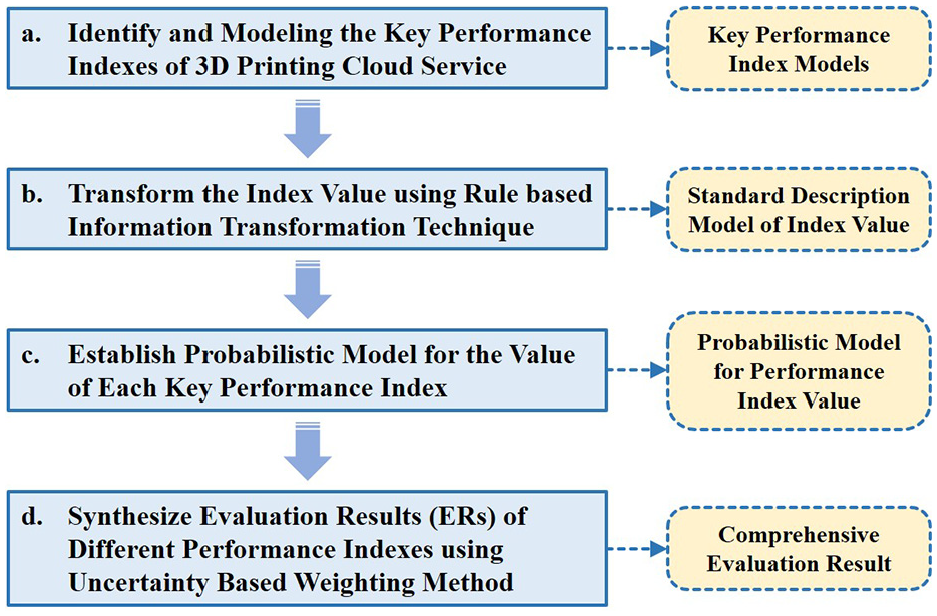
The evaluation process for 3DPCS.
Identify and model the key performance indicators of 3DPCS
Reasonable performance indicators can effectively describe the 3DPCS, and fundamentally support the entire service evaluation process. In cloud manufacturing environment, despite the difference in various manufacturing services, time, cost, and quality are still efficient abstract indexes for service performance representation. From the perspective of performance indicators, the essential difference between different manufacturing cloud services lies in the modeling process of the performance indexes. In other words, time, cost, and quality models of various manufacturing cloud services differ from each other in their calculation formula.
Specifically, evaluating indicators of 3DPCSs including build time, post-processing time, printing material cost, supplementary material cost, machine cost, labor cost, dimensional accuracy, surface roughness, thermal warpage, staircase effect, mechanical properties, color gamut, color output accuracy, and color output consistency. Each indicator represents a particular aspect of 3DPCS. However, these indicators can be generally classified into three categories: time, cost, and quality. For simplicity but without loss of generality, the time, cost, and quality are chosen as key performance indicators of 3DPCS in order to support the evaluation process. Section 3.2 gives a detailed modeling process of these performance indicators.
Transform the index value using the rule-based information transformation technique
According to the key performance indicator model constructed in the previous stage as well as the historical data of 3DPCS, the performance indicator value of 3DPCS can be obtained to support the evaluation process. As different performance index value has a different dimension, the rule-based information transformation technique is employed to convert the performance index value into standard description form, so as to eliminate the negative effect caused by dimensional inconsistency. Based on statistical information extracted from historical data of 3DPCS as well as professional experience, the conversion rules are provided by the domain experts. The details of the rule-based information transformation technique are given in Section 4.1.
Establish a probabilistic model for the value of each key performance indicator
The standard description model of key performance indicator value uses floating point numbers to express the membership degree of a performance index value to a certain service performance level. Generally, this standard description model can be described mathematically by using multinomial distribution probabilistic model. And the formal mathematical model can facilitate the computing process of 3DPCS evaluation.
Based on the standard description model of key performance indicator value for 3DPCS, the probabilistic model of each performance index value can be obtained. These probabilistic models are based on multinomial distribution. The maximum likelihood estimation method is employed to estimate the parameters of each multinomial probabilistic model. The process of establishing probability model and the corresponding parameter estimation method are given in Section 4.2.
Synthesize evaluation results (ERs) of different performance indexes using uncertainty based weighting method
In order to evaluate the performance of cloud service as a whole and simplify the process of comparison among various cloud services, a single index that comprehensively reflects the performance of 3DPCS is necessary. 33 In this stage, the uncertainty based weighting method is introduced to synthesize the ERs of different performance indexes. Information entropy is used to measure the uncertainty of the probability model of each performance index. The basic idea of the uncertainty based weighting method is that there is a negative correlation between the uncertainty of an item and its weighting factor. Section 4.3 gives the detailed calculation formulas of the uncertainty based weighting method. After this stage, the final ER of 3DPCS is obtained.
Key performance indicator model
Key performance indicators are able to reflect the quality or performance of a 3DPCS efficiently. In this section, three core performance indexes, including speed, cost, and quality, are defined and described with mathematical formulas.
Speed estimation model
3D printing service time consists of 3D printer service time and labor service time. Speed of a 3DPCS can be estimated using the following formula,

where V refers to printed model volume, T represents printing time of the model, and
Cost estimation model
3D printing service cost including material cost, binder cost, infiltrant cost, machine cost, and labor cost.
34
Total cost of a 3DPCS,
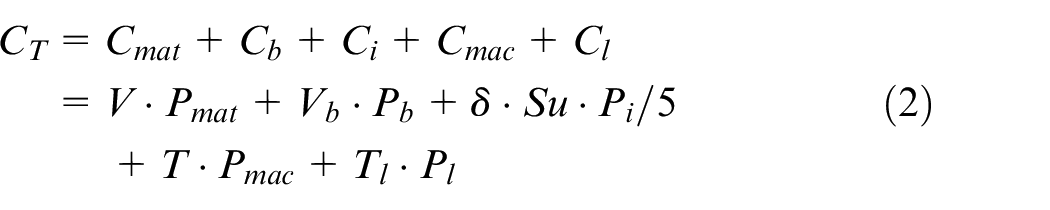
Service cost per unit volume of 3D printing service, C, can be calculated using formula (3).

Quality estimation model
Customer evaluation data plays a critical role in 3DPCS evaluation. 3DPCS platform generally adopt star-class assessment method for 3D printing service evaluation, intending to simplify the evaluation process for customer. An assessment frame with K grades can be represented as follows,

where
Support technology of the evaluation approach
The key support technique of the evaluation approach, the rule-based information transformation technique, is introduced in this section. By using the rule-based information transformation technique, the ERs of key performance indicators are converted into standard description forms. Besides, the multinomial distribution model for key performance indicators is presented. The probabilistic model parameter estimation method based on key index standard description form is given. In addition, this section also introduces the uncertainty based weighting method for ER integration.
Rule based information transformation technique
Transforming the key performance indicators assessment result into standard description form benefits the construction of probabilistic evaluation model for 3DPCS. Rule based information transformation technique 35 is employed to transform quantitative ERs into rating standard description form.
Consider standard description frame in formula (5), quantitative ER

To carry out the information transformation, empirical rules need to be extracted by domain experts. These rules associate each evaluation grade of the standard description frame to a specific value. The information transformation rules are represented as follows,

Information transformation process of

In formula (7), for

while for

After the transformation process calculated using formulae (7) to (9), parameter

Multinomial distribution probabilistic evaluation model
For a standard description form



By using parameter estimation method, the value of


Based on the above, a probabilistic evaluation model for 3DPCS consists of three multinomial distributions (speed, cost, and quality) with different parameters is presented as follows,

where
Uncertainty based weighting synthetic method
Aiming at combining different multinomial distributions in a probabilistic evaluation model, inspired by Ding et al.,
37
an uncertainty based weighting method is employed in this paper. And entropy is adopted as a metric for the uncertainty of a probabilistic model. For a multinomial distribution with parameter
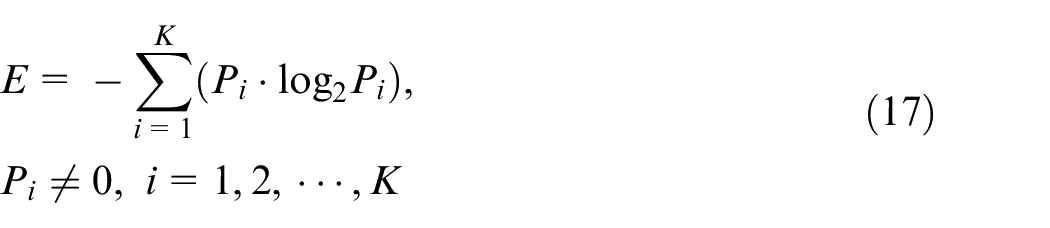
Consider a probabilistic evaluation model (18) consists of n multinomial distributions, according to the uncertainty based weighting method, weighting factor for each component can be calculated using formula (19) and the final evaluation value of probabilistic evaluation model (18) is calculated using formula (20).



Similarly, consider a probabilistic evaluation model for 3DPCS shown in formula (16), the final evaluation value can be represented as follows,
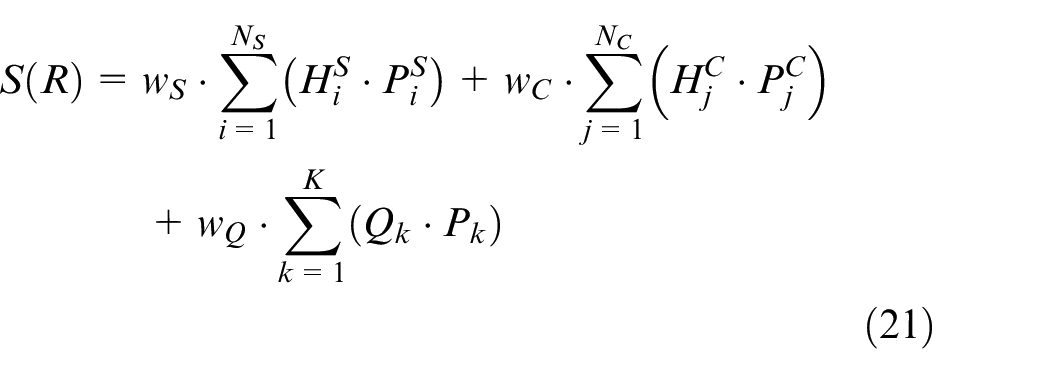
According to formula (16), the value of
Preliminary validation: Numerical simulation analysis
To demonstrate the feasibility and the performance of the proposed evaluation method, a group of numerical simulation experiments are designed for preliminary validation. The speed ER, the cost ER, the quality ER, and the comprehensive ER are selected as outputs of the numerical simulation experiments. It should be pointed out that the outputs are the results with weighting factors being taken into consideration. Therefore, the comprehensive ER is a summation of the speed ER, the cost ER, and the quality ER in the simulation experiments.
In the numerical simulation experiments, five different scenarios are set up for comparison. While these scenarios share the same parameter setting in speed and cost aspects, they are different in terms of quality parameter settings. Specifically, for the speed ER and cost ER, the probability of each level is set as (0.22, 0.35, 0.31, 0.08, 0.04) and (0.25, 0.5, 0.12, 0.13, 0), respectively. While for the service quality ER, Table 1 gives the probabilities of service quality level corresponding to different customer rating scenarios.
Probabilities of service quality level corresponding to different customer rating scenarios.
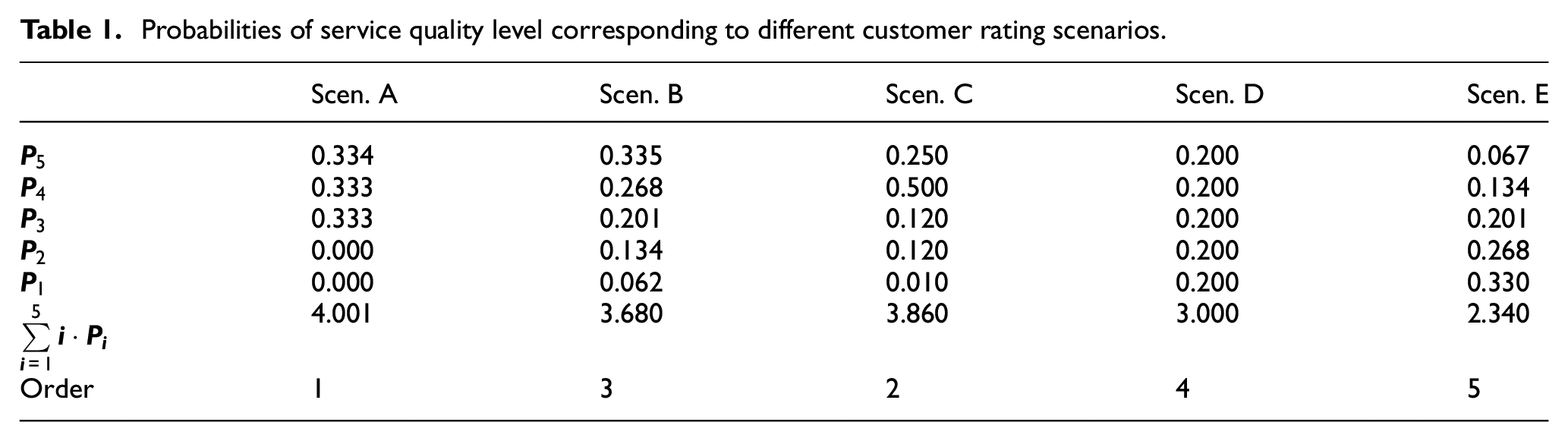
Figure 2 shows typical numerical simulation curves of the ER for a 3DPCS. As shown in the figure, in the early stage of the numerical simulation, the percentage of both speed ER and quality ER in the comprehensive ER decreased. However, the proportion of cost ER in the comprehensive ER has increased. Overall, the comprehensive ER shows a downward trend, and the attenuation rate slowed down obviously with the passage of time. Then, after running for approximately 1500 time steps, the numerical simulation enters the steady-state stage. To some extent, Figure 2 justifies the stability of the proposed probabilistic method for the 3DPCS evaluation problem.
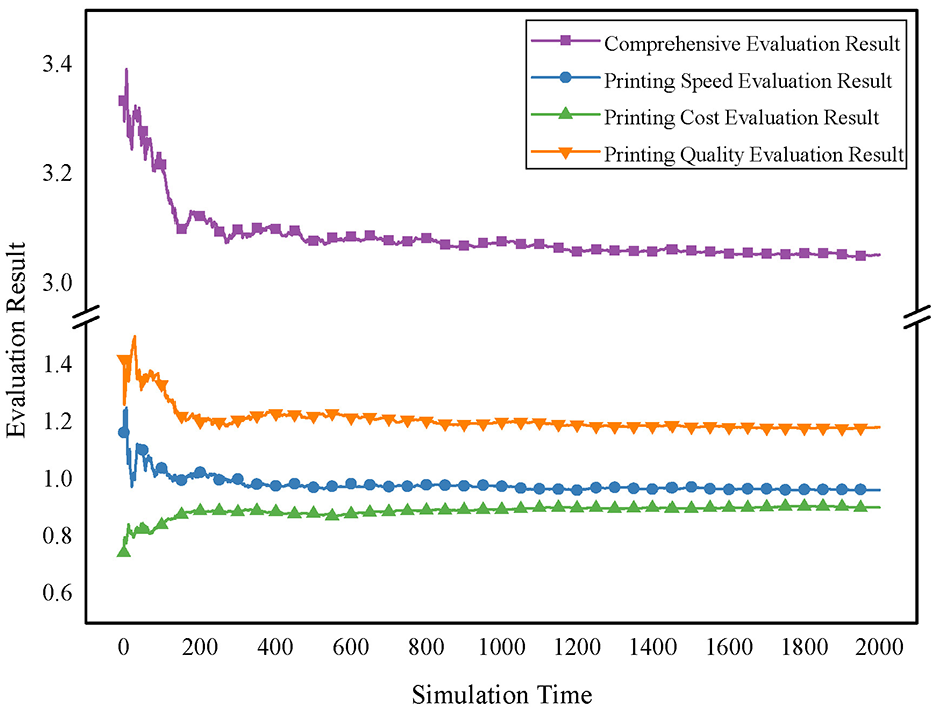
Typical numerical simulation curves of the ER for a 3DPCS.
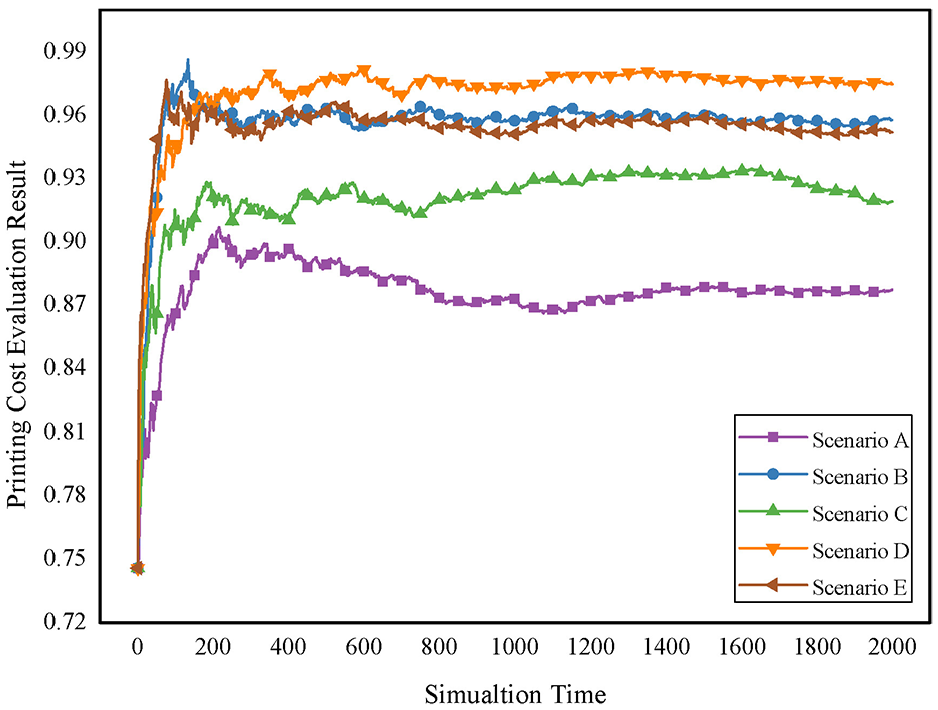
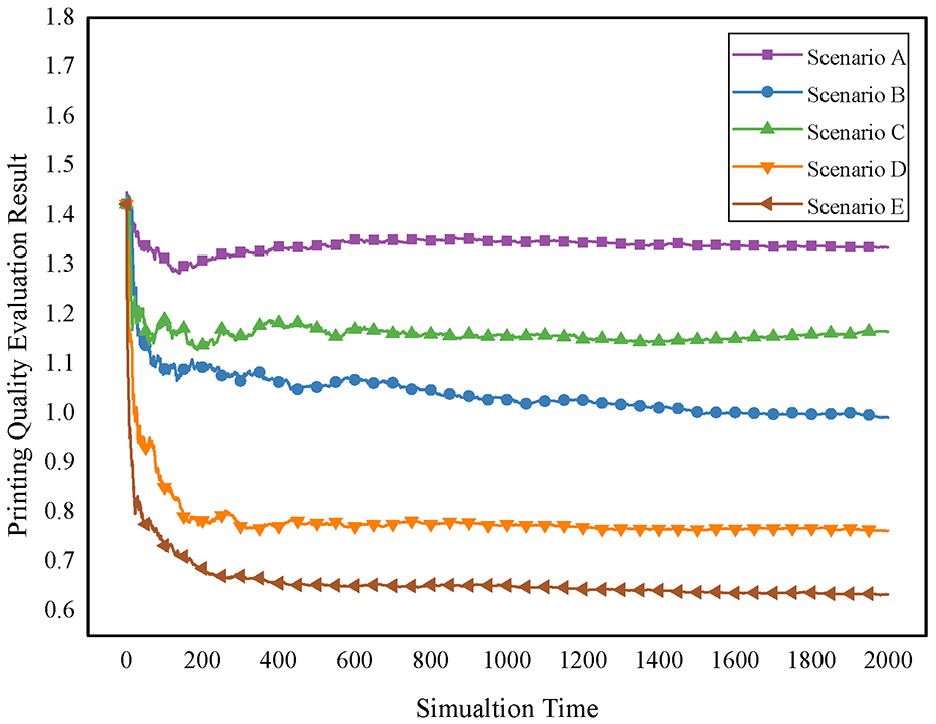
Figure 3 shows the evolutionary processes of the comprehensive ER for a 3DPCS in different customer rating scenarios. Corresponding to different customer rating, the evolution curves of comprehensive ER first drops sharply, and then gradually stabilize to different states, as shown by curves with different colors in the figure. It can be concluded from the curves shown in Figure 3 that a steady-state ER is closely related to the customer rating result. Specifically, for a 3DPCS, the more positive the customer rating is, the higher the comprehensive ER is. In order to analyze the influence mechanism of customer rating on the comprehensive ER for 3DPCS, numerical simulation curves of speed ER corresponding to different customer rating scenarios are given, as shown in Figure 4. Numerical simulation curves of cost ER, as well as quality ER, are also shown in Figures 5 and 6.
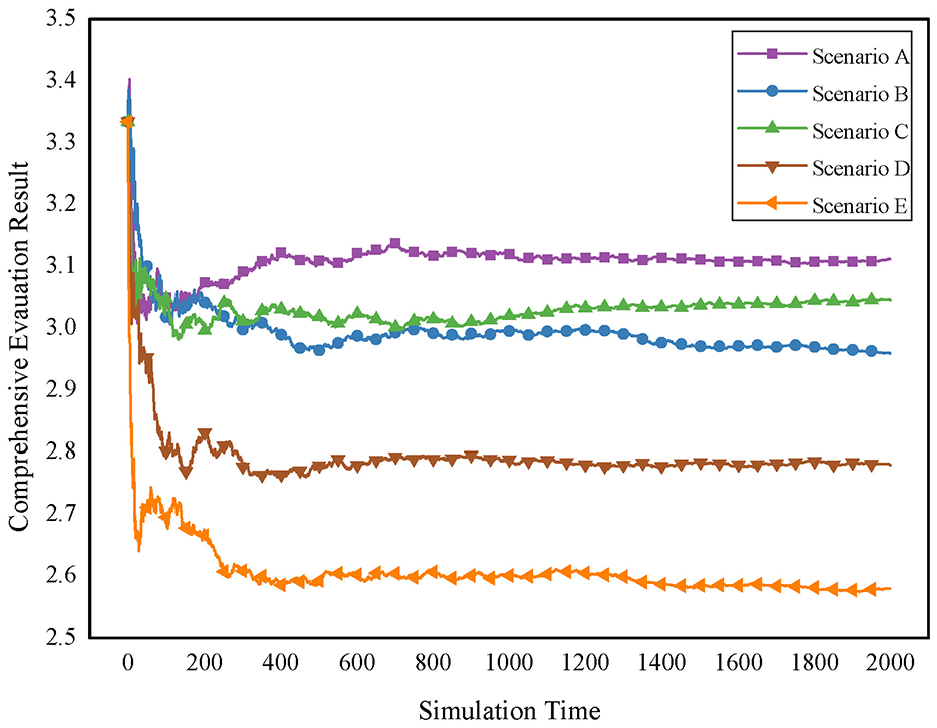
Comprehensive ERs in different customer rating scenarios.
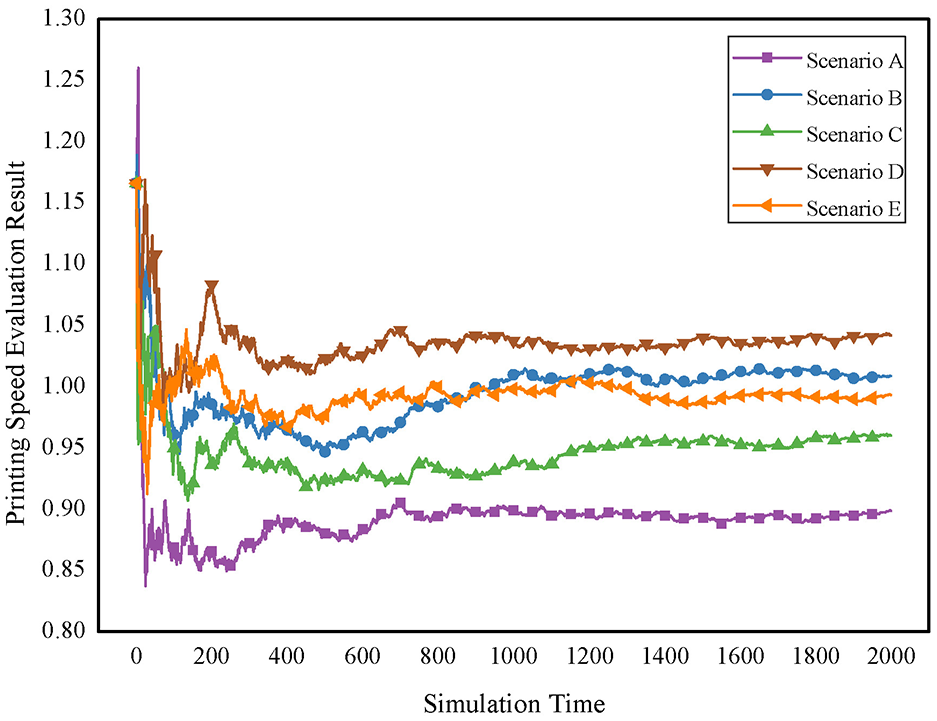
Printing speed ERs in different customer rating scenarios.
Printing cost ERs in different customer rating scenarios.
Printing quality ERs in different customer rating scenarios.
As customer rating data is the only direct variable in the numerical simulation experiments, the ERs of speed and cost in different scenarios are relatively stable, as shown in Figures 4 and 5, respectively. However, the results of speed evaluation and cost evaluation in different experiments are not completely the same. There are two factors that cause this phenomenon. One is the randomness of the probability distribution, and the other is the weighting factor influenced by the change of customer rating condition in different experimental scenarios. As the sum of weighting factors is 1, change of weighting factor of quality ER caused by changing customer evaluation data will inevitably change the weighting parameters of speed ER and cost ER.
As shown in Figure 6, quality assessment results are obviously different due to different customer rating scenarios. On one hand, according to the proposed 3DPCS evaluation method, different customer rating data result in different original quality ERs. On the other hand, the weighting factor of quality ER also change with the corresponding multinomial distribution, and the parameters of multinomial distribution are determined by the customer rating data. Positive customer rating data contributes to achieving a high original evaluation score for 3DPCS, while relatively consistent and intensive customer rating data helps to increase the proportion of weighting factor of the quality ER.
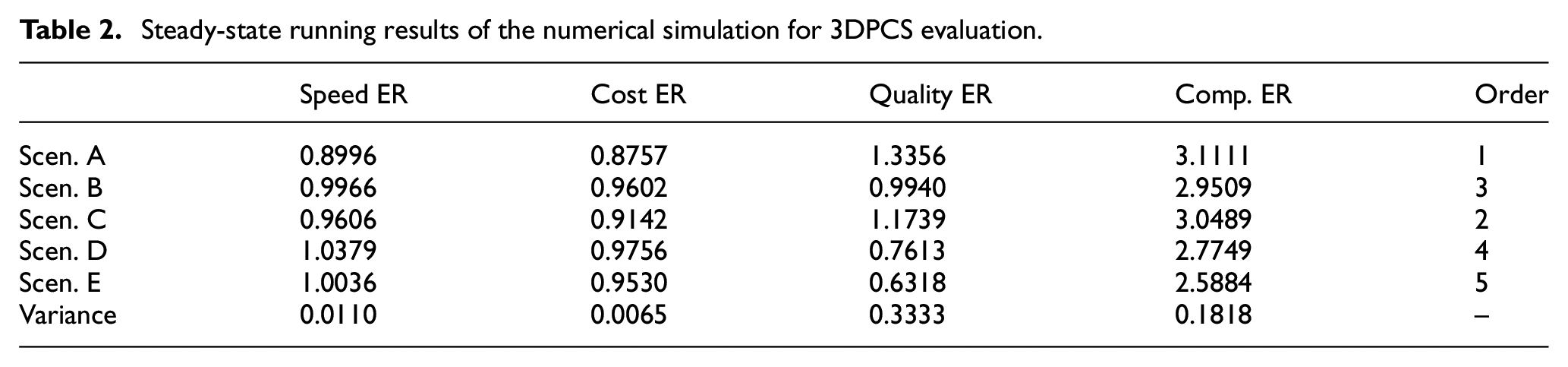
In order to further show the results of numerical simulation experiments, Table 2 gives the quantitative statistic results of experiments. It can be seen that the variance of quality ER is far greater than the variance of speed ER and cost ER. The variance of comprehensive ER is moderate, because the comprehensive ER is the weighting summation of speed ER, cost ER, and quality ER. These results are consistent with the conclusions drawn from the previous analysis.
Steady-state running results of the numerical simulation for 3DPCS evaluation.
Conclusions and future work
In this paper, the distinctive characteristics of the 3DPCS evaluation problem compared with traditional rapid prototyping system assessment or 3D printing machine selection are analyzed. Key performance indicator estimation models for 3DPCS evaluation are constructed, and a rule-based information transformation technique is employed to transform the assessment values of key performance indicators into standard description form. Multinomial distribution based probabilistic evaluation model, as well as the probabilistic model parameter estimation method, are presented. Uncertainty, measuring by information entropy, based weighting method is adopted to determine the weighting factor for each multinomial distribution. In order to verify the effectiveness of the proposed 3DPCS evaluation method, preliminary validation simulation experiments are carried out, and results of the numerical simulation experiments are systematically analyzed. Experiment results show the stability and robustness of the proposed evaluation method.
However, the proposed method still has limitations in two aspects. On the one hand, the expert experience is needed in the information transformation stage. On the other hand, the accuracy of the key performance indexes, as well as the precision of the evaluation model, conflict the computational complexity of the evaluation process to some degree. Besides, to ensure the high credibility of customer evaluation data employed in the evaluation method, additional data processing algorithms are needed in practice.
For future work, apart from service performance assessment, we will focus on the trust evaluation problem of 3DPCS, especially in the multi-service collaboration manufacturing scenario.
Footnotes
Declaration of conflicting interests
The author(s) declared no potential conflicts of interest with respect to the research, authorship, and/or publication of this article.
Funding
The author(s) disclosed receipt of the following financial support for the research, authorship, and/or publication of this article: The research is supported by the National Key Research and Development Program of China (grant number 2019YFB1705502), the National Natural Science Foundation of China (grant number 61873014).
