




Abstract
As the demands of customers in the modern industry increased, the number of products, and the variety of components has increased. These issues have led to difficulties in product development and production. Modularization of products has advantages such as cost reduction, product development time reduction, and production time reduction. Modular design of products has been studied in the design activities of the modern industry. In this study, a modular design method is proposed to design a modular product based on axiomatic design (AD) and design structure matrix (DSM). AD and DSM are efficiently integrated into the proposed method. Functional requirements and design parameters are defined based on the Independence Axiom of AD, and the zigzagging process of AD is employed for the decomposition of the functional requirements (FRs) and design parameters (DPs). The design sequence is established based on the design matrix. Coupled or functionally close DPs are grouped into a module (Module 1). These modules are efficiently used in the design sequence. DSM is used to modularize the design parameters of the lowest level of axiomatic design. DSM is constructed based on physical interfaces and numerical clustering algorithms are used to identify strongly related components. They are grouped into a module (Module 2). Module 2 is exploited for production and management. Therefore, these two modules for different purposes can be used to increase efficiency in the design and production process. The proposed method is applied to two automobile parts such as the suspension system and cooling system. The results are discussed from the viewpoint of usefulness.
Introduction
Design can be defined as the process of determining and evaluating the components, modes of operation, sizes, and dimensions of artifacts with functions and shapes that meet given purposes and constraints. 1 The process of designing a product can be roughly divided into three stages: conceptual design, preliminary design, and detailed design, or into two stages: conceptual design and detailed design.2,3 Conceptual design is the process of determining the overall functions and characteristics of a product that is needed to derive a solution for a given design problem. Although conceptual design is one of the most important processes of product design, it has been understood as an engineering activity with a strong tendency to be governed by the designer’s creativity or experience. Conceptual design is early work in product design and takes less time and money than the overall design time and cost. 4 However, conceptual design affects all subsequent design processes and decisions substantially. Small adjustments made later in engineering work have a much smaller impact on the final result, while wrong decisions at the conceptual design stage can lead to large defects. 5 Although conceptual design is important, it is less developed than the detailed design method. 3
Primitive conceptual designs, such as brainstorming, vary in degree, but most are carried out through the designer’s subjective view such as experience. 6 Conceptual design using a creative process can produce very different results due to various factors. Thus, most of the conceptual design studies focus on establishing the design process and related principles.7–10 Conceptual design methodologies such as axiomatic design (AD),11–18 TRIZ, and function analysis methods 19 have principles for the design process.
Meanwhile, the concept of modularity was introduced due to the increasing demands of the market.20,21 Increased market demand has led to increased product diversity and increased management costs. Modularity has been defined as “construction of standardized units of dimensions for flexibility and variety in use.” 22 Modular product architecture consists of modules, often clusters of physical components or functional building blocks with standardized interfaces. 23 The advantages of modularity include numerous benefits, such as the economies of component size, ease of product updates due to functional modules, and increased product diversity due to a smaller set of components, as components are used across the product family. 24 Recently, researches related to modular design have been actively conducted in the manufacturing industry.25,26 Many modular design techniques such as the design structure matrix (DSM),27,28 the modular function deployment (MFD), 29 etc. have been developed to take advantage of modularity. DSM was proposed by Steward. DSM was developed for projects or task management. 30 It also can be used to define product modules. DSM has a limitation, which most modular design methods have, in that it focuses only on the interrelationship between physical parts and does not consider functions. In DSM, we have the possibility that the modules can be functionally coupled. New designs generally are not made in the application of DSM. Meanwhile, axiomatic design is also used for modular design. 31 AD is a powerful method to identify the relationship between parts and functions and to create a new design. However, it has the disadvantage of the relationships between physical parts are not viewed in detail.
AD and DSM are integrated for modular design. Axiomatic design is not only used to make a new design but also to analyze and improve existing products. The zigzagging process of axiomatic design enables analysis of a large scale product. The design matrix from the relationship between the functional requirements (FRs) and design parameters (DPs) provides an efficient design flow. In AD, the coupled design is considered as an undesirable design so it should be changed to a decoupled or an uncoupled design. However, it is inevitable to have coupled aspects due to various reasons in some cases. For modular design, strongly coupled DPs in the design matrix can be assembled into a module. However, it is difficult to know the relationship between physical DPs in axiomatic design. A module from axiomatic design can have physically separated parts. The module can be exploited in the design process, but not in the production or management process. DSM is utilized in conjunction with axiomatic design to overcome the shortcomings of axiomatic design. The zigzagging process of axiomatic design is performed to make an entire design matrix and DSM is applied to the design parameters of the bottom level. In DSM, the components with a powerful physical relationship can belong to a module. Thus, functionally coupled parts can be in one module, and there may be a lot of feedback if this module is used in the design process. The modules defined in DSM are easy for production and management processes. In this research, two groups of modules are defined. One group consists of the modules from the design matrix of axiomatic design and the other is from DSM. Since the two modular designs have different advantages, it is necessary to use them for different purposes. The proposed method is applied to practical design problems such as an automotive cooling system and suspension system.
Background theories
Axiomatic design
Axiomatic design was created and popularized by Suh.3,32–34 In AD, the design is defined as “a continual interplay between ‘what we want to achieve’ and ‘how we want to achieve it.’” 5 “What we want to achieve” is the design objective and is defined as functional requirements (FRs). “How to achieve it” is physical objects which are adopted in the product to satisfy the functional requirements and defined as design parameters (DPs). In other words, the design is defined as the interaction between FRs and DPs. In AD, DPs should be defined so that the relationship between FRs and DPs satisfies the design axioms. There are two axioms: Independence Axiom and Information Axiom, and a good design should satisfy both axioms. Only the Independence Axiom is considered in this study. The Independence Axiom focuses on the relationship between FRs and DPs.
The domains and mapping processes are illustrated in Figure 1. 3 Based on the customer needs, FRs in the functional domain and the constraints are defined by a designer. And then, designers determine the DPs to satisfy the corresponding FRs in the physical domain. The FRs and DPs are decomposed into sub-level FRs and DPs until the complete detailed design of the bottom level is achieved. The FRs of the sub-level are determined by the characteristics of the DPs in the upper-level and the DPs of the sub-level are selected to satisfy the corresponding FRs at the same level in the zigzagging process. Hierarchies of FRs and DPs are generated during the zigzagging process. The relationship between the FRs and DPs in a level can be characterized as follows:

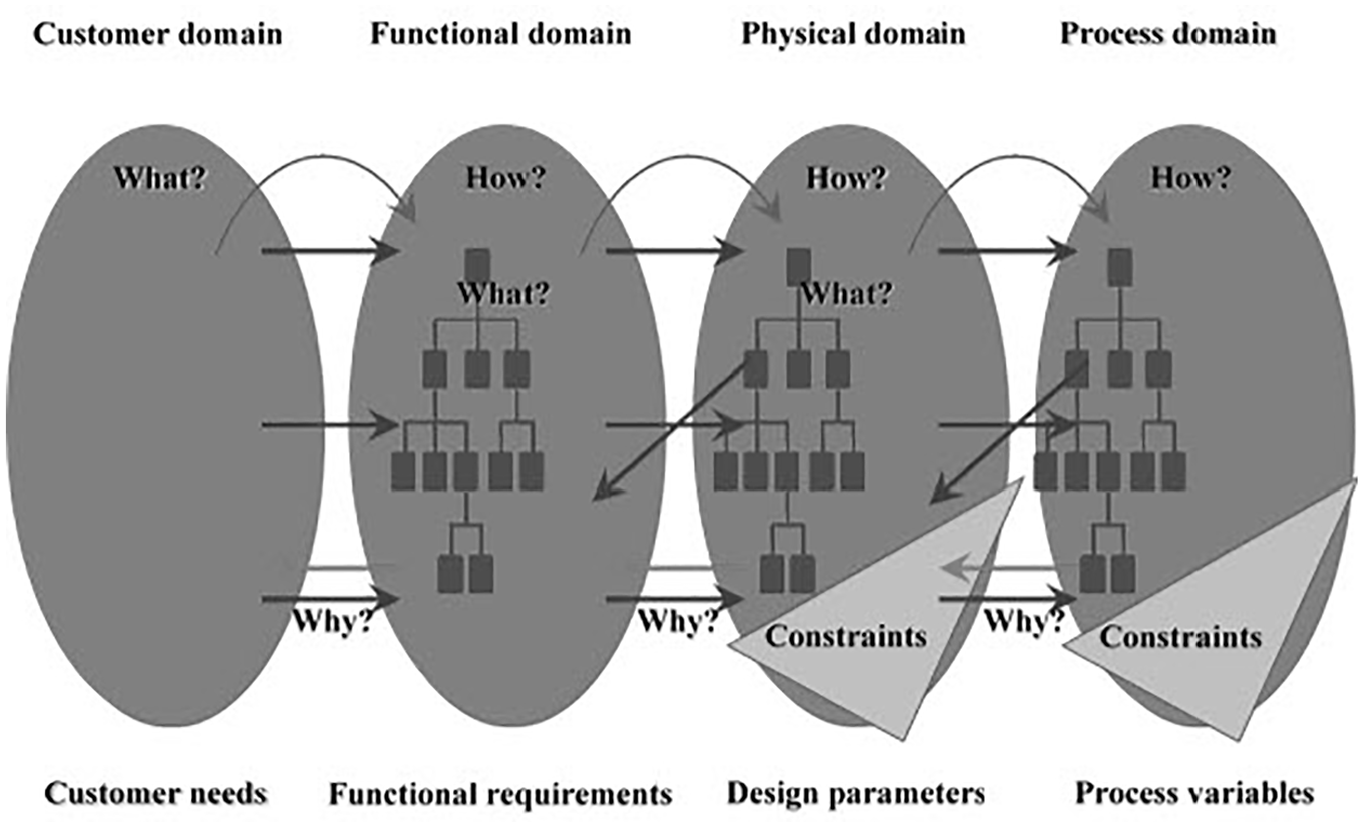
Concept of design, mapping, and spaces in axiomatic design.
A vector
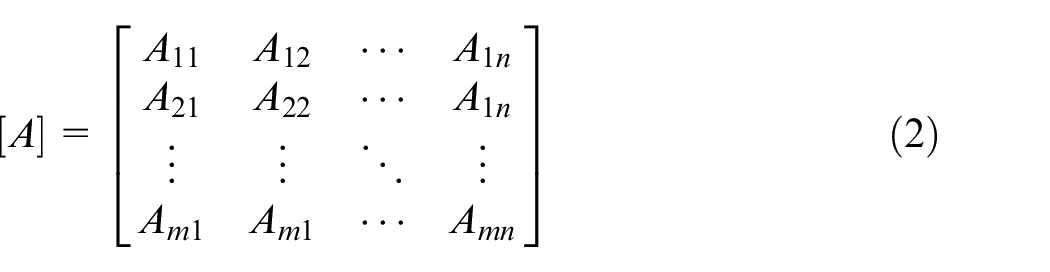
According to the design matrix, design can be classified into three categories. If the design matrix
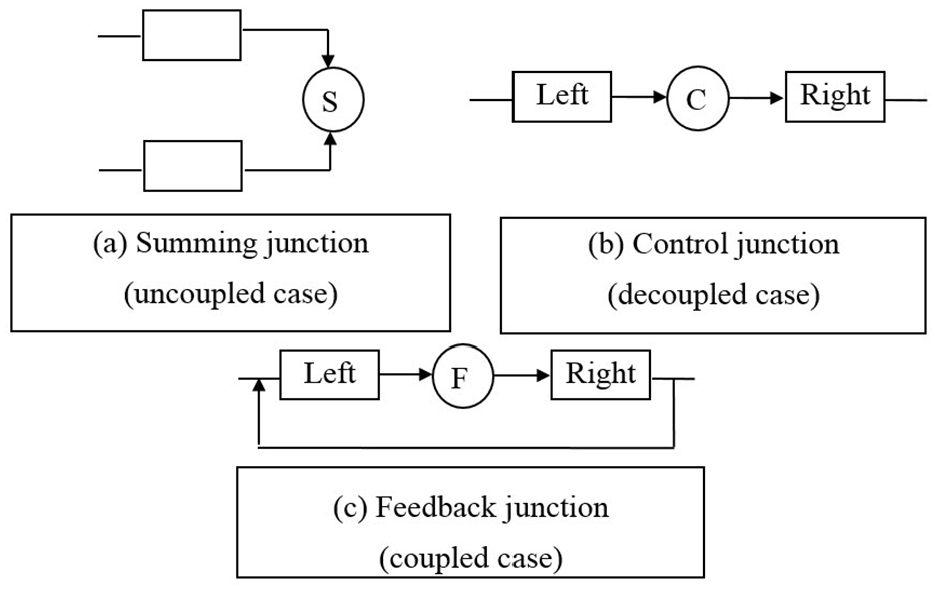
Representation of the design flow at each junction.
Axiomatic design has the advantage of defining the design sequence. When AD is employed, a new design can be created, and design improvement can be performed. It is noted that AD is efficient for large scale design problems. However, only relationships between FRs and DPs are identified and the physical relationship between DPs may not be shown exactly. Sometimes, the physical relationship is quite important to designers because it gives a rigorous picture of the product.
Design structure matrix
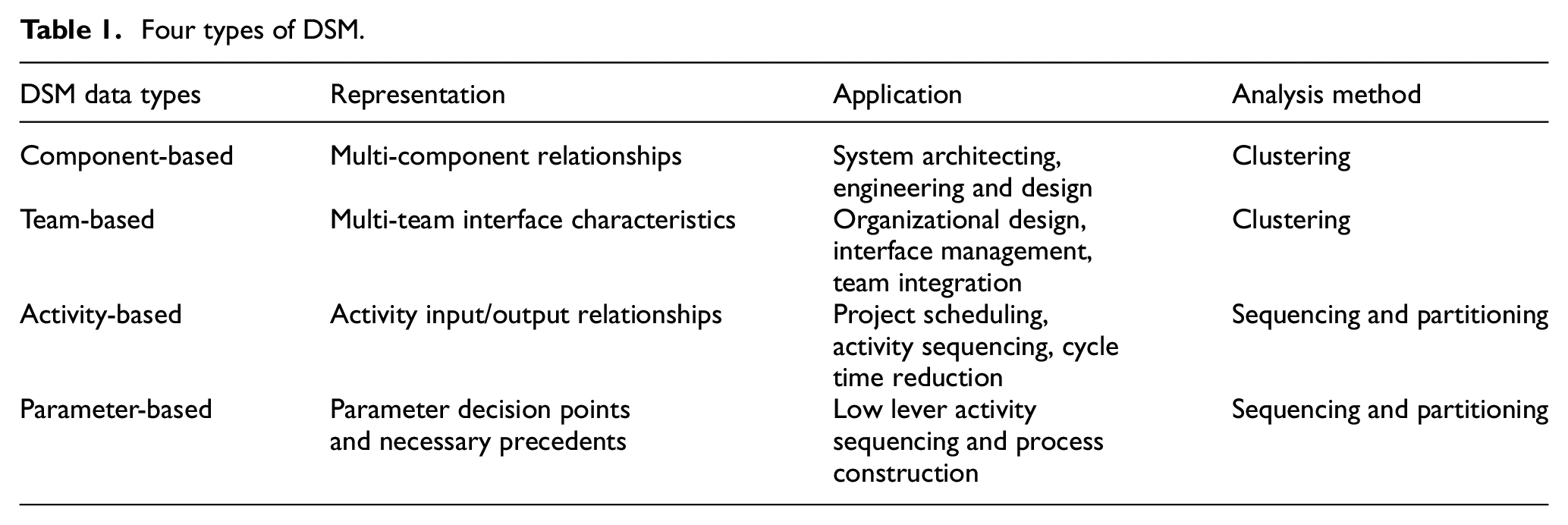
DSM was created by Steward 30 and is utilized to gather design parameters for modules. It was originally developed for projects or task management. It is often used to define product modules. The relationship between design parameters is expressed by a matrix as illustrated in Figure 3. DSM has been applied to make the modules of the products23,35–38 or to organize the organization, 30 project management,20,39 and working order management. 39 This technique is divided into a static DSM and a time-based DSM, and it is further subdivided into four types as shown in Table 1. Component-based DSM is mainly used to define the modules of a product while Team-based DSM is used to define an organization. Activity-based and Parameter-based DSM’s are usually used for project management and task management. In this study, Component-based DSM is employed as a technique for modularization.
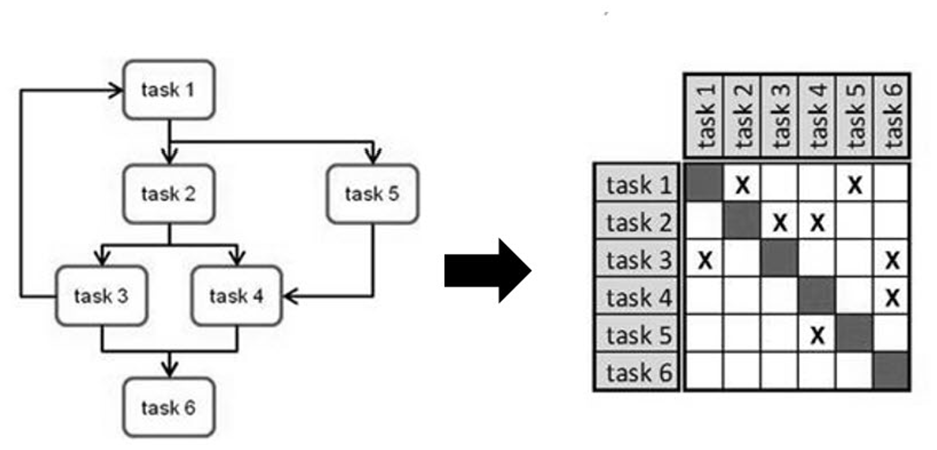
An example of design structure matrix (DSM).
Four types of DSM.
In component-based DSM, the relationships between components, which already exist, are identified and the components with strong associations are grouped into modules. Then product complexity is reduced and production efficiency is enhanced. Component-based DSM is performed in three steps. First, the system is decomposed into elements. Second, the interactions between the elements are identified. Interactions are analyzed and quantified in terms of spatial, energy, information, and material as shown in Table 2. The type of interaction can vary according to the nature of the given design problem. Interaction information can be obtained by interviewing team members of the engineering team or related experts. It can also be obtained from engineering models and real products. As illustrated in Figure 4(a), the obtained information is written by four quantified information in one cell, and the numbers are summed as illustrated in Figure 4(b). Finally, the DPs are clustered to group highly interactive elements. The goal of clustering is to minimize interactions between modules while maximizing the interaction between the components in a module. There are many clustering algorithms, and most of them are mathematical optimization methods.
Types of interaction.

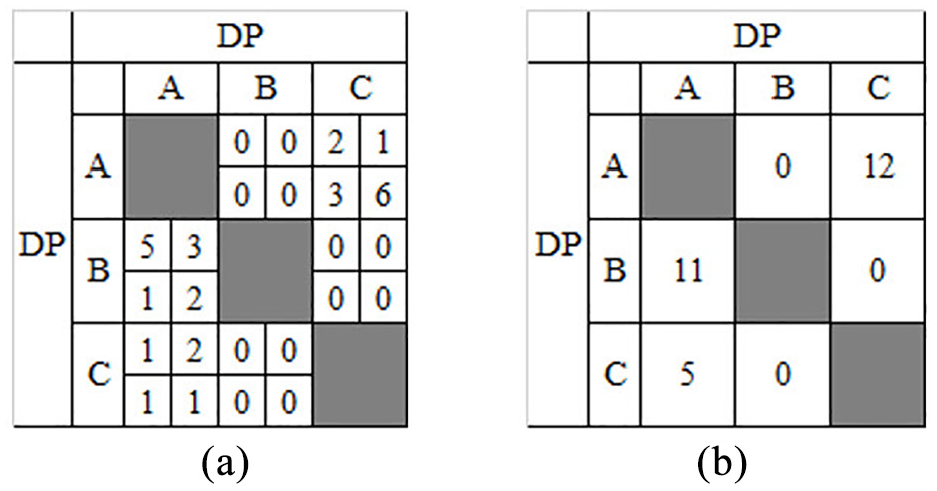
Examples of creating a DSM: (a) four numbers for each information and (b) summed numbers.
DSM typically shows the physical relationship between the DPs as a matrix and DPs are divided into groups. A strong physical relationship exists in a group. The modules are defined only by considering the physical connection between the DPs. Although DSM provides a sophisticated technique to analyze and decompose a complex system, it is difficult to create a new design by using DSM alone. Also, the method assumes that the designer knows the related FRs implicitly and there is a possibility that the FRs are functionally coupled.
Integration of axiomatic design and design structure matrix
Axiomatic design enables a designer to create a new design in the process of applying the Independence Axiom. A large scale system can be easily handled using the zigzagging process. The design structure matrix can make a modular design with the groups of close relationships for existing products. AD and DSM are integrated to generate a synergistic effect. The integration process is presented with detailed steps in Figure 5.
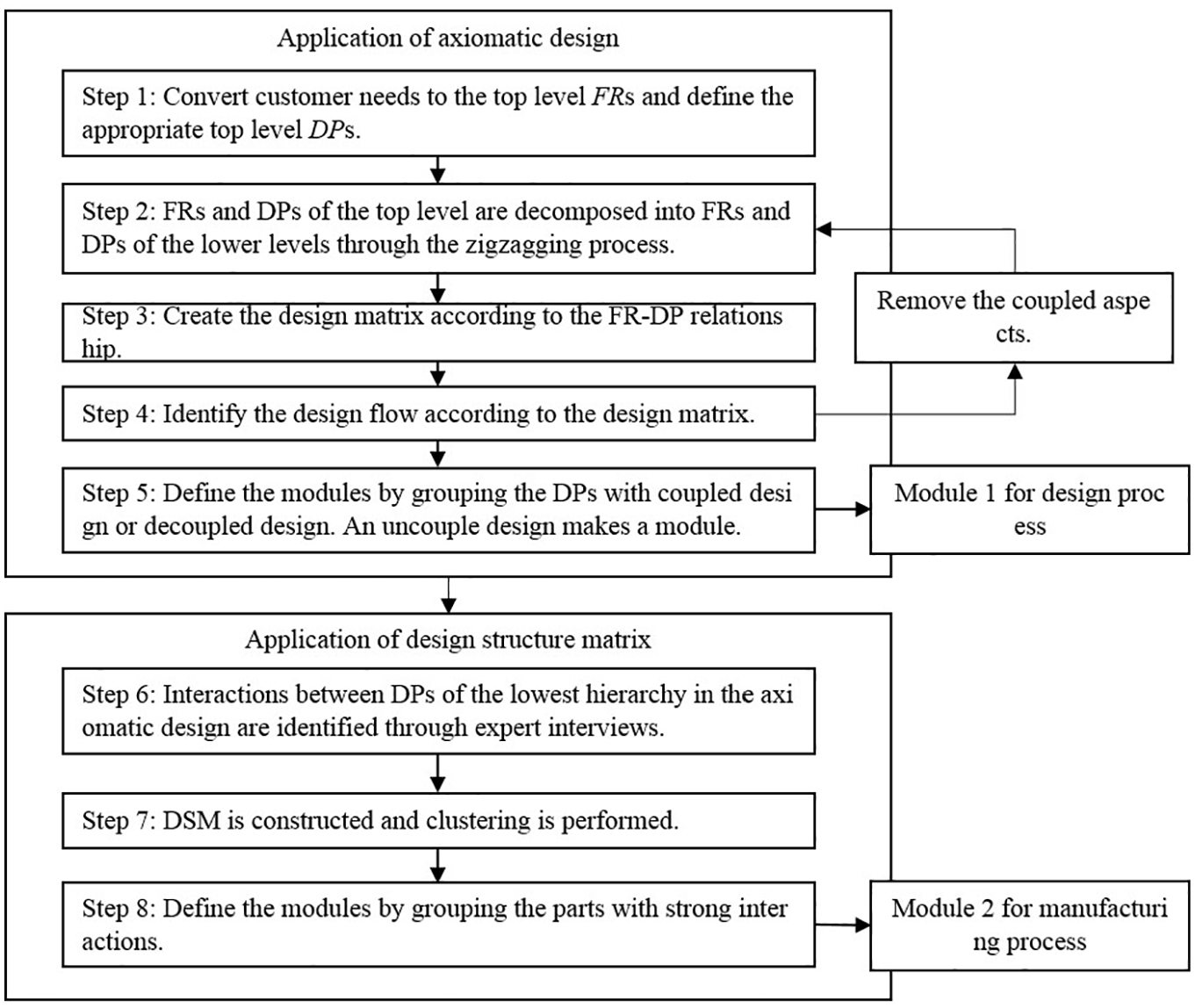
Integration process of axiomatic design and design structure matrix.
Two modular design results are generated from AD and DSM. In AD, a coupled design is supposed to be a bad design, and it should be changed to a decoupled or uncoupled design. This activity is performed in Steps 2–4 in Figure 5. However, there could be some inevitable coupled results due to various reasons. Such coupled parts can be included in a module. Module 1 is made up after Step 5 by grouping the DPs that make a coupled design or decoupled design. That is, DPs connected by a feedback or control junction are grouped and defined as a module. An uncoupled design can make a module as well. Module 1 in Figure 5 has multiple independent modules. Since the modules in Module 1 take into account the functional relationship without physical interaction, physically distant parts can be included in a module together. Therefore, Module 1 is a design module suitable for the design process. Using Module 1 in the design process can reduce the complexity of design iterations.
On the other hand, modules from DSM are defined by grouping the parts (DPs) with strong interactions. Physically close parts can be grouped into one module. These modules make Module 2 in Figure 5. A module in Module 2 can be manufactured or assembled although their designs are determined in Module 1. Module 2 allows for efficient handling of production management since the physical interactions are considered. In summary, Module 1 is for the design process and Module 2 is for the production and management process. Thus, the modules in Module 1 can be independently designed while those in Module 2 can be independently manufactured.
Application to automobile parts
The proposed method is applied to automotive cooling and suspension systems. It is quite difficult for non-experts to properly define the FRs and DPs of an automotive part. The zigzagging process is carried out through numerous meetings with practitioners working in an automotive company. Also, interaction information of DSM is obtained through interviews with professionals.
Design of the cooling system
Most internal combustion engines are fluid cooled using either air or a liquid coolant runs through a heat exchanger chilled by air. Recently, almost all automobiles employ liquid cooling systems for their engines as illustrated in Figure 6. The cooling system is made up of the passages inside the engine block and heads, a water pump to circulate the coolant, a thermostat to control the temperature of the coolant, a radiator to cool the coolant, a radiator cap to control the pressure in the system, and some plumbing consisting of interconnecting hoses to transfer the coolant from the engine to the radiator and also to the heating system of the car where the hot coolant is used to warm up the interior of the vehicle on a cold day. 40
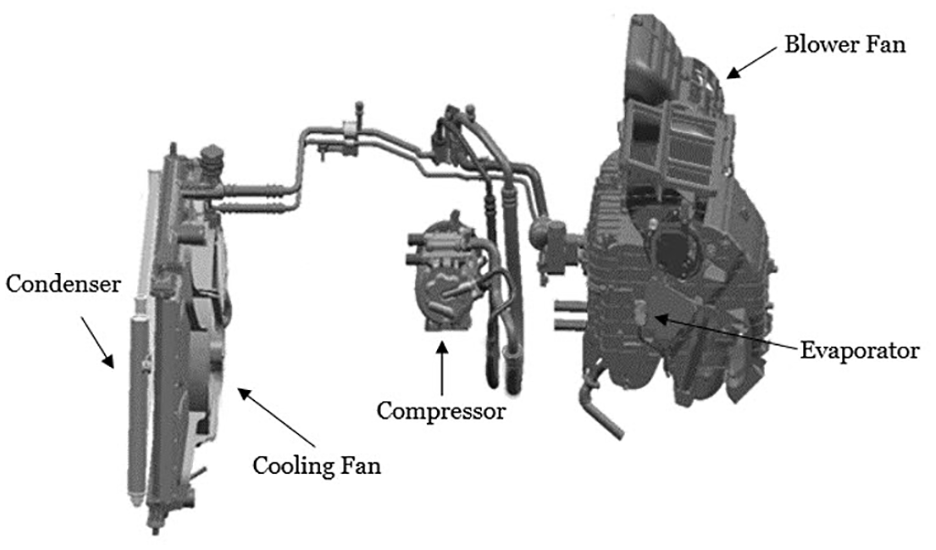
An automobile cooling system.
According to the customer needs, the top level FR and DP are defined as follows:
CN1: I want the inside temperature within a certain range
CN2: I want less environmental pollution
CN3: I want the vehicle fuel efficiency to be high
FR: Increase the energy efficiency of a hybrid car and maintain the inside temperature
DP: Cooling system
From the FR and DP at the top level, the lower FRs are defined and the appropriate DPs are also defined as follows:
FR1 = Maintain the temperature of the air inside the vehicle
FR2 = Minimize emissions of hazardous substances
FR3 = Minimize fuel consumption.
DP1 = Air conditioning system
DP2 = Hazardous material reduction system
DP3 = Energy management system
The design matrix of the second level is as follows:

The design equation is weakly coupled so the feedback process in the design is inevitable. FR1 and DP1 are decomposed into the lower level through the zigzagging process as follows:
FR11 = Decrease room temperature
FR12 = Increase room temperature
DP11 = Air cooling system
DP12 = Air heating system

DP11 is not decomposed anymore because the air cooling system is not considered in this research. FR12 and DP12 are decomposed as follows:
FR121 = Generate a heat source
FR122 = Generate additional heat
FR123 = Absorb the generated heat
FR124 = Deliver the heat
FR125 = Heat the air
FR126 = Move the heated air
FR127 = Adjust the air direction
DP121 = Engine operation request logic
DP122 = Positive temperature coefficient (PTC) system
DP123 = Coolant
DP124 = Coolant circuit
DP125 = Heat core
DP126 = Blower
DP127 = Flap
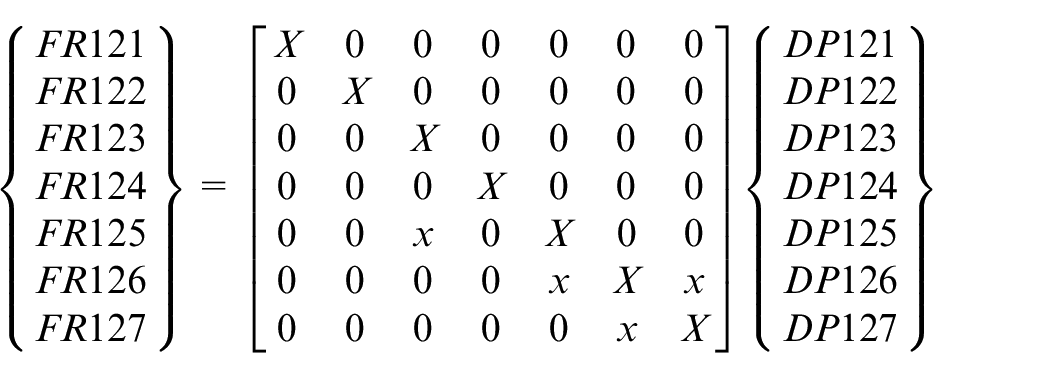
The rest of the FRs and DPs are decomposed using the zigzagging process. The entire design matrix is presented in Figure 7, and the design flow from AD is illustrated in Figure 8. In this process, the exhaust gas recirculation (EGR) system, DP2222, is a newly designed part to change the coupled design into a decoupled system. It is noted that a new design can be created during the zigzagging process of AD. The design matrix shows the design flow. Through the design matrix, we can predict how the design changes will affect the other functional requirements. It can be seen from the design matrix that the FR124 is also influenced by DP2222 and DP3222. DP124 can be independently designed in the above design equation. However, if we consider the entire matrix, DP2222 is designed before and DP3222 is considered in the design process of DP124 by a feedback process. In the cooling system, DP1 and DP3 can be grouped in a module because DP1 and DP3 are coupled. DP2 makes another module since it is not coupled with other DPs. Module 1, derived from the axiomatic design, shows that most parts except DP2 are coupled. In the cooling system, each part is physically separated, but some parts have a significant impact on one functional impact. Then they are functionally related, and it is desirable to consider them together in the design process. In Figure 8, DP1 and DP3 are weakly coupled. A designer can make one module for each DP.
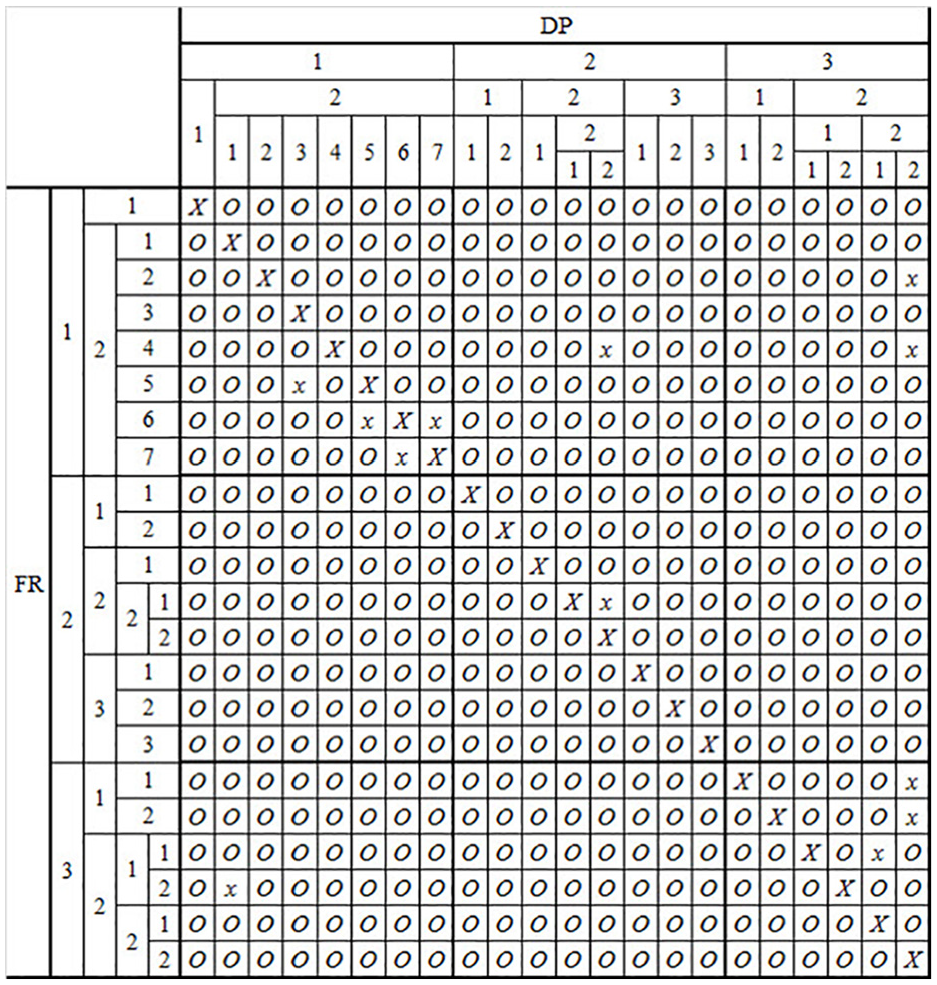
Entire design matrix of the cooling system.
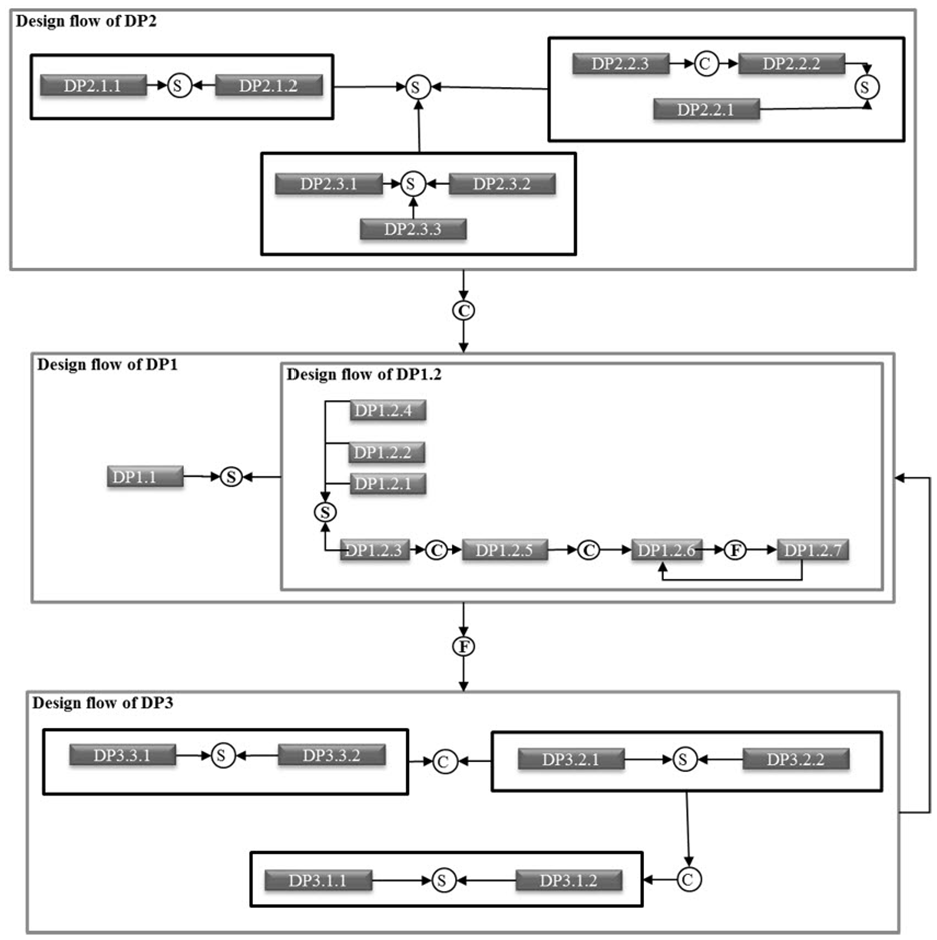
Design flow from axiomatic design (cooling system).
The number of DPs of the lowest hierarchy is 23. With the DPs of the lowest level, the interaction information of DSM is obtained through interviews with professionals in an automotive company. Four types of interaction types were defined by spatial, energy, information, and material types. The intensity of the interaction is set from 0 to 5. Weights for spatial, energy, information, and material types are defined as 2, 2, 1, and 2, respectively. Clustering is performed to minimize the total coordination cost. In Figure 9, DPs with strong correlations after clustering are grouped into a module and represented as a box. A module is defined to increase the sum of the values in one box. The larger the value of the cell, the greater the influence of the interface. Clustering is performed using an optimization algorithm. The modules are defined by the parts (DPs) with frequent and strong interfaces. The designer’s experience or intuition can be involved in defining the modules. Five modules are defined for Module 2 of DSM as illustrated in Figure 9. The small modules 1, 10, 11, 12, 15, 16, and 17 are ignored in the modularization process because they have no relationships with other parts. Each module is related to the DPs of the AD process as presented in Figure 9. In AD, even if some DPs are not adjacent, they can affect the same FR. Thus, they should be considered together in the design process. Therefore, it is recommended to use Module 1 from AD in the design process and Module 2 from DSM in the manufacturing process.
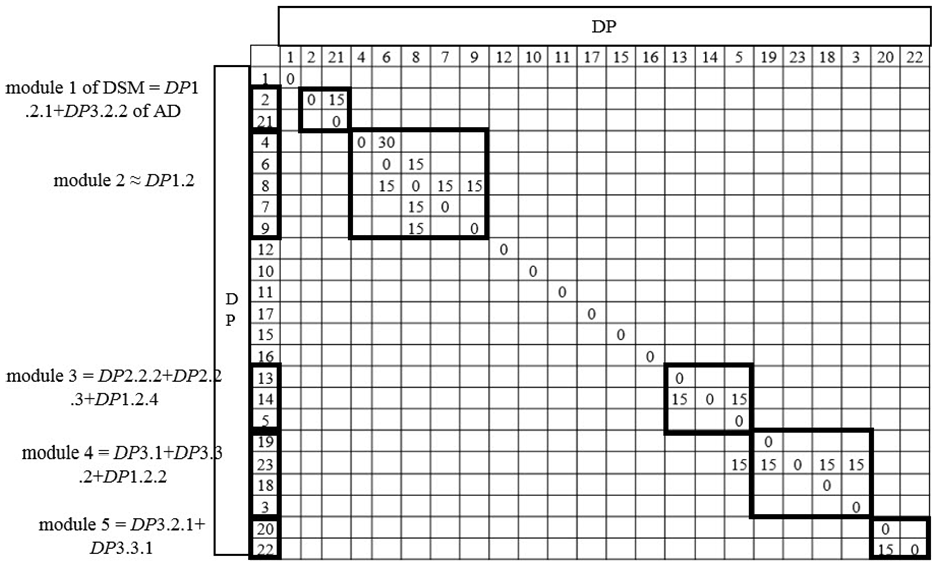
DSM after clustering (cooling system).
Design of the front suspension system
The main role of an automobile suspension system is to absorb the external impact from the road. It consists of tires, tire air, springs, shock absorbers, and linkages that connects a vehicle to its wheels and allows relative motion between the two as illustrated in Figure 10. 41 Suspension systems must support both steering and ride quality, which conflicts with each other. The suspension also protects the vehicle itself and any cargo or luggage from damage and wear. The design of the front and rear suspension of a car may be different. Suspension systems can be broadly classified into two subgroups: dependent and independent. These terms refer to the ability of opposite wheels to move independently of each other. In this research, the front suspension, which is called the MacPherson strut, is utilized. A new design is not pursued according to the sponsor’s request.
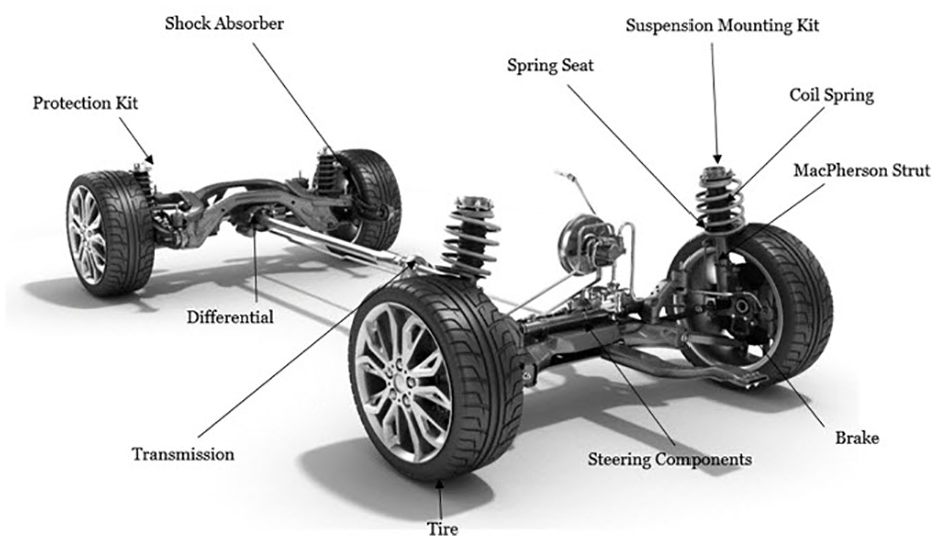
An automobile suspension system.
The customer needs are converted to the top level FR and DP as follows:
CN1: The vehicle must have a driving capability
CN2: Safety must be provided to the vehicle when driving
FR: Provide stable driving ability (CN1 +CN2)
DP: Front suspension system
The top level FR and DP are decomposed as follows:
FR1 = Generate the power to move forward
FR2 = Assist the wheel function
FR3 = Fix the car body
FR4 = Provide stable driving ability on rugged roads
FR5 = Provide stable driving ability when turning
FR6 = Provide turning ability
To satisfy the corresponding FRs, the DPs are selected as follows:
DP1 = Wheel system
DP2 = Knuckle and bearing
DP3 = Mounting system
DP4 = Independent link system
DP5 = Stabilizer bar and shock absorber
DP6 = Tie rod and ball joint
The design matrix is
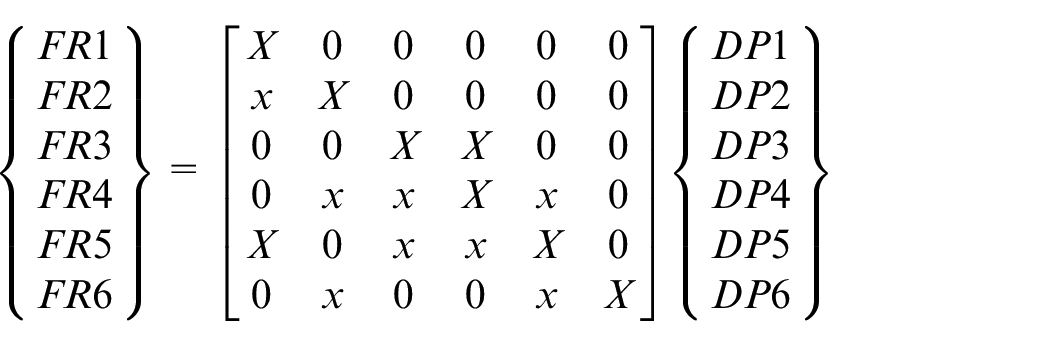
FR1 and DP1 are decomposed, and the design matrix is as follows:
FR11 = Generate the thrust using friction
FR12 = Assist thrust generation and deliver thrust
DP11 = Tire
DP12 = Wheel

FR4, DP4 and the design matrix are defined as
FR41 = Absorb vibration and noise at the junctions
FR42 = Connect the mounting and wheel system
FR43 = Allow the wheel system to move independently
DP41 = A, G bush
DP42 = Sub-frame
DP43 = Lower arm

The zigzagging process was also performed for all other FRs and DPs. The entire design matrix is presented in Figure 11, and the design flow is illustrated in Figure 12. The design matrix of the suspension confirms that there are quite a few parts coupled. This is because the role of the suspension is not only the ability of simple driving but also complex roles that provide performance and stability of driving. The thickness, width, and location of the hard points of a part affect different functional requirements of a suspension system. That is, multiple physical integrations are performed in a part. Because the purpose of this study is modular design, the physically integrated parts are not analyzed nor decomposed using the zigzagging process. In this case, it is desirable to design the coupled DPs together. From the AD viewpoint, it is desirable that DP3, DP4, and DP5 belong to one module because they are coupled. DP1, DP2, and DP6 make different modules. DSM is employed with the 15 DPs of the bottom level of the hierarchy. The values of a cell are determined through interviews with the practitioners. Four interaction types are defined by spatial, energy, information, and material characteristics. The intensity of the interaction is set from 0 to 5. Weights for spatial, energy, information, and material types are defined as 3, 2, 1, and 1, respectively. Clustering is carried out to minimize the total coordination cost. In Figure 13, the results are presented after clustering and DPs grouped in a box is a module. A module is determined to increase the sum of the values in one box. The modules are defined by the parts (DPs) with frequent and strong physical interfaces. In the suspension system, most parts are physically close together. Thus, Module 1 is quite similar to Module 2. For example, the fourth module of DSM is exactly the same as DP5 of AD, and the first module of DSM is the union of DP1 and DP2 of AD. Most of the parts in a suspension system are physically connected, thus, one DP can affect multiple FRs.
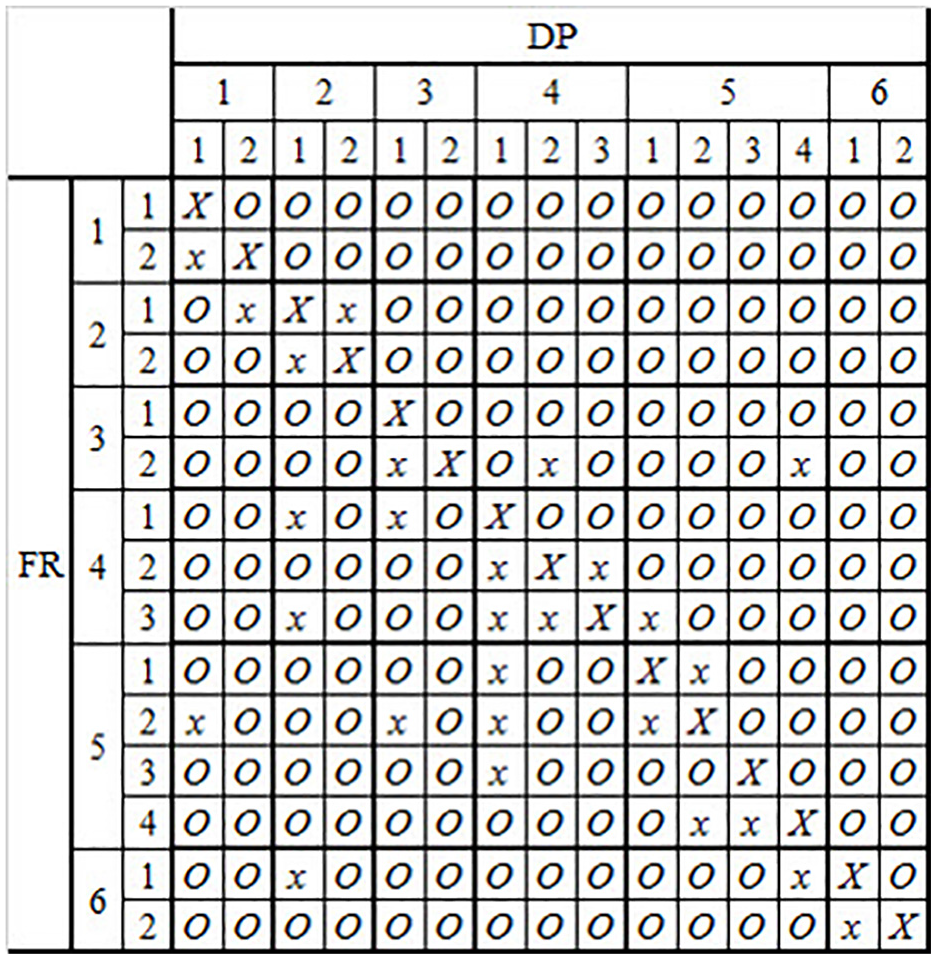
Entire design matrix of the suspension system.
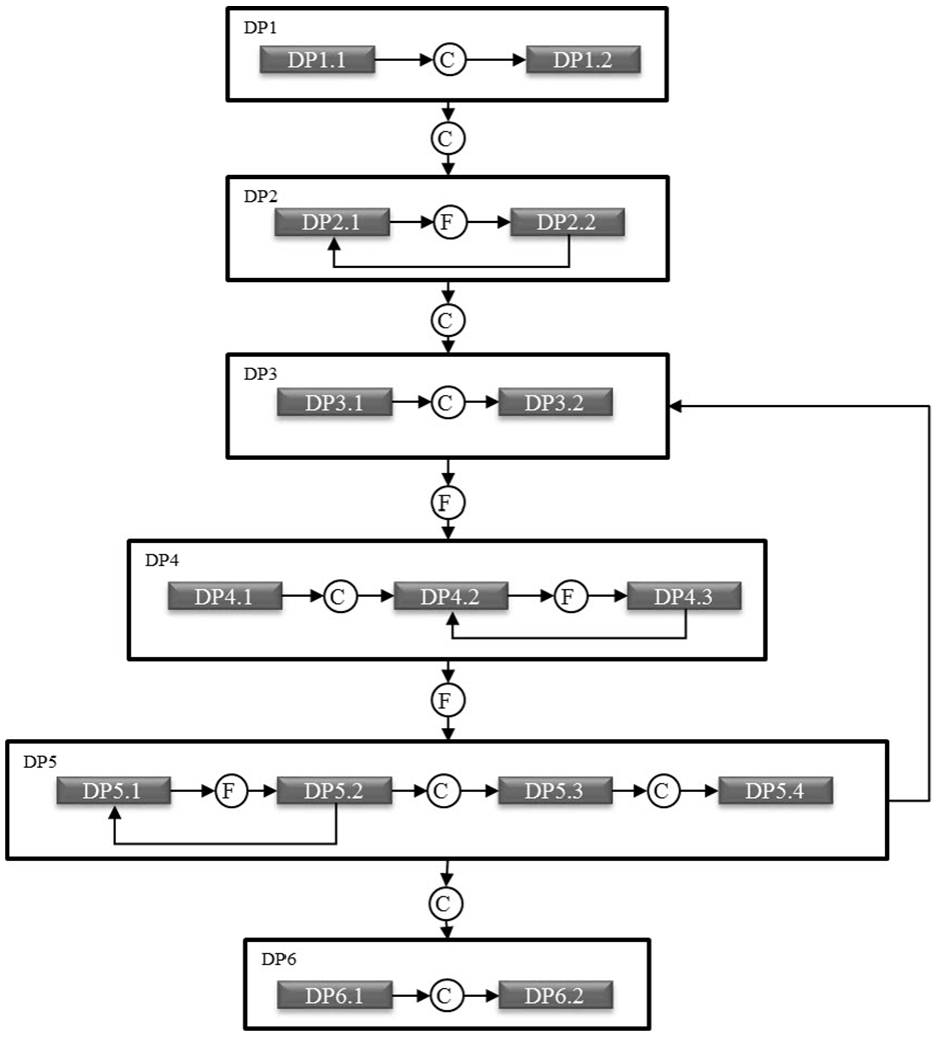
Design flow from axiomatic design (suspension system).
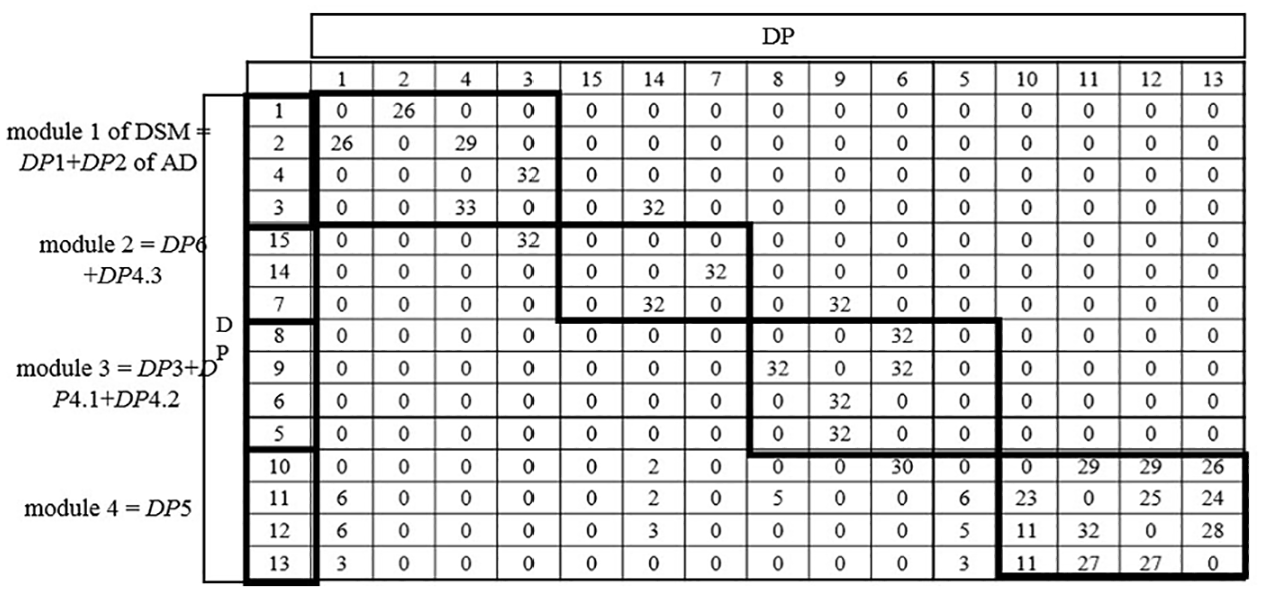
DSM after clustering (suspension system).
Conclusions
Modular design is quite a desirable method to reduce various costs. Axiomatic design (AD) and design structure matrix (DM) are integrated to enhance the engineering design process. AD is a method of grasping the relationship between parts and functions. AD has the advantage of identifying the design sequence from the design matrix. The technique can be used to create a new design while DSM can only be used for an existing product. AD has a disadvantage in that it is difficult to know the physical relationship between DPs. DSM uses design modules using physical relationships. It expresses the physical relationship between DPs as a matrix and makes groups with DPs that have strong physical relationships. However, a new design is not generally created by DSM because DSM is specialized to identify the groups of strongly related components and define modules using the relationship among components of an existing product. AD and DSM are integrated to make up for each other’s shortcomings and applied to automobile parts.
To decompose a system, the Independence Axiom and zigzagging process of AD are used first. DSM is used to define the modules of the system using the lowest level DPs in the hierarchy of AD. In this process, two kinds of modules are derived. Module 1, which is created from the design matrix of AD, is a design flow that considers the influence of one module on the others. Module 1 is appropriate when considering the functions of the system. However, Module 1 does not have information about the physical relationship or location between modules. Module 1 is defined to reduce the feedback process by identifying coupled aspects from the design viewpoint. Module 2 is made by the conventional method of DSM using the DPs from AD. Module 1 is excellent in the design process while Module 2 is appropriate for the manufacturing process. The developed method is applied to two practical problems from the automotive industry. The details of the process are demonstrated and the synergistic effect is explained. The proposed method can be used for a practical engineering modularization strategy.
Footnotes
Author note
Jeonggyu Park is now affiliated to Department of Mechanical Engineering, Hanyang University, Seoul, Republic of Korea.
Declaration of conflicting interests
The author(s) declared no potential conflicts of interest with respect to the research, authorship, and/or publication of this article.
Funding
The author(s) disclosed receipt of the following financial support for the research, authorship, and/or publication of this article: This work was supported by the Korea Institute for Advancement of Technology (KIAT) grant funded by the Korea Government (MOTIE) (P0012769, The Competency Development Program for Industry Specialist). The authors are thankful to Mrs. MiSun Park for her English correction of the manuscript.
