




Abstract
Successful surface modification can be obtained by Electrical Discharge Machining (EDM). In this work the discharge characteristics in misted deionized water and near-dry powder-mixed medium was studied systematically, as well as the microstructure and properties of electrical discharge strengthened layers on TC4 alloy. It indicates that the breakdown voltage of EDM in misted deionized water medium has been reduced to about 1/3 than in air medium. In near-dry powder-mixed medium, it is reduced to about 1/9, because the discharge gap is much larger than that of other mediums. In other words, a stable discharge can be obtained by larger discharge gaps and lower pulse energy than traditional EDM surface strengthening method, which leads to more stable discharge process. Experimental researches show that dense and sound combination with matrix like, multiphase hybrid intensification and chrysanthemum petal-like microstructure of strengthened layers can be observed in the near-dry powder-mixed medium. Meanwhile, it is found that the microhardness of the strengthened layer is up to about 1200 HV, which is four times higher than the base material.
Introduction
Titanium alloys are widely used in aerospace, automotive, and petroleum chemical industries. However, the applications are largely limited due to relatively low surface hardness and poor wear resistanc1,2 performance. Electrical discharge machining (EDM) has emerged as one of the most versatile manufacturing technologies widely disseminated in several industrial sectors. Especially, A number of researches observed that during the EDM process make it a high potential technology for application in the field of surface modification.3,4 EDM surface modification is one of the non-conventional surface strengthening techniques, which harden materials surfaces by applying high energy density electrical discharge, it will bring substantial economic benefits to the industry.5,6 The working process can be divided into four stages:
(a) breakdown of working medium,
(b) establishment of discharge channels and energy transformation,
(c) redistribution of material between electrode and workpiece surface,
(d) formation of strengthened layer.
The electrical energy was converted to thermal energy by means of a series of discrete electrical discharges between the electrode and workpiece immersed in dielectric medium.7–9 Due to the sparking effect, the energy distributed over all the regions of the surface.10,11 During EDM modification procedures, the discharge characteristics and energy distribution of the working medium play an important role in the microstructure and properties modification of strengthened layer.12,13 The RC (resistance–capacitance) discharge circuit was introduced in 1950s, which provided the first consistent dependable control of pulse times and also a simple servorvo control circuit to automatically establish and maintain a given gap between the electrode and the workpiece. 14
The studies of discharge characteristics of dielectric breakdown are mainly focused on the medium of pure gas, liquid, and solid. Meanwhile, the studies of discharge characteristics in mixed two-phase medium are limited to the gas-liquid.15,16 There are two important theories about the mechanism of the onset and development of discharge in gas medium, that are Towensed theory and Streamer theory, respectively.17–19 The main points for the mechanism of the breakdown discharge theories in liquid medium including: the electron discharge in gas medium, the bubble discharge, and the breakdown discharge of impurities.20,21 The misted deionized water was first used in 2006 as discharge medium for the correlational research. 22 The liquid-gas-powder (particles) mixture was used as dielectric in near-dry powder-mixed medium. 23 However, the breakdown mechanism of three phases of liquid-gas-powder, especially in the process of pulse discharge process, was not reported. A systematic study of the discharge mechanism of the misted deionized water and near-dry powder-mixed medium to further research on the microstructure and properties of strengthened layer is undoubtedly necessary. This paper attempts to provide theories for better understanding of the correlation between discharge characteristics and the strengthened layer quality.
Material and methods
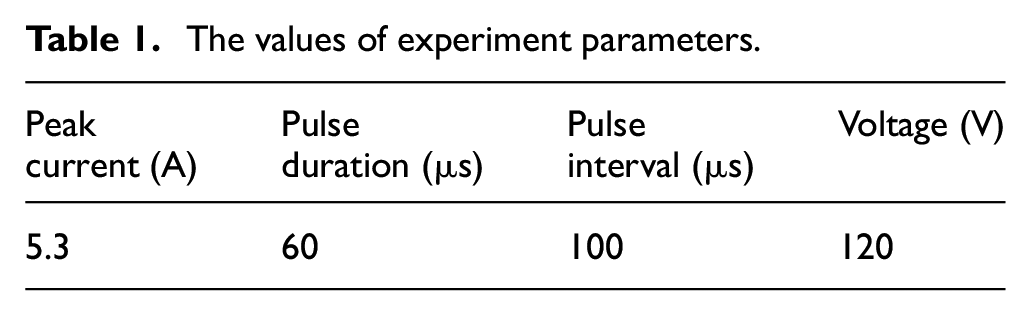
The base alloy in this study was TC4 (Ti6Al4V) alloy. Figure 1 shows the principle of powder-mixed near-dry multi-dielectrics EDM. In this experiment, B4C and C particles were mixed into the misted deionized water to produce misted discharge medium. The size of B4C and C particles is 4 μm and 1.5 μm, respectively, and the mass/volume concentration of B4C and C powder is 0.3 g/L. The principle of EDM is the conversion of electrical energy into thermal energy through a series of discrete electrical discharges occurring between the electrode and workpiece immersed in a dielectric medium. 24 The experiment parameters are the peak current, pulse duration, pulse interval. Experiment parameters were listed in Table 1. The workpiece is the negative polarity. The microstructures of strengthened layers were examined by scanning electron microscopy (SEM). The phase composition of the strengthened layer was identified by X-ray diffraction (XRD). The micro-hardness of strengthened layers was measured by a micro hardness tester with a diamond indenter, which was pressed into the modification layer in the measurement.
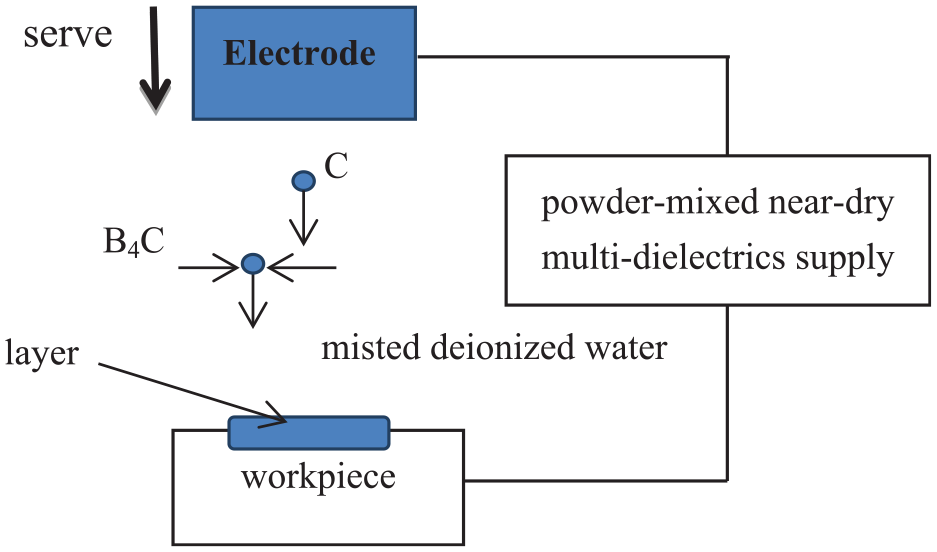
Principle of powder-mixed near-dry multi-dielectrics EDM.
The values of experiment parameters.
Discharge characteristics of working medium
According to the impurity breakdown theory, 25 impurities refer to substances that have different physical and chemical properties from the liquid medium. The impurities under the action of electric field can be considered as charged ionic bodies in the electrochemical process. Some “small bridge” formed along the direction of electric field and moving toward the area of the highest field strength, that causes the distortion and penetration of electric field. The higher concentration of impurities, the easier medium to be broken. A “conductive small bridge” with two electrodes is formed with the increasing of impurities, which makes the medium easier to be breakdown. The misted deionized water and continuous gas mixture is used as foggy medium, in which deionized water droplet is the impurity relative to the gas medium. Meanwhile, the solid phase is the impurity relative to the foggy medium in powder-mixed near-dry medium. The electric field between two poles is evenly distributed, and the strength of the interpolar breakdown field is equal to the external field strength when the working medium is a single medium. The droplets and particles in working medium are assumed to be spherical, and the radius is defined as “a.” 26 The dielectric sphere is polarized in electric field, and bound charges appeared on the surface of sphere, which produces an electric field in sphere parallel to applied field with an opposite direction. However, the electric field outside sphere is not parallel to the applied electric field. The superposition result makes the actual electric field deviate from the original one, as shown in Figure 2. E0 is strength of applied uniform electric field, Er1 is the electric field strength of foggy medium, ε1 is the permittivity of gas, and ε2 is the permittivity deionized water.
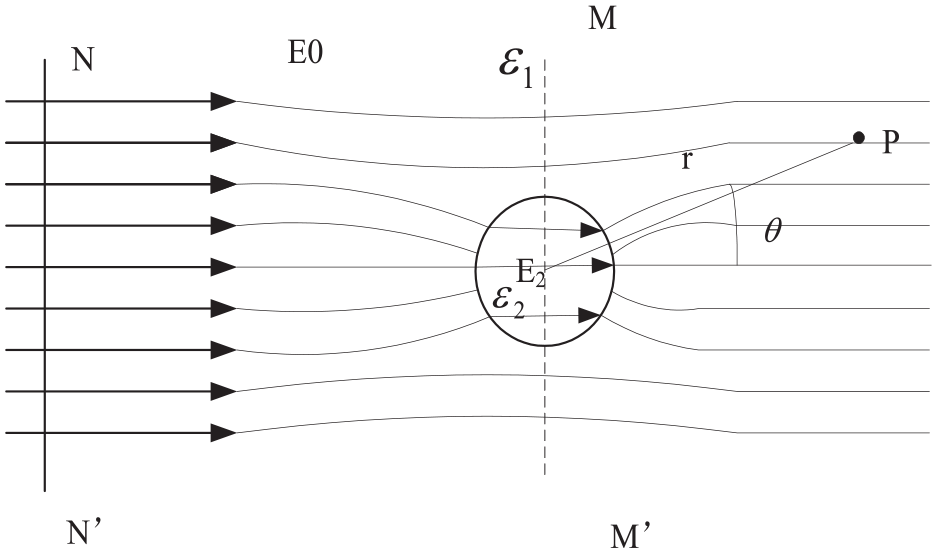
Dielectric sphere in electric field.
Gauss law is applicable not only to homogeneous media, but also to heterogeneous media. Therefore, the distribution of electric field in heterogeneous can be explained by the Laplace equation in the differential form of Gauss law. It is assumed that the shape of superfine water drops in the air is spherical in misted deionized water medium. In order to analyze the influence of dielectric spheres on uniform electric field, the Laplace equation in spherical coordinate system is selected, which is as follow:
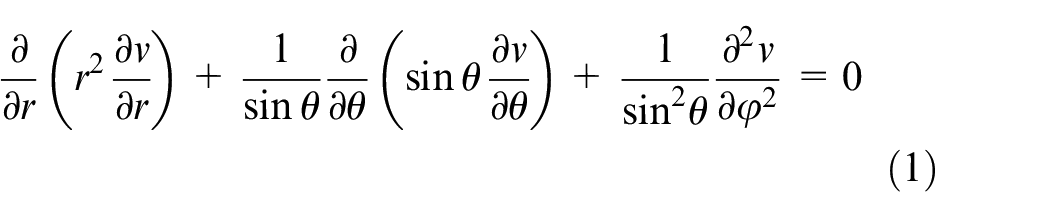
The value of potential V is different between internal and external of the sphere due to the difference of the distribution of electric field of the sphere. The boundary conditions are given by
(a) The electric field is uniformly distributed at infinity outside the dielectric sphere, such as

(b) The potential value should be continuous on the exterior of the dielectric sphere.

(c) The induction density is equal in the spherical normal component.

(d) The potential V2 is a finite value when r = 0.

From equations (1)–(5), the distribution of potential can be solved as:


According to Figure 2, the intensity of the electric field (Er1) along distribution of electric field in r direction out of dielectric in misted deionized water is given

The threshold field appears at the junction between the centerline of the dielectric sphere and the direction of applied electric field of the original working medium. The value of Er1 is used to solve equation (8).

where, ε1 = ε0, ε2 = 80ε0, as a function of Er1 can be calculated by:

The Eh1 of near-dry powder-mixed medium can be defined by the formula:


The above analyses indicate that the breakdown voltage of EDM in misted deionized water medium is reduced to about 1/3 of that in air. Therefore, the discharge gap of the misted deionized water medium is larger than that in air. The breakdown voltage of near dry powder-mixed medium is reduced to about 1/9 of that in air, as shown in Figure 3. It means that a stable discharge can be achieved by a large discharge gap. Meanwhile, the short circuit incidence can be reduced. As the debris in spark gap consists of B4C and C particles, and deionized water, which will drastically reduce the breakdown strength of dielectric. Evidently gap debris can facilitate ignition process and increases gap size.
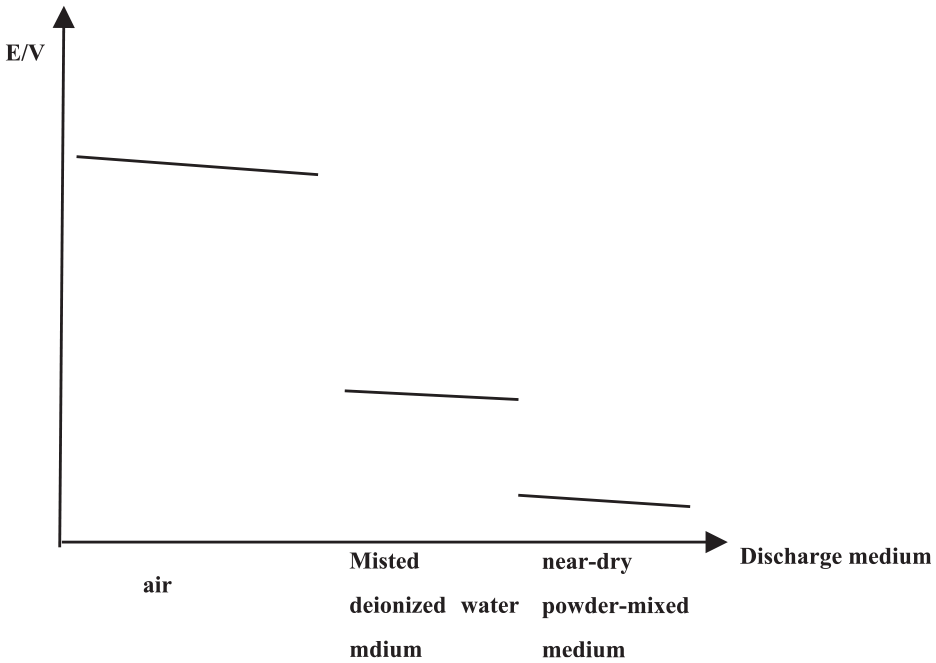
The breakdown voltage in the different discharge medium.
In misted deionized water, medium droplets are assumed spherical and distributed uniformly in the air, which is with good insulation according to the Wanger model. The permittivity of the system can be described by:

where,
The value of

where,

It is assumed that the enhanced particles in the near-dry powder-mixed medium are spherical and distributed uniformly in misted deionized water medium with good insulation. The permittivity of the system can be described by the equation (16)

where,

where, the value of

The parallel plate capacitor can be considered as equivalent between electrode and workpiece in the process of EDM surface strengthening, in which the equivalent capacity can be defined as

where,

The higher the discharge pulse energy and the larger the discharge gap width, the lower the equivalent capacitor. It results in a less influence to the discharge process. Meanwhile, when the discharge energy and discharge gap are small, the capacity of equivalent capacitor brings a significant effect to the stability of strengthening process. According to the equation (12), the value of
Microstructure and property analysis
Compared with traditional kerosene-based oil medium, the microstructure of strengthened layer was obtained in different working mediums are shown in Figure 4. It can be seen that the microstructure of strengthened layer appears chrysanthemum petal-like. The morphology is similar between misted deionized water and near-dry powder-mixed medium condition, but is more compact than that of kerosene-based oil medium. The microstructure of layer overlaps uniform petals and the edge position of petals show bright white which in kerosene-based oil medium. Moreover, there are many micro-spheroidal carbides distributed on the surface of the layer, as shown in Figure 4(a). The microstructure of layer which is obtained by misted deionized water medium becomes more dense compared with that in kerosene-based oil medium, due to a higher fast cooling rate.
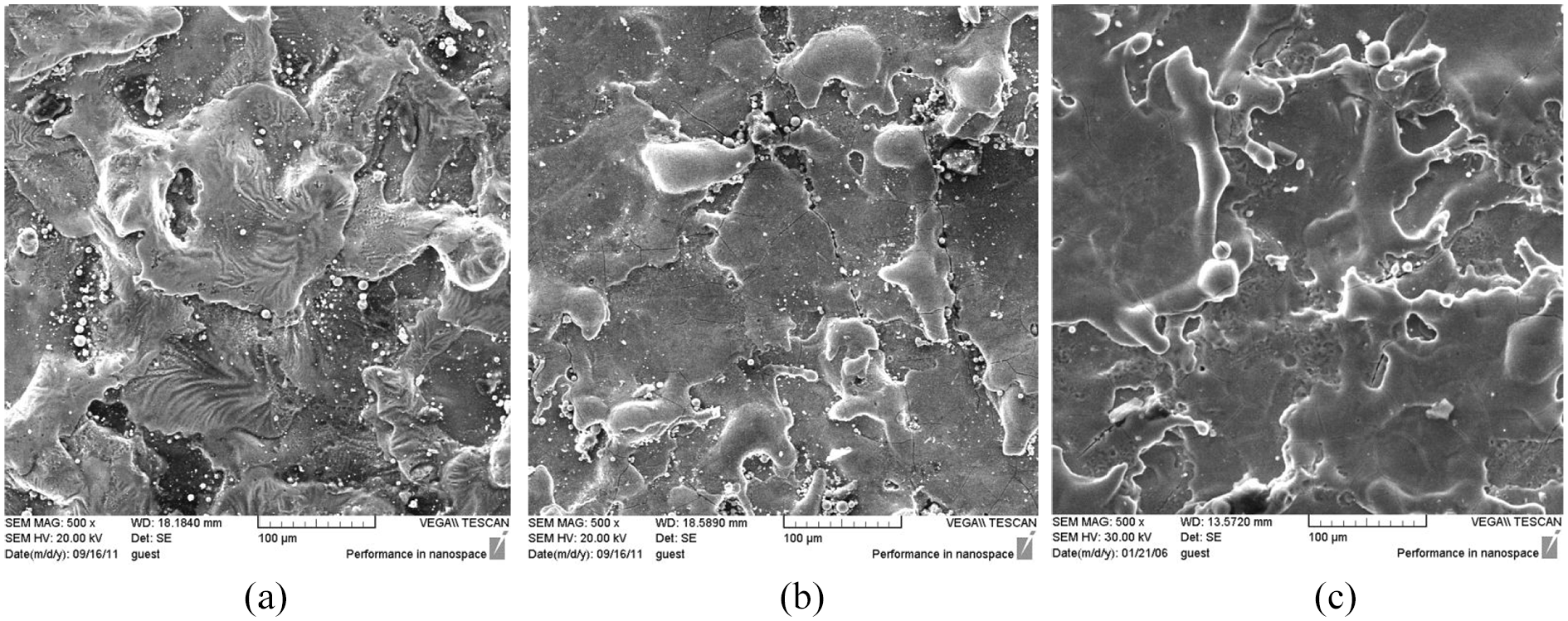
Microstructure of TC4 alloys after surface strengthen under different conditions. (a) Kerosene-based oil, (b) misted deionized water, and (c) near-dry powder-mixed.
Figure 4(c) shows the microstructure of the layer in the near-dry powder-mixed medium condition. The diameter of these petals were about 150 μm, the same as that in other mediums. The petal surface is more smooth and compact and without any obvious micro-spheroidal carbides and defects. According to the equations (12) and (20), the breakdown voltage of near-dry powder-mixed medium is reduced to about 1/9 of that in air which lead to the reduction of the value of equivalent capacitance can improve the stability of discharge process. The near-dry powder-mixed medium is a mixture that consists of continuous gas, droplet, and solid powder materials. The conductive solid powder materials would distort the electric field between two electrodes and then affect the physical state of discharge and energy distribution in the discharge region. It is reported that when the solid particles are suspended in the misted deionized water, which makes uniform in discharging energy dispersion, with multiple discharging effects within a single input pulse in the near-dry powder-mixed medium. 27 The electric field was distorted and the number of potential discharge points were increased. The energy distribution of discharge is more homogeneous than that in misted deionized water medium.
Figure 5 shows the result of X-ray diffraction of the strengthened layer by EDM under different working medium. The diffraction apex of TiC and Ti can be seen clearly in the strengthened layer under kerosene-based oil medium and misted deionized water medium, which means that there are TiC and Ti phase composition in the layer surface (shown in Figure 5 (a) and (b)). The phase composition of surface layer obtained in near-dry powder-mixed medium was presented in Figure 5(c). In this study, B4C and C particles have been added into the deionized water to produce misted discharge medium. During the modification procedure, the metallurgy reaction occurred among applied particles, electrode and TC4 alloy. XRD results reveal that TiC, TiB, TiB2, B8C, and Al3BC phases can be observed in the surface of the layer. A layer of multiphase hybrid intensification has been obtained. Furthermore, it is interestingly observed that the amorphous structure in the surface of the layer has been obtained in misted deionized water and near-dry powder-mixed medium, due to a faster solidification compared with kerosene-based oil medium.
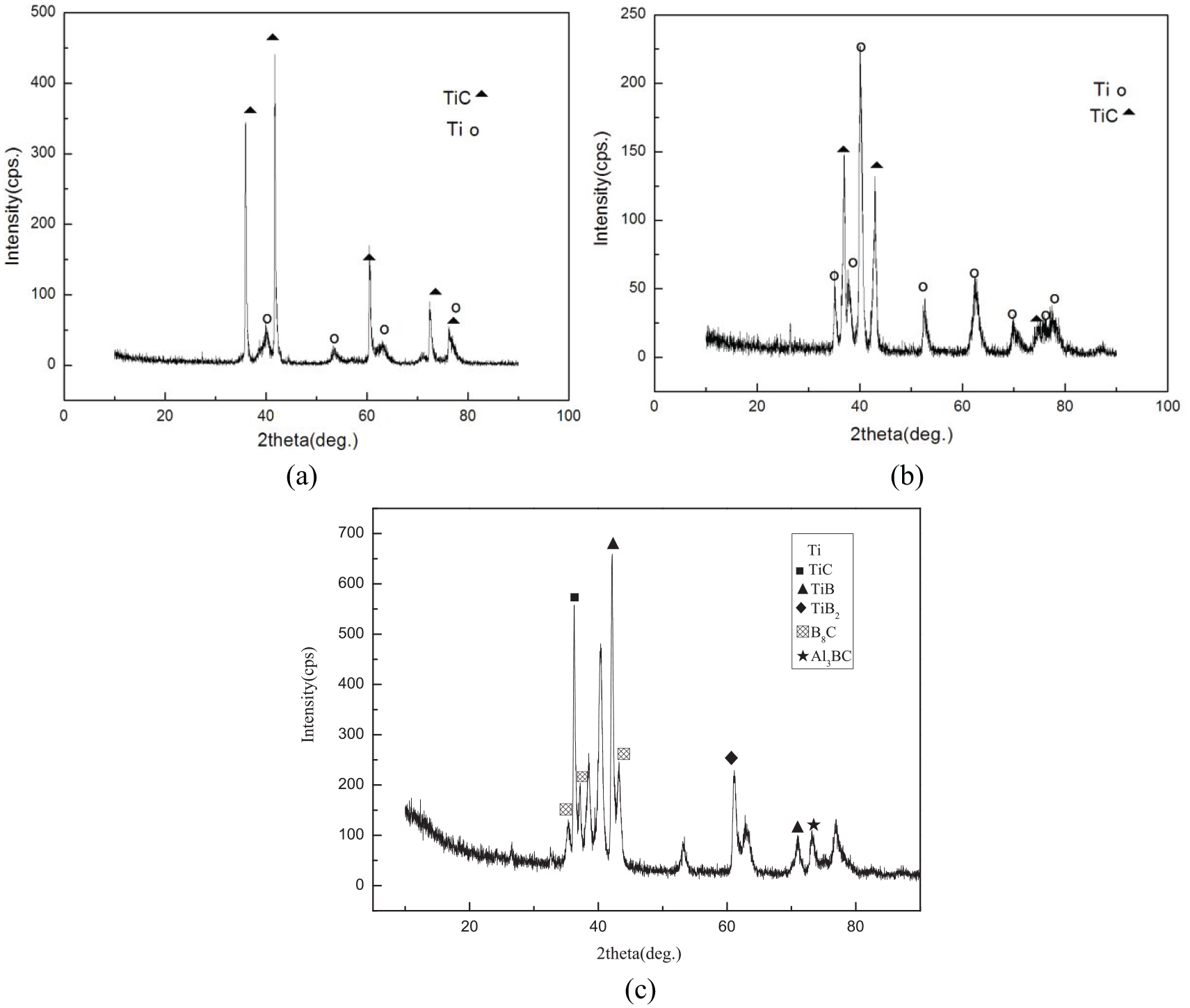
The X-ray diffraction of the strengthening layer by EDM. (a) Kerosene-based oil, (b) misted deionized water, and (c) powder-mixed near-dry.
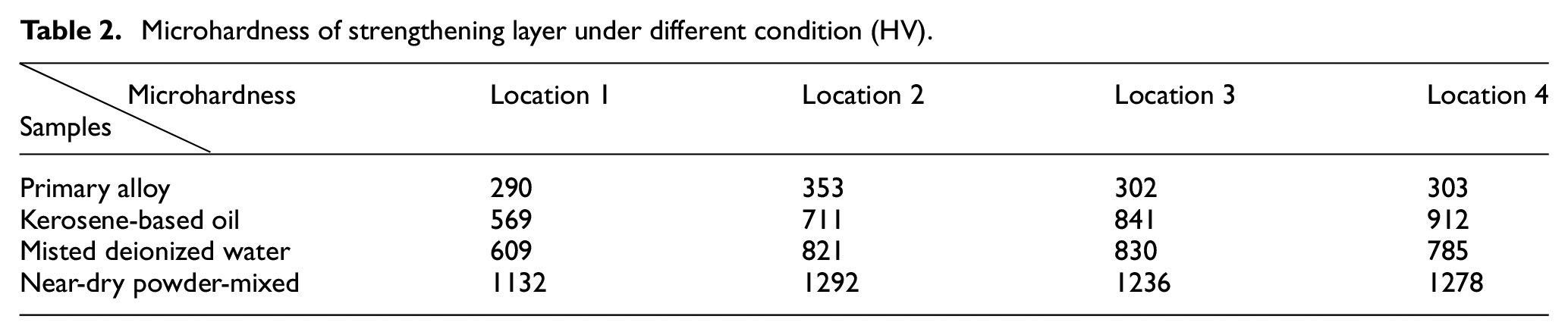
Table 2 shows the microhardness of the base material and the surface of strengthened layer by different working medium. It clearly indicates that even the minimum microhardness of the surface layer is two or three times higher than that of the base material. The maximum microhardness of surface layer obtained in powder-mixed near-dry medium is up to four times higher than that of base material. From these results, it follows that the properties of strengthened layers are related to the chrysanthemum petal-like microstructure. Under different discharge medium conditions, the number of strengthened microstructures in petal shape is different. These strengthening phases formed by high temperature melting are mainly TiC, TiB, B8C, which are the microstructure phases to improve the microhardness. It is suggested that the morphology, densification, and phase composition play a very important roles in improving the microhardness of the strengthened layer. These observations shed new light on exploiting the new method of electrical discharge surface modification for a broader range of applications.
Microhardness of strengthening layer under different condition (HV).
Conclusion
From this work, several conclusions can be obtained as follows:
(a) The breakdown voltage of EDM in misted deionized water medium is reduced to about 1/3 of that in gas medium. Meanwhile, in powder-mixed near-dry medium is reduced to about 1/9, which means more stable discharge can be achieved while using larger discharge gap.
(b) The morphology is similar between misted deionized water and powder-mixed near-dry medium conditions which is more compact than in kerosene-based oil medium condition.
(c) The phases of TiC, TiB, TiB2, B8C, and Al3BC were observed in the surface of the obtained layer in near-dry powder-mixed medium. By forming a composite strengthened layer, the microhardness of TC4 surface layer was obviously enhanced which is up to four times higher than that the matrix.
(d) The powder-mixed near-dry EDM is economical for developing green EDM surface strengthening technology, with higher-quality, efficiency, and lower cost.
These observations showed new ways on how to exploit the new method of electrical discharge surface modification in a broader range of applications. In the future work, we will explore the influence of different discharge parameters in the depth of the strengthened layer, as well as the properties of fatigue resistance of it. We will also explore the effect of adding different strengthened dielectric powder and different proportion of dielectric composition on the properties of the strengthened layer in the future.
Footnotes
Declaration of conflicting interests
The author(s) declared no potential conflicts of interest with respect to the research, authorship, and/or publication of this article.
Funding
The author(s) disclosed receipt of the following financial support for the research, authorship, and/or publication of this article: The authors would like to acknowledge the financial support by National Natural Science Foundation of China (grant no. 51301121). Research and development fund of Tianjin University of Technology and Education (no. KJ1710 and KJ1704).
