




Abstract
Manufacturing industry is heading towards socialization, interconnection and platformization. Motivated by the infiltration of sharing economy usage in manufacturing, this article addresses a new factory model – shared factory, and provides a theoretical architecture and some actual cases for manufacturing sharing. Concepts related to three kinds of shared factories which deal, respectively, with sharing production-orders, manufacturing-resources and manufacturing-capabilities are defined accordingly. These three kinds of shared factory modes can be used for building correspondent sharing manufacturing ecosystems. On the basis of sharing economic analysis, we identify feasible key-enabled technologies for configuring and running a shared factory. At the same time, opportunities and challenges of enabling the shared factory are also analysed in detail. In fact, shared factory, as a new production node, enhances the sharing nature of social manufacturing paradigm, fits the needs of light assets and gives us a new chance to use socialized manufacturing resources. It can be drawn that implementing a shared factory would reach a ‘win-win’ way through production value-added transformation and social innovation.
Introduction
Social manufacturing is defined as a kind of Internet-based and service-oriented manufacturing paradigm, 1 in which manufacturing activities are going to be more complex, diverse, and personalized, 2 and factories are becoming more open, sharing, collaborative, and flexible. 3 Different from the traditional manufacturing paradigms, social manufacturing has its own distinctive characteristics, as shown in Figure 1.
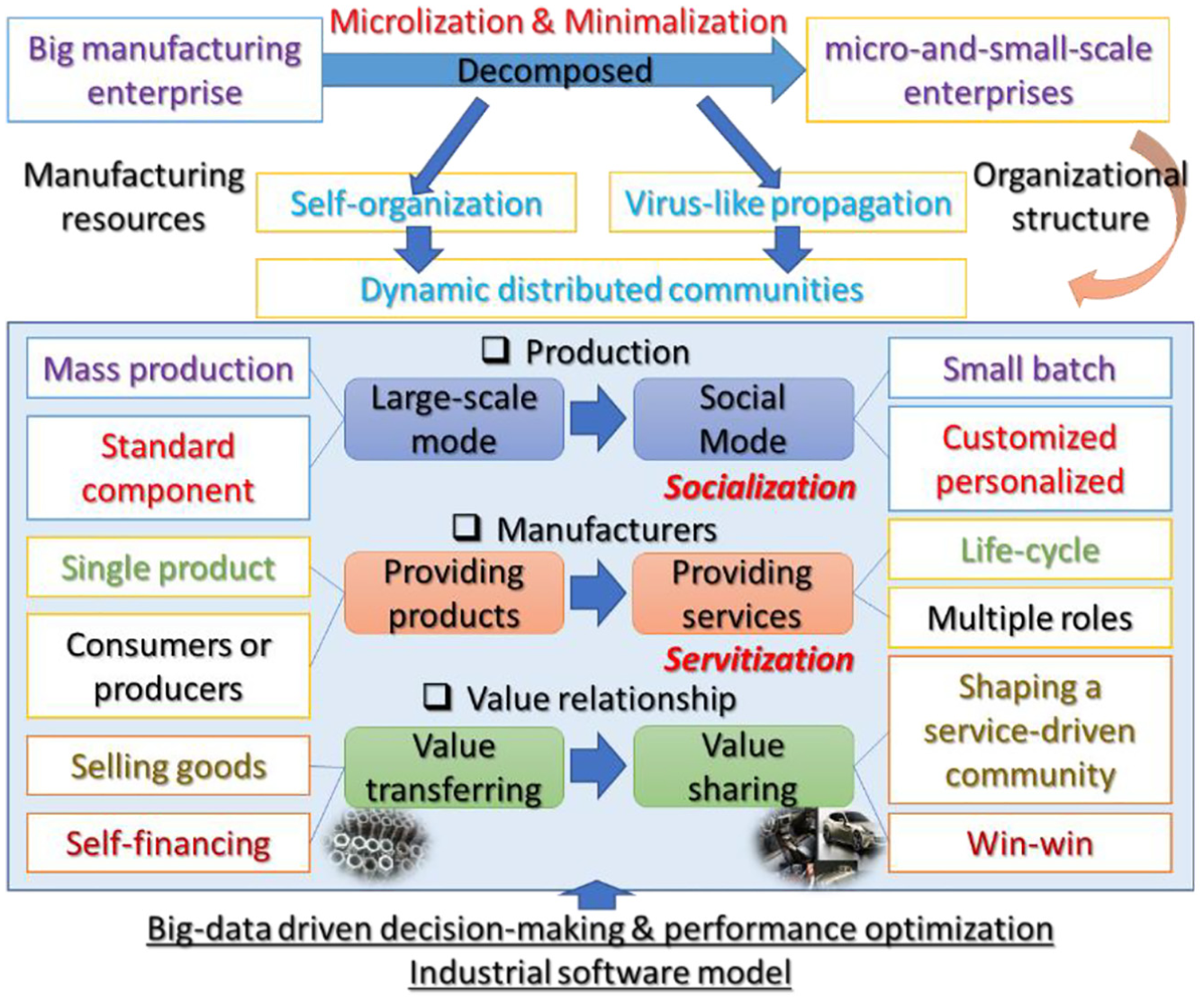
Evolution of manufacturing paradigm and its characteristics.
Here, the following characteristics need to be emphasized in detail:
Production changes from large-scale mode to customized and personalized ones in which batches are often smaller and smaller, even become one-of-a-kind. 4 Furthermore, the quality and delivery requirements of products are always customized. In addition, consumers are tending to focus on the reliability of products (usually endorsed by brands) instead of concerning on where and how the products are manufactured.
Manufacturers who run factories are providing services to customers instead of products, and these services might exist at any stage of product life cycle. 5 In this way, the boundaries of manufacturers and customers are blurring with their roles’ changes. It means that a factory might act as the role of consumer who uses manufacturing capabilities from other manufacturers in one situation and be the role of producer who provide its own manufacturing capability to other customers in another (called as prosumer role). This is an issue of service nesting. Here, manufacturing-capability sharing depends on manufacturers playing a role of supplier in a service-driven mode. It must be pointed out that the customers are connected with either manufacturers mentioned above or pure users of manufacturing capabilities who are actually without any manufacturing resources attached to factories. So, manufacturing participants including both manufacturers and customers will pay more attention to their core business to achieve greater economic returns and present themselves with multiple roles.
Value relationships vary from value transferring to value sharing. In the beginning, manufacturers get profits by selling goods so they had to invest some fixed assets to complete the production orders. Along with the role’s changes, customers and manufacturers can shape a service-driven community of interests. In fact, such a community makes the value distribution more reasonable. At the same time, there is also a business coalition among similar manufacturers, which drives the business relationship from competition to collaboration for more mutual benefits.
Meanwhile, sharing economy, in which ordinary consumers also act as sellers, is attracting much interest 6 in a series of scenes such as transportation (Mobike, 7 Uber 8 ) and accommodation (Airbnb 9 ). There is no doubt that the sharing economy has also penetrated into the manufacturing field, that is, the sharing manufacturing. 10 Although there have been some practical and academic discussions of the sharing economy recently, academic research on the topic of shared factory or sharing manufacturing is as quite limited yet.
The core idea of Shared Factory is inheriting from the concepts of value sharing 11 or manufacturing resources 12 /knowledge 13 /data sharing, 14 and, to some extent, is motivated by the success of sharing economy. With the help of Information Technology (IT) and intermediary mechanism, manufacturers can share their productivity on the network or platform with relative low costs 15 and potential customers can also get enough market information and manufacturing resources without limitation. Some researchers have focused on the demand-allocation mechanisms driven by platforms,8,16 and some others are concerned on how the sharing mechanisms affect the incumbent factories. 9 There are also papers that model a market where manufacturers can rent out their equipment to potential customers when not occupied, considering optimal pricing and product quality decisions.17,18
Distinguishing sharing manufacturing, which actually is a kind of implementation of social manufacturing, from other advanced manufacturing paradigms depends on the emergence of the platform at the very heart of the transaction. As shown in Figure 2, the platform occupies pride of place, brings manufacturers (who belong to different factories respectively and have various manufacturing capabilities but without production orders) and customers (who have production orders but no manufacturing capabilities) together, collects and disburses payments, and maintains the ratings-based cyber-credit system that makes the sharing marketplace work authoritatively. In a sense, such a kind of factory can be seen as a Shared Factory, in which ownership rights and usage rights are not same. Here, the platform actually is a front-end of the service-oriented community of interests mentioned above.
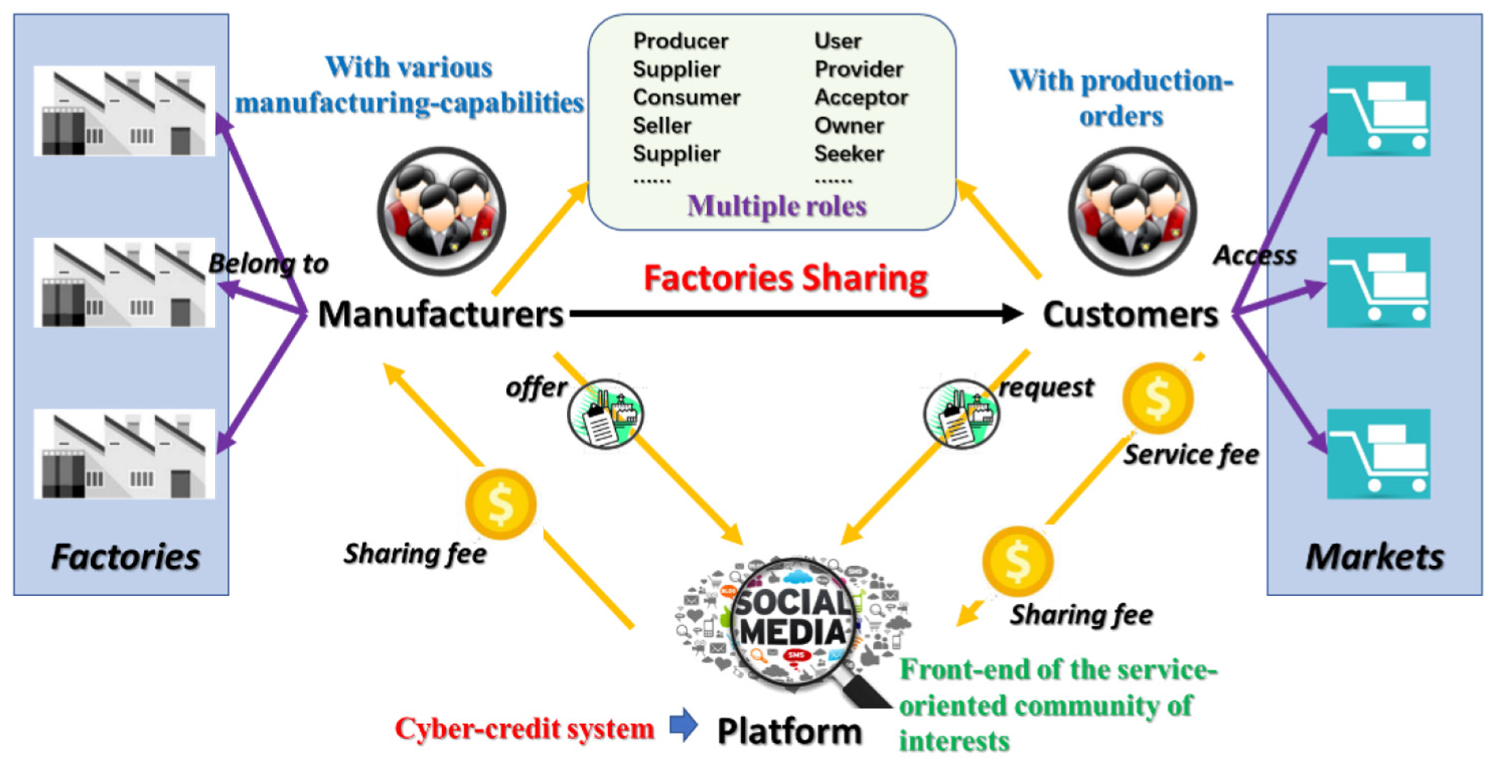
Overview of the sharing relationship in manufacturing. 19
In fact, shared factory is a new factory model in the context of sharing economy, works with a platform as its front-end of service-oriented community of interests, and is also a typical production node for social manufacturing. Concepts, characteristics, runtime and interaction logic of the shared factory will be discussed in this article. It would be helpful for us to not only understand the changes in manufacturing logic and the way of distributing benefits but also figure out the value-added mechanism concerning such a shared factory model.
Clarification of shared factory
Shared factory is an extension of the sharing economy in the field of manufacturing. It is necessary to clarify the definition of the shared factory.
Shared Factory is defined as a kind of factory-level manufacturing system with its fixed ownership, different rights for both different manufacturers from the inside and/or the outside, and different customers from the outside of the factory to use either the whole and partial manufacturing resources, or manufacturing capabilities in the manner of stranger-based service and service-nesting mechanism so as to finish production-order-oriented manufacturing activities.
The stranger-based service is an unsecured model on the basis of cyber-credit system for individuals who have not cooperated before. Manufacturer and customer, might unfamiliar to each other, take part in the manufacturing sharing by playing variety of roles in shared factory so that intertwined services form the service-nesting mechanism.
Typical role set for both manufacturer and customer can be written as


Classifications of shared factory
There are mainly three kinds of shared factories according to what the shared factory is used for:
The first kind of shared factory is used for sharing production orders from others. Production-orders from either other manufacturers or customers might be too many to deliver on time or with specific needs, so these manufacturers or customers will share these production-orders to the shared factory so as to fill the gap of insufficient capabilities.
For example, a manufacturer needs to undertake enough production orders to maintain its oligarchic position in the industry. However, some production orders might have low profit margins. This manufacturer has to expand production if it wants to produce these production orders by itself, which will bring additional business risks. The manufacturer can also choose to share these affluent production orders to the shared factory, so that it can remain highly competitive even during a recession.
2. The second kind of shared factory is used for sharing its own manufacturing resources to others. This kind of factory might own a lot of manufacturing resources but does not accept production orders so as to share its own manufacturing resources to either other manufacturers or customers who lack sufficient manufacturing resources to expand production.
For instance, a computer numerical control (CNC) manufacturer sits on a large amount of production resources. In the meantime, some start-up companies are unable to purchase CNC due to the high cost. Then, this manufacturer will share its manufacturing resources (CNC machines) to those start-up companies to obtain economic benefits.
3. The third kind of shared factory is used for sharing its own manufacturing capabilities as services to either other manufacturers or customers on demand, which can be regarded as a PSS mode similarly. PSS is more inclined to be a production system-level operation and maintenance mode while shared factory is an organizational form that realizes PSS.
For example, a gas service equipment manufacturer can sell gas equipment to customers and provide MRO (maintenance repair operating) services, and it can also provide customers with gas solutions, that is, sharing gas manufacturing capabilities to customers.
Characteristics of shared factory
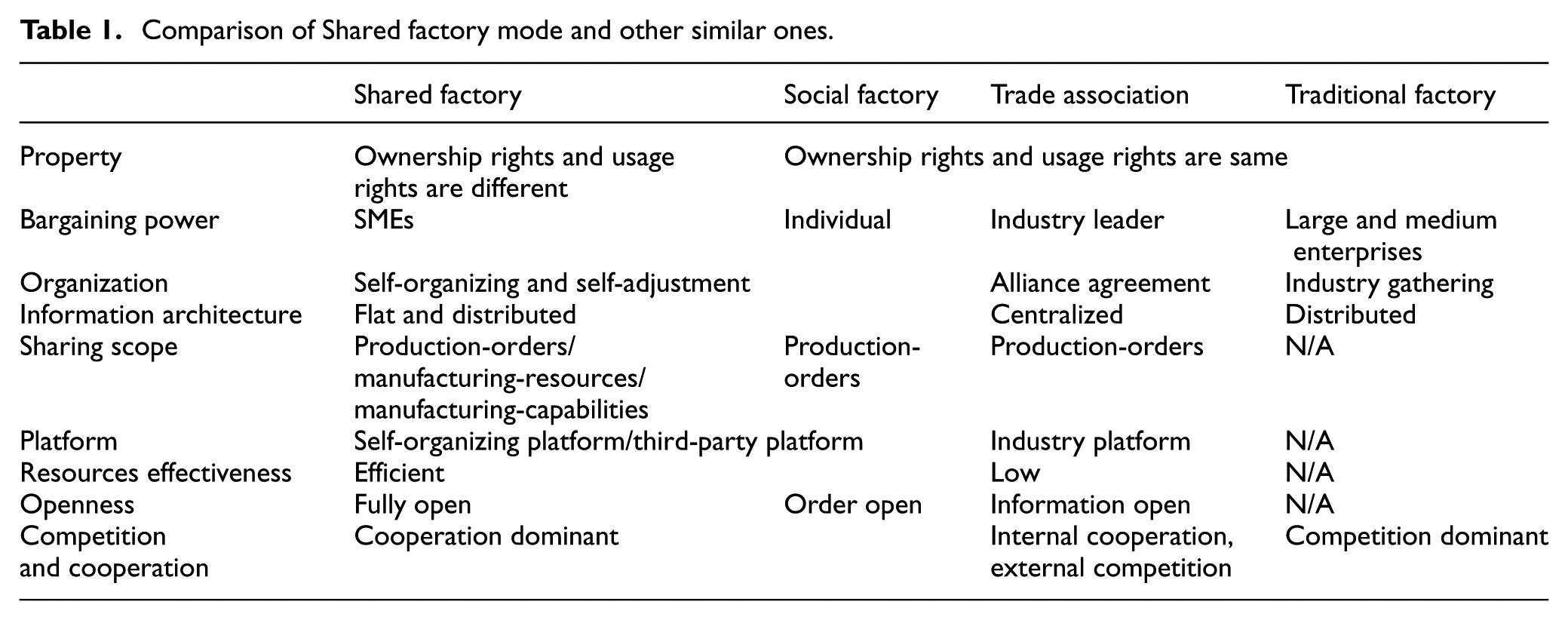
With distinct characteristics, shared factory is also quite different from some similar models, such as social factory 20 and trade association. 21 Distinctions among them are shown in Table 1.
Comparison of Shared factory mode and other similar ones.
Shared factories in manufacturing ecosystems
Three kinds of shared factories are attached to three types of corresponding manufacturing ecosystems, that is, production-orders-sharing-driven manufacturing ecosystem, resources-sharing-based manufacturing ecosystem, and capability-sharing-oriented manufacturing ecosystetm. Their operational logics are shown in Figure 3, and some real-world cases of the shared factory can be used to illustrate these logics of the three types of sharing-driven manufacturing ecosystems.
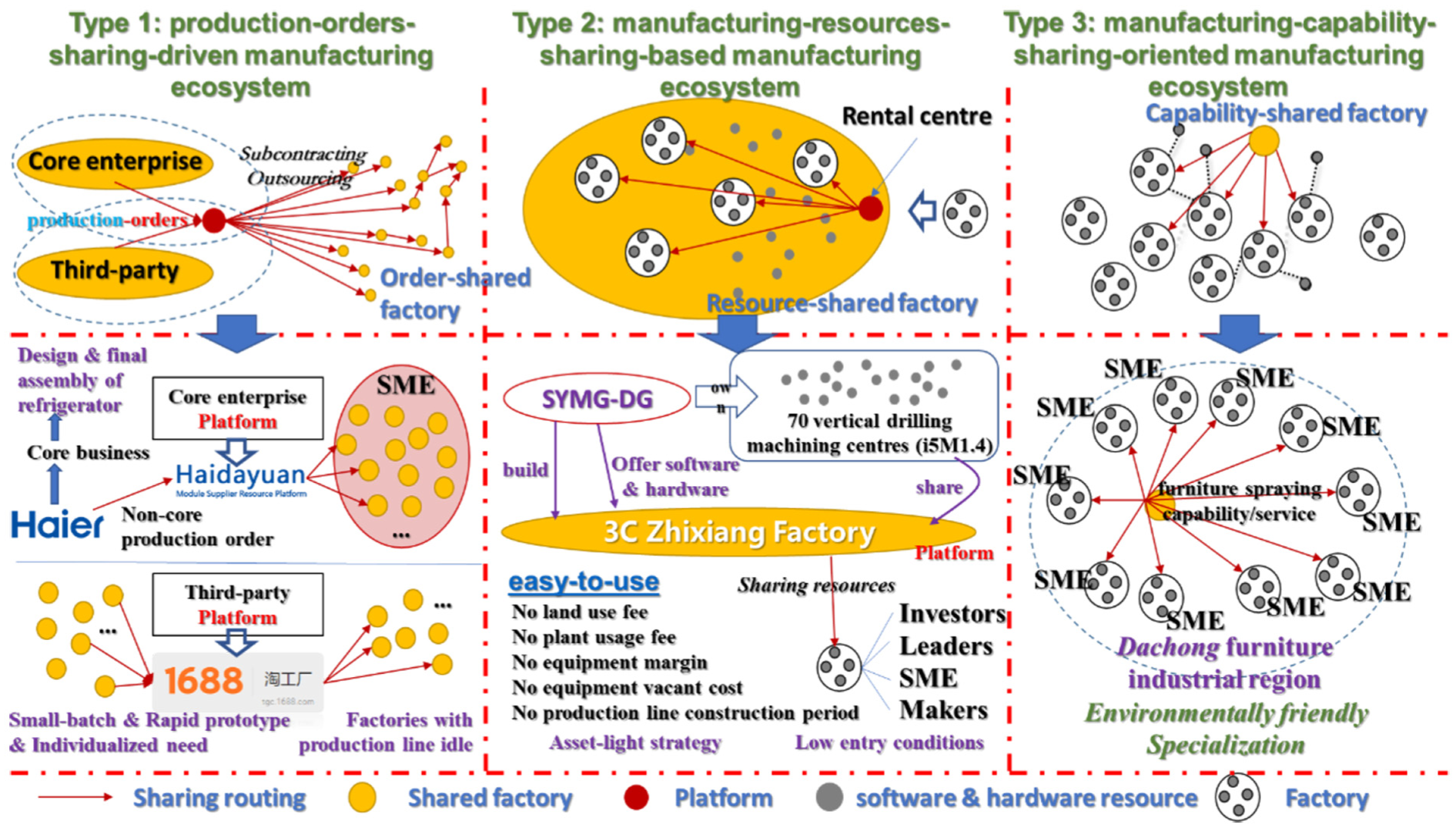
The operational logics and cases of shared factories.
The first type of sharing-driven manufacturing ecosystem depends mainly on the first kind of shared factory mentioned above, where shared factories can share production orders from core enterprise platforms (such as Haier Module Supplier Resource Platform – Haidayuan 22 ) or third-party platforms (such as Alibaba’s shared factory platform – 1688 Tao Factory). 23 In this case, Haier will share its non-core production orders to the SME by Haidayuan, and 1688 Tao Factory will connect and match the sharing between SMEs with small-batch and rapid prototype and individualized need and Small and medium-sized enterprises (SMEs) with production line idle. These platforms collect production orders either from other factories whose production orders are too many to deliver on time or with specific needs, or from customers who hold production orders, are without manufacturing resources and hope to share these shared factories for their manufacturing tasks. In this way, core enterprise or third-party platform can actively coordinate the available manufacturing resources in the ecosystem, so that the production order could be completed as soon as possible. Shared factory in this type of manufacturing ecosystem can be considered as an extension of traditional outsourcing and crowdsourcing nodes. From the view of ecosystem, sharing production orders can enable SMEs to form a community of interests and weaken their disorderly competition and then enhance the overall competitiveness of the manufacturing ecosystem.
The second type of sharing-driven manufacturing ecosystem deals with the second kind of shared factory mentioned above, where shared factories act as the platform role through which they share their own hardware and software resources (including plant, machines, workers and so on) out, such as the 3C Zhixiang Factory 24 built by Shenyang Machine Tools (Dongguan) Intelligent Equipment Co., Ltd. (SYMG-DG) in Guangdong Province, China. 3C Zhixiang Factory will integrate and manage its own idle manufacturing resources (High-end CNC) and share these resources to customers (usually SMEs) who need. In fact, customers can bring their own production orders into a shared factory, use the suitable manufacturing resources of the shared factory to complete production orders, and charge a certain fee to the shared factory according to the resource usage time or some other criteria. From the view of ecosystem, sharing manufacturing resources can optimize the configuration of resources in the manufacturing ecosystem, so that these resources belonging to different manufacturers and customers can be more fully utilized for achieving overall profit’s growth.
The third type of sharing-driven manufacturing ecosystem is concerned with the third kind of shared factory mentioned above, where shared factories have specific manufacturing capabilities and can share these capabilities as services to customers (usually SMEs) who do not want to invest and build new factories. For instance, in Dachong town of Zhongshan city, Guangzhou province, there are a lot of similar companies engaged in the production of mahogany furniture. 25 The furniture spraying process always brings a lot of waste gas, so some shared factories with perfect paint exhaust gas treatment systems have emerged. They provide a complete spraying service for a lot of Dachong furniture factories without exhaust emissions. Especially in an industrial region or park, this sharing mechanism that relies on professional services powered by the shared factories is needed urgently. From the view of ecosystem, sharing manufacturing capabilities can make the division of manufacturer and customer more reasonable and realize the rational distribution of manufacturing capability as a whole.
It can be said that shared contexts will be changed if type of shared factories changes. For example, 3C Zhixiang Factory is usually a manufacturing-resource-sharing-based shared factory when it only shares manufacturing resources for customers. But it can also be changed into a manufacturing-capability-sharing-oriented shared factory when it uses its manufacturing capabilities as services for designing, machining and assembling for its customers. This means that the type of a shared factory can be changer from one to another, and any manufacturing ecosystem can use different kinds of shared factories and their combination to power its functions and performances.
Economic analysis of shared factory model
Shared factories, reintegrating the socialized manufacturing resources, are a category of shared economy essentially, so the biggest benefit of this model is in terms of economics. A production function relates quantities of output of a production process to quantities of inputs and refers to the expression of the technological relation among manufacturing resources, production orders and manufacturing capabilities as inputs, and goods as outputs. 26 It seems difficult for traditional factories to balance their manufacturing resources, production orders and manufacturing capabilities. Sometimes, factories have sufficient manufacturing resources and manufacturing capabilities but few production orders, while others have sufficient production orders but lack manufacturing resources and manufacturing capabilities. The emergence of shared factories is to resolve this kind of contradiction.
Manufacturers and customers, no matter in which type of shared factory, have production-orders, manufacturing-resources and manufacturing-capabilities or all. The sharing process achieves the recombination of their redundant production-orders, manufacturing-resources and manufacturing-capabilities. Cobb–Douglas production function 27 is a particular functional form of the production function, widely used to represent the technological relationship between the amounts of two inputs. Thus, the economic analysis of the shared factory model can be illustrated in Figure 4(a) with typical Cobb–Douglas production function, in which two inputs are the production orders and manufacturing resources. Then, the Cobb–Douglas production function can be modified by adding an input, that is, the manufacturing capability, which is named the Cobb–Douglas production function with three inputs, illustrated in Figure 4(b).
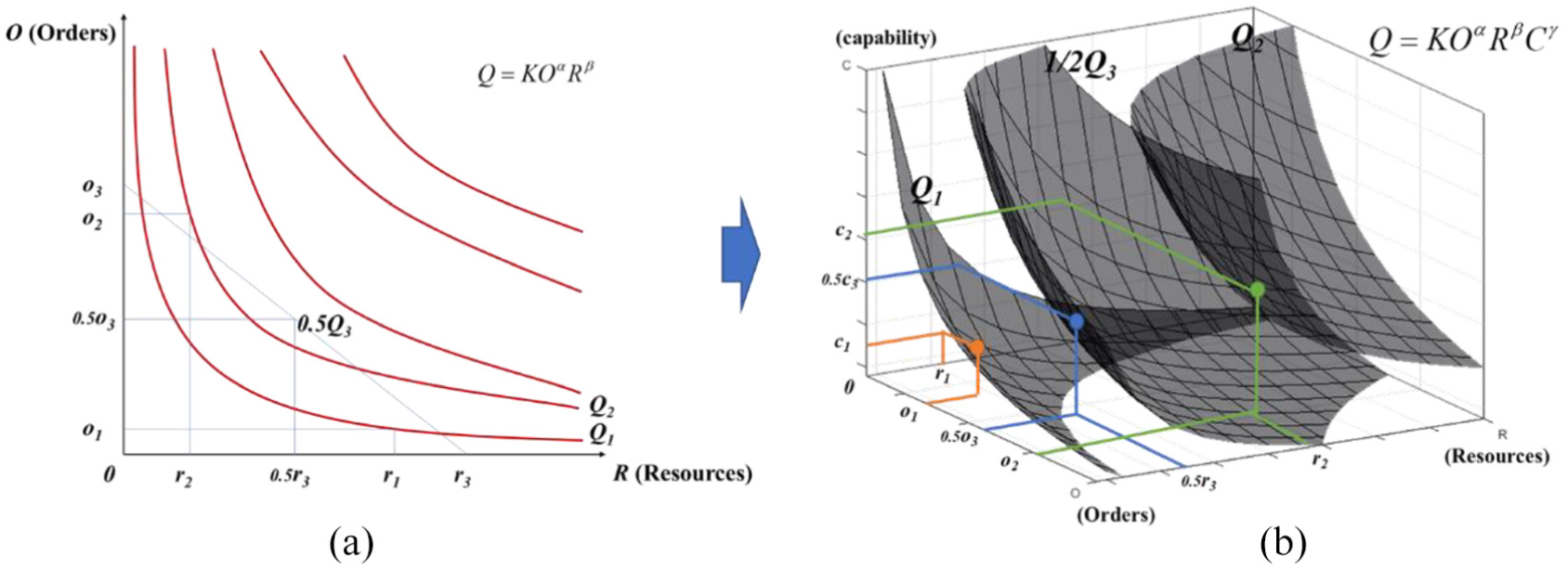
Cobb–Douglas production function of the shared factory: (a) typical Cobb–Douglas production function and (b) Cobb–Douglas production function with three inputs.
The total production

where
In Figure 4, production-order quantities of manufacturer and customer are
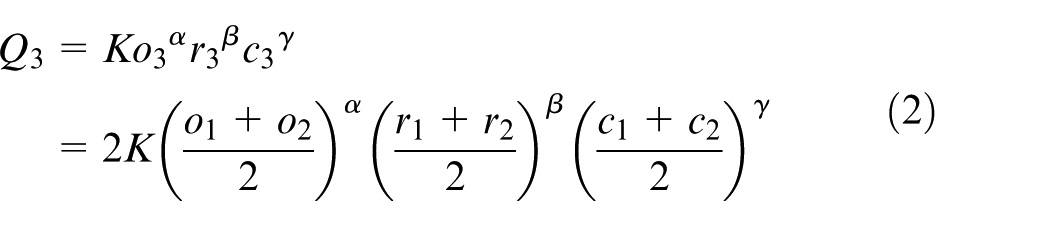
and the total output before sharing is

Next, compare Q3 and Q1 + Q2. The second-order Hessian Matrix of the function


So, Hessian is positive definite, which means that the
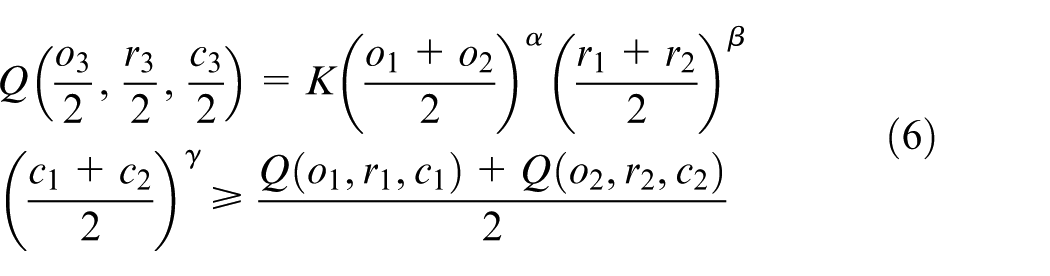
which means when the manufacturer and customer share their production-orders, manufacturing-resources and manufacturing-capabilities with each other, they will get more production in total from overall view. And when the market is in a downturn (Q is reduced), the shared factory model can also adjust the O, R and C of each participant simultaneously, so that each of them can maintain production without closure.
Identification of key-enabled technologies for shared factory
Running a shared factory needs to get the support of key-enabled technologies so identifying them seems quite important. In general, there are six main supporting technologies to ensure the smooth operations of a shared factory, as shown in Figure 5.
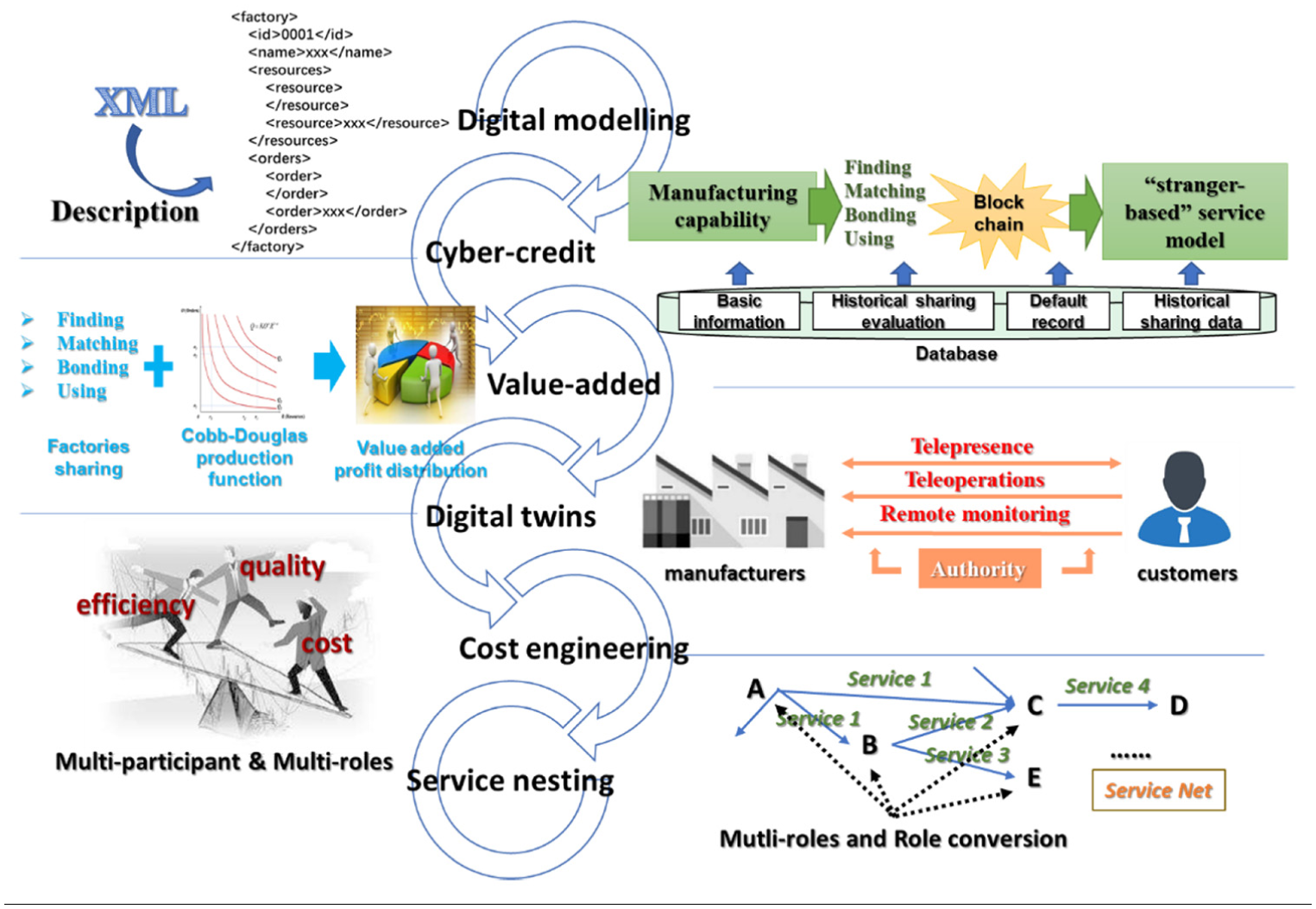
Six key-enabled technologies support the operations of a shared factory.
Digital modelling of shared factory and its running mechanism
As mentioned above, two main factors involved in the shared factory are the production orders and manufacturing resources and evolve the third factor, that is, manufacturing capabilities, which influences how to run the factory. To facilitate digital modelling of shared factories’ operations, the eXtensible Markup Language (XML) schema 28 is introduced to clarify the relationship among participants including both manufacturers and customers, manufacturing resources, production orders and manufacturing capabilities. It can not only show the basic properties of an actual factory (e.g. ownership) but also see who is using and operating these resources. Digital modelling of shared factory and its running mechanism is the fundamental of the five following enabled technologies.
Manufacturing-capability finding, matching, bonding and using mechanisms under ‘stranger-based’ service and cyber-credit model
It is necessary to set up manufacturing-capability finding, matching, bonding and using mechanisms for the socialized manufacturing resources, while participants sharing the shared factory might be a kind of stranger as its collaborators. These mechanisms will enable efficient connections of manufacturing capabilities and requirements, production orders and services, and factories and manufacturing resources. Noted that one of the most challenges is that all the above mechanisms need to be built on ‘stranger-based’ service model. At the same time, manufacturing cyber-credit model is a codified compulsory, deterrent and incentive mechanism governed autonomously by a smart contract system based on the distributed block chain technology. 29 In a shared factory, cyber-credit model acts as the trusted third party to prevent defaults and frauds during manufacturing sharing interactions and bridges the credit gap between manufacturers and customers.
Value-added mechanism based on sharing manufacturing capabilities
Section ‘Economic analysis of shared factory model’ has concerned on the economic value of shared factory from the view of overall. However, the relationship between resources input and profits output/distribute of each participant still needs further discussion. Although shared factory has proven to be a ‘win-win’ model, how the increased profits distribute reasonably is the key to determining whether this factory model is continuable and sustainable. Sharing a factory can enlarge manufacturers and customers bargain power and common profits, while each participant who join such a sharing can win its profit according to its contribution on production orders, manufacturing resources or manufacturing capabilities. For customers, sharing a factory provides a new value-added way through using additional manufacturing resources and manufacturing capabilities to get more benefits. For manufacturers who hold the shared factories, sharing a factory can also make the value added by getting into larger markets with taking more production orders and contributing their manufacturing resources and manufacturing capabilities to customers.
Digital twins as a telepresence, teleoperations or remote monitoring under the control of authority
It must be emphasized that shared factory model makes it possible to closely connect the manufacturers with customers. They create sharing relationships dynamically through the above mechanisms although the physical distance between them is probably very far sometimes. So, it is necessary to use a digital twin model for realizing the telepresence, teleoperations or remote monitoring of the manufacturing processes under the control of authority. Here, digital twin technology makes physical devices and virtual software connected seamlessly. Through creating a digital twin model related to operations, for example, real-time monitoring data in the physical world can be updated to the virtual model simultaneously and the controlling commands from the virtual model would be transmitted to the physical devices. In this way, it is possible for customers to be able to operate the shared factory especially when a manufacturing-resource-sharing-based shared factory runs.
Cost engineering related to three kinds of shared factory models
Cost engineering 30 plays an important role in taking a balance between cost, quality and efficiency. It deals with activity-based quality and efficiency estimation, cost control and forecast, investment appraisal and risk analysis. Due to the multiple participating roles in the shared factory model, cost engineering in this context needs to achieve the joint cost management, comprehensive efficiency assessment and collaborative quality control. It is convinced that cost engineering will enable the credible analysis of sharing alternatives, accurate quantification of the sharing capability, comprehensive balance in cost, quality and efficiency related to all sharing participants, and so on. One of the typical methods for cost engineering relies on activity-based costing model.
Production-order planning, scheduling and service nesting
Generally, a production order can be decomposed into several sub-production orders according to the product bill of materials (BOM). A customer, who holds this production order and acts as ‘producer’ role, either share these sub-production orders with production-order-driven shared factories or uses manufacturing resources or manufacturing capability services form potential manufacturers who run respectively in the form of other two kinds of shared factories. In fact, this customer has two roles, that is, ‘producer’ role when offering production-order-based products and ‘consumer’ role when sharing three kinds of shared factories. This situation can be seen as a two-layer service nesting, which deals with sharing shared factories and realizing product providing services. In actual production, the service nesting is complicated by different roles of manufacturers and customers. In addition, other service providers such as cutting-tool service system can support production activities inside a shared factory. It is also a kind of service nesting. Therefore, it is necessary to explore the service nesting mechanism when the customer plans and schedules the correspondent production order and sub-production orders, and the manufacturers want to cut down their production cost through introducing some service providers.
Discussion
More and more shared factories are emerging in more and more industrial scenarios due to their innovative architecture and economic advantages. With shared factory, some SMEs in the start-up stage can realize their low investment with high return, and some growing manufacturers can expand their market size. Moreover, some oligopolistic manufacturers facing the pressure of capital and cost can realize the divestiture of non-core profit business and the subversion of product profit model through the shared transformation. So, it is needed to clarify what are the opportunities and challenges faced with shared factory.
Opportunities
The shared factory model as a kind of new production node inside a social manufacturing network enhances the nature of manufacturing sharing in three forms which deal respectively with sharing production-orders, manufacturing-resources and manufacturing-capabilities. Its working logic relies on the platform which integrates different shared factories under the context of social manufacturing paradigm and is the front-end of a manufacturing community. This gives us a new way to use socialized manufacturing resources under the guidance of sharing economy. Both manufacturers and customers, who can take different roles concurrently under the context of running a shared factory, will share the benefits in a ‘win-win’ mode. It is possible for any traditional factories including SMEs to use this shared factory model to broaden the market, optimize resource allocation, enhance the bargaining power, cut down the manufacturing costs and increase the flexibility of production, together with the creative vitality inspiring.
Challenges
Frankly speaking, either the framework or the runtime of the shared factory is still in its early age and more following-up detailed studies with scientific rigour and proofs are needed. The shared factory model will be used mainly in a ‘stranger-based’ service mechanism. In addition, remote operations related especially to a manufacturing-resource-sharing-based shared factory in terms of using digital twins require the very strict conditions of security. This big challenge makes the implementation of shared factory model become more complicated. One of the most feasible methods is to introduce new cyber-credit model such as block chain so as to ensure the security mentioned above. The other big challenges include how to develop an efficient costing model and build a value-added mechanism so as to let potential manufacturers and customers believe that ‘win-win’ mode works well.
Conclusion
Shared factory, as a kind of new factory model with its fixed ownership, different rights and different customers, is becoming a new production node for social manufacturing in the context of sharing economy. It fits the needs of light assets and gives us a new chance to use socialized manufacturing resources.
Shared factory model enhances the sharing nature of social manufacturing paradigm in detail. Such a sharing nature is connected with three implementing levels, that is, sharing production orders, sharing manufacturing resources and sharing manufacturing capabilities. Here, platform would play an important role. It is very clear that this model also shows some contributions to production value-added transformation and social innovation. However, there are still some problems to be solved, such as how to use new IT technology in building a more feature-rich platform to integrate different shared factories, how to design a more rational profit distribution model, and so on.
The future work will include studying in the concepts, characteristics, runtime and interaction logic of the shared factory model in detail and developing the common implementation architecture of shared factory platform–based new IT technology and exploring more enabled technologies for more interactive and collaborative manufacturing sharing.
Footnotes
Declaration of conflicting interests
The author(s) declared no potential conflicts of interest with respect to the research, authorship and/or publication of this article.
Funding
The author(s) disclosed receipt of the following financial support for the research, authorship and/or publication of this article: The research work is under the financial supports of both MOST’s innovation method working projects with grant no. 2016IM010100 and Natural Science Foundation of China with grant no. 71571142.
