




Abstract
Industrial Internet platforms have the ability to access, manage and control product-related data, information and knowledge across all the lifecycle phases (beginning of life, middle of life and end of life). Traditional product lifecycle management/product data management software have many limitations when it comes to solving product lifecycle management challenges, like interoperability for instance. Industrial Internet platforms can provide real-time management of data and information along all the phases of a product’s lifecycle. Platform openness in combination with the above-mentioned industrial internet platform characteristics helps solve the product lifecycle management challenges. This article describes the product lifecycle management challenges in detail from the existing literature and presents solutions using industrial internet platform openness and related dimensions as well as sub-dimensions. A wide pool of platforms is narrowed down to specific platforms that can solve the documented product lifecycle management challenges and allow the manufacturing companies to collaborate as well as enhance their business. We also present in detail managerial implications toward long-term and sustainable selection of industrial internet platform.
Keywords
Introduction
Product lifecycle management (PLM) can be defined as a systematic and controlled concept for managing product-related information and products throughout the whole product lifecycle.1–3 Fundamentally, PLM is focused on data, information and knowledge (D-I-K) and how to use those to properly serve a company’s business and product development,4–6 as well as to create value for the customer. 4 For industrial manufacturing companies, the content of D-I-K is focused on the machines. Machines generate the data related to processes and operations. These data are translated into useful information using analytical frameworks. Operators and other personnel translate this information into actionable knowledge which can be used to improve the processes or operations or functioning of the machines based on their experience and expertise. However, there are various challenges related to accessing and managing all relevant D-I-K related to products’ lifecycles, which is often due to the fact that such relevant information may be dispersed among a number of various actors who also have their personal conception of the product and its performance. 7 Relatively recently, it has been understood that various technologies and approaches related to Internet of Things (IoT) and Industrial Internet, such as sensors, machine-to-machine communication and various types of platforms, can offer important and novel solutions to the management of product lifecycle information, such as providing access and real-time insights into the data of many PLM-related actors. For instance, the flow of real-time data from the various sensors across the value chain will enable for the first time the chance to observe the entire value chain instantly. This allows the optimization of the entire value chain rather than just selected parts of it. 8 Hence, the Industrial Internet will go way beyond the traditional factory automation and will reduce the transaction costs for every transaction in the value chain. Yet, partly due to the recent maturation of many industrial internet–related technologies and concepts, there is relatively little research that studies the possibilities offered by the industrial internet to the PLM field. One of such topics is the role of various types of industrial internet–related platforms to enhancing the management of relevant D-I-K related to products’ lifecycles and the various lifecycle phases.9–11 The significance of platforms is continuously growing at a fast pace. 12 In addition, it has been understood that platforms and platform-like digital services can provide new ways to access and accelerate the capturing of data and converting it into insightful information and knowledge. The role of various platforms and related platform openness, industrial internet–related platforms in particular, in the context of PLM and in facilitating the management of product lifecycle information has not been studied previously, according to our survey of current PLM and industrial internet literature.4,8,13,14 Thus, the following fundamental research questions have been derived to better understand the current status. The questions will be thoroughly addressed in this article:
RQ1. What kind of PLM-related D-I-K management challenges are addressed by novel platforms in industrial internet?
RQ2. How do the industrial internet platforms address the information and knowledge management challenges in PLM?
RQ3. What is the role of industrial internet platform openness in D-I-K management in PLM, and how can the different dimensions of openness be structured in the context of industrial internet platforms?
To address the above research questions, this study will analyze novel types of industrial internet–related platforms from the literature as well as other relevant sources. Different types of platforms are selected for analyses and evaluated based on their capabilities to address the various challenges related to the management of D-I-K in a PLM context. This study will provide detailed criteria for selection of appropriate industrial internet platforms based on the PLM challenges and industrial internet and related platform capabilities. One of the major PLM-related functionalities which is a challenge for most PLM/PDM software is openness related to D-I-K and is studied in detail to develop criteria for industrial internet platform selection from the perspective of effective facilitation of D-I-K within and between PLM lifecycle phases.15–19 The remainder of this article is organized in a manner that we discuss the PLM challenges, industrial internet platforms and related selection criteria. Then we analyze the selected platforms based on industrial internet functionalities. We provide a detailed analysis of the selected platforms based on industrial internet–related platform capabilities and PLM challenges. The final analysis provides the selection criteria purely based on platform openness. Finally, we discuss the findings and provide managerial implications, conclusions and future directions for the research.
PLM challenges
PLM can be defined as a systematic and controlled concept for managing product-related information and products throughout the whole product lifecycle. 20 However, the focus of our study lies essentially in the management of D-I-K related to products and product lifecycle, not, for example, product management as such. PLM aims to provide a shared platform for effectively capturing, representing, organizing, retrieving and reusing product-related lifecycle information across companies and to support the integration of existing software systems. PLM is often understood as mainly PLM software (in the form of either a single PLM solution or a large group of different types of solutions, such as product data management (PDM), customer relationship management (CRM), enterprise resource planning (ERP), excel sheets and various collaboration tools). However, PLM is also understood as more of a holistic concept which involves, for example, people, processes and technological solutions.4,21 In our study, we focus on the latter, more extensive concept of PLM.
There are a number of different types of challenges related to the management of product lifecycle information. We will review some of the major challenges here and analyze how such challenges can be dealt with through the novel possibilities of industrial internet and specifically the identified various industrial internet platforms in the later sections. Here, we focus on the important overall challenges of PLM that can most probably be addressed by means of industrial internet and industrial internet platforms, not, for example, topics related to standards.
There are various PLM-related literature reviews, outlook or survey-type articles1,7,13,22–24 and other relevant generic articles on the broad topic of D-I-K management in a PLM context. The many challenges in the management of D-I-K in a PLM context are rooted in the long lifecycles of products: 25 the transfer of information between product lifecycle phases (beginning, middle and end of life) and the so-called “closed-loop” PLM; 1 problems related to the extended enterprise and the collaboration and communication of companies, customers and other relevant actors with relevant expertise and knowledge during the lifecycle; 26 the real-time accessing, transfer, management, aggregation and analysis of all different types of D-I-K required in PLM, including structured, non-structured and even tacit knowledge of employees 26 as well as making sense of the data and connecting them to the decision making of various PLM-related processes. The goals and challenges of PLM might be very different in different types of companies, for example, project-based or one-of-the-kind organizations versus mass-customized or many-of-the-kind organizations.6,7 The interoperability of information systems throughout the product’s lifecycle is primordial for a successful PLM approach. The ability of two (or more) systems to communicate, cooperate and exchange services, data and so on, despite differences in languages, implementations, executive environments and abstraction models. 22 Interoperability of information systems in the context of PLM is studied extensively in the literature.22,27 Interoperability is a subset of openness in the case of platforms. 28 The various PLM studies of interoperability do not address openness in terms of various dimensions and sub-dimensions as well as connection of various lifecycle phases to openness. 7
Industrial Internet platforms
Types of platforms
Platforms on a very broad level can be divided into “internal” or firm-level platforms and “external” or ecosystem-level (industry-wide) platforms. This broad classification allows us to place external or industry platforms as key enablers for enhancement in the management of D-I-K during the lifecycle of a product.
We take the definition of Industry Platform by Gawer and Cusumano. 12 According to them, “industry platforms are defined as products, services or technologies developed by one or more firms, and which serve as foundations upon which a larger number of firms can build further complementary innovations and potentially generate network effects.” External or industry platforms are probably the most relevant forms of platforms in the context of PLM, because they can enhance the management of D-I-K not only internally, but also among the various organizational actors (stakeholders) throughout the lifecycle phases (beginning of life (BOL), middle of life (MOL) and end of life (EOL)).
In the case of industry or external platforms, there are differences in the degree of platforms’ openness meaning how “open” the platform is in order to let third-party developers and companies to develop applications for the platform using the data and information from the platform.12,29 In an external platform, the degree of openness may vary based on a number of factors or dimensions: 12 the access to information in the platform to build applications can vary, the rules that allow the usage of platform can differ and even the fee to get the access (license fee) can vary significantly. The more open the platform is in these three dimensions, the more easily it is for the different parties to access and share the relevant data through the platform.
Industrial Internet platform functionalities
Industrial Internet, Industry 4.0 and cyber-physical system (CPS) can be collectively defined as industrial systems that integrate computational and physical capabilities of machines in order to provide advanced analytics and interactions with humans.14,30–34 In this study, we define industrial internet platforms as platforms which adhere to the general definition of industry platform (as in section “Types of platforms”) and the industrial internet definition mentioned above.
In the context of PLM, there has been a marked shift in its vision, which would ideally mean the ability to access, manage and control product-related information across various phases of the lifecycle. 7 In the case of PLM, industrial internet platforms can provide the real-time management of data and information flows as well as help in the data–information–knowledge (D-I-K) transformations along all the phases of product lifecycle.
The industrial internet platforms can access data from different sensors, actuators, enterprise systems, social media and other novel data sources.35,36 The industrial internet platform is able to aggregate data into a single database which can be stored, either in dedicated in-house servers or with other third-party cloud storage providers.31,33 These organized data can be used, for example, by technicians to remotely monitor the condition of machines without physically being present, 37 and the data can also be run through machine learning algorithms to predict the health condition of a machine and notify the concerned technician to make an informed decision about the need for machine maintenance. 38 The data, via the platform, can provide different analytics results and visualizations, for example, descriptive, predictive and prescriptive, to create proper infographics which facilitate experienced knowledge workers. 39 Consider the example of a new industrial internet platform-based risk assessment solution in the oil and gas sector, which allows real-time visual representation of risks to oil pipeline, based on internal and external environmental factors. These infographics provide the experienced pipeline operators a new way to check pipeline integrity. 40 In many cases, the industrial internet platforms enable the development of applications (“apps”) on top of the platform. These applications help in sharing the relevant information between the different actors and also in sensemaking. 41 The ability to develop individual apps extends the realm of potential users significantly and virtually allows theoretically “limitless” functionality.
Industrial Internet platform openness and PLM
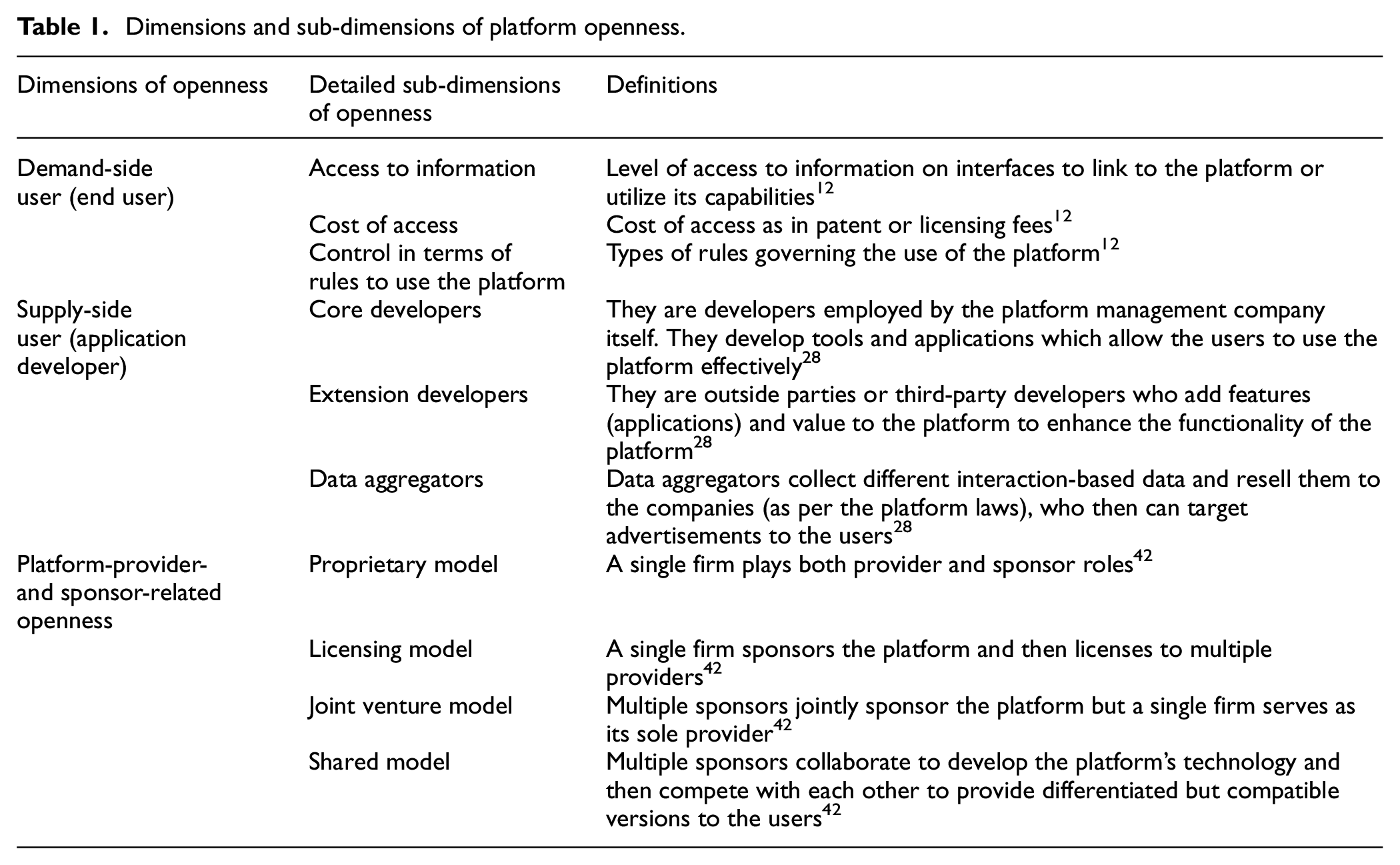
Industrial companies need to select the platforms based on optimal levels of openness because of their requirement to use the platforms with various different actors (e.g. suppliers, customers, designers). Furthermore, in a PLM context industrial internet platform openness can provide different benefits, possibilities and restrictions considering the management of D-I-K both within and between lifecycle phases. As defined by Eisenmann et al., 42 A platform is “open,” as long as, (1) no restrictions are placed on participation in its development, commercialization or use; or (2) any restrictions-for example, requirements to conform with technical standards or pay licensing fees-are reasonable and non-discriminatory, that is, they are applied to all the potential platform participants. This definition is applicable to a variety of actors that participate in the creation, usage and propagation of the platform. These actors are distributed in three categories: (1) demand-side user (end users of the platform), (2) supply-side users (application (app) developers on the platform) and (3) platform providers and sponsors (platform companies). Industry platforms generally have platform providers and sponsors as the same entity (e.g. GE Predix, Microsoft Azure). In some cases, they could be different entities, for example, with PTC ThingWorx, in Finland, PTC is the sponsor and Elisa is the provider. In this study, we have developed an analytical framework that presents the dimensions of platform openness and their detailed sub-dimensions by combining the theoretical frames presented by Gawer and Cusumano, 12 Parker et al., 28 Eisenmann et al. 42 and Benlian et al. 43 The conceptual analytical framework can be found in Table 1. Table 1 explains the dimensions and the sub-dimensions in detail in the context of industrial internet platform for PLM. For demand-side user (end user)-related openness, the sub-dimensions focused on (1) access to information—this deals with the level of access to information on interfaces to link to the platform or use its capabilities, (2) cost of access—this deals with the cost of access pertaining to licensing or patenting fees, and (3) control in terms of rules to use the platform—this deals with the types of rules governing the use of platform. In the case of supply-side user (application (app) developers on the platform), the sub-dimensions focus on openness related to (1) core developers—application developers working in the platform companies to develop the applications, (2) extension developers—third-party developers to develop applications on the platform, and (3) data aggregators—collect different interaction-based data and resell to the platforms, who can target advertisements to the end users (industrial companies). Finally, platform-provider- and sponsor-related openness adopts four models as sub-dimensions that can define the openness in different ways: (1) proprietary model—one company plays both provider and sponsor roles, hence controlling the openness, (2) licensing model—one single company sponsors (provides the funds or investment) the platform and then licenses to multiple providers (distributors or resellers), (3) joint venture model—multiple sponsors together sponsor the same platform and only one provider resells or distributes the platform, and (4) shared model—considered to be the most open model in a way that multiple sponsors as well as providers collaborate to develop the platform’s technology and then compete with each other to provide differentiated but compatible versions to the end users.
Dimensions and sub-dimensions of platform openness.
Openness within the lifecycle phases
In this section, the value and characteristics of openness within the different lifecycle phases (BOL, MOL and EOL) are discussed. The general structure is based on the three main “openness criteria” identified previously (see Table 1).
The openness from demand side (end user) can generally be understood to be essential during the BOL and EOL phases and in most cases also during the MOL phase. During BOL and MOL, the end users are relatively clearly defined and their openness requirements are also well understood. Access to the platform information is essential for many operations happening during BOL and EOL, and as such the openness requirement during these two phases is high. During the MOL it depends what stake-holders are understood as end users, which explains the possible limitation. In some cases, the end users will not have access to information, but other stakeholders, for example, the manufacturer who is collecting data on the usage, require openness to access the information. The cost of access and control over the rules of the platform are also important aspects that differ between BOL/EOL and MOL with a similar result as the access to information. While stakeholders with a business interest during the BOL/EOL can calculate how much the openness is “worth” to them, this might be different for private end users and thus lead to less demanding requirements toward demand-side openness during the MOL phase.
When investigating the openness requirement from the supplier side (application developer), the different phases are more homogeneous than the previously discussed demand side. As application developers during all the phases, BOL, MOL and EOL, have similar requirements toward the openness of the platform i.e. to being able to create their core applications, extensions or data aggregating services. While, during the BOL, the focus of these tasks is on, for example, design or manufacturing support, during the MOL the applications might provide services directly to the users themselves or other (professional) stakeholders, for example, in terms of product service system type of arrangements (e.g. uber) or predictive maintenance.
In terms of the openness criteria of the platform provider and platform sponsor, the implications on the different lifecycle phases are mostly related to interoperability issues. For the platform provider criteria, especially regarding coupling of OS and hardware, a licensing model is preferable in most cases, especially during BOL and EOL, so the existing infrastructure can be used to a large extent that is already available in most professional environments. With regard to platform sponsorship, this becomes relevant when thinking of the privacy (and/or competitive) issues (e.g. governmental access/backdoors; unclear rules of data usage, etc.). For example, with GE’s Predix, it is highly unlikely that (1) a direct competitor like, for example, Siemens or a subsidiary will use it during any lifecycle phase without access to the source code and (2) GE is highly unlikely to provide access to the source code to a direct competitor. This extreme example highlights that there are certain requirements toward openness at the platform sponsor level, but these will most likely be relatively rare cases.
Openness between the lifecycle phases
The following structure presents a simplified view on the interfaces of the three main lifecycle phases. There might be more complex constellations that require taking all phases in a more networked structure into account to replicate interdependencies between all phases. However, this needs to be studied in detail and is not in the focus of this study. More information regarding the information flows between different phases themselves can be found in Wellsandt et al.24,44 The demand-side (end user) openness requirements at the interface between BOL and MOL are expected to be high. Information access over lifecycle phase borders is essential for many applications. A rather common application of such cross-border information exchange that demands openness is design based on usage data. 45 The same high requirements toward openness stand true for the BOL–MOL and MOL–EOL interfaces. Many EOL applications require detailed information of the materials used, manufacturing/assembly processes (BOL–EOL) and also information about the usage of the product to determine if the materials might be contaminated (e.g. biohazard due to use in operating theater) or if remanufacturing is possible/reasonable (MOL–EOL).
From the supplier-side (application developer) openness criteria, the interfaces are rather important as well. Designing an application to collect usage data for use during the beginning of life requires a high degree of openness regarding the interface between BOL and MOL for example. And this certainly stands true for other cross-platform applications. As these services are in most cases very case specific, openness toward third-party developers for core application, extension and/or data aggregation is a necessity for most applications. Behind the applications, extensions and data aggregation services is a lot of expertise and dedicated knowledge that is unlikely to be shared by third-party developers with the platform operators in the case of a low level of openness. The reasons are that (1) this knowledge and expertise is a core competency of the developers and (2) the platform operator will most likely not be able to develop the solution in the required quality as it is outside of their expertise. Therefore, the supplier-side openness criteria are understood to be significant when it comes to the interfaces between the different phases.
With regard to the openness criteria of the platform provider and platform sponsor, the same arguments can be used for the interfaces between phases as for the phases themselves. In this case, it also strongly depends on the individual constellation or case to being able to judge the required or desired level of openness of a platform.
Industrial Internet platform selection criteria
Today, there is a plethora of platforms available. We selected a subset of platforms that enable efficient and real-time management of D-I-K over various lifecycle phases. These platforms were identified mainly from academic articles30,46–49 and other relevant sources which reviewed the characteristics, functionalities and data and information management perspective of platforms. Some platforms, such as Exosite and IndustryHack, were added into this pool because they were discovered to be interesting (e.g. unique or novel) in some of their characteristics. From this subset, a large pool was selected based on the following inclusion criteria:
Platforms that are relevant to industrial internet and cater to manufacturing and industrial companies;
Platforms that are international. This allows various actors involved in the lifecycle of the product to use them from different geographical locations.
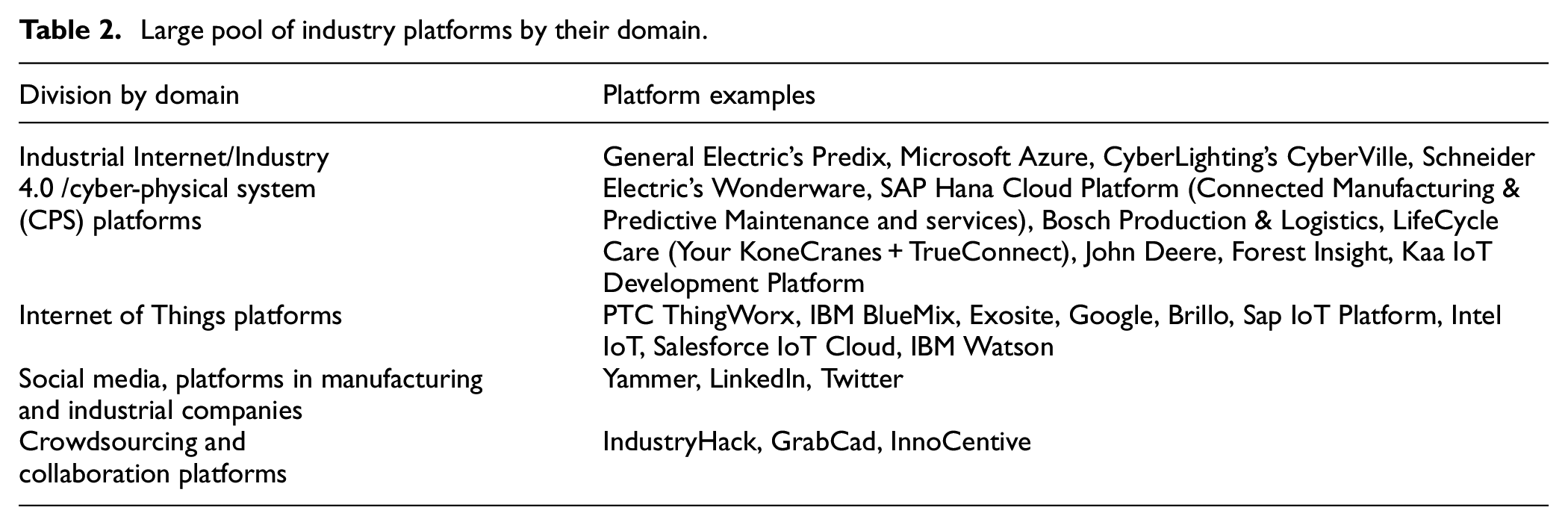
Platforms that satisfy the definition of external/industry platforms 12 allow the inter-organizational collaboration to manage D-I-K. Table 2 shows the examples of various platforms in the domain of industrial Internet/Industry4.0/CPS,14,30 IoT, 46 social media platforms in manufacturing industrial companies 50 and crowdsourcing and collaboration platforms. 51 These examples are not an exclusive list of platforms but they are representatives of the domains.
Large pool of industry platforms by their domain.
Research methodology
The aim of this article is to identify PLM-related D-I-K challenges as well as the role of industrial internet platform openness to address these challenges. In order to do this, first we identify the key PLM challenges related to D-I-K from the literature. Primary data from the literature and secondary data from credible and reliable sources related to industrial internet platforms were collected and a theoretical understanding was established to see how these platforms can address the above-mentioned PLM challenges, within as well as between the lifecycle phases. We understood from theory that platform openness can address PLM challenges in an effective manner. In order to investigate the above, we devised a conceptual framework (Table 1), where different dimensions and sub-dimensions are described. The selected industrial internet platforms (selection criteria are presented in the next section) were analyzed using the secondary data with respect to the openness dimensions and sub-dimensions.
Analyses of industrial internet platforms from PLM perspective
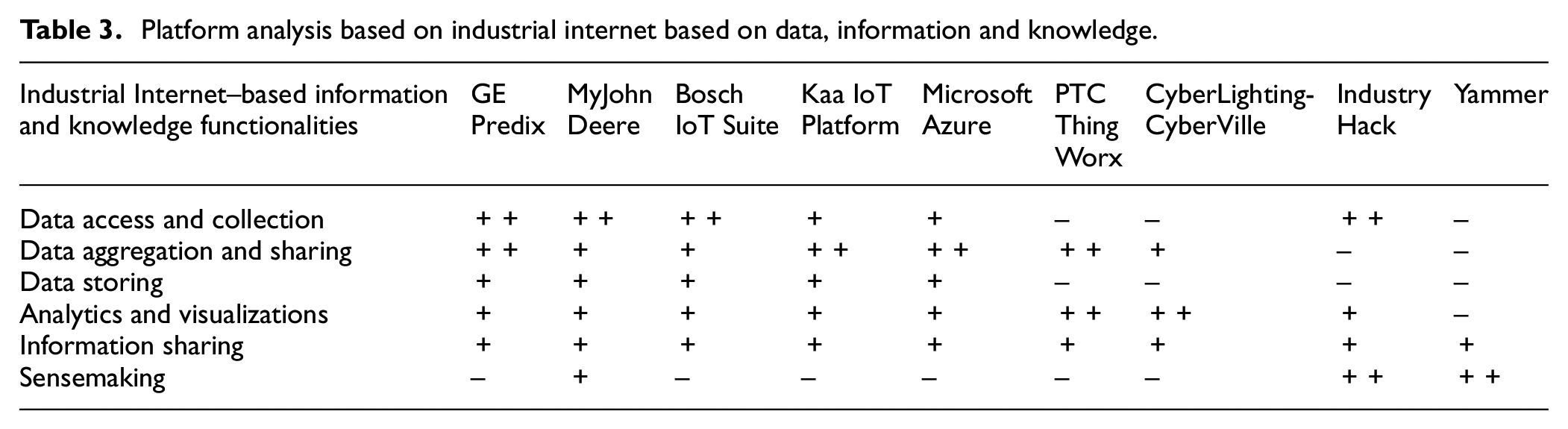
In order to perform an in-depth analysis of industrial Internet platforms from the perspective of PLM, we further selected 10 platforms (see Table 3) that represent different platform domains and have unique features as platforms, considering especially their capabilities to address various challenges (drawn from section “PLM challenges” and represented as the major evaluation criteria in Table 3). We further selected five platforms (see Table 4) that provide analysis to highlight the effects on management of D-I-K across various PLM phases using industrial internet as a technology enabler. In Table 3, IndustryHack is a unique actor as it uses the concept of hackathon 52 in an industrial setting to bring together outside experts who can help in rapid prototyping 53 and present a proof of concept for the given industrial problem. In terms of data access, Predix, MyJohnDeere and Bosch IoT Suite have the unique advantage of providing their own sensors which can work in different environments.14,36,41 These platforms have the capability to directly access a new source of data which is not possible for platforms which do not provide their own hardware (e.g. sensors, actuators). On the other hand, IndustryHack collects data in terms of a pool of experts which can collaborate with industries in the hackathons. Hana, Azure, Predix and ThingWorx also allow the real-time data integration with data from novel data sources like social media.46–48 This kind of combination of data can lead to the creation of new information. Platforms like CyberVille provide features like multilayered three-dimensional (3D) view of a complex network in real time. ThingWorx lowers technological complexities for users through codeless mashup capabilities. This enables easy creation of a variety of visual infographics.47,49 In business context, sensemaking needs experts who can help in making quality decisions after an informed sensemaking process. 41 While sensemaking is enabled by most of the platforms in the above list. Platforms like Yammer (microblog) and IndustryHack directly support sensemaking by bringing together relevant experts to make sense of provided information. Table 4 provides a detailed analysis of five platforms that address the challenges of PLM in the context of D-I-K management. Platforms have different degrees of openness: 12 access to data and information, rules governing the platform and cost of access to data and information. CyberVille is open from the viewpoint of D-I-K in a way that it follows the open source standards of the Internet technology. Access to D-I-K across the lifecycle phases and within the different phases (in the case of closed-loop PLM) is the key to the value creation from product-related lifecycle D-I-K. 13 MyJohnDeere is a kind of platform that enables the product manufacturer to tap into all the data and information throughout the lifecycle phases and also access within different lifecycle phases. Interoperability 22 which is one of the key issues in all industrial software solutions (e.g. PLM, PDM, CRM, ERP) is addressed by industrial internet platforms through the use of plugins. In order to create value of data and information, it is important to get this data and information in real time and provide analytics based on these data in real time as well. The GE Predix and Microsoft Azure which are examples of industrial internet platforms have incorporated Big Data technologies in the platform architecture to enable real-time monitoring as well as advanced analytics.14,40,46 One of the key differentiators between traditional industry software solutions and platforms like PTC ThingWorx, CyberVille and GE Predix is the availability of on-demand tailored solutions47,49 or “apps” which ultimately result in a marketplace offering a wide variation of dedicated solutions. These “apps” or applications create value of D-I-K for the platform users. The popularity and acceptance of this marketplace generates network effects for the platform. 12
Platform analysis based on industrial internet based on data, information and knowledge.
Detailed analysis of industrial internet platforms in the context of PLM.
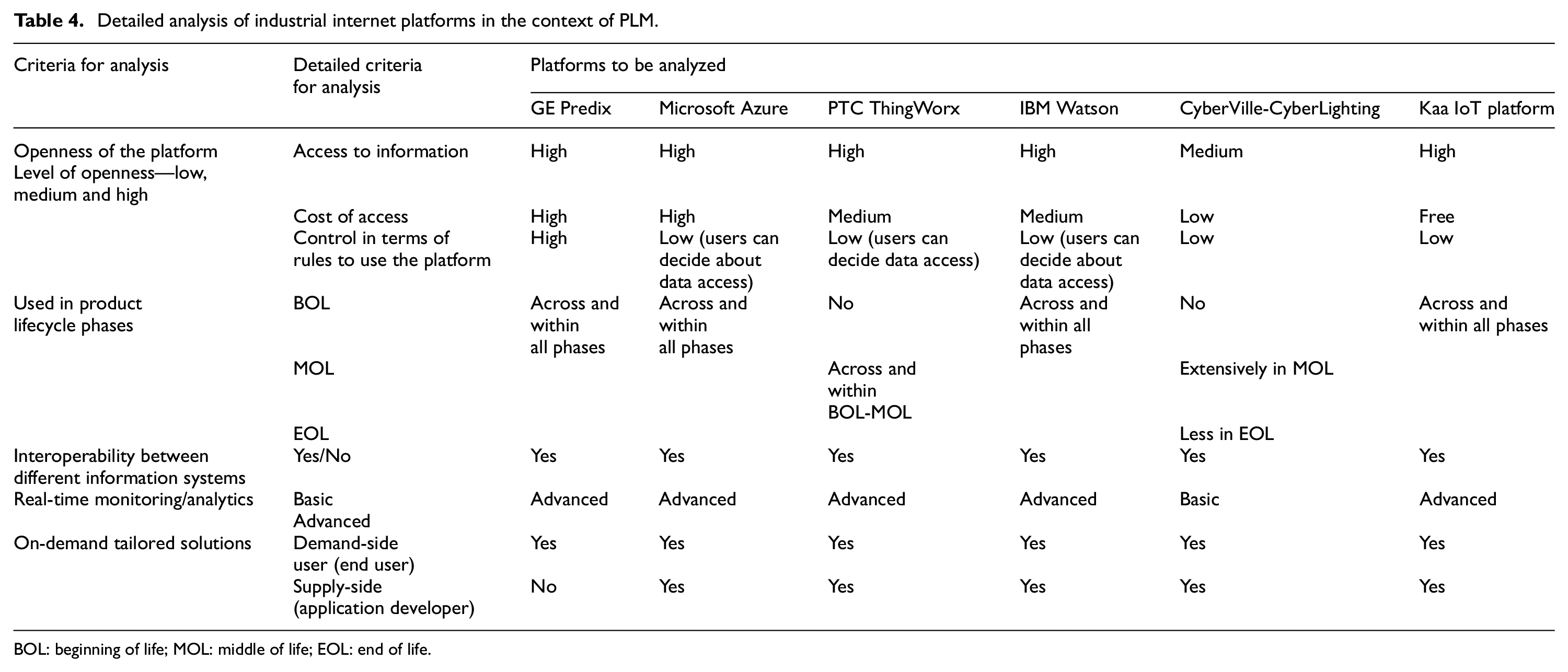
BOL: beginning of life; MOL: middle of life; EOL: end of life.
Analyses of industrial internet platforms and openness
Table 4 analyzes the platform openness in a unidimensional manner (only demand-side user-related openness) when it comes to openness because the purpose of the analysis was to understand its role in the management of D-I-K in a PLM context. Table 5 shows the details of the dimensions that provide the view on the degree of openness. The same six platforms that are analyzed in Table 4 are analyzed in Table 5. The dimensions and sub-dimensions are explained in Table 1.
Detailed analysis of industrial internet platforms based on dimensions and sub-dimensions of platform openness.
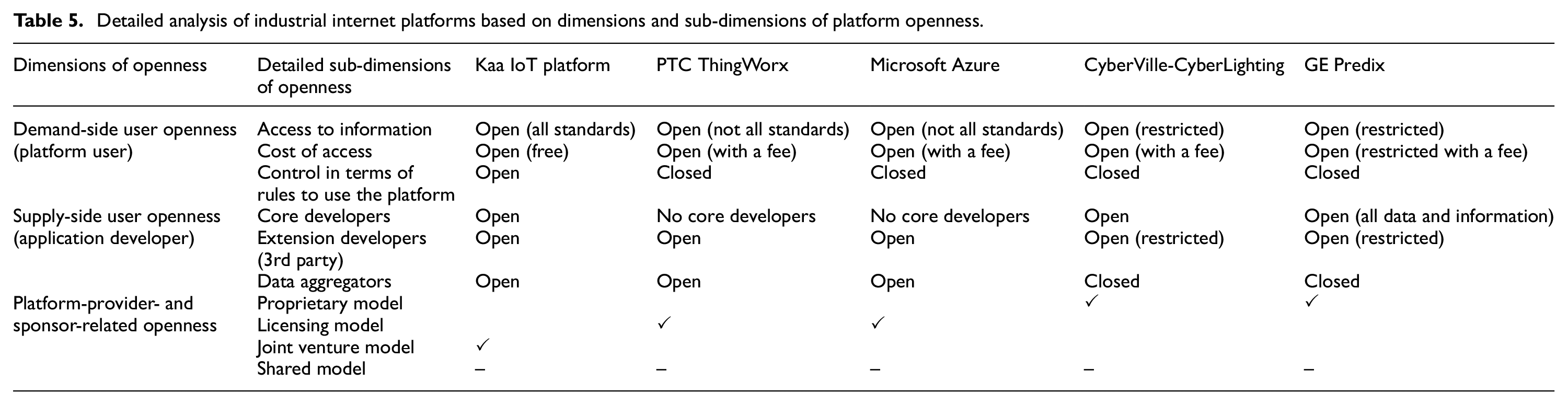
In the case of demand-side user openness dimension, Kaa IoT platform has a complete access to information (uses all open standards) for the end user, whereas GE Predix allows access to user data only, not to the source code of the platform instance implemented by the end user. In the case of the cost of access to information, Kaa IoT platform is completely free because a lot of development of Kaa IoT platform happens by the open source community, so Kaa IoT platform is like Linux. But platforms like Microsoft Azure, PTC ThingWorx and CyberVille have a fee for the end user which allows them the access to information. GE Predix even with a fee allows limited end user access to information. Governance or control in terms of rules to use the platform differentiates the very open (Kaa IoT platform) from the very closed (PTC ThingWorx, Microsoft Azure, CyberVille and GE Predix). For a platform user, at a higher level, all the platforms mentioned in Table 5 enable D-I-K management but when the sub-dimensions are considered, the openness to manage D-I-K varies for different platforms.
The supply-side user dimension which is further divided into core developers, extension developers (3rd party) and data aggregators is analyzed for all the five platforms. PTC ThingWorx and Microsoft Azure do not have core developers because their core business is driven by extension or third-party developers. Core developers for Kaa IoT platform and CyberVille mainly develop the core functionalities of the platform and do not have an end-to-end access to customer data and information. For GE predix, core developers are the main developers, and hence they have a lot of access to customer data and information, in order to provide tailor-made solutions. Data aggregators are relatively new in the manufacturing or industrial business. Not all platforms allow the data aggregators an access to data to merge similar kind of data from various industries and create meaningful insights. CyberVille and GE Predix, among the five platforms studied, do not allow data aggregators to access the data and information. Different platforms have different protocols for management of D-I-K, which leads the differences in access to core and extension developers as well as data aggregators.
In the case of the platform provider and sponsor dimension, platforms follow different models (models are represented as sub-dimensions). CyberVille and GE Predix follow the proprietary model, PTC ThingWorx and Microsoft Azure follow the licensing model and Kaa IoT platform follows the joint venture model. Partnership between different platforms affects the model they follow. The model that they follow also defines the D-I-K management policies. In the next section, we will discuss the findings and present the implications in detail.
Discussion and conclusion
Our purpose was to analyze and understand the potential role of industrial internet platforms in the management of product lifecycle–related D-I-K as well as understand the various dimensions and sub-dimensions of platform openness that influence the selection of these platforms.
Answering the research question 1 (RQ1), from PLM-related literature, we identified major D-I-K management–related challenges both within and between product lifecycle phases. In this article, we identified different types of novel platforms that handle D-I-K in a different manner in the context of industrial Internet. Some of the platforms are more focussed on addressing machine-related D-I-K, whereas others are more focussed on internal and external collaboration, and sensemaking of data and information. Such platforms are shown in Table 2.
Answering the research question 2 (RQ2), demonstrated in Tables 3 and 4, we found that industrial Internet–related technologies and platforms can address all of the identified major classes of challenges of D-I-K during and within the different PLM phases. We found that the platforms address PLM challenges in a different manner and showed more specifically in Tables 3 and 4 how different industrial internet platforms address different PLM challenges. For example, CyberVille is about innovative 3D visualization of industrial internet–related data and information, and addresses the PLM challenges using 3D visualizations. PTC ThingWorx-like platforms provide mobile applications that, for instance, enable companies to tap into real-time industrial internet–related novel data and information, use these data to collaborate with colleagues and make insights of it, and feed in information to the systems that can be used easily by people who are not experts in complex PLM/PDM systems. Most of the platforms listed in Table 4 can address PLM challenges (e.g. Table 4 shows most of the platforms that can be used to facilitate bringing information across and within the product lifecycle phases) which are normally not handled well by traditional PLM/PDM software.7,54
Answering the research question 3 (RQ3), we found that there are industrial internet platforms that had very different types of strategies and profiles related to openness. Industrial Internet platform openness, more specifically, was found to have a clear impact on many of such challenges and can be used to address various challenges in a structured manner. All the three identified major dimensions of openness as well as the resulting degree of openness were found to matter significantly to the management of D-I-K for both within and between product lifecycle phases. It was found from Table 5 that there are clear differences in the profiles related to openness and these differences matter in the management of D-I-K within and between product lifecycle phases. It can be found from Table 5 that sub-dimensions like access to information, cost of access and openness toward extension developers (3rd Party) matter to management of D-I-K within and between product lifecycle phases, and different platforms have different profiles when it comes to such sub-dimensions.
Limitations
A possible limitation of this study is that it focuses on creating a conceptual model to analyze industrial Internet platforms as well as dimensions of platform openness. Empirical validation which is not in the scope of this study will be carried out as a part of future studies where platform companies in Tables 4 and 5 as well as their customers will be interviewed about criteria of analysis and openness dimensions.
Managerial implications
Here, we consider mainly the managerial implications toward platform users, not for instance platform owners and developers. First, since this study demonstrates that many industrial internet platforms are designed to support interoperability and connections to external software and hardware, and can thus facilitate exchange of information between partners and customers relatively easy, as well as facilitate and speed up the implementation of industrial internet; these possibilities and capabilities should be carefully considered. Second, since there are clear differences and different emphases in industrial internet platforms’ capabilities to handle data and information, for instance related to their degree of openness, they should assess the overall benefits and risks (both short-term and long-term ones) from that perspective, making use of related frameworks and analyses provided by this study. Third, especially if the companies find the product lifecycle perspective important for their business, due to either long lifecycles of their products or the significance of the extended enterprise and related information management, they should consider the capabilities of various platforms to manage data in a longer term (e.g. legacy and interoperability issues) and to address other PLM challenges (e.g. the ability to connect different lifecycle phases such as MOL and EOL to BOL, which industrial internet technologies and platforms can address on the basis of this study). Fourth, not only the generic concept of platform openness, but, in more detail, also the overall impact of openness, as well as the different dimensions of openness in the considered industrial internet platforms, should be considered in the platform-related decision making. While selecting platforms, companies should consider at least these dimensions: access to information, cost of access and openness toward extension developers (3rd party), because they impact in various ways most of the challenges related to D-I-K. Fifth, when companies invest into platforms that enable and facilitate the extraction, storing, analysis and sharing of various data and information, allowing the tapping into vast amounts of data, they should also consider investing into platforms that enable them to better make sense of the data and make use of the data in managerial decision making, such as social media and crowdsourcing platforms discussed also in this article.
Sixth, while openness can offer significant benefits, but at the same time we clearly also notice that openness does not come for free. While a large established company might prefer a more mature and developed platform like Predix or ThingWorx, a small or medium-sized company might want to prefer a platform based on relatively open source standards and open interfaces, such as CyberVille-CyberLighting. However, small and medium-sized enterprises (SMEs) should also consider the platform selection from their limited resource perspective—they should not only consider the benefit perspective, but also take into consideration whether they can deal with the potential openness-related risks and problems (e.g. quality control, platform administration or potential information security problems). The costs of platforms and their various approaches to openness, especially in the long term, are often much more difficult to estimate than the short-term benefits provided by them.
Finally, companies should also consider carefully not only the extent of openness in their decisions as such, but also ponder in a more in-depth manner what is the suitable type of openness for them. For instance, in high-security organizations, such as the military, airplane industry or the energy sector, managers should not prefer the platform that is open in all aspects, but consider the significance of the implications of openness to information security or the quality control of applications for their business.
Footnotes
Acknowledgements
An earlier version of this article was presented in the 13th International Conference on Product Lifecycle Management (PLM), July 11–13, 2016, Columbia, South Carolina, USA.55
Declaration of conflicting interests
The author(s) declared no potential conflicts of interest with respect to the research, authorship and/or publication of this article.
Funding
The author(s) disclosed receipt of the following financial support for the research, authorship, and/or publication of this article: This work was supported in part by a grant received from Finnish Cultural Foundation (skr.fi) (Grant/Award No.: “00160626”) and VALIT, Tekes – Finnish Funding Agency for Innovation project (Grant/Award No.: “VALIT Project”).
