




Abstract
Lean proliferates the value-adding work by eliminating wastes and reducing incidental and non-value-adding work to a certain possible extent. Waste can be defined as anything other than the essential resources of people, machines, and materials that are needed to add value to the product. According to the lean concept, any action which does not directly enhance product’s value can be considered as waste. Analysis of lean waste issues is one of the primary steps to implement lean principles in many industries and the same is applicable for the foundry industry as well. The purpose of this article is to investigate the importance of various lean waste issues in Indian foundry industry for improvement in productivity and elimination of wastes, thereby initiating lean implementation. For the purposes of this study, we employed the survey questionnaire method to collect data against 17 lean waste issues from 71 middle- to senior-level professionals belonging to Indian foundry industry. The survey instrument of lean waste issues is developed based on a number of sources from the literature and formal discussions with academicians and foundry industry professionals. The responses were received on a 5-point Likert scale ranging from never found to mostly found. Descriptive statistics is employed to find out the relative significance of lean waste issues. Exploratory factor and reliability analyses are conducted to obtain and validate constructs and measure each construct’s Cronbach’s alpha. Finally, the study concludes that there is a need for elimination of lean waste issues to implement lean manufacturing and fulfil the requirements of Indian foundry industry.
Introduction
In today’s immensely competitive environment, the role of foundry industry is vital to the economies of many developing and developed nations of the world. The products manufactured by this industry are used in various other industries such as steel, electrical and electronics, railway, aerospace, and automobile industries. To produce a product in a foundry, it may undergo a variety of processes such as pattern making, mould making, melting of metals, metal treatment and degassing, cooling, fettling, recycling of sands, heat treatment, cleaning, drilling, polishing, machining, and surface coating. Thus, the manufacturing of a product by casting in the foundry industry requires a large number of processes and there are great possibilities of waste generation.
At present, Indian foundry industry is facing heightened challenges from global competition in all aspects of the business. There are more than 4500 foundry units throughout India, out of which 95% can be classified as small and medium-sized enterprises (SMEs) and 5% as large-scale enterprises. 1 During the financial year 2012–2013, Indian foundry industry has been acknowledged as the world’s third largest producer of castings producing 9.3 million tons per annum after China and United States producing 42.5 and 12.8 million tons per annum, respectively. Apparently, the large gap in the production of castings between India and China indicates that the industry is failing to utilize the availability of abundant natural and human resources and manufacturing potentials. Despite these challenges, foundry industry will continue to provide essential components for many of the manufactured goods. Torielli et al. 2 explained that foundries can become economically and environmentally sustainable businesses only by implementing the systematic approach offered by lean manufacturing to eliminate the wastes generated. Panwar et al. 3 highlighted that although implementation of lean practices is more generally seen in the discrete part industries, they are fairly frequently implemented in the process industries as well.
Nowadays, lean manufacturing is one of the most powerful strategies to achieve operational and service excellence. It is being extensively practiced and implemented by many manufacturing industries in different countries across the world for improving productivity and operational performance. Lean principles aim to increase productivity by extracting as much output as they can obtain from lesser inputs while eliminating wastes in terms of human effort, inventory, waiting, and so on from the systems and operations. 4 Waste consists of non-value-adding activities that contribute to the product costs and can be considered as any action for which the customer is unwilling to pay for. 5 In any process or industry, waste is referred to as the misuse of resources, as the product which is not appropriate for sale, as the resources that tie up cash, or as the inventory which provides little or no benefit to the industry or to its customer. Any process inside a manufacturing facility can be classified as an incidental activity, value-adding activity, or non-value-adding activity. 6 These activities are described as follows:
Incidental activities. The processes, such as inspection, that do not add value to the product, but are still required in the current production system;
Value-added (VA) activities. The processes, such as the final assembly of a product, that increase value of the product;
Non-value-added (NVA) activities. The processes that do not add any value to the product.
After having gone through the literature and discussing waste issues in terms of lean manufacturing with the industry professionals and academia, it has been observed that the lean approach can provide many benefits to Indian foundry industry. But the present status of lean manufacturing is not up to the mark in the industry and needs the attention of researchers and foundry managers for the implementation of lean concepts, principles, and practices. Thus, the main idea of this study is to facilitate foundry industry in taking up new initiatives, such as lean manufacturing, to become more cost-competitive in today’s global market. Although these methodologies have been around for several years, the purpose of this study is to bridge the gap between the theory and practice of lean and to study and investigate the importance of various lean waste issues in Indian foundry industry for improvement in productivity and elimination of wastes.
This study performed a survey to find out significant lean waste issues for elimination in Indian foundry industry. First, we systematically identify different lean waste issues based on a number of sources from the literature and formal discussions with academicians and foundry industry professionals. Then, we conduct a factor analysis to obtain and validate constructs of lean waste issues. Finally, we perform reliability analysis to verify the reliability of the constructs and use descriptive statistics to identify significant lean waste issues and their constructs. The results obtained from the analyses have been analysed and reported in this article.
The article is structured as follows. The next section ‘Literature review’ reviews the literature relating to lean manufacturing and its waste issues. Section ‘Research methodology’ provides the research methodology developed for analysing lean waste issues. Section ‘Data analysis’ presents the descriptive statistics and factor analysis of these waste issues. In section ‘Results and discussion’, implications of the results are discussed and suggestions for eliminating lean waste issues are presented. The conclusion of this study is provided in section ‘Conclusion’.
Literature review
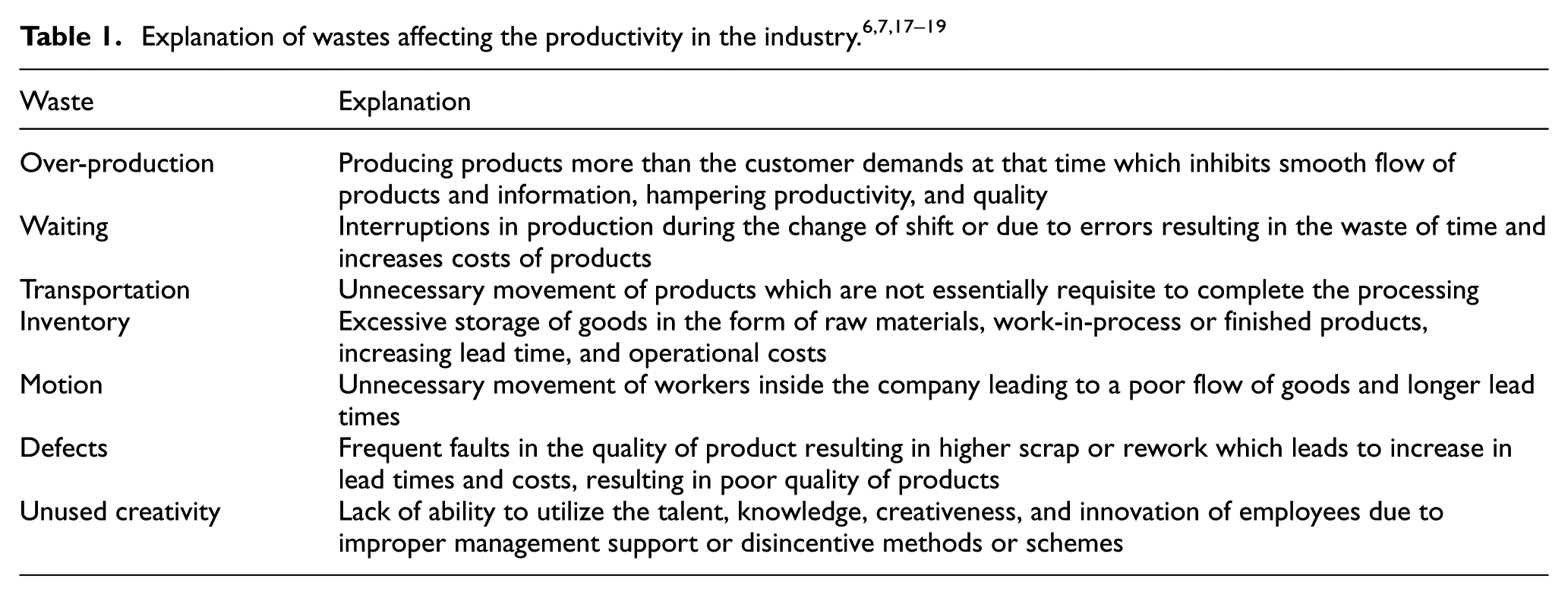
In the early 1980s, Japanese firms were leading the world’s automobile manufacturing sector with low-cost, best quality products, and just-in-time (JIT) delivery systems due to the Toyota Production System (TPS). The quality and efficiency improvement practices applied by Toyota in their production system, known as TPS, were first referred to as lean manufacturing in the book entitled The Machine That Changed the World published by Womack et al. 7 in the year 1990. Lean principles focus on the continuous identification and elimination of wastes and have begun to be propagated across the world owing to its influence on manufacturing operations. According to Hopp and Spearman, 8 lean manufacturing is ‘an integrated method that carries out production of goods or services with least possible buffering overheads’. Today, publications dealing with implementation of lean principles and practices in industries other than the automotive industry9,10 can be extensively seen within the literature such as in the aerospace,11,12 aviation maintenance repair overhaul, 13 hand tools, 14 and steel industry. 15 Elimination of wastes can be seen as an integral feature and ultimate target of most of the articles related to lean manufacturing within the literature. This shows that lean manufacturing is a universal philosophy implemented for eliminating wastes to a certain extent in any manufacturing industry. 16 Eliminating wastes can reduce product costs and enhance quality, but practically it is not viable to eliminate all the seven wastes absolutely even in an efficient system whose operations are waste dependent, that is, has waste as a part of its functionality. 5 Waste is anything other than the essential resources of equipment, effort, machines, materials, parts, space, time, and workers that are vital to add value to the product and for which the customer is willing to pay for.9,17 The seven types of waste categories identified from the TPS include over-production, waiting for equipment and human resources, transportation, inventory, motion, defects, and over-processing. 18 Moreover, the underutilization of creativity of employees is considered as the eighth waste. 7 Table 1 provides the explanation of most of the aforementioned wastes. However, the goal of lean principles is not to just deal with the elimination of these wastes but also to ensure that the flow of production is smooth and well-organized. 4
Cleaner production focuses on eliminating wastes and inefficiency at their source in the foundries rather than finding ‘end-of-pipe’ solutions once the wastes have been generated. 20 The survey results of Wong et al. 21 showed that many Malaysian electrical and electronics industries are committed to implementing various lean tools and techniques for reducing wastes, but they do not adopt a single tool in isolation. Singh et al. 22 suggested that implementation of lean principles can be beneficial in recession times since it provides the necessary flexibility to quickly change their strategies to meet customer’s expectations and to reduce the price of their product. The influence of e-supply strategy was empirically examined by So 23 on lean manufacturing adoption in electronic-enabled manufacturing supply chains which aim to create lean suppliers through waste reduction. Lyonnet et al. 24 developed a methodology to assess the level of maturity in companies regarding their insight of lean manufacturing and its application. A digital imaging of products was utilized by Hussein and Diab 25 to conduct a 100% online inspection since traditional methods of measurements have many shortcomings, such as high costs, calibration, the transition, time, and precision problems. Saurin and Ferreira 26 have conducted a study on harvester assembly line in Brazil to present guidelines for assessing impacts of lean manufacturing on working conditions on employees either at a plant or departmental level. Barber and Tietje 27 showed in what way the application of an essential lean technique, called value stream mapping (VSM), can be useful in the sales organization. A case study was described by Abdulmalek and Rajgopal 28 in which lean principles were adapted for the process sector for application at a large integrated steel mill. In their study, they used VSM to identify opportunities for various lean techniques. A study by Conti et al. 29 presents the possible stress on workers due to cycle time reduction because of lean implementation in the industry. However, all lean concepts, tools, and techniques cannot be implemented in any industry at a time. 30
Research methodology
The study on lean waste issues has been carried out to improve the productivity and operational performance of Indian foundry industry. The initial step in this research is to systematically study lean concepts and its different wastes in the context of the foundry industry. To collect data for this study, a survey instrument of 17 lean waste issues has been developed based on a number of sources from the literature (refer Table 1) and formal discussions with academicians and foundry industry professionals. We developed a structured questionnaire that included 17 items on lean waste issues using a 5-point Likert scale. For the grading of questions in the questionnaire by the respondents, a 5-point Likert scale ranging from 1 to 5 was provided, where 1 signifies never found, 2 signifies rarely found, 3 signifies sometimes found, 4 signifies frequently found and 5 signifies mostly found. The grades indicate the relative significance of lean waste issues for their elimination in Indian foundry industry.
The data employed in this study consist of questionnaire responses from various managers and executives of Indian foundries having a management experience of middle to senior level. The addresses of foundries were selected from various directories available at Confederation of Indian Industries (CII) and Foundry Informatics Centre (FIC) of India. The importance of the identified lean waste issues is justified with the help of a survey of foundries in India. Initially, a pilot study was conducted only to assess and improve the questionnaire. Based on a number of sources from the literature, a preliminary questionnaire has been designed for a pilot survey of 27 foundry industry in India selected on a statistical basis covering different regions and a variety of products. This questionnaire was distributed to a number of foundry industry professionals to get their suggestions as a part of the pilot survey. The final version of the questionnaire was framed by incorporating their comments and feedback and on the basis of various other information collected from the pilot survey. The final questionnaire was administered by mail to 368 professionals, along with a write-up of the objectives of the survey and its benefit to foundry industry. Out of a total of 368 questionnaires sent to the professionals, 71 valid responses were received, making a response rate of 19.29%. Thus, the analysis is based on 71 valid responses received from different experts of Indian foundry industry. Thereafter, the data collected have been subjected to assessment by using a standard research analysis software package called SPSS. The results obtained from these analyses have been used for discussion in section ‘Results and discussion’.
Data analysis
Factor analysis
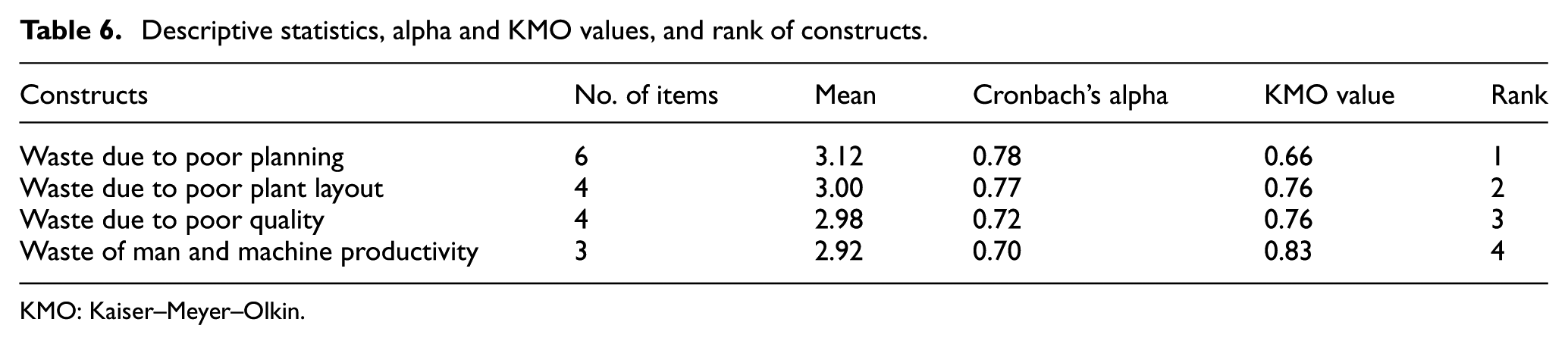
An exploratory factor analysis was performed using the survey data to obtain and validate constructs of lean waste issues in Indian foundry industry, as shown in Table 2. The constructs were obtained using the principal component analysis method, followed by a varimax rotation with Kaiser normalization. The Kaiser criterion (eigenvalues >1) was retained in conjunction with an evaluation of scree plots. The scree test and initial eigenvalue test indicated the occurrence of four significant constructs for lean waste issues which were retained after the rotation. The four constructs explain 59.7% of the inherent variation. The four constructs of lean waste issues obtained are shown in Table 5 and are labelled as the waste of man and machine productivity, waste due to poor plant layout, waste due to poor quality, and waste due to poor planning. Table 2 shows that factor loadings for all retained items ranged from 0.53 to 0.79. The Kaiser–Meyer–Olkin (KMO) measure of sampling adequacy test and Bartlett’s test of sphericity are performed to check that the survey data being used are appropriate for factor analysis.31,32 The output obtained by these tests has been shown in Table 3. In this analysis, the value of the Bartlett’s test comes out to be 462.204 (p < 0.001), representing the accuracy of factor analysis. Additionally, the KMO measure of sample adequacy is analysed, which produces a value of 0.86, and clearly exceeds the recommended threshold value of 0.60.
Factor analysis of lean waste issues.
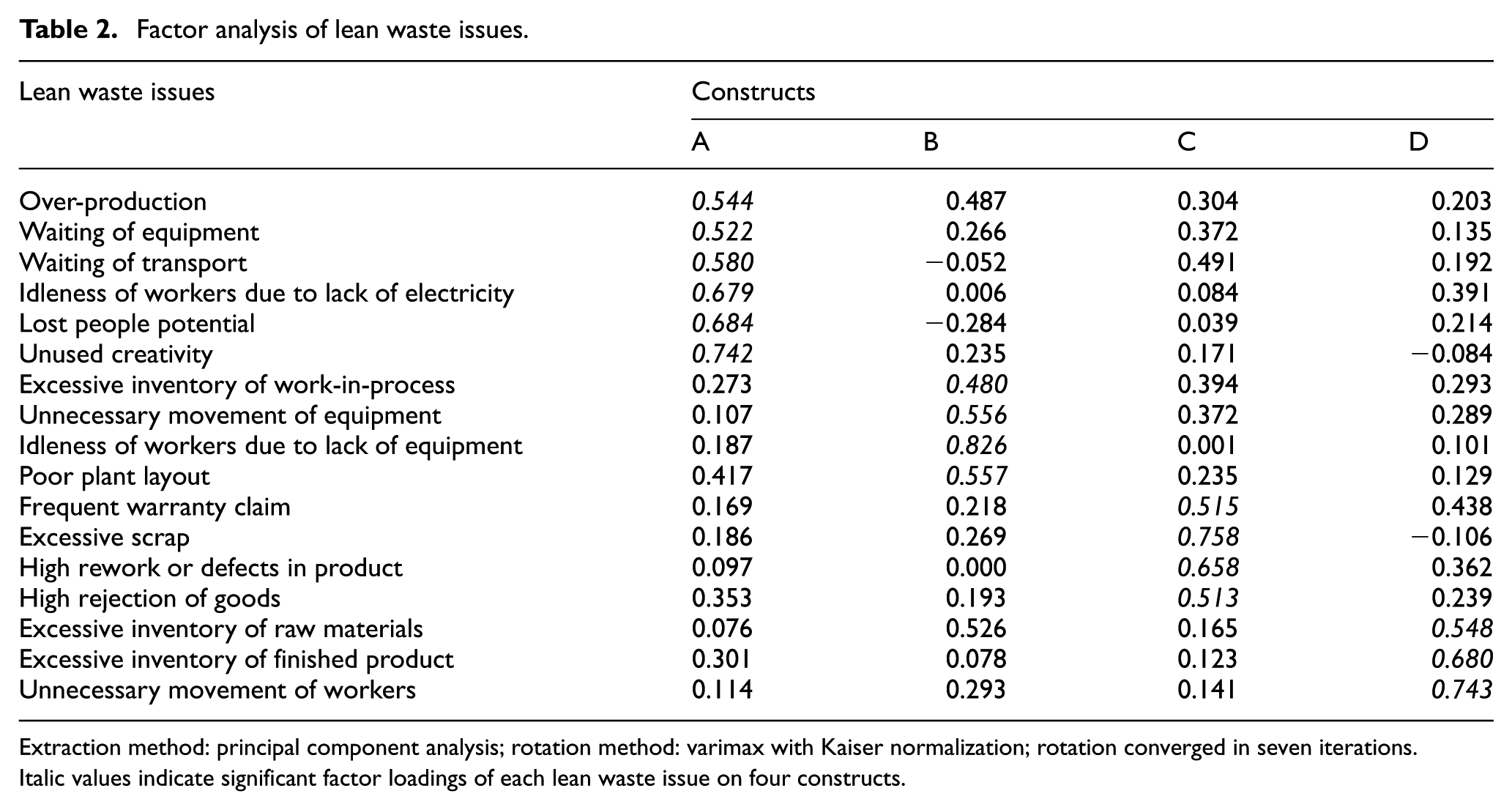
Extraction method: principal component analysis; rotation method: varimax with Kaiser normalization; rotation converged in seven iterations. Italic values indicate significant factor loadings of each lean waste issue on four constructs.
KMO and Bartlett’s test.
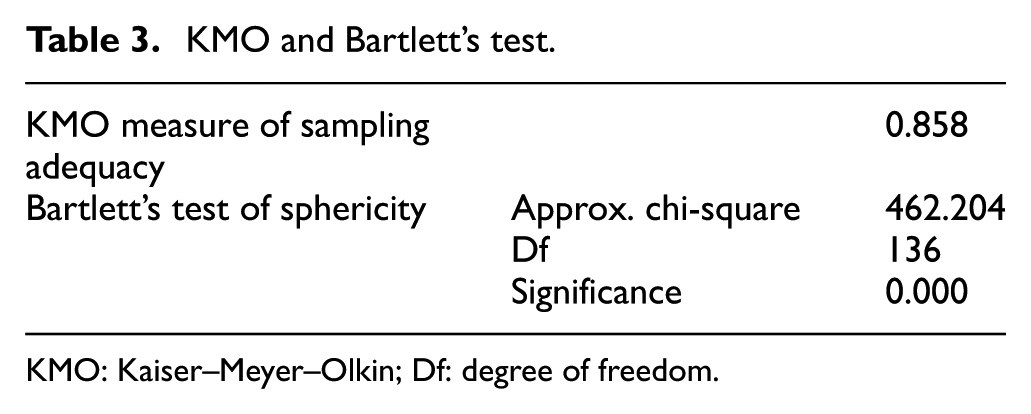
KMO: Kaiser–Meyer–Olkin; Df: degree of freedom.
Descriptive statistics and reliability analysis
Descriptive statistics is discussed for assessment of mean and standard deviation (SD) of lean waste issues in the foundry industry. The descriptive statistics, its mean, and SD of lean waste issues are shown in Table 4 and Figure 1. The descriptive statistics showed that the means of lean waste issues range from 2.76 (idleness of workers due to lack of electricity) to 3.21 (excessive inventory of raw materials), with the SDs ranging between 0.79 and 1.04 (Table 4).
Descriptive statistics of lean waste issues.
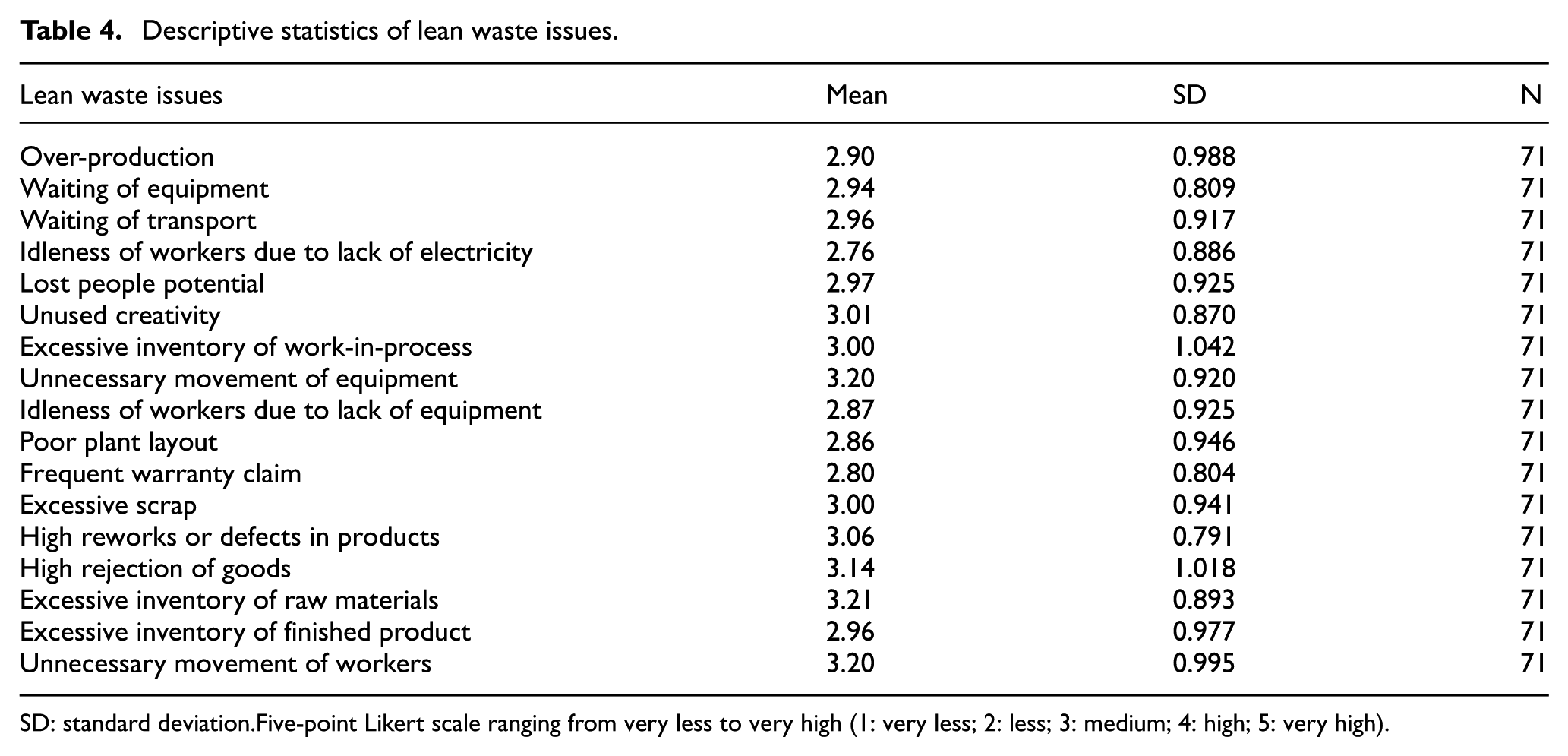
SD: standard deviation. Five-point Likert scale ranging from very less to very high (1: very less; 2: less; 3: medium; 4: high; 5: very high).
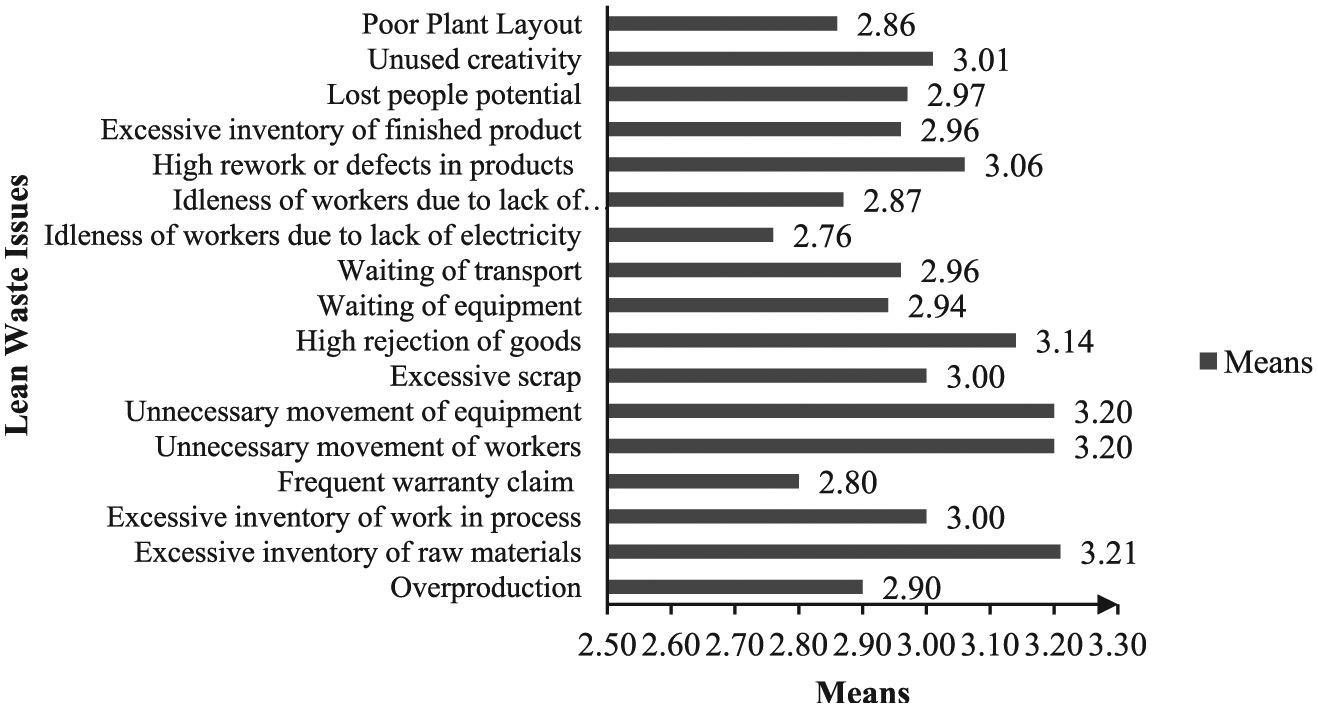
Importance of lean waste issues.
Reliability analysis has been performed to assess the internal consistency and reliability of the survey instrument. The reliability of the data can be confirmed by analysis of the values of Cronbach’s 33 alpha. It can be calculated using a standard user-friendly data analysing software package known as SPSS. The coefficients of Cronbach’s alpha for an empirical study should be above the threshold limit of 0.70 as suggested by Nunnally 34 to ensure the constructs internal consistency and reliability. Cronbach’s alpha coefficients have been analysed, as recommended by Flynn et al. 35 for an empirical research. The reliability of the four constructs has been confirmed by further analysis of the values of Cronbach’s alpha, of 0.78, 0.77, 0.72, and 0.70, respectively, for each construct. All Cronbach’s alpha values are above the threshold limit of 0.70, which ensure the constructs internal consistency and reliability. 34
Results and discussion
This study is based on a survey of 17 lean waste issues which have been identified based on literature review and discussion with professionals of Indian foundry industry. As apparent from Table 4, excessive inventory of raw materials is the most significant waste issue for lean implementation in Indian foundry industry with a mean value of 3.21. Unnecessary movement of workers and equipment since both are having a mean value of 3.20 is the second biggest waste issue for lean implementation in the industry. It is then followed by other lean waste issues. The idleness of workers due to lack of electricity with a mean value of 2.76 is the least significant waste issue and does not seem to play a large role in the industry.
The factor analysis was conducted (refer Table 2) to validate all lean waste issues, as shown in Table 5. The factor analysis suggested the occurrence of four significant constructs to represent lean waste issues. The lean waste issues have been categorized into four constructs as the waste of man and machine productivity, waste due to poor plant layout, waste due to poor quality, and waste due to poor planning. The means of all four categories of lean waste issues range from 2.92 to 3.12, as observed from Table 4, which indicates that there is not much variation in their significance and all these waste issues must be gradually eliminated from the operations and systems of the foundry industry. Table 6 provides the descriptive statistics, alpha and KMO values, and rankings for all four constructs of lean waste issues. Internal consistency or reliability of lean waste issues can be examined using the Cronbach’s alpha coefficient.33,34 The reliability of the four constructs of lean waste issues, as shown in Table 6, was confirmed by the analysis of Cronbach’s alpha values, of 0.78, 0.77, 0.72, and 0.70, respectively, for each construct. All constructs for lean waste issues possess a reliability or alpha value above the threshold value of 0.70, indicating that the reliability of survey instruments is fairly maintained.
Constructs of lean waste issues.
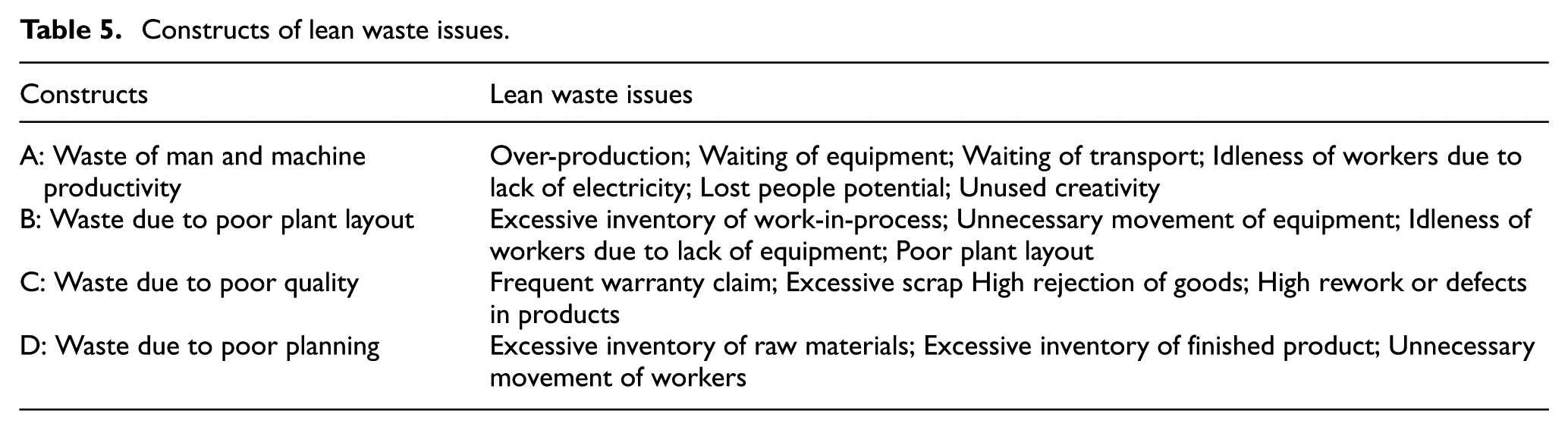
Descriptive statistics, alpha and KMO values, and rank of constructs.
KMO: Kaiser–Meyer–Olkin.
As apparent from Table 6, waste due to poor planning is the most significant waste construct in Indian foundry industry, with a mean value of 3.12. Thus, it seems that the foundry industries lack a separate planning department for developing good coordination among other departments. To eliminate this waste, software such as material resource planning and enterprise resource planning can be used in the raw materials and finished products store to implement pull production system. Moreover, the pattern shops must make use of computer-aided design to design patterns while integrating these systems with automated cutting tools. These steps would certainly eliminate various lean waste issues, such as the over-production, unnecessary movement of workers and equipment, as well as the inventory to the minimal level. Waste due to poor plant layout is the second main construct to lean implementation, with a mean value of 3.00. A reasonable explanation would be that the shop-floor of the foundry industry may not be well-organized or lacks proper arrangement which prevents smooth flow of semi-finished products to different shops. To eliminate this waste, the foundry industry should implement lean practices, such as cellular manufacturing and VSM, to plan the movement of products and facilitate operations and obtain maximum advantage of the correspondence among parts. 36 Waste due to poor quality, with a mean value of 2.98, has a great importance in the foundry industry since it becomes the reason of high rework on the products and are rejected as well due to its unacceptable quality, which finally becomes scrap. To eliminate this waste, industrial housekeeping techniques along with total quality management (TQM) practices and statistical process control must be implemented to initiate progress inside the firm in the form of excellent quality and increased efficiency while making sure that the processes are operating at their full potential. Wastes due to man and machine productivity are not as influencing but are identified with considerable importance since it reduces the operational performance and productivity of the foundry industry. As the operational processes of foundry involve a large number of non-value-adding activities, such as inventory, inspection, salvage, rework, over-processing, waiting, transportation, and various other processes, it contributes to wastage of many resources in terms of lead time, labours, materials, consumables, and equipment. Hence, if any foundry industry is moving towards lean implementation, it should target all categories of lean waste issues identified for elimination. Lean practices serve as a roadmap for the foundry industry aimed at the elimination of wastes. Therefore, it is recommended to apply most of the recommended lean practices to eliminate all these waste issues to a certain extent.16,37
The findings of this study provide obvious evidence that lean implementation is associated with the elimination of identified non-value-adding activities in the foundry industry. This study also provides help to the managers of foundry industry to implement advanced manufacturing systems, such as lean manufacturing, by suggesting lean practices for the elimination of wastes and promoting development within the foundry industry. Implementation of advanced manufacturing systems would surely make them more concerned to cost-competitive production in today’s global market. Worley and Doolen 38 have provided the evidence that top management support and leadership is prerequisite and vital for lean implementation and elimination of wastes in any manufacturing industry. In line with this finding, many researchers in the literature agreed that participation and investments of top management in lean manufacturing events are essential.39–42 Therefore, this study hypothesizes that there are big opportunities in the foundry industry for the elimination of waste issues if lean practices are utilized in an appropriate way with full support and leadership of senior and top management.
Conclusion
Till now, lean concepts were not properly implemented in the foundry industry as little attention has been paid to the elimination of lean waste issues in the industry. The objective of this article is to conduct an empirical analysis for assessing the significance of lean waste issues in Indian foundry industry through survey questionnaire method, which has been achieved by applying several statistical analyses. The significant aspect of this study is to identify lean waste issues in the foundry industry and make the industry move towards the elimination of these lean waste issues, thereby initiating lean implementation. The major contribution of this study is the development of a systematic methodology for assessing the significance of lean waste issues in the foundry industry and establishing the validity and reliability of the constructs through rigorous analyses. Besides, the findings of this study also contribute to the prediction of the future of Indian foundry industry. We have empirically found that all lean waste issues must be gradually eliminated to a certain extent from the processes of the foundry industry to initiate lean implementation. The study suggests that the implementation of lean principles and practices by eliminating waste issues along with strong market demand may allow foundry industry to reinvest, modernize, and dramatically improve quality and efficiency.
This article has certain limitations which provide avenues for future research. First, the limitation of this study is that the survey includes a sample size of 71 responses, which can be considered fairly low. In future research, this sample size could be expanded and the methodology developed for the foundry industry can be readily extended to other manufacturing industries such as forging, fabrication, machining, and rolling mill industry. Second, the data have been collected from various categories of foundry industry, such as ferrous, non-ferrous, and die-casting foundries that use different types of furnaces and moulding machines. Lean waste issues are assumed to have similar ineffectiveness in almost every foundry industry since their impacts are similar; however, they may possess different value to different organizations depending on their context. Hence for better results, identical categories of the foundry industry may be considered collectively with specific data analyses.
Footnotes
Acknowledgements
The authors would like to express thanks to two anonymous reviewers for thoughtful and positive recommendations that greatly improved this article. The authors also desire to give their heartiest thanks to all the foundry professionals and experts who devoted their precious time for filling our questionnaire.
Declaration of conflicting interests
The author(s) declared no potential conflicts of interest with respect to the research, authorship, and/or publication of this article.
Funding
The author(s) received no financial support for the research, authorship, and/or publication of this article.