




Abstract
Lean production is one of the alternatives to achieve excellence in the organizational operations. The objective of this study is to develop a lean production system framework by conducting critical analysis and comparative analysis on the existing lean production system frameworks. The study has collected 131 lean production system-related frameworks from the literature survey. The study has identified 39 frameworks using validity and reliability analysis, which is considered as a sample of framework in this study. The study has performed critical analysis on the sample of the frameworks in the aspects of novelty of frameworks, background development of framework, status of verification of frameworks and verification methodology used to verify the proposed frameworks. The study has proposed a framework with the help of domain knowledge, through discussion with experts in the field, comparative analysis as well as reliability and validity analysis. The study clearly discloses major irregularities in lean production system literature such as majority of frameworks have been developed based on novelty concept. The study also found a lack of significant participation of practitioners and consultants in the development of lean production system-related frameworks. The study has identified 11 pillars with the help of comparative analysis. However, finally the study has proposed a framework with the help of 11 pillars and 83 elements in the field of lean production system.
Keywords
Introduction
In the present scenario, manufacturing organizations are facing challenges in two directions. First, the organizations are struggling to implement advanced manufacturing philosophies in the organizational activities effectively. Second, the frequent change in customer requirements in terms of high quality and low cost with very short period of delivery time.1–3 In order to face these two challenges, manufacturing organizations are required to respond and adapt to new philosophies in the organizational activities to survive along with competitors. The concept of lean production (LP) is a topic of focus for the researchers as well as practitioners in the world to face these challenges. It is considered as a way to achieve excellence in the organizational performance that starts from product development, supply chain and manufacturing activities.
Indian manufacturing industries were protected from the global market up to the year 1990. Since the economic liberalization has started in India, it opened the Indian market to the global players. A wide variety of products are available to the customers due to liberalization. This kind of environment helped the customer to think and choose right product with high quality and low cost. However, Indian manufacturers struggled to compete with the global manufacturers in terms of quality and cost. 4 Global players are more focused in the implementation of advanced manufacturing strategies in the organizational activities. It resulted in Indian manufacturing players to start implementing or practicing the manufacturing strategies to improve the quality of the product as well as service with low cost to stay in competition along with the global players. 5 However, Indian manufacturing industries are lagging in implementation of advanced manufacturing strategies such as lean principles, total quality management (TQM) and agile manufacturing.
In recent trends, Southeast Asia and China are the manufacturing hubs of the world due to availability of labor at cheaper rates. This kind of environment also encourages the global manufacturing players to start the manufacturing units in these locations. It helped China to develop as one of the leading economies of the world and better employment destination in the world. 6 The growth of china is in rapid phase, that is, around 10%−11% per annum on the domestic front and around 35% on international front. 7 One of the questions raised in the discussion is whether that kind of development is possible in India. It is no secret that the economic growth of India is already in the direction of competing with china. India is one of the forthcoming manufacturing hubs in the world. The contribution of manufacturing sector is almost 16% of total Indian economy and the future prediction of the economists is that the manufacturing sector will contribute around 25% by the end of the next decade. 8 The kind of growth is possible only if the Indian manufacturing sector achieves excellence in the organizational activities. Indian manufacturing sector is moving in the right direction to achieve excellence in the field of manufacturing with implementation of some kind of advanced manufacturing strategies such as LP, TQM, flexible manufacturing system and agile manufacturing in critical areas of the organizational operations. With that, Indian manufacturing companies have started to achieve a considerable growth across the globe as well as within the country over the last two decades compared with an era of pre-economic liberalization in India. However, Indian manufacturing sector is lagging in effective implementation of advanced manufacturing strategies as compared with global manufacturing organizations.
Many Indian manufacturing industries have been struggling to achieve better productivity rate in terms of organizational performance. The average growth rate statistics of productivity of Indian manufacturing sector is 4.95% as compared with 7.31% for china, 9.45% for Singapore and 8.65% for Pakistan. 9 It clearly reveals that the Indian manufacturing sector has to improve its productivity growth drastically to achieve excellence in the field of manufacturing operations. To overcome these challenges, manufacturing sector industries have to implement effectively some kind of manufacturing strategies across the organizational activities instead of implementation of manufacturing techniques within some restricted areas of the organization. Anand and Kodali10,11 have reported that many Indian manufacturing companies have implemented lean principles in “bits and pieces” instead of across the whole organization. One of the root cause for this kind of trend is that a very few useful frameworks are reported in the field of LP. Many of the LP frameworks are addressed to some specific part of the organizational activities. To overcome these kinds of difficulties, this study tries to develop LP framework that will address all parts of the organization.
The structure of this study is arranged as follows: section “Literature review of LP” reviews the literature related to LP system and the guidelines to identify LP framework from the literature. Section “Research methodology” gives the details of the research methodology used to perform the study. Section “Reliability and validity analysis” is used to discuss the validity and reliability of existing frameworks in the field of LP system. Section “Classification and analysis of LP system frameworks” provides the classification of the valid LP frameworks and critical analysis of all aspects of LP system frameworks. Section “Comparative analysis” provides comparative analysis of the selected LP system frameworks. Section “Development of elements for the proposed framework of LP system” provides identification of LP system standard elements and pillars to propose LP system frameworks. Section “Discussion” provides the gaps existing in the present LP frameworks and proposes the future directions to improve the implementation of lean principles in any organization. Section “Implications” provides the implications of this study. Finally, Section “Conclusion” is devoted to conclude this study.
Literature review of LP
During World War II, the economic conditions of Japan as a country were in very bad shape that resulted in scarcity of funds and poor corporate finance. Even Toyota automotive industry also faced similar conditions because of which they were unable to maintain mass production system in the plant to sustain in the competitive world. 12 To overcome all these difficulties, Toyota automotive industry started a new manufacturing approach that required less capital investment to sustain in the competitive world.13,14 Initially, the new manufacturing approach was developed with a combination of knowledge and master craftsmen skill using the standardization as well as the teamwork concept. The new manufacturing approach was producing a small batch of products in the lot that resulted in fewer inventories and less capital investment to produce the same number of products. However, this approach faced practical limitations such as difficulty of changing tools and production lines. To overcome the shortcoming, Toyota organization started to use general purpose machines and trained employees instead of special purpose machines. Toyota understood the importance of investing on employee of the organization rather than procuring the bigger size machinery. This kind of approach motivates the employees of the organization to participate in improvement programs in the organizations. This approach helped Toyota automotive industry to sustain in the dynamic market, improved productivity as well as produced better quality products as compared to American counterparts. 15 John Krafcik initiated the term “LP” in 1988 while performing review of Toyota Production System. 16
The term “LP” has received attention from the western world through the book “The machine that changed the world” written by Womack et al.
16
According to Womack et al.,
16
LP can be defined as
use less of everything—half the human effort in the factory, half the manufacturing space, half the investment in tools, half the engineering working hours to develop a new product in half the time. Also, it requires keeping far less than half the inventory on site, results in fewer defects, and produces a greater and ever growing quality of products.
In recent years, Shah and Ward 17 have defined LP as “is an integrated socio-technical system whose main objective is to eliminate waste by concurrently reducing or minimizing supplier, customer, and internal.” During 1980s, the US organizations have faced heightened challenges from Japanese manufacturers in terms of quality, cost and customer satisfactions.18,19 The US manufacturing organizations started to rethink the strategies, which they have applied in the organization. In the same period, some of the researchers have started to study the successful manufacturing system applied in Japanese manufacturing organizations. Womack et al. 16 have exposed the real practices of Japanese manufacturing industries to the western world. LP is a successful integrated manufacturing strategy due to its multi-dimensional approach that contains a wide variety of management practices that include just in time, quality systems, teamwork, cellular manufacturing, supplier management, and customer focus in an integrated system. These factors influenced many western manufacturing organizations, which resulted in adaptation of similar strategies in their organization.
Papadopoulou and Ozbayrak 20 have conducted review on lean principles to trace the journey of lean from last century. Hines et al. 21 and Bhasin and Burcher 22 have discussed on lean manufacturing (LM) augmentation over its era and also tried to explain the way how the concept of LM was spread as a philosophy from just a production technique. The successful implementation of LP in manufacturing operations resulted in huge benefits in terms of productivity, quality, cost and overall performance of the organization. Womack and Jones 23 have proposed the concept of “lean enterprise (LE)” and defined it as a group of individual functions, which are separated legally; however, in the operational aspects of the organization, all these functions are synchronized with each other. The same researchers have proposed that the lean principles could be applied not only in manufacturing operations, but also it can be applied in supply chain, product development and for all-round organizational activities. 24 Womack and Jones 24 research findings helped the subsequent researchers to analyze in depth the concept of “lean.” Karlsson and Åhlström 25 have performed research on LP system and proposed that LP system consists of LE, LM, lean product development (LPD), lean distribution and lean procurement research streams.
Strozniak 26 has revealed that more than 80% of Indian manufacturing industries did not implement any kind of advanced manufacturing technologies such as lean practices and agile practices. According to Anand and Kodali, 10 many organizations were not able to implement lean principles effectively in organizational activities. The same research revealed that many organizations have implemented lean principles only in restricted function of organization as well as applied only one or two important elements. In order to get better results, the organizations have to implement throughout organizational activities as well as practice different lean elements in a systematic manner. It is not happening due to a lack of frameworks in the field of lean principles. Later, many researchers have proposed various frameworks in the field of lean philosophy. The focus of these frameworks restricted to a very specific field of research such as manufacturing operations, product development and supply chain activities instead of focus on throughout the activities of the organization. To overcome these shortcomings as well as to fill the vacuum in the field of frameworks of LP, this study has tried to propose a framework in the field of LP system that addresses all the issues related to organizational activities. The study also identified that many of the frameworks have been developed with novelty form instead of adapting existing frameworks in the field of LP. The study also believes that enough amount of theory building has been taken place in the field of LP framework. Hence, the study has reviewed existing frameworks in the field of LP system and based on that the study has proposed a new framework in the field of LP system.
Identification of LP system frameworks
The term “framework” is very popular in the field of operations research. However, many researchers have used “model” and “framework” interchangeably. It is happening because of a lack of awareness in differentiating the framework with the model. A very few researchers have tried to define the term “framework” to overcome the difficulty of identification of framework in the field of operations research. Aalbregtse et al. 27 have discussed that a framework is a tool that is used by management to project the overall picture of business objectives and also presents the complete methodology to be adapted to achieve the organizational business objectivities. Hakes 28 has discussed that the main focus of a systematic framework is generating the smooth correlation link between the theory and practice of the organizations. Popper 29 has pointed out that a framework contains various principles and techniques as well as discusses the systematic implementation methodology of the suggested principles and techniques in the organization. Yusof and Aspinwall 30 have proposed the difference between the model and the framework, and according to them, a model answers only “what is,” whereas a framework answers “how is.” Anand and Kodali 11 have discussed that a framework is used as a torch to guide the organizational managers as well as employees to adapt the proposed philosophy in a particular organization. Recently, Soni and Kodali 31 have selected frameworks in the field of supply chain management to perform required analysis. The same study has suggested a few guidelines to identify the framework in the field of operations management. This study also adapted same methodology to identify the framework in the field of LP system. According to Soni and Kodali, 31 the framework requires the following characteristics:
A framework should provide the complete relationship among proposed set of elements in the system instead of just proposing the list of elements in the system.
A framework should provide the information about how to implement the proposed elements in various stages of the system.
A framework should provide the complete information on the associated elements of framework and also actions required to practice the list of associated elements in the framework.
The study has used these guidelines to identify the frameworks in the field of LP system. The subsequent section illustrates the research methodology used in this research study.
Research methodology
The study has used the following five steps to perform systematic examination:
Step 1. This study has performed extensive literature review in the field of LP system. The study has gathered the research articles available in various standard books and online database sources published during a period of last 25 years, that is, the years 1988–2012. The study has considered the year 1988 as a starting point to collect the research articles. The main reason to select the year 1988 is that the term of LP was coined by Krafcik in the year 1988. 16 The study has collected the articles up to the end of year 2012, which is considered terminating point of the sample collection of articles.
Step 2. The study has used various online database portals that are as follows: Emerald online, SAGE Publications, ScienceDirect, Taylor and Francis, as well as Springer Link. The study also considered Google Scholars online portals to search the frameworks in the field of LP system. The study has contacted a few researchers using various online sources to collect the frameworks in the field of LP system. It clearly reveals that the study did not ignore any opportunity to collect research articles as well as frameworks in the field of LP system.
Step 3. The study has collected LP system-related articles using eight key words: LP, LM, lean supply chain, LPD, LE, just-in-time (JIT) manufacturing, lean thinking and Toyota production. Jasti and Kodali 32 and Anand 33 have adapted similar kind of search criteria to collect research articles to perform review in the field of LP. Finally, the study has collected a total of 762 research articles from five online research publication portals and 121 articles (includes text books, master thesis and white papers) from Google Scholar.
Step 4. According to Karlsson and Åhlström, 25 LP system consists of LM, lean procurement, lean distribution, LPD and LE research streams. Anand and Kodali 34 have clubbed lean procurement and lean distribution under the umbrella of lean supply chain management (LSCM) research stream. The study has classified all the articles in four categories, that is, LM (524 articles), LSCM (228 articles), LPD (88 articles) and LE (43 articles). The study also searched online portals with the help of Google search to find out LP system–related frameworks. The study identified 31 LE frameworks, 35 LM frameworks, 30 LSCM frameworks and 35 LPD frameworks. Finally, the study identified 131 LP system–related frameworks with the help of extensive literature survey in the field of LP system. However, the study has projected all these frameworks as a sample of frameworks of LP-related areas. It is an impossible task to collect the complete set of LP-related frameworks from the literature. The complete list of the LP-related frameworks considered in the study is given in Appendix 1.
Step 5. The researchers of this study have performed reliability and validity of the LP-related frameworks in the Indian manufacturing industries among all the frameworks of LP system in the previous study.35–38 The same study revealed that around 39 frameworks have shown good statistical values in terms of reliability and validity of the frameworks in the field of LP system. This study has considered these 39 frameworks to develop a new framework in the field of LP system. These frameworks are 11 LE frameworks, 11 LM frameworks, 9 LSCM frameworks and 8 LPD frameworks.
Step 6. The study has classified all these 39 LP-related frameworks based on its novelty, researcher background, verification of the framework and type of verification methodology used by the researchers. The study also tries to find out the inconsistencies and inadequacies existing in the sample of LP-related frameworks.
Step 7. The study has performed comparative analysis to identify pillars of the proposed framework in the field of LP. The study also identified elements of LP framework based on frequency distribution analysis, in which mean value is more than 3.5 and mode 4 or more.
Reliability and validity analysis
The researchers have prepared four different questionnaires separately in the fields of LM, LPD, LE and LSCM. The study has collected empirical data from 180 Indian manufacturing industries through survey questionnaire methodology to perform reliability and validity analysis on total 131 frameworks in the field of LP system. The reliability and validity analysis revealed that 39 frameworks have shown better reliability (Cronbach’s alpha ≥ 0.7) and validity analysis also performed in terms of verification of unidimensionality of the framework. Similar kind of analysis was performed by Sharma and Kodali. 39 The selected frameworks are as follows:
LE frameworks: Archfield Consulting Group, 40 Beason, 41 Bohan and Accorti, 42 Conner, 43 Cook and Graser, 44 Industrial Solutions Inc., 45 Just-in-time Enterprise Institute, 46 Karlsson and Åhlström, 47 Lean Breakthrough Consulting Group, 48 Unlimited Possibilities Consulting LLC 49 and Zayko. 50
LM frameworks: Åhlström, 51 Berry et al., 52 Dennis, 14 Flinchbaugh, 53 Found and Rich, 54 Höök and Stehn, 55 James-Moore and Gibbons, 56 Karlsson and Åhlström, 57 Liker, 58 Sanchez and Perez 59 and Sears and Shook. 60
LPD frameworks: Anand and Kodali, 61 Ballé and Ballé, 62 Kennedy, 63 McManus et al., 64 Nepal et al., 65 Possamai and Ceryno, 66 Reinertsen 67 and Ward. 68
LSCM frameworks: Barla, 69 Blanchard, 70 Cutcher-Gershenfeld and Bertelli, 71 Despres et al., 72 Lean Strategies Group LLC, 73 Manrodt et al., 74 McKee and Ross, 75 Poirier 76 and Taylor. 77
The same study also identified vital elements with the help of frequency distribution analysis. The study considered those elements as vital for study, which is having its value of mode 4 or more and mean value more than 3.5. The study identified 55, 47, 37 and 45 vital elements from LE, LM, LSCM and LPD, respectively. This study has observed that there is some kind of overlapping among 184 vital elements. The study tries to identify the unique elements from these 184 vital elements by removing the repeated elements. Hence, this study has established 83 elements from a total of 184 vital elements. These 83 lean elements have been considered to propose a new framework in the field of LP system. This study has also considered the sample of 39 LP system-related frameworks to perform required analysis to find out the inconsistencies in the trend of development of frameworks.
Classification and analysis of LP system frameworks
A sample of 39 LP-related frameworks was filtered out with the help of extensive literature review and empirical study. To develop a new framework, the study requires understanding of the existing form of frameworks in the field of LP system. Hence, the study tries to analyze the existing frameworks to find out the inconsistencies and inadequacies of the sample of the LP-related frameworks. This is discussed in detail in the next part of the present section.
Novelty of the framework
The study tries to find out whether the considered frameworks were developed based on adapting the existing frameworks or with novelty ideas. If the framework is developed based on existing frameworks in the field of LP, then the framework is categorized as an adapted framework. On the other end, if the framework is developed based on the researcher’s expertise, then the framework is categorized as novel framework. Soni and Kodali 31 have performed similar kind of analysis while reviewing frameworks in the field of supply chain management. The study has classified all considered frameworks as per aforementioned guidelines. The frequency distribution of LP system–related frameworks between novel and adapted framework is given in Table 1. Table 1 clearly reveals that around 95% of the frameworks fall in the category of novel frameworks. Only two frameworks are reported under the category of adapted frameworks. These two adapted frameworks are also belonging to the field of LM research stream. The complete list of frameworks from the research streams of LSCM, LPD and LE has been categorized as novel frameworks only. It indicates that a very few researchers have worked to develop the adapted frameworks in the field of LP system. Hence, the study also observed that a very less number of adapted frameworks have been reported in the field of LP.
The frequency distribution of lean production system–related frameworks between novel and adapted framework.
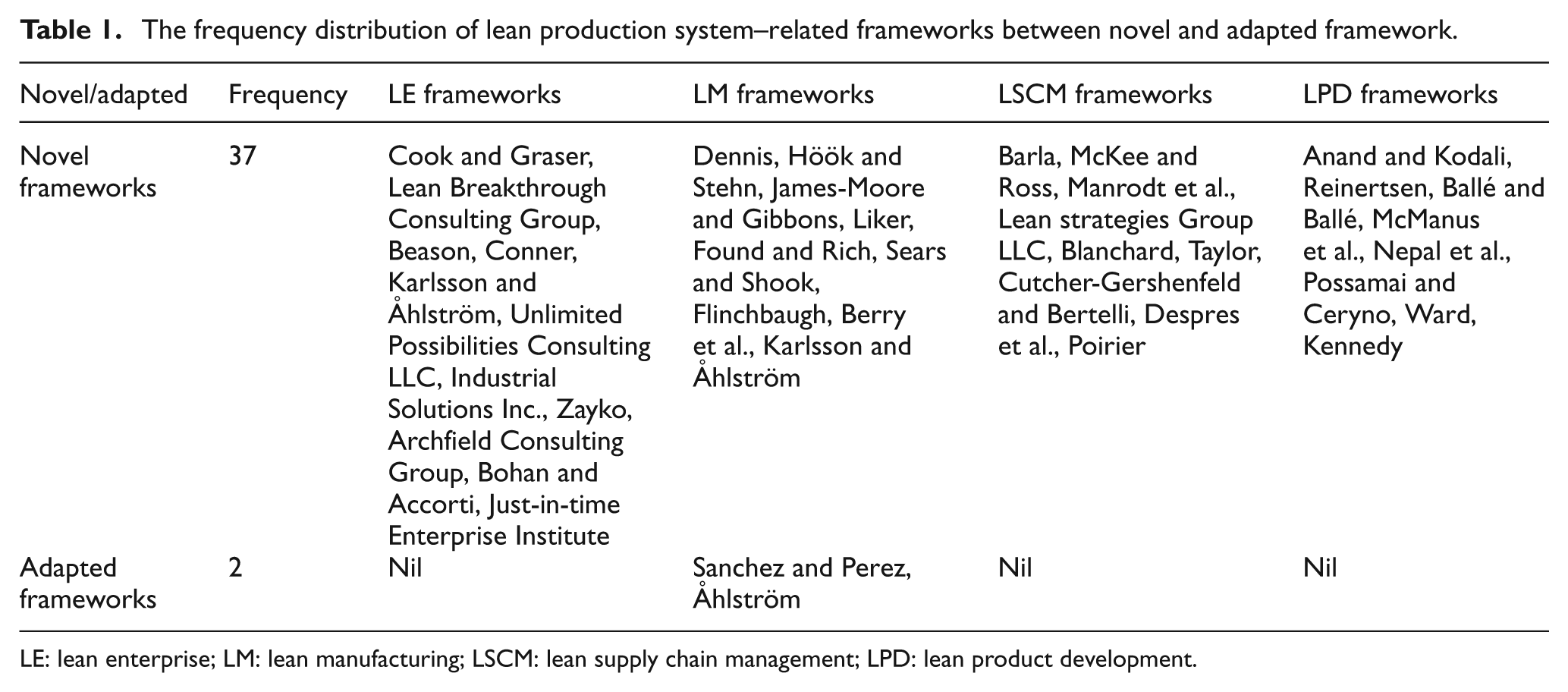
LE: lean enterprise; LM: lean manufacturing; LSCM: lean supply chain management; LPD: lean product development.
Source of framework
Yusof and Aspinwall 30 have classified the frameworks into three categories while performing a review in the field of TQM. These are academic-based, practitioners-based and consultants-based frameworks. If the framework is developed based on academic research performed in academic institution, then that framework is categorized as an academic-based framework. If the framework is proposed based on experience of the researchers, then the framework is categorized as a consultants-based framework. Finally, if the proposed framework is based on the industry practice or from a case study, then that kind of framework is categorized as a practitioners-based framework. This kind of classification scheme will help to find out the method of theory building taken place in the field of LP system–related frameworks. Table 2 gives the frequency distribution of LP system–related frameworks published as academic, practitioners and consultants-based frameworks. Table 2 reveals that around 56.5% of the frameworks are proposed based on academic-based research. Around 38.5% of the frameworks are proposed based on consultants-based research. The study clearly reveals that the number of frameworks based on practitioners’ research is minimal. The participation of practitioners in the fields of development of LM and LSCM frameworks is zero. The practitioners-based frameworks have been reported one each from the fields of LE and LPD. The participation of consultants-based research is minimal in the fields of LM and LPD research streams.
The frequency distribution of lean production system–related frameworks published as academic-, practitioners and consultants-based frameworks.
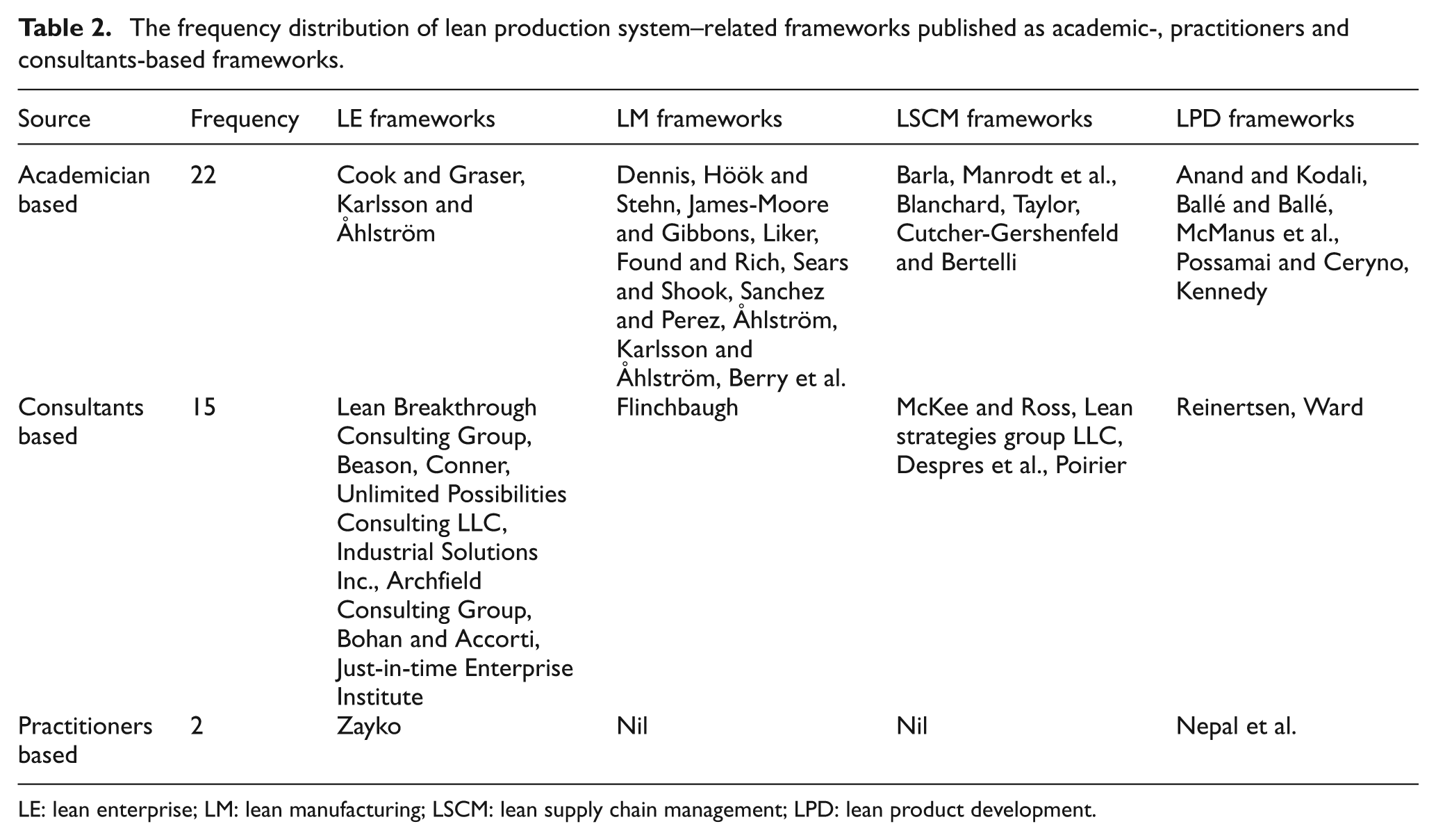
LE: lean enterprise; LM: lean manufacturing; LSCM: lean supply chain management; LPD: lean product development.
Framework verification
The study tries to investigate whether the framework was verified using any verification methodology or not. It is very important to check the applicability of frameworks in real-time scenario. Otherwise, there is a chance to have a huge gap between theory building and practices in the real-time scenario. Table 3 shows the frequency of frameworks that were verified in the selected literature. The study reveals that around 31% of the researchers have verified the proposed frameworks using different types of verification methodologies. Many researchers did not mention the verification status of the proposed framework. In that kind of situation, the study has considered those frameworks in the category of “not verified.”
The frequency of frameworks that were verified in the selected literature.
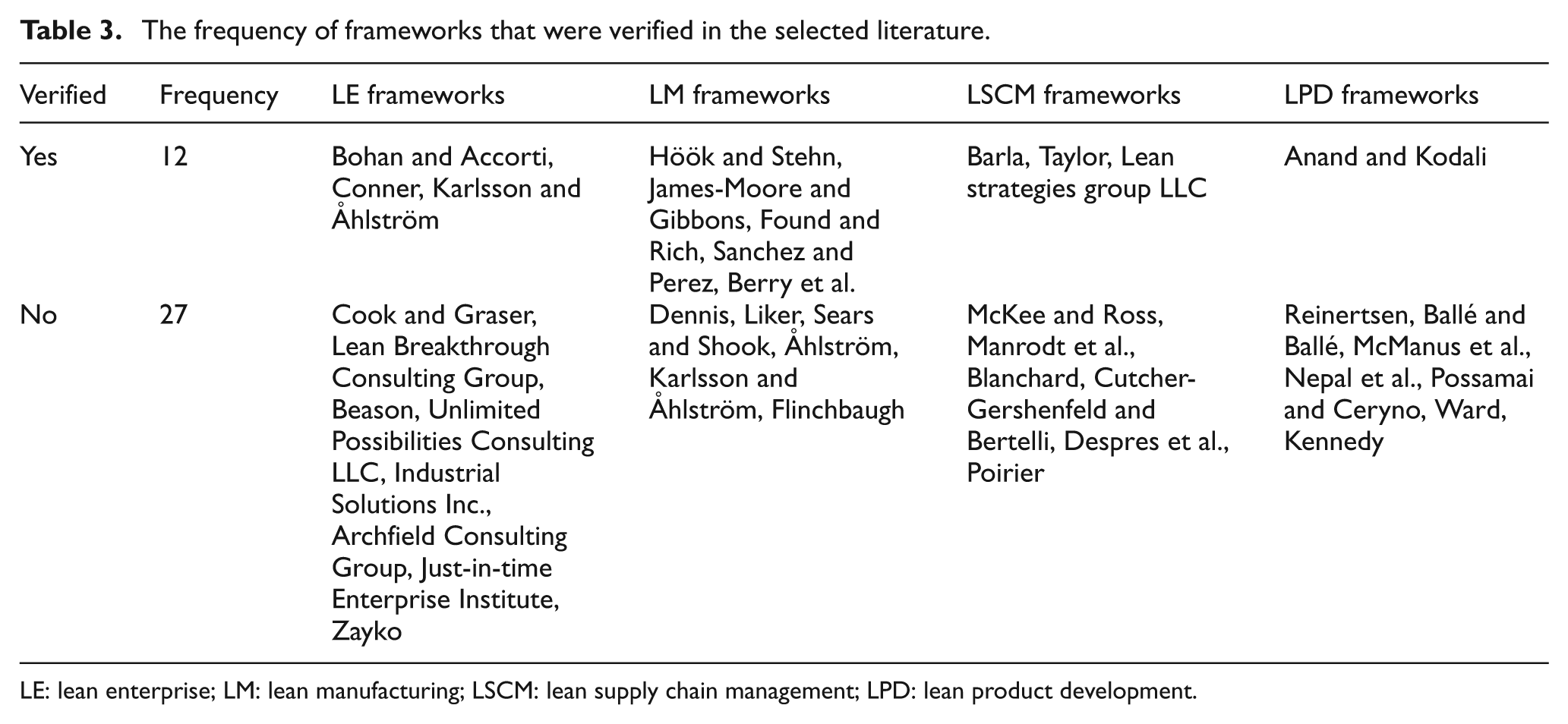
LE: lean enterprise; LM: lean manufacturing; LSCM: lean supply chain management; LPD: lean product development.
Mode of verification
Soni and Kodali 31 have reported that the proposed theory can be validated through case study, survey, focus study, panel study and Delphi methods. The study tries to investigate the type of verification methodology used frequently by the researchers to verify the proposed frameworks in the field of LP system. Table 4 gives the frequency of modes of verification for applicability of frameworks. The observation reveals that around 67% of the verified frameworks have used case study research design to verify the proposed framework. Around 33% of the frameworks have used survey research design to verify the proposed framework. None of the researchers used panel, focus and Delphi research design verification methodologies to verify the proposed frameworks.
The frequency of modes of verification for applicability of frameworks.
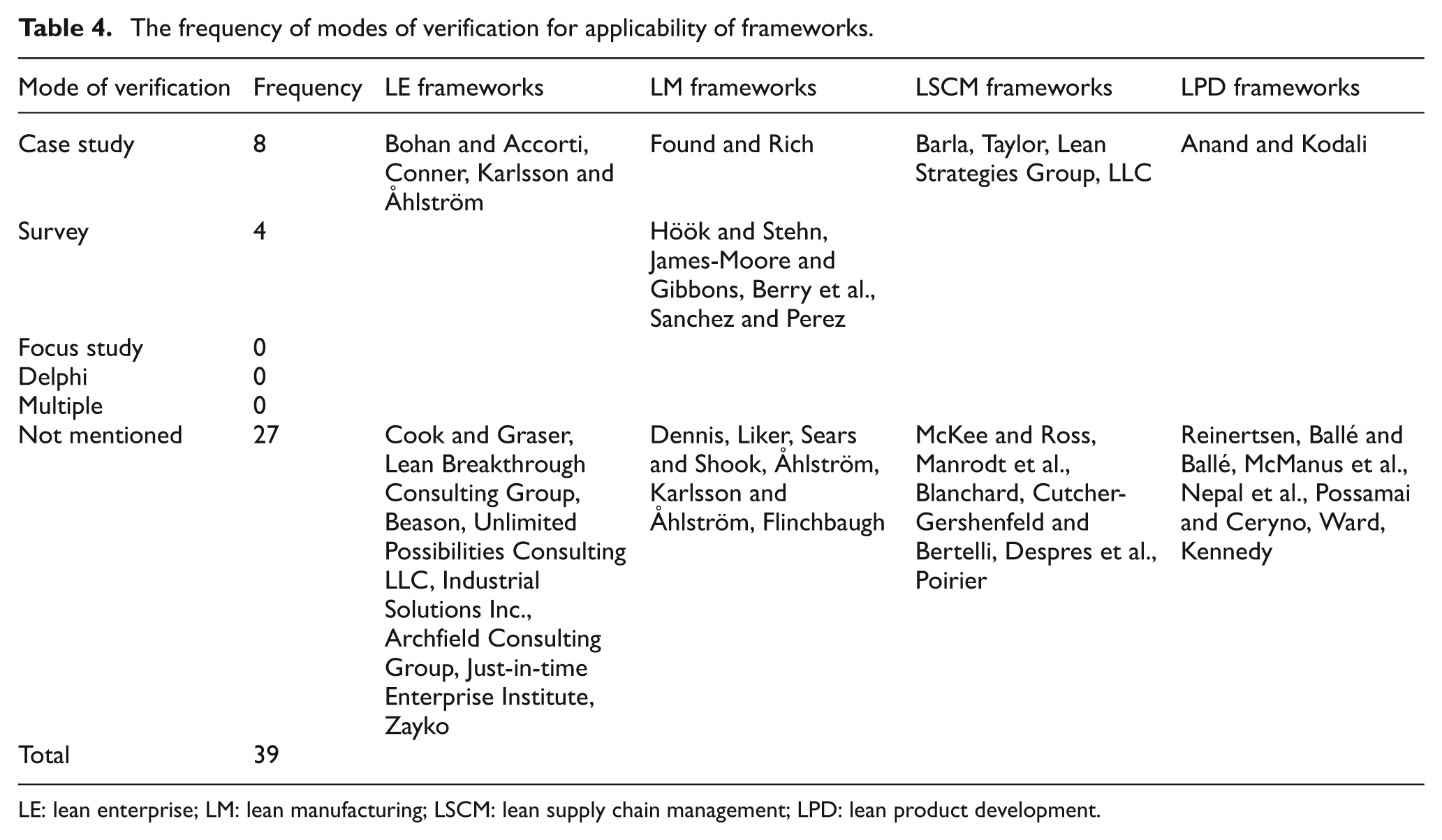
LE: lean enterprise; LM: lean manufacturing; LSCM: lean supply chain management; LPD: lean product development.
Comparative analysis
In order to build a new framework in any field of research, the study tries to understand the existing frameworks in the field of LP. The study requires understanding of which area of LP is already well addressed in the field of LP system and also tries to find out the area of research not addressed yet in the field of LP system. To fulfill the objective, the study is performing a comparative analysis of existing frameworks in the field of LP system. Table 5 shows the comparative analysis of LP system frameworks.
The comparative analysis of lean production system frameworks.

JIT: just-in-time; TQM: total quality management.
In Table 5, the first column shows the different elements under various frameworks and the first row gives the names of different frameworks recognized with the help of reliability and validity analysis in the field of LP system. The study observed that a very few frameworks have similar elements in the respective fields of the frameworks. It is also observed that a majority of dissimilar elements also appeared in the sample of frameworks considered in this study. From the reliability and validity analysis as well as frequency distribution analysis, the study has identified 39 frameworks as well as 184 elements in the field of LP system–related frameworks. The main problem is that all 184 elements cannot be adapted or implemented in piecemeal fashion. Hence, the framework should be defining some relationship between these elements. The study has tried to identify the initiatives to find out a path for achieving excellence in the field of LP system. Based upon the comparative analysis, it is observed that some elements are repeated with frequency of 0.2 or more. It indicates that 20% of the frameworks give importance to the particular element. Hence, the study has considered those elements as important initiatives to achieve excellence in the implementation of LP system in the organization. These elements act as pivotal point of the proposed framework to achieve excellence in the field of LP system. It has identified nine important pillars through a comparative analysis and two pillars have been proposed with the expert team. Similar kind of analysis was performed by Mishra et al., 78 Sharma and Kodali,79,80 and Soni and Kodali. 31 The study also verified all 11 pillars with the help of domain knowledge of 12 team members, that is, 6 academicians, 3 practitioners and 3 consultants. Finally, the study has proposed 11 pillars and 83 elements to build a new framework to achieve excellence in the implementation of LP system principles in the organization.
Development of elements for the proposed framework of LP system
The study has already identified 184 elements through frequency distribution analysis. Out of 184 elements, some elements are repeating more than once. The study has removed those repeated elements from the list and found 156 unique elements from the frequency distribution analysis. The study again communicated to the team members to regroup all the elements under 11 pillars of the proposed framework in the field of LP system. The team members suggested that further refinements of these elements are required because all 83 unique elements were not in systematic manner. Hence, the study was changed, combined, modified and removed using domain knowledge, literature search as well as experts’ opinion. The elements and pillars of proposed framework for LP system after refinement are given in Table 6.
The elements and pillars of proposed framework for lean production system.

JIT: just-in-time; TQM: total quality management; EDI: Electronic Data Interchange; CAD/CAE: computer-aided design/computer-aided engineering; WIP: work in process.
Features of proposed frameworks for LP system
Figure 1 presents a comprehensive framework of LP system. This study also tries to reveal the salient features of the proposed framework as compared with other existing LP system frameworks:
The study has proposed a comprehensive framework that consists of 83 lean elements and 11 pillars that have been identified through empirical investigation as well as literature survey in the field of LP system.
The study proposed a framework with the consultation of team members that includes academicians, practitioners and consultants in the field of LP system. This kind of practice certainly will help to overcome the shortcomings of present form of the frameworks in the literature in the field of LP system.
The study has proposed a framework with more number of pillars and elements as compared with the existing frameworks in the field of LP system. It clearly proves a comprehensive nature of the proposed framework as compared with the existing LP-related frameworks. However, there is a chance to miss out some of the elements in the proposed LP system framework. Weick 81 has discussed that it is not feasible to develop a framework in any field of research with the characteristics of general and simple, and to be accurate at the same time.
The proposed framework elements have been selected based on frequency distribution analysis and the empirical data collected from Indian manufacturing industry.
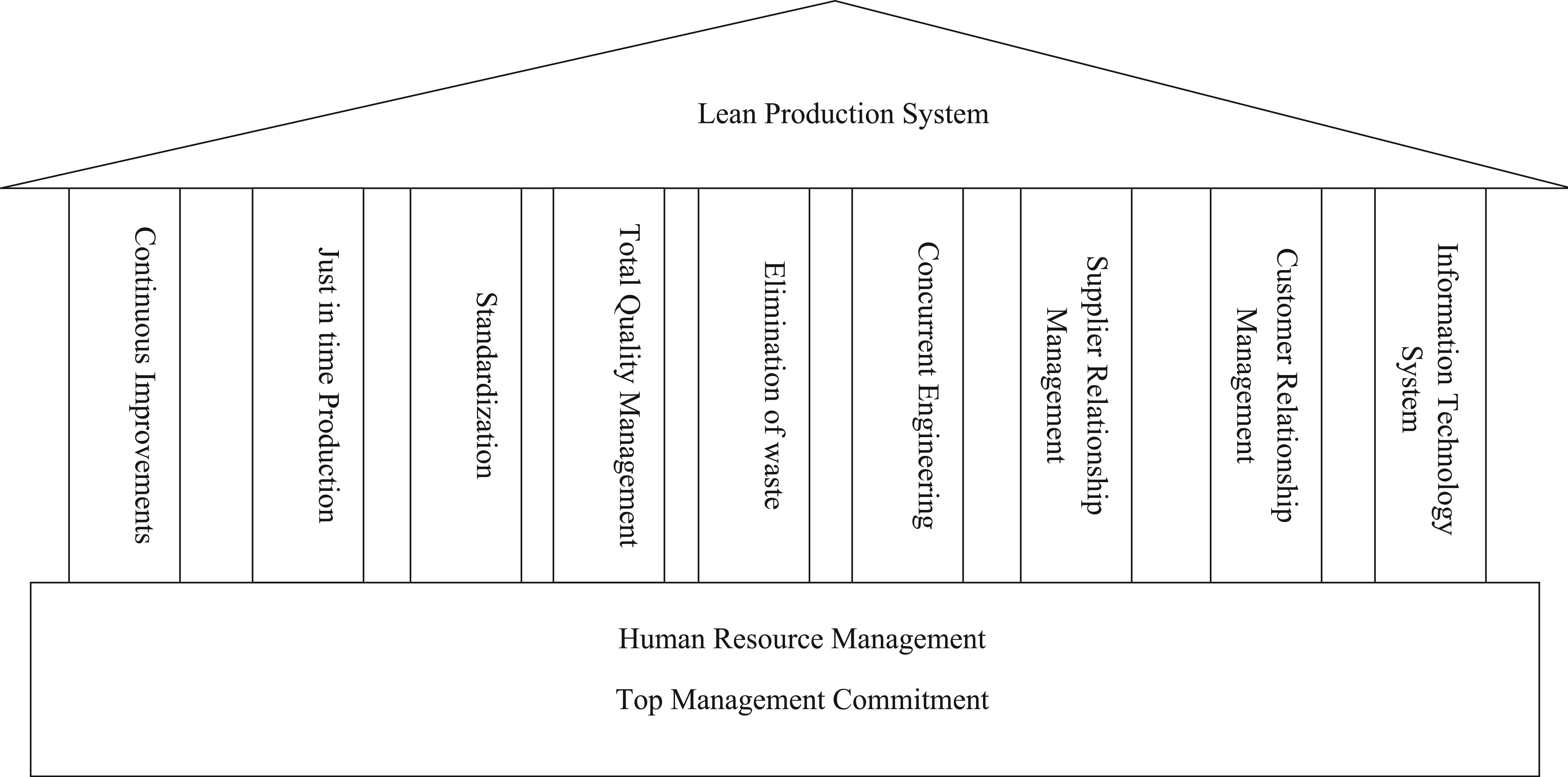
A framework for lean production system excellence.
The study also suggests that there is a requirement to perform validity and reliability analysis of the proposed framework in the field of LP system. This kind of verification analysis will help to check the suitability of the proposed framework. This study believes that verification and validation of the proposed framework in the field of LP system is very important and is also an essential requirement. Hence, the researchers have to perform required task as a part of the future research work.
Pillars of comprehensive framework of LP system
The study has proposed LP system framework that contains 11 essential pillars. The study also believes that it is a very important requirement as well as a task to justify the significance of these pillars to consider it as the integral part of LP system framework. Hence, this study tries to explore the significance of each individual pillar in the proposed framework to achieve organization’s operational excellence with the implementation of LP system.
Continuous improvement (CI)
CI is an approach used to achieve focused and continuous incremental innovation in the organization. 82 In this kind of approach, everyone in the organization should work together to implement improvements without a huge capital investment across the organization. Sometimes, CI can also be helpful to achieve drastic improvements that take place as an outcome of a novel initiative or new technology. 83 In the past, the implementation of CI principles can be seen related to work improvement specifically in operational area. In the present scenario, CI is associated with organized and comprehensive methodologies across organization. 84 It clearly indicates the importance of CI implementation in any organization. The comparative analysis of this study also reveals that around 60% of the frameworks have proposed CI as an important element to implement LP-related framework in the organization. Hence, the study also proposes CI as one of the pillars to implement the proposed LP system framework.
Supplier relationship management
In the present scenario, supplier relationship management (SRM) plays a vital role in success of the organizations. The main challenge is faced by organizations, which delivers the products to clients at the right time, at the right place, at the right quantity and at the right price. The main objective of the SRM is to streamline and develop a systematic methodology between the organization and its suppliers in terms of processes and deliveries of the products. 85 Cai et al. 86 revealed that the SRM enhances the organizational performances as well as improves the organizational learning abilities. Kanji and Wong 87 have discussed that suppliers’ knowledge and expertise also plays a critical role in terms of development of new product, manufacturing higher quality products and dynamic response as per market conditions. The comparative analysis of this study reveals that around 60% of the frameworks have considered SRM-related elements in order to implement LP system framework effectively. Hence, the study also suggests SRM as one of the pillars to implement LP system framework effectively in the organization.
Customer relationship management
Customer relationship management (CRM) is one of the customer-focused business strategies, which dynamically brings together sales, marketing and customer care services under one umbrella of the organization.88,89 The main objective of CRM strategy is to build and add real value both to the customers and to the organizations. 90 Richards and Jones 91 have discussed that it is a set of business activities maintained with the help of technology and procedures supported by strategy in order to improve the performance of organization in the field of customer management. Since late 1990s, CRM plays a vital role in the global competitive environment and to achieve customer satisfaction by producing high-quality products and providing high-quality customer service. 88 The comparative analysis of this study also reveals that around 50% of the frameworks have proposed CRM-related elements in the existing sample of frameworks. All these factors influenced this study to propose CRM as a pillar to implement LP framework in the organization.
Top management commitment
The success of any strategic management depends on how well the particular organization’s top management is involved in the implementation of these principles. 92 The organizational success factor also depends on managers and leaders’ ability to react, operate and adapt for required changes. 93 The lean approach is an integrated overall management approach. 94 Many studies also proved that top management commitment is one of the barriers to implement lean thinking approach in the organization through empirical investigations. However, the comparative analysis of this study reveals that around 12% of the frameworks have proposed top management commitment and leadership-related elements. It clearly reflects that a very few researchers have given importance to the top management commitment and leadership-related elements. However, the study has identified the importance of top management commitment and leadership. Hence, the study proposes top management commitment and leadership as a pillar in the proposed framework in the field of LP system.
Standardization
The objective of standardization technique is to perform the heterogeneous requirements with the help of common products, processes and components in the organization. According to Tarondeau, 95 the process of standardization will help to attain better productivity, drastically minimize the number of critical operations, reduce the capital investment on inventory management and also help to minimize the complex nature of the production system. Thonemann and Brandeau 96 have discussed that the standardization process will not limit to meet the customer satisfaction and the uniqueness of end component. Pahl and Beitz 97 have reported that the standardization process helps to attain an optimal design in terms of cost and time consumption. The comparative analysis of this study also reveals that around 64% of the frameworks have included standardization-related elements in the sample of existing framework in the field of LP. All these factors also helped this study to propose standardization as one of the important pillars in the proposed framework in the field of LP system.
Concurrent engineering (CE)
In the present scenario, the success of the product development mostly depends on speed of time to market. The product development processes consumes more time than other processes that restrict the organizations to meet customer demand to deliver right product in the right quality. 98 Many organizations have tried to focus on shortening the development cycle times with the help of lean principles.99,100 LPD system is considered a group of good ideas and slowly converge appropriate multiple solutions to achieve the final ultimate solution. In traditional product development process, only one good idea is considered and developed to final solutions within the boundary of initial idea. 101 The comparative analysis of this study reveals that around 18% of the frameworks have proposed LPD-related elements in the sample of existing frameworks. However, the study has identified the importance of LPD processes in the field of LP system implementation process. Hence, the study proposes LPD as one of the important pillars in the field of LP system.
TQM
In the modern scenario, TQM is in frequent discussion concerning to quality management. In traditional quality management techniques, only end product quality was considered through inspection processes. It is observed that the process is useful to stop defect product reaching the customer. Whereas TQM not only concentrates on quality of end product but also improves overall quality performance of organizations, processes. It also helps to meet the customer expectations and also quality is defined as per customer requirements. In addition to that many organizations have started to implement TQM principles irrespective of small- and large-scale organizations to meet customer satisfaction levels and also to get the financial benefits. 102 Shah and Ward 17 also reported that TQM is an integral part of LP system. The comparative analysis also reveals that around 50% of the frameworks have proposed TQM-related elements in the sample of existing lean frameworks. Hence, this study also strongly recommends TQM as a pillar of the proposed framework in the field of LP system.
Human resource management
Human resource management (HRM) is the backbone of any organization. Initially, Toyota manufacturing organization has also implemented same strategy while developing Toyota production system. Toyota manufacturing organization has initially invested small capital to train their employees to get desired results instead of investing a huge capital on procurement of advanced automated machinery. 103 Japanese manufacturing organizations always consider their employees as an asset of the organization because they are the people who are going to solve the organizational problems and improve the processes of the production lines. 104 Effective work-teams always play a critical role in implementing lean principles in the organization. 51 The comparative analysis also reveals that around 45% of the frameworks have proposed HRM as an important element in the implementation of LP in the organizations. Hence, this study also suggests that HRM is an important pillar in the proposed framework in the field of LP system.
Information technology system
Information technology (IT) systems play a vital role in supply chain, manufacturing and product development activities. In the present scenario, information flow is a critical parameter within the organization as well as across supply chain networks. 105 Srinivasan et al. 106 have emphasized that the effective IT system helps to bring down the shipment errors in the LP system environment. The organizations have started to think differently to work as a group instead of solitary entity to stay in the dynamic competitive market across globe.107,108 IT is useful to develop and manage multi-level networks as well as to improve communication activities across the organizations.109,110 Many studies111,112 also suggested that IT systems play important role in the aspects of product design, simulation and development processes. The comparative analysis also reveals that around 55% of the considered frameworks have included IT systems–related elements. Hence, this study also proposes IT system as an important pillar in the proposed framework in the field of LP system.
JIT production
JIT is a concept that is used to produce required volume of required product at required time and required quantity as per customer requirements. 113 JIT production is developed based on downstream information and is naturally following make-to-stock system.114,115 Many research studies have observed that JIT concept is useful to improve organizational performance with the help of reduced inventory across supply chain, improve overall quality and productivity of the organization, develop better supplier and customer relationship and improve inventory turnover and effective utilization of workspace.116–119 The comparative analysis reveals that 59% of the frameworks have proposed JIT concept as an element in the sample of existing LP system–related frameworks. Hence, this study also suggests that JIT is an important pillar in the proposed framework in the field of LP system.
Elimination of waste
Toyota engineers brought out new idea that the activity which does not add any value to the final product or the customer not ready to pay for a particular operation is treated as a waste activity in the production process. Ohno has classified the waste into seven categories: over production, inventory, motion, over-processing, defects, transportation and waiting.16,120,121 Toyota engineers have avoided all these kinds of waste by applying commonsense instead of using modern technologies in the manufacturing operations. The comparative analysis of this study also reveals that around 55% of the frameworks have proposed elimination of waste as an element in the sample of existing frameworks. Hence, this study also suggests that elimination of waste is an important pillar in the proposed framework in the field of LP system.
Discussion
The objectives of the study are to identify the inconsistencies existed in the considered sample of LP frameworks as well as to propose a new LP system framework based on the comparative analysis. The study may help to get appropriate directions to the future researchers in the field of LP system. The study discusses on inconsistencies that exist in the sample of frameworks. It reveals that most of the frameworks developed in the field of LP system is based on novelty grounds that clearly indicates the dominance of theory building without considering the existing theory in the field of LP system. It is an indication that there is an urgent requirement to perform critical analysis on existing LP system frameworks to propose new frameworks in the field of LP system. This kind of investigations may help the field of research to develop coherent theory as well as to define boundaries. Cousins et al. 122 have performed a similar kind of analysis in the field of supply chain management.
From the analysis, the study reveals that a majority of the frameworks were developed based on academic-based research in the field of LP system–related frameworks. The participation of practitioners is clearly lacking as compared with academic- and consultants-based research. The consultants-based frameworks are relatively moderate number as compared with practitioners, but less in number compared with academic-based research. Hence, the study suggests that there is an urgent requirement for participation of practitioners and consultants to develop strong theoretically grounded as well as practical-oriented frameworks in the field of LP system. This statement does not mean that such kind of practices are completely absent, but certainly are not in regular practice in developing frameworks in the field LP system.
The study has also performed analysis whether the proposed framework was verified or not. The analysis reveals that only around one-third of frameworks were verified by applying various verification methodologies. It clearly reveals that a majority of the frameworks did not undergo any kind of verification methodologies. This kind of trend leads to develop a huge gap between theory building and real-time practices. This kind of theory building should not be promoted until and unless the main objective of research is purely theory building or projecting some kind of abstract concept of LP system.
The study also analyzed the frequently used verification methodology to verify the proposed LP-related framework. The study reveals that case study verification approach is more familiar among researchers in the field of LP system. This kind of fact also supports that LP system is in an initial stage of development. Malhotra and Grover 123 have discussed that case study and qualitative methods are suitable to the evolving areas of the research before reaching maturity stage. The study believes that frequent use of case study approach to verify the proposed frameworks will carry-on until LP system discipline reaches maturity phase. However, the study advises to the future researchers that there is a requirement to use case study approach, survey approach and other qualitative research approach for framework verification.
The proposed LP system framework developed with the help of a group of academicians, practitioners and consultants. The study has developed the framework with 11 pillars and 83 elements. The study has identified 11 pillars through the comparative analysis and the pillars also were verified by the group of experts in the field of research. The proposed elements were suggested using frequency distribution analysis performed across Indian manufacturing industries. The study did not perform any kind of verification on proposed framework in the field of LP system. However, this study has devoted to find out the inconsistencies in LP system frameworks and developed a new LP system framework to overcome the present sample of framework limitations.
Implications
The results of this study can be useful to both theoretical and practical domains of LP system. This study has opened the debate to find out what a framework is really and how the framework can be differentiated with the term model. The study also gives strict guidelines to identify the framework as well as to propose a framework in the field of LP system. This article also gave importance to find out whether the frameworks have undergone verification and also mode of verification of frameworks. The proposed framework for LP system requires checking its reliability and validity of pillars and elements. The study considers it as a part of future research work.
The inference of the study may be useful in both management strategies and practice. The proposed framework will be utilized as a ready reference in the aspect of pillars. These pillars have been derived based on comparative analysis, that is, frequently repeated elements; hence, these elements may be treated as pillars of LP system excellence, particularly in manufacturing industries. If managers are interested to check the status of the LP system strategy of their organization, then the practitioners can use these pillars of LP system to find out in which part of LP system the organization is lacking or excelling with respect to competitive strategy. The study believes that these pillars can be useful in benchmarking operations also. Many researchers know that while performing benchmarking operations, the practitioners always confuse what are the parameters to compare. Under these kinds of situations, the managers and practitioners can use the proposed pillars as referral points and make appropriate judgments. However, this study did not perform any kind of reliability and validity analysis on the proposed framework. The study suggests performing required reliability and validity analysis before implementation of framework in organizations.
Conclusion
The study has observed that a huge number of frameworks have been proposed for LP system by various researchers across the globe. However, it is observed that none of the researchers have performed any critical analysis to find out inconsistencies and inadequacies on various aspects of LP system. The study has reviewed 131 LP system–related frameworks through extensive literature survey in various online portals. Finally, the study has identified 39 frameworks through empirical investigation performed across Indian manufacturing industries. These 39 LP system–related frameworks have been considered as sample of the frameworks in this study. The study has critically reviewed the sample of frameworks and identified various drawbacks in the LP system as follows: most of the frameworks were developed through novelty approach that resulted in building up of a huge incoherent theory in the field of LP system; lack of participation of practitioners and to some extent consultants in the field of framework development processes; only few researchers have performed verification on proposed framework; and most of the researchers have used case study approach to verify their proposed frameworks in the field of LP system-related frameworks. The study also tries to overcome all the shortcomings of existing frameworks with the help of a new framework proposed with help of team members including academicians, consultants and practitioners. The study has identified pillars through the comparative analysis and elements have been identified with the help of frequency distribution analysis across Indian manufacturing industry. Finally, the study has proposed a comprehensive framework with 11 pillars and 83 elements in the field of LP system.
The study has considered the empirical data to propose elements and comparative analysis to identify pillars. However, the study believes that some kind of verification methodology has to be applied to check its applicability in the real-time scenario. The study would like to take the problem as a part of future research. The study requests future researchers to perform appropriate statistical analysis to verify the proposed framework with the help of empirical data collected from the respective region or the globe.
Footnotes
Declaration of Conflicting Interests
The author(s) declared no potential conflicts of interest with respect to the research, authorship and/or publication of this article.
Funding
The author(s) received no financial support for the research, authorship and/or publication of this article.