




Abstract
This article extends the Ng-model for multiple criteria supplier selection problem based upon a distance-based decision-making method. The proposed method determines the common weights associated with all rankings of the criteria importance, and then provides a comprehensively scoring scheme by aggregating all rankings. A numerical illustration is presented to compare our computational results with that of the Ng-model.
Introduction
Supplier selection is an important strategic supply chain design decision, which motivates an extensive output in the academic literature to address this issue. De Boer et al. 1 present a review of decision methods for supporting the supplier selection process. Ho et al. 2 provide an exhaustive review of multi-criteria decision-making approaches for supplier evaluation and selection. Chai et al. 3 introduce a systematic literature review on the academic papers published from 2008 to 2012 on the application of decision-making techniques for supplier selection. Tadic et al. 4 develop a multi-criteria decision problem, including both qualitative and quantitative criteria to address the problem of supplier ranking and selection under uncertainties. Zhang et al. 5 address the supplier selection problem based on evidence theory and analytic network process.
Recently, Ng 6 presented a weighted linear optimization model (hereafter called the Ng-model) for multiple criteria supplier selection problem, which converts all criteria measures of an inventory supplier into a scalar score. The Ng-model is well-known as simple-to-understand and easy-to-implement. The optimal scores for each supplier can be easily obtained without a linear optimizer. Despite its many advantages, the Ng-model requires the decision maker to subjectively rank the criteria importance in a sequence. However, Soylu and Akyol 7 point out that the importance of criteria may change from industry to industry, from company to company, and even from decision maker to decision maker. Therefore, some questions inevitably arise: which ranking is more suitable? Which viewpoint is more desirable? Are there common weights associated with each of the rankings?
It is clear that the optimal scores derived from different rankings may not be the same. Each of the aforementioned rankings and viewpoints has some valuable advantages which we could not ignore. While it is impossible to ignore any ranking completely, the best way to make a decision is to accept all possible rankings first, and then aggregate the results of the different rankings and viewpoints. 8
The purpose of this short communication is to provide an extended version of the Ng-model based upon a distance-based decision-making method, and to present a comprehensively scoring scheme by determining the common weights associated with all criteria importance rankings. Undoubtedly, combining the scores of different criteria sequence definitely provides a more realistic classification compared with employing any ranking individually.
Compared with the Ng-model, our proposed distance-based decision-making method has at least three advantages. First, our method proposes a unique ranking among the suppliers. Second, our method eliminates unrealistic subjective ranking of the criteria importance, without requiring the elicitation of ranking restrictions from industry experts. Third, the comprehensive scoring scheme effectively distinguishes between good and poor performance.
Ng-model
Assume that there are

Furthermore, all the criteria are assumed to be benefit-type criteria. More specifically, all these criteria are positively related to the importance level of a supplier. To realize the multiple criteria supplier selection, Ng
6
defines a nonnegative weight
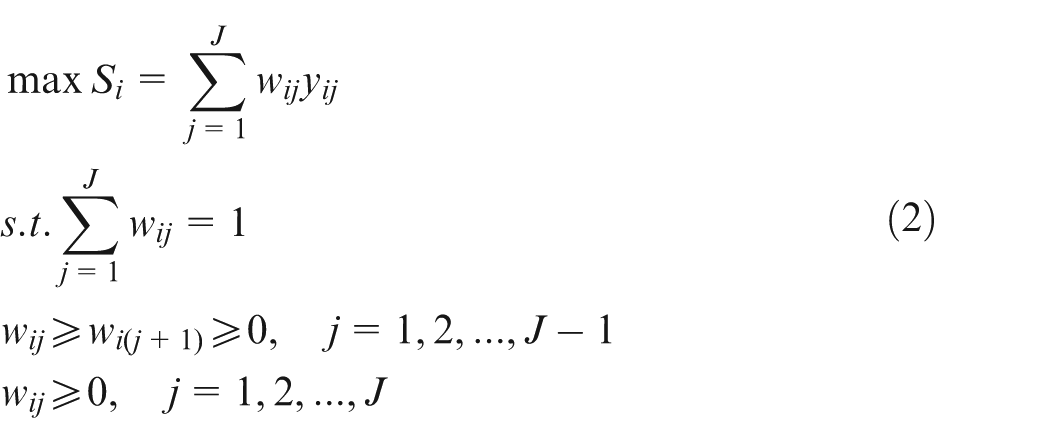
By employing the following transformations, namely,
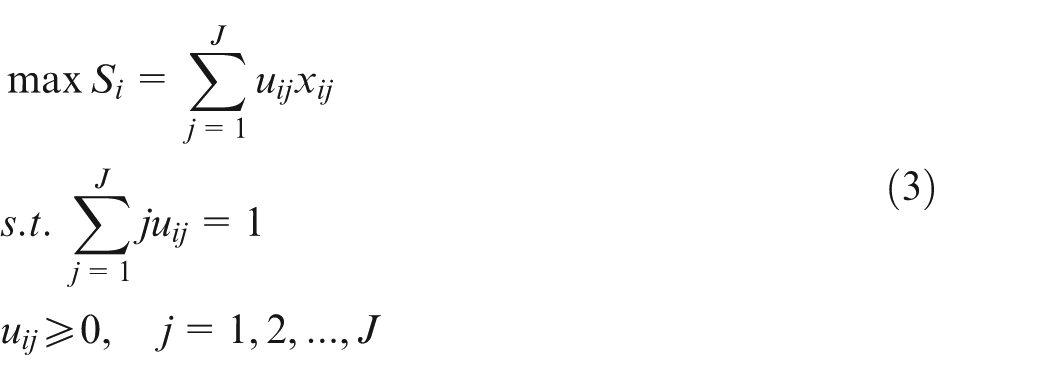
One can easily obtain the maximal score

Finally, the maximal score
The proposed method
In this section, we propose a distance-based decision-making method to combine different subjective rankings of the criteria importance by determining the common weights for all the rankings. It is clear that each ranking has limited discriminability which we would like not to ignore. We employ the concept of Euclidean distance to measure the degree of inconsistence between the peer-evaluation score and the self-evaluation score. 9 Note that this so-called inconsistence can be explained as the information redundancy or noisy generated from the process of assessment, which definitely should be reduced or eliminated to derive reasonable performance score for each supplier. 10 Without loss of generality, the smaller the distance is, the more consistent the evaluation between result of the peer-evaluation score and the self-evaluation score, and the better the evaluation results.
It is assumed that there are

Therefore, the derived scores for each supplier are listed in the following matrix
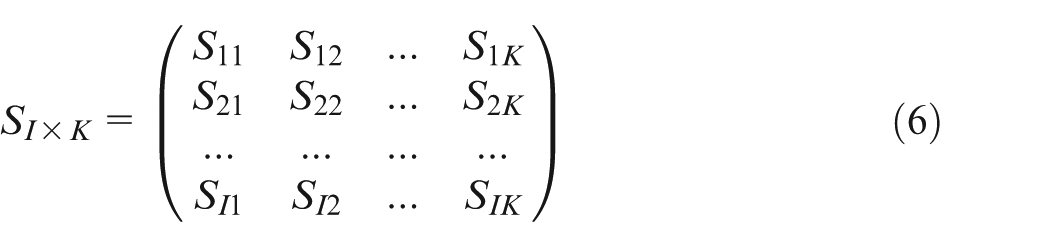
Each row of
Definition 1. For each supplier

Definition 2. For each supplier
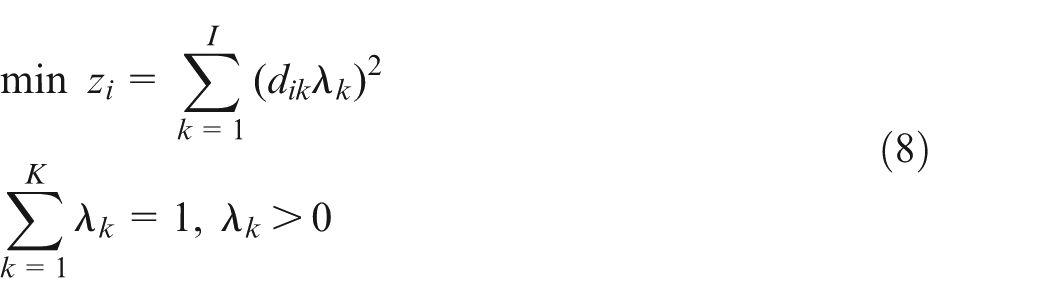
Finally, a multi-objective programming model is presented below to optimize the performance scores of all the suppliers
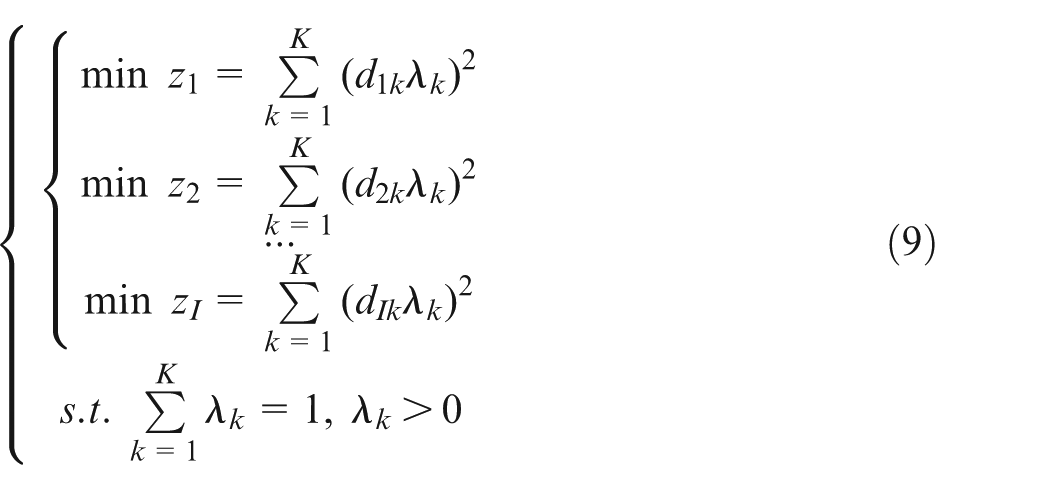
In what follows, we seek to derive the optimal solution
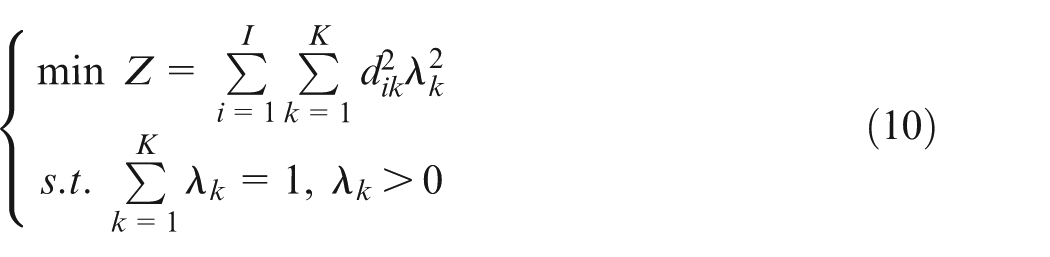
For the ease of solving the quadratic programming (10), we construct a Lagrange function as follows

and the Hessian matrix of (11) with respect to
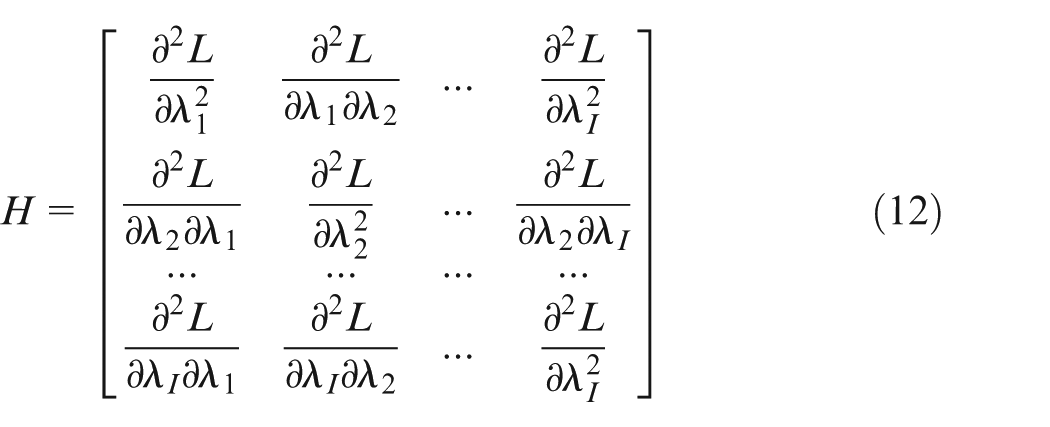
Obviously, in the Hessian matrix (12),
By setting
Recall the quadratic programming (10), we note that the constraints are nonempty convex sets, and the objective function is a convex set. Therefore, the model (10) is a convex programming model, and thus the generated
Consequently, the ultimate comprehensive score derived from a distance-based decision-making method for each supplier

Numerical illustration
For the purpose of illustrating our proposed method, we investigate the same multiple criteria supplier selection problem as discussed by Xia and Wu. 13 Three criteria, namely, Price, Quality, and Service are considered for supplier selection. Moreover, these criteria are rated using a 3-point scale, that is, the values of 1, 2, and 3, which are associated with “low,”“middle,” and “high,” respectively, for the Price criterion, and are also associated with “poor,”“middle,” and “good,” respectively, for the Quality and Service criteria. The criteria of Quality and Service are benefit-type criteria, which are positively related to the importance level of a supplier. However, the criterion Price is negatively related to the performance of a supplier, which could be taken as a reciprocal transformation to evaluate the candidate suppliers. A company with 14 candidate suppliers and the measures of each criterion are listed in Table 1.
Measures of suppliers and transformed measures.
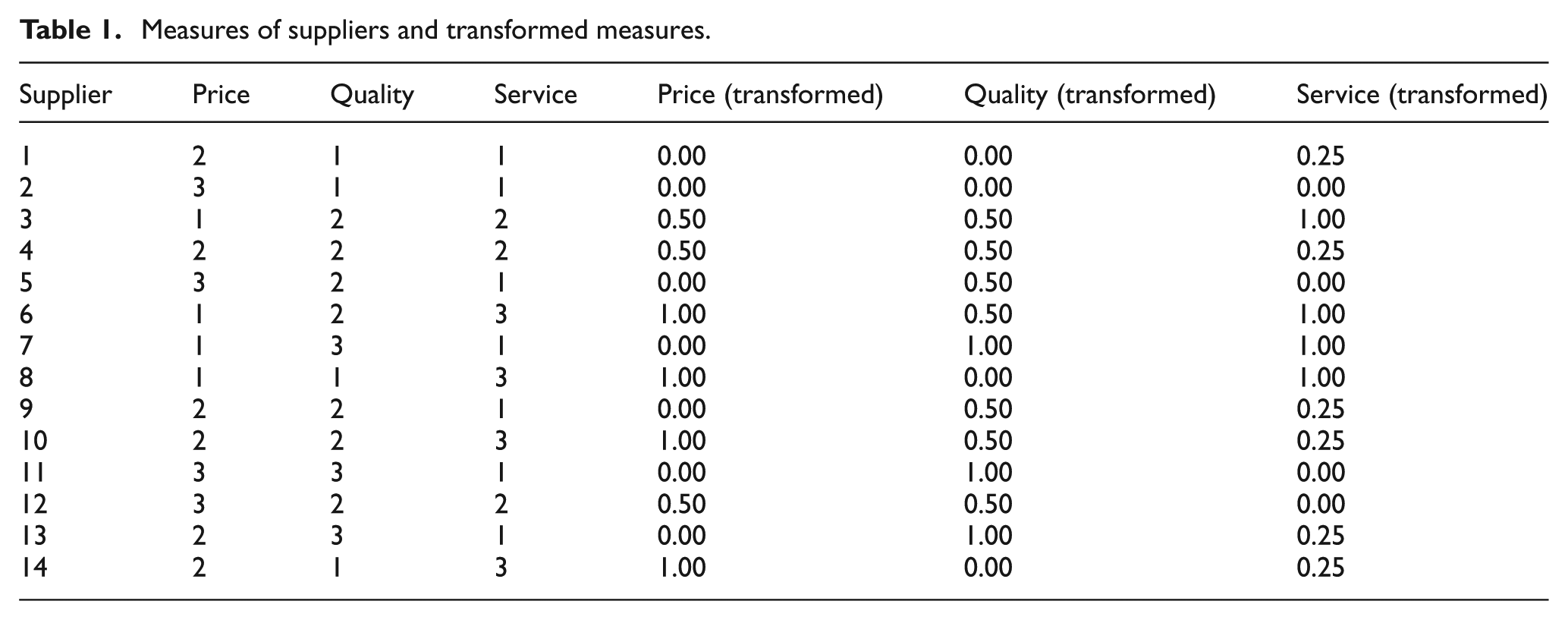
In order to compare our results with that of the Ng-model, we maintain the same number of selected suppliers, that is, five selected suppliers, as in the work of Xia and Wu.
13
Since the multiple criteria supplier selection problem is processed with three criteria, we investigate
A comparison between our proposed method and Ng-model.
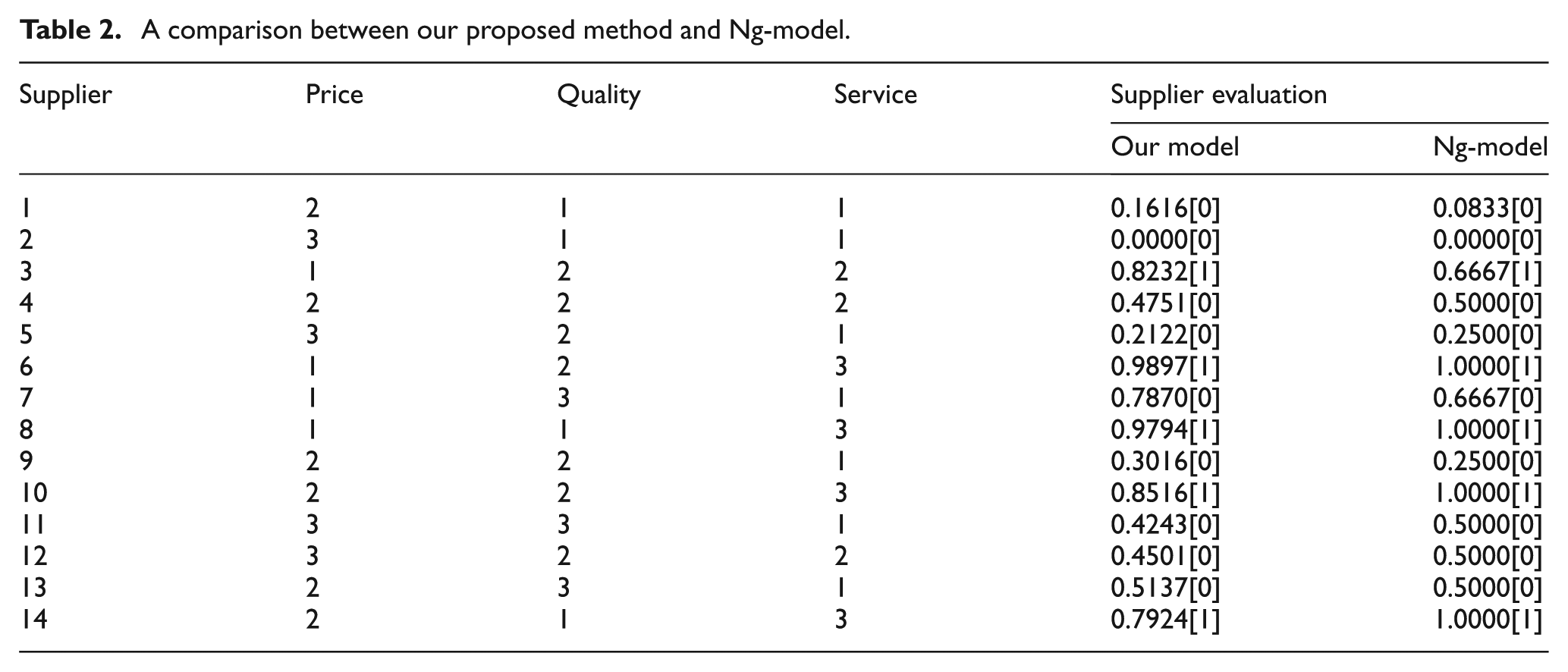
For both models, 5 out of 14 suppliers are selected according to the evaluating scores. More specifically, for the Ng-model, both supplier 3 and supplier 7 are scored equally, but as for our model, the final scores are completely different, and only supplier 3 will be selected. Therefore, our proposed method is more acceptable with more discriminability.
The common weights for each ranking of importance of the criteria are depicted in Figure 1.
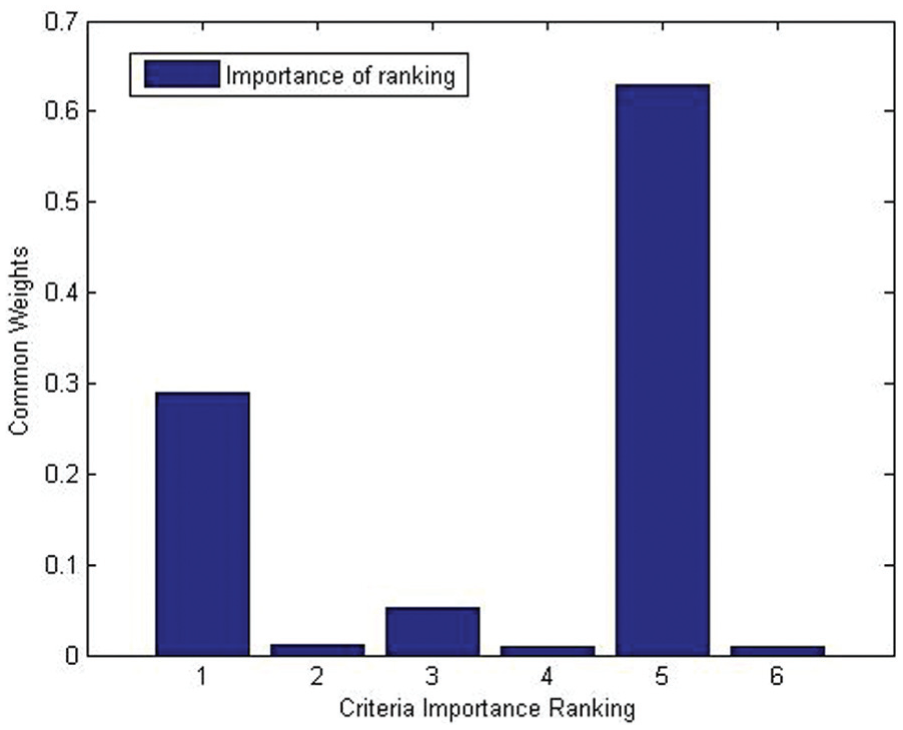
Common weights of criteria importance rankings.
The following Figure 2 shows the evaluated scores derived from our proposed method and the Ng-model.
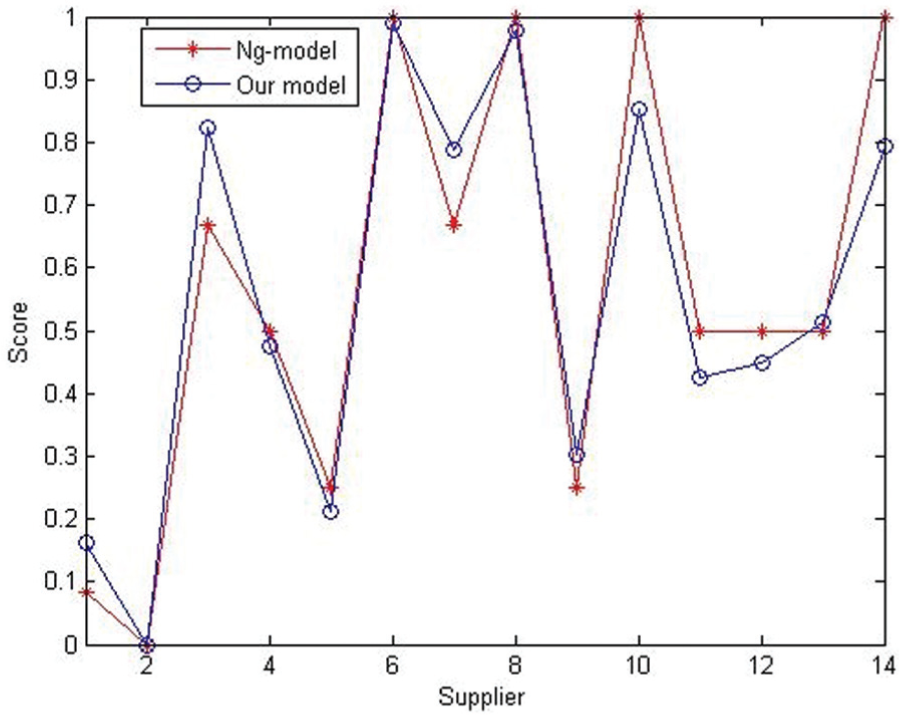
Comparison between our model and the Ng-model.
Concluding remarks
The present short article provides an extended version of the Ng-model for multiple criteria supplier selection problem. The contribution of our article is to present a distance-based decision making method for comprehensively classifying all available suppliers, which improves the Ng-model by deriving the common weights for all criteria importance sequences. The scores derived from the proposed method are calculated to provide a unique sequence of the suppliers. The ranking method presented in this article is originated from easily understood premises and provides interesting insights for ranking construction to avoid conflict.
Footnotes
Declaration of conflicting interests
The author(s) declared no potential conflicts of interest with respect to the research, authorship, and/or publication of this article.
Funding
The author(s) received no financial support for the research, authorship, and/or publication of this article.