




Abstract
Nowadays, manufacturing companies are moving towards lean practices and product-service system to develop their competitive ability. The purpose of this article is to present an innovative model to assess product-service system leanness incorporated with validating the model via three real-life case studies across various industries, thus improving the practical validity and relevance of the model. The model comprises three levels, namely, enablers, criteria and attributes. The first level contains five enablers, in the second level there are 21 criteria and finally the third level consists of 73 attributes. The development of the model was carried out through an iterative process. Starting from the literature review, going through semi-structured interviews with academic researchers involved in lean projects and ended with semi-structured interviews with a number of experts in the field of lean from five UK manufacturing companies. The model was validated by applying the model to compute the product-service system leanness level for three UK manufacturing companies and identifying areas for further improvement for these companies. The results indicate that the model is able to assess product-service system leanness level effectively and has a practical relevance.
Introduction
In today’s competitive market, manufacturing companies are more focused on the improvement of core competitiveness. Manufacturing companies try to improve and develop their ability for competition through modern manufacturing initiatives and from these initiatives are lean manufacturing and product-service system (PSS). Lean and PSS can lead to dematerialisation through reducing the creation of wastes and the consumption of raw materials, improving customers’ satisfaction by meeting customers’ needs better and improving competitiveness through increasing customers’ value.
In manufacturing companies, the trend of servitisation of products is obvious. 1 Through PSS, companies can add value to customers, enhance their competitiveness and provide new business opportunities. PSS can be defined as a mix of tangible products and intangible services, designed and combined to be competitive, satisfy customer needs and have lower environmental impact.2–4 The idea beyond PSS is the ‘sale of use’ rather than the ‘sale of product’, so customers pay for using the product rather than its purchase. 1 Generally, a PSS can be thought of as a market proposition that extends the traditional functionality of a product by incorporating additional services that move the emphasis towards the ‘product use’ rather than the ‘product sale’. 5
Besides PSS, lean manufacturing was developed from the Toyota Production System (TPS) with the aim of the continuous identification and elimination of waste from manufacturing processes.6,7 Lean is most frequently associated with the elimination of seven types of wastes, namely, overproduction, overprocessing, waiting, transportation, defects, inventory and storage. 8
Many researchers and authors have studied lean manufacturing and they have viewed it in different angles. There are many formal definitions of lean manufacturing. Liker and Wu 9 defined it as a philosophy of manufacturing that focuses on delivering the highest quality product on time and at the lowest cost. Shah and Ward 10 defined it as ‘an integrated socio-technical system whose main objective is to eliminate waste by concurrently reducing or minimising supplier, customer, and internal variability’. The idea beyond lean is to minimise waste and non-value-added activities or steps and improve the value-added activities or steps. 7 The goal of lean manufacturing is to reduce waste in terms of human effort, inventory, time to market and manufacturing space, and to become highly responsive to customer demand while producing world-class quality products in the most efficient and economic manner. 11 So, lean is about delivering the most value from the customers’ perspective while consuming the fewest resources.
In recent years, it was found that lean has been widely applied in both manufacturing and non-manufacturing sectors as this provides organisations with the ability of reducing cost by eliminating non-value-added activities. Womack and Miller 12 stated that lean is not only a manufacturing tactic, but also a management strategy that is applicable to all organisations because it has to do with improving processes. Lean in service sector is essential for adding value to customers by providing services with higher quality and lower lead time via using fewer, but right resources. The main concept in lean services is the removal of wastes from service processes. Lean services can be defined as the application of lean manufacturing principles to service processes.
Lean implementation includes a wide variety of management practices that can be implemented in manufacturing and non-manufacturing sectors. Some of these practices are as follows: (1) Total Quality Management (TQM); (2) Just-In-Time (JIT); (3) Total Productive Maintenance (TPM); (4) Kaizen and (5) Value Stream Mapping (VSM).10,13,14
Despite the vast research carried out either on lean manufacturing or on lean service, the definition of leanness was not stated explicitly. Few attempts were made to precisely define leanness in the context of assessing lean status. Bayou and De Korvin 15 described manufacturing leanness as a strategy to incur less input to better achieve the organisation’s goals through producing better output. Vinodh and Chintha 16 defined leanness as the performance measure of lean practices. The leanness measurement gains importance as it indicates the leanness performance of the organisation. Throughout this research, PSS leanness is defined as the degree of the adoption and implementation of the lean approach in the process of providing services to customers. PSS leanness is an assessment parameter to measure the lean status of the process of providing services to customers.
The article is structured as follows. Section ‘Literature review’ presents the literature review on lean and lean assessment. The research methodology used in this study is presented in section ‘Research methodology’. An explanation of the model is presented in section ‘PSS leanness assessment model’. In sections ‘Case studies validation’ and ‘Discussions on the case studies results’, the PSS leanness index for the three companies was calculated and areas for improvements were identified. Finally, the conclusion of this study is presented in section ‘Conclusion’.
Literature review
In spite of the vast research published on lean manufacturing and lean service, the concept remains immature for two reasons: (1) it lacks a general accepted definition and (2) it lacks a holistic and unifying measure. Therefore, it becomes necessary for successful lean implementation to develop a standard measure to assess the effectiveness and efficiency of lean implementation and lean practices.15,17 If lean is the aim, then it is necessary to use performance measures that promote lean behaviour. 18 Assessment is essential to identify both the deficiencies and progress of lean concepts within firms, because leanness is a process, a journey, not an end state and if you cannot measure it, you cannot manage it. 17
Leanness refers to the degree of the adoption and implementation of lean philosophy in the organisation. 19 Several researchers examined the leanness status in manufacturing and non-manufacturing sectors.
In the manufacturing sector, Karlsson and Åhlström 20 used a checklist to assess the extent of leanness in a mechanical and electronic office equipment industry. The checklist includes the following nine variables: elimination of waste, continuous improvement, zero defects, JIT deliveries, pull of materials, multifunction teams, decentralisation, integration of functions and vertical information system. Based on Karlsson and Åhlström variables, Soriano-Meier and Forrester 21 developed a model to assess the leanness levels of 30 UK ceramic tableware manufacturers.
The Lean Enterprise Self-Assessment Tool (LESAT) presented by Nightingale and Mize 22 was applied in the aerospace industry. This tool evaluated three main processes: (1) enterprise leadership processes, (2) life-cycle processes and (3) enabling infrastructure processes. Also, Goodson 23 evaluated manufacturing plants’ leanness with a Rapid Plant Assessment (RPA) tool. He developed a tool kit that measures customer satisfaction, safety, cleanliness and order, visual management system, use of space, movement of materials, level of inventory, teamwork and motivation, supply chain integration and commitment to quality. As an extension of the RPA tool, Makui et al. 24 introduced the Total Rapid Assessment (TRA) tool in order to evaluate lean implementation in manufacturing companies. The TRA is based on 15 assessment categories.
Shah and Ward 10 developed an instrument for measuring lean practices. Some of these measures related to suppliers and other measures related to customers. Furthermore, Bayou and De Korvin 15 made a comparison between the leanness of General Motors and Ford Motor Company using Honda Motor Company as a benchmark. They found that Ford’s system is 17% leaner than General Motors’s system over a period of 3 years. Bhasin 25 used a total of 104 indices, which are grouped within 12 distinctive categories to measure the leanness of 20 manufacturing organisations in the United Kingdom. Additionally, Vinodh and Chintha 16 developed an index for measuring the leanness of an Indian electronics manufacturer. They developed a model consisting of three levels. The first level consists of five leanness enablers; the second level consists of 20 lean criteria and the third level consists of several lean attributes. Using this model, they have specified the degree of leanness and the areas for leanness improvements. Also, Vimal and Vinodh 26 used their previous system, but they have applied artificial neural network with fuzzy logic in the leanness assessment process. Pakdil and Leonard 17 developed a tool called the Leanness Assessment Tool (LAT) to assess the effectiveness and efficiency of lean implementation throughout the entire organisation, using both quantitative and qualitative approaches. Pakdil and Leonard used eight quantitative performance dimensions: time effectiveness, quality, process, cost, human resources, delivery, customer and inventory. They also used five qualitative performance dimensions: quality, process, customer, human resources and delivery, with 51 evaluation items. Finally, Matawale et al. 27 developed a quantitative analysis framework and simulation methodology to evaluate the existing leanness level in the production systems. This lean appraisement is based on generalised interval-valued (IV) trapezoidal fuzzy numbers set.
In non-manufacturing sector, there are some existing instruments for evaluating leanness status. Kollberg et al. 28 developed a model called ‘flow model’. This model used to explore lean thinking initiatives in the Swedish health care. The main focus of the model was not measuring lean, but to measure lead times and their improvement in health care. Also, Sánchez and Pérez 29 assessed the changes towards leanness in services. Their model was implemented in Spanish service companies. Cuatrecasas 30 assessed lean adoption in a hotel checkout service. Cuatrecasas established a methodology used in measuring the operations efficiency of the hotel checkout service. Moreover, Apte and Goh 31 built a model for evaluating the performance of lean adoption in the insurance claims handling process. Moreover, Malmbrandt and Åhlström 32 developed an instrument for assessing lean service adoption. This instrument contains 34 items that assess enablers of lean adoption, lean practices and operational performance. Finally, Machado Guimarães and Crespo de Carvalho 33 developed a framework called Healthcare Lean Assessment (HLA) framework. The HLA framework assesses three main dimensions: lean readiness or preconditions, lean hard and soft deployment and lean outcomes. The HLA used an ‘as is’ diagnosis tool, assessing whether each process should be improved, disrupted or eliminated and an on-going implementation assessment, as well providing control measures and correction actions.
Despite the vast research published on leanness either on manufacturing or non-manufacturing sectors, the concept of leanness is immature and the extent literature fails to provide a method or instrument that can be used to measure the degree of PSS leanness. Accordingly, the purpose of this article is to develop a model for assessing PSS leanness and validating the model via three real-life case studies.
Research methodology
Starting from the existing literature on lean manufacturing assessment and lean service assessment as shown in Figure 1, the initial model for assessing PSS leanness was developed. After conducting literature review, semi-structured interviews with five academic researchers involved in lean projects were conducted. Each interview was held independently and ranged from 45 to 60 min. In each interview, an explanation of the model, its items and how it will be used in calculating the leanness of PSS were presented. Every researcher was asked about his opinion in the model in order to validate the model and assess its feasibility. These interviews ended up with the second version of the model.
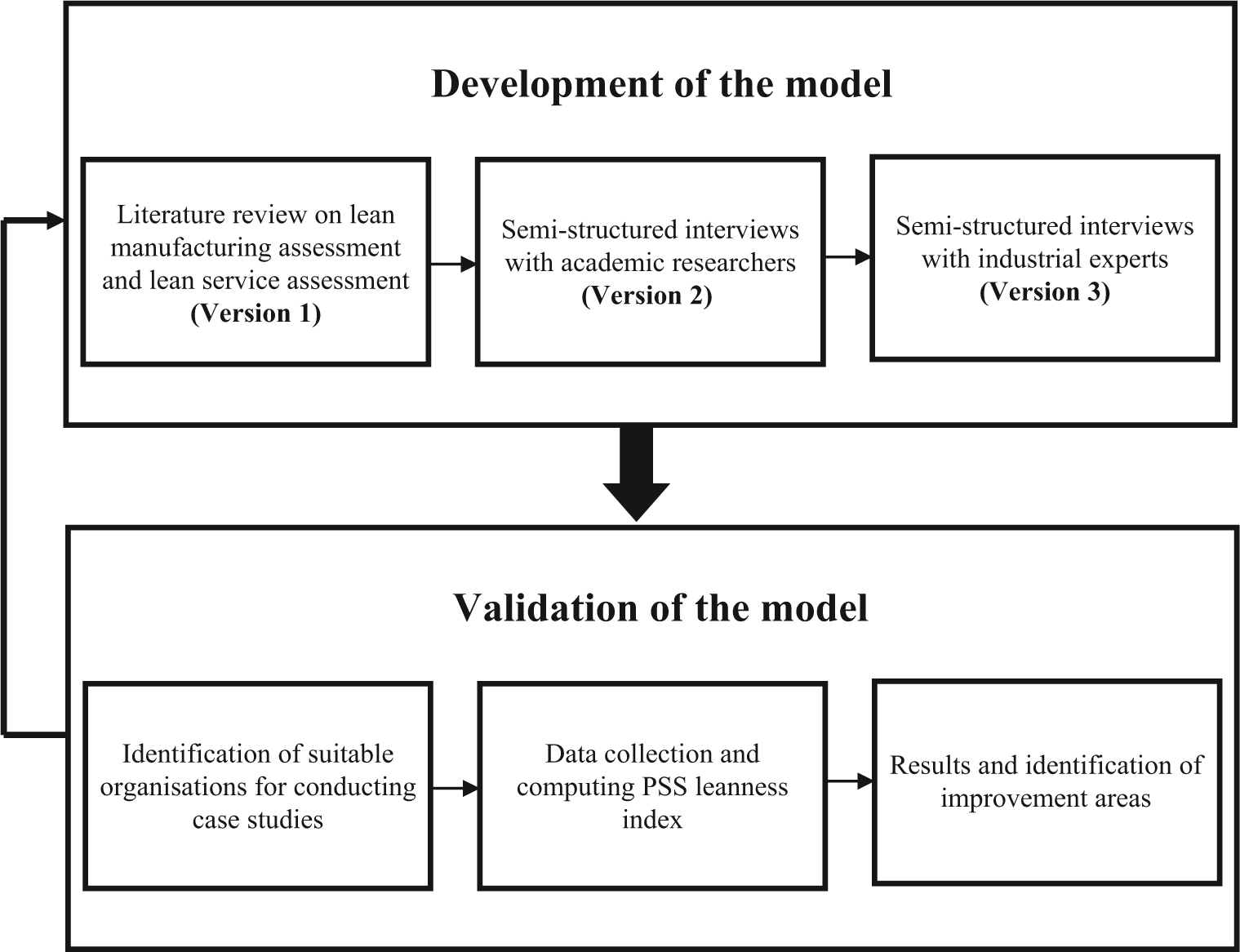
Research methodology.
The second version of the model was refined using semi-structured interviews with a number of experts working in different UK manufacturing industries (trucks and buses, transportations, document management and aerospace), involved in lean and continuous improvement projects, and with working experience ranged from 15 to 30 years. Each interview took about 60 min discussing the model and examining its items, its structure and its ability to measure PSS leanness.
These interviews resulted in refining the second version of the model by adding and removing some items as well as changing the names of other items. The next step was to identify suitable companies for applying the model. Then, the collection of data was started from the case companies to calculate the PSS leanness index for each company. After the calculation of the PSS leanness indices, a comparison between the case companies was conducted and areas for further improvement for each company were identified.
PSS leanness assessment model
The PSS leanness assessment model is developed on three levels as presented in Figure 2. The first level consists of five enablers, the second level contains 21 criteria and finally the third level involves 73 attributes. The rationale behind the formulation of the model is that it represents five major perspectives of lean in PSS, namely, supplier relationship, management leanness, workforce leanness, process excellence and customer relationship.
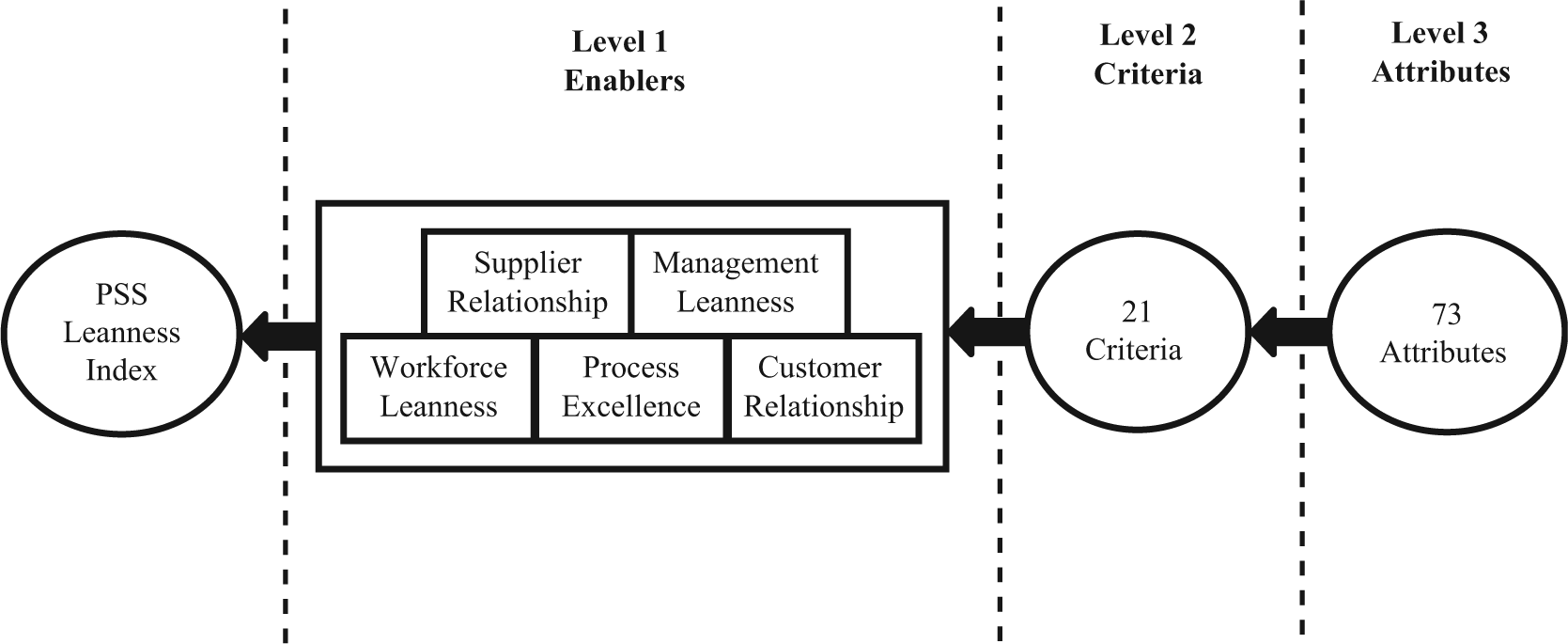
PSS leanness assessment model.
The computation of PSS leanness index goes through successive steps. The assessment of each level depends on the assessment of the preceding level. For instance, the PSS leanness index is the sum of the indices calculated for each enabler. Also, the index of each enabler is the sum of the indices computed for the criteria pertaining to each enabler. Finally, the index computed for each criterion will be determined by the assessment scores for each attribute pertaining to each criterion.
As an example, the management leanness enabler has been explained. The major perspectives of management leanness are culture of management, management practices, leadership and feedback, which forms the criteria. The culture of management criteria includes attributes such as a clear understanding that lean is not just about tools and techniques, but a philosophy, lean thinking is an integral part in offering services to customers and culture of problem prevention and waste elimination. Table 1 presents all the enablers, criteria and attributes used.
PSS leanness assessment model

Case studies validation
Case study companies
The validation of the model has been carried out in three UK manufacturing companies across various sectors. All these companies have applied PSS successfully. Due to confidentiality agreements, the companies’ name will not be disclosed and will be referred as Company (A), Company (B) and Company (C). The following presents a brief summary about each company.
Company (A) is a document management company that produces and sells portfolio of offerings such as colour and black-and-white printing, publishing systems, multifunction devices, photocopiers, fax machines and related consulting services. Company (A) started its quality journey in the early 1990s and in 2003 six sigma and lean were integrated and driven as a company strategy. Improvement processes, tools and techniques were deployed across the company and centred on improving business processes to create a higher level of customer satisfaction, quality and productivity.
Company (B) is a specialist train manufacturers that provide a comprehensive range of design, manufacturing, operating and maintenance service for the rail transport. Company (B) develops and markets the most complete range of systems, equipment and services in the railway sector, including rolling stock, infrastructure and signalling equipment, as well as maintenance operations. The company started its lean journey in 2006. The company deployed the lean concept throughout the whole company via a policy deployment process. The company uses a wide variety of lean tools and techniques including Kaizen, 5s, daily management process, standard work, visual control, Key Performance Indicators (KPIs) and daily accountability process.
Company (C) is specialised in manufacturing commercial heavy vehicles. The company offers customers comprehensive services in one-stop shopping such as service and repair contracts, fleet management, tailor-made financing, leasing and insurance, flexible rental options and many other tailored services. Company (C) is still in the early stage of lean implementation.
Assessment of the three companies’ PSS leanness
This section presents the equation used in calculating PSS leanness index for each company and the steps used in the assessment process. By following the same approach of calculating the leanness index presented by Vinodh and Chintha, 16 the PSS leanness index for each company presented by (I) will be the product of the overall assessment factor (R) and the overall weight (W)

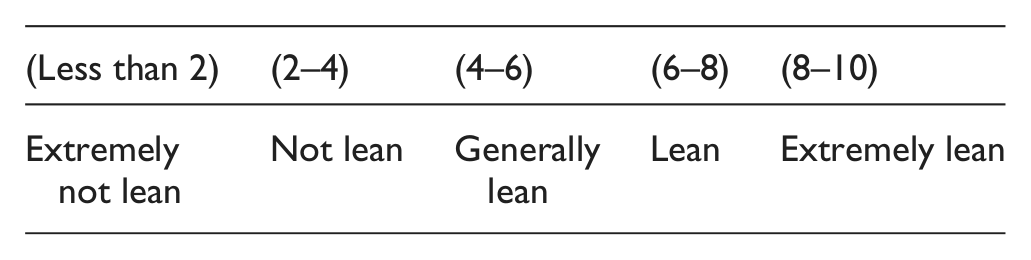
The assessment has been divided into five grades as follows:
Fifteen experts (E) participated in the assessment process, five experts from each company. Experts include, for example, CEO, Head of after sales business development, European deployment manager lean six sigma, business improvement manager and Head of UK service. Every expert has completed an excel tool independently by identifying the relative importance (weight) of each enabler, criterion and attributes. Then each expert evaluates the performance of their company on each attribute by giving a score for every attribute, which ranges from 0 to 10. After collecting all the required information, the assessment process began, as given in the following.
Step 1: computing the relative importance (weight) for each enabler, criterion and attribute
Because of the small sample size, the median has been used instead of the mean in calculating the relative importance in order to avoid the effect of the outliers and sensitivity to extreme values pertaining to mean. Table 2 presents a summary of the relative importance (weights) computed for the enablers, criteria and attributes and all the assessment scores of each attribute collected from the companies’ experts.
Weights and assessment scores for the three companies (refer to Table 1 for enablers, criteria and attributes).

Step 2: computing the index belonging to each criterion
For example, the calculation related to supplier quality criterion for company (A) is shown as follows

Assessment scores pertaining to the supplier quality criterion are given by
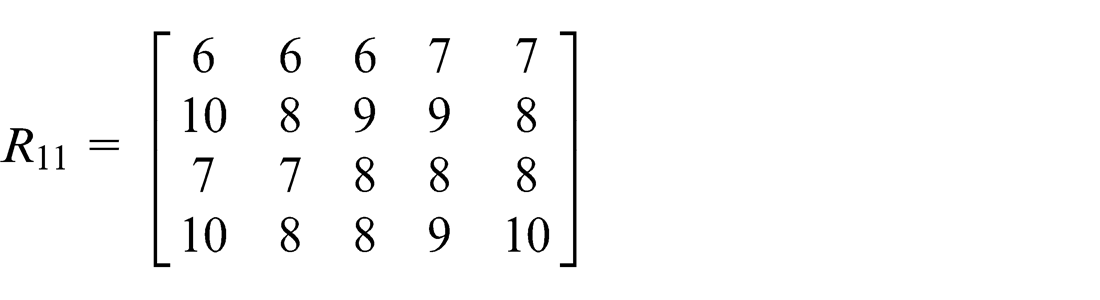
Index pertaining to the supplier quality criterion for Company (A) is given by


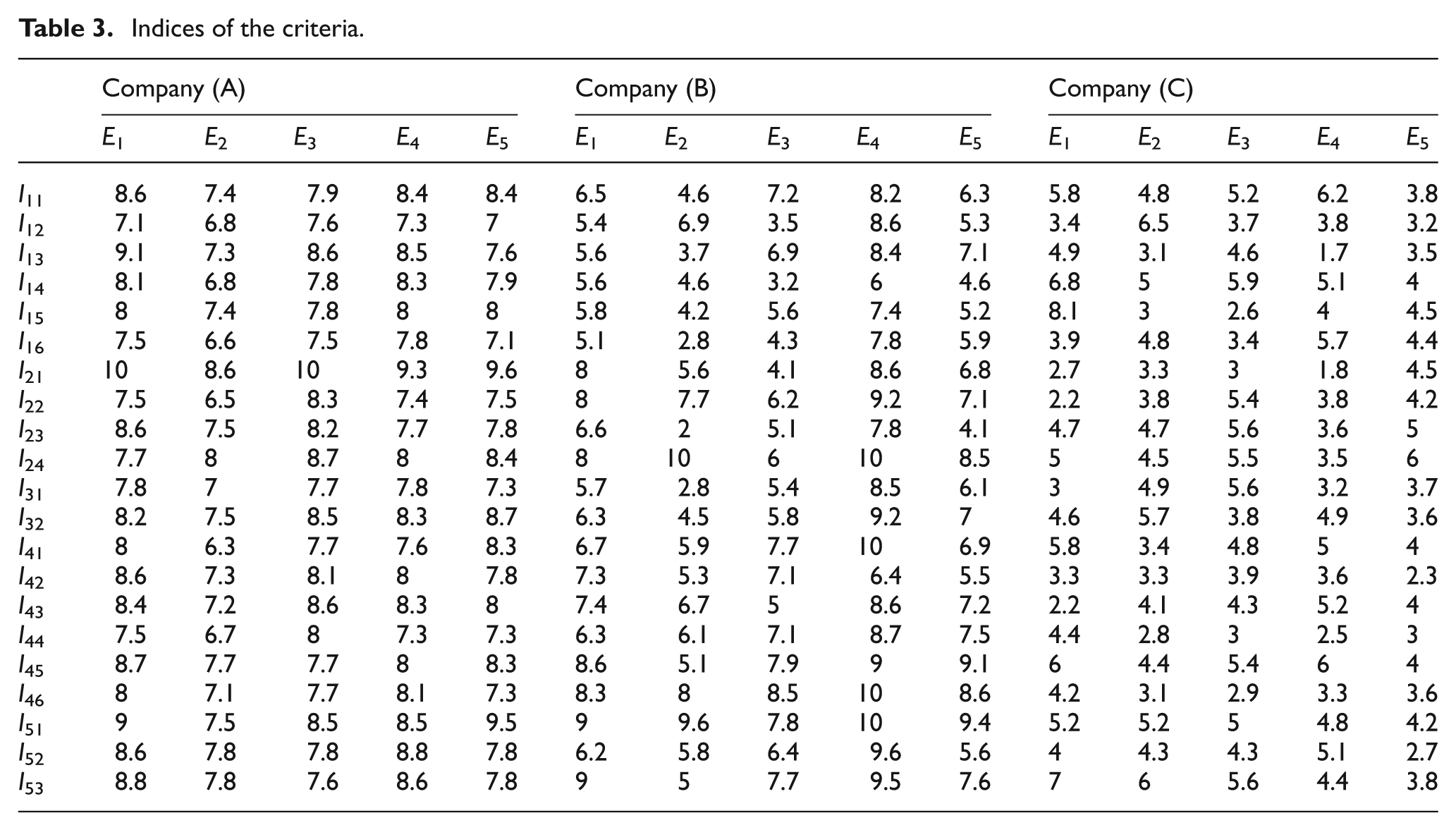
Using the same procedures, the indices pertaining to the remaining lean criteria for the three companies are presented in Table 3.
Indices of the criteria.
Step 3: computing the indices belonging to each enabler
For example, the calculation related to the supplier relationship enabler for Company (A) is given by

Weight pertaining to the supplier relationship enabler is given by

Assessment scores pertaining to the supplier relationship enabler are given by
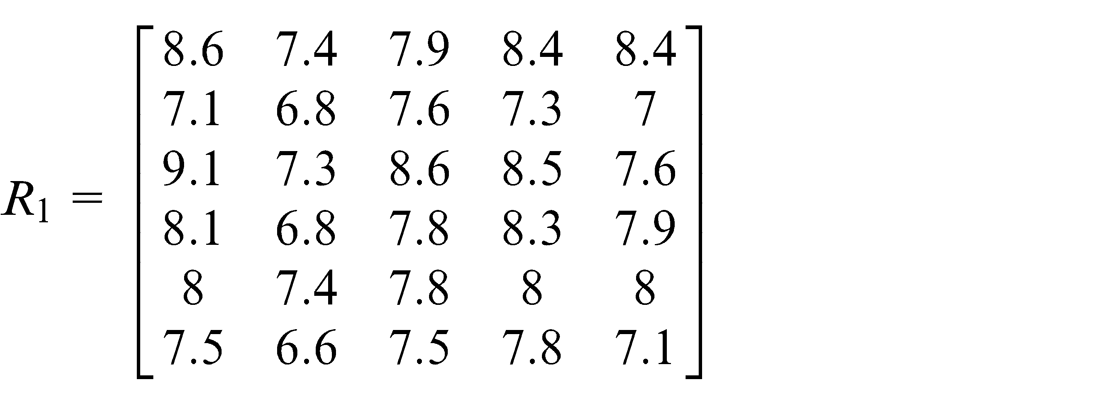
Index pertaining to the supplier relationship for Company (A) enabler is given by


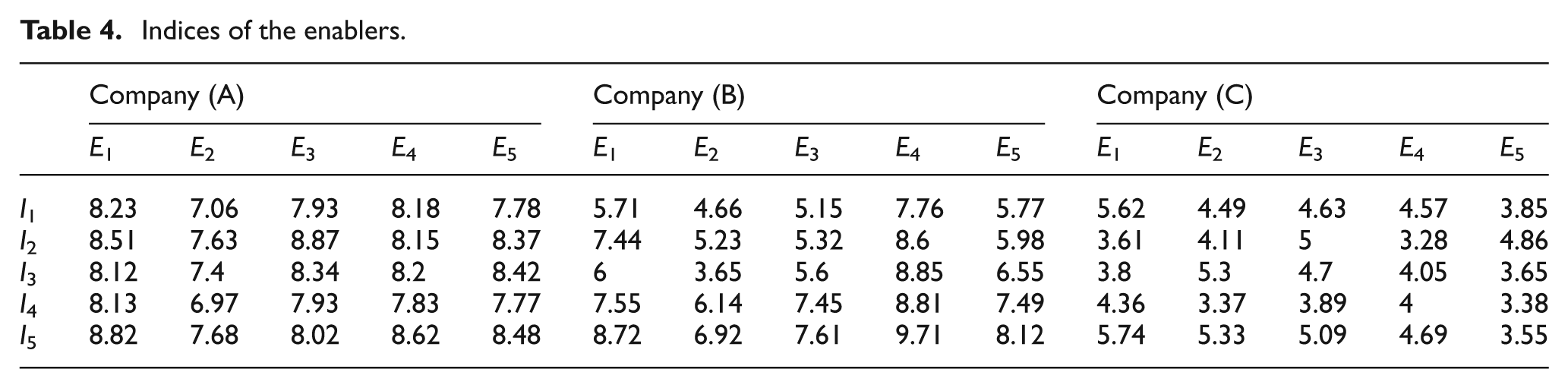
Using the same principle, the following indices have been calculated for remaining lean enablers for the three companies as given in Table 4.
Indices of the enablers.
Step 4: computing PSS leanness index
The PSS leanness index for Company (A) has been computed as

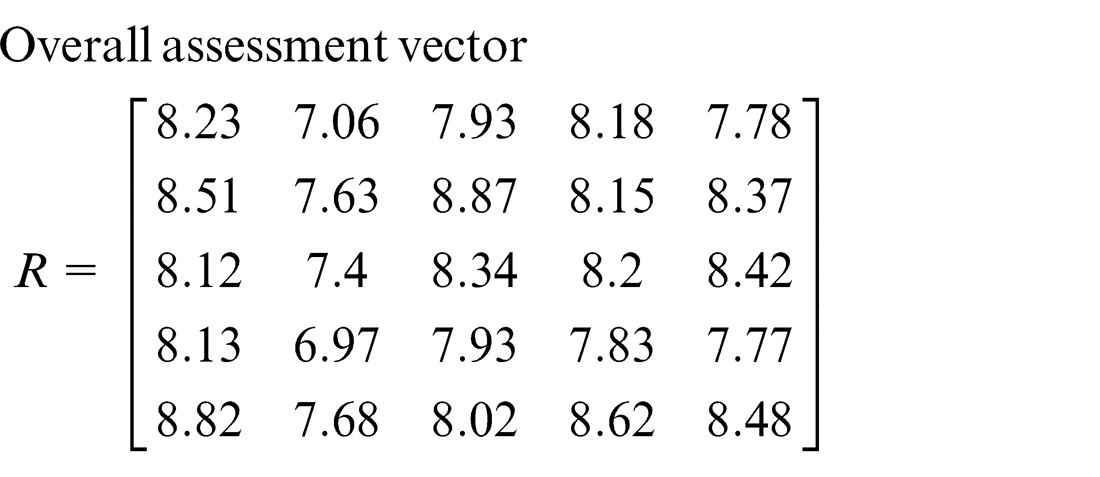
Company (A) PSS leanness index has been calculated as




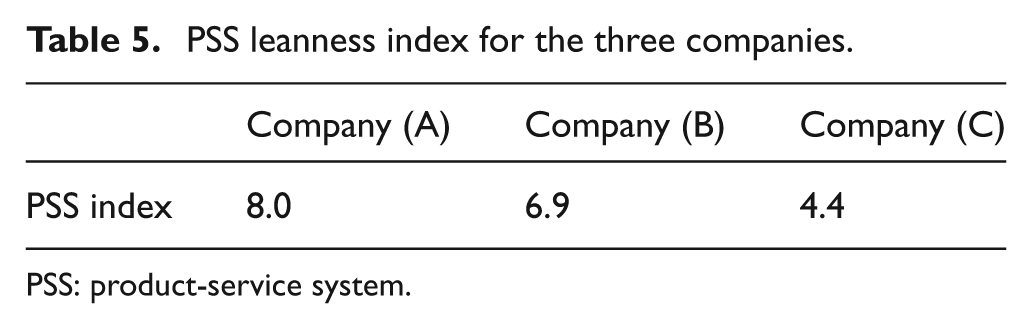
Using the same procedures, the PSS for the three companies will be shown in Table 5.
PSS leanness index for the three companies.
PSS: product-service system.
Discussions on the case studies results
Based on the assessment conducted for the three Companies (A), (B) and (C), it was found that the PSS leanness indices for the three companies are 8.0, 6.9 and 4.4, respectively. The indices for Company (A) and Company (B) reveal that the service offering in both companies is lean, but the PSS in Company (A) is 11.08% leaner than Company (B). The difference between the companies comes from the history of each company in implementing lean practices. As mentioned before, Company (A) started its quality journey in the early 1990s and lean was integrated and driven as a company strategy, while Company (B) started its lean journey in 2006.
Apart from Company (A) and Company (B), the PSS leanness index for Company (C) was found to be 4.3568. This PSS leanness index indicates that the service offering in Company (C) is not lean; this is because Company (C) is still in the early stages of lean implementation. More discussions about each company are presented in the following sections.
Company (A)
The PSS index for Company (A) is 8.0096; the PSS in Company (A) is just about to be extremely lean. Some improvements should be conducted in order for Company (A) to shift to the extremely lean category. As presented in section (a) of Table 6, Company (A) should focus more on the process excellence enabler, where process excellence is highly important for Company (A) with a weight of 40% and an index of 7.7.
A comparison between the three companies.
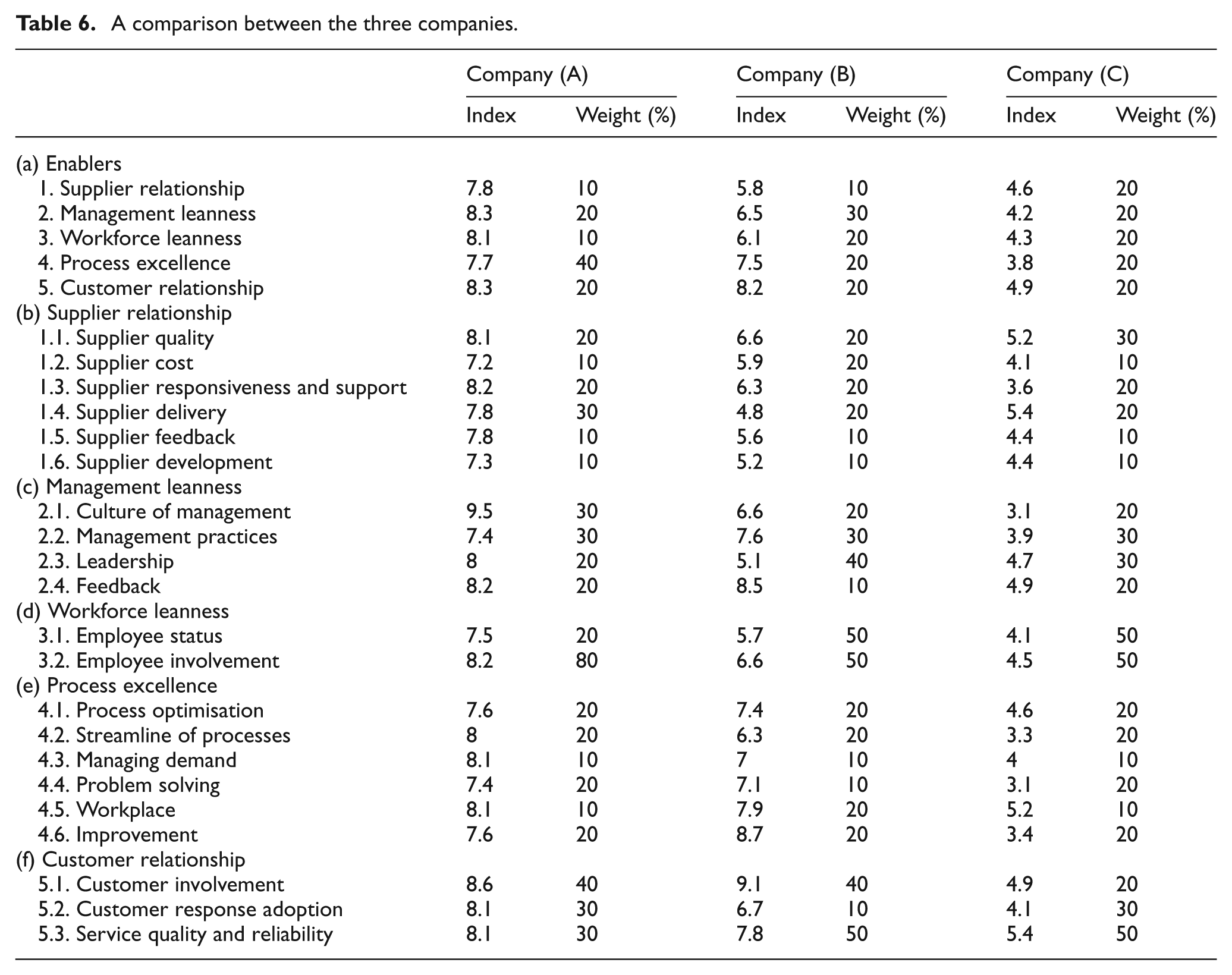
From section (e) of Table 6, it is obvious that some enhancements are required in three criteria, namely, problem solving, process optimisation and improvement. This improvement can be achieved by having a well-defined action plan for each problem, using statistical techniques to reduce process variance, encouraging improvement team and quantification of the seven wastes.
The second enabler that needs some improvement is the supplier relationship. The index of the supplier relationship as mentioned in section (a) of Table 6 is 7.8. Supplier relationship can be improved by conducting regular training for suppliers’ employees and flexibility in payment for suppliers.
Finally, other area for improvements may include workforce leanness. This can be done by implementing job rotation system and giving more empowerment for employees to be able to solve customers’ problems faster.
Company (B)
The PSS leanness index for Company (B) is 6.902. This total PSS leanness index reflects the indices computed for the five main enablers for Company (B) as shown in section (a) of Table 6. The PSS in Company (B) is considered to be lean, but more progress is still available. Three main enablers need some improvement in Company (B) as presented in section (a) of Table 6. These enablers include management leanness, workforce leanness and supplier relationship with indices of 6.5, 6.1 and 5.8, respectively.
Company (B) should give more attention to the leadership style as shown in section (C) of Table 6, where leaders should refer to employees as associate and spend a lot of time coaching, mentoring and leading by example. Also, more focus is required in management practices in terms of the smooth of information flow, process-focused management and team management for decision-making.
The second enabler that can be improved is workforce leanness. Workforce leanness index is 6.13 with a relative importance of 20%. Improvement in workforce leanness can be achieved by implementing job rotation system, enhancing culture of continuous improvement, identifying the internal and external customers for each employee and encouraging employees’ cooperation and empowerment. With regard to supplier relationship as shown in section (b) of Table 6, it can be improved by considering three areas that include supplier delivery, supplier development and supplier cost. Other areas for improvement may involve some attributes pertaining to process excellence and this can be achieved by adopting VSM, quantification of the seven wastes, optimising the cost of inventory, usage of automated tools to enhance services and existence of future state maps.
Company (C)
Apart from Company (A) and Company (B), the PSS leanness index for Company (C) was found to be not lean with an index of 4.3568. According to Company (C), all the enablers are equally important for implementing lean practices in PSS with a relative importance of 20% as shown in section (a) of Table 6. Company (C) should work hard in all areas to improve the PSS leanness level. But the focus here will be only on process excellence, because the index computed for process excellence was found to be 3.8 and this presents the lowest index computed for the enablers for Company (C). As a starting point for Company (C), process excellence can be improved by the following:
Adoption of VSM;
Quantification of the seven wastes;
Having extra capacity to handle unpredictable demand;
Training employees on problem-solving tools and techniques;
Using root cause analysis;
Identifying a well-defined action plan for each problem;
Using Kaizen and 5s;
Existence of improvement team;
Existence of future state maps.
Approval of the results
After computing PSS leanness index and identifying areas for further improvement for the three companies, a presentation to the experts participated in the assessment process of each company was carried out. The aim of this presentation was to discuss the index calculated for each company and areas for further improvement and examine if the results reflect the real situation in each company or not. In a group discussion in each company, the five experts were asked whether
The index computed presents the reality.
The improvement areas reflect the current situation of the company.
There were any missing items or items that should be excluded from the tool.
The experts asserted that the index computed for their company reflects the current lean practices in their company. Also, there was an agreement among them on the improvement areas identified for each company. Finally, they did not suggest any modifications on the model and they mentioned that the model is comprehensive and covers all the required elements. For example, the Operation Manager of Company A mentioned:
I am quite happy with the way we implement lean. You can always say it could have been better, but I think we did very well. One of the very appealing sides of the tool is to identify the gap between the current leanness state and the ideal leanness state. The tool can identify what can be improved. We will seek opportunities for improvement.
Also, the Continuous Improvement Manager of Company B said:
I am proud. The tool is pretty simple, holistic and quick to put into practice. All the suggestions and recommendations are acceptable. Our strength and weak points are much clearer now. Our performance in certain areas was lower than expected, but it will get better. The index proves that we are on the right track.
Finally, the CEO of Company C stated:
This tool is really helpful. It enables us to assess our performance across different areas. The tool is useful for use to find and diagnose problems. It has the advantage of analysing our performance in each area by cutting problems into bite-sized chunks. We are now aware of the bigger picture of what’s going and how we can change it.
Conclusion
The assessment of leanness in either manufacturing or non-manufacturing sectors gains vital importance. There were numerous methods and instruments to measure the effectiveness of lean implementation in both manufacturing and non-manufacturing sectors. Thus, this article reports the development of an innovative model that can be used in measuring the leanness level of PSS in manufacturing companies. Also, this article presents the validation of the model via three real-life case studies across varied industries. The PSS leanness index was computed for the three companies based on the relative importance and assessment scores provided by 15 experts from three UK manufacturing companies, five experts from each company. Then, a comparison between the three companies was conducted and areas for further improvements were identified for each company. The PSS leanness index discussed in this article is useful for business improvement. This index provides managers with a real insight into the leanness level of their service offering; also, it provides managers with a quantifiable of how lean their PSS is. The index identifies the gap between the current state and the future state and this helps in determining areas for further improvement.
Footnotes
Acknowledgements
The authors are gratitude to the three companies and the experts for their efforts and support during the research.
Declaration of Conflicting Interests
The author(s) declared no potential conflicts of interest with respect to the research, authorship, and/or publication of this article.
Funding
The author(s) disclosed receipt of the following financial support for the research, authorship, and/or publication of this article: The authors would like to thank the Egyptian Ministry of Higher Education (Arab Republic of Egypt) and Cranfield University for funding this research project.