




Abstract
Process capabilities, which are the outcomes of both Critical Success Factors and Barriers, could play an essential part in the implementation and continuous development of a process. This article explores the Configuration Management process capabilities extracted on the basis of semi-structured interviews with Configuration Management professionals and analysis of two highly significant studies in the development of Configuration Management as a researchable topic. The first study investigated the Critical Success Factors for successful Configuration Management development, while the other study looked at the identification of barriers to effective Configuration Management deployment. It is evident that the majority of research studies on process maturity concepts have focused on process capability itself, not the success or failure of Configuration Management. A list of 10 process capabilities and 35 constructs (C1–C35) are established which would provide necessary foundation for the effective implementation of CM practices.
Keywords
Introduction
‘Configuration Management (CM) is a technical and management process applying appropriate resources, processes, and tools to establish and maintain consistency between the product requirements, the product, and associated product configuration information’. 1 According to Burgess et al., 2 ‘CM has been recognized as a significant philosophy to bridge the gap between project management activities and those for the Design, Manufacture and Support of a product’. After its inception from the defence sector back in 1950s, Configuration Management (CM) has received considerable recognition in the last two decades because of its inclusions in terms of compliance requirements in several major standards. CM is an integral part of both the project and product life cycles and has a great influence on reducing product development time, minimizing through life cost, and enhancing overall product quality. 3 CM is not a radical discovery that revolutionizes the way a system or product is developed and maintained, but a set of good working practices for coping with uncertainty and change, and achieving commitment of the projects stakeholders as the design evolves. 4
Despite extensive literature, industries are still facing difficulties in the implementation of CM practices. 5 The literature suggests that some efforts have been made to enhance CM practices through Capability Maturity Models6,7 developed by the Software Engineering Institute (SEI), and additionally a rudimentary Configuration Management Maturity Model (CMMM) developed specifically for the medical device industry by McCaffery and Coleman. 8 These studies are similar in nature and lack important information. They follow a general theme, by asking what to implement instead of how to implement,9,10 and are not built on process capabilities extracted from Critical Success Factors and Barriers to a process implementation. 11
The studies of Niazi et al., 10 Fortune and White, 12 and Yeo and Ren 11 provide baseline guidelines on process maturity. The research of Yeo and Ren 11 emphasizes the extraction of key capability areas which are mainly based on Critical Success Factors and Barriers to a process, whereas in the study of Niazi et al., 10 emphasis is on the identification and measurement of Critical Success Factors and Critical Barriers to suggest improvement priorities. The study of Fortune and White 12 suggests the extraction of key capability areas from Critical Success Factors to evolve and mature a particular system or process through a Formal System Model. From the above, we postulate that factors which are based on Critical Success Factors and Barriers ensure the avoidance of possible risks and assist in achieving the desired objectives through effective implementation strategies.
The academic literature in the field of CM is extremely scarce in comparison with allied fields, with no formal or valid studies to explore CM-specific process capabilities. The studies on Critical Success Factors 13 and Barriers 3 provide the necessary foundation to further explore this concept based on existing literature in other allied field,10–12 which highlight necessary guidelines on maturity concepts. To further investigate the issue, this research is designed to identify process capabilities and define the necessary requirements which could help in the implementation and continuous development of CM practices. In-depth analysis of 21 Critical Success Factors 13 and 19 Barriers 3 followed by semi-structured interviews with CM subject specialists helped us to identify 10 process capabilities and 35 constructs necessary for the implementation and continuous development of CM.
Research methodology
This research is based on semi-structured interviews which are part of a qualitative research methodology 14 and a critical analysis of the available literature, especially the studies on Critical Success Factors 13 and Barriers 3 in the field of CM. Since mixed-method research, also called triangulation, is used to increase validity and reliability of research, 15 this research is triangulated through a questionnaire survey as part of our overall study. Since the existing body of knowledge plays a vital role by providing important information about the history of a particular field and forms the foundation for further research, some research studies are non-empirical in nature and are based on searching and reviewing the previous literature,16,17 while others are empirical, which involve the collection and analysis of data, quantitative or qualitative, 17 and are mostly based on observation or experience. 15
In the first phase, an initial list of process capabilities and constructs was identified through critical analysis of the available literature. In the second phase, semi-structured interviews conducted with six CM experts from four different industries helped in establishing a list of 10 process capabilities and 35 constructs. Interviews were conducted with the help of an interview guide, which was developed and refined several times before interviews. Each interview was recorded for later analysis. Interviews were analysed several times, and areas of importance were recorded where cross comparison was done with initially identified data to come-up with required information. In the third phase, a questionnaire survey was conducted since it was essential to see the validity of our research because of the limited number of interviews.
Judgemental and convenience sampling techniques were used for the collection of data. Only targeted CM professionals were contacted to provide their views on the issue to maintain legitimacy of the received data. After six interviews, a total of 10 process capabilities and 35 constructs were established, which were further validated through a questionnaire survey where a total of 50 received questionnaires from CM experts showed extreme satisfaction on the completeness and appropriateness of the identified 10 process capabilities and 35 constructs.
Findings and discussion
Process capabilities play a crucial part in the effective implementation and continuous development of a process, and therefore, it is essential to investigate and understand their strength in the maturity of CM practices. Following discussion further investigates this concept to help practitioners in better understanding and effectively implementing the CM process in their organizations.
Identification of key process capabilities
This research highlights 10 process capabilities 18 for the effective implementation and continuous development of CM practices, which are shown in Figure 1. Some of these process capabilities are the composition of multiple factors (rephrased Critical Success Factors or Barriers) and are grouped on the basis of their inherent relationships to facilitate the design of a CMMM. Each process capability is further explained through defined practice(s) to help in defining and measuring the required capability. The 10 process capabilities are therefore explained through 35 constructs (C1–C35), which are essential for the effective implementation of CM.
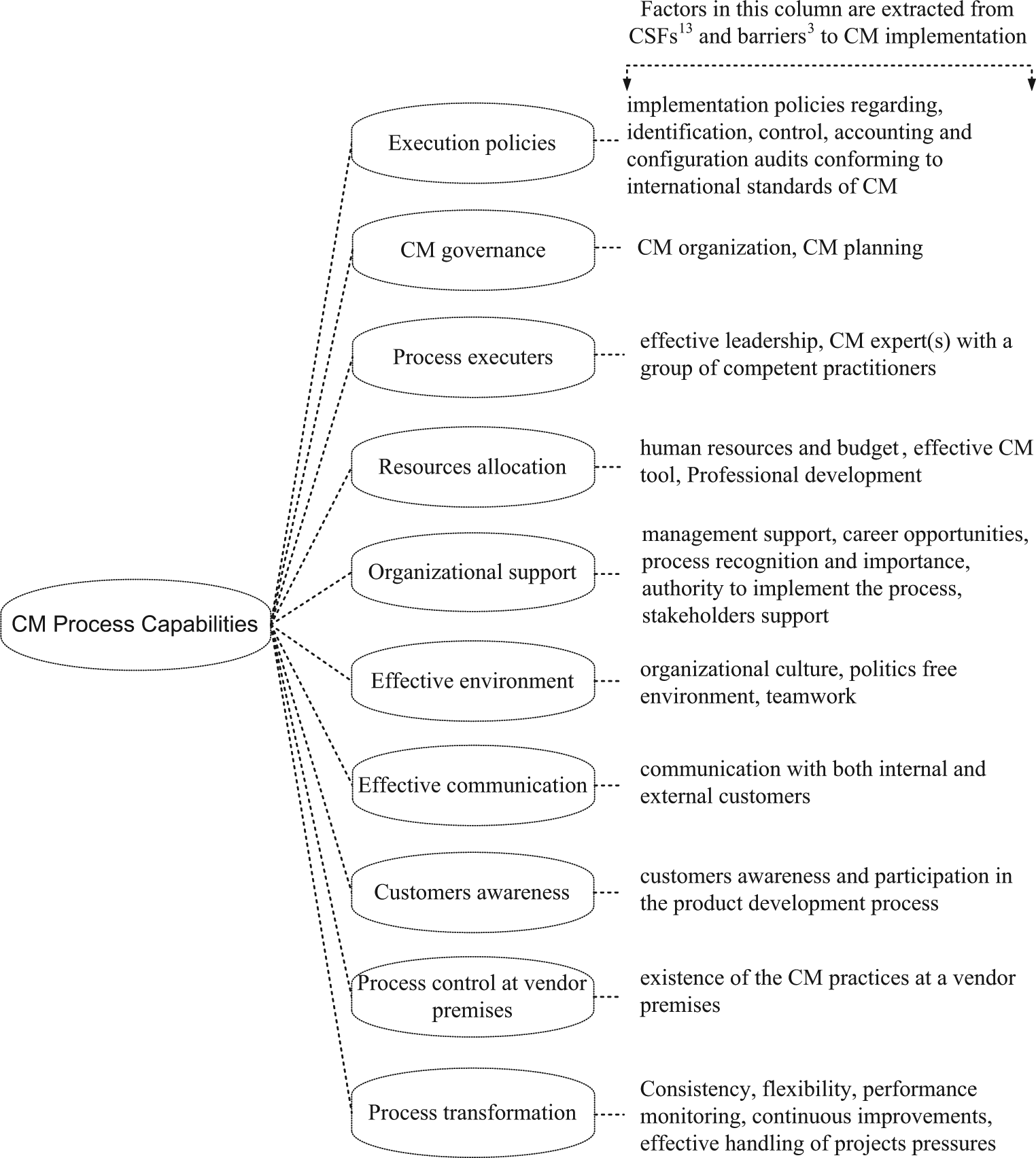
CM process capabilities.
The limited number of interviews forced us to run a questionnaire survey to maximize the responses and validate the designed parameters. The questionnaire was part of our overall research related to the validation of CMMM. A number of statements were provided, whereas opinions of CM professionals on the designed parameters were accumulated on a 5-point Likert scale running from 1 (strongly disagree) to 5 (strongly agree). An open question was also provided by asking respondents to highlight limitations observed in the overall designed process. More than 90% of the research participants either marked ‘agree’ or ‘extremely agree’ on the statements representing the completeness of process capabilities and easiness, generalizability, and representativeness of the identified 35 constructs in terms of implementation and continuous development of CM. These data validated the designed parameters, which could provide baseline guidelines on CM maturity.
CM process capabilities and constructs
This section further explains the 10 process capabilities and 35 constructs extracted through extensive analysis of the data received from semi-structured interviews and literature, especially the studies on Critical Success Factors 13 and Barriers 3 in the field of CM. The resulting 10 process capabilities and 35 constructs are detailed below.
Execution policies
Since implementation of a process is largely facilitated through effective adaptations of execution policies, it is therefore essential for organizations to benchmark their CM execution policies against specific international standard(s) (e.g. EIA-6491). Although CM is not a new set of ideas and considerable literature is available in the form of standards,1,19 books,20–23 and academic research,2,3,5,13,24,25 to facilitate its implementation, organizations are still facing difficulties in its implementation. It is always hard to define the key parameters which are used to judge the effectiveness of this process and is accomplished through detailed discussion with CM professionals. The execution policies which are explained through limited statements (C1–C12) is always difficult and would need extensive knowledge and experience in the field of CM or help from any of the latest standard on the subject at the same time for comparison. The 12 constructs do cover the main areas but do not highlight insight of detailed practices which could be obtained from many international standards and should be part of the organizational procedures.
There is a basic requirement for any organization to define its process against selected international standard(s), which should critically define and evaluate the following 12 constructs as a minimum:
C1. The CM process is available in the form of documented procedures describing the organizational policies, activities, and conventions related to CM planning, configuration identification, configuration control, configuration status accounting, and configuration auditing.
C2. CM practices are implemented in all projects irrespective of the value or complexity of those projects.
C3. Product configurations (hardware system and software) and their related configuration documentation have a strong correlation and unique identification.
C4. Configuration documentation is released through a formal release process, which includes the review and approval of all functional stakeholders.
C5. The CM process specifies the rules and procedures to identify and control configuration items across all projects.
C6. The CM process specifies requirements of managing baselines from concept to disposal of the product or system, which are implemented across projects through the application of company-wide procedures.
C7. The configuration change management process is implemented through a closed loop cycle where configuration changes are identified, documented, evaluated, and implemented with appropriate approval.
C8. Engineering changes are classified in two high-level categories, that is, permanent changes (dealt through engineering change orders (ECOs) or engineering change proposals (ECPs)) and temporary changes (dealt through waivers and deviations), which are properly identified and recorded across all projects.
C9. The Change Control Board (CCB) is the sole authority to accept or reject both permanent and temporary changes.
C10. Configuration status accounting is in place to capture and maintain product configuration information throughout the product life cycle.
C11. The physical and functional configuration audits are conducted to provide assurance of the physical and functional configuration verifications before release of the products to customers.
C12. The documented CM process fulfils detailed requirements of any latest international standard(s) on CM (e.g. EIA-649 (Rev B)), which covers the sub-elements of all areas highlighted from P3 to P11.
Governance
There are two elements under this category, that is, organization and planning. Since CM is often considered a secondary role with only few organizations having senior managers with CM-specific responsibilities, 2 there is a growing requirement for the governance of CM through a centralized body. 3 On the other hand, CM planning, which is termed as the backbone of CM 26 plays an essential part to enhance the effectiveness and productivity of projects. 27 Organizations need to give special attention to the following two constructs:
C13. The CM process is governed through a defined organization with dedicated staff having documented responsibility and authority.
C14. CM planning is the fundamental activity during project-specific CM activities, which are managed through updated CM plans throughout the product life cycle.
Process executers
The requirements under this category are dedicated, trained, and experienced individual(s) and someone to lead the process. The important aspect for any core business process is its leadership which plays a major part in the establishment and continuous development of the process. 20 Leadership is always backed by competent and experienced employees to achieve their objectives. 13 To test these requirements, following constructs have been established:
C15. The CM process is managed and governed by a dedicated individual having in-depth knowledge of CM and leadership qualities.
C16. The CM process is backed by CM expert(s) having previous experience with a team of competent, committed, and focused practitioners (according to requirements) to carry out CM activities according to defined CM principles and practices.
Resources allocation
Resources are grouped into three categories, which are essential for the effective implementation of CM practices. First, both human and financial resources play a major role in the implementation and continuous development of CM 20 but always remained major issues. 28 Second, the availability of a suitable software tool is another important aspect which according to Cantamessa et al. 29 has positively influenced the capabilities of individuals and helped organization in streamlining their data and information. Third, professional development is the core issue for any business process management 30 and could play a positive role in CM development because professionals with CM certification and training not only understand the limitation of the process but could also play an active role in the effective implementation of the process. 3 Organizations need to have positive responses on the following three constructs for having improved CM practices:
C17. The CM process has the required infrastructure (buildings, equipment etc.) and resources (human and financial) to effectively execute the process within projects.
C18. The CM process is supported by a software tool which is easy to use and fulfils the organizational requirements to effectively implement and support CM principles and practices.
C19. Professional development is part of the organizational training programme to create awareness and importance, and help in the implementation of CM methodologies and related fields in the organization where required.
Organizational support
The success of the CM process is linked with organizational support, which can be judged from the level of support both from management and functional stakeholders, recognition and acceptance of the process across organization, authority of the CM function to implement the process across projects, and career progression of the CM personnel. According to Guess, 20 management support plays an essential part in establishing CM as a core business process area. It is true but management will only support a process if they know the criticality and importance of the process which is only possible through continuous people development programmes. 3 Organizations need to target the following constructs for the effective implementation of CM:
C20. Management understands the importance of CM practices and is committed to establish CM as a core business area.
C21. CM is recognized as a key process area where both management and stakeholders understand the importance and criticality of the process.
C22. The growing awareness and importance of CM practices has resulted in career progression opportunities for CM professionals similar to those in the fields of project management, quality engineering, design, and so on.
C23. CM managers have the authority through strong backing of senior management to implement the process against established guidelines.
C24. Stakeholders understand the importance of CM, provide the required resources, ensure effective coordination, and show commitment to effectively implement the process.
Effective communication
Communication plays a significant role in the implementation of changes because not only around 40% of the time reduction is reported in the implementation of changes through effective communication31,32 but also failure in the same may result in the increase of changes due to decisions on obsolete data. 33 According to Project Management Institute (PMI), 34 sound, fundamental, and quality communication is essential in the integration of product CM activities into the project management plan. Organizations need to give special attention to the following practice:
C25. The communication with both internal and external customers is open, timely, and free flowing both from top to bottom and bottom to top.
Customers’ awareness
An organization needs to facilitate their customers by ensuring that their requirements are incorporated within products before setting for production. It has been known that with extensive knowledge proliferation and peoples understanding of managing requirements, there is still a lack of CM awareness in the customer world. 3 It is believed that customers are very often unaware of the importance of CM which could play an important role by ensuring their requirements with products at different life cycles of a product. Organizations have to ensure the following constructs to ensure quality products against customer’s requirements:
C26. It is our company policy to maintain close liaison with external customers to make them aware of the completion of their major milestone and ensure their active participation in product design reviews to validate their requirements before finalization of product specifications.
Effective environment
There are multiple factors such as organizational culture, politics-free environment, and teamwork, which could play its role in the effective implementation of this process. The importance of organizational culture is reflected in the literature and has great importance on the outputs of any activity. 13 According to Ali and Kidd, 13 the supportive attitude and politics-free environment help in the effective communication between CM and other functional stakeholders. It is believed that teamwork could play an essential role since the results of working together are more superior to individual accomplishment. 35 An organization needs to emphasize on the following three constructs to ensure effective environment and have the desired results:
C27. Organizational culture does support the effective implementation and continuous development of the CM process.
C28. The working environment is politics free where decisions are made on merit to ensure holistic implementation of the process for quality products.
C29. CM professionals work as a team while establishing, implementing, and continuously improving CM practices.
Process control at vendor’s premises
It is compulsory to ensure effective CM practices at a subcontractors and suppliers premises 1 to avoid the acceptance of faulty items and minimize the risk of compromising the overall quality of the product before delivery. It is believed that applications of CM at a vendor’s premises needs to be observed by CM officers, which in most cases is controlled either by quality engineers or project managers. The following construct needs special attention at every facility:
C30. CM is planned against international standards at a vendor’s premises which fulfils your organizational CM requirements and is assured through periodic audits to ensure production of acceptable and consistent products.
Process transformation
It is believed that effective implementation of CM needs flexibility but not on the cost of consistency. By combining the two concepts with effective monitoring and continuous improvements methodologies along with planning, we can better control the effects of projects pressures. Maintaining consistency of CM practices within projects is a major concern which is mainly caused by the lack of planning, lack of communication, lack of centralized body for the governance of CM, and lack of authority to implement the CM process. 3 According to Ali and Kidd, 3 CM policies are quite rigid and hence not effectively followed which needs flexibility to accommodate the requirements of different projects.
To ensure the effective implementation of CM within projects, CM system audits at specific intervals must be arranged. This is essential for continuous improvements of the process because as highlighted by Guess, 20 the survival of organizations is at risk when they operate in a corrective action mode since they spend their time and resources in overcoming intermittent failures. One should understand and implement the following constructs:
C31. CM practices are consistent throughout the organization irrespective of the size and complexity of projects and across the projects or products life cycle phases whether it is concept, development, production, and maintenance or modification.
C32. CM practices are flexible and may vary to accommodate project-specific requirements based on the complexity, criticality, and project/product life cycle phases while ensuring compliance with company-wide CM principles and practices.
C33. CM system audits are planned and conducted periodically to identify areas of weakness, plan remedial actions, and address needs to enhance performance of the process in terms of identified and measurable criteria.
C34. The CM process is continuously improved through small incremental changes to accommodate technological advances, reduce limitations of the process, and induce more flexibility within the rigidity you have.
C35. CM activities are planned, effectively communicated, and properly executed by keeping in mind the criticality of tasks with respect to project scheduling to effectively handle project pressures.
Research limitations and its implications
There are some limitations with this study which needs to be acknowledged for further research. The research work is limited to aerospace and defence sectors only because of the high level of understanding of CM practices in these industries. The focus on these sectors raises another question about the current situation of CM in the commercial industries. It is believed that commercial sectors have either limited understanding of CM or have fragmented it through several business processes. Research could be done in these sectors to fully understand the implementation status of CM practices, which could help in the generalization of this concept.
Conclusion
This research on process capabilities in the field of CM is the first study on the subject, which is based on detailed discussion with CM professionals through semi-structured interviews and the outcomes of two independent studies which have contributed greatly to the understanding of CM as a value-added process. By better understanding and implementing the highlighted capabilities to its merit, it may be possible to maximize the likelihood of an organization to successfully implement the CM process that performs to its intended level of performance.
This research identifies 10 process capabilities and controlling parameters for each process capability to measure and enhance performance of the process. The controlling parameters are highlighted through detailed practice definition where a list of 35 constructs are presented under different categories which could help CM professionals to better understand and target areas of improvement. The process capabilities explained with the help of 35 constructs fully cover implementation of the CM process from management perspective. Organizations can measure their CM practices against these guidelines on any specified scale to determine the overall performance of the process. The CMMM could be based on these process capabilities and could be measured through highlighted 35 constructs. This research could help CM practitioners in prioritizing their activities to enhance the implementation status of the process.
This study is part of our ongoing research, which investigates maturity concepts to provide the necessary foundation for establishing a CMMM to evolve the capabilities of CM along an anticipated and logical maturation path to achieve the desired objectives. The highlighted process capabilities represent a complete set of requirements, which are necessary for the implementation of successful process. This study will help organizations in establishing and improving their CM practices since it is not only based on the success and failure factor of the CM process but detailed practices summarizing expert opinions of CM professionals necessary for the effective implementation and continuous development of CM practices.
Footnotes
Declaration of conflicting interests
The authors declare that there is no conflict of interest.
Funding
This research received no specific grant from any funding agency in the public, commercial, or not-for-profit sectors.