




Abstract
The second part of this article reports our query into the essential characteristics of effective engineering networks in the current business environments through case studies focusing on engineering design, manufacturing engineering, and engineering services. The engineering networks of four global leading companies were studied to refine, enrich, and extend the preliminary understandings gained from the first part of this article. The case studies suggested essential characteristics of effective engineering networks in four main areas, including (1) efficient engineering processes, (2) effective engineering learning, (3) flexible engineering resources, and (4) digital engineering environment. This contributes to the theoretical understanding of international engineering operations by bridging a missing link between the engineering network theories and the unique nature of engineering. It is expected that the findings can help managers to improve the performance of their engineering networks and facilitate the effective interface management between engineering and other functional areas.
The main research question
Theoretical preparations reported in the first part of this article helped to define the main research question to guide our case studies: how do global leading companies effectively cope with the unique nature of engineering in their network operations?
Research approach
To answer the main research question, we adopted a theory building approach based on the case study method considering the contemporary nature of this research and the complexity of the research object.1–3 The approach began with exploring the characteristics of effective engineering networks through a literature review and scoping interviews with academics and industrialists. A preliminary framework was developed to guide the case studies (see Part I). Key elements of the framework and their relations have been enriched and extended through the case studies. The studies ended when these theoretical understandings were mature, that is, when additional case data would not introduce substantial changes to the characteristics of effective engineering networks. 1
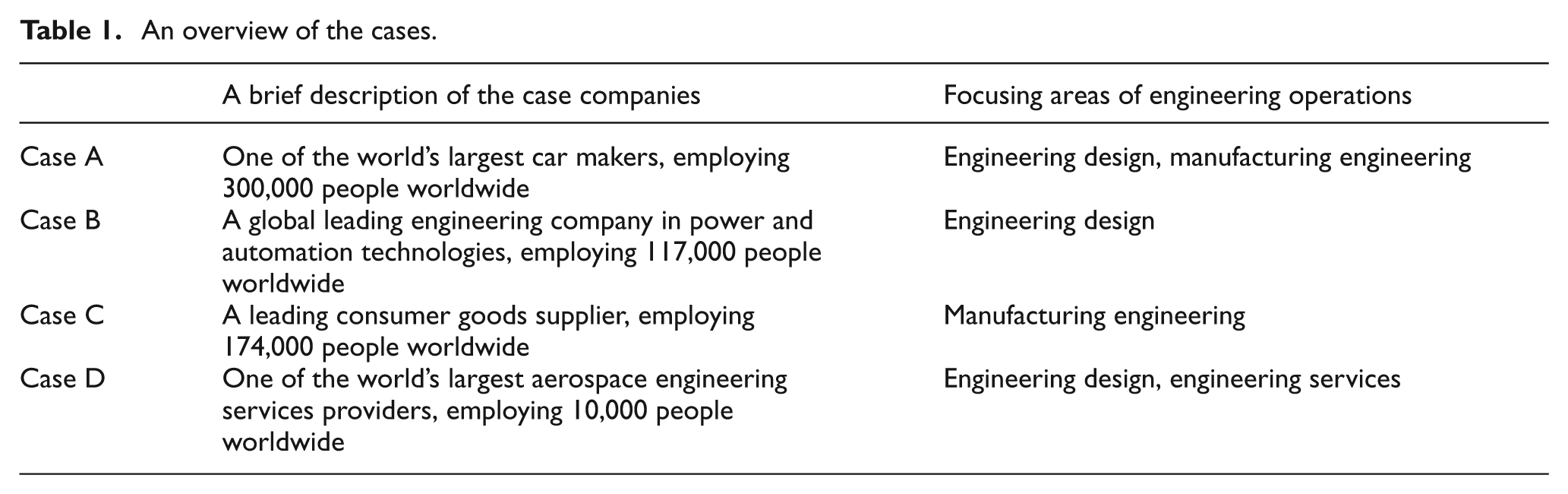
Four case companies were carefully selected to put together a theoretical sample consisting of engineering network operations in different contextual situations and thus allowing a broad scope of exploration.3,4 Case selection has been guided by the engineering value chain model developed by Zhang and Gregory, 5 which suggests that engineering activities may have different value creation mechanisms and thus requiring different operational capabilities or organisational structures. The selected cases collectively demonstrate a comprehensive view of engineering activities along the engineering value chain with complementary focusing areas on engineering design, engineering services, and manufacturing engineering. This allowed us to gain an in-depth view of different types of engineering networks and to capture generic patterns through cross-case analysis. 2 At the same time, the case companies have been perceived as leading players in international engineering operations, and engineering has been an area of strategic importance in the case companies evidenced by statements from the company websites and recent annual reports (see Table 1). This enhanced the theoretical significance of the case studies and improved the validity of the research design. 2 In addition, the case companies are willing to support this research with top management engagement. Most of them have recently tried to implement network concepts of different forms in their international engineering operations.
An overview of the cases.
Case data were collected mainly through semi-structured interviews and supplementary studies of company documents. Interviewees include senior managers who are most likely to have an overall understanding of their international engineering operations, for example, corporate strategists, chief engineers, or group engineering directors, and front-line engineers with in-depth knowledge about their engineering operations (above 10 years working experiences). The interviewees were suggested by the case companies when they agreed to support this research or in an exploratory meeting afterwards. Altogether, over 20 senior managers and experienced engineers were interviewed. Most of the senior managers were interviewed twice or more at the beginning of this research to explore the relevant issues and later to review the research findings. A case study protocol, including an overall structure of this research, the aims, approach, expected outputs, and a set of interview questions, was used to guide the interviews and thus maintaining a focus on the basic theoretical elements, that is, engineering natures, external influences, engineering network characteristics, and their linkages.
Figure 1 presents the key categories of interview questions addressed in the case study protocol, which collectively contribute to our investigations around the main research question. The first category of questions was to understand the particular requirements of the case companies’ engineering operations, targeting at an in-depth view of the unique nature of engineering with specific examples. The second category of questions was to understand the influence of the external business environments. The third category of questions was to capture the structural and infrastructural elements of the case companies’ engineering networks with reference to the network configuration features such as network structures, operation processes, governance systems, support infrastructure, and external relationships.5,6 The questions have been adapted for different purposes of the interview meetings. For example, the questions about the natures of engineering in an exploratory interview may sound like as follows: ‘Could you please describe the main functions of your engineering operations? What makes your engineering operations different from other functional areas, e.g. manufacturing, research, or after sale services? Why?’ In the following up meeting, the questions would be more specific by focusing on issues highlighted in the previous meetings, for example, ‘Do you have a formal process to sustain the intangible knowledge of experienced engineers? If so, how does it work? If not, why not?’ Recording equipment was rarely used to encourage open discussion and the interviewer noted down the key issues to facilitate interview scripts preparation afterwards. Most of the interview script was completed on the same day of the interviews. The script was then reviewed by the interviewees via emails or telephones. Sensitive materials were removed or coded as the interviewees suggested.
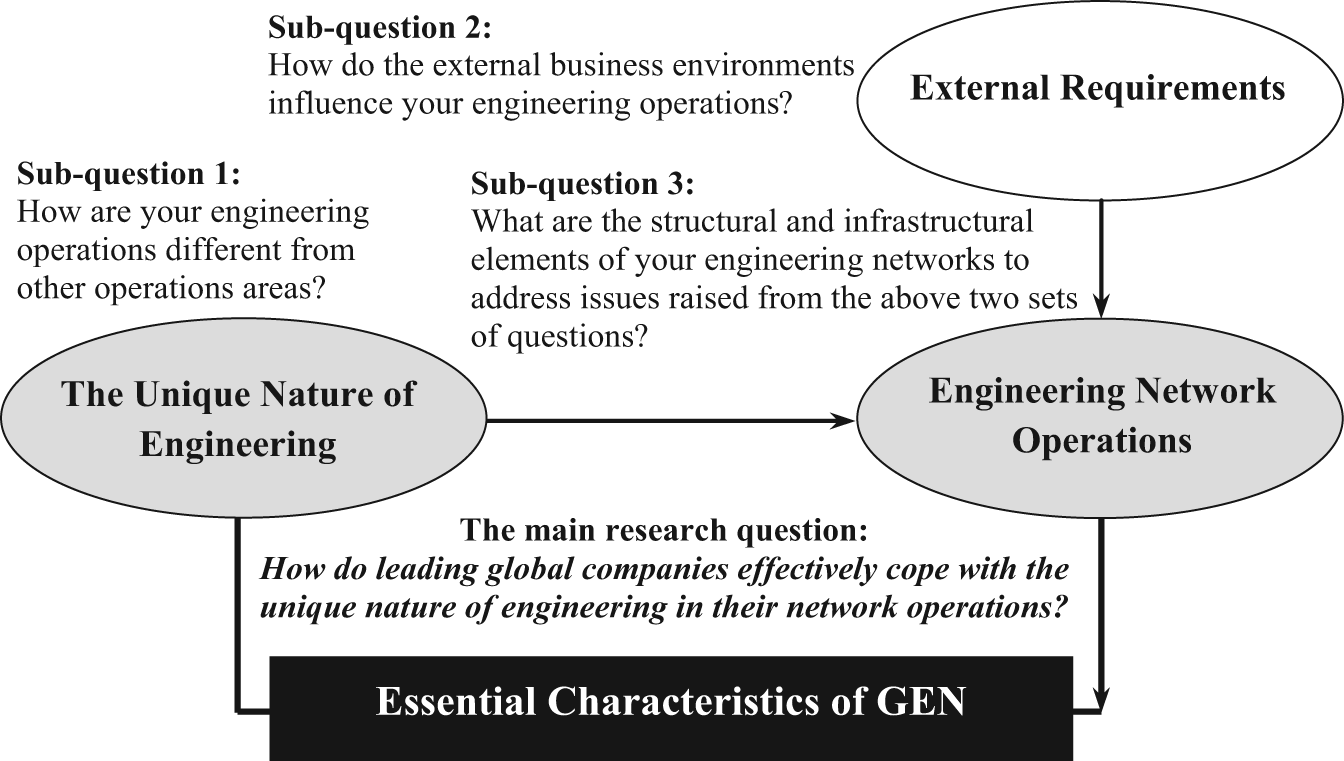
Key interview questions addressed in the case study protocol.
Collected data were analysed through an inductive process of categorisation focusing on the key elements of the theoretical framework, that is, the unique nature of engineering, essential characteristics of effective engineering networks, and their linkages.4,7 Guided by preliminary understandings gained from the literature, main categories and subcategories were created and refined by searching the case data, identifying the keywords, classifying them into common patterns, and updating the theoretical elements with emerging patterns. For example, engineering design tools, communication facilities, and Internet-based databases were identified as subcategories contributing to the main category of digital engineering working environment. The relevant keywords, for example, ‘design tools’, ‘virtual environment’, or ‘databases’, were highlighted in the interview scripts, and their implications and contribution to the case companies’ engineering networks were analysed to generate potential patterns (see Table 2 as an overview of the analysis). Independent academics, consultants, and industrial experts were involved in the theory building process by advising on the research approach and reviewing the data analysis process and the outcomes and thus improving the reliability of this research.
Characteristics of the case companies’ engineering networks.
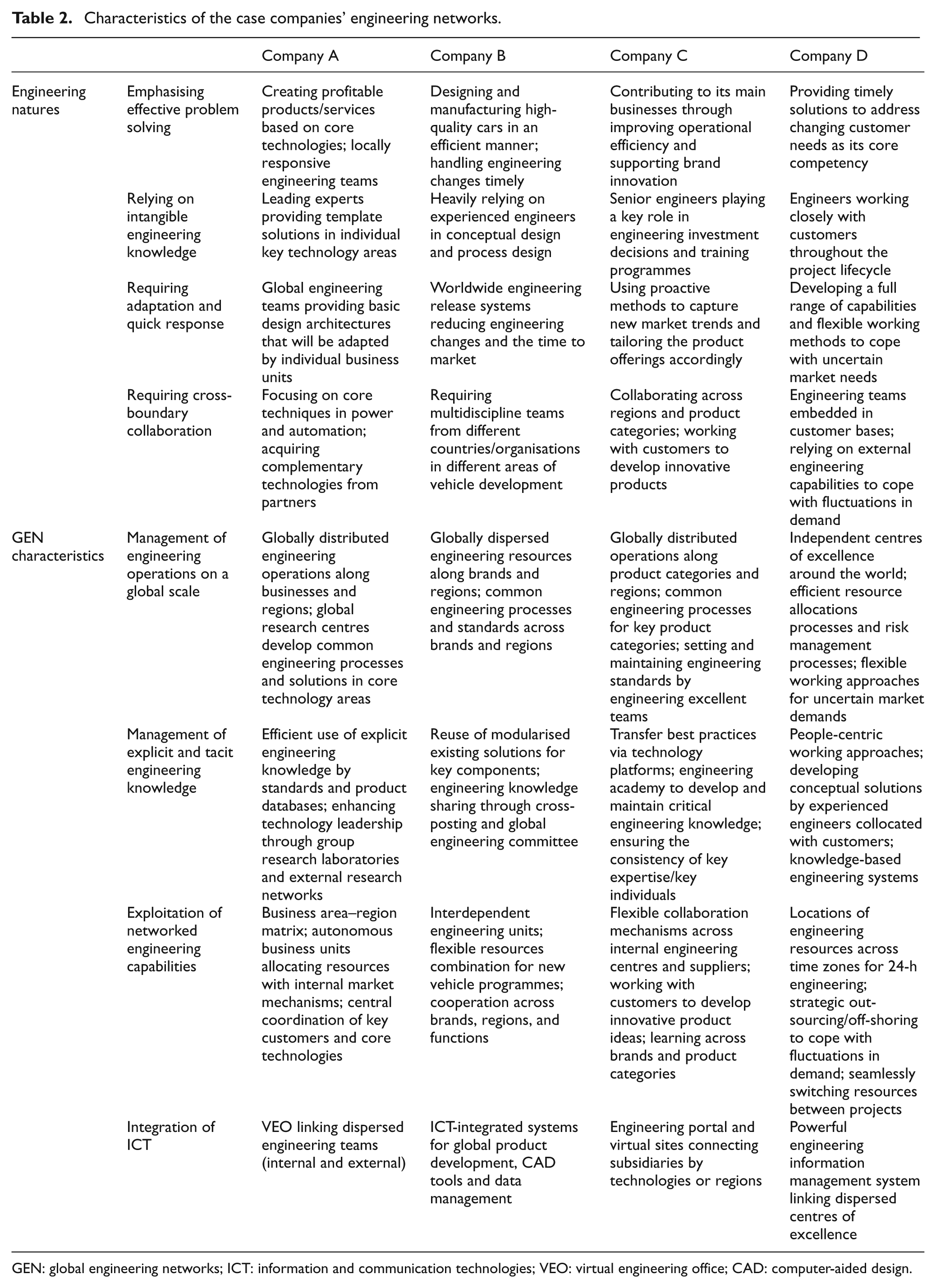
GEN: global engineering networks; ICT: information and communication technologies; VEO: virtual engineering office; CAD: computer-aided design.
Case studies
Key observations from individual cases will be introduced in this section followed by cross-case analysis focusing on the characteristics of the case companies’ engineering networks.
Case A – the engineering designer
Our studies with the Company A were focused on its engineering design activities. The company is a global leading company in power and automation technologies. It has three levels of engineering centres. The first level consists of two group research laboratories dedicated to power technologies and automation technologies, respectively. Each laboratory collaborates with universities and other external partners to support its divisions in developing cross-divisional technology platforms. The second level includes nine global research and development centres operating around the world. Each centre works closely with the group research laboratories and business divisions to carry out applied research, product development, adaptation, and improvement tasks. The third level consists of engineering centres embedded in business units with responsibilities mainly for product development, adaptation, and improvement tasks.
Company A’s organisation structure has been based on a business area–country matrix with central coordination of key customers and core businesses. The matrix consists of thousands of profit centres in over 100 countries. Internal market mechanisms have been adopted for resource allocation among profit centres. Each engineering centre can make its own decisions on what activities to undertake and charge another business unit or external customers at approximately market prices.
The company has developed the virtual engineering office (VEO), an information and communication technologies (ICT)–enabled engineering platform, to support collaborative processes for its widely dispersed engineering groups. All the business partners (e.g. producers, suppliers, and customers) can get involved in the company’s product development processes at the earliest opportunity. Important information (e.g. product specifications, new proposals, or changes to orders) is shared across the VEO to improve coordination while reducing development time and costs. This allows distributed engineering teams to work together effectively and efficiently, regardless of time zones, locations, or computer-aided design (CAD) systems they use. Early integration of expert knowledge (usually dispersed around the globe) can considerably reduce development time, while spontaneous, ad hoc collaboration between team members drives innovative solutions that not only improve product design but also minimise the number of design changes. The company’s internal report revealed that collaborative design and better interaction between engineering and manufacturing departments can reduce production costs by 10%–15% without any significant investments.
Case B – the engineering designer and manufacturer
Company B is a global leading company in the automotive industry. The company’s engineering resources are highly concentrated with three vehicle programme centres. Each has thousands of engineers and is fully responsible for the design and development of a particular range of vehicles. The company also has minor engineering centres dispersed with manufacturing facilities with responsibilities for supporting the vehicle programme centres or adapting vehicles for local markets.
Company B’s engineering operations follow common processes and are centrally controlled with a set of metrics around financial health, quality, product performance, operations cost, revenue, and market. An ICT-based engineering platform links together engineering activities throughout the company, consisting of computer-aided tools and product information management. Main suppliers are closely involved in vehicle development programmes.
Company B’s global engineering operations seek for greater efficiency, speed, and quality through improved communication, commonality models, and operations synergising. Dispersed engineering resources are brought together with cross-company standards, common working procedures, a worldwide engineering release system, and a powerful global product development system. By adopting common working procedures, the number of engineering changes of a new vehicle programme has been reduced more than 50% on average, and at the same time, the time to get an all-new vehicle to market has been reduced by 27%.
Commonality models and commodity business plans facilitate efficient co-operations between engineering centres. Four levels of commonality models have been adopted across the company: architectures, shared technologies, power packs, and commodities. Cross-brand commodity plans have been adopted to reduce the number of variants and to maximise the economies of scale. Shared vehicle components and platforms have reduced the development costs of some vehicle programmes by as much as 60%.
Best practices, core technologies, and expertise have been developed and disseminated across all the brands. A committee formed by high-level experts from all the brands takes the responsibility of identifying systems that should be designed as core, that is, systems that are common or scalable across brands. To enable the integration and synergising of engineering operations on a global scale, customer-driven quality management has been implemented as a high-priority task at all levels of engineering processes. Global quality operating systems and six-sigma tools/metrics have been aggressively implemented across the company.
Case C – the engineering manufacturer
Company C is a global leading consumer goods manufacturer. Engineering operations contribute to the success and growth of Company C’s businesses by supporting new product development, commercialising new concepts, and improving customer services through delivering reliable and safe operations. Its engineering resources are dispersed with three types of centres around the world with main aims to support brands health, development, and innovation. Six principal research and development laboratories aiming at long-term technology development work closely with product categories to create or maintain excellent brands. Research and development centres in most countries operate closely with local markets for medium-term innovations. Many product technology centres collocated with manufacturing sites support existing businesses. At the same time, the company has a corporate technology and engineering group to maintain worldwide engineering standards, capabilities, and processes.
The global engineering network (GEN) of Company C seeks for innovation and excellence through collaboration and sharing. Market-driven innovation guides the development of technologies, products, and brands. Understanding people to build brands is considered as a basic principle for case C’s engineering operations. This allows the company to develop innovative products and solutions for people and at the same time to develop its people to grow the businesses. A series of methods and techniques have been developed for understanding customer needs, including customer intimacy, gaining consumer insight, risk taking, encouraging diversity, and winning with customers (who are often large retailers).
Learning and sharing across regions and product categories are facilitated by a set of tools, standards, processes, and a supportive corporate culture. An engineering portal has been established for engineering data management, which facilitates the virtual site (VS) activities connecting subsidiaries by technologies and regions. Technology platforms have been formed to maintain standards and to ensure the implementation of best practice along key product lines. The engineering excellence team (EET) has been formed to bring the dispersed experts and specialists together for standards development and collective problem solving. The global engineering team ensures that the EET is actually delivering what the regions need by directing the EET working program with proper strategies and structured working approaches. The engineering academy ensures the consistency of engineering knowledge, especially the intangible knowledge of key individuals. These key individuals have gained valuable skills and capabilities through their rich working experiences, but such intangible knowledge is very easy to lose when people move to different roles or leave the company. Cross-posting (or job rotation) across subsidiaries, countries, and categories has been used to establish unity, a common sense of purpose, and an understanding of different cultures and attitudes.
Case D – the engineering service provider
Company D is a global first-tier supplier of aerospace engineering services. Its engineering resources are highly distributed with customer bases, technology bases, and manufacturing facilities around the world. The company has a set of independent centres of excellence, which are responsible for local businesses, with the central corporate function reviewing their performance quarterly and the technology committee overseeing the long-term capability development. These centres are strategically located around the world and can continuously operate from different time zones in 24h. Supported by a powerful global information management system based on the Internet, engineers can easily switch between projects even without physical relocation.
Company D’s engineering operations have been heavily influenced by the recent changes in the aerospace industry, which is getting increasingly global, concentrated, interdependent, and dynamic. The dominant aircraft manufacturers are increasingly moving towards a business model based on systems integration; and the customers (e.g. airlines or armies) pay an increasing attention to the total value along the product lifecycle. Under such circumstances, Company D has to improve the scope and quality of its competencies, the global presence, and the relationship with prime contractors to ensure the success of every single bid.
In order to cope with uncertain customer demands, Company D has developed a full range of flexible, adaptable, and proactive operating approaches for different kinds of customers’ requirements, for example, on-site working, package work, integrated solutions, design and build, strategic relationships, dedicated and collocated teams, joint teams, or partnerships. These approaches are customer oriented and can be used on an integrated or stand-alone basis. People-centric philosophy is another contributor to the company’s flexibility. Focusing on the intangible knowledge of engineers makes the engineering processes flexible and effective. In a new programme, particularly at the early stages to develop conceptual solutions, multi-skilled engineers will work closely with customers, often at customer bases, to make sure that customer requirements are well understood and conceptual solutions are worked out in an effective way. At the same time, rigorous risk management improves the performance of existing engineering systems and helps to predict the performance of potential future upgrades.
Company D has developed an efficient process to restructure its engineering network by acquiring external resources and integrating them into its global network. Acquired engineering centres, which usually possess unique technologies or skills, will join the company’s engineering network as new centres of excellence after reorganising (or relocating) their resources and connecting them into the company-wide information system. The new centres operate autonomously with their expertise accessible to the other centres via the central engineering information system.
In the recent years, the company has strategically developed external partners or off-shoring engineering operations to cope with fluctuations in demand. It has an established and quality-approved second-tier supplier base to provide peak time or specialist engineering support, including a semi-independent and fully capable engineering arm that employs about 2000 aerospace engineers with access to more than 500 systems and software engineers.
Cross-case analysis
Table 2 presents a cross-case view of the characteristics of the case companies’ engineering networks from the four theoretical perspectives suggested by literature as well as indicating their relevance to the unique nature of engineering.
Company A’s engineering operations enhance its technology leadership in key business areas. Engineering processes and standards are developed and maintained by the global research and development centres around the world. Highly autonomous engineering centres allocate resources with the internal market mechanisms. A sophisticated VEO has been introduced to support dispersed engineering teams as well as facilitating collaborations with external partners.
Company B’s engineering operations have been directed by a comprehensive set of common working processes and standards for engineering teams around the world. Explicit engineering knowledge has been developed into worksheets and detailed guidance for effective decision-making. Formal and informal mechanisms, for example, cross-posting or global engineering committee meetings, are introduced to foster the sharing of intangible engineering knowledge within and across brands. Its engineering network relies heavily on ICT-based engineering systems that consist of a full range of computer-aided engineering tools, engineering processes, and engineering data management systems.
Company C’s engineering network aims to improve innovation and operational excellence in its core product categories. Best practices are disseminated, and engineering expertise is shared across brands and regions. Standards and guidelines are developed and maintained by the global EET. An engineering academy helps to maintain intangible engineering knowledge, focusing on the consistency of critical engineering expertise and key individuals. There are supportive corporate cultures to encourage diversity, cross-boundary learning, and market-driven innovation. The company has an ICT-based engineering portal to support technology platforms and virtual engineering sites.
Company D’s engineering operations aim to enhance strategic flexibility in uncertain business environments. The company has developed efficient engineering resources allocation processes between projects and engineering teams. Engineering resources are strategically allocated in different time zones to support 24-h engineering. Many engineering decisions are made locally by individual centres of excellence for quick response to local markets. Experienced engineers work with customers to develop conceptual solutions. A knowledge-based engineering system has been used to capitalise intangible engineering expertise. External resources are used to cope with fluctuations in demand. A powerful engineering information management system connects its dispersed engineering teams.
Further discussions and directions for the future research
Essential characteristics of effective engineering networks
Cross-case analysis has suggested essential characteristics of effective engineering networks in four main areas.
Efficient Engineering Processes for managing engineering operations on a global scale. Common working approaches have been adopted in the case companies with various focusing areas along the engineering value chain, 5 for example, key technology areas in Case A, global product development processes in Case B, brand innovation in Case C, or quick response to customer enquiries in Case D. Similar observations were reported in engineering network studies focusing on concurrent engineering from the perspectives of customer orientation 8 and management structures.9,10
Effective Engineering Learning through managing explicit and tacit engineering knowledge. Explicit engineering knowledge has been developed into standards and guidance in all the case companies. Tacit engineering knowledge has been maintained through formal mechanisms such as the referencing engineering design models in Case A, the global engineering committee and cross-posting system in Case B, the engineering academy and technology platforms in Case C, and knowledge-based project management in Case D; or informal mechanisms such as EETs in Case B and practice-sharing forums and supportive working culture in Case C. Relevant practices were reported by studies on collaborative engineering, especially in the areas of supplier involvement8,11 and cross-organisational learning. 12
Flexible Engineering Resources to fully deploy network-based engineering capabilities. Typical examples include internal market mechanisms and reconfigurable network structures in Case A, flexible working approaches in Case D, and outsourcing strategies in Cases B, C, and D. Studies on virtual engineering teams 13 and centres of excellence 14 suggested possible means to develop and exploit flexible network capabilities.
Digital Engineering Environment supported by integrated ICT. Various ICT-based engineering systems are used in the case companies, which allow the dispersed engineering teams to work together effectively across disciplinary, organisational, or geographic boundaries. Examples include the VEO in Case A, the global product development system in Case B, the VSs of Case C, and the global engineering information system of Case D. The recent studies on product lifecycle management15,16 suggested promising areas of developments in this direction.
These GEN characteristics have enhanced the case companies’ competitiveness with international engineering operations, especially through efficient use of explicit engineering knowledge (or tangible knowledge such as guidance, standards, and instructions) and effective management of tacit engineering knowledge (or intangible knowledge such as skills or know-how).6,17,18 Engineering capabilities are supported by network coordination mechanisms (such as budget control mechanisms, resources allocation mechanisms, or decision-making mechanisms), and network organisation structures (e.g. centres of excellence, virtual teams, or matrix structures of products, technologies or regions). All the case companies heavily rely on their ICT-enabled engineering systems, either supported by external solution providers or developed by internal ICT teams. These characteristics would reinforce each other in many situations rather than being mutually exclusive.
We have been closely involved in some recent engineering improvement initiatives in the case companies as external facilitators or academic observers. Our observations confirmed the importance and practical value of gaining an overall understanding of these GEN characteristics in helping companies consider their response to the changing business environments and prioritise their efforts to enhance the performance of their engineering functions. A broader scope of issues relevant to the implementation and management of GEN have been investigated and reported in the following up studies, 19 which would in principle suggest a strategic approach to international engineering operations, consisting of developing a competitive vision, making consistent decisions and addressing changes in the contextual environments. Such observations would also contribute to the development of practical tools or guidance that can be directly used by managers to formulate their global engineering strategies or to optimise their GEN in the future.
Directions for the future research
We may venture to express our conviction of the value of such studies, although they have been commonly neglected by manufacturing strategists20–23 or scholars writing on new product development,17,24 research and development,25,26 technology management, and innovation.27–29 The case study observations (as summarised in Table 2) would suggest a series of important research areas for enriching this body of knowledge and establishing a solid foundation for the design and operations of GEN in the future.
Figure 2 illustrates some possibilities of developing potential research propositions through understanding the linkage between GEN characteristics and engineering natures. For example, the importance of intangible engineering knowledge (N2) has been highlighted in all the case companies. Various learning initiatives (C2) were introduced to maintain the consistency of key engineering expertise, for example, the EETs, engineering academy, or good practice sharing forums. However, such issues have not attracted enough attention in the international manufacturing network literature20,21 or the international research policy literature25,26 yet. We may therefore suggest the following research proposition to further investigate the linkage between N2 and C2.
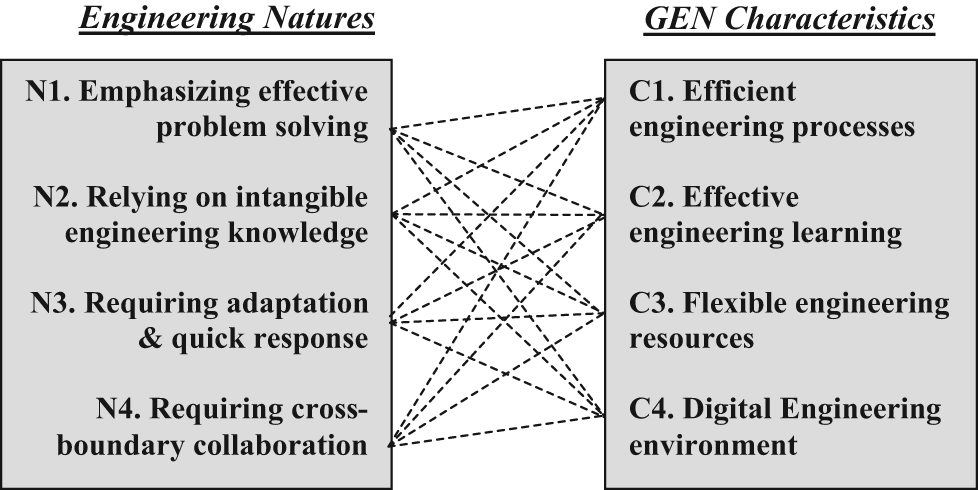
Bridging GEN characteristics and engineering natures.
Example proposition N2–C2: engineering’s reliance on intangible knowledge requires effective learning mechanisms in international engineering operations
Similarly, the case study observations indicated that the intangible nature of engineering (N2) has posed a serious problem in engineering off-shoring or engineering outsourcing decisions. This is largely due to the difficulty in precisely specifying engineering tasks or assessing the required capabilities of external partners at an early stage of a complex engineering project. Such decisions often heavily rely on the judgement of some senior engineer and his or her trust in the partners’ capabilities. In an international engineering network, the decision-maker may know very little about a partner in another country or hardly trust an expert from a different cultural/institutional background. This would suggest research propositions around such experience-based engineering decisions, for example, C4.
Example proposition N2–C4: digital working environments will (or will not) improve the effectiveness of engineering decision-making
In addition to developing research propositions around the possible links illustrated in Figure 2, we could also extend the scope of investigation to address the external business environment matters discussed in the first part of this article. For example, we have observed serious problems in recruiting younger generation engineers in the case companies, especially in their subsidiaries in the developed countries. This may suggest a timely research topic focusing on the inconsistency of engineering capabilities and its impact on manufacturing and many other industrial activities in such regions. It would also be useful to understand the impact of global dispersion on engineering learning or the influence of engineering off-shoring on engineering capability development. Since engineering activities are often deeply embedded in an organisation and its local supply networks, cross-culture or inter-organisation collaborations between partners from different countries would provide a rich area of research in GEN.
We hope that the above examples may inspire some wider discussion on the unique nature of engineering operations and encourage researchers and practitioners to explore its implications in complex global business networks. At the same time, we are cautious of the academic limitation of case base theory building approaches, although they have been considered as appropriate in establishing an overall structure in relatively unexplored fields.1,2,4 The true value of this article lies very likely in providing a stepping stone for further advancement in engineering network studies.
Summary
We have developed a systematic view of the essential characteristics of effective engineering networks through case studies. This will hopefully lay a foundation for our investigations in the future to better understand their linkages to the unique nature of engineering and at the same time provide guidance for managers to deal with challenges in their engineering network operations on a global scale. Evidenced by the case companies’ recent initiatives to develop their global engineering strategies, the above findings can help large multinational companies to enhance the performance of their engineering operations in two main areas. First, an overall understanding of GEN characteristics provides a strategic framework for managers to assess the current situation of their GEN and allow them to develop improvement plans in a systematic manner. Second, discussions on the unique nature of engineering would help managers to understand the linkage between engineering operations and other functional areas and thus contributing to a more effective interface management between engineering and other operation areas.
We, through this article, would also like to suggest a benchmarking framework for less-successful companies, particularly the small- and medium-sized enterprises (SMEs) who have tight resource constraints or a rather local view of their engineering operations. The introduced cases may serve as exemplar practice for them to prioritise their effort for gaining global engineering capabilities or to learn how to effectively work with their global partners, customers, and suppliers.
Footnotes
Declaration of conflicting interests
The authors declare that there is no conflict of interest.
Funding
This study has been supported by the Seventh Framework Programme of the European Union through Marie Curie Actions IRSES Europe-China High Value Engineering Network (EC-HVEN). Grant No. EU FP7 PIRSES-GA-2011-295130.