




Abstract
Network concepts have been widely reported in the current literature on international engineering operations. However, a systematic view of the unique nature of engineering is missing, and its implications for the design and operations of global engineering networks are poorly understood. This article has been written to address the above-mentioned knowledge gaps by understanding how global leading companies effectively cope with the unique nature of engineering in their network operations. A theory-building approach based on the case study methods was adopted considering the contemporary nature of this study and the complexity of the research object. The first part of this article establishes a theoretical foundation for global engineering networks through discussing the intrinsic requirements of engineering operations, understanding the influence of the external business environments, and reviewing the relevant engineering network theories and practices. A preliminary framework was developed to bring together the key issues and suggest focusing areas of investigation in the case studies.
Background and introduction
Network concepts have been studied in international engineering operations as coordination mechanisms,1,2 organisation structures,3,4 or industrial practices.5 –8 This is largely driven by the properties of the network form of organisations in offering flexibility, 9 reliability, 10 cost efficiency, 11 and learning ability,12,13 as well as the demand of engineering operations in the above-mentioned areas for effective problem solving.14 –16 Recent developments in engineering networks are converging towards the concept of global engineering networks (GEN), which provided an integrating framework to explain the contextual environments, required capabilities, and enabling configurations of engineering network operations on a global scale.17 –20 However, the existing literature failed to provide a satisfactory answer on the difference between GEN and network operations with other functional requirements, for example, manufacturing networks13,21,22 or research networks.23 –25 While the primary concern of engineering differs from other operation areas, such as manufacturing and basic research, for example, in the output, required knowledge and tasks,15,26 this has posed a real danger in dealing with engineering network issues without considering the unique nature of engineering.
We would like to argue through this article that the effective management of international engineering operations requires a proper understanding of the intrinsic requirements of engineering, for example, relying on intangible engineering know-how, emphasising effective problem solving, requiring adaptation and cross-boundary collaboration, and so on. Such natures of engineering, combined with challenges from the external business environment, would heavily influence the way to design and operate GEN. The question to guide our investigation has therefore been articulated as: how do global leading companies effectively cope with the unique nature of engineering in their network operations?
To report our investigations around the above-mentioned question in an accessible manner, we will set out to explore the unique nature of engineering as well as introducing the major challenges from the current business environments. This will allow us to gain a preliminary understanding about effective engineering networks from the existing literature and then refine and enrich the understanding through case studies. We will complete this writing by discussing the theoretical and practical implications of the key findings and setting directions for the future research. The above contents were structured into two parts. Part I mainly focuses on identifying the key problems and establishing a theoretical foundation. Part II focuses on introducing the case studies and the key findings.
Unique nature of engineering
It has been believed that the term ‘engineering’ originated from its Latin root ingeniōsus, meaning ingenious or skilled and characterised by cleverness or originality of invention, production, or construction. 27 The term is now considered broadly as an ability of directing the great sources of power in nature for the use and convenience of human,28,29 or specifically as activities of finding solutions within constraints of resources, technologies, and environments.30,31
The long history of engineering has been evidenced by great artefacts like Sumerians’ construction, Egyptian pyramids, Chinese Great Wall, Roman aqueducts, or war machinery. 28 Scientific understandings of engineering methods have been dramatically improved since the Industrial Revolution stimulated by the practical achievements of engineers, such as the invention and development of steam engines or machine tools.29,30 A historic view of engineering suggests that engineering and science actually stemmed from the same root, while engineering emerged from the work of the inventors and entrepreneurs who paid relatively little attention to the theoretical truth of their technological activities.31 –33 Mitcham 34 in his classification of technologies described such differences as follows: ‘The [engineering] invention causes things to come into existence from ideas, makes the world conform to thought; whereas science, by deriving ideas from observation, makes thought conform to existence’ (p. 244). A similar attempt by the Royal Academy of Engineering (RAEng) 35 began with ‘Engineering research is fundamentally different from curiosity driven basic science research because it is driven by direct relevance to applications for wealth creation and quality of life …’ (p. 8). Lipton more recently in the Philosophy of Engineering published by the RAEng 15 suggested a set of interesting contrasts between science and engineering by looking into their differences in output, knowledge and drivers (pp. 7–13). He explained that the philosophy of science is concerned with the ‘light’ question, getting the truth of how the world really works, while the philosophy of engineering is concerned with the ‘fruit’ question, practical use of anticipating and controlling nature. 1 Such differences were also observed in Organisation for Economic Co-operation and Development’s (OECD) categorisation of research and development-related activities where engineering activities would focus more on the applied research and experimental development rather than the basic research. 36
These statements indicate that scientists investigate phenomena, whereas engineers create solutions to problems or improve upon the existing solutions. To explain phenomena, a scientific investigation may wander at will as unforeseen results suggest new paths to follow, and such investigations never end because they always throw up further questions. On the contrary, engineering is directed towards serving the process of design and manufacturing or constructing particular things whose purpose has been clearly defined. Therefore, engineering investigations may end when reaching an adequate solution of a practical problem or be restarted with renewed interest in the product. In this account, engineering has been widely regarded as a process that converts basic science into real societal wealth, that is, the creative art of using the basic rules of science and the properties of raw materials.31,32,34 Figure 1 presents an attempt to summarise the above-mentioned discussions by illustrating the philosophy stand of engineering in contrast with two closely related functional areas, that is, research and manufacturing.
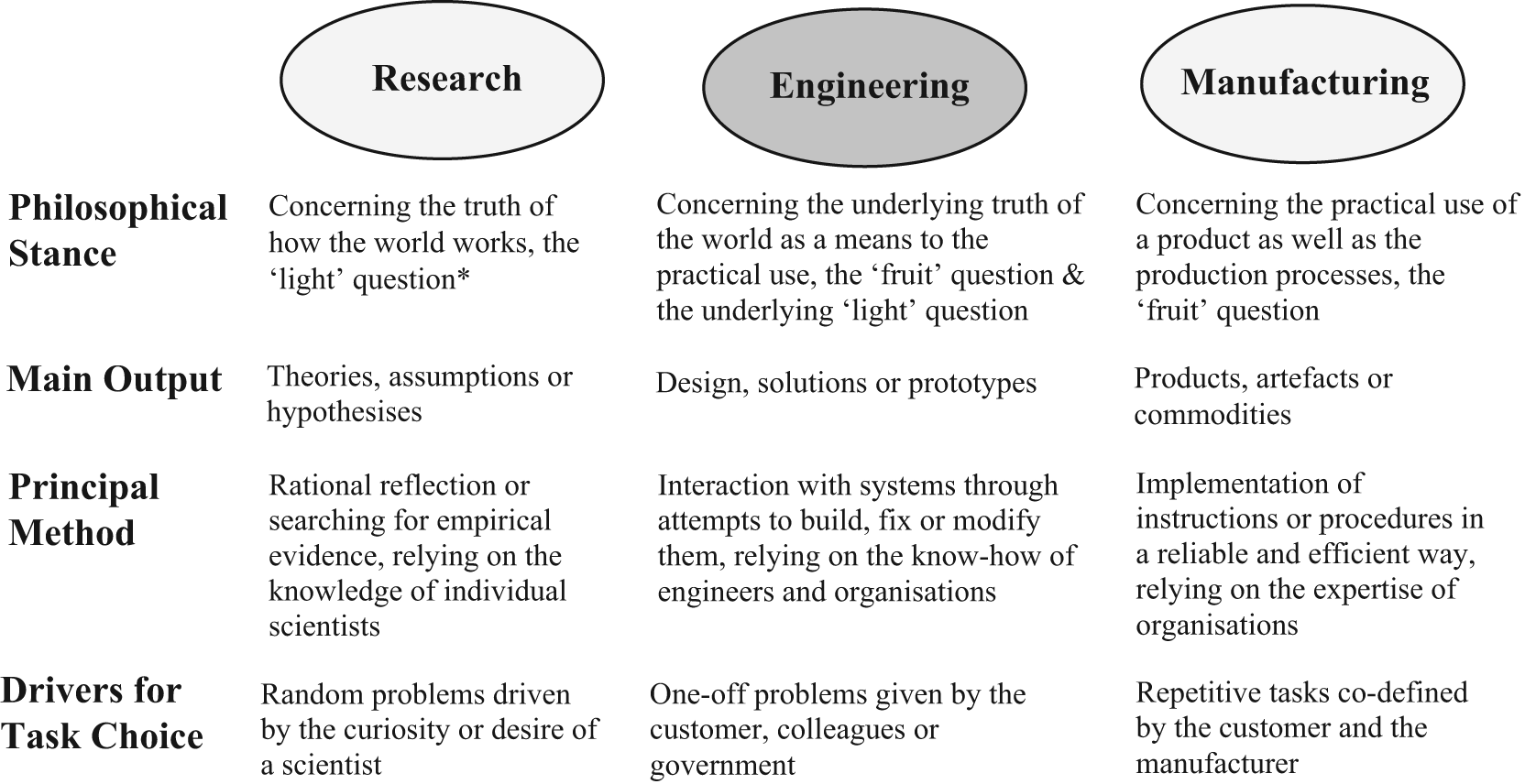
Engineering, research, and manufacturing.
It might be hard to define engineering satisfactorily in a single sentence due to its vast diversity in the current business environments. We have reviewed a number of attempts along time series, ranging from Leonardo Da Vinci’s notebooks about 500 years ago to the latest update on Wikipedia (see Table 1).
Example definitions of engineering.
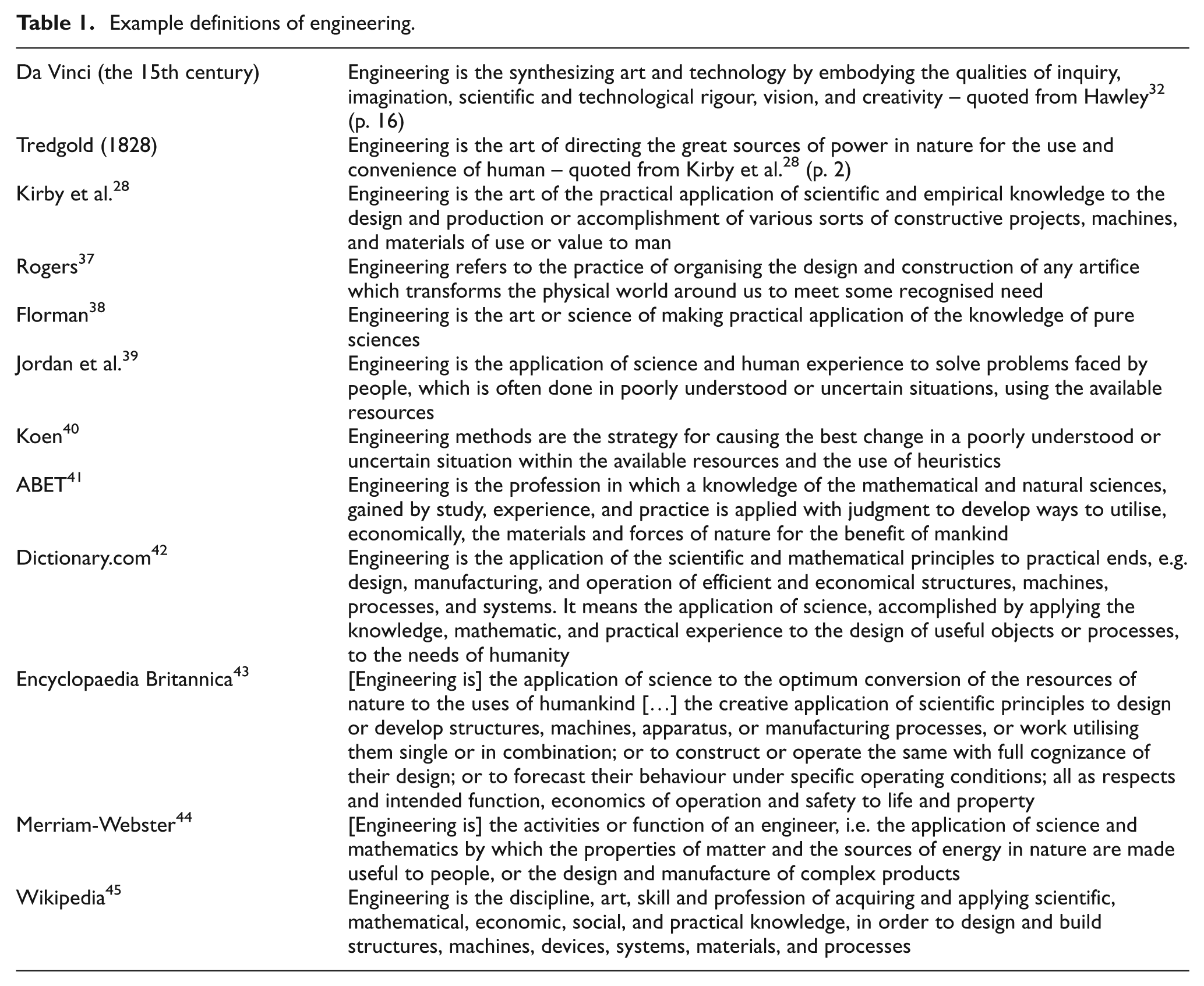
These definitions collectively articulated the unique nature of engineering in the following aspects:
Relying on intangible engineering knowledge. The working approach of engineering involves scientific rigour, and equally importantly, engineering creativity. Engineering know-how, for example, the skills, expertise, and experience of engineers, has always been a critical element in novel engineering solutions. Such knowledge is a matter of having an ability, which unnecessarily exists in the form of beliefs that an engineer can articulate in his/her mind or write down and pass on. For this reason, engineering methods sometimes would have an approximation character to accommodate such intangible engineering knowledge, that is, the Navier–Stokes equations to solve aerodynamic flow over an aircraft or the Miner rule to calculate fatigue damage. 46
Emphasising effective problem solving (i.e. valuing the practical use of engineering outputs). Engineering is concerned mainly with developing and exploiting knowledge for innovative design for the convenience and benefit of human beings. Engineers emphasise the practical value and usefulness of their work and therefore seek for effective problem solving in various situations. This attitude towards practical value was highlighted in the statement of National Academy of Engineering (NAE) 26 as engineering’s ultimate mission to maintain the nation’s economic competitiveness and to improve the quality of life for people around the world.
Requiring adaptation and quick response in uncertain working environments. Major drivers for engineering task choice are external, for example, the customer, colleagues, or governments, rather than solely based on the curiosity of an engineer or driven by an engineering organisation’s discovery desire. 15 At the same time, engineering tasks are often one-off problems. It therefore is difficult to specify such tasks comprehensively and precisely at the contracting stage of a complex engineering project. To solve unpredictable engineering problems with limited resources and limited time available, engineers have to adapt their working methods effectively and respond quickly to the changing contextual environments.
Requiring cross-boundary collaboration. Engineering activities are to identify, understand, and integrate constraints on a design in order to achieve a successful result. An actual engineering task is often complex and unpredictable, and in most cases, the required knowledge is possessed by an organisation (instead of an individual), shared by the members, and stored in records or on databases. To produce a useful solution in an effective manner, engineering processes increasingly depend on inputs from different technological disciplines or multiple organisations. Cross-boundary collaborations are therefore essential for contemporary engineers to acquire knowledge for the specific task of designing new systems for various challenging applications. 35
Driven by the above-mentioned nature, the primary concern of engineering differs from that of manufacturing or basic research in the tasks, outputs, and required knowledge. Main drivers for engineering task choice are often external sources rather than the curiosity of an engineer or the scientific desire of an engineering organisation.15,26 The outputs are often one-off designs or solutions for the benefit or convenience of people, rather than standardised manufacturing outputs, 47 or a scientific enquiry or theory purely to improve our understanding of the world or to fulfil the discovery desire of a researcher. The required knowledge, especially engineering know-how, is often intangible and embedded in different parts of an organisation or a group of organisations.14,17 Such intangible, practical, unpredictable, and embedded natures of engineering will heavily influence the way to manage international engineering operations.
External environments of engineering operations
Engineering management has been generally referred to the use of engineering processes to enable the creation of knowledge, products, services, and markets 48 or specifically defined as the process of envisioning, designing, developing, and supporting new products and services to a set of requirements, within budget, and to a schedule with acceptable levels of risk. 49 Engineering operations have to rely on internal management systems to address the above intrinsic requirements, as well as coping with demands from the external business environments.3,50
The recent trends of globalisation have brought companies opportunities in supporting global markets, accessing global resources, gaining operational efficiency, and developing strategic capabilities.51,52 Engineering operations are more likely to get dispersed because (1) companies increasingly move towards smaller and decentralised units that suit the complex and information-rich natures of engineering; 6 (2) specialised engineering skills and talents often locate or develop locally, and therefore, managers disperse their engineering units to access such dispersed knowledge and skills; 14 (3) improvements in education in developing countries, the expansion of large engineering firms to emerging economies, and the advent of communication technologies have led to the increased trade in all disciplines of engineering activities worldwide. 53 These driving forces have led to major changes in current engineering operations in two main areas. One is the pursuit of efficiency via the specialisation of engineering capabilities: engineering resources have been concentrated to organisational units best suited to the business environments, 9 and the other is the pursuit of effectiveness via the internal resource allocation based on returns: engineering resources are largely directed by business plans and market opportunities.18,54 These changes have increased the interdependency between functionally and geographically dispersed engineering resources, and thus increasing the complexity and uncertainty in international engineering operations. Main trends of developments leading to a changing global landscape of engineering include the following:
Changing role of engineering operations. The traditional engineering sectors have been shifting away from the developed economies to lower cost locations or emerging economies. 53 Many companies in the developed countries are now trying to transform their home operations towards a knowledge-based model, which requires engineering skills and expertise to play a driving role in delivering customer value rather than simply supporting manufacturing activities. 55 Ongoing developments include the emergence of the advanced manufacturing sectors, 56 the increase of engineering services in the traditional manufacturing sectors, 53 and the transformation towards sustainable industrial systems.57,58
Engineering outsourcing and engineering off-shoring. Another main trend of development is that many engineering companies in the developed countries are now trying to focus on higher value-added operations and outsource low-value operations through global supply networks. 59 However, engineering capabilities are often dispersed with different parts of their businesses and deeply embedded in one organisation or a group of organisations. This has made outsourcing decisions especially complex and difficult in engineering operations. For example, after cross-border mergers and acquisitions (M&A), engineering resources are very difficult to be moved from one place to another without losing capabilities. 60 A closely related trend is engineering off-shoring, which becomes a popular solution to deal with shrinking engineering resources in the developed countries or to benefit from increasing engineering capabilities overseas.8,20,53 This allows companies to take advantage of low-cost resources in the short term, but such decisions will have far-reaching and complex consequences in their engineering operations.14,61
Rapidly changing markets, emerging technologies, and new concepts of operations. Rapidly changing markets and emerging technologies bring new business processes and novel concepts of operations, which are radically different from the traditional way of managing engineering activities. To deal with the accelerated pace of technology exploitation and the demand for changes in implementation, managers have to update their engineering decision-making with a more dynamic and proactive approach. 62 This often leads to a change of business model with various initiatives and subsequent changes of engineering operations, especially in restructuring programmes towards more sustainable industrial systems 58 or in continuous improvement programmes towards lean or agile enterprises.49,63
Studies on engineering networks
Network-based organisation structures, coordination mechanisms, and practices have been developed to address the above-mentioned challenges. The relevant studies were reviewed by Zhang et al.17,19 with the following three main categories:
Network coordination mechanisms as the third form of organisation coordination64,65 after the traditional market mechanism and the hierarchy.10,66 –68 Such organisations are characterised by horizontal patterns of exchange, interdependent flows of resources, and reciprocal lines of communication.66,69,70 Network organisations and its members often demonstrate collective learning ability to achieve some strategic objectives through accessing and deploying dispersed resources.65,71,72
Network organisation structures, especially the matrix of the functional approach and the project approach to engineering management.3,73 Matrix organisations can be organised by dimensions of product categories, technology disciplines, geography regions, or management functions. Such structures provide adaptability and flexibility in deploying resources and allow the long-term development of expertise within disciplinary or technological domains.74,75 However, this would require effective coordination and conflict management between different matrix dimensions. 76
Engineering network practices, including the introduction of global product development processes, 77 the development of concurrent/simultaneous engineering,78 –80 and collaborative engineering,81,82 as well as the use of virtual teams83 –86 and centres of excellence. 87 An important development in this area is the product lifecycle management (PLM) as an integrated system for managing product-related activities throughout the lifecycle.88 –90 PLM applications have recently been extended from new product development activities to include a broader scope of collaboration and integration activities, for example, supply chain integration, 91 project management, 92 through-life support and maintenance, 93 or manufacturing knowledge sharing. 94
The concept of GEN has been proposed to integrate the above-mentioned developments of engineering network theories and practices. Zhang et al. 18 revealed the evolutionary trends towards GEN by investigating the major drivers, main barriers, organisational features, and performance preferences. Zhang et al. 17 proposed an overall framework for understanding GEN through investigating their contextual features, critical capabilities to compete in a particular contextual circumstance, and configuration characteristics to deliver the capabilities. Based on the strategic management theories and the operation management literature, especially the contingency theories, 95 the configuration theories, 96 and the theories of organisational or operational capabilities,21,97 the GEN framework suggests a configuration view to systematically describe the organisational features of engineering network operations from the perspectives of network structures, operations processes, governance systems, support infrastructure, and external relationships. 16
Towards a theoretical foundation for effective engineering networks
Table 2 summarises the key issues addressed by the engineering network studies and indicates their linkage to the unique nature of engineering. Above all, companies are expected to manage their engineering operations on a global scale, including the organisation of global engineering resources and the coordination of global engineering activities. This addresses the need of engineering operations for effective collaborations across disciplinary, geographic, and organisational boundaries and helps companies to cope with challenges in engineering off-shoring and outsourcing decisions in a strategic manner. At the same time, companies have to effectively use both their explicit engineering knowledge and their tacit engineering know-how and expertise. Improving knowledge sharing between globally distributed engineering teams is the key task. This reflects the heavy reliance of engineering on the skills and experience of engineers and helps to maintain the core engineering capabilities of a company. In addition, companies should successfully exploit their networked engineering capabilities via appropriate network coordination mechanisms and network structures. This reflects engineering’s emphasis on effective problem solving and allows companies to build adaptable network capabilities in rapidly changing business environments. Last but not the least, companies should support their international engineering operations through integrated information and communication technologies (ICT), for example, integrated ICT tools, processes, and infrastructure. This facilitates knowledge sharing and effective collaboration and provides potential directions for developing novel business models and innovative concepts of operations.
Key issues addressed by the engineering network studies.
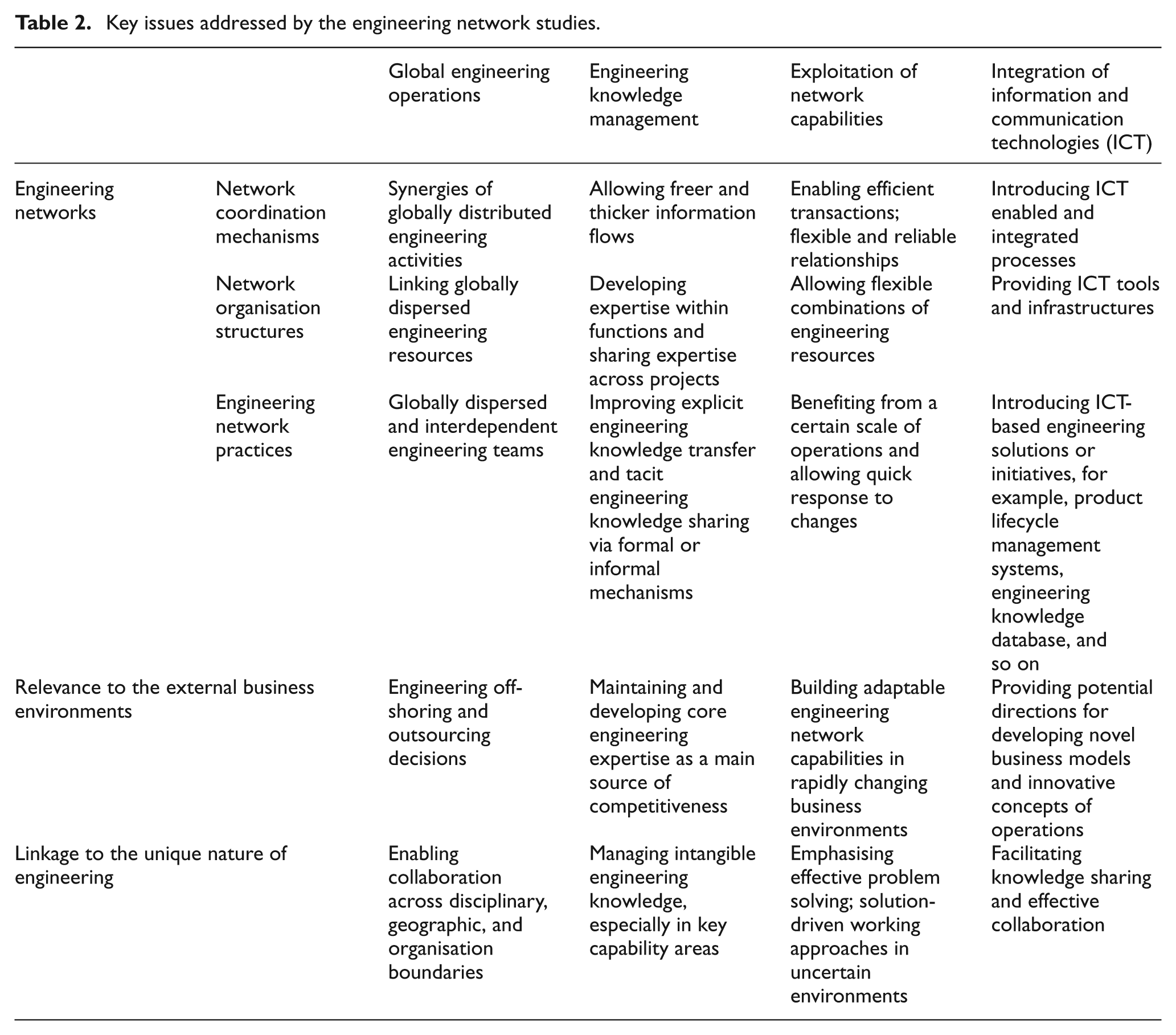
Figure 2 summarises the above-mentioned review and illustrates the rationale of theoretical development through case studies, which will be introduced in detail in the second part of this writing. In brief, the unique nature of engineering, together with the requirements from the external business environments, will influence the way of managing international engineering operations. Network concepts have been developed to address the challenges in current engineering operations. The recent developments have been integrated into the concept of GEN. Our investigations were focused on understanding the essential elements of effective engineering networks, which would characterise GEN from network operations with other functional requirements.
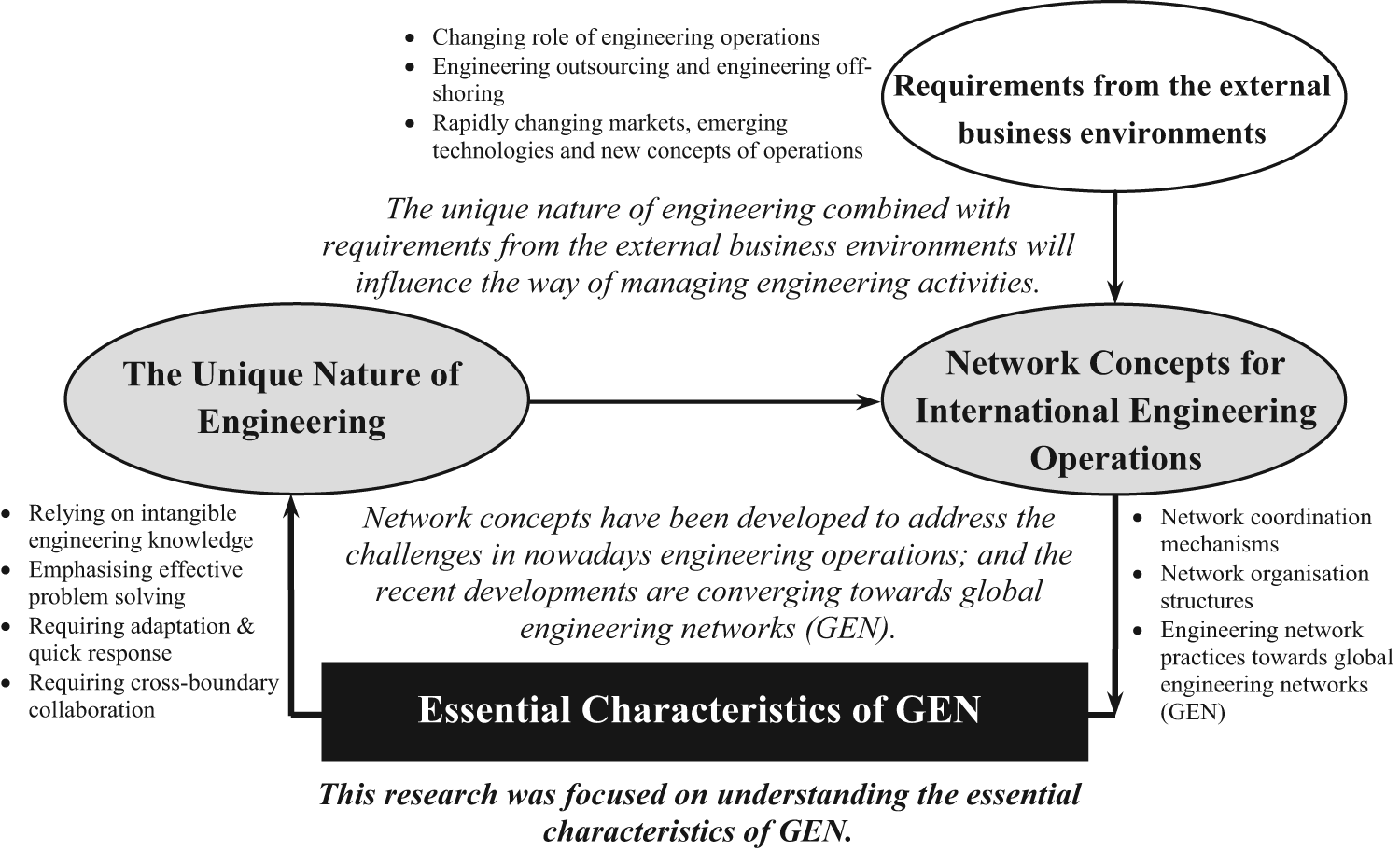
Towards a theoretical foundation for effective engineering networks.
Footnotes
Declaration of conflicting interests
The authors declare that there is no conflict of interest.
Funding
This study has been supported by the Seventh Framework Programme of the European Union through Marie Curie Actions IRSES Europe-China High Value Engineering Network (EC-HVEN). Grant No. EU FP7 PIRSES-GA-2011-295130.