




Abstract
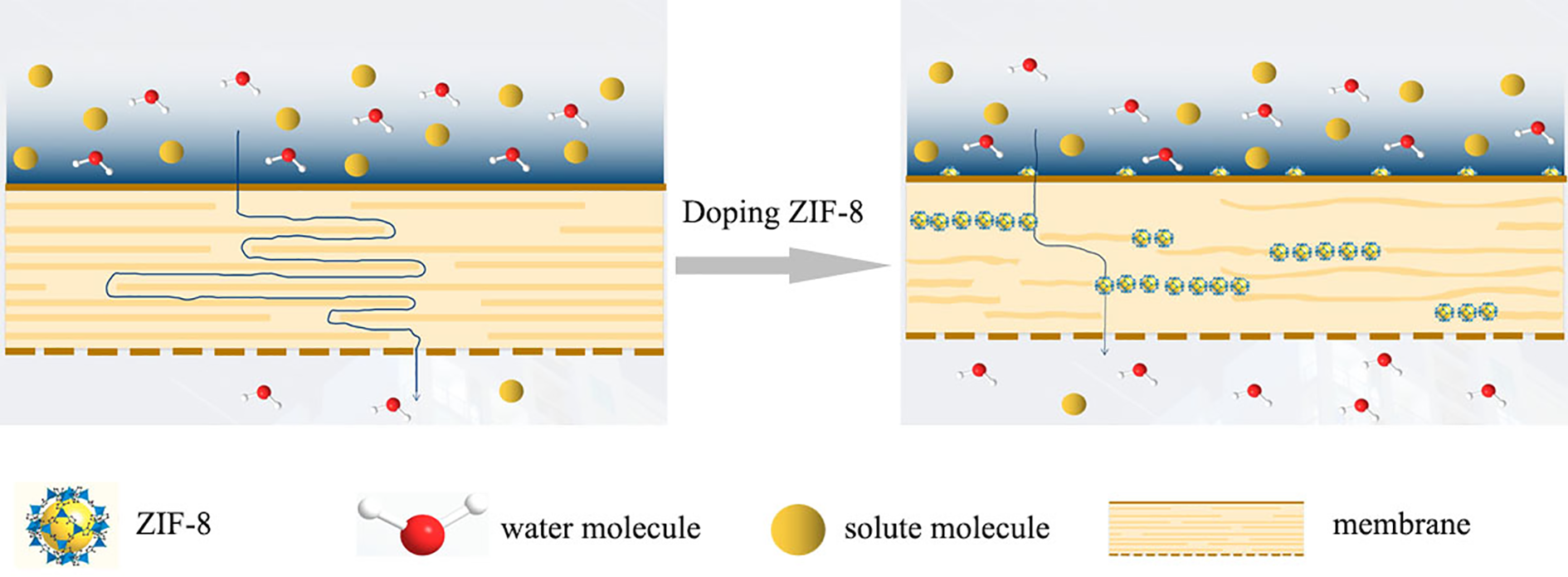
Zeolitic imidazolate framework (ZIF-8) in three particle sizes (40, 70 and 100 nm) was prepared through both solvothermal and hydrothermal methods and employed to decorate polyvinylidene fluoride (PVDF). The finger-like macro-voids, sponge-like poly-porous morphology and surface roughness of prepared membranes were characterized by SEM and AFM microscopy. The FTIR spectrum and XPS analysis bear out the chemical component. ZIF-8 has the characteristics of higher porosity and appropriate pore size, which is a condition for improving the permeability and pollution resistance of the modified membrane. Results indicated that different ZIF-8s have different enhancement effects on PVDF MMM. 100 nm ZIF-8 membrane possessed pure water flux (PWF) of 350 L m−2h−1, which was 10 times more than the bare membrane (30 L m−2h−1), and OVA flux recovery ration (FRR%) is 98%. 40 nm ZIF-8 membrane owned BSA FRR% of 98.4%. The 70 nm ZIF-8 showed the best mechanical properties. The dynamic contact angles of UP-Z70 ranged from 104.5° to 62.5° within 180 s. Furthermore, pore size distribution, molecular weight cut-off (MWCO) and porosity were also researched to evaluate the MMM. The dislodge of Reactive Black KN-B, Reactive Red 3BS and Reactive Brilliant Blue KN-R dyes by MMM were studied under different dye concentrations and transmembrane pressures. The membrane can provide selective separation methods for dyes and Reactive Brilliant Blue KN-R up to 99%. Overall, the permeability, hydrophilicy, anti-fouling performance and wastewater treatment of modified membranes were regulated by the ZIF-8 in a steerable blending reaction modification process.
Keywords
Get full access to this article
View all access options for this article.
References
Supplementary Material
Please find the following supplemental material available below.
For Open Access articles published under a Creative Commons License, all supplemental material carries the same license as the article it is associated with.
For non-Open Access articles published, all supplemental material carries a non-exclusive license, and permission requests for re-use of supplemental material or any part of supplemental material shall be sent directly to the copyright owner as specified in the copyright notice associated with the article.
