



Abstract
Public professionals such as medical doctors, teachers, and police officers are key actors in delivering public health, education, and security. However, the service settings in which professionals operate and the cases they face are affected by societal turbulence. The sudden spread of pandemics, geopolitical upheaval, or new digital technologies affect the societal context, organizational resources, and clients’ demands. In this paper, we contribute to debates on professionalism in public service provision amid societal turbulence by studying how frontline professionals navigate their work in such volatile circumstances. Based on a narrative literature review, we develop a typology of public professional ‘navigation tactics’. We show how frontline professionals deal with pressures at the point where turbulence in the societal context meets their service setting, and at the point where the service setting intersects with their cases. Our search generates four tactics; professionals might (1) persevere, by maintaining their work as ‘business-as-usual’, (2) pragmatize, by finding innovative solutions to changing cases, (3) propagate, by fueling reforms in wider environments, or (4) pioneer, by steering environments and proactively readjusting approaches to cases. At the end of the paper, we draw conclusions, address implications, and discuss future research avenues.
Keywords
It is a chilly but sunny morning in March 2021 as youth support worker Sam ventures out for a ‘walk and talk’ session with one of her clients. The tranquil weather belies the troubling upheavals that rock the world Sam inhabits. The global pandemic has gripped the world for over a year, and successive lockdowns have placed immense strain on the young people Sam aims to support. Their mental health has deteriorated at an alarming pace, but COVID-19 precautions prevent Sam from interacting with clients in the ways she once did. Sam strives to adapt to the continuous changes, and she seeks creative solutions to continue her work. However, in doing so, she faces significant challenges, including more complex demands and growing staff shortages.
Introduction
Day in day out, public professionals like Sam dedicate themselves to generating societal benefits by delivering services at ‘the frontline’. To do so, Sam must provide support to individual youngsters but also consider practical limitations and respond to external shocks. Sam’s case – a real story from the Netherlands – illustrates how frontline professional work is layered: it revolves around treating a case, while dealing with a service setting, full of organizational pressures and cases, in wider societal contexts, full of demands and expectations (cf. Noordegraaf, 2015). Through their work, public professionals help individuals, affect the well-being of communities and support the stability of societies (Pare Toe and Samuelsen, 2021; Hendrikx et al., 2022). As such, they can be seen as ‘the most influential, contemporary crafters of institutions’ (cf. Scott, 2008: 223).
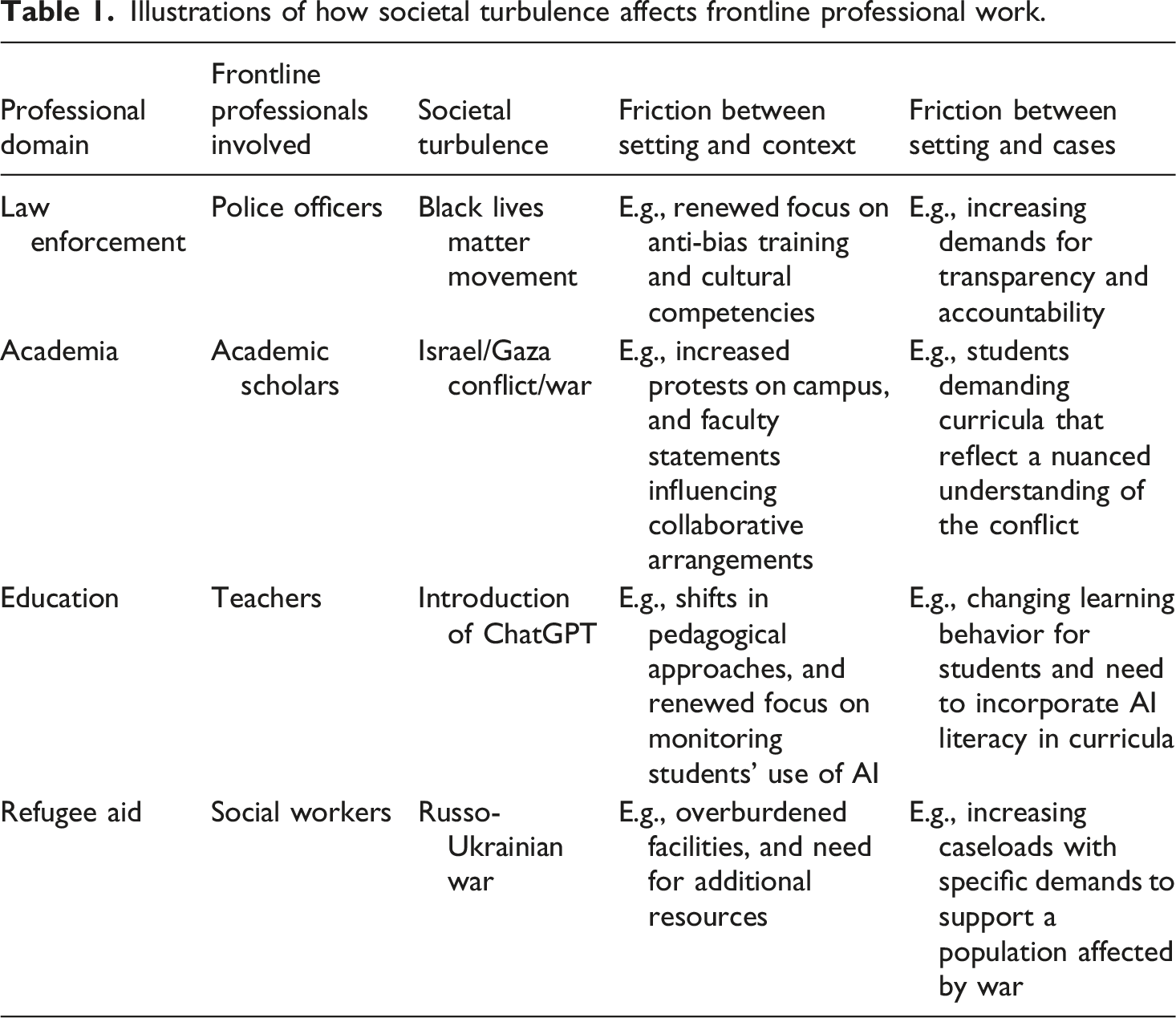
Although professionals’ roles in tackling pressing issues sound appealing, their work is affected by increasing levels of societal turbulence (e.g., Ansell et al., 2021). Societal turbulence is defined as ‘a situation where cascading and interrelated social, natural, economic, and political events, demands, and developments unexpectedly create unpredictable temporal dynamics that jeopardize the preservation of core functions, goals, and values of society […]’ (Ansell et al., 2024: 19). To illustrate, due to the outbreak of COVID-19 and accompanying lockdown measures (i.e., shock in societal context), professionals like Sam were confronted with growing staff shortages and restrictions on their practices (i.e., affected service setting), while a larger group of pupils needed more diverse types of support (i.e., affected cases). Accordingly, societal turbulence results in highly challenging situations for frontline professionals.
In turbulent times, public professionals are key actors in steering public sector actions (Gofen and Lotta, 2021; Lund and Andersen, 2023; Paanakker et al., 2024), individually and collectively. Reactions to critical incidents and shifting circumstances are determined by the ‘aggregated behavior of individual actors at the front lines’ (Henderson, 2014: 261). To deal with the constraints imposed by societal turbulence, public professionals rely on ‘adaptive acts’ or – what we coin – navigation tactics. These enable frontline professionals to balance pressures and demands, maneuver in dynamic landscapes, and tackle multiple cases (in line with e.g., Noordegraaf, 2015). In terms of the academic turbulence discourse, these tactics enable professionals to use ‘problem-solving strategies without eroding public trust’ (Ansell et al., 2024: 24).
When it comes to understanding what frontline professionals do, how they act, and what tactics they employ in turbulent times, considerable knowledge gaps remain. As for professional work in general, scholarly literature has mainly focused on the use of discretion when treating a single case (e.g., Lipsky, 1980) and on the way public professionals cope with pressures and demands from individual clients (e.g., Tummers et al., 2015). There is still much to discover about the layered treatment of changing cases in volatile service settings.
Furthermore, literature on how to deal with societal turbulence mostly focuses on macro-level mechanisms such as multi-level governance (Caponio et al., forthcoming), hybridity of governance (Nõmmik et al., forthcoming), and societal intelligence (Russo et al., forthcoming) instead of mundane, day-to-day behavior. Although insights on the role of public managers (Lund and Andersen, 2023), politicians, and administrative officials (Ansell et al., 2021) have been developed, acts of public professionals in turbulent times remain understudied.
In this study, we work towards a classification of professional navigation amid societal turbulence based on a narrative review of the literature. We develop a typology of tactics employed by public professionals by cataloguing current understandings of what they do in turbulent times. We pose the following research question: What is known about how frontline professionals navigate cases in volatile service settings, affected by societal turbulence? To answer this question, we first explore key components of our question, i.e., frontline professional work, societal turbulence, and professional navigation. Next, we clarify our research approach and methodology. Thereafter, we present a typology of professional navigation tactics. At the end, we address implications and conclusions, including an agenda for future research.
Defining frontline professional work, societal turbulence and navigation
Frontline professionals as key actors in tackling societal issues
Public professionals, such as teachers, medical doctors, and police officers, operate at the frontlines of service delivery, where they engage in day-to-day interactions with clients (cf. Chang and Brewer, 2023; Hupe, 2022). In doing so, they actively translate public policies into concrete decisions and thereby shape the lives of citizens (May and Winter, 2009). Traditionally, service providers active in schools, hospitals, or police stations have been labelled as ‘street level bureaucrats’ (cf. Lipsky, 1980), whose work is embedded in political-bureaucratic frameworks characterized by formal rules, policy instructions and organizational hierarchies. Recent scholarship emphasizes that street-level work also entails ‘performing tasks based on the basis of knowledge and experience’, highlighting that frontline workers are ‘trained professionals’ rather than mere bureaucratic rule-followers (Harrits, 2019: 193). More specifically, service providers continuously balance bureaucratic requirements with case- and context-sensitive decision-making, based on ethical and normative considerations (cf. Hupe and Hill, 2007). In doing so, they not only act as agents of the state but also as citizen agents, engaging with clients’ experiences and circumstances (Eteläpelto et al., 2013; Giddens, 1984; Maynard-Moody and Musheno, 2000). As such, street-level work is much more than political-bureaucratic and organizational logics; it represents occupational logics that extend policies and organizations (also Noordegraaf, 2015).
To capture both the political-bureaucratic, organizational and the normative, knowledge-based dimensions of frontline professional work, in this paper, we speak of frontline professionals. We are aware they might operate within bureaucratic systems, to a higher or lesser extent, and we are also aware of their differences. They might differ, for example, in terms of occupational field, socialization, and specialization. But, in order to treat cases, they have been trained to perform their tasks (cf. Hupe et al., 2015). Their work is characterized by discretionary decision-making and real-time judgment in often complex situations, based on technical expertise, professional norms, and occupational identities. More than complying with or resisting policy rules and organizational routines (in line with a street-level bureaucracy lens), a public professionalism lens allows us to examine how frontline professionals actively diagnose, reason, and intervene (cf. Harrits, 2019), moving between client demands and their expert base. Frontline professionals are active interpreters of and responders to institutional and societal demands shaping their work. This is even more important when circumstances become challenging and/or disruptive (cf. Noordegraaf, 2016). We have to study how technical expertise and normative capabilities are leveraged to positively cope, and how professional acts are (re)shaped. Occupational logics can support this, but they can also work against ‘easy’ adaptation.
Frontline professionals treat cases in service settings, in societal contexts
As was shown in Sam’s case, frontline professionals’ work revolves around single clients’ demands, organizational dynamics, and broader, societal circumstances and trends. We see professional work as the handling of cases in well-organized service settings, in wider surroundings, with the aim of serving public goals (cf. Noordegraaf and Steijn, 2013). As argued by Noordegraaf (2015), professional work unfolds in a layered way.
First, frontline professionals treat individual clients and cases, working on specific situations, interactions, issues, or concerns. Teachers educate students, nurses provide patient care, and police officers arrest suspects. Treating such cases or handling accompanying dossiers involves personal and societal dimensions, as clients or matters are intertwined with the environment in which they exist. A student may, for example, have a home situation that affects his/her cognitive development, and the condition of a heart patient may be complicated by limited access to healthcare (Noordegraaf, 2015).
Second, frontline professionals work in organized service settings as they deal with multiple cases in structured ways. Each year, medical doctors treat thousands of patients and judges work on dozens or hundreds of verdicts. In handling these, professionals need to find a balance between service quality and efficiency, for example through prioritizing clients or cases (Noordegraaf, 2015; Steenhuisen and Van Eeten, 2013). This is because service settings have limitations in, for example, financial resources, time, workload and capacity. Professionals use their expertise to weigh and judge competing demands, but they must also be mindful of political calls for e.g., cost-effectiveness (cf. Noordegraaf, 2017). To illustrate, when prescribing medications or scheduling surgeries, medical professionals take the needs of clients into account, and they must consider a hospital’s budget constraints.
Third, frontline professional work takes place in wider societal contexts. To illustrate, police officers face significant scrutiny and pressure due to (social) media coverage and public opinion, affecting their ability to carry out duties effectively and efficiently. Moreover, social workers are required to meet stringent standards and quality benchmarks set by regulatory agencies, fueled by calls for accountability. Such pressures emerge in surroundings in which goals may be unachievable, and expectations cannot be fully satisfied (Zacka, 2017). Citizens’ expectations may be high, and politicians might fuel political ambitions to ‘solve problems’, which even more burdens day-to-day practices.
Turbulence causes friction between cases, settings, and contexts
Frontline professional work has always been subject to change due to societal, technological, economic, and demographical shifts (e.g., Noordegraaf, 2015). However, increasing and enduring societal turbulence in wider contexts imposes further challenges as it makes public service provision difficult to regulate, standardize, and routinize (based on Ansell et al., 2021; Eriksson et al., 2021). Characterized by ‘surprising, inconsistent, unpredictable, and uncertain events’ (Ansell et al., 2020: 1; Torfing et al., forthcoming: 16), societal turbulence arises in diverse forms, ranging from political unrest and economic shocks to social turmoil and climate chaos (Cristofoli et al., 2023). Such turbulence jeopardizes core values (such as equality and inclusivity), goals (like reducing health imparities and maintaining social order), and societal functions (including provision of medical services and emergency response).
Although sound service provision by means of frontline professional work is crucial, this core function is jeopardized in turbulent times. Societal turbulence directly and indirectly increases friction at the intersections of the societal context and service settings, and of service settings and cases. While the three layers of professional work can be analytically distinguished, in practice, societal turbulence renders their boundaries less clear and stable. In addition, it activates occupational reflexes (linked to expertise, norms, identities, and the like), which might add to the friction.
When it comes to the intersection of societal context and service settings, societal turbulence affects work surroundings of frontline professionals, as it leads to ‘factional conflict, staff turnover, conflicting rules, [and] internal reform […]’ (Ansell et al., 2024: 17). This requires a reconfiguration of resources and capabilities (Ostrom et al., 2021). Frontline professionals rely on tacit knowledge, specialized skills, professional standards, routines, protocols, and codes when providing services (Noordegraaf, 2020). However, as societal turbulence leads to ‘rapidly changing environments where the past may not be as predictive for the future’ (Ostrom et al., 2021: 337), skills, routines and protocols run the risk of becoming less relevant, if not outdated, affecting professionals’ legitimacy. In the long run, this weakens public service provision, emphasizing the need for adaptive procedures and dynamic approaches in turbulent times (Lotta et al., 2021; Raeymaeckers and Van Puyvelde, 2021).
When it comes to the intersection of service settings and cases, Ostrom et al. (2021: 343) argue that ‘[p]atterns of customer demand related to various forms of services […] appear to be increasing in their unpredictability’. Due to societal turbulence, client’s needs diversify, and the accumulation of pressing issues leads to ‘exacerbated tensions’ in public service provision (Ansell et al., 2024: 18). Hence, in the cases that are to be treated by professionals, ‘demand volatility’ arises (cf. Ostrom et al., 2021: 344). For example, during COVID-19, youth support workers were confronted with more requests for support, as numbers of applications increased. They also faced more diverse demands as their target group broadened, including e.g., youngsters enrolled in special needs education. Some of the youngsters were helped by casual conversations, whereas others needed alternative types of support.
Illustrations of how societal turbulence affects frontline professional work.
Professional navigation amid societal turbulence
Frontline professionals are essential in public sector responses to societal turbulence. When there are shocks or surprises in realizing goals and policies, it is professionals’ judgements and practices that are relied on to secure ‘sound’ service provision (e.g., Lund and Andersen, 2023). However, anticipating future events is complex in turbulent times, and public dissatisfaction due to ‘confused or purposeless’ (cf. Ansell et al., 2024: 24) responses puts pressure on frontline professionals.
To continue service provision, be ‘dynamically resilient’ (Lund and Andersen, 2023: 125) and get a grip on challenging situations, professional navigation is pivotal (e.g., Paanakker et al., 2024). Frontline professionals need to act quickly while lacking a complete understanding of turbulent issues. They might miss grip on the changes in their work, organization and wider context. To illustrate, when lecturers face Israel/Gaza protests, they report the loaded nature of the issue at hand and the complexity of swift response, as they lack both the expertise and capability (e.g., legal, ethical and historical skills or knowledge) to react appropriately.
Navigation is required when cases and service settings change due to societal turbulence. To tackle societal issues amid such turbulence, frontline professionals need to develop ‘specialized skills and knowledge about how to manage complex […] systems’ (Ansell et al., 2024: 46). We see navigation tactics as ‘adaptive acts’ (cf. Tummers et al., 2015: 1103) that public service professionals perform amid uncertain and often stressful situations. Navigation is much more than ‘behavioral coping’, which refers to the ‘behavioral efforts frontline workers employ when interacting with clients’ (cf. Tummers et al., 2015: 1100), as navigation faces service settings and the societal context as well.
Navigation serves to deal with organizational difficulties and conflicting considerations amid volatility and turbulence. As turbulence might lead to e.g., changes in workforce and clashing protocols (Ansell et al., 2024), public professionals might have to find new ways to make choices between cases (cf. Laufs and Waseem, 2020). Moreover, professionals’ ability to serve societal purposes might have to be (re)shaped, as purposive action will be less fixed. Empirically, they might also disengage to keep things the same.
In Figure 1, we visualize how societal turbulence in wider contexts (i.e., third layer of professional work) exerts an influence on professional work by affecting service settings in which public professionals operate (i.e., second layer of professional work) and the (individual) cases they face (i.e., first layer of professional work). We show how professional navigation entails maneuvering in the areas where contexts, settings and cases intersect, where professionals must balance pressures and demands, where they must tackle multiple cases, whilst case treatment might be risky or sensitive. Professional navigation in and around public service provision.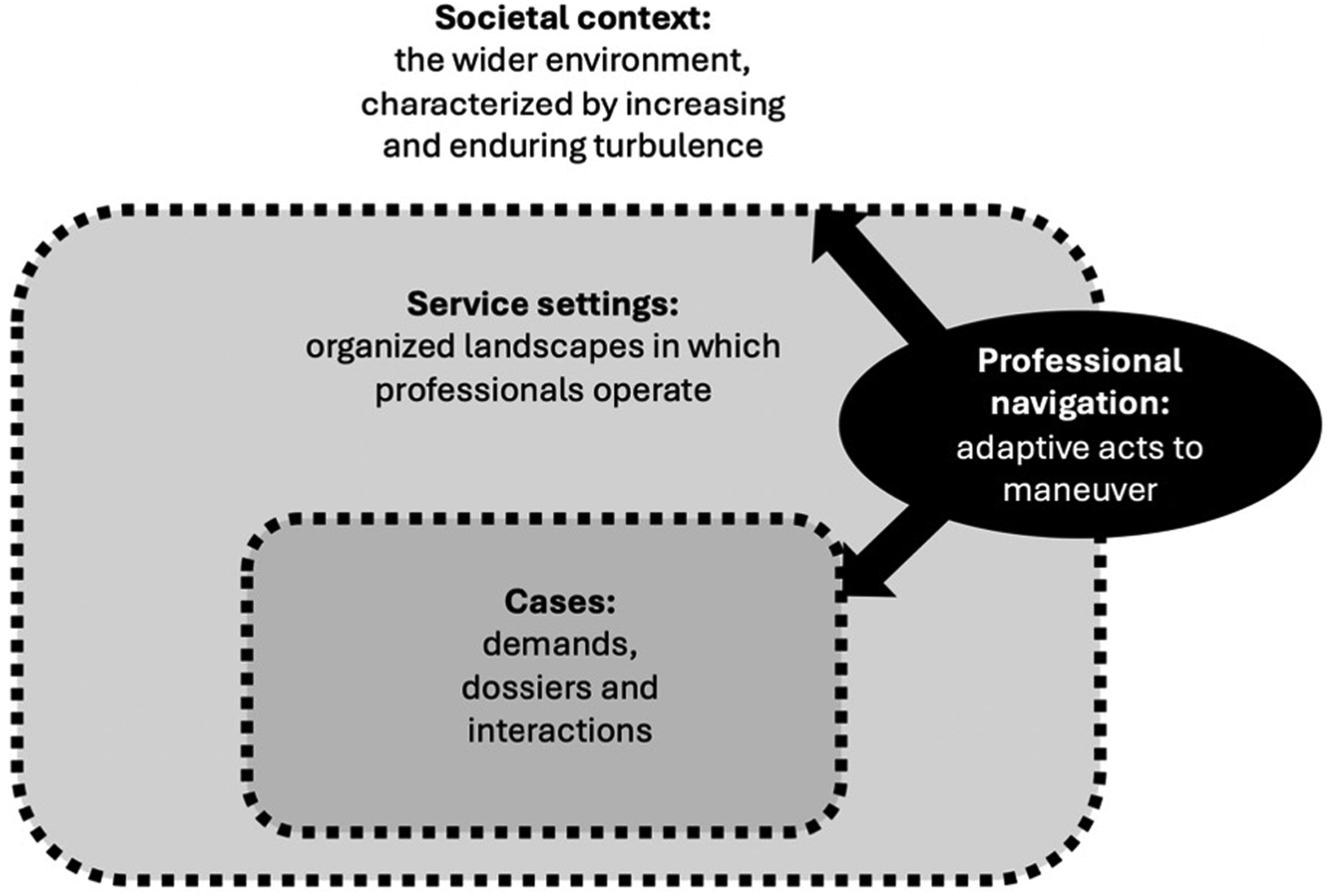
Importantly, we conceptualize professional navigation as an agentic process (cf. Eteläpelto et al., 2013; Giddens, 1984) in which professionals actively engage with, interpret, and respond to multiple and often overlapping demands. Rather than viewing professionals as either strict rule followers or as actors fully constrained by societal or organizational structures, we understand navigation as situated action through which professionals continuously and actively respond to turbulent conditions, backed by occupational capabilities. Amid turbulence, navigation becomes the essential mechanism through which frontline professionals bridge the gap between disruptive societal shifts, challenging service settings, and changing service demands. In the next section, we present our research design we used to classify professional ‘navigation tactics’.
Research design
This paper adopts a narrative review of the literature to develop a conceptual understanding of professional navigation tactics amid societal turbulence. The narrative review enabled us to track academic debates and identify key themes (Bryman, 2016; Chaney, 2021; Ferrari, 2015). Our goal was not to include all eligible literature available. Rather, our aim was to conduct a wider exploration, gain insight into core publications, and integrate strands of scholarship to identify conceptual patterns. A narrative review proved to be a suitable method to do so (Sukhera, 2022). In contrast to scoping reviews that primarily aim to map key concepts and bodies of literature (e.g., Munn et al., 2018; Pham et al., 2014) and integrative reviews that focus on systematically synthesizing relatively mature research streams (e.g., Cronin and George, 2023), narrative reviews allow for conceptual integration and theory development, which aligns with the present study’s aim to develop a typology of navigation tactics.
The literature reviewed was selected based on its relevance to frontline professional work in turbulent times, with specific attention to studies on frontline work amid dynamic and pressing circumstances. We employed a two-step process. In the first step, we tried to identify integrative works that provide an extensive insight into the interrelated concepts. To do so, we used different (combinations of) keywords, such as [turbulence] plus [case treatment], [professional tactics], [professional acts], [professional work], or [public service delivery]. Multiple electronic databases were consulted, such as Google Scholar, Scopus and Web of Science.
Our search yielded insights on how frontline professionals approach their work amid challenging conditions (e.g., Noordegraaf, 2015; Zacka, 2017), often with emphasis on ‘coping’ (e.g., Jaspers and Steen, 2019; Lipsky, 1980; Steenhuisen and Van Eeten, 2013; Tummers et al., 2015). For example, a key publication by Tummers et al. (2015) illustrates how professionals ‘move towards, away from, or against’ clients to reduce, tolerate, or master the pressures associated with public service provision. Furthermore, Jaspers and Steen (2019) shed light on seven coping strategies – such as ‘building firewalls’ and ‘escalation’ – to overcome tensions between values in service provision, such as efficiency and inclusion. These studies, however, lack a specific focus on societal turbulence. A few publications are exceptions. To illustrate, Hupe and Van der Krogt (2013) demonstrate how professionals engage in ‘coping, networking, or activism’ in times of uncertainty. The authors distinguish between pressures regarding accountability and scarcity of resources but also provide a wider perspective by considering societal challenges. We used such publications to work towards a first typology of the adaptive acts – ‘tactics’ – that frontline professionals employ in turbulent times.
In the second step, we manually selected key publications from specific journals known for their contributions to our field. Journals such as Public Policy & Administration (PP&A), Public Administration, Administration & Society, and Journal of Professions and Organization (JPO) were targeted. We also consulted journals that pay attention to specific groups of frontline professionals, such as Educational Review and Clinical Nursing Research, to ensure the inclusion of relevant research. One can think of work on professional acts in the medical sector during the COVID-19 pandemic (e.g., López-Cabarcos et al., 2020; Lotta et al., 2021; Perryman et al., 2024). These studies, in which manifestations of turbulence are linked to specific professional fields, further ground our typology of navigation tactics.
Navigation tactics
Four professional navigation tactics.
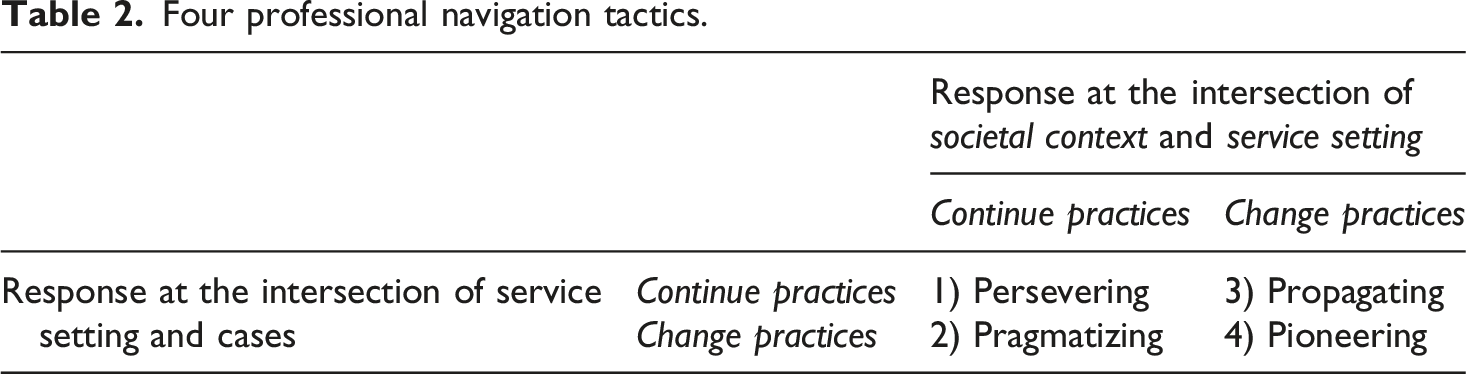
We started the paper by describing how COVID-19 affects youth support worker Sam’s practices. If Sam would continue using familiar methods, her approach would be in line with the persevering tactic. Alternatively, maintaining case-related efforts while creatively adapting treatment strategies would align with pragmatizing. Propagating would manifest itself through advocating for systemic reforms. Pioneering would involve a combination of innovative treatment of clients with efforts to change the service setting, e.g., by proposing new protocols for client engagement. In the remainder of this paper, we discuss each navigation tactic in detail. We describe their antecedents, accompanying acts, and implications and impact.
Persevering
Increasing complexity of their course of action due to societal turbulence can make frontline professionals hesitant to change the way they work (e.g., Sokal et al., 2020; Perryman et al., 2024). This leads to professionals persevering in their day-to-day practices, prioritizing stability and continuity over innovation. They prefer to maintain systems rather than disrupt them.
Antecedents of persevering
Persevering may be caused by several factors. First, persevering may stem from reluctance to change and risk aversion. For instance, during COVID-19, teachers were required to shift to online education, yet some perceived this transition as an unnecessary burden or as potentially exacerbating existing inequalities in youngsters’ access to education (Herawati et al., 2022; Sokal et al., 2020). Such concerns led to more negative evaluations of remote teaching and reduced willingness to adopt new practices, reinforcing a tendency to rely on established routines (Sokal et al., 2020). Reluctancy to change and risk aversion are in line with the ‘threat rigidity approach’: individuals and organizations rely on familiar professional tools, methods, and ways of working to tackle threats instead of seeking innovative approaches (e.g., Randma-Liiv and Kickert, 2017). Second, societal turbulence reduces role clarity. Organizations adapt their strategic priorities, team structures and working procedures. In turn, this increases role ambiguity, which leads to hampered professional performance (e.g., Verlinden et al., 2022), affecting professionals’ ability to seek new ways of working.
Response at intersection of service setting and cases
Persevering involves rule following and adherence to established guidelines. To illustrate, during COVID-19, Brazilian public health professionals had to apply strict criteria for intensive care services due to resource shortages, leading to ‘extreme rationalization of policy implementation’ (Lotta et al., 2021: 14). Persevering is also characterized by a certain level of indifference, which leads to public professionals extracting the relevant information when listening to their clients’ stories, remaining (relatively) unaffected and trying to treat as swiftly as possible (e.g., Zacka, 2017). By maintaining rigidity and impersonality, they prioritize efficiency and seek to push through pressures.
Response at intersection of societal context and service setting
When persevering, professionals do not engage in attempts to transform service environments. Frontline professionals maintain the status quo, continue ‘business-as-usual’ and prioritize safety (Perryman et al., 2024). High levels of uncertainty and continuous surprises may even lead to a certain level of ‘paralysis’, as illustrated by a study on pedagogues amid the COVID-19 pandemic. Due to higher or ‘unmanageable’ workload, professionals involved experienced emotional exhaustion and emphasized how they faced heightened risks of burnout (Koontalay et al., 2021; Perryman et al., 2024). Public service providers may cope temporarily by suppressing their emotions (Näring et al., 2006) and by detaching themselves from their work (Tummers et al., 2015). Accordingly, such responses leave no room changing service environments.
Implications and impact
Persevering facilitates continuity and stability, safeguarding operational effectiveness amid turbulent conditions, at least for the time being. However, persevering can also disrupt service processes, as ‘[e]mployees stuck in inadequate, unjust, or burdensome […] structures […] may act in ways that slow or even counteract the aims of their respective agencies’ (Moore 2017: 11). To illustrate, persevering professionals may increase risks of errors (Rosted et al., 2021), or decrease service availability (Papastavrou et al., 2014), reducing public service access. Consequently, perseverance may misalign services with needs, jeopardizing societal benefits and eroding public trust, ultimately harming service legitimacy.
Pragmatizing
When pragmatizing, frontline professionals opt for a tactic to simplify or innovate the way they treat multiple cases, while approaching their service environment pragmatically. In other words, they try to reduce complexity and work on renewed service provision approaches; they do not participate in efforts to change wider surroundings (Dumez and Minvielle, 2024; Lotta et al., 2021).
Antecedents of pragmatizing
The lack of information regarding continuous surprises fuels the pragmatizing tactic. To continue service provision processes amid turbulence, frontline professionals must respond quickly while having a limited understanding of what is happening around them (Ormerod, 2021). To do so, professionals make minor adjustments to the way they fulfil their tasks ‘to empower them and reduce their feelings of uncertainty’ (Petrou and Jongerling, 2022: 382). They gather knowledge on-site and continuously evolve the protocols to respond to shocks through subtle modifications (e.g., Dumez and Minvielle, 2024).
Response at intersection of service setting and cases
Pragmatizing involves eliminating unnecessary processes, clarifying goals, and finding straightforward solutions through ‘incremental strategies’ that prioritize feasibility over ideals (Ansell and Boin, 2019; Cristofoli et al., 2023). To illustrate, during COVID-19, Brazilian primary health professionals adapted home visits by using WhatsApp or speaking through gates (Lotta et al., 2021). This enabled them to see their patients while maintaining physical distance. Similarly, with the rise of ChatGPT and the ‘technological renaissance’ (Yu, 2024: 11) educational practices, teachers adapted their perspective on ‘talent cultivation’ by guiding students in exploring themselves through digital applications. They now support learning by recommending materials and replacing homework with in-class tests, modernizing education amid technological change (He, 2023).
Response at intersection of societal context and service setting
When pragmatizing, frontline professionals do not engage in attempts to reform the surrounding in which they operate. In the Brazilian illustration described above, changing demands as well as operational restrictions severely challenged professionals’ attempts to influence procedures (Lotta et al., 2021). Growing service demands (e.g., in homeless centers, due to increased socioeconomic fragility), inadequate working conditions (e.g., outdated prison facilities) and a lack of (legal) recognition of the role of professionals during the pandemic contributed to radical uncertainty, putting professionals ‘on standby’ (Lotta et al., 2021: 20).
Implications and impact
\Pragmatizing contributes to feasible, realistic solutions (Ansell and Boin, 2019; Cristofoli et al., 2023) and incremental acts help prevent work overload and burnout (Petrou and Jongerling, 2022), sustaining short-term operational effectiveness. However, avoiding efforts to change service surroundings can limit the generation of societal benefits. In the case of the Brazilian healthcare professionals, structural problems in public service provision increased as professional practices were constrained, and service providers had little role in policy renewal (Lotta et al., 2021). In the long run, therefore, pragmatizing may hinder both effectiveness and legitimacy.
Propagating
A third tactic frontline professionals employ amid societal turbulence is propagating, where they speak out, fuel change, and act as advocates (Chiu et al., 2023). Propagating professionals take assertive action or initiate movements to reform service environments; they do not engage in innovative approaches to change the way they treat multiple cases (Borg and Kraft, 2023; Raeymaeckers and Van Puyvelde, 2021; Sachs, 2000).
Antecedents of propagating
Propagating professionals ‘[understand] themselves in relation to the society’ (Sachs, 2000: 93) and adopt a ‘fundamentally political’ approach to promote social change, often aimed at benefiting vulnerable groups (Costa et al., 2021). Personal interests (Rogers et al., 2020) and professional empathy (Bason, 2010; Costa and Coimbra, 2024) help professionals identify ‘good’ or ‘bad’ practices, stimulating them to develop renewing and fitting approaches. To illustrate, medical professionals feel urged to voice their concerns about the impact of climate change on public health: ‘Despite decades of raising awareness and gentle persuasion, there has been insufficient action from governments and corporations. […] There is no time for slow incrementalism. […] Many have turned to activism’ (Clery et al., 2022: 553). Taken together, both personal and professional characteristics may lead to employing a propagating tactic.
Response at intersection of service setting and cases
Activist attempts often come at the expense of direct interactions with clients and cases. As trying to exert an influence on e.g., institutional policies is time-consuming, professionals face constraints in the possibility to meet the expectations of clients (e.g., Lana et al., 2024). Their focus is on reforming the wider environment instead of reorganizing day-to-day interactions and practices. For instance, an activist physician may be highly vocal in pleading for systemic healthcare reform, but in doing so, he/she may gradually reduce patient interactions.
Response at intersection of societal context and service setting
Propagating professionals stand up for their ambitions and root for collective action to reshape the environment in which they operate. During COVID-19, several instances of professionals propagating emerged. First, lecturers and scholars encouraged nurses to spread pro-vaccine messages (e.g., Borg and Kraft, 2023) to combat anti-vaccine movements and mistruths. Second, social workers and nonprofit members of an advocacy coalition in Belgium stood up and argued for new measures to address the harmful effects of the pandemic on vulnerable groups. They did so by informing journalists, advocating via social media, and engaging in dialogues with government officials.
Implications and impact
Propagating professionals aim to shape change (e.g., Costa and Coimbra, 2024; Eke et al., 2021), but such activist activities can lead to stress, anxiety, and emotional exhaustion. Propagating can be ‘mentally challenging and emotionally draining as it usually pits the activist against management, peers, and one’s own personal values’ (Lana et al., 2024: 4). This may hinder short-term service effectiveness, although long-term systemic gains can enhance the public sector’s capacity to deliver fit-for-purpose services. The legitimacy of this tactic is double-edged: propagating can enhance the moral authority of professionals as advocates for societal welfare (e.g, Buck-McFadyen and MacDonnell, 2017) while also risking controversy and resistance due to tensions between public service duties or institutional policies and activist endeavors (Lana et al., 2024).
Pioneering
Frontline professionals embracing a pioneering tactic are proactive in seeking out new ideas and creative approaches amid societal turbulence. They innovate and experiment to push boundaries and explore novel solutions (e.g., Li et al., 2021; Ross et al., 2021; Rowe and Hogarth, 2005) in the approach to multiple cases and service environments in which they operate.
Antecedents of pioneering
Societal turbulence induces the engagement of frontline professionals with their work and public interests (e.g., Gómez-Salgado et al., 2021; López-Cabarcos et al., 2020). Enthusiasm and dedication encourage professionals to adapt their approaches to contribute to organizational outcomes. To illustrate, the COVID-19 pandemic fostered healthcare professionals’ ‘vocational nature and [the wish] to develop [their work] with more energy and willingness’ (López-Cabarcos et al., 2020: 3). As e.g., medical doctors and nurses feel their profession can contribute to societal benefits in challenging circumstances, this ‘can stimulate employees to make more efforts to carry out their job […], engaging them even more than in ‘normal’ situations,’ (López-Cabarcos et al., 2020: 3).
Response at intersection of service setting and cases
Pioneering professionals try to improve public service provision by innovating products and processes (e.g., Jordan, 2017). They act as caregivers (Zacka, 2017) by listening to their clients’ needs, feeling sympathy towards them and focusing on addressing needs more than rendering services in the most efficient manner. To illustrate, during COVID-19, clinical pharmacists established digital platforms through which clients could share pictures or pose medication-related questions, fostering accessible consultation (Li et al., 2021). Furthermore, academic scholars from Kenya, Mexico, and the United Kingdom facilitated one-on-one meetings and small group gatherings to connect with students during lock downs (Loyola-Hernández et al., 2022). The professionals became more ‘hands-on’ involved and shared personal experiences to help students process traumatic experiences.
Response at intersection of societal context and service setting
Pioneering professionals do not only engage in attempts to innovate their approach in treating multiple cases; they do so to exert influence on their surroundings as well. To illustrate, the abovementioned pharmacists formulated prevention strategies and worked on guidelines to enable effective and responsive service provision during the pandemic (Li et al., 2021). Furthermore, the academic scholars contributed to new policies to make a change in educational practices and create better conditions for both students and staff (Loyola-Hernández et al., 2022).
Implications and impact
By pioneering, professionals adapt service provision and professional working methods to tackle complex issues, which enhances effectiveness in the short- and long-term. To illustrate, the one-on-one meetings with students facilitated by academic professionals from Kenya, Mexico, and the United Kingdom, fostered strong student-teacher relationships and personalized support, which contributed to meaningful learning environments (Loyola-Hernández et al., 2022). As professionals involved find creative solutions themselves, their sense of preparedness for unexpected challenges improves (Samuelson et al., 2024), further fostering possibilities to tackle pressing societal issues amid challenging conditions. Pioneering can elevate the legitimacy of professionals, as they act as proactive problem-solvers, but the tactic can also be seen as disruptive or too risky as professionals challenge established occupational norms.
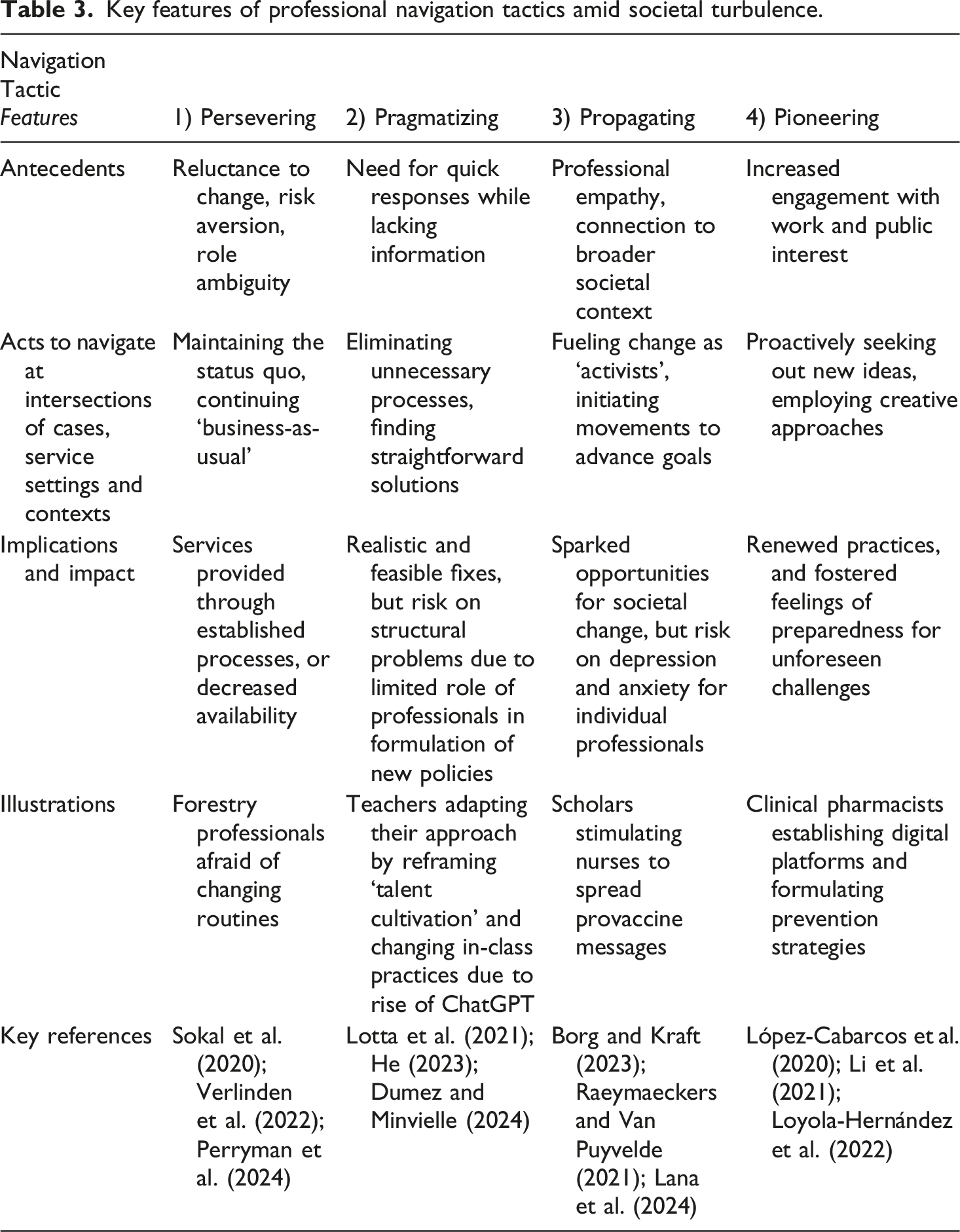
Summary of navigation tactics
Key features of professional navigation tactics amid societal turbulence.
Discussion
In this paper, we explored how public frontline professionals tackle pressing issues amid societal turbulence. Such turbulence poses significant challenges for professionals as it affects the cases they face and the settings in which they operate. As key actors in generating societal benefits, however, such professionals – working in political-bureaucratic and organizational as well as occupational systems – remain essential. To provide insight into the ways in which professionals navigate amid such complex conditions, we posed the following research question: What is known about how frontline professionals navigate cases in volatile service settings, affected by societal turbulence?
By conducting a narrative review and exploring academic debates, we conceptualized professional navigation and presented four distinct tactics: persevering, pragmatizing, propagating, and pioneering. These tactics vary in the ways in which frontline professionals respond at the intersection of societal context and service settings, and the intersection between service setting and cases. In both instances, professionals continue their ways of working or change them. The typology, supported by real-life illustrations from various professional domains, provides a comprehensive overview to understand the diverse, day-to-day ways in which frontline professionals act amid societal turbulence.
These day-to-day practices have implications for the effectiveness and legitimacy of professional work. Some tactics provide effectiveness in the short run but might jeopardize operations in the long run. Accordingly, trade-offs emerge, where professionals maneuver between immediate responses and long-term sustainability, balancing the needs of today with approaches required for the future. To illustrate, when pragmatizing, professionals respond facilitate sound support to their clients, but do not engage in efforts to initiate and stimulate systemic reforms to protect service provision for future (turbulent) events. Other tactics may contribute to sound service provision in the long-term (such as propagating) but may simultaneously compromise the immediate fulfillment of clients’ needs in the here and now, affecting the legitimacy of service provision.
Effectiveness and legitimacy are deemed crucial to respond to societal turbulence in adequate or robust ways. As Ansell et al. (2024: 34) argue, ‘[p]ublic governors are successful in delivering robust governance [in response to societal turbulence] in so far as they manage to make authoritative decisions that are both effective in terms of achieving specific outcomes and legitimate in the eyes of those who are executing the decisions and those affected by those decisions’. Professionals must thus remain sensitive to the effectiveness and legitimacy of their responses, for instance by paying attention to the lived experiences of those they serve. This enables them to adjust their approaches where necessary, so that services remain responsive and appropriate.
Two key academic contributions emerge from our paper. First, the typology of professional navigation tactics bridges the gap between responses to societal turbulence and professional work by highlighting frontline actors’ day-to-day responses to render public services when ‘the going gets tough’. While prior studies focus on macro-level mechanisms (Caponio et al., forthcoming; Nõmmik et al., forthcoming, Russo et al., forthcoming) and roles of managers and politicians (Ansell et al., 2021; Lund and Andersen, 2023), insights into everyday actions of public professionals amid societal turbulence remain fragmented. We offer a renewed perspective by focusing on the action repertoires of frontline actors, perceived as the ‘face of the state’ (Zacka, 2017: 109). The navigation tactics identified provide a framework to systematically analyze professional acts under turbulent conditions, linking micro-level practices to broader societal dynamics. Second, we provide a realistic view of professional work by acknowledging various challenges such as competing priorities, limited resources, and shifting stakeholder demands (e.g., Paanakker et al., 2024) and by differentiating between multiple navigation tactics. Moving beyond idealized notions of seamless performance, we emphasize the complexities professionals face and offer a more nuanced understanding of professional work. This allows the academic debate to move beyond rosy painted pictures and ground discussions in the messy realities of professional working environments.
Beyond advancing academic knowledge, this work holds practical value. For frontline professionals, insight into navigation tactics contributes to their awareness of the various approaches available which enables them to assess their acts in challenging conditions. More specifically, each navigation tactic offers insights into patterns of action in day-to-day practices: persevering supports continuity but may risk lagging behind rapid changes; pragmatizing enables flexible adaptation in relation to clients’ demands but tensions in organizational standards or service procedures may not be addressed; propagating enables influencing broader routines and arrangements but may leave clients’ changing demands unanswered; and pioneering combines case-level and service setting-level innovation but requires high competence and may entail risks. By making these compromises explicit, our typology not only increases awareness of available approaches but also supports professionals in weighing potential consequences of their acts and in deciding how they respond to specific situations. In different phases of turbulence, frontline professionals may shift their acts wherever necessary, as a certain level of ‘fluidity’ enables them to balance stability and change, both deemed crucial to generate societal benefits amid societal turbulence (Ten Dam and Waardenburg, 2020; Kuiper et al., forthcoming). Accordingly, the typology of navigation tactics informs reflexive and situated judgment under turbulent conditions. For public managers as well as professional associations, the typology of tactics equips them to foster navigation capabilities within teams and to create environments in which professionals feel supported to adjust approaches. These insights can be integrated into training and development programs.
While our typology offers a lens to study professional acts amid societal turbulence, we are aware of its limitations. First, we acknowledge that frontline professionals do not operate in isolation. They rely on collective efforts involving (e.g.,) governmental institutions, civil society organizations, managers, and volunteers to generate societal benefits (e.g., Vanleene et al., 2020), especially in turbulent times (Trondal et al., 2022; Scognamiglio et al., 2023). Therefore, public professionals cannot tackle societal issues alone and need support and cooperation of various stakeholders to render services amid turbulent conditions. Second, our typology builds on empirical instances in which various types of frontline professionals are involved, including nurses, medical doctors, pharmacists, pedagogues, social workers, teachers and academic scholars. While this breadth allows us to develop a more general conceptualization of professional navigation tactics, it comes at the cost of in-depth exploration of specific professional groups. Third, we recognize frontline professional work is no linear process that can be managed logically (cf. Paanakker et al., 2024), especially amid turbulence. Although we distinguish four navigation tactics, professionals might fluidly shift between them based on evolving demands or changing constraints. The adaptive nature of professional navigation became evident during COVID-19 in the Netherlands, where healthcare workers initially persevered to provide care amid uncertainty but later propagated for long COVID compensation. Exposed to the virus early on, many fell ill, and some suffered lasting effects. Over time, professionals transitioned to activistic attempts, successfully securing government recognition and financial support (Van Gaalen and Van Mersbergen, 2024; Rijksoverheid, n.d.).
The boundaries between navigation tactics as well as between professionals and key stakeholders are not stable and fixed. This underlines the need for further research. Future studies could explore how professional navigation evolves over time, and when, how and why professionals transition between tactics. Although we know that professionals may employ different tactics under varying circumstances, we do not know what conditions lead to the employment of which tactic and how levels of societal turbulence affect professionals’ acts. Moreover, empirical testing is needed to provide in situ understandings of professional navigation. Contextual factors, including cultural, historical, and geographical aspects, influence the outcomes of responses to societal turbulence (e.g., Pollitt, 2013; Virtanen, 2013). Public professionals’ acts can ‘never get rid of the broader fabric’ in which they are situated or take place (Ongaro et al., 2021: 6). By investigating the tactics professionals employ in different contexts, ranging from e.g., large-scale countries in the Global North to small islands in the Global South, we can gain insight into which professional navigation tactics are helpful, when, how and why.
Conclusion
Our study provides a comprehensive overview of how frontline professionals navigate their work amid societal turbulence, presenting four distinct tactics that comprise a range of acts amid ever-changing circumstances and continuous surprises. By shedding light on professional work in turbulent times, the study enriches our understanding of professional practices amid dynamic and pressing circumstances, including ongoing maneuvering, balancing and readjusting responses.
Our work has broader implications; we need to rethink how we view frontline professional acts, especially considering the increasing interweaving of professional work and societal dynamics. Frontline professionals’ actions are affected by broader social, political, and economic trends and events and, in turn, they exert an influence on their surroundings. Therefore, professional work must be understood as part of larger, dynamic organizational and societal systems. This calls for broader perspectives on professionalism, which acknowledge societal implications of public service provision and recognize the need for adaptability.
Ultimately, to support frontline professionals navigating in these complex environments, both research and practice must foster a deeper understanding of how to balance challenging conditions and competing demands in turbulent times. This calls for collaborative efforts among researchers, practitioners, and policymakers to provide guidance and empower public professionals. By doing so, we can better equip such service providers to emerge as ‘robust’ change agents, capable of fostering societal benefits amid continuous shocks and surprises. We can reinforce the critical role of public professionals like Sam, whose practices and acts were illustrated at the outset of this study. They can effectively meet the needs of the communities they serve, especially when turbulence reigns.
Footnotes
Acknowledgments
The authors thank the editors of this special issue and the anonymous reviewers for their highly valuable feedback.

Ethical considerations
Not applicable. No respondents were consulted for this study, as no empirical data was collected for this study. The study did not involve human participants, human data or human tissue.
Funding
The authors disclosed receipt of the following financial support for the research, authorship, and/or publication of this article: This study received financial support from the European Commission (HORIZON-CL2-2021-DEMOCRACY-0), grant agreement number: 101061272. The funders had no role in study design, data collection and analysis, or preparation of the manuscript.
Declaration of conflicting interests
The authors declared no potential conflicts of interest with respect to the research, authorship, and/or publication of this article.
Data Availability Statement
Not applicable. We draw upon earlier academic studies.