




Abstract
Based on an extensive literature review, this article explores the impact of strategic renewal in the public sector on the roles and skills of public professionals. Findings show that successive reforms of New Public Management and New Public Governance have resulted in hybrid role requirements that go beyond the often-debated dichotomy between professionalism and management. Based on our review, we could distinguish four sets of skills for professionals, linking traditional professional expertise to competences for networking and co-creation. Implications for future research are discussed.
Introduction
Strategic renewal in the public sector is here understood as public management reform (Pollitt and Bouckaert, 2017). It is said to move from Traditional Public Administration (TPA) to models like New Public Management (NPM) and New Public Governance (NPG) over time (Osborne 2006). Such strategic renewal is however largely dependent on the engagement of the professionals that constitute a huge part of its labour force – from teachers to social workers, from clinicians to security officials, and from urban planners to firefighters (Hupe et al., 2016; May and Winter 2007; O’Toole Jr and Meier, 2015). They are the ones who actually ‘make’ public policies through their crucial role in applying strategic renewal in day-to-day activities (Burau, 2016; Hupe and Hill, 2016; Lipsky, [1980] 2010; Zacka, 2017). Studying the engagement of public professionals in public management reforms is therefore highly relevant (Brandsen and Honingh, 2013; Jilke and Tummers, 2018).
Despite their key role, it is not a given that professionals feel involved in the strategic renewal of public services. They have their own professional values that are not necessarily in line with reform-related role expectations and organizational change (Evetts, 2011; Newman, 2013). Professionals have a degree of autonomy in their work to deal with these changes, which does not guarantee commitment to strategic renewal as designed in public administration models (Hupe and Hill, 2016; Jaspers and Steen, 2019; Lipsky, [1980] 2010; Tummers and Beckers, 2014). The relationship between professionals and strategic renewal of (public) organizations thus has been shown as tense (Bévort and Suddaby, 2016; Osborne and Brown, 2011; Waring and Currie, 2009). Professionals have been seen as protectors and defenders of traditional rights, to preserve their privileges and/or to counterbalance management ambitions for standardization and control (Ackroyd et al., 2007; Evetts, 2009). But they are also regarded potential ‘change agents’ (Leicht et al., 2009; Noordegraaf, 2011), or ‘boundary spanners’ (Van Meerkerk and Edelenbos, 2018; Williams, 2002) not just looking for self-interest, or being victims of management, but meaningful actors in realizing public sector ambitions and managing relationships across institutional borders effectively.
Given the contrasting views on the role of professionals as both change agents and under pressure (Burau, 2016; Evetts, 2011; Muzio et al., 2013), it is not yet clear whether and how professionals are willing and able to engage in strategic renewal of public organizations. This is particularly relevant for more recent (NPG) reforms for public-private networks and co-creation (Bryson et al., 2014; Torfing, 2019). These type of reforms are often considered a ‘magic recipe’ for public sector improvement, but so far empirical research lags behind (Dudau et al., 2019; Voorberg et al., 2015). Hence, in an effort to map literature’s key insights about the roles professionals play in strategic reform, we are interested in (1) what are the strategic requirements framing professional roles in public management reform models, (2) how are professionals motivated for – and cope with – strategic renewal, and (3) which skills are deemed necessary to do so? To answer these questions, we conducted an extensive review of the academic literature, bringing together insights from two bodies of literature regarding ‘strategic renewal’ on the one hand and ‘professionalism’ on the other. We will further demarcate these two central concepts in the method section.
The relevance of our review is twofold. First, an explicit focus on the role of public professionals still only takes up a small portion of the literature on public management reform (Aschhoff and Vogel, 2019; Brandsen and Honingh, 2013; Hendrikx and Van Gestel, 2017). Our literature review uncovers hybrid professional roles that not only evolve from professional and managerial demands, but from the accumulation of professional role requirements, related to three subsequent public management models (TPA, NPM and NPG). Second, our literature review shares present-day insights on motivations of professionals for strategic renewal and diverse ways of coping. We contribute to both literature and practice by listing four sets of skills that may bridge traditional and newer role demands derived from diverse public management models for public professionals. In this vein, public professionals may operate as boundary spanner (e.g. Williams, 2002), connecting their organization to its environment.
In the following, we start by explaining our research strategy for the literature review. Then, the analysis is directed to which professional roles are conceptualized, related to alternative public management models. Next, we discuss literature about professionals’ motivations for – and coping with – strategic reforms, and debate related skills. We conclude with suggestions to address theoretical and empirical lacunas.
Research strategy
To investigate state-of-art insights into professionals’ engagement in processes of the strategic renewal of public services, we conducted an extensive literature review (Denyer and Tranfield, 2009; Fink, 2019). We sought for literature in two fields – i.e. public sector reform as ‘strategic renewal’ and ‘professionalism’ – aiming to find leads where both fields overlap. We ultimately reviewed 166 articles published between 2000 and 2020, scrutinizing each of them for our three questions on professionals’ roles, motivations and skills in processes of strategic renewal. Below, we will explain our search strategy, selection process and analysis more in-depth.
The literature search began with the identification of key words as search terms, identified and discussed in the research team, and by asking feedback from an international panel. As the strength of this literature review lies in the combination of two important themes in the literature – i.e. strategic renewal and professionalism – we demarcated these central concepts as follows.
For ‘strategic renewal’, we were most keen to learn about the consequences of three public management models (TPA, NPM and NPG (Osborne, 2006; Pollitt and Bouckaert, 2017) for the changing demands of public sector professionals. We recognize the term ‘strategic renewal’ is a broader concept, also used in private sector literature, for example related to strategic planning approaches, Mintzberg or the cultural school (Ferlie and Ongaro, 2015). In our study however, we limit the concept to public management reform models. Acknowledging that public organizations often have their roots in Traditional Public Administration (TPA) and New Public Management (NPM), with the NPG-model being relatively recent, we decided to capture insights on professionalism in all three alternative models (Brandsen and Honingh, 2013; Hendrikx and Van Gestel, 2017), allowing for a more complete, and historically informed overview.
With regard to the concept ‘professionalism’, three key principles are widely acknowledged in literature: specialized knowledge, a service ideal, and professional autonomy (Evetts, 2009; Freidson, 1970; Freidson, 2001; Noordegraaf, 2007; Wilensky, 1964). Some studies focus on so called ‘classic professionalism’, related to professions such as medical doctors or lawyers; others include ‘semi-professional’ occupations, such as teachers and nurses (Noordegraaf, 2007). We incorporated both types of occupations, as equally relevant for public services. In our focus on public professionals, we point to the traditional public servant at a ministry or in local government as well as to professionals in for example government agencies, public corporations, and non-profit organizations, as long as they are affected by, or involved in developing and implementing strategic public management.
Search strategy.
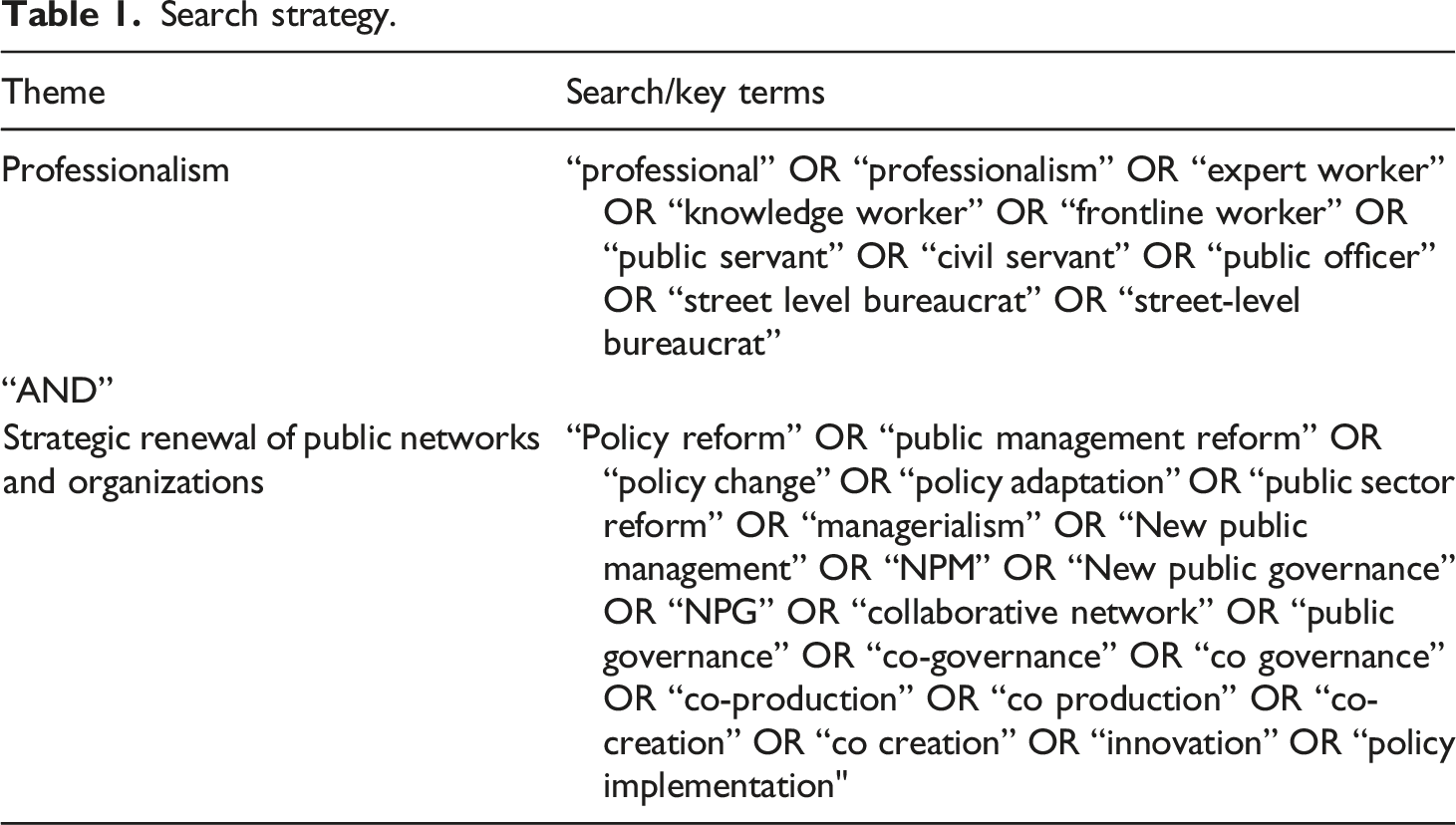
Since we combined two bodies of literature that are usually only loosely connected, we decided to carry out three separate searches to construct an innovative literature corpus of international publications and to prevent ‘blind spots’: a general search, a ranked journal specific search and a thematic journal specific search, all focusing on publications from 2000 until January 2020. For all three ways of searching we used the key words (Table 1).
For our general search, we started with a Web of Science search for which we included journals from a broad variety of categories to capture as many public services as possible, concerning journals on health policy services; urban studies; sociology; law; social issues, political science. To reduce the thousands of hits, while preserving the explorative character of our search including its generic search terms, we decided to use three cut-off points based on citations to be able to concentrate on articles with most impact. For 2000–2014 we exported all bibliographical entries with 90 or more citations. Acknowledging that it takes a few years before articles build up a citation score, for 2015–2017 we exported entries with seven or more citations and for 2018–2019 we exported all entries, leading to a total of 936 articles.
Selected ISI ranked journals (Public Administration, 2018; with Impact Factor >2).
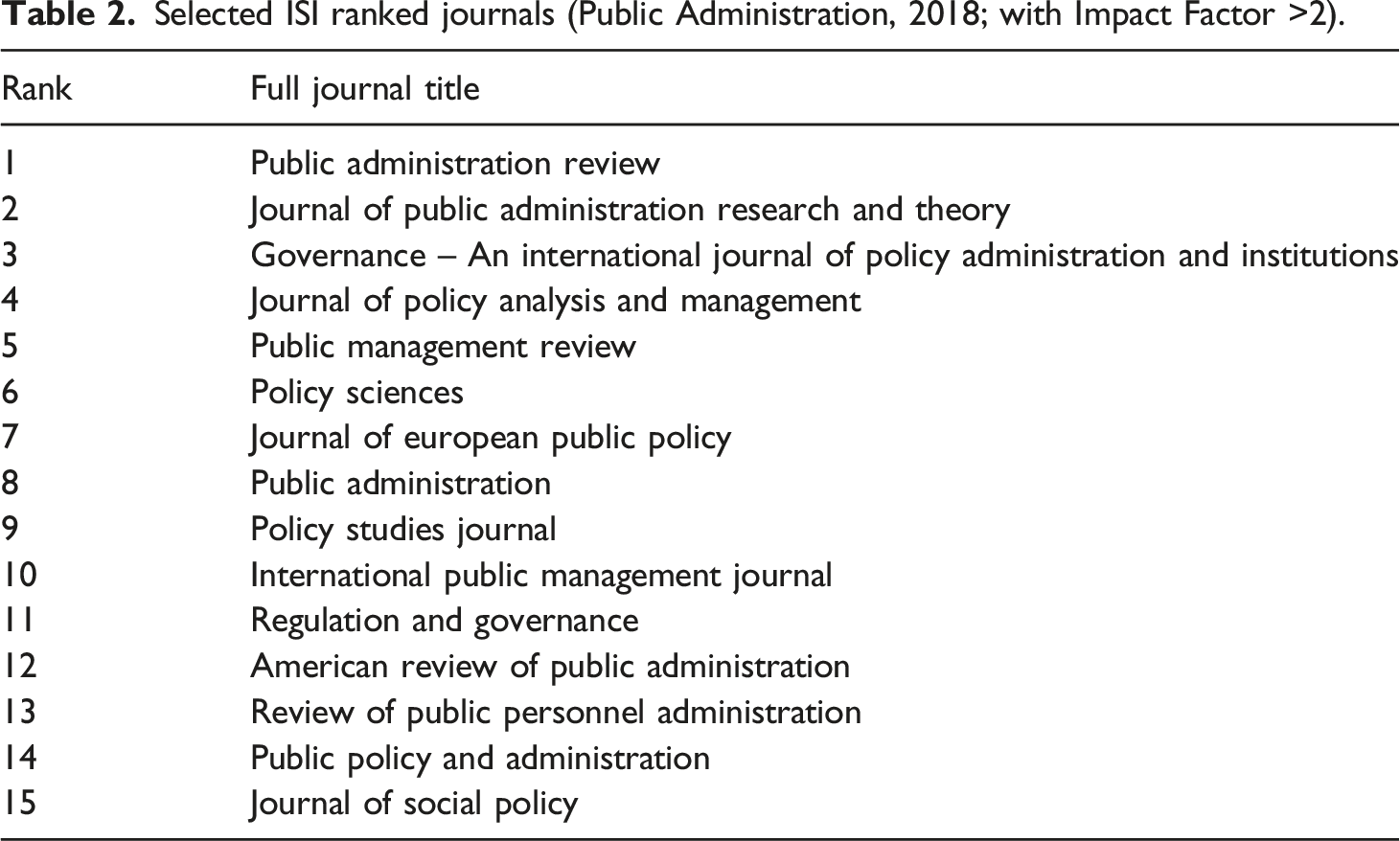
Since we worked with citation scores and impact factors in the general search and the ranked journal specific search, we realized that two – relatively new – journals that are specifically tailored to the study of professions and professionalism were not included in the search: the Journal of Professions and Organisations (JPO) and Professions and Professionalism (PandP). Since both journals have a double-blind peer review system to ensure quality, we decided to conduct a thematic journal specific search as well to include articles from these two journals. Again looking for the ‘professionalism’ search terms in the abstract, and for the ‘strategic renewal’ search terms in the full-text, we managed to list another 133 articles.
We then subjected the articles from each of the three ways of searching to the same screening process, assessing them for their potential eligibility based solely on their title using the wide inclusion criterion ‘professionals in relation to strategic reform’. We had to exclude a surprisingly large number of studies, especially for the journal specific search, whereas it turned out that while most articles indeed addressed ‘strategic renewal’, they only mentioned the word ‘professional’ in a common speech way without explicating their (new) role and position. Nevertheless, we were left with 188 articles from the general search, 110 from the ranked journal specific search and 87 from the thematic journal specific search. We then merged the articles from the three search modes, removed the duplicates and performed another round of screening based on title and abstract, leading to a literature corpus of 248 articles.
We assessed the full-texts of these 248 articles, using the three main questions of our study as inclusion criteria. Hence, selected papers should explicitly cover either/or a combination of (1) strategic requirements framing professional roles in such public management reform models, (2) how professionals are motivated for – and cope with – strategic renewal and (3) the skills that are deemed necessary to do so. This full-text selection process was performed by the first and second author separately to improve inter-rater reliability. We singled out 80 key publications. Differences in decisions (in- or exclusion) were discussed in the team to reach a final decision. For example, the article by Verhoeven and Van Bochhove (2018) was included in our final selection as it explicitly deals with coping behaviour of frontline professionals, whereas Lamothe and Dufour (2007) was excluded after full-text screening as its focus is on professionals, but not explicitly covers one of our three sub questions.
While reading thoroughly through our 80 key articles, we came across references that were not part of our key selection. To understand what happened, we compared some of these references with the three modes of our initial search to see whether we had mistakenly removed these references somewhere during our screening. This turned out not to be the case. A possible explanation we could think of for why search engines did not show these references in the first place, is that our key concepts are not always consistently used in literature. As a consequence, we decided to check our 80 key articles to identify all references with promising titles in the light of ‘professionals in relation to strategic reform’. Through this form of snowballing, we identified 86 referenced publications, including books and chapters. Acknowledging the explorative aim of our study, we decided to add these sources to our literature corpus. Hence, the final literature corpus used to develop this paper is therefore composed by a set of 166 articles.
We conducted a narrative literature review based on these 166 articles. Narrative reviews are particularly suited for a general appraisal of previous studies and the identification of a current lack of knowledge, and to track the development of concepts and reforms (Onwuegbuzie and Frels, 2016). We developed a coding table with a column for each of our subthemes: (1) strategic requirements framing professionals’ roles, (2) motivations and coping behaviour, and (3) skills, summarizing each study’s main insights per theme. Based on this coding table, we collectively identified the dominant storyline for each subtheme and constantly refined and rewrote our subtexts into a mid-term report that was submitted to an international panel. Feedback allowed us to conclude that the storyline we constructed proved convincing in the eyes of our international peers. It also enabled us to refine our findings, including more nuances and discussion in a final report, as the basis for our analysis here (Figure 1) Flowchart literature selection.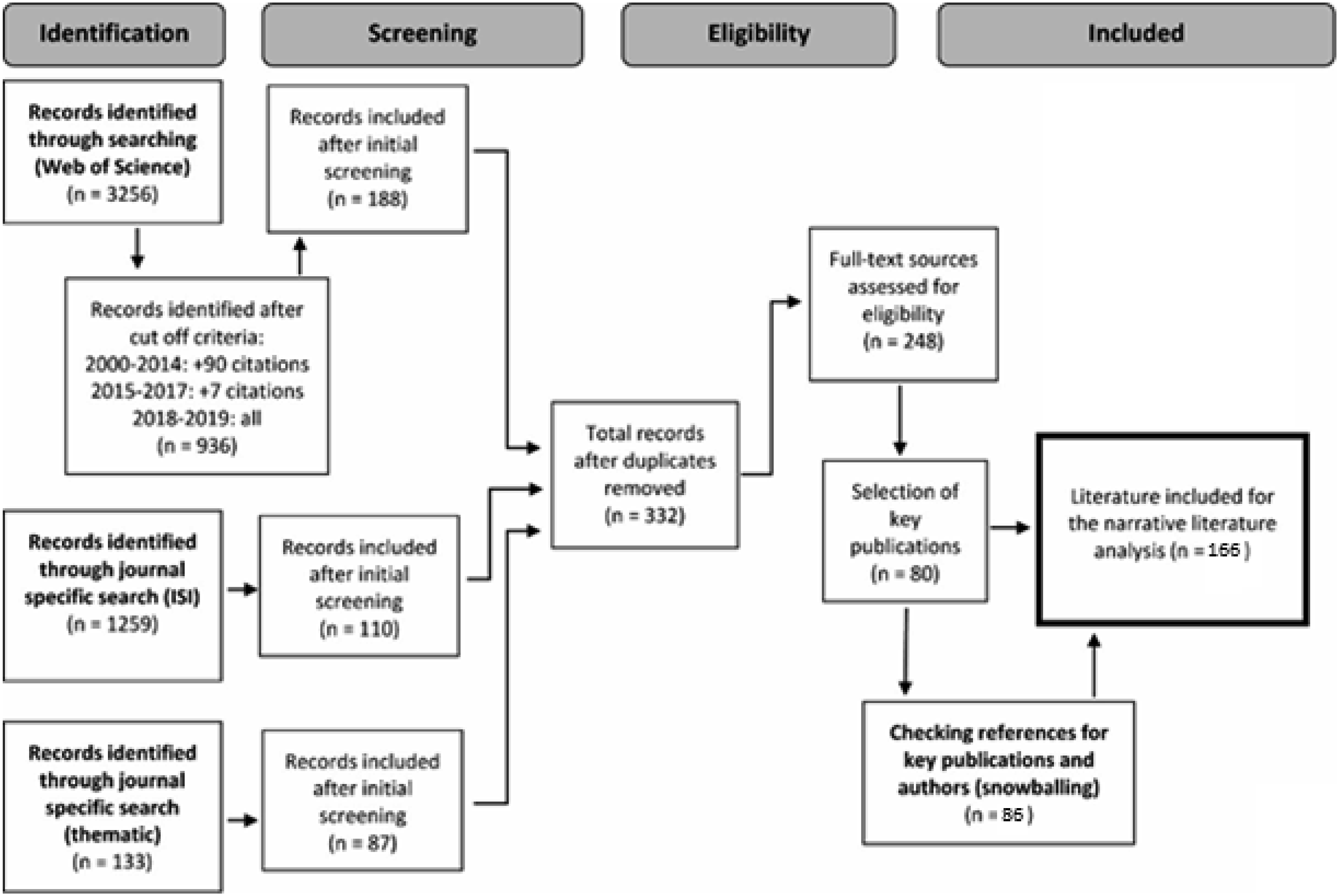
Conceptualizing professional roles in strategic reforms
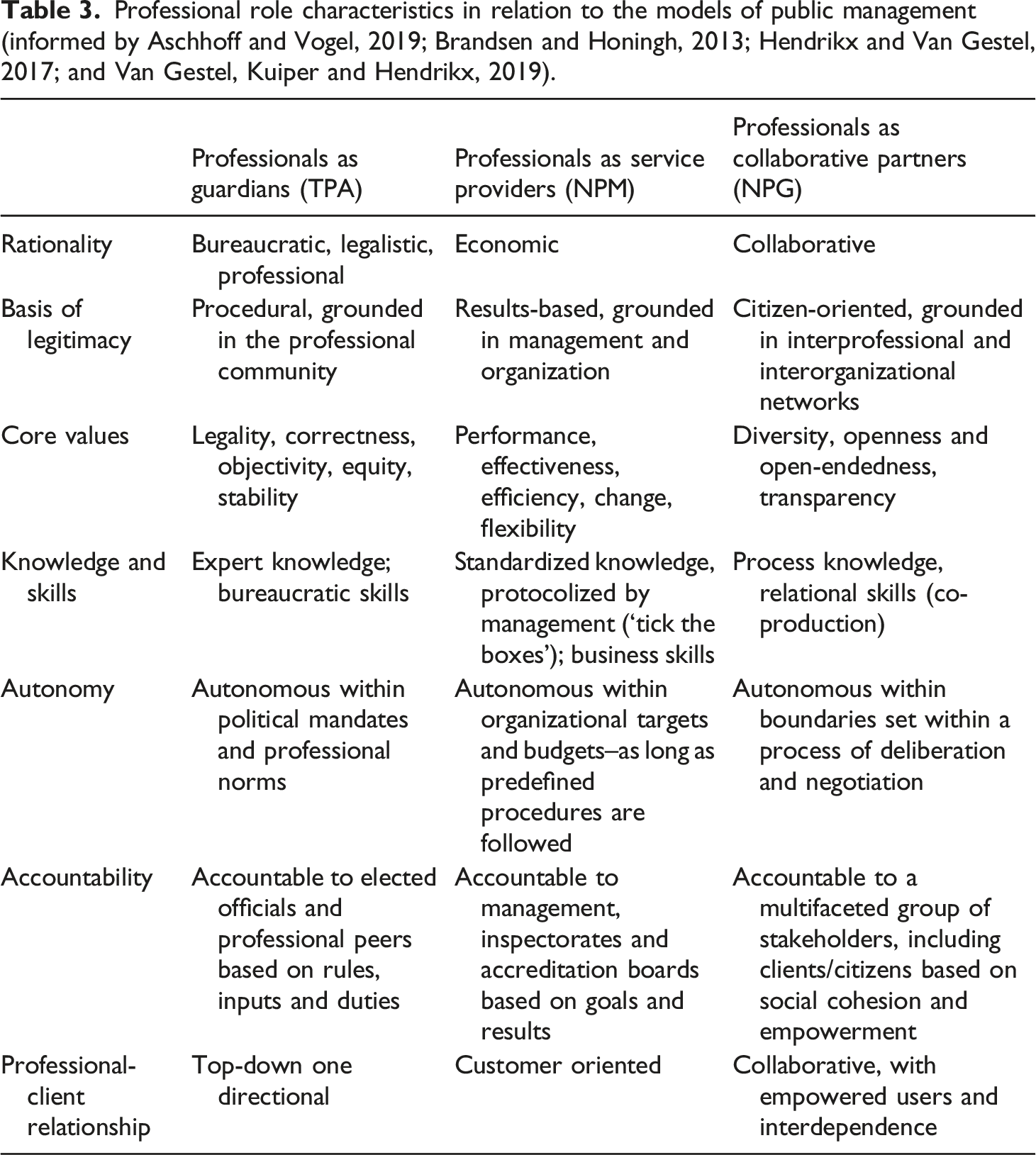
Professional role characteristics in relation to the models of public management (informed by Aschhoff and Vogel, 2019; Brandsen and Honingh, 2013; Hendrikx and Van Gestel, 2017; and Van Gestel, Kuiper and Hendrikx, 2019).
From TPA’s ‘guardians’ to NPM’s ‘service-providers’
In the TPA model, public service delivery took place along the principles of the Weberian bureaucracy (Faulconbridge and Muzio, 2011; Van der Steen et al., 2018). Ideally, politics and administration were separated (Bryson et al., 2014): while elected officials set the goals, technical experts were to refine and operationalize these goals (De Boer, Enders and Leisyte, 2007). Most of these technical experts classify as ‘professional’ in terms of this review and had expert autonomy within the boundaries set by political mandates (Hendrikx and Van Gestel, 2017). They were expected to know what was best for the citizens, whose needs they defined in their process of public services delivery (Sehested, 2002). Citizens, on the other hand, were supposed to be the passive receivers of the public services (Torfing et al., 2019). Already during the TPA regime this view started to tilt towards a more critical perspective, highlighting the self-interest of professionals and scrutinizing their dominance and elitist positions (Broadbent and Laughlin, 2005; Laffin and Entwistle, 2000; Schimank, 2015). Gradually, attention was shifted from professional towards external control over the output of professional service delivery (Leicht, 2016).
Since the 1980s, the focus in strategic public management moved towards market-based coordination of public service delivery, widely known as New Public Management (Leicht, 2016; Pollitt and Bouckaert, 2017). The description of NPM in literature clearly shows its broad range of facets and national variations which made some wonder whether we even can speak of a coherent approach (Ackroyd et al., 2007). Consensus about key elements though revolved around “the adoption of commercial management practices” (Kitchener and Gask, 2003: 20), the “[application of] market-based techniques to public services in order to improve cost efficiency and strengthen result orientation” (Bergh et al., 2015 190), and the “[promotion of] management, consumerism and competition alongside the previous concern with efficiency” (Butterfield et al., 2004: 396).
Most studies on the effects of NPM on professional roles and professional work tend to focus on specific domains (e.g. Buchanan, 2015; Croft et al., 2015). Often it is emphasized that NPM reforms took on the monopoly position of professions, diminishing professionals’ autonomy by replacing – or counterweighing – a traditional professional logic with a managerial logic (Bévort and Suddaby, 2016; Evetts, 2013; Kitchener and Glask, 2003; Noordegraaf, 2007). This means that management was empowered over professionalism (Evetts, 2009; Leicht et al., 2009), among others by defining goals for professional work and by capturing professional expert knowledge and skills in protocols and regulations so that managers could monitor and control professionals’ performance (Barry et al., 2001; Leicht et al., 2009; Waring and Currie, 2009). In defining the desired output, NPM’s consideration of the client as ‘customer’ of professional services gained centrality, reshaping social interaction as a relationship between providers and purchasers (Leicht, 2016; Torfing et al., 2019) and requiring professionals to gain commercial expertise (Brandsen and Honingh, 2013; Turner et al., 2016). Therefore, NPM role expectations for professionals turned them into ‘service-providers’ (Hendrikx and Van Gestel, 2017).
Post-NPM: collaborating with ‘inevitable’ partners
Various authors declared that we have entered a ‘post-NPM’ era, dominated by collaborative governance and network-style approaches (Osborne, 2006; Torfing, 2019; Van de Walle et al., 2016). Since the late 1990s, collaborative approaches were revalued because of the recognition that in order to solve public problems and to create solutions, other actors – private and non-profit organizations as well as citizens – are key. Hence, networks gained prominence as a way to “overcome the limitations of anarchic market exchange and top-down planning in an increasingly complex and global world” (Jessop, 2003: 101–102). Networking is often presented as ‘inevitable’ or ‘inescapable’ to overcome fragmentation and to deal with complex issues (Breit et al., 2018). The most prominent model following up on this awareness is New Public Governance (NPG) (Osborne, 2006), in which coordination through networks is central in processes of co-production and co-creation (Torfing et al., 2019). Although the broadness of this ‘co’-paradigm may lead to conceptual fuzziness (Dudau et al., 2019), more and more studies explored collaborative approaches that bring along new role expectations for professionals (Aschhoff and Vogel, 2019), and new state-professions dynamics (Kjær Joensen et al., 2014).
While NPG’s collaborative approaches are introduced as strategic reform, the role of professionals in this model has seldomly been dealt with explicitly (Aschhoff and Vogel, 2019; Hendrikx and Van Gestel, 2017). It is said that for professionals, collaboration in networks implies a bundling of social issues which pushes professionals and partners to come up with new solutions to complex problems, connecting organizations and fields previously separated (Ferlie et al., 2011; Huq, 2019; Lecy et al., 2014). Some studies see collaborative approaches as a simple ‘add-on’ to already existing processes of public service planning and delivery, leaving professionals in control of public service delivery (Osborne et al., 2016). Others argue that the knowledge and experiences of all actors involved become an inherent part of the design and delivery of public services, next to professionals’ knowledge and skills (Osborne, 2018). In this view, public service users have changed from ‘passive consumers’ and ‘rational customers’ to ‘inevitable partners’ (Tuurnas, 2015). This places a ‘double pressure’ on professionals: coming from the top through administrative and political actors and from the bottom through service users and citizens (Sehested, 2002).
Literature shows that collaborative approaches are often treated as a ‘magic recipe’ (Dudau et al., 2019): they are thought to increase the effectiveness of public service delivery, to decrease the democratic deficit, to activate citizens and communities, and to add resources to public service delivery (Osborne et al., 2016). The ‘inevitable’ aspect in the new partner role of users and the new expectations for professionals that come along with that, leads literature to raise critical points; for example, co-creation with ‘partners’ can also lead to ‘co-destruction’ (Osborne et al., 2016), or diminished policy performance (Schalk, 2017). To avoid negative impact, professionals are also expected to manage the collaboration, ensuring its added value through accountability to society in general (Noordegraaf, 2015; Tuurnas et al., 2016).
In sum, the multiplicity of role expectations simultaneously at play for public professionals does not limit itself to competing demands from professionalism and management. Instead, while literature shows how each public management model has come with new – often implicit – role expectations, it also shows how formerly dominant roles remain present when new ones like in collaborative approaches are added (Aschhoff and Vogel, 2019; Brandsen and Honingh, 2013; Hendrikx and Van Gestel, 2017). Therefore, it is key to examine in literature how professionals themselves are motivated for – and cope with – strategic renewal as based on the successive models of public management reform, dealing with multiple roles including networking and co-creation.
Professionals′ motivation and coping with strategic renewal
The sources that address our second sub question – how are professionals motivated for – and cope with – strategic renewal– show that NPM reforms were met with much more resistance by professionals than NPG reforms (e.g. Echeverri and Åkesson, 2018; Van der Steen et al., 2018). It is often argued that with the rise of NPM the autonomy of professionals diminished, replacing a TPA or traditional logic with a managerial logic (Bévort and Suddaby, 2016; Evetts 2013). Having their knowledge standardized and protocolized, literature shows professionals often feel threatened in their expert positions (McGivern et al., 2015). Moreover, studies report professionals struggle reconciling ‘efficiency’ and ‘competition’ as prominent values for public service delivery with for example building relationships with clients and peers (e.g. Bryson et al., 2014; Leicht et al., 2009; Waring and Currie 2009), leading them to experience paradoxical identity demands (Ahuja et al., 2017; Spyridonidis et al., 2015).
It seems that with professionals’ resistance against NPM reforms in mind, studies focussing on NPG reforms often assume professionals are also unwilling to participate in collaborative processes and even to resist such processes because these are thought to limit professional power. However, literature more and more shows that certain elements from NPG based approaches are in fact appreciated by professionals. Examples are the ability to be more responsive towards local needs of clients (McDermott et al., 2015; Weir et al., 2019); a genuine belief in empowering citizens and local communities (Van Meerkerk and Edelenbos, 2018); and the opportunity to gain thorough knowledge of other (professional) partners involved and their personal, organizational, and institutional backgrounds (Van Gestel, Kuiper and Hendrikx, 2019).
As NPG role demands for networking and co-creation are often expected to be fulfilled in a context of alternative public management models (TPA/NPM), literature suggest that professionals do not find it easy to match the different role requirements (Brandsen and Pestoff, 2006; Van Gestel, Kuiper and Hendrikx, 2019). They feel constrained to fulfil their new collaborative roles if organizational support for inter-professional cooperation is absent, and legal rules, financial incentives, and performance systems are still dominated by TPA and/or NPM principles (Van Gestel, Kuiper and Hendrikx, 2019). Professionals also feel that traditional professional values of ‘equality, representativeness and the neutrality of the public service activities’ may come under pressure in NPG (Tuurnas, 2015: 592), which tends to keep them applying familiar professional practices and frames (Noordegraaf et al., 2016). Moreover, professionals are geared towards offering readymade solutions to citizens/users, but networking and co-creation imply accepting (experiential) knowledge of clients, next to their professional knowledge (Brandsen and Pestoff, 2006). Especially in a welfare state context this is a challenging task, whereas citizens traditionally are seen as ‘objects of care’ rather than co-creating partners (Torfing et al., 2019). Thus, although professionals understand the multifaceted contexts in which network processes occur, they feel that distributions of roles should be clarified better and that explicit strategies for supporting implementation are needed (McDermott et al., 2015).
Diverse coping strategies
Literature that addresses how professionals cope with hybrid role demands (NPG added to TPA- and NPM-based role expectations) is still scarce (Hendrikx and Van Gestel, 2017; Brandsen and Honingh, 2013; Jaspers and Steen, 2019). The limited number of studies that do describe coping by frontline professionals with strategic renewal, lists multiple coping strategies, all showing how professionals struggle to reconcile strategic renewals’ competing role demands in practice.
In a context of frontline professionals in public services delivery, Tummers et al. (2015) distinguished three coping categories, framed as: moving towards clients, moving away from clients, and moving against clients. In the first type, professionals are willing to break or bend the rules, or use personal resources to help clients. Moving away from clients implies that professionals may routinize their interactions, treating all clients in the same way irrespective of clients’ needs. When professionals move against clients (third type), they actively seek confrontation with them, for example, by rigidly following legal rules or acting aggressively to assert professional control (Tummers et al., 2015; Verhoeven and Van Bochove, 2018). Tummers et al. (2015: 1099) conclude that frontline professionals often draw on ‘moving towards clients’, “revealing a strong tendency to provide meaningful public service to clients, even under stressful conditions.” We thus can view ‘moving towards clients’ as a coping strategy close to professional values, as well as to NPG demands for involving users in public services.
An alternative coping strategy is when professionals apply forms of ‘creative mediation’ to make competing demands manageable (Gleeson and Knights, 2006), and actively seek to conciliate multiple demands by reconstructing them as coherent. As indicated in literature, professionals often struggle to reconcile strategic reform demands from NPG with NPM; especially standardization and detailed registration of professional actions diminish professional discretion and time available for NPG demands (Van Gestel, Kuiper and Hendrikx, 2019). It has been suggested that professionals can cope more easily with conflicting demands when they could integrate organizational work principles into their professional work (Croft et al., 2015; Schott et al., 2016; Teelken, 2015). We also found a coping strategy in our review, framed ‘deferred coping’ (Jaspers and Steen, 2019: 13), meaning that professionals agree with applying a collaborative approach in future, but for now claim that ‘partners’ or ‘citizens’ are not ready for it, and first need more training and supervision. Hence, this decoupling strategy is not about ‘moving towards clients’, mediating or integrating, but about postponing NPG-professional role demands in practice.
We conclude that professionals seem more motivated for strategic renewal based on NPG than NPM and are less prone to resist such reforms because they match much more with professional values like client centeredness. At the same time, whereas they choose different ways of coping – from ‘moving towards clients’ to ‘moving away’ or ‘against’, with in-between forms as ‘creative mediation’ and decoupling – we do see that professionals are often struggling to reconcile strategic renewals’ competing role demands of guardian, service provider and collaborative partner in practice.
Skills of professionals in networking and CO-CREATION
Here we reflect on literature related to our last sub question: which skills are deemed necessary for public professionals to cope effectively with strategic renewal? Expert knowledge as prominent feature of professionalism in TPA is perceived to be still relevant, but in collaborative approaches professionals must deal with new sources of knowledge besides their own (Glimmerveen et al., 2019). Through client participation, user experience has become a crucial part in networking and co-creation (Osborne, 2018; Vanleene et al., 2018), requiring professionals to revalue their own knowledge and to encompass elements derived from experiential learning into their public service delivery (Leemeijer and Trappenburg, 2016). In this vein, some argue that professionals should simultaneously be ‘friend’, ‘leader’, ‘representative’ and ‘mediator’ (Vanleene et al., 2018). Rather than sole experts who define the needs of their clients, professionals also require ‘boundary spanning’ or ‘brokerage’ capacities to make clients, stakeholders and themselves work effectively and synergetic together (Long et al., 2013; Maaijen et al., 2018). The skills that follow from literature to realize the potential of public professionals being collaborative partners in a context where alternative reform models (TPA/NPM) are still at play, roughly fall into four categories (Figure 2). Skills and capabilities professionals need to co-produce and co-create (informed by O’Leary et al., 2012; and Steen and Tuurnas, 2018).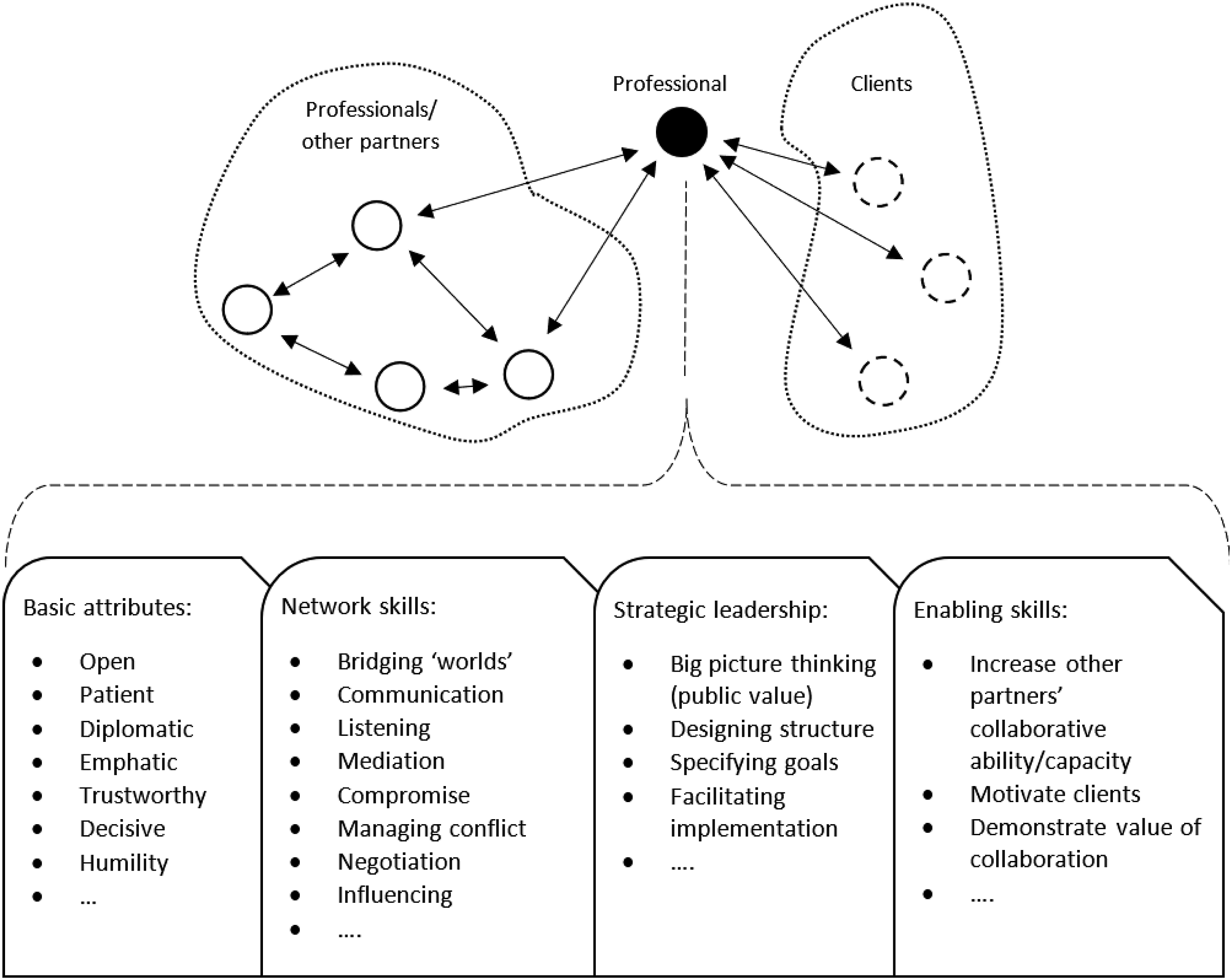
A first set of skills revolves around individual attributes or competences for ‘collaboration’, viewed as a crucial trait for innovative practices (Lloyd et al., 2018). Collaborative skills are not fixed qualities like personality traits (O’Leary et al., 2012), but can be acquired through training and experience. Cho et al. (2005) found qualifications and experience of professionals decisive in effective implementation, with the most important one being receptive for new ideas, perspectives and changes (see also Steen and Tuurnas, 2018). Besides, professionals also need the – perhaps more traditional – skill of being patient, diplomatic and empathetic (O’Leary et al., 2012). According to our literature review, professionals thus should be capable to think beyond their own knowledge and perspectives, and to place oneself in someone else’s position.
A second set of skills is related to public professionals involved in a network partner role: they should to be able to communicate effectively and to bring together different actors from different worlds, each with their own logic and identity, helping them understand each other’s language (O’Leary et al., 2012). Acknowledging that collaboration can also lead to conflict (Hendrikx, 2018), for example when actors are involuntarily part of collaborative arrangements (Osborne et al., 2016), public professionals in collaborative networks need to understand the fine skills of listening, mediating, negotiating, and managing conflict to reach compromises that hold value for all (Kemp and Rotmans, 2009; O’Leary et al., 2012).
Third, public professionals are entailed to have strategic leadership skills (O’Leary et al., 2012). They should keep an eye on the ‘big picture’, and develop new ‘storylines’ that capture the transformative change of the collaborative coalition (Kemp and Rotmans, 2009). They need skills to define what the collaborative arrangement aims to attain and, in some cases, to design a structure that helps realizing this aim (Maaijen et al., 2018). Professionals also should be able to make use of the assets offered by clients/citizens (Tuurnas, 2015), and to acknowledge the complexity of internal network dynamics, where agency is a relational and emergent potential of group members (Tuominen and Lehtonen, 2018). Since professionals often remain highly dependent on reporting up to a managerial hierarchy (Kellogg, 2019), they need strategic leadership skills to negotiate and settle (new) performance indicators. And, as strategic leader, public professionals should be foremost keen to protect traditional (TPA) values and safeguard that outcomes of collaboration are also delivered to citizens and partners not involved in the particular network (Steen and Tuurnas, 2018).
A fourth set of skills for public professionals is about enabling citizens and partners to participate in public policy and services delivery. While networks are viewed beneficial to reach collective aims, and co-creation is ‘the new kid on the block’ (Ansell and Torfing, 2021), this does not mean that every (potential) citizen and partner is automatically convinced of its value, or has the ability or capacity to collaborate. It thus requires ‘enabling skills’ on the side of the professional, to support users and partners to participate, plan, design and deliver within the collaborative arrangements (Verhoeven and Van Bochove, 2018). Enabling skills are also relevant in the conversation with politicians, to engage them in collaborative approaches and assure their support (Torfing and Sørensen, 2019). Professionals thus need enabling skills to create a collaborative, productive environment in which all partners ideally feel free to think and speak so ideas can emerge and develop (Kemp and Rotmans, 2009).
In sum, strategic renewal carries new and additional role expectations for professionals, in particular for NPG-based approaches in public services. Current professional skills are not just about the ‘traditional’ hybrid professional, combining professional and managerial tasks. Based on our literature review, we identified four sets of skills for public professionals, related to TPA/NPM but most notably to NPG networking and co-creation (see Figure 2).
Discussion and concluding remarks
This article presents the result of an extensive literature review of 166 sources – mainly scientific peer-reviewed articles – that provides an in-depth understanding into the state-of-art knowledge about engaging professionals in the strategic renewal of public services, most notably collaborative approaches. Its two main findings are that strategic reforms have resulted in multiple (competing) role expectations, with especially collaborative roles requiring new sets of skills. Second, although public professionals are perceived crucial for implementing strategic reform, their motivations and coping with strategic reforms are less exposed in literature. However, our review shows that professionals are much more motivated and more easily cope with NPG rather than NPM reforms, whereas values like client-centeredness are much more in line with professionals’ already existing identities compared to values of efficiency and competitiveness. Based on our review, we subsequently could identify four types of skills that may connect more traditional professional skills with competences for networking and co-creation. We make a twofold contribution to literature:
First, our review reveals that the complexity of the multiple role demands goes beyond the dichotomy of professional versus managerial values and approaches and the blurring of managerial and professional jurisdictions (Evetts, 2011; Newman, 2013; Waring and Curie, 2009). Keeping in mind that the framing of professional roles can differ across professional groups, public organizations, policy sectors and/or nations (Ackroyd et al., 2007; Faulconbridge and Muzio, 2011), it turns out that public professionals should simultaneously operate as experts providing professional knowledge (TPA); as service providers following protocolized procedures (NPM); and as collaborative partners, operating in teams, networks and platforms for co-creation (NPG). This opens a debate to whether these different role expectations and responsibilities can be aligned in theory and practice. It seems that contemporary public professionals often wear two hats: according to NPG they represent their public organization/the public policy in an ‘equal’, ‘horizontal’ role in networking and co-creation with clients and other partners; according to TPA/NPM they are also responsible for the final public decisions being made, for example as doctors, teachers, social workers or police officers. It cannot simply be assumed that these two hats can be worn on the same head. Combining a (vertical) traditional expert role and a (horizontal) network partner role may even create an irreconcilable role conflict. It can increase tensions rather than contribute to NPG-advocated creative problem-solving. Acknowledging the complexities of such network skills, literature on boundary spanning also notes that not one boundary spanner can act as “super (wo)man” (Van Meerkerk and Edelenbos, 2018:110) who incorporates all (network)competences and activities. Rather, boundary spanning emerges as ‘interactivity’ in which multiple boundary spanners possess different skillsets (ibid, also Williams, 2002).
Whilst professionals’ collaborative attributes are increasingly considered ‘core competencies’, it remains disputed how these should be practiced and evaluated (Eichbaum, 2018). Spanning boundaries for instance contains a risk of getting too closely and personally involved with external actors and processes, thereby losing support and becoming distanced from the home organization (Van Meerkerk and Edelenbos 2018). Explicit attention should therefore be given to the roles professionals are expected to fulfil and how they can be facilitated to do so. In this respect, the governance structure of the policy field and the regulative support and (financial) incentives and resources should promote innovation rather than obstruct it (Torfing et al., 2019; see also Scott, 2008). Professionals operate in a context of ideology and belief systems at the macro level and control mechanisms of individual practitioners at the micro level (Evetts, 2013). They hold the potential to bring about the strategic renewal desired by politicians and policy makers, but also deliver from bottom-up the input, knowledge, and experience to develop new initiatives (Tuominen and Lehtonen, 2018). An explicit use of public professionals’ ‘creative ideas’, ‘capacity’ and ‘policy entrepreneurship’ to inform new strategies and spread developments (Scott, 2008) may nurture the effectiveness of strategic renewal.
Second, most literature studying motivations and skills of public professionals focuses on reforms that are managerial in nature, and not collaborative (e.g. Tummers et al., 2015). Our review contributes to a wider perspective, including NPG reforms. Since professionals are key for effective public policy delivery, especially their motivations, coping strategies and skills for more integrated, ‘holistic’ services deserve more attention. Based on our review, we highlighted that (some) professionals feel motivated by the notion of delivering public services in a NPG setting (McDermott et al., 2015; Steen and Tuurnas, 2018), but others feel less comfortable by using knowledge other than their own expert knowledge (Jaspers and Steen, 2019). Moreover, as multiple professional role demands cause a challenge beyond professionalism and management, it should be investigated at a deeper level whether NPG’s networking and co-creation align well with professional values, or whether they are perceived to be a threat for professional expert knowledge, traditional skills and autonomy – just like earlier values and practices pursued by NPM-reforms were.
For professionals’ skills, our review allowed us to identify four sets of skills as illustrated by Figure 2. At the level of daily practices, literature points to professionals having leeway in building local capacity for improvement, necessary to translate national goals to local contexts (Steen and Tuurnas, 2018). For NPG, professionals often have no or very limited training to fulfil their new collaborative roles (Tuurnas, 2015), which may explain a critical attitude (Liao and Ma, 2019). To strengthen their capacity related to networking and co-creation, professionals can be supported practically, for example by facilitating training in data management or by exchanging knowledge about promising practices (Dalgarno and Oates, 2018; McDermott et al., 2015). Simultaneously, professionals may need a new repertoire of ‘tools’ to work with. Appropriate platforms for collaborative interaction are to be found or created to share in-depth knowledge, and to monitor and evaluate collaborative aims and outcomes (Ansell and Gash, 2018). Moreover, interactions with professionals from other fields can encourage professionals to ‘adapt and adopt the learned methods in their own fields of service’ (Tuurnas, 2015: 592). They can build ‘bottom-up capacity’, crucial to adopt promising practices and to adapt and supplement national mandates (Van Gestel and Nyberg, 2009; McDermott et al., 2015; Weir et al., 2019). Interestingly, different studies extensively describe new repertoires and skillsets that professionals need in order to successfully collaborate and co-create public services. Despite the acknowledgement of the complexity of what it takes from professionals, there is little attention for the conditions under which they can develop new skills. Rather, they are presented as ‘agents’ or ‘boundary spanners’ that already possess skills and perform activities (Edelenbos and Van Meerkerk, 2018).
Research agenda
From our literature review, we recommend a few topics for future research. First, recognizing that the framing of roles can differ across professional groups, and between different public services settings, comparative studies are required about how professionals perform multiple roles – traditional expert, service-provider, collaborative partner – simultaneously or as a team, in order to trace how contextual factors affect the framing and experience of professional roles. Second, most literature on professional’s motivations is focused on NPM-type reforms while less is revealed about engagement in strategic reforms based on NPG and co-creation with available studies limited to a specific sector, for example healthcare. We recommend to further explore the topic across different policy areas and nations, whereas meso-level institutions are relevant for the role of professionals (Hendrikx, 2021; Turner et al., 2016). Third, our literature review indicates more careful attention in (public) organizations should be devoted to the (new) skills of professionals necessary for collaboration with various stakeholders and users. Strategic renewal based on NPG principles requires professionals from different backgrounds to work in interdisciplinary teams geared towards cocreating public services. So far, research concentrates on skills of the individual professional (see e.g. work on boundary spanners, Williams 2002), while it would be worthwhile to explore further how teams of professionals within their institutional environment develop and exchange collaborative skills.
Methodologically, current literature predominantly relies on single case studies, and different theoretical models and research execution makes it sometimes challenging to aggregate and compare results in contributing to theory and practice. Based on our literature review, we call for a future research agenda with large-scale, international comparative case study designs. We recommend drawing on (focus group) interviews with professionals and clients/partners from various public services, enabling comparisons across policy areas and nations. Such a large-scale systematic case study approach is probably the most promising way to acquire a better understanding of professional engagement, which in turn is key for governments, public organizations and professionals alike for effective strategic renewal of public services.
Footnotes
Declaration of conflicting interests
The author(s) declared no potential conflicts of interest with respect to the research, authorship, and/or publication of this article.
Funding
The author(s) disclosed receipt of the following financial support for the research, authorship, and/or publication of this article: The literature review on which this contribution is based has received funding from the European Union’s Horizon 2020 research and innovation programme under grant agreement No 770591.
