




Abstract
Recent research shows that new types of high-skilled administrators, what we in this article label organisational professionals, have amplified their presence in public sector organisations in relation to other types of public sector employees. Our purpose is to analyse how organisational accountability can be seen as a driver behind the expansion of organisational professionals. Intensified political and administrative pressures seem to be driving this process, but there also seems to be internal turfs in which the different parts of the government administration seek to hold each other accountable, a process possibly amplified by professionalising ambitions of the organisational professionals. The article concludes that the bureaucratising effect of accountability demands ought to be highlighted more in critical research of accountability. The study is based on semi-structured interviews and focus groups with public sector professionals in Sweden from different policy sectors and government levels.
Introduction
Sweden has, alongside other Western industrialised democracies (Löfgren et al., 2022a), witnessed an unprecedented expansion of advanced administrative professional roles in both the public and private sectors. The existing body of academic literature on administrative intensity (Boyne and Meier, 2013; Andrews et al., 2017), and bureaucratisation (Hood and Peters 2004; Torsteinsen 2012) has paid less attention to the growth of managerial and professional roles, which we in this article will analyse as organisational professionals (Löfgren et al., 2022a, 2022b). The research question we ask in this article is: Why are organisational professionals expanding in the Swedish public sector?
Given the challenges facing public sector organisations in Sweden, this question is valid as this expansion is affecting both the allocation of resources as well as the fundamental question about the purpose of the public sector. Our contribution in this article is limited to establishing a link between the growth of organisational professionals, and the general quest for organisational accountability in public sector organisations. While it is out of scope to establish any positive correlation between accountability and changes in the public sector workforce, our limited, open-minded, and inductive approach seeks to generate a few possible explanations, based on self-reflections among public sector professionals. Our explicit purpose is thus to identify if organisational accountability is a plausible factor behind the expansion of advanced administrative staff in the public sector.
Hitherto, the growth in numbers (and status) of organisational professionals within public organisations has largely been conceived as the outcome of New Public Management (NPM) reforms, with public sector organisations copying practices from the private sector, enhancing results and performance, and disconnecting policy from delivery (Hood and Peters, 2004; Diefenbach, 2009). These reforms based on managerial principles require new lines of advanced administrative staff to secure efficiency, accountability, and control. While we do not dismiss the importance of NPM for understanding the increase of professional and managerial staff in the public sector, this almost axiomatic focus on NPM has limited our analytical outlook. In line with Halligan (2020), it seems like managerialism is only one part of the storyline with politicisation, as well as professionalisation of new administrative groups being equally significant vehicles (as described by Pollitt (1990) and Aucoin (2012)).
Our study takes a bottom-up approach to understand the expansion of high-skilled administrators in public organisations, by asking the organisational professionals how they perceive their professional roles, and the context for their work. Departing from the tradition of interpretative organisational studies, we contend that insight into the social reality of these professionals can help us understand organisational and professional change processes (Rhodes, 2011, 2013). We conducted 24 semi-structured interviews and five focus groups with organisational professionals and managers working in a wide range of Swedish public sector organisations, asking them to reflect on changes in personnel composition through open-ended questions.
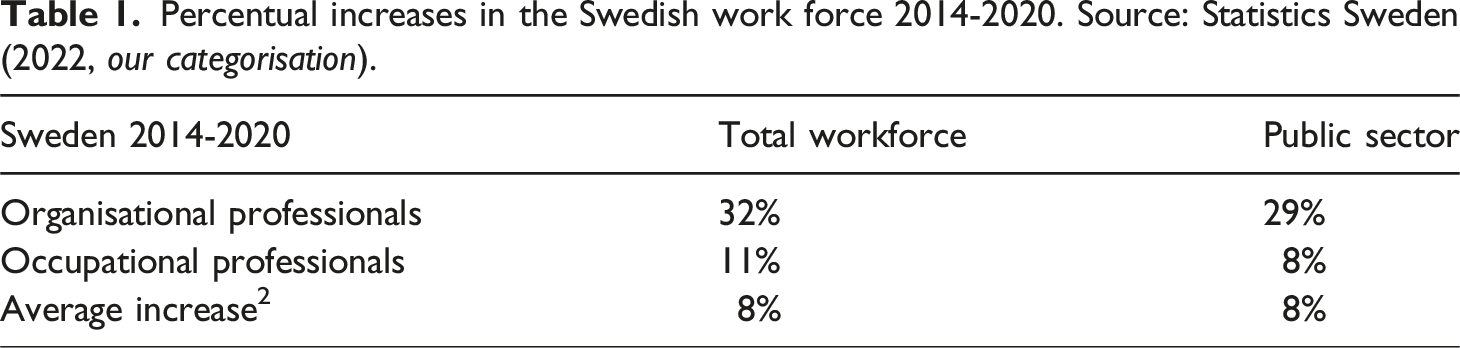
The remainder of the article is structured as follows. In section two, we will briefly present some figures illustrating the expansion of organisational professionals within the Swedish public sector. In section three, we review the literature on organisational professionals and accountability and define our own research puzzle and contribution to the literature. This is followed by section four where we present our methodological approach and our empirical data collection. Section five presents the empirical findings, followed by section six, where we discuss our findings in light of our contribution to the body of literature, followed by a conclusion in section seven.
Background: The expansion of higher administrative positions in the Swedish public sector
In tandem with other industrialised democracies, the Swedish public sector has been affected by waves of both managerialism and politicisation. The country has since the 1990s witnessed an intensification of performance management practices, a divide between policy and delivery and a far-reaching devolvement of operational responsibilities for welfare policy (including delegated financial accountability) to local and regional governments, as well as private contractors. Unsurprisingly, this devolution has caused an expansion of the number of publicly financed, accountable units in the political system (Hall 2013, 2015).
Percentual increases in the Swedish work force 2014-2020. Source: Statistics Sweden (2022, our categorisation).
Percentage increases in the public workforce (FTEs) in local and regional government, Sweden, 2008-2022. Source and categorisation: Swedish Association of Local Authorities and Regions (web publication, 2022).
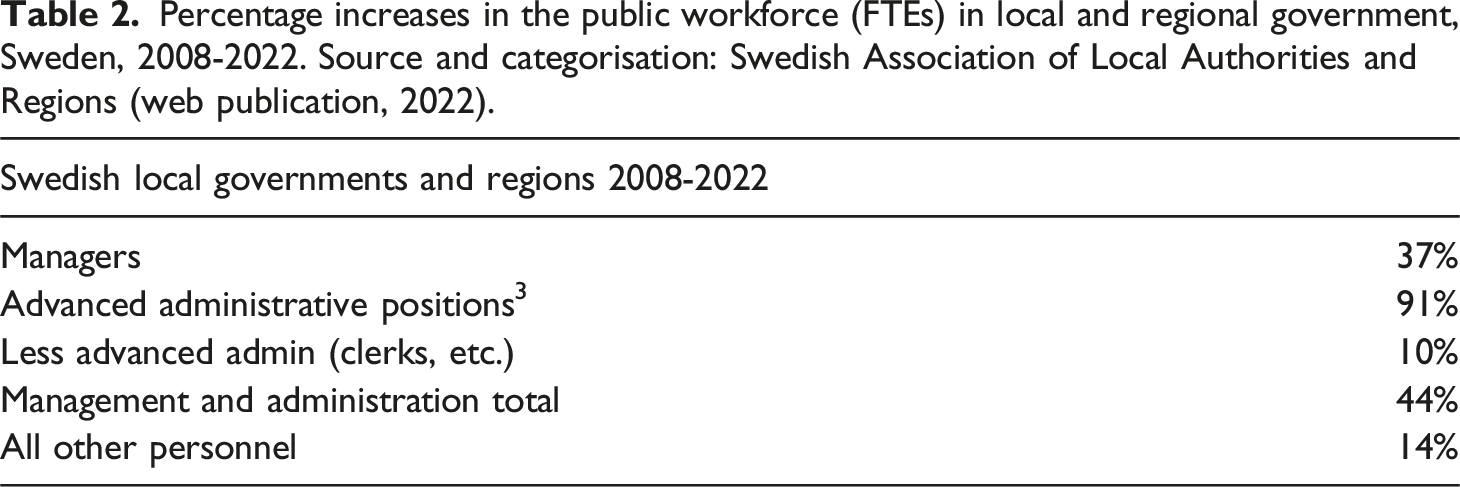
The growth can primarily be observed in the more advanced administrative positions, whereas the more traditional (clerical) administrative roles are witnessing moderate changes. Consequently, we are witnessing a rapid professionalisation of the organisational roles in the Swedish public sector. The remainder of this article will be devoted to the question of why these groups expand at this rate during a comparatively short period of time.
Organisational professionals and accountability
Organisational professionals
The term organisational professional was initially coined by Larson (1977). In her account, the category of organisational professionals covers those occupational groups that grew out of the need to coordinate and manage large organisations. More recently, the term organisational professionals has been associated with the separation between staff that are mainly engaged in organisational and managerial functions, and the category of occupational professionals who are operatively engaged in core service delivery such as for example, health professionals, teachers, and police officers (Evetts, 2013; Noordegraaf, 2011; Noordegraaf et al., 2014). This distinction mirrors those of back-office and front-line workers (Andrews et al. 2017), or overhead functions and primary production (Van Helden and Huijben, 2014; Boon and Wynen, 2017). In all these accounts, organisational professionals are defined according to the function they hold within their organisations. Andrews et al. (2017) talks about the “central administrative function” of the organisation which is defined as Those personnel with no direct role in service production, such as the senior management team, corporate services (e.g., finance, human resources, IT, marketing) and other workers of providing services to the whole of an organisation. (Andrews et al., 2017: 116)
Examples of professional roles.
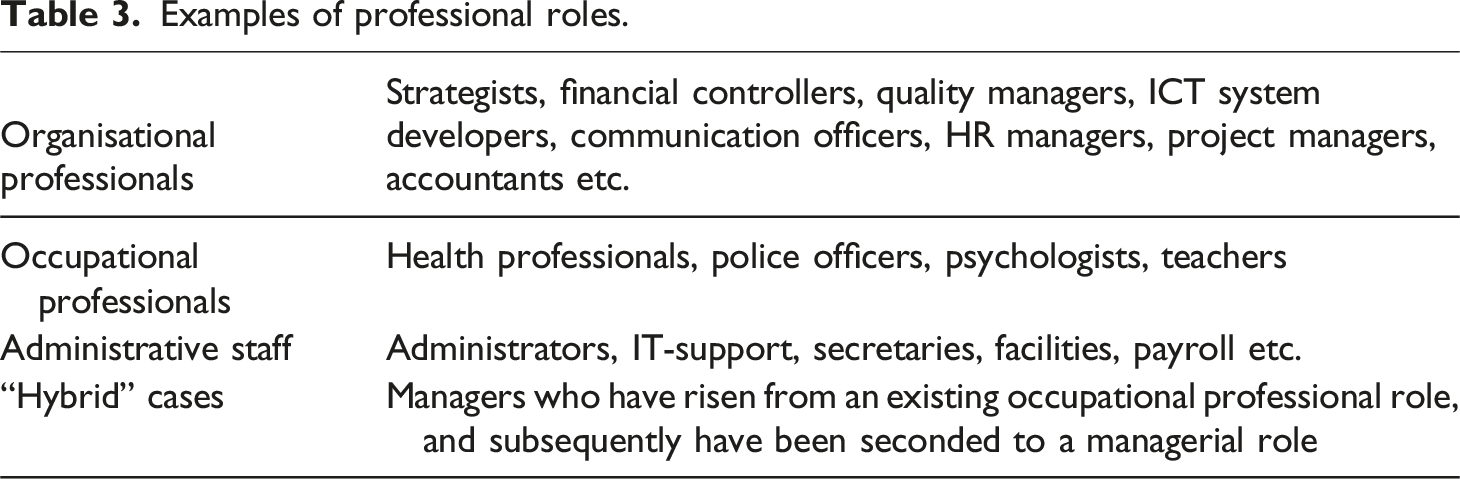
Our categorisation of organisational professionals excludes traditional administrative support staff assigned to routine administrative tasks, such as for example, administrators, office clerks, and IT-support. Organisational professionals are typically generalist graduates (including business studies and social sciences). The group has also recently moved beyond traditional managerial and support functions to also include management consultants, business developers and project managers (Muzio et al., 2011; Reed, 2018).
To label these organisational professionals a “professional” category is not uncontroversial, as some would deem it questionable whether this group fulfils the traditional criteria of professionalisation (monopolistic market closure, restrictive practices, and self-regulation) (Muzio et al., 2011). Nevertheless, from the perspective of professionalism as an expanding project the interesting part of the story is not whether organisational professionals succeed in meeting the definition of professionalism, but rather their professionalising aspirations in pursuing the establishment of their own professional bodies and networks, training programmes, journals and conferences, as well as standards of good practices, and codes of conduct (Noordegraaf et al., 2014).
Along these lines, Evetts (2013) suggests that we think of occupational and organisational professionalism as two different discourses employed to justify professional status. While occupational professionalism draws on notions of self-regulation, autonomy, professional ethics, and collegial authority; the discourse of organisational professionalism builds on notions of control, rules and standardisation, accountability to external audiences, and hierarchy. From this perspective we can expect organisational professionals to build their professionalism on the needs of the organisation rather than adherence to the expertise and ethics of a broader professional collective. This focus on the (internal) organisational pressure may be seen as parallel to the focus upon delegated organisational accountability within modern public sector organisations. The expansion of accountable organisations will shape a demand for actors who can manage accountability. This makes the organisational professional a potential borderline position – externally in the form of managing outside accountability pressure; internally in the form of constructing the accountable organisation based on managerial pressure and professional knowledge. Thus, our classification of the empirical narratives (see below) will focus on external and internal pressure.
Organisational professionals managing and constructing accountability pressure
The chief argument in this article is that the expansion of organisational professionals is linked to an increased focus on organisational accountability. The decentred character of the managerial state implies an increase in accountable actors, that is, bureaucratic organisations, within the public sector. This pattern is highly visible in Swedish public sector reforms as pointed out in section two. This, in turn, generates a demand for monitoring and controlling performance bodies on the part of parental ministries and central agencies. We suggest that organisational professionals can be identified as a form of ‘accountability managers’ devoted to the construction of accountable organisations responding to external performance control mechanisms. Our focus on accountability is far from new. Indeed, many scholars have proclaimed accountability a defining feature of modern societies in the shape of the “audit society” (Power, 1997) or the “evaluation society” (Dahler-Larsen, 2011). Accountability is also considered a central value in public service (Kernaghan, 2003), often used in close association with other ideas, particularly responsiveness, answerability, fault, and blame (Gregory, 2003). Originating from a traditional financial accounting meaning, the term has since the 1990s become synonymous with all kinds of evaluative arrangements through which performance of actors, quality of institutions and processes, and not at least satisfaction among constituents can be recorded, evaluated, presented, and justified. In this article, we will not be able to establish any causal relationships, but rather, by using the stories from the organisational professionals themselves, suggest that such a link exists and ought to be subject to further research.
We follow Bovens (2007) understanding of accountability as a specific social relationship: …accountability is a relationship between an actor and a forum, in which the actor has an obligation to explain and to justify his or her conduct, the forum can pose questions and pass judgement, and the actor may face consequences (Bovens, 2007: 450).
Both the actor and the forum can be individuals but are more likely to appear as organisations. Public organisations are accountable to several different forums. Bovens separates between five different forums constituting different kinds of accountability relationships: political (politicians, voters), legal (courts), administrative (agencies), social (the broader public, media), and professional (professional bodies, unions). Bovens framework captures different types of external accountability relationships on a systemic level, but not the possibilities of intra-organisational accountability relationships. The distinction between external and internal relationships can be difficult to uphold (internal accountability pressure may be claimed to refer to external ones), but we will separate them analytically.
Importantly, our study is aligned with the concept of felt accountability, understood as the expectation that one’s decisions and actions will be evaluated by a forum with the authority to deliver rewards or sanctions (Hall and Ferris, 2011; Hall et al., 2017; Schillemans et al., 2020; Overman and Schillemans, 2021). This approach emphasises how accountability is perceived by involved actors. It constitutes a “bottom up”-perspective on accountability in contrast to “top down”-approaches. Studying formal accountability mechanisms will only provide us with the formal narrative. By bringing on board the actors own perceptions of how accountability relationships matter, we are getting a richer picture of what accountability means to the community practitioners. Thus, we make a slight adjustment to Bovens definition of accountability: accountability is a relation between an actor and a forum, in which the actor feels a need to explain and justify his or her conduct.
Methodology
The unit of observation in this article is how actors make sense of their role within the organisation, as well as how they perceive organisational changes more broadly. We have chosen to adopt an approach inspired by Rhodes work on senior level civil servants in the UK (Rhodes, 2011, 2013) in which ‘stories’ and ‘narrative’ play a central role. While this approach inevitably entails a subjective bias, it does resonate with the everyday life of civil servants. By posing open-ended questions about events, stories, changes, institutions, conventions etc., the researcher is provided with a “snapshot” of how the actors within public sector organisations receive and interpret reforms, the history of the organisation, and the constitution of boundaries between levels and organisational entities. It is important to note that accountability as such was not the dominant focus of our questions, but emerged as a theme as we begun to code our empirical data.
Our questions to the respondents were open-ended and did not follow a rigorous structure. The overall ambition was to capture the respondents’ view of why higher administrative positions were expanding, and how these professional roles were perceived. By doing so, we sought to capture a selection of themes: (a) the individual professional role and function in relation to other roles and functions over time, (b) organisational reforms and restructures within the organisation, (c) the respondents’ view of organisational pressure and changes over time, (d) pressures within the organisation, and (e) external pressures towards their own organisations, including political and legal pressure, and variation over time.
We conducted individual interviews (24) as well as focus groups interviews (five) to capture the perceptions of a total number of 41 respondents. Our sampling of respondents covers both different levels, organisations as well as different professional functions. The selection cannot be seen as representative for the whole Swedish public sector, but still, the respondents reflect a variety of sectors, representing a total of 20 public sector organisations in Sweden, at both central and local levels. A full list of respondents can be found in appendix one.
The 24 individual interviews each had a duration of 60-120 min. The sample of respondents were affected by the fact that the study is part of larger comparative project with a special focus on the Police Force and the transport agency. Thus, 17 of the respondents are related to these sectors, working in various positions, with a mix of professional roles. A few additional interviews have also been conducted within the primary school administration since this sector stands out statistically with an increase of various analysts.
The rationale for conducting focus groups was that we wanted to encourage interaction between organisational professionals with a similar professional background. The five focus groups each consisted of 3-4 participants (in total 11 women and six men) grouped according to their positions as finance officers/controllers (2), communication officers (1), and policy advisers (2). 4 All focus groups lasted for approximately 2 hours. There was an inevitable element of chance in our selection of groups (see note 4), since we wanted persons in similar positions in different organisations, and unknown to each other.
All interviews and focus groups were conducted during the period of 2021-2022 on Zoom, partly due to the pandemic, but primarily because the participants were distributed throughout the country. Research shows that digital conversations tend to be a bit more formal, but also provide space for female participants (Hall et al., 2024). All interviews were audio-recorded and transcribed.
While the interviews and focus groups were semi-structured, the coding followed an inductive and iterative process. As we noticed that increasing pressure on accountability was a reoccurring theme in our respondents’ narratives about the drivers behind the expanding number of organisational professionals, we turned to the literature on accountability for analytical concepts to help guide our analysis. We then used Boven’s categorisation of five different accountability forums (political, legal, social, administrative, and professional) to code our material according to where our respondents placed the source of the accountability pressure. For example, a felt need to respond to performance measurement systems was linked to administrative accountability, while the need to respond to critical enquiries from citizens and media was categorised as social accountability. Furthermore, we noted that our respondents made a separation between accountability pressure coming from “outside” or “inside” the organisation. We therefore used this distinction to further guide our analysis. Although the empirical findings did not automatically emerge from the excerpts, the patterns were clear in terms of aligning the abstract categories of accountability with the assertions from focus groups and interviews.
As a result, the findings section below is structured according to Bovens’ types of accountability forums, as well as the distinction of internal and external sources of accountability pressure. However, professional accountability is left out since we did not find any developed comments about this in the data, despite asking questions about professional identity and background in both the interviews and the focus groups. This way of working should not be seen as deductive – that is, filling in the informants stories in preconceived boxes – but rather as a way of structuring the material and paving way for discussions regarding the potential of accountability pressure as a reason behind the expansion of organisational professionals.
Findings
External accountability pressure: political and social
Our respondents’ view of the degree of political steering naturally varies depending on what sector they are working in, and the proximity to the political leadership. Some of the respondents belong to the top echelons of state agencies and were consequently more subjected to political signals. But there was a general sense of an increasing number of political objectives across various policy fields. The proliferation of political objectives is aligned with increasing public pressures on politicians to deliver results. One respondent, with a long professional experience as a policy analyst within a local government, described the increase in political objectives as a perceived need to demonstrate that problems are being managed, prompting politicians to set objectives for every thinkable area (thereby deflecting themselves from criticism): …I tried to persuade them [politicians] to realise that this is your opportunity to prioritise. To highlight your priorities for the years to come. But they didn’t have the guts to do it. They insisted that everything was equally important. And they tried to articulate objectives for every little unit of the organisation, so that nobody would feel excluded. Because as soon as they would choose to leave out some issue, or prioritise one of them, they would leave them politically vulnerable for criticism of neglecting something (Policy analyst, Local government, interview)
The same respondent argued that such a strategy became counterproductive as it enfeebled the political control rather than bracing it. In effect it hives off the political discretion to prioritise to the administration.
Politicisation is especially felt by those of our respondents who work in education and policing. According to our respondents working for the Swedish Police, the increased media attention, and subsequent public criticism, has mounted pressure on politicians to deliver tangible results with respect to protecting the public. The response so far has been to present new political and quantifiable objectives (such as e.g., recruiting 26,200 police officers by 2025).
According to our respondents, the relationship between politicisation and a growth in numbers of organisational professionals captures a need to satisfy the political calls through recruiting organisational professionals with expertise in policy analysis, evaluation, public affairs, and strategic communication. The professional role is typically to draft strategies and action plans to attain the desired outcomes, and to oversee and manage the performance and visibility of the organisation. Although far from a novel phenomenon, our respondents concur that the political pressure has been on the rise. 5
Our interviews and focus groups also signal a felt increase in social pressure which are sometimes obviously related to the political ones (i.e., a public and/or media opinion leads to reaction from the politicians) The respondents describe a pressure to respond to requests and complaints from the public, as well as a general need to “visualise” the activities of the organisations, and any results achieved. This is particularly prevalent in the educational sector. There is much more pressure on teachers to be accountable. To be able to justify your interactions with pupils and parents […] Teachers are much more accessible today through email or text messages. They run the risk of being filmed and outed on social media. That was definitely not the case when I entered the profession. (Primary school manager and former teacher, Local government, interview)
This felt pressure on social accountability is aligned with the emergence of social media. Since there are no formally sanctioned mechanisms for exercising accountability by individuals, our respondents describe the fear of bad publicity and negative opinion as sufficient to make public organisations feel a pressure to justify their actions in public forums.
This tension between transparency and publicity of the organisation is especially prominent in our respondents’ views on the role of communication officers in the public sector. Some of the interviews and focus groups contemplated the possibility of increasing social pressure as one of the driving forces behind the increased number of communication officers in public sector organisation. This growth has been a talking point in the Swedish public debate with a recurrent claim that the number of communication officers in public organisations are now surpassing independent journalists (making it more difficult to hold public sector organisations accountable). This criticism is felt by the communication officers in the specific focus group on communication professionals, who tend to justify their roles by referring to internal organisational pressure (which in this case is indistinguishable from the external, social pressure): Communication officers is such an easy group to pick on. “What are they doing? What is their purpose? They represent an internal ministry of propaganda distorting the journalists’ “work”, and so on. But my impression is that there are mounting pressure from inside the organisations. They require more and more communication. They want to reach out to citizens and to take the democratic commitments more seriously […] which indicates that we need more communication officers to help them do that. (Communication officer, focus group)
But the felt increase in social accountability is not only aligned with an increased demand for communication officers. One respondent also reflects on a general need for communicative skills that can be provided by higher education. The outside world sets expectations that we in the Swedish Transport Administration are transparent about our operations and can describe how our outcomes match the tax-funded investments. And it is very clear that engineers and technically trained people generally don’t have that skill, while it is a skill that we often see among graduates from the social sciences (Manager, Swedish Transport Administration, interview)
The Swedish Transport Administration is one out of many agencies which has hired an increasing number of graduates with a generalist social science degree in recent decades. In summary, the dominant narrative is that both political and social pressure have been on the rise (but with some variation due to the political saliency and visibility of the sector in question).
External accountability pressure: Legal and administrative
Our respondents argued that legal pressures had increased over time due to a growing formalisation of public sector activities, and a strengthening of the judicial branches of government. They described a development where blocs of legal requirements have been layered on top of each other, leading to an increase in administrative burdens, and the need for more legal expertise within public organisations. One specific instance, mentioned by more than one of our respondents, is the expansion of employment regulation as well as occupational health and safety rules. This has spurred an increase in the number of HR staff in all public sector organisations. Within the educational sector, one of our respondents talks about “juridification” with the introduction of statutory rules aiming to reinforce central control over a decentralised school system, as well as protecting the individual rights of school students. Increasingly, local school authorities have begun to recruit legal professionals alongside new ranks of case officers responding to an increasing number of formal complaints filed by individual students and parents. As described by a school manager, the administration sees itself as a support function that serves to offset the administrative burdens. Our department, Quality and Regulation, are heavily involved with the national regulation. We’ve got legal professionals and analysts who engage with the national educational authorities. If it concerns employment laws or health & safety regulation, it is the HR department. If it concerns legislation on property ventilation and the physical environment, it is Facilities Management. All the regulatory requirements have grown in numbers. It wasn’t like that 20 years ago. If we weren’t there, it would all pile up on the desks of the headmasters. (Primary school manager, local government, interview)
The number of supervisory authorities has grown in Sweden in recent years due to the increase in regulation, as well as the delegation of operative responsibilities to local governments. External administrative pressure is therefore difficult to distinguish from legal pressure as regulation and supervision are intertwined, as illustrated by the example from the educational sector above. However, not all agencies are regulatory, and there are still considerable degrees of flexibility regarding how the regulation should be interpreted. Administrative pressure is described by our respondents as a flow of external pressure for various sorts of information. This pressure can emanate from regulatory supervision but also from a more general ambition to accumulate data on public sector performance for various purposes.
However, there is a possible tendency to amplify this administrative pressure internally. This is a phenomenon which Ivarsson Ivarsson Westerberg et al. (2021) call “administrative snowballing” in the Swedish context, where a number of public authorities are being involved). For instance, the Swedish School Act specifies standardised and continuous “systematic quality management” in all primary schools. This has accentuated requests from the National Agency for Education to local governments to produce and report data (reported in our interviews with respondents working in education). While systematic quality management formally falls within the folds of legal accountability (as a statutory requirement) it is felt like an administrative burden by both school managers and staff. “Snowballing” would here refer to the extensive interpretation of the regulation, for instance by the National Agency for Education, which in turn leads to a perceived need for local governments to employ administrative officers trained in systematic quality management to match the Agency’s requirement.
However, one respondent also refers to policy vagueness as a source of increasing administrative pressure: Generally, there has been an increasing emphasis on control. If there’s no enacted policy or guideline in place, it’s almost as if we were doing nothing. Hence, we need someone to produce these policies and guidelines. The challenge then is that the high-level policies generated on the top echelon levels are not implementable, so you need someone to convert them to something actionable. And once you have created a policy, an action plan, or a routine, you need someone to follow up and report on the results. And so, it goes. It becomes a self-playing piano…. (Policy Analyst, Local Government, interview)
To summarise, our respondents report that the legal and administrative accountability requirements have expanded. However, according to the stories of our respondents, it is not clear whether this is a direct or indirect effect of the national framework regulation.
Internal accountability pressure
Our empirical data demonstrates a visible narrative regarding internal pressure, where organisational professionals attempt to hold other parts of the organisation accountable in line with their responsibilities and statues. However, whether this pressure originates from the inside or the outside of the organisation is debatable, and maybe even controversial since it implies potential “self-criticism” towards the own organisation or actors within the organisation.
In general, the respondents perceive themselves as part of a support function filling the role to alleviate their organisation from administrative chores that would otherwise fill the desks of managers and core professional staff. However, what is also clear from our data is that these “support functions” often moulds itself into internal policies, and subsequently begins to direct other entities of the organisation. In this sense, “support” becomes synonymous with “steering” by the receiving end. This is also illustrated by the fact that many of these functions, such as HR and communication, are increasingly becoming centralised in most organisations. There are plenty of voices, particularly in the focus groups, expressing frustration over how other professional groups within the administration seem to create more for work for the rest of the organisation, rather than delivering value to the organisation. One manager from one of our focus describes it like this: A new organisation has emerged, which we call the “management organisation” which function is to tell us how to work. It’s like an independent profession. You never deliver anything you have produced yourself, but merely tell others what they should deliver. […] The communication officers want to be coaches, so we have 200 communication officers within the agency telling others how they should do their job. We have a legal team which wants to tell others how they should do their job. Meanwhile, no-one wants to help me as a manager! It’s the same with HR, our specialists in recruitment, they will generate nine checklists which I need to consider/ And when I want to hire new staff none of them are ready to roll up their sleeves and support me! (Manager, focus group)
This criticism of HR and communication units as sources of internal pressure is echoed in several of our interviews and focus groups. These are two occupational functions which traditionally have been perceived as “administrative support” but which are aspiring to gain status as professional groups with their own norms and expertise grounded in formalised training programmes. According to several of our respondents, communication offices and HR managers are pursuing more “strategic” positions within the organisations, reflecting a desire to be aligned with management rather than with the operative side. Partly, the ambition is to detach themselves from more operational duties, such as managing individual staff cases (HR), or managing social media accounts (communication). Instead, they wish to coach other managers on functions such as strategic recruitment, or how to transform the organisation to a “communicative organisation” (quote from a communication officer in one of our focus groups). As described by an experienced senior HR consultant with a critical attitude to his own profession Back in the days HR staff were assisting others. Today they are requesting the organisation to assist them. (HR Consultant, interview)
Other HR professionals defend their role as part of management teams by making references to the need to make sure that the organisations adhere to external pressure We really represent a support function, but a part of that support function entails the role to direct them [the managers] towards doing the right thing. […] It’s not like HR being “in charge” just because managers need to consult with us from time to time. But they lack the knowledge about certain aspects, about certain pieces of legislations, or just the formal due processes. (HR officer, the Swedish Police, interview)
This tension between “supporting” and “steering” is something that reverberates throughout our interviews, not only in relation to HR but also regarding the broader group of organisational professionals. Rather than providing support, organisational professionals are often perceived as an internal accountability holder, generating mechanisms which obliges other parts of the organisation to match. Subsequently, the increase in internal accountability mechanisms generates a pressure for more staff in the organisational professional categories. As expressed by a local government communication manager, when one part of the organisation begins to hold other parts accountable, the response is to hire more staff: It follows a similar pattern: I create a policy for the organisation. Other departments then need to hire more staff to answer my questions, which in turn means that I in return must increase the number of staff in order to manage their answers… And all the sudden, we’re stuck with a superstructure that nobody really needs (Local Government Communication Manager, focus group).
One aspect is that the more people getting involved in developing guidelines, the more detailed and burdensome do they become. In the past, we invented our own routines, which in all fairness were a bit rough around the edges, not always perfectly in line with the legislation, things might not have been uniform and so on. Since then, new professional groups with ambitions to have a say about things have entered the scene. The proverbial too many cooks [spoil the broth], you know. The legal team may say “you can’t write this because it won’t hold for so-and-so”, or “you need to add these legal references” etc. This has resulted in more detailed and burdensome guidelines. I keep hearing it from my colleagues who work with [implementing] national guidelines. The time it consumes, and the number of people that must be consulted. (HR officer, the Swedish Police, interview)
In line with this, one of the policy analysts in one of our focus groups (state agencies) responsible for evidence-based reports, argues that the number of people who are signed up to read her drafts of reports have increased significantly in recent years. And the expansion of communication officers in her unit from one to three did not make her life easier.
Related to this growth in administrative support functions, one of the focus groups reflected whether actual accountability is becoming more unclear, at least regarding the limits of the individual mandate. This was partly related in the focus group discussion to pressure on collaboration, where managers are perceived as absent, and the individual officials themselves must work out their purviews. One voice in the focus group even longed for a traditional “Weberian” world of clear-cut hierarchies and formally defined accountabilities.
In summary, and perhaps not surprising, the voices regarding internal sources of pressure is more mixed among our respondents compared to external pressure, but they seem to agree that there are tendencies towards a clearer steering role for what was supposed be a group of support staff. Some organisational professional groups (HR and communications officers) are specifically criticised by other professional groups. There seems to be an element of consensus around a certain unclarity regarding roles, responsibilities, and accountabilities in modern Swedish public sector organisations.
Discussion
Our study represents some initial observations of the dynamics of the new cohorts of organisational professionals’ march into public sector organisations from an accountability angle. First, the need to be able to make the public sector organisations activities and performance visible to an external audience, holding different levels of authority, has created a pressure to recruit staff that can match these obligations including more direct political pressure to act. This trend is also verified in a quantitative study of government letters of appropriation in Sweden (Ahlbäck Öberg and Wockelberg, 2021). Second, the importance of legal and administrative accountability is clearly part of our respondents’ narratives and is consistent with decades of performance-based management and decentred organisational accountability in Swedish public sector organisations. In addition, the phenomenon of administrative snowballing is something which both our respondents and the literature are addressing. Third, there seems to be a view that organisational professionals such as communication and HR officers are pursuing their own conception of how their professional knowledge should be realised (challenging other professional groups). Finally, there are some mixed voices regarding the internal amplification, or even creation of accountability pressure. HR and communication officers are singled out by other organisational professional groups as producing internally generated administrative intensity. However, this “overload” is also associated with the feeling of unclear role descriptions and responsibilities.
In line with an NPM reform agenda, performance-based management has been introduced broadly throughout the Swedish public sector. The ambition to empower public sector managers with individual discretion on how to attain political objectives has resulted in an increasing emphasis on organisational accountability. Maybe the case is that the more accountable actors you bring into the public sector ecosystem, the more administrative staff is needed to manage the pressure for more accountability. However, our study shows that external political and managerial pressure tend to mix in practice. Political salience of an area generates more political requests for action, which translates to measurable organisational performance indicators (highlighting organisational accountabilities).
What we have been presenting in this article are narratives regarding the administrative expansion. We do not exclude other explanatory factors to occupational changes in the public sector work force. More directly associated with organisational professionals as a distinct and growing occupational category is the expansion of higher education which in turn has generated a growth in university graduates leading to a general upskilling and an undisputable professionalisation of administrative staff in the public sector. This group is also increasingly intruding on the territory of the occupational professionals (a proposition far from new, cf. Exworthy and Halford 1999). Unsurprisingly, politicisation, managerialism and professionalisation as driving factors are easy to separate analytically but conflate in practice.
The role of the organisational professionals in this “fusion ” seems to be related to their borderline position between managing external pressure and constructing the accountable organisation internally. The respondents observe a gap between on the one hand vaguely defined requirements from national regulatory bodies, aiming to increase accountability, and the local context where these are supposed to be implemented. This seems to result in a “better safe than sorry” response from subordinated levels initiating even more accountability mechanisms, and subsequent increases in administrative capabilities. This enhancement of administrative capacities can be appraised in two ways, captured by the concepts of support and steering. When interpreted as “support”, the administrative capacity that organisational professionals provide represents a buffer (Meier and O’Toole, 2008) regarding external pressure which supports or protects the operative core (as shown in the Quality and Regulation unit in section 5.2). From a more critical point of view, the organisational professionals hold the power to develop even further mechanisms and to amplify the already quite high level of pressure for external accountability. The newly developed “Quality and Regulation” unit then generates new pressure.
The idea of a “self-playing piano” seems related to interventions from external (e.g., politicians) or internal actors requiring answers, clarifications, new routines, and procedures, which lead to a sense of administrative overload. The function of the organisational professionals is to hold different parts of the organisation to account. When these groups expand, the sense of a self-playing piano will subsequently feel stronger. Guided by a combination of self-serving career interests, and benevolent aspirations for “professionalisation”, organisational professionals tend to align themselves with the managerial side of the organisation. This seems to create even more tensions regarding priorities between the strategic/policy level, and the more operative functions within public sector organisations. Or to put it differently, a tension between the narrative of “good civil servants” and “bad bureaucrats”. The “good civil servant” supports management and the organisation by producing public values to citizens. Meanwhile the ”bad bureaucrat” is involved in a self-serving strife for power internally. This tension may endure in a system where delegated accountability has become a cornerstone of government.
Conclusion
Our findings demonstrates that there exists a discourse on organisational accountability which shapes the identity of certain administrative staff groups, and which paves the ground for organisational restructures. Our results also show that there is a concern among many of our respondents, that public sector organisations are turning into bureaucratic entities with extensive control and reporting mechanisms, and with an increasing proportion of the workforce being involved in setting standards and monitoring and controlling the performance of other staff members rather than being involved in operative functions. The potential bureaucratising effect of rising accountability pressure ought to be highlighted in more critical research on accountability (cf. Schillemans, 2022).
The limitation of this study is obvious. We cannot generalise the findings, and the selection of respondents has been partly arbitrary since they were not invited according to the specific purpose of this article (to inquire into accountability pressure as a driver behind administrative expansion). We suggest two possible avenues for further research. First, the expansion of organisational professionals within the private sector seems to follow the expansion in the public sector (see Table 1 above and Löfgren et al., 2022a). Comparisons with the private sector could possibly throw the role of politicisation in doubt, to the advantage of managerialism and professionalisation, but this is only a qualified guess. Second, the devolved model of the Swedish public sector has several times above been singled out as a factor behind multiplied organisational accountabilities. This calls for comparisons with more centrally governed jurisdictions.
Footnotes
Declaration of conflicting interests
The author(s) declared no potential conflicts of interest with respect to the research, authorship, and/or publication of this article.
Funding
The author disclosed receipt of the following financial support for the research, authorship, and/or publication of this article: This work was supported by the Forskningsrådet för Hälsa, Arbetsliv och Välfärd (2019-01278).

Notes
Appendix
List of interviews and focus groups.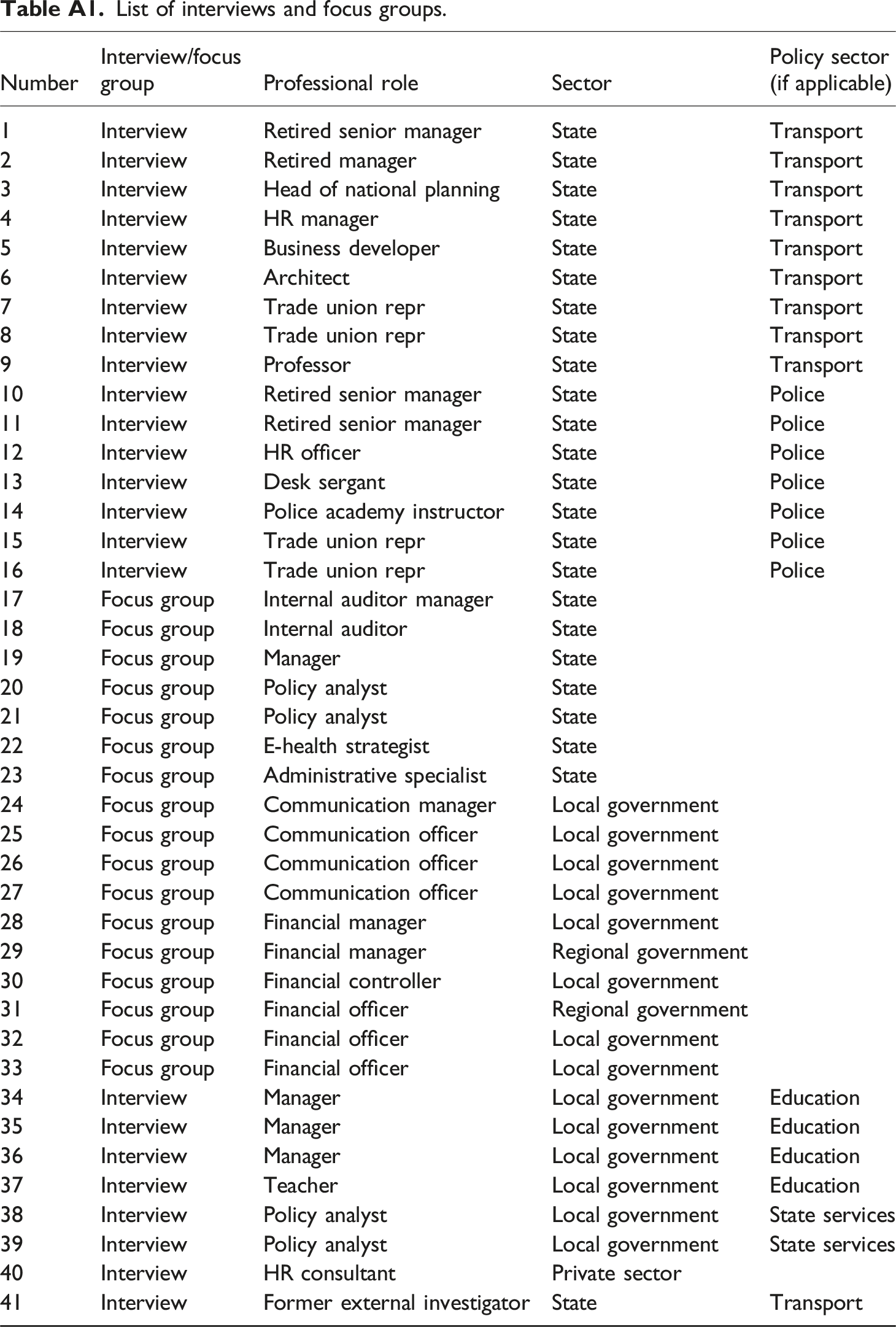
Number
Interview/focus group
Professional role
Sector
Policy sector (if applicable)
1
Interview
Retired senior manager
State
Transport
2
Interview
Retired manager
State
Transport
3
Interview
Head of national planning
State
Transport
4
Interview
HR manager
State
Transport
5
Interview
Business developer
State
Transport
6
Interview
Architect
State
Transport
7
Interview
Trade union repr
State
Transport
8
Interview
Trade union repr
State
Transport
9
Interview
Professor
State
Transport
10
Interview
Retired senior manager
State
Police
11
Interview
Retired senior manager
State
Police
12
Interview
HR officer
State
Police
13
Interview
Desk sergant
State
Police
14
Interview
Police academy instructor
State
Police
15
Interview
Trade union repr
State
Police
16
Interview
Trade union repr
State
Police
17
Focus group
Internal auditor manager
State
18
Focus group
Internal auditor
State
19
Focus group
Manager
State
20
Focus group
Policy analyst
State
21
Focus group
Policy analyst
State
22
Focus group
E-health strategist
State
23
Focus group
Administrative specialist
State
24
Focus group
Communication manager
Local government
25
Focus group
Communication officer
Local government
26
Focus group
Communication officer
Local government
27
Focus group
Communication officer
Local government
28
Focus group
Financial manager
Local government
29
Focus group
Financial manager
Regional government
30
Focus group
Financial controller
Local government
31
Focus group
Financial officer
Regional government
32
Focus group
Financial officer
Local government
33
Focus group
Financial officer
Local government
34
Interview
Manager
Local government
Education
35
Interview
Manager
Local government
Education
36
Interview
Manager
Local government
Education
37
Interview
Teacher
Local government
Education
38
Interview
Policy analyst
Local government
State services
39
Interview
Policy analyst
Local government
State services
40
Interview
HR consultant
Private sector
41
Interview
Former external investigator
State
Transport