




Abstract
Due to a detrimental impact of the COVID-19 pandemic on domestic economies, many countries have considered adopting government programs that can stimulate individual consumption, such as a universal basic income. Since such programs would potentially require greater bureaucratic involvement, how civil servants evaluate the introduction of these programs has important implications for policy implementation. In this study, we develop a vignette survey experiment to understand how the perceived identity of those who drive the development of these programs, from the agenda-setting to the next stage, shapes civil servants’ assessments. Specifically, we propose four different participants with their roles related to the programs in this process as main treatment conditions. Analyzing original data of more than 4000 civil servants from central and local governments in South Korea, we find that civil servants have more positive perceptions when a basic income policy evolves through incorporating academic experts’ advice. We further find that central and local bureaucrats have different preferences, as the former actually consider reflecting demands from the public more important in this process.
Since COVID-19 spread all over the world from 2020 onwards and affected the domestic economy and people’s socioeconomic status in many countries, there has been increasing discussion of the necessity for a basic income in many countries’ politics and media (Nettle et al., 2021). For example, in South Korea, it gained a momentum when disaster subsidies were paid to all citizens by the central government twice, with the third subsidy being paid according to income level, followed by additional disaster subsidies paid separately by some provincial and local governments. The discussion reached a peak when the candidate of the ruling party at the time put forward the introduction of universal basic income (UBI) as an election pledge for the 2022 presidential election, and the idea of adopting UBI was also specified in the priority platform of the major opposition party. Introducing UBI is considered by numerous democratic governments, typically as a means to alleviate poverty, but this time it is the COVID-19 pandemic that has re-activated this discussion, particularly as a way to stimulate individual consumption, because of its detrimental economic impact (Blundell et al., 2020; Nettle et al., 2021).
In this article, we pay attention to on-going social discussions of UBI in the South Korean context, where different groups in the population push forward their demands regarding this subject and aim to get these demands formulated into a bill that will be scrutinized by policy makers. We borrow insights from the models of agenda building and policy participants (Anderson, 2002; Cobb et al., 1976; Jones, 2016) and evaluate who receives greater support in driving the development of a basic income program from the agenda-building (or agenda-setting) to the next stage. According to these frameworks, which outline key actors inside and outside the government in this process, we propose the following four actors: within the government, they are (1) politicians representing policy-making institutions and (2) civil servants representing administrative agencies, and outside the government, they are (3) experts from academia and (4) the public that may shape organized opinion.
We adopt a novel vignette survey experiment to address the question of which policy actors induce greater support within government organizations and how they drive the development of UBI. We propose the four different groups described above with their roles related to the programs as the main treatment conditions of our experiment. We analyze original data of more than 4000 civil servants from central and local governments in South Korea, gathered as representative of the country’s civil service population regarding demographic and civil service characteristics. We find that civil servants have more positive perceptions when a basic income policy is developed through incorporating academic experts’ advice. After separately analyzing responses from central and local civil servants, we further find a nuanced difference in their preferences: while local civil servants still strongly support the evolution of UBI based on academic experts’ advice, central civil servants are actually more supportive of the evolution process reflecting demands from the public.
Our analysis of the data from civil servant surveys in understanding the development of UBI has clear contributions and important implications. First, while much research on the policy process focuses on either agenda building or policy formulation itself, there is little work analyzing the actual process of transitioning from the former to the latter. This is an important oversight, because how the process develops and who leads this development will result in different outcomes for the whole policy process. In pre-decisional social processes, which include not only agenda building but also the transition from agenda building to the next step, finding out which actors create a support base and where (i.e. inside or outside the government) is crucial. In this article, we therefore experimentally test this idea and contribute to the scanty literature on the development of agenda-building into policy-formulation processes by extending the seminal work on policy participants in agenda-setting processes (Cobb et al., 1976; Jones, 2016), as well as building on the recent literature on the political feasibility and implementation of UBI (De Wispelaere and Noguera, 2012; De Wispelaere and Stirton, 2013), including the perspectives of civil servants―a crucial group in policy implementation.
Second, recent behavioral and experimental research provides more concrete evidence of why clearly understanding civil servants’ perceptions is important for the implementation of government programs, and our analysis adds value to the behavioral public administration literature by particularly focusing on the implementation level (e.g., Ewert et al., 2021; Lee and Park, 2024; Sanders et al., 2018). Civil servants are likely to develop specific stances towards the policies they implement (Simon, 1997), and these stances reflect their preferences for certain policies, which in turn influence policy implementation (Andersen and Jakobsen, 2017). Abundant evidence suggests that, in order to be motivated or willing to implement policies, civil servants need to find the meaningfulness of policies (e.g., Tummers et al., 2009), that is, to perceive that the policies are valuable for society and clients (Thomann et al., 2018). Moreover, any government program that gives negative or harmful impressions to civil servants may not be performed properly (Huber and Shipan, 2002; Lipsky, 2010; O’Toole, 1986), as civil servants’ decision making is based on their own perceptions of reality (Ajzen and Fishbein, 1980). Indeed, existing literature demonstrates that civil servants’ perceptions of policies significantly influence policy outcomes across various domains (Burden et al., 2012; May and Winter, 2009). Since basic income programs potentially require greater bureaucratic involvement, it is reasonable to expect that how civil servants see these programs at the pre-decisional stage strongly shapes how they will be implemented once enacted. Likewise, returning to democratic theory, Cobb and Elder (1972/1983: 163) also noted the importance of pre-decisional social processes in “determining what occurs at the decisional stage and the types of policy outcomes that will be produced” (quoted in Jones, 2016: 29).
The rest of this article is structured as follows. In the next section, we first conceptualize UBI and provide its characteristics as a distributive policy. Then we discuss the development of UBI from the pre-decisional stage and the main participants in this stage, followed by our hypotheses formulated based on the literature as well as the surrounding context. In the empirical section, we first present our experimental design and describe our survey samples. Then we report the results of our statistical analysis, highlighting the main findings. We conclude by discussing the results not fully conforming to our predictions, the main contributions of the article, and the implications and limitations of our analysis.
Universal basic income and its characteristics as distributive policy
According to the Basic Income Earth Network (BIEN), 1 basic income, also known as universal basic income (UBI), has the following main characteristics: paid in cash, to every individual, unconditionally, and on a regular basis. In this sense, it is distinguished from other types of subsidies, such as one-off stimulus funds, temporal or contingent subsidies, and special purpose vouchers (Torry, 2019), as it tends to be more perennial. Due to a detrimental impact of the COVID-19 pandemic on domestic economies, some countries have already adopted temporary government programs that can stimulate individual consumption, such as the disaster relief fund. In the face of enduring challenges and persistent disruptions from the pandemic, countries are further considering adopting a government program such as UBI. The goals of UBI are clear: to reduce poverty and substitute for other need-based social policies that may necessitate expansive bureaucratic involvement.
UBI can be classified as a typical distributive policy, as it aims to encourage individuals’ activities, such as individual consumption that boosts the domestic economy, that are regarded as desirable or beneficial for society as a whole (Ripley and Franklin, 1982). Distributive policies are associated with widely distributed costs and benefits—almost every citizen pays a price and gets a benefit—so that they are usually characterized by low-level conflicts over the supply of goods and services (Lowi, 1972). As Wilson (1989/2019) describes, it involves “majoritarian politics,” where they are “broad and vague enough to permit the agency to behave in ways that would not stimulate the formation of a hostile interest group (82).” Given dispersed costs and benefits, although an element of political tension may be involved in the policy-making stage, players and beneficiaries surrounding the allocation of goods and services are perceived as not competing with each other.
Not surprisingly, as also taking place in South Korea’s local government, provisional trials of the policy, together with direct stimulus payments through COVID-19 relief funds, have led to an unprecedented magnitude of attention to and interest in UBI in many developed and developing countries (Jordan et al., 2022). Yet, there is little consistent evidence of how a large-scale basic income policy has been driven from the agenda-setting stage. For example, in Finland, the country regarded as a frontrunner in the European basic income debate, it was primarily driven by Juha Sipilä’s center-right coalition government, which designed and conducted the first national basic income experiment between 2017 and 2018 (Halmetoja et al., 2019). In France, which has attempted to introduce a basic income policy that fully conforms to the definition of UBI, it was initiated by two scholars who created the BIEN, which in turn resulted in the adoption of a need-based social program by the French government (Choi, 2019). In Switzerland, the country that has also tried to introduce UBI, it is mainly public opinion that has acted as a gatekeeper in adopting a basic income system. Overall, in adopting (or deciding not to adopt) one form or another of basic income program, there have been different participants initiating and influencing the process in each country, but there seems to be no consistent pattern of how the “built” agenda has developed into the next phase. In the next section, we thus discuss which actors participate in and drive the process as key stakeholders of UBI, given its nature as a distributive policy, borrowing insights from actor-based theories of public policy.
Development of UBI from pre-decisional stage and main participants
As argued by Jones (2016: 25), it is Cobb and Elder (1972) who undertook the first systematic academic evaluation of the pre-decisional element of the policy process—a part of the process that takes place before open conflict over policy choices. Cobb and co-authors (1976: 126), who call a major part of this process “agenda-building,” define it as “the process by which demands of various groups in the population are translated into items vying for the serious attention of public officials.” It was clear that a pre-decisional phase existed in the politics of the policy process, but scholars tended to dismiss the idea of discussing such a phase, assuming that the phase was unobservable and the idea not scientific. Nonetheless, the non-decisional stage of the policy process, where institutional decision-making bodies actively and seriously consider a set of concrete items, is successfully conceptualized as an “institutional agenda” (Cobb and Elder, 1972: 906).
As clearly stated by Cobb et al. (1976), “an essential characteristic of any polity” is how “different groups participate in the process of policy formation (126).” Such a process can be also described as “the relationship between mass participation and elite decision making (Cobb and Elder, 1972: vii).” This point was re-iterated by other scholars who also emphasize the importance of theories of policy processes. Sabatier (1991), through his argument for the necessity of “better theories of the process”, said, “Any theory of the manner in which governmental policies get formulated .. requires an understanding of the behavior of .. governmental institutions (legislatures.. administrative agencies, chief executives), as well as the behavior of .. the general public.. (147).” Zahariadis (2016) puts the interactive relationship between participants at the center in referring to agenda building.
The question is, who are the major participants in agenda building that drive the process into the policy formulation stage (see Figure 1)? While there has been little theoretical discussion on this, the three models of agenda building developed by Cobb et al. (1976)— 1) the outside initiative model, (2) the mobilization model, and (3) the inside initiative model—provide insights useful in seeking an answer to the question, because they introduce key participants in the agenda-building process who can potentially play this role. Development of policy processes: From agenda building to policy Formulation.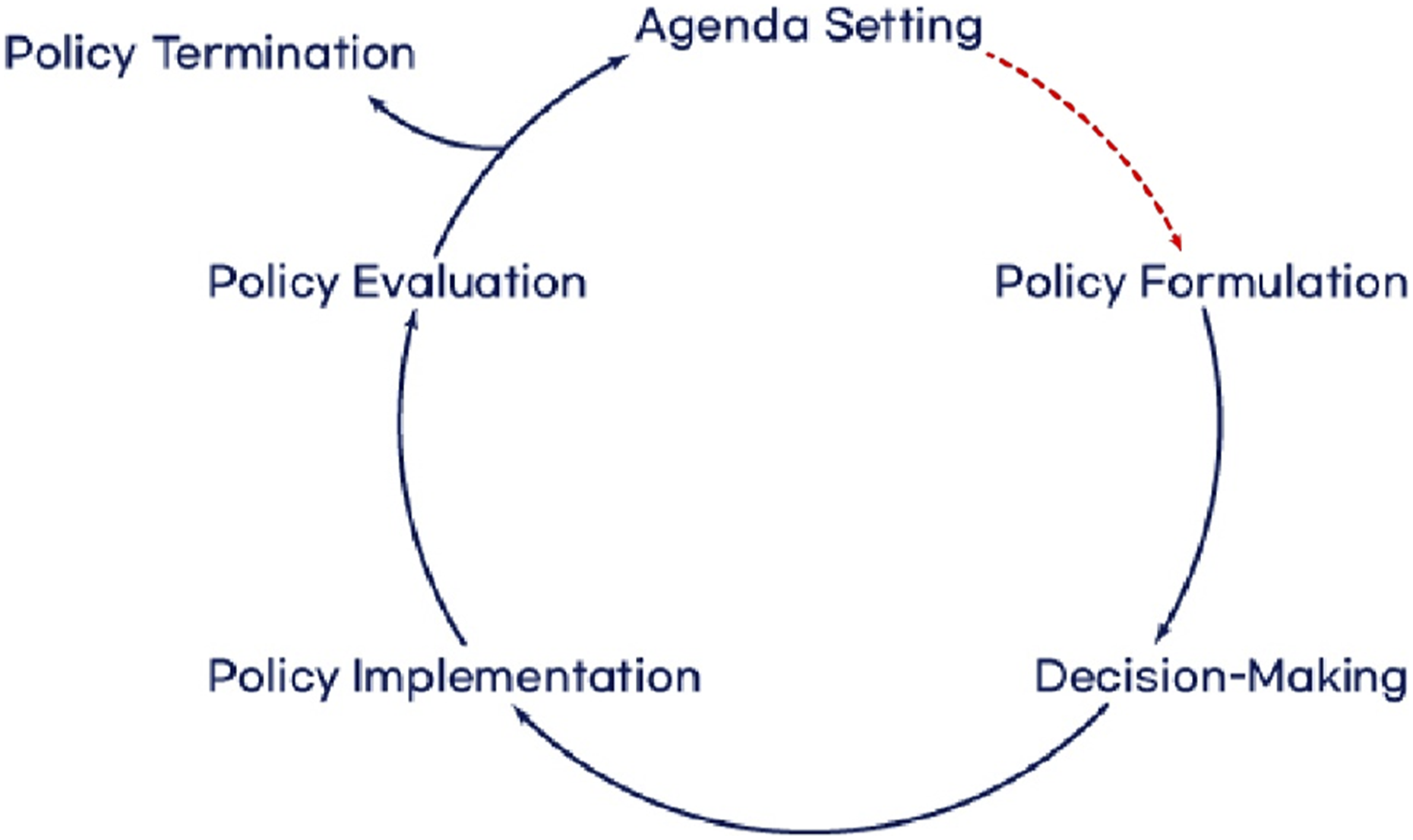
The first model—the outside initiative model—explains the process where issues arise outside the government among nongovernmental groups, such as external experts from academia or organized groups in the public. The second and third models—the mobilization and the inside initiative models—both describe the process where issues are raised inside the governmental sphere, but the former considers issues expanding to the public agenda to garner broad public support, while the latter keeps the issues inside the government, rather than expanding them to the mass public, by creating a support base within the government. Given the nature of a basic income program as a distributive policy and the patterns from developed democracies described in the previous section, we believe either the outside initiative model or the mobilization model is suitable to the participatory processes of a basic income program. These key participants are also reiterated by Anderson (2002) who list important formal (actors inside the government such as legislators and administrative agencies) and informal (external actors such as academic researchers and citizens) policy participants in the policy process.
Therefore, we focus on the following four groups whose demands and roles are likely to be considered important in the formulation of a basic income policy: within the government, (1) politicians representing policy-making institutions and (2) civil servants representing administrative agencies, and outside the government, (3) experts from academia and (4) the public that shapes organized opinion.
Hypotheses: Influence of key policy participants in agenda building
According to Cobb et al. (1976), while the outside initiative model of policy agenda-setting is common in developed democracies, for policy issues requiring high levels of expertise such as economic policies the government-led mobilization model often emerges first, and such issues then transform into public agenda. UBI, as a policy proposal, intersects economic, social, and political dimensions, making it challenging to explain who drives its introduction. According to Anderson (2002), the influence of the policy participants is often considered in the policy environment (see Lee et al., 2024), which concerns political, economic, and social conditions of the case discussed. We thus examine the four groups likely to be involved in the agenda-setting process of introducing UBI, namely academics, civil servants, citizens, and politicians, not only theoretically but also in the actual context, where the issues concerning UBI have been debated, and discuss what their actual roles or demands are in agenda building.
First, expert knowledge is often helpful for making more logical decisions on the direction of policy making and implementation (James and Jorgensen, 2009), and academic research has made significant contributions to such knowledge. Since knowledge from academic experts is typically used throughout the organizational process, including agenda building and policy formulation, innovation, and enforcement (Canary and McPhee, 2009; Hwang and Moon, 2014), it is also easily expected that scholars in the relevant field will play a role in shaping UBI as the public agenda. Scholars contribute to the agenda-building process in several aspects: they can provide expertise on the practicality of the planned program, and the sustainability of the formulated policy (Clinkinbeard, 2014; Schlesinger, 2009). Moreover, scholars influence policy through knowledge development (Elmore, 1979). Given the characteristics of scholarly contributions, among several debating points raised in past research on UBI (Groot and Van der Veen, 2011; Torry, 2019), such as whether or not to pay universally to all, including high-income earners, it is likely that academic experts can propose an inclusive plan but also make it realistic, for example, by suggesting recovering a certain proportion from high-income groups through taxable income.
In South Korean academia, there has been a clear position on the direction of the formulation of UBI. The discussion of UBI initially took place in the early 2000’s and gradually took shape over time. From the late 2010’s, debates over UBI were centered around the practicality and feasibility of the program, mainly focusing on the effects of introducing UBI as well as the pros and cons of adopting such a program (Seo, 2019). Among scholars who argue for its introduction, they draw attention to the redistributive effect of the basic income system itself (e.g., You, 2018), pointing out that the relative income gap between high- and low-income earners will become narrower after the adoption of the program. Therefore, if academic experts play a leading role after the agenda-building process, the basic income program might be formulated in such a way that all citizens are paid universally but as taxable income, so that a certain share of the payment is retrieved from high-income groups.
In sum, given that even policy research institutes affiliated with local governments in South Korea have actively produced academic papers and reports on the potential effects of UBI implementation (Yoo, 2022), we expect civil servants to have a positive view of academics and their role in leading the UBI agenda-building process.
Civil servants will positively assess UBI policy led by academics and their role in the agenda-building process, compared to the absence of such conditions. Second, in making and implementing need-based social policies, such as UBI, an expansive role of bureaucrats is typically expected, because the characteristics of such policies themselves potentially require greater bureaucratic involvement. For this reason, civil servants can also be main players in the pre-decisional stage when these policies start being shaped as the public agenda. Active participation of bureaucrats in the policy agenda-setting process also tends to expand and diversify the policy agenda (Baekgaard et al., 2018). In relation to recent research on UBI and the essential roles of a bureaucratic agency, most scholars point out the importance of identifying the program’s financial resources and proper beneficiaries (e.g., Ciaian et al., 2019; De Wispelaere and Stirton, 2013). Therefore, if the UBI proposal that reflects the position of civil servants in the relevant field is considered, what comes together in this discussion will involve the financial and administrative feasibility of the reform, so that it does not necessarily rely on bureaucrats’ sacrifices, such as labor or compensation costs from the public sector, as actually happened with some countries’ disaster subsidies. There is no doubt that civil servants, who are familiar with the field of a basic income policy and will actually implement this program, are involved once it is adopted as a formal policy in South Korea. Recent research on civil servants’ perceptions in the Korean context suggests that civil servants are more motivated to implement a policy when they perceive that the policy is valuable for their principals (Lee and Park, 2021). Given that civil servants are the participants in the process who are likely to know best about the benefits and costs of a distributive policy, such as UBI, to citizens and the whole society, they may realistically view the development of such a program from the agenda-building stage. At the same time, civil servants are likely to take a clear position about its feasibility if it goes beyond provisional trials, as done by central and some local governments during the COVID-19 pandemic. Therefore,
Civil servants may neither positively nor negatively assess UBI policy led by civil servants and their role in the agenda-building process, compared to the absence of such conditions the absence of such conditions. Third, the public and its opinion matters as recipients of public services. Recent studies continue to demonstrate that the public can exert influence on government policy agenda-setting, either through interest groups (Banafont, 2016; Jones and Baumgartner, 2004) or through more direct and individual means such as petitions (Birkland, 2017; Protess and McCombs, 2016; Zahariadis, 2016). Consequently, various studies have examined citizens’ opinions on the introduction of UBI and how these opinions are reflected in policy formulation (Kim et al., 2024; Van Hootegem and Laenen, 2023; Weisstanner, 2022). Moreover, one dominant body of recent research on UBI focuses on individuals’ support for the policy, asking to what extent they support UBI and what is attractive or objectionable about a UBI to the public in various countries (e.g., Jordan et al., 2022; Rincon, 2023). At the same time, what is discussed as equally important in the literature is how public opinion concerning an issue will be successfully organized, so that it can attract the attention of decision makers (Cobb et al., 1976): it better applies to the situation where a group outside the government structure articulates a demand and “tries to expand interest in the issue to other population groups to gain a place on the public agenda,” so that it creates “sufficient pressure on decision makers to force the issue onto the formal agenda for their serious consideration” (p. 132). In this regard, citizens who support UBI can leverage a formal channel, such as the online platform of the official government website, which is open to everyone, and may use public petitions to mobilize support from other people, as a means to easily attract attention from decision makers.
2
In reality, views from South Korean citizens about the introduction of UBI have varied over time. In June 2020, when the central government decided to pay emergency disaster subsidies to the whole household, which was followed by debates over whether or not to adopt the basic income system, there were more approving than opposing (48.6% vs 42.8%), as the former group see it as helpful for the safety of people’s livelihoods.
3
Yet, in January 2022, when a candidate from the ruling party proposed it as one of his campaign promises, there were actually more opposing than approving (49.3% vs 42.9%) opinions.
4
This means that in the future, if supporters of UBI want to successfully mobilize enough approving views, so that they can force the basic income issue back onto the formal policy agenda for decision-makers’ serious consideration, they may leverage a more effective formal channel, such as public petitions to the Blue House via the president’s office website,
5
to facilitate the attracting of the decision-makers’ attention.
Civil servants will positively assess UBI policy led by organized citizens’ opinions and their role in the agenda-building process, compared to the absence of such conditions.
Lastly, in terms of politicians representing governmental institutions, they are traditional players who are expected to participate even before the policy-making stage. A stylized model of the political economy of UBI points out three key components in shaping basic income, and one of them is (political) “coalitions” (De Wispelaere and Yemtsov, 2020). Coalitions designate political agents who are involved in the process, support the policy proposal (contrary to opposing), and will adopt and implement the policy (De Wispelaere and Yemtsov, 2020). Generally, they are from the ruling party or coalition of parties. However, given that UBI might not be a part of major parties’ political platforms (see e.g., Adkins and Ylöstalo, 2021; Caputo, 2012; Chrisp, 2017; Gourevitch and Stanczyk, 2018; Groot and Van der Veen, 2011), attracting and consolidating political support for the policy proposal may vary over time.
6
For this reason, politicians leading central or local governments may leverage political momentum to build supporting coalitions for the policy proposal. For example, a typical example could be listing the UBI proposal as part of a campaign platform during election periods, in order to convince voters to believe that it will help to revitalize the economy. In South Korean politics, the major opposition party, the United Future Party, who lost the general election in April 2020, officially announced that it would introduce UBI as its prior policy agenda. In late 2021 and early 2022, the subject was in the spotlight when the ruling party candidate for the coming presidential election proposed the adoption of UBI as one of his campaign promises. Then in April and May 2022, it was picked up by many candidates running for local elections, which were held in June 2022, who promised that they would adopt UBI targeting local residents who are farmers, students, or youth.
7
This indicates that, as predicted, politicians are willing to leverage election timings by proposing UBI as a part of their campaign promises and attempting to attract support more broadly, even if it would be a temporary measure. In sum, political leaders’ commitment and support, particularly for complex policies, significantly influence bureaucrats’ attitudes and actions (Peters and Pierre, 2001, 2004; Svara, 1999). Since civil servants are also aware of the necessity of political support in moving policy agenda forward from the pre-decisional stage, we predict:
Civil servants will positively assess UBI policy led by political leaders and their role in the agenda-building process, compared to the absence of such conditions.
In addition, within the civil servant group, we might see a discrepancy between central and local civil servants in their view of the formulation of a basic income policy, according to the literature. While central civil servants’ main clients are often broader and more ambiguous as the central government serves the entire population of a country (Rheem and Jeong, 2012), local civil servants have a more clearly targeted group as their main clients since local governments serve only a limited territory. This difference in defining their key clients leads them to set different types of goals and seek different values: symbolic goals and democracy for central civil servants but specific goals and effectiveness for local civil servants (Epstein et al., 1992; Rogers, 1990). The potential for divergent perceptions of specific policies between central and local civil servants is further supported by existing research, which suggests that local civil servants tend to be more innovative and risk-taking in policy adoption compared to their central counterparts (Borins, 2002; Walker, 2006). As a result, the latter are likely to adopt more practical and realistic approaches while the former adopt more symbolic ones as agenda building shifts toward the policy formulation process. In sum, we thus expect that
Local civil servants will more positively assess UBI policy led by academics and their role in the agenda-building process, compared to central civil servants.
Central civil servants will more positively assess UBI policy led by organized citizens’ opinions and their role in the agenda-building process, compared to local civil servants.
Research design: A survey experiment
We adopt a novel research design that employs a unique survey design of vignette experiment and incorporate a field experimental aspect by conducting the surveys at civil servants’ workplaces. This type of design has been widely used in recent civil servant surveys to understand the impact of various policy environments on policy implementation (e.g., Lee et al., 2024). When evaluating various conditions concerning UBI within and outside the government, ensuring that respondents are randomly allocated to control and treatment groups is important, because civil servants’ actual assessments of such conditions may not be randomly distributed across employees with different policy views. That is, some civil servants who have more positive perceptions of UBI might be more likely to pursue information about its development than would civil servants with less positive perceptions. Our experimental design reduces these potential issues.
The basic design of a vignette experiment is straightforward. We first randomize respondents into treatment and control groups. Then we ask respondents assigned to the treatment groups to show their opinion toward treatment conditions, that is, a set of systematically differing descriptions of objects or situations. These responses are compared with a control group’s responses to a control condition—the answers to the same question without the collection of vignettes. In measuring the differences in support between the treatment and control groups within each dimension, the estimation based on the differences in support between the two groups may produce either positive or negative outcomes of the treatment effects, or those not statistically significant. Higher levels of support for a basic income system with a vignette relative to the one without it (i.e. positive and statistically significant) are considered as evidence of approval for the described actor or object, but lower levels of support for the system with a vignette relative to the one without it (i.e. negative and statistically significant) are regarded as evidence of disapproval for the described actor or object (Faulk et al., 2020). Therefore, the larger the difference in support between the treatment and control groups, the larger the treatment effect on approval or disapproval.
Specifically, in our survey experiment designed to evaluate civil servants’ preferences regarding the introduction of the basic income system, approximately one fifth of the randomly selected respondents were presented to the control condition. 8 The other four fifths of the respondents were randomly assigned to the following four treatment conditions with equal probability (additional text compared to the control group marked in bold). Here, we reproduce our vignette questions, asking civil servants to assess their view on the introduction of the basic income program:
Control group
As part of the response to the COVID-19 crisis, there have been expanded discussions about the payment of additional disaster funding and the introduction of a basic income system, thanks to the consumption boosting effect of the disaster subsidies provided by the central and local governments. What do you think about the introduction of the basic income program?
Treatment group I (Academics)
As part of the response to the COVID-19 crisis, there have been expanded discussions about the payment of additional disaster funding, followed by the introduction of a basic income system thanks to the consumption boosting effect of the disaster subsidies provided by the central and local governments. Some scholars are pushing for a plan to pay universally to all, but to include it in taxable income to recover a certain percentage from high-income earners. What do you think about the introduction of the basic income program?
Treatment group II (Bureaucrats)
As part of the response to the COVID-19 crisis, there have been expanded discussions about the payment of additional disaster funding, followed by the introduction of a basic income system thanks to the consumption boosting effect of the disaster subsidies provided by the central and local governments. Measures that directly reflect the opinions of civil servants who are familiar with the policy field are being considered, for a payment policy that goes beyond securing emergency financial resources through sacrificing some costs from civil servants. What do you think about the introduction of the basic income program?
Treatment group III (Public opinion)
As part of the response to the COVID-19 crisis, there have been expanded discussions about the payment of additional disaster funding, followed by the introduction of a basic income system thanks to the consumption boosting effect of the disaster subsidies provided by the central and local governments. Many citizens may support the implementation of the policy through public petitions to the Blue House, saying that it is a policy that can be helpful for the safety of people’s livelihoods. What do you think about the introduction of the basic income program?
Treatment group IV (Politicians)
As part of the response to the COVID-19 crisis, there have been expanded discussions about the payment of additional disaster funding, followed by the introduction of a basic income system thanks to the consumption boosting effect of the disaster subsidies provided by the central and local governments. Political leaders of the central and local governments are positively reviewing the adoption, even if it is a temporary measure, if it can revitalize the economy. What do you think about the introduction of the basic income program?
Respondents’ answers were recorded on a five-point scale, ranging from “very negative (1)” to “very positive (5),” which is the main dependent variable of this study. Figure 2 shows mean responses to this question. The pattern shows that civil servants’ responses differ significantly between control and treatment groups as well as within each group. This variation seems to be a positive sign as it indicates that our question has strong discriminatory power. Mean Responses by Group: Civil Servants’ Assessment.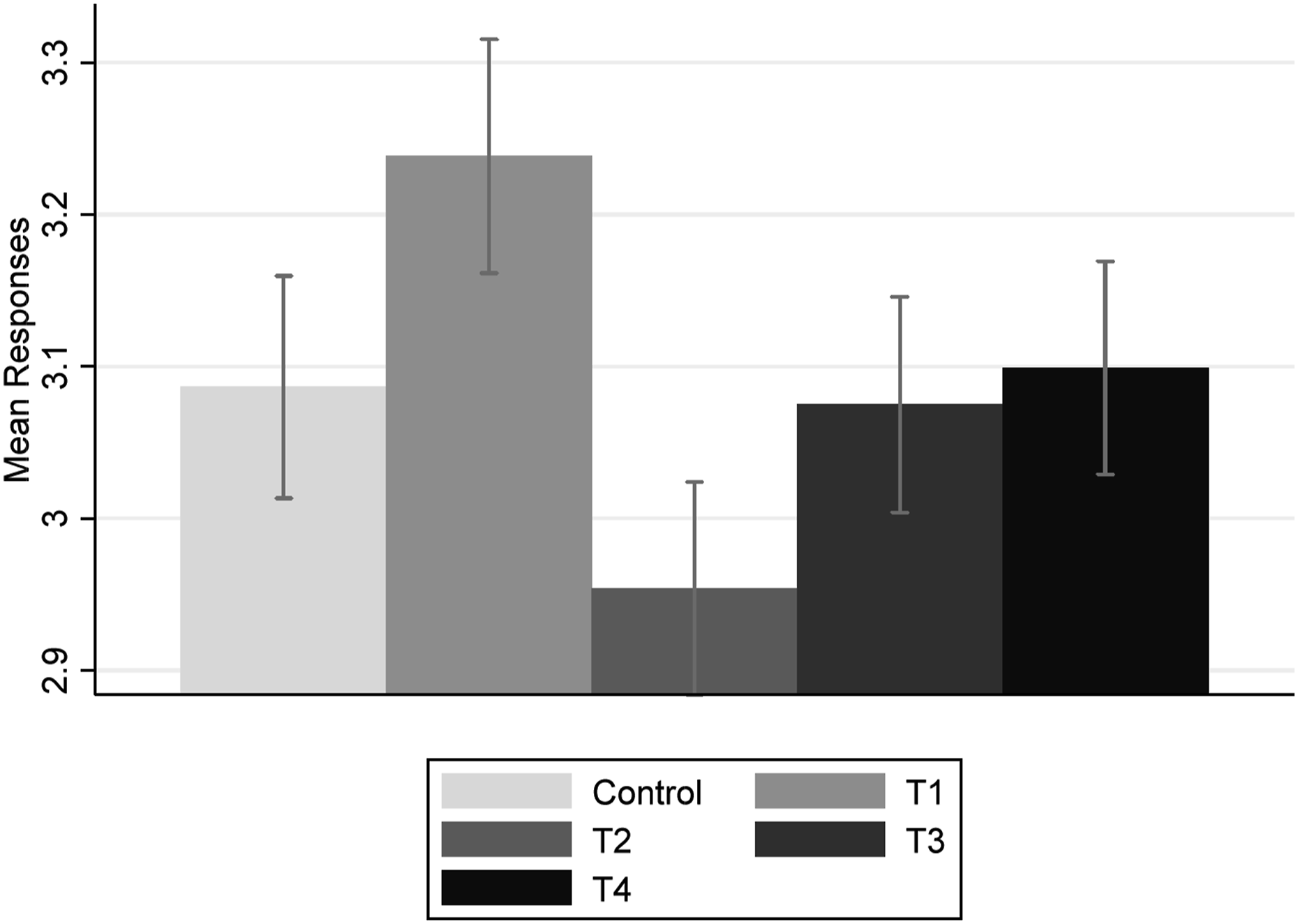
First, the pattern in Figure 2 suggests that civil servants have the most positive perceptions when academic experts play a role in the agenda-building process, and the basic income program is formulated in such a way that all citizens are paid universally but as taxable income, so that a certain share of the payment is retrieved from high-income groups. Under these treatment conditions, civil servants highly evaluate the idea of introducing the basic income program (difference in means: .150, p < .01).
Second, by clear contrast, civil servants have the most skeptical views when the opinions of public officials in the relevant policy field are directly reflected, and resources for the basic income program come from more stable sources than emergency ones obtained via sacrificing some costs from public officials. Under these treatment conditions, civil servants show fairly reduced levels of support for the idea of adopting the basic income system (difference in means: −.123, p < .05).
In addition, the two other treatment conditions — the formulating process of the basic income program is shaped by (1) organized public opinion whose supporting view is channeled through a formal channel, such as public petitions to the Blue House, and (2) political leaders for the purpose of revitalizing the economy even as a temporary measure — result in not statistically significant outcomes. Below, in the empirical section, we further attempt to validate the results of our survey experiment through a more sophisticated regression analysis.
Sampling and balance
Our survey experiment was conducted as part of the Public Performance and Management Survey, which took place from December 2020 to March 2021. The original survey includes 1404 participants from 42 central government agencies and 2863 participants from 245 local government agencies in South Korea. Our samples were drawn from all government agencies accessible for survey research, representative of the country’s civil service population regarding demographic and civil service characteristics. South Korea’s civil service system is merit-based, and most of its entry-level recruitment is done through centralized examinations at grades 5, 7, and 9 (high-low) for central government agencies and at grades 7 and 9 (high-low) for local government agencies.
Survey respondents were recruited by Hankook Research, one of the largest survey research firms in South Korea. 9 The survey questionnaires were distributed to civil servant respondents at their workplaces based on a stratified sampling method, using the following stratifications: civil service rank, recruitment type, and gender. All survey samples were randomly allocated to control and treatment groups, and completed the surveys in private (response rates approximately 35%). Of the 4236 completed questionnaires, 845 (19.9%) are from the control group and 3391 (80.1%) are from the four treatment groups, where each group has a range of 839 to 856 respondents, making the respondent rates for the treatment and control groups similar.
Regarding our covariates, for demographic characteristics, we have data on age (in years), level of education (1 if no higher education, two if having completed a two-year program in community colleges, 3 if holding a BA from a four-year program as the highest degree, 4 if holding an M.A. as the highest degree, and 5 if holding a PhD degree), and gender (0 if male, 1 if female). For employment characteristics, we have information on job category (0 if technical or others, 1 if administrative), civil service rank (1 if grade 9 (lowest), two if grade 8, 3 if grade 7, 4 if grade 6, 5 if grade 5, and 6 if grade 4 or higher), recruitment path (0 if open recruitment, 1 if centralized civil service examination), and private sector experience (0 if no experience, 1 if more than a year of experience). For political characteristics, we have information on policy position (1 if very conservative, two if conservative, 3 if neutral, 4 if liberal, 5 if very liberal).
Balance test: Characteristics of respondents by group.
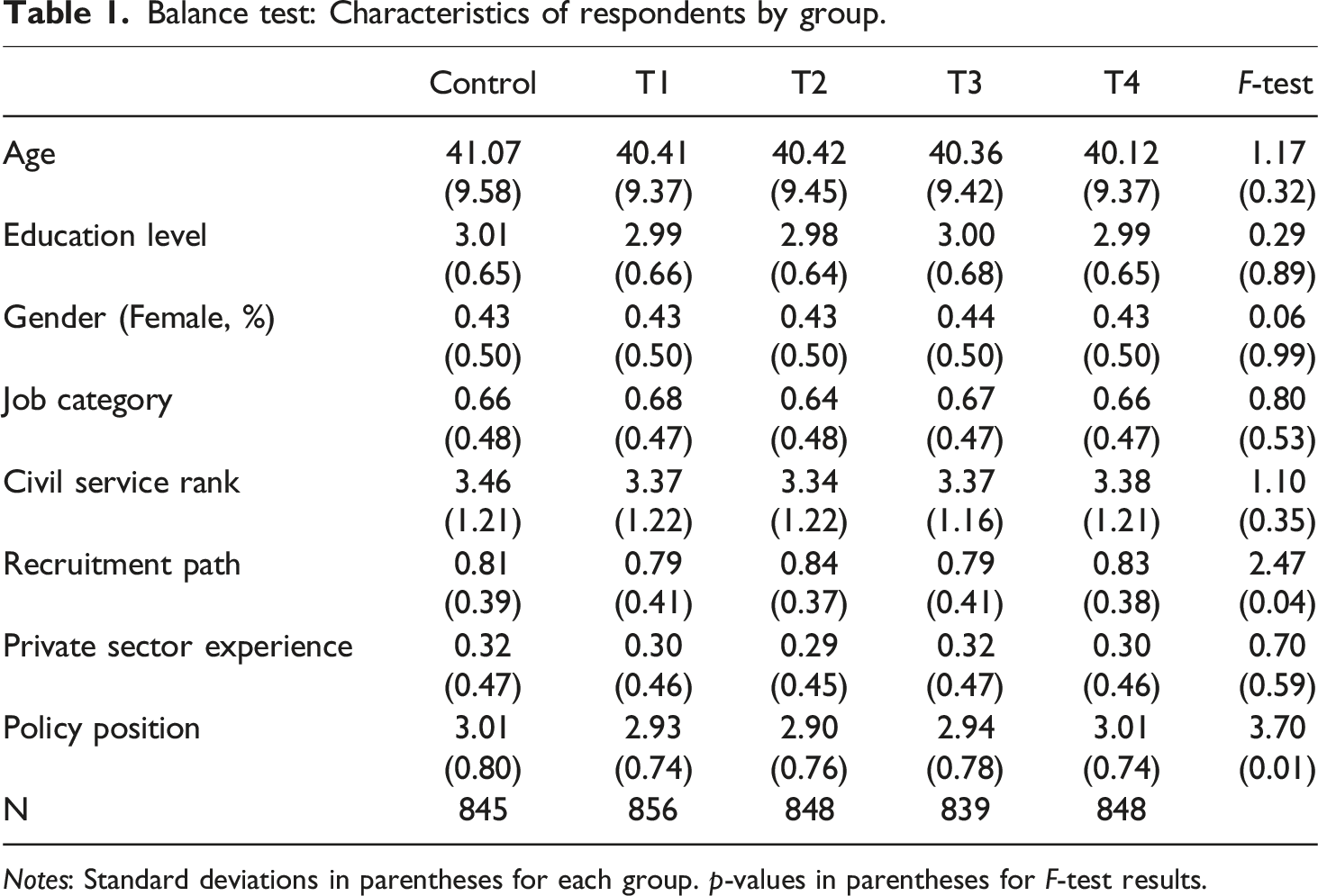
Notes: Standard deviations in parentheses for each group. p-values in parentheses for F-test results.
Analysis and results
Methods
In order to examine whether civil servants’ assessment of the introduction of the basic income system is conditional on diverse participants and their roles in the development process of agenda building, we employ statistical models and analyze the original data from our survey experiment. Since the main dependent variable of this study is the responses in a five-point scale (i.e. civil servant assessment), we employ ordinary least squares (OLS) models to facilitate interpretation and graphical displays. A simple regression model estimating the effect of treatment conditions on civil servant assessment is described in the following equation:
Given the dependent variable is ordinal, we also run ordered logit analysis and provide the results in the appendix (Tables A1 and A2) for robustness. All our statistical models include control variables described in Table 1, as well as agency fixed effects to account for unobserved heterogeneity across organizations.
Findings
OLS regression analysis: Civil servants’ assessment, all samples.
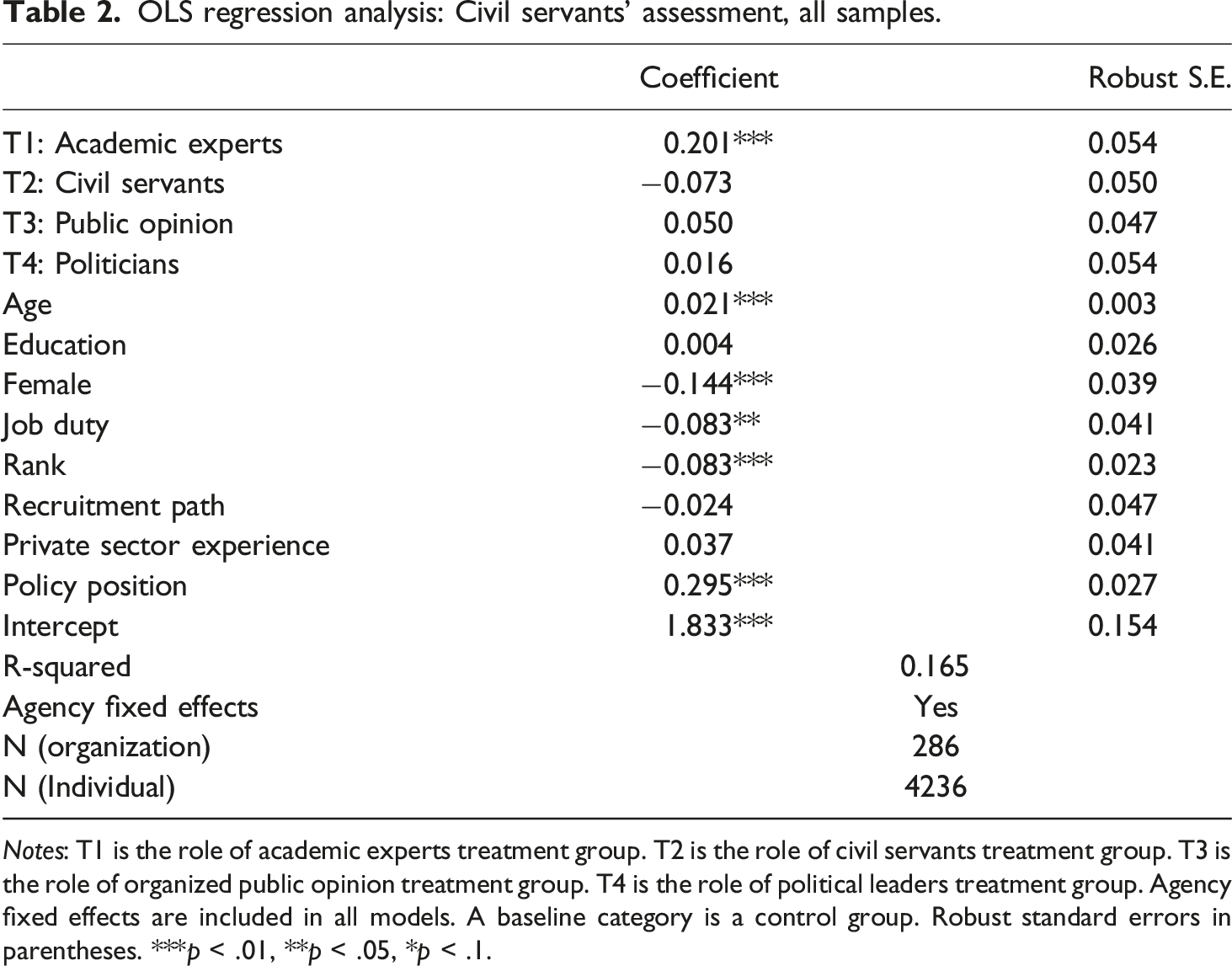
Notes: T1 is the role of academic experts treatment group. T2 is the role of civil servants treatment group. T3 is the role of organized public opinion treatment group. T4 is the role of political leaders treatment group. Agency fixed effects are included in all models. A baseline category is a control group. Robust standard errors in parentheses. ***p < .01, **p < .05, *p < .1.
Further in Table 2, we find that the effect of the role of civil servants treatment is negative, as also observed in Figure 2, but it no longer becomes statistically significant after controlling for respondents’ individual and organizational characteristics. Including Treatment 2 as well as Treatments 3 and 4, their effects are not only statistically insignificant but also relatively small in magnitude, indicating that Hypotheses two to 4 are not confirmed. Overall, our multivariate regression analysis shows interesting results regarding the treatment effects of diverse conditions but still leaves some questions and doubts. Given that the basic income program may fundamentally change people’s livelihoods, does public opinion really not matter in the formulation process from civil servants’ point of view? Or do different groups of civil servants have different perceptions toward treatment conditions? These are the questions we attempt to address further in the following section.
Do central and local civil servants have different views?
OLS regression analysis: Civil servants’ assessment, central and local civil servants separately.
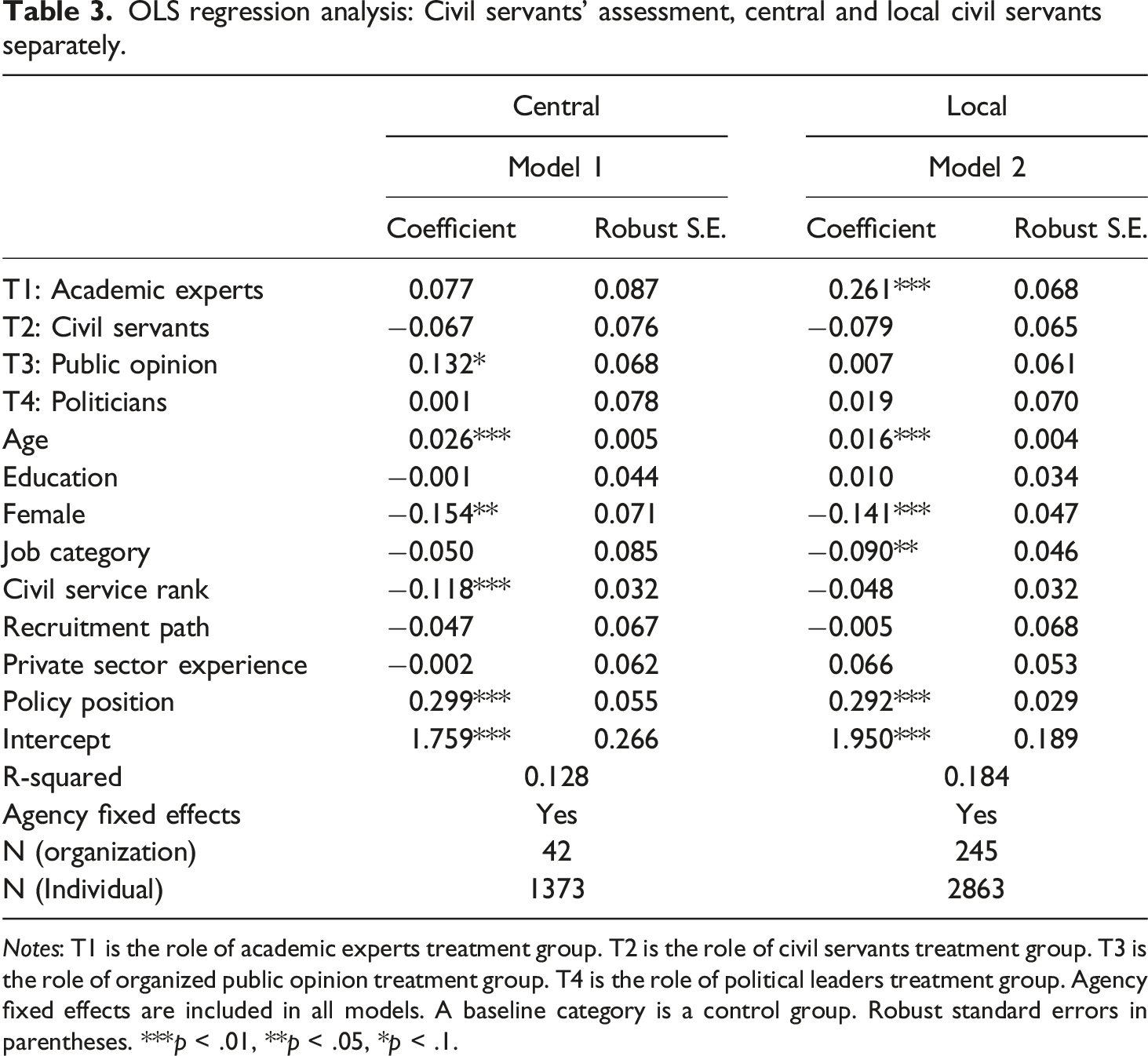
Notes: T1 is the role of academic experts treatment group. T2 is the role of civil servants treatment group. T3 is the role of organized public opinion treatment group. T4 is the role of political leaders treatment group. Agency fixed effects are included in all models. A baseline category is a control group. Robust standard errors in parentheses. ***p < .01, **p < .05, *p < .1.
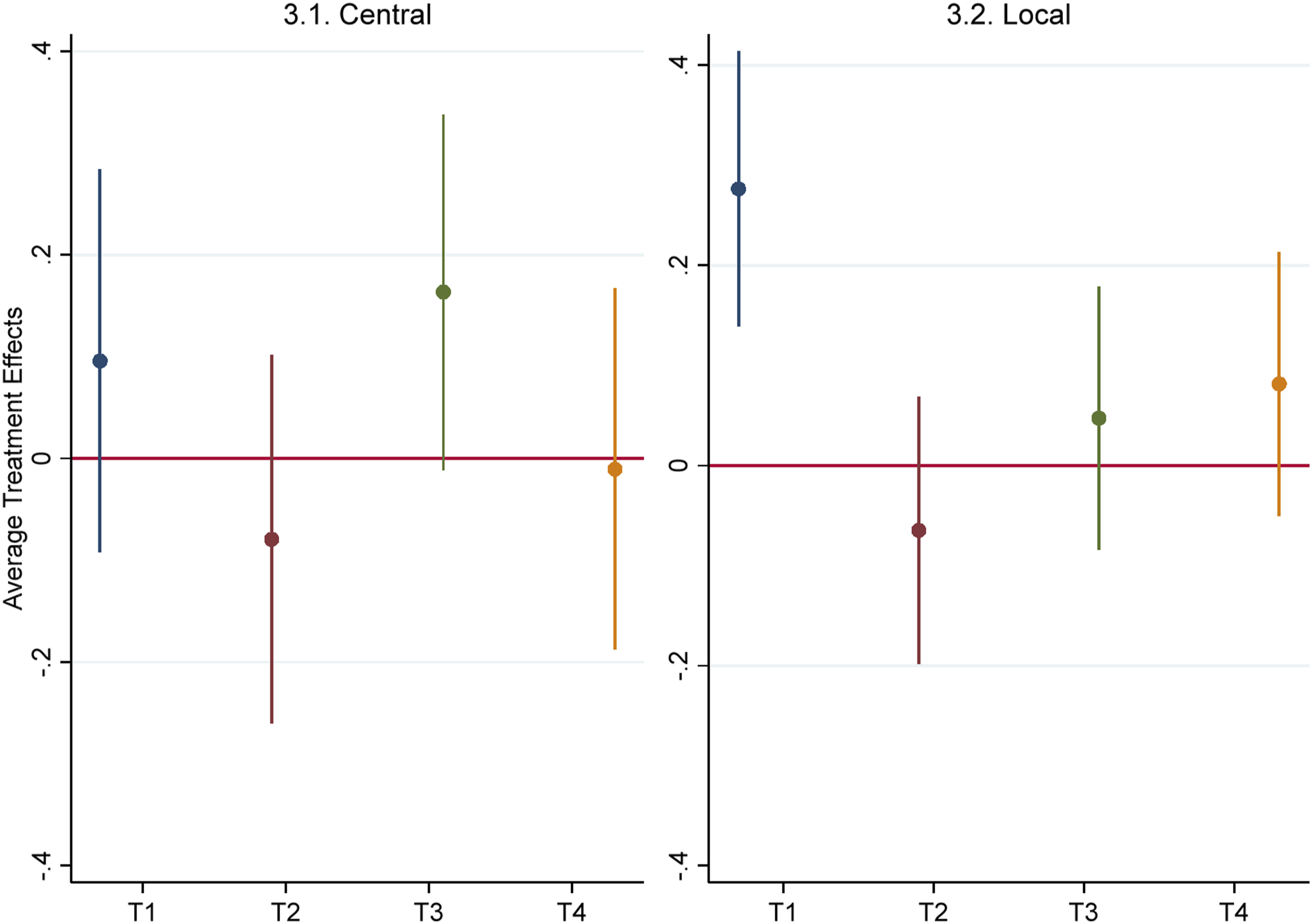
Average Treatment Effects on Civil Servants’ Assessment: Central and Local Civil Servants.
Moreover, in Model 2, we further find that Treatment 1 is positive and statistically significant. Based on the estimation of the coefficient on Treatment 1 in Model 2, holding all other variables constant, local civil servants have more positive perceptions by 26.1 units when the formulation process is centered around academic experts whose plan is to pay universally to all but include it in taxable income, compared to when the basic income system is formulated without such a condition. On the right panel of Figure 3 (3.2), we clearly show the marginal effect of this treatment condition.
In sum, the results in Table 3 show that central and local civil servants tend to have different views in assessing how and by whom the agenda-building process of UBI is led. Therefore, this suggests that our last hypothesis is confirmed.
Discussion
When applying the three models of agenda building (Cobb et al., 1976) to the South Korean context, the four participants and their roles in our treatment conditions are expected to be central in the formulation of South Korea’s basic income program. Yet, our multivariate analysis reveals that while the two of the participants, namely academic experts and organized public opinion, and their roles had predicted treatment effects, the other two participants, that is political leaders and civil servants, and their roles had null effects.
We interpret the null effects of these treatment conditions as civil servants’ strong skepticism toward how these players drive the agenda-building process of UBI rather than the development of UBI by these players itself. This seems to be particularly the case for the role of political leaders treatment, because civil servants are not so likely to support the idea of developing UBI if it is a temporary measure exploited by politicians for the sake of the latter’s political campaign and electoral success. In terms of the role of civil servants treatment, civil servants tend to be skeptical about adopting UBI when its financial resources come within the executive branch. This means that, to generate greater support for this treatment effect from civil servant groups, the question of how to realistically secure financial resources for UBI needs to be first resolved.
Regarding our prediction concerning the heterogeneous treatment effects between central and local civil servant groups, we indeed find that central civil servants tend to support the formulation process involving mobilized citizens and their role, whereas local civil servants are more supportive of such a process incorporating academic experts and their role. According to intergovernmental relations, particularly in the South Korean context, despite the gradual advancement of decentralization with the public’s growing call for grassroots democracy, local governments are highly dependent on the central government legally and financially. This means that local governments are limited in fully planning their own programs, and it is the central government that mostly does the planning for public policy, while local governments implement national policy with the support of conditional and unconditional grants from the former (Lee et al., 2023). Therefore, in assessing the formulation of a new policy program, central civil servants may see whose view needs to be counted for planning, but local civil servants rather consider whose view is likely to be helpful for the actual implementation at the local level (Bae and Lyu, 2010).
Conclusion
In this article, we examine the development process of UBI in a young but stable democracy in Asia, South Korea. In selecting which players and whose roles are considered in this process, we borrow insights from Cobb et al. (1976) and focus on the four participants inside and outside the government, namely legislators, civil servants, academic experts, and citizens. We adopt a survey experiment to understand what views about UBI civil servants, the ultimate executers once the program is enacted, have depending on which participants and their roles are incorporated into the transition process from agenda building to policy formulation. Our analysis of more than 4000 civil servants’ responses reveals that civil servants seem to prefer the process where academic experts and their advice play a central role. Our additional analysis further reveals that central and local civil servants have different preferences for whose demands are chiefly incorporated in the process. While it is the academic experts that local civil servants still strongly support, it turns out to be citizens of whom central civil servants are more supportive.
Our study makes clear contributions to the literature on policy processes as well as the literature on UBI. First, building on the framework of the classic policy process theory (Cobb et al., 1976), we provide empirical evidence to the literature on the non-decisional stage of the policy process and evaluate the development of the process from civil servants’ perspective. Scholars of policy processes commonly emphasize the importance of agenda building and policy formulation and the necessity of more research on this stage (Jones, 2016; Sabatier, 1991; Zahariadis, 2016), and we add value to the relatively scanty literature with novel experimental analysis. Second, we also provide experimental evidence from surveys of civil servants to the growing literature on UBI. In the wake of enduring challenges and persistent disruptions from the COVID-19 pandemic and its detrimental impact on domestic economies, countries have considered adopting a UBI. Yet, understanding to what extent key participants, such as legislators, civil servants, and citizens, support the policy and how their views are incorporated in the formulation process via sophisticated empirical analysis is still immature (e.g., Jordon et al., 2022).
In relation to the contributions of our article, we also acknowledge the limitation of our study and would like to propose several future research agenda that can extend our research. First, in our analysis, we focus on the four participants and their roles in our treatment conditions, namely academic experts, political leaders, civil servants, and organized public opinion, but formulating a basic income program typically requires a number of other key participants to actively put forward their demands or to contribute some roles. Future research that analyzes additional participants’ views on the formulation process will help to deepen our understanding of the non-decisional stage of the policy process regarding UBI. Second, as discussed in several cases of European democracies, given that there is little consistent evidence of how UBI is formulated after the agenda-setting process, more comparative research on UBI is much needed within and across regions, on top of the evidence from South Korea. Third, it would be interesting to see how the characteristics of public policy are connected to the processes of agenda building and policy formulation. For example, our analysis shows that citizens’ and external experts’ roles are perceived to be more important for a distributive policy such as UBI. Yet, future research may find out whether different types of policies (e.g., regulatory and redistributive policies) are linked to greater support for different participants’ roles in the transition stage from agenda building to formulation process.
Supplemental Material
Supplemental Material - The perceived identity of policy participants: The agenda-building process of universal basic income in South Korea
Supplemental Material for The perceived identity of policy participants: The agenda-building process of universal basic income in South Korea by Sunggeun Kim, Don S Lee, Soonae Park in Public Policy and Administration
Footnotes
Acknowledgements
This study was conducted based on survey data funded by the Public Performance Management Research Center at Seoul National University. Additionally, Researcher Sung-Geun Kim received research funding from Seoul National University for this study.
Declaration of conflicting interests
The author(s) declared no potential conflicts of interest with respect to the research, authorship, and/or publication of this article.
Funding
The author(s) disclosed receipt of the following financial support for the research, authorship, and/or publication of this article: This work was supported by The Ministry of Education of the Republic of Korea and the National Research Foundation of Korea (NRF-2023S1A5A8080650).
Correction (October 2025):
Article updated for Don S Lee’s current affiliation in the footnote.

Supplemental Material
Supplemental material for this article is available online.
Notes
References
Supplementary Material
Please find the following supplemental material available below.
For Open Access articles published under a Creative Commons License, all supplemental material carries the same license as the article it is associated with.
For non-Open Access articles published, all supplemental material carries a non-exclusive license, and permission requests for re-use of supplemental material or any part of supplemental material shall be sent directly to the copyright owner as specified in the copyright notice associated with the article.
