




Abstract
Philosophical thought may provide an important contribution to the development of the theory and practice of public administration (PA). Notwithstanding such potential, however, philosophical thought has so far been limitedly employed in PA studies. To the extent philosophy has been brought into PA, three philosophies have been mainly used: Pragmatism, strands of Relativism-Constructivism, and Positivism. This paper argues that another philosophical approach can and ought to be considered much more systematically for application to foundational issues in PA studies, namely Critical Realism. The potential of this philosophical perspective is deployed to shed new light on key issues in the theory and practice of public value governance and management, a major area of academic investigation and practical application in the field of public administration and public management.
Introduction
Philosophical thought may provide a significant contribution to the field of public administration, public management, and public governance (hereafter: PA) by shedding light on foundational issues and helping clarify concepts and notions employed and their implications (Ongaro, 2020, 2022; Raadschelders, 2011). Notwithstanding the potential, so far philosophical thought has been limitedly employed in PA studies, at least in recent times.
To the extent that philosophy has been brought into PA, we argue that three philosophical approaches – three philosophies – have been mainly used so far, leaving room for other philosophical approaches to be potentially considered for application to foundational issues in PA studies. This paper suggests that another philosophical perspective, namely Critical Realism, may provide a powerful contribution to a better foundational understanding of PA.
The three philosophical movements that have found their way more amply into PA studies are: Pragmatism, Relativism-Constructivism, and Positivism. In addition, some specific PA works rely on distinct Philosophers, whose thought we would not categorise under any of these rubrics: for example, Stout and Love (2015 and 2019) elaborate a sophisticated proposal for ‘integrative (public) governance’ which relies on the thought of Mary Parker Follett as well as on Whitehead’s process philosophy.
As to the three philosophies that have so far infused PA thinking, at least to a certain extent and in certain areas, a first one is Pragmatism. Pragmatism is a philosophical movement associated with the contribution of – amongst others – the Philosophers Charles Sanders Peirce, John Dewey, George Herbert Mead and, more recently, Richard Rorty. Pragmatism – very broadly speaking - understands knowing the world as inseparable from agency within it (Haack and Lane, 2006). The employment and deployment of this philosophical strand to PA problems and issues has been carried out by such scholars as Chris Ansell, Patricia Shields, and Travis Whetsell, amongst others. A number of publications have made explicit reference to applying Pragmatism as a philosophy to PA topics (see inter alia, Ansell and Boin, 2019; Shields, 1996, 2008; Whetsell and Shields, 2011). A PA journal which has hosted a number of significant contributions in this strand is Administration & Society.
Relativism-Constructivism is a broad and composite philosophical movement which encompasses a variety of philosophical strands. Importantly, such a broad philosophical approach can count on a significant streak of works in PA, by such authors as (amongst others): Box (2007), Catlaw and Treisman (2014), Farmer (2005), and Fox and Miller, notably their joint work (Miller and Fox, 2007). Constructivism is centred on the idea that all knowledge is subjective and socially constructed. To the constructivist, even scientific facts are no more than the facts that make situational sense at that moment. This creates a challenge for public administrators, who find themselves having to contend with varied situational interpretations emanating from pre-existing experiences within a socially constructed world muddled with bias and prejudgments. Within this philosophical perspective, what constitutes knowledge – about notions such as ‘public interest’ – for public administrators is called into question. Constructivism sheds light on inherent tensions in our understanding of PA. A reference journal for PA studies in this philosophical stream is Administrative Theory & Praxis.
Positivism enjoys a somewhat distinct status here, as insightfully argued by Whetsell and Shields (2011): rather than a philosophical perspective explicitly spearheaded by specific PA scholars, or whose debates get ‘hosted’ by a specific scientific journal, it enjoys the status of the ‘default philosophy’ for many scholars. Yet, it is not explicitly supported and elevated to the standing of underpinning philosophy; instead, it enjoys an ambiguous status of ‘implicit philosophical understanding’ for many PA works: notably, two of its core tenets - namely the ‘unity of science’ (that is, the idea that society itself could be studied and explained in the same manner as the natural sciences), and the ‘empiricist observation language’ as the preferred explication language in scientific work (rather than narrative, legal, or historical explications) - infuse and undergird many published works in the PA field (Whetsell and Shields, 2011). Public Administration Review and the Journal of Public Administration Research and Theory are notable journals which host many important contributions in this philosophical tradition.
Within this picture of the state of philosophical thinking in PA, which we could here only sketch through very broad-brush strokes, we argue that one important addition might be very beneficial to the field of PA: Critical Realism. We discuss why such is the case in the remainder of this paper. Specifically, we illustrate our point about the contribution of this philosophical perspective by applying it to advance the theory and practice of public value governance and management, a major area of academic investigation and practical application in the field of PA. We argue that Critical Realism helps us better gauge the nature of public value, shedding light on the dynamic and reflexive processes within which both public values and public value emerge, and then consolidate in individual practices and collective performances.
In the remainder of the paper, we at first briefly introduce the notion of public value and sketch the contours of key debates in this major stream of inquiry and practice. Further aspects of the public value debates are then discussed in subsequent sections aiming at showing how Critical Realism may enable a deeper understanding of conceptions of public value. We conclude on the benefits of a more systematic application of philosophical thinking into PA.
Public value
Public value has become a ubiquitous term in public management scholarship in response to the continuing evolution of PA thinking (Bryson et al., 2015; O’Flynn, 2021). In this approach, government has a special role to play as a guarantor of public value(s), but citizens as well as businesses and non-profit organizations also are important as active public problem solvers: starting from the original approach to public value as outlined by Mark Moore in his seminal work (Moore, 1995), such an approach posits that the task of public managers is to ‘create public value’; it sets the notion of creation of public value as goal and rationale for the very job of being a public manager. In subsequent works, Moore further addresses the issues of ‘measuring’ and ‘managing’ public value creation, also by developing a ‘balanced scorecard’ approach (Moore, 2013). Another significant stream of research for public value theory has been developed by Bozeman, who works out approaches to detect public values, intended as relative citizen consensuses that are discernible from policies and polls, which form the basis for guiding the course of action of public managers (Bozeman, 2007, 2019). Another key strand of inquiry has been wrought out by Meynhardt (2009), who elaborates on psychological theories of human needs for explaining processes and outcomes of public values formation. Finally, Benington (2011) theorises public value notably by proposing a processual approach centred on the notion of the public sphere, in which public value outcomes are developed.
Synthetising effectively the ongoing discourse on public value, Hartley et al. (2017) provide a valuable summary of the literature by distinguishing: (1) a managerially focused concept of creating public value that reflects normative agreements of what the public wants (e.g., Moore, 1995, 2013); (2) a policy and societally focused conception of public values as relative citizen consensuses that are detected from constitutions, policies, and opinion polls (e.g., Bozeman, 2007, 2019); (3) a psychology-based approach and theory of basic human needs and objectified values (e.g., Meynhardt, 2009); (4) a process focused approach to study the public sphere in which public value outcomes are debated and created (e.g., Benington, 2011). Here, we also acknowledge the contribution by other authors who have shed light on the significance of the notion of public value for other key debates in public management and public policy at large, like public innovation, co-creation, or the strategic management of public organisations: for example, scholarships by Rønning et al. (2022) and Rainer Kattel et al (2022) provide links between public innovation and public value while Torfing et al. (2021) sketch out a way to link the growing literature on co-creation of public services and public value governance and management; Ongaro et al. (2021) elaborate a framework to connect the strategic management of public service organisations with the governance and management of public value.
Such diverse approaches push us to rethink the nature of public value, or even query whether public value(s) are knowable at all (Prebble, 2021). For instance, among these different takes, public value is something that ‘starts and ends with the individual’ for Meynhardt (2009: 215), or something ‘temporal, heterogeneous, and subjective’ for Cluley and Radnor (2020). While for Benington (2011), public value is about bringing a public into being for the purpose of discovering its own interests and making decisions, through the dynamic process of valuing.
In short, this consideration of whether public value is knowable at all is very important for our analysis based on the perspective of Critical Realism, and we include it in the analytical framework we work out to apply Critical Realism to shed light on the public valuing process.
Critical Realism
Origins, developments, and applications to social science
Critical Realism is a movement which began in philosophy following the founding work of Roy Bhaskar, Margaret Archer, and others (Porpora, 2015). Since the 1970s, critical realists have been calling for the centrality of ontology (‘the nature of that which is to be known’) for underpinning research, i.e., for bringing to the fore the study of existence, with wide applications in social science (e.g., see a review by Danermark et al., 2019; other comprehensive textbooks on Critical Realism and its applications to social science include Buch-Hansen and Nielsen, 2020; Edwards et al., 2014).Critical Realism has been applied and contributed to a range of disciplines and fields, including but not limited to anthropology (Graeber, 2015), education (Scott, 2013), history (Lloyd, 1993), law (Norrie, 2010), political science (McAnulla, 2006), economics (Lawson, 1997), and sociology (Porpora, 2015).
To illustrate the already widespread use of Critical Realism in diverse disciplines and fields, we can draw on some of the latest publications. For instance, Wilson (2019) provides the first dedicated account of art and aesthetics from a critical realist perspective, arguing for a profound paradigm shift in how we should understand and care for culture in terms of our system(s) of value recognition. Considering rival concepts of sport, Scambler (2022) presents detailed, illustrative studies of various types of sporting or athletic activity – including soccer, cricket, rugby and track and field – to advance an alternative understanding of sport rooted in the philosophies and theories of Critical Realism and critical theory. Ash (2022) also adopts a critical realist approach to ethics and morality, seeing morality as an aspect of social reality.
In the fields of PA and public policy, and therefore of particular relevance for the present study, Yang (2022a) engages Weber and Kafka’s work on bureaucracy and administration to articulate the condition for human liberty, using Critical Realism to reveal the potential emancipatory nature of bureaucracy as a way out of Kafka’s powerlessness and Weber’s iron cage via citizen engagement. In another work, Yang (2022b) also addresses the paradox of embedded agency in the study of policy entrepreneurship by avoiding either voluntarism, that inflates the role of actors to change policies as in extant applications of policy entrepreneurship models, or determinism, whereby policy changes are shaped by contextual forces; likewise, Newman (2023) develops a critical realist framework to reveal ontological contradictions in the UK’s Universal Credit reforms, analyzing fundamental policy assumptions about how individual agents relate to their material and ideational contexts.
How Critical Realism accounts for the unobserved and the unobservable in the social world
Tilly (1995) forcefully argues that because ontological assumptions inevitably influence epistemology (‘the conditions for the generation of knowledge’), it is critical that those assumptions be ‘plausible’ (p.1602). Currently, the prevailing ontology in social science research is empiricism, often in the form of positivism, which burdens itself for good reason with the discipline of the empirical (Hacking, 1983): in accordance with this perspective, science and social science have insisted that for any knowledge claims to qualify as sound there must be sensory empirical proof. However, a pertinent question arises when realists ask us to reflect on how to account for the unobserved, or even the unobservable. In fact, all versions of realism accept that causal mechanisms—despite being currently unobserved or unobservable—must be used as the basis of explanatory theoretical accounts (Sommers, 1998): since the work of Descartes, science and social science have set for themselves the goal of understanding forces that, albeit often beyond the senses, are nonetheless believed to be the real causal forces at work in the world. For instance, we can observe the results of gender discrimination, but how can we prove a causal claim about gender characteristics? Similarly, we can count income distribution, but it is difficult to prove a causal claim about class exploitation. Such examples illustrate the line of argumentation employed by realists to counter positivists’ claims that theory must hold up against what can be observed empirically—for realists, such actualist claims deny the existence of underlying structures which affect events, by ending up locating the succession of causal mechanisms at the level of empirical regularities only (Collier, 1994).
Instead, critical realists aim to discover the structures, powers, propensities, and liabilities of the unobservable and currently unobserved forces, assigning mind-independent status to many elements of the world, while being agnostic about the absolute truth of any given theory about the world (Steinmetz, 1998). Critical Realism thus dismisses the positivist prohibitions against nonempirical postulates in science and social science explanations, as it privileges the deep structures and mechanisms of reality that are often not accessible to the senses (Bhaskar, 2008).
One of the most central tenets of Critical Realism is the three overlapping domains of reality (Bhaskar 1993, 2008): the Empirical domain includes observed events, practices, and experiences; the Actual domain represents the level at which events (actions) happen—some of these events may be observed and then become part of the Empirical domain; finally, the Real domain includes causal mechanisms (e.g., such mechanisms include structures as social relationships, and cultures as formal rules and norms, see Yang, 2022b) that possess power to shape events in the Actual domain and generate observed events in the Empirical domain. Taken together, the three domains tell us that we should differentiate between experiences, events, and mechanisms. Further, they tell a causal story: ‘the Real’ represents the idea that powers exist even when they are not being exercised; ‘the Actual’ represents the idea that any given power may be exercised, even if being so is not a condition of its existence; ‘the Empirical’ represents the idea that being observed by a subject is also not a general existence condition for (the) powers (of things). This means that at any given moment not all powers are actualised, and not all actualised powers are observed: the Real may not be observed and it exists independently from human perceptions and theories. Put differently, causal mechanisms, as powers, may operate unobserved (the Empirical/Actual distinction). Causal mechanisms may operate without producing their characteristic effect, due to counteracting (e.g., structural and cultural) mechanisms operating, or they may even lie dormant when their triggering conditions are absent (the Actual/Real distinction). This explains why in the Actual, which consists of all possible events, actions, and outcomes, only some but not all such events, actions, and outcomes will be sensed in the Empirical.
To illustrate Critical Realism’s layered ontology with two examples, we may gauge global warming only via our concepts in the Empirical because scientific research of it started 50 years ago, but global warming as an event in the Actual started to manifest itself hundreds of years ago (we just did not observe or understand it) while the causes of it can be found in the Real. Thus, global warming is an ontologically objective fact, independent of how we conceptualize and whether we see it. As another example, we cannot see ‘magnetism’, but when we move a magnet under some iron filings, it is highly plausible that the magnet causes the filings to move.
For proponents of Critical Realism, its three-layered ontology—the three reality domains—makes us rethink what our data is (i.e., agents’ experiences of events), and what we should aim to do (i.e., to explain how causal mechanisms bring about the events and experiences). They stop us falling into the trap of focusing only on what we can measure and observe (i.e., events and experiences), and keep us on the task of finding the underlying causal mechanisms.
Furthermore, we should pay particular attention to the denomination of ‘Critical’ in Critical Realism: it first signifies a thrust to overcome the ‘epistemic fallacy’ that lies in reducing what we say is ‘real’ or exists (ontological statements) to what we can know or understand about the ‘real’ (epistemological statements). In this sense, the three domains operate as a rhetorical device that neatly and symmetrically expresses the critical realist critique of alternative perspectives on the operation of causal mechanisms and powers. Those who ignore what happens unobserved can be accused of empiricism, which is a failure to recognise the Actual domain. Those who ignore the inactivated mechanisms in the world can be accused of actualism, which is a failure to recognise the Real domain. ‘Critical’ also means that for all its emancipatory potential as a philosophy, Critical Realism is methodologically neutral while at the same time ‘critical’, in the sense (also) of challenging existing assumptions and the socio-political status quo (of course, there has long been, within the ‘critical’ tradition, an influential rationale for the drawing of value conclusions from factual evidence: that offered by Marx and the Frankfurt School and Critical Theory). In fact, a key feature that is distinctive to Critical Realism, against the background of other recent versions of critical social science, is the explicit rationale it provides for research being ‘critical’, to better diagnose defects in our discipline, academia as well as society. Very often, as Hammersley (2005) argues, critical researchers may fail to explicate the basis for their critical orientation; they should search for those features of social and political institutions for their undesirability, and to think about the need to change them in particular ways just as there is no reason to accept them at face value.
To summarize, critical realists are committed to ontological realism, epistemological relativism, and judgmental rationality. First, the commitment to ontological realism entails a belief in the existence of a reality that is independent of our knowledge of it. Second, the commitment to epistemological relativism involves recognising that knowledge is always socially produced and fallible. The world can only be known under particular conceptual frameworks that always have limitations (Bhaskar, 2008). Third, the commitment to judgmental rationality means that critical realists believe that those who study the world can have rational grounds for choosing amongst competing theories and statements about it (Porpora, 2015). Put differently, the commitment to epistemological relativism does not lead to radical scepticism, entailing that all statements about reality are to be regarded as deeply problematic or equally (un-)true. Rather, it is maintained that not all theories or statements about the world are equally warranted, and to enjoy the benefits of deliberation amongst rival theories, Critical Realism focuses on issues of causal complexity characterized by multiple-conjunctural causation (Ragin, 1987) and space-time dependency (Steinmetz, 1998)—the former suggests that there may exist multiple alternative constellations of causes for an event to happen, while the latter concerns the time-space dependence of social structures or power mechanisms (Bhaskar, 2008), presuming that structures and mechanisms are historically emergent and bounded in space and time.
A further note on causality: it is surely the task of PA research to try to explain why events of relevance for PA occur. This task requires us to understand the nature of causality. For critical realists, events are not just a random jumble of occurrences but are caused by potentially identifiable factors. And this is what differentiates Critical Realism from positivist analyses of cause in the covering law tradition of Hume: causality is something more than an observable regularity in the flow of events, a pattern in which an A event is consistently followed by a B event (Groff, 2017). For Critical Realism, to say that ‘B always (or usually) follows A’ is not to offer a causal explanation of B, but to describe a phenomenon that needs to be explained. Bhaskar instead offers an account of causation—multiple determination because ‘actual events, Bhaskar argues, are not produced by single causes as the covering law model suggests, but by a complex interaction of the causal powers of the entities involved.’ (Elder-Vass, 2010: 47).
We now turn to show how we can study this mind-independent world in three reality domains by applying Critical Realism to the theory of public value, thereby (we argue) better illuminating this important area of inquiry and practice in the field of public management.
Critical Realism and public value
The upshot of Critical Realism for better understanding public value is to point out where public value resides in the three domains of reality: structures and cultures in the Real domain enable and constrain actors’ navigation of their social and organizational environments, as well as their reflexive thinking activities over what they may see as their cherished mundane, social, and political values in the Actual domain. The Actual domain represents the level at which such social, organizational, and individual interpretive events (or valuing activities) happen, as actors constantly adjust their structurally and culturally embedded actions to carry on with their lives. Some of such embedded actions can be observed in the Empirical domain.
For critical realists, citizens’ or public managers’ understandings of public values are personal, but they also draw deeply on cultural standards embedded in structural relationships as public values are normative ethics that convey how things should/ought to be in specific relational settings. Here, Geertz (1973: 89) defines culture as ‘a system of inherited conceptions expressed in symbolic forms by means of which men [sic] communicate, perpetuate, and develop their knowledge about and attitudes toward life’. For Critical Realism, such symbolic forms of the cultural system include formal rules and diverse ideas about market, state, family, religions, professions, and community (Greenwood et al., 2011; Yang, 2022b). Swidler (1986) adds that culture at the heart is also practical because as a normative toolkit, it influences actions by shaping habits, skills, and styles by which people construct ‘strategies of action’.
On top of this understanding of culture, Critical Realism adds that culture and relevant strategies of action are embedded in structure, which refers to the systems of human relationships among social positions (Porpora, 1989). A simple example of a structure is that between the employer and employee—the employer and employee are in a necessary relationship by virtue of the obligation on the employer to pay a wage or salary and an obligation on the employee to do work. This means that the causal efficacy of structure both constrains and enables human activities by creating certain norms, cultures, resources, expectations, constraints, and predicaments that are built into each position within webs of relationships. These comprise the circumstances in which people must act and which motivate them to act in certain ways. Taken together, Critical Realism concludes that people can creatively use broader cultural tools such as rules, knowledge, norms, and beliefs to justify and pursue their positional interests within diverse social, organizational, and personal relationships.
With such insights on powers, Critical Realism urges us to see that a coherent understanding of public values must therefore examine how they are formed, transformed, and supported by people. Archer (1995, 1996) in her morphogenetic approach provides us with a clue, explaining the intertwining of the three reality domains via an agency-structure interaction perspective: people’s actions to engage with, and to strategically use, diverse cultures take place in relationally constituted structures, which constrain and enable their acts. But on a longer timescale, the structures and cultures themselves in the Real domain reproduce and/or change as a result of the activities and choices of the historically situated individuals who make them up in the Actual domain. She summarizes this ontology as a set of cycles with different time frames: structural/cultural conditioning ⟹ social interaction ⟹ structural/cultural elaboration.
We can apply this morphogenesis approach to the study of public value (see Figure 1). Here, Critical Realism suggests that actors and their actions are conditioned by the historical structural and cultural systems that are given at Time Point 1 (T1). Then within a T2-T3 period, human agency takes the forms of ‘inner dialogue’ to reflect on what they value, vis-à-vis the natural, practical, and discursive orders of reality (Archer, 2007, 2012). Such a socio-culturally conditioned, yet individual reflexive value elaboration process contributes to the reproduction or transformation of the structural and/or cultural configuration of the human value system, manifested as a particular public value pronouncement at T4, which is also the T1 of the descendent cycle of the formation of (public) value. In this model, public value formation can be enabled and constrained by structural, cultural, and agential forces, just as public values can also be those that were held and/or practised by the agents of the previous morphogenetic cycle, which are being passed on and thus affecting the present agents’ practices (i.e., prescriptive ethics and situational concerns that individuals hold, and that guide their actions): these values predate the status quo and condition the presence whereby they enable or constrain actions. A critical realist framework of public value (adapted from Archer’s morphogenetic cycle model).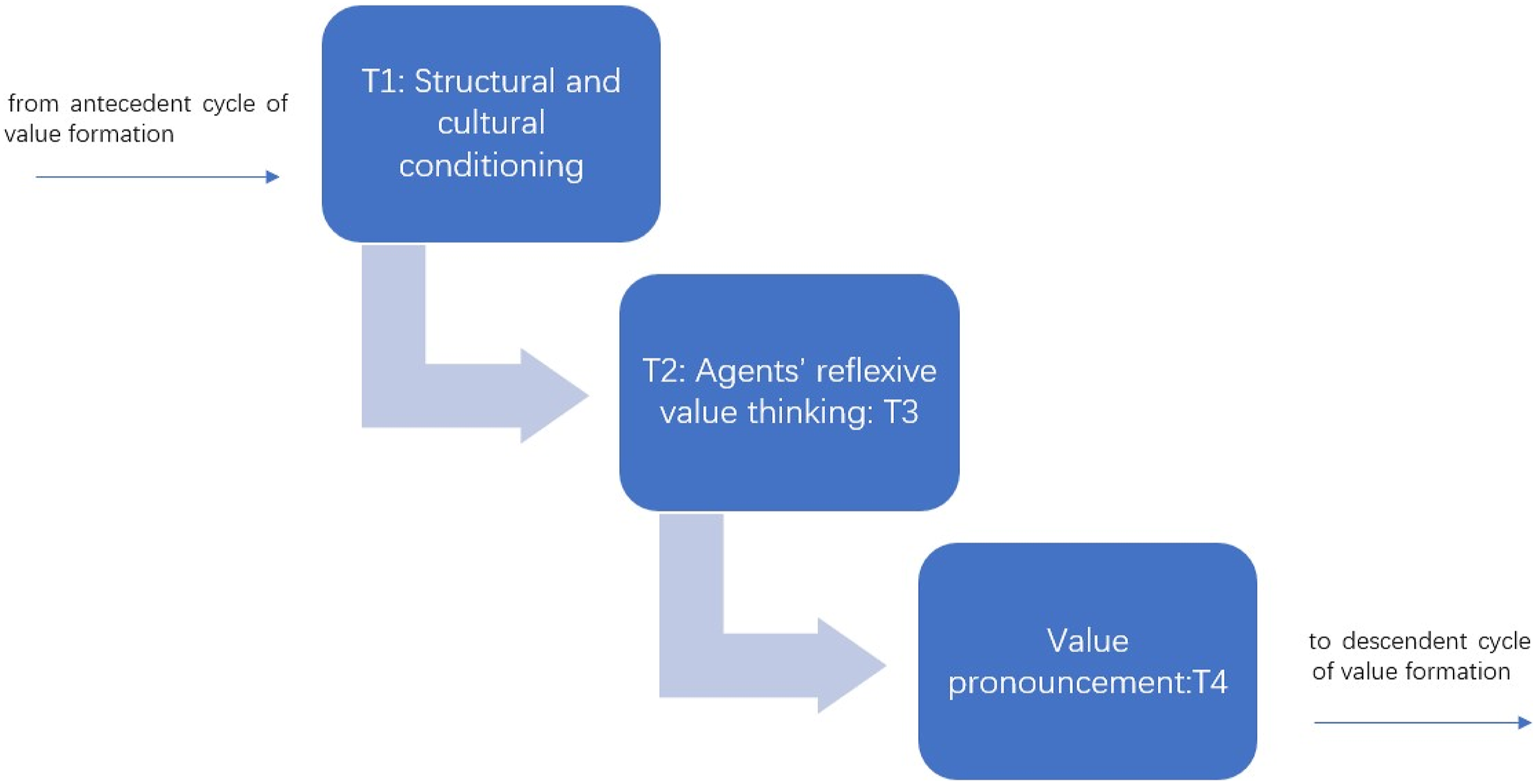
Subsequently, as Figure 2 shows, this critical realist morphogenetic model helps better explain the four major approaches to public value in the literature that have been so aptly delineated by Hartley et al. (2017), as forementioned: Bozeman (2007) suggests that a society’s public values are those providing normative agreements on citizens’ rights and obligations, while Moore (1995)’s definition of public value also highlights specific public values and priorities such as efficiency, effectiveness, and procedural justice. Together, their approaches treat public values as already objectified and concrete phenomena, or normative consensus at T1 that condition/enable agents’ reflexive thinking over what they value at T2-T3, which then leads to T4, a stage where Meynhardt’s approach to public values signals that as a result of agents’ reflexivity towards valuing, public values—as structural and cultural elaboration—eventually become pronounced as objectified psychological needs on moral-ethical, political-social, utilitarian-instrumental, and hedonistic-aesthetical dimensions. Finally, Benington’s insights unpack what is beneath the empirical lived public valuing experiences from the perspectives of structure, culture, and agency. It documents and dissects the whole T1-T4 recursive process of public value creation, reproduction, and transformation that is embedded and informed by the past, agential reflexive evaluation of the present, and their imaginary projective future. Key public value conceptions revisited through a critical realist framework.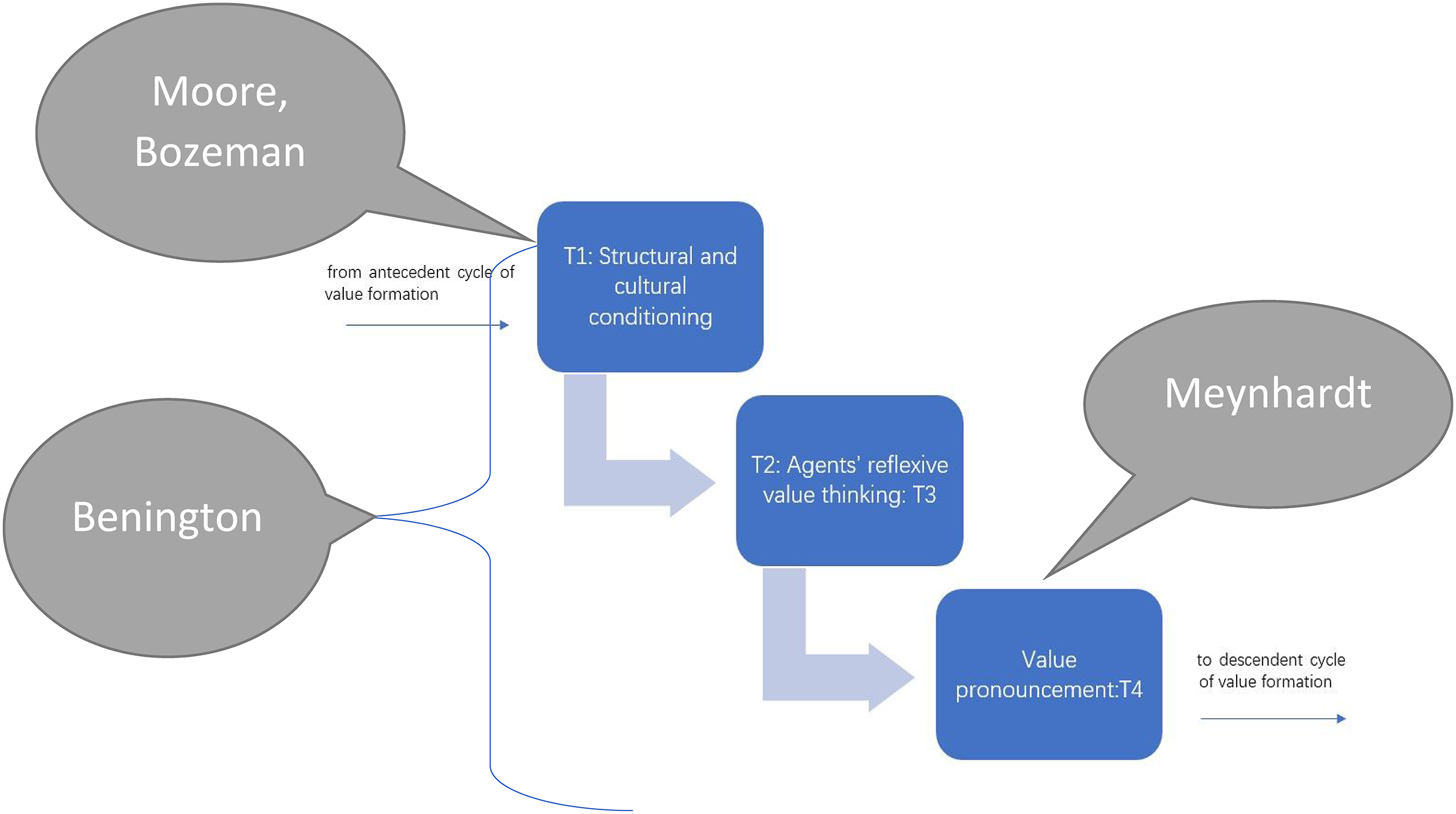
In this vein, Benington’s take provides a more encompassing timeframe within which to consider in an integrated way Moore’s public managers, Bozeman’s citizens, and Meynhardt’s psychological needs. Benington defines public value as a dialogical process, embedded in Habermas’s vision of the public sphere in which competing interests are debated. This means that public value, not a settled matter, is about creating ‘what the public values’ and ‘what enhances the public sphere’ (Benington, 2011: 31); his insights enable a performative understanding of values and valuing, thereby revealing the dynamic processes within which public values emerge and then consolidate in individual practices and collective performances.
But why are some public values recognised, experienced, and practised by some while not by others? Critical Realism can suggest that human practices when interpreting and working with public values not only reveal the essential contestability of the public value concept in different eyes but also the politics within and beyond the social and organizational processes: Gallie (1955) reminds us that ‘essentially contested concepts’, often signifying politics, will provoke unresolvable disagreements about their meanings. This is because each such concept, like freedom, (1) has a normative dimension; (2) has a number of alternative definitions; (3) allows modifications without pointing toward a final resolution of the original ambiguity; and (4) attracts proponents for each of its meanings by recognizing that there are alternatives. Critical Realism then informs us that essential contestability does not characterize political concepts such as public value by accident. These concepts are essentially contestable because they are political, due to diverse yet potentially complementary and/or conflicting positional interests and cultural norms that shape citizens’ understandings and interpretations of such concepts.
In short, for Critical Realism, public value is a social construction, a real causal process driven in part by specific actors, and under the political influence of a range of social structures, mediated through the production of cultures, and thereby producing causal consequences for affected audience. The T1 to T4 way in which public value becomes a social construction suggests that there is a set of relationships and discourses that tend to stabilise belief in some particular values as reliable guides to serve and satisfy the ‘public’, at a particular point in time.
We should also note that to argue that conceiving of values as being socially constructed and invoking a realist philosophy of causation may not be uncontroversial, since realism and constructionism have often been seen as at odds with each other; however, as several critical realists have already argued at length, realism and a moderate version of constructionism are not merely compatible but complementary (Sayer, 2000: 81–102; Smith, 2010: 119–206; Elder-Vass, 2012): Critical Realism differs from radical constructivism, which argues that it is meaningless to claim that one statement about reality is more truthful than another, since all knowledge is socially defined. Contrariwise, Critical Realism is consistent with a moderate social constructivist approach, which emphasizes that knowledge is socially influenced, but not determined. This conclusion suggests that the seminal debate on whether public value is knowable or not (which we recalled earlier) needs to concede that this is rather a question about ontology as well as epistemology—Critical Realism should inspire scholars to acknowledge that we are never able to fully comprehend the social world and all the public values emanating from individual mindsets and collective decision-makings and deliberations such as in the public sphere, while at the same time to never give up trying to learn as much as possible from such individual and collective knowledge, which is always evolving and under ‘construction’.
Discussion: The implications of using Critical Realism for public administration research
The perspective of using Critical Realism as a philosophical grounding to shed light on existing approaches used in the field of PA offers a stimulating prospect. Critical Realism underpins an ontological lens which has unlimited potentials to produce knowledge: it assumes that an external reality exists, independently of our conceptions of it, and the purpose of social science is to come as ‘close’ to this reality as possible. Further, Critical Realism tells us that things do not happen by chance or without a reason: behind events there are causal powers generating them. The physical and social worlds abound with such causal powers, and they exist whether they are being exercised or not. A person is capable, for example, of lifting some weight, remembering things, or loving somebody. Sometimes such powers are exercised and generate events (observed or not); sometimes they are not exercised. Then how to uncover such often ‘hidden’ powers for PA research? In the search for the underlying mechanisms that cause events to happen - and specifically valuing agents and their valuing activities that inform processes of public value creation, we could resort to retroduction, as long voiced by Bhaskar.
For Sayer (1992), ‘retroduction is the mode of inference in which events are explained by postulating mechanisms which are capable of producing them’ (p. 107): while induction, deduction, and abduction each refers to a distinct form of logical inference, retroduction describes an overarching logical method that incorporates abduction, deduction, and induction for its full performance (Mukumbang, 2023). Thus, retroduction is an empirical process of devising a theory and requires moving from an observation—an inference made by an observer in response to (or ideas about) an event—of concrete phenomena to reconstruct the basic conditions for a deeper causal understanding (Lawson, 1997).
Specifically, inductive, deductive, abductive, and retroductive forms of inferencing are systematically applied in pluralistic theorizing. Inductive reasoning involves projecting from what we know to what we do not know and starts with a specific observation to make broad generalizations and predictions. In deductive reasoning, the researcher moves from the general (the theory) to the specific (the observations). Abduction, on the one hand, typically begins with an incomplete set of observations and by interpreting and re-contextualizing observed actions and events, researchers suggest the ‘best explanation’ of those observations (Downward and Mearman, 2007). As Ritz (2020) explains, abduction is an educated guess about the likely explanation for an observation, which can then be tested, while retroduction, on the other hand, is conditionally epistemic, that is, it is about what must be true if X is as it is (although the truth of the retroductive conclusion is in turn conditional on the truth of the abductive inference that is supposed to be true for the sake of further inquiry because abductive conclusions provide the starting point for retroductive inferences).
Used in conjunction, these forms of inference can lead to the formation of a new framework or theory. Luckily, both abduction and retroduction are analytical tools often used in Critical Realism and are particularly appealing for studying public value. For instance, a procedure for identifying causal mechanisms has been proposed by critical realists Thapa and Omland (2018) into four steps: (1) describing the events in the situation studied; (2) identifying the entities that characterize the phenomena being studied, and collecting qualitative and quantitative data about these entities; (3) searching for different theoretical perspectives and different explanations (abduction); and (4) hypothesising and testing the mechanisms that might have activated the generation of the events (retroduction).
Surely, critical realists do not claim to be able to predict occurrences or anticipate situations: reality is too complex for that. But a critical realist lens utilizing abduction and retroduction can provide insights into the causal mechanisms that make things happen in society in general and—of significance for this study—in public organizations and public services in particular: Critical Realism is ontologically bold but methodologically cautious. It is permeated with the notion of reality as having ontological depth, while at the same time pursuing a realistic task to arrive at knowledge about a specific phenomenon, defined in time and space. It does not therefore exclude any method (whether qualitative or quantitative) a priori, but the choice of method should be driven by, on one hand, what we want to know, and on the other, what we can learn with the help of different forms of inference. Critical realist research does not eliminate uncertainty because exemplary social science should involve movements from empirical phenomena to deep causes—and back again, to search for reasonable answers.
In this vein, method-wise, Critical Realism emphasises the need for a suitable ontology of causal structures prior to deciding upon appropriate scientific procedures. It is methodologically pluralist and inclusive: the choice of research design for critical realists depends on the position of one’s research purpose, ranging from intensive research to extensive research. Intensive research prioritises qualitative research designs, such as case-studies or action research, where the context is known and the mechanism is unknown. Extensive research examines the effect of different contexts on a mechanism, for example by using qualitative comparative analysis, or quantitative surveys. Overall, Critical Realism provides a philosophically informed and methodologically pluralist lens to generate new insights for PA studies accommodating both qualitative and quantitative designs.
Furthermore, it should also be noted that such a philosophical shift, that is, putting Critical Realism at the centre stage of the PA discipline, has the potential to generate significant findings – research outputs and theory developments – also in a range of other areas of the PA discipline, beyond the thematic area of public value analysed here. Two other examples can be particularly illuminating to this purpose: the realist evaluation approach amply used in public health studies; and the understanding of red tape in public sector organizations.
In short, Critical Realism can enable the advancement of PA research and practice in a range of key thematic areas in the field, of which public value, realist evaluations, and the study of red tape are three significant examples.
Conclusion
Philosophy—philosophies—in PA are beneficial for the furthering of theory and practice (Ongaro, 2020, 2022). In this paper, we argue that Critical Realism can be an important addition to this regard, complementing other approaches which are—to some extent at least—already in PA debates. We have illustrated this point by showing the significance of philosophical thought for theorising about public value governance and management, a major theme in the field of PA which has informed academic debates as well as the practice of innumerable public managers all over the world. Notably, we have shown how philosophical thinking can enrich the process of literature review by offering novel perspectives from which to look at existing scholarship, and how Critical Realism helps us integrate diverse literature streams into one: this is what the philosophy of Critical Realism enables us to do with regard to the contributions to public value theory offered by such leading authors as Mark Moore, Barry Bozeman, Timo Meynhardt, Jean Hartley, and John Benington.
It would, of course, be remiss before concluding not to alert readers to the pertinent critiques of Critical Realism, for the purpose of seeking transparent debate and inviting counter argument. Although a deeper interrogation is beyond what can be exposed in this concluding section, useful critiques of Critical Realism can be found elsewhere including but not limited to those works that question how Critical Realism slips between different yet competing definitions of ontology (Cruickshank, 2004), argue that philosophy needs not precede empirical science (Kemp, 2005), or accuse it of being unclear about how other theories can fit within Critical Realism as a ‘meta-theory’ (Graça Moura and Martins, 2008), let alone the more purely philosophical discussion by Gilson (2012), who dismisses altogether the notion of Critical Realism, which he sees as a contradiction in terms because the use of the term ‘Critical’ adds nothing to the notion of Realism: For Gilson, the term ‘Critical’ is simply to say that one’s Realism is philosophical (see an interesting exchange by Maritain and Gilson on whether Critical Realism is itself incoherent, by Chamberlain, 2017). Critical realist theorists have countered to at least some of these objections, and such fruitful dialogues can ultimately provide a better and stronger assessment of Critical Realism in the philosophical domain.
Despite such challenges, through the analysis developed here and by showing how a philosophical lens like Critical Realism may shed fresh light on key underpinnings of major areas of inquiry in public management, like the central topic of the creation of public value, we hope to also have been able to make the broader case for the significance of more systematically bringing philosophical thought into PA. A thread in this paper is specifically to highlight the integrative function of philosophy: how philosophical thinking can reveal the underlying assumptions of the theories and practices in PA, and enable us to see them in an integrated and more encompassing way. We wish to also emphasise that, alongside the integrative function of philosophical thinking highlighted in this paper, philosophical thought may be employed to challenge the implicit assumptions of theories which are commonly employed in the field, thereby helping research in the field to be assumptions-challenging (critical function of philosophy applied to PA), alongside it being gap-filling of extant theories, as a way of furthering our understanding of the field (gap-filling function of philosophy, see Alvesson and Sandberg, 2011). Finally, while this paper has confined itself to a western philosophy like Critical Realism, in our call to scholars and practitioners to employ and deploy philosophical thinking more systematically into PA, we wish to enclose (more) eastern philosophies alongside western ones (echoing the call by Ongaro, 2021), in a truly global (while not globalist) perspective whereby different intellectual traditions are critically discussed and integrated (as suggested by Ongaro and Sancino, 2023) for application to PA problems and issues.
Footnotes
Acknowledgement
We would like to thank the editors and the three reviewers for their insightful comments that significantly improved the paper. Both authors contributed equally to this project.
Declaration of conflicting interests
The author(s) declared no potential conflicts of interest with respect to the research, authorship, and/or publication of this article.
Funding
The author(s) disclosed receipt of the following financial support for the research, authorship, and/or publication of this article: This work was supported by The Institute of Public Governance, Peking University; YBXM202207, Social Science Fund of Beijing Municipality; 18ZGC012.
