




Abstract
Implementing new value systems in municipal organizations to add societal value is extremely challenging. Value tensions emerge inside public organizations when the traditional (TPA) and market (NPM) value systems are confronted with new collaborative value systems (NPG). A multi-level case study, based on interviews, observations and documents, was conducted in two large Dutch municipalities to analyze implementation challenges that civil servants encounter due to the implementation of NPG. By integrating a governance mechanisms-based approach with a value tension approach, the paper contributes to the understanding of internal hybridity in municipal organizations, and the wickedness of organizing public administration when implementing NPG, by identifying both vertical - formalization, flexibilization, and misalignment in top-down and bottom-up governance - and horizontal - different organizational pillars, professions, and value interpretations - implementation challenges. The paper concludes that in the paradoxical situation of complex policy arenas, values elements of TPA and NPG governance models associated with “doing it right” remained dominant in the trade-offs with new values of NPG modes associated with “doing the right thing”. Value conflicts hinder civil servants in ‘doing the right thing right’.
Keywords
Introduction
As a response to the downstream implementation of sectoral policies, a stream on collaborative governance in public administration evolved (Ansell and Gash, 2008). In line with this movement, a more interactive, inter-organizational and indirect form of governance, commonly referred to as New Public Governance (NPG), has been unfolding over the last decade (Torfing and Triantafillou, 2013). Forms of collaborative governance generally refer to multi-actor collaboration led by a public sector organization, aimed at building consensus among stakeholders on a formal set of policies designed to generate more public value (Bianchi et al., 2021).
NPG is considered the third dominant mode that public administration management has passed through, following Traditional Public Administration (TPA) in the late 19th century and New Public Management (NPM) in the late 1970s and 1980s (Osborne, 2010). While NPG has by no means replaced TPA and NPM, it introduced a whole new set of governance principles and mechanisms that supplement existing ones (Torfing and Triantafillou, 2013). The co-existence of different institutions and accompanying institutional logics of hierarchy (TPA), market (NPM) and networks (NPG) causes a more crowded, complex, and contested policy arena where various mechanisms and alternative values and goals co-evolve and must be institutionalized (Bryson et al., 2014; Keast et al., 2006). The institutionalization of principles and mechanisms is particularly important in case of wicked problems because these situations call for coordinated action by different individuals, organizations, technologies, and resources.
In policy making and implementation governmental employees are tasked with carrying out many different mandates and promoting public value (Candel and Biesbroek 2016). The increasing complexity of policy arenas will likely create integration challenges for public and policy actors as they encounter tensions between elements of logics (Pache and Thornton, 2020). This is because, in this hybrid context, civil servants are tasked with carrying out different mandates and promoting a multiplicity of values system (Candel and Biesbroek 2016). Integration challenges emerge particularly when the management of wicked problems like sustainability and inclusion, is confronted with traditional forms of subsystem policymaking within hierarchic governance systems (Candel and Biesbroek, 2016; Wellstead and Biesbroek, 2022).
While there is an overall understanding in the literature about increasing complexity and hybridity in public sector reform, the mechanisms of this development are poorer understood (Christensen and Laegreid, 2011). So far, the theory on hybridity in public administration has been limited to describing a hybrid organization as comprising multiple features of hierarchy, market, and network (Mair et al., 2015; Pache and Thornton, 2020). Moreover, nobody seems to be able to explain what it is that creates a hybrid, and what the consequences of hybridity are (Skelsher and Smith, 2015) since extant studies primarily focus on the organizational network governance level when discussing hybrid governance, and thus the collaboration and tensions that arise between organizations with different governance preferences (Christensen and Lægreid, 2011; Ansell and Gash, 2008). Literature on collaborative governance mainly focused on horizontal integration between organizations and sectors (Candel and Biesbroek, 2016) and as such has taken the possibility to align the perspective of the single organization with the inter-organizational joined-up perspective to develop successful collaboration for granted (Osborne 2010).
The problem of hybridity, however, especially manifests within an individual organization (Skelcher and Smith, 2015), where new governance modes are implemented, and actors face internal tensions due to the coexistence of the three different governance modes of TPA, NPM and NPG. We argue that to better understand how hybrid modes operate when addressing wicked problems in society we need to learn more about mixing governance modes at the internal micro level (Besharov and Smith, 2014; Mair et al., 2015; Thornton et al., 2012). In this respect, recent research has introduced the concept of organizational hybridity, defined as ‘the mixing of core organizational elements that would not conventionally belong together (Pache and Thornton, 2020). It is shown that distinct logics are combined on the organizational level and new organizational practices emerge. Hence, overall empirical research falls short in exploring how the interplay between the institutional logics within different intra-organizational levels of public organizations takes shape (Mair et al., 2015; Pache and Thornton, 2020).
In this article, we aim to bridge the intra-organizational levels of analysis on NPG implementation by studying the experience of internal hybridity and value tensions of civil servants at the micro level via two case studies in large Dutch municipalities. We strive for an actor-based understanding of the wickedness of organizing public administration in relation to the following research question: How does the implementation of New Public Governance confront civil servants in municipal organizations with internal hybridity and value tensions? As such, our study helps to understand how the wicked interaction between the logics of different governance modes within public organizations leads to internal vertical and horizontal implementation tensions (Mair et al., 2015; Nederhand et al., 2019).
Theoretical background
The formal institutionalization of governance modes comprises approaches to public management that have a central logic as a means of mediating between organizations and society (Coule and Patmore, 2013). Public and policy actors who try to justify their choices in the face of complexity are constrained and enabled in that task by the institutions available for them to draw on (Thatcher and Rein, 2004). NPG has introduced an additional set of principles and mechanisms to the modes of TPA and NPM, causing hybridity (Torfing and Triantafillou, 2013), requiring actors to coordinate their activities and seek interventions that integrate multiple objectives (Van Broekhoven and Van Buuren, 2020). Following Fossestøl et al. (2015: 290), we approach hybridity in terms of “the ability of organizations to incorporate elements from contradictory institutional logics over time, and thus as the organizational processes through which this incorporation is managed”. These contradictory institutional logics lead to a paradoxical environment - a set of contradictory yet interrelated elements that exist simultaneously and co-evolve over time, like market and regulatory demands - in which tensions are both an integral characteristic of organizational systems, as well as a social construction (Smith and Lewis 2011).
The literature on collaborative governance generally considers organizations as each representing one governance system and thus views hybridity as an inter-organizational mix of governance modes. Organizational hybridity literature, however, recognizes hybridity as an intra-organizational mix, due to the differentiation of governance mechanisms among departments, domains, and or organizational levels. The scope of analysis of hybridity here expands beyond organizational forms to, for example, consider identities and rationalities in defining an organization’s goals and authority structures, or value systems (Battilana et al., 2017: 138, 138)’. In this study, we focus on conflicts or, in other words, tensions, that civil servants perceive when navigating the complexity of the institutional logics of their organization (De Graaf et al., 2014; Pache and Santos, 2013).
Hybrid governance
Most studies on hybrid governance focus on the network level of collaborations between actors, and more specifically on the collaborations and conflicts that can arise between organizations characterized by different governance modes. Stafford and Stapleton (2017), for example, examined the ineffective rendering of public accountability via the use of corporate governance mechanisms that aim to ensure financial accountability in public-private partnerships. Based on the assumption that many implementation issues are rooted in problems of cross-sector and inter-organizational forms of collaboration, several public administration scholars focused on a better understanding of the operational models underlying the three governance modes (Bryson et al., 2014; Jensen et al., 2018; Keast et al., 2006)
The different modes of governance reflect various models of public management; hierarchy, market, or network. TPM has an administrative management focus based on centralized and legitimate authority, which uses policies, programs, and other legitimate procedure, while NPM has a formal contractual focus steering on values by incentives for private parties like transactions, and bargaining. NPG finds these types of steering either too rigid or too reactive and looks for alternatives in collaboration (Keast and Hampson, 2007; Sørensen and Torfing, 2009). Each of the governance modes have different logics that support government relations (McMullin, 2020) that affect what (kinds of) values are considered most important in governance. For example, while the community ethos which are governed by procedural and bureaucratic values is the main concern in TPA, and the performance values efficiency and competitiveness are central in market logics of NPM, under NPG market and community logics are ultimately combined for the purpose of achieving added value such as interpersonal trust, mutuality, and reciprocity (e.g., Bryson et al., 2014; Keast and Hampson, 2007).
For each of these respective modes, there are specific structural arrangements, distinct integrating mechanisms to link actions to outcomes, as well as different desirable outcomes (Keast et al., 2006: 12). For example, NPG demands that public organizations change their attitude towards the market and society at large, requiring them to move away from their former role as service providers, rowing and answering to society as a client in the political environment, and inter-organizational performance-based contractual relations viewing society as customers in a steering role, and see themselves as service brokers and society as co-producers (Bryson et al., 2014: 448). Hence, a networking and participatory government that acts as a facilitator, negotiator, and collaborator (Coule and Patmore, 2013; Kuitert et al., 2019).
The macro ‘organization as a whole’ perspective says little about how this plays out inside municipal organizations, as well as whether similar social mechanisms are used to overcome problems within organizations (Mair et al., 2015; Pache and Santos, 2013). In our study, we therefore specifically look at the micro perspective of hybrid governance.
Internal hybridity
Kraatz and Block (2008) argue that because the pluralistic organization is a composite of multiple institutional systems, its internal functioning is reflective of the contradictions between the larger systems themselves. While network, market and hierarchy logics are mutually exclusive, the hybrid does not form a discrete fourth category. Instead, new approaches to complex processes such as NPG implementation, must be employed through institutional reforms, social systems, and management systems.
A central feature of hybridized modes of governance is that the institutional logics that they embody are not always compatible (Pache and Santos, 2013). The consequence of this is that a number of rivalrous public values have to be preserved simultaneously, or, alternatively, an instrument that may effectively safeguard one public value may have a detrimental effect on another value of equal importance (De Ridder, 2010). This leads to implementation problems, insofar as new knowledge is reinterpreted and adjusted to fit diverse organizational conditions and contexts (Bresnen et al., 2004). Such as the fact the value of collaboration can have a detrimental impact on the overall efficiency of a project. The classic sectoral demarcations between departments and internal hierarchies (TPA) will be unable to cope with the new relational management approaches (NPG).
Next, the coalitions of multiple institutional logics fight each other to let the one they prefer to prevail. Through conducting survey-based research on social enterprises, Mair et al. (2015) found two reasons for assuming hybridity: first, for symbolic reasons – acting as conforming hybrids that prioritize dominant logics, whilst, simultaneously, complying with the basic requirements of other logics; secondly, for substantive reasons – acting as dissenting hybrids that perceive heterogenous logics as a resource rather than a restriction. Contributing to extant understanding of how hybrid organizations function by also studying social enterprises, Pache and Santos (2013) subsequently demonstrate how multiple logics influence the core mission and strategy of organizations. More specifically, their work shows how these hybrid organizations internally manage the logics they embody by manipulating the templates provided by the multiple logics in which they are embedded, in order to gain acceptance when they are lacking legitimacy (Pache and Santos, 2013).
In addition, Besharov and Smith’s (2014) framework demonstrates that both the nature and extent of conflict depends, in part, on the type of logic multiplicity within different categories of organizations. They highlight two critical dimensions that delineate heterogeneity in organizations: compatibility – the extent to which the instantiations of multiple logics within an organization are suggestive of consistent organizational action – and centrality – the extent to which these logics manifest in core features that are central to organizational functioning (Besharov and Smith, 2014: 365).
Overview of value elements of governance modes.
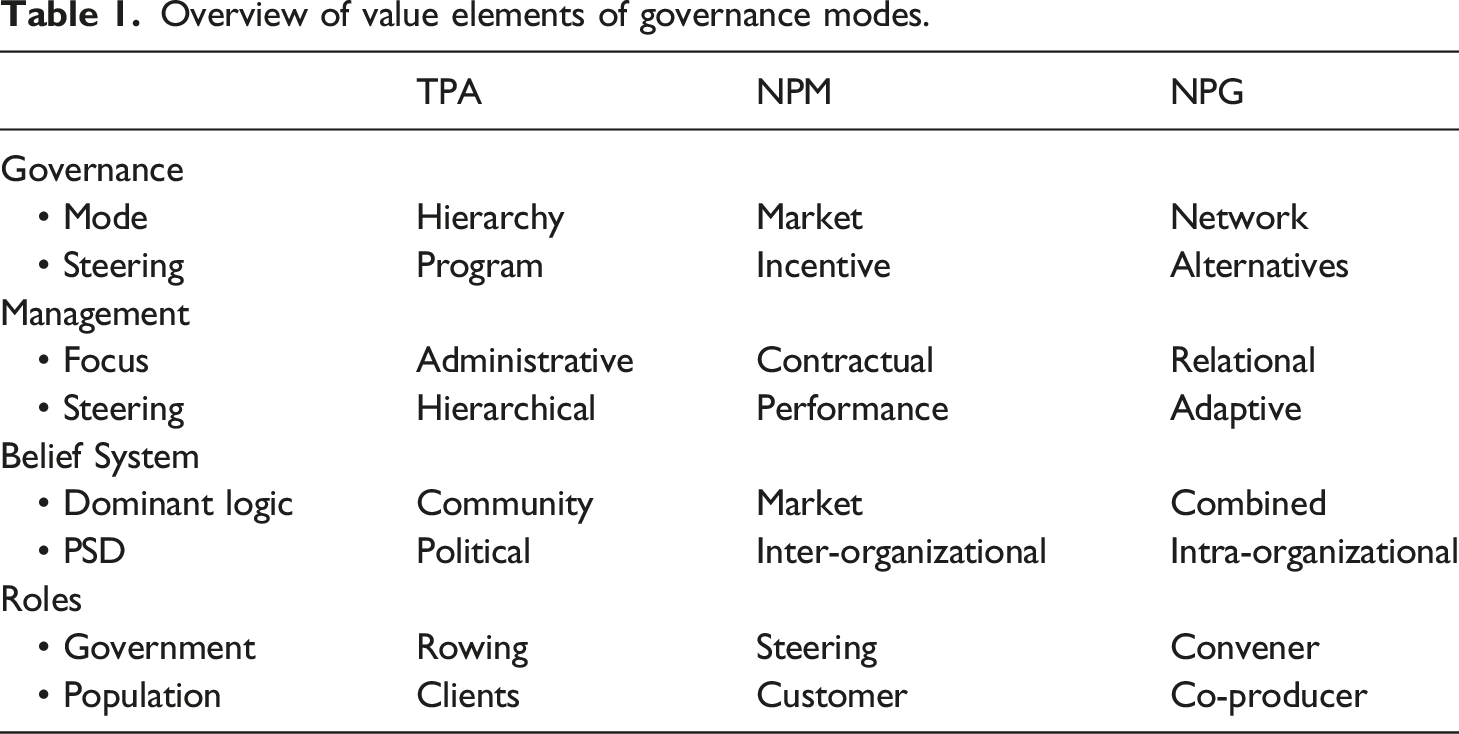
Despite their respective merits, previous studies are limited to social enterprises and private organizations and do not focus specifically on the implementation of NPG. Moreover, they are limited to discussing the inherent duality within institutional logics while Besharov and Smith (2014) emphasize the importance of analyzing organizations that embody more than two logics simultaneously. Where different streams of literature in public administration (Kuitert, 2019; Wällstedt and Almqvist, 2015) and strategic management focus (De Wit and Meyer, 2014) on how to deal with contradictory logics by approaching conflicts as dilemma’s (either/or), trade-offs (weighing) or a balancing act (both/and), this paper takes a step back and provides insights in the actual experienced tensions that lead to implementation challenges and thus how public actors experience internal hybridity.
Research approach and methods
To investigate NPG implementation challenges that civil servants in municipal organizations experience, a multi-level case study (Yin, 1994) was conducted in two large municipalities (>500.000 inhabitants) in the Netherlands. The Netherlands is particularly interesting to study as it is considered one of the few countries that displays strong NPG tendencies (Torfing et al., 2020). We used an extreme case selection technique (Seawright and Gerring, 2008) as little was known about intra-organizational hybridity. Since we aimed to explore rather than test hypotheses or confirm expectations, large municipalities were selected as cases where a high degree of hybridity was expected. In contrast to smaller municipalities, civil servants in large municipalities are less likely to have multiple roles, which could diminish internal value tensions between roles. Within the municipal organizations, we focused on the implementation of NPG in the delivery of public goods and services in the built environment, such as real estate, water resources and infrastructure maintenance. To deal with complex societal issues fundamental project values like engineering quality and cost-effectiveness need to be expanded to include novel values on social and sustainability dimensions that are difficult to quantify or translate into spatial elements, and thus integration between different levels and departments is needed in a commissioning environment that causes fragmentation within organization because projects are often divided between different departments and services, like the engineering department and the procurement department (Hermans et al., 2018). In addition, with the growing demand for innovative solutions to increasingly complex social issues, physical interventions are often commissioned in complex multi-level collaborative environments which means that internal logics of public organizations also need to reflect commercial logics and social logics.
Data collection
Following Roberts (2019), we explored how civil servants were confronted with tensions caused by internal hybridity within their organization across multiple levels (from more strategic to more operational), and between sub-domains (as part of a municipal department or unit). For this study we focused on the urban management and development departments, in Municipality A in particular on teams with a focus on commissioning, engineering, procurement and assessment, sustainability and urban planning (between September 2018 and December 2018) and a specific construction project (between June 2017 and October 2019). In Municipality B the focus was on teams working on procurement, engineering, urban planning, area management and management of civil works and public lighting. With respect to municipality B, interviews and documents were collected as part of an earlier study with the urban development and engineering department (Kuitert et al., 2019).
To allow for triangulation between self-reported behavior, actual behavior, and official documentation different types of data were collected for each case: formal and informal interviews, observations, and documents. The interviewees were selected via expert sampling, a type of purposive sampling that selects respondents known to have a certain level of expertise in the field (Hennink et al., 2020). For each organization, the principal goal was to interview civil servants who were involved with different clusters of values related to competing institutional logics based on their profession. Interviewees were selected that fitted a specific job description of directors of the management and development departments, general integrity coordinator, people that are responsible for policy and assessment of procurement, program managers or internal advisors responsible for innovation, sustainability, socially responsible procurement, finance and/or control, and for managing the use of (new) forms of contracts. In total, fifteen semi-structured (A:7, B: 8) interviews, lasting 45-90 min each were conducted, recorded, and transcribed verbatim. An extensive topic list formed the foundation of the interview, but interviewees were free to elaborate or discuss topics they deemed relevant.
Analytical dimensions.
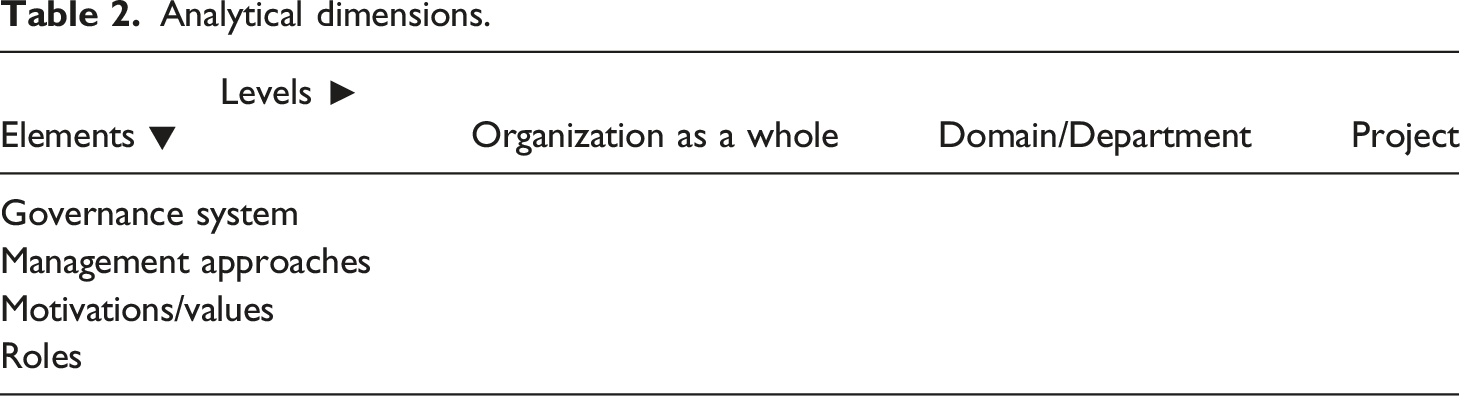
Documents that were mentioned in the interviews were collected and the internet was searched for additional relevant documents using the different value clusters and distinct levels using a purposeful sampling technique, regarding internal commissioning, mandate regulations, codes of conduct, policies, visions, laws and regulations, stakeholder groups, programs, portfolios, projects, and measurement tools that were directly related to the value clusters.
Finally, around 40 h of observation data were collected at the organizational and project level during 4 months of observations at the urban development department of case A (between September 2018 and December 2018), several indirect observations of other projects in Case B and 2 years of following a project that was seeking to implement a policy on stakeholder participation (between June 2017 and October 2019) (Kuitert et al., 2023). During the observation period, amongst other things, meetings of a tender pool, client board, project evaluations, an innovation workshop and monthly gatherings of the project-private project team were observed. Actors from various domains or departments participated in these meetings, which enabled thorough analysis of the application of (elements of) governance modes across different organizational levels. Throughout the observation period, notes were taken to collect as much detail as possible.
Data analysis
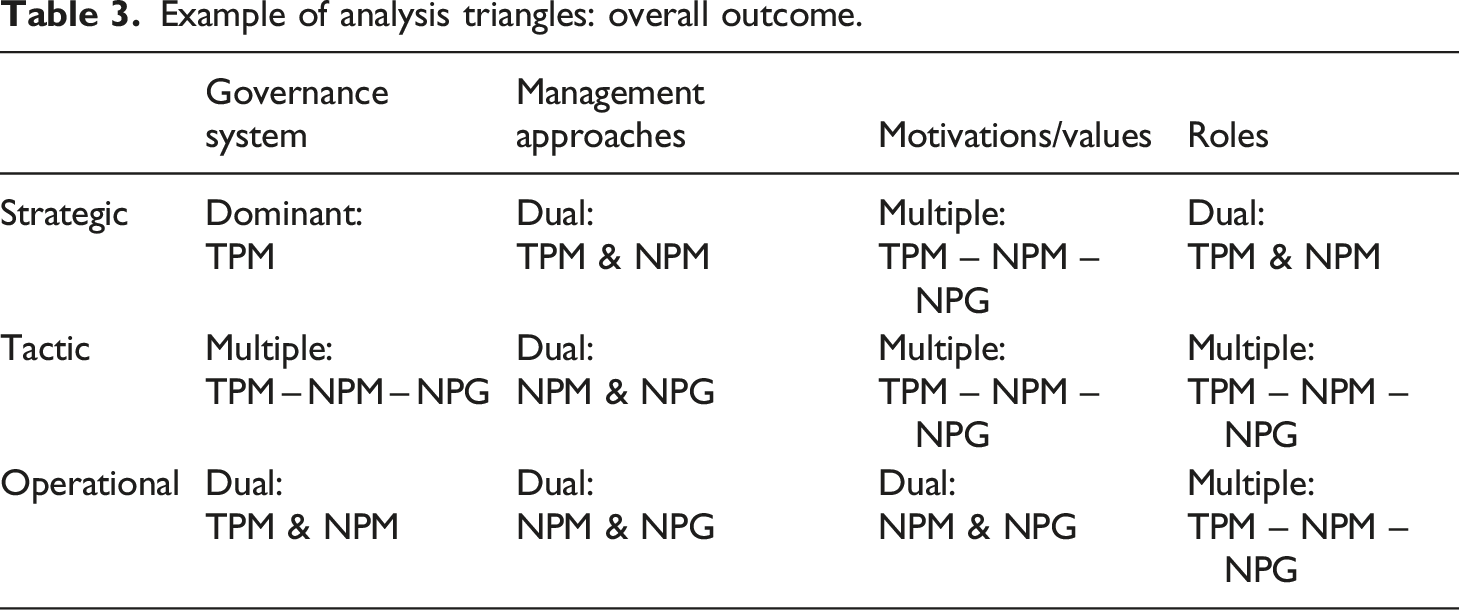
Example of analysis triangles: overall outcome.
Findings
Vertical NPG implementation challenges
Required formalization versus flexibility
With regard to the formalization versus flexibility challenge, we found that NPG requires various actors to view the entire process and discuss how a certain outcome can be best achieved. Data indicated that parts of the TPA and NPM value systems hindered this new approach because TPA and NPM values systems are driven by ‘delivering something within time or budget’, rather than engaging in the participative question of ‘how to add value to this part of the city’. The dominance of TPA and NPM value manifested a need to translate ‘new’ NPG values into frameworks for each department and to formalize them. For example, documents show that at the urban development department sustainability was translated into a points-based system for nature-inclusive building, whereas in the public works department sustainability was translated into core values, such as health and resilience, within an asset management plan. This meant that every department had their own operationalization of value, which, in turn, engendered internal hybridity.
The bureaucratic and formal way of implementing NPG values within the two organizations did not necessarily make the implementation of these values more effective. For example, we observed how members of the tender board consistently asked project leaders if they could include sustainability in their new project, even when it was unclear if it would make any contribution to the societal goals that underpinned these values. Moreover, the inclusion of these values was often found to be easily pushed aside. As a department head from municipality B stated:
“We always try to be participative. To say: we’re going to address your neighborhood, you get to have a say. […] In the end we notice that within the framework of the zoning plan we all think they’re nice ideas, but we still just do what we want.”
Misalignment between top-down and bottom-up governance
The analysis of the triangles shows that in both cases the implementation of the new NPG values, such as innovation or sustainability, often transpired at lower levels of the organization, see Table 3. Meaning that compared to TPA and NPM values, the NPG values were less dominant in strategic organization-wide decision-making than they were at the level of substantive departments and the operational project level. However, initiatives to shape the integration of overarching NPG themes did often occur at higher levels, requiring implementation in the organization in a top-down way, which, in turn, caused misalignment between bottom-up and top-down initiatives and induced internal hybridity. For example, we observed in the evaluation of a smart city living lab it was often unclear which problem the lab was addressing, while the tasks of the lab often appeared to be more about complying with existing policies and linking the solution to an established problem, than it was about achieving the goal of sustainable urban development. The lab, a bottom-up initiative, did not fit in with the larger strategic goals of the municipality. This, in combination with other data, indicates that it is relatively straightforward to get initiatives created by enthusiasts at the operational level, but that in the end, such initiatives must also be deemed to be important at the strategic level and aligned with broader organizational strategies. This, in turn, allows these values to be implemented across all levels and departments of the organization. As one of the policy advisors from municipality B stated:
“I know that if I want to get something done with a program, it doesn’t make much sense to only talk to people with substantive tasks. I also have to make sure that I talk to people, in my case around procurement, at the management level.”
In both cases, we found that the primary mode of governance remained hierarchical, limiting the implementation of NPG, both in terms of bottom-up attempts at accountability and in the translation of new values at the lower levels. This is an indication that administration is still a dominant condition for initiatives undertaken by these municipalities. The preference for bureaucracy and formalization hinders the achievement of certain objectives, although we did find evidence of an increasing level of cooperation within the organizations. For example, in an interview with the head of the urban planning department it was indicated that “everyone comes with an Excel sheet and does not consult each other”. Hence, even when efforts are made to meet each other, the old TPA and NPM values of budget control and efficiency and transparency operate as control mechanisms, rather than as instruments that facilitate the implementation of NPG values such as innovation or participation.
Considering the whole and the part
The analysis of the triangles combined with explanations during the interviews indicate that the implementation of NPG differs per organizational scale level. At certain levels of the organization, such as the level of the organization-as-a-whole, there is still a clear preference for TPA and NPM elements, while other levels, such as the individual project level, are more likely to adopt NPG elements. This results in differences in NPG implementation and adoption rates across the different levels of the organization. For instance, while following a project focused on the redevelopment of a park, which included citizen participation, we observed that its project members were willing to take much greater risk in designing an innovative procurement process than the engineering department of the municipality would. Indeed, the department as a whole was found to be more defensive, risk averse and non-opportunistic than specific projects were. As a project manager stated: “My colleagues are still a bit conservative”. The difference in implementation rates between different levels caused value tensions. For example, from the level of a specific project, it may well be desirable to focus on certain NPG values, while from the department level it may be desirable to focus more on TPA and NPM values, as the head of a department in municipality A explained:
“Of course, as a municipality we are also very busy with how we procure, and which topics are involved [….]. And we also have to be careful that we do not put things on paper, which cannot be assessed in reality. Of course, this is something that people in my municipality may run into during the implementation”.
Horizontal NPG implementation challenges
Differences between pillars
In both cases, the organizations showed signs of pillarization, with different parts of the organization existing side-by-side as separate columns, units, or pillars. Each pillar had its own responsibilities, which, in turn, caused fragmentation and compartmentalization within the organization. This complicated the implementation of ‘new’ and overarching NPG values such as innovation and sustainability, as these types of values demand a broader multi-perspective and require an integrated approach, as explained by multiple interviewees. The pillarization made it difficult to cross intra-organizational boundaries and embed the new NPG values and corresponding governance elements. A sustainability manager described how much of his works ends up ‘falling in between’:
“Basically, everything in the department is framed within the policy frameworks. I, on the contrary, always have things that just fall in between. So, things that just don’t fit within the frameworks. So, I always have to find out how I can do this in a good way and spend public money the right way.”
Moreover, even if a person, policy, project, or team that aims to implement a specific new value is granted a formal position within the pillarized organizational structure, it means that they are ultimately accountable to that specific pillar. Observation and informal conversations with team members of a working group on innovation show, for example, that this team becomes part of one particular pillar, the urban development pillar, but that the team members are (financially) accountable for their activities in this working group to the department to which they formally belong. This causes a tension between NPG values, which require a broad and integrated approach, and the traditional and bureaucratic TPA and NPM accountability values that require all activities to be accounted for within their own department, thereby challenging the implementation of NPG.
Differences across professions
Not only did we find implementation differences between different parts of the organization, but we also found differences across professions. The analysis of the triangles showed that management professions were still dominated by TPA values, displaying only limited adoption of NPG values, and thus experienced little value conflicts. On the contrary, the development professions, such as engineers or urban designers, did show and discussed to experience explicit conflicts stemming from the simultaneous implementation of NPM and NPG values. The different experiences regarding value conflicts can cause value tensions between different professions, especially when using an integrated approach. One interviewee involved with procurement explained that this often results in other professions testing the limits of the public procurement value system, pushing the procurement professional into roles they do not appreciate:
“They ask us: ‘Does it always have to be like this?’ Occasionally we act as supervisors and police officers to alert them to the legitimacy of procurement.”
We also found that the people in the executing professions varied in terms of their motivations, attitudes, and behavior, and that as a result, certain professions (e.g., engineers) were more likely to adopt NPG values than others (e.g., controllers). This was because certain professions appeared to be linked to attitudes that favored or disliked the implementation of the new values. For example, interviewees generally considered advisors to be more composed, while engineers were perceived as out of the box thinkers who possessed an experimental attitude. This was exacerbated by the fact that when new values were introduced into the organizations, they were often assigned to specific people or teams, who were given the task of driving its implementation. A manager from municipality A explained how this can have a detrimental impact on the institutionalization of such values:
“When the word participation is mentioned in the management team, everyone is looking at me now. ‘Oh, there is [name] from participation.’ But this is not good. It might be good compared to a year ago, because no one ever looked at me then. But this is not what I want, because participation has to belong to everyone.”
Due to the person-relatedness of thematic instruments, the implementation of such instruments, such as a citizen participation policy, remained difficult.
Different value interpretations between the departments
The analysis of the triangles combined with explanations during the interviews indicate different interpretations of values between departments, and differences in the dominance of governance models causing internal hybridity. For example, departments differed in their perception of the term ‘participation’, as well as in terms of how it should be integrated into existing roles. While some interviewees perceived asking citizens which option they preferred as participation in a development project, others only considered it participation when citizens were able to actually participate in the design of the project. Differences in value interpretations were also found in relation to what a certain process of a project should deliver. Actors from one department spoke about specific output whereas actors from a different department discussed it from an outcome perspective, which as a respondent explained, once again caused value conflicts:
“Sometimes we’re stuck with a certain product, that actually gets in our way. Then we don’t ask the question behind the product: what do we really want to achieve?”
Such interpretation differences sometimes made communication and collaboration between departments a bit difficult, with in some situations misunderstandings as a result. Interviews revealed that civil servants, for example, were less likely to collaborate if they thought their collaborator was aiming for something different than they were.
Conclusion and discussion
Our study aimed to create insight into how the implementation of New Public Governance (NPG) confronts civil servants in municipal organizations with internal hybridity and value tensions by integrating a governance mechanisms-based approach with a value conflict approach from institutional logics. Using a multi-level comparative case study in two Dutch municipalities, we find that civil servants, on a daily basis, face several vertical integration challenges - the tension between formalization and flexibilization, a misalignment in top-down and bottom-up governance, and a tension between more integrated approach addressing ‘the whole’ versus issues concerning ‘the parts’ of a physical intervention from NPG value frameworks -, and horizontal integration challenges - different organizational pillars, professions, and value interpretations -, that affect the implementation of NPG. Based on our empirical results, we draw the following conclusions with regard to facing value wickedness in municipal organizations.
First, with the implementation of NPG the range of values that civil servants are confronted with continually grows, extending the pluralistic character of the public value system, rather than replacing existing values. This can be considered as a consequence of governance reform in public administration and continuation of the complexification of governance (Osborne, 2010; Torfing and Triantafillou, 2013). Despite the governance reform we found the specific process value palette from the TPA mode of governance to be deeply embedded within the studied municipal organizations. The dominance of the different governance modes and the emergence of governance conflicts did not only differ between organizational levels and their centrality, as argued by Besharov and Smith (2014) and Roberts (2019), but also horizontally between departments and even professions, thereby increasing the degree of internal hybridity experienced by civil servants.
Second, as new values were added rather than replacing existing values, we find that civil servants’ daily experience of value conflicts and tensions created a paradox in their minds between: ‘am I going to do it right’ – implementing traditional TPA and NPM values, such as transparency, legitimacy, and effectiveness – and ‘am I going to do the right thing’ – implementing NPG values such as sustainability, innovation, or citizen participation. On the one hand, the ability to cross internal boundaries to work in an integral way is key for innovation in NPG as discussed by Van Broek and Van Buuren (2020). On the other hand, sustaining existing boundaries is needed to defend traditional public values, such as accountability (Stafford and Stapleton, 2017). Our study shows that civil servants very much wanted to do what they perceived as ‘the right thing’. However, as the new value systems were often not yet translated to managerial processes, governance systems and other formal practices, they found it hard to ‘do the right thing’ while also ‘do it right’ according to the available value systems. This because the value systems from what their perception of what ‘do it right’ means were derived from TPA and NPM, revealing a compatibility with organizational actions as explained by Besharov and Smith (2014), rather than NPG. While it is relatively easy to say that actors just need to ‘do the right things right’, operationalizing the idea of doing both rather than ‘either-or’ is difficult (Wällstedt and Almqvist, 2015). Our study finds that value conflicts hindered civil servants in ‘doing the right thing right’ and required them to make an impossible choice. While civil servants could deal with the implementation challenges that reflect specific value tensions by approaching them as trade-offs or dilemma’s (either/or), the overall paradox (Smith et al., 2010) could not be resolved. Balancing a both/and approach, as a way to deal with the paradox, resulted in a situation where ‘doing the right things right’ was usually not achieved. In this paradoxical situation the established side generally ‘won’: the old ways of safeguarding values of TPA and NPM governance models remained dominant in the value conflicts due to the sheer range of implementation challenges standing in the way of implementing new values of NPG governance modes.
Third, this means that the only chance that the new values currently have of being implemented is if they align with the old values from older modes of governance. To establish a balance between procedural obligations as a public agent and the increasing need to steer on sustainability, innovation and quality, alignment between the new values with the old values from older modes of governance is necessary. Otherwise, the internal hybridity caused by multiplicity in (elements of) modes of governance between fragmented departments and misaligned levels – and the ensuing conflicts this creates – may lead to an overall reduction in value creation (De Ridder, 2010; Stafford and Stapleton, 2017). Whether or not this is a bad thing, or whether it should be understood as a preliminary step in the transition towards dominance of NPG, is an interesting question to raise in ongoing discussions around implementation challenges (Besharov and Smith, 2014; Mair et al., 2015; Pache and Thornton, 2020) and one which requires further research.
Finally, we find that the complexity of internally hybridity is caused not only by the existence of multiple institutional logics belonging to the different governance models, but tensions also arise from the differences in the degree of NPG adoption. From a vertical perspective in the organization the implementation of NPG appears to be rather top-down. When considered from a horizontal perspective the sectoral fragmentation leads to different degrees of implementation. Pillarization meant that trying to implement NPG values, such as sustainability, which requires a broad approach, regularly fell between pillars, while the traditional bureaucratic accounting systems also limited the options for intra-organizational border crossing. Differences in implementation rates were also discerned between professions within the organization, whereby some professions, such as engineers, experienced more value conflicts between concurrently implementing the values associated with NPM and NPG than other professions. Overall, this poses a risk. If the transition towards NPG would stall our findings suggests a scenario will unfold where value conflicts will result in trade-off value systems rather than collaboratively striving towards balancing public values. It is therefore vital to understand how governance modes can be successfully mixed and aligned at the organizational level as a way of coping with the paradox. We, therefore, recommend further research on how civil servants can best balance NPG values alongside TPA and NPM values within organizations to come to a successful mix of governance modes. For example, using the work of Balogun et al. (2005) on innovating and sustaining boundary spanning actions. Another option could be to use the work of Crosby et al. (2017) to zoom in on how public managers can use different types of leadership to promote collaborative innovation, for example, to turn antagonistic conflict into agonistic conflict and hence play a key role in solving wicked problems network collaboration.
Like any other study, this study has its limitations. Our study only provides a first insight into how the co-existence of multiple governance modes confronts civil servants with value tensions and internal hybridity. The results and the outlined implications should therefore be interpreted in light of the scope of the research, which is limited to two cases with a limited set of value interests within two large Dutch municipalities with a focus on urban management. This means our findings cannot be directly generalized to other projects or organizations, for example with a different degree of publicness, task, size, or in a different organization. Yet, it does offer a theoretical steppingstone for further research into the implementation of NPG and the internal hybridity that can occur because of it. We therefore call for further research to examine if and how the perceived internal hybridity relates to the implementation of NPG across and inside different public organizations and identify and explain the mechanisms behind these variations. Moreover, we also call for more longitudinal research to better understand the effects of value conflicts and increase the chances of civil servants ‘doing the right things right’, and analyze whether and how the wickedness of the ‘doing it right’ - ‘doing the right thing’ paradox develops over time.
Footnotes
Declaration of conflicting interests
The author(s) declared no potential conflicts of interest with respect to the research, authorship, and/or publication of this article.
Funding
The author(s) received no financial support for the research, authorship, and/or publication of this article.
