




Abstract
Public value co-creation has become one of the most relevant topics in the economic and social sciences in recent years. However, literature on the theme seems quite fragmented; we deem part of the explanation for why there seems not to be consensus on the definition of the nature of the processes of co-creation of value could and should be sought by querying what underlying ontology of the human being, philosophical anthropology and political philosophy underpin the entire value co-creation intellectual endeavour. We argue the strand of philosophy known as Personalism – developed by intellectuals such as Jacques Maritain, Emmanuel Mounier and Luigi Giussani – may contribute to outlining the ideational bases of public value co-creation and root them in a relational conception of the individual as person, an approach which compounds a ‘negative’ conception of freedom (whereby someone’s liberty ends where somebody else’s begins) with a ‘positive’ one (whereby someone’s liberty has a transformative influence on somebody else’s liberty), a conception which underpins a notion of freedom hinging around the core idea that persons develop and flourish through their mutual relationships, and a conception of the human being as socially dependent. The paper then analytically revisits key ideas in value co-creation - namely the notions of public value, value co-creation, collaboration, and participatory public policy - through the notions in philosophical personalism of common good, active citizenship, relational freedom for collaboration, and intermediate communities, in order to highlight parallels and conceptual affinities between the two bodies of thought.
Keywords
Introduction
The notion of value co-creation and, in the field of public management, of public value co-creation has become one of the most relevant topics in the economic and social sciences in recent years, half a century since the seminal work of Ostrom (1972, 1976 and 1978). The service-centric character of many public services has stimulated the interest in co-production and co-creation in public administration research (Alford, 2016; Bovaird and Loeffler, 2021; Brandsen et al., 2018; Osborne et al., 2016; Osborne and Strokosch, 2013; Torfing et al., 2021), and such notions have in recent times informed many conceptual frameworks for public services reform and development.
However, despite this important research activity, authors have highlighted a relevant research gap in value co-creation theories and approaches. To this regard, based on a wide review of the literature, Alves et al. (2016: 1626) conclude that “no consensus exists on the definition of the value-creation concept and the processes inherent to that concept”. More recently, Saha et al. (2022) synthesized the literature on value co-creation from 2004 to 2019 and state that “although the value co-creation literature has grown in the last two decades, this literature is quite fragmented” (p. 624) and that, more specifically, “the nature of the fragmented conceptualization is quite evident (p. 616)”. Such conclusions reinforce a similar assessment by Ranjan and Read (2016) who point out the theoretical ambiguity which may explain conflicting results in the studies. In a similar vein, Cluley and Radnor (2020) point out gaps and contradictions in the definition of value co-creation in the literature.
This leads us to wonder: what are the reasons why there is no clear consensus on the definition of co-creation of value and what conceptual tools could help build a conception of value co-creation that may engender consensus? To address such question, we follow the approach and conclusions of Cluley and Radnor (2019, 2020), Torfing et al. (2021) and Ongaro (2022) and take as starting point that the lack of philosophical grounding of the extant theorisation of public value co-creation provides a possible explanation for the somewhat fragmentary status of research in the field. Taking a philosophical perspective may help construe a more comprehensive approach, which may contribute to the conceptualization of public value co-creation. We argue that the answer to such question could and should be sought by adopting a different theoretical perspective, one which queries what underlying ontology of the human nature underpins the entire value co-creation intellectual endeavour, what conception of person lies at the roots of the value co-creation movement – and specifically for the field of public management, of the public value co-creation movement, which is in the ascendancy of recent.
Torfing et al. (2021) argue that “the ideational basis of co-creation may be traced back to the philosophical strand of ‘personalism’ associated with philosophers such as Emmanuel Mounier and Jacques Maritain” (Torfing et al., 2021: 13). This can be a very suitable starting point. The philosophy of personalism proposed by Mounier and Maritain (known as Christian personalism) places a strong emphasis on the interpersonal and collaborative dimension of human life: personalism adopts an inherently relational conception of the human being – one which seems to dovetail key assumptions and starting points (albeit often formulated only implicitly) of the public value co-creation literature, thence such philosophy can be very well-suited for explicating some of the underpinnings of processes of public value co-creation.
According to the philosophical perspective of personalism - which provides both an anthropology and a political philosophy (more precisely, Personalism can be seen as a philosophy of the human being: it can be mainly characterised as belonging to the academic field of philosophical anthropology, the philosophical foundations of ‘human nature’, and its implications for a range of social and public affairs problems) – it is only in relationships with others and in belonging to multiple and multilevel communities of people that the individual person can fulfil her/himself and fully develop their vocation. This perspective entails a conception of freedom which compounds a ‘negative’ conception of freedom – whereby somebody’s liberty ends where somebody else’s begins – with a ‘positive’ one, whereby somebody’s liberty has a transformative influence on somebody else’s liberty: persons develop through their mutual relationships, people become free by relating to each other - the notion of ‘fraternity’ in the most famous triad at the roots of the French revolution substantiates and gives life to the notions of ‘liberty’ and ‘equality’ (Biancu and Ongaro, 2025a). The perspective of personalism is miles away from notions of the economic man (homo economicus), rather, it is close to Plato’s conception of the human being as socially dependent in a strong sense, an argument developed in Plato’s The Republic (individuals can be said to be socially dependent if ‘[T]he achievement of their well-being depends crucially on the pattern of social forms surrounding them and the terms in which they are encouraged to participate in them’, see more extensively Bird, 2006, pp. 42-43). We argue such conception of person can provide an ontological basis for deepening our understanding of the nature of co-creation processes at large and, specifically for the purposes of this paper, of public value co-creation. Therefore, we are contributing to the literature field of the value co-creation by integrating the personalism philosophy and the foundations for a better understanding and conceptualization of public value co-creation.
Some of the concepts that are at the centre of the theoretical elaboration of Christian personalism - such as ‘common good’, ‘active citizenship’, ‘relational freedom’ and ‘intermediate communities’ (Deweer, 2013, 2017; Giussani, 2008; Giussani, 2023; Lee, 2017; Ongaro, 2020) - are strongly linked to fundamental elements of value co-creation processes. For instance, taking the concept of active citizenship (Deweer, 2013; 2017; Ongaro, 2020), personalism envisages extensive forms of bottom-up politics seen as pivotal to guaranteeing maximal participation and control by the citizenry. In the words of Maritain (1951): “The program of the people should not be offered from above to the people, and then accepted by them; it should be the work of the people (p. 68)”. This presents obvious relationships with the active involvement of citizens in creating solutions to public affairs problems that theories of value co-creation promote.
Likewise, other key concepts in Christian personalism such as the existence of an adequate framework for citizen participation, the importance of small communities participating in public and political life – intermediate communities (Giussani, 2008) -, or the role played by the voice of citizens in regulating public activity are all ideational elements closely related to mainstream theories in the contemporary scientific literature on the co-creation of value in the public sector (Ansell et al., 2023; Opdebeeck, 2017; Wardhaugh, 2015). Finally, theories of value co-creation seek to generate methods to increase public value, a thrust which is in parallel to one of the purposes of personalism approaches, namely to attain improvements of the common good (intended as a state of affairs in which the wellbeing of everyone is improved, or at least not impaired).
In this sense, studying the philosophical and ontological development of certain economic and political notions from the perspective of personalism and developing an analytical comparison with the range of notions employed and deployed in the value co-creation theory to draw parallels between related families of ideas can serve as a starting point to attain a broader and more comprehensive theorization of the co-creation of value in the public sector. This is the contribution this paper aims to make in order to address the research gap mentioned at the outset: to critically analyse key concepts of personalism that can be related to the conceptualization of value co-creation, to then explore whether the approach suggested by Torfing et al. (2021), according to which personalism can provide a theoretical source for a deeper and broader conceptualization of value co-creation, can indeed constitute a promising way forward for the suppler theorisation of public value co-creation. This paper thus attempts to answer a main theoretical research question: what are the theoretical lineages between the theory of value co-creation in the public sector and the philosophy of personalism, and how can notions drawn from personalism enhance our understanding of public value co-creation processes?
To address the research question, we will analyse ideational correspondences between the following concepts, trying to delineate how the former set of concepts may provide underpinning/enablement for the latter: first, the notion of common good in personalism for underpinning certain aspects of the theorisation of the notion of public value; second, the notion of active citizenship seen as an ontological condition for enabling value co-creation processes; third, the notion of relational freedom as ontological condition enabling forms of collaboration; fourth, the notion of intermediate communities for enabling forms of participatory public policy.
We will develop such analysis by introducing each of these concepts from the philosophical approach of personalism, to then outline how such a perspective can provide important philosophical foundations to understand the co-creation of public value. This will be mostly done by using the work of the two fathers and main authors of Christian personalism, Maritain and Mounier, and a more recent thinker, Giussani, who has introduced the concepts of “intermediate communities” and “operational companionship” (thereby reinforcing the communitarian dimension of personalism) which are important for our analysis 1 .
The paper unfolds by at first introducing the framework of the conceptual correspondences between notions drawn from personalism and concepts in public value co-creation theory, to then analyse each of the four main concepts in personalism – common good, active citizenship, relational freedom, intermediate communities – in detail for application for theorising public value co-creation in distinct sections. Parallels and conceptual lineages between key notions of personalism and concepts in the public value co-creation theory are then discussed. The work concludes by arguing for the significance of connecting philosophical concepts and streams of inquiry with public administration and public management theories.
Conceptual framework
In order to connect the philosophy of personalism and public value co-creation theory, we propose a conceptual framework (see Figure 1) that elaborates on how the means and ends of personalism may serve as a theoretical and philosophical foundation for the means and ends of theories of value co-creation in public services, thereby enabling to appreciate the contribution that personalism can provide to the theorisation of public value co-creation, notably in relation to defining the role of the State and public institutions at large. A conceptual framework connecting key notions of personalism and public value co-creation theory.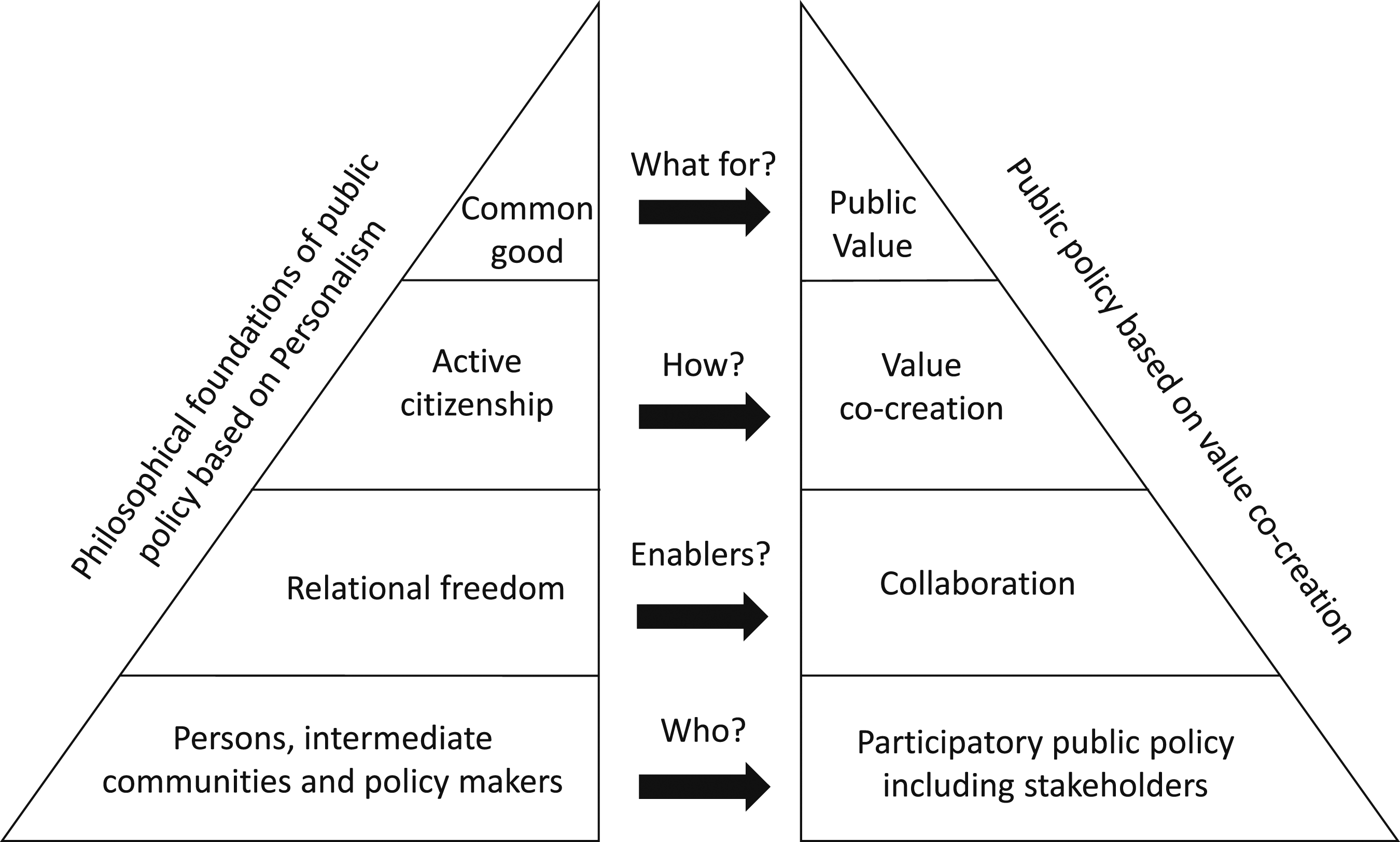
When it was initially proposed, the philosophy of personalism aimed to contribute an approach capable of overcoming what its proponents deemed to be the drawbacks of individualism on one hand, which neglects the importance of communities, and of collectivism on the other, which subordinates the individual to a collective, by charting a sort of ‘third way’ between, and beyond, the two dominant ideologies of the time (Capitalism and Communism). It also contained a critique of the limits of parliamentarian democracy, yet with a thrust to complement and supplement, indeed, to ground and root it and hence breathe life into it, rather than displacing or belittling it, as the then dominant ideologies were attempting to do (at least in the view of the proponents of personalism). In this sense, there are profound affinities in the overall thrust between the exponents of personalism and leading authors in the public value co-creation theory who speak of ‘democratic quality’ of co-creation (Ansell et al., 2023): both aim at revitalising liberal democracy by complementing it, thereby enabling it to resist to the assaults of the enemies of liberal democracy (the totalitarianisms of the 20th century, the democratic backsliding of the 21st century).
Figure 1 proposes a conceptual framework for illustrating how concepts drawn from personalism may provide foundations to core notions that form the basis of the public value co-creation theory. The proposed framework also considers the role of both citizens and the State in the creation of public value (to note that the notion of “citizen” is used here in the sociological sense, thereby encompassing residents and all those who have an affective and social belonging to a certain community, even when they do not hold the citizenship of the given jurisdiction), and explains why citizens exercise their relational freedom and actively and freely associate in intermediate communities for carrying out forms of collaboration which bring about value co-creation activities that ultimately create public value, which is a form of attainment of the common good.
At the bottom of the figure, we focus “who” the social actors in PV co-creation are: public sector officers, citizens-users, social designers and stakeholders are the ones who produce public value; on this regard, the personalism concept of ‘intermediate community’ may contribute to explain why humans need to associate themselves to produce value and why this is more efficient for the economy. Complementarily, personalism also sustains that the State must ensure an institutional framework that can enable the development and flourishing of intermediate communities.
One rung above in Figure 1, it is indicated that relational freedom stands as the main enabler of public value creation. From a personalism philosophy perspective, in fact, without freedom any action is doomed to failure, and no isolated action is useful in the pursuit of the common good, so there is a need for platforms or institutions that enable people to collaborate and participate in the political life of a jurisdiction; moreover, without a pattern of values, action is rudderless, resulting in arbitrariness, inertia or delusion; this conception of freedom of the human being might provide a fresh perspective from which to look at how contemporary societal needs and challenges can be addressed.
Next, the concept of active citizenship is the culmination of the relational form of freedom unfolding within intermediate communities and their interactions with the State and public institutions, interactions which enable forms of collaboration to occur, thereby addressing the “how” question. Such collaborations can bring about value co-creation activities that ultimately create public value. In fact and finally, at the top of the framework, the Thomistic concept of common good developed by personalist Philosophers (mainly Maritain) may offer a convincing understanding of what the nature of public value is.
Common good for public value
Defining public value has proved challenging, and the very notions of value, of public value, and of co-creation – however finessed in the literature – present some problematic aspects. Cluley and Radnor (2019) notice that “[W]hat value actually is and how it emerges through public service provision and interactions is subject to ongoing debate“, while also pointing out that “discussion regarding epistemology and ontology, however, are fundamentally missing from these debates (p. 2)”, as also noticed by Meynhardt who, before proposing a psychological theory approach to defining public value, notes that: “The conceptualization of public value creation requires beforehand a stepwise discussion of the single constructs “value,” “the public” and “public value.” Only against this background of philosophical and psychological notions value creation in economic/financial terms can be contrasted with public value creation (p. 193)” (Meynhardt, 2009, italics added).
Value creation is inherently relational. In fact, “public value is created in relationships in which “the public” is involved (p. 203)” (Meynhardt, 2009), and consequently public value “often takes the form of co-production and inter-organizational collaboration within or across sectors” (Bryson et al., 2017). The inherent “relational” character of value was extensively theorised by Vargo and Lusch (2004, 2008, 2016; Lusch and Vargo, 2006), who contributed to the development of the service dominant logic in economic theory, which has applied to public services most prominently by Stephen Osborne (Osborne et al., 2013, 2021). Their analysis centres on the exchange process itself, and conceives of the co-creation of value as the fundamental element of this exchange process, which is understood as a process that is not restricted to the relationship between the consumer and the supplier, rather all value configurations are intended as the locus of value creation: economic and social actors within networks that interact and exchange with each other form an ecosystem of co-creation (Desmarchelier et al., 2021). In an effort to scope the contribution of the service logic, authors such as Grönroos (2011) point out that some of the foundational premises of the so-called service-dominant logic do not entirely support an understanding of value creation and co-creation in a way that is meaningful for theoretical development and decision making: to this purpose, a philosophical approach can be useful. In this line of reasoning, we turn to the philosophical notion of common good as interpreted within personalism.
The notion of common good has a long history in western philosophy since at least Plato. This concept was revisited and developed in an original way by Maritain, by focusing on what he called the concrete historical ideal, in which “the proper and specifying end of the city and civilization is a common good different from the simple sum of individual goods and superior to the interests of the individual” (Maritain, 1934: 27). The concept of concrete historical ideal has two components. First, Maritain (1948) accepted the neo-Thomist notion of bonum commune (common good), according to which the common good is an element with material, moral, spiritual and historical dimensions, and that this common good is desired by all humans in the world; in this sense, the common good gives to the concrete historical ideal a community ideal. Second, Maritain (1936) underlines that “it is essential to the common good to respect and serve the supratemporal ends of the human person. (p. 105)”: thus, the fundamental purpose of political society is to lead the human person to their happiness and full freedom.
For Deweer (2013), these two features highlight the typically personalist tension: all persons of a community participate in the common task of a society to which they are, therefore, subordinate; however, because of their personal vocation, each person is also superior to this common task: “[T]he person is at the service of the common good, but the common good is at the service of favoring the vocational search of the individual person.” (Deweer, 2013: 4). Maritain sought the ontological foundation of this tension in Thomas Aquinas’s description of humanity: “Each individual person is related to the community as a part of a whole [but] man is not subservient to the political community on the basis of all that it is and possesses.” 2
In their work, therefore, Maritain and Fitzgerald (1946) draw a link between the idea of the person as a social entity and the concept of the common good as the ultimate aim of society. These ideas are interdependent. The common good is considered common because it is shared and utilized by the community, it is received and consumed by the public. The ultimate aim of society is the common good, which represents the well-being of each concrete person. However, the welfare of the social body should be recognized as a common benefit for individual human beings. The common good is neither a simple aggregation of individual benefits, nor the exclusive good of a whole without regard to individuals (such is the case for a species in relation to its members, or a hive in relation to its bees). The common good is common both to the whole and to the parts to which it flows back and which, in turn, should benefit from it. It is useful to report the exact wording used by Maritain and Fitzgerald (1946) as they can help to clarify the concept of public value in the theories of co-creation of value in the public sector starting from the notion of common good: “The common good includes the sum or sociological integration of all the civic conscience, political virtues and sense of right and liberty, of all the activity, material prosperity and spiritual riches, of unconsciously operative hereditary wisdom, of moral rectitude, justice, friendship, happiness, virtue and heroism in the individual lives of its members. For these things all are, in a certain measure, communicable and so revert to each member, helping him to perfect his life and liberty of person. They all constitute the good human life of the people (p. 438)”.
While the notion of concrete historical ideal, for Maritain, emerged in the Medieval Age in the West in the context of a wholly Christian society, it must be adapted to the current age. Thus, Maritain (1948) proposed a “new Christianity” in which elements such as religious and social plurality (i.e., pluralism) are central and in which free humans have “friendships” and “associations” that allow them to work for the common good.
There is also an inherently dynamic character to the attainment of the common good: the concrete historical ideal has to be interpreted as a “pilgrim ideal”; in the words of Maritain: “The condition of the members of the temporal city cannot be confused with stillness and repose” (Maritain, 1936: 107). Maritain’s political philosophy is ultimately about how politics should focus on the common good (Burgos and Allen, 2018; Deweer, 2013, 2022). Maritain (1948) believed that the problem with the “bourgeois democracy” of the 19th century is that in its efforts to build a new society, rather than “the city of the person” centred on a relational conception of human beings, it ultimately built in its place the “city of the individual”, isolated and not in relation with the broader community. A relational notion of the person may instead enable to imagine the social design of a different set of political and societal arrangements, conducive to processes of public value creation.
Active citizenship for value co-creation
The study of value co-creation in public management has its theoretical roots in the mid-1970s with the work of Elinor Ostrom (1972, 1976, 1978), yet it is only with the new millennium that more numerous and systematic attempts to conceptualize the process of public value co-creation have developed (Gronroos, 2011; O’Flynn, 2021; Ongaro et al., 2021; Osborne et al., 2013, 2016; Osborne et al., 2015; Osborne, 2017; Torfing et al., 2021; Vargo and Lusch, 2004, 2008), also by interconnecting both with the public value theory (Benington, 2011; Bryson et al., 2014; Hartley et al., 2017; Meynhardt, 2009, Moore, 1995 and 2013) and with the growing body of literature on collaborative advantage (Huxham and Vangen, 2003).
Value, and public value, can only be created in a networked relationship between parties; Osborne (2017: 1) defines co-creation as “an interactive and dynamic relationship whereby value is created at the nexus of interaction”. Public value co-creation is an inherently relational and active process, which begets the question: what does such constitutive trait of public value co-creation presuppose in terms of human behaviour and, indeed, human nature? The very notion of “creation” and “co-creation” is philosophical in nature: what does “creating something” entail? In what sense is the notion of “creation” in the co-creation of public value being used in the pertinent literature? If we concur with the consideration that innovation is a key outcome of co-creation, then this begets the question of what are the roots of innovation in human nature, which leads us to consider the question of what is human creativity and inventiveness?
Personalist ideas of active citizenship might inform the notion of value co-creation. According to Maritain (1943), democracy faced threats from two directions: the totalitarian tendencies of the State, and the dangers posed by undemocratic political actors. In both scenarios, the solution lies in active citizenship. Only the vigilance of the citizenry can oblige the State to comply with its duties and refrain from illegitimate domination. This vision of the active participation of citizens represents one key element in common between Maritain’s philosophy and the theory of co-creation of public value and notably the argument about its democratic quality (Ansell et al., 2023).
This essential role of the active involvement of citizens implies the existence of appropriate structures and resources to carry out said involvement effectively. Maritain (1948) argued that while families bear the primary responsibility for education, the State and educational systems also hold additional duties. He believed that a deeper theoretical understanding – not just practical skills – are central to solidify young people’s commitment to democracy. Furthermore, active participation is not solely about citizens and the State: social networks and community connections are vital for ensuring genuine and vigilant engagement. Maritain defined citizen participation as a force that holds the state accountable and prevents illegitimate domination, emphasizing its role in securing the common good (Deweer, 2013, 2022; Lee, 2017; Wardhaugh, 2015).
Mounier´s personalist theory of human action includes concepts intimately related to the notions of collaboration, cooperation and co-creation. According to Deweer (2013) Mounier’s personalist theory is based on three pillars: first, without freedom any action is doomed to failure, so public administration has to guarantee the basic conditions for people to act freely (the “liberal rights”); second, no isolated action is useful in the search for the common good, so there is a need for platforms or institutions that enable people to collaborate and participate in the political life of a jurisdiction; third, without a pattern of values, action has no direction, resulting in arbitrariness, inertia or delusion. Therefore, human action as theorized and proposed by Mounier presupposes freedom, cooperation between different parties, and a horizon of values to avoid insignificance.
But not all human actions effected by human agency contain these same elements to the same extent, according to Mounier, who for this reason (Mounier, 1949) made a distinction between different types of action, such that each type of action provides a dominant input at a certain level. First, there is economic action (to which he refers through the ancient Greek term poiein, which roughly translated means “making”): it refers to “action of man on things, action of man on man in the domain of natural or productive forces, everywhere, even if it is in matters of culture or religion, where man dismantles, clarifies and disposes of determinism (p. 50)”. The second type of action is ethical action (prattein): in such instance, action “no longer aims primarily at building an external output, but at forming the agent, his ability, his virtues, his personal unity. This area of ethical action has its end and its measure in authenticity, a note strongly emphasized by existentialist thinkers: it matters less here what the agent does, how he does it and what he does converts by doing so (p. 51)”. Thirdly, Mounier also mentions contemplative action (theorein), which “designates that part of our activity that explores values and is enriched by them by extending his kingdom over humanity (p. 52). Finally, the collective action is the one that can be expressed as a “community of work, community of destiny or spiritual communion are essential for their integral humanization (p. 53)”.
Human actions are interconnected and influence each other. Economic activities alone cannot bring fulfilment unless they also offer dignity, friendship, and a sense of higher purpose. Hence, the economy relies on politics to link economic actions with ethical considerations. Mounier (1949), recognizing the essential interaction between various forms of action, defines a proper society as one that involves the cooperation between a political pole and a prophetic pole. The political pole focuses on establishing and committing, while the prophetic pole emphasizes thought and reflection. For Opdebeeck (2017), combining these two poles into a single personality is not something everyone can achieve; hence, society requires a diverse mix of individuals with varying qualities across the spectrum between the political and prophetic poles. This interaction leads to a cooperative model where different members of society contribute to the common good while also maintaining a supervisory role over the political system. This societal model, along with the types of actions it fosters, can be seen as providing a theoretical basis for the co-creation of value, (Deweer, 2013) as well as to attribute to co-creation a democratic quality, thereby, in our interpretation, prefiguring the argument made recently by Ansell et al. (2023).
Regarding the political implications of Mounier’s thinking, by initially taking the move from a deep scepticism towards the State and by producing a comprehensive critique of parliamentary democracy, Mounier embarked on his theoretical exploration of political fragility. Within this framework, he introduced a tripartite distinction among authority, power, and force to delineate different forms of political influence (Deweer, 2013; Opdebeeck, 2017). Authority denotes the genuine basis of power, rooted in the superiority of the human individual and spiritual values. Power represents the tangible tool of authority, capable of imposing constraints if required. Force emerges when power becomes disconnected from authority. Thus, the rightful exercise of power necessitates its subordination to authority. For Mounier (1936), the restriction of State power has to be guaranteed from the top down, by the supreme authority of a higher court, but also from the bottom up, by the social fabric of the communities that together make up the nation. It is important to note that power can never suppress the individual or her liberty. Freedom involves active liberation. Authority should guide without infringing on personal autonomy. Politics aim for the common good, distinct from individual interests.
Mounier’s philosophy has been influential on the thinking of the founding fathers of the European Union, and his political thought continues to prove influential on the debate about the foundations of the European Union as a political community, including in relation to the functioning of its administration (Dewandre and Ongaro, 2022).
Giussani’s thought is also relevant to the theories of value co-creation, first of all, because it explains the ontological reasons why human beings need to associate with each other: when grounded on an ontological reflection on the human being as a bundle of irreducible and irresistible demands, processes of value co-creation come to be understood as a means to satisfy the associative and creative thrust that every human being possesses, and it is in the inherently creativity of the person in its relationality that co-creation has its roots; in this sense, such conception of the human being can provide a broader horizon to studies on co-creation. Giussani also takes the move from the conception of person in order to delineate the contours of the tasks of the State: in this sense, Giussani also introduces philosophical reasons that justify the participation of the State in processes of co-creation of value, also emphasizing the fundamental role that it has in society, to promote society.
Relational freedom for collaboration
The core of Mounier’s mature thought was the idea of the responsible freedom of human beings. A year before his death, in his book Personnalisme (1949), Mounier emphasises that “[F]reedom is the total condition of person. Freedom is a living source of being, an act is only a human act if it transfigures into the most rebellious acts and into the magic of this spontaneity. In this sense and only in this sense man is in a whole and always. However, the freedom of man is the freedom of a person, and of this person, constituted and situated in itself in a certain way, in the world and before the values (p. 38)”. At this intellectual juncture, he delves into a paradox of human life. This paradox consists in personhood being the true mode of human existence, and yet this mode is always to be realized (Amato, 2002; Deweer, 2013, 2022). The core idea behind the concept of personality is essentially about existing for the sake of others. This means creating a society that works together, collaborates and cooperates, where both the formal and informal rules and organizations support recognizing others and allowing freedom. To achieve this, every person has to go through a series of stages. Individuals need to learn how to look beyond themselves. Once that is accomplished, they can start to imagine themselves in someone else’s shoes. This is crucial for empathy, which serves as the basis for being generous and caring. The final and ongoing step is to stay committed to being available for others, which means continually renewing your dedication to society and the community you are a part of (Amato, 2002; Deweer, 2013, 2022). Mounier’s existential personalism stressed that freedom isn’t inherent; it must be defended and embraced. Amid a state of uncertainty, people have a moral duty to make a creative choice in favour of association with others in pursuit of the common good. Maritain views politics as serving the people, who in turn must serve democracy. As individuals, they possess a calling beyond politics, yet politics establishes the framework for their personal development. Maritain’s democracy is both humanist and Christian, recognizing the autonomy of politics while guiding Christians to view it in light of ultimate human ends. A Christian’s earthly duty involves realizing freedom as a secondary but crucial aim, acknowledging that humans transcend mere political existence. Freedom, in this context, requires proper understanding; it’s not solely about choice but about positive liberty—the ability to pursue what is good and fulfil one’s life’s purpose (Maritain, 1951).
Freedom refers, above all, to a creative impetus. For Giussani (2008), freedom and association coincide and, furthermore, true freedom is accompanied by “a creative instinct in the most positive and experientially fascinating way (p. 107)”. A society is built because this creativity of which human freedom is capable is asserted, this creativity is capable of imposing itself even against the power of the government. Thus, Giussani too endorses the principle of subsidiarity that Mounier spoke of, centred on creation from below and the free association of individuals, which “the State must protect, just as a father of a family protects the activity of children as they grow up” (Giussani, 2008: 108). In line with Mounier and Maritain, Giussani argues that people are capable of exercising a regulatory function of power, limiting its reach, stopping and annulling any attempt at pursuing forms of totalitarianism or other political coercion that seeks to reduce the fundamental demands of the human beings, or to restrict the freedom of association (Giussani, 2023). Giussani affirms that State power is distorted when it tries to govern the fundamental demands of a human being (it becomes “too much State” in this sense): in this case, power is no longer servant and its sole objective becomes to ensure that there is the maximum possible consensus of a mass of people, in which individuals lose their “personhood” and whose demands are increasingly conditioned. When this happens, human desires and therefore their values are dramatically curtailed and then “the ideal of life reside in a hypothetical evolution in a future, an evolution in which all should collaborate as the only reason for living, and where the spiritual dynamic of the individual and the evolving mechanism of social reality will be finalized.” (Giussani, 2023: 78). When such processes occur, social life becomes more and more uniform and grey and dumb, with no room left for free creation by and among associated individuals who are moved by their deepest and most beautiful demands. In this vision, politics must therefore, first and foremost, keep alive the constitutive demands which are in each and every human being, as these represent the point of departure for unity and association between them. The second and complementary task of the state is to encourage the emergence of local forms of communities, in which freedom to create is guaranteed and fostered.
Giussani is in profound accord with Mounier and Maritain in valuing the community (communitarian) dimension that human beings possess. On this community, what Giussani calls “operational friendship” or “operational companionship” is born (Giussani, 2013). The application of these concepts enables to qualify the conception of the common good. Firstly, because the common good can be considered to be born from one’s own individual good. Humans seek the common good because it is also the best way to obtain one’s own good: “[E]ach work is an attempt to respond to the needs that constitute the fabric of human existence” (Giussani, 2008: 142). The common good as traditionally intended is not only a matter of generosity and altruism. Secondly, because, for Giussani, freedom is at the basis of this transition between one’s own good and the common good. Freedom is not understood as the absence of ties, but as a connection with what allows us maximum satisfaction (Latin: satis facit; literally: “to do what suffices”) (Giussani, 2008: 105). A deep ontological connection with others is at the base of operational friendships and companionships, which are at the root of many active associations of citizens, notably in the third sector.
Intermediate communities for participatory public policy
The notion of intermediate communities is central to Giussani’s Personalism, which is grounded in an integral conception of human beings that focuses on their infinite need for fulfilment. When two or more human beings who are aware of this need meet, what the author calls an “intermediate community” is begotten: “a man has a desire and tries to satisfy it. There are other men who, feeling the same desire, try to satisfy it as well, and they understand that, coming together, each one will satisfy his own desire in an easier and better way. The more freedom is left to the creation of such intermediate communities, and the more power is at their service, the fuller humanity will be” (Giussani, 2008: 162). For Giussani, interactions and the creation of value in intermediate communities is of vital importance and can shape society and politics. These intermediate communities could be understood as co-creation networks in which the dynamics defined by Desmarchelier et al. (2021) may occur, which is why delving into Giussani’s reflections can provide useful conceptual tools for the definition of the notion of value co-creation.
Giussani argues that all political power must be at the service of such intermediate communities and must guarantee freedom among the people who comprise it: “The fundamental point on which to judge the relationship between person and power is found here: to see whether or not society is led in such a way that the force of power is used to facilitate, value, and intensify, in the first place, the works that are born of individuals and, especially, of associated individuals” (Giussani, 2008: 45). For this reason, Giussani emphasises the significance of collaboration, participation and co-creation of value and stresses that governmental action must facilitate creativity and enable the invention of the unforeseen, stemming from the activity of free human beings operating together, in associative form. In this sense, the work of Giussani can help to understand the role of the state in the creation of multiagent participatory public policy. Giussani continues: “it is not a question of casting a shadow over the value of the government and the State, but of correctly defining the ultimate horizon that they must have.” (Giussani, 2008: 46) “Democracy must be born from dialogue and collaboration between different human beings that esteem their identities and respect each other, not because they limit themselves, but because of the impenetrable fate that their differences share in common” (Giussani, 2008: 44). This echoes the findings of recent analyses about the linking of strategic action by governmental actors and processes of value co-creation: in the words of Ongaro et al. (2021) “governments at all levels must clarify their value propositions and must play a strategic intermediation role, designing meeting places and orchestrating interactions where relevant and affected actors can come together (p. 23)”.
Giussani elaborates on the task of politics in society: like Mounier and Maritain, Giussani places the concrete, actual human being at the centre of his political and social thought, and he interrogates key issues about human nature. Prior to working out and proposing any type or form of association, Giussani asks ontological questions about the human being – “what is being human?” – arguing that in the human being there is a substantial element that “is not derived from any empirical phenomenon, because it does not depend upon, does not originate in the biology of my father and mother. It directly depends on the infinite, which makes the whole world” (Giussani, 2023: 95). The human being is defined by a “nucleus that is shaped existentially in a set of demands deeply united at its root. A set of fundamental demands that are characterized by being structurally insatiable, and that, therefore, carry with them the possibility of a great hypothesis or a great intuition“ (Giussani, 2008: 42), and he points out that each human being recognizes that, in the same way that s/he cannot be born alone, neither can s/he live alone; in this sense, it is only possible to respond to needs - from the smallest to the most aspirational and transcendental – from within a company, with the help of a company. Alone it is impossible to face any need in the systematic way that the organic nature of life requires; for this reason, human beings need to have the freedom to associate in order to be able to create new possibilities for human life to flourish.
Mounier (1936) stressed that the restoration of respect for the dignity of the human person would require a new approach to society, one in which each of the individuals that make up a society can flourish as full persons: an approach to which he referred as a “new Renaissance” (Mounier, 1935, 1936). Mounier defines the person as a complex, broad and mysterious being who, in fact, is not susceptible to being captured by a single definition; however, a requirement when attempting to understand the human person is to start from its infinite value. Besides, the human being possesses a set of characteristics, such as creative impulse, freedom, vocation, and the need to live in community that must be cared for and promoted. Mounier (1936) denounced the decline of democracies in his time: “The depersonalization of the modern world and the decline of the idea of community are for us one and the same disintegration. Both lead to the same byproduct of humanity: society without face, made of faceless men (p.48)”. Thus, he argued that personalist concepts and ideas could enable to reconstruct political life by creating an institutional framework with three fundamental tasks: eliminating oppression, safeguarding a margin of independence, and holding responsibility for the foundation of life in society (Deweer, 2013; Opdebeeck, 2017).
Mounier claimed that working is to be making a person as well as a thing. Nowadays, we might replace “service” to thing, because of the implications of the move from a goods-based economies to services-based economies (Rubalcaba, 2018), so working is to be making a person at the same time as a set of service relationships, through which both the common good and the individual good may be achieved. And this is where Giussani’s notions of operational friendship and companionship come into play. The individual acting on its own is not enough, nor are the markets, nor the State. Friends and “companies” (not just firms, also groups of companions) are required. Giussani establishes the concept of “operational friendship (conviviality, companionship, movement) as a more copious association of energies based on mutual recognition” (p. 86). An operational friendship today is not just about replicating already existent social or economic working arrangements: operational friendship is the most natural way of relating to those who want to help each other through social or economic work. For Giussani, that this way of relating to each other happens builds on what he calls “the religious sense”, by which Giussani refers to the set of needs and demands existing in each human being and that make her or him able to build society with others, and that for Giussani is “the only thing that can truly unite people” (p. 52).
Revisiting public value co-creation through the notions of philosophical personalism
Studying the main theories of co-creation of value in the public sector in light of the thought of some of the main theorists of the philosophy of personalism enables to address the research question of this article by exploring the issues of how personalist concepts such as “common good”, “active citizenship”, “relational freedom” and “intermediate communities” can inform, and underpin, the theorising of public value co-creation. Hence, this article aims to address the call made by Cluley and Radnor (2019) for the philosophical development of the foundations of value co-creation, and to provide a framework for the analysis and elucidation of key concepts employed in the public value co-creation literature. We thus aim to complement ‘upstream’ – that is, through the clarification and elucidation of the conceptualizations underpinning the empirical work in public value co-creation - the burgeoning literature in the field which is developing ‘downstream’ through empirical investigation (e.g., Roiselnd et al., 2024).This article also aims to substantiate the claim in Torfing et al. (2021) that Christian personalism may provide a valuable approach for the understanding of key elements of value co-creation processes.
While mainstream value co-creation theories and studies tend to approach issues such as the dynamics of reinventing public services delivery processes, or aspects of how citizen participation can improve effectiveness and efficiency in value creation, and what are effective methods to foster user involvement, personalism offers an anthropology, an ontology of the human being, and a related political philosophy which may underpin key elements of the theory of public value co-creation (Cluley and Radnor, 2020; Ongaro, 2020 and forthcoming) . In fact, we would argue that the research carried out so far in the field is highly valuable on the empirical side as well as in clarifying key theoretical issues, yet it may lack an ontological grounding, which is why building a framework that enables, or at least facilitates, an ontological understanding of the so significant and composite phenomenon of public value creation occurring in various jurisdictions across the world may be highly significant. Thus, the mobilisation of a philosophical perspective, on one hand, and the pursuit of ‘mainstream’ social scientific inquiry of the dynamics of public value co-creation processes at the empirical level, on the other hand, are distinct but not distant: rather, both approaches feed each other off, helping to better our understanding of the ontological, anthropological, philosophical, economic and technical reasons for value co-creation, thereby ultimately also demonstrating the relevance of the discipline of philosophy for public administration (Tang et al., 2024).
Parallels and conceptual affinities in selected key concepts in Public Value co-creation theory and in the philosophy of Personalism.
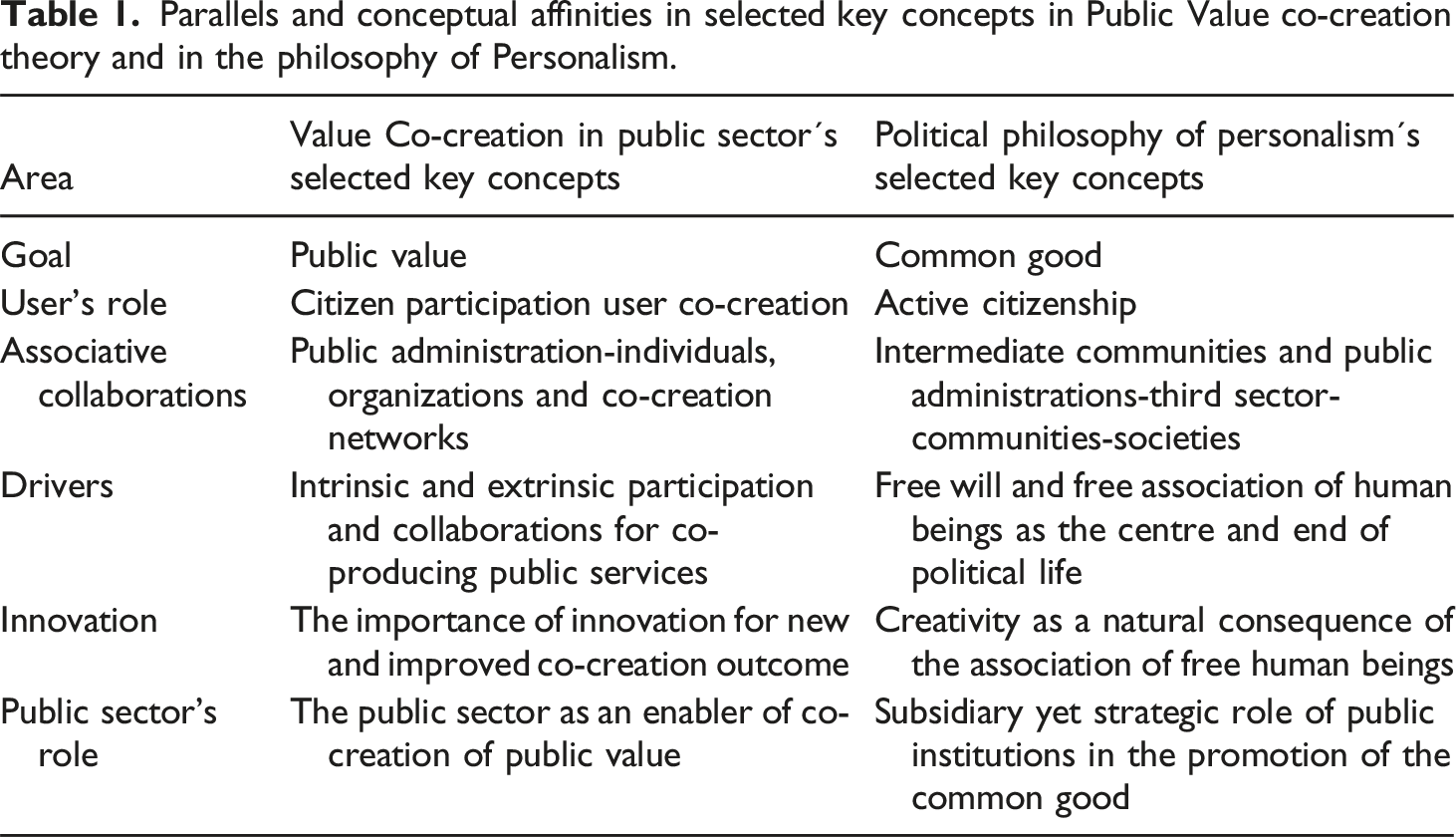
Table 1 highlights parallels and conceptual affinities between core concepts developed in the theories of value co-creation and the philosophy of personalism. Public value co-creation stresses that public value is produced in a participatory way: a notion which has many affinities with the way in which common good is defined by personalism, which stresses its inherently relational nature. Citizen participation and active citizen participation refer to the importance of citizen involvement in value creation processes, as well as to the relational dimension of citizens’ social agency (Ongaro et al., 2021; Osborne, 2017). Users’ involvement and co-creation networks in the public value co-creation theory have deep parallels to the concepts of relational freedom and intermediate communities (notably as located in-between individuals and the State), central notions in personalism (Giussani, 2008; Mounier, 1949).
The drivers for engaging in public governance is often related to the specific public services and is characterized in public value co-creation theories as either intrinsic (associated to the use of the service) or extrinsic (active engagement in co-design or co-implementation) (Osborne et al., 2016, 2021). Personalism is ultimately aligned intellectually to this approach, yet its main preoccupation is emphasizing free will and free association of human beings as the centre and end of political life, hence of public services as part of it, and the pursuit of human fulfillment of one’s own life as the ultimate driver (Deweer, 2013; Maritain, 1951). Ultimately, we would argue, the two perspectives complement each other.
Both bodies of thought uphold innovation and consider it to be resting on human creativity and to blossom almost naturally as a consequence of persons relating to each other, to be built on and by the working together of people. Finally, both streams of thought conceive of the State and public sector organizations at large in an enabling role, as setting conditions for co-creation processes to occur and unfold (Burgos and Allen, 2018; Osborne, 2017; Torfing et al., 2021).
In regard to the role of the State in enabling co-creation, it is important to emphasise how the theoretical expectations set out by personalism should be seen in light of more empirical considerations: scholars and practitioners alike who have experience of co-creation processes may point to governments (central and local) to be keen on co-creation also as a way to curtail public expenditures in a time of continual austerity and budgetary pressures, and instrumentally as means to shift responsibility – and with it to also shift blame if things go wrong - to individuals and communities (Maritain, 1951). This is one area where philosophical theorizing about human nature and empirical work may engage into a mutually enriching dialogue: tempering the expectations that philosophers may set from a theoretical standpoint, and helping refine and nuance propositions about empirical processes of co-creation (Giussani, 2023; Tang et al., 2024). Yet, this consideration reinforces the argument about the affinities in the overall thrust between the two bodies of thought, albeit pitched at different levels: that of philosophy and the logic of the humanities for the philosophy of personalism, that of the (empirical) social sciences for public value co-creation theories.
We would argue that such affinities and deep intellectual consonance show that Personalism may provide ontological and political philosophical underpinnings for the more empirically orientated concepts and notions that form the basis for the burgeoning public value co-creation literature. For example, Giussani’s perspective on the human nature can help explain why in the first instance persons join value co-creation processes enabled by the public sector; the active citizen participation theorised by Maritain can help understand why citizens engage in the co-creation of public value; Mounier’s work can shed light on ascertaining when an associative act is truly free, and what types of social acts ought to be promoted by public policy – and so forth. Thus, Personalism seems to provide relevant ideational bases for revisiting the conceptualization of public value co-creation.
Conclusion
Drawing the intellectual linkages between core elements of the theory of co-creation of value in public services and the political philosophy and philosophical anthropology of personalism shows the extent and depth to which the latter may provide an ontological grounding for the former, or at least what lineages can be traced between a century-old philosophy and a more recent theory-building endeavour in the field of public policy and management. Personalism may provide a theoretical-philosophical source to enrich the theory of co-creation and provide grounding (and therefore, perhaps, some more consensus?) on its core concepts and its manifold applications.
This work has delineated the contours of such intellectual linkages, in order to contribute to the development of the theory of public value co-creation, and thereby, hopefully, also more broadly suggesting how significant the contribution of philosophical thinking can be for developing public governance and management theories on a more solid ground, as a contribution to an expanding research programme – developed also through this special issue (see Ongaro and Yang, 2024; Tang et al., 2024; Tong, 2024) as well as other publications (see Little, 2020; Ongaro, 2020, 2021, 2022 and forthcoming) - that aims at bringing philosophical thought in closer connection to the field of public administration and management.
Finally, foundational elements of personalism have strong potential impact on value co-creation theories due to their institutional and organization implications. An anthropology centred on Personalism can offer an intellectual constellation of ideas which, as we have shown, can provide an understanding and knowledge base from which to develop forms of co-creation of public services. We would further argue that this anthropology may have even broader implications and could be employed and deployed for developing new modes of organizing the economic sphere. Our thinking here is intellectually consonant with the propositions by economists like Stefano Zamagni and Luigino Bruni (Zamagni, 2017; Zamagni and Bruni, 2013), in which conceptual categories such as the common good are centre stage. This might be an indication that perspectives in the social sciences, ranging from the field of economics to that of public administration and management, that call (as we do in this paper) for a re-thinking of approaches to the organisation of society centred on humanistic (Biancu and Ongaro, 2025b; Ongaro, 2020, chapter 1) and person-centred ontologies and anthropologies, are attracting more and more attention among academics, practitioners and policy-makers alike.
Footnotes
Declaration of conflicting interests
The author(s) declared no potential conflicts of interest with respect to the research, authorship, and/or publication of this article.
Funding
The author(s) received no financial support for the research, authorship, and/or publication of this article.
