




Abstract
Collaborative approaches to governance, policymaking, and administration are believed to provide means of adequately handling wicked problems. Simultaneously, many scholars have acknowledged the difficulty of collaboration in practice. In this article, we argue that understanding the ‘small’ practices of collaborative governance and actor-positioning processes illuminates why collaborative governance is such a challenging response to wicked problems. Instead of focussing on ‘big’ collaborative approaches to ‘big’ wicked problems, zooming in on mundane dynamics demonstrates the continuous work that governing and positioning processes require, exposing the provisional nature of elements that have been argued to be vital, such as mutual trust, reciprocity, long-term commitment, authority, or autonomy. Lastly, the mundane uncovers the importance of the material, spatial, and temporal organisation of actor-positioning processes and the potential of language to inhibit or enable collaborative governance. The article ends with a reflection on how analyses of mundane dynamics may help scholars, practitioners, policymakers, and citizens to understand their own processes of engagements in collaborative endeavours and possibly temper expectations.
Keywords
Introduction
In an attempt to deal with wicked problems—public problems characterised by a high level of uncertainty, complexity, and stakeholder divergence (Head and Alford, 2015)—scholars increasingly present collaborative governance as an adequate response (e.g. Ansell et al., 2021; Bryson et al., 2015; Sørensen and Torfing, 2011; Torfing, 2019). Collaborative governance is often described as bringing public and private stakeholders together to achieve consensus-oriented decision-making based on mutual trust and reciprocity, and is often touted for its innovative potential to handle wicked problems (Ansell and Gash, 2007; Emerson et al., 2011). This way, collaborative governance creates a setting in which actors with their diverse perspectives on problems and their potential solutions conjoin their knowledge, capacity, and resources. Increasingly, scholars of collaborative governance call for more attention to the inherent difficulties and intricacies of the processes of reconciling different actor perspectives and action logics in an increasingly complex, culturally plural, continuously changing, and multi-dimensional context (Bannink and Trommel, 2019; La Grouw et al., 2020; Van Duijn et al., 2021). In addition, scholars have argued that this type of situated knowledge, focusing on how actors deal with collaborating partners with different perspectives, is necessary for understanding why collaborative governance is hard to establish and maintain (Bartels and Turnbull, 2020; Rhodes, 2017; Van Duijn, 2022). This warrants a better understanding of how actors position themselves as collaborative governance processes unfold.
In this article, we argue that zooming in on ‘small’ mundane dynamics in specific situations may illuminate ‘intelligent responses’ of actors involved in collaborative governance approaches to wicked problems (Bannink and Trommel, 2019). While many collaborative governance scholars tend to focus on ‘big’ answers to wicked problems, we believe the ‘small’ should not be overlooked. We aim to complement and deepen the collaborative governance literature by showing how attention to mundane dynamics helps to develop a better understanding of collaborative governance responses to wicked problems. Building from theoretical and empirical insights from four individual (ongoing) doctoral research projects that focus on collaborative processes in the context of public governance in the Netherlands, we argue and show how attention to mundane dynamics helps researchers to improve our understanding of collaborative processes. In particular, we discuss three types of mundane elements that emerged from our four doctoral studies: (i) people and their everyday governing practices, (ii) place, artefacts and time, and (iii) discourse and talk.
Importantly, we do not claim that zooming in on mundane dynamics is a new all-encompassing lens to collaborative governance that inherently leads to increasing (public) problem-solving capacity. Rather, by showing various ways in which mundane dynamics can be illuminated and understood in terms of governance, we aim to bring together and facilitate scholars, practitioners, policymakers, and citizens in their search for a deep understanding of the nonlinear and complex nature of collaborative governance and actor-positioning processes in everyday life. To illustrate how this collective work came about, we have enclosed a short process tale (see Appendix 1) in which we elaborate on the emergence and iterative steps taken during the past 2 years (from early-2021 until early-2023).
The theoretical contribution of attention to mundane dynamics in understanding collaborative governance is threefold. First, mundane dynamics illuminate why collaborative governance is such a challenging response to wicked problems by offering situated understandings of its everyday practice and challenges. Second, mundane dynamics demonstrate the continuous work that governing and actor-positioning processes require, exposing the provisional nature of collaborative components such as mutual trust, reciprocity, long-term commitment, authority, or autonomy. Third, mundane dynamics draw attention to the importance of the material, spatial, and temporal organisation of actor-positioning processes and the potential of language to inhibit or enable collaborative governance.
This article proceeds as follows. First, we elaborate on how collaborative governance scholars frequently adopt a ‘big’, holistic approach to wicked problems. Next, we explain why this ‘big’ approach benefits from approaches that put forward the ‘small’ details of actors’ beliefs, experiences, and (inter)actions in mundane situations. Then, we explicate how collaborative governance researchers can grasp these mundane dynamics of collaborative governance, by illuminating mundane dynamics in detailed empirics. In the concluding remarks, we summarise the contributions of paying attention to the ‘small’ and reflect on how analyses of mundane dynamics may help future scholars, practitioners, policymakers, and citizens to understand their own processes of engagements in collaborative endeavours, and possibly temper expectations.
Collaborative governance and wicked problems: Theory and practice
The relevance of collaborative forms of governance like inter-organisational networks or public-private partnerships to process and manage grand challenges is increasingly addressed by scholars in the field of public administration, public management, policy studies, and organisational science (e.g. Ansell and Gash, 2007; Ansell and Torfing, 2016; Emerson et al., 2011; Ferlie et al., 2011; Ferraro et al., 2015; Sørensen and Torfing, 2017; Termeer et al., 2015). Collaborative governance is often described as: “(…) the processes and structures of public policy decision making and management that engage people constructively across the boundaries of public agencies, levels of government, and/or the public, private and civic spheres in order to carry out a public purpose that could not otherwise be accomplished” (Emerson et al., 2011: 2).
The core aim of collaborative governance is to facilitate ‘constructive engagement’ among a variety of actors (e.g. service-users, professionals and managers, public agencies, private parties, civic organisations) who operate on different governance ‘levels’ to develop new and creative solutions that cannot be achieved individually (Ansell and Gash, 2007; Emerson et al., 2011). Collaborative governance is often referred to as a type of governance that is rather distinct from hierarchical strategies like top-down implementation and traditional managerial forms of governance (Ansell and Gash, 2007; Osborne, 2006).
The vastly growing popularity of collaboration as a problem-solving strategy is often explained as a response to a changing, complex society (Castells, 2000; Lash, 2003). In recent years, grand challenges have put pressure on the social order and public services, i.e. in ensuring sufficient healthcare provision, with worsening workforce shortages, for a rising number of patients with chronic and complex diseases; generating democratic legitimacy through public engagement; and climate change issues such as flooding and drought. Such grand challenges are often characterised as ‘wicked problems’ in the public administration and policy literature (Rittel and Webber, 1973). 1 Wicked problems are problems with high levels of uncertainty, complexity, and divergence in perspectives of stakeholders (Alford and Head, 2017; Bannink and Trommel, 2019; Rittel and Webber, 1973). Wicked problems are highly uncertain because each wicked problem is more-or-less unique and evolving, and each policy response has potentially great social and political effects. Next, the complexity of wicked problems implies that endless explanations for and solutions to wicked problems are possible, each representing different and often conflicting values and knowledge. Lastly and importantly, the actors involved in wicked problems have diverging perspectives on the appropriate problem definition and corresponding solution strategy. The interplay of these aspects illustrate that wicked problems come with a certain ‘wickedness’ that complicates its response (Peters, 2017).
The combination of uncertainty, complexity, and divergence in perspectives of actors involved in wicked problems hinders definitive policy formulation and rational planning by experts from one single domain or perspective (Rittel and Webber, 1973). Instead, scholars argue that multiple actor perspectives are essential in facing the challenges of wicked problems. Through collaboration among a variety of actors with different repertoires of knowledge, expertise, and values, we can better understand and therefore respond to these multifaceted, evolving problems (e.g. Ferlie et al., 2011; Innes and Booher, 2016; Weber and Khademian, 2008). In other words, collaborative governance is useful in answering wicked problems because it can be applied in different settings and different (public) domains with various actors involved. Furthermore, it provides valuable general principles, tools, and mechanisms for designing and managing effective collaborations at the macro- and meso-levels. Pursuing such endeavours may be worthwhile as they can potentially contribute to the attainment of ‘community outcomes’ (Bianchi, 2021) like public engagement or accessible and quality healthcare provision in times of scarcity.
Collaborative governance approaches, such as ‘cross-boundary collaboration’, ‘collaborative innovation’, ‘policy networks’ and ‘robust governance’, are ‘big’ answers to wicked problems (Ansell et al., 2022; Bianchi, 2021; Bianchi et al., 2021; Bryson et al., 2015; Ferlie et al., 2011; Sørensen and Torfing, 2011; Torfing, 2019). We consider these collaborative governance strategies as ‘big’ because of their holistic level of analysis. Holistic analyses aim to grasp the phenomenon of collaborative governance as a whole. This way, scholars explore the ideal characteristics of and conditions for collaboration, in order to design a structure or setting that encourages actors with a multitude of perspectives to collaborate across organisational, professional, and administrative boundaries. An example is the search for ‘effective’ inter-organisational networks in (among others) the field of healthcare management and governance (cf. Peeters et al., 2022; Provan and Kenis, 2007; Raab et al., 2013). Furthermore, Ansell et al. (2016) put forward three ‘essential components’ that make collaborative governance work. First, the creation of a network with diverse stakeholder perspectives, interests and expertise is considered important to better understand the different aspects of the public problem at hand. Second, such a collaborative entity must have the authority and autonomy to steer others into collaborative behaviour. Third, while identifying and addressing policy shortfalls, the collaborative entity must be flexible in coping with emerging uncertainties and adapting to unforeseen circumstances, and it must integrate innovative solutions in (newly developed) decision-making structures. Other scholars have emphasised the importance of components or conditions such as mutual trust, reciprocity, interdependency, mandate, consensus, leadership, urgency, deliberation, engagement, motivation, and capacity for collaboration to be successful (e.g. Ansell and Gash, 2007; Bianchi, 2021; Emerson et al., 2011; Ferraro et al., 2015). The role of power in collaborative governance arrangements is also an important topic in the literature. Through identifying which actors have more power than others, scholars explore how the design and management of collaborative governance can mitigate power imbalances to prevent deadlocks (Bryson et al., 2020; Purdy, 2012).
While holistic perspectives are strong in the development of comprehensive frameworks of relevant components and conditions for successful collaborative governance, these perspectives are less well-equipped to capture ongoing social dynamics and the individual beliefs, experiences, and actions of actors that shape the course and outcomes of collaborative governance processes. To fill this gap, it is crucial to zoom in on the mundane dynamics of collaborative approaches to wicked problems.
Mundane dynamics: Understanding and processing ‘big’ problems through ‘small’ practices
While general knowledge about the characteristics, components, and conditions of successful collaborative governance arrangements grasps the ‘bigger picture’, it has its limitations. This type of knowledge does not inform us specifically about how a particular governance arrangement works out in practice, in a specific local context, with specific actors. It can only partly inform us about how actors position themselves in specific situations, or what they do when they engage in collaborative relations and interactions. Furthermore, it is less well-equipped to explain conflict and unsuccessful collaborative endeavours while such ‘dark sides’ that seem part and parcel of collaborative governance may also provide valuable insights with regards to actor-positioning. Consequently, it is difficult to apply knowledge on collaborative governance in specific, local settings. It is exactly this gap that we are trying to address in this article. Informed by different turns in the wider public administration and governance literature, we argue that analysing mundane dynamics of collaborative governance provides new insights in the processing of wicked problems.
One of the main challenges of a collaborative governance approach to wicked problems is to overcome disagreements about problem definitions and policy preferences. Collaborative governance requires negotiation over perspectives and action logics, and inherently prompts actors to position themselves in relation to the problem and in relation to possible collaboration. In contrast to holistic perspectives, looking at the mundane shifts focus to the experiences and meaning-making processes of individual actors and their situated interactions. It studies collaborative governance as everyday actions and interactions of actors, each with their own perspective to the problem definition and preferred (policy) solution to a wicked problem.
Zooming in on mundane dynamics provides a rich, dense, comprehensive understanding of the everyday actions of actors in these processes. It explores what is usual, ordinary, and routine—the minutiae, detailed, and taken-for-granted of collaborative governance and actor-positioning processes. It not only reveals the actions performed, but also the subtleties and multiplicities of perspectives, concerns, and intentions that shape those actions in a real-time governance context. It pays attention to what people say and how they say it, and to how people use their bodies and other devices in governing and positioning. Everyday activities are thus situated, contextualised by meaning and materiality.
The premise of focussing on mundane dynamics is, on the one hand, that collaborative governance, beyond the large structures, also comprises people who engage in all kinds of ‘small’ actions. These small actions can have big consequences for governance processes. Governance structures result in people doing things; talking, meeting, writing documents (Visser, 2023). Analysing these small actions, the ordinariness that is in this normality, can give insights in the tacitly known scripts and schemas, often difficult to articulate, that organise them (Ybema et al., 2009). This can give insight into the dynamic, contested, and provisional nature of governing and positioning; in the invisible work such as building trust or catching up that do not make it into formal documentation; and into hidden aspects of actor positioning, acts of resistance, or concealed agreements, laying bare harsh and hidden realities.
At the same time, these seemingly small acts might achieve more, and thereby be less ‘small’ than they seem to be. Attending to the mundane can deepen aspects of justice, power, aesthetics, and change (Star, 1999). Actors’ everyday actions can be vital to producing collaborative governance from the bottom-up, to establish rules of engagement, to agree on problem definitions or preferred solutions (Bevir and Waring, 2020). Ordinary, everyday, pervasive objects, and technologies can enact and even create governance. Everyday actions can also covertly undermine, openly challenge, rebel against, or one-sidedly change the structural contours of collaborative governance. So, attention to mundane dynamics is valuable for our understanding of collaborative approaches, as it helps in explaining how and why collaborative processes are shaped by actors in specific situations, and why they evolve the way they do.
Uncovering mundane dynamics of collaborative governance: The mundane in four different studies on collaborative governance
Different strands in the policy and public administration literature have drawn attention to mundane dynamics of governance processes, most notably interpretive policy studies and practice theory. These literatures have shown how mundane governance dynamics can be studied, and are helpful in theory development about the how and why of governance processes. Interpretive collaborative governance scholars have drawn attention to meaning-making and sense-making processes in specific situational contexts, and the ‘lifeworld’ of the people involved in collaborative (policy) processes (Bartels and Turnbull, 2020; van der Woerd et al., 2023b; van Duijn et al., 2021). Such analysis follow an interpretive approach that centralises actors’ different, and often incongruent, lifeworld’s (Bevir and Rhodes, 2022; Flyvbjerg, 2001; Yanow and Schwartz-Shea, 2015). Illustratively, decentred accounts of dominant policy discourses like a networked model of care pay attention to the “(…) beliefs individuals adopt against the background of traditions and in response to dilemmas” (Bevir and Waring, 2020: 8-9).
Practice theory centralises what actors say, do, and feel when they engage in governance (e.g. Freeman et al., 2011; Wagenaar, 2004). ‘Practices’ briefly speaking, refer to the bundling of the actions and interactions that actors undertake on a day-to-day basis, and the emerging dynamics between them (Nicolini, 2012, 2017). The study of practices shows how actors ‘get things done’, despite formalised governance agreements, theories, or regulatory requirements (e.g. Huising and Silbey, 2011; Wagenaar and Wilkinson, 2015). The practice turn centralises what actors say, do, and feel when they engage with one another (e.g. Freeman et al., 2011; Wagenaar, 2004). Practice-based accounts build on the premise that the social world comes into being through everyday activity (Feldman and Orlikowski, 2011). Its analytical focus provides rich insights into the actual doings of governance, i.e. how it unfolds in the practices of affected actors. For instance, scholars in this field pay attention to situations of conflict and ambiguity, exploring actors’ valuation schemes and the trade-offs being made in handling and tinkering with situations of conflict (e.g. Boltanski and Thévenot, 2006; Oldenhof et al., 2022). In addition, we have seen a growing body of literature that focuses on the ‘soft’ and informal (e.g. Ayres, 2017; Ayres, 2019) and relational (e.g. Bartels, 2013; Bartels and Turnbull, 2020) elements of governance. This literature steam seeks to grasp less tangible elements of governance, and in doing adds nuancing insights into ‘hard’ and formal ideas of doing governance.
Increasingly, interpretive and practice scholars have focused on collaborative governance processes. These studies focus on how a variety of actors process emerging tensions and complexities in collaboration, which (pragmatic) strategies are developed in response, and how their interactions affect the collaborative process and outcomes (e.g. Blijleven and van Hulst, 2020; La Grouw et al., 2020; Oldenhof et al., 2022; van der Woerd et al., 2023a, 2023b; van Duijn et al., 2021). These studies explicitly move away from constructing collaboration as holistic entities, but rather choose to analyse collaborative strategies in response to grand challenges through the eyes of the actors involved. Our four doctoral research projects take a similar approach, by exploring how we can understand collaborative approaches to wicked problems ‘from within’, rather than from ‘the outside’. In each doctoral project, zooming in on the ‘small’ of collaborative governance processes appeared to be crucial in explaining how and why collaborations evolved the way they do. To mark this development in the study of collaborative governance, and draw attention to its complementary value to holistic approaches, we uncovered the relevance of mundane dynamics in different settings of collaborative governance.
Four research cases of collaborative governance.
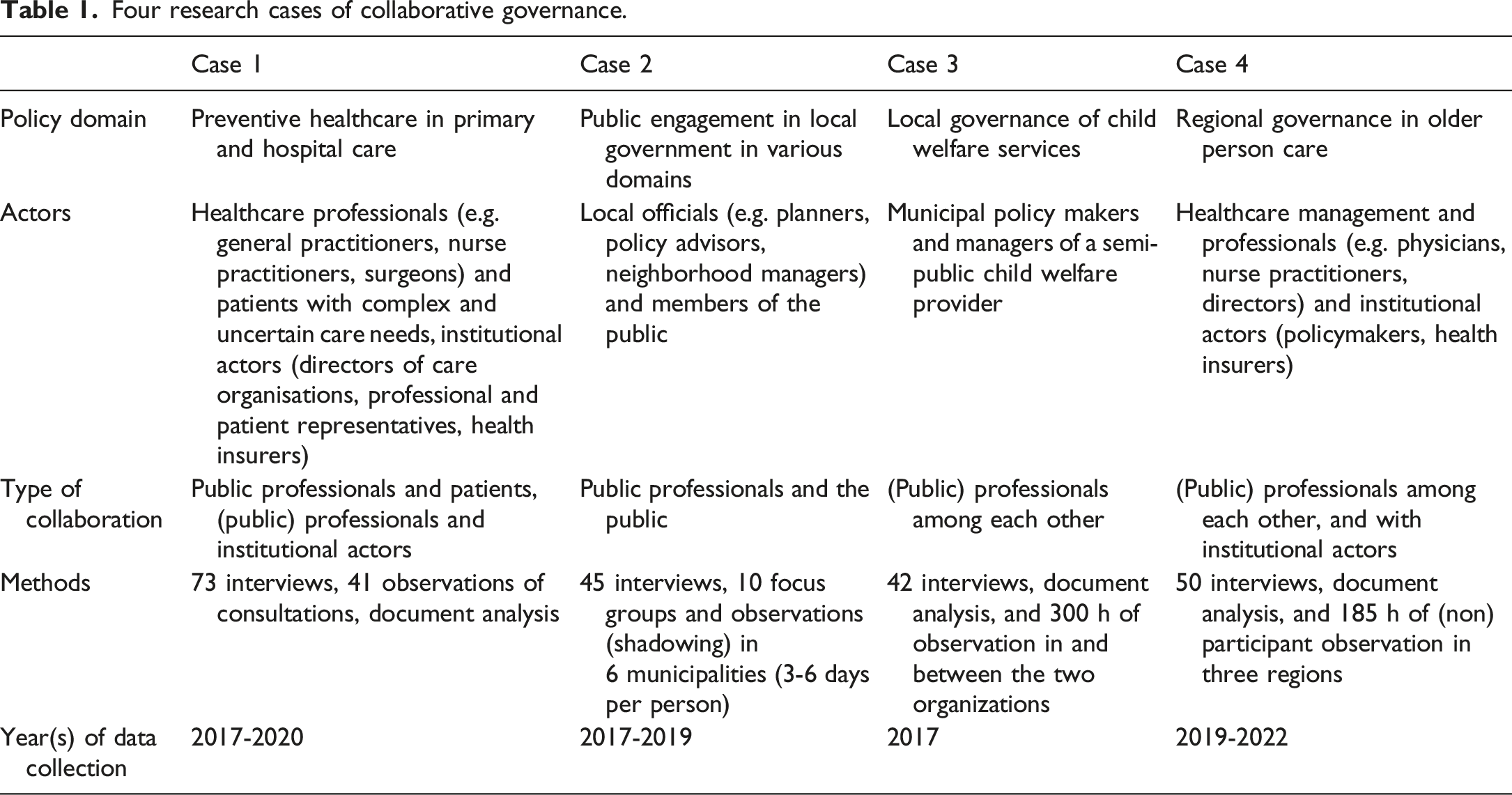
Importantly, the sensitising foci that emerged from our doctoral studies should not be understood as a fixed, comprehensive set of elements that need to be observed in combination as a prerequisite to understand mundane dynamics. In turn, by identifying three sensitising focus points, we aim to facilitate scholars, practitioners, policymakers, and citizens to recognize and draw attention to the relevance of the mundane dynamics of collaborative governance.
People and practices: How people and their practices (un)intentionally (re)produce collaborative dynamics
Collaborative governance starts with real people, who each have their own perspective on what should be governed and in which way. Those actors ‘work’ or ‘act’, and with their actions they can produce, perpetuate, or disrupt processes of collaborative governance. Collaborative governance requires “skillfully negotiating and dynamically reproducing apparently stable, coherent policy systems” (Bartels, 2018: 68). People need to build relationships and deal with tensions, demands, and layers of governance arrangements, collaborative initiatives, and policy echelons (Blijleven and van Hulst, 2020; van de Bovenkamp et al., 2016; van der Woerd et al., 2023a; van Duijn et al., 2021; Visser and Kruyen, 2021). They may act strategically, while in other cases intricate situations are met with pragmatist responses, both ‘front stage’ in the visible collaborative arena as well as ‘backstage’ (Ayres et al., 2017). These specific interactions of collaboration, in turn, may shape the perspectives of the actors involved (Bartels and Turnbull, 2020). Through their mundane actions and interactions, then, the specific people involved, produce the institutions that govern their collaboration.
Looking at the mundane helps uncover how the different elements of a collaborative governance process, structure, and agency, interact. By focusing on the people involved in collaborative governance and closely studying the practices they engage in—including the everyday and the routine—we see how the actors, together, produce and reproduce the iterations that are part and parcel of collaborative governance. Our doctoral studies illustrate several context-specific actor practices through which collaborative governance is accomplished.
In the case of local child welfare governance, for instance, municipal policymakers and child welfare managers were followed and observed in their everyday meetings. This led to the surprise that the actors rarely referred to governance documents. Rather, they adapted tasks, discussed performance, defined the scope, and negotiated authority in the meetings. By looking at these everyday practices, we learn that formal governance structures are negotiated through small adaptations in responsibilities that take place in everyday meetings. In fact, many of the governing processes that matter in practice are never even formalised. These everyday actions sometimes reproduce or recreate the structural arrangements of governance, whilst at other times challenging or changing the structural contours or creating variations or changes that remain outside the visibility of formal agreements and arrangements.
In the regional governance case, nursing home managers, professionals, and policymakers were also observed during meetings about regional collaboration. Such regionalisation of older person care seeks to distribute scarce medical capacity among healthcare organisations, hereby enhancing regional care provision (Schuurmans et al., 2021). However, ‘the region’ as an administrative domain for organising and delivering older person care appeared far from developed and institutionalised within a healthcare system of regulated competition. Rather, the actors in interaction gave shape to regional networks as a response to severe workforce shortages. In the process of building regional networks, actors were confronted with a proliferation of change-oriented organisational and policy initiatives, as well as organisation-centred regulatory frameworks that, in practice, hampered collaborative practices. In response, actors developed creative ways to deal with emerging tensions; they constituted the region as a new administrative domain by embarking on (and utilising) regional dynamics to adjust regulatory policies in such a way that it enables regional care. Nursing home managers addressed and negotiated stringent regulations about accessibility of care services with regulatory agencies; they obtained ‘regulatory space’ and commitment to organise regional care in alternative ways, for instance with more nurse responsibilities.
In the citizen participation case, interviews in which local officials walked the researcher through specific cases of citizen participation, illustrated that the officials needed to respond to ideas, initiatives, questions, and concerns from citizens for which they, by definition, did not have a predefined approach. From their very different, but concrete stories, it appeared that for these officials, much of their work involved developing solutions together with members of the public, by bringing together a range of interests, values, perspectives, logics, and resources outside and inside the local bureaucracy. In other words, they engaged in public ‘bricolage’.
Some of these practices are deliberately aimed at creating or sustaining collaboration. They are explicit and intentional parts of collaborative governance. These practices, which are often aimed at making the particular situation work, do affect the collaborative process.
Place, artefacts and time: How place, artefacts, and time structure and are being structured by collaborative dynamics
For a thorough analysis of mundane collaborative governance and actor-positioning processes, place, artefacts, and time are important. Collaborative encounters unfold in specific physical or digital places. The encounters have all kinds of material characteristics, ranging from the room design, furniture, and appliances, to actors’ clothing. Places and their material characteristics often embody specific meanings to the actors involved (Ivanova et al., 2016; Star and Griesemer, 1989). The place and artefacts themselves, but also their particular use, therefore, create possibilities for and limitations to governance (Pollitt, 2011). Similarly, collaborative encounters and governance practices are enacted within a specific time frame—for example defined by meetings, calls, timelines of procedures, and the urgency of the problem at hand (Visser, 2023). Governance can then (partly) be accomplished through spatial and temporal arrangements, illustrated in policy reforms that, for instance, rely on re-placements of care (Lorne et al., 2019; Schuurmans et al., 2021). In this process, place and practice form a dialectical relationship, with governance practices generating places, artefacts, and temporal structures, which in turn structure the governance practices (Freeman et al., 2011).
Zooming in on the mundane dynamics of collaborative governance can imply studying the local context and the specifics of the situation in which it unfolds. It brings place, artefacts, and time into the heart of the analysis, instead of treating it as an external condition. An ‘emplaced’ understanding (Ivanova et al., 2016) focuses on how both the tangible physical setting and the tacit socio-historical context shape interactions in collaborative governance. Yet, we learned that these contextual elements were actively and strategically structured by affected actors when they become aware of these effects.
For example, in the case about collaboration between public professionals and the public, place and time play an important role. Firstly, as the setting of a public encounter, places shape the interactions between the professional and the citizen. Public professionals who are experienced in engaging with the public are aware of this and use it in their approach towards citizens. When local officials were asked to describe how they approached a specific public engagement process, they explained how a meeting at a city hall may feel very different to a meeting in a community centre, or meeting face-to-face is different to meeting in an online space. Secondly, citizen-government collaborations often had a specific place as their subject. It concerned, for instance, the design of a park or building; the traffic in a particular street or the nuisance experienced around a particular square. Resistance and distrust towards a particular (participatory) project initiated by the local government often originated in the history of a particular place and its citizens’ previous experiences with (local) government. When reflecting on their actions during the interviews, the local officials explained that learning about and being sensitive to such historical notions, and visiting the site, were important to better understanding the situation, but also to build rapport and trust with citizens involved.
The case of local child welfare governance focused not only on practices, but also on the physical settings in which they took place. Both the city hall and the multiple child welfare offices dispersed over the city acted as meeting places between municipal policymakers and child welfare managers. The actors purposefully alternated between the physical locations as a means of exhibiting a certain equality in the relationship. Yet, when municipal actors felt a need to better demarcate the border between the organisations in terms of role and communication, they decided to retract the access passes to the municipal buildings of the child welfare managers. Although the municipality remained unaware, among child welfare managers this led to worries about the self-evident nature and strength of the collaboration and challenged their open and learning-focused attitude. Authority was continuously produced and reproduced by meeting in particular (and multiple) places, and at times location and artefacts challenged collaborative governance. Furthermore, the multilocality demonstrates the ‘moving’ nature of collaborative governance.
The regional governance case looked not only at the people, but also at the meaning of place in regional collaboration. This uncovered the observation that actors like nursing home managers and professionals struggled with dominant policy ideas of what ‘the region’ was. For instance, some regions covered a fragmented geographical area (i.e. islands and peninsulas) with various cultural-religious differences (i.e. Protestant, Catholic, or more liberal-oriented). Such emplaced complexities complicated the building of regional networks as, for instance, nursing homes predominantly held on to their local identity. Hence, we learn how the definition and demarcation of the region as an administrative (geographical) place, as the subject of collaborative governance, can become part of the collaborative governance process itself (van der Woerd et al., 2023b). What the region is, or should be, is not evident. Rather, it is a contested place for healthcare in-the-making, as the region is perceived differently by the actors involved compared to policymakers’ prescribed definitions of the region.
Discourse and talk: How discourse and talk affect collaborative dynamics
Vital to mundane collaborative positioning processes are actual people, in space and time, who interact with each other. When actors come together, they do not tend to engage in silence, rather they talk. As such, collaboration is often in large part accomplished through talk in interaction. Talk can be very instrumental—discussing collaborative plans, goals, and tasks. Yet, talk can also serve to produce, maintain, and negotiate the identities, perspectives, and positions of those involved, or make sense of the situation by defining the nature of issues, the purpose of collaboration, and its rules of engagement (Goffman, 1959). Central to these interactions are the discourses the actors use, and other participants’ interpretations of those discourses. Discourse, in part, defines what actors deem feasible and reasonable actions and decisions in collaboration. To discuss and possibly reconcile individual perspectives and action logics, mutual understanding seems requisite. This is stipulated in part by lexical choices, prior knowledge, and interpretations thereof. In some cases, actors might be impelled to develop a shared vocabulary to support mutual understanding and collective goals. In others, governance actors engage in continuous translation between professional and local discourse or between different professionals’ discourses (Tonkens et al., 2013).
The former example of ‘the region’ included a focus on discourse and uncovered, how the collaborative process was hindered by a conflict between policy discourse and the perceptions of local actors. Here, dominant policy ideas of the region contrasted with socio-cultural perceptions of regional boundaries among local actors. Although they were urged by policymakers to explore regional care, they still adhere to organization-centred regulatory frameworks rather than the region. As processes proceed, this caused resistance as, in the end, organizational performance proliferated over regional care with yet unknown (institutional) responsibilities.
Also, we found in our research projects how discourse and talk can empower individual actors in a collaborative process, or establish and empower actors as collectives, with different consequences for their collaboration. For instance, the local child welfare governance case explored the role of talk, which showed that case workers developed a new vocabulary that supported or represented their new, shared work practice. The actors quickly adopted the new vocabulary and worked hard to avoid the ‘old’ discourse. Municipal policymakers and child welfare managers needed to interact in order to accomplish the (re)production of local governance. Part of this process was the shared language they used. Using ‘the right’ words enabled and supported new governance practices; using the wrong words would undermine this. Thus, we learn that talk supported and hampered collaboration.
The public engagement case emphasised how collaboration involves translation between the different languages and narratives of stakeholders. When analysing the different public engagement processes local officials such as planners, lawyers, and ecologists described in their interviews, it became clear that translating between the language of the local bureaucracy and their professional background on the one hand, and the everyday language of citizens they encountered on the other, was an important, recurring element of their work. On the one hand, they translated their expertise in ways that made sense to the public and use it to develop a shared problem definition. On the other hand, they listened and learned, in order to translate citizens ideas into technical language, official documents, or feasible designs. The local officials explained that this helped them to develop mutual understanding and trust.
These two examples illustrate how shared discourse and talk can support collaborative governance, by creating mutual understanding and a ‘level playing field’. However, discourse does not necessarily have to be an ‘equaliser’ in order to foster successful collaboration. In the hospital case, for instance, observations of patient consultations showed how a collaborative decision-making policy practice enabled patients to voice their treatment preferences. In the interactions between surgeons and patients, the researcher observed, however, that surgeons used this information to substantiate their preferred treatment option, presented in future scenarios for the patient. From a discursive analysis of the fieldnotes from all the different consultations observed, it appeared that future-talk among surgeons and patients, combining lay and expert knowledge, did do justice to the high complexity and uncertainty of patients’ health problems. However, it did not live up to the policy discourse that was found in an analysis of relevant policy documents, implying that collaborative decision-making balances out power differences. In fact, the discursive practice empowered both patients and surgeons in their collaborative dynamic, but surgeons remained dominant.
In sum, these examples illustrate how—through their actions and interactions—actors constantly produce and reproduce collaborative governance. In order to grasp these actions and interactions, we need to look closely at the context—physical, material and socio-historical—in which they unfold, and listen carefully to the discourse and talk that is exchanged. In doing so, we can take into account the everyday, informal, and sometimes implicit and unintended actions, that shape collaborative governance in practice.
Discussion and conclusion
Collaborative governance theory acknowledges that collaborative endeavours are often more easily said than done; putting these ideas into practice is rather complex and time-consuming (e.g. Ansell and Gash, 2007; Bianchi, 2021; Emerson et al., 2011; Ferraro et al., 2015). While describing and stimulating governance actors to act collaboratively and navigate emerging complexities, the theory does not yet fully grasp its empirical realities. To understand how we can respond to ‘big’ problems through collaborative governance approaches, we also need to look at the ‘small’, mundane dynamics of collaborative—actor-positioning—processes. In this article, we proposed to pay more attention to studying the mundane dynamics of collaborative governance. Studying mundane dynamics foregrounds governance actors and their (inter)actions in specific settings. Doing so, we argued, helps to better understand how and why collaborative processes evolve the way they do, something which is increasingly called for (Peters et al., 2022). We have drawn from our individual doctoral research projects to demonstrate what we can learn from zooming in on mundane dynamics for improving our understanding of collaborative governance in response to wicked problems. The interpretive and ethnographic studies conducted in the Netherlands between 2017 and 2022 each analysed various aspects and forms of collaborative governance processes.
Building from our four doctoral projects rooted in interpretive and practice approaches in policy and administrative studies, we have demonstrated the relevance of illuminating the mundane dynamics of collaborative governance. In particular, we have shown several empirical examples, structured by three sensitising focus points that emerged from our studies of collaborative governance: (i) people and practices; (ii) place, artefacts, and time; and (iii) discourse and talk. By providing empirical examples of mundane dynamics of collaborative governance in different settings, we offer an empirically grounded development to collaborative governance theory. Whereas holistic perspectives analyse collaborative governance ‘from the outside’, we show how focusing on mundane dynamics helps to understand the collaborative processes ‘from within’ (Bevir, 2013; Van Duijn, 2022). This way, we have sought to provide heuristic tools for scholars to uncover mundane dynamics in the specific field of collaborative governance. In this section, we distil three main contributions.
First, the mundane dynamics of collaborative governance illustrate why collaborative governance is a highly challenging answer to wicked problems (Bannink and Trommel, 2019; Bevir, 2009). We need situated analyses to apprehend local interpretations and positioning practices. The bricolage efforts of local officials to engage the public, the ordering effect of regional cultural-geographic and religious histories, or the persistent hierarchy of particular doctors’ ways of talking are all components that seriously impact collaborative endeavours. These local and actor-specific differences and difficulties—entangled in complex webs of everyday dynamics—are uncovered through in-depth analysis of the co-existing, and often conflicting, governance and positioning processes by actors in their specific contexts. These intricate social dynamics enrich ‘big’, holistic collaborative governance responses (e.g. Bianchi et al., 2021; Sørensen and Torfing, 2011; Torfing, 2019), by showing how and why actors may hinder collaborations even when conditions for success are met. We conclude that illuminating mundane dynamics can contribute to a better theoretical understanding of “the nonlinear aspects of the collaborative process” (Ansell and Gash, 2007: 562), empirical complexity (Van Duijn et al., 2021), practical challenges, and the role of discourse and power processes in collaborative governance (Bevir, 2009; McIvor, 2020; Van Duijn, 2022).
Second, insight in mundane dynamics demonstrates that actor positioning, collaborative governing and processing wicked problems requires continuous and hard-fought, skilled work. This aligns with literatures on collaborative governance that emphasise that establishing collaborative governance is time- and resource-consuming and challenged by political barriers, power asymmetries, and of course, the inherent wickedness of the problems collaborations try to address (Ansell and Gash, 2007; Bryson et al., 2015; Head and Alford, 2015). Attention to the mundane deepens this knowledge by showing how actors engage in all kinds of ‘small’ activities that are moreover ongoing, ranging from relational, policy, internal governance, sense-making, and repair practices, acting strategically or pragmatically, actively delaying or accelerating processes, to make collaborative governance work. These governance processes are necessarily provisional and imperfect until new actions reproduce or possibly change them. Insight into these small practices is useful, because partial and provisional responses to wicked problems can help collaborative processes move forward (Head and Alford, 2015). Because wicked problems cannot be ‘fixed’ in time and place (Peters, 2017) and are constantly changing (Alford and Head, 2017), we believe a better understanding of mundane dynamics will not lead to the identification of definite solutions (Bannink and Trommel, 2019). Hence, we argue that zooming in on mundane dynamics in specific situations may illuminate such ‘intelligent responses’ that affect larger collaborative processes, and potentially challenge our thinking on dealing with big problems (Bannink and Trommel, 2019).
It hence matters to discern the ongoing governance practices uncovered through focussing on the mundane, not only because it provides theoretical and practical insights in itself, but also because they relate to the bigger structures of collaborative governance (Rhodes et al., 2010). Practices of collaborative governance on occasion result in the reproduction of existing governance arrangements (Star, 1999). On other occasions they might lead to more-or-less fundamental changes, and on yet other occasions the results are informal and undermine existing structures. Understanding mundane dynamics matters, because actors might act to let collaborative governance thrive even when conditions are unfavourable, or contrarily actors might sabotage collaborative processes when favourable conditions permit such acts. Thus, attention to mundane dynamics also provides knowledge on how collaborative governance and the vital components thereof are socially constructed by actors through specific (inter)actions (Goffman, 1959), and how these actors achieve results—or why they do not, and with what consequences.
Third, zooming in on mundane dynamics emphasises several elements that have been left rather understudied in collaborative governance research. We particularly emphasise the importance of place, artefacts, and time, as well as discourse and talk. Collaborative governance is (in part) ordered through spatial, material, and temporal organisation (Lorne et al., 2019; Oldenhof et al., 2016; Pollitt, 2011). Place, artefacts, and time (and their use) have the potential to (re)produce hierarchy, formality, trust, and equality. These components stipulate collaborative and actor-positioning processes. This contributes to and refines contemporary understanding of the power of place in relation to collaborative governance (also referred to as ‘place-based governance’) (Hambleton, 2019; Hambleton et al., 2022). Taking place seriously does not only encompass localities and the feelings of commitment citizens attach to their living environment—which carry the risk of being easily overlooked during governance reforms (Hambleton et al., 2022). Actors may also purposefully use place during interactions in collaborative governance as we saw in the local child welfare governance case and regional governance case. Discourse and talk are vital to collaborative governance as it is through interaction that actors negotiate and (temporarily) establish actor-based understandings of problem definitions, the purpose of collaboration, its rules of engagement, respective individual and relational identities and positions, and preferred (policy) solutions. The public engagement case and hospital case were illustrative of this. Actors might develop a shared discourse, continuously translate, or get lost in translation, all with their own effects for collaborative governance.
For practitioners, policymakers, and citizens, analyses of mundane dynamics within collaborative governance could help develop understanding of their own processes of engagements in collaborative endeavours, and possibly temper expectations. Through concrete and real-life examples of the issues and tensions that influence collaborative endeavours, practitioners, policymakers, and citizens can be enabled to recognise similar dynamics in their own contexts, fostering their reflective capacity (Flyvbjerg, 2001; Rein and Schön, 1996). In turn, potentially redirecting existing dynamics when they work on grand challenges, if they deem it desirable. In that sense, knowledge about mundane dynamics has potential to offer practitioners, policymakers, and citizens a practical step in applying theoretical lessons in practice. It helps them take ‘small’ steps in everyday (professional) life while being confronted and dealing with ‘big’ problems.
A focus on governance actors and their actions is not new in collaborative governance scholarship, although empirical examples remain scarce and are increasingly called for (Bevir and Rhodes, 2022; Peters et al., 2022). The empirical examples in this paper, structured along the lines of three sensitising focus points, emerged from the orientations and insights from our recent empirical work rooted in interpretive and practice perspectives. By discussing how these different empirical vignettes show new insights about collaborative processes, we aim to inspire scholars and citizens to capture the situated, detailed, nonlinear and complex nature of collaborative governance and actor-positioning processes in everyday life.
Furthermore, attention for mundane dynamics in the study of collaborative governance in response to wicked problems is still in an early stage of development. To further develop this type of research, and the broader field of approaching collaborative governance ‘from within’ (Bevir, 2013; Bevir and Rhodes, 2017; van Duijn, 2022), more empirical and theoretical work will be necessary. This article is therefore also explicitly an open invitation for further research and debate. Further research, for instance, can deepen our theoretical understanding of (additional) sensitising focus points, (new) relations between them, and additional lessons for theories of collaborative governance and wicked problems. For these reasons, we want to invite scholars and practitioners to not only look in other collaborative contexts at similar lessons, but also to look for other context-specific lessons and other focus points of the mundane in different contexts of collaborative governance.
To conclude, by showing scholars, practitioners, policymakers, and citizens how mundane dynamics are important for our understanding of collaborative governance, we aim to broaden the current comprehension of and mainstream thinking on wicked problems and actor-positioning processes, and collaborative governance. Zooming in on mundane dynamics sheds light on how collaborative positions and arrangements are formed, developed, and work out in practice; in specific situational contexts, among specific actors. Focusing on the interrelatedness of different governance actions helps us better understand (non-)collaborative behaviour. Mundane dynamics do not show us isolated, volatile moments. Instead, it show us how actors concretely act upon grand challenges, and that these actions are informed by, amongst others, their partial perspectives and positioning, place, artefacts, time, discourse, and talk.
Footnotes
Acknowledgements
We would like to thank attendees at the Critical Interpretive Public Administration (CIPA) panel during the Netherlands Institute of Governance (NIG) conference in 2021 for their constructive feedback. We also thank attendees at the mini-conference organised by the editors of this special issue in 2022, as well as the reviewers, for their useful feedback on an earlier draft of this article.
Declaration of conflicting interests
The author(s) declared no potential conflicts of interest with respect to the research, authorship, and/or publication of this article.
Funding
The author(s) received no financial support for the research, authorship, and/or publication of this article.

Notes
Collective work during doctoral research: A short process tale
This paper on collaborative governance is the result of a collaborative process on which we, four early-career researchers affiliated with different universities and research institutes, have worked with excitement and pleasure. In this short tale, we would like to unpack and share this process—which may be relevant for other researchers who study collaborative processes, or (want to) engage in it.
Over the past years (early-2021 until early-2023), we collectively worked on this paper while most of the time being involved in doctoral research projects that focus on collaborative processes in the context of public governance in the Netherlands—a combination that we experienced as enjoyable, but also challenging at times due to work intensification and pressure (which became even more so during the COVID-19 pandemic). The origins and ambitions of this ‘collective work’ can be traced back to a genuine interest in each other’s (at that time, still ongoing) research projects. This was triggered when one of the authors (LV) noticed an overlap in our research approach (the actor-level) and theoretical scope (collaborative governance). In this phase, many informal and often ad hoc organised conversations took place—our process involved a lot of ‘talk’. Here, we shared ‘surprising findings’ that we obtained during our fieldwork, for instance about how certain collaborative process come about (or not), and the roles affected actors played in this regard (Timmermans and Tavory, 2012). These meetings became more structured in the years to follow, as we looked for and found a form (a paper) and outlet for our ideas (this special issue about collaborative governance and wicked problems within Public Policy & Administration). We explored what our research projects and their results had in common and aimed to define our shared approach. Inspired by scientific and societal debates on collaborative governance, as well as dominant policy discourses that increasingly rely on collaboration, we then discussed what and how our research projects add to an already well-established collaborative governance literature. In this phase of our process, we became increasingly interested in and concerned with ‘mundane practices’—at that time roughly defined as the ‘on the ground’ and everyday activities of actors involved in collaborative processes. In all, our research process was iterative, pragmatically working up to a coherent line of argumentation as presented in this paper.
Reflecting on the outlined process, what can one learn from our collective work during doctoral research? How did we achieve this collective work and what did it bring? We will share three main lessons learned. First, the iterations over time of our collective work created new standpoints for interpretation with regards to collaborative governance. Parallel to this, the reinterpretation efforts also enriched individual doctoral research projects as we reinterpreted our fieldwork even more explicitly in light of ‘the mundane’. It placed (preliminary) findings into a broader conceptual framework, which helped to highlight the contributions of our research. Second, our collective work helped to develop critical-infused reflective capacity towards our fieldwork, at times uncovering underlying assumptions with regards to the actors, policies, places, objects and materials we studied. For instance, while ‘the region’ has become an increasing popular administrative domain in the (re)organisation of welfare state regimes, this paper on collaborative governance helped to problematise the regional governance in older person care case from an actor-level perspective. These reflections, in addition, provided us with distance to make cross-doctoral connections, enabling us to further sharpen the conceptual foundations of a mundane approach to collaborative governance. In other words: we found and developed our shared discourse. Third, we have experienced that carefully keeping track of informal talks and group discussions, for instance by writing these up into memos shortly afterwards, is key in doing collective work. Such narratives about mundane practices were used as valuable input for meetings, resulting in lively discussions that increasingly followed-up on each other. In addition, they created an ongoing record of our ideas, materials and process, even before we had decided what the end product would be. This helped us sustain progress, while we would go back to our everyday work in our individual research projects.
Overall, we experienced that collective work among peers may not only lead to creative, refreshing conceptual ideas related to, in our case, collaborative governance. It may also provide opportunities for synthesis that is difficult to achieve individually, and moreover may help to clarify the relevance of individual scientific work to pressing grand challenges. This makes further pursuing and investing in collective scientific work a worthwhile endeavour.