




Abstract
Analyses of ‘wicked problems’ often lead to recommendations for collaborative governance as a metagovernance solution. The case of deadlocked European Union genetically modified crop authorization processes offers a good example. However, the stalemate is not the result of the inherent ‘wickedness’ of the problem posed by the risk of genetic modification technology applied to agricultural production of food and feed. Rather, the policy lock-in results from the structure and dynamics of the policy network. Rigid interactions between the same institutionalized policy actors sustain instigation and power games interlaced with question–answer or probing games that jointly reproduce a clash between differently structured problems over and over again. This has created a typical wrong-problem problem situation: the EC imposing ‘safety’ and ‘consumer choice’ of GM crops as a structured problem on member states, business interests and anti-GM NGOs that, for different reasons, saw the cultivation of GM crops as an uncertain and normatively conflicted activity. Neither of the issue network’s opposing discourses and advocacy coalitions gained sufficient political power to bring their preferred problem structuring journeys to closure. Critical reflection on practices of problem structuring suggest scepticism about collaborative meta-governance and stakeholder dialogues as solutions to deal with wickedness. Instead, we argue that the European Commission’s recent coping strategy constitutes incomplete but intelligent management of relational distances in regard to a complex problem.
Keywords
Introduction
Ever since Rittel and Webber (1973) coined the concept, the world appears to have been flooded by ‘wicked problems’, more recently even by ‘super-wicked problems’ (Lazarus, 2009; Levin et al., 2012). As the experience of collective action problems gravitated away from structured or ‘tame’ towards unstructured or ‘wicked’, the exercise of political power shifted from government to governance (Jessop 2020; Voets et al., 2021). Dealing with such problems became the province of metagovernance: Are we dealing with the right problems? Who or what takes care of the entire techno-economic and socio-political system as the successful collective action problem processing arrangement (Jessop 2020)? Despite its depoliticizing language, metagovernance concerns high politics, ascertaining the possibilities for proper decision-making and productive conflict settlement, the survival conditions for a political regime (Diesing, 1962) or a well-functioning policy subsystem (Hoppe 2011).
In this article we critically analyze and apply the concepts of problem structuring, wrong-problem problems and metagovernance to the case of how the European Commission (EC) dealt with the wicked problem of genetically modified organisms (GMOs) in agriculture in the European Union (EU) and its member states (MS). The article offers four contributions to the wicked problem literature: 1) a novel theory of wicked problems based in the variability of problematicity and political distance in policy network dynamics and science–policy interfaces; 2) a novel, diachronic approach to the empirical study of problem structuring trajectories; 3) a fresh analysis of the causes of EC policy paralysis in the GM crop authorization controversy; and 4) an operational account of the EC’s living-with-the-problem strategy for dealing incompletely, yet intelligently, with this problem. The case study (1990–2018) relies on secondary literature, primarily two well-researched, longitudinal case studies by Mampuys (2021) and Inghelbrecht (2017), dealing with EU risk management in the GM crop problem. Where illuminating, we refer to other research on this case.
Section Two sets out the basic tenets of our policy problem structuring theory. We reject the wicked problems notion in favour of an empirical account of problem structuring trajectories. Section Three describes the EU GM crop authorization framework and traces how the EC produced a wrong-problem problem situation and intractable controversy. Section Four explains how EU comitology rules constrained metagovernance coping efforts. Section Five describes efforts to escape policy paralysis by constructing political urgency and incremental reframing. Section Six reflects on advocacy for collaborative metagovernance. The most recent EC policy design is claimed to be an imperfect, but intelligent mode of strategic relational policy analysis.
Variable problematicity and political distance
The topological emergence of differently structured problems
Our exploration of problem types and metagovernance began in previous work on the governance of problems and policy work as a questioning practice (Turnbull and Hoppe 2019). We see policy work as, at its core, problem processing. Reflecting consensus opinion (Head, 2016; Daviter, 2017; Termeer et al., 2019), we propose that wickedness is a matter of degree: wicked problems are the upper limit condition on problem dimensions of high problematicity and high political distance (Turnbull and Hoppe 2019). Variable problematicity results from policy work (Hoppe 2011) as probing or puzzling, along with the management of relational positions in regard to the problem and proposed interventions. Policy work is continuous question–answer dialogues and transactions, the social ‘fractals’ of policy process action (Dunn, 2018). Variable political distances (Turnbull 2013) result from policy work as instigation or power bids in conflicts: the continuous push and pull of powering efforts that drive political authorities, policy workers, political parties, business and civil society organizations, and sometimes entire electorates, either farther apart or closer together. Using (un)certainty on required and available knowledge and (dis)agreement on norms and values-at-stake, Hoppe (2011: 70–79) developed a problem typology: structured problems (SP), moderately structured problems with goal consensus but means conflicts (MSPg), moderately structured problems with means consensus but value conflicts (MSPm), and unstructured or doubly conflicted problems (UP).
This typology is a basic, but static element of the theory. Policy process dynamics arise from problem structuration, that is, temporal shifts between the four types. In a dynamic theory of problem structuration, the typology becomes a topology (Kurz and Snowden, 2003). The four problem types are loosely demarcated zones of destination in problem structuring journeys (Simon, 1973; Chisholm, 1995). Problem and solution space perceptions are socially constructed in historical sequences of constraining actions. These may be temporarily interrupted by longer periods of apparently stable problem structures. But the question–answer dialectic ultimately oscillates between two poles: strong answers to knowledge and value questions, which constrain and close down towards the order of structured problems and settled conflicts; and weak answers that open up, inviting further questioning, leading towards the indeterminacy of unstructured problems and unresolved conflicts (Hoppe 2011). A ‘gravity pull’ towards structured problems exists because politicians, high-level state and corporate bureaucrats and scientific experts find it easier to work with more certainty, fewer participants, a limited range of acceptable arguments, and therefore less conflict and contested power. But sooner or later scientific innovation, new arguments, outsider advocacy and discourse coalitions, public mood changes or physical catastrophes will trigger movements towards less structured problems. To reaffirm: we must abandon teleological assumptions about problem-solving. Problem structuring is non-linear and driven by the position-taking of the stakeholders.
Looking for stable properties of ontologized problems will always be in vain (Head 2022; Turnbull and Hoppe 2019). As Simon (1973: 186) warned, because each problem framing may be re-problematized over time, most problems will appear wicked. Cowan (1986) helpfully distinguished the interrogative contexts in a problem structuring journey from problem finding to solving. Descriptively, these sensitize observers to the differences in observational contexts. Normatively, these are bases covered in a completed problem structuring trajectory. First comes the problem sensing and gestation function. Situations are experienced as ‘problematic’ or ‘un-order’ (Kurz and Snowden, 2003) because they are undesirable, even if only through intuitive, emotion-driven notions, anecdotes and impressions. Such questions receive partial and weak answers. It takes time for more cogent ideas to emerge. This precedes the second function, problem categorization and exploration. In this interrogative context, questions gain in focus and answers about desirability and the situation’s nature strengthen. Norms are mapped more precisely by applying operational and descriptive categories. Problems are tentatively framed and categorized, albeit without fixed standards for strong policy advocacy.
A third function moves interrogation towards less ambiguous problem diagnosis and decomposition (Hoppe 2018) in sub-problems. As identifiable gaps emerge, sub-problems are analyzed to demonstrate they are potentially bridgeable (if not solvable) by policy instruments and operational objectives. Normative questions now receive stronger answers, even if only compromises backed by political actor coalitions with different belief systems. Questions about situation and instruments remain contested despite experts attempting to impose their preferences. Nevertheless, a shared notion of the policy challenge emerges, with contested alternatives.
The problem structuring trajectory can only be brought to (temporary) closure by choice of problem definition: a) persuasively showing that sub-problems have doable, effective and efficient solutions; and b) a collective decision to implement one or more solution proposals. Or merely politically imposing a partial or symbolic solution, playing for time while the political climate ripens. We stress the decisional character in the interrogative function. To shift to action from cognition and judgement (probing) or appeal and incentive (instigation) requires the implicit or explicit performance of an act of will or decision.
Different problem structures, different policy politics
These problem structuring journeys find their homeground in multi-institutional and multi-level networks, of which state organizations are important, but not necessarily dominant parts (Hoppe 2011: 123–142). The rise of issue-based network modes of governance is the ‘intellectual and practical reflection of a trend towards problem specific, pragmatic arrangements for social and political decision-making’ (2011: 167). The relevant demos for decision-making consists of those affecting and affected by the complex issue at stake: no public, no issue (Marres, 2005; Dryzek 2007; Hoppe 2022). The actively affecting are often organized as strategic advocacy coalitions. The affected are a shadow public of spectators, sometimes aligned to diffuse discourse coalitions. The demoi differ by problem types. Each constructs a different stage, with different key characters, props and plots, to perform the problem structuring drama.
Hence, different types of policy problems trigger, and are stabilized by, different types of policy politics (McCool, 1995: 175; Schneider and Ingram 1997). Hoppe added the following policy politics types to the matrix: i) structured problems (SP) – rule and analysis-instruction learning, professional expert communities; ii) moderately structured problems (MSPg) – negotiation and problem-driven search, well-delineated policy subsystems, discourse and strategic advocacy coalitions; iii) moderately structured problems (MSPm) – accommodation for transformative discourse coalition building and/or conflict management, plural but constrained issue networks; and iv) unstructured problems (UP) – crisis management, or strong leadership and/or variety-selection learning, ad-hoc, emerging or vanishing, agonistic networks (Hoppe 2011: 142, 246–7).
Part of the modern policy politics stage is the science–politics interface. Institutional boundary work spaces (Wesselink and Hoppe, 2020) between scientists and policy actors usually construct the role of scientists as decision support or advice-giving, or ‘speaking truth to power’, ‘at arm’s length’ from politics. However, evidence shows that the role of science differs considerably depending on problem and network types (Hisschemöller et al., 2001: 437–470; Wesselink and Hoppe, 2011). In Figure 1, these are: problem solver; ‘stealth’ advocate or ‘honest broker’ (Pielke, 2007); depoliticizing interpreter and mediator; and problem sensor or recognizer. Problem structure typology, political interactions and roles of science. Sources: Hisschemöller and Hoppe (1996), Hisschemöller et al. (2001), Hoppe and Wesselink (2014).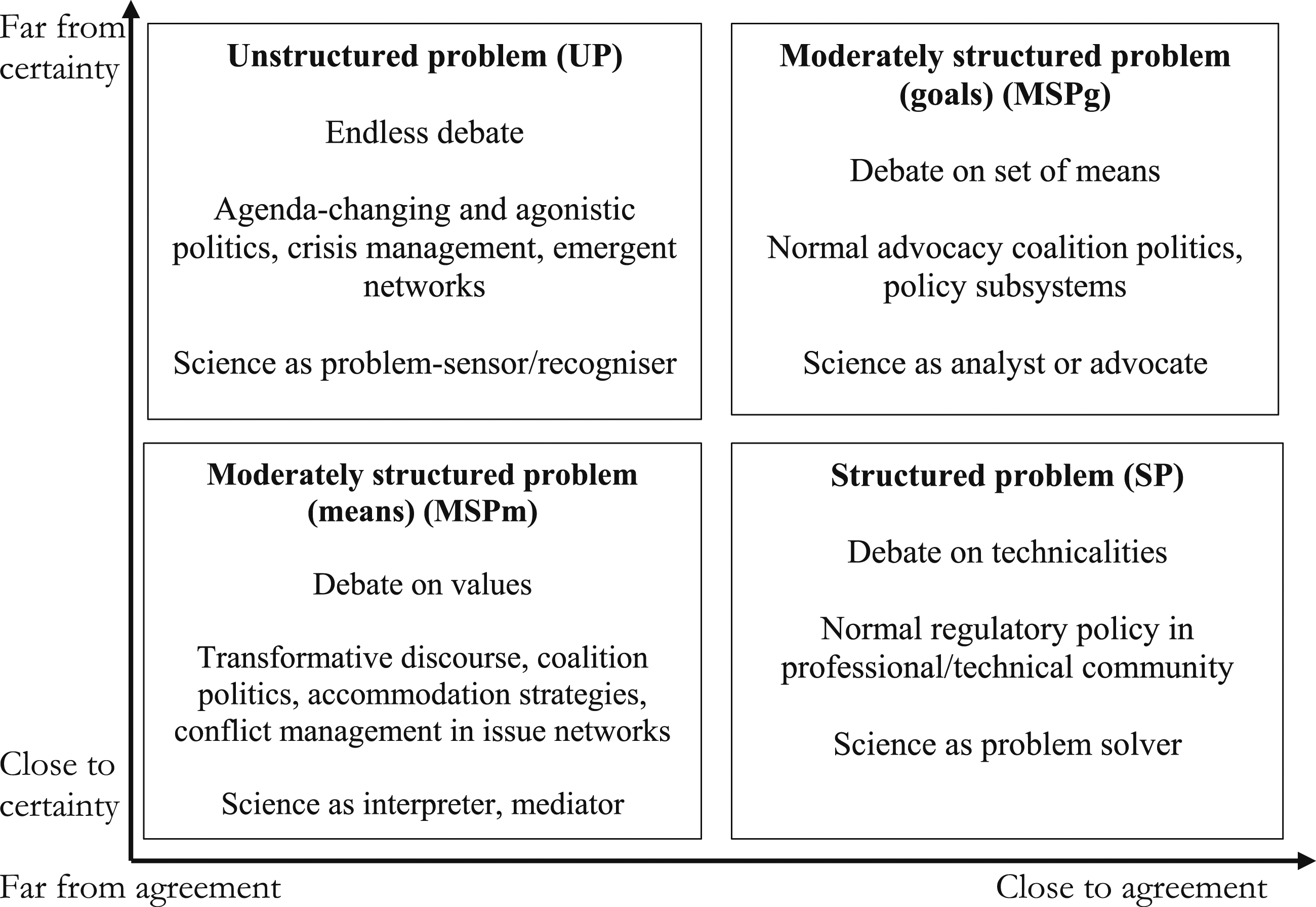
Wrong-problem problems, protracted controversies and metagovernance
How we perceive salient political issues and structure them into problems amenable to policymaking results from a contextual ‘palimpsest’: obscure and difficult to interpret traces from a dimly aware legacy of ‘how we used to do things here’, and more legible contemporary problem framing contests. In a world of intertwined political and policy action, many problems are apparently well-structured and deeply entrenched in institutionalized networks. Clear problem frames temporarily stabilize and sometimes even institutionalize policy networks and vice versa; ‘to get on’ with practice as unproblematic, normalized routine, complexity is simplified, doubts put on hold, and counter-arguments quelled (Jessop, 2020). Educational and media practices imperceptibly promote commonsense beliefs and discourses to hegemonic status (Gramsci, 1971). Nevertheless, through political struggles, types of problem and policy politics also clash. When opposed politicians and policy workers imagine very different destinations for problem structuring journeys without mutual adjustment, a wrong-problem problem situation may result (Hoppe 2011: 86; Mitroff and Silver, 2010). Policy designers, using their political power to select what counts as rational knowledge, may presume and impose sufficient agreement on values and knowledge claims. Disputants use the resulting sentiment of feeling side-lined as a resource for counter-policymaking.
Wrong-problem mismatches frequently arise not from intellectual error, but from power asymmetries, potentially leading to protracted controversy (Schön and Rein, 1994). To avoid or escape such controversies, scholars suggest metagovernance. Politicians and public managers deal with unstructured problems by reasserting control over policy networks, redesigning them as collaborative governance (Huxham, 1996; Van Buuren, 2009) spaces and orders of transaction that prescribe, facilitate or ease towards more harmonious, mutually respectful and potentially transformative relations. The idea is that collaborative governance and its many methods and techniques for stakeholder and citizen dialogue and participation allow them to reap the benefits of collaborative advantage. It is often illustrated by the co-production of a shared information base (Van Buuren 2009) and claims of achievement of policy outcomes that no actor could have achieved alone (Huxham, 1996).
But we ask whether collaborative governance approaches really are so useful. Collaborative approaches share a similar problem-solving assumption as scientific design; ultimately, problem structuring can be finalized, or closed, entailing codifying the answer and the question disappearing. Such approaches assume either that value conflicts do not lie behind intractable controversies, such that conflicts arise over resolvable means, or that a collaborative approach can indeed eliminate value conflicts. Problem-solving is the premise we abandon in order to reveal an alternative reading of how to handle wicked problems.
Emergence of a protracted controversy in EU GM crop authorization
The collaborative governance solution has been proposed as a way of handling wicked problems, for instance in the case of the complex EU GM crop authorization problem. However, the EU did not adopt this approach, despite this ‘wrong-problem problem’ causing a protracted policy controversy lasting decades. In his comprehensive analysis of the treatment of wicked problems, Head (2022; see also Daviter 2017) concludes that coping strategies are more widely used and more effective than aiming for scientific solutions. In this section, we illustrate our approach by applying it to this supposedly wicked problem, showing how it supports a topological explanation that rejects the notion of wickedness, instead highlighting the EU’s problem structuring mistakes and then recovery by means of effective relational metagovernance. We use secondary sources, relying heavily on the rigorous analyses of Mampuys (2021) and Ingelbrecht (2017: 44ff), who set out the main problem frames and chart the policy process. We build upon their work, developing our own conception of the agonistic problem framing efforts by stakeholders and, instead of proposing a collaborative governance resolution, we develop a different reading in regard to relational metagovernance. The case illustrates how our framework finds wickedness in relational processes, not in the problem itself.
Since the 1970s, the discovery of genetically modified organisms (GMOs) has promised to improve industrial agriculture, but carried risks of nature contamination. Insider, scientific knowledge of GMO risk spilled over into public fear, with governments moving to manage risks and public sentiment. In this problem gestation and categorization period, the EU worked to install a ‘harmonized’ regulatory framework for GM crops, applicable to importation of GM food and feed, cultivation and field trials for crops and industrial processing. Requests for GM business products were to become subject to a European Food and Safety Authority (EFSA) authorization procedure of risk analysis and assessment, listing potential GM hazards and adverse impacts in reports to the EC. Risk would be regulated by a system of structured interaction, comitology, governing power and authority relations in authorization decisions between the EC, the Council of Ministers (Environmental), and MS expert Standing Committees. Quickly rushing into problem choice, the EC formulated the major legislative policy goal: ‘protect human and animal health and the environment’ before a GMO is placed on the market and establish ‘harmonized procedures’ for risk assessment across the single market. Effective market functioning required ‘clear labelling’ to support informed choice and GMO ‘traceability’. 1
The history of EU GM crop authorization can be reconstructed in five episodes (from Skogstad, 2008; Morris and Spillane, 2010; Inghelbrecht, 2017; and Mampuys, 2021): 1) Incubation and agenda-setting (1973–1986); 2) Mega-policy choices and initial legislation (1986–1991); 3) Mounting controversy and de facto moratorium (1991–1999, and 1999–2003); 4) Conflict management politics for a protracted controversy (2003–2019); and 5) Constructing political urgency and problem reframing (2019–present).
Incubation and agenda-setting
This episode begins with the r-DNA technique invention and maturation of biotechnology, uniting university researchers and corporations in a shared interest. Rapidly commercialized ‘biotech’ became embedded in collaborative ‘Triple Helix’ networks. They consisted of university centres interested in attracting research grants from government and business, commercial start-ups (often scientists) and large corporations (like Monsanto and BASF) interested in exploiting the new technology for profit-making, and national governments interested in boosting technological innovation for economic development and global competition (Demont and Devos, 2008). Initial caution waned as it was hailed an agricultural saviour technology and business opportunity. EU interest (October 1983) in GMO regulation led to establishing a Biological Steering Committee chaired by three Directorates General (DG) that neatly indicated the angles of expertise – science, economics, environmental science – necessary for scientifically coherent risk assessment and testing. The lead role of DG XI Environment ensured the double-barrelled quality of every innovation policy; foster technological innovation and growth, while applying the precautionary principle. Meanwhile, several MSs developed their own regulatory initiatives.
In the first instance, we work from the basic insight that problems are framed by the choice of one or more key concepts which express the core of a preferred problem diagnosis and definition (Roe, 2013). The EU chose two overarching framings that permeated the emerging policy discourse and mega-policy choices on GMO authorization. The first is the ‘(un)naturalness’ of GM, evidenced in Directive 2001/18/ED, Art. 2. This definition matters, both for probing and instigation, because it makes a value judgement placing humans above, or at least separate from, and intervening in, nature. In political debates, (un)naturalness is an essentially contested concept. One side argues that technology is good and merely improves upon nature (Crocker, 2012). The other rejects genetic modification as inherently bad, as human hubris, ‘playing God’ (Nuijten et al., 2017). For a majority of other stakeholders, value-laden references to (un)naturalness express not fundamental disagreement, but voice questions or worries to be investigated before application. For instance, Dutch advisory body COGEM interprets unnaturalness as a safety issue, compared to North American product-based definitions. This GMO framing opened the possibility of strong value dissensus and knowledge conflict on the presence and severity of risks.
The second major framing was the interpretation of the precautionary principle. In one application, the promise frame (Mann 2018), the EU should not become an international laggard and therefore only soft precaution is necessary to steer clear of egregious risk, scientifically defined (Mampuys, 2021: 82). Contrarily, the ‘GMO-free agriculture’ frame of ‘prophets’ (Mann, 2018) believes in limited planetary carrying capacity, especially of the soil, to ‘feed the world without devouring the planet’ (Monbiot, 2022). Non-GMO crops and foods are a pre-set goal, via organic farming, necessitating strong precaution as a decision rule extending beyond science to encompass ethical, social and political concerns. Third is the indifference frame of producers and retailers controlling the food supply chain. Their positioning is determined by consumer choices around risks, their goal to ward off the GMO threat to their markets.
These three ambiguous discourses had to be navigated by politicians and policy workers. We follow Inghelbrecht’s (2017) discourse coalition grouping method, identifying in regard to GM attitudes; PRO- (the farmer as client food producer, agricultural biotech industry, agricultural science, compound feed industry, feed manufacturing industry, international organizations (WTO) backed by Anglo-Saxon (USA, Canada, Australia) and South-American governments); ANTI- (planet first groups, organic farming sector, environmental/ecological NGOs, consumer associations, Green parties, many national governments, (e.g. Italy, France, Austria, Sweden), majority public opinion); and INDIFFERENT (the consumer’s preference alone is what counts, food marketing industry, food retailers, many governments (tacitly)). Unfortunately, two of the discourse coalitions held strong, contradictory views on both (un)naturalness and the precautionary principle. Our theory presents the EU’s choice of overarching concepts as reflecting incompatible problem categorizations, inviting not experiments but agonistic struggle. Only a space supporting mutual adjustment between discourses could ameliorate the difficulty. Instead, we find that the EC strategy worked against this by embarking directly upon a journey towards a fully structured problem around safety, added to freedom of choice for consumers and producers, later. This exacerbated the apparent distance between proponents and opponents, leading them to adopt entrenched positions in regard to interpreting precaution.
Megapolicy choices and initial legislation 1986–1991
The second episode concerns EC mega-policymaking and initial legislation. Mega-policy is the major pillar of a policy framework that permeates subsequent actions (Dror, 1971). The EC adopted a heavy-handed regulatory science approach to soft precaution. This assumes human and animal safety concerns are a structurable problem, with: broad agreement on ethics and practical goals of human, animal and environmental safety; biotechnological knowledge on achieving goals; uncertainties tamed by scientific monitoring and research. Theoretically, the problem diagnosis hovers between SP (for Promethean promise believers) and MSP(g) (for those with pragmatic doubts).
A common over-simplification of science-based regulation is that ‘science speaks truth to power’. But ‘advice-giving’ is not a one-directional process, requiring ‘boundary work’ between scientists and policy workers, who have demarcated roles but must arrive at coordinated conclusions in practice (Halffman, 2003; Wesselink and Hoppe, 2020). At first, the EC adopted a non-transparent (Borrás, 2007) process of closed advisory networks. Scientific panels would make decisions jointly with DG’s bureaucratic experts. To overcome suspicion by external actors, the EC proposed a more visible institutionalization of the science–politics interface, later called ‘comitology’. This attracted criticism from already suspicious MS Green Parties and media, reflected in public opinion (Morris and Spillane, 2010; Skogstad, 2008: 6; Ichim, 2021: 21).
From January 1990, the EP agreed on a process-, not product-triggered, regulation. This focused on possible harm from the entire process of GM and GMO release, instead of a narrow risk-versus-benefit analysis of end-products. With a tabled 5-year moratorium on GM crop authorizations only narrowly defeated, many MEPs held strong doubts about science as principal safety guarantor, bolstered by the pro-farmer stance of the Common Agricultural Policy. MEPs demanded guarantees that MSs could impose territorial bans on GMOs and that food consumers and food/feed producers hold a free choice. The EC followed the EP’s wishes by including a ‘safeguard clause’ on deliberate release in Directive 90/220/EEC, allowing MSs to ban GM field trials and cultivation. Thus, EC pressure to render the problem as fully structured was effectively resisted by those who wanted to keep alive a problem structuring trajectory leading towards MSP(m) or even UP.
Mounting controversy and de facto moratorium, 1992–2003
In the third episode, problem structuring tensions produced an open political clash in a de facto moratorium of GMO authorization (1998–2003). GMO risk perception increased to what some called ‘hysteria about “Frankenstein foods”’ (UK Select Committee on Science and Technology, 2003). Events strengthened sceptical views: the 1995 EU accession of countries with a record of environmental and consumer protection (Austria, Finland and Sweden); a blockade of US-produced GM soy and maize; mad cow and dioxin studies, along with ‘alarming’ scientific findings on GM impact on animals; and food retailers seeing GM food as a threat to consumer markets (Inghelbrecht, 2017: 48ff), demanding that the US separate GM from conventional products (Lynch and Vogel, 2001). In 1997 the Novel Foods and Novel Food Ingredient Regulation 258/92/(EC)2 came into effect, upscaling the requirement for food labels from ‘may contain’ to ‘genetically modified’. Against the political mood, in 1998 the EC formally authorized MON810 – a GM insect-resistant maize – for cultivation. It remains the only authorized GM crop on the EU market.
GMO risk regulation became a priority issue for MS governments and EP elections. MSs rebelled, with 12 of 15 invoking the regulatory safeguard harmonized system opt-out clause, a de facto moratorium 8 years after the EP had threatened it. MEPs (strengthened by the 1992 Lisbon Treaty veto-power) presented the EC with two stark alternatives. Those in favour of continued EU-wide harmonization demanded no new market releases until stricter rules became available for labelling, traceability and release (temporary block). Those against demanded no authorizations whatsoever until no adverse effects on human health and environment were demonstrated (continuing block). Further problem decomposition occurred in stricter risk assessment demands and monitoring. Opposition to the SP grew, and the MSP(m) forces strengthened.
Metagovernance for protracted controversy
Adding consumer protection reshuffles the network
Under standard operating rules, ‘comitology’, the EC, as EU executive committee, was the only metagovernor in town (Borrás, 2007: 9). The Commission prudently chose to work on restoring the legitimacy of the harmonized regulatory framework. Over subsequent years this produced a hybrid, some say ‘hypocritical’ (Brunsson, 1989) or ‘clumsy’ (Verweij, 2011) system of policy politics on GMO regulation.
Following the EP’s call for stricter authorization rules and procedures, the emphasis on a SP, science-based approach to precaution was maintained and even strengthened. First, values informing the regulatory framework were sharpened, from a broad but fuzzy agricultural-plus-environmental perspective on safety as precaution, to food safety as consumer protection (Inghelbrecht, 2017; Mampuys, 2021). The framework’s ethical base was articulated more clearly regarding traceability and trials (Mampuys, 2021: 179). Improved public perception allowed ‘the Commission to exercise a relative (even if weak) degree of moral leadership’ (Borrás, 2007: 10).
Second, adding food safety and consumer protection to the precautionary framework, the new ‘A + B approach’ to policy goals (Inghelbrecht, 2017: 22) required reshuffling of the policy network. Selecting DG-SANCO for Health and Consumer Protection as penholder for rewriting legislation and rules for policy work, the Commission reacted to the EP by bringing in new public and private participants. Borràs (2007: 8–11) found that this marginalized private actors representing GMO-producing firms, while civil society groups were drawn closer.
Tinkering with comitology
In an effort to increase metagovernance legitimacy, while maintaining the SP focus, regulatory distances were extended. The practice of ad-hoc and all too cozy boundary arrangements between risk assessment and management were replaced, with risk assessment, communication and management formally separated and organizationally distributed. A European Food Safety Authority (EFSA) was established (General Food Law–Regulation 178/2002), located not in Brussels but in distant Parma – at more than ‘arms’ length’. Although working in response to requests for scientific advice from the Commission, the Parliament and MSs, the EFSA operates autonomously from them, governed by an independent and mixed management board. Note that in response to the call by GM-sceptic MEPs to give citizens more information, the EFSA is also responsible for EU public communication on GMOs. This met the formal demand for openness, but also tied both citizen information and feedback to the science-informed approach.
Despite the altered stakeholder positions, this arrangement remained every bit as science-based and technocratic as before, even strengthening it. First, the EFSA became the sole body for evidence and judgement on GMO cultivation and imports. Moreover, the Commission tried to make MS opt-out escape routes more difficult by tinkering with the comitology rules (Mampuys 2021: 39) via a sophisticated committee system overseeing MS implementation (Patel, 2020:185). This aimed for a high degree of professional knowledge deliberation between MSs for EC decisions (Geuijen and ‘t Hart, 2010; Woeltjes, 2010). The key measure was limiting the scope of arguments for justifying opt-outs to ones based on scientific evidence. The EC, with the EFSA and ECJ, set out specific impacts and risk principles, specifying methodologies via regulation (Annex II and Annex III of Directive, 2001/18/EC).
Second, since 2001, the safeguard clause was tightened (art. 23 Dir, 2001/18/EC or art. 34 Regulation). Bans could only be temporary and argued by ‘justifiable reasons’ on relevant ‘new information’. However, such new information was brought forward, with scientists contesting EFSA safety and uncertainty claims (Mampuys, 2021: 137), along with MS risk assessments offering argumentative ammunition to be used in comitology. Some described this as an EFSA versus national science battle through knowledge coalitions over contested facts (Hristova and Böschen et al., in Inghelbrecht, 2017: 21–23). From 2004–2015, eight countries used the new safeguard clause. In all cases an EFSA expert panel found the argumentation wanting (Mampuys, 2021: 33). In addition to ex ante assessments, annual ex post monitoring reports were required, and authorizations renewed after 10 years. A final tweaking of the comitology procedure was to grant sole arbitration authority to the Commission in ‘no opinion’ outcomes.
Conflict management by re-nationalization and stalemate
The combined EFSA ‘scientization’ and EC ‘arbitration’ were supposed to speed up authorization as SP and bring about a policy politics more favourable to EFSA-expert rule and subsequent compliance of MSs. However, this did not happen. The Commission proved to be not an arbitrator but a non-decisionmaker. Neither in the standing nor appeal committees was the qualitative majority ever achieved. ‘No opinion’ was the standard outcome (Inghelbrecht, 2017). The Commission itself overruled its own voting schedules by as much as years between the first and second votes in the vain hope that more time might bring favourable outcomes. However, positive EFSA assessments hardly influenced MSs’ stances. Some would always be in favour of authorization, some would always reject or abstain, and only some would shift positions between first and second votes based on a hodgepodge of reasons (Mampuys 2021: 178). These expressed the worries, concerns and questions around (un)naturalness.
Obviously, probing by MSs and other stakeholders could not be straightjacketed into evidence-informed science. Several countries, for example, Austria, cherished their non-GM image. Political and sectoral business interests also played a role. Tagliabue (2017) summarizes the many reasonable motives to duck the authorization’s binding decisions, to: 1) avoid harming EU farmers; 2) gain political consensus from organic food producers and retailers; 3) spare public money in subsidy payments; 4) satisfy anti-GMO interests; 5) adapt policy to consumer preferences; and 6) protect the herbicide/pesticide chemical industry.
With so much headwind, the EC chose not to activate its option to arbitrate the issues as a power lever to insist on the SP-nature of authorization. Also, following EU culture of dealing prudently with MSs, it did not attempt to lift national government bans. Additionally, a WTO legal challenge against MSs’ de facto sovereignty in banning GM crop cultivation undermined EC authority and EU law enforcement’s credibility. For this reason alone, since 2010, the Commission invented a complicated legal bypass or ‘escape hatch’: Deliberate Release was amended by Directive (EU) 2015/412 in a way that sacrificed EU-wide harmonized authorizations for re-nationalized ones. The Commission would remain responsible for authorizations under the old regime, but MSs were allowed to opt-out for part or all their territory on grounds well beyond the narrow science-based risk assessment. Private applicants would be informed about national opt-outs and asked for permission (Inghelbrecht, 2017: 9–11). If agreed, the opt-out was considered final. If not, applicants could go to international (WTO) court but the country could meanwhile enforce its ban.
Small wonder that GM food and feed producers chose to withdraw from the European market (Halford, 2019). EU territory is as good as GM crop cultivation free. And yet, the EU imported tens of millions of tonnes of GM soybean, maize and other crops for animal feed. Evaluating this situation depends on one’s stance towards biotechnological innovation. Most scientific commentators, not incidentally, lament the EU’s ‘irrational’ refusal to use a safe and readily available, mature technology (e.g. Mann, 2018, 471–474, Appendix B). However, if one believes there are good reasons to refuse a new technology, or wait-and-see, EU policies are an outstanding success and anything but irrational.
(Re)constructing political urgency through modest but clever reframing
The ability of MSs and other actors to take intractable positions stymied the EC’s problem structuring attempts. But of course, GMO policy remained problematic, given post-2001 advances in which ‘genetic modification’ disappears as a separate, recognizable technology (e.g. gene-editing with CRISPR-Cas; Poort et al., 2022). To scientists and many agri-food stakeholders, this renders obsolete the EU definition of GMOs. Scientific methods can no longer detect (un)naturalness (Garnett 2019). With tracing rules un-implementable, it is argued that GM crops from these newer technologies be exempted.
In this situation, most theorists recommend that the Commission initiate a new round of metagovernance (Hisschemöller and Hoppe, 1996; Head, 2022: 102ff). From a perspective of policy design thinking (Verweij, 2011; Ney, 2022), EU policy allowing imports but prohibiting cultivation, and the backdrop of technological change, could be reframed as a temporary clumsy solution to a messy problem, requiring collaborative governance, accompanied by integrative thinking through design labs or stakeholder–citizen dialogues. This reflective yet actor-oriented step backwards effectively redoes the problem structuring functions and exploratory categorization to overcome policy paralysis.
This was not the course the EC followed, probably because experiences in initiating integrative thinking were discouraging. Despite the efforts of Dutch and Austrian scientific entrepreneurs (Lotz et al., 2020; Niggli, 2021) and German green policy entrepreneurs (Chritsman et al., 2020) advocating that gen-tech and agro-ecology need each other and can co-exist, polarized stances on food and farming prevent integrative thinking on a politically significant scale (Feindt, 2004; Montenegro De Wit, 2021).
Mampuys (2021) rightly argues that depoliticization – through delegating responsibilities to scientific, societal and legal actors and systems – is the major culprit of the present paralysis. Hence, she advocates repoliticization: the Commission should roll back re-nationalization and expressly reclaim crop risk as an EU-level regulatory question. This does not mean that the Commission uses its formally assigned arbitration authority. She acknowledges this would only be possible were an additional condition met: sufficient political urgency, clearly expressed by society and MSs. Two precedents exist in the use of glyphosate and relaxed vaccine conditions for COVID-19 R&D. In both cases, ‘humdrum’ bureaucratic risk regulation rules were overturned by ‘high politics’ Council of Ministers interventions (Mampuys, 2021; Hoppe, 2019).
But achieving political urgency is difficult, given public rejection of GM foods as too risky (Skogstad, 2011). Nonetheless, EU institutions pursued such a path, through patience and cunning exploitation of events. The first event was a legal challenge by anti-GMO Confédération Paysanne, demanding the French Prime Minister ban herbicide-tolerant rapeseed varieties created through mutagenic techniques. The French Conseil d’État referred the case to the ECJ, which ruled in July 2018, to the surprise and irritation of many, that such techniques are still subject to EU GMO provisions (CJEU, Case C-528/16). Following a stringent interpretation of the precautionary principle, the Court held that the formulation of the GMO Directive implied a non-exhaustive definition of non-natural plant breeding technologies (Garnett, 2019).
Scientists and industry lambasted the ruling as ‘irrational’, ‘anti-science’, ‘anti-free trade’ and at loggerheads with the EU’s global technology leadership aim. The issue became politicized as the Council of Ministers (8 November 2020) assigned the Commission to propose answers to the question of Directive 2001/18/EC compliance in the mutagenesis case (Council Decision, (EU) 2019/1904). The Council deadline stressed the political urgency of the request.
The Commission’s report and new policy design drew from all MS GM authorities and a stakeholder consultation. In 2021 it repeated its proposal to update legislation for ‘plants derived from targeted mutagenesis and cisgenesis only’ (European Commission 2021: 92). More importantly, the adaptation was no longer linked to safety alone. It is now explicitly incorporated into a broader EU innovation and transition agenda because a ‘purely safety-based risk assessment may not be enough to promote sustainability’, and NGT plant produce could ‘contribute to objectives of the EU’s Green Deal and in particular to the Farm to Fork and biodiversity strategies, and the UN’s Sustainable Development Goals (SDG) for a more resilient and sustainable agri-food system’ (2021). The Commission acknowledges continued ethical and economic objections from market sector stakeholders. Before the final report (2023), the Commission hopes for more integrative thinking on both sides under pressure of political urgency, implementation problems and its new policy horizons.
Discussion and conclusion
Wickedness lies in the structure and dynamics of the policy network
Both Inghelbrecht’s and Mampuys’ studies should be commended for their long time frames (>30 years) in studying EU GM crop risk problem structuring. But both presuppose, from the beginning, that the problem itself was inherently ‘wicked’. By carefully tracing journeys of problem structuration, we see that different actors have different problem structures in mind when participating in intellectual debates and political conflicts. Depending on their persuasiveness and power resources, they may sometimes realize all or most of their aspirations, even for an amount of time imposing their problem structure as dominant. In such periods, a researcher may unambiguously classify the problem type as SP, MSP(g), MSP(m) or UP. At other times we can only observe that actors with different problem structuring trajectories in mind have been unable to achieve structural dominance. Haggling continues without any of the involved parties, authorities included, gaining the upper hand.
This is the case in EU GM crop authorization (Figure 2). But our conclusion is not that the problem is wicked; rather, wickedness lies in the structure and dynamics of the policy network. Rigid structural interaction between institutionalized policy actors sustains instigation and power games interlaced by question-answer or probing games that jointly reproduce a clash between the same, in compatible problem types over and over again (Figure 2). Problem structuring trajectories in EU GM crop authorization, 1985–2022.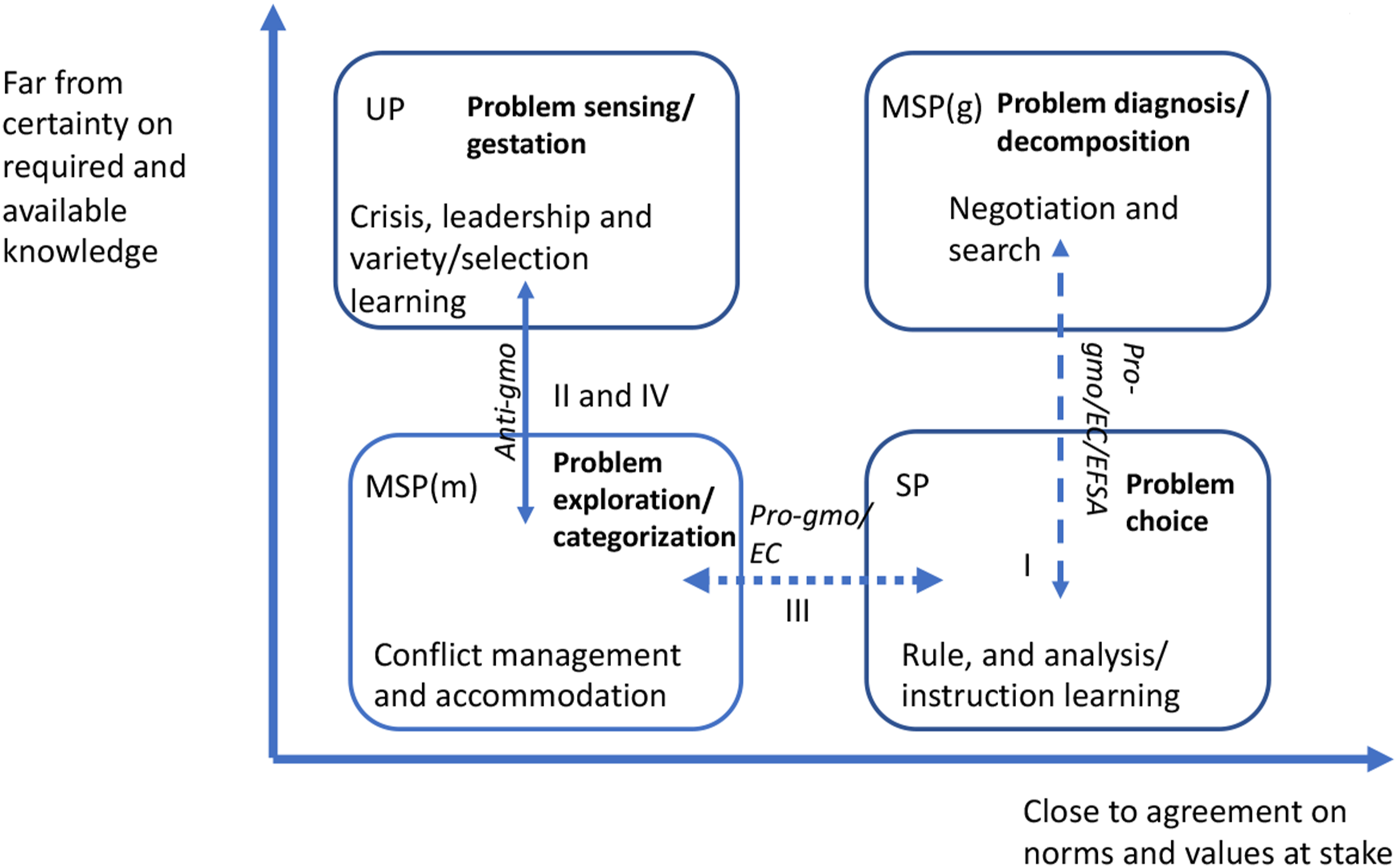
Since 1986, those convinced of GM crop safety and in a position of political-administrative (EC) and scientific (EFSA) authority, rushed towards imposing a SP and a fitting policy politics regime of ad hoc, then later institutionalized, expert-driven boundary work. But there was also room for adjusting problem diagnosis and decomposition. Remaining uncertainties would be reduced over time by monitoring and scientific research, and compromising between more or less effective and efficient means. This is depicted by the dashed bidirectional ‘I’ arrow. This governance style mixes hierarchical rule with a periphery of expert controlled incremental pragmatic adjustment.
Increasingly resisting these views, those unconvinced about GM safety insisted, rather successfully, on more problem exploration and diagnosis falling outside the scope of debate as defined by techno-optimists. They insisted on the problem as MSP(means), allowing debate not only on remaining uncertainties and better means, but also on wide-ranging ethical, socio-economic, economic-institutional and political issues (Wickson and Wynne, 2012; Montenegro De Wit, 2021). Member states and NGOs resisted path dependency drift in problem structuring. They argued that more time was needed for problem sensing and gestation, indicated by the bidirectional arrow ‘II’.
Since the 1998 moratorium and early 2000s issue network reshuffling, a wrong-problem problem situation or protracted controversy existed. Authorities tried to impose their SP on opposing and dissident forces able to sabotage their power. These were not persuasive or powerful enough to formally change the dominant governance style. Nevertheless, they forced authorities into a hypocritical or clumsy stance of formally keeping a SP alive as a ‘front office’ for political and legal reasons, while in effect pursuing an informal, ‘back office’, but eventually formalized, positioning strategy – the dashed double arrow ‘III’. They forced the EU to live with an unresolved wicked problem (Bannink and Trommel, 2019), made possible by double decomposition of the risk problem: dealing with cultivation and imports under different regimes and at different levels, an EU level for external accountability to the WTO and US, and a MS-level for internal accountability. This ‘clumsy’ situation has now existed for almost two full decades!
Making the most of comitology through imperfect but intelligent strategic analysis
In stalled policymaking conditions and protracted controversies, many authors normatively argue for metagovernance by political statesmen or entrepreneurial policy workers who envision reframing through transformative new discourses and reshuffling, sometimes even breaking-up, policy issue networks (Head, 2022: 102ff.). Usually it is considered government’s responsibility to establish metagovernance that shifts from polarized and competitive to a collaborative or integrative style, no longer pretending to provide the right answers but merely asking the right questions (Stevens and Verhoest, 2016; Fawcett and Wood, 2014; Qvist, 2017; Temmerman et al., 2015; Raelin, 2020).
It makes sense to ask why this did not happen. We argue that such a shift was practically and politically highly likely to fail. Instead, the EC chose a seemingly imperfect but intelligent mode of strategic analysis to nudge forward the process in its current policy politics style and yet keep all stakeholders on-board. In political distance terms, a chasm yawns between the techno-optimist pro-gentech ‘wizards’ aiming to save an overpopulated planet through GM technology and the anti-gentech ‘prophets’ who believe their opponents, despite good intentions, will destroy human habitat. The two camps have cemented positions in battles over three decades. It is unrealistic to expect their representatives to build bridges and explore common ground without being immediately ostracized from their respective communities. Collaborative governance is only possible after significant network reshuffling and the emergence of a different kind of policy politics and governance culture. Additionally, the Commission clearly chose the wizards’ side and made uneasy compromises only in the face of strong political opposition. It would lack authority and credibility were it to propose collaborative metagovernance. With comitology, there is simply no thinkable alternative. The Commission, forced by Court ruling to apply technically infeasible rules, assisted by the Council of Ministers, chose a patient strategy of gradually building up political urgency for an incrementally adapted SP choice.
The paradigmatic rethink proposed by Inghelbrecht (2017) and the explicit problem-reframing stakeholder participation and Habermasian discourse ethics proposed by Mampuys (2021) are both perfectly justified policy design logics. However, this assumes it is the problem itself that is wicked and therefore can be managed by metagovernance that institutes a reframing and collaborative process. Such interpretive methods differ from natural science solutions, but nonetheless still suppose a total resolution is possible. But in EU realpolitik, both problem reframing and a discourse ethics–collaborative governance approach have a high likelihood of failure and continued policy paralysis. Instead, the policy analysts of the Commission (2021) reframed GM risk by adding agro-ecological flavour from the From Farm to Fork strategy and stressed the EU’s Green Deal imperatives. Instead of pushing gentech and agro-ecology complementarity, this is no more than a gentle nudge, accepting the need to manage entrenched distances. It is clearly imperfect and incomplete. But one cannot deny it is sound and intelligent strategic analysis.
Strategic analysis means ‘using intellect to aid interaction between people’ (Wildavsky, 1980: 17). It limits focus to those aspects of immediate concern for seducing opponents to non-sabotage or cooperation and securing allies’ support. This bounded rationality follows a relational logic. Instead of a sudden role switch from arbitrator to mediator, the EC humbly adopts the role of nudger. It crafts arguments to – contra explicit criteria for participation ethics or power-free argumentation space – take into account power differentials and positions between allies, opponents and indifferents. Policy workers present arguments as the next incremental step in a dynamic sequence that ‘convert(s) an impossible task into a feasible one’ (Braybrooke and Lindblom, 1963: 53). EC arguments (2021) facilitate continuance by targeting the interests of opposing stakeholders who, therefore, will have to invest in the process and not just walk out. There is no need for agreement on a politically disempowering participation ethics. From a probing perspective it is a promising yet modest policy design, and realistic from a political instigation perspective. As a way of governing unstructured problems marked by wickedness, it is politically intelligent (Bannink and Trommel, 2019).
Footnotes
Declaration of conflicting interests
The author(s) declared no potential conflicts of interest with respect to the research, authorship, and/or publication of this article.
Funding
The author(s) received no financial support for the research, authorship, and/or publication of this article.
