




Abstract
Effective administrative-political relationships are vital for the quality of public administration, both within Westminster-style systems and beyond. However, changes in political practice can put pressure on Westminster administrative conventions. More broadly, recent research interest in the changes in accountability relationships between bureaucrats and political principals and associated challenges to the neutrality of the public service have highlighted the need for further work to explore the changing operation of administrative-political relationships. This article analyses 15 key speeches of eight Australian Prime Ministers to explore whether there has been a significant shift in expectations of the public service, and whether these shifts represent a fracturing of Westminster conventions, or are a result of ongoing trends such as higher expectations of public sector responsiveness and the shift to market mechanisms consistent with New Public Management. The article makes two contributions: it analyses the approaches of Prime Ministers in Australia from different political parties over nearly 50 years and it contributes to understanding shifts in the relationship between governments and the public sector. The analysis also has implications for underlying concerns about how public institutions cope with changes in political leadership, and about how democratic institutions manage under increasingly right-wing governments.
Keywords
Introduction
Three decades ago, Thompson stated: “Neither democratic theory nor democratic practice has yet discovered a form of administrative responsibility that would let democrats comfortably consort with bureaucrats in the governing of society” (Thompson, 1983: 250). More recently, Peters (2010: 210) identified the underlying conflicts between bureaucracy and democracy, but noted that “the responsiveness of democratic governing must be balanced with the predictability and impartiality assumed to reside within bureaucratic institutions”. Certainly, the changes in accountability relationships between bureaucrats and political principals have been receiving more attention (see for example Wood et al., 2022) as confidence that governments are making sound decisions is declining (Coaldrake, 2022: 24). Further, the debate over public service responsibilities and political control are long standing (Aberbach and Rockman, 2006). The capacity of the bureaucracy to remain neutral is challenged by Farazmand who states that “whoever controls the institutions of government also controls and uses the bureaucracy as an instrument of power and rule” (Farazmand, 2010: 248).
Recently it has been claimed that in “Westminster-style systems, political practice has outstripped traditions, beliefs, conventions and accountability arrangements” (Tiernan, 2019). Yet ministers and public servants are inextricably bound in a co-dependent relationship (Boswell et al., 2022: 2) and effective administrative-political relationships are vital for the quality of public administration, both within Westminster-style systems and beyond (Tiernan et al., 2019). Exactly what ‘Westminster’ means is contested, but is perhaps best summarised by Grube and Howard (2016: 478) as a system which can be understood as operating as “a language, or a set of institutions, or as an elite bargain”. It is a system which allows for flexibility and contextual interpretation, and as such, the absence of clear frameworks means that its implementation depends on and is shaped by (political) actors (Chapman, 2000: 119). In other words, the effectiveness of the system relies on “a depth of political will and courage” (Grube and Howard, 2016: 478). This flexibility of interpretation is seen as an important factor in its durability (Weller and Haddon, 2016). The traditions and conventions of the Westminster system are essential to the functioning of Australia’s system of government: it is the “lifeblood of the system is convention and practice” (Bongiorno and Millane, 2022). Respect for, and adherence to, the conventions of the Westminster system are therefore a critical pre-requisite for the symbiotic relationship between the public service and Ministers (Richards and Smith, 2016).
This article seeks to explore how one of the key players in Australia’s Westminster system, the Prime Minister, frames the administrative-political relationship and whether their perception of an effective relationship has shifted over time. In particular, it looks at Prime Ministerial expectations of the public sector as articulated in public speeches to discern whether these expectations reflect general ongoing trends such as higher expectations of public sector responsiveness, or a fracturing of the conventions on which Westminster systems rely.
Australia is fortunate to have a record of the stated aspirations of Prime Ministers for the public sector through speeches made specifically on the topic, often directly addressed to bureaucrats. This record stretches back nearly 50 years and covers both right-wing (Liberal) Prime Ministers and left-wing (Labor) Prime Ministers. In these speeches, Prime Ministers have set out their views on long-established political conventions relating to the public sector such as the Westminster system, independence, accountability and responsiveness. By linking this canon to understanding of concurrent public sector reforms and managerial paradigms the analysis seeks to trace changing political-administrative relationships within Westminster systems.
The article starts by setting out the public sector context in Australia before moving to the research method. Discourse analysis is applied to speeches from Prime Ministers from Fraser to Morrison (1975 to 2022). The focus of the analysis is on an inventory of representations of Westminster traditions within the speeches. In other words, what the Prime Ministers say is of less interest than how they are reflecting accepted discourse on these matters.
The analysis fully recognises that what Prime Ministers say is not what necessarily they will do, but what is talked about and/or missed out (and by some and not others) is still illuminating, as are shifts over time. The analysis also recognises that the speeches are not written by Prime Ministers but likely are a product of being written by public servants, altered by Ministerial advisors and subject to final editing only by the Prime Minister. But again, what is taken for granted, what is considered the ‘right’ thing to say, is still interesting.
The implications of the analysis for the administrative-political relationship are then discussed, suggesting that there are clear differences between left- and right-wing governments, but ideology on its own is not sufficient to understand the shifts in the administrative-political relationship over time.
At this point a quick note on the terminology used in this paper is required. Firstly, ‘government’ is taken to mean the elected government of the day. Secondly, ‘bureaucracy’ and ‘public service’ both refer to the administrative arm in the Australian context. Further, the political landscape in Australia is dominated by two major parties. The Labor party is left leaning and the Liberal party in right leaning, although both have traditionally clustered at the centre Fenna et al. (2021).
The public sector context in Australia
In June 1974, the then Prime Minister, Gough Whitlam, established a Royal Commission into Australian Government Administration, no doubt in part due to deep seated suspicions of a public service which had served a Liberal government for 23 years. However, it was left to his controversial successor, the Liberal Prime Minister Malcolm Fraser to respond to the 1976 report (Coombs, 1976). The Royal Commission has had an enduring influence on modern public administration in Australia. In particular, the report clarified the relationships between Ministers (and Prime Ministers) and the public service, abolished the office of a permanent secretary and established offices of Ministerial staff.
Since the Royal Commission, most Prime Ministers have made clear their expectations of the public sector through public speeches, primarily focussing on accountability and performance. In more recent speeches, the focus has shifted to the government’s expectations as to how the delicate balance between an independent public service and the political goals of the government will be managed. Australia thus has a rich resource over nearly 50 years to track any shifts in how Prime Ministers see the political-administrative interface operating.
Over the same period, New Public Management (NPM) has seen a broader shift in bureaucratic traditions. Australia was an early and enthusiastic adopter of NPM (Lindquist, 2010). Under NPM, accountability, particularly for performance, once thought to be through the Minister (and Parliament) to the public, has gradually come to be seen as more direct to the public. As well, since NPM was primarily about ensuring “the primacy of representative government over bureaucracy” (Aucoin, 1990: 115), bureaucracies are expected to be more responsive to Ministerial direction than in the past. While NPM is generally felt to be on the decline (Halligan, 2010), it still felt to underpin much of the organisation of the Australian Public Service (Shaw, 2012: XIII).
The danger of increased responsiveness was taken up by Aucoin (2012) where he coined the term ‘promiscuous partisanship’: In the environment of [new political governance], moreover, ministers, sometimes explicitly, usually implicitly, expect those public servants who are seen and heard in countless public forums to support government policy; that is, to go beyond mere description and explanation. The expectation is not that they engage in the non-partisan political process, for example, at elections or political rallies. Rather, it is that they be promiscuously or serially partisan … (Aucoin, 2012: 189)
Further, Grube (2019) reflecting the more active role of bureaucrats in publicly supporting government policies coined the term ‘megaphone bureaucracy’, but suggests that this is not a politicisation, but a reflection on the need for public servants to “contribute to well-informed discussions” in the increasingly hyper-partisan “public square”. In Australia, the debate continues as to whether the public service is “more responsive or more politicised” (O’Flynn et al., 2011: 310).
At the same time, neoliberalism enabled a shift in management which favoured using the logic of market competition to allocate resources and a light touch regulatory environment focussed on efficiency and effectiveness (Gertz and Kharas, 2019). The natural effect of neoliberal logics which favour the private sector and markets for public provision is to support a lack of respect for institutions such as the public service. For example, Navarro (2020) suggests that neoliberalism enabled policies of austerity, which contributed to the decline of the public sector, particularly in health and education. The shrinking of both the size and the capacity of the public service in Australia remains a critical concern (Independent Review of the Australian Public Service, 2019), particularly with the advent of significant shocks such as COVID-19 (Navarro, 2020). Nonetheless, neoliberal politicians are claimed to remain unconcerned about the decline in public institutions (Sumonja, 2021).
It was in this environment that the then Liberal Prime Minister Morrison sought to assert control over the Australian Public Service in 2019. Having taken on the portfolio of the public service (previously sitting with the Finance Minister) (Jennings, 2019), Morrison addressed senior public servants setting out his expectation that public servants respect that “responsibility for setting policy lies with the elected representatives of the people” and that they should expect “Ministers to provide that leadership and direction” (Morrison, 2019). This contention was strongly reiterated during interviews in the 2022 election campaign (Ravlic, 2022), although Morrison only made the 2019 speech devoted to the topic.
Morrison’s speech provoked outrage when he appeared to propose a significant shift in official understandings of the appropriate relationship between government and the public service. In particular, Morrison appeared to reinforce the notion that Ministers make policy and public servants merely implement these policy instructions. The widespread consternation at the speech is perhaps best summarised by Edwards (2019):
Where are the guardians of Western civilisation when you need them? The Prime Minister’s address to the public service on 19 August should ring alarm bells in every public office in the country, especially those of conservative orientation. How so? Because he unambiguously asserted that the role of the public service is to implement whatever the government decides. He has just trashed what remains of one of the finest conservative traditions bequeathed by our mother country.
Australia therefore provides a useful case for exploring the complexities of the political-administrative interface within Westminster systems. The remainder of the article seeks to explore whether then Prime Minister Morrison’s assertion was a significant shift in Prime Ministerial views on the role of the public service, or a natural progression of ongoing trends. The method and approach are outlined in the next section, before turning to the analysis.
Method and approach
The discourse analysis used in this article relies heavily on interpretation. This requires not just a description of representations and representational practices, but a deep “contextualisation within the larger structures of meaning of which they are a part” (Dunn and Neumann, 2016: 106). This also allows us to understand how and when a concept was “formed as well as how it succeeded in marginalizing other representations” (Hansen, 2006: 53).
Most discourse analysis is looking for continuities or persistence of linguistic signs, tropes or metaphorical schema, emergence or disappearances of these, and changes or ruptures in the discourse (Dunn and Neumann, 2016: 104). Of particular interest is how the linguistic tropes and metaphors persist, emerge or disappear and how they transform (Salter and Mutlu, 2013: 113-114). In this respect, silences, or what is not mentioned, can also be informative. By understanding the “space of discursive legitimacy” the connections between discourse and power can emerge (Dunn and Neumann, 2016: 107).
Understanding how these shifts occur requires not just a description of representations and representational practices, but a deep “contextualisation within the larger structures of meaning of which they are a part” (Dunn and Neumann, 2016: 106). This also allows us to understand how and when a concept was “formed as well as how it succeeded in marginalizing other representations” (Hansen, 2006: 53).
Prime Ministerial speeches analysed.
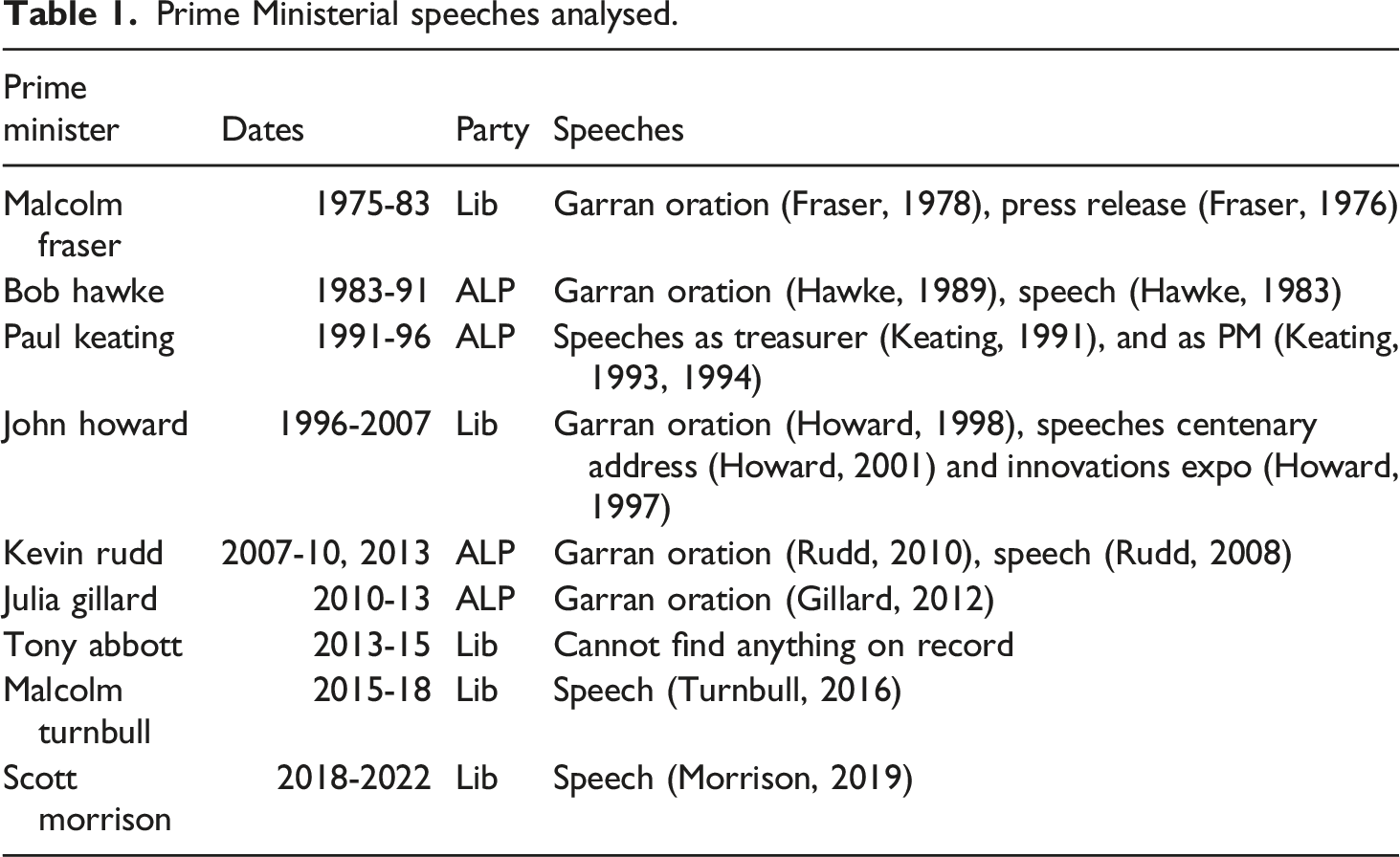
The starting point for the search was 1975 (Fraser), as this follows the Royal Commission which was a significant juncture in reconfiguring the relationship between Ministers and the public service, as well as the beginning of staffed Ministerial offices and the introduction of contracts for heads of agencies. The end point is the 2019 speech by Morrison (Morrison, 2019), which commentators held to be indicative of a significant shift away from Westminster conventions (see for example Edwards, 2019). The concern proved to be well founded, with concerns over the centralisation of power with the Prime Minister (Karp, 2022), lack of respect for Ministerial conventions (Bongiorno and Millane, 2022) and lack of respect for transparency and accountability (Tingle, 2020). As such, the speech represents a critical case for assessing whether political practice has indeed outstripped Westminster-style systems, as claimed by Tiernan et al. (2019).
The search strategy has quite narrowly focussed on speeches made to and about the public service. This has implications for the empirical results. Firstly, this means that analysis needs to focus less on what the Prime Minister has said, but more on how what was said reflects accepted discourse on the relationship. A further interesting question is who constitutes the target audience for these speeches? While the speeches are primarily aimed at clarifying the Prime Minister’s expectations of the public service directly to them, they also clearly have a political role to play in signalling more broadly how the Prime Minister proposes to manage the always vexed political-administrative relationship. In this way, we might expect ideology to play a role in what is said in the speeches. This means that the analysis needs to look for differences between left- and right-wing Prime Ministers.
The texts cover four right-wing (Liberal) Prime Ministers and four left-wing (Labor) Prime Ministers. No speeches were found by Prime Minister Abbott (2013-2015) on the topic. Perhaps the immediate sacking of four Departmental Heads was considered sufficient indication of how Abbott saw the relationship operating (Podger, 2013). Certainly, the actions of Prime Minister Abbott were keenly felt by senior public servants who tempered their public actions accordingly (Grube and Howard, 2016: 522). Further, the speech by Prime Minister Gillard was only tangentially on the issue, but is still included to provide balance between left- and right-wing Prime Ministers. It is also worth noting that the more recent Prime Ministers had relatively short terms in office, which likely explains why there are more speeches from earlier Prime Ministers, rather than it being indicative of more interest in earlier periods.
The approach taken is a double reading of the speeches. The first reading aims to identify and map the “limits of the discursive terrain” and construct nodal points. The second reading is “dialogical” reading to challenge the “supposed fixity and structuring of text” to identify what it is closing off (Dunn and Neumann, 2016: 106). The second reading identifies those things that are taken to for granted as true. These presuppositions assume a common understanding that is not necessarily there. It also identifies the metaphors (such as frank and fearless) which evoke the familiar and in so doing structure the “possibilities for human reasoning and action” (Dunn and Neumann, 2016: 115).
In this way, an “inventory of representations” is constructed to identify both anomalies and repetitions (Dunn and Neumann, 2016: 117). In particular, the analysis looks for different representations of Westminster traditions such as partisanship or politicisation, accountability, responsiveness and independence or impartiality.
Positionality statement
I am a policy scholar who comes from a practitioner background. I worked in the public service as a policy advisor and as a Ministerial advisor, prior to and during the introduction of New Public Management reforms in the Northern Territory. I have written speeches for Ministers on policy issues in the Northern Territory. I have also worked for the Commonwealth and Queensland governments. I have a deep respect for the institutions that underpin good governance and think that where necessary they need to be protected and nurtured. Being aware of this subjectivity meant that I worked hard to minimise confirmation bias in the analysis. I also reviewed the findings with my peers.
Analysis – first reading constructing nodal points
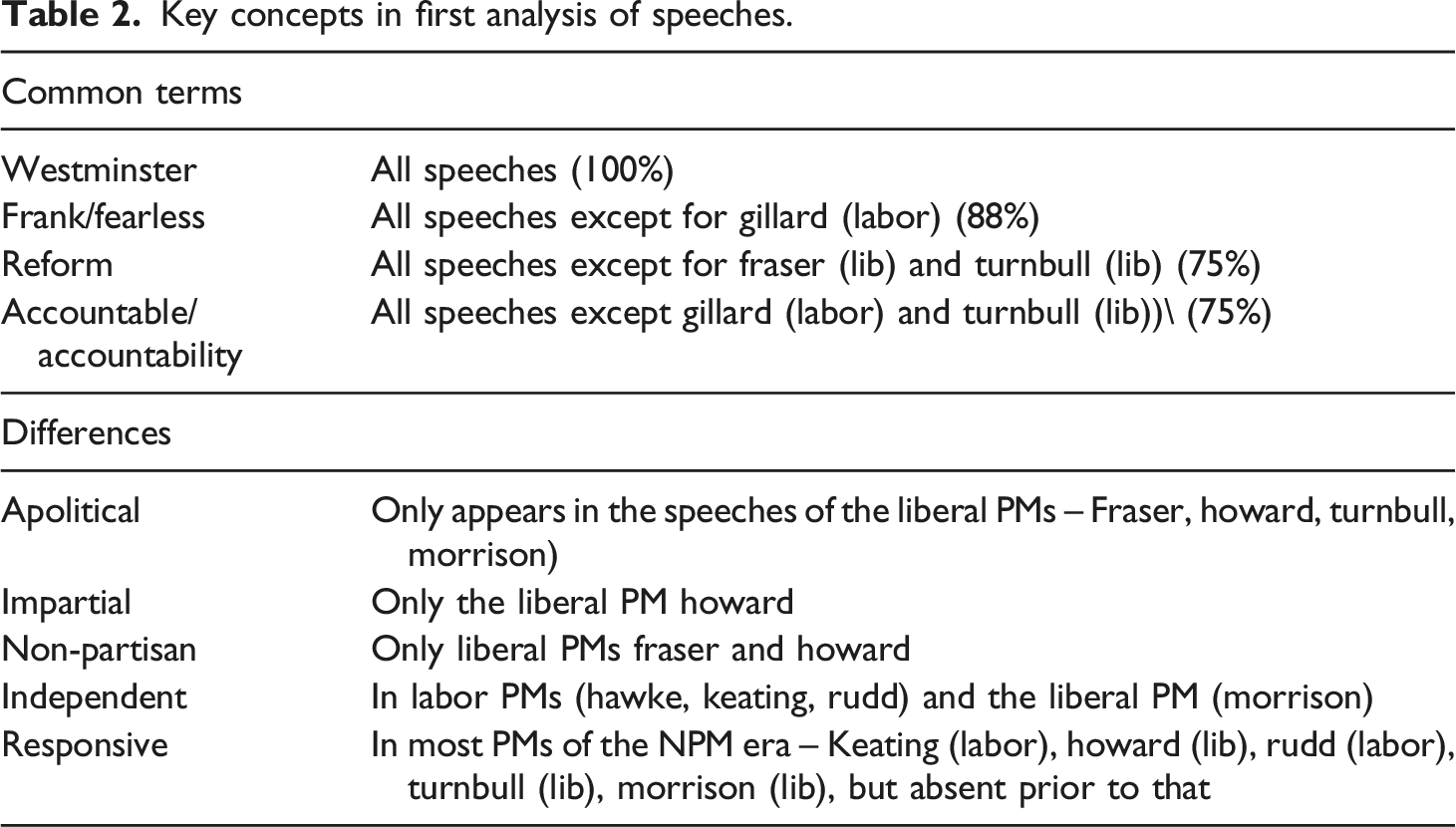
The purpose of the first reading of the texts was to identify Westminster conventions that the Prime Ministers discussed in their speeches, and to identify any nodal points of difference either between political persuasions or over time (Table 2).
All but one of the Prime Ministers (Gillard) mentioned Westminster in their speeches, perhaps reflecting that it is an enduring rhetorical trope, rather than any firm commitment to its traditions and institutions. Similarly, most Prime Ministers said that they expected “frank” or “fearless” advice from the public service, again confirming this cornerstone of the traditional relationship between the public service and government as an enduring metaphor within the discourse.
In keeping with the “endless search for public sector reform” (Rhodes, 2015: 42), most Prime Ministers talked about “reform”. It is unsurprising Prime Minister Fraser did not discuss reform. His tenure saw the implementation of the major reforms arising from the Coombs Royal Commission, leaving little reason to discuss further reform. Further, Turnbull’s tenure saw a narrow majority in Parliament (Economou, 2016) and a fragmented party room (Walter, 2017), again leaving little room for talk of reform.
Key concepts in first analysis of speeches.
Terms used for describing the administrative-political interface.
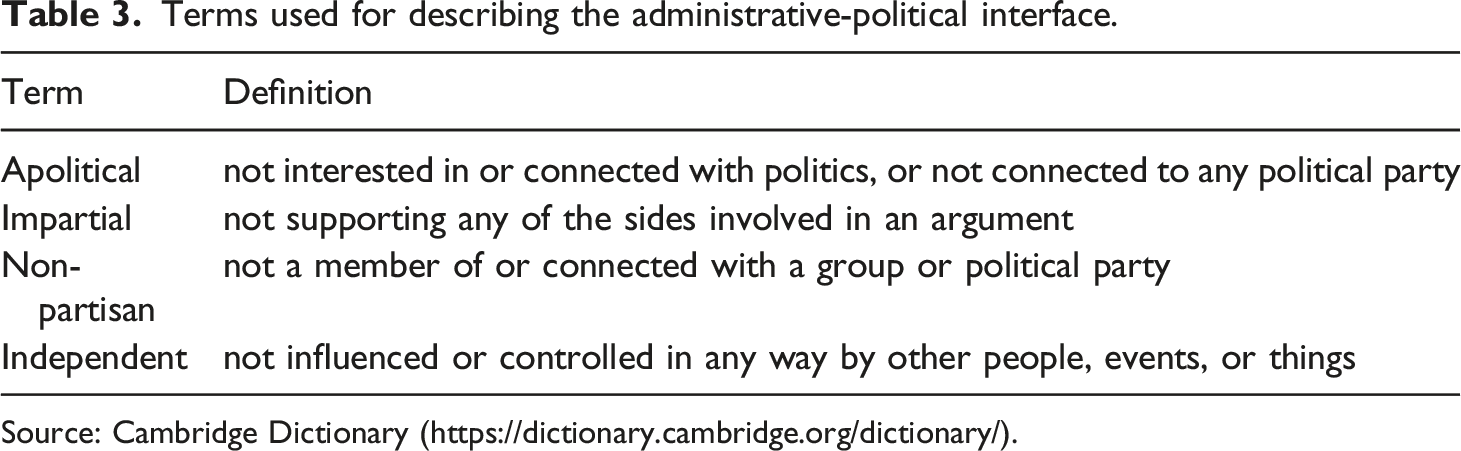
Source: Cambridge Dictionary (https://dictionary.cambridge.org/dictionary/).
Secondly, the term “responsiveness” only appears during the time of NPM. This is perhaps unsurprising, given that greater responsiveness was one of the motivations for the NPM reforms. Nonetheless, how this developed over time is interesting and is explored further in the next section.
Analysis – second reading – inventory of representations
In the second reading, the nodes or key concepts identified in the first reading were explored in more detail. The ‘balancing’ between politics and administration is explored through two themes. Firstly through the discussions on where policy decision-making sits – solely with Ministers or through an interaction between the government and the public service. Secondly, the shifting understandings of accountability over time are explored. Then explicit commitments made to institutions (especially the Australian Public Service or APS) and to processes are analysed. Finally, the trend to greater responsiveness with NPM is explored. The starting point for the analysis of each node is what Morrison said about the issue in the speech which caused so much consternation.
Policy decision-making
Consistent with Westminster tradition, PM Morrison clearly delineates the role of the public service as providing “policy advice and implementation skills” and that this advice is to be “apolitical” (Morrison, 2019). These sentiments are echoed by all the other PMs. For example, PM Fraser stated: My government looks to [the public service] … for strong and competent support in the formulation of policies and in taking a major part in administering those policies when they are determined (Fraser, 1978).
However, how this is to occur is different across political parties and over time.
In keeping with the finding in Boswell et al. (2022: 7) that “senior, older, male, Conservative politicians” tend to see their role as “one to lead, and the civil service as one to follow”, PM Morrison was very clear that Ministers are to set the policy direction, and “… having set that direction, they will have high expectations, as they should, of the public service when it comes to implementation of the Government’s agenda” (Morrison, 2019). These sentiments were also expressed by PM Fraser: “The role of the public servant is to act as the agent of the elected government” (Fraser, 1978). These statements seem to suggest that Australia is following the UK in that the traditional relationship between Ministers and the civil service in the UK has been replaced by a principal-agent model (Richards and Smith, 2016).
However, a more nuanced relationship was envisaged by the second Labor PM Keating (1991-96). While recognising that the final decisions sit with government: “Change cannot come from the bureaucracy no matter how well motivated, or gifted, because the public service has no authority to rank priorities or make decisions” (Keating, 1991), he appears to envisage a more cooperative relationship with the public service: “… it is fatal to good government if Ministers do not listen to, or are not served by, a strong public service” (Keating, 1991). Further, he talks about a “… philosophic belief that the expertise of the public service needs to be explicitly and deliberately brought to bear on policy matters (Keating, 1991).
As well, early Liberal PMs see the relationship as one of command and control, in part due to the responsibility sitting with Ministers. For example, PM Fraser (1978) noted that “… ministers and the government must themselves control public policy so that those who the Parliament and people can call to account are indeed responsible”. PM Howard’s position is consistent, stating that: “One of my very firm views on government is that, while it is most important to seek and take full account of public service advice, ultimately decisions must be for government to make, and responsibility must lie with government” (Howard, 1997). In contrast, PM Keating appears to see the relationship as one of delegation: “Ministers have to set the framework and priorities under which policy change takes place” (Keating, 1991) within a “compact with a cooperative altruistic civil service” (Keating, 1994: 5).
Interestingly, this theme is less prominent in later speeches, perhaps as “responsiveness” emerges as an important consideration (see below).
Accountability
Certainly, PM Morrison’s speech reflected a strong expectation of public accountability by public servants: … you can make a difference to the lives of the Australian people. We all have a job to do and that is to serve them…I want public servants to share in the success of public policy…I want the APS to have a laser-like focus on serving these quiet Australians (Morrison, 2019).
Traditionally, the public service has been seen as “legalistic and largely indifferent to the wishes and demands of individual citizens” (Peters, 2010: 209). In his discussion of accountability within a Westminster system, Chapman (2000: 116) suggests that there are tensions between “increasing demands for accountability, more responsiveness and responsibility, the new public management and the institutional framework”. Certainly, the traditional chain of ministerial responsibility from the public service to the Minister, to parliament and hence to the people (Brenton, 2014: 467) has become more complex over time. Under NPM, purchaser-provider models and devolution have complicated this direct line to the extent that ministers are reluctant to accept responsibility for delivery and implementation outcomes (Brenton, 2014: 473). This is now seen to sit with agencies, who manage these processes through contracts and agreements. As such, we would expect to see a shift towards expectations of greater public accountability by public servants.
While reflecting this trend, PM Morrison was also clear that ministers remain accountable to the parliament “through our democratic processes for the policies of the Government” (Morrison, 2019).
This is in sharp contrast to 41 years ago when PM Fraser reflected the more traditional lines of accountability: Ministers are individually responsible to the Parliament for the proper administration of their departments, and the government is accountable collectively for its performance (Fraser, 1978: 1).
This situation was also reflected in 1983 by PM Hawke who said: “…while departments provide services to and have direct dealings with the public, they are directly and immediately accountable to their Ministers” (Hawke, 1983). However, by 1989, these clear lines were already starting to blur: Clearly there are many areas where the detailed development of policy proposals is, within a broad framework of ministerial direction, entrusted to officials; similarly, there are many maters of administration in which ministers take a close interest. In other words, ministers must, of course, continue to be answerable to the Parliament and take any necessary corrective action (Hawke, 1989).
By the time of PM Turnbull in 2016, the public service was seen to be directly accountable to the public: “You work for the Australian people… serving the Australian people” (Turnbull, 2016). Nonetheless, accountability is “socially contingent” and while the pathways have become more complex, there is still political pressure on ministers “to provide some account for departmental actions” (Brenton, 2014: 479)
Commitment to institutions and processes
Again consistent with Westminster traditions, all PMs make a commitment to an “APS that is apolitical, merit based and committed to the highest standards of integrity” (Morrison, 2019). At times these statements look more like motherhood statements than real commitments. For example: “…my government knows and respects the true value of the Australian Public Service” (Turnbull, 2016). Another Liberal PM, John Howard tempers his commitment to the public service by noting that “it is always a worth pursuit to aim for a government that is modest in size” (Howard, 2001).
Two recent Labor PMs (Rudd and Gillard) made very similar statements about the importance of the APS to support the work of governments. For example, PM Rudd states that the “work of the APS is therefore crucially important to the Government” (Rudd, 2008). Similarly, PM Gillard notes the importance of the public service in implementing government agendas: “it’s only through the work of great public servants, in a world class public service, with courageous political leadership, sharing a vision for Australia’s future, that our country can seize the opportunities” (Gillard, 2012). This latter point is also made by PM Morrison: “The public service is the indispensable engine room for any successful government in delivering on its commitments to Australians” (Morrison, 2019). However, the emphasis is slightly different, appearing less a collaboration and more a delegation.
PM Morrison acknowledges the relationship between this important tradition and “the trust and legitimacy of democratic government” (ibid). However, concerns over institutional integrity were held to be on show in the 2022 Federal election (Bongiorno and Millane, 2022). Indeed, the current Minister for the Public Service stated in a recent speech that: “a decade of deliberate devaluing of the APS has meant that the Australian people are looking at our institutions with a more jaundiced eye” (Gallagher, 2022a).
Only one PM (Keating, Labor) talked specifically about process and institutional integrity: … due process has meant that the Government has valued official advice and made sure that the institutions that provide it are strong and effective… most of all, public institutions require Governments to bestow a legitimacy upon them to operate effectively (Keating, 1991).
Part of this process, according to PM Keating is to not “shield itself from critical advice by appointing ‘friendly voices’ to key positions” (Keating, 1991). Impartiality is something that has concerned PMs over time. Perhaps reflecting the worldview of his Labor predecessor (PM Whitlam), PM Hawke noted that he expected “loyalty from the public service in putting our policies into effect” (Hawke, 1983). As noted above, mistrust of the public sector to deliver on the government’s agenda was one of the motivating forces behind NPM, so it is unsurprising that PM Hawke, the Prime Minister during the transition to NPM stated: “The aim must also be to ensure that the public service is not a stumbling block for broader, economy-wide change; indeed that the public service becomes where possible an effective instrument of that change (Hawke, 1989).
The emphasis on loyalty shifted for the Liberal PM Howard as NPM was firmly entrenched by the time he took office in the late 1990s. He took it for granted that policy advice would be made within the context of government policies. He noted that concerns over the “weakening of the tradition of impartiality within the service” were increasing, or “at least, been given greater prominence”, however dismissed them as being “based on unrealistic assumptions about what the basis of competent public service advice should be” (Howard, 1997).
This increasing trend towards responsiveness is explored in the next section.
Responsiveness
PM Morrison’s speech articulated a belief that the public service is primarily about responding to the government’s policy agenda: I have always believed that, guided by clear direction from Ministers, the public service is best when it is getting on with the job of delivering the services Australians rely on and ensuring Governments can implement the policies they have been elected to deliver for the Australian people (Morrison, 2019).
Impartiality is seen as a critical element of good public administration. According to Aucoin (2012: 179), impartiality refers to citizens being treated “impartially in the administration of public affairs” and public servants not acting so as to “advantage or disadvantage the partisan-political interests of any political party”. However, the post-NPM tendency for senior public servants, especially the heads of the Department of Prime Minister and Cabinet, to change with a change of Prime Minister, creates concerns for the impartiality of these appointees, who may see themselves as “personal agents of the prime minister” (ibid) and so required to be more responsive to the interests of the government of the day.
PM Morrison’s position echoes the views of the previous Labor PM Rudd, who also emphasised the service delivery and implementation functions of the public service: Of course the Government is ultimately responsible for decision making. Once a decision is taken, the task of the public service changes to ensuring effective implementation and service delivery (Rudd, 2008).
These sentiments are consistent with the views of all post-NPM PMs, but perhaps with more nuance. For example, PM Keating suggested that significant shifts in direction must come from Ministers: While many decry the role that politicians play, only politicians can make major changes to the way a country conducts its business. … Nor can change come from the media and the opinions of columnists no matter how eminent. In the end, politicians have to have the foresight to see the need for change and the courage and strength to carry it through (Keating, 1991).
But he places this directive role in the context of being informed by public servant advice: But none of this is to suggest that the role of Ministers is to be simply clear thinking, hard-working and listen to the expert advice of their bureaucratic advisers. Far from it. Ministers have to set the framework and priorities under which policy change takes place (Keating, 1991).
PM Howard was the first to suggest that there had been a shift in the responsiveness of the public service over time: there’s a greater desire on the part of the public service to implement what are the accepted political goals and the accepted political mandate of the government of the day (Howard, 1997).
And They also neglect some of the changing realities of governance in which the public service has operated over recent decades. Ministers are taking greater control of policy planning, detail and implementation and that is in part a response to a more demanding electorate that expects, quite properly, to see members of the government responding to community needs and answering for their decisions in a public and continuous way (Howard, 1998).
Twenty years later, PM Turnbull also reflects that the meaning of responsiveness has shifted over time, but does not go further to explain how it may have shifted: … the meaning of “responsive” of course may have changed for the Public Service from a century ago (Turnbull, 2016).
One of the challenges to Westminster in this trend arises in the erosion of bureaucratic anonymity, replaced with “promiscuous partisanship” (Aucoin, 2012) or “megaphone bureaucracy” (Grube, 2019), however this trend was identified well before the 2019 speech.
Another challenge arises from the delegation of the public service’s role in governing to service delivery. In 1998, PM Howard was reflecting on the increased role of service delivery for the public sector: One of the marked changes we have seen in the public service over the last ten to fifteen years has been its acceptance of the need for a culture of quality service delivery (Howard, 1998).
Which PM Rudd later put down to: … the APS responding to … fundamental changes that require a redrawing of the relationship between citizens, governments and markets (Rudd, 2010).
The influence of NPM might be responsible for PM Keating being the last PM to note the importance of public service advice informing the decisions of Ministers. More recently, there is a strong Prime Ministerial view that primary role of the public service in governing is service delivery and this view crosses ideological divides.
Discussion
From the analysis we can see that, at least in words, a commitment to a divide where the administration provides (impartial/independent) advice and Ministers make the final policy decision is consistent across time. At the same time, we can see four main differences.
Firstly, in terms of accountability, PM Morrison seems to be claiming that public servants are accountable to the public, not to Ministers. This is a significant shift from earlier speeches which are more consistent with conventional ideas about Westminster. However, it is a continuation of a trend that started with PMs Hawke and Keating and is certainly consistent with the expectations of NPM. The main danger is whether this encourages partisan promiscuity on the part of senior bureaucrats? PM Howard’s statement: “there’s a greater desire on the part of the public service to implement what are the accepted political goals and the accepted political mandate of the government of the day” (Howard, 1997) appears to support the kinds of shifts identified by Grube and Aucoin.
Secondly, in terms of responsiveness, we know that the distrust of the public service to actually do what it is told to do, and to take too long doing it, is long-standing. Indeed, NPM has been claimed to have been motivated by a desire to assert control over the public service, and this can be seen in many of the PM’s speeches. Nonetheless, PM Morrison is the most explicit in articulating what this means in practice.
Thirdly, dangers of politicisation of the public service have been debated extensively, with an independent public service being seen as fundamental to the Westminster system. It is curious therefore that the Liberal PMs used terms such as ‘apolitical’, whereas Labor PMs talked about ‘independent’. Further research is needed to better understand if this is an ideological divide, or just an artefact. Nonetheless, PM Morrison’s speech did not significantly depart from those of his predecessors, especially his Liberal counterparts.
Finally, there appears to be a difference in commitment to institutions and processes. There appears to be an ideological divide here, with the Labor PMs more committed to them that the Liberal. Certainly the new (Labor) PM has been quoted as saying that “I think the independence and processes of the public service were undermined over a long period of time” (Prime Minister Albanese quoted in Johnson, 2022) and that “our system of parliamentary democracy relies upon conventions, relies upon the Westminster system of checks and balances” (Albanese, 2022).
The study has implications for the broader public policy literature. Firstly, the analysis highlights that there has been a significant shift in how Westminster conventions are interpreted, and that many of these shifts transcend ideology. On the other hand, it also highlights that there are ideological differences in how independence is viewed, as well as commitment to institutions and processes. This speaks to concerns about how public institutions cope with contrary leadership as well as how democratic institutions manage under increasingly right-wing or populist governments.
As a qualitative study focussed on Australia there are clearly limitations to the study. Further research is needed to see whether the findings apply more broadly or whether they are specific to Australia. Using Morrison’s speech as a critical case study, which could be seen as an outlier, also limits the transferability of the findings. However, the fact that on many issues, such as responsiveness, politicisation and lack of commitment to institutions and processes, Morrison’s speech can be seen as reflective of an ongoing trend, rather than a significant shift, suggests that the positions articulated are now a part of accepted discourse. Whether this is the same in other countries with Westminster-style systems needs further research.
In conclusion, did the speech given by PM Morrison in 2019 foreshadow a dangerous slide towards politicisation within Australia’s Westminster system? From the analysis of nearly 50 years of Prime Ministerial speeches, it seems to be more a reflection of ongoing public sector trends than a significant ideational shift. Indeed, as Peters and Pierre (2022: 9) note “public bureaucracy is not cut in marble and steel but it continuously evolving”.
The new Labor government has commenced a series of reforms to the public service, including appointing a Secretary for Public Sector Reform. On the one hand, their commitment to an effective administration is clear: “the Australian Public Service plays a crucial role in serving the Australian community and helping to shape the future of our nation” (Gallagher, 2022b). On the other hand, their corresponding commitment to an independent public service with strong policy advisory capacity is yet to be realised. The key features of the political-administrative interface are likely to continue their evolution.
Footnotes
Declaration of conflicting interests
The author(s) declared no potential conflicts of interest with respect to the research, authorship, and/or publication of this article.
Funding
The author(s) received no financial support for the research, authorship, and/or publication of this article.
